1. Introduction
The law of the wall remains a cornerstone of turbulence theory in wall-bounded flows by offering one of the few analytical descriptions of the mean-field behaviour (Bradshaw & Huang Reference Bradshaw and Huang1995). Originally developed for incompressible, constant-property flows (Prandtl Reference Prandtl1925; Von Karman Reference Von Karman1939; Bradshaw & Huang Reference Bradshaw and Huang1995; Buschmann & Gad-el-Hak Reference Buschmann and Gad-el-Hak2006), the law of the wall has served as the basis for configuring wall functions in turbulence modelling by providing a simple yet powerful scaling for mean-velocity profiles. The wall-scaling law for mean velocity (V-law) was later extended to compressible regimes (Van Driest Reference Van Driest1951; Huang, Coleman & Bradshaw Reference Huang, Coleman and Bradshaw1995; Zhang et al. Reference Zhang, Bi, Hussain, Li and She2012; Trettel & Larsson Reference Trettel and Larsson2016; Griffin, Fu & Moin Reference Griffin, Fu and Moin2021; Hasan et al. Reference Hasan, Larsson, Pirozzoli and Pecnik2023; Zhu et al. Reference Zhu, Song, Yang and Xia2024), where the mean property variations induced by Mach number are non-negligible. While considerable efforts have been devoted to the V-law, the studies on the thermal boundary layer (T-law) have been relatively underdeveloped, particularly at supercritical pressure (SCP), a typical condition encountered in many practical applications, such as liquid rocket engines (Yang Reference Yang2000; Wang et al. Reference Wang, Huo, Unnikrishnan and Yang2018), regenerative cooling (Xie et al. Reference Xie, Xiaoxiao, Xianliang, Zhouhang and Yong2022) and thermal power cycles (White et al. Reference White, Bianchi, Chai, Tassou and Sayma2021). Supercritical pressure fluids exhibit steep gradients and strong nonlinearities in thermophysical properties such as specific heat capacity, thermal conductivity, dynamic viscosity and density, particularly near the pseudo-boiling regime (Jiang et al. Reference Jiang, Zhang, Xu and Shi2008). These variations impact both the mean flow and its stability characteristics, giving rise to inviscid instabilities and increased sensitivity to perturbations. In such regimes, the mean velocity and temperature profiles may develop inflectional features across the Widom line (Ren et al. Reference Ren, Wu, Mao, Wang and Kloker2025), further complicating the applicability of classical scaling arguments. The existing temperature-based thermal transformations for the T-law (Kader Reference Kader1981; Patel, Boersma & Pecnik Reference Patel, Boersma and Pecnik2017; Guo, Yang & Ihme Reference Guo, Yang and Ihme2018) often fail to provide consistent scaling under these conditions. This further motivates us to establish a universal thermal transformation at SCP, which would be of theoretical interest and practical significance for reduced-order turbulence wall modelling.
1.1. The law of the wall – velocity scaling
Advancements in the wall-scaling law in compressible boundary layers mainly stem from the foundational work of Van Driest (VD) (Reference Van Driest1951), who proposed the velocity transformation (namely, VD transformation or VDT) grounded in Morkovin’s scaling and Prandtl’s incompressible mixing length theory. However, the VDT does not perform well for diabatic boundary layers and channel flows. To address this issue, Zhang et al. (Reference Zhang, Bi, Hussain, Li and She2012) introduced a viscosity-weighted transformation of the mean-velocity profile based on a boundary-layer thickness length scale using Reynolds stress structure parameters to fulfil the Mach-number-invariant condition. The performance improvement was found to be still limited under diabatic conditions (Griffin et al. Reference Griffin, Fu and Moin2021; Hasan et al. Reference Hasan, Larsson, Pirozzoli and Pecnik2023). Huang et al. (Reference Huang, Coleman and Bradshaw1995) developed a semi-local scaling method to enhance the mapping of wall-normal turbulence statistics in the logarithmic region. Pecnik & Patel (Reference Pecnik and Patel2017) provided theoretical support for the semi-local scaling and identified the quasi-similarity between variable-property and constant-property flows. Ma, Yang & Ihme (Reference Ma, Yang and Ihme2018) examined this approach under transcritical conditions and reported reduced effectiveness near the heated wall, where density fluctuation is stronger than at the cooled wall. Trettel & Larsson (TL) (Reference Trettel and Larsson2016) incorporated the stress balance assumption and developed a new transformation (namely, TL transformation) to overcome the VDT’s insufficiency for non-adiabatic wall-bounded flows. The TL-transformed mean-velocity profiles collapse consistently at various Reynolds numbers, Mach numbers and wall heat transfer rates in supersonic channel flows. Wan et al. (Reference Wan, Zhao, Liu, Wang and Lei2020) and Bai, Griffin & Fu (Reference Bai, Griffin and Fu2022) demonstrated that the TL transformation works well for the inner region of the boundary layer in supercritical channel flows. More recent efforts by Griffin et al. (Reference Griffin, Fu and Moin2021) integrated the frameworks of Zhang et al. (Reference Zhang, Bi, Hussain, Li and She2012) and Trettel & Larsson (Reference Trettel and Larsson2016), and derived a new transformation based on the universality of the production-to-consumption ratio and a stress-based mixing function, yet their approach struggles with non-air-like viscosity laws and SCP conditions. Hasan et al. (Reference Hasan, Larsson, Pirozzoli and Pecnik2023) accounted for intrinsic compressibility effects and extended the capabilities of the TL transformation to a broader range of flow scenarios, covering wall-bounded flows of both ideal gases and SCP fluids. However, Zhu et al. (Reference Zhu, Song, Yang and Xia2024) revealed that the efficacy of both the Griffin’s and Hasan’s transformations is diminished in low Reynolds number channel and pipe flows. A more complex transformation that incorporates intrinsic compressibility effects and the multi-layer structure of mixing lengths was developed, whereas its performance in SCP regimes remains unconfirmed.
1.2. The law of the wall – temperature-/enthalpy–velocity relations
Regarding the studies of thermal scaling, one major line of the research is on the similarity between velocity and temperature fields to establish a temperature–velocity (T–V) relation. Unlike coordinate-based wall-scaling laws, this approach is generally regarded as a weaker form of scaling (Chen et al. Reference Chen, Huang, Shi, Yang and Lv2022). An early T–V relation was established by Busemann (Reference Busemann1931), who showed that, for compressible laminar boundary layers with a molecular Prandtl number (
 $\mathit{Pr}$
) of unity, velocity and temperature follow a quadratic relation. Walz (Reference Walz1969) later modified this relation to account for the deviation of
 $\mathit{Pr}$
from unity through the introduction of a recovery factor,
 $r = \mathit{Pr}^{1/3}$
 \begin{equation} \tilde {T}_{\textit{Walz}} = \tilde {T}_w + \big(\tilde {T}_r - \tilde {T}_w \big) \frac {\tilde {u}}{\tilde {u}_e} + \big(\tilde {T}_e - \tilde {T}_r \big)\left (\frac {\tilde {u}}{\tilde {u}_e}\right )^2\!, \end{equation}
where
 $T$
and
 $u$
denote temperature and velocity, with subscripts `
 $w$
’ and `
 $e$
’ referring to wall and boundary-layer-edge values, respectively. The recovery temperature is defined as
 $\tilde {T}_r = \tilde {T}_e + r\tilde {u}_e^2/(2c_{\!p})$
, and
 $c_{\!p}$
is specific heat capacity at constant pressure. The tilde
 $(\tilde {\ })$
denotes a Favre-averaged quantity. While (1.1) showed good performance for adiabatic compressible turbulent boundary layers, it deviates significantly from direct numerical simulation (DNS) data under strong cold-wall conditions (Duan & Martin Reference Duan and Martin2011; Zhang et al. Reference Zhang, Duan, Choudhari and Wu2014). To address these limitations, Zhang et al. (Reference Zhang, Duan, Choudhari and Wu2014) introduced a generalised recovery factor,
 $r_{\!g}$
to revise
 $\tilde {T}_{\textit{Walz}}$
by incorporating cold-wall and diabatic effects. A local generalised recovery temperature
 $\tilde {T}_{r_{\!g}}$
was defined to replace
 $\tilde {T}_r$
 \begin{equation} \tilde {T}_{\textit{Zhang}} = \tilde {T}_w + \big(\tilde {T}_{r_{\!g}} - \tilde {T}_w \big) \frac {\tilde {u}}{\tilde {u}_e} + \big(\tilde {T}_e - \tilde {T}_{r_{\!g}}\big) \left (\frac {\tilde {u}}{\tilde {u}_e}\right )^2\!, \end{equation}
where
 $\tilde {T}_{r_{\!g}} = \tilde {T}_e + r_{\!g} \tilde {u}_e^2 / (2 c_{\!p})$
and
 $r_{\!g} = (\tilde {T}_w - \tilde {T}_e) / (\tilde {u}_e^2 / (2 c_{\!p})) + (2 c_{\!p} / \tilde {u}_e) (\partial \tilde {T} / \partial \tilde {u})_w$
. Equation (1.2) was shown to perform well in hypersonic turbulent boundary layers of calorically perfect gases, where
 $c_{\!p}$
is constant (Zhang, Duan & Choudhari Reference Zhang, Duan and Choudhari2018; Mo et al. Reference Mo, Zhang, Duan and Choudhari2023). However, its applicability to wall-bounded SCP flows remains to be confirmed, as real-fluid effects caused by abrupt property variations render the perfect-gas assumption invalid. In particular,
 $c_{\!p}$
varies dramatically and nonlinearly across the pseudo-boiling line, complicating the relation between enthalpy and temperature in the energy transport.
To mitigate the explicit dependence of T–V relations on thermal and chemical models, Duan & Martin (Reference Duan and Martin2011) introduced the concept of recovery enthalpy,
 $\tilde {h}_r = \tilde {h} + r(\tilde {u}^2/2)$
, and established a semi-empirical enthalpy–velocity (H–V) relation
 \begin{equation} \tilde {h} = \tilde {h}_w + \big(\tilde {h}_r - \tilde {h}_w\big) f\!\left (\frac {\tilde {u}}{\tilde {u}_e}\right ) - \frac {r\tilde {u}^2}{2}, \end{equation}
where the recovery factor
 $r$
is assumed to be
 $0.9$
, and the empirical function
 $f(\tilde {u}/\tilde {u}_e)$
is given by fitting the DNS data of hypersonic reacting turbulent boundary layers
 \begin{equation} f\left (\frac {\tilde {u}}{\tilde {u}_e}\right ) = 0.8259\frac {\tilde {u}}{\tilde {u}_e} + 0.1741\left (\frac {\tilde {u}}{\tilde {u}_e}\right )^2\!. \end{equation}
For calorically perfect gases, (1.3) reduces to the classical Walz’s relation (1.1) with
 $\tilde {u}/\tilde {u}_e$
replaced by
 $f(\tilde {u}/\tilde {u}_e)$
. However, its empirical nature, including a constant recovery factor and data-fitted function
 $f(\tilde {u}/\tilde {u}_e)$
, may jeopardise its reliability for SCP conditions, where property variations are far more drastic. Inspired by Duan & Martin (Reference Duan and Martin2011) and Zhang et al. (Reference Zhang, Duan, Choudhari and Wu2014), Li et al. (Reference Li, Zhang, Duan and Choudhari2025) have recently developed a new H-V relation without empirical function
 $f(\tilde {u}/\tilde {u}_e)$
but introduced the generalised recovery enthalpy
 $\tilde {h}_{r_{\!g}^*}$
 \begin{equation} \tilde {h} = \tilde {h}_w + \big(\tilde {h}_{r_{\!g}^*} - \tilde {h}_w\big)\frac {\tilde {u}}{\tilde {u}_e} + \big(\tilde {h}_e - \tilde {h}_{r_{\!g}^*}\big)\left (\frac {\tilde {u}}{\tilde {u}_e}\right )^2\!. \end{equation}
The generalised recovery enthalpy
 $\tilde {h}_{r_{\!g}^*}$
is determined as
 \begin{equation} \tilde {h}_{r_{\!g}^*} = \tilde {h}_e + r_{\!g}^* \tilde {u}_e^2 / 2, \end{equation}
and the recovery factor
 $r_{\!g}^*$
defined as
 \begin{equation} r_{\!g}^* = \big(\tilde {h}_w - \tilde {h}_e\big)/\big(\tilde {u}_e^2/2\big) + 2\mathit{Pr}_w \, \bar {q}_w / (\tilde {u}_e \bar {\tau }_w). \end{equation}
Numerical studies (Li et al. Reference Li, Zhang, Duan and Choudhari2025) of hypersonic reacting turbulent boundary layers at atmospheric pressure confirmed the improved accuracy of this relation.
Despite these advances, existing T–V and H–V relations were developed primarily for compressible flows under near-atmospheric conditions. Their extension to SCP wall-bounded flows remains uncertain due to the strong influence of real-fluid effects. Moreover, recent studies (Chen et al. Reference Chen, Huang, Shi, Yang and Lv2022; Cheng & Fu Reference Cheng and Fu2024) argue that these relations are not closed by themselves, and limited by both the empirical recovery factor and outer boundary conditions, which prevents their application to complex flow configurations. In § 4.1, an assessment of H–V relations for SCP fluid flows will be conducted.
1.3. The law of the wall – thermal transformation
Another category for thermal scaling is to develop transformation-based thermal wall models that map the mean scalar profile of compressible flows into its `incompressible’ equivalent form. Recently, Chen, Gan & Fu (Reference Chen, Gan and Fu2025) have demonstrated that the temperature-transformation wall model for compressible laminar and turbulent flows at atmospheric pressure serves as a good alternative to the T–V wall model and successfully excludes the dependence on boundary-layer-edge quantities. However, compared with velocity transformation, thermal transformation faces additional complexity due to dependencies on heat flux, specific heat capacity and thermal conductivity (Bradshaw & Huang Reference Bradshaw and Huang1995). Furthermore, most studies on thermal boundary layers have primarily focused on flows under the ideal-gas assumption and cannot be directly extended to SCP fluid flows, where real-fluid effects play a critical role. Early efforts, such as Kader’s temperature transformation (Kader Reference Kader1981) based on the Reynolds analogy, were made for low-speed incompressible flows and assumed constant thermophysical properties
 \begin{equation} \overline {\theta }^+ = \frac {\overline {\theta }}{\overline {\theta }_\tau } = \begin{cases} \textit{Pr}_w y^+ & \text{sublayer region}, \\ \frac {1}{\kappa } \ln (y^+) + \beta (\textit{Pr}_w) & \text{logarithmic region}. \end{cases} \end{equation}
Here, overbar
 $\overline {(\boldsymbol{\cdot })}$
denotes the Reynolds-averaged physical quantity, and the mean temperature difference is defined as
 $\overline {\theta } = \overline {T} - \overline {T}_w$
;
 $\kappa$
is a constant of 0.47;
 $\beta (\textit{Pr}_w)$
is another constant determined by the wall Prandtl number
 $\textit{Pr}_w$
and is given by
 $\beta (\textit{Pr}_w) = (3.85 \textit{Pr}_w^{1/3} - 1.3 )^2 + 2.12 \ln (\textit{Pr}_w)$
. The friction temperature is defined as
 $\overline {\theta }_\tau = \overline {q}_w / (\overline {\rho }_w \, \overline {c_{\!p}}_w \, \overline {u}_\tau )$
, where
 $q$
,
 $\rho$
and
 $u_\tau$
are the heat flux, density and wall friction velocity, respectively. Hereinafter, the wall-normal coordinates
 $y$
,
 $y^+$
and
 $y^*$
denote the physical coordinate, the coordinate scaled by the wall viscous length
 $\delta _v^+$
(Pope Reference Pope2001) and the coordinate scaled by the semi-local viscous length
 $\delta _v^*$
(Huang et al. Reference Huang, Coleman and Bradshaw1995), respectively. Specifically,
 \begin{align} y^+ &= \dfrac {y}{\delta _v^+},y^*= \dfrac {y}{\delta _v^*},\delta _v^+= \dfrac {\overline {\mu }_w}{\overline {\rho }_w\,\overline {u}_\tau },\delta _v^*= \dfrac {\overline {\mu }(y)}{\overline {\rho }(y)\,\overline {u}_\tau ^*}, \overline {u}_\tau = \sqrt {\dfrac {\overline {\tau }_w}{\overline {\rho }_w}},\overline {u}_\tau ^*= \sqrt {\dfrac {\overline {\tau }_w}{\overline {\rho }(y)}}, \end{align}
with
 $\mu$
and
 $\tau _w$
being dynamic viscosity and viscous shear stress.
Note that (1.8), which does not account for property variations, is generally inapplicable to compressible or other variable-property flows. Lee et al. (Reference Lee, Jung, Sung and Zaki2014) modified Kader’s formulation by incorporating semi-local Prandtl number
 $\textit{Pr}^*$
instead of the wall-based
 $\textit{Pr}_w$
. Nonetheless, their method was pointed out to be inadequate because of neglecting the impact of property variations on the log-law slope. Patel et al. (Reference Patel, Boersma and Pecnik2017) prescribed the relations for density
 $\rho$
, viscosity
 $\mu$
and thermal conductivity
 $\lambda$
as functions of temperature and derived a temperature scaling using the semi-local coordinate. This allows the influence of property variations to be parameterised by the semi-local Reynolds number
 $\textit{Re}_{\tau }^*$
and Prandtl number
 $\textit{Pr}^*$
. The transformed mean scalar is expressed as
 \begin{equation} \overline {\theta }^* = \int _0^{\overline {\theta }_{\textit {VD}}^+} \left [1 + \frac {y}{\textit{Re}_\tau ^*} \frac {{\rm d} \textit{Re}_\tau ^*}{{\rm d}y}\right ] {\rm d}\overline {\theta }_{\textit{VD}}^+ = \int _0^{y^*}\! \dfrac {1}{\alpha _t / \overline {\mu } + 1 / \textit{Pr}^*} {\rm d}y^*, \end{equation}
where
 \begin{align} {\rm d}\overline {\theta }_{\textit {VD}}^+ = \sqrt {\dfrac {\overline {\rho }(y)}{\overline {\rho }_w}} \, d\!\left (\dfrac {\overline {\theta }}{\overline {\theta }_\tau }\right )\!, \textit{Re}_\tau ^* = \textit{Re}_\tau \sqrt {\dfrac {\overline {\rho }(y)}{\overline {\rho }_w}} \, \dfrac {\overline {\mu }_w}{\overline {\mu }(y)},\textit{Pr}^* = \textit{Pr}_w \, \dfrac {\overline {\mu }(y)/\overline {\mu }_w}{\overline {\lambda }(y)/\overline {\lambda }_w}. \end{align}
Here,
 $\bar {\theta }_{\textit {VD}}^+$
denotes the VD-type temperature, and
 $\alpha _t = -\bar {\rho } \, \widetilde {v'' \theta ''} / ({\rm d}\bar {\theta }/{{\rm d}y} )$
represents the turbulent heat conductivity. The transformed scalar
 $\bar {\theta }^*$
is independent of
 $\textit{Re}_\tau ^*$
while exhibiting a
 $\textit{Pr}^*$
-dependent shift. Chen et al. (Reference Chen, Huang, Shi, Yang and Lv2022) extended these transformations to channel and boundary-layer flows with varying wall conditions. Huang et al. (Reference Huang, Coleman, Spalart and Yang2023) simplified the expression by leveraging analogies with incompressible transport equations. More recently, Cheng & Fu (Reference Cheng and Fu2024) introduced a Mach-independent thermal scaling law at a given constant Prandtl number. In SCP wall-bounded flows, however,
 $c_{\!p}$
and
 $\lambda$
feature sharp temperature-dependent variations, leading to varying local Prandtl number in energy transport, which must be taken into account.
Establishing a reliable thermal scaling law at SCP is more challenging due to the strongly nonlinear variations of thermophysical properties near the pseudo-critical temperature
 $T_{pc}$
, which is defined as the temperature at which
 $c_{\!p}$
peaks (Jiang et al. Reference Jiang, Zhang, Xu and Shi2008; Yoo Reference Yoo2013). The interplay of these abnormal property variations and the near-wall turbulent dynamics poses challenges to the validity of existing thermal transformation rules developed at atmospheric pressure. Guo, Yang & Ihme (Reference Guo, Yang and Ihme2022) adopted Patel’s transformation at SCP and reported poor collapse of transformed mean scalar profiles, likely attributed to its insufficient treatment of near-wall property variations. To address this issue, Wan et al. (Reference Wan, Zhao, Liu, Wang and Lei2020) modified Patel’s transformation by incorporating variable
 $\bar {c}_{\!p}$
into the semi-local Prandtl number (
 $\textit{Pr}^* = \textit{Pr}_w \bar {\mu }(y)\bar {c}_{\!p}(y)\bar {\lambda }_w / (\bar {\mu }_w \overline {c_{\!p}}_w \bar {\lambda }(y))$
) and the VD-type temperature gradient (
 ${\rm d}\bar {\theta }_{\textit{VD}}^+/{\rm d}y = \sqrt {\bar {\rho }(y)/\bar {\rho }_w}\bar {c}_{\!p}(y)/\overline {c_{\!p}}_w d(\bar {\theta }/\bar {\theta }_\tau )/{\rm d}y$
). While the modified transformation improved the collapse of the slopes in logarithmic region at small wall-temperature differences, it still performs unsatisfactorily in capturing the overall transformed temperature profiles. Toki, Teramoto & Okamoto (Reference Toki, Teramoto and Okamoto2020) proposed a VD-based temperature transformation that incorporates the variation of
 $\bar {c}_{\!p}$
at SCP and the mixing length hypothesis for energy transport with a linear heat flux, yielding
 \begin{equation} \bar {\theta }_{\textit {Toki}}^* = \int _0^{\bar {\theta }^+}\! \sqrt {\frac {\bar {\rho }(y)}{\bar {\rho }_w}} \frac {\tilde {c}_{\!p}(y)}{\bar {c_{\!p}}_w} \, {\rm d}\bar {\theta }^+. \end{equation}
Although (1.12) shows a slight improvement over (1.10), significant deviations still persist, especially near the heated wall where large property variations occur (Guo et al. Reference Guo, Yang and Ihme2022). Guo et al. (Reference Guo, Yang and Ihme2018) introduced the TL scaling for thermal transformation by considering a range of thermophysical property variations
 \begin{align} \bar {\theta }_{\textit {TL}}^+ = \int _0^{\bar {\theta }^+}\! \left ( \frac {\overline {\rho (y) c_{\!p}^2(y)}}{\bar {\rho }_w \overline {c_{\!p}}_w^2} \right )^{1/2} \left ( 1 + \frac {1}{2} \frac {y}{\overline {\rho (y) c_{\!p}^2(y)}} \frac {{\rm d}\overline {\rho (y) c_{\!p}^2(y)}}{{\rm d}y} - \frac {y}{\bar {\mu }(y)} \frac {{\rm d}\bar {\mu }(y)}{{\rm d}y} \right ) {\rm d}\bar {\theta }^+. \\[-18pt]\nonumber \end{align}
Despite the modification on property variations, the improvement on T-law was shown to be limited against the VD-based transformation (Guo et al. Reference Guo, Yang and Ihme2018). This is likely due to large gradients in
 $c_{\!p}$
, which cause large variations and inaccuracies in the associated terms of the TL-like derivation (Guo et al. Reference Guo, Yang and Ihme2018). Furthermore, we observe that the TL transformation in (1.13) did not account for the variations in local thermal conductivity, which could be significant in the vicinity of the pseudo-critical region. More recently, Guo et al. (Reference Guo, Yang and Ihme2022) proposed an improved T-law that incorporates the contribution of viscous dissipation to the total heat flux, leading to a reduced uncertainty – by approximately 18 % – in the slope of the transformed mean temperature profiles within the logarithmic region. In spite of numerous efforts on T-law, the transformed scalar profiles still fail to collapse effectively at variable semi-local Prandtl numbers at SCP.
The primary objective of this study is to establish a theoretical framework to characterise the T-law for wall-bounded channel flows at SCP. Unlike existing approaches using temperature transformation, we introduce a novel enthalpy transformation that considers the effects of property variations sufficiently. The use of enthalpy can effectively circumvent the involvement of the isobaric specific heat gradient term, which approaches infinity across the pseudo-critical temperature, thereby remedying the large uncertainty encountered in temperature transformation. For demonstration, DNSs of fully developed SCP channel flows at different wall-temperature differences and bulk Reynolds numbers are performed for detailed examination. The remainder of this paper is structured as follows: the mathematical foundation of the enthalpy transformation is presented in § 2; the computational set-up is briefed in § 3; the performance of the new scaling law is assessed and compared with those of existing H–V relations and temperature-based scaling laws in § 4; conclusions are provided in § 5.
2. Enthalpy transformation
In light of the unsatisfactory results of the existing thermal scaling laws for SCP wall-bounded flows, we aim to develop an improved transformation for the near-wall mean scalar profiles, which can: (i) adequately account for the relevant thermophysical property variations associated with the scalar profiles, (ii) avoid the gradient of isobaric specific heat capacity-related terms, which could downgrade the overlapping performance in the transformed thermal profiles, (iii) satisfy energy balance and (iv) closely resemble the profile of wall-bounded constant-property fluid flows. To this end, we begin with the conservation equation of energy transport.
For low-speed internal flows with significant property variations due to heat transfer – such as the SCP flows considered in the present study – the low-Mach-number assumption is usually employed (Bae, Yoo & Choi Reference Bae, Yoo and Choi2005; Patel et al. Reference Patel, Boersma and Pecnik2017; Wan et al. Reference Wan, Zhao, Liu, Wang and Lei2020). Property variations due to acoustic effects and pressure changes are negligible, and heat transfer process is treated as a thermodynamically constant-pressure process. Furthermore, the viscous dissipation and gravitational work terms in the energy equation are neglected owing to their small effects in low-speed flows (Bae et al. Reference Bae, Yoo and Choi2005). With these assumptions, the energy equation is simplified as
 \begin{equation} \dfrac {\partial \rho h}{\partial t} + \dfrac {\partial (\rho u_j h)}{\partial x_j} = \dfrac {\partial }{\partial x_j}\! \left ( \lambda \frac {\partial T}{\partial x_j} \right )\!. \end{equation}
Introducing
 $\mathrm{d}h = c_{\!p} \, \mathrm{d}T$
, (2.1) can be rewritten solely as a function of enthalpy
 \begin{equation} \dfrac {\partial \rho h}{\partial t} + \dfrac {\partial (\rho u_j h)}{\partial x_j} = \dfrac {\partial }{\partial x_j}\! \left ( \alpha \frac {\partial h}{\partial x_j} \right )\!. \end{equation}
Here,
 $\alpha = \lambda / c_{\!p}$
, which integrates the effects of isobaric specific heat capacity and thermal conductivity. Additionally, this formulation aligns more closely with the energy conservation, compared with the traditional approach of rewriting the convection term using temperature (Patel et al. Reference Patel, Boersma and Pecnik2017; Chen et al. Reference Chen, Huang, Shi, Yang and Lv2022). Equation (2.2) motivates us to derive a new scaling law based on enthalpy.
We intend to develop a universal thermal scaling law using enthalpy transformation, which enables the similarity of the mean enthalpy profiles at SCP with those of constant-property conditions in wall-bounded flows. Instead of adjusting density or isobaric specific heat capacity as seen in temperature transformation (Guo et al. Reference Guo, Yang and Ihme2018; Toki et al. Reference Toki, Teramoto and Okamoto2020), a universal enthalpy scaling law is developed using the chain rule
 \begin{equation} \dfrac {\mathrm{d} \overline {H}}{\mathrm{d}Y} = \dfrac {\mathrm{d} \overline {H}}{\mathrm{d} \overline {h}} \boldsymbol{\cdot }\dfrac {\mathrm{d} \overline {h}}{\mathrm{d}y} \boldsymbol{\cdot }\frac {\mathrm{d}y}{\mathrm{d}Y}, \end{equation}
where
 $\overline {H}$
and
 $Y$
denote the transformed universal mean enthalpy and universal wall-normal coordinate, respectively. Since
 $\mathrm{d} \overline {H} / \mathrm{d} \overline {h}$
and
 $\mathrm{d}y / \mathrm{d}Y$
are unknown, we would seek their solutions using the semi-local scaling framework (Huang et al. Reference Huang, Coleman and Bradshaw1995) and the heat flux balance raised from the idea of stress balance condition in velocity transformation (Trettel & Larsson Reference Trettel and Larsson2016).
The heat flux balance condition is derived from the mean energy equation. Applying Reynolds averaging to (2.2), we obtain
 \begin{equation} \dfrac {\partial \overline {\rho h}}{\partial t} + \dfrac {\partial \overline {\rho u_j h}}{\partial x_j} = \dfrac {\partial }{\partial x_j}\! \left ( \overline {\alpha \frac {\partial h}{\partial x_j}} \right )\!. \end{equation}
As the flow is fully developed and periodic in the
 $x$
and
 $z$
directions, (2.4) can be further simplified to
 \begin{equation} \dfrac {\mathrm{d} \overline {\rho v h}}{\mathrm{d} y} = \dfrac {{\rm d}}{\mathrm{d} y}\! \left ( \overline {\alpha \frac {\mathrm{d} h}{\mathrm{d} y}} \right )\!. \end{equation}
Integrating (2.5) in the
 $y$
direction yields the total heat flux equation
 \begin{equation} - \overline {\rho } \widetilde {v^{\prime \prime} h^{\prime \prime}} + \overline {\alpha \frac {\mathrm{d} h}{\mathrm{d} y}} = \overline {q}^{\textit {tot}}, \end{equation}
where
 $\overline {q}^{\textit {tot}}$
represents the total heat flux, that is, the sum of molecular and turbulent heat fluxes. The total heat flux should remain the same before and after transformation, leading to
 \begin{equation} - \overline {\rho } \widetilde {v^{\prime \prime} h^{\prime \prime}} + \overline {\alpha \frac {\mathrm{d} h}{\mathrm{d} y}} = - \overline {\rho }_w \widetilde {V'' H''} + \overline {\alpha _w \frac {\mathrm{d} H}{\mathrm{d} Y}}. \end{equation}
Following Trettel & Larsson (Reference Trettel and Larsson2016), we assume that turbulent heat flux is analogous to the turbulent shear stress in the momentum equation, remaining comparable before and after transformation, and this simplifies the total heat flux balance to a balance of molecular heat flux
 \begin{equation} \overline {\alpha \frac {\mathrm{d}h}{\mathrm{d}y}} = \overline {\alpha _w \frac {\mathrm{d} H}{\mathrm{d}Y}}. \end{equation}
Assuming that the fluctuating molecular heat flux
 $\overline {\alpha ' \, {\partial h'}/{\partial y}}$
embedded in (2.8) is negligible, yielding
 \begin{equation} \overline {\alpha } \, \frac {\mathrm{d} \overline {h}}{\mathrm{d}y} = \overline {\alpha }_w \, \frac {\mathrm{d} \overline {H}}{\mathrm{d}Y}. \end{equation}
The validity of assumptions to derive (2.8) and (2.9) will be assessed later in § 4.3. Re-arranging (2.9), we obtain
 \begin{equation} \frac {\mathrm{d} \overline {H}}{\mathrm{d} \overline {h}} = \frac {\overline {\alpha }}{\overline {\alpha }_w} \frac {\mathrm{d}Y}{\mathrm{d}y}. \end{equation}
Equation (2.10) provides the relationship between two transformation derivatives on the right-hand side of (2.3). We then employ the semi-local scaling framework to determine the transformation kernel
 $\mathrm{d}Y / \mathrm{d}y$
, The scalar profile normalised by the semi-local viscous length scale (
 $\delta _v^*$
) is expected to be equivalent with the universal scalar profile normalised by viscous wall length scale (
 $\delta _v^+$
), represented as
 \begin{equation} \frac {Y}{\delta _v^+} = \frac {y}{\delta _v^*}. \end{equation}
Substitute the definitions of
 $\delta _v^*$
and
 $\delta _v^+$
into (2.11), the explicit expression between
 $Y$
and
 $y$
is given as
 \begin{equation} Y = \dfrac {\overline {\mu }_w}{\overline {\mu }(y)} \sqrt {\frac {\overline {\rho }(y)}{\overline {\rho }_w}} \, y, \end{equation}
where dynamic viscosity and density vary with the wall-normal coordinate
 $y$
. The derivative of the universal wall-normal coordinate
 $Y$
with respect to
 $y$
can be derived as follows:
 \begin{equation} \dfrac {\mathrm{d}Y}{\mathrm{d}y} = \dfrac {\overline {\mu }_w}{\overline {\mu }(y)} \sqrt {\frac {\overline {\rho }(y)}{\overline {\rho }_w}} \left [1 - \frac {y}{\overline {\mu }(y)} \frac {\mathrm{d} \overline {\mu }(y)}{\mathrm{d}y} + \frac {y}{2 \overline {\rho }(y)}\! \frac {\mathrm{d} \overline {\rho }(y)}{\mathrm{d}y} \right ]\!. \end{equation}
Substituting (2.13) into (2.10) yields
 \begin{equation} \dfrac {\mathrm{d} \overline {H}}{\mathrm{d} \overline {h}} = \dfrac {\overline {\alpha }(y)}{\overline {\alpha }_w} \boldsymbol{\cdot }\dfrac {\overline {\mu }_w}{\overline {\mu }(y)} \sqrt {\frac {\overline {\rho }(y)}{\overline {\rho }_w}} \left [1 - \frac {y}{\overline {\mu }(y)} \frac {\mathrm{d} \overline {\mu }(y)}{\mathrm{d}y} + \frac {y}{2 \overline {\rho }(y)} \frac {\mathrm{d} \overline {\rho }(y)}{\mathrm{d}y} \right ]\!. \end{equation}
Through dimensional analysis, we define the friction enthalpy as
 $\bar {h}_\tau = \overline {q}_w / (\overline {\rho }_w \bar {u}_\tau )$
. Dividing both numerator and denominator by friction enthalpy on the left-hand side of (2.14), the transformed scalar profile based on enthalpy is deduced by integration
 \begin{equation} \overline {H}^+ = \int _0^{\overline {h}^+} \frac {\overline {\alpha }(y)}{\overline {\alpha }_w} \boldsymbol{\cdot }\frac {\overline {\mu }_w}{\overline {\mu }(y)} \sqrt {\frac {\overline {\rho }(y)}{\overline {\rho }_w}} \left [1 - \frac {y}{\overline {\mu }(y)} \frac {\mathrm{d} \overline {\mu }(y)}{\mathrm{d}y} + \frac {y}{2 \overline {\rho }(y)} \frac {\mathrm{d} \overline {\rho }(y)}{\mathrm{d}y} \right ] \mathrm{d} \overline {h}^+, \end{equation}
where the superscript `+’ denotes the variables normalised by friction enthalpy. Here,
 $\overline {H}^+$
, defined in (2.15), is the new thermal scaling law using enthalpy transformation. Unlike conventional temperature-based transformations, enthalpy transformation incorporates property variations, including mean density, viscosity and thermal diffusivity. Meanwhile, it excludes the gradient of isobaric specific heat-related derivative terms that could amplify errors in thermal scaling.
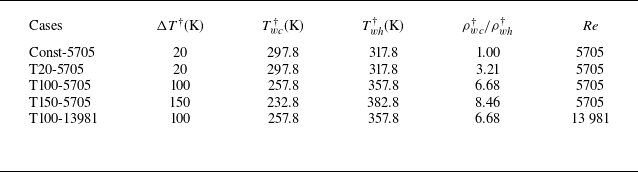
Key parameters of different cases:
 $\Delta T^\dagger$
(temperature difference),
 $T_{w\textit{c}}^\dagger$
(cooled-wall temperature),
 $T_{w\textit{h}}^\dagger$
(heated-wall temperature),
 $\rho _{w\textit{c}}^\dagger / \rho _{w\textit{h}}^\dagger$
(density ratio).

Alternatively, the scaling law can also be written as a function of the semi-local wall-normal coordinate
 \begin{equation} \overline {H}^+ = \int _0^{y^*}\! \dfrac {\partial \overline {H}^+}{\partial y^*} \, \mathrm{d}y^* = \int _0^{y^*}\! \overline {\alpha }^+ \frac {\partial \overline {h}^+}{\partial y^+} \, \mathrm{d}y^*, \end{equation}
where
 $\overline {\alpha }^+ = \overline {\alpha }(y)/\overline {\alpha }_w$
. In the following, the proposed enthalpy scaling law is examined using DNS data of SCP channel flows with various wall-temperature differences and Reynolds numbers. For comparison, existing temperature-based thermal scaling laws are also discussed.
3. Computational set-up
Table 1 summarises the key parameters of all the DNS cases in SCP channel flows. In all cases, the working fluid is CO
 $_2$
, and the operating pressure
 $P_0^\dagger$
is maintained at a value of 8 MPa, corresponding to a reduced pressure
 $p_r = 1.1$
. The thermophysical properties of CO
 $_2$
at this pressure are depicted in figure 1. Both the upper and lower walls of the channel serve as isothermal boundaries, and
 $T^{\dagger }_{w\textit{c}}$
and
 $T^{\dagger }_{w\textit{h}}$
denote the temperature of cooled and heated channel walls. The const-5705 case represents a constant-property flow, while the remaining four cases operate at SCP, where the temperature differences range from 20 to 150 K to examine various heating conditions. The setting of temperature span in each SCP case ensures the occurrence of the pseudo-critical process. The bulk Reynolds numbers for cases T20-5705, T100-5705 and T150-5705 are set at a constant value of
 $Re=5705$
, while case T100-13981 has a bulk Reynolds number of
 $Re=13\,981$
. All Reynolds numbers are calculated based on the bulk velocity and the channel height, using the characteristic thermophysical properties at the pseudo-critical temperature. Note that the const-5705 case serves as a reference for all other cases, as our goal is to develop a transformation that aligns the transformed scalar profiles of SCP fluid flows with that of constant-property flow.
Thermophysical properties of CO
 $_2$
at 8.0 MPa: (a) density
 $\rho$
and isobaric specific heat
 $c_{\!p}$
, and (b) thermal conductivity
 $\lambda$
and dynamic viscosity
 $\mu$
as functions of temperature.

The numerical scheme implements a kinetic-energy-conservative space–time discretisation (Pierce & Moin Reference Pierce and Moin2004), with fourth-order central differencing for spatial derivatives and a semi-implicit iterative algorithm (Wall, Pierce & Moin Reference Wall, Pierce and Moin2002). To mitigate numerical oscillations caused by steep enthalpy gradients, a fifth-order weighted essentially non-oscillatory scheme is applied. Thermophysical properties, including density, are interpolated from pre-tabulated data as functions of enthalpy and constant thermodynamic pressure (8 MPa), generated using the NIST REFPROP database (Lemmon et al. Reference Lemmon, Bell, Huber and McLinden2018). Details of the computational set-up, grid resolution and code verification can be found in the previous studies (Wan et al. Reference Wan, Zhao, Liu, Wang and Lei2020, Reference Wan, Wang, Jin and Zhao2025).
Wall-normal mean profiles of (a) isobaric specific heat capacity
 $\overline {c}_{\!p}$
, and (b) thermal conductivity
 $\bar {\lambda }$
; and r.m.s. profiles of (c)
 ${c_{\!p}}^{\prime }_{\textit {rms}}/ \overline {c}_{\!p}$
, and (d)
 $\lambda ^{\prime }_{\textit {rms}} / \bar {\lambda }$
, normalised by local mean quantities.

4. Assessment of enthalpy transformation
Before assessing the performance of thermal transformations, we first examine the behaviour of the mean isobaric specific heat capacity and thermal conductivity, along with their fluctuations at SCP. Unlike in atmospheric flows, these properties show abrupt variations with temperature in SCP fluid flows. As shown in figure 2(a),
 $\bar {c}_{\!p}$
exhibits pronounced variation on the heated-wall side (
 $y=2.0$
), which becomes increasingly significant with higher wall-temperature difference (higher density ratio). In particular, for the T150-5705 case, figure 2(c) reveals that the root mean square (r.m.s.) of isobaric specific capacity fluctuations of
 $c_{\!p}$
can reach up to 150 % of the mean value (the r.m.s. of fluctuation is defined as
 $\phi '_{\textit {rms}} = \sqrt {\overline {\phi ^2} - \bar {\phi }^2}$
). This highlights the substantial impact of
 $c_{\!p}$
variation on the thermal boundary-layer structure, an effect often neglected in conventional scaling approaches. To further substantiate this point, we have also included the wall-normal distributions of mean thermal conductivity (
 $\bar {\lambda }$
) and its relative fluctuations in figures 2(b) and 2(d), respectively. The results show that the r.m.s. of thermal conductivity fluctuations can reach up to 45 % of its mean value. These property variations are not properly considered by temperature-based scaling methods, thereby limiting their predictive performance.
4.1. Comparison with H–V relations
The performance of the new transformation is first assessed against existing H–V relations. Specifically, we compared the mean enthalpy profiles predicted by the H–V relations of Duan & Martin (Reference Duan and Martin2011) and Li et al. (Reference Li, Zhang, Duan and Choudhari2025) and by our proposed enthalpy transformation with those obtained from DNSs. Figure 3 presents the wall-normal profiles of the enthalpy
 $\tilde {h}$
obtained from each H–V relation and the proposed transformation, as well as the DNS data. On the cooled-wall side, where the fluid thermodynamic state remains far from the pseudo-boiling region, both our transformation and the H–V relation of Li et al. (Reference Li, Zhang, Duan and Choudhari2025) show good agreement with DNS results, whereas the relation of Duan & Martin (Reference Duan and Martin2011) exhibits slightly poor performance (blue dashed lines). This is likely due to the empirical nature of the function
 $f(\tilde {u}/\tilde {u}_e)$
, which was obtained by only fitting the DNS data of hypersonic reacting turbulent boundary layers. Additionally, the recovery factor is typically treated as a constant (determined by a constant Pr), which is not applicable to SCP flows where Pr varies significantly. The accuracy may be improved by fitting the coefficients of the empirical function using the present DNS results.
Comparison of mean enthalpy profiles obtained from different methods with DNS results in various cases: (a) T20-5705, (b) T100-5705, (c) T150-5705 and (d) T100-13981. Black: DNS results; red: H–V relation (Li et al. Reference Li, Zhang, Duan and Choudhari2025); blue: H–V relation (Duan & Martin Reference Duan and Martin2011); green: present enthalpy transformation.

On the heated-wall side, however, both H–V relations deviate substantially from DNS results, while the proposed transformation remains in close agreement. Notably, the formulation by Li et al. (Reference Li, Zhang, Duan and Choudhari2025) even produces unphysical values (
 $\tilde {h} \gt 1$
) in the region
 $y^* \lt 10$
. This deficiency likely arises from the strong transcritical effects and sharp thermophysical gradients near the heated wall, which are not carefully considered by the generalised recovery factor
 $r_{\!g}^*$
, as it accounts only for wall properties.
To further quantify these differences, we introduce the integrated relative error (Chen et al. Reference Chen, Gan and Fu2025; Zhu et al. Reference Zhu, Zhang, Yang, Ji and Xia2025), defined as
 \begin{equation} \epsilon _{y^*} (\%) = \dfrac {\int _0^{y^*} | \varTheta - \varTheta _{\textit{ref}} | \, {\rm d}y^*}{\int _0^{y^*} \varTheta _{\textit{ref}} \, {\rm d}y^*} \times 100 \,\%, \end{equation}
where
 $\varTheta$
and
 $\varTheta _{\textit{ref}}$
represent the predicted and reference quantities, respectively, with DNS data serving as the reference. Figure 4 presents the distributions of the integrated relative error along
 $y^*$
for each SCP case on both the cooled- and heated-wall sides.
Consistent with the observations above, the proposed transformation shows comparable accuracy to the H–V relation by Li et al. (Reference Li, Zhang, Duan and Choudhari2025) on the cooled-wall side. On the heated-wall side, however, both H–V relations display notable deviations, while the proposed transformation yields relatively small errors, demonstrating its robustness and reliability under SCP conditions. These results also suggest that existing H–V relations, originally developed for high-speed compressible flows under the perfect-gas assumption, cannot be directly extended to SCP flows where real-fluid effects dominate.
Integrated relative errors of different methods in cases (a) T20-5705, (b) T100-5705, (c) T150-5705 and (d) T100-13981. Solid lines: heated-wall side; dashed lines: cooled-wall side.

Transformed scalar profiles of (a)
 $\overline {\theta }^*/\textit{Pr}_w$
, (b)
 $\overline {\theta }_{\textit {Toki}}^*/\textit{Pr}_w$
, (c)
 $\overline {\theta }_{\textit {VD}}^+-\textit{Guo}/ \textit{Pr}_w$
, (d)
 $\overline {\theta }_{\textit {TL}}^+-\textit{Guo}/ \textit{Pr}_w$
and (e)
 $\overline {H}^+/ \textit{Pr}_w$
. Solid lines: cooled-wall side; dashed lines: heated-wall side; magenta dash-dot line: Kader’s law.

4.2. Comparison with temperature-based transformations
Next, we evaluate the comparable performance of the proposed transformation against several previously established temperature-based scaling methods. Figure 5 shows the transformed scalar profiles of all cases using different scaling laws, including existing temperature transformations
 $\overline {\theta }^*$
(1.10),
 $\overline {\theta }_{\textit{Toki}}^*$
(1.12),
 $\overline {\theta }_{\textit {VD}}^+$
(Guo et al. Reference Guo, Yang and Ihme2018),
 $\overline {\theta }_{\textit {TL}}^+$
(1.13) and the proposed enthalpy transformation
 $\overline {H}^+$
(2.15). For consistency, all profiles are normalised by
 $\textit{Pr}_w$
to eliminate the influence of the wall Prandtl number, and all vertical axes have been set to the same range of the scale. As shown in figure 5(a–d), the transformed scalar profiles based on temperature transformation overlap unsatisfactorily near the cooled wall and fail largely near the heated wall. This is consistent with the findings of existing studies (Guo et al. Reference Guo, Yang and Ihme2018, Reference Guo, Yang and Ihme2022). This discrepancy likely stems from inadequate consideration of variations in thermophysical properties, including thermal conductivity and dynamic viscosity, on the heated-wall side, where the pseudo-critical phenomenon occurs (Wan et al. Reference Wan, Wang, Jin and Zhao2025). Under this condition, strong fluctuations and substantial mean variations of thermophysical properties, particularly specific heat capacity, are triggered, leading to the failure of the temperature-based scaling law. In contrast, the newly proposed enthalpy transformation (figure 5
e) exhibits good overlapping performance in the viscous sublayer and the buffer layer near both cooled and heated walls. Notably, in the logarithmic region, the alignment of the new transformed scalar curves is substantially improved, compared with the temperature-based scalar curves.
Integrated relative errors of mean thermal scaling laws in different cases: (a) T20-5705, (b) T100-5705, (c) T150-5705 and (d) T100-13981. Solid lines: heated-wall side; dashed lines: cooled-wall side. Black lines:
 $\bar {\theta }^*$
; red lines:
 $\bar {\theta }_{\textit{Toki}}^*$
; blue lines:
 $\bar {\theta }_{\textit{VD}}^+-\textit{Guo}$
; green lines:
 $\bar {\theta }_{\textit{TL}}^+-\textit{Guo}$
; and purple lines:
 $\bar {H}^+$
. Note that the error profiles in the logarithmic region on the heated-wall side are zoomed in for clarity.

To further quantify the alignment performance, figure 6 shows the distributions of the integrated relative error along the wall-normal distance
 $y^*$
in each case on both the cooled- and heated-wall sides. On the cooled-wall side, where the thermodynamic state is far from the pseudo-boiling point and property variations are gradual, all transformation methods yield relatively small errors, and the proposed enthalpy-based transformation performs similarly to previously developed temperature-based transformations. On the heated-wall side, in contrast, the enthalpy-based transformation exhibits markedly smaller errors than the existing temperature-based methods. To evaluate the performance in the logarithmic region, the relative root-mean-square error (rRMSE) of the transformed profiles is computed as
 \begin{align} &\mathrm{RMSE} = \sqrt {\frac {1}{N} \sum _{i=1}^{N} ( \varTheta _i - \varTheta _{\textit {ref},i} )^2}, \quad \mathrm{r.m.s.} = \sqrt {\frac {1}{N} \sum _{i=1}^{N} \varTheta _{\textit {ref},i}^2}, \end{align}
 \begin{align} &\mathrm{rRMSE} = \frac {\mathrm{RMSE}}{\mathrm{RMS}} \times 100\,\%. \end{align}
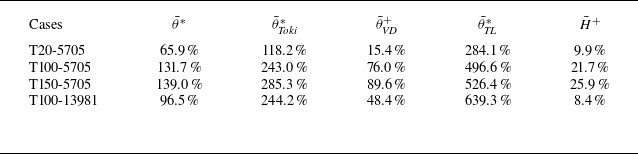
Table 2 summarises the rRMSE values for each SCP case relative to the constant-property baseline, specifically within
 $ 30 \lt y^* \lt 100$
. The results confirm that the proposed transformation consistently achieves the lowest rRMSE values across both small and large wall-temperature differences. Notably, the superiority of enthalpy-based scaling becomes more pronounced at larger wall-temperature differences.
The rRMSE of different transformed profiles against constant-property case.

4.3. Uncertainty analysis
Note that slight misalignment still persists in figure 5(e), which is probably linked to the earlier assumptions made to derive (2.8) and (2.9): (i) reducing the total heat flux balance to the molecular heat flux balance; and (ii) neglecting the fluctuating component of molecular heat flux. The validity of (2.8) is examined in figure 7, where the normalised mean molecular heat flux
 $\overline {\alpha \, \partial h / \partial y}$
and the turbulent heat flux
 $-\bar {\rho } \, \widetilde {v'' h''}$
are compared between the SCP and constant-property cases. It is observed that
 $\overline {\alpha \, \partial h / \partial y}$
dominates in the vicinity of the cooled and heated walls, while
 $-\bar {\rho } \, \widetilde {v'' h''}$
dominates away from the channel walls. The non-negligible differences in turbulent heat flux between SCP and constant-property cases exist away from the wall. These discrepancies help explain the observed deviations in the transformed enthalpy profiles in the logarithmic region, which is also an area we strive to improve in the future.
Decomposition of the total heat flux into (a) the molecular heat flux
 $\overline {\alpha \, \partial h / \partial y}$
and (b) the turbulent heat flux
 $-\bar {\rho } \, \widetilde {v'' h''}$
. All cases are normalised by the wall molecular heat flux
 $\bar {q}_w$
.

To evaluate assumption (ii), figure 8 presents the distributions of
 $\overline {\alpha \, \partial h / \partial y}$
and
 $\overline {\alpha } \, \partial \overline {h/ \partial y}$
, each normalised by wall heat flux. The difference between the two terms reflects the relative contribution of fluctuating molecular heat flux. The two quantities align well on the cooled-wall side. On the hot-wall side, however, notable discrepancies appear in the buffer and logarithmic regions. To quantify the effect of the fluctuating term, table 3 presents the rRMSE between the true value
 $\overline {\alpha \, \partial h / \partial y}$
and the simplified value
 $\overline {\alpha } \, \partial \overline {h/ \partial y}$
using data points within the near-wall region where
 $y^* \lt 100$
. The results show that rRMSE is small in all cases on the cooled-wall side, where the fluid thermodynamic states are far away from the pseudo-critical point and the variations in thermal diffusivity are small. The contribution of the fluctuating molecular heat flux is thus negligible on the cooled-wall side. In contrast, on the heated-wall side, especially under high temperature differences, the influence of neglected fluctuation becomes pronounced. For example, in the T150-5705 case, the rRMSE reaches 15.86 %, implying that the neglected fluctuation contributes to the deviation observed in the transformed profiles near the heated wall.
Relative deviation between the truth
 $\overline {\alpha \, \partial h / \partial y}$
and the simplification
 $\overline {\alpha } \overline {\partial h / \partial y}$
in different cases.

Effect of the fluctuating molecular heat flux: (a) cooled side, (b) heated side. Solid lines:
 $\overline {\alpha {\partial h}\text{/}{\partial y}}$
, symbols:
 $\bar {\alpha }\overline {{\partial h}\text{/}{\partial y}}$
. Black: T20-5705, red: T100-5705, blue: T150-5705, green: T100-13981.

Despite small discrepancies, the proposed enthalpy transformation under the present assumptions shows the remarkable performance on the alignment of thermal profiles compared with the existing temperature-based transformations in the literature. For wall-bounded turbulence and heat transfer under SCP conditions, the energy equation can be more effectively unified using enthalpy as the primary variable. In engineering applications, enthalpy at the wall can be determined from wall-temperature measurements, and the enthalpy distribution in channel flows can be reconstructed using the enthalpy-based scaling law proposed in this study. The temperature profile can be subsequently retrieved through thermodynamic calculations. Note that the proposed enthalpy transformation is examined in SCP channel flows in the present work; its validity in other wall-bounded SCP flows remains to be verified and will be explored in the future.
5. Conclusion
A novel thermal scaling law based on enthalpy transformation has been developed to address the limitations of existing wall-scaling laws under SCP conditions. The proposed transformation is derived from the chain rule, heat flux balance and semi-local scaling framework, enabling a consistent treatment of thermophysical property variations while excluding the gradient of isobaric specific heat-related derivative terms. The transformed mean enthalpy profiles show good overlapping performance in the viscous sublayer and the buffer layer. In the logarithmic region, the curves also demonstrate significantly improved alignment with those of constant-property incompressible flows, although some deviations persist under high density ratio conditions. Compared with existing H–V relations, the new scaling also provides better performance, particularly near the heated wall where the pseudo-boiling process occurs with abrupt thermophysical property variations. Overall, the proposed enthalpy-based scaling provides a robust and physically consistent approach for characterising near-wall scalar behaviours in SCP channel flows, offering new insights for modelling and analysis in real-fluid environments.
Fundings
This work is supported by the National Natural Science Foundation of China (52276123), the China Postdoctoral Science Foundation (2024M751636) and the Postdoctoral Fellowship Program of CPSF (GZC20231221).
Declaration of interests
The authors report no conflict of interest.
Data availability statement
Data availability statement. The data that support the findings of this study are available from the corresponding author upon reasonable request.