




No CrossRef data available.
Article contents
RECEPTIVE AND PRODUCTIVE VOCABULARY LEARNING: The Effects of Reading and Writing on Word Knowledge
Published online by Cambridge University Press: 18 February 2005
Abstract
This study investigates the effects of receptive and productive vocabulary learning on word knowledge. Japanese students studying English as a foreign language learned target words in three glossed sentences and in a sentence production task in two experiments. Five aspects of vocabulary knowledge—orthography, syntax, association, grammatical functions, and meaning and form—were each measured by receptive and productive tests. The study uses an innovative methodology in that each target word was tested in 10 different ways. The first experiment showed that, when the same amount of time was spent on both tasks, the reading task was superior. The second experiment showed that, when the allotted time on tasks depends on the amount of time needed for completion, with the writing task requiring more time, the writing task was more effective. If the second experiment represents authentic learning, then a stronger argument can be made to use productive vocabulary learning tasks over receptive tasks.I wish to acknowledge the generous input of the following people in the evolution of this paper: Paul Nation, Jonathan Newton, and Jim Dickie from Victoria University of Wellington, and the anonymous SSLA reviewers, for their helpful comments.
Information
- Type
- Research Article
- Information
- Copyright
- © 2005 Cambridge University Press
The majority of vocabulary is learned receptively through reading or listening (Jenkins, Stein, & Wysocki, 1984; Nagy, Anderson, & Herman, 1987; Nagy & Herman, 1987; Nagy, Herman, & Anderson, 1985). When vocabulary is taught in the classroom, learning is also likely to be receptive. Teachers may tell learners the meaning of a word, provide a definition, or use the word in a sentence, but they are less likely to ask students to use an item, apart from spelling or pronouncing it. Vocabulary learning tasks are also more likely to be receptive than productive. Receptive activities, such as looking up words in a dictionary, matching words with their meanings or definitions, guessing from context, and learning from word pairs (words are most often learned receptively in L2-L1 pairs) are more common than productive activities, such as cloze exercises or writing tasks. Receptive tasks may be more popular because they are easier to design, grade, and complete than productive tasks. However, it has never been demonstrated that receptive learning is more effective than productive learning. In fact, research indicates that the opposite may be true.
Most research on reception and production has focused on either receptive and productive vocabulary size (Laufer, 1998; Laufer & Paribakht, 1998; Morgan & Oberdeck, 1930; Waring, 1997a) or whether receptive knowledge is gained before productive knowledge (Aitchison, 1994; Channell, 1988; Melka, 1997). Surprisingly, there is very little research that compares receptive and productive learning. However, research on learning word pairs sheds some light on this issue. Research on learning from word pairs suggests that the type of learning—receptive or productive—affects the type and amount of knowledge gained (Griffin & Harley, 1996; Stoddard, 1929; Waring, 1997b). If words are learned receptively, then learners are likely to gain significantly more receptive knowledge, whereas productive learning leads to larger gains in productive knowledge. This provides a possible explanation for why a learner's receptive vocabulary may be larger than his or her productive vocabulary, a situation described in current research (Laufer; Laufer & Paribakht; Waring, 1997a). Given that vocabulary learning is predominantly receptive, learners are more likely to gain receptive knowledge than productive knowledge. Findings also indicate that productive tasks may be more effective if only one task is used (Griffin & Harley).
To my knowledge, there has been no research comparing receptive and productive learning, apart from the studies that investigated learning from word pairs. Crow and Quigley (1985) investigated two different approaches to vocabulary learning to determine which promoted greater gains in receptive knowledge; however, both approaches involved receptive and productive tasks. Considering the implications of the word pair studies, this lack of research is surprising. If receptive learning is better suited to developing receptive knowledge, then it may not be efficient to use productive tasks in a learning program in which the primary aim is to improve receptive skills. Similarly, if the goal is to increase production, receptive tasks may be less beneficial.
One weakness of the word pair studies (Griffin & Harley, 1996; Stoddard, 1929; Waring, 1997b) is that vocabulary gains were measured only with tests of meaning and form. Researchers tend to agree that knowing a word involves much more than simply knowing its meaning and form and have proposed different criteria for vocabulary knowledge (Aitchison, 1994; Laufer, 1997; McCarthy, 1990; Miller, 1999; Nation, 1990, 2001; Richards, 1976). Nation's (2001) vocabulary knowledge framework lists nine different aspects of knowledge involved in knowing a word, each of which can be broken down into receptive and productive knowledge.
Although meaning and form must be considered the most important aspects of vocabulary knowledge, in some cases they seem inappropriate as a measure of the relative efficacy of tasks. For example, it should be expected that tasks that provide learners with both meaning and form—such as learning from word pairs, the keyword technique, and learning from glossed sentences—may be effective in promoting semantic knowledge. However, it might also be expected that the presence of context in the learning from glossed-sentence tasks promotes larger gains in knowledge of syntax and grammar than the other two tasks. If research investigating those tasks does not measure gains in all three aspects of knowledge (i.e., syntax, grammar, and meaning), the results may be misleading. Similarly, reading tasks may contribute to larger receptive gains in syntax, grammatical functions, and meaning and form than writing tasks, which may lead to larger gains in productive knowledge. However, at present I know of only three studies that have measured receptive and productive gains in multiple aspects of knowledge (Schmitt, 1998, 1999; Schmitt & Meara, 1997).
The present study aimed to gain further insight into the effects of receptive and productive learning tasks on vocabulary knowledge. Two experiments were designed to determine the relative efficacy of learning from three glossed sentences and sentence production on receptive and productive knowledge of orthography, syntax, grammatical functions, association, and meaning and form.
EXPERIMENT 1
Experiment 1 was undertaken to determine whether other receptive and productive tasks contribute to vocabulary knowledge in the same manner as learning word pairs. Research on learning from word pairs suggests that a reading task would promote larger gains in receptive knowledge and a writing task would promote larger gains in productive knowledge (Stoddard, 1929).
Participants
The participants in this experiment were 66 Japanese native speakers from one first-year English as a foreign language (EFL) class at Kyushu University in Japan. Their mean score on version 1 of the Vocabulary Levels Test (Schmitt, 2000) at the second 1,000-word level was 27.6/30, which indicated that they were in control of that level and had receptive knowledge of almost all the 2,000 most frequent words (Schmitt, Schmitt, & Clapham, 2001). Proportional scores on the Vocabulary Levels Tests indicate the proportion of words known at a given level. The learners' mean score on version C of the Productive Vocabulary Levels Test at the second 1,000-word level was 15.1/18, which suggested that they had mastered that level and had productive knowledge of approximately 1,800 of the 2,000 most frequent words (Laufer & Nation, 1999). The learners were randomly assigned to the experimental groups.
Design
The experiment was conducted within one 90-minute class period. Learners were divided into two experimental groups. Learners in the receptive treatment encountered each target word with its L1 meaning in three glossed sentences. Nonsense words matched with the meanings of low-frequency L2 words were selected as target words. The use of nonsense words rather than authentic words eliminated the possibility of the learners having any knowledge of the target words. The target words were presented on the left of the L1 translations, which were in turn followed by the sentences. In each sentence, the target words were underlined and written in bold; for typographic reasons, they appear in italics here. In (1), the meaning of the target word dangy is “boulder.”

In the productive treatment, the target words were presented in the same word pairs followed by space to write each target word in a sentence, as in (2).

Instructions on how to complete each treatment were written at the top of each page in both English and the learners' L1. In the receptive treatment, the learners were simply told to learn the words, whereas in the productive treatment, they were told to write each word in a sentence in English and learn the words. The learners were given 12 minutes to complete the treatments, following findings from pilot studies that showed that the slowest learners were able to finish the productive task in 12 minutes. The learners were told that they would be tested after the treatments but were not told the nature of the tests. After completing the treatments, the learners were given 10-page test booklets. There was one test per page, which they were instructed to complete in order. Once a test was finished, the learners were not allowed to go back to revise any answers. They were carefully supervised to prevent this, thus eliminating the possibility of a learning effect from subsequent tests. Learners were given as much time as needed to finish a test.
Target Words
Ten target words were used in this experiment: six nouns and four verbs. This ratio was used because nouns and verbs are the most common parts of speech found in natural text; the 6:4 ratio approximates their proportional frequency of occurrence (Kucera & Francis, 1967). All of the target words were taken from the fifth frequency band in the COBUILD dictionary. This band contains the 6,601st to the 14,700th most frequent words. The target words were: locomotive, visage, lane, abode, boulder, crave, doze, sob, abhor, and dagger.
In the experiment, the L2 forms of the target words were replaced with 10 nonsense words to ensure that the learners had no prior knowledge of the target words. All of the nonsense words were disyllabic and were created to resemble English words phonetically and orthographically. Because of the possibility that the learners could mistake the nonsense words for real words that were orthographically similar, the spellings of the nonsense words did not always conform to common spellings. However, in pilot tests, Japanese learners were able to pronounce all the words correctly and reported that they believed the nonsense words to be authentic English words. Given that the learners in the experiments were not aware that nonsense words were used, authentic vocabulary learning should have occurred. Seven of the nonsense words were five letters long, and three were six letters long. The nonsense words and the target words that they replaced were as follows: ancon “dagger,” cader “doze,” dangy “boulder,” denent “visage,” faddam “abode,” hodet “lane,” masco “locomotive,” pacon “sob,” sagod “abhor,” and tasper “crave.”
There were several advantages to using nonsense words rather than low-frequency words. First, it ensured that learners had no prior knowledge of the target words. Finding target words that no learners have encountered previously proves very difficult, as there are often target words familiar to some learners. To avoid this, very infrequent target words may be used. Unfortunately, infrequent words do not often occur in text with very frequent words, rendering the use of authentic texts difficult. Another advantage of nonsense words is that the need for a pretest to measure for prior knowledge of the target words is eliminated.
Sentence Contexts
The contexts were taken from the British National Corpus. Because the amount of information a context provides about a target word may influence learning gains (Webb, 2002), an attempt was made to select equally informative contexts. Using a four-point scale, two native speakers rated the contexts on the amount of information they provided about a target word. In all the sentences used in the experiment, it was unlikely that the exact meaning of the target words could be inferred from one context. However, information in each context could lead to partial knowledge of the target word's meaning. It should be noted that the contexts were not meant to define the target words but rather to represent typical sentences that learners are likely to encounter when reading. Extensive pilot testing was used to ensure that learners were familiar with all of the running words in the contexts. Contexts that contained words unknown to any learner in the pilot tests were simplified or discarded. Controlling the running words in the contexts ensured that the learners would quickly understand the sentences and also eliminated the chance of a learning reduction due to other unknown words.
Dependent Measures
After the treatments, the learners were administered 10 tests that measured knowledge of orthography, association, syntax, grammatical functions, and meaning and form. Although multiple aspects of knowledge were measured, it should be noted that successful scores on the tests still may not indicate that the learners have acquired full lexical knowledge. Gaining full knowledge of a word is likely to take much longer and involve much more than reading three sentences or writing one. The reason for measuring multiple aspects of knowledge is to provide a more accurate assessment of the relative efficacy of the tasks.
Each test enabled learners to demonstrate a specific aspect of word knowledge productively or receptively. The tests were carefully sequenced to avoid the risk of earlier tests affecting answers to later tests. Instructions and examples were provided for each test in English and Japanese. Because the aim of this study was to determine how the learning tasks affected each aspect of knowledge, it was important to isolate each type of knowledge. In an earlier study (Webb, 2002), it was found that scoring successfully on the tests may not be dependent on gaining knowledge of meaning and form, despite the fact that association, syntax, and grammatical functions are closely linked with meaning and form. If a test involved more than one aspect of knowledge, the gain would be unclear. Moreover, how each type of knowledge influenced the scores on that test would also be uncertain. These concerns eliminated the possibility of using any tests that provided context to cue recall, despite suggestions that context is essential on receptive tests (Crow, 1986).
Almost all receptive and productive test formats can be criticized on two grounds. First, they tend to ignore most aspects of knowledge apart from meaning and form (Melka, 1997). Second, all tests involve both receptive and productive knowledge to some extent (Crow, 1986; Waring, 1999). In receptive tests (e.g., multiple choice, translation, and matching), learners must produce the meanings of target words or distracters to recognize the correct response, whereas in productive tests (e.g., cued recall and translation), learners must recognize the prompt to recall the target word. Consequently, there are many different testing methods, none of which appear ideal. Melka stated that “it is not obvious that any particular form of test is either specifically or adequately suited for testing either reception or production” (p. 97). It is doubtful that any test will be without criticism until there are clear and concise definitions of reception and production. One solution would be to alter the definitions to conform to what is being tested. In this study, receptive and productive knowledge are defined by the learning outcome demonstrated by the tests. Because the completion of most tests involves receptive and productive processes, skills, and abilities, reception and production are perhaps best defined as a product of learning.
All of the productive tests had a similar format in which a decontextualized cue prompted a response. The learners were cued with the target words and had to produce a response that demonstrated the aspect of knowledge being measured. The receptive tests of orthography, syntax, association, and grammar employed a multiple-choice format, and the receptive test of meaning used a translation format. The receptive and productive tests were selected for the following reasons: (a) they clearly demonstrated receptive or productive knowledge, (b) the aspects of knowledge could be isolated in the tests, (c) they did not require context, (d) they were easy to understand and quick to complete, and (e) the tests had proven effective in two previous experiments (Webb, 2002).
Test 1: Productive Knowledge of Orthography
On the first test, which measured productive knowledge of orthography, the learners heard each target nonsense word pronounced twice and then had 10 seconds to write it correctly. If there were any spelling mistakes the answers were marked incorrect. Because the learners were at the intermediate level and were likely to have learned most—if not all—of the rules of spelling, aural cues would be enough to lead them to write at least a close approximation of the target words. If responses with minor spelling mistakes were marked as correct, then it could not be determined whether a correct response was due to the learning task or the aural prompt. On all of the other productive tests, spelling was not a determining factor in scoring if the response could be clearly understood.
Test 2: Receptive Knowledge of Orthography
The second test measured receptive knowledge of orthography; the learners had to circle the correctly spelled target words, which appeared with three distracters. The distracters were created to resemble the target words both phonetically and orthographically. In (3), the target words are dangy and hodet.

Usually, all productive tests need to be completed before receptive tests to avoid a learning effect. However, it was highly unlikely that the receptive test of orthography would contribute to a learning effect in this study for two reasons: (a) the target words were used as cues on three of the four remaining productive tests, and (b) the determining factor on the other test measuring productive knowledge of meaning and form was whether the learners could link the L2 form with its L1 meaning rather than spelling the L2 form correctly.
Test 3: Productive Knowledge of Meaning and Form
Productive knowledge of meaning and form was measured by means of a translation test; the learners were given the L1 meanings and asked to write the words that the meanings had been paired with in the treatment. The aim of this test was to determine whether the learners could link the L2 form of the target words with their L1 meanings. To score correctly in (4), the learners had to write the target nonsense word masco beside the L1 translation with which it was paired.

Because the aim of the first two tests was to determine whether learners could write the target words correctly and recognize the correct spellings of the target words, spelling was not the determining factor for a correct answer in this test. Therefore, spellings that demonstrated that the learners could link the L2 form with its L1 meaning were marked correct. In (4), close approximations of the target word masco (e.g., mosco, masko, or mascoe) were acceptable responses.
Test 4: Productive Knowledge of Grammatical Functions
The productive knowledge of grammatical functions test was essentially a sentence construction test. Learners were cued with the target words and had to write each one in a sentence. It was made clear in the instructions to the participants that the only determining factor for a correct response was using the target words with grammatical accuracy. For example, the target word masco “locomotive” would have been scored as incorrect for The girl mascoed to school and correct in both The masco left the station early and It is a masco.
Test 5: Productive Knowledge of Syntax
In word association research, the productive knowledge of syntax test has traditionally been used with responses often classified as either paradigmatic (demonstrating productive knowledge of association) or syntagmatic (demonstrating productive knowledge of syntax; Soderman, 1993). On this test, the learners had to produce a L2 syntagmatic associate beside the cues, which were the target words. A common-sense approach was used when evaluating responses because L2 learners often respond with more variety and less uniformity than native speakers on word association tests (Meara, 1983). A comparison of the native-speaker and learner responses was considered, but this may not be sensitive to partial gains and might be better suited to determining whether learners gain full knowledge of syntax. In the current study, measuring for partial knowledge provides a more useful assessment of the relative efficacy of the tasks. Therefore, in both the productive tests of association and syntax, a common-sense approach to marking was employed.
Examples of acceptable responses for the target word masco, which had been paired with the Japanese translation of locomotive, were words commonly encountered in context with locomotive, such as station, tracks, left, and arrived. Words less frequently found in context with locomotive—such as clock, ate, and hard—were marked as incorrect. Because the following test measured productive knowledge of association, paradigmatic associates were marked as incorrect. This was carefully explained in the instructions to the participants.
Test 6: Productive Knowledge of Association
This test was designed to measure knowledge of paradigmatic associations; learners were presented with the target words and asked to write an associate beside each item. Coordinates, superordinates, subordinates, antonyms, and synonyms were all scored as correct. Because the previous test measured productive knowledge of syntax, syntagmatic associates were marked as incorrect, as was carefully explained in the instructions. Examples of some acceptable responses for masco “locomotive” were train, airplane, and vehicle. The method of scoring the responses was the same as in the productive test of syntax.
Test 7: Receptive Knowledge of Grammatical Functions
This test measured receptive knowledge of grammatical functions by means of a multiple-choice test. Learners were presented with three sentences containing each target word and had to choose the correct one from three choices. Knowledge of the target word's part of speech enabled the learners to select the correct answer. Because the productive knowledge of grammatical functions test was perhaps the most demanding test, it was important to have a second test that was sensitive to smaller gains. If the learners knew that masco “locomotive” was a noun, in (5) they would be able to choose (a) as the correct answer.

Test 8: Receptive Knowledge of Syntax
On this test, the learners circled the responses that were most likely to appear in context with the target words. All distracters were words that the learners were likely to know, and they were the same part of speech as the correct answer. The target words dangy “boulder” and hodet “lane” are illustrated in (6) and (7).

Test 9: Receptive Knowledge of Association
On this test, the learners had to circle the responses that were paradigmatic associates of the target words. All distracters were words that the learners were likely to know, and they were the same part of speech as the correct answer. This is illustrated for the target words dangy “boulder” and hodet “lane” in (8) and (9).

Test 10: Receptive Knowledge of Meaning and Form
This was a receptive translation test in which the target words cued responses of L1 form. An argument can be made that a receptive translation test involves both receptive and productive processes (Waring, 1999); however, the same argument can be made for most receptive tests. Because the learners had learned the answers in the treatments, a recognition test would have been extremely easy. The receptive translation test was better suited for this experiment because it was more demanding, requiring learners to recall rather than recognize meanings. In (10), the learners were required to write the Japanese translation of locomotive beside the target nonsense word masco.

Results
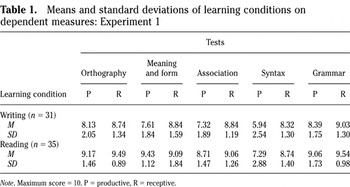
The descriptive statistics (means, standard deviations, and number of subjects) of vocabulary knowledge scores for the 10 dependent measures are reported in Table 1. A multivariate analysis of variance (MANOVA) was performed, using the scores on the 10 dependent measures. The independent variable was the type of learning task—writing each target word in a sentence and reading each target word in three sentences. The MANOVA revealed an overall significant difference between the two tasks, F(10, 55) = 5.07, p < .001.
Means and standard deviations of learning conditions on dependent measures: Experiment 1

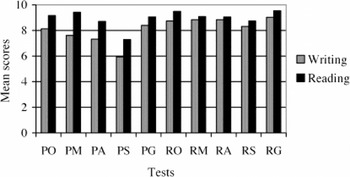
Figure 1 and Table 1 show that the learners who completed the receptive task had higher scores than the productive group on all of the dependent measures. Significant differences were found on the productive tests of orthography, F(1, 64) = 5.76, p < .05, receptive orthography, F(1, 64) = 7.21, p < .01, productive meaning, F(1, 64) = 24.10, p < .001, productive association, F(1, 64) = 11.33, p < .01, and productive syntax, F(1, 64) = 4.04, p < .05.

Mean scores for the reading and writing tasks on dependent measures: Experiment 1. PO = productive knowledge of orthography, RO = receptive knowledge of orthography, PM = productive knowledge of meaning and form, RM = receptive knowledge of meaning and form, PA = productive knowledge of association, RA = receptive knowledge of association, PS = productive knowledge of syntax, RS = receptive knowledge of syntax, PG = productive knowledge of grammar, RG = receptive knowledge of grammar.
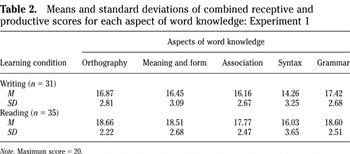
Table 2 shows the combined receptive and productive scores for each aspect of vocabulary knowledge. A MANOVA revealed an overall significant difference between the two treatments, F(5, 60) = 2.51, p < .05, for the combined scores. Significant differences were found for orthography, F(1, 64) = 8.28, p <. 01, meaning, F(1, 64) = 8.44, p < .01, association, F(1, 64) = 6.46, p < .05, and syntax, F(1, 64) = 4.29, p < .05. However, no significant difference was found for grammar.
Means and standard deviations of combined receptive and productive scores for each aspect of word knowledge: Experiment 1

Overall, the results indicate that both treatments were very effective. Large gains in knowledge of orthography, association, meaning and form, syntax, and grammatical functions were made by both groups. However, the results show that the receptive task is superior to the productive task on both productive and receptive measures. This contrasts with previous research on word pairs (Griffin & Harley, 1996; Stoddard, 1929; Waring, 1997b). One factor that may have contributed to this result was time. The amount of time given (12 minutes) was based on how much time the slowest learners needed to complete the productive writing task in a pilot study. In the pilot study, it was found that most students needed only 8 minutes to complete the reading task. Thus, learners in the receptive group may have used alternative strategies, such as learning word pairs receptively and productively or creating mnemonics. Although some learners in the productive group may have also used other strategies, the amount of time they had on average would have been less than was available to the receptive group. To clarify the gains from each task, a second experiment was performed.
EXPERIMENT 2
Design
Experiment 2 involved the same tasks as experiment 1 but differed from the previous design in three respects. First, experiment 2 used a same-subjects design. One experimental group completed both tasks. This reduced the number of learners required and also decreased the possibility of individual differences influencing the results. Second, in experiment 1, the learners were given an equal amount of time (12 minutes) to complete their tasks; however, in experiment 2, the learners were given only enough time to complete each task and were instructed to begin the second task as soon as they had completed the first. The treatment booklets were collected after the completion of the second task, which reduced the likelihood that learners used alternative learning strategies when completing the tasks. Time was considered to be a function of the tasks and was not controlled. Therefore, it was likely that time on tasks and on target words would covary. Hulstijn and Laufer (2001) took a similar approach, arguing that time should not be considered a separate variable but an inherent property of a task. Third, in experiment 1, the learners knew that they would be tested at the conclusion of the treatments. Because this may have motivated them to use other learning strategies, the learners in experiment 2 were not told that they would be tested. The instructions, however, remained the same: in the reading task, learners were told to learn the words, whereas in the writing task, they were told to write each word in a sentence in English and learn the words.
Participants
The learners in this experiment were 49 Japanese native speakers from one first-year EFL class at Kyushu University in Japan. Their mean score on version 1 of the Vocabulary Levels Test at the second 1,000-word level was 27.1/30, which indicated that they had receptive knowledge of almost all of the 2,000 most frequent words (Schmitt, Schmitt, & Clapham, 2001). Their mean score on version C of the Productive Vocabulary Levels Test at the second 1,000-word level was 14.8/18, which suggested that they had productive knowledge of approximately 1,750 of the 2,000 most frequent words. The learners were randomly assigned to the experimental groups.
Target Words
Twenty target words were selected for this experiment: 10 low-frequency target words from the first experiment (set A) and 10 different low-frequency words (set B). Both sets of target words comprised six nouns and four verbs. All of the target words were taken from the fifth frequency band in the COBUILD dictionary. The target words from set A were: locomotive, visage, lane, abode, boulder, crave, doze, sob, abhor, and dagger. The target words from set B were: lick, spear, recluse, pawn, landfill, mourn, convent, pier, reef, and marinate. Nonsense words replaced the L2 forms of the 20 target words. The 10 nonsense words from the first study and an additional 10 nonsense words were used. The same criteria from the first study were used to create the new words. The 20 nonsense words and the target words that they replaced in version 1 of experiment 2 were as follows: ancon “dagger,” cader “doze,” dangy “boulder,” denent “visage,” faddam “abode,” hodet “lane,” masco “locomotive,” pacon “sob,” sagod “abhor,” tasper “crave,” copac “mourn,” gishom “marinate,” hattaw “convent,” ictay “spear,” mesut “lick,” nasin “landfill,” nuggy “pawn,” tagon “recluse,” toncop “pier,” and dapew “reef.”
Four versions of the treatment were created to ensure that interlexical and intralexical factors and order of the tasks did not influence the results. Half of the learners completed the productive task first; the other half completed the receptive task first. Half of the learners did the receptive and productive tasks with set A of the target words, and the other half had set B. After completing both treatment tasks, the learners were administered the same 10 tests measuring vocabulary knowledge from experiment 1. The order of the words alternated between sets A and B on the tests to avoid a bias toward one of the tasks.
Results
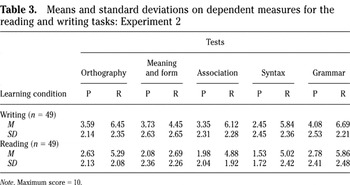
The descriptive statistics (means, standard deviations, and number of learners) of vocabulary knowledge scores for the 10 dependent measures are reported in Table 3. A repeated-measures MANOVA was performed, using the scores on the 10 dependent measures to analyze the within learners factor. The independent variable was the type of learning task—writing each target word in a sentence and reading each target word in three sentences. The MANOVA revealed an overall significant difference between the two tasks, F(10, 39) = 2.79, p < .05. MANOVAs were also used to determine that the order of the treatments (reading first and writing second or vice versa), F(10, 87)= 1.54, p = .137, and the word sets (reading set A and writing set B or vice versa), F(10, 87) = 1.48, p = .162, had no significant effect.
Means and standard deviations on dependent measures for the reading and writing tasks: Experiment 2

Figure 2 and Table 3 show that the writing task led to significantly higher scores than the reading task on all measures. The repeated-measures MANOVA revealed significant differences on the productive tests of meaning, F(1, 48) = 19.53, p < .001, association, F(1, 48) = 14.99, p < .001, orthography, F(1, 48) = 7.62, p < .01, syntax, F(1, 48) = 10.92, p < .01, and grammar, F(1, 48) = 11.86, p < .01. Significant differences were also found on the receptive tests of meaning, F(1, 48) = 24.23, p < .001, orthography, F(1, 48) = 9.57, p < .01, association, F(1, 48) = 12.52, p < .01, grammar, F(1, 48) = 6.90, p < .05, and syntax, F(1, 48) = 4.18, p < .05.

Mean scores for the writing and reading tasks on dependent measures: Experiment 2. PO = productive knowledge of orthography, RO = receptive knowledge of orthography, PM = productive knowledge of meaning and form, RM = receptive knowledge of meaning and form, PA = productive knowledge of association, RA = receptive knowledge of association, PS = productive knowledge of syntax, RS = receptive knowledge of syntax, PG = productive knowledge of grammar, RG = receptive knowledge of grammar.
It should also be noted that the scores in experiment 2 were much lower than those in experiment 1. Table 3 shows that these scores ranged from 1.5 to 2.8 for the reading task and from 2.5 to 4.1 for the writing task. However, in experiment 1, the scores ranged from 7.3 to 9.4 for the reading task and 5.9 to 8.4 for the writing task. The large drop in performance in experiment 2 was likely due to the higher learning demands on the students; whereas in experiment 1, the students had to learn 10 target words, in experiment 2 they had to learn 20.
The combined receptive and productive scores for each aspect are shown in Table 4. A repeated-measures MANOVA revealed an overall significant difference between the two tasks for the combined scores, F(5, 44) = 5.44, p < .01. According to this measure of significance, the productive task was more effective than the receptive task on the tests of orthography, F(1, 48) = 12.48, p < .001, meaning, F(1, 48) = 24.27, p < .001, syntax, F(1, 48) = 8.81, p < .01, association, F(1, 48) = 17.34, p < .001, and grammatical functions, F(1, 48) = 11.64, p < .001. The scores indicate that the writing task is the more effective of the two tasks, but it should also be noted that both conditions resulted in considerable learning in a short period of time. Interestingly, the tests of meaning resulted in the lowest combined scores. This suggests that studies that measure only meaning may be unable to find a significant result when there have in fact been significant gains in other aspects of vocabulary knowledge. It should also be pointed out that if knowledge of meaning was the sole criterion for learning, then the productive task was nearly twice as effective as the receptive task.
Means and standard deviations of combined receptive and productive scores for each aspect of word knowledge: Experiment 2

DISCUSSION
Experiment 1 examined vocabulary learning from a different receptive (reading three glossed sentences) and productive (sentence production) task. The results indicate that both tasks were very effective methods of gaining receptive and productive knowledge of all aspects. Research investigating L2 incidental vocabulary learning has shown that vocabulary gains tend to be lower and take longer than intentional vocabulary learning tasks (Day, Omura, & Hiramatsu, 1991; Dupuy & Krashen, 1993; Horst, Cobb, & Meara, 1998; Hulstijn, 1992; Pitts, White, & Krashen, 1989). However, the results of this study contrast with earlier findings that claim receptive learning to be more effective in contributing to receptive knowledge, whereas productive learning may be better suited to increasing productive knowledge (Griffin & Harley, 1996; Stoddard, 1929; Waring, 1997b). Learners who completed the reading task outperformed the writing group on all 10 dependent measures. Significant differences were found on the productive measures of orthography, syntax, meaning, and association as well as on the receptive test of orthography. The superior scores of the learners assigned to the receptive task condition on the productive measures—and not the receptive measures—are puzzling. Previous research indicated that if the reading task were more effective, receptive test scores would improve (Griffin & Harley; Stoddard; Waring, 1997b). There are several possible explanations for this result. First, if receptive knowledge is easier to gain than productive knowledge, as research suggests (Morgan & Oberdeck, 1930; Stoddard; Waring, 1997a, 1997b), then both tasks may have allowed the learners to gain enough knowledge of the target words to score well on the receptive measures. The multiple-choice format on the receptive tests of syntax, grammar, and association may have also contributed to the high scores, given that they allowed the learners at least a 25% chance to score correctly by guessing, whereas the productive tests did not. Second, ceiling effects on the receptive tests may have reduced the possibility of finding significant differences. Finally, it is possible that the experimental design confounded the results. In the treatment, both groups were given the same amount of time (12 minutes) to complete their tasks, but, although some learners struggled to finish the writing task on time, learners from the receptive group had ample time to finish the reading task. Although this was a function of the tasks—writing usually takes longer than reading—it may also be a function of receptive and productive learning in general. Waring (1997b) found that students took longer to learn productively from word pairs than receptively. Any extra time may have allowed the receptive group to process greater input more deeply or use alternative strategies to help them to score higher on the productive measures. However, if the receptive group used other learning strategies, it cannot be clear how the reading task affected the outcome. Still, the results indicate that, if learners spend an equal amount of time on tasks, a receptive task—or combination of tasks—may be superior to a productive task. Moreover, this experiment shows that receptive learning tasks may be better not only at developing receptive knowledge but also yield significantly greater gains in productive knowledge.
The purpose of experiment 2 was to clarify the results of experiment 1 and better understand how receptive and productive learning tasks contribute to vocabulary knowledge. It involved the same reading and writing tasks as experiment 1, but the time on task was not controlled. The results of experiment 2 show that learners gained significantly more knowledge on all 10 dependent measures from the sentence production task than from the reading task. Although this result supports previous research in that it shows productive learning to be more effective in promoting productive knowledge, it also contrasts with previous research that has shown receptive learning to be conducive to gaining receptive knowledge. It can be argued that the productive task was more effective on the receptive measures because the learners were likely to have spent more time on the productive task than on the receptive task. Experiment 1 demonstrated that, when the time of both tasks is equal, the sentence production task results might show less improvement. Although the results of experiment 1 are interesting and useful, the question remains as to whether its receptive treatment reflects authentic vocabulary learning. Are students actually going to spend more time reading sentences than they feel they need? This is unlikely without them having been instructed to do so. The tasks in experiment 2 are certainly ecologically valid—both tasks are often used inside and outside the classroom. Informal observation has shown that, when teaching a word, teachers usually give students one or more examples of the new vocabulary item in context, and many student dictionaries provide three examples of an item in context. Teachers may also ask students to write new vocabulary in sentences, and students regularly write new words in lists with their meanings and in context in order to learn them. If we consider the time spent on the tasks to be a function of the tasks and consider the results to be ecologically valid, then writing a sentence may be a more effective method of gaining vocabulary knowledge than reading three sentences. Moreover, this experiment indicates that productive learning is superior to receptive learning not only in developing productive knowledge but also in producing larger gains in receptive knowledge.
As mentioned previously, the overall gain scores in experiment 2 were much lower than in experiment 1. Although the scores for the reading task may partially reflect the fact that learners may have used other strategies to learn the target words, this was less likely to occur for the writing task. It is therefore likely that the drop in scores is the result of the increase in target words from 10 in experiment 1 to 20 in experiment 2. Students may be able to learn 10 words from reading and writing tasks in a relatively short period of time; however, attempting to learn more words may have an adverse effect on vocabulary gains. This result suggests that both teachers and students need to be aware of vocabulary learning limits. Language learners can be made aware of these limits by performing learning tasks with different numbers of words to determine how many items they can acquire. Additionally, teachers who use these learning tasks may be able to set vocabulary learning goals for students.
The experiments also highlight the importance of using multiple tests to measure vocabulary gains. Many vocabulary acquisition studies have measured only one aspect of knowledge—meaning—with only one test. Experiment 1 showed that no significant differences would have been found between the groups if only a receptive measure of meaning had been used. However, there were significant differences on four of the five productive tests and one of the receptive tests; this indicates that using only receptive or productive tests to measure learning might provide misleading results. Using receptive and productive tests to measure an aspect of knowledge and testing multiple aspects of knowledge may give a much more accurate assessment of the degree and type of learning that has occurred.
Combined, the experiments demonstrate that both tasks contributed to all five aspects of knowledge that were measured. This expands on previous findings that have shown that contextualized learning tasks contribute to meaning and form (Dempster, 1987; Griffin, 1992; Laufer & Shmueli, 1997; Pickering, 1982; Prince, 1996; Seibert, 1930). Although it should not be surprising that reading and writing tasks contribute to multiple aspects of vocabulary knowledge, it has been rare to measure aspects of knowledge apart from meaning. Because most vocabulary learning tasks probably promote several aspects of knowledge, measuring multiple aspects of knowledge seems necessary to fully determine their relative efficacy.
References
REFERENCES
Aitchison, J.
(1994).
Words in the mind.
Oxford:
Blackwell.
Channell, J.
(1988).
Psycholinguistic considerations in the study of L2 vocabulary
acquisition. In
R. Carter &
M. McCarthy (Eds.),
Vocabulary and language teaching (pp.
83–96).
London:
Longman.
Crow, J. T.
(1986).
Receptive vocabulary acquisition for reading comprehension.
Modern Language Journal,
70,
242–250.Google Scholar
Crow, J. T., &
Quigley, J. R.
(1985).
A semantic field approach to passive vocabulary acquisition for
reading comprehension.
TESOL Quarterly,
19,
497–513.Google Scholar
Day, R. R.,
Omura, C., &
Hiramatsu, M.
(1991).
Incidental EFL vocabulary learning and reading.
Reading in a Foreign Language,
7,
541–551.Google Scholar
Dempster, F. N.
(1987).
Effects of variable encoding and spaced presentation on vocabulary
learning.
Journal of Educational Psychology,
79,
162–170.Google Scholar
Dupuy, B., &
Krashen, S. D.
(1993).
Incidental vocabulary acquisition in French as a foreign language.
Applied Language Learning,
4,
55–63.Google Scholar
Griffin, G. F.
(1992).
Aspects of the psychology of second language vocabulary list
learning.
Unpublished doctoral dissertation,
University of Warwick,
UK.
Griffin, G. F., &
Harley, T. A.
(1996).
List learning of second language vocabulary.
Applied Psycholinguistics,
17,
443–460.Google Scholar
Horst, M.,
Cobb, T., &
Meara, P.
(1998).
Beyond A Clockwork Orange: Acquiring second language
vocabulary through reading.
Reading in a Foreign Language,
11,
207–223.Google Scholar
Hulstijn, J. H.
(1992).
Retention of inferred and given word meanings: Experiments in
incidental vocabulary learning. In
P. Arnaud &
H. Bejoint (Eds.),
Vocabulary and applied linguistics (pp.
113–125).
London:
Macmillan.
Hulstijn, J. H., &
Laufer, B.
(2001).
Some empirical evidence for the involvement load hypothesis in
vocabulary acquisition.
Language Learning,
51,
539–558.Google Scholar
Jenkins, J. R.,
Stein, M. L., &
Wysocki, K.
(1984).
Learning vocabulary through reading.
American Educational Research Journal,
21,
767–787.Google Scholar
Kucera, H., &
Francis, W. N.
(1967).
A computational analysis of present-day American English.
Providence, RI:
Brown University Press.
Laufer, B.
(1997).
What's in a word that makes it hard or easy? Intralexical
factors affecting the difficulty of vocabulary acquisition. In
N. Schmitt &
M. McCarthy (Eds.),
Vocabulary: Description, acquisition, and pedagogy (pp.
140–155).
New York:
Cambridge University Press.
Laufer, B.
(1998).
The development of passive and active vocabulary: Same or
different?
Applied Linguistics,
19,
255–271.Google Scholar
Laufer, B., &
Nation, I. S. P.
(1999).
A vocabulary size test of controlled productive ability.
Language Testing,
16,
36–55.Google Scholar
Laufer, B., &
Paribakht, T. S.
(1998).
The relationship between passive and active vocabularies: Effects
of language learning context.
Language Learning,
48,
365–391.Google Scholar
Laufer, B., &
Shmueli, K.
(1997).
Memorizing new words: Does teaching have anything to do with it?
RELC Journal,
28,
89–108.Google Scholar
McCarthy, M.
(1990).
Vocabulary.
Oxford:
Oxford University Press.
Meara, P.
(1983).
Word associations in a foreign language: A report on the Birkbeck
Vocabulary Project.
Nottingham Linguistic Circular,
11,
29–38.Google Scholar
Melka, F.
(1997).
Receptive versus productive aspects of vocabulary. In
N. Schmitt &
M. McCarthy (Eds.),
Vocabulary: Description, acquisition, and pedagogy (pp.
84–102).
New York:
Cambridge University Press.
Morgan, B. Q., &
Oberdeck, L. M.
(1930).
Active and passive vocabulary. In
E. W. Bagster-Collins (Ed.),
Studies in modern language teaching (pp.
213–221).
London:
Macmillan.
Nagy, W. E.,
Anderson, R. C., &
Herman, P. A.
(1987).
Learning word meanings from context during normal reading.
American Educational Research Journal,
24,
237–270.Google Scholar
Nagy, W. E., &
Herman, P. A.
(1987).
Breadth and depth of vocabulary knowledge: Implications for
acquisition and instruction. In
M. McKeown &
M. Curtis (Eds.),
The nature of vocabulary acquisition (pp.
19–35).
Mahwah, NJ:
Erlbaum.
Nagy, W. E.,
Herman, P. A., &
Anderson, R. C.
(1985).
Learning words from context.
Reading Research Quarterly,
20,
233–253.Google Scholar
Nation, I. S. P.
(1990).
Teaching and learning vocabulary.
Rowley, MA:
Newbury House.
Nation, I. S. P.
(2001).
Learning vocabulary in another language.
New York:
Cambridge University Press.
Pickering, M.
(1982).
Context-free and context-dependent vocabulary learning: An
experiment.
System,
10,
79–83.Google Scholar
Pitts, M.,
White, H., &
Krashen, S. D.
(1989).
Acquiring second language vocabulary through reading: A replication
of the Clockwork Orange study using second language acquirers.
Reading in a Foreign Language,
5,
271–276.Google Scholar
Prince, P.
(1996).
Second language vocabulary learning: The role of context versus
translations as a function of proficiency.
Modern Language Journal,
80,
478–493.Google Scholar
Schmitt, N.
(1998).
Tracking the incidental acquisition of second language vocabulary:
A longitudinal study.
Language Learning,
48,
281–317.Google Scholar
Schmitt, N.
(1999).
The relationship between TOEFL vocabulary items and meaning,
association, collocation, and word class knowledge.
Language Testing,
16,
189–216.Google Scholar
Schmitt, N.
(2000).
Vocabulary in language teaching.
New York:
Cambridge University Press.
Schmitt, N., &
Meara, P.
(1997).
Researching vocabulary through a word knowledge framework: Word
associations and verbal suffixes.
Studies in Second Language Acquisition,
19,
17–36.Google Scholar
Schmitt, N.,
Schmitt, D., &
Clapham, C.
(2001).
Developing and exploring the behaviour of two new versions of the
Vocabulary Levels Test.
Language Testing,
18,
55–88.Google Scholar
Seibert, L. C.
(1930).
An experiment on the relative efficiency of studying French
vocabulary in associated pairs versus studying French vocabulary in
context.
Journal of Educational Psychology,
21,
297–314.Google Scholar
Soderman, T.
(1993).
Word associations of foreign language learners and native
speakers: The phenomenon of a shift in response type and its relevance
for lexical development. In
H. Ringbom (Ed.),
Near-native proficiency in English (pp.
91–182).
Abo, Finland:
Abo Akademi University English Department Publications.
Stoddard, G. D.
(1929).
An experiment in verbal learning.
Journal of Educational Psychology,
20,
452–457.Google Scholar
Waring, R.
(1997a).
A comparison of the receptive and productive vocabulary sizes of some
second language learners.
Immaculata [occasional papers of Notre Dame Seishin
University, Okayama],
1,
53–68.Google Scholar
Waring, R.
(1997b).
A study of receptive and productive learning from word cards.
Studies in Foreign Languages and Literature,
21,
94–114.Google Scholar
Waring, R.
(1999).
Tasks for assessing second language receptive and productive
vocabulary.
Unpublished doctoral dissertation,
University of Wales,
Swansea, UK.
Webb, S. A.
(2002).
Investigating the effects of learning tasks on vocabulary knowledge.
Unpublished doctoral dissertation,
Victoria University of Wellington,
NZ.
Means and standard deviations of learning conditions on dependent measures: Experiment 1
Mean scores for the reading and writing tasks on dependent measures: Experiment 1. PO = productive knowledge of orthography, RO = receptive knowledge of orthography, PM = productive knowledge of meaning and form, RM = receptive knowledge of meaning and form, PA = productive knowledge of association, RA = receptive knowledge of association, PS = productive knowledge of syntax, RS = receptive knowledge of syntax, PG = productive knowledge of grammar, RG = receptive knowledge of grammar.
Means and standard deviations of combined receptive and productive scores for each aspect of word knowledge: Experiment 1
Means and standard deviations on dependent measures for the reading and writing tasks: Experiment 2
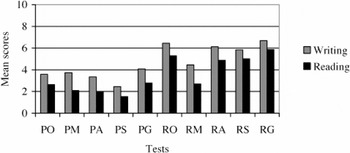
Mean scores for the writing and reading tasks on dependent measures: Experiment 2. PO = productive knowledge of orthography, RO = receptive knowledge of orthography, PM = productive knowledge of meaning and form, RM = receptive knowledge of meaning and form, PA = productive knowledge of association, RA = receptive knowledge of association, PS = productive knowledge of syntax, RS = receptive knowledge of syntax, PG = productive knowledge of grammar, RG = receptive knowledge of grammar.
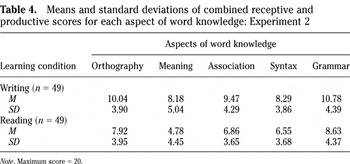
Means and standard deviations of combined receptive and productive scores for each aspect of word knowledge: Experiment 2
 You have
Access
- 261
- Cited by