

1 Introduction
Language changes over time, reflecting shifts in politics, society, and culture. The word “apple” used to refer just to a fruit but now also refers to a company; the word “gay” used to refer to a mood or personality type but now almost solely refers to a sexual orientation. Similarly, the meanings of words like “freedom” or “citizenship” have changed dramatically over time, reflecting the political and cultural shifts in a given society (Foner Reference Foner1998; Goldman and Perry Reference Goldman and Perry2002).Footnote 1 The diachronic study of language—the study of changes in language over time—tracks these cultural shifts in a word’s meaning, encapsulating not merely the word’s dictionary definitions (which may not shift) but also its central referents, contexts of use, associated sentiment, and typical users, which together reflect political attitudes and culture (Hamilton, Leskovec, and Jurafsky Reference Hamilton, Leskovec and Jurafsky2016a).
Studying changes in language over time, as a window into a specific political and cultural context, rests on the assumption that words can have many layers of meaning. Producing a thick understanding of this semantic architecture of words (de Bolla Reference de Bolla2013) and languages has been a central goal of 20th century linguistics theory and the computational linguistics methods that have sought to implement those theories. While many computational methods have been produced to map and measure semantics (e.g. latent semantic analysis and semantic folding, among others), word vectorization methods (also called word embeddings) built on shallow neural networks have recently emerged as exciting new front runners in this effort. Recently developed algorithms like word2vec and others (Mikolov, Yih and, Zweig Reference Mikolov, Yih and Zweig2013; Pennington, Socher, and Manning Reference Pennington, Socher and Manning2014) have made this word vector modeling much more computationally accessible to practitioners, expanding efforts to apply word vectors to many text-based questions.
These word vectorization methods are unsupervised methods, in that they take no human inputs aside from the corpus of texts and a few model hyperparameter settings. Relying on the semantic information intrinsic to the collocation of words in the texts, these models produce low-dimensional vectors that represent each word. These word vectors have been shown to encode a tremendous wealth of semantic information. For instance, scholars have shown that we can use vector representations of words to accurately answer analogy questions like Man is to King as Woman is to _____ (Mikolov et al. Reference Mikolov, Yih and Zweig2013). By starting with the vector for the word “king,” subtracting the vector for the word “man,” and adding the vector for the word “woman,” you end up positioned in the model space closest to the vector for the word “queen.” The changing proximity of words to one another in these model spaces has also shown a remarkable capacity to capture semantic relationships and cultural–temporal shifts in the architecture of words (Mikolov et al. Reference Mikolov, Sutskever, Chen, Corrado and Dean2013; Hamilton et al. Reference Hamilton, Leskovec and Jurafsky2016a). Recent work, for instance, has used word vectors to track the changing cultural meanings and stereotypes associated with race, ethnicity, and gender (Garg et al. Reference Garg, Schiebinger, Jurafsky and Zou2018).
In this paper, I utilize a substantive example from my own work as a scholar of American political thought to demonstrate both the utility and empirical validity of word vector models for questions of semantic change over time. I argue that understanding contemporary American political culture requires an understanding of how the architecture of the word “equality” has changed over time. Rather than projecting contemporary meanings of the word backward onto the past, this requires a genealogy of the semantics of American equality, excavating what equality meant to the people who used it in any given historical epoch. As part of that analysis, I applied computational text-as-data methods to help me make sense of uses of equality in a sizeable corpus of historical American newspapers. Because the goal was to track the semantics of a single word, word vectors appeared promising as a method to study equality’s changing historical meanings; indeed, as I show in Section 7, there are questions of interest which would not be answerable with other common approaches to studying text as data.
However, nearly all work on word vectors—most of which has been done by computer scientists—trains the models that produce these vectors on extremely large corpora of texts, containing billions of words.Footnote
2
Much of this work also looks at only a single moment in time, attempting to replicate the broad semantic structure of a language. By contrast, the data set of texts used in this paper
 $(n=3,105)$
contains a total of only 206,190 words, and I model change across the period spanning 1855 to 2016 in a specific, relatively small subset of English language newspaper texts. In general, political scientists will be interested in comparing the semantics of smaller collections of texts (say, for instance, exploring the variation in press releases from different sets of elected officials or showing how the language in governance documents related to climate change changes over time).
Although computer scientists and computational linguists have developed several sophisticated time-sensitive implementations of word vectorization (Kim et al. Reference Kim, Chiu, Hanaki, Hegde and Petrov2014; Kulkarni et al. Reference Kulkarni, Al-Rfou, Perozzi and Skiena2015; Hamilton et al. Reference Hamilton, Leskovec and Jurafsky2016b; Yao et al. Reference Yao, Sun, Ding, Rao and Xiong2018; Bamler and Mandt Reference Bamler and Mandt2017), their efforts to date have done little to help guide practitioners, for several reasons. First, existing studies on how to use word vectors for diachronic analysis have been performed on extremely large corpora, often far exceeding typical use cases for political scientists.Footnote 3 While the literature offers some guidance on using word vectors with smaller corpora more generally (Antoniak and Mimno Reference Antoniak and Mimno2018), there has been no integration of these developments into diachronic questions, with the result that practitioners cannot be sure whether any of the existing diachronic methods will produce valid results when used on more modest corpora. Second, little explicit guidance is offered as to the appropriateness or details of a given time-sensitive implementation for given use cases. The challenges, hurdles, and occasionally even implementation details of diachronic analyses using word vectors have been left largely implicit in existing studies, leaving new users without the necessary introductory information to fully understand the method’s structure, reasonability, or utility for a given task.Footnote 4
After introducing first principles of word vectors, this study moves to fill those gaps by 1) articulating both the promise and the challenges of diachronic word vectorization models, 2) describing four possible diachronic implementations of the method for political scientists with modest programming skills in Python, and 3) offering an empirical assessment of the success of these time-sensitive formulations of word vector models on a relatively small corpus. Though larger corpora are generally preferred for word vector models, I suggest here that empirical validation of small corpus model results should substitute general pessimism about the utility of small corpus vector models. For my empirical assessment, I used human-coded documents and supervised topic modeling on my newspaper corpus to produce a gold standard—known semantic relationships between “equality” and other words like “race” and “gender”—and then tested four methods of time-sensitive word vectorization to see which method reproduced the gold standard semantic relationships most closely.Footnote 5 My results are encouraging, suggesting that with attention to new methods like bootstrap resampling of documents and pretraining of word vectors, even relatively small corpora can be successfully modeled using word vectorization. By empirically validating best practices for political science practitioners, I seek to encourage the use of word vectorization methods in political science, which—despite showing great promise as a method for questions of interest to political scientists—has lagged economics and other social sciences in uptake (Gurciullo and Mikhaylov Reference Gurciullo and Mikhaylov2017).Footnote 6
I begin by discussing the utility of text-as-data methods—particularly word vectorization or word embeddings—for typical theoretical questions of interest to political scientists (Section 2). I then turn to the mechanics of word vectors, offering an introduction to distributional semantics, followed by word vectorization theory, methods, and implementations in common programming languages (Section 3). I then describe the challenges such methods present to analysts interested in studying semantic changes over time (Section 4). Using a data set of newspaper articles which has been previously topic coded and modeled using supervised topic modeling (Section 5), I propose and empirically test four solutions to the challenges of temporal analysis using word vectors and I report the results. I find that there are certain best practices for using word vectorization methods to answer questions about changes in word meaning over time, including bootstrap resampling of documents, selective language stabilization, and chronological training (Section 6). Finally, I show the utility of this validated word vectorization model for political scientists by demonstrating its ability to answer questions about the changing meaning of words over time that other common text-as-data methods are unable to answer (Section 7).
2 Studying Words
Political scientists interested in theory have begun to recognize the utility of computational text-as-data methods, particularly for questions that involve large scale text analyses or comparisons across divergent cultural contexts. For instance, in their recent work topic modeling medieval political theory texts that offer advice to princes and sultans in the Islamic and Christian worlds, Blaydes, Grimmer, and McQueen (Reference Blaydes, Grimmer and McQueen2018) have shown how text-as-data methods can augment and strengthen historical analyses of theoretical concepts. Political theory has also benefited from text-as-data work that helped to establish the authorship of disputed Federalist Papers (Mosteller and Wallace Reference Mosteller and Wallace1964/2008) as well as attributing certain anonymous works to Thomas Hobbes (Reynolds and Saxonhouse Reference Reynolds and Saxonhouse1995). Related disciplines like history, classics, law, and literary studies have found text-as-data approaches to be similarly helpful as a means of tracing topics and themes (Mimno Reference Mimno2012; Rhody Reference Rhody2012; Jockers Reference Jockers2013).
Such work, however, only begins to demonstrate the potential utility of text-as-data methods for political theorists and those engaged in conceptual research. New methods of computationally analyzing large collections of text using word vectors can go beyond topics or authorship, directly revealing the changing meanings of individual words and concepts across time. Concepts like rights, equality, peace, and democracy are both important to understand on their own, and also function as key variables in many scholarly hypotheses. Word vector methods that track the changing meaning of such concepts will have broad utility for political scientists.
Consider, for instance, the idea of equality in America. The meaning of equality in America has been central to our political culture; as Alexis de Tocqueville put it in Democracy in America, “the gradual development of the principle of Equality” underlies all other political dynamics and forces in the United States. Yet our contemporary vantage point tends to flatten our view of the past, making it hard to read the potentially alien meanings of equality in, say, the Founding era or the Reconstruction era on their own terms. In the current moment, we tend to strongly associate the idea of equality with progressive struggles for justice on behalf of marginalized groups. Computational methods allow us to step outside of our moment, enabling us to understand the meanings of concepts in the divergent cultural contexts of the past. Our position in the present moment, for instance, makes it surprising to learn that the most vocal advocate of equality in the era between the first and second world wars was Germany’s Adolf Hitler. Hardly viewed by history as a model egalitarian, Hitler was nevertheless extremely fond of invoking equality in his speeches and quotes to the press, arguing in January of 1937 that Germany had finally won the “battle for equality” with other European powers that he had spent years urging as Germany’s national mission. The use of equality language among nations, in matters of norms, peace, standing, and war, also dominates American discourse on equality in the interwar period. In the same period, equality discourse around women and African Americans is comparatively rare, complicating the historical story about the close association of equality with marginalized identities like race or gender. As I show in Section 7, word vectors can also help complicate our view of equality in the present.
Word vectors are a relatively recent methodological innovation that allows us to unearth and track such unexpected shifts in a word’s meaning. These new computational methods can potentially allow analysts to excavate the historical layers of the concept, offering a time-sensitive genealogy of its meaning to supplement their own subject area expertise.
3 What are Word Vectors?
Basic computational linguistics can provide interesting information about a word in a given set of documents (known as a corpus). We can, for instance, count the number of times that a given word is used in each document or the percentage of documents containing the word in any given year. In an archive of newspaper articles, we can see where the word appears (the headline, the abstract, the first paragraph, etc.). To understand what the word means when it is used, however, requires not merely counting the uses of the word but somehow quantifying the meaning of the word (Kulkarni et al. Reference Kulkarni, Al-Rfou, Perozzi and Skiena2015). Word vectors attempt to do this. In this section, I offer an intuitive, minimally mathematical discussion of the general theory and mechanics of word vectorization. Once we have a sense of how such models work, we can then turn our attention to the acute dilemmas they present for temporal questions and then to implementations for small data sets that provide possible solutions.
3.1 Distributional Semantics
Word vectorization methods are an implementation of a much older linguistic theory known as the distributional hypothesis. Simply put, the distributional hypothesis argues that the meaning of a word can be extracted by looking, over many texts, at the words that occur around it. As linguist J. R. Firth emphatically put it, “You shall know a word by the company it keeps!” (Firth Reference Firth and Firth1957, 11). The distributional hypothesis argues that, independent of any other context or even grammatical order, a systematic collection of word collocations can allow us to make semantic ‘sense’ out of words. In other words, linguists have argued that the words that appear near one another contain a surprising amount of information about the meaning of a given word and that a “difference of meaning correlates with difference of distribution” of these collocations (Harris Reference Harris1954, 156). Words that appear in similar contexts of nearby words have similar meanings.
The power of the distributional hypothesis lies in its generalizability. It can be applied to any language, or even to individual corpora within a given language; it requires no prior input of dictionaries or grammatical structures. It deduces—and here we should probably say ‘we deduce,’ since there is evidence that this is how humans learn language—the meanings of words based on considering the collocations of all words that occur in a given corpus of texts. The distributional hypothesis is the backbone assumption that drives word vectorization models (Turney and Pantel Reference Turney and Pantel2010).
3.2 Turning Words Into Vectors
How might we approximate the distributional semantics model of human language acquisition to teach it to a computer? We might begin by looking at simple word co-occurrence, a very basic way of expressing the understanding that words that occur in similar context have similar meanings. To look at the co-occurrence of words in a given text, we could take every possible pair of words in a text, and then calculate the conditional probability
 $P(a|b)$
of word a occurring within, say, five words of word b in the text. Since different words have different independent probabilities of occurring, though—some words are more common than others—we want to calculate what is called the point-wise mutual information (PMI) of the pair: in essence, how much more are we seeing a given pair of words occurring together than we would expect to at random, given the independent probability of seeing each word. PMI values can be positive or negative, but
 $PMI(a,b)=0$
when words a and b are independent, i.e. when the presence of one word has no impact on the likelihood of seeing the other. The calculation of the PMI of a given pair of words is then approximated using linear algebra:
 $$\begin{eqnarray}PMI(a,b)=\overrightarrow{\mathbf{A}}\cdot \overrightarrow{\mathbf{B}}\end{eqnarray}$$
where the model makes the assumption that PMI can be approximated as a single (scalar) product of two equivalent-length vectors,
 $\overrightarrow{\mathbf{A}}$
and
 $\overrightarrow{\mathbf{B}}$
.
But what are these new vectors that represent each word? Thinking about words a and b as vectors allows us to conceptualize something important. If we are interested in meaning, we are probably more interested in synonyms than in mere collocation: that is, we want to know which words appear in similar contexts, and such words are thus not likely to appear together. Hence, we are interested in words a and b that occur with the same frequency relative to all other words w. The mere co-occurrence of a and b is far less useful than the comparison of both a and b’s co-occurrence with w. In other words, we are more interested in comparing the meaning of the two words, a meaning that we can deduce from the context in which each word appears. In broad conceptual strokes, in a case where words a and b are functionally equivalent—exact synonyms or antonyms, for instance, always used in the same contexts—their vectors will contain the same values along all dimensions, yielding the highest possible PMI value. Words a and b that are unrelated to each other—whose contexts of appearance in the text are fully independent from one another—will have orthogonal vectors, whose product will yield a PMI of
 $0$
. Words a and b that are inversely related—less likely than chance to appear in the similar contexts—will yield negative PMIs.
But what, exactly, are these vectors of values? If each word is represented as a vector of values of equivalent dimensionality n, there is an n-dimensional reference vector which we can imagine as being a vector of points upon which each word is scored or compared. Let us imagine we want to compare words a and b. We could, for instance, imagine a vector for word a that has as many dimensions as there are unique words w in the text, and scores the co-occurrence (how often they appear together within a fixed window around each word) of word a with each other word w in the text. The reference vector, then, would be a vector of w-dimensionality of all unique context words w. We would then produce another vector (again with w-dimensionality) of co-occurrences of all context words w with a second word b. We would then be able to compare
 $\overrightarrow{\mathbf{B}}$
to
 $\overrightarrow{\mathbf{A}}$
by taking their scalar product, which would give a single number that we might term a similarity score.
One thing that we might notice, however, is that every context word w is not equally useful in helping us to distinguish the difference or similarity of words a and b. Some words will be louder or brighter sources of information; many words mean similar things and can be clustered together without a loss of information. In other words, rather than a w-dimensional reference vector, we can actually describe word a (and every other word in the text) with a much, much smaller n-dimensional reference vector against which a is scored. The scores of word a against each element of the reference vector, when all taken together, come to represent the abstract meaning of a. One could think about the reduction from w to n dimensions as a reduction from the vocabulary of all words in the text to a much smaller vocabulary of concepts: for example, from rating the dog-ness, fox-ness, squirrel-ness, etc. of a word to merely its animal-ness. (Though this example might aid our conceptualization of dimension reduction, it is important to note here that word vector dimensions do not actually refer to anything directly like concrete concepts.) These values of the vector of a given word, taken together, provide its semantic address in a given corpora’s universe.
3.3 Algorithms and Implementations
Reducing the w-dimensional vector to smaller n-dimensionality is a form of unsupervised learning; in other words, it does not require a human to specify a set of concepts against which words are scored. Like unsupervised topic modeling, it takes a user-specified value of n (between 100 and 500 dimensions is common) and generates n points against which each word is scored. There are several popular methods by which this functional compression to lower dimensionality takes place, some of which also modify some of the details of the preliminary steps conceptually outlined above. In general, contemporary methods of word vectorization rely on a neural network approach to translate a large, sparse matrix of values into a dense, low-dimensional vector space via a hidden layer of weights.
The details of neural networks and the algorithms that train them are beyond the scope of this paper; for our purposes, we can imagine a neural network as an extremely complex function that takes a huge number of inputs (a corpus of words and each of their surrounding window of context words) and produces a huge number of outputs (vectors of
 $n$
-dimensionality for each word).Footnote
7
The word vectors produced by the model are actually one of the hidden layers of weights in the neural network; the actual final outputs of the neural network are predictions about words that co-occur.
The most popular implementation of word vectors, word2vec, structures this network in two different ways. In the case of the skip-gram with negative sampling (SGNS) algorithm that this paper utilizes, the model trains itself on the corpus by working to improve the accuracy of its predictions of words it knows co-occur in the corpus and minimize the likelihood of “negative samples” of words it knows do not co-occur (Mikolov et al.
Reference Mikolov, Yih and Zweig2013). The model seeks to give each word in the corpus values (weights) along each dimension of the
 $n$
-dimensional vector that minimizes the cost function: i.e. that reduces the number of incorrect predictions about word co-occurrence. The weights of the model are typically initialized randomly, and then the model works to tweak the weights and biases at every term in the function until it reaches a local maxima in the likelihood of predicting a set of context words given a single input. This training of the network is done through stochastic gradient descent and backpropagation. The final weights of the model correspond to the values of the word vector for each word.Footnote
8
By contrast, the continuous bag-of-words (CBOW) word2vec architecture essentially inverts the SGNS model: it trains a neural network to optimize its prediction of words given the context around them, rather than trying to predict the context given a single word. As the developers of these models put it, “the CBOW architecture predicts the current word based on the context, and the skip-gram predicts surrounding words given the current word” (Mikolov et al.
Reference Mikolov, Chen, Corrado and Dean2013, 5). SGNS tends to run more slowly, but to be better for infrequent words and for semantic tasks, which makes it the architecture of choice for smaller corpora (Mikolov et al.
Reference Mikolov, Chen, Corrado and Dean2013).
Using either the CBOW or SGNS architecture, the neural network is trained on a given corpus of interest, producing a vector of weights associated with each word in the context of that corpus. Several straightforward implementations of these methods exist in both the R and Python programming languages. In R, the package wordVectors builds on word2vec, while in Python, the gensim package will allow you to build SGNS or CBOW models with greater freedom to set the hyperparameters and structure the analysis; the gensim implementation is recommended for temporal analyses and is used here.
3.4 Training & Corpus Size
Using these implementations, one can either run analyses on existing, trained word vectors or one can train new word vectors on a given corpus of interest.Footnote 9 While most existing trained word2vec embeddings were generated from large corpora with millions or billions of tokens, there is no hard minimum requirement on the volume of texts required to train word vectors.Footnote 10 Though the conventional wisdom is that larger corpora will train higher quality vectors, several promising lines of research are opening doors to smaller corpora.
First, small corpora word vector analyses can benefit from the use of transfer learning, also known as pretraining or fine-tuning, where the model has nonrandom initializations. Most prominent in computer vision studies that attempt to train image classifiers, transfer learning has shown that gains in performance and efficiency are possible when a machine learning model is initialized with weights from a previous model, rather than starting the learning process from scratch (Pan and Yang Reference Pan and Yang2010). Translating this insight to word vector models, one might use vectors from an entire corpus to initialize the first slice in a diachronic analysis, as I discuss in the next section, or one might use a small corpus of interest to fine-tune vectors trained on an entirely different, more universal corpus (Howard and Ruder Reference Howard and Ruder2018).
Another development in small corpora word vector analysis relies on statistical insights around bootstrapping. One concern about small corpora is that the vectors they produce are highly sensitive to single documents, corpus size, and document length, generating divergent model outputs based on small changes to these corpus characteristics (Antoniak and Mimno Reference Antoniak and Mimno2018). Antoniak and Mimno have shown, however, that averaging over the model outputs from multiple bootstrap samples of documents can produce stable, reliable results from small corpora.
3.5 Uses for Word Vectors
Once a corpus has been vectorized, each word essentially has an address or assigned location in
 $n$
-dimensional space. Just as
 $(x,y)$
coordinates allow us to locate a position in two-dimensional space and can be added or subtracted to move around the grid, word vectors locate words in a semantic space of
 $n$
-dimensions, and can be added or subtracted to move around the space. Hence, the analogy king is to man as woman is to what? is a logical expression, but embedding these words in vector space makes it an algebraic expression, not just a logical one. As noted at the outset of this paper, by starting with the vector for ‘king,’ subtracting the vector for ‘man,’ and adding the vector for ‘woman,’ the word located closest to the position you end up is ‘queen.’ Word vectorization models trained on large corpora have performed astonishingly well on these kinds of language analogy tasks. They are very good at identifying the fourth word in an analogy, or at identifying the word in a cluster of four that is least like the others.
Word vectors can also be directly compared to one another to produce a similarity score between words. The most common method of doing this is by cosine similarity, where
 $\cos (\unicode[STIX]{x1D703})=\frac{\mathbf{A}\cdot \mathbf{B}}{\Vert \mathbf{A}\Vert \Vert \mathbf{B}\Vert }$
gives the cosine similarity, ranging between
 $-1$
and 1, of two vectors
 $\overrightarrow{\mathbf{A}}$
and
 $\overrightarrow{\mathbf{B}}$
, drawn from the origin. The semantic similarity between two words is approximated by their cosine similarity, with values closer to 1 indicating greater similarity (Turney and Pantel Reference Turney and Pantel2010; Antoniak and Mimno Reference Antoniak and Mimno2018).
Another way of thinking about this is that we can semantically map a given word, like “equality,” by looking at its cosine similarity scores with other words (e.g. “race” or “gender”). The changing proximity of two words will reflect shifts in the cultural meaning of a given word: for instance, the proximity of “woman” and “homemaker” over time will reveal important semantic information about the cultural meaning of the word “woman.” Similarly, when people think about equality in any given era, how close is gender or race in their thoughts? Or what about the proximity of equality to words like liberty or dignity? Cosine similarity scores (either for pairs of words, or lists of closest words like in Hamilton et al. Reference Hamilton, Leskovec and Jurafsky2016b) can allow analysts to track these changing semantic relationships, which in turn reflect a picture of the thick, cultural meaning of a word as it changes over time.
4 The Problem of Time
The word vectors produced from a corpus express the language regularities and semantic relationships in a given corpus. Another way to say this is that the corpus is “the central object of study” for word vector methods and the goal is to understand and explore the distinct semantic universe of the corpus and, by extension, the world that produced the corpus (Antoniak and Mimno Reference Antoniak and Mimno2018, 107). For example, analyses on distinct corpora of texts can reveal what we might term ideological biases in each corpus. One word2vec analysis of articles from left-leaning, centrist, and right-leaning news sites done by ProPublica found that there were marked differences in the words with the closest cosine similarity scores to “Clinton” or “abortion” in each corpus of news articles (Larson, Angwin, and Parris Reference Larson, Angwin and Parris2016). Other word vectorization analyses have revealed that corpora reproduce gendered or racial biases and stereotypes (Bolukbasi et al. Reference Bolukbasi, Chang, Zou, Saligrama and Kalai2016; Caliskan, Bryson, and Narayanan Reference Caliskan, Bryson and Narayanan2017; Garg et al. Reference Garg, Schiebinger, Jurafsky and Zou2018).
Word vectorization allows us to map the semantic universe of a given corpus, and then to compare universes to each other in order to track semantic differences. These universes might be different subsets of the world at the given moment in time—like the example of different sets of media with certain ideological orientations—or they might be the same subset of the world at different moments in time. For instance, we can imagine that a sample of articles taken from The New York Times in 1870 will represent a distinct semantic universe from a sample of Times articles taken in 1970. This section explores the challenges associated with using word2vec to produce valid results for this type of chronological comparison.Footnote 11
4.1 Challenges for Diachronic Analysis
As with all methods for computationally analyzing text as data, word2vec users need to be aware of how preprocessing and hyperparameter settings can influence the outcomes of their models.Footnote 12 Word vectorization analyses conducted over time, however, face three additional validity challenges which have been either generally underappreciated in previous studies or have not been addressed with an eye to valid semantic analyses in small-scale corpora. All three of these problems emerge from the norm of slicing a single corpus into time intervals in order to model each semantic universe separately, producing word vector relationships for each universe, and then tracing the changes in those semantic relationships across time.Footnote 13
Arbitrary Cut Points
First, slicing a corpus into time eras introduces arbitrary cut points between eras. The selection of these cut points—both their location and number—can have an effect on the embeddings produced and thus on the similarity scores. While the size of the eras will be determined to some extent by the research question and by the size and scope of the corpus, selecting different era sizes has known effects on trends and the smallest feasible era size should be utilized to avoid losing trend information (Box-Steffensmeier et al. Reference Box-Steffensmeier, Freeman, Hitt and Pevehouse2014). In addition, semantic shifts can be produced quickly by dramatic single day historical events like September 11, 2001 or October 29, 1929, or by less visible but still rapid processes of cultural and linguistic change. Cutting a corpus on one side or another of such events affects model results. While some of these shifts are known and can be accounted for, others are discovered by the model itself and so cannot be accounted for in advance. Thus, any given cut point introduces unknown and arbitrary effects into the trends the model produces.
Language Instability
The second problem that analysts of semantic changes over time face is issues of homonymy, polysemy, and instability in corpus vocabulary (Huang et al. Reference Huang, Socher, Manning and Ng2012). The same concept is often referenced using different words over time, limiting the ability to use cosine similarity between a given pair of words over time as synonyms shift in and out of fashion. For example, if we want to track the relationship between equality discourse and black Americans, we will need to choose a term consistent in meaning over time and distinguishable from other meanings of the term. Our challenge becomes clear when we recognize that today “African American” is used to describe Americans of African descent, but this term only came into use in the last three or four decades; prior popular terms used in print for the same set of people have included “Negro,” “Black,” “Colored,” and (if you go back far enough) “Freedman” (plus all respective pluralizations). The polysemous character of the word “black”—both a race referent and a general color—increases the difficulty. The underlying concept “African American” may exist across time, but both its cultural meaning and the specific word used for the concept will have shifted.Footnote 14 To produce valid measures of its relationship with equality across time, then, one has to account for language instabilities like these.
Spatial Noncomparability
Finally, word vectorization models suffer from a particular and (at least among noncomputer science practitioners) underappreciated challenge of what I will term spatial noncomparability. Recall that our model produces word vectors with length n, where each element can be understood as a coordinate that locates or embeds a given word in n-dimensional space. Words located closer to one another in this space are more similar in meaning; cosine similarity between two vectors gives a kind of proximity score. The overall space is defined by a set of n basis vectors, which allows the analyst to orient themselves within the space and meaningfully compare vectors and distances. The simplest example of this is in the familiar graph of 2-space, where the axes x and y serve as reference vectors that allow us to plot and compare other vectors of given magnitudes and directions.
A temporal analysis wants to compare cosine similarities (the closeness of vectors) from across different models. But word embeddings produced by stochastic processes like SGNS from different time slices will embed words in nonaligned spaces defined by different basis vectors. This precludes direct comparison of cosine similarity across distinct corpora (Hamilton et al. Reference Hamilton, Leskovec and Jurafsky2016b). In fact, it even complicates our ability to compare different modeling runs on the same corpus, where nearest neighbors might remain the same but coordinates might shift (Kulkarni et al. Reference Kulkarni, Al-Rfou, Perozzi and Skiena2015). This all makes sense, actually, since the foundation of any diachronic semantic analysis is the recognition that the meaning of a word changes over time; correspondingly, we would expect the meanings of most words (and even the list of words) in a given space to shift, and it would be reasonable to expect a corresponding shift in the structure of the space itself.
An example might help to clarify this point. Imagine a graph that plotted per capita consumption of fresh fruit each year in the United States over time. Such a graph would allow confident discussions of trends in fruit consumption over time. Now imagine that instead of each point representing the annual per capita consumption of all fruit, each point represented the annual per capita consumption of some specific fruit, where the specific fruit used changed each year. One year, we would plot the per capita consumption of bananas, the next year mangoes, the following year apples. Such a graph would be in some unknown way related to overall fruit consumption trends, but would much more prominently be related to the idiosyncrasies of the consumption of a given individual fruit in a given year. Without a way to convert individual fruit consumption to a common, comparable baseline, it would be challenging to speak confidently about fruit consumption trends from this graph. While the analogy to spatial noncomparability is inexact, this example gives some sense of the alignment problem faced by trying to compare values with different baselines.Footnote 15
4.2 Analyzing Vectors Across Time
While the first two of these problems are common to all efforts to analyze semantic shifts over time, addressing them within the context of word vectorization presents particular challenges. The third problem is unique to word2vec. There are many possible ways to implement time-sensitive word vectorization that attempt to address these issues; I describe four in the subsection that follows. I then implement tests of each using a small, relatively sparse data set typical of corpora used by social scientists and scholars in the humanities. Rather than work out a theoretical solution to these problems, I create a set of gold standard semantic tests, and empirically determine which implementation allows word2vec to overcome these challenges and excavate known trends in the corpus.
The simplest method of conducting an analysis over time using word2vec is to cut the corpus into chronological time slices (days, months, years, etc.) and separately model each slice. We will call this a naive time series model. This method produces a set of word vectors for each interval of time, from which cosine similarity scores between pairs of words can be computed. Bootstrap resampling of the data and repeated modeling of each slice allows for the generation of standard errors and confidence intervals around such scores; these scores can then be compared across the slices to measure semantic changes across time. The cosine similarities for terms of interest can be compared (e.g. comparing the cosine similarity score of “race” and “equality”) at slices
 $t$
and
 $t+1$
to ascertain, with some level of confidence, if the meaning of the word of interest (here, “equality”) is moving. The naive time series assumes that there are no problems of spatial noncomparability across time slices and does not account for the effect of arbitrary cut points; it serves as a functional baseline or null result.
The overlapping time series model attempts to smooth out differences across time slices by cutting some of the edge texts from slice
 $t$
into the corpus at slice
 $t+1$
, and so on. Otherwise, the same methods are applied and the same results are generated as from the naive time series. This method decreases the chance of spurious results as a consequence of arbitrary cut points between time slices, but does not directly address problems of spatial noncomparability across slices.
Rather than initialize the word2vec model for each time slice with random weights, the chronologically trained model utilizes the word vectors from slice
 $t-1$
to initialize the model for slice
 $t$
(Kim et al.
Reference Kim, Chiu, Hanaki, Hegde and Petrov2014). This method assumes, essentially, that word meanings and relationships in slice
 $t$
begin semantically where
 $t-1$
ended. The first time slice,
 $t_{1}$
, is initialized with the vectors from the full corpus. This method utilizes the leverage offered by pretrained vectors and provides some semantic linkages across slices, but does not directly address spatial noncomparability. The training on
 $t$
and production of results then proceeds as in the naive time analysis.
Finally, the aligned time series method generates vectors for each slice as in naive time analysis, but then seeks to address the spatial noncomparability of slices in a postmodeling alignment phase (Kulkarni et al. Reference Kulkarni, Al-Rfou, Perozzi and Skiena2015; Hamilton et al. Reference Hamilton, Leskovec and Jurafsky2016b). One approach to this task is an orthogonal Procrustes matrix alignment. The alignment process requires that the analyst choose one anchor slice in the corpus, to which all other slices are aligned.Footnote 16 At the alignment phase, vocabulary is necessarily limited to words present in all time slices, limiting the information available in any single slice and potentially limiting the utility of this method for corpora which extend over long periods of time or where vocabularies change dramatically.Footnote 17 This type of alignment model has been used with some success to align embeddings across languages, on very large corpora.Footnote 18
The gap between the tests previously done on some of these methods (produced in computational linguistics or computer science, with extremely large data sets) and typical use cases for social scientists and humanists is profound. For example, the aligned time series analysis performed by Hamilton et al. (Reference Hamilton, Leskovec and Jurafsky2016b) utilized several data sets, including the Google N-Gram data set, which is constructed from 6% of all books ever published and contains
 $8.5\times 10^{11}$
tokens (roughly, words). Their smallest corpus, a genre-balanced collection of literature, contains 410 million tokens. While some social scientists and humanists employ comparatively large data sets, time analysis word vectorization methods that will be broadly useful to practitioners must apply effectively to substantially smaller corpora. Existing diachronic analysis papers provide little guidance on this front. Diachronic word vector methods will only be useful insofar as practitioners with smaller corpora can feel confident that the models are retrieving valid semantic information about trends in the corpus. In the next sections, I test the relative efficacy of these four models on just such a semantic task: recovering known semantic relationships in a previously coded, relatively small corpus. I compare the performance of these four models against one another on the same corpus and same task, generating empirically validated methodological recommendations for practitioners.
5 Data and Methodology
This project seeks to validate best practices for using word2vec on diachronic questions with smaller corpora. In this section, I begin by discussing the challenges of validating diachronic word vector models, describing typical validation methods and justifying my choice of a gold standard semantic test. I then describe my corpus of texts and how I modeled them using human coding and supervised topic modeling to produce the gold standard description of the semantic relationships in the corpus. I follow this with the details and implementation of each word vectorization method. I end this section by spending some time describing the assumptions and preprocessing choices that allow me, in this specific case, to use supervised topic model results to empirically validate unsupervised word vector models. The results of the tests of each word vector model against the gold standard, and the general findings, are described in Section 6.
5.1 Problems of Validation
Word embedding models are typically assessed on language tasks that mirror how well the model “understands” the underlying language structure of the corpus. Computational linguists have relied on sets of grammatical, knowledge-based, and semantic analogy tasks, (Mikolov et al. Reference Mikolov, Yih and Zweig2013; Pennington et al. Reference Pennington, Socher and Manning2014; Levy et al. Reference Levy, Goldberg and Dagan2015) as well as word similarity tasks (Hamilton et al. Reference Hamilton, Leskovec and Jurafsky2016b; Bruni et al. Reference Bruni, Boleda, Baroni and Tran2012; Levy et al. Reference Levy, Goldberg and Dagan2015). In these assessments, differently specified models are scored and compared based on how accurately they are able to answer questions like:
∙ Athens is to Greece as Rome is to _____?
∙ Mexico is to peso as USA is to _____?
∙ Dad is to mom as father is to _____?
∙ Running is to ran as knowing is to _____?
The answers to these questions are produced using vector arithmetic and cosine similarity scores, where the model answers with the word closest to the position in space produced through vector addition and subtraction of the preceding three elements. Such tasks assess how well the model can grasp the language structure of the corpus and answer questions with known answers; models assessed in this way are typically trained on exceptionally large corpora.
Similarly, some large scale diachronic models have been assessed with analogy tasks that rely on extrinsic knowledge that changes in each time slice: for instance, the ability of the model to correctly associate the last names of all United States presidents with their terms or South African political leaders and their parties (Yao et al. Reference Yao, Sun, Ding, Rao and Xiong2018; Arnold et al. Reference Arnold, Erlich, Jung and Long2018). Other diachronic studies, however, have lacked an extrinsic method of evaluation (Kim et al. Reference Kim, Chiu, Hanaki, Hegde and Petrov2014) or have relied on human-created semantic tasks intrinsic to the substantive questions of interest (Kulkarni et al. Reference Kulkarni, Al-Rfou, Perozzi and Skiena2015; Hamilton et al. Reference Hamilton, Leskovec and Jurafsky2016b; Yao et al. Reference Yao, Sun, Ding, Rao and Xiong2018).Footnote 19 Similarly, as I describe below, this paper departs from validation tasks like analogies and word similarities. Instead, I construct a gold standard semantic task specific to the substantive research question in order to validate the word vector models.Footnote 20 In general, the diachronic literature agrees that assessing the fit of the models comes down to how well the models discover known semantic relationships between words; in other words, “a good embedding provides vector representations of words such that the relationship between two vectors mirrors the linguistic relationship between the two words” and the best way to assess whether this has occurred is research question dependent (Schnabel et al. Reference Schnabel, Labutov, Mimno and Joachims2015, 298).
5.2 Data
For this project, I constructed a corpus of newspaper articles
 $(n=3,105)$
from The New York Times (NYT), Reuters, and the Associated Press, accessed via the NYT Articles API.Footnote
21
All articles from 1855 to 2016 with the word “equality” in the headline were downloaded. Headline restricted articles were chosen in order to construct a corpus of articles centrally, rather than incidentally or tangentially, concerned with equality. The headlines, first paragraphs, and abstracts from each article were used for analysis.Footnote
22
The corpus was divided into seven 25-year time slices; the proportion of articles in each time slice that are centrally about equality ranges between 0.6 and 3.4 articles per 10,000.Footnote
23
Due to both this varying newsworthiness of equality and the general increase in the volume of news articles produced in later slices, there is significant variation in document counts across slices. In chronological order by slice, there are 80, 102, 496, 1137, 660, 259, and 371 documents, respectively.
5.3 Producing the Gold Standard
To produce the gold standard against which the word vector models were validated, I first created a codebook for my newspaper corpus based on spot reading and computational exploration. The topics in the codebook emerged organically from an exploration of the corpus (Saldana Reference Saldana2009).Footnote 24 These topics were intended to capture who, in a given article, is seeking, achieving, needing, or being denied equality—in other words, which group was associated with the equality discussed in a given article. This codebook was refined iteratively and finalized during several preliminary rounds of trial coding with two undergraduate coders. The final codebook contained fifteen mutually exclusive and exhaustive topic codes, including a “misc.” topic.Footnote 25
Next, using this codebook, the coders each coded the same simple random sample of 400 articles from the corpus, with an overall inter-coder agreement of 89%. After every 100 articles, coding disagreements were referred to me and resolved in conference with the coders; I also spot checked their coding on articles where they were in agreement. This coded collection of 400 articles served as the training set for the supervised topic model.
This training set was then used to run a supervised topic model on the full corpus of all articles using the R package ReadMe, which utilizes a training set of documents hand-coded with exhaustive and mutually exclusive topics to compute the proportion of documents in each topic in a second test set (Hopkins and King Reference Hopkins and King2010). Following Hopkins and King’s implementation of a proportions-over-time analysis, I split the test set into 25-year eras and used the full training set to model each era separately.Footnote
26
Bootstrapping
 $(n=300)$
was used on each era to produce means for the document proportions in each topic. The shift in the proportion of documents in each of the ReadMe model’s topics matches known historical shifts in the use of equality language—we see, for instance, a large spike in gender articles in the suffrage era of 1905–1930; a similar spike is present in both international relations and German focused articles in the era leading up to and including World War II—which provides overall inductive validity for the model.
Finally, I selected five of the fifteen topics, where the topic could be easily approximated by a single word (see Section 5.5 for more detail on this approximation).Footnote 27 As Figure 1 demonstrates, the trends in proportions over time in these five topics match historical expectations. These trends in the corpus—the shift in document proportions in these topics over time—are the semantic gold standard against which the four word vector models, described next, will be assessed.
Proportion of documents by topic and era in the gold standard model. (Proportions do not sum to 1 in each era because only five of fifteen topics are plotted.)

5.4 Word Vectorization Modeling
I then produced four diachronic implementations of word2vec models. All four of the word vectorization models utilized word2vec’s SGNS algorithm as implemented in the Python library gensim (Rehurek and Sojka Reference Rehurek and Sojka2010; Mikolov et al. Reference Mikolov, Yih and Zweig2013). Except where noted in the implementation of a specific temporal method below, all models follow hyperparameter recommendations from previous literature or gensim defaults (Levy et al. Reference Levy, Goldberg and Dagan2015).Footnote 28 All words were converted to lower case and punctuation was removed; the corpus was not stemmed, nor were stop words removed. Each of the seven eras of the corpus was modeled separately.
Two important modeling choices were made, which are recommended for small corpora and diachronic studies. First, each era was modeled repeatedly with bootstrapped samples of the documents to produce sample means of, and confidence intervals around, model outputs of interest (Antoniak and Mimno Reference Antoniak and Mimno2018). For each bootstrapped sample,
 $n$
documents were randomly sampled with replacement from the corpus, where
 $n$
is equal to the number of documents in the era being modeled. As Antoniak and Mimno describe, averaging across many bootstrapped models stabilizes the model outputs (like, in this case, cosine similarity scores) for small corpora, making the analysis less vulnerable to single documents, and allows the computation of confidence intervals around model outputs.
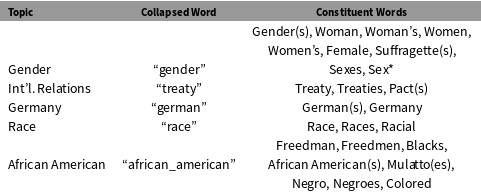
Second, language stabilization and selective stemming was done manually on the corpus prior to modeling to enable tracking of the five test words associated with the five gold standard topics outlined above. This was done to correct for plurals and for the fact that over time synonymous words are used with different frequencies and politically correct language shifts (see Table 1).Footnote 29 For instance, the phrase “equality of the races” was quite typical in articles up until the 1955 era; from that point, such language drops out entirely and is replaced by “racial equality.” In such a case, we need some way to understand “racial” and “races” as equivalent.
Corpus language stabilization and selective stemming.

To implement each of the four temporal word2vec models, the texts for each of the seven time slices were divided into sentences, each of which was then divided into lists of individual words, using the Python package nltk. In the naive time model, each corpus of documents was resampled and modeled until the bootstrapped mean around the cosine similarity scores for the five test words stabilized
 $(n=100)$
. In the overlapping time model, the text list
 $T$
for each era
 $e$
was sorted chronologically. The first and last 10% of each
 $T_{e_{i}}$
were duplicated. These duplicate lists were then appended to the adjacent corpora
 $e_{i-1}$
and
 $e_{i+1}$
, respectively. Each era’s
 $T_{\text{new}}$
was then bootstrapped as per the naive time model. In the chronologically trained model, the model for
 $T_{1}$
was initialized using the word vectors from a model of the entire corpus. The word vectors from model
 $T_{1}$
, when trained, were then used to initialize
 $T_{2}$
, and so on through all time slices. Each slice was bootstrapped as per the naive time model. In the aligned model, each corpus slice was modeled separately and the resulting vectors were L2-normalized. The vector spaces in adjacent slices, beginning with
 $e_{1}$
and
 $e_{2}$
, were then aligned in sequence by cutting the vocabulary to common words and then using Procrustes matrix alignment (Heuser Reference Heuser2016; Hamilton et al.
Reference Hamilton, Leskovec and Jurafsky2016b). This process was repeated for each bootstrapped sample of each slice; cosine similarity scores were retrieved from slices post-alignment.
5.5 Modeling Assumptions and Data and Preprocessing Choices
Before moving to the findings, it is important to emphasize the limited scope of the validation method of this project. For this project, I produced a unique corpus with specific texts, which allowed me to use the results of a supervised topic model to validate the four word vector models. This was only possible because of the specifics of my corpus and preprocessing steps, and was only desirable because it allowed me to empirically validate general best practices for small corpus diachronic word vector modeling.
It is important to be clear, however: in general, word vector models and topic models are not equivalent. Topic models assign topics to texts, either user-generated topics (supervised topic models) or computer-generated topics (unsupervised topic models). Topics are typically complex ideas expressed through word clouds or collections of key words. Such topic models can be used, as in this project, to track how prominent certain topics are over time by looking at the changing proportion of texts assigned to a topic. ReadMe, the method I employ here to assign a topic to each text, does precisely this, taking as inputs a set of human-coded texts assigned to mutually exclusive topics and a set of uncoded texts and producing as output the proportion of all texts in each topic. Word vectorization models, on the other hand, produce a high-dimensional space and embed all the words present in the corpus of texts in that space. These word vector models are unsupervised. Words which are closer to one another in the space are closer in meaning; they have greater semantic proximity. In other words, topic models traffic in the topic(s) of each text, while word vectors traffic in the semantic relationships between individual words in the overall corpus of texts.
To use a supervised topic model to validate my word vector models, I made two important data and preprocessing choices and three key modeling assumptions. The first data choice I made was to limit my corpus to those articles with the word “equality” in the headline. This choice was made because articles with equality in the headline (rather than, say, in a body paragraph) are likely to be centrally, rather than tangentially, concerned with the idea of equality. In other words, I assume that all of the articles in my corpus can be assigned to the topic “equality,” in addition to the secondary topic they are assigned by ReadMe. The first key assumption, then, is that each article has two topics: “equality” and a secondary topic assigned by ReadMe from a codebook of mutually exclusive options.
The proportion of texts in each of these secondary topics, therefore, corresponds to the centrality of the relationship between that topic and equality in the corpus. If, for instance, only one percent of all the equality articles are about race, it is clear that—at least in this corpus—the equality and race topics are not commonly co-occurring or closely related. If, on the other hand, 65% of the equality articles are about gender, it is clear that the gender and equality topics are frequently co-occurring and closely related: i.e. that there is a closer semantic relationship between the gender and equality topics than between the race and equality topics in this given corpus. The second key assumption, therefore, is that the proportion of texts in each topic tracks the strength of the semantic relationship in the corpus between equality and that topic.
I then selected five topics from the codebook used to code the ReadMe training texts which could be closely represented by a single word. Recall that topics in topic models are typically expressed using word clouds or lists of keywords. Here, I made my second important data choice, choosing topics (gender, race, African American, Germany, and international relations) which I could represent relatively well with a single word. This required preprocessing the texts fed into the word vector models, performing some language stabilization and selective stemming. After that preprocessing, the third key assumption was made: that the semantic relationship between these individual words (“gender,” “race,” “african_american,” “german,” and “treaty”) and the word “equality” would mirror the semantic relationship between each of the five topics (gender, race, African American, Germany, and international relations) and the equality topic. In other words, in a highly successful word vector model, the z-score normalized cosine similarity between equality and each of these five words would precisely mirror the z-score normalized document proportions of the corresponding topic from the gold standard supervised topic model.
6 Results
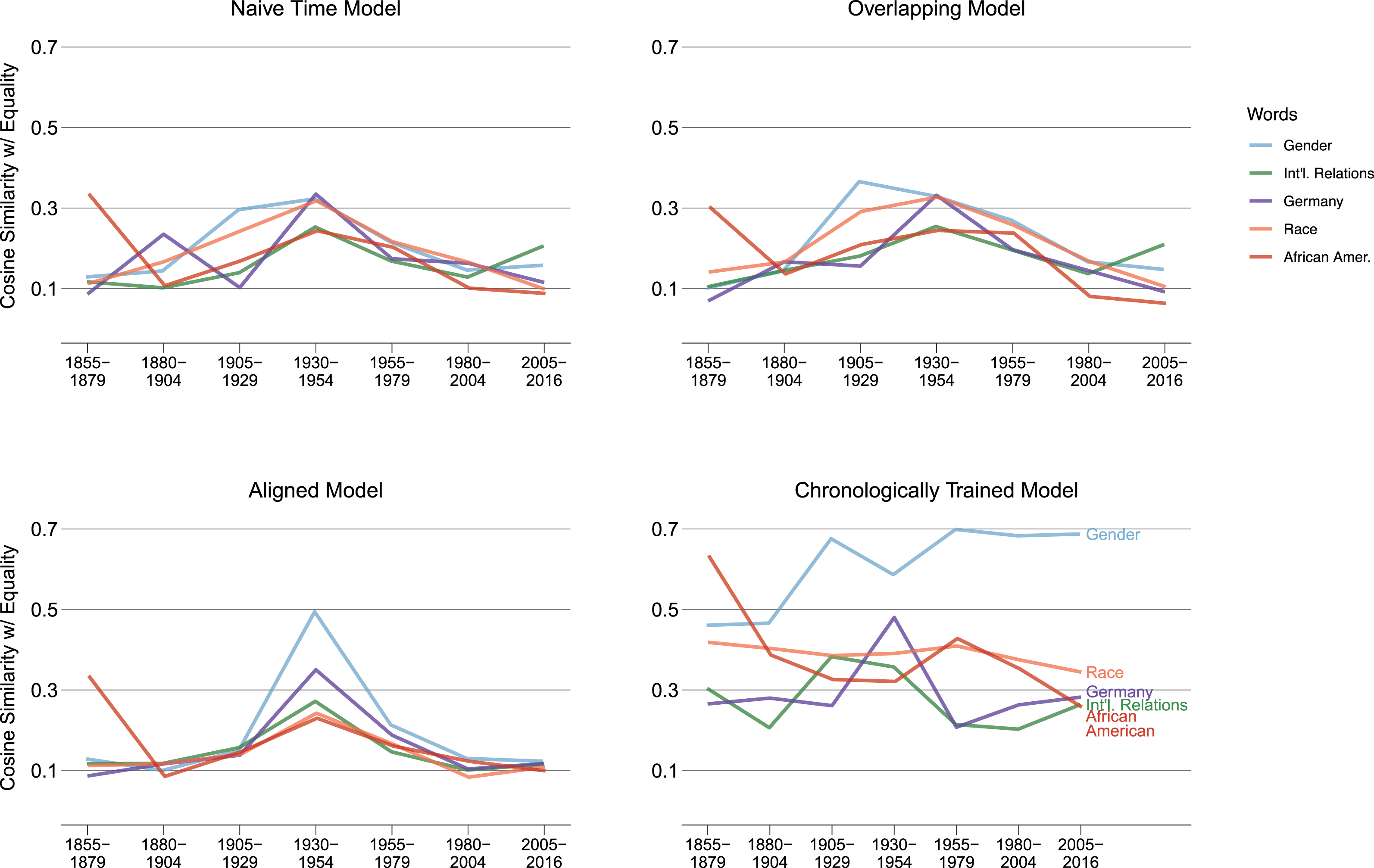
Once I produced the four word2vec implementations, I then turned to validation. The models were assessed based how well they replicated the ReadMe gold standard of document proportions across five topics: gender, international relations, Germany, race, and African American. The gold standard model produced document proportions across these five topics as depicted in Figure 1 on page 101. The four word vectorization models produced cosine similarity scores for “equality” and the word associated with each topic. The cosine similarities of those “equality”-word pairs, one cosine similarity score for each era, are shown in the model-by-model plots of word vector outputs in Figure 2.
Four Diachronic word2vec Model Implementations.

6.1 Model Performance
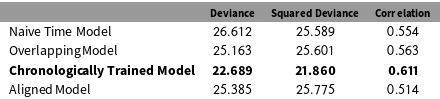
The gold standard was used to assess which of the four word2vec models most closely replicated the known corpus trends. After z-score normalizing the gold standard document proportions and the four word2vec model outputs, I calculated three fit measures: the sum of the point-by-point deviances between the gold standard and each word2vec model, the sum of the point-by-point squared deviances, and the correlations between the gold standard and each of the word2vec models (see Table 2 for a summary of how well each word2vec model performed on these three metrics).Footnote 30
word2vec Models compared to gold standard model.

The normalized outputs offer the same conclusion regardless of the fit measure chosen. Across all three metrics, the chronologically trained model outperformed the other three implementations, more closely positively correlating to the baseline trends and producing the lowest summed point-by-point deviance and squared deviance from the baseline values. The other three implementations not only failed to as closely reproduce the baseline data, but a one-way ANOVA provides no evidence that the naive, overlapping, and aligned models are statistically distinct from one another
 $(F(2,102)=1.169;p=0.314)$
.
The chronologically trained model starts with vectors from the whole corpus, and then is iteratively retrained at each time slice using the vectors from the previous slice. Rather than starting the model with random weights and biases as in the other three models, the chronologically trained model starts with more information in each training cycle. This information appears to allow the model to reproduce the overall structure of semantic shifts in the corpus with higher fidelity, mirroring successes seen with pretraining or transfer learning in other domains of machine learning (Pan and Yang Reference Pan and Yang2010; You et al. Reference You, Luo, Jin and Yang2015). Although this implementation does not directly align the slices to address problems of spatial noncomparability, it appears to functionally stabilize the basis vectors across time slices to some extent.
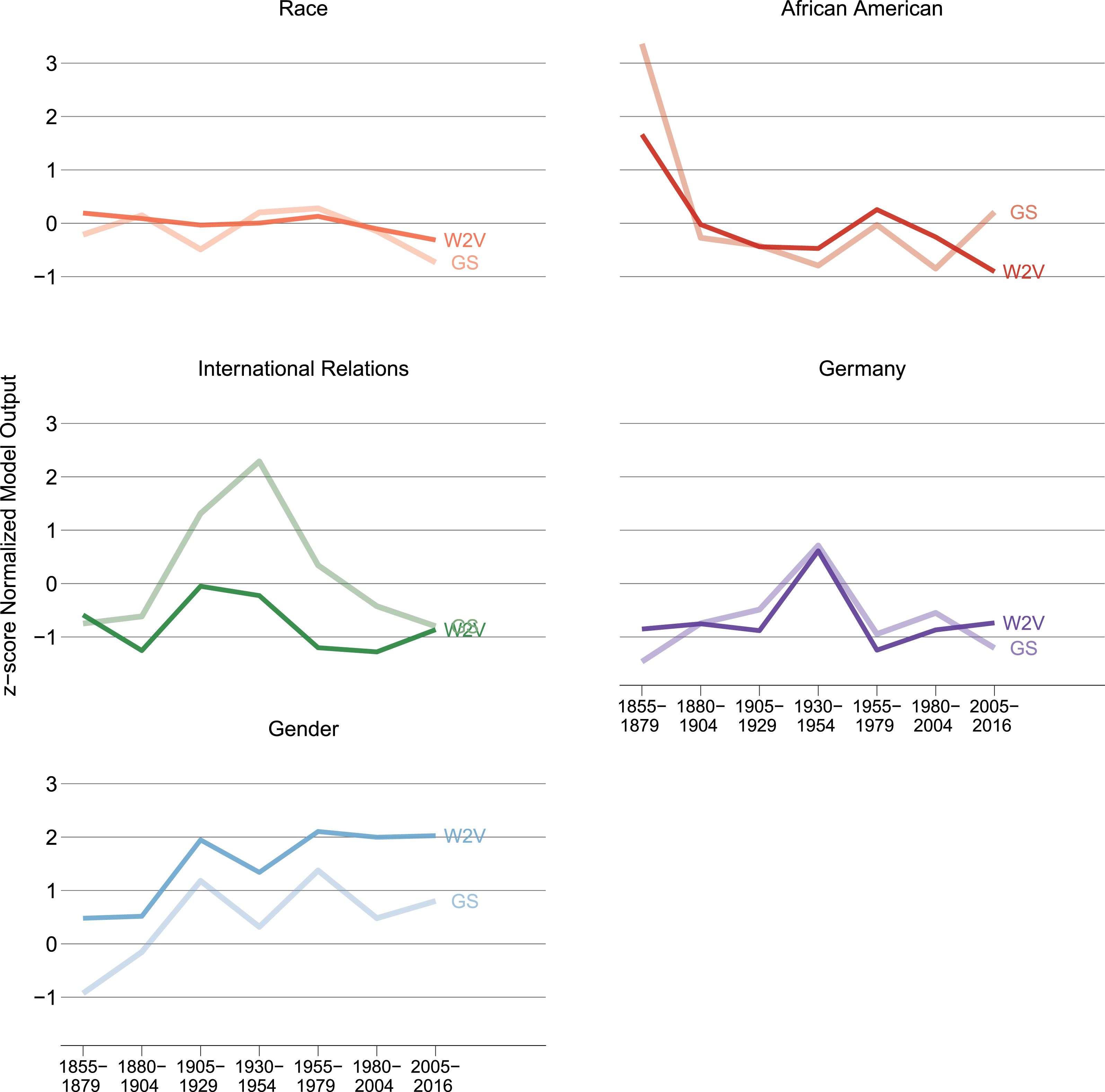
While the chronologically trained model provides the overall best word2vec implementation to track semantic shifts, model performance across certain eras and on certain topics provides additional guidance about the limits of word vectorization methods. As described above, the NYT equality corpus is not large by machine learning standards, and time slices at the beginning and the end of the corpus are particularly sparse. Much of the deviation from the gold standard in the chronological model is centered in those eras; for instance, the 1855
 $(n=80)$
and 2005 eras underestimate African American, while gender is overestimated in both eras.
The chronological model also displays limitations on the general international relations topic, roughly reproducing the trend line but not the magnitude of change in that topic (see Figure 3). This is likely an artifact of the limitations of the validation test itself. While other topics are more closely replicated by a single word (“German,” “race,” etc.), the international relations topic is more of a cluster of concepts, where the test word chosen (“treaty”) is likely to capture the rough directionality and shape but not the full magnitude of equality’s changing closeness to international relations. As one would expect, this limitation in the ability to reproduce magnitude is most pronounced during the extreme spike in equality rhetoric in international relations in the lead up to, and aftermath of, World War II.
Chronologically Trained word2vec Model Compared to Gold Standard.

6.2 Recommendations and Best Practices
For practitioners in the social sciences and humanities, word vectors can offer illumination into large corpora, helping to track semantic changes over time. Like all methods, word vectorization is not a substitute for expert knowledge of a substantive topical area; it will complement a thorough exploration of the corpus via spot reading, subject matter familiarity with the context of production, and other computational methods of exploration, like word counts and looking at keywords in context. In other words, as with all unsupervised computational approaches to text as data, external validation of model results is crucial (Grimmer and Stewart Reference Grimmer and Stewart2013).
Backed by this knowledge, word vectorization models can be implemented in ways that increase confidence in the robustness and stability of their results. Bootstrapping as implemented in this paper is strongly recommended to generate stable cosine similarities and confidence intervals. While this can be computationally intensive, experiments in the literature (Antoniak and Mimno Reference Antoniak and Mimno2018) and in the course of this project show that cosine similarities stabilize at between
 $n=25$
and
 $n=50$
bootstrapped samples; sparse corpora or time slices would benefit from doubling that number. Based on the outcomes of the tests on this particular project’s corpus, analysts should seek time slices with as many texts as possible; depending on document length and how closely each text relates to the words under consideration in the analysis, this analysis suggests that between 100 and 500 documents is a reasonable minimum per slice.
As I have shown, for this data, modeling time slices using a chronologically trained approach best replicates the underlying semantic relationships in the corpus over time. While the generalizability of these results on a variety of data sets was not tested, the literature on transfer learning gives a theoretical basis from which to assume that word2vec implementations relying on pretrained vectors (in this case, pretrained on the full corpus) will do a better job of modeling semantics in small corpora in general.
Finally, word vector approaches are most effective for studying a single word, rather than analyzing more diffuse notions that might be captured by a topic or word cloud. In other words—as I emphasize in the next section—word vectorization is not a replacement for topic modeling. Once the analyst has identified words of interest, language stabilization needs to take place on the corpus prior to processing. Again, subject matter knowledge and spot reading in the corpus is an important guide to this process. For some words, stemming is all that is required; for others, as in the African American concept in this project, complex political and social processes have dramatically shifted synonyms over time, resulting in the need for more involved preprocessing stabilization steps.
7 Diachronic Analysis in the Field: “Social Equality”
As I have described, the corpus used to test these model implementations was constructed specifically to facilitate comparability between supervised topic model outputs and word vectorization outputs. In this analysis, the corpus was limited to a subset of articles which were explicitly about equality, the analysis was locked into certain topics to compare to equality once the ReadMe codebook was finalized, and coders had to be trained and paid to produce gold standard documents with which to train the ReadMe model. These steps were necessary to empirically validate which diachronic implementation performed best on semantic tasks, but do not reflect how analysts will typically use or validate word vector models “in the field.”
In other words, far fewer limits exist on most word2vec analyses. While relatively robust to scarcity, generally word vector analyses benefit from training on as many corpus documents in each era as are available. Additional word–word pairs can be added to the analysis with relative ease, compared to the expense and inconvenience of manual recoding to add new word–topic pairs to a ReadMe model, allowing word2vec to be used as an exploratory method. In addition—and most important in terms of its methodological utility—there is far greater nuance available in the word–word analysis of semantics that word2vec can perform than was clear in the word–topic analysis of this project’s validation test. This is because the number of discernible document topics is extremely limited compared to the number of possible word–word pairs of interest. Many single word–word pairs cannot be replicated by a corresponding word–topic pair, yet may be highly semantically revealing. It is in the ability to analyze these word–word pairs that word vector methods demonstrate their unique utility for political scientists over other existing text-as-data methods.
To demonstrate both the additive flexibility of the model and the semantic utility of word–word pairs over word–topic pairs, I used the trained chronological model outlined above to analyze a new word–word pair: “social” and “equality.” Social equality is a complex, often euphemistic term of art used by American leaders after the Civil War; the words are often but not always used next to each other. Booker T. Washington, for instance, in his famous “Atlanta Compromise Speech” on race relations in the South, described how “in all things that are purely social we can be as separate as the fingers” while also explicitly referencing social equality in his assertion that “the agitation of questions of social equality is the extremest folly” (Washington Reference Washington and Harlan1895/1974). Because it is often used indirectly, vaguely, or obliquely, is a common word in other contexts, and when conceptually paired with equality references a wide range of substantive topics, tracking the relationship of social to equality over time is not tractable with either a topic model or word count approach.
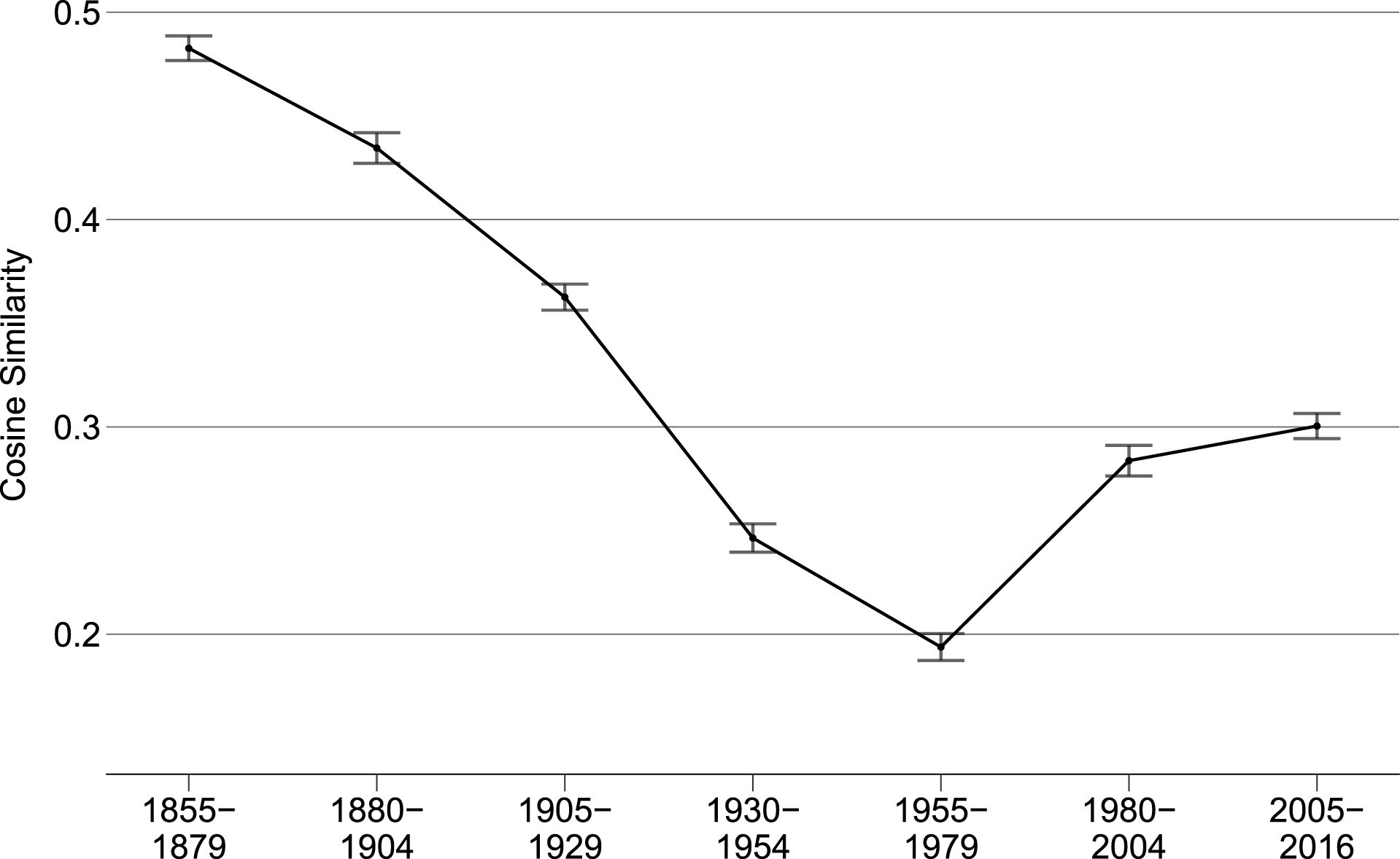
Word vectorization, however, is admirably suited to the task of tracking the prominence of this “social” meaning of “equality.” The proximity of “social” and “equality” in vector space directly reflects their semantic proximity in a given time slice in a given corpus. Figure 4 plots the cosine similarities of this pair over time.
“Equality” - “Social” Cosine Similarity (with 95% confidence interval).

The close proximity of social to equality—as high as gender and race in the first two eras—trails off as we approach the Civil Rights era. Scholars know social equality was a euphemistic stand in for fears of miscegenation and aversion to black–white intimacies of all types. Given this, the declining proximity of social to equality in the lead up to the Civil Rights movement and legal victories like Loving v. Virginia (1967), which struck down state laws banning interracial marriage, tracks expectations. That the decline of social equality began before the Civil Rights era might spark considerations about the importance of diminishing such social stigma as a precursor to changes in laws and institutions.
Figure 4 also revealed an unexpected feature of the corpus—the re-emergence of “social” as an important facet of equality’s meaning in the most recent eras. Here the results sparked additional close reading of the corpus to determine what this re-emergence might signify. Is it a return to certain kinds of euphemistic racial stigmatization? Or is this a new valence of social equality that has emerged?
Close reading of the corpus in later eras suggests that the conjoint meaning of social and equality has expanded from a racial euphemism to also capture economic relationships. Phrases like “economic equality,” “social issues,” and “social justice” are used together, and social dimensions of equality are mentioned in articles about access to elite institutions like private golf clubs and Ivy League universities. At the same time, “social” has taken on a new negative valence, with some articles decrying an emphasis on social justice or social equality, where the “social” modifier—like in the Reconstruction era—serves as a euphemistic stand in for some vague, undeclared racial and economic agenda to which the writer is opposed.
8 Conclusion
By close reading, a political theorist can produce an admirable semantic analysis of how the meaning of rights discourse shifts between John Locke’s Second Treatise of Government (with a mere 28 mentions of rights) and The Federalist Papers (with a still-manageable 152 mentions). While such an analysis is interesting in itself, and well within the capabilities of a single reader, we can easily imagine interesting cases which would exceed those capabilities. Computational methods can expand the universe of texts we can consider, and such methods have, among many other successes, already facilitated broader inquires into the meaning and development of words like rights (see de Bolla Reference de Bolla2013). Here, I have shown how word2vec can reveal the changing meaning of a single word like “equality” in a modest corpus of newspaper articles. In addition to tracking general trends in the meaning of equality as it relates to gender, race, and international relations, my analysis also highlights the granularity that is possible with word vector models: with my chronologically trained model, I show that the prominence of the idea of “social equality” inversely tracks racial progress, demonstrating unexpected commonalities between the post-Reconstruction era and the contemporary moment.
Word vectorization is a particularly promising computational method that has the ability to track the evolution of single words like rights or equality over time by tracking the cosine similarities of pairs of words. While computational linguists have shown how word vectorization of single corpora can produce impressive results on word analogy and synonym tasks, this project has highlighted the utility of word vector methods for more complex semantic tasks over time periods in which the cultural meanings of words evolve. By attention to details of implementation (bootstrapping, language stabilization, and chronological training), analysts can confidently discover semantic trends in corpora, a development which should be broadly interesting to scholars studying the evolution and history of ideas and concepts, and their relationship to politics, society, economics, and culture. Whether as an exploratory tool, as a means of validating close-reading insights from a small corpus on a much larger corpus of texts, or as a mechanism of producing free-standing analyses of vast corpora, word vectorization methods offer political scientists a useful strategy for treating texts as data to reveal changes in the meanings of concepts and ideas over time.