Introduction
Haiti is one of the poorest countries in the Western Hemisphere, 1 and among nations in the Americas, it has the highest child and adult mortality rates. Estimates from 2010 show a mortality rate of 165 per 1000 Haitian children under five, and a maternal mortality ratio of 350 per 100,000 live births (a figure more than four times that of the regional average). 2 , 3 The mortality rate due to preventable injuries in Haiti is estimated at 52 per 100,000 annually, with 56% of child deaths in 2010 attributed to injuries. 4 , 5
Although implementation of prehospital systems has been shown to be effective in reducing time-to-treatment and mortality in low-income settings,Reference Husum, Gilbert, Wisborg, Van Heng and Murad 6 - Reference Murad, Issa, Mustafa, Hassan and Husum 8 and is considered a critical component of health systems in low-income countries,Reference Kobusingye, Hyder, Bishai, Hicks, Mock and Joshipura 9 - Reference Anderson, Suter, Mulligan, Bodiwala, Razzak and Mock 11 it is often a late intervention in public health development.Reference Anderson, Suter, Mulligan, Bodiwala, Razzak and Mock 11 As in most resource-limited nations, prehospital care throughout Haiti is underdeveloped or nonexistent. Although health surveillance systems have been implemented in reaction to the postearthquake population displacement and ensuing cholera epidemic, 12 - Reference Barzilay, Schaad and Magloire 14 no standardized surveillance for prehospital needs has been undertaken. The North East Department of Haiti has a population of approximately 300,000 people and is one of the poorest regions in the country. 15 The Fort Liberté Hospital is a Ministry of Public Health and Population facility that is the primary referral center serving the health needs of the region. Similar to the majority of the country, no formal prehospital care system or surveillance of prehospital needs exists in the North East Department of Haiti.
Taking into account the absence of prehospital systems and the lack of information on out-of-hospital characteristics in the North East Department of Haiti, it follows that data are needed to understand and guide emergency prehospital development in the region. This cross-sectional observational study aimed to describe baseline prehospital characteristics in the North East Department using a hospital-based surveillance protocol.
Methods
Ethics Statement
The study was approved by the Institutional Review Board of the State University of New York Downstate Medical Center (Study number: 12-041, Brooklyn, New York USA) and the administration of Fort Liberté Hospital (Fort Liberté, North East Department, Haiti).
Study Design, Participants, and Setting
This hospital-based, cross-sectional, observational study was undertaken in the Fort Liberté district of the North East Department of Haiti, a low-income setting which lacks formal prehospital services. Data were collected from patients presenting at the public regional referral health center, Fort Liberté Hospital, from April 2, 2012 through June 5, 2012. All patients presenting for nonspecialty care were eligible for participation. Specialty services were excluded as they represented scheduled follow-up visits.
Medical records and patient censuses maintained at the Fort Liberté Hospital included no data on prehospital information. Nonspecialty patients are treated in either the Ambulatory Care Clinic or the Emergency Care Department. The Ambulatory Care Clinic functions on weekdays during daytime hours, and is staffed by a variable number of nurses and registrars (medical doctors in their first postgraduate year). Nearly all ambulatory care patients are nonscheduled, walk-in evaluations. The Emergency Care Department is the only 24-hour health care delivery area in the hospital, and is staffed by multiple nurses and at least one registrar. The department has a triage station, six treatment beds, and a waiting area in which medical care is also provided.
Procedures and Data Collection
The data collection tool (Appendix, online only) was developed via structured focus group discussions among research personnel and providers from Fort Liberté Hospital. The tool was reviewed and piloted by local health care practitioners and was found to identify consistently and comprehensively common mechanisms of access and needs for health assessments specific to the population. The study questionnaire was created in English and translated into Haitian Creole by a medical translator indigenous to the North East Department. For verification, the tool was back-translated independently from Haitian Creole to English with near perfect convergence. All practitioners staffing the Fort Liberté Hospital were trained in study protocol and standardized data collection via interactive, informational sessions.
As has been previously employed for prehospital surveillance in low-income settings, a hospital-based surveillance protocol was used.Reference Mtonga and Zavala 16 - Reference Omoke, Chukwu, Madubueze and Oyakhiolme 18 Data gathering was integrated into standard treatment. At time of presentation, patients were informed of study activities and the risks and benefits of participation via a written information sheet, or by having the information read to them by staff. After participant questions were addressed, verbal consent for data collection was requested from either the patient or, in the case of children (those <18 years of age and accompanied by an adult), the caregiver. If consent was obtained, enrolled participants had a questionnaire administered by hospital staff trained in study protocols. For stable patients, data collection was undertaken during the initial interaction between provider and patient. For patients in extremis, attainment of consent and data collection were carried out after clinical stabilization. Completed data forms were placed in a locked cabinet and collected weekly for entry into a password-protected database.
Statistical Methods
Data analysis was performed using STATA version 10.0 (College Station, Texas USA). Descriptive analyses were undertaken for the overall study population, and for subpopulations stratified by reason for presentation as either traumatic or medical (nontraumatic). Inferential analysis compared variables based on categorization for presentation (traumatic versus medical). For categorical variables, differences were assessed using Pearson X 2 tests. For continuous variables, frequency distributions were examined graphically and either independent sample t tests or Mann-Whitney U tests were used for normally and non-normally distributed samples, respectively. Measures of effect were calculated using odds ratios with 95% confidence intervals. A significance level of P < .05 was used in all analyses.
To better delineate characteristics among acutely-injured or ill patients, an a priori subgroup analysis of participants presenting within 24 hours of onset of their health needs was undertaken. Duration of transport was calculated based on the difference between time of onset of health need and time of hospital presentation. Reason for seeking care was limited to a single categorical variable. For medical patients, the primary reported concern was recorded, while for trauma patients, the most significant injury identified by hospital staff was used. Road traffic accidents (RTAs) were identified as the primary traumatic injury only in the absence of other identifiable traumatic injuries.
Mortalities were recorded if patients were brought to the hospital postmortem or expired within the first hour of treatment. Additionally, Fort Liberté City municipal records were reviewed at study conclusion to access reported deaths among prehospital patients who did not present to the hospital. To assess robustness in data capture, clinic and department censuses were reviewed at the completion of data collection, and census counts were compared with the number of enrolled participants. Data collection in the Emergency Care Department was explored, based on time of day, to assess temporal variation in data capture.
Results
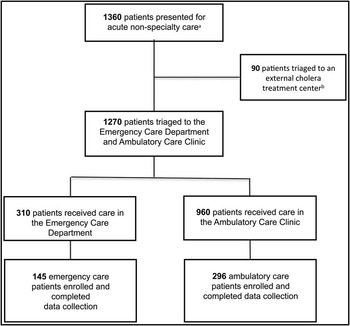
A total of 1,360 patient encounters were recorded during the data collection period. Ninety (6.6%) encounters were treated at an external cholera facility located adjacent to the Fort Liberté Hospital. Among the remaining 1,270 patient visits, 310 (24.4%) were treated in the Emergency Care Department and 960 (74.6%) were treated in the Ambulatory Care Clinic, respectively. Study data were collected from 441 patient encounters, with 145 (32.9%) from the Emergency Care Department and 296 (67.1%) from the Ambulatory Care Clinic (Figure 1). All patients screened agreed to consent and were enrolled.
Study Population
aSpecialty care represents patients presenting for obstetrical, gynecological or dental services.
bPatients with symptoms consistent with cholera infection were treated at an external cholera center located adjacent to the Fort Liberté Hospital.

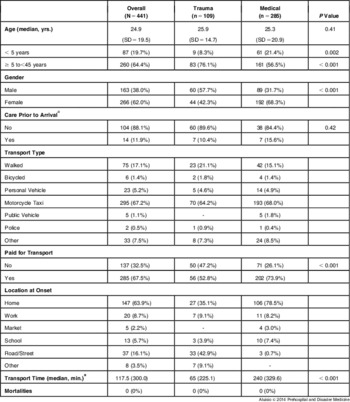
In the overall study population, the median age was 24 years. Approximately one-third of study participants were under 18 years of age and 19.7% were under than five years of age. The primary modalities of patient transportation were motorcycle taxis (67.2%) and walking (17.1%). More than two-thirds of patients paid transportation fees. Among patients whose onset of reason for seeking care was within 24 hours of presentation, 11.9% reported receiving treatment prior to reaching the hospital (Table 1). Oral analgesics and traditional therapies (predominately medicinal teas) accounted for 70% of reported prehospital care. No patients were brought to the hospital postmortem, nor did any deaths occur during the first hour of hospital treatment (Table 1). There were 35 deaths reported to the Fort Liberté City municipal offices during the period of data collection.
Patient and Prehospital Characteristics

aRepresents only patients who reported onset of their health concerns within 24 hours prior to presentation.
Trauma patients accounted for 24.7% of the population sampled, while patients presenting for medical concerns comprised the remainder. Patients with traumatic injuries were more commonly treated in the Emergency Care Department, while medical concerns were serviced predominantly in the ambulatory care setting (P < .001). There was no statistical difference in median ages between trauma and medical patients. Among patients under five years of age, reasons for presentation were significantly more likely to be identified as medical versus traumatic (P = .002) (Table 1). Males were approximately three times more likely to present for traumatic injuries as compared with females (OR = 2.94; 95% CI, 1.83-4.74; P < .001). No statistical difference existed in receiving care prior to arrival based on whether the patients were presenting for traumatic versus medical needs. Medical patients most frequently reported onset of need for medical care from a home setting (78.5%), whereas trauma patients most frequently reported onset in the road/street setting (42.9%) (Table 1).
Among patients whose reason for presentation began within 24 hours of hospital arrival, motorcycle taxi remained the predominant mode of transport (67.5%). In the same subgroup, excluding patients who reported walking or coming by personal vehicle, those with traumatic injuries were approximately nine times more likely to report free transport as compared with medical patients (OR: 9.10; 95% CI, 2.19-37.76; P < .001). No statistical difference in the likelihood of payment for transport existed between medical and trauma patients if the respondent reported that the reason for presentation began greater than 24 hours prior to hospital arrival (OR = 0.81; 95% CI, 0.22-3.02; P = .76).
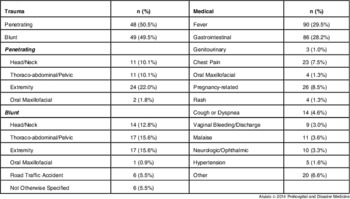
Among trauma patients, there was an even distribution of blunt and penetrating injuries. Extremity trauma accounted for 22% of prehospital penetrating injuries. The most common subclassifications of blunt trauma were thoraco-abdominal/pelvic (15.6%) and extremity injuries (15.6%). Motor vehicle accidents without an identified primary traumatic injury were reported in 6.6% of patient encounters. The most frequently reported prehospital reasons for seeking care among medical patients were fever (29.5%), gastrointestinal complaints (28.2%), pregnancy related concerns (8.5%), and chest pain (7.5%) (Table 2). For children less than five years of age, fever and gastrointestinal complaints accounted for 50.8% and 21.3% of all acute care medical visits.
Reasons for Seeking Care

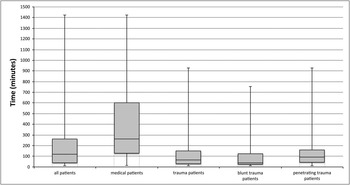
For respondents whose reason for presentation began within 24 hours prior to hospital arrival, median transport time was 117.5 minutes (SD = 300.0). Transport time was significantly lower among trauma victims as compared with medical patients (P < .001) (Table 1). Median time of transport was 240 minutes (IQR = 120-500) and 65 minutes (IQR = 30-150) among medical and trauma patients, respectively. For blunt trauma patients, the median transportation time was 40 minutes (IQR = 25-145), and among those presenting with penetrating trauma, median duration was 93 minutes (IQR = 45-161) (Figure 2). As compared with penetrating trauma patients, blunt trauma patients showed a trend toward a greater likelihood of presenting for treatment within the first hour after injury (OR = 3.17; 95% CI, 0.94-10.7; P = .05).
Transport Timea
aAnalysis includes only patients who reported onset of their health concerns within 24 hours of hospital presentation.

In the overall study population, 34.7% of patients who presented for acute nonspecialty care were enrolled and had data gathered through the survey tool. Among emergency care encounters, 47.8% of visits were captured, while data from 30.9% of ambulatory care patient encounters was accrued (Table 3). In the 24-hour Emergency Care Department, 91.4% of data acquisition occurred between the hours of 6 am and 6 pm.
Data Acquisition

aRepresents patients not seen in the cholera treatment center, obstetrical, gynecological, or dental clinics.
Discussion
This study provides the only available data on prehospital characteristics from the North East Department of Haiti. The majority of patients sought care for medical needs, and injuries accounted for approximately one-quarter of encounters. Receipt of prehospital care was rare in the population, and motorcycle taxis were the predominant mode of transport. Trauma victims presented in a comparatively shorter time period than medical patients, and transportation had a greater likelihood of being free for injured patients.
Globally, traumatic injuries are common, and they are projected to increase with a disproportionate burden in low-income countries.Reference Mathers, Boerma and Ma Fat 19 , Reference Patton, Coffey and Sawyer 20 Similar to global trends, the present study found that males were more likely to report traumatic injuries, and patients were primarily transported from a road/street setting.Reference Mutasingwa and Aaro 21 - 23 Counter to previous reports from low-income areas, the most frequent anatomical location of trauma in this setting were extremity injuries.Reference Hyder, Wunderlich, Puvanachandra, Gururaj and Kobusingye 24 This discrepancy may be a result of sampling bias. Data collection was hospital-based and subsequently, patients with injuries who failed to present for treatment were not sampled. It is possible that this skewed the distribution of observed injuries, as severely injured patients may have expired in the field and this data may not have been captured. Similarly, as out-of-hospital mortality in low-income settings is known to be high, the sampling frame also may account for the lack of deaths observed during data collection.Reference Wisborg, Murad, Edvardsen and Husum 7 , Reference Mock, Jurkovich, nii-Amon-Kotei, Arreola-Risa and Maier 25 , Reference Henry and Reingold 26
As has been reported previously, in the absence of formal prehospital care systems, laypersons respond and provide transport.Reference Kobusingye, Guwatudde, Owor and Lett 22 , Reference Mock, Tiska, Adu-Ampofo and Boakye 27 , Reference Jayaraman, Mabweijano and Lipnick 28 Additionally, studies have shown that laypeople trained as community first responders provide such services and retain their knowledge.Reference Mock, Tiska, Adu-Ampofo and Boakye 27 , Reference Jayaraman, Mabweijano and Lipnick 29 In the population studied, transport primarily was achieved via motorcycle taxi drivers, and transport times were congruent with those documented in other low-income settings.Reference Husum, Gilbert, Wisborg, Van Heng and Murad 6 , Reference Murad, Issa, Mustafa, Hassan and Husum 8 Given the already active role among motorcycle taxi drivers, this cohort represents an important access population for the provision of emergency care in the development of services in this area of Haiti. Prehospital models composed predominately of first responders have been associated with reduced trauma mortality in rural Iraq and Cambodia,Reference Husum, Gilbert, Wisborg, Van Heng and Murad 6 and it is feasible that in the rural region studied here, a lay-provider model designed to stabilize and rapidly transport patients may yield similar outcomes. Further study exploring the hypothesis of a lay-provider model in this setting would be beneficial before investing in the development of advanced Emergency Medical Services (which may not necessarily result in larger gains than could be obtained with a basic skills community intervention).
The most frequent medical reason for seeking acute care was febrile illnesses, indicating communicable diseases as the predominate etiology in the setting studied. Given the high burden of malaria in Haiti, these findings fit the health profile of the country and support accuracy in the data. 2 Treatment with antimalarial medications is suboptimal in Haiti, with only five percent of febrile children receiving treatment. 23 In low-income settings, treatment algorithms utilizing cellular phone communications have been developed for out-of-hospital community management of fever and suspected malaria,Reference Prue, Shannon and Khyang 30 , Reference Zurovac, Sudoi and Akhwale 31 and may have application in the setting described here. Such field-based algorithms could be integrated into both lay-provider and more advanced prehospital systems and represent a venue for future study.
Limitations
As previously discussed, the hospital-based data collection inherently suffered from sampling bias and this must be considered in interpretation of the results. However, in settings without formal surveillance systems, institution-based data collection has been utilized to provide an initiation point for defining prehospital needs.Reference John, Mohammed and Lawoko 32 , Reference Zavalaa, Bokongo and John 33 In the low-income setting studied here, which lacks surveillance systems, data collection was feasible and required minimal resource allocation. The cross-sectional design of this work fails to provide information on disease incidence that may be important in guiding development of prehospital care. As both communicable diseases and traumatic injuries have epidemiologic variability over time, future work aimed at providing longitudinal data would be beneficial in defining prehospital characteristics in this setting.Reference Fisman 34 , Reference Friede, Osborne and Erickson 35 In ascertaining the reason for seeking care, a single parameter was used. Although this methodology improved data acquisition, it did not allow for characterization of polytraumatic injuries or multiple reasons for seeking care, and may have underestimated the prevalence of certain health needs in the population. This was likely the case in relation to RTAs, where the observed prevalence was lower than reported figures from similar low-income settings.Reference Mutasingwa and Aaro 21 , Reference Ameratunga, Hijar and Norton 36
Conclusions
Although recognized as key in health systems development,Reference Kobusingye, Hyder, Bishai, Hicks, Mock and Joshipura 9 , Reference Henry and Reingold 26 prehospital care has been neglected in Haiti. This work provides baseline data on prehospital characteristics in the North East Department, with the aim of informing the development of local emergency care systems. The data show that out-of-hospital care is rare in the region, and that potential access points exist for the development of interventions. The results suggest that motorcycle taxi drivers in the region already function in a prehospital role and may represent a lay population suited for the provision of care and transport in the out-of-hospital setting. Although these findings begin to provide an understanding of characteristics to guide the development of prehospital response systems, additional research is needed to further define health needs and appropriate interventions in the North East Department of Haiti.
Acknowledgements
The authors would like to thank all the study participants, the Fort Liberté hospital staff, and the Haitian Ministry of Public Health and Population. The authors acknowledge Dr. Ruby Kesar, Dr. Alex Brevil, Dr. Lisa Meister, and Dr. Susan Cheng for their invaluable fieldwork. The authors would like to thank Dominique Bruno and Rachel Bruno for providing translation services.