Introduction
Mild cognitive impairment (MCI) is often a transitional phase between normal aging and dementia (Petersen et al., Reference Petersen2001). Some have suggested that MCI should be considered a crucial stage for the provision of non-pharmacological approaches addressing both cognitive and psychosocial features because these individuals still have the ability to learn and use new strategies (Belleville, Reference Belleville2008). Cognitive interventions in MCI have been the focus of a growing number of studies. Many have focused on episodic memory deficits (Rapp et al., Reference Rapp, Brenes and Marsh2002; Belleville et al., Reference Belleville, Gilbert, Fontaine, Gagnon, Menard and Gauthier2006; Troyer et al., Reference Troyer, Murphy, Anderson, Moscovitch and Craik2008; Jean et al., Reference Jean2010b). Some have targeted a range of cognitive functions, including memory as well as attention, processing speed, language, visual-spatial abilities, and/or executive functions using multifaceted computerized programs (Cipriani et al., Reference Cipriani, Bianchetti and Trabucchi2006; Rozzini et al., Reference Rozzini, Costardi, Chilovi, Franzoni, Trabucchi and Padovani2007; Kinsella et al., Reference Kinsella2009; Buschert et al., Reference Buschert2011; Gagnon and Belleville, Reference Gagnon and Belleville2012). These interventions have been generally shown to be effective ways to improve cognition in MCI (Gates et al., Reference Gates, Sachdev, Fiatarone Singh and Valenzuela2011; Li et al., Reference Li, Li, Li, Li, Wang and Zhou2011; Teixeira et al., Reference Teixeira, Gobbi, Corazza, Stella, Costa and Gobbi2012; Huckans et al., Reference Huckans, Hutson, Twamley, Jak, Kaye and Storzbach2013). However, there are few published randomized controlled trials (RCT) to date and generally, the number of participants is small. Furthermore, many of those RCTs used non-active control groups (e.g. waiting list) and/or did not examine long-term treatment effects. Recent reviews (Belleville, Reference Belleville2008; Jean et al., Reference Jean, Bergeron, Thivierge and Simard2010a; Teixeira et al., Reference Teixeira, Gobbi, Corazza, Stella, Costa and Gobbi2012; Huckans et al., Reference Huckans, Hutson, Twamley, Jak, Kaye and Storzbach2013; Reijnders et al., Reference Reijnders, van Heugten and van Boxtel2013) and a Cochrane review (Martin et al., Reference Martin, Clare, Altgassen, Cameron and Zehnder2011) recommended the use of larger sample sizes, more robust experimental designs with active control groups, and long-term follow-ups to strengthen the evidence supporting cognitive interventions in MCI. In addition, few studies on MCI have included boosters. Boosters refer to providing brief reinstantiation of the training content at later intervals following training. These were found to have positive effects on the maintenance of training gains (Willis et al., Reference Willis2006) but have not been used extensively in persons with MCI in spite of the fact that long-term maintenance is a crucial goal in cognitive training.
The non-cognitive features of MCI have also received a lot of attention in the literature (Lyketsos et al., Reference Lyketsos, Lopez, Jones, Fitzpatrick, Breitner and DeKosky2002; Winblad et al., Reference Winblad, Palmer, Kivipelto and Fratiglioni2004; Apostolova and Cummings, Reference Apostolova and Cummings2008). Behavioral and mood alterations are common (e.g. depression, apathy, anxiety, and irritability) and some level of psychological distress can be observed in nearly half of individuals meeting the criteria for MCI (Feldman et al., Reference Feldman2004; Modrego and Ferrandez, Reference Modrego and Ferrandez2004; Geda et al., Reference Geda2006; Palmer et al., Reference Palmer, Berger, Monastero, Winblad, Backman and Fratiglioni2007). There has been growing interest in interventions that target the psychological distress of persons suffering from MCI. Although few studies have published data on psychosocial interventions in MCI, results are promising. One study indicates that a multifactorial intervention combining elements of psychoeducation, cognitive rehabilitation, and cognitive-behavioral therapy helps patients with MCI to better accept their chronic condition and deal with their uncertain future (Joosten-Weyn et al., Reference Joosten-Weyn Banningh, Kessels, Olde Rikkert, Geleijns-Lanting and Kraaimaat2008). Another study indicated that the mood of patients with MCI improved significantly following a rehabilitation program that included relaxation techniques and stress management (Kurz et al., Reference Kurz, Pohl, Ramsenthaler and Sorg2009). However, in both studies, the isolated effect on psychological distress of psychosocial components – relative to the cognitive training part – was not assessed. There is thus a need to devise and test psychosocial interventions and compare their effects with those of cognitive training.
The main goal of the present study is to test and compare the efficacy of cognitive and psychosocial interventions in older adults with MCI with respect to cognitive functions, psychosocial health, and everyday life functioning. This project is a continuation of a series of studies in which the effect of memory intervention, the MEMO program, was assessed in a small group of persons with MCI and healthy older adults (Belleville et al., Reference Belleville, Gilbert, Fontaine, Gagnon, Menard and Gauthier2006). Comparison of pre-intervention performance with post-intervention performance indicated positive intervention effects on delayed recall and face–name association, and no test-retest effect in a group of persons with MCI and healthy older adults who did not receive any intervention. It was also found that the MEMO program was associated with increased activation in brain areas that are involved in the types of strategies learned during the program (Belleville et al., Reference Belleville, Clement, Mellah, Gilbert, Fontaine and Gauthier2011).
The design of the Memo+ study includes many unique components relative to previous studies, which are as follows: (1) It includes and compares two types of interventions, psychosocial and cognitive training, that are meant to have an effect on different outcome measures; (2) the number of participants is based on a power analysis of pilot data to allow for the use of more stringent statistics; (3) a three-group randomized controlled design is used with randomization to psychosocial intervention, cognitive intervention, or a no-contact condition; (4) the psychosocial intervention encompasses a wide range of evidence-based cognitive-behavioral strategies; (5) maintenance will be measured after three and six months; (6) measures are included to assess whether the strategies taught are used in daily life; (7) the study will examine the effect of a number of cognitive (general cognitive functioning), some socio-demographic (age, gender, and level of education), and psychological factors (personality, self-efficacy) that are likely to impact the efficacy of training; and finally (8) the study includes a booster session.
Objectives and hypotheses
Patients will be randomized into three intervention conditions: (1) cognitive training; (2) psychosocial intervention; and (3) no contact. The first objective of this project is to assess whether cognitive training in persons with MCI improves their cognitive abilities and the ease with which they deal with complex everyday activities that require such abilities. The second objective is to assess whether a psychosocial intervention improves the psychological health of individuals with MCI by reducing anxiety and depressive symptoms and improving their general well-being.
Participants in the cognitive training group are expected to obtain higher memory scores than participants in the other two groups (psychosocial intervention group and no-contact control group) on the memory tasks administered at post-test 1, i.e. one week after the end of intervention. Better performance is also expected at post-test 2 (three months post) and post-test 3 (six months post) when comparing the group that received cognitive training with those receiving the psychosocial or no intervention. Participants in the psychosocial intervention group are expected to obtain better scores at post-test 1 than the pre-test for psychological health measures in comparison with participants in the other two groups. This improvement is expected to be maintained at post-tests 2 and 3. Prior studies suggested that cognitive training might also improve psychological health measures, but we hypothesize that the improvement would be less pronounced and/or durable compared with the psychosocial intervention. For complex daily living activities, better performance is expected from participants enrolled in the cognitive intervention program relative to the other two groups. These participants should also increase their use of memory strategies in daily life.
Methods
The MEMO+ study is registered with the US National Institutes of Health clinical trials registry (ClinicalTrials.gov Identifier: NCT01448148).
Design
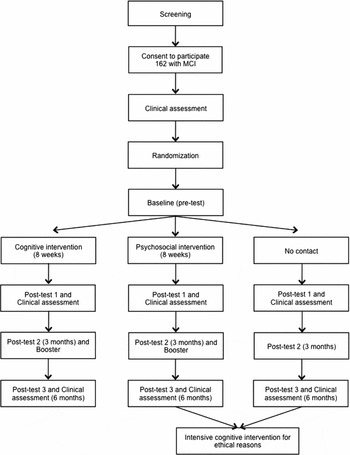
The study design is presented in Figure 1 in line with the Consolidated Standards of Reporting Trials (CONSORT) statement (Begg et al., Reference Begg1996). The participants in the cognitive and psychosocial intervention groups participate in eight intervention sessions. Outcomes include memory tests, psychosocial health measures, and complex activities of daily living and are measured prior to training (after allocation), one week after training (post-test 1) as well as three months (post-test 2) and six months (post-test 3) after training. One booster session is provided three months after the intervention, just after post-test 2. During this six-month post-training period, participants from the three groups are contacted by telephone every two weeks for follow-up. This is expected to help reduce the attrition rate and maintain therapeutic gains. In total, each participant will take part in the study for a period of ten months.
Progress through the various stages of the MEMO+ trial. The figure includes flow of participants and timing of each measure.

Study population
Recruitment
The research is carried out at two sites in the Province of Québec (Canada): one in Montréal (IUGM; coordinator site) and the other in Québec City. At both sites, participants aged 55 years and over are recruited from memory and cognition clinics and from neurologist, geriatrician, or neuropsychologist referrals. Clinicians who believe their patients meet the inclusion and exclusion criteria for MCI refer them for further assessment and participation in this project. A research coordinator at each site talks with prospective participants on phone to determine whether they meet the general inclusion/exclusion criteria. Eligible patients are then invited for further investigation. Exclusion criteria include probable or possible AD according to Diagnostic and Statistical Manual of Mental Disorders: Fourth Edition (DSM-IV) and NINCDS–ADRDA criteria (McKhann et al., Reference McKhann, Drachman, Folstein, Katzman, Price and Stadlan1984), other forms of dementia, significant cerebrovascular disorder, presence or history of neurological disorder, severe psychiatric illnesses (major depressive disorder (MDD) with or without suicidal ideation, generalized anxiety disorder (GAD), obsessive-compulsive disorder (OCD), post-traumatic stress disorder (PTSD), and psychotic disorder), alcoholism; general anesthesia in the previous six months, history of head trauma, and significant impairment of physical mobility or manual dexterity. Enrolment began in April 2012 and is expected to be completed around December 2014.
The participants are French-speaking, report normal corrected vision and hearing, and meet criteria for amnestic single- or multiple-domain MCI (Petersen, Reference Petersen2004) based on an analysis of the clinical data. All participants have a memory complaint. They perform at least 1.5 standard deviations (SD) below the average compared with the people of their age on standardized memory tests and score above the cutoff for dementia on the Mini-Mental State Examination (MMSE; 24/30). Their cognitive impairment has no significant repercussions on functional independence based on the clinical interview. Persons with both single- and multiple-domain amnestic MCI were included because these individuals are at high risk of developing AD. Use of over-the-counter agents such as vitamins or omega 3 and medications such as antidepressants, benzodiazepines, or cholinesterase inhibitors (ChEI) are recorded.
The project was approved by the Research Ethic Comities of the Institut Universitaire de Gériatrie de Montréal and Institut Universitaire en Santé Mentale de Québec.
Sample size, attrition, and compliance
The sample size was determined from a power analysis of our pilot data that used the same proximal outcome measures (see Appendix S1 for more details on the calculation of the sample size) (Appendix S1 is available as supplementary material attached to the electronic version of this paper at www.journals.cambridge.org/jid_IPG). If we take into account an expected 15% attrition rate, we calculated that initial recruitment of 162 participants should ensure that about 138 participants remain in the final sample. Halfway in the recruitment period, if the attrition rate differs from the projected rate, recruitment will be modified accordingly. To reduce attrition, many strategies are used, such as regular phone calls and wish cards. The characteristics of those who withdraw will be analyzed and intent-to-treat analyses will be used. They will be invited to come for post-tests as well. More details on attrition and compliance can be founded in Appendix S1.
Participants who are present for at least 80% of the interventions and who complete at least 80% of the homework will be considered compliant. In our previous study, more than 90% of our participants were compliant with these criteria (Belleville et al., Reference Belleville, Gilbert, Fontaine, Gagnon, Menard and Gauthier2006).
Randomization and blinding procedure
Participants are randomly assigned to one of the three conditions (cognitive intervention group, psychosocial intervention group, no-contact control group) using a computerized random list. Randomization is centralized and performed at the coordinating site (IUGM) by a statistician not involved in the project. Randomization is done at site, that is, each site has the same number of participants in each condition. It is also done by wave, that is, each time a site has recruited 12–16 participants. Participating sites send participant information to the coordinating site. The coordinating site assigns a code to each participant, and the 15 participants are randomly allocated to a condition. The coordinating site then sends allocation information to the participating site. The person coordinating patient assignment is not involved in training or outcome assessment and is independent from the project. Evaluators involved in outcome assessment are blind to the hypotheses and to participants’ group assignment, and participants in the intervention groups are not informed of the hypotheses (i.e. which intervention is expected to have an effect). As is typical of non-pharmacological intervention trials, they are not blind to their group assignment (i.e. single-blind design).
Interventions
The cognitive and psychosocial interventions are delivered in eight sessions with a similar structure but different content. Sessions are held weekly, and last for two hours with a break. A weekly schedule was chosen to facilitate recruitment – older persons found it easier to fit the intervention in their schedule when it is held once a week – and to allow sufficient time to complete the home exercises. Training is conducted in small groups (five participants per group), as this format has been shown to be more efficacious than one-on-one training (Flynn and Storandt, Reference Flynn and Storandt1990; Scogin and Prohaska, Reference Scogin and Prohaska1992; Verhaeghen et al., Reference Verhaeghen, Marcoen and Goossens1992). To ensure quality control and treatment integrity, many strategies were used such as providing a complete training to each therapists involved in administering the interventions, videotaping “mock” interventions, and audio-taping the sessions. For more details, see Appendix S2 (it is available as supplementary material attached to the electronic version of this paper at www.journals.cambridge.org/jid_IPG).
Cognitive intervention
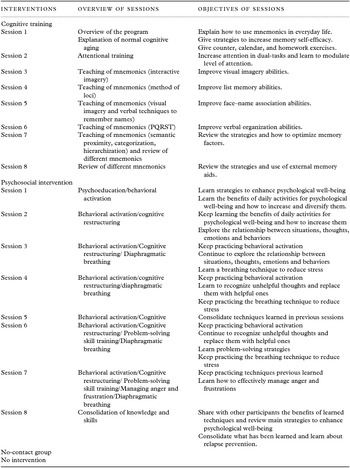
The cognitive intervention (see Table 1 for an overview) is the MEMO program, which is an intervention developed by clinicians and researchers aimed at optimizing memory of elderly persons with and without significant cognitive impairment (Gilbert et al., Reference Gilbert, Fontaine, Belleville, Gagnon and Ménard2007). The program is available in French and English (see www.programme-memo.ca).
Interventions in the MEMO+ project

The MEMO program targets the primary domains of impairment in amnestic MCI, i.e. episodic memory and attentional control (for a review, see Belleville et al., Reference Belleville, Bherer, Lepage, Chertkow and Gauthier2008), and includes a range of episodic memory strategies as well as exercises to increase attentional control (Belleville et al., Reference Belleville, Gilbert, Fontaine, Gagnon, Menard and Gauthier2006; Gagnon and Belleville, Reference Gagnon and Belleville2012). The complete rationale of the intervention is presented in Appendix S3 (it is available as supplementary material attached to the electronic version of this paper at www.journals.cambridge.org/jid_IPG). The program also pays particular attention to increasing memory self-efficacy and reducing the negative perception that older people often have of memory tasks and their memory capacity. Generalization is fostered with (1) homework exercises to practice the strategies in diverse situations (including real-life situation); (2) teaching of multiple mnemonics to increase the likelihood that training components will be appropriate for, and therefore transferred to, daily complex situations requiring memory; and (3) indication of the occasions when particular strategies can be used and when it would be better not to use them.
An overview of the sessions is given in Table 1. In Session 1, the instructor presents an overview of the program and explains different aspects of normal cognitive aging. The discussion focuses on strategies that the participants can use in their home environment to maximize the impact of the training they receive. Another goal of this discussion is to modify, if necessary, the misconceptions that older adults may have about aging and to increase memory self-efficacy. Session 2 is devoted to attention using a simplified adaptation of the program developed by Kramer and colleagues (Reference Kramer, Larish and Strayer1995) and adapted for MCI by Gagnon and Belleville (Reference Gagnon and Belleville2012). Participants are trained in different dual-task conditions to control their attention according to different task priorities: they are asked to vary the priority placed on each task in the dual-task condition to emphasize one or the other. In Session 3, a series of exercises to improve visual imagery abilities and interactive imagery are taught (Yesavage, Reference Yesavage1983). In Session 4, the method of loci is introduced. Participants have to generate and memorize a set of familiar locations in their home environment. When later presented with words to remember, participants are instructed to link each word with a place on their mental map. In Session 5, participants learn to use visual imagery and verbal techniques to learn people's names (face–name associations). In Session 6, hierarchical analyses are used to remember texts. Participants are instructed to use a simplified version of the strategy known as the PQRST method – Preview, Question, Read, State, Test (Moffat, Reference Moffat, Wilson and Moffat1984) – to remember a short passage of text. In Sessions 7 and 8, the strategies learned in the program are reviewed. In addition, Session 7 presents different memory optimizing factors (e.g. lifestyle and attitudes), while in Session 8, external memory aids are presented and discussed.
Psychosocial intervention
The study aims to improve the psychological health of individuals with MCI by reducing anxious and depressive symptoms using a cognitive-behavioral (CBT) approach. The psychosocial intervention includes several components: behavioral activation, cognitive therapy techniques, problem-solving techniques, and stress/anger management strategies (e.g. diaphragmatic breathing, self-assertion techniques). As recommended by Laidlaw and collaborators (Reference Laidlaw, Thompson, Gallagher-Thompson and Dick-Siskin2003), components of CBT were adapted to persons with MCI by including simplified instructions, repetition of information during and across sessions, visual support of information during therapy sessions, use of pictograms and simple analogies, practice during sessions, and simple printed handouts. The complete rationale for the psychosocial intervention is presented in Appendix S3.
An overview of the sessions is given in Table 1. In Session 1, an overview of the program is presented followed by psychoeducation concerning the links between activities, aging, and psychological well-being. Participants are invited to identify satisfactory aspects of their lives and find ways to increase these positive situations or behaviors. Participants are also encouraged to increase their daily activities (behavioral activation), initially by self-monitoring their activities and then by identifying and planning at least one pleasant activity per day. Different types of activities are explored: pleasant (e.g. going to a movie), useful (e.g. helping a neighbor), social (e.g. meeting with friends), or healthy (e.g. physical activity). Session 2 pursues behavioral activation and explores the relationship between situations, thoughts, emotions, and behaviors. Participants are invited to self-monitor situations, thoughts, and emotions during the following week. In Session 3, a diaphragmatic breathing technique is taught. Participants are encouraged to use it daily and practices are provided in all of the following sessions. Session 4 expands the cognitive component to cognitive restructuring, including the identification of potential unrealistic or unhelpful thoughts and the generation of more realistic or helpful thoughts. Session 5 serves to consolidate the new techniques learned in the previous sessions, particularly cognitive restructuring. Session 6 introduces problem-solving skills training, including problems communicating with significant others and coping with stressful life events. Participants are encouraged to use the techniques in the following week to address a particular problem in their personal lives. In Session 7 participants are introduced to strategies to manage anger and frustration (e.g. “time out,” diaphragmatic breathing, replacing anger-related thoughts by more adaptive thoughts). Session 8 serves to consolidate all of the knowledge and skills learned.
Booster sessions
An intensive booster session is provided in both groups three months after the intervention ends (after post-test 2) to ensure that participants maintain acquisition and to enhance generalization and permit consolidation. The booster consists of a single session in which the main content of the intervention program received is reviewed and new exercises are proposed to broaden the spectrum of usage of different procedures and strategies.
Variables and measures
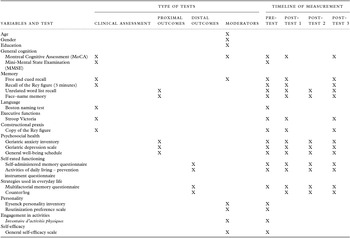
A clinical assessment is done prior to randomization to characterize participants. This is done in a single session. Then for each time point (one pre-test and three post-tests), proximal and distal measures are taken in one session (see Table 2). Each testing session takes no more than 90 minutes to complete. Participants are assessed individually. The order of presentation of the tasks is fixed across participants and precautions are taken to minimize any interference effect between the memory tasks. Alternative versions of the memory and constructional praxis tasks are used for each different time point of measure completion to limit memory bias. All details on the different tests used in this study are reported in Appendix S4 (it is available as supplementary material attached to the electronic version of this paper at www.journals.cambridge.org/jid_IPG).
Variables and tests used in the MEMO+ study

Evaluators at the different sites are in charge of administration of the outcome measures. They are trained by the investigators who are experienced with the outcome measures and complete one “mock” evaluation session that is reviewed for quality control.
Clinical tests
Table 2 gives details on the tests administered to study participants. General cognitive status is tested with the Montreal Cognitive Assessment (MoCA; Nasreddine et al., Reference Nasreddine2005) and MMSE (Folstein et al., Reference Folstein, Folstein and McHugh1975). Episodic memory (free and cued recall; Van der Linden et al., Reference Van der Linden2004), three-minute recall of the Rey Figure (Rey, Reference Rey1959), language (Boston Naming Test; Kaplan et al., Reference Kaplan, Goodglass and Weintraub1983), executive functions (Stroop Victoria; Regard, Reference Regard1981), and constructional praxis (copy of the Rey Figure; Rey, Reference Rey1959) are also evaluated. This neuropsychological assessment is used to ensure that patients meet clinical inclusion criteria and to characterize them. It is used again at post-tests 1 and 3 (without MMSE and the Boston Naming Test) to assess whether patients still meet criteria for MCI, have reverted to normal, or have progressed toward dementia.
Proximal outcome measures
Proximal outcome measures were selected based on our previous studies (Belleville et al., Reference Belleville, Gilbert, Fontaine, Gagnon, Menard and Gauthier2006; Reference Belleville2010; see Table 2) and include measures of memory and psychological health. Proximal outcomes were not a uniform set for the two interventions. Memory measures were used as the proximal outcome for cognitive training whereas psychosocial measures were used as proximal outcomes for psychosocial interventions (see hypotheses above).
Memory measures
Two sets of episodic memory tasks are used: (1) learning of unrelated word lists is tested by presenting lists of 12 frequent and imageable words. All words are presented simultaneously on a piece of paper, and a two-minute study period is allowed to give participants time to use the strategies they were taught. Recall is tested immediately after learning (immediate recall) and after a ten-minute delay (delayed recall). The second list is presented right after delayed recall of the first list and is tested the same way. (2) Face–name memory is tested by presenting a series of 12 face–name associations. Each association is presented for 45 seconds. Then after 30 seconds of interference, each face is presented, and participants are asked to give the associated name. These two tests have been shown to be sensitive to cognitive intervention in MCI (Belleville et al., Reference Belleville, Gilbert, Fontaine, Gagnon, Menard and Gauthier2006).
Psychological health measures
Three psychological health measures are used: (1) the French version of the Geriatric Anxiety Inventory (GAI; Pachana et al., Reference Pachana, Byrne, Siddle, Koloski, Harley and Arnold2007), which is specifically designed to assess symptoms of anxiety in older adults; (2) the French version of the Geriatric Depression Scale (GDS; Yesavage et al., Reference Yesavage1983; Bourque et al., Reference Bourque, Blanchard and Vézina1990), which is a 30-item self-report scale measuring the presence of depressive symptoms; (3) the French version of the General Well-Being Schedule (GWBS; Bravo et al., Reference Bravo, Gaulin and Dubois1996), which measures well-being and distress.
Distal outcome measures
Distal outcome measures appraise generalization of therapeutic gains to everyday life. There was a uniform set of distal outcomes for the two types of interventions. Two categories of instruments are used: participants’ self-assessment of cognitive functioning, and the use of strategies in daily life.
Self-assessment of cognitive functioning
Two instruments measure this aspect: the Self-administered Memory questionnaire (Questionnaire d’auto-évaluation de la mémoire – QAM; Clement et al., Reference Clement, Belleville and Gauthier2008), and the Activities of Daily Living – Prevention Instrument questionnaire (ADL-PI; Galasko et al., Reference Galasko, Bennett, Sano, Marson, Kaye and Edland2006). The QAM is a questionnaire assessing the impact of memory deficits (e.g. episodic, working, and prospective memories) in daily life situations. The ADL-PI comprises questions about difficulties encountered in different activities of daily living.
Strategies used in everyday life
A modified French version of the Multifactorial Memory Questionnaire (MMQ) – Memory Strategies (Troyer and Rich, Reference Troyer and Rich2002; Fort et al., Reference Fort, Adoul, Holl, Kaddour and Gana2004) is used to assess the use of memory strategies by participants in their everyday lives. A daily log is used to better appreciate whether participants apply the strategies in their daily lives. Participants are asked to record each day, on a calendar, the number of times that they used a strategy. They also have the possibility to use a mechanical counter to record the utilization of cognitive strategies. Participants are asked to press a button to record each time they use a strategy learned in the intervention sessions in their daily lives. During the training phase, the number of strategy used (from either the counter or the log) is recorded each week at the beginning of each session. During the post-training phase, with bi-monthly follow-up calls, the coordinator asks participants to provide the number on their counter/log.
Moderators
Factors related to personality, lifestyle, and/or self-efficacy are also considered and used as moderators. The Eysenck Personality Inventory (Eysenck and Eysenck, Reference Eysenck and Eysenck1968) is used to measure the personality dimensions of neuroticism, introversion—extraversion, and likelihood of trying to please the evaluator. The Routinization Preference Scale (Échelle de préférence de routinisation – EPR; Bouisson, Reference Bouisson2002) is used to assess whether individuals have routinized behaviors, that is, whether they prefer to engage in routines. The Inventaire d’activités physiques (Physical Activity Inventory; Ouellet and Morin, Reference Ouellet and Morin2007) assesses engagement in physical activities. Finally, the General Self-Efficacy Scale – GSE (Schwarzer, Reference Schwarzer1992) evaluates optimistic beliefs about being able to cope with challenging situations.
Statistical analyses
Intervention effect
Analyses of variance (ANOVAs) with group (cognitive, psychosocial, and no-contact) as a between-subject factor and time as a within-subject factor (pre-test, post-test 1) will be used to assess the efficacy of each intervention. A significant Group X time interaction is expected here. The analysis will be conducted separately for each outcome measure (proximal and distal). Given the large number of dependent variables, the Bonferroni corrections will be applied. Analyses of covariance (ANCOVA) will be used if groups differ on aspects correlated with the treatment effect (e.g. education or age). Because we also wish to investigate whether moderators have an impact on the extent of improvement, we will perform hierarchical regression analyses on a change score ((pre test – post test 1)/pre test) with different potential moderators (personality, routinization, engagement in activities, age, gender, education, and self-efficacy). Cognitive factors are also likely to act as moderators of treatment outcome (Yesavage et al., Reference Yesavage, Sheikh, Friedman and Tanke1990). Those used here will be performed at pre-test on MoCA and total recall on the Free and cued recall memory test.
Long-term maintenance
A second set of ANOVAs will be conducted to measure long-term maintenance of the improvement that will use group as a between-subject factor and time (post-tests 1, 2, and 3) and any of other independent variables within particular tasks as repeated factors. Control measures will also be used as potential predictors of long-term retention in hierarchical regression analyses that will use ((post test 1 – post test 2)/post test 1) and ((post test 1 – post test 3)/post test 1) as a retention score. Effect sizes and power calculations will be measured for each of these comparisons.
Discussion
The MEMO+ study is a randomized, controlled, single-blind trial designed to assess the efficacy, including the impact on everyday life, specificity and long-term effect of two complementary non-pharmacological treatments in persons with MCI: cognitive training and psychosocial intervention. Each of these treatments targets different features of MCI. Cognitive training targets the cognitive impairment in MCI and is expected to specifically improve performance on cognitive measures. The psychosocial intervention targets the neuropsychiatric symptoms that have been documented in MCI and is expected to increase psychological well-being by reducing or preventing anxiety and depressive symptoms and improving general well-being.
Small-scale studies have shown that cognitive interventions are suitable and beneficial for persons with MCI (Belleville et al., Reference Belleville, Gilbert, Fontaine, Gagnon, Menard and Gauthier2006; Kinsella et al., Reference Kinsella2009; Kurz et al., Reference Kurz, Pohl, Ramsenthaler and Sorg2009; Jean et al., Reference Jean2010b). The purpose of the MEMO+ study is to strengthen the available evidence by using a large sample size, controlled experiment, and long-term follow-ups, which were identified as important aspects to consider for future studies by many recent literature reviews (Jean et al., Reference Jean, Bergeron, Thivierge and Simard2010a; Gates et al., Reference Gates, Sachdev, Fiatarone Singh and Valenzuela2011; Martin et al., Reference Martin, Clare, Altgassen, Cameron and Zehnder2011; Teixeira et al., Reference Teixeira, Gobbi, Corazza, Stella, Costa and Gobbi2012; Huckans et al., Reference Huckans, Hutson, Twamley, Jak, Kaye and Storzbach2013; Reijnders et al., Reference Reijnders, van Heugten and van Boxtel2013).
In addition, MEMO+ will provide critical data regarding the impact of non-cognitive interventions, which have not received much attention in this population. Thus, another strength of the MEMO+ study is that it will allow comparison of two training conditions relative to a no-contact group. Because the two interventions are very different and target mainly non-overlapping dimensions of MCI symptomatology, these are expected to have specific effects. Accordingly, each will be used as an active control condition for the other. In turn, the no-contact group will be important to assess non-specific effects that might be common to both types of training (for instance, familiarization with the environment, task repetition, being involved in a study, general cognitive arousal, etc.). These non-specific effects will also be estimated by the effect of each intervention on abilities that are trained by the other intervention. Most studies to date have mainly used no-contact or waiting list control groups (Rapp et al., Reference Rapp, Brenes and Marsh2002; Belleville et al., Reference Belleville, Gilbert, Fontaine, Gagnon, Menard and Gauthier2006; Rozzini et al., Reference Rozzini, Costardi, Chilovi, Franzoni, Trabucchi and Padovani2007; Troyer et al., Reference Troyer, Murphy, Anderson, Moscovitch and Craik2008; Kinsella et al., Reference Kinsella2009; Kurz et al., Reference Kurz, Pohl, Ramsenthaler and Sorg2009). Others have used control groups receiving computer-based activities (Barnes et al., Reference Barnes2009), occupational and physical therapy treatments as well as behavioral therapy (Talassi et al., Reference Talassi, Guerreschi, Feriani, Fedi, Bianchetti and Trabucchi2007) and a combination of psycho-educational sessions and errorless learning techniques (Jean et al., Reference Jean2010b). The advantage of the psychosocial intervention is that it takes into account an important part of MCI symptomatology. In the future, it might be important to combine both kinds of interventions, psychosocial and cognitive, to boost the impact on everyday activities and quality of life in MCI.
Another important aspect of the research protocol is that the proximal and distal outcome measures were selected based on pilot results (Belleville et al., Reference Belleville, Gilbert, Fontaine, Gagnon, Menard and Gauthier2006; Reference Belleville2010). The project includes a variety of measures that were found to be sensitive to the effect of the cognitive and psychosocial interventions. More importantly, we added psychological well-being measures and self-assessments of cognition and functioning in daily life, which are important outcomes to capture to determine the effects of the program in real life. These measures include the use of a counter and a calendar by participants to monitor their use of mnemonic strategies in real time, which is a novel and promising measure of whether participants actually use those strategies in daily life. In addition, results will be controlled for different personal factors, i.e. personality, lifestyle, and self-efficacy, which have been shown to influence cognition in aging. Long-term follow-up for up to six months is another strength of the project. Few studies have assessed the long-term effect of cognitive interventions in the MCI population, but the results are promising. For example, Willis and collaborators (Reference Willis2006) demonstrated that, with booster sessions, the benefits of cognitive intervention may be preserved after five years in normal older persons. The presence of booster sessions is, in fact, an important aspect to consider to promote long-term maintenance of effects (Ball et al., Reference Ball2002), and thus another strength of the MEMO+ study is the provision of such booster sessions.
In spite of these strengths, the project has some potential limitations. The results will reflect those of people living in urban areas, thus limiting the potential for generalizing the results to other social contexts. There is also a possible confounding effect of the therapists: the therapists give only one type of intervention and there is a possibility that the effects of the intervention depend on the therapist who gives the program. However, training of the therapists, quality control with audiotaping, and multi-site recruitment should limit the likelihood of having this effect. Finally, daily living measures are not performance-based and are thus limited to what the person is able to reflect on his/her performance. Older persons have been shown to incorrectly estimate their difficulties in self-report questionnaires on daily living compared with professional evaluations or caregiver perceptions (Hilton, Fricke & Unsworth, Reference Hilton, Fricke and Unsworth2001; Mitchell and Miller, Reference Mitchell and Miller2008; Suchy et al., Reference Suchy, Kraybill and Franchow2011). In spite of this, our pilot studies have found significant differences pre- and post-intervention on self-report questionnaires following the MEMO program (Belleville et al., Reference Belleville, Gilbert, Fontaine, Gagnon, Menard and Gauthier2006; Reference Belleville2010).
The MEMO+ study targets an important population at risk of developing AD, a disease with devastating consequences at the social, personal, and family levels. It is crucial to devise interventions that can be targeted toward the earliest phases of this disease. Positive results on the MEMO+ project would mean that cognitive interventions can help reduce the deficits and impairments experienced by cognitively fragile older adults and that psychosocial treatment may decrease the psychological distress associated with cognitive decline. This, in turn, would have tremendous consequences for the well-being of the person and caregivers. It would also illustrate the potential plasticity of the aging brain. Future directions include assessment of the combined value of cognitive and psychosocial treatments, use of this intervention in combination with pharmacotherapy when drug treatments are available to this population, and assessment of the neural substrates of recovery effects using brain imaging techniques.
Conflict of interest
None.
Description of authors’ roles
Sylvie Belleville is the principal investigator and coordinates the study. She was involved in all aspects of the protocol and the paper. Sébastien Grenier and Marie-Christine Ouellet were in charge of the psychosocial part of the paper. Nathalie Bier and Chantal Viscogliosi contributed to aspects related to proximal and distal outcomes, and Nathalie Bier was in charge of coordinating the writing of the whole paper. Serge Gauthier, Carol Hudon, Catherine Brodeur, and Brigitte Gilbert were involved in the clinical aspects of the study population. Émilie Lepage is involved in the coordination of the study and participated in writing all parts of the paper. Finally, Brigitte Gilbert was involved in the conceptualization and description of cognitive intervention.
Acknowledgments
The Canadian Institutes of Health Research (CIHR) funded this project. Carol Hudon and Marie-Christine Ouellet received a salary award from the Fonds de recherche du Québec – Santé. Sébastien Grenier received a postdoctoral fellowship from CIHR. We particularly want to thank Samira Mellah who coordinated the pilot study.
Supplementary material
To view supplementary material for this article, please visit http://dx.doi.org/10.1017/S1041610214001902