INTRODUCTION
Triplet-born lambs are lighter at birth (Gootwine Reference Gootwine2005; Gardner et al. Reference Gardner, Buttery, Daniel and Symonds2007; Gootwine et al. Reference Gootwine, Spencer and Bazer2007) and have lower rectal temperatures (Dwyer & Morgan Reference Dwyer and Morgan2006; Kerslake et al. Reference Kerslake, Kenyon, Stafford, Morris and Morel2007; Stafford et al. Reference Stafford, Kenyon, Morris and West2007) than single- or twin-born lambs. In addition, lighter lambs have a greater surface area (SA) to body mass ratio (Alexander Reference Alexander1962) and less body energy reserves (Alexander Reference Alexander1978) than heavier lambs. Thus, in a cold environment, lighter lambs lose more heat to the environment and have less energy reserves to produce heat to maintain core body temperature after birth. A light birth weight and poor thermoregulation may therefore be important factors influencing the lower survival rates observed in triplet-born lambs (Kerslake et al. Reference Kerslake, Everett-Hincks and Campbell2005; Thompson et al. Reference Thompson, Briegel, Thompson and Adams2006; Everett-Hincks & Dodds Reference Everett-Hincks and Dodds2008).
The herbage intake of twin- and triplet-bearing ewes is unrestricted when grazing herbage heights that are 40 mm or greater (Morris & Kenyon Reference Morris and Kenyon2004). Triplet-bearing ewes, however, still mobilize body reserves and lose body condition when grazing these unrestricted herbage heights (Morris & Kenyon Reference Morris and Kenyon2004), suggesting that herbage-only diets may be unable to meet the nutritional requirements of a triplet-bearing ewe. Insufficient ewe nutrition during mid to late pregnancy can result in lighter lamb birth weights (Robinson & McDonald Reference Robinson, McDonald, Dyrmundsson and Thorgeirsson1989), utilization of foetal endogenous energy reserves (Dalinghaus et al. Reference Dalinghaus, Rudolph and Rudolph1991; Milley Reference Milley1993), which are used for post-natal heat production (Mellor & Cockburn Reference Mellor and Cockburn1986), and poor colostrum production after birth (Mellor & Murray Reference Mellor and Murray1985). In contrast, improved ewe nutrition or the infusion of glucose during late pregnancy has been shown to increase lamb birth weight (Stevens Reference Stevens, Alexander and Bell1990; Budge Reference Budge, Bispham, Dandrea, Evans, Heasman, Ingleton, Sullivan, Wilson, Stephenson and Symonds2000), increase the amount or thermogenic capacity of endogenous energy reserves used for post-natal heat production (Stott & Slee Reference Stott and Slee1987; Stevens et al. Reference Stevens, Alexander and Bell1990; Budge et al. Reference Budge, Bispham, Dandrea, Evans, Heasman, Ingleton, Sullivan, Wilson, Stephenson and Symonds2000) and increase colostrum production in ewes (Banchero et al. Reference Banchero, Quintans, Martin, Lindsay and Milton2004). Offering concentrate supplements to twin- and triplet-bearing ewes grazing ad libitum pasture may therefore improve ewe nutrition and the performance of twin- and triplet-born lambs. Only a few experiments have looked at the effects of offering concentrate supplements during late pregnancy to ewes grazing ad libitum pasture (Hinch et al. Reference Hinch, Lynch, Nolan, Leng, Bindon and Piper1996; Kerslake et al., Reference Kerslake, Kenyon, Morris, Stafford and Morelin press). In these latter experiments, the effects of offering concentrate on lamb birth weight, growth and survival were inconsistent.
The aim of the current experiment was to investigate the effect of offering concentrate supplements to twin- and triplet-bearing ewes grazing ad libitum pasture from pregnancy day 100 until parturition on lamb birth weight, heat production at 24–36 h old and post-natal growth.
MATERIALS AND METHODS
The experimental design was a 2×2 factorial design that included two litter sizes (twin- and triplet-bearing ewes) and two nutritional treatments, 60 mm herbage sward height (non-concentrate), and 60 mm herbage sward height with concentrate supplement (concentrate). A 60 mm sward height was chosen as previous research has shown that twin- and triplet-bearing ewe intake is unrestricted when grazing a sward height greater than 40 mm (Morris & Kenyon Reference Morris and Kenyon2004).
Six hundred and seventy six ewes were bred with five Romney rams, fitted with crayon mating harnesses, for a breeding period of three oestrous cycles. At 54 days (P54) after the mid-point of the first oestrous cycle, crayon marked ewes from the first oestrous cycle were weighed, body condition scored (scale 1–5, where one describes a ewe that is extremely emaciated and five describes a ewe that is very fat), and pregnancy diagnosed using ultrasound technology. All ewes were grazed as one group under commercial grazing conditions from the commencement of the breeding period until P70. On P70, 40 twin-bearing and 28 triplet-bearing ewes were balanced for liveweight and body condition score and were allocated to either a 60 mm herbage sward height (non-concentrate) or 60 mm herbage sward height with concentrate supplement (concentrate). From P102 until parturition, concentrate supplemented ewes were offered 400 g/day/ewe of sheep pellets (903 g/kg dry matter (DM), 141 g/kg DM crude protein (CP), 126 g/kg DM of lipid, calculated metabolizable energy (ME) content of 12·3 MJ/kg DM; Universal stock feed, Harvey Farms Ltd, Wanganui, New Zealand) in two 2·5×0·4 m troughs. An amount of 400 g/day was chosen because the previous research has shown that offering 400 g/day to twin-bearing ewes grazing a restricted herbage sward height increases lamb birth weight (Kerslake et al. Reference Kerslake, Kenyon, Morris, Stafford and Morel2008), whereas offering 200 g/day did not (Kenyon et al. Reference Kenyon, Morris, Corner, Stafford, Jenkinson and West2005a). Throughout pregnancy, ewes were set stocked in two 2·0 ha paddocks at a rate of 17 ewes/ha. Ewes were rotated weekly to limit potential paddock effects. During the concentrate feeding period, troughs were checked daily for residuals; however, there were none during this period. Twenty-four hours after parturition, ewes and lambs were moved from their paddock to an indoor pen. Lambs were removed from their dams for heat production measurements and were returned within 3 h. Ewes and lambs remained in the indoor pen for 24–36 h to ensure the mother–young bond was re-established and then were returned to the paddock. Between P100 and 140, two triplet-bearing ewes aborted and were removed from the study.
The trial was carried out at Keebles Farm, Massey University, Palmerston North, New Zealand (latitude: 40°23′S, longitude: 175°36′E, 64 m asl). The trial period was from 24 January to 10 September 2006 and lambing occurred from 28 August to 10 September. During the lambing period the average wind speed was 3·0 m/s, average rainfall 0·7 mm, average temperature of 11·8°C (min=8·0°C and max=15·5°C) and the average cold stress index (CSI) was 994·5 kJ/m2/h.
Herbage management
Throughout the study ewes and lambs were grazed on a ryegrass (Lolium perenne) and white clover (Trifolium repens) sward that was sown the previous year. Herbage sward heights were measured at weekly intervals (Sward stick, Jenquip, New Zealand, 100 readings per paddock) to ensure that ewes were grazed within a controlled range of sward heights. If the sward height was below 50 mm, ewes were placed in an alternative paddock that had been prepared at the appropriate sward height. If the sward height was above 70 mm, additional ewes were introduced to control sward height.
Herbage mass was measured at two weekly intervals using a rising plate meter (Ashgrove Pastoral Products, New Zealand, 50 readings per paddock) and was calculated using the following formula:

where MR is the meter reading (Hodgson et al. Reference Hodgson, Matthews, Matthew, Lucas, White and Hodgson1999).
To estimate the amount of neutral detergent fibre (NDF) and CP in the sward, sward samples were plucked on P116, freeze died, ground to pass a 1 mm sieve, and analysed using near-infra-red-reflectance spectrometry (FeedTech, AgResearch, Grasslands, Palmerston North, New Zealand). The sward had 400 g/kg DM of NDF, 249 g/kg DM of CP, and a calculated ME content of 12·8 MJ/kg DM.
Animal measurements
Unfasted liveweight and body condition scores of ewes were measured on P52, 70, 100, 130, 135 and 140. A 10 ml blood sample was collected by jugular venepuncture (Lithium heparin, Becton Dickson Vacutainer Systems, USA) on P100, 130, 135 and 140.
From P125 until P136, triplet-bearing ewe herbage intake was estimated using the n-alkane method (Dove & Mayes Reference Dove and Mayes2005). On P125, triplet-bearing ewes were dosed with an intra-rumenal alkane controlled release faecal marker capsule (Alkane CRC, Captec NZ Ltd®, Auckland, New Zealand), which released the alkanes, dotriacontane (C32) and hexatriacontane (C36), at a rate of 50 mg/day. From P133 until P136, between the period 08.00 and 10.00 h, a faecal sample was collected from all triplet-bearing ewes. These samples were then dried in an oven at 65°C for 48 h. Dried faecal samples were ground, and 0·5 g sub-samples from each sample taken over the 4-day period were bulked for each ewe. Herbage samples were plucked on P116 to a similar height grazed by the sheep. Samples were washed, oven dried at 65°C for 48 h and ground. Faecal and herbage alkane concentrations were measured using gas chromatography (Dexcel, Hamilton, New Zealand) and intakes were calculated using procedures of Dove & Mayes (Reference Dove and Mayes1996).
Within 12 h of birth, all lambs were identified to their dam, tagged and their sex and birth rank determined. In addition, lamb birth weight, crown rump length and thoracic-girth circumference was recorded. SA of the lamb was calculated using the mathematical formula for the total SA of a cylinder,

where r is the thoracic-girth circumference of the lamb divided by 2π, h is the crown rump length of the lamb.
Between 24 and 36 h old a 5 ml blood sample was collected by jugular venepuncture (Lithium heparin, Becton Dickson Vacutainer Systems, USA). At this time, 35 twin- and 11 triplet-born lamb sets were chosen randomly to determine maximum heat production (summit metabolism (SM)) for each lamb. An average cold stress index (CSI) within the first 24–36 h of life was also calculated using the following equation (Donnelly Reference Donnelly1984):

where W is the mean windspeed (m/s), T is the mean temperature (°C), R is the mean rainfall (mm).
A 10 ml blood sample was taken from the lamb via jugular venepuncture (Lithium heparin, Becton Dickson Vacutainer Systems, USA) immediately prior to the lamb being placed in a crate within an indirect open circuit calorimeter (McCutcheon et al. Reference McCutcheon, Holmes, McDonald and Rae1983). The lamb's head was placed in a plastic hood, which was sealed around the neck with a collar. Air was drawn into and from the hood for measurement of oxygen consumption. A temperature probe was inserted in the rectum of the lamb for measurement of body temperature. The lamb was exposed to an environmental temperature that ranged from 6 to 8°C, and was allowed to acclimatize to these conditions for a total of 12 min. This period of time is referred to as the adjustment period. During this time rectal temperature and oxygen consumption measurements were taken over three successive 4-min periods to obtain a stabilized metabolic rate so a base heat production could be calculated. At the end of 12 min, lambs were exposed to wet and windy conditions to induce SM (maximal heat production). This period of time is referred to as the onset of severe cold stress. Artificial chilled rain (1°C) was applied through sprinklers at a standardized rate of (1·08 litre/min) and cold air was passed over the lamb by a fan positioned behind the animal at a rate of 1·0 m/s. After 20 min cold air was passed over the lamb at a rate of 1·5 m/s, and after another 20 min at a rate of 2·0 m/s. The rate of cold air then stayed constant for the remaining period of time. Rectal temperature and oxygen consumption measurements were taken at 4 min intervals for 88 min or until the lamb reached maximal heat production, whichever occurred first. Maximal heat production was assumed to have been met when the rectal temperature of lamb declined at the rate of 1°C/20 min and there was no further increase in the consumption rate of oxygen (Alexander Reference Alexander1962). To facilitate heat loss and to encourage heat production to reach a maximum, all lambs with a birth weight above 4 kg had the wool removed from their back and sides leaving a wool depth of 3 mm. Maximum heat production was calculated from oxygen consumption using the following formula (Revell et al. Reference Revell, Morris, Cottam, Hanna, Thomas, Brown and McCutcheon2002):

where it was assumed that 20·46 kJ of heat is produced per litre of oxygen consumed (McLean Reference McLean1972). Division of oxygen consumption by 3·6 converts from kJ/h to W.
After the lamb reached maximum heat production or after 88 min in the calorimeter, the lamb was removed, dried and a 5 ml blood sample collected via jugular venepuncture (Lithium heparin, Becton Dickson Vacutainer Systems, USA). Lambs were then placed in a heated room for 1 h before being returned to their dams. Ewes and lambs were weighed 94 days after the midpoint of lambing (lactation day 94 (L94)).
Laboratory analysis
All blood samples were placed on ice until they were centrifuged at 1000 g for 15 min. The plasma was removed and frozen at −20°C. Ewe plasma samples were analysed using diagnostic kits for glucose (Hexokinase method, Roche Diagnostics Ltd, Switzerland), beta-hydroxybutyrate (BOH) and non-esterified fatty acid (NEFA) (Sigma, IL, USA) concentrations. Lamb plasma samples were analysed for gamma-glutamyl transferase (GGT) (Roche, diagnostics Ltd, Mannheim, Germany), glucose (hexokinase method, Roche Diagnostics Ltd, Switzerland) and NEFA (Sigma, IL, USA).
Statistical analysis
Herbage sward height and mass, and triplet-bearing ewe herbage intake, were analysed using a general linear model (PROC GLM, SAS, SAS Institute, Cary, NC, USA), which contained the fixed effect of nutritional treatment (non-concentrate, concentrate).
Ewe liveweight (mating, P52, 70, 100 and 140, and L94) and liveweight gain (P100–140), body condition score (P52, 70, 100 and 140) and change in body condition score (P100–P140), BOH, NEFA and glucose concentrations at P135 and P140 and total weight of lamb produced at L94 were analysed using a general linear model (PROC GLM). Fixed effects included nutritional treatment (non-concentrate, concentrate), litter size (twin, triplet) and the interactions between the main effects. Interactions were retained in the model if significant (P<0·05). If not significant they were removed and the model re-fitted.
Lamb birth weight, SA, crown–rump length, thoracic-girth circumference and lamb plasma metabolites (glucose, NEFA and GGT) were analysed using a general linear model (PROC GLM). Fixed effects included nutritional treatment (non-concentrate, concentrate), birth rank (twin, triplet), and interactions between fixed effects. Liveweight at L94 and liveweight gain from birth until L94 were analysed using the same general linear model (PROC GLM). The fixed effect of birth rank (twin, triplet), however, was removed and replaced with rearing rank (twin reared as a single or twin, triplet reared as a single, twin or triplet). Interactions were retained in the model if significant at P<0·05, if not significant they were removed and the model re-fitted.
The base heat production and maximum heat production (W), the base heat production and maximum heat production on a per kg of body weight basis (W/kg), rate to reach maximum heat production from the base heat production (W/kg/min), rectal temperature before the onset of severe cold stress, plasma glucose and NEFA concentrations immediately before or after calorimetry and the change were analysed using a general linear model (PROC GLM, SAS, 2003). Fixed effects included nutritional treatment (non-concentrate, concentrate), birth rank (twin, triplet) and the interactions between the main effects. Birth weight, plasma GGT concentration, average CSI within the first 24 h of life, and rectal temperature before the onset of severe cold stress were all fitted as covariates. Interactions and covariates were retained in the model if significant at P<0·05. If not significant they were removed and the model re-fitted.
The plasma GGT concentrations were not normally distributed. To achieve a normal distribution, plasma GGT concentrations were subjected to square-root transformation before being analysed.
The proportion of lambs reaching SM and surviving from birth to weaning were analysed as a binomial trait using the SAS procedure for categorical modelling (PROC GENMOD). Data were analysed as logit transformed values and presented in results as back-transformed percentages. Fixed effects included nutritional treatment (non-concentrate, concentrate), birth rank (twin, triplet) and the interactions between the main effects.
RESULTS
Herbage measurements
Herbage measurements from P70 until parturition for both ewe nutritional treatments did not differ (non-concentrate 80±6·0 mm, concentrate 60±6·0 mm) or mass (non-concentrate 1208±74·5 kg DM/ha, concentrate 1007±74·5 kg DM/ha).
Ewe liveweight, body condition and estimated herbage intake
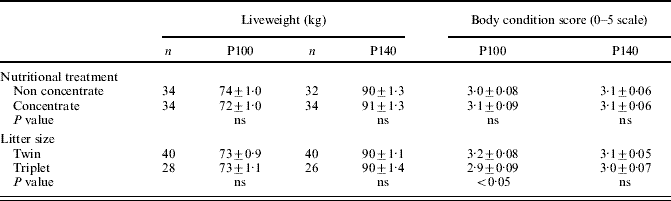
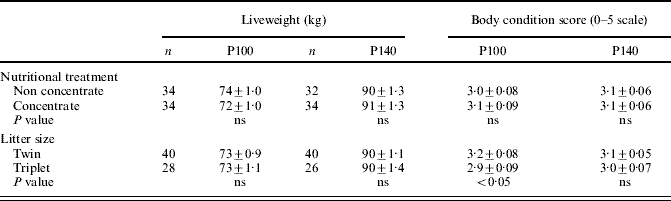
Liveweight at mating, and liveweight and body condition score at P52 and P70 did not differ between ewe nutritional treatments and litter size groups (pooled means of ewe liveweight at mating and ewe liveweight and body condition score at P52 and P70 were 59, 62 and 3·1 kg, and 64 and 3·2 kg, respectively). Offering concentrate supplement and litter size had no effect on ewe liveweight at P100 and P140 (Table 1). Twin-bearing ewes had a greater (P<0·05) body condition score than triplet-bearing ewes at P100. This effect was not observed at P140. Offering concentrate supplement and litter size also had no effect on ewe liveweight gain and change in body condition score from P100 until P140 (data not shown). Offering concentrate supplement had no effect on triplet-bearing ewe herbage intake during late pregnancy (non-concentrate 2·5±0·27 kg DM/ewe/day, concentrate 2·4±0·23 kg DM/ewe/day).
The effect of offering concentrate supplement (non-concentrate, concentrate) and litter size (twin, triplet) on ewe liveweight and body condition score at pregnancy day 100(P100) and P140 (mean±s.e.)
At P135, offering concentrate supplement had no effect on ewe plasma BOH, NEFA and glucose concentrations. Triplet-bearing ewes had greater (P<0·05) plasma BOH concentrations than twin-bearing ewes at P135 (triplet 0·62±0·030 mmol/l, twin 0·53±0·024 mmol/l) but had similar plasma NEFA and glucose concentrations as twin-bearing ewes (pooled means of plasma NEFA and glucose concentrations at P135 were 0·4 and 3·6 mmol/l, respectively). At P140, offering concentrate supplement and litter size had no effect on plasma BOH, NEFA and glucose concentrations (pooled means of plasma BOH, NEFA and glucose concentrations at P140 were 0·51, 0·46 and 3·75 mmol/l, respectively).
Lamb size and plasma concentrations of glucose and GGT
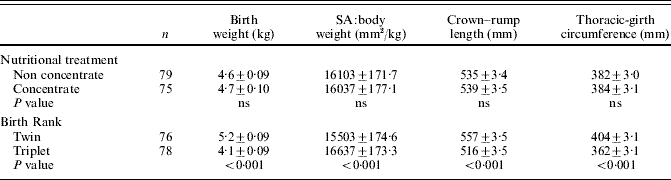
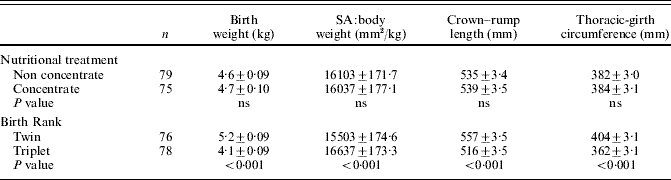
Offering concentrate supplement had no effect on lamb birth weight, SA to body weight ratio, crown–rump length or thoracic-girth circumference (Table 2). Triplet-born lambs, however, had lighter birth weights, a greater SA to body weight ratio and a shorter crown–rump length and thoracic-girth circumference than twin-born lambs. Birth rank still had a significant (P<0·05) effect on body size measurements after correction for lamb birth weight.
The effect of offering concentrate supplement (non-concentrate, concentrate) and birth rank (twin, triplet) on lamb birth weight, surface area (SA) to body weight ratio, crown–rump length and thoracic-girth circumference (mean±s.e.)
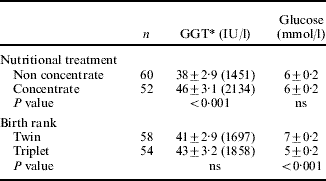
Lambs born to concentrate-fed ewes had greater (P<0·001) plasma GGT concentrations between 24 and 36 h of age than lambs born to ewes offered pasture only (Table 3). Offering concentrate supplement had no effect on lamb plasma glucose concentration between 24 and 36 h old (Table 3). Triplet-born lambs had lower (P<0·001) plasma glucose concentrations than twin-born lambs.
The effect of offering concentrate supplement (non-concentrate, concentrate) and birth rank (twin, triplet) on lamb plasma GGT and glucose concentration at 24–36 h of age (mean±s.e.)
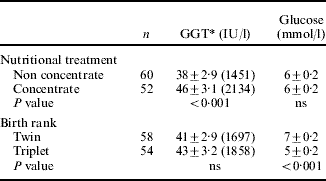
* Data were square-root transformed to achieve normal distribution. Transformed data with s.e. are presented with back-transformed means in parenthesis.
Rectal temperature before onset of severe cold stress
Offering concentrate supplement and birth rank had no effect on lamb rectal temperature before the onset of severe cold stress. The average CSI in the first 24 h of life, however, had a negative effect (P<0·01) on the rectal temperature of the lamb, with a 0·008 KJ/m2/h increase in the CSI being associated with a 1°C decrease in rectal temperature. Plasma glucose concentrations immediately before calorimetry measurements also had an effect (P<0·001) on lamb rectal temperature before the onset of severe cold stress, with a 1 mmol/l increase in plasma glucose associated with a 0·1°C increase in lamb rectal temperature.
Calculated heat production during calorimetry
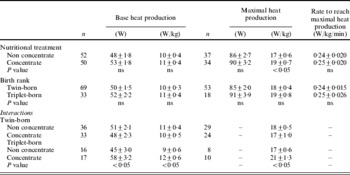
Offering concentrate supplement had no effect on the base heat production of the twin-born lamb (Table 4). Triplet-lambs born to concentrate-fed ewes, however, had a greater (P<0·05) base heat production than triplet-lambs born to ewes fed with pasture only. Twin and triplet-lambs born to pasture-only-fed ewes had a similar base heat production. Within the concentrate treatment group, however, triplet-born lambs had a greater (P<0·05) base heat production than twin-born lambs. There was a positive relationship between the base heat production and lamb body weight, with a 1 kg increase in body weight being associated with an 8·0 W increase in the base heat production (P<0·05).
The effect of offering concentrate supplement (non-concentrate, concentrate) and birth rank (twin, triplet) on the base heat production (W and W/kg), maximal heat production (W and W/kg) and the rate to reach maximal heat production (W/kg/min) (mean±s.e.)

Offering concentrate supplement had a negative effect (P<0·05) on the base heat production on per kg of body weight basis of a twin-born lamb but had a positive effect (P<0·01) on the base heat production on a per kg of body weight basis of a triplet-born lamb (Table 4). Twin-lambs born to concentrate-fed ewes had greater (P<0·05) base heat production on a per kg of body weight basis than triplet-lambs born to ewes fed pasture only, and triplet-lambs born to concentrate fed ewes had greater (P<0·05) base heat production on a per kg of body weight basis than twin-lambs born to ewes fed pasture only.
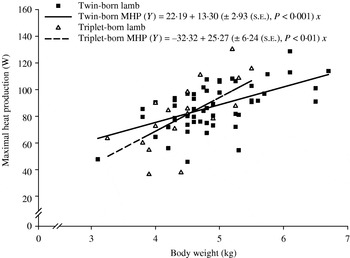
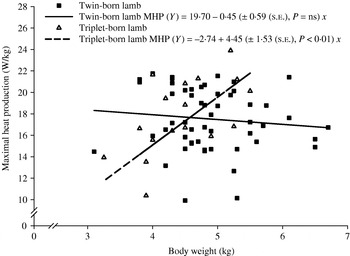
Offering concentrate supplement and birth rank had no effect on maximum heat production (Table 4). A 1 kg increase in twin- or triplet-born lamb birth weight was associated (P<0·001) with an increase in maximal heat production of 13 and 26 W, respectively (Fig. 1). In addition, a one degree increase (P<0·001) in the rectal temperature of the lamb before the onset of severe cold stress was associated with an 11 W increase in maximal heat production. Triplet-lambs born to concentrate fed ewes had a greater (P<0·01) maximum heat production on a per kg of body weight basis than triplet-lambs born to pasture only fed ewes and twin-lambs born to ewes from both nutritional treatment groups (Table 4). A 1 kg increase in triplet-born lamb birth weight was associated with a 4·5 increase in maximal heat production on a per kg of body weight basis. Twin-born lamb birth weight had no effect on maximal heat production on a per kg of body weight basis (Fig. 2). In addition, a 1°C increase in lamb rectal temperature before the onset of severe cold stress was associated with a 2·0 W/kg increase in maximal heat production on a per kg of body weight basis.
The association between lamb body weight and maximal heat production after adjustment for ewe nutritional treatment, birth rank and initial rectal temperature before the onset of severe cold stress.

The association between lamb body weight and maximal heat production on a per kg of body weight basis after adjustment for ewe nutritional treatment, birth rank and initial rectal temperature before the onset of severe cold stress. ns, not significant.

Offering concentrate supplement and birth rank had no effect on the lambs' rate to reach maximal heat production on a W/min/kg of body weight basis from the base heat production during the adjustment period. The rectal temperature of the lamb before the onset of severe cold exposure had a positive effect (P<0·01) on the rate to reach maximal heat production on a watt per min per kg of body weight basis, with a 1°C increase in rectal temperature being associated with a 0·007 W/kg/min increase in the rate to reach maximum heat production.
Offering concentrate supplement had no effect on the proportion of lambs reaching maximal heat production during severe cold stress (concentrate 0·65, non-concentrate 0·68). A greater (P<0·05) proportion of twin-born lambs reached maximum heat production when compared to triplet-born lambs (twin-born 0·77, triplet-born 0·55).
Lamb plasma concentrations of glucose and NEFA before and after calorimetry
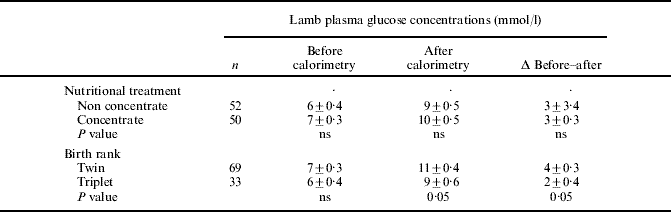
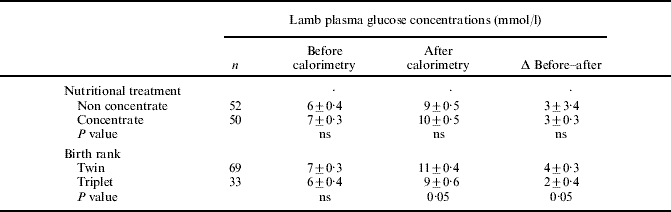
Of the lambs that reached maximum heat production, offering concentrate supplement had no effect on lamb plasma glucose concentrations immediately before or directly after the calorimetry procedure or on the change of plasma glucose concentrations from immediately before until after calorimetry procedure (Table 5). Birth rank also had no effect on lamb plasma glucose concentrations immediately before calorimetry. Twin-born lambs, however, had greater (P<0·05) plasma glucose concentrations than triplet-born lambs immediately after calorimetry and a greater (P<0·05) change in glucose concentration from immediately before calorimetry until directly after calorimetry. Of the lambs that reached maximum heat production, offering concentrate supplement and birth rank had no effect on lamb plasma NEFA concentrations immediately before or directly after calorimetry, or the change of plasma NEFA concentrations from immediately before until directly after calorimetry (pooled means were 0·72, 0·98 and 0·27 mmol/l, respectively).
The effect of offering concentrate supplement (non-concentrate, concentrate) and birth rank (twin, triplet) on lamb plasma glucose concentrations immediately before calorimetry, immediately after calorimetry and on the change in plasma glucose concentrations from before until after calorimetry (Δ before–after) (mean±s.e.)
Lamb growth and survival
Liveweight gain per day from birth until L94 was greater (P<0·01) for lambs born to ewes fed concentrate than lambs born to ewes fed pasture only (concentrate 261±5·7 g/day, non-concentrate 239±5·8 g/day). Triplet-born lambs reared as a twin (224±9·1 g/day) or triplet (219±7·6 g/day) gained less (P<0·05) liveweight per day than twin-born lambs (twin-born lamb reared as single 260±13·2 g/day, twin-born lamb reared as twin 250±4·8 g/day) and triplet-born lambs reared as a single (297±13·3 g/day). Triplet-born lambs reared as a single gained more (P<0·05) liveweight per day than twin-born lambs and triplet-born lambs reared as a twin- or triplet-born lamb.
Offering concentrate supplement had no effect on lamb survival to L94 (data not shown). Triplet-born lambs had a lower (P<0·05) survival rate than twin-born lambs (triplet-born 73·1%, twin-born 93·7%). Offering concentrate supplement and litter size had no effect on total weight of lamb reared/ewe from birth until L94 (pooled mean was 51 kg).
DISCUSSION
The aim of the current experiment was to investigate the effect of offering concentrate supplement to twin- and triplet-bearing ewes grazing ad libitum herbage from pregnancy day 100 until parturition on twin- and triplet-born lamb birth weight, heat production at 24–36 h old and post-natal growth.
Although individual concentrate intake was not measured, herbage intake measurements of triplet-bearing ewes indicated that substitution of herbage for concentrate supplement did not occur. While this may suggest that total DM intake was greater in ewes offered concentrate supplement, offering concentrate supplement had no effect on ewe liveweight gain or body condition during pregnancy or the birth weight of the offspring when compared to ewes offered a pasture only diet. This is inconsistent with the present authors' previous findings that showed that offering concentrate supplement to twin- and triplet-bearing ewes grazing a 60 mm sward improved ewe liveweight gain by 60 g/day and twin- and triplet-born lamb birth weight by 300 g (Kerslake et al., Reference Kerslake, Kenyon, Morris, Stafford and Morelin press). While the reasons for the inconsistencies across these two studies are unclear, in the current study ewes were heavier throughout pregnancy and were grazed on 1-year-old pasture rather than 4–6-year-old pasture.
An improvement in lamb thermoregulation can occur through either a reduction in heat loss or an increase in heat production. While heat loss was not measured in the present experiment, the lack of difference in birth weight and surface-area-to-body-weight ratio between lambs born to either concentrate- or non-concentrate-fed ewes suggests that lambs from both nutritional treatments would lose a similar amount of heat during cold stress. Compared with twin-born lambs, the lighter birth weights and greater SA to body weight ratio of triplet-born lambs would suggest that triplet-born lambs would lose more heat to the environment than twin-born lambs (Alexander Reference Alexander1962; Mount & Stephens Reference Mount and Stephens1970). Within litter size, offering concentrate supplement had a positive effect on the triplet-born lambs' maximal heat production on a W/kg of body weight basis. The same effect was not seen in twin-born lambs, which may suggest that endothermic mechanisms of the triplet-born lamb are more sensitive to ewe nutrition during pregnancy. Interestingly, the amount of prolactin and prolactin receptors, which play a role in thermogenesis (Stephenson et al. Reference Stephenson, Budge, Mostyn, Pearce, Webb and Symonds2001), have been shown to be influenced by foetal number and maternal nutrition (Mostyn et al. Reference Mostyn, Pearce, Stephenson and Symonds2004). An increase in foetal number, independent of maternal nutrition, has been shown to be positively associated with an increase in the amount of prolactin receptors in foetal brown adipose tissue (Budge et al. Reference Budge, Dandrea, Mostyn, Evens, Watkins, Sullivan, Ingleton, Stephenson and Symonds2003). In addition, plasma prolactin concentrations of the foetus have been shown to be positively influenced by an increase in nutrient supply (Harding & Johnston Reference Harding and Johnston1995). While offering concentrate may have had a positive effect on the thermogenic efficiency of the triplet-born lamb, the thermogenic efficiency of brown adipose tissue was not measured in the present experiment. It is also of interest to note that while triplet-lambs born to concentrate-fed ewes had a greater ability to produce a maximum amount of heat on a per kg of body weight basis, their base heat production on a per kg of body weight basis, which was required to maintain homoeothermic status at a constant environmental temperature, was elevated compared with lambs from all other treatments. This may indicate that the endothermic mechanisms of triplet-lambs born to concentrate fed ewes are not as energy efficient. Because triplet-born lambs have the potential to lose a greater amount of heat to the environment, and are likely to have less energy reserves than single- and twin-born lambs, the efficient use of energy reserves will be of particular importance to sustain high rates of heat production during cold stress. While offering concentrate may improve the maximal heat production of the triplet-born lambs, further research into the ability of the lamb to sustain a homoeothermic state during severe cold stress would be beneficial.
Both twin- and triplet-born lamb birth weights were positively associated with maximal heat production. This is in agreement with Alexander (Reference Alexander1962), who also showed that maximal heat production on a per kg of body weight basis for single-, twin- and triplet-born lambs at 24–36 h old were independent of lamb birth weight. This is somewhat inconsistent with the current results, which showed that maximal heat production on a per kg of body weight basis was positively associated with an increase in triplet-born lamb birth weight, but was constant over a range of body weights for twin-born lambs. This suggests that increasing the birth weight of triplet-born lambs should increase their ability to cope with a cold environment.
The rectal temperature of the lamb during the adjustment period was also positively associated with maximal heat production on a per kg of body weight basis. Furthermore, this rectal temperature was positively related to plasma glucose concentration prior to calorimeter procedure and negatively related to the exposure of colder outdoor conditions. These results indicate that ensuring lambs are adequately fed, to maintain plasma glucose concentrations, and keeping lambs sheltered from cold conditions would have a positive effect on the lambs' ability to maintain body temperature during adverse environmental conditions.
It is well known that an inadequate intake of colostrum will limit the ability of the lamb to maintain high rates of heat production during periods of cold stress (Eales & Small Reference Eales and Small1980, Reference Eales and Small1981; Eales et al. Reference Eales, Gilmour, Barlow and Small1982; Mellor & Cockburn Reference Mellor and Cockburn1986). In the current experiment, and others (Stafford et al. Reference Stafford, Mellor, Todd, Gregory, Bruce and Ward2001; Kenyon et al. Reference Kenyon, Stafford, Morel and Morris2005b), plasma GGT concentrations, which are positively correlated with plasma IgG concentrations (Tessman et al. Reference Tessman, Tyler, Parish, Johnson, Gant and Grasseschi1997; Maden et al. Reference Maden, Altunok, Birdane, Aslan and Nizamlioglu2003; Britti et al. Reference Britti, Massimini, Peli, Luciani and Boari2005), were used as an indicator of colostrum uptake. The plasma GGT concentrations of lambs may therefore indicate that offering concentrate to twin- and triplet-bearing ewes has a positive effect on the colostrum intake of the lamb. Caution should be taken here, however, as passive transfer of IgG is not only influenced by colostrum intake, but also by the amount of IgG in the milk, and the efficiency of colostral absorption (Boland et al. Reference Boland, Brophy, Callan, Quinn, Nowakowski and Crosby2004, Reference Boland, Brophy, Callan, Quinn, Nowakowski and Crosby2005). While colostrum intake has been shown to increase SM of the lamb by 17–20% (Eales & Small Reference Eales and Small1981), associations between plasma GGT concentrations and SM were not significant in this current experiment.
Offering concentrate supplement had a positive effect on twin- and triplet-born lamb growth rate from birth until L94. A positive relationship between ewe nutrition and milk production (Treacher Reference Treacher1970), and between milk production and lamb liveweight gain (Morgan et al. Reference Morgan, Fogarty, Nielsen and Gilmour2007), has previously been reported. It may therefore be possible that ewes offered concentrate had greater milk production to improve lamb growth rates. To clarify this association, however, further research on the effects of offering concentrate supplement to twin- and triplet-bearing ewes grazing 60 mm herbage sward height on milk production of the ewe and lamb growth is needed.
CONCLUSION
Offering concentrate supplement in late pregnancy to ewes grazing ad libitum pasture had a positive effect on triplet-born lamb heat production on a per kg of body weight basis and twin- and triplet-born growth rate to weaning. Concentrate supplement may therefore be a way of increasing the capabilities of the triplet-born lambs to deal with cold stress when offered under similar conditions. Triplet-born lamb birth weight also had a positive effect on the maximal amount of heat produced per kg of body weight. These effects were not seen in twin-born lambs. This may indicate that increasing birth weight is beneficial for triplet-born lamb heat production only.
The authors would like to thank Meat and Wool New Zealand for providing financial support to this research programme, and the National Centre for Growth and Development, Liggins Institute, Auckland University and IVABS, Massey University for financial support of the first author.