Introduction
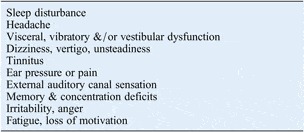
There have recently been concerns, reported in the UK media, that living close to wind turbines causes health problems.1 A constellation of symptoms, including tinnitus, vertigo, migraines and sleep deprivation (Table I), has been described by Pierpont, who first coined the term ‘wind turbine syndrome’.1–Reference Punch, James and Pabst3 It is proposed that the symptoms described are caused by exposure to infrasound and low frequency noise produced by the wind turbines.
Core symptoms of ‘wind turbine syndrome’Reference Pierpoint2, Reference Punch, James and Pabst3

There are currently 4035 wind turbines in the UK, and this figure is set to triple.4 Since there will be a corresponding increase in the population exposed to this low frequency noise, concerns about the health effects of wind turbines are likely to grow. This may result in an increase in patients presenting to their general practitioner and local ENT service.
This review addresses the otological effects of infrasound and low frequency noise, and reviews the available literature supporting the validity of wind turbine syndrome.
Methods
This review is based on a search for articles, using the PubMed database and Google Scholar search engine, which included in their title or abstract the terms ‘wind turbine’, ‘infrasound’ or ‘low frequency noise’, and which were published within the last 10 years. The defined search limits included English language, human trials, and either randomised control trials, meta-analyses, editorials, letters, clinical trials, case reports, comments or journal articles. Additional articles received following author correspondence were also included.
Definitions
Infrasound is defined as sound with a frequency of less than 20 Hz, and low frequency noise as sound with a frequency of less than 200 Hz.Reference Dommes, Bauknecht, Scholz, Rothemund, Hensel and Klingebiel5–Reference Leventhall7 Low frequency noise is generated by many everyday sources such as household appliances, transportation and industrial machinery.Reference Salt and Hullar8, Reference Takahashi9 There are natural sources of infrasound such as ocean waves and volcanoes, as well as internal sources such as the heartbeat and respiration. A child playing on a swing experiences levels of infrasound of approximately 110 dB.Reference Alves-Pereira and Castelo Branco10 Some large mammals may use infrasound for communication.11
Infrasound is commonly misinterpreted as sound that is inaudible. There is no definite delineation between what is audible and what is not. Studies have shown a hearing threshold as low as 4 Hz can be measured in an acoustic chamber, and 1.5 Hz for earphone listening.Reference Leventhall12 Infrasound, if presented at a high enough level, may indeed be audible.Reference Salt and Hullar8, Reference Leventhall13 To become audible, the sound pressure level for a 20 Hz sound needs to be approximately 75 dB, compared with 4 dB for a 1000 Hz sound.Reference Salt and Hullar8, Reference Leventhall13
Historically, infrasound and low frequency noise have attracted much adverse publicity mainly based on misunderstanding and media hype, with stories such as the worker who ‘fell dead on the spot’ and the ability of infrasound to ‘knock down buildings’.Reference Leventhall12, Reference Leventhall13 Wind turbine syndrome has reinvigorated these anxieties about possible adverse health effects of infrasound.Reference Leventhall12, Reference Leventhall13
Wind turbine noise
Wind turbines consist of a tower, a rotor (or hub), a set of rotating blades, and a nacelle which houses the generator and controls.Reference Punch, James and Pabst3 These tall and highly visible structures are often placed in open, rural areas – places where the level of background noise is typically low and the surroundings perceived as natural. Unsurprisingly, wind turbines are often viewed as both visual and auditory intruders.Reference Dommes, Bauknecht, Scholz, Rothemund, Hensel and Klingebiel5
There are two sources of noise from wind turbines: mechanical noise from the gearbox and generator; and aerodynamic noise produced by the flow of air around the blades.Reference Pedersen and Persson Waye14 The latter tends to be the main source of problems.Reference Punch, James and Pabst3
Under good conditions with low wind speeds, the sound of wind turbines can appear benign or ‘difficult to discern above the rustling of trees’, as described by the British Wind Energy Association.Reference Salt and Hullar8 However, in suboptimal conditions the aerodynamic noise varies as the blades turn with changes in the strength and direction of wind.Reference Punch, James and Pabst3 Several studies have indicated that this amplitude modulated sound, rather than being a constant, steady type of noise, is more easily perceivable, and hence more likely to cause annoyance or health symptoms.Reference Punch, James and Pabst3
We know that wind turbines produce broad-band noise; however, unweighted sound measurements have shown that this noise is indeed dominated by infrasound with frequencies of less than 10 Hz, and that levels of more than 90 dB are generated for sounds around 1 Hz.11, Reference Salt and Kaltenback15, Reference Salt and Lichtenhan16
Wind turbine syndrome
Some people have reported adverse symptoms which they have attributed to noise from wind turbines (Table I). Pierpont was the first to describe wind turbine syndrome.Reference Pierpoint2, Reference Punch, James and Pabst3 Otological symptoms such as vertigo, tinnitus and ear pain have been reported, and have been proposed to be caused by prolonged exposure of the vestibulocochlear system to infrasound and low frequency noise.Reference Pierpoint2 Other reported symptoms include sleep disturbance, headaches and concentration problems. This collection of symptoms has been colloquially termed wind turbine syndrome, but this is not currently a clinically recognised diagnosis.Reference Salt and Hullar8
Measuring noise
The World Health Organization has recognised that assessment measures for environmental noise are inadequate for evaluating noise with a large low frequency component, such as that produced by wind turbines.Reference Leventhall12 This is for two reasons: firstly, the widespread use of A-weighting in sound measurement; and secondly, technical issues in the actual measurement process.
The term A-weighting refers to a filtering process which aims to simulate human hearing in the measurement of sound. A-weighting is recognised internationally and used in the vast majority of noise-related studies and legislation.Reference Alves-Pereira and Castelo Branco10, 11 Humans are considered able to perceive sound between 20 and 20 000 Hz, but not uniformly. The A-filter de-emphasises all auditory energy with frequencies of less than 500 Hz, and completely ignores all auditory energy of less than 20 Hz, in an effort to estimate the noise thought to be actually processed by the ear.Reference Alves-Pereira and Castelo Branco10 Hence, much of the noise produced by a wind turbine is effectively ignored. The A-filter is not used in physiological studies of cochlear function.Reference Salt and Hullar8
There are alternative weighting systems available which may be better suited to measuring sound with a predominantly low frequency component, namely: unweighted measurements, C-weighting (designed for 50–4000 Hz) and G-weighting (designed specifically for infrasound).11, Reference Salt and Kaltenback15 Studies support the view that these may better predict the effects of low frequency sound.Reference Pawlaczyk-Luszczynska, Dudarewicz, Szymczak and Sliwinska-Kowalska17
The second problem in evaluating noise generated by wind turbines relates to a technical issue. Suitable instruments for measuring infrasound and low frequency noise are not widely available.Reference Salt and Hullar8 Most commonly used types of apparatus are insensitive to infrasound components such as those produced by wind turbines.Reference Salt and Hullar8
Sound level meters also tend to measure noise by averaging the sound levels over a period of time. Hence, for fluctuating sound such as wind turbine noise, information about the quality of the noise and its corresponding perceived sound character may be lost.11
Studies tend to assess sound pressure levels under specific meteorological conditions (generally winds of 8 m/second at 10 m height).Reference Pedersen, van den Berg, Bakker and Bouma18 Again, this may mean that specific characteristics present under different conditions are ignored.
The location is also important. As sound travels away from its source, the sound pressure level is affected both by absorption from ground cover and by a dilution effect as sound energy spreads out from its source.11 Both these effects may play an important part in the subjective assessment of noise, and may be useful topics for future research.Reference Leventhall12
Regulations regarding noise
In contrast to ultrasound, there are no clear protection standards established for infrasound.Reference Dommes, Bauknecht, Scholz, Rothemund, Hensel and Klingebiel5 Infrasound and low frequency noise are not currently recognised as disease agents, and therefore there is no legislation regarding permissible exposure levels and dose–response relationships.Reference Punch, James and Pabst3
Guidelines for noise management have been produced, such as the World Health Organization 1999 guidelines on community noise.Reference Pedersen, van den Berg, Bakker and Bouma18 Unfortunately, these guidelines contain no specific reference to wind turbine noise.11 The World Health Organization night noise guidelines (2007) do comment on wind turbine noise, and state that observable effects of night-time, outdoor wind turbine noise do not occur at levels of less than 30 dBA;Reference Pedersen, van den Berg, Bakker and Bouma18 they also state that there is evidence to link prolonged exposure to adverse health effects if levels are greater than 40 dBA. This has led to a proposed sound level limit of 45 dBA for new wind farms in Canada.Reference Pedersen, van den Berg, Bakker and Bouma18 A number of other countries have agreed upper limits of 80 dBA at 20 Hz frequencies and 20–40 dBA at 100 Hz.Reference Leventhall12
Wind turbines are a new source of community noise to which relatively few people have been exposed. As the number of wind turbines increases, with a corresponding increase in the number of people exposed, guidelines will be needed to indicate the maximum safe exposure to infrasound and low frequency noise.Reference Pedersen, van den Berg, Bakker and Bouma18 Since infrasound also occurs regularly in other environments (e.g. industrial and military sites), appropriate recognition of adverse health effects is a relevant public health issue.Reference Dommes, Bauknecht, Scholz, Rothemund, Hensel and Klingebiel5
What is known about the effects of infrasound and low frequency noise on the ear?
Sounds presented below the typical human audible range have previously been presumed to have no influence on the ear.Reference Salt and Hullar8 However, Alves-Pereira and Castelo Branco have utilised comparison with the electromagnetic spectrum: light is perceived by the eye at certain frequencies but not others (e.g. X-ray frequencies), however, despite not being perceived as light, we do of course know that excessive exposure to X-rays can cause severe biological damage.Reference Alves-Pereira and Castelo Branco10 Perhaps the situation is similar with sound: although low frequency noise may not be audibly perceptible, there may be physiological effects which are as yet unknown.Reference Salt and Hullar8 Responses to infrasound are not well documented, but there is some evidence that low frequency noise may indeed affect inner ear function.Reference Dommes, Bauknecht, Scholz, Rothemund, Hensel and Klingebiel5, Reference Salt and Lichtenhan16
A recent functional magnetic resonance imaging study assessing the effects of low frequency noise on healthy volunteers found that auditory cortex activation was induced by low frequency exposure.Reference Dommes, Bauknecht, Scholz, Rothemund, Hensel and Klingebiel5 This was dependent on high sound pressure levels (i.e. thresholds of 90–110 dB in normal hearing adults). The cortical activation patterns suggested that low frequency noise was processed through acoustic pathways in a similar way to noise frequencies within the main hearing range.Reference Dommes, Bauknecht, Scholz, Rothemund, Hensel and Klingebiel5
A review by Salt and Hullar has described in detail the possible effects of infrasound as mediated by the inner ear.Reference Salt and Hullar8 These authors have described how hearing perception by the inner hair cells of the cochlea, the main hearing pathway in mammals, is indeed insensitive to infrasound. However, other structures of the inner ear (e.g. the outer hair cells of the cochlea) are more sensitive to infrasound and low frequency noise, and can be stimulated at levels below those normally perceived as audible.Reference Salt and Hullar8
The outer hair cells of the cochlea send information to the brain via type two afferent fibres, nerves which were previously thought to be unresponsive to sound but which seem to respond to the static position of the organ of Corti. The outer hair cells are stimulated via direct contact with the tectorial membrane as it moves in response to sound. This displacement of the tectorial membrane remains sensitive at lower frequencies. Therefore, the outer hair cells are more sensitive at lower frequencies, including those below the audible range.Reference Salt and Hullar8
The outer hair cells of the cochlea have been shown to respond to sound at frequencies and levels such as those produced by wind turbines, suggesting that this type of low frequency noise may well influence inner ear physiology. However, whether this actually alters function or causes symptoms is currently unknown.Reference Salt and Hullar8
Aural pain is another proposed symptom of wind turbine syndrome. This usually arises due to mechanical displacement of the middle ear beyond its comfortable limits: this requires high sound pressure levels, such as 165 dB at 2 Hz or 145 dB at 20 Hz.Reference Salt and Kaltenback15, Reference Salt and Lichtenhan16 It has been postulated that noise from a wind turbine may produce sensations of fullness, pressure or tinnitus; however, there is currently no firm evidence to support this.Reference Salt and Kaltenback15, Reference Salt and Lichtenhan16
What is known is that the variation in human response is wide.11 There is no doubt that some humans exposed to infrasound and low frequency noise experience abnormal ear symptoms that are stressful, and the effects of this can be far-reaching.11
What is known about the effects of infrasound and low frequency noise on other systems?
Infrasound and low frequency noise have been controversially described as potential health hazards, causing various somatic and psychosomatic disorders such as chronic fatigue, sleep disorders, hypertension and vibroacoustic disease.Reference Dommes, Bauknecht, Scholz, Rothemund, Hensel and Klingebiel5 There has been ongoing debate about whether acoustic phenomena can cause extra-auditory effects in humans.Reference Alves-Pereira and Castelo Branco10 The role of alternative receptors has been discussed in the literature, with questions arising about the possibility of a hierarchy of sound receptors some of which may be more important at lower frequencies.Reference Leventhall12 The remote possibility of a currently unknown, highly sensitive receptor remains, but there is no clear evidence of this.Reference Leventhall12
What is known is that wind turbine noise is annoying.Reference Pedersen, van den Berg, Bakker and Bouma18 Any unwanted noise leads to annoyance, a symptom which can be moderated by multiple personal and social characteristics.Reference Leventhall12 Wind turbine noise appears to be more annoying than other noise at similar levels, such as transportation or industrial noise, possibly due to specific sound qualities and lack of night-time abatement.Reference Punch, James and Pabst3, Reference Pedersen, van den Berg, Bakker and Bouma18 The low frequency nature of the sound also means it is less likely to be masked by other environmental noise.Reference Punch, James and Pabst3 Pederson et al. have demonstrated a dose–response relationship between A-weighted sound pressure levels from wind turbines and annoyance.Reference Pedersen and Persson Waye14, Reference Pedersen, van den Berg, Bakker and Bouma18 Other interesting factors noted to be significant are visibility of the turbine and whether or not the responder benefits economically from the wind turbine.Reference Pedersen, van den Berg, Bakker and Bouma18, Reference Pedersen and Persson Waye19
It is also known that high levels of low frequency noise induce body vibrations, most prominently chest resonance vibration in the range of 50–80 Hz.Reference Leventhall13 The lower a sound's frequency the longer its wavelength, which means resonance may occur in an enclosed or partially open space such as a room in a house, as well as within the body.11 This vibratory sensation is one of the main contributors of the human response to low frequency noise, and may well be perceived as an ill effect.Reference Takahashi9
Sleep disturbance is another symptom commonly reported in case studies of low frequency noise. A large body of evidence now exists to suggest that wind turbines do disturb sleep and impair health at distances and sound pressure levels that are permitted in the UK.Reference Hanning and Evans20
Alves-Pereira and Castelo Branco have described a multisystem disorder occurring secondary to excessive exposure to infrasound and low frequency noise, which they have named vibroacoustic disease.Reference Alves-Pereira and Castelo Branco10 This is characterised by the abnormal proliferation of collagen and elastin in people exposed to low frequency noise, in the absence of an inflammatory process.Reference Punch, James and Pabst3 These authors' work was initially based on observations of aircraft technicians regularly exposed to infrasound and low frequency noise. The manifestations described are wide, ranging from mild behavioural disturbance to epilepsy, arrhythmias and malignancies.Reference Punch, James and Pabst3, Reference Leventhall12 Vibroacoustic disease, like wind turbine syndrome, remains unproven and has not found general acceptance within the scientific community.Reference Leventhall12
Variation in response
Certain individuals may have more sensitive perception of low frequency noise than others.Reference Dommes, Bauknecht, Scholz, Rothemund, Hensel and Klingebiel5, Reference Leventhall13 Such noise may be perceived as sound or vibration, or not heard at all.Reference Punch, James and Pabst3
The hearing threshold itself is a median value for an otologically normal young adult. Therefore, some individuals will be more sensitive and some less sensitive, such that a noise that is inaudible to one person may well be troublesome to others.Reference Leventhall12 In addition, the dynamic range of the auditory system at low frequencies is such that a very slight increase in sound pressure level at a low frequency can change the perceived loudness from barely audible to very loud.Reference Dommes, Bauknecht, Scholz, Rothemund, Hensel and Klingebiel5, Reference Leventhall13, Reference Pawlaczyk-Luszczynska, Dudarewicz, Szymczak and Sliwinska-Kowalska17 Clinical conditions involving changes to endolymph volume regulation, such as Ménière's disease, may well further enhance an individual's sensitivity to low frequency noise.Reference Salt and Hullar8
It is possible that long term exposure to unwanted sound can lead to enhanced perception of that sound.Reference Leventhall7, Reference Leventhall12 Studies have shown the brain has plasticity, exemplified by the findings of a study of London taxi drivers, who were shown to have an enlarged posterior hippocampus in response to their time spent navigating around London.Reference Leventhall12 A few people with highly sensitive hearing have been discovered among low frequency noise plaintiffs investigated; however, usually there is little difference between the hearing thresholds of those who complain about low frequency noise and those who do not, suggesting higher centre involvement.Reference Leventhall12
Wind turbine noise affects people differently. Public concerns about low frequency noise tend to be based around work on subjective effects.Reference Leventhall12 Subjective and personal issues are bound to be involved; for example, people living in rural areas may well have moved there for the peace and quiet, and hence a negative reaction to wind turbines is unsurprising.Reference Pedersen and Persson Waye19 Indeed, some have suggested that personal and social factors can be so variable that it may not be feasible to develop a national noise policy.Reference Leventhall12
What is not known?
There is an abundance of information available on the internet describing the possibility of wind turbine syndrome. However, the majority of this information is based on purely anecdotal evidence.Reference Pierpoint2 Whilst it is biologically and physically plausible that low frequency noise generated by wind turbines could affect people, there is insufficient evidence on which to base conclusions.1 The fact that the ear may respond to low frequency noise at the frequency and levels generated by wind turbines does not necessarily mean that such noise will be perceived or will disturb function.Reference Salt and Hullar8
Another important factor is length of exposure. There are currently no reported studies which come close to replicating the long term exposure to low frequency noise experienced by individuals who live near wind turbines.Reference Salt and Kaltenback15 This may be a topic for future study.
A better understanding is needed in order to deal with low frequency noise, to establish why some people are more sensitive than others, and to allow modelling of acceptable exposure levels.Reference Pedersen and Persson Waye14, Reference Salt and Kaltenback15 The complexity of the ear's response to low frequency noise suggests that there are many aspects which should be better understood before the influence of wind turbine noise on the ear can be dismissed as insignificant.Reference Salt and Kaltenback15, Reference Salt and Lichtenhan16
Conclusion
There is ample evidence of symptoms arising in individuals exposed to wind turbine noise. Some researchers maintain that the effects of wind turbine syndrome are clearly just examples of the well known stress effects of exposure to noise, as displayed by a small proportion of the population.21 However, there is an increasing body of evidence suggesting that infrasound and low frequency noise have physiological effects on the ear.Reference Salt and Hullar8 Until these effects are fully understood, it is impossible to state conclusively that exposure to wind turbine noise does not cause any of the symptoms described. The effects of infrasound and low frequency noise require further investigation.