INTRODUCTION
Listeners continuously assess the speech of their interlocutors, and pronunciation is among the most salient aspects to guide listeners in their judgments of both the speech that is produced and the speakers who produced it (e.g., Hayes-Harb & Hacking, Reference Hayes-Harb and Hacking2015). Listeners have been shown to reliably and consistently rate the speech of a range of speakers, but research tends to rely more on native than nonnative listeners. One reason that so few studies make use of nonnative speaker raters may be that their ability to perceive speech stream cues may be related to their L2 proficiency level. That is to say, less proficient learners may not be able to pick up on errors that are present in speech samples. Along the same lines, they may regard certain unfamiliar lexical items or grammatical features as incorrect. Footnote 1 It may therefore not be surprising that nonnative listeners tend to apply different evaluation criteria as they perform their ratings (e.g., Kim, Reference Kim2009; Riney, Takagi, & Inutsuka, Reference Riney, Takagi and Inutsuka2005). Numerous studies have examined the extent to which listener characteristics (e.g., Gui, Reference Gui2012; Isaacs & Trofimovich, Reference Isaacs and Trofimovich2011; Kang, Reference Kang2012; Winke & Gass, Reference Winke and Gass2013) and acoustic or other linguistic measures (e.g., Gut, Reference Gut2009; Isaacs, Trofimovich, Yu, & Chereau, Reference Isaacs, Trofimovich, Yu and Chereau2015; O’Brien, Reference O’Brien2014; Riney, Takada, & Ota, Reference Riney, Takada and Ota2000; Saito, Trofimovich, & Isaacs, Reference Saito, Webb, Trofimovich and Isaacsforthcoming; Saito, Webb, Trofimovich, & Isaacs, Reference Saito, Webb, Trofimovich and Isaacsforthcoming; Trofimovich & Baker, Reference Trofimovich and Baker2006; Trofimovich & Isaacs, Reference Trofimovich and Isaacs2012) play a role in listeners’ assessments of speech, and the results point to the importance of examining a range of variables that may affect a listener’s judgment.
Less attention has been paid to methodological issues in the rating of L2 speech. One notable exception is Isaacs and Thomson’s (Reference Isaacs and Thomson2013) mixed-methods study, in which the researchers investigated the effects of rating scale length (i.e., five- vs. nine-point scales) and listener experience (i.e., experienced ESL teachers vs. novice raters) in the assignment of accentedness (i.e., the degree to which pronunciation deviates from an expected norm), fluency (i.e., fluidity of speech), and comprehensibility (i.e., the perceived ease with which an utterance is understood) ratings assigned to L2 English speech samples. The results indicated that the patterns of ratings did not differ across the five- and nine-point rating scale conditions, and there were no statistically significant differences in ratings provided by experienced and novice raters. Nonetheless, an analysis of raters’ verbal reports indicated that the experienced raters were better able to isolate errors in pronunciation.
Studies performed to date have not investigated the effect of two potentially significant methodological issues: the effects of rating condition and continuum order, both of which are the focus of this study. As such, this study makes an important contribution to discussions surrounding methodology employed in pronunciation research.
Perceived Accentedness
Accentedness is the “degree to which the pronunciation of an utterance sounds different from an expected pronunciation pattern” (Munro, Derwing, & Morton, Reference Munro, Derwing and Morton2006, p. 112). This study examines the notion of foreign accentedness, that is, deviation from an expected pronunciation pattern that is rooted in a speaker’s native language. Speaking with a foreign accent is a reality for most L2 learners who begin learning languages after early childhood (e.g., Long, Reference Long1990). Although researchers including Abrahamsson and Hyltenstam (Reference Abrahamsson and Hyltenstam2008) and Bongaerts, Mennen, and van der Slik (Reference Bongaerts, Mennen and van der Slik2000) point to exceptions to this general finding, those late learners in these studies who did achieve a nativelike accent differed from members of the general population in terms of their language aptitude, motivation, and intensity of input. A foreign accent acts as an immediate marker of nonnative speaker status, even when speech samples are very short (e.g., Flege, Reference Flege1984) or when they are played backward (Munro, Derwing, & Burgess, Reference Munro, Derwing and Burgess2010). Because of the salience of features of foreign accented speech, even nonspeakers of a target language are able to reliably rate speech for foreign accentedness (Major, Reference Major2007).
Researchers investigating the concept of accentedness have pointed to the ability of a variety of types of listeners to scale accents similarly to expert native speakers. These include teachers (e.g., Trofimovich, Gatbonton, & Segalowitz, Reference Trofimovich, Gatbonton and Segalowitz2007), naïve native speakers (e.g., Kang, Rubin, & Pickering, Reference Kang, Rubin and Pickering2010), and nonnative speakers (e.g., Flege, Reference Flege1988; Kang, Reference Kang2012; Mackay, Flege, & Imai, Reference Mackay, Flege and Imai2006; Munro et al., Reference Munro, Derwing and Morton2006). Nonetheless, the majority of studies investigate the extent to which native English listeners are able to detect and scale foreign accents in L2 English (e.g., Anderson-Hsieh, Johnson, & Koehler, Reference Anderson-Hsieh, Johnson and Koehler1992; Chakraborty & Goffman, Reference Chakraborty and Goffman2011; Chen, Reference Chen2010; Moyer, Reference Moyer2011; Trofimovich & Isaacs, Reference Trofimovich and Isaacs2012), although a few accentedness studies have also been conducted on other target languages (e.g., Leikin, Eviatar, & Sapir, Reference Leikin, Ibrahim, Eviatar and Sapir2009; Pinget, Bosker, Quené, & de Jong, Reference Pinget, Bosker, Quené and de Jong2014; Reinisch & Weber, Reference Reinisch and Weber2012). A few studies have investigated native listeners’ (Molnar, Reference Molnar2010; Moyer, Reference Moyer1999; O’Brien, Reference O’Brien2004) and nonnative listeners’ (O’Brien, Reference O’Brien2014) foreign accent ratings of L2 German speech. A common finding was that listeners differentiated native from nonnative speech, regardless of their status as a native or nonnative listener. Wilkerson (Reference Wilkerson2010), who compared ratings assigned by native and nonnative listeners, found that L2 learners were better able than native speakers to determine whether speech samples were produced by native or nonnative speakers of German. She suggests that nonnative listeners hold “the speech samples to a different standard” than native listeners (p. 148), and although she did not examine speech stream characteristics, the author posits that nonnative listeners tune in to different speech stream cues than native speakers do.
Previous studies have found that a range of speech stream characteristics is associated with accentedness ratings. These may include subsegmental phenomena (e.g., González-Bueno, Reference González-Bueno1997), segmental errors (e.g., Riney et al., Reference Riney, Takagi and Inutsuka2005), and a number of prosodic parameters (e.g., Anderson-Hsieh et al., Reference Anderson-Hsieh, Johnson and Koehler1992). Prosodic errors that have been shown to influence accent ratings include word stress (e.g., Chakraborty & Goffman, Reference Chakraborty and Goffman2011) and sentence stress errors (e.g., Hahn, Reference Hahn2004), articulation and/or speech rate (e.g., Kang et al., Reference Kang, Rubin and Pickering2010; Munro, Reference Munro1995; Munro & Derwing, Reference Munro and Derwing2001), pitch range (e.g., Kang, Reference Kang2010), and pause frequency and duration (e.g., Chen, Reference Chen2010; Trofimovich & Baker, Reference Trofimovich and Baker2006).
Perceived Fluency
Fluency is a term that is often used to describe the speech of both native and nonnative speakers, but the use of the term—both its definition and its operationalization—differs between researchers and members of the population at large (see, e.g., Koponen & Riggenbach, Reference Koponen, Riggenbach and Riggenbach2000). For the purposes of the current research, it is important to highlight two of the main ways in which the term is used. The first, which is commonly used by researchers, corresponds to Lennon’s (Reference Lennon1990) narrow definition of fluency. That is, it is “an impression on the listener’s part that the psycholinguistic process of speech planning and speech production are functioning easily and efficiently,” and disfluency markers like pause time, repetitions, filled pauses, and speech rate “make the listener aware of the production process under strain” (p. 391). When speech samples are rated according to this definition of fluency, listeners are directed to listen for speech stream cues that disrupt the fluidity of speech. The second definition, common in lay usage, is Lennon’s (Reference Lennon1990) broad definition of fluency, which corresponds to oral proficiency (p. 389). As such, when listeners make use of this definition of fluency, they may tune into morphological, syntactic, or lexical errors. The current study operationalizes perceived fluency according to Lennon’s narrow definition.
Much of the research on the topic has shown that fluency is related to planning and automaticity of processing (e.g., Bortfeld, Leon, Bloom, Schober, & Brennan, Reference Bortfeld, Leon, Bloom, Schober and Brennan2001; Segalowitz, Reference Segalowitz2007). As such, even native speakers of a given language do not always produce fluent utterances (e.g., Riggenbach, Reference Riggenbach1991). Speakers—whether native or nonnative—make use of pauses and other disfluencies in the planning and formulation of utterances (Clark & Fox Tree, Reference Clark and Fox Tree2002). Nonetheless, it has been shown that L2 learners tend to pause more in their L2s than in their L1s (Riantseva, Reference Riazantseva2001), and L2 speech is usually slower than that of native speakers (e.g., Gut, Reference Gut2009). Speaking fluently has practical implications for both speakers and listeners. Derwing, Munro, and Thomson (Reference Derwing, Munro and Thomson2008) note that “[f]luency problems can … be exasperating for L2 speakers” (p. 360). Along the same lines, Rossiter (Reference Rossiter2009) notes that fluent speakers may keep their listeners more engaged than those who are disfluent.
Much of the research investigating perceived fluency relies on the judgments of native listeners, although Rossiter (Reference Rossiter2009) employed three types of listeners in her investigation of L2 English fluency: ESL teachers, novice native listeners, and nonnative English listeners from a variety of L1 backgrounds. She found that the nonnative listeners rated speech samples more harshly (i.e., they rated the samples to be less fluent) than did the novice native listeners. Kormos and Dénes (Reference Kormos and Dénes2004) also examined listener effects. They investigated the difference in fluency ratings assigned to English L2 speech by native and nonnative (teacher) raters. Unlike Rossiter (Reference Rossiter2009), they found no significant difference in ratings assigned by listeners in the two groups. To date, most of the research into the perceived fluency of L2 speech has been performed on L2 English, although researchers have investigated fluency in other L2s including Dutch (Cucchiarini, Strik, & Boves, Reference Cucchiarini, Strik and Boves2002; de Jong, Steinel, Florijn, Schoonen, & Hulstijn Reference de Jong, Steinel, Florijn, Schoonen and Hulstijn2013) and French (Préfontaine, Reference Préfontaine2013).
Fluency researchers often look to the speech stream characteristics that may be associated with fluency ratings assigned by listeners, and most of them include cues that negatively affect the fluidity of speech. These include frequency of filled and/or unfilled pauses (e.g., Brand & Götz, Reference Brand and Götz2011), pause duration (e.g., Kormos & Dénes, Reference Kormos and Dénes2004; Lennon, Reference Lennon1990), speech rate (Derwing, Rossiter, Munro, & Thomson, Reference Derwing, Rossiter, Munro and Thomson2004; Riggenbach, Reference Riggenbach1991), mean length run (e.g., Cucchiarini et al., Reference Cucchiarini, Strik and Boves2002; Préfontaine, Reference Préfontaine2013; Towell, Hawkins, & Bazergui, Reference Towell, Hawkins and Bazergui1996), and self-repetition (e.g., Lennon, Reference Lennon1990; Rossiter, Reference Rossiter2009). Some studies have found that listeners may rely on other cues when they rate speech along the perceived fluency continuum. For example, the ratings assigned by the listeners in Freed (Reference Freed and Freed1995), Kormos and Dénes (Reference Kormos and Dénes2004), and Rossiter (Reference Rossiter2009) were correlated with errors in pronunciation, grammar, and vocabulary.
Comprehensibility
While learners regularly report a desire to speak their L2 without an accent or more fluently, the focus of many researchers and classroom practitioners has turned to comprehensibility, which has been determined to be a more realistic and important goal inside and outside the L2 classroom (e.g., Derwing & Munro, Reference Derwing and Munro2009a). In the current study, comprehensibility is operationalized according to definitions provided by Derwing and colleagues. That is, it is the “ease or difficulty with which a listener understands … accented speech” (Derwing et al., Reference Derwing, Munro and Thomson2008, p. 360), and it corresponds to “judgments on a rating scale of how difficult or easy an utterance is to understand” (Derwing & Munro, Reference Derwing and Munro1997, p. 2).
The results of a host of comprehensibility studies indicate that listeners are indeed able to understand some accented speech (e.g., Derwing & Munro, Reference Derwing and Munro1997). In Derwing and Munro’s (Reference Derwing and Munro2009b) workplace study, employees were asked to choose between two foreign-accented speech samples, one of which was more comprehensible than the other. The listeners preferred the more comprehensible speech samples. The authors thus concluded that the listeners placed a higher value on comprehensible than on less accented speech. With the exception of Munro et al. (Reference Munro, Derwing and Morton2006) and Derwing and Munro (Reference Derwing and Munro2013), few comprehensibility or intelligibility studies have made use of L2 listeners. The results of these studies have shown that L2 listeners perform similarly to native speakers. As is the case with studies investigating foreign accentedness and fluency, most comprehensibility and intelligibility studies investigate the production of L2 English speech (but see Caspers, Reference Caspers2010; Neuendorf, Reference Neuendorf2010; O’Brien, Reference O’Brien2014 for exceptions).
A variety of speech stream characteristics including segmental accuracy (e.g., Braun, Lemhöfer, & Mani, Reference Braun, Lemhöfer and Mani2011), a combination of word stress and segmental errors (Caspers, Reference Caspers2010), sentence accents (e.g., Hahn, Reference Hahn2004), and speech rate (Kang, Reference Kang2010) have been shown to correlate with comprehensibility ratings. Trofimovich and Isaacs (Reference Trofimovich and Isaacs2012), in their comprehensive study into the speech stream cues that might affect comprehensibility ratings, found that comprehensibility ratings assigned to L2 English speech samples were primarily predicted by grammatical accuracy, lexical richness (i.e., type frequency), and word stress. Similarly, Munro and Derwing (Reference Munro and Derwing1995) found that grammatical errors were significantly correlated with ratings indicating less comprehensible speech.
RESEARCH QUESTIONS
Previous research has found that the concepts of perceived accentedness, fluency and comprehensibility not only share common features but that listeners are also able to distinguish among the three when they rate speech samples. This previous research, however, relies primarily on native speaker raters (but see, e.g., Kim, Reference Kim2009; Munro et al., Reference Munro, Derwing and Morton2006; Rossiter, Reference Rossiter2009; Wilkerson, Reference Wilkerson2010) who evaluate English L2 speech (but see, e.g., Caspers, Reference Caspers2010; de Jong et al., Reference de Jong, Steinel, Florijn, Schoonen and Hulstijn2013; Freed, Reference Freed and Freed1995; Gut, Reference Gut2009; Moyer, Reference Moyer1999). A common finding is not only that accented speech may be comprehensible but also that incomprehensible speech is often heavily accented (e.g., Munro & Derwing, Reference Munro and Derwing1995).
Research making use of human raters who rate speech samples along more than one continuum (accentedness, fluency, comprehensibility) employs one of two methodologies: multiple ratings are completed together (e.g., Isaacs & Trofimovich, Reference Isaacs and Trofimovich2011) or separately (e.g., Derwing & Munro, Reference Derwing and Munro1997). The current study builds on research into methodological issues in the assessment of L2 speech, and the methodological focus of this study is the rating procedure. The current study thus seeks answers to two key questions:
-
1. To what extent do perceived accentedness, fluency, and comprehensibility ratings assigned by German native listeners and English-German L2 listeners differ according to rating condition? That is to say, does it make a difference whether listeners who assess speech samples (a) listen to a sample only once before they assess its accentedness, fluency, and comprehensibility, or (b) rate a large number of samples along one continuum before moving onto the next continuum and then the final continuum?
The answer to this question is methodologically important. Because few previous studies report on the specific methodology employed, and no study has compared the results of one rating condition (i.e., together: three ratings in tandem after one exposure to a speech sample vs. separate: ratings along the three continua separately from one another) compared to the other, we do not know whether ratings will differ if listeners rate the speech samples along all three continua at once compared to if listeners rate the samples separately along each continuum. If the results indicate no differences by rating condition, researchers will be well justified in carrying out the more efficient rating task that involves only one exposure to each speech sample. If, however, there are differences, researchers will be encouraged to carefully consider the role of rating condition in future studies.
-
2. What is the effect of continuum order on the results obtained?
Order effects are methodologically important, as they enable us to determine whether ratings along each continuum differ according to whether they are performed first, second, or third. The study builds on the results of Munro and Derwing (Reference Munro and Derwing1994), who report that listeners rated speech samples more harshly in later tasks (i.e., when they rated speech samples for the third and fourth times). Although previous studies control for continuum order by balancing out the number of times listeners rate along a specific continuum first, second, or third, we know of no study to date that has investigated whether listeners who rate speech samples along one continuum (e.g., accentedness) before another (e.g., comprehensibility) provide different ratings from those who rate the samples in the opposite order.
METHOD
Speech Samples
Speech samples rated in the current study are the same 48 twenty-second samples as those used in O’Brien (Reference O’Brien2014). These were gathered as part of a larger study investigating the use of prosodic cues among native speakers and L2 learners of German. They were produced by 48 German speakers, 24 of whom were German native speakers living in Germany. The remaining 24 speakers were English-German L2 learners, six of whom were living in Germany at the time of the study. The German native speakers (6 males, 18 females) were university students who were an average of 23.9 years of age (range 21–30 years). The English-German L2 learners (12 males, 12 females) were university students with a mean age of 22.8 years (range 21–30 years). Half of the L2 learners’ speech samples were produced by speakers with intermediate (CEFR level B1) proficiency in German, and half were produce by speakers with intermediate to advanced (CEFR level C1 or C2) proficiency in German, as determined by the results of an online multiple-choice proficiency test that focuses on grammar and vocabulary knowledge (Goethe Institut, 2004).
All of the speakers were recorded reading the suitcase narrative, Footnote 2 a picture story illustrating a collision between a man and a woman, both of whom are carrying identical green suitcases. This accident causes them to drop their bags. It is only when they reach their final destinations that each realizes that he or she has picked up the bag of the other. This task has been widely used in previous studies investigating L2 speech production (e.g., Derwing & Munro, Reference Derwing and Munro2009b; Isaacs & Trofimovich, Reference Isaacs and Trofimovich2011).
Participants
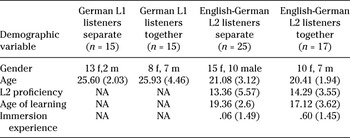
Listeners in the current study included 30 German native speakers and 42 English-German L2 learners. In order to test for the effect of rating condition (i.e., ratings performed together or separately), listeners from each L1 group were further divided into two groups (together vs. separate). An overview of the participants by group is provided in Table 1.
Means and standard deviations (in parentheses) of listener demographic information and L2 proficiency by rating condition group

Note. f = female; m = male; age = current age in years; L2 proficiency = score out of 30 points on the German proficiency test (Goethe Institut, 2004); NA = not applicable; age of learning = age of learning German as an L2; immersion experience = time living in a German-speaking region in years.
The only significant difference between the L2 listener groups is in length of immersion experience, with the together group having spent significantly more time in a German immersion setting (t(40) = -1.858, p = .001).
Procedure
The first 20 seconds of speech—excluding hesitations like filled or unfilled pauses at the onset of the recording—from each speech sample were prepared for use in the rating task, along the lines of previous studies (e.g., Derwing et al., Reference Derwing, Munro and Thomson2008). As in other research, listeners rated the speech samples along nine-point Likert scales (e.g., Chakraborty & Goffman, Reference Chakraborty and Goffman2011; Derwing et al., Reference Derwing, Rossiter, Munro and Thomson2004; Isaacs & Trofimovich, Reference Isaacs and Trofimovich2011; Kennedy & Trofimovich, Reference Kennedy and Trofimovich2008; Munro & Derwing, Reference Munro and Derwing1995). The three scales in the study include perceived accentedness, where 1 = no accent and 9 = extremely strong accent; perceived fluency, where 1 = extremely fluent and 9 = extremely disfluent; and comprehensibility, where 1 = easy to understand and 9 = extremely difficult to understand. Given the recommendations of researchers to familiarize listeners with rating scales and procedure (e.g., Derwing et al., Reference Derwing, Rossiter, Munro and Thomson2004; Rossiter, Reference Rossiter2009), participants were asked to rate three spontaneous speech samples along each of the continua before they began the experimental task. The samples used in the training, which were gathered as part of another production study, were produced by speakers with a proficiency level equivalent to those speakers whose samples were used in the current study. In each instance, one native speaker sample was included among the training samples. Feedback that focused on speech stream characteristics associated with each of the continua was given to listeners after they rated each of the training stimuli. For example, listeners were told to focus primarily on segmental and prosodic (especially word stress) pronunciation errors as they rated speech samples for accentedness. They were told to listen for pauses (filled and unfilled), repetitions, and overall speed of delivery when they rated the speech samples for fluency. Listeners were directed to only focus on how well they understood utterances when they rated for comprehensibility. As they rated the speech samples during the training session, they were asked to point out specific speech stream characteristics that caused them to rate the samples as they did. The researcher also pointed out specific instances of each type of speech stream characteristic associated with each continuum as they worked through the training.
As shown in Table 1, a total of 40 listeners (15 native speakers, 25 L2 learners) rated each of the speech samples in three separate tasks (once for accentedness, once for fluency, and once for comprehensibility), and 32 listeners (15 native speakers, 17 L2 learners) rated each of the speech samples along all three continua together after having heard each stimulus only once. The presentation of stimuli was randomized, and the continuum order was balanced across participants. All participants took part in the study in their home countries, and they were paid a small honorarium of $15 or €12 for their participation.
Data Analysis
Once it was determined that listeners in both groups distinguished among the speech samples produced by native German speakers and English-German L2 learners (i.e., that ratings assigned by both listener groups to speech samples produced by native speaker and L2 learners differed significantly along each continuum), it was decided that the focus of the study should be on the ratings assigned to the English-German L2 learners, along the lines of Derwing et al. (Reference Derwing, Rossiter, Munro and Thomson2004).
Because each rater provided three ratings for each speech sample, there are potential correlations among ratings. It is essential to make use of a statistical procedure that can deal with dependence among the outcomes. For this reason, data were analyzed through an unbalanced repeated measure design with interval outcome variables using a Generalized Estimating Equation (i.e., GEE under Genlin procedures in SPSS version 21) to determine whether and the extent to which English-German L2 listeners and German native listeners differed in their ratings of English-German L2 learners’ speech along each of the three continua. The dependent variable in all analyses was rating, and raters were treated as repeated measures. We applied a Bonferroni adjustment in the order analysis to account for the fact that multiple comparisons were performed simultaneously on the data.
RESULTS
Given that the research questions focus on the differences in ratings assigned by native and nonnative listeners by rating condition and order, it is helpful to begin by examining how listeners in the two groups rated the speech samples overall. The mean ratings assigned by native listeners and English-German L2 listeners are provided Table 2. An analysis of the results indicates that German native listeners and English-German L2 listeners did not differ significantly in their accentedness ratings. Nonetheless, they did differ in their ratings of fluency (B = -.794, SE = .191, χ 2 (1) = 17.232, p < .001) and comprehensibility (B = -.835, SE = .3256, χ 2 (1) = 6.65, p = .010), with English-German L2 listeners assigning significantly harsher ratings on both continua.
Mean ratings and standard deviations (in parentheses) by L1 group

The Effect of Rating Condition
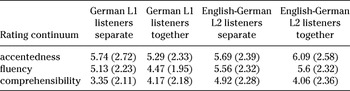
The results of analyses investigating the effects of rating condition indicate that there is no effect of rating condition along any of the continua when the data are collapsed across listeners. That is to say, accentedness, fluency, and comprehensibility ratings assigned to L2 speech samples did not differ according to whether listeners performed the ratings along all three continua together after having heard the speech sample once or whether they rated speech samples along each continuum separately from the other two. The story becomes a bit more nuanced, however, if we analyze rating condition effects by listener groups. Ratings by listener groups and rating condition are provided in Table 3.
Mean ratings and standard deviations (in parentheses) by rating condition and listener group

An analysis of the results indicates no effects of rating condition by language group for ratings along the accentedness continuum. This finding is in line with those presented for listeners as a whole: accentedness ratings are not significantly different whether they are performed together or separately for both German native listeners and English-German L2 listeners. The same can be said for comprehensibility ratings performed by German native listeners and fluency ratings performed by English-German L2 listeners. There is no significant effect of rating condition on ratings assigned along these continua. Nonetheless, we see one important rating condition effect for German native listeners: their ratings along the fluency continuum differ significantly by rating condition (B = -.679, SE = .2873, χ 2 (1) = 5.582, p = .018). That is to say, German native listeners who rated fluency together with accentedness and comprehensibility assigned ratings indicating that speech samples were more fluent than did those who performed the tasks separately along each of the three continua. A slightly significant rating condition effect was found for English-German L2 listeners along the comprehensibility continuum (B = -.863, SE = .4475, χ 2 (1) = 3.721, p = .054). That is to say, English-German L2 listeners who rated the speech samples along all three continua together showed a tendency to rate the speech samples as being more comprehensible than did those who rated comprehensibility separately from accentedness and fluency.
The Effect of Order
The results examining the effect of rating order (i.e., whether participants performed ratings along a given continuum first, second, or third) on ratings indicate no effects of rating order on the ratings assigned. That is to say, listeners rated speech samples similarly along the accent continuum when they rated for accentedness before the other two ratings, between the two ratings, and as the last of the three rating types. The same is true for fluency and comprehensibility ratings.
DISCUSSION
Native and L2 Listener Ratings
German native listeners and English-German L2 listeners showed similar patterns in their ratings: accentedness ratings were harshest, and these were followed by fluency and then comprehensibility ratings. Thus, the results support previous research that has shown that accented speech may indeed be comprehensible (e.g., Munro & Derwing, Reference Munro and Derwing1995) as well as that which posits that L2 learners are competent raters (e.g., Derwing & Munro, Reference Derwing and Munro2013; Rossiter, Reference Rossiter2009; Wilkerson, Reference Wilkerson2010). As in previous studies investigating the role of L1 listener status in accent ratings, the English-German L2 listeners and German native listeners in the current study did not differ from one another in their accentedness ratings (e.g., Flege, Reference Flege1988; Reference Mackay, Flege and ImaiMacKay et al., 2006; Munro et al., Reference Munro, Derwing and Morton2006).
German native listeners and English-German L2 listeners did differ in the ratings they assigned to the speech samples along the fluency and comprehensibility continua. The English-German L2 listeners assigned significantly harsher ratings to the speech samples along these two continua than did the German native listeners. The finding for fluency ratings is in line with the results of Rossiter (Reference Rossiter2009), whose advanced L2 English listeners assigned the harshest ratings of all three participant groups. This is in spite of the fact that Rossiter’s listeners were advanced EFL learners. To date only Derwing and Munro (Reference Derwing and Munro2013) and Munro et al. (Reference Munro, Derwing and Morton2006) have compared the perceived comprehensibility ratings assigned by native listeners to those of L2 listeners. The findings from these studies indicate that L2 listeners’ responses are in line with those of native listeners. Thus, although the comprehensibility results in the current study may seem to stand counter to those of previous studies, they do support the results of research highlighted by Rossiter (Reference Rossiter2009), whereby L2 learners have been shown to evaluate the errors made by other L2 learners more severely than native speakers do (e.g., Derwing, Rossiter, & Ehrensberger-Dow, Reference Derwing, Rossiter and Ehrensberger-Dow2002; Hughes & Lascaratou, Reference Hughes and Lascaratou1982). One important reason why the comprehensibility results are not in line with those of previous studies may have to do with a factor raised at the outset of the paper: L2 learners’ relatively low proficiency in German. The mean proficiency level of participants in the current study corresponds to the CEFR B1 level, indicating that participants exhibited on average low-intermediate proficiency. As such, they may have applied different criteria when performing their ratings, due, among other things, to more limited lexical and grammatical knowledge. The fact that the fluency ratings assigned by L2 learners in the current study were in line with those of previous research may have to do with the fact that knowledge of a language is not required when participants rate speech samples according to the narrow definition of fluency.
Methodological Issues
At first glance, it may appear as though the methodological issues taken up in the current paper—rating condition and order effects—play little to no role in the ratings assigned by listeners. While this is the case for the group of listeners as a whole, significant rating condition effects were found for German native listeners in their fluency ratings, and the rating condition effects for English-German L2 listeners were slightly significant for comprehensibility. In both instances, listeners assigned lower ratings—indicative of more fluency and greater comprehensibility—when they rated the speech samples along all three continua at once as opposed to when they performed the ratings separately. To date no study has specifically investigated the effects of rating condition on rating outcomes, but these results may support the findings of Munro and Derwing (Reference Munro and Derwing1994), who found that listeners assigned harsher ratings to utterances that they listened to more often. Similarly, participants in the current study who performed the ratings together heard each speech sample only one time and then performed all of the ratings. Those who performed the ratings separately heard each speech sample three times.
No effects of order were found for either listener group. The results of the current study therefore support those of Derwing and Munro (Reference Derwing and Munro1997), who found no order effects when listeners rated each speech sample twice. Order effects—like rating condition effects—may have to less to do with order as such and may instead be due to the number of times a listener hears a given utterance.
IMPLICATIONS
Nonnative speakers teach and assess L2 learners on a regular basis, and this study adds to the body of literature that indicates that L2 learners—in this case L2 learners of German who speak English as an L1—rate the speech of fellow L2 learners similarly to native speakers along the accentedness scale. Although German native listeners were significantly more lenient in their ratings than the English-German L2 listeners along the fluency and comprehensibility continua, participants in the two listener groups showed similar trends in all of their ratings: accentedness ratings were harsher than fluency ratings, which were harsher than comprehensibility ratings.
As noted by Isaacs and Thomson (Reference Isaacs and Thomson2013), studies that examine methodological issues in pronunciation research have implications for both L2 pronunciation researchers and for the language testing community (p. 157). Although future research is required on the topic, the results of the current study imply that performing ratings along three continua after hearing a speech sample once is at least as effective as rating a series of stimuli along each continuum separately. In fact, it may be that listeners may become more irritated by or sensitive to errors in the speech stream the more often they hear them.
The results indicate that both native and nonnative raters, all of whom were trained on the operationalization of the three concepts—accentedness, fluency, and comprehensibility—distinguished among the terms. This study therefore supports a recommendation made by Munro and Derwing (Reference Munro and Derwing1995): developers of assessment schemes should consider which of the concepts matter for the type of assessment being carried out. Such schemes should provide independent guidelines for assessing each of the concepts as opposed to including a single category like “pronunciation.” Whereas many formal assessment schemes like the Common European Framework of Reference (Council of Europe, 2001) and the ACTFL Proficiency Guidelines for speaking (American Council on the Teaching of Foreign Languages, 2012) clearly distinguish among the concepts—especially accent and comprehensibility, research has shown that difficulties may arise when the concepts are not clearly operationalized in assessments of nonnative speakers (e.g., Hanna & Allen, Reference Hanna and Allen2012).
Future research on the topic would benefit from making use of L2s that have not been investigated in previous studies as well as from L2 listener raters from a wider variety of L1 backgrounds. An additional factor that should also be considered in future studies includes L2 listeners’ proficiency, as this may play an especially important role in comprehensibility ratings.