1. Introduction
The study of international organizations (IOs) has recently turned its attention to questions related to output, measured in terms of promotion of peace (Pevehouse and Russett, Reference Pevehouse and Russett2006; Danilovic and Clare, Reference Danilovic and Clare2007) compliance with international agreements (Guzmann, Reference Guzmann2008; Simmons, Reference Simmons2009), performance (Gutner and Thompson, Reference Gutner and Thompson2010), and promotion of democracy (Pevehouse, Reference Pevehouse2002). In relation to the key multilateral organization that regulates trade, the World Trade Organization (WTO), there is surprisingly little systematic work on its output and performance (Elsig, Reference Elsig2010b). Most attention has been devoted to studying how participation in the WTO and its forerunner (the General Agreement on Tariffs and Trade: GATT) affects trade flows (Rose, Reference Rose2004; Goldstein et al., Reference Goldstein, Rivers and Tomz2007). In this article, we focus on the role of the WTO in promoting democracy. At first sight, this does not seem an obvious question to ask; however, considering that the WTO represents two of the three elements of the Kantian triangle for a more peaceful international system, it becomes intriguing to investigate WTO-induced changes to the third element: democracy.Footnote 1
Liberal international relations theory has long been obsessed with democracy and democratization. For instance, Milner and Kubota (Reference Milner and Kubota2005) provide statistical evidence of a positive relationship between democratization and trade openness. Another strand of literature has focused on how new democracies use IOs for strategic reasons. One of the most cited arguments has been the so-called lock-in mechanism where states join international institutions to protect domestic reforms against modifications by future governments (see Moravcsik, Reference Moravcsik2000). While Mansfield and Pevehouse (Reference Mansfield and Pevehouse2008) suggest that democratizing states are more likely to join IOs that regulate economic activity than IOs that address general political goals, most work on trade has focused on regional agreements or preferential trade agreements (PTAs). Hafner-Burton (Reference Hafner-Burton2009) shows how PTAs can serve as a tool to enforce international human rights. A significant number of contributions have focused on the ways in which the European Union has contributed to democratization by giving access to the single market and by using conditionality instruments to foster domestic reforms in these young democracies (Schimmelfennig and Sedelmeier, Reference Schimmelfennig and Sedelmeier2004). What has been largely neglected is the role of the WTO in promoting or sustaining democracy (but see Aaronson and Abouharb, Reference Aaronson and Abouharb2011; Comerford Cooper, Reference Comerford Cooper2003).
This article contributes to addressing this gap and situates itself in the literature on outside-in effects. Three questions inform this article: First, how do we measure democracy in the context of the WTO? Second, what are the channels of democratization? Third, what are the conditions under which democracy promotion can be observed? In order to approach these questions we rely largely on the stimulating work by Keohane et al. (Reference Keohane, Macedo and Moravcsik2009). They argue that IOs ‘can contribute to the improvement of democracy’ by three main channels, which aim at ‘combating special interests, protecting rights, and fostering robust public deliberation’ (Keohane et al., Reference Keohane, Macedo and Moravcsik2009: 9). We follow their invitation that ‘an assessment of whether any given multilateral institution enhances or degrades democracy must therefore be based on an analysis of whether, on balance, international cooperation improves … aspect of constitutional democracy … as compared to existing domestic practices’ (2009: 23).
This article engages critically with the framework proposed by Keohane et al. (thereafter KMM) and discusses the factors that affect the dependent variable (change in democratic quality). Generally, we expect variation across types of regimes and variation across the three instruments described. In an attempt to advance the analysis of how IOs enhance democracy, we suggest three specific developments that condition the results.
First, the marginal effect of democracy promotion is directly conditioned by the initial degree of democracy. We expect democratization effects in particular among new democracies to occur. However, we should expect results to differ as a function of how well liberal democratic standards are already established. Further, we do not expect large ‘democratizing’ effects in established democracies through participation in IOs because the marginal increase is naturally limited due to the higher starting point. Similarly, democratization effects should be low for autocracies as they lack some of the conditions for democracy promotion (e.g., existence of civil society organizations, availability of platforms for free speech, lack of institutional capacity to protect individual rights). Second, when relying on the three mechanisms sketched by KMM, we need to control for canceling-out effects when these instruments are at work. While one mechanism might yield positive results, another might diminish democratic standards. Therefore, we need to pay attention to interaction effects in order to come up with a judgment on overall impact. Third, we need to be careful to disentangle the IO causes from other factors that influence domestic democratic standards. Research design in empirical studies needs to control for alternative sources causally affecting democracy promotion.
The article takes the form of a cautionary note. While we conceptually posit variation of effects, empirically we expect little in the way of direct outside-in effects. Put differently, we do not expect to find systemic evidence that the WTO increases democracy. Marginal effects should be mostly visible for new democracies. In their case, acceding to the WTO treaties in 1995 or joining the WTO after its creation is an important signaling device vis-à-vis foreign traders and investors. The signal is intended to convince market actors that a country lives up to internationally accepted standards, upholding the general rules of (trade) law.
The article is organized as follows. In the next section, we present the three mechanisms of democracy promotion suggested by KMM and discuss how to conceptualize and operationalize these mechanisms in the context of the WTO. In section 3, we provide an argument as to the expected effects of democracy promotion conditioned by regime type, suggest potential interaction effects, and sketch alternative explanations. In section 4, we present some preliminary empirical evidence to tease out our arguments. Section 5 concludes, addressing a so-called expectation − capacity gap and suggests that future research should focus more on the indirect effects of democracy promotion.
2. Democracy promotion and the WTO
In this article, we abstain from offering a new definition of democracy promotion and rely largely on KMM. By democracy promotion, KMM do not simply equate democracy with the creation of institutions to elect representative governments, but they in addition focus on the liberal (constitutional) character of a state by stating that ‘the management of elections is only the beginning’ (KMM, Reference Keohane, Macedo and Moravcsik2009: 5).Footnote 2 They refer to institutional mechanisms that support democratic rule and limit ‘arbitrary actions of government, which could instill fear of free expression’ by supporting the ‘rule of law, a wide variety of rights, and impartial enforcement mechanisms’. They continue: ‘democracy requires that the powerful are held in check by the prospect that abuses of power will be detected and publicized, which implies public access to information. Elected representatives and other public officials must be constrained to defend their policy choices publicly. Deliberation helps ensure that the public can live with political choices over the long haul’ (KMM, Reference Keohane, Macedo and Moravcsik2009: 6). In this sense, democracy promotion goes beyond advocating the right to vote, and includes various checks on legitimate (democratic) governance and supports the creation of additional deliberation platforms.
There are various ways we could capture the causal relations between IOs and domestic democracy. Pevehouse (Reference Pevehouse2002) has focused on pressures emanating from the IO and its members, ways in which elites are supported during the transition process, and key constituencies (e.g., military) undergoing socialization effects through interaction. Empirically, he focuses on regional organizations which are different from multilateral organizations. In regional organizations there are fewer participants, the organizations are more homogeneous, members might care more about neighbors' behavior, and socialization effects are more likely given the frequency and intensity of interaction (see Checkel, Reference Checkel2005). Therefore, we prefer KMM's conceptualization, which is aimed more directly at multilateral organizations.
Below, we briefly summarize their conceptualization and suggest variables to focus on in the WTO context. The WTO as an international organization is chosen as it signifies an important departure from the old GATT system which had fewer obligations and lacked a legalized dispute settlement system. There is consensus that the GATT system was not characterized by ambitions towards democracy promotion or protecting human rights (Aaronson and Zimmerman, Reference Aaronson and Zimmerman2008: 16–17). In the WTO context, democracy promotion may be occurring for older Members (who were already GATT signatories) as well as for newly acceding Members (that usually follow a stringent accession process often leading to more concessions than for existing Members). Below we discuss three channels through which a multilateral organization can support democracy promotion as outlined by KMM.
2.1 Special interest groups
KMM first suggest that IOs may help constrain special interest groups. They argue: ‘Of the numerous constitutional domains in which the interests of broad groups are particularly apt to be overwhelmed by pressure from more powerful, self-conscious, and concentrated special interests, trade policy is among the most prominent. Control of minority factions is thus a central issue of trade policy’ (2009: 9). They continue: ‘Multilateral institutions such as the GATT, WTO, and NAFTA provide mechanisms by which democratic publics can limit the influence of minority factions by committing in advance to a set of multilateral rules and practices that reflect broad public interests’ (2009: 11). They refer to three specific mechanisms (and use examples from the WTO) that support this development: first, a system of reciprocity that will promote exporter coalitions to constrain the influence of import-competing industries; second, empowering the executive vis-à-vis the legislative which leads to more independence from special interest groups; third, the support of a highly legalized dispute settlement system that constrains reneging on agreed commitments.
These are all well-established arguments in the liberal school, yet some caution is warranted. First, the causal story suffers from US centrism. Few countries foresee an important constitutional role for national parliaments in trade policy as in the US system; the executive branches are generally more influential in other WTO Members (see for instance Davis (Reference Davis2012) on Japan). Therefore, a systematic transfer of internal power to the executive is limited at best. Second, a point raised by realists, a liberal reading overlooks in whose interests the rules are designed. It is easier to delegate power to the executive with underlying expectations that rules reflect the countries’ interests. Third, there are doubts about the long-term effects of increased legalization on controlling the influence of narrowly defined interest groups. This intra-liberal criticism suggests that it is precisely the highly legalized dispute settlement system which has empowered narrowly defined import-competing special interest groups that had been loosely organized in the past (Goldstein and Martin, Reference Goldstein and Martin2000).Footnote 3 In any case, the KMM argument suggests that after countries gain membership to the WTO (either as an original Member or through accession), the influence of special interest groups is constrained to the benefit of some greater societal goals.
Empirically, we suggest focusing on two areas to analyze whether special interest groups have been constrained: trade negotiations and implementation of existing WTO obligations. First, when analyzing the current negotiations (Doha Round), can we observe that issue-specific interests are counterbalanced? Second, when we focus on implementation of the Uruguay Round agreements, are special interest groups (e.g., import-competing industries) constrained in their ability to use legal protection (e.g. trade remedies)?
2.2 Protecting rights
The second mechanism suggested by KMM is that IOs may help protect minority rights therefore ‘rendering democratic politics more inclusive and reasonable’ (2009: 7). Various individual rights can be fostered through IO participation, including ‘free speech, assembly and privacy, as well as freedom of press’ (2009: 7). In addition, KMM refer to evidence from the democratization literature, that these effects are most substantial for new democracies and states in transition. These countries aim to protect human rights by using IOs to lock-in existing reforms. This argument suggests two things: first, that there were some internal reforms that led to individual rights (before locking in) and, second, that IO participation assisted in protecting those individual rights by building buffers against ex post domestic reversal as a result of regime or governmental change.
If we focus on the WTO, the debate on protecting individual rights when viewed through the lenses of democratic, human or constitutional rights is less obvious (see Howse, Reference Howse2002; Alston, Reference Alston2002). Given the general objectives of the WTO as stipulated in the treaties’ preamble, individual rights have not been top of the list. One of the aims of the GATT/WTO system has been to raise standards of living, and trade integration has been seen as an instrument to achieve this. Over time, the WTO membership has paid more attention to empowering developing and least developed countries (to address inequality among nations). In addition, in light of the strong intergovernmental functioning of the organization, the demand for strengthening individual rights that foster democratic standards is obviously conditioned by governmental (in opposition to individual actor) interests.
Which rights are strengthened through WTO participation? To some degree, one could argue that general exporter and importer rights are improved by granting better access to information and fair treatment in administrative procedures, among others (Ala'i, Reference Ala'I and Steger2009). We also witness the strengthening of general constitutional rights, such as increased transparency, which directly profit traders. Therefore, we should observe an outside-in effect, most likely through national courts referring to WTO law, when protecting certain rights.
It is noteworthy that on a number of occasions the criticism has been made that some WTO rights (the right to trade which protects importers and exporters) may have negatively impacted on other rights that reflect minority concerns (e.g., see debates on whether WTO law affects the protection of cultural diversity, of the environment, or access to medicine).Footnote 4 A key platform where different rights have clashed is in dispute settlement at the international level. Two questions arise: First, what is the bias that is introduced through a selection effect as countries decide which cases they want to bring? Second, under what conditions will the Geneva judges set a type of precedent through legal interpretation that might spill over to the domestic arena? Thus, in the empirical section, we will in particular address the role of the WTO dispute system and focus on national courts as potential enforcers of individual rights.
2.3 Public deliberation/fostering collective deliberation
The third mechanism suggested by KMM through which IOs might foster democracy is by encouraging deliberation that is more public. The concern here, similar to the above, is that political systems might not sufficiently take into account ‘information, criticism and expertise’ (2009: 8) spread across the population. This calls for the creation of more depoliticized platforms in order to improve the quality of information ‘on which decisions are made’ (2009: 8). The channel through which this is to work relates for instance to ‘reporting requirements of international treaties and organizations’. This also brings in ‘external views’, which is important in particular in authoritarian countries. KMM continue that ‘multilateral institutions and networks offer forums in which proposals for solutions and ‘best practices' can be debated’ (2009: 19).Footnote 5 We surmise two types of deliberation processes that might affect domestic democracy, one at the international level and one at the national level. In Geneva, increased benchmarking and reporting is most prominently done through the WTO's trade policy review mechanism (TPRM). Every country is evaluated by the WTO Secretariat on a regular basis and a special session is devoted to discussing the assessment report. If deliberation should occur (with a potential outside-in effect on national discourse), then it should be witnessed during such sessions. As to the domestic trade policy formulation, the question is whether we witness the emergence of new consultation processes among stakeholders orchestrated by trade ministries. While we might observe more such platforms of deliberation, what is the deliberative character and does it affect the overall quality? The latter question – to see whether deliberation improves quality – is a hard test from an empirical standpoint.
3. Regime type, interaction effects, and alternative explanations
Before we discuss selected empirical evidence to address the above questions related to the three postulated goals and channels, we refer in this section to conditioning factors and alternative sources of democracy promotion. KMM are well aware of conditions that affect the causal mechanisms postulated. They argue that ‘if we have effectively made the case that multilateralism can be democracy-enhancing, it would be worthwhile to consider further empirical research to specify the conditions under which this benign result – or the reverse – will ensue’ (2009: 23). KMM suggest three additional specific conditions. First, KMM expect democracy promotion to be more likely in liberal democracies that already have some well-functioning domestic constitutional democratic procedures than for illiberal democracies that are only defined as such through electoral institutions (illiberal democracies) or for non-democracies.Footnote 6 Second, multilateral institutions that generate and involve civil society networks and organizations can enhance transnational discussions, creating new forms of participation that may partially compensate for participatory forms that are lost. Third, KMM refer to some country characteristics, namely that ‘the costs and risks of multilateralism for democracy are likely to be somewhat different between countries that are large and heterogeneous and those that are small and homogeneous, with participation costs higher for the latter …’ (2009: 25–26). We build upon the first conditioning factor and draw attention to two other conditions that seem underspecified by the KMM framework. We outline these below.
First, we assume that the pre-existing level of democracy-type standards conditions the marginal effects that can be expected in an optimistic scenario. This assumption is in line with much of the literature on international law and domestic human rights, which suggests that effects are greatest for new democracies and transition countries (Simmons, Reference Simmons2009). We posit as a starting point that there needs to be some minimum level of democratic rights for the effects to occur. Thus, we posit little direct effects on autocracies. We suggest that while potential gains are possible, there are too many internal barriers to reform which an economic-oriented IO cannot easily affect. Effects, however, should increase with the level of initial degrees of democratization (transition countries, new democracies (illiberal and liberal forms)). For established democracies, we again expect little direct impact from IO membership. For this category, we assume a tipping point, past which the marginal effects could decrease and could even be negative. To illustrate this theoretical option: countries with high participatory rights may suffer constraints in certain areas through international law. In particular, for democracies that rely on instruments of direct democracy (e.g. referenda) or that can be categorized as consociational or corporatist democracies (e.g., strong participation by societal actors (e.g., in wage bargaining)), delegating powers to IOs and their members naturally decreases input-related democratic standards as access, influence and scope of democratically deliberated policies become more constrained. In sum, we conjecture that democracy promotion to be most likely to occur among less-established or newer democracies. Following KMM and Danilovic and Clare (Reference Danilovic and Clare2007), we suggest that newness of democracy is not to be as important as the existence of some constitutional rights (beyond electoral institutions). Among new democracies, ones that are more liberal should be more susceptible to import democracy promotion than illiberal ones.
Second, while KMM refer to sometimes competing democratic values, they abstain from explicitly addressing interaction effects. We posit a link between protecting minority rights and constraining special interests. Providing minorities with more rights may increase the overall quality in domestic policy formulation, yet, potential costs emerge. We expect actors to use their newly acquired access to pursue their individual interests (which may well stand in opposition to societal interests). Another interaction effect may be witnessed between high legalization and narrowly defined interests groups that attempt to capture regulators. We could conceive of a situation in which legalization leads to an increasing interest being articulated by a protectionist group to use international law to legitimize its policies (protectionist lock-in effect). Poletti (Reference Poletti2011) provides empirical evidence in EU trade policy-making of how protectionist forces strategically attempt to use IOs to get international approval of domestic policies. We focus on this issue in the empirical part in more detail when referring to the area of trade remedies where we suggest that a similar development is occurring.
Third, if democracy is strengthened, the question is whether we can establish a causal impact through WTO membership. Put differently: Is there a WTO pull-factor at work? How can we disentangle the multiple factors that could contribute to an increase in democratic quality? Is more domestic participation in Chilean trade policy mainly a reaction to globalization (and a result of democratization processes) or IO membership? And, if Slovakian firms and interest groups are more involved in trade policy formulation, is this most likely conditioned by EU membership which foresees stakeholder exchange in EU trade policy-making or WTO membership? If Indian companies are more involved domestically and internationally in policy formulation, is this a direct effect of new opportunities induced by domestic liberal reforms in the 1980s or by WTO-derived individual rights? The following section provides selected empirical evidence to address the three channels of democracy promotion and discusses in more detail the conditional factors sketched above.
4. Empirical discussion
This section illustrates our cautionary reading of the WTO's democracy-enhancing processes. Examples are taken from cases where we should expect such processes to occur following a type of most-likely case design approach. If we do not find evidence in the context of an economic multilateral body such as the WTO, then doubts about the validity of the conjectures made by KMM for certain types of IOs are warranted. In the following, we do not per se make a differentiation between newly acceding countries or original Members of the WTO. Both groups had accepted the WTO treaties as a single package and entered (for the most part) into the same obligations under international trade law.Footnote 7
4.1 Special interest groups
Two areas where we should witness constraining effects on specific interest groups are negotiation and implementation. In respect to the Doha Round negotiations, can we observe that more actors are involved in the national trade policy formulation processes constraining special interest groups? In respect to implementation, can we observe that more societal interests are being taken into account in implementing the WTO agreements? Existing evidence for answering the first question is scarce. There is anecdotal evidence that some WTO Members created new or additional opportunities for stakeholders to engage (see Aaronson and Abouharb, Reference Aaronson and Abouharb2011; Halle and Wolfe, Reference Halle and Wolfe2007). We witness this process for many types of democracies (in particular established and new liberal democracies). Since the creation of the WTO, there has generally been increasing interest in the work of the WTO, even cotton farmers in Western Africa are today aware of the Geneva-based institutions and they lobby their governments to take an active stance in the negotiations (Elsig and Stucki, Reference Elsig and Stucki2012). But, what we largely observe is that new demands cannot automatically be equated with general support for more societal goals, for instance Indian farmers lobby the Indian government to encourage them to abstain from making concessions in the area of special safeguards for agricultural imports. Therefore, what we observe is more attention and more voices, which also implies more organizations pushing specific interests (see also Goldstein and Martin, Reference Goldstein and Martin2000; Poletti, Reference Poletti2011). Yet, there is no evidence so far available to support the proposition that newcomers help in controlling ‘regulatory capture’.Footnote 8 The emergence of new actors primarily replaces one set of interest groups by another or makes the ‘market place’ for lobbying more crowded.
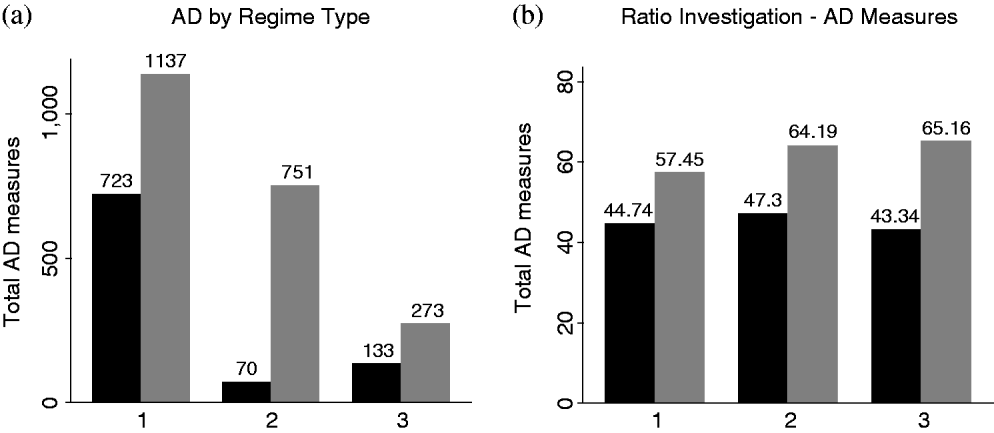
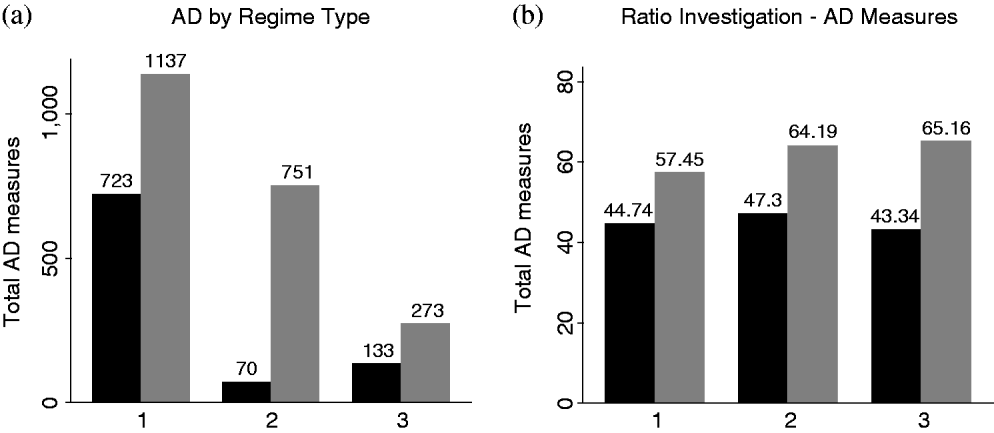
In terms of implementation, an interesting area in which to study the constraining effects of the WTO is the use and application of domestic anti-dumping (AD) procedures. This instrument is used by the main trading partners in the system. There is work that shows how WTO law can have a disciplining effect on accepting companies’ complaints against unfair competition through dumping (Allee, Reference Allee2005). This is actually good news for overall societal interests, if countries are taking less recourse to these measures which largely serve import-competing industries’ interest and can easily develop into protectionist tools. However, the story does not end here. While there might be a constraining effect for some Members, data on the use of AD show some interesting patterns. Figures 1(a) and (b) provide trends in the use of AD measures by regime type and the percentage of AD measures that are accepted by national authorities after an investigation process.Footnote 9
The rise of AD is not surprising as it is closely related to trade flows that have increased over time (and is a result of lower tariffs agreed upon in multilateral, regional, and bilateral negotiations, as well as unilateral liberalization). However, what is interesting is that the use of AD by new democracies in particular has significantly increased, much more than its use by established democracies or autocracies.Footnote 10 Now, this could also be the price to be paid for promoting more free trade (Milner and Kubota, Reference Milner and Kubota2005) as AD measures serve as additional ‘safety valves’ to buy support for more liberalization. Considering that most liberalization has occurred regionally or bilaterally, the WTO in this sense could be seen as an instrument that allows, within some legal boundaries, the use of protectionism-light. What is more puzzling, is that the ratio between investigations and AD measures has increased across all regime types, contrary to the expectations that the WTO's new agreements on AD were likely to lead to less acceptance by national authorities (given a more constraining effect of international trade law).Footnote 11 Here the growth for autocracies is highest, followed by new democracies.
AD by regime type and ratio investigation measures
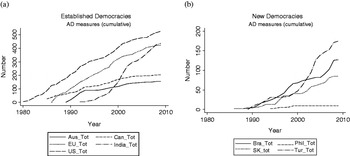
If we focus on the prominent users of AD measures, we see substantial variation across countries. Figures 2 (a) and (b) show cumulative applied AD measures. A rather linear path suggests constant use of these measures. Of the established democracies, India stands out in particular with a large increase in the use of AD measures. With the exception of Australia, however, there seems to be no slowing down effect to be observable after the creation of the WTO, in particular for the US and the EU as two of the largest users. As to new democracies, data suggest high growth rates, in particular in the case of Turkey. In the same period, only the Philippines have observed a relative decline.Footnote 12
Total AD measures

The empirical illustrations above suggest a need for caution as to the ability to constrain import-competing interest groups in their demand for protection. Also, the patterns for regime type effects are ambivalent.
4.2 Protecting minority rights?
Petersmann (Reference Petersmann, Kennedy and Southwick2002) has been the key proponent of the argument that WTO principles, by providing for market freedoms, (should) develop into fundamental rights with human rights character. In this respect, the WTO principles contribute to controlling the misuse of public power (restricting individual rights) and private power (rents from a dominant market position to the detriment of the general public). Yet, I agree with Alston (Reference Alston2002) who argues that economic liberties are hardly classical human rights instruments (and may often stand in opposition to other constitutive rights). In this sense, he posits that ‘trade-related rights are granted to individuals for instrumentalist reasons … They are empowered as economic agents for particular purposes … but not as political actors in the full sense and nor as the holders of a comprehensive and balanced set of individual rights’ (2002: 826). There are two areas where we may find evidence of institutions protecting individual rights defined by WTO law. Below, we focus on disputes in the domestic court arena and within the WTO's institutionalized dispute settlement system. Trade law experts suggest that there is little (systematic or anecdotal) evidence that human rights obligations have served as the driver in interpretation of GATT/WTO rules (Howse, Reference Howse2002). The first obstacle to democracy promotion is that WTO law generally has no direct effect, therefore individuals cannot ask domestic courts to draw upon WTO law (Cottier and Oesch, Reference Cottier and Oesch2001).Footnote 13 In this respect, Cottier and Oesch argue that states need to find a balance between WTO legal effects, fostering market access rights and largely preserving traditional constitutional allocations of power at home. It is noteworthy that even countries with a strong ‘monist’ legal culture (e.g. Switzerland), which attribute direct effect to many international law instruments, have been cautious about granting the same treatment to WTO law. In the case of Switzerland, the legislative arm did not want to allow a shift of competence or power towards the judicial arm. Given the lack of direct application of WTO law, the potential rightholders cannot call upon WTO-induced rights for issues that are settled in national courts.
Protection of minorities, however, might be a by-product of WTO Members challenging certain practices that inhibit the free flow of goods, services, capital, or ideas. Put differently, a Member, in theory, relies upon dispute settlement to protect specific rights of its exporters and by doing so might promote specific economy-related democratic rights in the importing country. A prominent example has been the criticism of Chinese authorities’ censorship which inhibits rights of traders and authors. In this respect, the US has brought two separate cases. However, the disputants, the panels, and the AB largely evaded the sensitive issue whether China's censorship had to be interpreted in relation to public morals (ICTSD, 2009; Pauwelyn, Reference Pauwelyn2010). Pauwelyn observes that ‘the fact that China may … be violating basic principles of freedom of speech was not even mentioned. This approach – for which, after all, the US is as much to blame as the panel and Appellate Body themselves – should temper the hope of those who believe that the WTO can nudge China toward a more open society’ (Pauwelyn, Reference Pauwelyn2010: 15). He concludes that the rulings ‘may facilitate importation and distribution of material that passes Chinese censorship, but leaves China's substantive content review intact and may even make it worse’ (Pauwelyn, Reference Pauwelyn2010: 17). This reluctance by WTO Members to bring cases in relation to democracy-enhancing rights issues was further reflected in early 2010, when the United States Trade Representative (USTR) consulted with Google to discuss whether to bring another case against censorship on the Internet (Internet firewall). The USTR Ron Kirk preferred to resolve the issue through bilateral fora such as the US − China Joint Commission on Commerce and Trade (JCCT) which he anticipated to be ‘much more preferable than the uncertain path of what can be a two-, three-, four-year legal battle in the WTO’ (Reuters, 2010). Lack of progress in bilateral discussions later led the US to request consultations in October 2011, however, without any further steps in the legal proceedings. This example illustrates the fear to overload the existing system with cases related to human rights. The lack of evidence either in domestic or international courts of a democracy-enhancing process suggests caution as to the second channel of suggested ‘democratic’ outside-in effect.
4.3 On deliberation
The third platform where we might observe democracy-enhancing processes induced through WTO membership is related to deliberation fora. Collective deliberation may occur at the Geneva level and at the domestic level. The primary instrument within the WTO intended to increase deliberation is the ongoing exercise in the assessment of national trade policy-making (the TPRM process). The major trading nations are evaluated by the WTO Secretariat every two years, large and middle-sized economies every four years, smaller countries every six years. The written reports focus primarily on core trade issues; however, over time, the Secretariat has also addressed, albeit with significant variation in degree, the nature of domestic trade policy formulation. These reports are discussed in a special session chaired and run by Geneva-based ambassadors. Discussions with ambassadors involved, however, indicate that little substantial discourse takes place. The nature of the exchange hints at lack of significant forms of deliberation and rather low quality when established measures of discourse quality assessment are applied (Steenbergen et al., Reference Steenbergen, Bächtiger, Spörndli and Steiner2003). Whereas the platform could be used for deliberation, the strategic environment dictates a low degree of critical reflection. Members usually abstain from openly criticizing each others’ trade policy in that forum anticipating that when their country is under review other Members will play the same cooperative game.Footnote 14 An interesting case in point is the trade policy review conducted in respect to China in 2010, nine years after its accession. If this forum is important for democracy promotion, we should at least witness deliberation attempts over issues such as democratic standards. However, there was little attention devoted to China's democracy records. The Secretariat report reflected (somewhat critically) on only one democracy-related issue: transparency. The report stated that ‘since its previous Trade Policy Review in 2008, China has continued to take steps to improve transparency. Nonetheless, some aspects of China's trade policy regime remain complex and opaque. For example, China ranked 38th among 48 countries in the 2009 Opacity Index, which measures the degree to which countries lack clear, accurate, easily discernible, and widely accepted practices governing the relationships among governments, businesses, and investors’ (WTO, Reference Organization2010: 12). However, only a few representatives of WTO Members that took the floor at the Council Meeting supported this viewpoint.Footnote 15 The major concern voiced in this respect by the EU, the US, and Korea was increasing transparency to safeguard exporters’ interests on the Chinese market, but not directly improving individual rights for domestic traders. Other interventions from diplomats representing established democracies did not address the transparency issue (e.g., Sweden, Norway, and Switzerland).Footnote 16 Another of the main weaknesses limiting the outside-in effect is that, in most cases, senior civil servants from the capitals are not present.Footnote 17 Therefore, these reports get barely any attention in political circles outside Geneva.
At the national level, we have witnessed various attempts to provide additional platforms for domestic trade policy formulation to increase the base on which decisions are taken. In the 1990s, when many new actors from the private sector and from civil society organizations discovered the WTO, governmental agencies started to set up additional platforms of exchange. In many countries, these consultative processes started as a result of bilateral or regional trade talks (Capling and Low, Reference Capling, Low, Capling and Low2010: 8). In particular, the decision to offer new venues for interaction was swiftly taken in established democracies (on the Canadian experience, see Wolfe, Reference Wolfe, Halle and Wolfe2007).Footnote 18 For instance, in Switzerland, the competent authority set up a new type of platform inviting 20–30 organizations to meet on a regular basis (usually every six months) depending on the speed and progress of negotiations. However, in the end limited deliberation took place.Footnote 19 In addition, participation frequently changes over time. This change in representation negatively impacts on any socialization effects towards more discursive and rhetorical action (Checkel, Reference Checkel2005). The negotiators usually explain in general terms the development of negotiations and use the group as a sounding board for spearheading new initiatives or to prepare for events which will need support from the key constituencies. While negotiators were originally skeptical about this type of exchange (e.g., important information could leak out), they have realized that by engaging with specific groups and selectively exchanging information, they can achieve a certain buy-in. The experience with these types of stakeholder exchanges has been similar in the EU context where the Commission invites and briefs various interested parties. A representative of the business community stressed: ‘The Commission does not share the negotiation texts, but some of the sector representatives might be shown parts of the text (to gather support), the Commission is trying to build up a constituency, and once you are in this process it's hard to back track.’Footnote 20 By bringing various differing views around one table, negotiators can also showcase the difficult position they are in with regard to addressing the different concerns. Therefore, interest groups also develop some understanding when the government is willing to consider other concerns than their own. Thus, if there is wide disagreement among stakeholders, this offers some flexibility to negotiators in case they are called upon by other trading partners to act in the negotiations (see also Elsig and Dupont, Reference Elsig and Dupont2012). Yet, some empirical findings on EU trade policy formulation suggest that civil society actors only marginally impact on the policy formulation; lobbying is still dominated first and foremost by business actors (see Dür and DeBièvre, Reference Dür and DeBièvre2007).
4.4 Regime effects, interaction effects and alternative explanations
The empirical discussion above suggests a need for skepticism about the democratization channels postulated by KMM, when focusing on the WTO. Not only are economic rights far from directly applicable, but the majority of WTO Members have deliberately blocked all attempts to bring democratic issues to the negotiation table, most notably initiatives by the US to address labor rights. The other two channels (constraining special interest groups and increasing deliberation) need to be assessed jointly as they significantly interact in terms of effects. Whereas there is certainly wide variation in participation through institutionalized mechanisms (also for demanding protectionism), we observe few systematic effects on democracy promotion.
From a regime perspective, the effects for established democracies and autocracies have largely the expected magnitude (and direction). For established democracies, new platforms may eventually contribute to an existing state of saturation. There are already a number of platforms to gain access to decision-makers and to engage in deliberation. Adding new platforms might lead to disinterest of (formerly) active stakeholders (partial exit) and those actors with the greatest stakes in terms of distributive outcomes are better able to cope with multiple venues (Drezner, Reference Drezner2006). So, we may under certain conditions witness negative effects on democracy promotion. The evidence presented here also supports the expectations about little effects for autocracies. Deliberation or sector interest constraints are less likely given the lack of democratic culture (which the WTO taken alone cannot penetrate). However, we might witness some indirect effects on selectively increasing access to domestic or foreign traders. As to new democracies, we expected tangible effects (in particular for new liberal democracies). Not only will new actors gain access to decision-making, they will learn to appreciate their new potential influence (empowering effect). State authorities (and strongly linked business interests, including state-trading enterprises), for their part, will have to acknowledge a wider spectrum of concerns. An increase in transparency has the potential to address the ‘secrecy’ of trade policy-making. Yet the evidence presented above is ambiguous, suggesting little impact even for new liberal democracies.
The interaction effects may be most significant for new democracies. There exists a trickle-up effect for empowering certain groups (e.g. cotton farmers in Mali and Benin), constraining at the same time other narrow interests, and increasing overall transparency and accountability of state actors. However, as the data from the use of AD suggest, these economic interest groups are most likely to follow their own special interests, limiting some of the positive results. For autocracies, effects are at a lower level and could cancel each other out. It may well be that in China the individual rights of traders are strengthened (e.g. access to information and due process), but other rights (e.g. labor rights) continue to be ignored. In addition, in autocratic states with substantial raw materials, investor rights may continue to trump legitimate concerns for the protection of certain individual rights related to health, water, and access to basic services. For established democracies, aggregation effects could be negative if existing strong involvement of different fractions of society is suddenly diminished.
Are there any other outside-in effects we should control for? As we find little evidence of democracy-enhancing channels through the WTO, we are less concerned with alternative explanations for democracy promotion. Whether the WTO induces some democracy-enhancing processes remains questionable at this stage; however, there is considerable evidence that democratizing and transition states have joined the WTO to signal to the world that they have moved from a state-based economic system to a market-based one and that, in the country concerned, the rule of law is upheld, for example through non-discrimination principles creating a level-playing field between foreign and local traders.
5. Conclusions
When the WTO was created in 1995, its designers had no intention of empowering the new organization with instruments to induce more democracy in the contracting parties’ polities. Therefore, if democracy promotion were to occur, this would be more a by-product of the interpretation and implementation of the WTO law than a result from rational design. This article has taken a cautious approach to democratization effects through the WTO. There is little evidence of outside-in effects up to this day. If we witness some effects, these are mostly likely to occur in new (liberal) democracies where additional actors become empowered to engage in the domestic trade policy formulation and where global economic institutions help to signal lock-in internally and the existence of ‘rule of law’ externally. The discussion has also shown that we might witness negative effects, such as the empowerment of more issue-specific interest groups or the dominance of trade-related rights to the detriment of other legitimate principles. Specific case studies applying the KMM framework might provide us with more country-level information as to the conditions under which aggregate effects turn out to be positive or negative. For example, how can underprivileged producers gain more rights in the internal political system by drawing on WTO-related norms? In addition, systematic studies on domestic trade policy formulation and access of stakeholders over time might generate important empirical insights to detect additional scope conditions of democracy promotion.
In addition, the article shows that the KMM framework is overtly optimistic about direct democracy promotion. It creates sort of an expectation-capacity gap. IOs, such as the WTO, are not created to promote democracy. Therefore, we need more research to gauge the indirect effects of IO membership. While there exist anecdotal evidence in the context of the WTO (e.g. Aaronson and Zimmerman, Reference Aaronson and Zimmerman2008), we lack more systematic empirical studies focusing on the causal mechanisms of domestic transformation. How will more transparency in one area (e.g. in the trading system providing some rights to importers and exporters) spillover to other domains and increase in turn overall democracy? Democracy enhancement may be a long-term process in which international institutions and transnational organizations (business and civil society) jointly affect democracy promotion at home. In the context of new European democracies, it has been shown that EU membership was the prime instrument for democracy promotion (and not the ratification and accession to international treaties) (Milewicz and Elsig, Reference Milewicz and Elsig2012). Therefore, a multilateral organization, such as the WTO, cannot be expected to do all the work.
The main systemic benefit viewed from a democratic perspective is situated at the level of international cooperation. The WTO is constraining the powerful nations and addresses states' abuse of certain trade instruments (Grant and Keohane, Reference Grant and Keohane2005). However, we also observe that the way the WTO does business today suffers from consensual procedures which in turn affect performance. Overall, the system has witnessed a ‘crowding’ effect (Elsig, Reference Elsig2011). The result is not lack of input, expertise, and voice, but the failure to aggregate those interests. It is ironic that many states demand more democracy from the WTO than is standard at home. In conclusion, the WTO suffers from a democracy surplus in terms of participatory rights to the detriment of its overall performance. The output problem is the key issue that will need to be addressed in the years to come. Attention therefore is currently focused more on enhancing performance than on enhancing democracy.