

I. Introduction: The global constitutional cacophony
The idea of using the concept of constitutionalism to understand global order is hardly new, dating at least as far back as the early twentieth century when scholars of the ‘Vienna School’ laid the conceptual foundations of a proto-global constitutionalism based on the unity of (positive) law and state and international legal orders. Footnote 1 However, inspired by the success of constitutional discourse at the European Union level, and reacting to the end of the cold war, the increasing institutionalisation of international relations and the onward march of economic globalisation, the concept of constitutionalism has been undergoing a renaissance in international legal literature Footnote 2 as well as making headway in international relations. Footnote 3 Unlike the relatively limited ambition of the former ‘wave’ of global constitutionalism, the remit and ambition of the idea in contemporary scholarship is considerably broader, reflecting the significant changes to global ordering in the intervening, particularly post-war, years.
Read any tract in the burgeoning literature on global constitutionalism, however, and you will invariably be met with a definition of some sort. Frequently this will be at, or near, the beginning of the piece, where the conceptual ground is swept clean, a bespoke definition of constitutionalism advanced, and armed with this definition, a particular area or corner of global governance duly analysed, or the use of constitutionalism in the context of global governance duly critiqued. Footnote 4 Given that this exercise is replicated multiple times in global constitutional literature, the concept of constitutionalism seems to suffer from an ever-increasing definitional inflation in the global context.
The way in which constitutionalism is defined seems to depend on the particular object of the global constitutional exercise; whether to ‘map’ Footnote 5 or ‘shape’ Footnote 6 global governance or to criticise the idea of global constitutionalism itself. ‘Mapping’ global governance in constitutional terms involves the recasting of discrete areas of international legal practice in constitutional terms, Footnote 7 or, more ambitiously, the United Nations Charter (UNC) as a ‘constitutional document’ for world order, Footnote 8 the positing of ius cogens norms positivised in provisions such as Article 53 of the Vienna Convention on the Law of Treaties of 1969 as a constitutional ‘hierarchy of norms’, Footnote 9 or the designation of the International Court of Justice as an ‘international constitutional court’ Footnote 10 prospectively exercising judicial control over United Nations Security Council actions through judicial review. ‘Shaping’ approaches tend to involve more explicitly value-based conceptions of constitutionalism to recommend certain reforms to global governance practices including the rolling out of judicial review, or the insertion of human rights standards in certain global governance regimes and practices. Footnote 11 Critics, on the other hand, decry the use of constitutionalism in this way due to the lack of institutions or global constituent subject robust enough to support global constitutionalism, stipulating certain necessary and sufficient conditions (usually something resembling a demos or constituent power) in support of their case. Footnote 12 As a result, in global constitutional literature, ‘constitution’ or ‘constitutionalism’ is variously defined as a foundational blueprint for government, Footnote 13 a hierarchy of norms, Footnote 14 the protection of core fundamental values such as fundamental rights or the rule of law Footnote 15 , the legal-systemic qualities of normative orders including power-conferring and power-limiting rules, Footnote 16 the existence of a demos, Footnote 17 the epistemological condition of modernity, Footnote 18 modern attitudes to power, Footnote 19 neo-liberal economics, Footnote 20 judicial review Footnote 21 and democratic deliberation. Footnote 22 Conceptually speaking, then, the field of global constitutionalism is best characterised as a cacophony.
The presence of the cacophony in global constitutional discourse seems to vindicate the main lines of attack of critics of suprastate constitutionalism more generally predicated on its ‘impossibility’, its ‘inconceivability’, its ‘improbability’ and its ‘illegitimacy’. Footnote 23 In summary, these forms of suprastate constitutional scepticism are critical of the idea of taking constitutionalism beyond the state on the grounds that the problems which constitutionalism was designed to address were, and are, peculiar to states, not least its ‘monopoly of legitimate coercive force’ (impossibility); that the state provides a unique ‘epistemic horizon’ Footnote 24 within which the concept of constitutionalism would or could make sense (inconceivability); that even accepting the transformations entailed in a ‘post-Westphalian’ Footnote 25 world, no site of suprastate governance could be legitimated to the same extent as the state or credibly take its place as a political actor (improbability); and relatedly, any attempt to legitimise suprastate governance in constitutional terms is therefore necessarily illegitimate. Footnote 26 The existence of the cacophony fuels these forms of suprastate constitutionalism in that the question of impossibility is reflected in the fact that the myriad of conceptions of constitutionalism advanced in global constitutionalism testify to the fact that the unique problems of legitimacy in the state and in particular the centralisation of power are not replicated beyond the state resulting in a radical fragmentation of the concept. The cacophony is similarly symptomatic of the question of inconceivability in that the application of the concept to a ‘mysterious’ Footnote 27 epistemic horizon such as that of global governance, gives rise to chaotic ‘definitional conundrums’ Footnote 28 surrounding the concept at the global level as evidenced by the cacophony.
Furthermore, the cacophony seems to lend credence to the ‘improbability’ critique in that the slicing and dicing of the concept of constitutionalism evident in the global constitutional cacophony cannot hope to legitimate global governance in the ways in which its proponents seem to envisage such as to rival the pre-emptive authority of states. Finally, the attempt to sanctify that which ought not to be sanctified with the mantle of constitutionalism at the root of the illegitimacy critique results in ‘empty and misleading’ Footnote 29 partial or fragmented conceptions of constitutionalism evident in the constitutional cacophony. Viewed in this light, the global constitutional cacophony seems to testify to the emptiness of the concept of constitutionalism beyond the state and the rudderlessness of the field of global constitutionalism. The fact that we can have so many different and at times contradictory accounts of constitutionalism serves to highlight the redundancy of any concept of suprastate constitutionalism, not least in the context of global governance where it cannot hope to deliver on its promise to ‘map’ Footnote 30 and ‘shape’ Footnote 31 global governance in the light of its definitional fluidity.
This article will attempt to address the global constitutional cacophony as well as suprastate constitutional scepticism by developing a particular conception of constitutionalism entitled ‘constitutionalism as legitimacy’. In developing the conception of constitutionalism as legitimacy, the relationship between the historically contingent idea of constitutionalism and broader theories of legitimacy are traced in order to identify precisely the specific type or form of legitimacy that the notion of constitutionalism best resembles. Using the concept of legitimacy as a basis for a conception of constitutionalism, it is argued, provides a bridge between the state and non-state contexts in that it introduces a common denominator involving a mutual preoccupation with power and authority between these two contexts.
Constitutionalism as legitimacy presents the historical practices of constitutionalism in states as a discursive form of legitimacy which entails both factual and normative components. The concept of constitutionalism as legitimacy is further developed as a form of reason-giving for the legitimacy of an authority, identifying the relevant reasons with which constitutionalism purports to legitimate authority. These relate to a mix of liberalism and republicanism and are ordered according to the primary preoccupations of both theories; the problematisation of the origins, the aims and the methods of authority. The article goes on to illustrate how this framework of reasons in constitutionalism as legitimacy provides a ‘good’ account of the concept of constitutionalism in that it is historically relevant, sufficiently general to provide a workable conception in different institutional and political contexts as well as provides the important ‘guidance function’ of constitutionalism as a form of practical reason, Footnote 32 not least in the context of global governance.
The article proceeds as follows. Part II shows how a concern for legitimacy provides the key motivating factor behind global constitutional debates allowing it to serve as a common basis between state and non-state conceptions of constitutionalism. Part III provides a brief overview of the idea of legitimacy and identifies constitutionalism as a ‘mixed’ form of legitimacy entailing both normative and descriptive components based on its status as a law-centric form of historical social practice. Part IV develops the conception of constitutionalism as legitimacy as a framework of reasons for the legitimacy of authority based on the dimensions of power or authority problematised by the ‘co-original’ Footnote 33 theories of republicanism and liberalism; namely its origins, its aims and its methods. Part V shows how this conception of constitutionalism can be ‘translated’ to the global level without shedding its relevance or analytical or critical functions which is illustrated by reference to the legitimacy questions surrounding the United Nations Security Council’s ‘war on terror’ and Part VI shows how constitutionalism as legitimacy clearly addresses scepticism about the exportation of the concept of constitutionalism to the global context.
II. The legitimacy of global constitutionalism
Any attempt to cut through the global constitutional cacophony to assess whether the cumulative scepticisms surrounding suprastate constitutionalism are warranted requires a substantive inquiry into the purposes of taking constitutionalism beyond the state, and its application to the global context in particular. To paraphrase a leading commentator on the debate, in the global context we need to identify the question to which constitutionalism is supplied as the answer. Footnote 34 The question, what is (global) constitutionalism for, conventionally elicits two responses reflecting two ‘anxieties of the international jurist’; the fragmentation of international law and the rise of global governance. Footnote 35 Whereas they are usually treated as separate questions, they can, it is argued, be collapsed into one overarching concern which motivates global constitutionalism more generally; a broader concern with the legitimacy of the activities of de facto suprastate authorities in an emerging ‘New World Order’. Footnote 36
The legitimacy concerns related to the second anxiety of the international jurist – that is the emergence of global governance – do so in a rather obvious way and the use of constitutionalism to temper the legitimacy problems which accompany global governance are clear, for example, in ‘compensatory’ accounts of global constitutionalism. Footnote 37 The core justification of the compensatory function of this form of global constitutionalism lies in the fact that ‘political decisions affect people in other states, people who have not elected the decision-makers and can in no way control them’ Footnote 38 as well as the lack of a democratic mandate or control of non-state decision-makers. These developments are occasioning a shift in the ‘justificatory basis of international law’, Footnote 39 from state consent to more normative standards which determine the legitimacy of international acts.
However, even the question of the fragmentation of international law can also, in the final analysis, be reduced to a preoccupation with legitimacy in global order. Anxieties about the fragmentation of international law taps into a broader ‘anxiety of the international jurist’ surrounding the perennial question of the nature of international norms qua law and legal system properly so called. Footnote 40 This hoary old issue questions the credentials of the international legal order as a developed legal system (at least as compared with state legal systems) due to the lack of a centralised enforcement mechanism, the dubious ‘systematicity’ of norms providing the requisite unity of a global legal order, as well as the ostensibly poor record in obedience to the norms of international law by their primary addressees, states. Footnote 41
The putative fragmentation of international law feeds into and exacerbates this anxiety due to the fact that the fragmentation of the international legal order into a global ‘disorder of normative orders’ Footnote 42 seems to demonstrate the inability of international law qua unitary legal order to govern the globe in a comprehensive way, Footnote 43 thereby encouraging scepticism as to the existence of a robust overarching international legal system. For this form of international legal scepticism, then, international law is best conceived of as a ‘set’ Footnote 44 of rules rather than a system of law. However, concerns about the status of international law as a unitary legal system posed by the fragmentation of international law are not, or at least not only, concerns about international law for its own sake. Rather, the undermining of the idea of a unitary system of international law potentially threatens the increasingly central role attributed to law in the legitimacy of international relations. One of the hallmarks of the transition from the ‘Westphalian’ to the ‘post-Westphalian’ era is a shift away from legitimacy based on the balance of power, hegemony Footnote 45 or state-consent, Footnote 46 to institutional rule-based forms of legitimacy. Footnote 47 Central to this rule-based account of the legitimacy of international relations is the presumption of a unitary system of public international law imbued with law-related values such as legality and the rule of law and crucially, something resembling ‘secondary rules’; Footnote 48 the lynchpin of mainstream positivist accounts of a legal system. If the norms of international law do not form part of a coherent unitary legal system, then the enforcement of discrete sets of ‘primary rules’ Footnote 49 of international law, such as those relating to the legitimate use of military force, run the risk of quite literally succumbing to the rule of the powerful. Where primary rule-enforcement is unconstrained by one of the key components of legal systems in states; namely secondary rules of change, recognition and particularly adjudication, Footnote 50 it begins to look more like a primitive legal system; a coercion-based account of law predicated on powerful sovereigns. Footnote 51 As such, any challenge to the authority of international norms qua binding system of law can undermine the rule-based view of international order and contemporary accounts of legitimacy in international relations more generally. Footnote 52
Which legitimacy?
Identifying legitimacy as a common foundation of global constitutional debates therefore provides a fruitful starting point from which to make sense of the global constitutional cacophony. As noted in the previous section, the concept of legitimacy is undergoing something of renaissance in international legal circles in recent times. Footnote 53 However, this ‘turn to legitimacy’ in the ostensible ‘post-ontological’ Footnote 54 phase of theorising international law is not without its critics and has been met with an equally sceptical dismissal of legitimacy in international law; introduced merely to ‘ensure a warm feeling in the audience’. Footnote 55 Indeed, as a contested term in itself, beset by ‘fuzziness and indeterminacy’ Footnote 56 and arguably more contested than constitutionalism and subject to even more cacophonous debate than constitutionalism itself, it may seem an inauspicious place to attempt to grapple with the cacophony of global constitutionalism. However, identifying a common thread of legitimacy in the cacophonous debates on constitutionalism beyond the state more generally at least provides us with a common root of the various conceptions which can bring harmony to the cacophony as well as establish some common ground between the state and suprastate contexts.
Legitimacy is conventionally defined as the obedience of subjects to an authority bracketing coercion or self-interest. Footnote 57 That is that the reasons for the obedience of subjects to an authority relate to the legitimacy of that authority rather than the fact that it uses coercion to obtain obedience or that it serves the self-interest of each individual subject. Beyond this minimalist baseline understanding of legitimacy, theories of legitimacy fragment into a myriad of different positions and questions regarding what, precisely, this might entail. As such here are a variety of ways to cut the ‘conceptual cake’ of legitimacy in theoretical terms and the literature on legitimacy is littered with various taxonomies including sociological legitimacy, moral legitimacy, legal legitimacy, normative legitimacy, legitimacy as a ‘belief’, legitimacy as justice, legitimacy as consent and legitimacy as beneficial consequences among a variety of others. Footnote 58 Notwithstanding the fragmentation and diversity in theorising legitimacy, the diverse threads can be organised and briefly summarised according to three main trends in theorising legitimacy; sociological legitimacy, normative legitimacy and ‘mixed’ accounts. Footnote 59
Promoted most famously by Max Weber, sociological legitimacy primarily relates to the belief in the opinion of the ruled as to the legitimacy of the ruler as evidenced by obedience to the commands of the ruler. Footnote 60 In such a case legitimacy relates to the ‘belief by an actor that a rule or institution ought to be obeyed’. Footnote 61 It has been subjected to a variety of interpretations and some criticism, primarily for its subjective and almost solipsistic nature. Footnote 62 For example, it has been argued that in sociological accounts, the concept of legitimacy does little or no work; legitimacy is merely what happens Footnote 63 or worse, rulers whose commands are wicked are nonetheless considered legitimate. Footnote 64 Beetham has attempted to rescue Weber’s account from this critique arguing that legitimacy on this view doesn’t simply mean that legitimacy is merely what happens, that power is automatically self-justifying. Rather he argues that a power relationship is not legitimate because subjects merely believe in the legitimacy of an authority but rather that the legitimacy of an authority can be ‘be justified in terms of [the] beliefs’ of the subjects of the authority. Footnote 65 Thus, when assessing the legitimacy of a particular power relationship we should examine the extent to which the authority conforms to the values, standards and normative expectations of its subjects rather than merely reporting on the subjects’ ‘belief’ in the legitimacy of an authority. Footnote 66
If sociological legitimacy focuses on the ‘internal point of view’ of the opinions and beliefs of the subjects of an authority, normative accounts of legitimacy relate to an ‘external’ or at least universalisable point of view, focusing on the form of objective or shared standards of (moral) conduct, creating or sustaining a ‘right to rule’ against which the authority and its commands and actions can be evaluated. Footnote 67 It is under this rubric that vast swathes of normative political theory can be recast as theories of legitimacy. As Mulligan notes, even if many of the classical political theorists did not necessarily mention the word ‘legitimacy’, the substance of their theories were essentially concerned with what we now call the normative or moral dimension of the legitimacy of authority. Footnote 68 The area of normative legitimacy/political theory is, of course, vast and diverse dealing with a variety of questions and values including the relationship between legitimacy and equality, liberty, consent, justice, security, democracy among as well as the complex issues of the relationship between the individual and a political community. Footnote 69
A third ‘mixed’ account of legitimacy views legitimacy as a phenomenon which entails both sociological or ‘factual’ as well as political theoretical, or ‘normative’ dimensions. It has its origins in the Weberian account of legitimacy, Footnote 70 however, perhaps the best-known exponent of this particular form of legitimacy is the work of Jürgen Habermas, who has developed a complex account of legitimacy over the past number of decades. Footnote 71 Dismissing purely normative accounts of legitimacy as too abstract, and purely sociological accounts as mere ‘historical understanding’, Footnote 72 Habermas probes an alternative between the two based on ‘facticity and validity’ or ‘facts and norms’. Footnote 73 This mixed account of legitimacy involves a consensus around particular facts about how the world is; that is, the forms of power and authority and the institutions and structures which support it, for example, in the particular political and constitutional arrangements of a state as well as the need to make decisions based on normative criteria. That is, that the decisions or directives of authorities in certain factual circumstances must be justifiable to the subjects of that authority. A key element of legitimacy for Habermas is the idea of ‘communicative power’ Footnote 74 in which reasons have a ‘motivational force’ Footnote 75 for the subjects of an authority to obey its directives. Key to this process of legitimacy based on communicative power is a discourse principle where ‘only those norms are valid to which all affected persons could agree as participants in rational discourses’. Footnote 76 Summarising and simplifying considerably what is a complex and sprawling theory, then, for Habermas legitimacy involves the process of communicative action surrounding the directives of an authority in a public discourse between authorities and subjects where reasons for the legitimacy of the authority based on citizens interests, values and identities are mobilised creating a motivation for obedience on behalf of citizens themselves. Footnote 77
Constitutionalism as legitimacy
If constitutionalism is a proxy for legitimacy in global constitutional discourse (and indeed in much political theoretical discourse more generally), then the question of which type of legitimacy of the three broad categories outlined above constitutionalism best approximates is important to understand the ways in which constitutionalism can and cannot address the legitimacy of authority. This in turn implicates some sort of definition of constitutionalism as the classification of constitutionalism as a particular type of legitimacy, whether sociological, normative or mixed, will necessarily entail a stipulative understanding of the concept of constitutionalism itself. Here the two questions will be dealt with in tandem. Firstly the criteria for any good account of constitutionalism will be elaborated before moving on to specify which type of legitimacy, under these constraints, best conforms to the concept of constitutionalism as it appears in constitutional and political debates.
In thinking about constitutionalism as a ‘standard’ Footnote 78 or ‘touchstone’ Footnote 79 or ‘code’ Footnote 80 of legitimacy, we are already constrained by its history and usage in the state context which narrows down somewhat the broad scope and contestation of the concept of legitimacy outlined briefly in the previous section. Firstly, constitutionalism is a way of thinking about legitimate government which is historically embedded in a particular era of human social and political development, primarily the development of the state from the sixteenth century onwards. Footnote 81 Whereas the concept of constitutionalism entails ideas and values which predate its incarnation, Footnote 82 the ideas which make up the contemporary conceptions of constitutionalism, including the idea of constitutionalism itself, are deeply rooted in modernity. In particular, the values, practices and rhetoric of the political upheavals and reforms in Europe and North America from the late seventeenth century to midway through the nineteenth mark the era when the basic elements of constitutionalism were firmly established. Footnote 83 These developments, of course, occurred and were particularly influenced by enlightenment thinking which inspired many constitutional reforms during this period. Footnote 84 Perhaps the single most important animating enlightenment ideal which shaped the development of constitutionalism as a ‘political technology’, and which makes it stand out as a truly modern idea, was the placing of individuals at the centre of the political universe. This was made clear in Hegel’s reflections on the French Revolution: that never before ‘had it been perceived that man’s existence centres in his head, i.e. in thought, inspired by which he builds up the world of reality.’ Footnote 85 This meant that government and political power, as Alexander Hamilton recognised would no longer result from ‘accident and force [but] reflection and choice.’ Footnote 86
The fact that constitutionalism emerged as a relatively historically fixed (and geographically limited) Footnote 87 way of thinking means that any attempt to analyse or understand it as a concept, or indeed marshal it to new contexts beyond the state must pay due regard to its nature as historical way of thinking about government, power and legitimacy. Footnote 88 Otherwise, there is little use in adopting the specific term ‘constitutionalism’ in the context of global law and governance when one among the variety of other, more specific, concepts and values employed in the history of human thought, such as justice or democracy, is in question and would be preferable to address the legitimacy problems which global governance is currently experiencing.
Even if the concept of constitutionalism developed in a relatively limited temporal and geographical period, it did develop out of a diverse and at times contradictory series of practices, historical accidents and diverse political movements from the early modern ‘Whig’ revolution in England, to the more prominent republican revolutions in France and the US to the ‘springtime of the nations’ in the mid-eighteenth century to the more contemporary spread of constitutionalism in the aftermath of the cold war. Footnote 89 Reviewing the various practices and values conventionally associated with the concept of constitutionalism (and clearly on display in the global constitutional debates) reveals a lack of overarching coherence or conceptual purity in the development of the concept. Constitutionalism thus emerged as, and compatible with, legislative and judicial supremacy, constitutional monarchies, revolutionary republics, various degrees of ‘writtenness’, Footnote 90 with and without canonical statements of fundamental rights, varying uses and degrees of law from clear examples of positive law, through to judicial precedents, customs, habits and conventions. Thus, rather than being conceived of as a specific concrete and discrete set of practices and values or coherent set of necessary and sufficient conditions, even within this relatively limited geographical and temporal space, constitutionalism is arguably better understood, as Grey argues, as a series of ‘family resemblances’ Footnote 91 between diverse enlightenment infused practices of legitimacy and good government. The significance of this feature of the development of constitutionalism is that any attempt at conceptual formulation must abstract, potentially considerably, from the various discrete instances of constitutionalism practised in particular states in order to fashion a credible and workable definition of the concept.
Finally, part of the shift occasioned by enlightenment thinking was the increasing centrality of positive law as both an instrument of, and constraint upon, government. Footnote 92 Constitutionalism is therefore necessarily a law-centric phenomenon even if the precise extent to which law is implicated in government, and the precise definition of what, exactly, qualifies as ‘law’ in this context may be debated. What is clear is that many of the traits of analytical positive accounts of law including a system of norms, reasonably clearly identifiable sources of norms, the idea of hierarchical ordering and considerations of validity, have at least a significant, if not fundamental, role in the development of constitutional forms of government. Footnote 93 The implication of law in the concept of constitutionalism introduces an element of ‘facticity’ to the concept of constitutionalism; that is something that is practised and empirically verifiable, rather than a purely ideal concept. Footnote 94 Legal positivism has implicated the idea of ‘real world’ sociological practice to the idea of law, particularly in Hart’s well-known ‘social fact’ account, Footnote 95 but even Kelsen, who was less sanguine about the contribution sociology could make to the concept of law, did insist on the idea of ‘effectiveness’ as an essential element of the concept of law. Footnote 96 Constitutionalism, therefore, like the concept of positive law itself, tracks the complex dynamic between the ‘is’ and the ‘ought’ in political and legal practices. Moreover, a further element of the implication of law in the concept of constitutionalism is the fact that it should track positive law’s ‘guiding’ function. Footnote 97 That is, that like law, constitutionalism should provide prescriptions for action in particular context. In this way, constitutionalism, like the concept of law, is a form of practical reasoning. Footnote 98
In the light of these constraints when considering the concept of legitimacy from the viewpoint of constitutionalism as a form of legitimacy, then, constitutionalism most corresponds, it is argued to the third category of legitimacy outlined in the previous section; that is, that constitutionalism is a form of ‘mixed’ legitimacy which entails both factual and normative aspects. Whereas constitutionalism does have a sociological dimension stemming primarily from its law-centric nature, it also necessarily involves a strong normative dimension which provides a series of general reasons for the legitimacy of a particular authority based on, for example, its respect for certain substantive values such as fundamental rights.
Expressions of this ‘mixed’ form of legitimacy in constitutional thought are manifest in the work of a variety of contemporary constitutional scholars including Dworkin, Footnote 99 Alexy, Footnote 100 Raz, Footnote 101 Loughlin, Footnote 102 Fallon Footnote 103 and somewhat obviously Habermas, who in his later work has brought his ideas of legitimacy and communicative power to bear specifically on the questions of constitutional government. Footnote 104
The factual dimension of constitutionalism as a form of legitimacy, then, implies that the appropriate context for the application of constitutionalism, the context within which constitutionalism is ‘apt’, is the existence, in fact, of a pattern of rule-based obedience to an authority, an empirically verifiable ‘habit of obedience.’ Footnote 105 From the viewpoint of the broader questions of political legitimacy, this dimension of constitutionalism therefore relates to the justification of actually existing authority, as opposed to the foundation of authority hypothetical or otherwise. Footnote 106 In its factual register, then, constitutionalism is made up of local ‘traditions’ of legitimate government entailing a ‘composite of (frequently inconsistent) beliefs, opinions, values, decision, myths, rituals, deposited over generations’ Footnote 107 about what legitimate government requires. As such its precise contents will vary between different contexts.
However, these various factual elements of constitutionalism as a form of legitimacy, as noted, betray ‘family resemblances’ which allow for the formularisation of a more general conception of constitutionalism. Thus, even if the experience of these individual states is ‘varied’, Footnote 108 there is, as Loughlin argues, a ‘coherent trajectory’ Footnote 109 of Western constitutional development. As such, the ‘coherent trajectory’ in these practices speak to constitutionalism’s universalising normative register. In this way, constitutionalism can be seen as a particular, historical way of thinking about the legitimacy of political power in the practices of primarily European and North-American states since the seventeenth century, culminating in what can be described as a ‘Western Constitutional Tradition’. Footnote 110
The fact that constitutionalism emerges from a series of convergent practices betraying ‘family resemblances’ rather than one single and uniform practice means that the normative dimension of constitutionalism cannot be the product of a ‘time free’ Footnote 111 universal and uniform single value detached from the particular contexts within which they developed. The normative dimension of constitutionalism cannot provide a static blueprint or paradigm for legitimate government such as a precise series of criteria based on a priori principles of justice or equality or autonomy from which a series of necessary and sufficient conditions could be distilled. Unlike other ideal accounts of legitimacy based on, for example, consent or justice, Footnote 112 the normative dimension of the tradition does not conform to any one particular value system or ‘pure’ political theory. Recalling Oakeshott’s quip that the reality of politics ‘offend most of our rational and all of our artistic sensibilities’, Footnote 113 the normative core that emerges from the ‘family resemblances’ making up the ‘Western Constitutional Tradition’ are a mix or blend of ideal political theories. The political theories which dominate the normative dimension of the ‘Western Constitutional Tradition’ such as it is, are centrally preoccupied with what Benjamin Constant described as the liberty of the ancients and the liberty of the moderns; that is, a mix of ideal types of republican and liberal theory. Footnote 114
Republicanism departs from the premise that society is the most basic and primary political unit, within which individuals gain and develop their agency. Footnote 115 Republican theory is explicitly concerned with the terms of engagement, and frequent tensions between the individual and the collective, primarily mediated by the idea of self-legislation; where the individual and the collective interact through the involvement of the individual in collective decision-making. Footnote 116 Contemporary republican theory has developed this idea to promote a particular conception of freedom as non-domination whereby an individual is free to the extent that no other person or group ‘has the capacity to interfere in their affairs on an arbitrary basis’. Footnote 117 In terms of legitimate government, then, in order to avoid arbitrary interference, public power must be traceable to citizens. To actively engage and participate in political decisions in the pursuit of the goals of self-legislation is to reduce the risk of being dominated by others, of having one’s life chances interfered with by others on an arbitrary basis. Thus in institutional terms, the accent in republican theory is on deliberation, contestation and participation, which makes it the natural foundation theory for political forms of constitutionalism. Footnote 118
Unlike republicans, liberals postulate the individual as the most basic political unit and construct a political philosophy around this idea. The basic aim of politics, for liberals, is to secure the liberty of individuals by preventing unwarranted interference from political power. Footnote 119 Where it is necessary for political power to restrict individual liberty, such as to prevent harm to others, Footnote 120 this should only be done within procedural constraints dictated by values such as due process and the rule of law. Footnote 121 As such, law and legal institutions feature predominantly in liberal constitutional theory. Indeed, perhaps the most defining feature of liberalism, and its most marked contrast with contemporary republicanism, is its belief in the ability to legally isolate certain values as fundamental to individual flourishing by reference either to metaphysical ideas of natural rights, Footnote 122 or through some sort of constructed agreement on basic values through an ‘overlapping consensus’. Footnote 123 Given that these values are most basic or fundamental, then, they can and should be shielded from quotidian political processes though legal means such as their codification in a bill of rights or some other form of ‘higher law’ beyond the reach of daily politics. This position usually Footnote 124 leads liberals to favour judicial review to secure these values.
III. Developing ‘constitutionalism as legitimacy’
As a ‘mixed’ form of legitimacy, then, constitutionalism relates to ‘good arguments’ Footnote 125 for the legitimacy of a particular authority as part of a broader discursive process. Weber emphasised the discursive reason-giving nature of legal-rational legitimacy arguing that giving of reasons created a motivation for obedience given the fact that a decision was based on reason rather than personal will. Footnote 126 This discursive aspect of legitimacy evident in Weberian accounts of legal-rationality was developed at length by Habermas in his idea of communicative action where, as noted, reasoning-giving plays a central role. Footnote 127 The exercise of coercion by the state is thus legitimated through the mobilisation of ‘reasons and arguments’ Footnote 128 which generates the ‘communicative power’ Footnote 129 central to his account of legitimacy. This relationship between decisions of authority and their justification through reason-giving was also acknowledged by Carl Friedrich, the Germano-American constitutional theorist, who made a connection between authority created by reason-giving – which supplements an act of will ‘by adding reasons to it’ Footnote 130 – and Theodor Mommsen’s analysis of the etymology of the word ‘authority’; which stems from the Roman root of the word augere, ‘to augment’. Footnote 131
However, the reasons provided by an authority for its legitimacy are subject to reasonable disagreement and can therefore be challenged and contested. This is due to the fact that in a ‘disenchanted’ Footnote 132 world, where the idea of divine or metaphysical truths are no longer accepted as authoritative reasons, ‘secular’ accounts of legitimacy will naturally attract reasonable disagreement. Footnote 133 As such, there is no privileged epistemic vantage point in contemporary politics which would allow for the shielding of particular legitimating reasons from disagreement and contestation. Footnote 134 Moreover, the ‘co-original’ values of republicanism and liberalism which make up constitutionalism as legitimacy are, themselves, in tension with each other as the perfection of the values of one can only be achieved at the cost of the values of the other. As such, reasons for the legitimacy of an authority based on, for example, republican theory can be contested with countervailing reasons drawing on liberal political theory. The reasons accompanying the directives of an authority such as a legislative, administrative or judicial decision, because of their imminent contestability make such directives in Habermas’s terminology a ‘caesura’ Footnote 135 in ongoing discussion rather than a ‘conversation stopper’ on the question of the legitimacy of the decision or the authority itself. Such directives, therefore, are provisionally, rather than categorically justified, allowing for ongoing contestation and deliberation of the balance between the ‘co-original’ values of liberty and equality. This tension and contestation in these mixed forms of legitimacy introduce a dynamic and reflexive element making legitimacy an ongoing activity rather than an ‘end-state’. Footnote 136
Constitutionalism as legitimacy can contribute to these discursive reason-giving accounts of legitimacy by organising the different reasons conventionally advanced to legitimate or contest the legitimacy of an authority. The various tropes commonly associated with constitutionalism such as liberty, equality, democracy, the rule of law, separation of powers or fundamental rights can be traced back to the core constitutional theories of liberalism and republicanism. However, constitutionalism as legitimacy orders these values and aspirations by isolating the different types of reasons which these two ‘co-original’ theories of normative legitimacy provide in attempting to understand, and particularly respond to, crises of legitimacy. The reasons offered up by republicanism and liberalism respectively for the legitimacy of an authority can be organised by focusing on the distinct ways in which republicanism and liberalism problematise authority. This can be understood by reference to what has been called Lenin’s question: where does political power come from, how is political power exercised and what is political power used for Footnote 137 which can be rephrased as concerns about the origins, the aims and the methods of political power.
Republican theory has traditionally been more concerned with both the ‘who?’ and the ‘whose benefit?’ question. This is clear in the dominant role of ‘the public’ in republican theory both as the source as well as the telos of political power to achieve the core republican value of ‘freedom as non-domination’. Footnote 138 As such, predominantly republican-inspired constitutional concepts and ideals such as the idea of a ‘constituent power’ Footnote 139 as the legitimate source of constitutional order, the idea of ‘self-legislation’ as one of the primordial values of legitimate government and appeals to the common good representing the dictates of a ‘general will’ Footnote 140 can be seen to reflect a preoccupation with the origins and aims of political power. The ‘what?’ question tends to attract more focus from liberalism and particularly the ways and procedures through which political power is exercised and the extent of the limits on the exercise of that power. As such, liberalism traditionally privileges the morality of freedom and autonomy, classically interpreted as non-interference, Footnote 141 as operationalised though legal structures and processes.
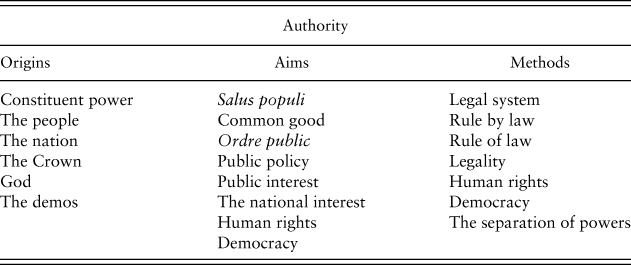
In short, in developing a framework of reasons for the legitimacy of public power, in the Western Constitutional Tradition the tension between liberalism and republicanism can be said to problematise, and offer solutions to, questions surrounding the legitimacy of the origins, aims and methods of political power. In this way, the collection of practices, values, tropes and principles of constitutionalism drawn from liberal and republican theory can be (re)presented in a broader framework of constitutionalism as legitimacy in terms of a series of responses to questions surrounding these three dimensions. Table 1 provides an illustration of how these common dimensions of constitutionalism can be organised into a framework of constitutional legitimacy.
The framework of constitutionalism as legitimacy

From this table, it can seen how the various interventions in constitutional debates can be plotted according to the particular dimensions of political power with which they are particularly concerned. For example, approaches to constitutionalism which use the concept of constitutionalism to argue for, among other things, the promotion of particular values such as the rule of law, due process, fundamental rights protection or the separation of powers Footnote 142 are honing in on the question of the legitimacy of the methods of the exercise of authority. In doing so they reflect the more liberal end of the Western Constitutional Tradition. On the other hand, the ‘foundational’ Footnote 143 conception of constitutionalism, which informs many of the sceptical positions to the idea of global constitutionalism, resonates more strongly with the question of the legitimate origins of political power and its consequences of institutional decision-making along democratic lines, reflecting the more republican dimensions of the tradition.
However, what the framework makes clear is that these are both tendencies within a broader tradition which views the political theories that inspire these positions as ‘equiprimordial’ Footnote 144 or ‘equally basic’. Footnote 145 This ‘equiprimordiality’ is not only historical but also normative. Footnote 146 It is, moreover, evident in the overlaps between the different dimensions of the framework. For example, the idea of a legal system and the rule of law in method, overlaps with aims in that the existence of a functioning stable legal system which contributes to social order can be said to contribute to the common good. Origins can overlap with aims in particular contexts in the respect in which the subjects of the aims of political power can be said, rhetorically speaking, to be the ‘people’, which established the power. The overlap between origins and methods becomes clear in the core idea of ‘authorship’, Footnote 147 where the emphasis on a single source of law granting the validity of the individual norms of a system of positive law resonates with the postulating of the people as the legitimate authors of the law in particular contexts as expressed in the process of legislation by representative assembly.
The overlap is made more apparent in the way in which the same values can be concerned with different dimensions of public power. In the scheme above, for example, human rights can be seen as a liberally infused limit in terms of the legitimacy of the methods of public power but it can, and does in practice, also feature in republican aims of public power, in that the protection of fundamental rights can be considered to be part of the common or public good. Footnote 148 Perhaps more strikingly, the protean value of democracy can be linked to all three dimensions; republican-inspired ideas such as constituent power can provide a powerful justificatory prop for subjecting decision-making to democratic institutions while some (particularly liberal) readings of legitimate aims see democratic procedure as the ultimate expression of the common good. Footnote 149 Democracy has also been posited as a necessary condition of a theory of a normatively desirable theory of law. Footnote 150
Bringing the various values associated with constitutionalism together in this way to reveal the links as well as the tensions between them is of considerable normative value. The close relationship between republicanism and liberalism in the tradition as well as the discursive ‘reasons’ they offer for the legitimacy of political power means that when considering particular issues of constitutional value, such as the rule of law or fundamental rights in methods in order to think about the legitimacy of authority more broadly, we must keep the other, potentially competing, reasons offered by origins and aims in the frame. Changes in one particular dimension can, and usually will, have an impact on the achievement of the others, and the extent and nature of this impact will, in turn, impact upon the legitimacy of the exercise of authority more generally. Thus, for example, arguments for the introduction of ‘reasons’ of method (such as rule of law values) to enhance the legitimacy of particular exercises of authority must contend with reasons relating to legitimate origins and aims such as democratic or policy-based arguments. This is particularly clear when the reason-giving by an authority is contested. The impact of the justification for a decision on the other potential justifications for authority means that they can be mobilised to contest the original justificatory basis of an exercise of authority.
In this way the framework shows how constitutional values are not ‘freestanding’ or ‘time free’ axiomatic goods applicable in the same way in all contexts. Rather, notwithstanding the universalistic tendencies of the constitutional values distilled from liberalism and republicanism, they operate in particular factual contexts where other, competing, liberal and/or republican-inspired constitutional values will be advanced as requiring equal or more respect which will be contested and debated in ongoing discourses regarding the legitimacy of a particular authority. Much of the way in which the discourse progresses will depend on the exogenous ‘facts’ of the constitutional context which will shape and structure the ensuing normative discourse.
IV. ‘Constitutionalism as legitimacy’ beyond the state
Walker identifies three requirements for the ‘basis of translation’ of the concept of constitutionalism between the state and suprastate levels: relevance, generality and normative salience. Footnote 151 The requirement of relevance demands that the translation is ‘sensitive to a sufficiently “thick” understanding of each local context’; Footnote 152 the requirement of generality involves the idea that the translated concept must have some explanatory purchase in all contexts and the requirement of normative salience requires that constitutionalism retains its nature as a form of practical reasoning, providing ‘solutions’ to questions of legitimacy in the contexts to which it applied. Footnote 153 The conception of constitutionalism as legitimacy presented here, it is submitted, fulfils these three requirements of translation allowing for it to provide insights into questions of legitimacy in global governance. Given that it shows the links between different and countervailing reasons for legitimacy, moreover, it does so in a way, which brings order to, rather than replicates, the cacophony.
Firstly, the criteria of relevance, it is submitted, is implicated in the factual dimension of constitutionalism as legitimacy. As noted above, constitutionalism as legitimacy presupposes a sociologically factual practice of authority to which the legitimating discourse of reason-giving and contestation can be applied. As such, the relevant setting for constitutionalism in the context of global governance can be the structures established in a treaty regime, convergent submission to an authority by states or the decisions of suprastate institutions. This means that the peculiar circumstances of particular local contexts of governance are already ‘preloaded’ into the conception of constitutionalism as legitimacy complying with the ‘relevance’ criteria for translation. Secondly, with regard to the ‘generality’ criteria, constitutionalism as legitimacy is sufficiently general to aid understanding of legitimacy questions in different sites of governance whether state, sub-state or suprastate. In the context of de facto authorities, therefore, it helps to explain why a de facto authority such as a global governance institution is successful in having its subjects (in the global governance context usually states) comply with its directives. Finally, constitutionalism as legitimacy also contains the resources for the critique of a de facto authority such as a global governance institution for failing to comply with particular normative benchmarks such as due process, lack of participation in decision-making or substandard review procedures. In this way constitutionalism as legitimacy contains the resources for prescriptions for reform of particular authorities undergoing, or at risk of, legitimacy crises. That constitutionalism as legitimacy successfully fulfils Walker’s criteria for translation to the global level can be illustrated by applying the framework to an area which has attracted much interest from global constitutional scholars: the activities of the United Nations Security Council (UNSC) and in particular its ‘war on terror’. Footnote 154
Constitutionalism as legitimacy and global governance: The case of the United Nations Security Council
As noted, constitutionalism as legitimacy allows analytical insight as well as resources for critique of de facto authorities in a way which is sensitive to the relevant context whether state or suprastate. It does this by identifying not only the legitimacy deficits of particular sites of political power such as global governance institutions, a common theme in global constitutional literature, but also their legitimacy credits. It can perform this function by identifying and classifying the particular ‘reasons’ why actually existing and effective (global) authorities are generally obeyed in the first instance. Frequently questions of legitimacy in global governance focus on legitimacy deficits at the cost of recognising the ways in which the exercise of political power by global governance institutions may be considered to be legitimate, notwithstanding these particular legitimacy deficits. As Steffek notes, ‘if international organisations can suffer a legitimacy crisis […] after many decades of existence this somehow implies that they have been regarded as legitimate before’. Footnote 155 In this way we can make more sense of the ways in which the legitimacy of the UN Security Council and particularly its war on terror, has been contested in recent times.
The ‘activism’ of the UNSC since the end of the cold war, and particularly its role in the ‘war on terror’ has been well documented and has attracted considerable attention in global constitutional literature. Footnote 156 This activism has primarily involved a shift in its activities as a primarily administrative and executive body to adopting more legislative measures in the aftermath of the terror attacks in the US on 11 September 2001. Footnote 157 Its activities during this period have been the subject of considerable critique, based on the ‘radical’ Footnote 158 unauthorised expansion in its powers as well as the lack of procedural safeguards such as the presumption of innocence, the right to be heard, equality of arms, and rights to property and free movement. Footnote 159 Constitutionalism, particularly in its ‘liberal-legal’ Footnote 160 guise, has been primarily employed in this context in a prescriptive or ‘shaping’ form as a way of critiquing UNSC’s activities in this area. Footnote 161 However, constitutionalism as legitimacy outlined above can add to these contributions by showing the complexities of the question of legitimacy in such contexts, and in particular the ways in which the UNSC’s activities could be said to be legitimate as well as illegitimate. Rather than viewing the activities of the UNSC, and perhaps more importantly its legitimacy, exclusively through a focus on constitutional values such as the rule of law or fundamental rights, the framework provided by constitutionalism as legitimacy allows us to plot these interventions in debates about the UNSC’s activities within a broader understanding of the Western Constitutional Tradition as a specific form of legitimacy, as well as capture more clearly the complexity of the issues of the legitimacy of the UNSC raised by its anti-terrorism measures.
In the first instance, constitutionalism as legitimacy forces us to think of the relatively uncontested dimensions of the UNSC’s power; that is in terms of the way in which it currently enjoys legitimacy. The UNSC can be considered a successful de facto authority; as the UN’s Counter-terrorism Committee itself notes, the rate of compliance with these counter-terrorism measures by states has been extraordinarily high, Footnote 162 which speaks at least to some perception of the legitimacy of the UNSC by states. To recall and slightly recast Steffek’s point above, if the UNSC can suffer legitimacy problems from a substantive rule of law perspective, this cannot not mean that its legitimacy tout court has always been in question. Rather the rate of compliance and relative stability of its authority speak to a legitimacy explicable by factors other than these accounts of constitutionalism, which the framework of the constitutionalism as legitimacy divided into origins, aims and methods can provide. In terms of looking for ways in which the legitimacy of UNSC’s activities in this area can be perceived to be legitimate by the constituent states of the UN in the framework of constitutionalism as legitimacy, we need look no further than the recitals to the two resolutions most central to the terrorist-listing regime, 1267 (1999) Footnote 163 and 1373 (2001). Footnote 164 Both of these instruments justify the draconian measures of terrorist listing by reference to the maintenance and preservation of ‘international peace and security’. Footnote 165 As such, a strong factor in the UNSC’s legitimacy in this context, due to its relatively uncontested nature, is the legitimacy of its aims, the ‘global public good’ of international peace and security, Footnote 166 an aim of public power which has been central to the legitimacy of states. Footnote 167 Reasons for the UNSC’s legitimacy in its ‘war on terror’ are also present in the resolutions in their appeal to the legal authority of the UN Charter, and Chapter VII in particular, in executing its counter-terrorist programme. Footnote 168 This ‘global state of emergency’ as developed by the UNSC’s war on terror is formally legal Footnote 169 making it very hard to ‘make the ultra vires argument.’ Footnote 170 As such, the framework also serves to highlight the legitimacy of the methods of the UNSC in respect of the formal legality of its actions through ideas of rule by law. Footnote 171
Against this backdrop of the uncontested aspects of the UNSC’s activities, the framework also allows for the more common critiques of the activities of the UNSC to be put in context, that is critiques based on substantive legality and ‘guarantisme’ constitutionalism, Footnote 172 including the rule of law, due process, judicial review and human rights considerations. Footnote 173 Not only does this allow for a more nuanced understanding of questions of the (il)legitimacy of the UNSC in the context of its war on terror, but it also allows for a more effective method of critique, in identifying and clearly exposing the counter-positions to a critique based on substantive legality.
Given the discursive conception of legitimacy upon which the framework is based, the question of the UNSC’s legitimacy or otherwise will ultimately be thrashed out in the ongoing negotiation and renegotiation of the legitimacy of its particular political and legal practices and their evaluation by its primary constituencies, the constituent states of the UN, and also increasingly non-state actors such as NGOs and supranational bodies like the EU. Footnote 174 The dimensions of the legitimacy as well as the illegitimacy of the UNSC’s activities feed into this discursive (re)negotiation and how this plays out, and in particular which dimension of political power is prioritised, will ultimately depend on the dynamics and character of the relationship and the extent to which its legitimacy is contested. The success of one particular form of legitimacy such as substantive legality will be evidenced by a change in the practices of the UNSC and will ultimately depend on the extent to which the critical discourse of substantive legitimate methods gains sufficient traction. As is well known, the critique of substantive legality has borne fruit having been canvassed by certain UN member states as well as other actors such as the Court of Justice of the European Union, Footnote 175 resulting in increased – but still limited – oversight to the listing procedure through the establishment of an Ombudsperson. Footnote 176
In cases such as this one, what the framework highlights is that in the combination of the stability and success of certain global governance institutions and critiques of their practices, that legitimacy is a more complex phenomenon than is often recognised in global constitutional discourses. This complexity means that the questions of the legitimacy of global governance, to which global constitutionalism is oriented, will not yield simple zero-sum answers. Rather, what constitutionalism as legitimacy emphasises is that authority can be legitimate in some senses but not in others, according to some dimensions of public power but not others, more legitimate from a liberal perspective but not a republican one. As such, the framework of constitutionalism based on this tension provides a useful tool by which to approach the complexity of the question of legitimacy in global governance by appraising both the legitimacy as well as the illegitimacy of the various political relationships and sites of public power which make up this phenomenon.
Moreover, in this way, constitutionalism as legitimacy serves to impose order on the global constitutional cacophony. Each of the various interventions in global constitutional debates such as the ‘constitutional’ critiques of the UNSC’s ‘war on terror’ can be plotted on the framework of constitutionalism as legitimacy in terms of different reasons problematising different dimensions of authority whether origins, aims or methods. The framework also helps to identify and trace the overlaps and relationships between different reasons qua conceptions of constitutionalism in global constitutional debates which helps provide some order and orientation to the cacophony. This helps orient the debate away from binary solutions such as constitutional/unconstitutional to more directly address the substantive questions of legitimacy which animate global constitutional discourse.
V. Some residual scepticism?
The framework of reasons entailed in constitutionalism as legitimacy, as argued above, serves to put some order on the global constitutional cacophony by categorising the different conceptions of constitutionalism which inform the debate and emphasising the relationship between them, not least their ‘equiprimordial’ Footnote 177 nature and common root in a ‘Western Constitutional Tradition’. However, if the cacophony can be ordered in this way, does this mean that the scepticism of which it was argued that the cacophony was symptomatic, can also be addressed? Does constitutionalism as legitimacy effectively deal with the quartet of suprastate constitutional scepticism? Can it take at least some of the sting of the alleged impossibility, inconceivability, improbability and illegitimacy of bringing constitutionalism beyond the state? It is submitted that it can.
Firstly, the impossibility and related inconceivability objections to suprastate constitutionalism entailed the idea that the state provides such a unique context with unique problems and a unique ‘epistemic horizon’ Footnote 178 to which the concept of constitutionalism was uniquely tailored, making its transportation beyond the state problematic. Whereas it is true that much suprastate governance is functionally limited to pursue particular policies such as trade, human rights or security, the lack of comprehensive ‘sovereignty’ in at least formal terms does not negative their status as authorities and their susceptibility to justification (and critique) along the lines of their origins, aims and methods. Neither their functionally limited competence, nor their suprastate context, makes these questions disappear. Indeed, much of the legitimacy crisis surrounding many global governance institutions testify precisely to the ongoing presence and relevance of these different grounds of legitimacy in global governance.
Constitutionalism as legitimacy addresses this twin scepticism through its emphasis on the questions to which constitutionalism is designed as the answer: the legitimacy of authority. This necessarily involves a measure of abstraction from particular expressions of constitutional practices in states to the problematisation of authority more generally. Once abstracted in this way the differences between state and non-state contexts begin to recede, allowing us to see familiar questions between state and suprastate authorities to which constitutionalism can be put to use without foundering on the specificity of particular constitutional arrangements in particular state settings.
The improbability objection, that all law and politics is, in the final analysis reducible to the state system and its legitimating tendencies making the idea of suprastate constitutional authority ‘improbable’, is elided by constitutionalism as legitimacy and its focus on substantive questions of legitimacy. The improbability objection fails to take the ‘post-Westphalian world’ and the legitimacy problems affecting it seriously. That a global governance institution is not, nor can ever aspire to be, a state is neither analytically interesting nor relevant to the contemporary legitimacy problems which these types of authorities face. More problematically, to argue or assume that the problems with, for example, the UNSC’s terrorist listing procedures is either not a ‘real’ problem given that states still exist, or that it is ultimately resolvable by states, seems anachronistic, or naïve or both.
Finally, and perhaps most prominently, constitutionalism as legitimacy meets the illegitimacy objection to suprastate constitutionalism head-on. As noted, the issue of the illegitimacy of suprastate constitutionalism involves the charge of sanctifying that which ought not to be sanctified. Footnote 179 That is, given constitutionalism’s conventional use as a proxy for legitimacy, the emaciated or tendentious nature of much suprastate governance is not deserving of this symbolic legitimating label. Footnote 180 Some take this critique further, arguing that much suprastate and global governance has particular ideological leanings in a neo-liberal direction which are shielded from contestation and are therefore not deserving of the legitimacy associated with constitutionalism. Footnote 181 Approaches to suprastate constitutionalism which attempt to ‘parse’ Footnote 182 the concept to tailor it to the context of global governance, it is submitted, are primarily responsible for this type of suprastate constitutional scepticism. These approaches disaggregate the diverse elements of the ‘Western Constitutional Tradition’ such that only certain aspects of the broader idea are exported to the suprastate level. Footnote 183 However, constitutionalism as legitimacy avoids this critique by employing the Western Constitutional Tradition in toto at the suprastate level. Stressing the ‘equiprimordiality’ Footnote 184 of liberalism and republicanism in the Western Constitutional Tradition and stressing the interrelationships between them, constitutionalism as legitimacy does not privilege or attempt to promote any particular expression of either theory in considering questions of legitimacy beyond the state. Rather than promoting an idea of constitutionalism as one tendentious panacea to the legitimacy problems of global governance, it provides an organisation of reasons for the legitimacy of authority which can be used to gauge the legitimacy credits and deficits of individual sites of governance. In this way constitutionalism as legitimacy is quite balanced.
VI. Conclusion
Constitutionalism as legitimacy encourages us to interpret the various conceptions of constitutionalism in global constitutional discourse as reflecting elements of a broader Western Constitutional Tradition involving a particular historical way of thinking about questions of the legitimacy of authority. The conflicts, incoherence or even mutual disengagement of different conceptions of constitutionalism in global constitutional discourse can be interpreted as an expression of the tensions within the core normative component of this tradition; the tension between liberal and republican theory and the different dimensions of political power they emphasise. This results in a useful account of constitutionalism which can order the global ‘constitutional cacophony’ and contribute to understanding as well as set about addressing the legitimacy crisis in global governance.
Krisch, considering the issue of suprastate constitutionalism notes in sceptical tones, that, Footnote 185
We tend to fill voids with what we know. When we are thrown into unfamiliar spaces, we try to chart them with the maps we possess, construct them with the tools we already have. Working with analogies, extending and adapting existing concepts, seems usually preferable to the creation of ideas and structures from scratch, not only because of the risks involved in the latter, but also because of our limits of imagination. When we try to imagine the postnational space, it is not surprising then that we turn for guidance first to the well known, the space of the national.
Whereas Krisch opens with these reflections as the prelude to his critique of the idea of global constitutionalism, here they are presented as its vindication. The tendency to draw on the known to deal with the unknown is entirely natural and legitimate. Indeed, it is arguably an epistemological necessity; in the history of ideas, there is no view from nowhere. Footnote 186
In taking legitimacy seriously in the context of global governance we are always building the ship at sea. As such we will, by necessity, fall back on the ways in which these forms of authority have conventionally been understood in its most prominent and most familiar form, that is within state practices. Therefore, rather than reinventing the wheel on legitimacy to the changed circumstances of global governance as some propose, the constitutionalism as legitimacy, given its reliance on a tradition does ‘our thinking […] for us and […] ahead of time’. Footnote 187 Traditions, such as the Western Constitutional Tradition, operationalised into the conception of constitutionalism as legitimacy therefore, provide us with ‘storehouses of possibly relevant analogies to our present problems’ in global governance as well as ‘ways of thinking about such problems, and successful and unsuccessful attempts to solve them’. Footnote 188 This considerable experience of thinking about power, authority and legitimacy entailed in the conception of constitutionalism as legitimacy provides a ready-made toolkit to start to think about and address the inevitable welter of ongoing legitimacy questions which will continue to emerge in the transition to a ‘new world order’.