Introduction
According to Darwin (Reference Darwin1874), evolution favours large body size in females since they produce more offspring (fecundity advantage hypothesis). This general hypothesis has enjoyed wide support and has been used to explain why females grow larger than males in zooplankton, insects, fishes, amphibians, reptiles, birds, and other animal species (Bisazza Reference Bisazza1993; Bunger et al. Reference Bunger, Lewis, Rothschild, Blasco, Renne and Simm2005; Cox et al. Reference Cox, Butler and John-Alder2007; Donoso and Tregenza Reference Donoso and Tregenza2011). In insects, including Coccinellidae (Coleoptera), larger females usually have increased capacity to store energy for reproduction and increased internal space to accommodate more developing embryos that result in higher fecundity and larger eggs and egg clutches (Dixon Reference Dixon2007; Kajita and Evans Reference Kajita and Evans2010; Salavert et al. Reference Salavert, Zamora-Munoz, Ruizrodriguez and Soler2011). Larger males are also in general more successful during intrasexual competition for access to mates, have greater sperm supply (Thornhill and Alcock Reference Thornhill and Alcock1983; Bissoondath and Wiklund Reference Bissoondath and Wiklund1996; Hoefler Reference Hoefler2007; Yadav et al. Reference Yadav, Wang and He2010) and thus, successfully pass on fitness advantages to their offspring (Alcock Reference Alcock1993; Hunt and Simmons Reference Hunt and Simmons2000; Omkar and Afaq 2012).
Though the advantages of large body size are well documented, many recent studies have shown that Darwin's “fecundity advantage hypothesis” may apply to a limited set of species and are not applicable to species where genetic constraints prevent variation in offspring number per reproductive event (Shine Reference Shine2005; Losos Reference Losos2009). Many earlier studies also reflect the costs associated with large body size: (i) viability costs in neonates due to prolonged development (Blanckenhorn Reference Blanckenhorn2000), (ii) increased foraging costs and high energy requirements for reproduction (Blanckenhorn Reference Blanckenhorn1998; Dixon Reference Dixon2007), and (iii) decreased reproductive success of larger adults owing to late reproduction (Blanckenhorn Reference Blanckenhorn2000). Further, the smaller size of males is more economical in terms of energy required to sustain them and thus, would benefit and perform better in situations of patchy resources. Since body size is an important determinant of a wide diversity of basic biological properties, ecologists have shown keen interest in establishing linkages between body size variation and population dynamics (De Roos et al. Reference De Roos, Persson and Mccauley2003; Brown et al. Reference Brown, Gillooly, Allen, Savage and West2004; Filin and Ovadia Reference Filin and Ovadia2007).
The importance of intraspecific size variations, though well established in other organisms, is largely ignored in Coccinellidae. Further, it is assumed that prey availability rather than size is more limiting on reproductive attributes of coccinellid (Dixon Reference Dixon2000), though a recent review by Sloggett (Reference Sloggett2008) also talks about differential prey size and quality specialisation based on interspecific variations in coccinellid size. Also, being a potential biocontrol agent, the emphasis has largely been on identifying the suitable prey rather on the role of intraspecific size variations. While numerous studies have been dedicated to prey suitability in coccinellids, both in terms of suggesting prey classifications (Hodek Reference Hodek1962; Mills Reference Mills1981; Malcolm Reference Malcolm1992; Hodek and Honěk Reference Hodek and Honěk1996; Dixon Reference Dixon2000; Michaud Reference Michaud2005) and investigating prey suitability (Bilde and Toft Reference Bilde and Toft2001), hardly any emphasis has been paid on whether size variations in a species also modify prey suitability.
Sloggett (Reference Sloggett2008) suggests that smaller coccinellids are likely to establish more successfully on small aphids at both low and high densities, but when aphid (Hemiptera: Aphididae) species are large, they need high density to sustain themselves. The reverse is true for large coccinellids, but this is based on interspecific variations in size. However, by extension of interspecific variations, it is likely that even smaller size individuals within a species are likely to be constrained in prey capture and consumption, thereby leading to modification of prey suitability.
To answer the questions of prey suitability and influence of size on it, we selected two locally abundant co-occurring aphidophagous coccinellids, Coccinella septempunctata (Linnaeus) and Coccinella transversalis Fabricius (Coleoptera: Coccinellidae). These were selected as they show natural size variation in the field as well as stock. The aphid species Acyrthosiphon pisum (Harris) and Aphis craccivora (Koch) were selected as prey variants and are known to be suitable for these coccinellids (Blackman Reference Blackman1967; Debaraj and Singh Reference Debaraj and Singh1990; Mishra et al. Reference Mishra, Kumar, Shahid, Singh and Omkar2011). The investigation was designed to evaluate the effects on reproductive attributes: fecundity, egg fertility, age specific fecundity, number of clutches, and clutch size. In addition, longevity of males and females were also evaluated. It is our assumption that larger adults would perform better under the ad libitum conditions of the laboratory. We also anticipate that smaller adults of both the coccinellids would perform worse on A. pisum because of its large size, but that the larger adults would prefer A. pisum over A. craccivora. The size difference of these aphid species would further lead to a variation in the prey preference of these coccinellids.
It is expected that the findings will not only explore the assumption whether reproductive attributes of coccinellids are more limited by body size and/or prey suitability or both, but provide information for the selection of suitable size of coccinellids and prey that would help in improving their mass multiplication for biocontrol of pests.
Materials and methods
Establishment of stock
Adult C. septempunctata (C7; ∼100) and C. transversalis (Ct; ∼85) were collected from agricultural fields around the city of Lucknow, India (26°50′N, 80°54′E) and brought to laboratory to establish the stock in environmental test chamber at 27 ± 1 °C; 65 ± 5% relative humidity and 14L:10D light:dark hour photoperiod. Two experimental stocks were maintained; one where adults were supplied with A. craccivora infested on bean (Dolichos lablab Linnaeus; Fabaceae) plants reared in greenhouses (at 28 ± 1 °C; 65 ± 5% relative humidity and 14L:10D light:dark hour photoperiod), and the other on A. pisum infested on broad bean (Vicia faba Linnaeus; Fabaceae) plants reared in greenhouses (at 21 ± 1 °C; 65 ± 5% relative humidity and 14L:10D light:dark hour photoperiod).
In each stock, adults were paired in plastic Petri dishes (14.5 × 1.5 cm). The aphid supply was replenished every 24 hours and the oviposition, if any, was recorded, after which mating pairs were transferred to new dishes. The Petri dishes containing eggs were observed for hatching and the newly emerged larvae were reared in beakers (14.5 × 10.5 cm) on daily replenishment of an exclusive ad libitum supply of the aphid species provided to parents. The newly emerged adults were sexed and isolated and kept in conditions similar to above.
Experimental design
To study the influence of body size and prey quality on reproductive attributes, sexually mature virgin females and unmated males of C7 were selected from each experimental stock (A. pisum or A. craccivora), weighed using an electronic balance (Sartorius CP225-D; Sartorious AG, Goettingen, Germany; 0.01 mg precision), and segregated on the basis of their mass into, large (C7large = 43.10 ± 0.53 mg) and small females (C7small = 34.90 ± 0.31 mg; F female =141.12, P < 0.0001, df = 1, 19), and large (C7large = 39.80 ± 0.51 mg) and small males (C7small = 29.20 ± 0.59 mg; F male = 183.20, P < 0.0001, df = 1, 19). Similarly, Ct adults were separated into large (Ctlarge = 28.14 ±0.33 mg) and small females (Ctsmall = 23.16 ±0.19 mg; Ffemale = 173.19, P < 0.0001, df = 1, 19), and large (Ctlarge = 24.97 ± 0.46 mg) and small males (Ctsmall = 19.44 ± 0.61 mg; F male = 66.07, P < 0.0001, df = 1, 19).
C7 adults from the A. craccivora stock were paired into large × large (n = 10) and small ×small (n = 10) pairs at the age of 10 days. The same was repeated in size segregated C7 from A. pisum stock and also Ct from both prey stock (age at pairing = 5 days). Each mating pair was kept in separate Petri dish (14.5 × 1.5 cm) with respective prey species. Food was replenished and Petri dishes were changed every 24 hours. Daily oviposition (egg laying in 24 hours), clutch number and size, and egg fertility ((number of eggs hatched × 100)/total number of eggs) were recorded for the entire reproductive phase. No adult died prematurely in these treatments; all females and males died in the post reproductive phase. Male and female longevity was also calculated.
Statistical analysis
Data on fecundity, egg fertility, and male and female longevities were subjected to Bartlett's test of homogeneity of variances and Kolmogorov-Smirnoff test of normality before being subjected to three-way analysis of variance (ANOVA) followed by Tukey's post-hoc comparison of means. Reproductive attributes and longevity were considered as dependent factors, and coccinellid species, body size, and prey quality as independent factors. Percent data were subjected to arcsine square root transformation prior to three-way ANOVA.
Age specific fecundity and egg fertility, number of clutches (number of egg batches per female per day), and clutch size (number of eggs per clutch) per species, per size, and per prey, were polynomially regressed against mean reproductive age. All statistical analyses were performed on MINITAB 16 (Minitab Inc., State College, Pennsylvania, United States of America).
Results
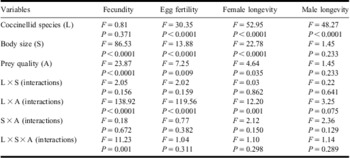
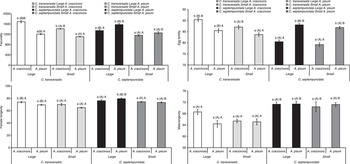
The three-way ANOVA revealed that fecundity was influenced by body size and prey quality and not by coccinellid species. The interactions between coccinellid species and prey species, and between coccinellid species, their body size, and prey species had statistically significant effect on fecundity. Ct females were significantly more fecund on A. craccivora and C7 females on A. pisum regardless of their size (Table 1).
Three-way ANOVA table showing the effects of coccinellid species, size (body size), and prey quality (prey species) on various reproductive attributes.

Notes:F-values significant at P < 0.05 (df = 1, 79).
Analysis further revealed significant influence of coccinellid species, body size, and prey species on egg fertility and female longevity (Table 1, Fig. 1). The interaction between coccinellid species and prey species had significant effect on egg fertility and female longevity. Egg fertility of Ct on A. craccivora was highest in all treatments. Both smaller and larger-sized Ct laid more fertile eggs on A. craccivora while both sizes of C7 showed higher egg fertility on A. pisum. Both smaller and larger sized Ct females lived longer on A. craccivora. However, smaller C7 showed insignificant difference in female longevity between prey species, while larger C7 females lived longer on A. pisum. The longevity of larger C7 females on A. craccivora was similar to that of the smaller C7 females.
Effects of Coccinellidae species, body size, and prey quality on fecundity, egg fertility, and male and female longevities (values are mean ± SE). Small letters, large letters in parentheses and large letters represent comparison of means between reproductive attributes, longevities and prey quality, between reproductive attributes, longevities and body size, and between reproductive attributes, longevities and ladybird species respectively, based on Tukey's post hoc comparison of means.

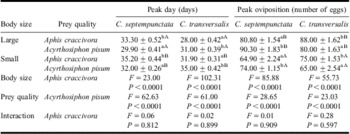
Male longevity was influenced only by the coccinellid species and not by their body size and prey species. Larger males of C7 had highest longevity on both prey species when compared with smaller C7 males and larger Ct males (Table 2).
Effects of body size and prey quality on peak day and peak oviposition in the case of Coccinella septempunctata and Coccinella transversalis.

Notes: Values are mean ± SE.
F-values significant at P < 0.05 (df = 1, 39).
Small letters and large letters represent comparison of means between peak day/peak oviposition and prey quality and between peak day/peak oviposition and body size, respectively.
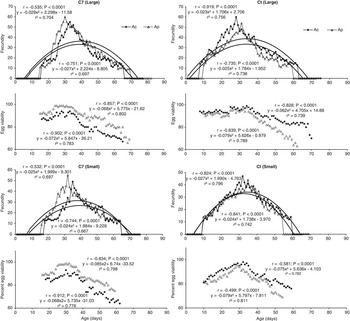
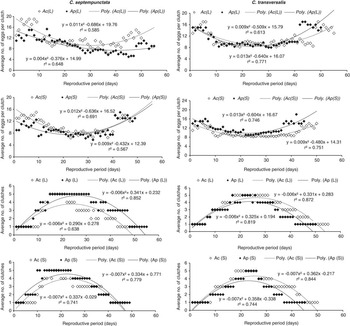
Age specific fecundity data further revealed that daily oviposition increased with increase in adult age, reached a peak, and thereafter declined with further advancement in age; that is, a triangular fecundity trend. The age-specific egg fertility also revealed similar trend (Figs. 2, 3). The peaks of maximum fecundity and egg fertility were obtained between 25- and 35-day-old adults in both coccinellid species. The peaks were higher in larger coccinellids of both the species (Table 2). Early onsets of peaks of fecundity were observed on A. pisum and A. craccivora in the case of C. septempunctata and C. transversalis, respectively.
Age specific fecundity and egg fertility (egg viability) showing the effects of body size and prey quality in case of Coccinella septempunctata (C7) and Coccinella transversalis (Ct). C7, Ct, Ac and Ap represent C. septempunctata, C. transversalis, A. craccivora and A. pisum, respectively. r and r 2 represent correlation and regression coefficients, respectively (value significant at P < 0.05). Solid and dotted lines represent the trend lines observed.

The average number of clutch during the reproductive period, in the case of large (L) and small (S) Coccinella septempunctata and C. transversalis fed on Acyrthosiphon pisum (Ap) and Aphis craccivora (Ac). L, S, Ac and Ap represent large, small, A. craccivora and A. pisum, respectively. r 2 represent regression coefficients (value significant at P < 0.05). Solid and dotted lines represent the trend lines observed.

The number of clutches was highest during mid-reproductive period, though the number of eggs per clutch was low. The reverse was observed in early and late reproductive phases. Larger females laid more number of clutches than smaller ones irrespective of species. C7 laid highest number of clutches on A. pisum, while Ct on A. craccivora.
Discussion
In the present study, higher fecundity, egg fertility, and longevity of larger females of C7 and Ct substantiate the role of body size on reproductive performance of coccinellids, as we expected. However, body size was not found to influence the prey preference of the two species, with C7 preferring A. pisum over A. craccivora and Ct preferring the latter over the former, regardless of their size. This is against our hypothesis as it was our assumption that the larger size of A. pisum would be disadvantageous for smaller adults and would lead to a variation in prey preference. The absence of this result indicates that though the interspecific variation in size of adults is known to influence their arrival in the field on patches of prey of different sizes (Sloggett Reference Sloggett2008), intraspecific variations did not reveal such differential ability in the laboratory and under ad libitum conditions. It is, however, possible that ad libitum conditions might have effectively masked the advantage of being small for males; prey scarce condition may change the scenario and larger adults may be disadvantaged and show change in prey preference. Also, in the present study the size variations used were natural variants and not induced ones. Selection for size using food and temperature variations may change the outcome of the study. In cases where some prey may be less suitable than the others, the result may also be influenced (Ferrer et al. Reference Ferrer, Dixon and Hemptinne2008). However, this is not the case in the present study where both A. pisum and A. craccivora are optimal prey for both the coccinellids.
Larger females were found to perform better as is supported by the fecundity advantage hypothesis proposed by Darwin (Reference Darwin1874). Larger females acquire more nutrient resources to produce more eggs and possess higher capacity to store eggs, overcoming the constraint of space to store eggs, or the nutrients required for egg production (Howard and Kluge Reference Howard and Kluge1985; Wicklund and Karlsson Reference Wicklund and Karlsson1988; Roff Reference Roff1992). Larger coccinellids, besides meeting their metabolic costs, partition more energy in the eggs production/reproduction (Dixon Reference Dixon2007). Thus, larger females are more fecund and produce higher number of clutches and clutch sizes than smaller females (García-Barros Reference García-Barros2000).
Earlier studies have reported larger females to be preferred as mates by the males and to have higher fecundity than smaller ones (Saeki et al. Reference Saeki, Kruse and Switzer2005; Hoefler Reference Hoefler2007; Berger et al. Reference Berger, Walters and Gotthard2008; Salavert et al. Reference Salavert, Zamora-Munoz, Ruizrodriguez and Soler2011; Omkar and Afaq 2012). Stewart et al. (Reference Stewart, Hemptinne and Dixon1991) associated higher fecundity in larger females with increased number of ovarioles. The role of larger males in mate choice and reproductive success has also been ascertained by many researchers (Bonduriansky Reference Bonduriansky2001; Helinski and Harrington Reference Helinski and Harrington2011). Larger males are believed to have better genes, higher sperm supply, and the ability to transfer increased male accessory gland proteins during mating to stimulate egg production, ripening, and deposition, and thus ultimately enhance fecundity, egg fertility, and reproductive period (Perry and Rowe Reference Perry and Rowe2008; Yadav et al. Reference Yadav, Wang and He2010; Avila et al. Reference Avila, Sirot, LaFlamme, Rubinstein and Wolfner2011; Hanin et al. Reference Hanin, Azrielli, Zakin, Applebaum and Rafaeli2011; Omkar and Afaq 2012). Higher fecundity is also associated with higher longevity in coccinellids (Omkar and Srivastava Reference Omkar and Srivastava2003; Pervez and Omkar Reference Pervez and Omkar2004).
The prey species, A. pisum and A. craccivora, are among the suitable prey for both the coccinellid species (Omkar and Srivastava Reference Omkar and Srivastava2003; Kalushkov and Hodek Reference Kalushkov and Hodek2004; Omkar and James Reference Omkar and James2004; Mishra et al. Reference Mishra, Kumar, Shahid, Singh and Omkar2011). Still, higher fecundity, egg fertility, higher number of clutches, and clutch size of C7 and Ct on A. pisum and A. craccivora, respectively, substantiate towards the presence of better and essential nutrients in these aphid species for the respective coccinellids, resulting in their better and higher palatability. But, it took several generations (Rana et al. 2002) for C7 to get adapted to deal with A. pisum toxins, and for Ct to become well used to A. craccivora, and acquire the ability to detoxify the toxins. Studies have also shown that certain defensive chemicals in some prey species are very important factors determining prey specialisation (Rana et al. 2002). The results thus indicate that growth, development, reproductive performance, and longevity are highest on most suitable prey and lowest on the least suitable prey (Omkar and Srivastava Reference Omkar and Srivastava2003; Omkar and James Reference Omkar and James2004; Omkar and Mishra Reference Omkar and Mishra2005; Ferrer et al. Reference Ferrer, Dixon and Hemptinne2008).
Higher palatability and suitability of A. pisum to C. septempunctata over A. craccivora have been reported by Kalushkov and Hodek (Reference Kalushkov and Hodek2004). Omkar et al. (Reference Omkar, Mishra, Srivastava, Gupta and Singh2005a) reported higher reproductive performance of C. transversalis over C. septempunctata on A. craccivora. The higher reproductive performance of C. septempunctata on A. pisum and of C. transversalis on A. craccivora suggest the higher suitability of the respective aphid species to respective coccinellids, possibly owing to availability of better nutrients in these prey species required by their respective coccinellid species.
Regardless of the aphid prey species, relatively higher male and female longevity of C. septempunctata over C. transversalis, suggests the former to have certain intrinsic advantages over the latter. Omkar et al. (Reference Omkar, Pervez, Mishra, Srivastava, Singh and Gupta2005b) observed such intrinsic advantages in the form of higher reproductive performances in C. sexmaculata, despite of its smaller size, over C. septempunctata and C. transversalis when fed on A. craccivora.
Age-specific fecundity in the present study has followed a triangular trend and indicates towards the effects of maternal senescence beyond a certain age. Early onset of peak of fecundity on A. pisum by C. septempunctata (for both sizes) and on A. craccivora by C. transversalis (for both sizes) further substantiates the better suitability of these prey for the respective coccinellids. Similar observations have also been reported on Menochilus sexmaculatus (Fabricius) (Coleoptera: Coccinellidae) (Omkar et al. Reference Omkar, Singh, Pervez and Mishra2004) and the Parthenium beetle, Zygogramma bicolorata Pallister (Coleoptera: Chrysomelidae) (Omkar et al. Reference Omkar, Kumar and Sahu2009). Age-specific egg fertility also follows the similar pattern, but is known to be largely paternal age dependent (Omkar et al. Reference Omkar, Singh, Pervez and Mishra2004; Pervez et al. Reference Pervez, Omkar and Richmond2004). The finding further reveals that the middle reproductive age individuals (between 25 and 35 days old) have better reproductive performance for both sizes of coccinellids on both prey species. It is believed that middle-age individuals invest most of their energy in reproduction than young or old-age individuals. The results are in agreements with the findings in Propylea dissecta (Mulsant) (Coleoptera: Coccinellidae) by Pervez et al. (Reference Pervez, Omkar and Richmond2004).
The higher number of eggs per clutch during early and late reproductive phases might be attributed to the least number of clutches during these phases. There always exists a trade-off between number of clutches and number of eggs per clutch (Forsman Reference Forsman2001). Similarly, higher numbers of clutches along with lower numbers of eggs per clutch during middle reproductive phase were also recorded, which further substantiates the above view. Age-based trade off between number of clutches and number of eggs per clutch can be expressed in the terms of energy partitioning. During early reproductive phase, females probably invest their energy in both somatic growth (increase in body biomass) and growth of their gonads. As females age, somatic growth ceases and most of the energy is used in growth of gonads (Dixon and Agarwala Reference Dixon and Agarwala2002). Moreover, studies have shown that reproduction and rate of senescence are linked in insects (Blackman Reference Blackman1967; Boggs Reference Boggs1997; Fernando and Walter Reference Fernando and Walter1999; Dixon Reference Dixon2000). As coccinellids age their reproductive organs deteriorate. They become less efficient in assimilating the food consumed, and their fecundity and fertility decline as consequences of senescence (Kindlmann et al. Reference Kindlmann, Dixon and Dostalkova2001; Dixon and Agarwala Reference Dixon and Agarwala2002).
Thus, it may be inferred that:
(i) Both body size and prey quality affect the reproductive performance in coccinellids. This combination may be exploited for the mass multiplication of these coccinellids in laboratories.
(ii) Although both the coccinellid species co-exist in A. craccivora and A. pisum colonies, there are higher probabilities of C. transversalis to dominate in A. craccivora guild and C. septempunctata to dominate in A. pisum guild.
(iii) The middle-age individuals appear to have better reproductive performance.
Acknowledgements
M.B. is thankful to the University Grants Commission, Nepal for providing financial assistance in the form of Teacher Fellowship and Omkar is thankful to the Department of Higher Education, Government of Uttar Pradesh, Lucknow for financial assistance under the Centre of Excellence programme.