This paper describes our qualitative research on 10 children’s experience of cardiac surgery and follow-up care at the Red Cross War Memorial Children’s Hospital (RCWMCH), Cape Town, South Africa, from 2011 to 2016. Broadly speaking, the study, a multi-disciplinary collaboration between medical anthropologists, cardiologists, and an intensive care specialist, sought to find out how parents understood and described their child’s surgery, recovery at home and follow-up visits in the cardiology services. We qualitatively tracked children from their hospital admission for surgery into their homes and communities. Methodologically we chose to investigate two broad questions. The first is addressed in this paper and asks, could we in the research team maintain communication after surgery with parents and children? The second question, which we will discuss in future papers, is, “What life is like in the world” of these vulnerable children.Reference Kleinman and Benson 1 The questions take into consideration that despite excellence in paediatric cardiac surgery, most children who enter government hospitals in South Africa come from poorer homes in the metropolitan region. Compared to developed world standards they are socio-economically challenged and this is illustrated on our social media platform. Given their circumstances and to enhance the research, we established a Participant Action-based Research project titled Operation BraveHeart.Reference Baum, MacDougall and Smith 2 This included a social media platform, www.braveheartfoundatıon.org, and a Facebook page to disseminate our results to parents and communities. Furthermore, they were encouraged to remain in contact with us.
Our questions express known concerns in the long-term success rate for surgical procedures and aftercare for CHD in lower- to middle-income countries where preventable suffering remains an issue. In this the importance of having effective communication with parents and communities has been cited as critical in maintaining good post-surgical follow-up for children.Reference Larrazabal, Jenkins and Gauvreau 3 , Reference Yacoub 4 Failures in communication happen for two reasons; the first is challenge that is inherent in children’s home environments, and the second, the nature of medical research. As regards the latter, specialist clinical settings tend to rely on quantitative methodologies to substantiate outcomes for children with CHD. This strategy, however, fails to provide an in-depth interrogation of the psychological and social circumstances and communication deficits that families encounter in their pathway to care, and will be explored in future papers. In comparison, qualitative research facilitates a broad-based enquiry to elucidate a child’s welfare, not as a marker of the surgery’s success but of sustained well-being in a complex socio-political locale. This strategy facilitates a constant examination of communication strategies. Zarocostas argument that child health is a qualitative issue and a moral imperative that requires commitment to rational long-term investment in integrated health systems in which a variety of skilled professionals have “periodic oversight” for “specific interventions” pertains.Reference Zarocostas 5 This discussion has relevance in South Africa, where – although the country is relatively resource rich – children from socio-economically deprived homes scheduled to receive cardiac surgery often get it in an emergency rather than as a scheduled procedure. This is because the South African Constitution (1996) guarantees this surgery in an emergency such as tetralogy of Fallots, in which severe cyanotic spells mean children tend to receive immediate attention. However, those children on cardiology waiting lists with similar defects may wait for considerable periods for their procedure to be scheduled and get beds in the intensive care. This has salience given that cardiac surgery for simple lesions may be remarkably cost-effective, as these require a single intervention at the appropriate time.Reference Blue, Kirk, Sholler, Harvey and Winlaw 6 This allows many children to have a near normal life expectancy with minimal medical support. Set against this are complex CHDs that require further multiple surgical interventions and ongoing care, and yet increasing numbers live to adulthood. Added to this is that the well-being of affected children in such settings is at issue because surgery for a specific pathology must happen within a set age range; otherwise irreversible damage will occur.Reference Larrazabal, Jenkins and Gauvreau 3 Unfortunately, correction of these defects is more difficult to justify in resource-poor contexts where children’s rights to life-saving procedures cannot be guaranteed by health system budgets.Reference Mocumbi 7 In South Africa, it was estimated in 2011 that only 25% of the patients accessing public hospitals with CHD would receive surgery.Reference Hoosen, Cilliers and Hugo-Hamman 8
Methodology
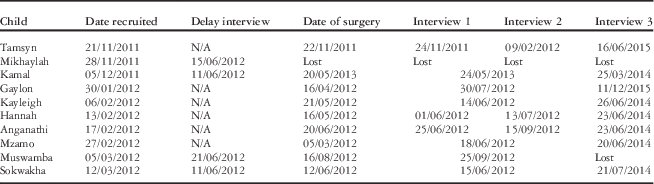
In 2011 two cardiologists – J.L. and G.C., over a period of 5 months, recruited 10 children, aged from birth to 13 years old, into the present study. As a convenience sample, eligible children who were scheduled for an immediate but not emergency elective cardiac surgical procedure were included. Inclusion criteria required that each child had a diagnosis for an operable cardiac condition and was scheduled to receive surgery within the following 2 months. We excluded children with a poor prognosis for ethical reasons and those older than 13 years. As each child was recruited into the study, two qualitative researchers – L.V. and C.N. – attended his or her pre-surgery cardiology appointment and invited parents to join the long-term (5 year) study. Researchers were informed about the child’s clinical diagnosis, demographics, and social history (Table 1).
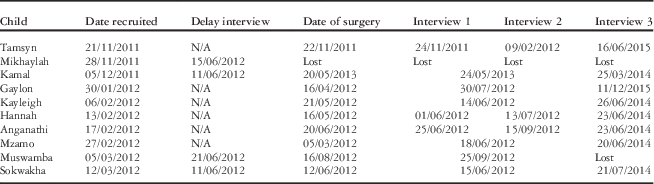
Interview schedule for study participants.
Data collection relied on classic qualitative research tools and we engaged parents in semi-structured interviews in clinical and home settings, observational sessions, and focus groups. Focus groups were held with parents and separately with key clinical staff from the cardiology and intensive care departments. Participative Action-based Research was employed to actively include participants in the research process because it encourages feedback into the research with the objective of increasing the veracity and accuracy of evidence during data collection. This strategy openly seeks to empower respondents as regards their right to health care. Another strength of the methodology is that it is more informal and observational allowing researchers to be present in clinical arenas but not overtly intrusive. In order to bolster the participative aspect of the study over the 5-year period, we deployed a web-based environment – www.braveheartfoundation.org and Operation Facebook page – to facilitate our respondents’ feedback, which is evidenced on our Facebook page.
Research became operational when the first of the 10 children and their parents were recruited into the study. Each recruitment interview included obtaining informed consent from parents, and a sticker was placed on the child’s folder asking doctors and nurses to notify the researchers as soon as the child went in for his or her operation. Having given informed consent, parents were then prepared for researchers to follow children into surgery, be interviewed in intensive care, on the wards after surgery, and then be contacted in their homes 6 weeks after the procedure. Informed consent and later interviews happened whenever possible in the respondent’s first language, and when this was not English we employed isiXhosa-speaking and Afrikaans interpreters. These early interviews established an information-rich profile on each child’s clinical history, life story, and family relationships. Employing qualitative research facilitated an on-going and more intimate investigation of the child and family’s circumstances and feelings about the procedure. It allowed us to accumulate data on the procedure, the child’s pathway into care, cultural background, language, customs, cultural and family beliefs. This included asking them about their understanding of the “heart” and CHD. Video-recordings and photographs of the child and family were included in the data collection. When age and comprehension allowed we asked the child about his or her feelings.
Once the child was discharged from hospital, we relied on contact with parents to carry out all future follow-up interviews. The first follow-up interview was 6 weeks after the surgery, the second within a year of the child’s surgery, and then 2 years later. The most recent interviews were carried out from March, 2014 to December, 2015. At each interview session the same qualitative data collection procedure and a review of previous information was undertaken. Additional video-recordings were made and photographs taken. Concurrently, feedback on this information was placed onto our web-based environment for on-line discussions.
Once the data were collected we transcribed, collated, and thematically analysed them for key themes and salient quotations. This paper looks at a very small sector of this databank. Qualitative research requires that analysts make themselves familiar with the data, consistently reading them in order to define central and sub-themes across the cases and the data set. Themes were validated through NVIVO, a qualitative data analysis package. The Human Research Ethics Committee at the University of Cape Town and the RCWMCH Ethics Committee granted ethics approval (HREC.355.2011/DOH.02.11.2011) for the project and this included permission to gather photographic evidence and engage parents on a web-based platform.
Results
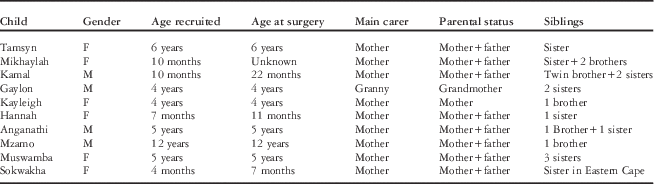
During the period from November, 2011 to March, 2012, we recruited 10 children with different cardiac defects who were scheduled for cardiac surgery into the study. Of the 10 children, six were girls and four boys, and their ages ranged from 4 months to 12 years; four were aged between 4 and 10 months; five between 4 and 6 years; and one boy was 12 years old (Table 2).
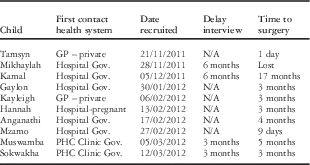
Time lapse between recruitment and surgery.
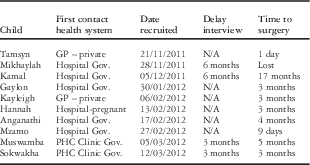
Although researchers and parents believed the child’s surgery was scheduled to happen within the week, only Tamsyn underwent surgery the day after she was recruited into the study; Mzamo had his operation 9 days after, four children had it within 3 months, Anganathi 4 months and Muswamba 5 months later. Kamal received surgery 17 months after recruitment.
Because delays in surgery happen frequently in this environment, we decided to carry out interviews with four of the children’s parents in June, 2013 to find out how the delay had affected them and the child. Most parents did not know why the surgery was delayed, reporting in general that this had been because their child’s operation was cancelled when he or she had been unwell. It was after her “delay interview” that Mikhaylah was lost to follow-up in the study but medical records show that she did receive surgery. Delays and cancellations “muddled” our interview schedules; as researchers we were not always informed in time that a child was about to undergo surgery. Keeping up to our interview schedule was also complicated by our having to go out into poorer communities to find parents who lived stressful lives in Cape Town. Future papers will address these themes and how they affected communication. The interview schedule table illustrates how some parents were successfully interviewed twice after the child’s operation and others only once. In 2014, we undertook a third follow-up interview and successfully followed up seven children in their homes. Of the three – out of 10 – children missing for interview in 2014, Mikhaylah was lost to the study after the delay interview; Gaylon’s grandmother was subsequently interviewed in the cardiology clinic; and Muswamba’s mother has remained difficult to contact. All three children met their yearly cardiology appointment, and the reasons for this will be discussed (Table 3).
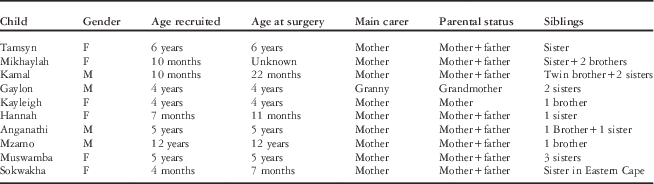
Demographics.
F=female; m=male.
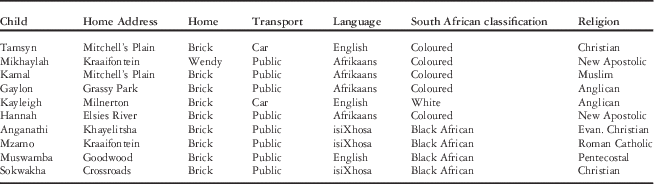
The demographic tables describe the socio-political circumstances of our respondents and this presents as a fairly typical patient profile in government health care in South Africa. Apart from two families, the remainder of the children came from more socially disadvantaged areas in Cape Town where many continue to suffer the disadvantages brought in by apartheid, relied on public transport, lived in small brick houses, or in one case a wooden shed, and visited government-run hospitals. Two families had the financial means to consult a private doctor but relied on government health services to access paediatric cardiac surgery. Our patients are fortunate in that they have access to a surgical service as they live in an area of South Africa where the under-5 mortality is declining and hence resources can be diverted to cardiac surgery. Nevertheless, they live in areas that are similar to the favelas of Rio de Janeiro, typified by poor-quality housing and sanitation and gang violence. All except one child had their mother present during the recruitment interview and she was waiting for them to return from surgery. Unusually in this setting eight children lived with both parents.Reference Reid, Hendricks, Groenewald and Bradshaw 9 , 10
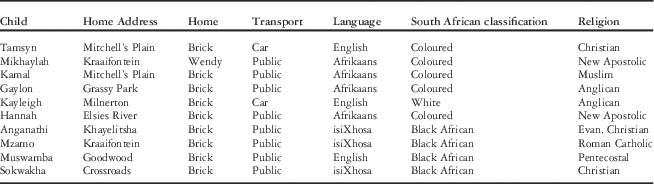
Diversity in language, culture, and religion as indicated in Table 4 was prevalent amongst the respondents; one family was Muslim and the others from different Christian denominations. IsiXhosa-speaking families claimed culture was important to them as they needed to carry out traditional practices to ritually protect their child. Themes in the analysis, which will be presented in a second paper, showed that a sense of spiritual protection, need for prayer, and visits from religious authorities was important for families with strong religious affiliations.
Demographics.
Discussion
This article provides a qualitative snapshot on the communicative problems we encountered in following up 10 children who received cardiac surgery at the RCWMCH in Cape Town, South Africa, the best resourced health care services on the continent. In the country an estimated 11,000 children are born annually with CHD, with about 85% of sufferers living to adulthood. Hoosen et al have argued that despite functioning cardiac surgery programmes, 3000 children die or remain disabled from CHD each year, making the number of deaths greater than the number of children who undergo surgery.Reference Hoosen, Cilliers and Hugo-Hamman 8 Underlying this statistic is an unaddressed issue about access to children who get surgery in resource-poor environments. Related questions arise about how well these vulnerable children actually do and whether the health system safeguards them in their homes.Reference Kasparian, Winlaw and Sholler 11 While this study provides some information on this subject, we recognise that our small sample group represents the tip of an iceberg, beneath which exists a known paucity of care for children with CHD in lower- to middle-income countries.Reference Larrazabal, Jenkins and Gauvreau 3 , Reference Yacoub 4
This discussion turns therefore to qualitatively examine our results and elucidate why, we as researchers struggled to follow patients into their communities. In this South African context all 10 children received cardiac surgery – despite delays – and cardiology follow-up over the 5-year period. This was determined by the availability of excellence in clinical expertise and the close proximity of sound biomedical resources, for example, theatres, equipment to respondents’ homes. Cardiology follow-up was of particular note because unlike children in resource poor countries who receive surgery from internationally based intervention programmes, they received rigorous, regular check-ups. Despite these positive outcomes effective communication with respondents proved difficult for the researchers. While we struggled to locate parents, because they had moved house, for instance, the cardiologists in our multi-disciplinary research team could inform us that the children had attended their appointments. This was true even when there were delays in scheduled operations. Thus parents, in spite of difficulties, diligently met check-up dates, illustrating their concern but also high regard for authority in this well-functioning hospital. Patients have access to relatively cheap minibus taxi transport and live relatively close to the hospital despite being poor; it is likely that budgetary or work constraints resulted in some parents having to prioritise a visit to the medical team over a visit to the research team. They were reassured by physicians who had an in-depth knowledge of their child’s medical condition, and this was highlighted in the case of three children who suffered with “Down’s Syndrome” and had subsequent “critical events”. In comparison, parents were often reluctant to access community clinics. One mother described waiting in a clinic for a day for her acutely ill – post-surgery – child to see a doctor who on reading the patient folder immediately sent the child by ambulance to RCWMCH.
Thus at a community level a different story was being told and this spoke of the socio-economic challenge that impacted families who had children with debilitating heart conditions. It was this factor which significantly determined our inability to access children. Home visits after surgery were an essential part of our qualitative methodology and thus with permission we always endeavoured to visit each child as often as possible in that setting. While we found that unusable roads, unpredictable violence, and poor circumstances in township areas such as Khayelitsha made it difficult for us to reach families, so the same factors were given as reasons why parents who lived in Mitchells Plain struggled to get to hospital by taxi for one twin’s heart surgery whereas the other had to remain at home. In this respect, Yacoub recommends the establishment of integrated Paediatric Cardiac Services that interleave with other sectors in society such as legal advisors and NGOs who can facilitate appropriate long-term follow-up of cardiac patients.Reference Yacoub 4 In our study what proved critical was an absence of interpreting services that addressed language and cultural difference and worked through explanations about clinical diagnoses. This is not the place to discuss our evidence on the importance of informed consent procedures, language difficulties, and inadequate education, which often prevented parents from understanding their child’s CHD, but suffice to say that this absence was ameliorated by their trust in surgeons and clinical procedures. This failing had repercussions, however, because it compromised future timely interventions and the ability to identify symptoms of crisis. One example was Mzamo who underwent surgery when he was 12 years old; he was discharged from the children’s hospital and received no further check-ups. At his last interview he and his mother were anxious and so our research cardiologists brought him back in for a check-up. This has signalled the need for specialist follow-up for adolescents.
Thus, our failing as researchers to reach children with CHD in their home settings showed that many were doubly disadvantaged; first by their heart condition and second by the broader socio-economic circumstance into which they are born. The fact that surgery was available and accessible shifted this negative dynamic. The research shows, however, that much needs to be done to make children with CHD and their parents more visible in their home environments during vulnerable periods if they are to be safeguarded. For instance, and interestingly, most parents did not sense that their child had CHD before the first diagnosis, but when interviewed 5 years later, they said there was a remarkable difference in their child’s physical condition. Mothers seemingly failed to pick up on their child’s distress because their symptoms were indistinguishable from the chronic stresses they daily endured. Surgery therefore had a significant impact on the whole family’s health and their social and economic circumstances. Sadly, the same chronic stressors existed on their return home with a small child, who less than 2 weeks previously had her chest opened up and yet had no one to care for him or her when her mother had to return to work.
Conclusion
This article is the first descriptive paper on our qualitative study and establishes a marker for the future development of caring interventions and multi-disciplinary research. The results present a surprisingly optimistic 5-year picture of cardiac surgery procedures in South Africa, a middle-income country where despite considerable constraints in the health system and socio-economic challenge, parents and children experienced positive outcomes in respect of their surgical procedures and cardiology follow-up. Parents and children tended to accept the necessity of surgery and delays, trusted doctors and nurses, and expressed being enormously grateful. Despite or perhaps because of the challenges described, children and their parents were remarkably resilient and clinicians and nurses were robust in working productively to achieve the best possible outcomes. Embracing Participant Action Research and a web-based platform for parent/child and researcher interaction was enormously beneficial in building relationships with parents and children, which were sustainable and caring. It has resulted in an information-rich database that is still to yield much insight into how we, in the health services, can care for and safeguard vulnerable children. We recognise that our sample size may appear to be small for those reading mostly quantitative research; our project is a qualitative study. Only once the data have been analysed for themes, will the adequacy of the sample size be known.Reference Baum, MacDougall and Smith 2 This platform has encouraged informal conversations on children with CHD in our local context and reached out to successfully converse in an international framework. In this respect showcasing our project demonstrated that despite setbacks, we persevered and managed to maintain contact with the majority of the families. If funding had been more forthcoming there is little doubt within our dynamic research team and participant-based initiative that even these difficulties could have been overcome. This is said because many parents and their extended family expressed ownership of the project through this medium and felt empowered to discuss how their child’s and familial and financial circumstances had changed quite dramatically following surgery and the recovery process.
Acknowledgements
Our research team gratefully acknowledge Professor Andrew Argent’s considerable contribution to our research process and publication endeavours. The authors also gratefully acknowledge the parents and children in our research, who agreed to be “known” on our web-based platform. The authors also thank the contribution to research procedures of the staff in the Cardiology Department, Intensive Care Unit and Administration services in the Red Cross Children’s Hospital and the Primary Health Care Directorate, University of Cape Town, South Africa.
Financial Support
The National Research Foundation of South Africa; Emerging Researcher Award: University of Cape Town.
Conflicts of Interest
None.
Ethical Standards
The authors assert that all procedures contributing to this work comply with the ethical standards of the Helsinki Declaration of 1975, as revised in 2008, and has been approved by the Human Research Ethics Committee, Faculty of Health Sciences, University of Cape Town and the Red Cross War Memorial Children’s Hospital, Ethics Committee, Cape Town, South Africa.