Children's differential susceptibility to rearing experiences, which is the idea that individuals with particular characteristics are more responsive to both adverse and supportive contextual influences, has attracted increasing research interest (Belsky, Bakermans-Kranenburg, & van IJzendoorn, Reference Belsky, Bakermans-Kranenburg and van IJzendoorn2007; Boyce & Ellis, Reference Boyce and Ellis2005; Ellis & Boyce, Reference Ellis and Boyce2008; Ellis, Essex, & Boyce, Reference Ellis, Essex and Boyce2005; Pluess & Belsky, Reference Pluess and Belsky2009). Most supporting empirical work has focused on the developmental effects of early rearing experiences with parents, prior to primary school entry, and the moderating influences of children's biological sensitivity to context, operationalized as either physiological or behavioral responses to environmental adversities. Previous findings generally suggest that children who are more physiologically or behaviorally reactive exhibit more internalizing and externalizing symptoms and poorer adaptive outcomes when in adverse, or unsupportive, contexts (Colder, Lengua, Fite, Mott, & Bush, Reference Colder, Lengua, Fite, Mott and Bush2006; Feldman, Greenbaum, & Yirmiya, Reference Feldman, Greenbaum and Yirmiya1999; Kochanska, Aksan, & Joy, Reference Kochanska, Aksan and Joy2007) and lower symptom levels and more positive outcomes when in supportive contexts (Blair, Reference Blair2002; Crockenberg, Reference Crockenberg1981; Denham et al., Reference Denham, Workman, Cole, Weissbrod, Kendziora and Zahn-Waxler2000; Feldman et al., Reference Feldman, Greenbaum and Yirmiya1999; Klein Velderman, Bakermans-Kranenburg, Juffer, & van IJzendoorn, Reference Klein Velderman, Bakermans-Kranenburg, Juffer and van IJzendoorn2006). However, little is known about the joint influences of child physiological and behavioral reactivity, along with school-age, nonparental rearing experiences, on the development of mental health by adolescence.
From an evolutionary perspective, the success of different behavioral strategies is contingent upon the physical, economic, and socioemotional demands of each individual's environmental context (Crawford & Anderson, Reference Crawford and Anderson1989), and thus strategies that promote success in some contexts may lead to failure in others. The biological sensitivity to context model (Boyce & Ellis, Reference Boyce and Ellis2005) posits that variation in susceptibility to environmental influence, which is instantiated through reactivity of the stress response systems, has been maintained by natural selection because this variation promotes success and failure in different social contexts. Within the biological sensitivity to context model, greater early stress exposure upregulates general stress reactivity and increases an individual's capacity and tendency to detect and respond to environmental danger. Conversely, exposure to a highly nurturing context during childhood is also thought to upregulate stress reactivity, thus increasing the individual's ability to benefit from additional social resources and support. By contrast, exposure to childhood environments that are not extreme in either direction downregulates stress reactivity, buffering individuals against the chronic stressors encountered in a world that is neither highly threatening nor consistently safe (Boyce & Ellis, Reference Boyce and Ellis2005).
Central to the biological sensitivity to context model is the assumption that individuals with particular qualities are likely to be not only more susceptible to adversity but also more sensitive to enriching experiences. Supporting this position, physiological markers of heightened stress reactivity (Boyce, Chesney, et al., Reference Boyce, Alkon, Tschann, Chesney and Alpert1995; Boyce et al., Reference Boyce, Essex, Alkon, Goldsmith, Kraemer and Kupfer2006), including genetic markers often considered indicative of vulnerability to environmental risk (Belsky et al., Reference Belsky, Jonassaint, Pluess, Stanton, Brummett and Williams2009), have also been associated with adaptive outcomes under supportive conditions. Thus, heightened stress reactivity likely reflects an increased neurobiologically mediated sensitivity to context (i.e., biological sensitivity to context). Such sensitivity increases the potential for developing negative health outcomes under conditions of adversity and positive outcomes under conditions of support and nurturance (Boyce, Chesney, et al., Reference Boyce, Chesney, Alkon, Tschann, Adams and Chesterman1995; Boyce & Ellis, Reference Boyce and Ellis2005; Ellis et al., Reference Ellis, Essex and Boyce2005).
Although not presupposing that stress reactivity is a conditional evolutionary adaptation, Belsky and colleagues (Belsky et al., Reference Belsky, Bakermans-Kranenburg and van IJzendoorn2007, Reference Belsky, Jonassaint, Pluess, Stanton, Brummett and Williams2009; Pluess & Belsky, Reference Pluess and Belsky2009) have, like biological sensitivity to context theory, argued that some individuals may be differentially susceptible to both supportive and adverse environmental influences, “for better and for worse” (Belsky et al., Reference Belsky, Bakermans-Kranenburg and van IJzendoorn2007). Unlike diathesis–stress models, which treat reactivity as a risk factor for negative outcomes, both biological sensitivity to context and Belsky's and colleagues' work suggest that consideration of differential susceptibility to adverse and supportive contextual influences may more fully explain why some highly reactive children develop problems when other similarly reactive children fail to do so or even thrive (Belsky & Pluess, Reference Belsky and Pluess2009; Ellis & Boyce, Reference Ellis and Boyce2008).
Biological Sensitivity to Child Rearing
Biological sensitivity to context in children may dispose them to be sensitive to both the harmful effects of adverse contextual factors and the benefits of supportive contextual characteristics (Calkins, Blandon, Williford, & Keane, Reference Calkins, Blandon, Williford and Keane2007; Lengua, Bush, Long, Kovacs, & Trancik, Reference Lengua, Bush, Long, Kovacs and Trancik2008; Obradovic, Bush, Stamperdahl, Adler, & Boyce, Reference Obradovic, Bush, Stamperdahl, Adler and Boyce2010; Pauli-Pott, Mertesacker, & Beckmann, Reference Pauli-Pott, Mertesacker and Beckmann2004; Pluess & Belsky, Reference Pluess and Belsky2009). This research has focused primarily on early parenting and has examined differential susceptibility across various types of samples and using various measurement strategies and conceptual frameworks. Negative parenting behaviors (e.g., maternal hostility, power assertion, psychological control) have been associated with a range of poor outcomes among children with temperaments characterized by negative emotionality, typically operationalized as difficult temperament, irritability, proneness to frustration/anger, impulsivity, fearfulness, or inhibition (Kochanska et al., Reference Kochanska, Aksan and Joy2007; Lengua, Reference Lengua2008; Lengua, Wolchik, Sandler, & West, Reference Lengua, Wolchik, Sandler and West2000; Leve, Kim, & Pears, Reference Leve, Kim and Pears2005; Morris et al., Reference Morris, Silk, Steinberg, Sessa, Avenevoli and Essex2002; Van Zeijl et al., Reference Van Zeijl, Mesman, Stolk, Alink, van IJzendoorn and Bakermans-Kranenburg2007). In contrast, positive parenting behaviors (e.g., maternal sensitivity, positive discipline, secure parent–child relationships) have been linked to better outcomes among children who show more negative emotions (Gilissen, Bakermans-Kranenburg, van IJzendoorn, & van der Veer, Reference Gilissen, Bakermans-Kranenburg, van IJzendoorn and van der Veer2008; Mesman et al., Reference Mesman, Bakermans-Kranenburg, van IJzendoorn, Juffer, Koot and Alink2009; Van Zeijl et al., Reference Van Zeijl, Mesman, Stolk, Alink, van IJzendoorn and Bakermans-Kranenburg2007; Velderman, Bakermans-Kranenburg, Juffer, & van IJzendoorn, Reference Velderman, Bakermans-Kranenburg, Juffer and van IJzendoorn2006). Evidence of differential susceptibility to parental behaviors also includes two recent analyses from the NICHD Study of Early Child Care, which found that, compared to other study participants, children who had been temperamentally difficult infants showed the worst outcomes if they experienced poor parenting and the best outcomes if parenting was excellent (Bradley & Corwyn, Reference Bradley and Corwyn2008; Stright, Gallagher, & Kelley, Reference Stright, Gallagher and Kelley2008). Further, evidence from animal models suggests that highly reactive individuals are more sensitive to both the negative consequences of suboptimal parenting and the benefits of highly nurturant caregiving (e.g., Suomi, Reference Suomi1997).
We previously demonstrated that reactive children are more sensitive to early parental behavior across multiple measures of reactivity (Boyce et al., Reference Boyce, Essex, Alkon, Goldsmith, Kraemer and Kupfer2006). Unlike much research in this area that focuses on maternal parenting, our prior analyses focused on the interaction of father involvement during infancy with children's physiological and behavioral reactivity at age 7 years. We found that low father involvement, combined with high reactive mean arterial pressure (MAP), high reactive salivary cortisol, or low temperamental inhibition/high disinhibition, contributed to later high symptom severity (i.e., combined internalizing and externalizing) at age 9, whereas strong father involvement for reactive children buffered against high symptom levels. Further, a three-way interaction indicated that the children most at risk for high symptom levels were those with high MAP who experienced low paternal involvement and high maternal depression symptoms during infancy. Thus, the most reactive children, whether indexed by physiological or behavioral reactivity, were most susceptible to the effects of both adverse and supportive early parenting.
In addition to parenting, a few investigations have considered early child care as a context to which reactive children may be sensitive. Most notable is a recent study by Pluess and Belsky (Reference Pluess and Belsky2009). Using data from the NICHD Study of Early Child Care, they found that childcare quality, as indexed by caregiver sensitivity, interacted with infant temperament to predict children's behavior problems and social competence. Specifically, when caregiver sensitivity was low, children who had been temperamentally difficult infants exhibited low levels of social competence at 54 months and high levels of behavior problems at 54 months and in kindergarten; conversely, when caregiver sensitivity was high, children who had been temperamentally difficult infants later exhibited high levels of social competence and low levels of behavior problems; and finally, caregiver sensitivity had no effect on outcomes for children who were not temperamentally difficult during infancy. Considering these findings alongside those of Bradley and Corwyn (Reference Bradley and Corwyn2008) and Stright et al. (Reference Stright, Gallagher and Kelley2008), Belsky and Pluess (Reference Belsky and Pluess2009) conclude that “infants with difficult temperaments appear more affected by the quality of care they experience—both in and out of the home—than do other young children” (p. 401). Several smaller studies also suggest that reactive children may be sensitive to extrafamilial caregiving. Being in child care for ≥30 hr/week (Crockenberg & Leerkes, Reference Crockenberg and Leerkes2005) and in greater numbers of care arrangements (De Schipper, Tavecchio, van IJzendoorn, & Van Zeijl, Reference De Schipper, Tavecchio, van IJzendoorn and Van Zeijl2004) have been associated with elevated levels of internalizing symptoms among temperamentally reactive young children. In addition, young children high in temperamental social fear exhibited low levels of peer competence when childcare quality was low and high levels of peer competence when childcare quality was high (Volling & Feagans, Reference Volling and Feagans1995).
The research summarized above suggests important ways that children's experiences of parenting and child care may interact with their stress reactivity to influence child outcomes. However, work on biological sensitivity to context has received little attention in studies of children's experiences with teachers following the transition to primary school (Myers & Pianta, Reference Myers and Pianta2008). Nevertheless, a vast literature has demonstrated that the quality of the relationship between child and teacher is important to numerous childhood outcomes (Baker, Grant, & Morlock, Reference Baker, Grant and Morlock2008; Birch & Ladd, Reference Birch and Ladd1997; Burchinal, Peisner-Feinberg, Pianta, & Howes, Reference Burchinal, Peisner-Feinberg, Pianta and Howes2002; Curby, Rimm-Kaufman, & Ponitz, Reference Curby, Rimm-Kaufman and Ponitz2009; Ladd & Burgess, Reference Ladd and Burgess2001; Myers & Pianta, Reference Myers and Pianta2008; Pianta & Stuhlman, Reference Pianta and Stuhlman2004). Longitudinal studies have linked the teacher–child relationship in the early school years with children's academic and socioemotional functioning in later elementary and even middle school years (Brendgen, Wanner, & Vitaro, Reference Brendgen, Wanner and Vitaro2006; Hamre & Pianta, Reference Hamre and Pianta2001; Pianta, Steinberg, & Rollins, Reference Pianta, Steinberg and Rollins1995). Generally, greater conflict and (sometimes) less closeness in the teacher–child relationship have been associated with externalizing problems, whereas less teacher–child closeness has been connected in some studies to internalizing problems (Birch & Ladd, Reference Birch and Ladd1998; Buyse, Verschueren, Doumen, Van Damme, & Maes, Reference Buyse, Verschueren, Doumen, Van Damme and Maes2008; Henricsson & Rydell, Reference Henricsson and Rydell2004; Pianta & Stuhlman, Reference Pianta and Stuhlman2004). In our own prior work (Silver, Measelle, Armstrong, & Essex, Reference Silver, Measelle, Armstrong and Essex2005), we used a person-centered approach and found that higher levels of teacher–child conflict in kindergarten increased the odds of being in “chronically high” and “low but increasing” (vs. “stably low”) externalizing groups.
Although the possible combined effects of teacher–child relationship quality and children's stress reactivity on child outcomes have received very little attention, there is some evidence indicating that the teacher–child relationship (Brendgen et al., Reference Brendgen, Wanner and Vitaro2006; Meehan, Hughes, & Cavell, Reference Meehan, Hughes and Cavell2003), and more broadly, observations of teacher supportiveness and the classroom environment (Gazelle, Reference Gazelle2006; Hamre & Pianta, Reference Hamre and Pianta2005), can have the largest impact on children who are most at risk for negative outcomes. For example, Hamre and Pianta (Reference Hamre and Pianta2001) found that conflict in the kindergarten teacher–child relationship was associated with the highest levels of later disciplinary infractions at school, especially among children with behavior problems in kindergarten. Ladd and Burgess (Reference Ladd and Burgess2001) found that, in addition to teacher–child conflict and closeness functioning as respective general risk and protective factors across kindergarten and Grade 1, teacher–child conflict increased the likelihood of maladjustment primarily among aggressive children. Other studies have focused on the influences of teacher–child closeness. For example, Baker (Reference Baker2006) found that elementary school children with high degrees of emotional/behavioral problems who experienced a close relationship with a teacher evidenced significantly higher levels of positive school outcomes (academic, classroom adjustment, social skills) than children with comparable levels of emotional/behavioral problems who experienced a lack of closeness with their teachers. Our own work (Silver et al., Reference Silver, Measelle, Armstrong and Essex2005) demonstrated that teacher–child closeness was most beneficial for children with externalizing problems. In regression terms, children who had the highest externalizing intercepts across the early school years experienced the largest decreases in externalizing slope when teacher–child closeness was high in kindergarten; that is, for children with externalizing problems, high closeness with teachers was associated with the largest declines in externalizing over time, whereas low closeness was associated with the growth of externalizing.
Taken together, the extensive evidence of the role that early teacher–child relationships can play in children's development, combined with findings on highly reactive children's sensitivity to parental and nonparental contexts, suggest that the levels of conflict and closeness in the teacher–child relationship in the early school years may also have significant influences on the developmental outcomes of reactive children. However, no studies have addressed this important question.
Present Study
We prospectively examined the influences of the teacher–child relationship at Grade 1 (age 7) on the development of child mental health symptoms by Grade 7 (age 13), and the potential moderating effects of child biological sensitivity to context at Grade 1. We chose to focus on the Grade 1 teacher–child relationship primarily because it parallels previous studies and captures the child's early experiences during the transition to primary school before relations with teachers have been well established. Grade 7 was selected for assessing outcomes primarily because, in addition to representing the early adolescent period when mental health problems begin to increase, it corresponds to the transition to middle school (>80% of children in the present study changed schools), with accompanying changes in teachers and the broader school climate and structure. To address questions regarding differential susceptibility to both adverse and supportive school experiences, the levels of conflict and closeness in the teacher–child relationship were considered. Based on the previous research summarized above, adversity in the teacher–child relationship was conceptualized as either a relationship characterized by high levels of conflict or a suboptimal relationship characterized by a lack of closeness; a supportive relationship was conceptualized as either a relationship characterized by high levels of closeness or a relationship without conflict. To address questions regarding possible differences in the moderating influences of physiological and behavioral reactivity, one measure was considered from each domain to assure that the variable to subject ratio was adequate for the relatively small sample size (N = 96) of the present study. For the physiological reactivity domain, we focused on the autonomic nervous system (ANS) because it has received more attention than the hypothalamic–pituitary–adrenal system in studies of differential susceptibility (Belsky & Pluess, Reference Belsky and Pluess2009); and within the ANS, MAP was chosen because it is an integrated measure of that system. For the behavioral reactivity domain, temperamental inhibition/disinhibition was selected for its coverage of the most commonly studied temperamental characteristics (reviewed above) in previous research on differential susceptibility (Belsky & Pluess, Reference Belsky and Pluess2009). Consistent with biological sensitivity to context and differential susceptibility models, we hypothesized that children who were more reactive would develop the most severe Grade 7 mental health symptoms if they had adverse experiences with their Grade 1 teachers, and the fewest mental health symptoms if they had more supportive experiences with their Grade 1 teachers. Grade 7 symptom levels in children low in reactivity were expected to be similar, regardless of Grade 1 teacher–child relational quality. Potential differences by child sex were also explored.
Method
Participants
A subsample of 120 children and their parents and teachers was recruited from the Wisconsin Study of Families and Work in 1998 when children were in Grade 1 (7 years of age). Using scores on the MacArthur Health and Behavior Questionnaire (HBQ; Boyce et al., Reference Boyce, Essex, Goldstein, Armstrong, Kraemer and Kupfer2002; Essex et al., Reference Essex, Boyce, Goldstein, Armstrong, Kraemer and Kupfer2002) from mother and teacher report 1 year prior (in kindergarten), children were selected with the goal of a subsample divided roughly evenly between children high and low in reported mental health symptoms and, among symptomatic children, between those high on internalizing, externalizing, or both. The Wisconsin Study of Families and Work, from which the subsample was drawn, comprises 570 pregnant women and their partners who were recruited from prenatal clinics in and around Madison and Milwaukee, Wisconsin, to participate in a study of maternity leave and health outcomes. Eligible female participants were over the age of 18, in the second trimester of pregnancy, living with the baby's biological father, and either employed or a full-time homemaker (for details, see Hyde, Klein, Essex, & Clark, Reference Hyde, Klein, Essex and Clark1995). Of those eligible, 75% agreed to participate. Demographics were collected during the second trimester of pregnancy, and data for the present study were obtained at Grades 1 and 7. In Grade 7, 113 (94%) of the 120 subsample participants continued in the study; of these 113, 96 had complete data on the measures of interest and were included in the present analyses. The 17 participants with incomplete data were missing Grade 1 teacher report (n = 4), MAP (n = 6), Grade 7 teacher report (n = 8), and/or Grade 7 mother report (n = 1) data.
At recruitment, the 96 mothers ranged in age from 22 to 41 years (Mdn = 29). Three percent of mothers had less than a high school education, 12% were high school graduates or equivalent, 28% had some postsecondary education or training, 38% were college graduates, and 18% had postbaccalaureate schooling and/or degree; fathers' education levels were comparable. Nearly all couples were married (97%), 43% were first-time parents, and 9% were ethnic minorities. Family incomes ranged from less than $10,000 to $120,000 (Mdn = $50,000). There were no statistically significant differences between these demographic characteristics of the 96 families and the remainder of the 570 original families. There was a significant difference in the percentage of girls in the 96 families compared to that in the remainder (61% vs. 50%, respectively; χ2 = 4.49, df = 1, p = .034). Possible differences in the level of mental health symptoms at Grade 1 and Grade 7 between the 96 and the remaining participants of the original 570 children were also examined. No significant differences in mental health symptoms were observed at either grade between these groups.
Measures
Teacher–child relationship
During the spring of Grade 1, teachers completed a phone interview that included rating conflict and closeness in their relationship with the child using a version of the Student–Teacher Relationship Scale (Pianta, Reference Pianta1996; Pianta et al., Reference Pianta, Steinberg and Rollins1995). The Student–Teacher Relationship Scale items are rated on a 5-point scale (1 = definitely does not apply, 5 = definitely applies). In the present study, scores for conflict (e.g., “When [this child] arrives in a bad mood, you know the two of you are in for a long and difficult day”) and closeness (e.g., “You share an affectionate, warm relationship with [this child]”) were constructed as the mean of the five items in each area that were included in the MacArthur HBQ (Boyce et al., Reference Boyce, Essex, Goldstein, Armstrong, Kraemer and Kupfer2002; Essex et al., Reference Essex, Boyce, Goldstein, Armstrong, Kraemer and Kupfer2002). Internal consistency was good for both scales (α = 0.87 for conflict and 0.83 for closeness).
Physiological reactivity
A 4-hr assessment was conducted by a trained female research assistant (advanced undergraduate or baccalaureate) in the summer following Grade 1 to acquire physiological and behavioral data. Approximately halfway through the home visit, children's autonomic reactivity was tested using a 20- to 30-min protocol completed in a van stationed outside the family's home (Alkon et al., Reference Alkon, Goldstein, Smider, Essex, Kupfer and Boyce2003; Boyce et al., Reference Boyce, Quas, Alkon, Smider, Essex and Kupfer2001). Children were monitored using thoracic and precordial electrodes and a Dinamap cardiac monitor (Model 1846 SX by Critikon, Inc., Tampa, FL). Physiological response parameters employed in the protocol included MAP as measured with the Dinamap monitor at the point of maximal oscillatory amplitude (Park & Menard, Reference Park and Menard1987), which provided a single integrated measure of autonomic reactivity. The research assistant administered a session that included four mildly stressful standardized challenges in the following sequence: (a) a social task, which was a structured child interview modified from the Gesell School Readiness Screening Test (Carlson, Reference Carlson, Keyser and Sweetland1985); (b) a cognitive task, which was a digit span recitation from the Kaufman Assessment Battery for Children (Kaufman & Kaufman, Reference Kaufman and Kaufman1983); (c) a physical task, which was two to three drops of concentrated lemon juice placed on the child's tongue; and (d) an emotional task, which was two video segments (Eisenberg et al., Reference Eisenberg, Fabes, Bustamante, Mathy, Miller and Lindholm1988) chosen to elicit mild fear (a train-chase scene from the film Stand By Me) and sadness (a paternal death scene from the film The Champ). The set of challenge tasks was preceded and followed by the research assistant reading aloud from relaxing, age-appropriate picture books for 2 min, and a 1-min quiet rest period occurred between the cognitive and physical tasks.
Given that this protocol occurred in the middle of an intensive 4-hr assessment, we anticipated that conventional change scores might not adequately represent the dynamics of autonomic response within this study context. In situations where achieving resting values is difficult, more predictive reactivity measures might be derived from a multidimensional response profile, encompassing measures such as maximal response intensity, response variability, or the up- or downregulatory slope of measures over time (Boyce, Alkon, Tschann, Chesney, & Alpert, Reference Boyce, Alkon, Tschann, Chesney and Alpert1995). In our data the change scores for MAP showed minimal shifts from resting to task levels, and inspection of raw data suggested that neurobiological reactivity would be best operationalized as the slope of task measures over the course of the four challenge epochs. Positive MAP slope scores denoted increasing autonomic activation over the 20- to 30-min protocol.
Behavioral reactivity
Children's behavioral reactivity was assessed with home administration of the Temperament Assessment Battery for Children (Goldsmith, Lemery, & Essex, Reference Goldsmith, Lemery and Essex1998), a videotaped observational measure that extends the Preschool Laboratory Temperament Assessment Battery (Goldsmith, Reilly, Lemery, Longley, & Prescott, Reference Goldsmith, Reilly, Lemery, Longley and Prescott1993) to middle childhood and comprises a series of standardized emotion- and behavior-eliciting episodes. Children's predispositions to inhibited versus disinhibited behavior under conditions of novelty and social stress were assessed while meeting a stranger, which is a classic elicitor of inhibition/disinhibition among infants (Rheingold & Eckerman, Reference Rheingold and Eckerman1973), children, and adults (Kirschbaum, Pirke, & Hellhammer, Reference Kirschbaum, Pirke and Hellhammer1993), and during administration of the Berkeley Puppet Interview (BPI; Measelle, Ablow, Cowan, & Cowan, Reference Measelle, Ablow, Cowan and Cowan1998).
Consistent with prior practice (Goldsmith & Campos, Reference Goldsmith and Campos1990; Pfeifer, Goldsmith, Davidson, & Rickman, Reference Pfeifer, Goldsmith, Davidson and Rickman2002), research assistants not present during the home assessment independently rated the latencies, durations, frequencies, and intensities of facial, vocal, and bodily behaviors, with a mean interrater reliability of .93. Multiple discrete variables were scored in each episode, across each of three to five intervals, including latency to verbal response, voice tone, amount of speech production, spontaneous conversation, and approach versus withdrawal behavior. Individual scores were averaged across the intervals, creating a set of intercorrelated scores that were averaged to form an overall inhibition/disinhibition composite (α = 0.75). The inhibition/disinhibition score was substantially correlated with Temperament Assessment Battery for Children ratings of activity level (ρ = −0.44, p < .001) and behavioral control (ρ = 0.42, p < .001). Thus, children with high scores on inhibition/disinhibition were quiet, socially reticent, and behaviorally inhibited, whereas children with low scores exhibited bold, undercontrolled, and disinhibited behavior.
Children's mental health symptoms
Mothers, teachers, and children were questioned using instruments designed in parallel to assess children's mental health symptoms in Grades 1 and 7. Mothers and teachers completed the MacArthur HBQ (Boyce et al., Reference Boyce, Essex, Goldstein, Armstrong, Kraemer and Kupfer2002; Essex et al., Reference Essex, Boyce, Goldstein, Armstrong, Kraemer and Kupfer2002) in Grade 1 and a slightly revised, age-appropriate version of the HBQ in Grade 7. The HBQ shows strong psychometric properties in discriminating groups of children with and without signs of psychopathology (Essex, Klein, Slattery, Goldsmith, & Kalin, Reference Essex, Klein, Slattery, Goldsmith and Kalin2010; Lemery-Chalfant et al., Reference Lemery-Chalfant, Schreiber, Schmidt, Van Hulle, Essex and Goldsmith2007; Luby et al., Reference Luby, Heffelfinger, Measelle, Ablow, Essex and Dierker2002). Children were administered the mental health symptom scales (Ablow et al., Reference Ablow, Measelle, Kraemer, Harrington, Luby and Smider1999; Arseneault, Kim-Cohen, Taylor, Caspi, & Moffit, Reference Arseneault, Kim-Cohen, Taylor, Caspi and Moffit2005) of the BPI (Measelle et al., Reference Measelle, Ablow, Cowan and Cowan1998) in Grade 1. For Grade 7, the interview was modified to an age-appropriate questionnaire format in which the child was asked to choose which of two opposing statements was most like them (e.g., “I'm not a sad kid” vs. “I am a sad kid”) and then mark whether that statement was sort of, mostly, or really like them, thus paralleling the item format and coding system of the BPI. For each reporter, scores were computed for internalizing (i.e., mean of subscales for depression, generalized anxiety, and separation anxiety) and externalizing (i.e., mean of subscales for oppositional defiance, conduct problems, inattention, impulsivity, overt aggression, and relational aggression).
Separately for internalizing and externalizing symptoms, multiinformant scores were computed using the principal components analysis based approach outlined by Kraemer and colleagues (Reference Kraemer, Measelle, Ablow, Essex, Boyce and Kupfer2003), which by carefully selecting reporters who view the child from different perspectives (e.g., child self-view vs. adult view) and in different contexts (e.g., home vs. school) can be used to measure a core characteristic (e.g., behavioral symptoms) that is free of systematic error associated with reporters' different perspectives and contexts. The resulting first component of each principal components analysis (designated the core internalizing symptoms score I, and the core externalizing symptoms score E) represented the variance in reported symptoms shared among the three reports (see Kraemer et al., Reference Kraemer, Measelle, Ablow, Essex, Boyce and Kupfer2003, for details). The factor loadings for each informant were consistently above 0.50, and the α coefficients for both scales exceeded 0.80.
To address the frequent epidemiological comorbidity of childhood internalizing and externalizing symptoms (e.g., in the current study, internalizing and externalizing scores were correlated at ρ = 0.49 in Grade 1, 0.61 in Grade 7, ps < .001), we distinguished the overall total severity of behavioral symptoms, symptom severity (computed as the average of the standardized core scores for internalizing and externalizing symptoms, i.e., [(I + E)/2]), from what differentiates them, symptom directionality (computed as the half-difference of the standardized core scores, i.e., [(I – E)/2]; Essex, Klein, Cho, & Kraemer, Reference Essex, Klein, Cho and Kraemer2003). A positive directionality score indicates a preponderance of externalizing (vs. internalizing) symptoms, and a negative score indicates the reverse. Severity and directionality scores are independent as calculated and thus can be analyzed separately without incurring additional Type I error.
Data analyses
Data analysis strategies were selected to be sensitive to the relatively small sample size (N = 96) and the limited range and nonparametric character of some of the variables. First, Spearman rank-order correlations were used to assess whether or not differential susceptibility was empirically demonstrated based on criteria suggested by Belsky and colleagues (Belsky et al., Reference Belsky, Bakermans-Kranenburg and van IJzendoorn2007; Belsky & Pluess, Reference Belsky and Pluess2009). Of particular interest was (a) whether the environmental factors (i.e., teacher–child conflict and closeness) predicted the outcomes (i.e., Grade 7 symptom severity and directionality); and (b) for demonstrating differential susceptibility, whether the susceptibility factors (i.e., the two biological sensitivity to context measures) were independent of both the environmental influences and the outcomes. Because teacher–child conflict and closeness did not predict Grade 7 symptom directionality (ρ = 0.16 and −0.04, respectively, ns), the outcome of symptom directionality was not considered further. Second, for Grade 7 symptom severity, a multiple linear regression model was computed, with each independent variable centered at its mean (Kraemer & Blasey, Reference Kraemer and Blasey2004). Here, we were especially interested in identifying significant interactions of the susceptibility factors and the environmental influences in predicting the outcome. The first step (Model 1) included teacher–child closeness and conflict, the two biological sensitivity to context measures, and the four pairwise multiplicative interactions of teacher–child closeness and conflict with each reactivity measure. In a second step (Model 2), Grade 1 severity was added to investigate the influences of the predictors on Grade 7 severity over and above the level of symptom severity at Grade 1. Third, where significant interactions were found, interactive effects were probed using Aiken and West's approach (Reference Aiken and West1991) and Cohen and Cohen's (Reference Cohen and Cohen1983) technique of plotting interactions using 1 SD above and below the mean for each component variable. Here, for demonstrating differential susceptibility, graphs of significant interactions were inspected for crossover effects, and tests of simple slopes assessed whether the slope for the susceptible subgroup was significantly different from zero and significantly steeper than that of the nonsusceptible subgroup. Fourth, to explore potential sex differences, child sex and the interactions of child sex with each predictor were considered. Because child sex was associated only with symptom directionality and no significant interactive effects were found, it was not considered further.
Results
Descriptive statistics
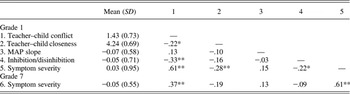
Descriptive statistics are presented in Table 1. Examination of frequency distributions indicated substantial individual variation for all variables. Closer examination of the biological sensitivity to context variables indicated group level downregulatory change in MAP over the course of the reactivity protocol, with scores ranging from −0.91 to +0.98; the standardized score for inhibition/disinhibition ranged from −1.57 to +1.93. Closer examination of the two teacher–child relationship variables showed that they covered all or most of the 5-point scale range (range for teacher–child conflict = 1–5, teacher–child closeness = 2–5), although there were less than 20% of the children above the midpoint of the range for each variable. In addition, to characterize the nature and severity of mental health symptoms, children were divided into those below versus greater than or equal to 1 SD of the mean of the Grade 7 symptom severity score. Using mother-report HBQ cut-points previously established with Diagnostic Interview Schedule for Children, Version IV (DISC-IV) diagnoses (Shaffer, Fisher, Lucas, & NIMH DISC Editorial Board, Reference Shaffer, Fisher and Lucas1998) in a study of similar-aged children (Lemery-Chalfant et al., Reference Lemery-Chalfant, Schreiber, Schmidt, Van Hulle, Essex and Goldsmith2007), chi-square analyses revealed that children with Grade 7 severity scores at least 1 SD above the mean were significantly more likely than those with lower severity scores to exceed the cut-point for at least one DISC diagnosis, χ2 (1) = 32.67, p < .001. Specifically, of the children in the “high severity” group, 62% (8/13) exceeded the cut-point for a DISC-based diagnosis of an internalizing disorder only (n = 1), externalizing disorder only (n = 3), or both internalizing and externalizing disorders (n = 4) compared with only 6% (5/91) of the remaining children who exceeded the DISC-based diagnostic cut point for either an internalizing (n = 3) or externalizing (n = 2) disorder, but not both.
Means (standard deviations) and Spearman correlations of variables

Note: N = 96. MAP, mean arterial pressure.
*p ≤ .05. **p ≤ .01.
Bivariate associations
Correlations among all variables are shown in Table 1. The physiological and behavioral stress reactivity measures were independent (i.e., correlations were statistically nonsignificant); and there was a small, but statistically significant, negative correlation of teacher–child conflict and closeness. Of particular importance for demonstrating differential susceptibility were the correlations of the susceptibility factors (the two biological sensitivity to context measures) with the environmental predictors (teacher–child conflict and closeness) and the outcome (Grade 7 symptom severity). Consistent with evidence for differential susceptibility, the two reactivity measures were independent of teacher–child conflict and closeness, and Grade 7 symptom severity, with one exception. There was a statistically significant, modest association of child inhibition/disinhibition with teacher–child conflict (ρ = −0.33).
Influences of early teacher–child relationship and biological sensitivity to context on adolescent symptom severity
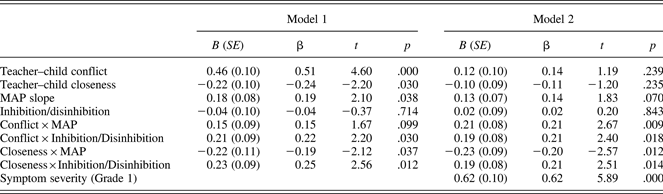
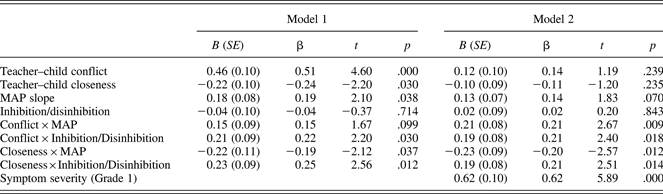
Results of the multiple linear regression for Grade 7 symptom severity are shown in Table 2. The R 2 value for Model 1 was statistically significant (p < .001) and explained a substantial 34% of the variance in symptom severity; the addition of Grade 1 symptom severity in Model 2 increased the explained variance to 53%. The main effects of teacher–child conflict and closeness were statistically significant in Model 1 but were reduced to nonsignificance in predicting the residual of Grade 7 symptom severity after the substantial effect of Grade 1 symptom severity was accounted for in Model 2. This, together with the stronger correlations of teacher–child conflict and closeness with Grade 1 severity (Table 1), suggests that, on average, children with more conflictual and less close relationships with their Grade 1 teachers also evidenced more severe symptoms at that time, which persisted to Grade 7. There was also a statistically significant main effect of MAP slope in Model 1, which was reduced to marginal significance in Model 2, suggesting that, on average, children who were more autonomically reactive evidenced more severe symptoms at Grade 7. There was no significant main effect of temperamental inhibition/disinhibition.
Regression models predicting Grade 7 symptom severity from Grade 1 factors
Note: N = 96. MAP, mean arterial pressure.
Of most importance for establishing differential susceptibility were the interactions of teacher–child conflict and closeness with the two biological sensitivity to context measures. Except for the statistically marginal interaction of Teacher–Child Conflict × MAP Slope (p = .099), the interactions were significant in Model 1. Note, however, that all four interaction terms were also statistically significant (all ps < .02) in Model 2, showing that they were associated with more severe Grade 7 symptoms over and above the level of Grade 1 symptoms.
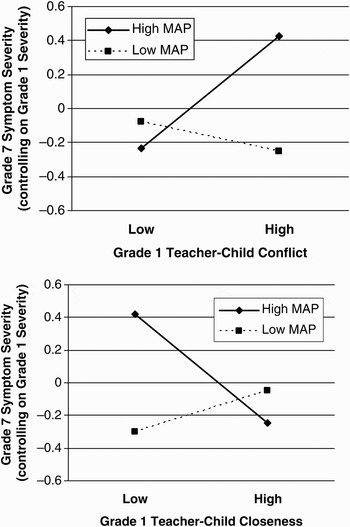
The interactions of MAP slope with teacher–child conflict and closeness are shown in Figure 1. Neither interaction shows a true crossover effect where the highly reactive children differ from the low reactive children under supportive as well as adverse conditions. As hypothesized, children with high MAP reactivity evidenced the highest Grade 7 severity scores, over and above their Grade 1 severity scores, under adverse conditions, that is, if they experienced high levels of conflict (β = 0.33, t = 2.59, p = .011) or low levels of closeness (β = −0.33, t = −2.66, p = .009) with their Grade 1 teachers. However, under more supportive conditions, that is, if they experienced high levels of teacher closeness or low levels of teacher conflict, children with high MAP reactivity evidenced low Grade 7 severity scores that were comparable to those of the low reactivity children. In contrast, children with low MAP reactivity evidenced similarly low Grade 7 severity scores regardless of the levels of teacher–child conflict (β = −0.09, t = −0.66, p = .511) and closeness (β = 0.13, t = 1.01, p = .317) at Grade 1.
Grade 1 Teacher–Child Conflict × MAP Slope interaction and Teacher–Child Closeness × MAP Slope interaction predicting Grade 7 symptom severity (controlling for Grade 1 symptom severity). MAP, mean arterial pressure.

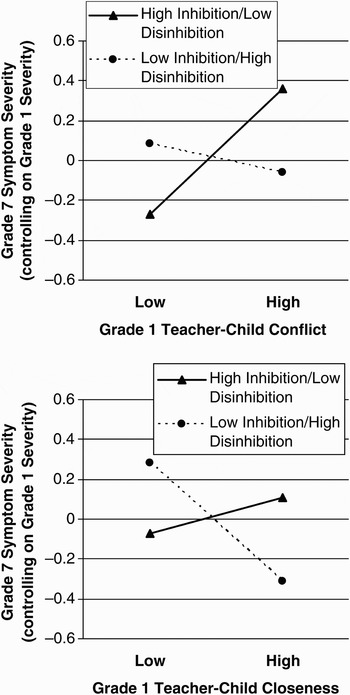
The interactions of temperamental inhibition/disinhibition with teacher–child conflict and closeness are shown in Figure 2. Both reflect crossover interactions, but the children who are differentially susceptible vary in temperament (i.e., inhibited vs. disinhibited) depending on which dimension of the teacher–child relationship is considered in defining more adverse versus supportive conditions. Highly inhibited children evidenced the highest Grade 7 severity scores, over and above Grade 1 severity scores, if they experienced high levels of conflict with their Grade 1 teachers, and the lowest Grade 7 severity scores if they experienced low levels of teacher conflict (β = 0.31, t = 2.04, p = .044); highly disinhibited children evidenced average Grade 7 severity scores regardless of the levels of teacher–child conflict (β = −0.07, t = −0.71, p = .482) at Grade 1. In contrast, highly disinhibited children evidenced the highest Grade 7 severity scores if they experienced low levels of closeness with their Grade 1 teachers, and the lowest Grade 7 severity scores if they experienced high levels of teacher closeness (β = −0.30, t = −2.13, p = .036); highly inhibited children evidenced average Grade 7 severity scores regardless of the levels of teacher–child closeness (β = 0.09, t = 1.00, p = .321) at Grade 1.
Grade 1 Teacher–Child Conflict × Inhibition/Disinhibition interaction and Teacher–Child Closeness × Inhibition/Disinhibition interaction predicting Grade 7 symptom severity (controlling for Grade 1 symptom severity).

Discussion
This study tested the proposition that individuals with particular physiological and/or behavioral characteristics are more responsive to both adverse and supportive contextual influences. Past research has focused predominantly on the moderating influences of either physiological or behavioral reactivity on the associations of either adverse or supportive child-rearing experiences prior to primary school entry with a range of short-term developmental outcomes (for review, see Belsky & Pluess, Reference Belsky and Pluess2009). We extended past research to examine the joint influences of both physiological and behavioral reactivity on the associations of both adverse and supportive aspects of the teacher–child relationship during the transition to primary school with the development of mental health symptoms 6 years later in early adolescence.
Overall, the results highlighted the substantial association of the Grade 1 teacher–child relationship with the development of children's mental health symptoms in Grade 7, especially for more reactive children; multiple regression analyses explained 34% of the variance in Grade 7 symptom severity prior to the inclusion of Grade 1 severity and 53% when it was included. Teacher–child relationship and child autonomic reactivity significantly predicted later mental health symptoms as main effects. Specifically, high levels of teacher–child conflict, low levels of teacher–child closeness, and greater MAP slopes in Grade 1 significantly predicted greater symptom severity in Grade 7. These main effects were reduced to nonsignificance (MAP slope remained marginally significant) when Grade 1 symptom severity was controlled for. This, in combination with the stronger association of the teacher–child relationship with Grade 1 compared to Grade 7 symptom severity, suggests that, on average, the teacher–child relationship was primarily associated with concurrent Grade 1 child mental health symptoms, which persisted to Grade 7. Most salient to the goals of the present study, all four Biological Sensitivity to Context × Teacher–Child Relationship interaction terms were statistically significant when Grade 1 symptom severity was controlled for, suggesting that both physiological and behavioral reactivity moderated the associations of both adverse and supportive aspects of the teacher–child relationship with Grade 7 symptom severity over and above Grade 1 severity.
Closer examination of the interactions revealed two distinct patterns. First, there was a general (i.e., nonspecific) moderating effect of children's biological sensitivity to context on the association of an early adverse teacher–child relationship with the development of children's later mental health symptoms. Across both physiological and behavioral reactivity domains, highly reactive children who experienced high levels of conflict or a lack of closeness with their Grade 1 teachers developed the highest levels of mental health symptoms by Grade 7. These findings extend previous research showing that “vulnerable” children, defined by either physiological or behavioral reactivity, are disproportionately affected by adverse early child-rearing environments (Colder et al., Reference Colder, Lengua, Fite, Mott and Bush2006; Feldman et al., Reference Feldman, Greenbaum and Yirmiya1999; Kochanska et al., Reference Kochanska, Aksan and Joy2007). Notably, teacher–child conflict and closeness were only modestly correlated and thus represent somewhat distinct environmental conditions. This suggests that, especially for children who are more reactive, it does not take actual conflict with the Grade 1 teacher to increase the probability of developing more severe mental health symptoms by Grade 7, but that lack of a close relationship with the teacher is equally adverse.
Second, important differences emerged depending on which reactivity measure was considered as a main effect and as a moderator of the influence of teacher–child conflict versus closeness on the development of adolescent mental health. Results for physiological reactivity suggest that, on average, highly autonomically reactive children develop more severe mental health symptoms by Grade 7. Further, although such children are more susceptible to the adverse qualities of their relationship with their teacher (as noted above), they are no more susceptible than low autonomically reactive children to the supportive qualities of the relationship. As articulated by Belsky et al. (Reference Belsky, Bakermans-Kranenburg and van IJzendoorn2007), this form of interaction suggests a “dual risk” model in which the highly autonomically reactive children (i.e., Risk 1) show disproportionately high symptoms under conditions of high conflict or low closeness with their teachers (i.e., Risk 2) but do not show disproportionately low levels of symptoms under conditions of high closeness or low conflict with their teachers. In previous work (Boyce et al., Reference Boyce, Essex, Alkon, Goldsmith, Kraemer and Kupfer2006), we found this same pattern for early father involvement, where highly autonomically reactive children evidenced the most severe symptoms under conditions of low father involvement but were no more susceptible than low reactive children to high father involvement. However, in earlier work (Boyce, Chesney, et al., Reference Boyce, Alkon, Tschann, Chesney and Alpert1995), we found crossover effects in which cardiovascular and immune reactivity were associated with the highest rates of respiratory illnesses under conditions of adversity in the home or child care center, but the lowest rates under conditions of low adversity and support. It is possible that these crossover effects were observed because physiological reactivity measures were used to predict a physiological outcome, and more generally, that true crossover effects might be easiest to detect when both the reactivity and outcome measures are either physiological or behavioral. Further, as noted in Obradovic et al. (Reference Obradovic, Bush, Stamperdahl, Adler and Boyce2010) and Boyce and Ellis (Reference Boyce and Ellis2005), whether interactions signifying dual risk or differential susceptibility emerge from a given study may depend in part on the particular segment of the social environmental spectrum, from beneficial to pathological, the sample and measures have captured. The present study was based on a relatively small sample of children, with only a few who experienced extremely high conflict or low closeness with their teachers. Further, the particular measures of conflict and closeness used in the present study might not have captured the full range of those relationship qualities. Thus, although simple dual risk type interactions were found, a larger sample comprising more children with high levels of conflict and low levels of closeness with their teachers, and a broader “window” on the range of teacher–child relationship qualities, might reveal differential susceptibility effects for highly autonomically reactive children.
In contrast to the results for physiological reactivity, results for behavioral reactivity provided clear evidence for differential susceptibility to both adverse and supportive contexts. As discussed above, these crossover effects were found when considering reactivity and outcomes measures that are both behavioral. It is interesting, however, that the moderating effects of inhibition/disinhibition varied according to which dimension (i.e., conflict or closeness) of the teacher–child relationship was considered. Specifically, behaviorally inhibited children developed the most severe mental health symptoms by Grade 7 under conditions of high Grade 1 teacher conflict but the lowest levels of symptoms under conditions of low teacher conflict, and there were no differences in symptom severity according to levels of teacher–child closeness. It was instead highly disinhibited children who developed the most severe mental health symptoms under conditions of low teacher closeness, and the lowest levels of symptoms under conditions of high teacher closeness, and symptom severity did not differ according to levels of teacher–child conflict. These results are consistent with our previous studies. In a study of early father involvement (which might be considered parallel to teacher–child closeness) we showed that only for disinhibited (vs. inhibited) children was low father involvement associated with high symptoms whereas high father involvement was associated with low symptoms, and there was no effect of father involvement for inhibited children (Boyce et al., Reference Boyce, Essex, Alkon, Goldsmith, Kraemer and Kupfer2006). In addition, in a study of the development of externalizing behaviors, children with prior externalizing problems (which are often associated with, but not the same as, disinhibited behaviors) evidenced the greatest decreases in externalizing behaviors if they had a close relationship with their kindergarten teacher (Silver et al., Reference Silver, Measelle, Armstrong and Essex2005).
In contrast to the findings for autonomic reactivity and consistent with the relatively small negative correlation of teacher–child conflict and closeness, the findings for behavioral reactivity suggest that adverse environments characterized by high levels of teacher–child conflict are not the same as suboptimal relationships characterized by a lack of closeness and more supportive environments characterized by high levels of teacher–child closeness are not the same as those characterized by a lack of conflict. It instead appears that children of differing temperaments are differentially susceptible to the two dimensions of the teacher–child relationship. Inhibited children (those who are socially reticent and fearful of situations perceived to be threatening) may be especially sensitive to the level of tension and conflict they experience with their teacher. In contrast, disinhibited children (those who are bold and undercontrolled) may be especially sensitive to the level of support and close connectedness they have with their teacher. In broad terms, these findings are consistent with the vast “goodness of fit” literature showing that children of different temperaments fit best in different types of settings (Keogh, Reference Keogh1986). However, the findings also elaborate this perspective to suggest that (a) the salient dimensions of social environments differ by child temperament, and (b) such dimensions are most salient because they are those to which the child is most attuned and responsive.
More generally, when considered together, the present findings extend current thinking on differential susceptibility to suggest that context sensitivity is not a monolithic category, that is, there are identifiable groups of context sensitive, “orchid children,” as proposed by Boyce and Ellis (Reference Boyce and Ellis2005). Although numerous diverse studies provide converging evidence for differential susceptibility (reviewed in Belsky & Pluess, Reference Belsky and Pluess2009), the range of reactivity measures, contexts, and outcomes included in these studies have resulted in many inconsistencies in findings and few replications. Further, because few studies have included multiple domains of reactivity, contexts, and outcomes, the question remains whether differential susceptibility reflects a more global, traitlike characteristic or is more specific to the reactivity, context, and outcome being considered. Although it is plausible that some individuals are simply more susceptible in general to the beneficial effects of supportive environments as well as the harmful effects of adverse environments, it is also possible that context sensitivity is specific to different environmental features and that the salience of those features varies according to the stress reactivity system and functional outcome of interest. Although the present study cannot fully address this question, the findings suggest that there might be more than one type of biologically sensitive child.
What remains unclear and unanswerable within the constraints of the sample size of the current study is whether the effects of the teacher–child relationship are attributable to characteristics of that relationship per se or whether the early teacher–child relationship is a proxy for other social relational risk factors, including peer relations, earlier family relations or more distal characteristics such as socioeconomic status (SES), or perhaps later and more proximal relationships with peers or teachers. Although numerous studies have shown associations among the teacher–child relationship, peer relations, family relations, and SES (Howes, Reference Howes2000; Ladd, Birch, & Buhs, Reference Ladd, Birch and Buhs1999; Miech, Essex, & Goldsmith, Reference Miech, Essex and Goldsmith2001; NICHD Early Child Care Research Network, 2004), few have considered the joint influences of multiple relationships. There is some evidence that the teacher–child relationship exerts independent effects over and above parenting (Meehan et al., Reference Meehan, Hughes and Cavell2003). Further, in previous work we have shown that the inclusion of peer, family, and SES variables did not account for the associations of the teacher–child relationship with the development of children's externalizing problems across the elementary school years (Silver et al., Reference Silver, Measelle, Armstrong and Essex2005; Silver, Measelle, Armstrong, & Essex, in press). This suggests that the early teacher–child relationship plays an important and distinct role in children's development over and above that played by the peer and family contexts.
Note also that predispositions to internalizing versus externalizing symptoms in Grade 7, assessed by symptom directionality, were not associated with the earlier teacher–child relationship. Although previous studies have shown that the teacher–child relationship is associated with externalizing (Hughes, Cavell, & Jackson, Reference Hughes, Cavell and Jackson1999; Silver et al., Reference Silver, Measelle, Armstrong and Essex2005, in press) and, to a lesser degree, internalizing (Hamre & Pianta, Reference Hamre and Pianta2001) problems, most studies have not considered both forms of problems even though their comorbidity during childhood is often quite high (Lilienfeld, Reference Lilienfeld2003). When comorbidity is dealt with, as we have shown here and in our previous work (Boyce et al., Reference Boyce, Essex, Alkon, Goldsmith, Kraemer and Kupfer2006; Essex et al., Reference Essex, Kraemer, Armstrong, Boyce, Goldsmith and Klein2006), symptom directionality is associated primarily with children's sex. It is well established that by early adolescence internalizing forms of mental health problems are reported more frequently among girls and externalizing forms more frequently among boys (Zahn-Waxler, Shirtcliff, & Marceau, Reference Zahn-Waxler, Shirtcliff and Marceau2008). Thus, although the severity of mental health symptoms may be influenced by environmental and neurobiological risk, bias toward internalizing or externalizing forms may be primarily the product of biological sex and/or socially constrained gender roles (Essex et al., Reference Essex, Klein, Cho and Kraemer2003, Reference Essex, Kraemer, Armstrong, Boyce, Goldsmith and Klein2006). In other words, symptom directionality may be engendered by complex processes involving sexual dimorphisms in biological circuitry and social conventions regarding acceptable expressions of psychological distress.
Taken together, these results highlight that, in general, children's biological sensitivity to context exerts a significant moderating effect on the association of the early teacher–child relationship with the severity of later mental health symptoms. Further, the results suggest that, only in the context of an adverse teacher–child relationship, physiological reactivity may act primarily as a risk factor for the development of mental health symptoms by adolescence. However, behavioral reactivity may act alternately as either a risk or protective factor depending upon the qualities of the early teacher–child relationship. Such interpretation implies that temperamental forms of reactivity may reflect most strongly an underlying susceptibility to both the adverse and supportive aspects of this particular early social context as it influences the development of mental health problems by adolescence.
Limitations
The study has several limitations. The possibility of a sampling bias within this population and the nonrepresentativeness of this sample of the larger US population must be kept in mind in interpreting the findings. This sample represents largely middle class, White, and, at least at the outset, intact families in a Midwestern state. In addition, the sample is relatively small, especially given the number of variables included in the major analyses. The ratio of subjects to variables also limits investigation of potentially important additional variables. For example, future studies should investigate the effects of both the parasympathetic and sympathetic components of the ANS system as well as other temperamental characteristics. It is also important to investigate the effects of the hypothalamic–pituitary–adrenal system and ways in which all stress reactivity domains might jointly exert their moderating influences to explain children's differential susceptibility to experience. Finally, future studies should investigate positive as well as negative developmental outcomes.
Conclusions
Despite these limitations, this study extends previous research on differential susceptibility in important ways. First, it goes beyond consideration of early family relationships and young children to consider a key nonfamilial relationship for children after the transition to primary school. Second, it includes both physiological and behavioral markers of biological sensitivity to context. Third, it systematically addresses key questions of differential susceptibility by including both adverse and supportive environmental conditions and by considering the criteria suggested by Belsky et al. (Reference Belsky, Bakermans-Kranenburg and van IJzendoorn2007) that provide clear evidence of differential susceptibility. The findings hold educational implications, but it is important that they be replicated by other studies, especially because the sample size was relatively small for the number of variables considered. Nevertheless, the strength of the findings suggests that the early teacher–child relationship may exert a powerful influence, for better and for worse, on the development of children's mental health by adolescence, especially for those who are highly reactive.