Introduction
Respiratory syncytial virus infection is the most common cause of acute lower respiratory tract disease in infants worldwide.Reference Shi, McAllister and O’Brien1 Congenital heart disease (CHD), chronic lung disease of infancy/bronchopulmonary dysplasia, male gender, premature birth, Down syndrome, immune deficiency, and neuromuscular disease are described as risk factors for increased severity of respiratory syncytial virus infection.Reference Welliver2– Reference Simoes5 Of these risk factors, CHD and chronic lung disease are associated with the development of pulmonary hypertension.Reference Krishnan and Rosenzweig6, Reference Roth and Aboulhosn7 Recent studies have shown that a history of pulmonary hypertension is associated with increased severity of illness during acute lower respiratory tract infection.Reference Pedraza-Bernal, Rodriguez-Martinez and Acuna-Cordero8 Worsening pulmonary hypertension secondary to respiratory syncytial virus infection in infants with CHD is a challenging issue for paediatric cardiologists, cardiac surgeons, and intensivists, and in severe cases can result in mortality.Reference Jung9– Reference Castelli, Maeda and Aiello12
Pulmonary hypertension during acute bronchiolitis is observed by echocardiography in 29–67% of infants and associated with prolonged hospitalisation.Reference Bardi-Peti and Ciofu13– Reference Fitzgerald, Davis, Rohlicek and Gottesman15 The pathophysiology of pulmonary hypertension secondary to respiratory syncytial virus infection could be multiple factors including lung volume changes either with atelectasis or hyperinflation, hypoxic vasoconstriction, endothelin pathway, and Th2-skewed immune response.Reference West and West16– Reference Samransamruajkit, Moonviriyakit, Vanapongtipagorn, Prapphal, Deerojanawong and Poovorawan19 Treatment for pulmonary hypertension during acute lung disease with pulmonary vasodilators is controversial because it is usually transient and could cause further hypoxia due to worsening ventilation-perfusion mismatch.
In infants with CHD, the presence of pulmonary hypertension during severe bronchiolitis could be a risk factor for worse clinical outcomes as indicated by these small studies.Reference MacDonald, Hall, Suffin, Alexson, Harris and Manning11, Reference Castelli, Maeda and Aiello12, Reference de Zegher, De Boeck, Devlieger, van der Voort and Elzenga20, Reference Moler, Khan, Meliones, Custer, Palmisano and Shope21 However, the clinical significance of pulmonary hypertension during respiratory syncytial virus bronchiolitis is still undetermined, especially in infants without CHD. We sought to review echocardiography during respiratory syncytial virus infection and assess the association between the presence of pulmonary hypertension and clinical outcomes in respiratory syncytial virus infected infants. The primary outcome measured in this study was mortality, and the secondary outcomes were the severity of the disease measured by intensive care unit (ICU) admission, prolonged ICU stay (>10 days), tracheal intubation, and use of high frequency oscillator ventilation.
Methods
Retrospective cohort screening
The UTHSC Institutional Review Board approved this study. We retrospectively reviewed the records of 154 children hospitalised, documented with the diagnosis of respiratory syncytial virus bronchiolitis who underwent echocardiography at Le Bonheur Children’s Hospital from December 2007 to December 2014. International Classification of Diseases (ICD) code was used for screening patients with respiratory syncytial virus bronchiolitis, and patients who received echocardiography were identified with the support of biomedical informatics core team in Le Bonheur Children’s Hospital. Diagnosis of respiratory syncytial virus was made with either rapid antigen test (enzyme immunoassay) or polymerase chain reaction using nasal or tracheal aspirate samples. Patients without positive respiratory syncytial virus test results were excluded from this study.
Pulmonary hypertension detection by echocardiography
Indirect measures of pulmonary hypertension were used to categorise subjects with pulmonary hypertension, including peak tricuspid regurgitation gradient (TR), interventricular septal curvature geometry, early and end diastolic pulmonary insufficiency gradients, and the left ventricle to right ventricular ratio in systole in short axis.Reference Mirza, Ziegler, Ford, Padbury, Tucker and Laptook22, Reference Mourani, Sontag, Younoszai, Ivy and Abman23 The pressure gradient between the right ventricle pressure and the right atrium pressure was estimated using the modified Bernoulli equation (4 × TR2) if TR was measurable. We uniformly estimated right atrium pressure as 5 mmHg and calculated systolic pulmonary artery pressure as 4 × TR2 + 5 mmHg.Reference Mirza, Ziegler, Ford, Padbury, Tucker and Laptook22 If patients had intracardiac or extracardiac shunt without measurable TR, the gradient across the shunt was used for calculating estimated systolic pulmonary artery pressure.Reference Mirza, Ziegler, Ford, Padbury, Tucker and Laptook22 Systemic blood pressure measured by a cuff or arterial line was used to compare with estimated systolic pulmonary artery pressure. For this study, pulmonary hypertension was defined as an estimated pulmonary artery pressure of at least one-third systemic arterial blood pressure as assessed by echocardiography. If patients had multiple echocardiograms, the presence of pulmonary hypertension was determined by the echocardiogram with the most severe pulmonary hypertension. Echocardiographic images were reviewed by a paediatric cardiologist, who was blinded to the clinical outcomes. In the subjects that had echocardiography done after recovery from their acute illness, follow-up echocardiograms were reviewed for the presence of pulmonary hypertension.
Data collection
In addition to demographic data and indications for echocardiography, the presence of risk factors for severe respiratory syncytial virus bronchiolitis (CHD, chronic lung disease, premature birth (<37 weeks gestational age (wGA)), Down syndrome, and neuromuscular disease), and clinical outcomes such as ICU admission, prolonged ICU stay (>10 days), tracheal intubation for mechanical ventilatory support, use of high frequency oscillator ventilation, and mortality during the admission were collected for these patients from the electronic health record. In this study, prolonged ICU stay was defined as >10 days according to the median ICU stay in patients with comorbidities and it includes 25 percentile of patients reported by others.Reference Hosheh and Randle24, Reference Ghazaly and Nadel25
Statistical analyses
Demographic data between patients with and without pulmonary hypertension, indications for echocardiography, and clinical outcomes were compared with Mann–Whitney U-test or Fisher’s exact test, according to the data type. Continuous variables are reported as median (25th, 75th percentile) unless otherwise specified. Subgroup analysis was conducted to evaluate the effect of pulmonary hypertension on clinical outcomes within the patients who required ICU admission using Fisher’s exact test. A multivariate logistic analysis was conducted to evaluate the association between pulmonary hypertension and clinical outcomes using variables including age, gender, CHD, chronic lung disease, Down syndrome, and neuromuscular disorders to predict clinical outcomes including ICU admission, prolonged ICU stay (>10 days), tracheal intubation for mechanical ventilation, and necessity of high frequency oscillator ventilation. We chose these variables described as risk factors by other groups for increased severity of respiratory syncytial virus bronchiolitis.Reference Welliver2– Reference Simoes5 Statistical analyses were conducted with JMP and SAS 9.4 software (SAS, Cary, North Carolina, United States of America), and p < 0.05 was considered statistically significant.
Results
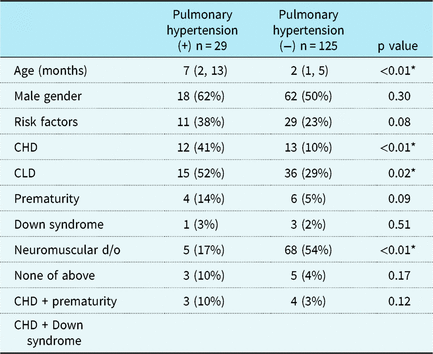
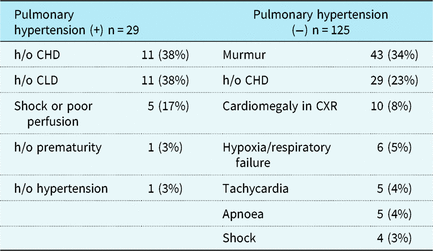
The summary of demographic data for the 154 patients included in this study is shown in Table 1. Indications for echocardiography are summarised in Table 2. Most patients with pulmonary hypertension had echocardiography for either past medical history of CHD, chronic lung disease, shock, or poor perfusion. Conversely, one-third of the patients without pulmonary hypertension underwent echocardiography for a heart murmur. Echocardiography detected evidence of pulmonary hypertension in 29 patients (19%) and suspected right ventricle pressures were 1/3–1/2 of systemic blood pressure in these patients. The patients with pulmonary hypertension (median 7 months of age; 25–75 percentile, 2–13 months) are significantly older than the patients without pulmonary hypertension (2, 1–5-month-old) (p < 0.01). Approximately one-fourth (n = 40) of the patients in this study had CHD, and 11 of these 40 patients (28%) with CHD had pulmonary hypertension. In these patients with CHD, there were no patients with unrestrictive communication at the ventricular or great artery level. Pulmonary hypertension was observed more frequently in patients with chronic lung disease (n = 12/29, 41%, p = 0.0002), and those who were born prematurely (<37 wGA, n = 17/29, 59%, p = 0.03). Few patients without any risk factors developed pulmonary hypertension (n = 5/29, 17%, p = 0.0009). For these five patients without risk factors, echocardiography was performed for shock or poor perfusion. Eight patients with pulmonary hypertension (28%) and 11 patients without pulmonary hypertension were treated with inhaled nitric oxide, mainly for severe ventilation–perfusion mismatch and hypoxia. In this study, one patient without pulmonary hypertension was treated with extracorporeal membrane oxygenation.
Demographic data

CHD = congenital heart disease; CLD = chronic lung disease; Neuromuscular d/o = neuromuscular disorder
* p < 0.05
Indications of echocardiography during respiratory syncytial virus bronchiolitis

CHD = congenital heart disease; CLD = chronic lung disease; CXR = chest x-ray; h/o = history of
Of the 29 patients with pulmonary hypertension, 38% had past medical histories of pulmonary hypertension secondary to CHD or chronic lung disease before the current episode of pulmonary hypertension. Thirteen patients with pulmonary hypertension (45%) had newly developed the condition during hospitalisation with respiratory syncytial virus bronchiolitis, including five patients with shock or poor perfusion. For six patients with pulmonary hypertension (21%) who had past medical history of CHD (n = 5, ventricular septal defect ×2, atrioventricular canal, d-transposition of great arteries, patent ductus arteriosus) or chronic lung disease/premature birth (n = 2, one had both CHD and chronic lung disease), it was unclear whether pulmonary hypertension was developed before or during respiratory syncytial virus infection. In 19 of 29 (66%) patients with pulmonary hypertension, follow-up echocardiography was conducted after the acute illness, and echocardiographic signs of pulmonary hypertension were not observed in 15 patients (79%). All four patients who remained to have pulmonary hypertension in follow-up echocardiography had baseline medical problems (chronic lung disease, CHD × 2, neuromuscular disease).
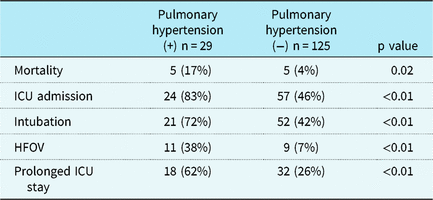
Clinical outcomes of the patients with or without pulmonary hypertension are summarised in Table 3. Mortality prior to hospital discharge among the patients with pulmonary hypertension (n = 5/29, 17.2%) was significantly higher than those without pulmonary hypertension (n = 5/125, 4%, p = 0.02). During this study, 81 children (53%) were admitted to the ICU, including 20 patients (13%) who were placed on high frequency oscillator ventilation. Among the patients with pulmonary hypertension, more than half (n = 11/21) of the intubated patients were treated with high frequency oscillator ventilation, and three-fourth (n = 18/24) of the patients admitted to ICU had prolonged ICU stay. The presence of pulmonary hypertension during respiratory syncytial virus bronchiolitis was significantly associated with all clinical outcomes evaluated in this study, including ICU admission, tracheal intubation, use of high frequency oscillator ventilation, prolonged ICU stay, and mortality (p < 0.05 for all).
Clinical outcomes of respiratory syncytial virus bronchiolitis among patients with or without pulmonary hypertension

HFOV = high frequency oscillatory ventilation; ICU = intensive care unit
One-tailed Fisher’s exact test
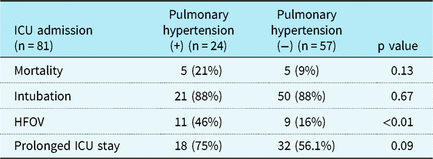
The subgroup analysis was conducted to evaluate the outcome effect of pulmonary hypertension among the patients admitted to ICU. (Table 4) Pulmonary hypertension was associated with the use of high frequency oscillator ventilation (p = 0.006). In our subgroup analysis (data not shown), the presence of pulmonary hypertension in patients with CHD was not associated with worse clinical outcomes.
Subgroup analysis for patients admitted to ICU

HFOV = high frequency oscillatory ventilation; ICU = intensive care unit
One-tailed Fisher’s exact test
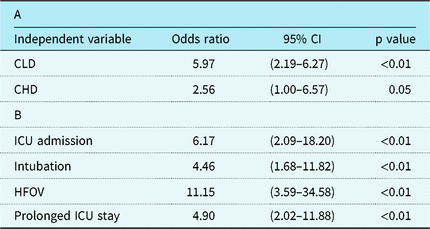
In multiple variate analysis adjusted for age, pulmonary hypertension was associated with chronic lung disease, but was not associated with CHD (Table 5A). A multivariate logistic regression modelling was also conducted to evaluate the association between pulmonary hypertension and clinical outcomes. The number of mortality cases in this study was so small that we removed mortality from the logistic regression model. Since pulmonary hypertension remained associated with chronic lung disease (Table 5A), we calculated odds ratio between pulmonary hypertension and clinical outcomes adjusted for age and chronic lung disease. Pulmonary hypertension detected by echocardiography was associated with ICU admission, intubation, use of high frequency oscillator ventilation, and prolonged ICU stay even after adjusted for age and chronic lung disease (Table 5B).
(A) Multivariate logistic analysis for the association between pulmonary hypertension and CLD or CHD. (B) Multivariate logistic analysis to determine the association between pulmonary hypertension and clinical outcomes. Adjusted for age and CLD

CHD = congenital heart disease; CI = confidence interval; CLD = chronic lung disease; HFOV = high frequency oscillatory ventilation; ICU = intensive care unit
Discussion
In this study, pulmonary hypertension was detected in 29 out of 154 patients (19%) by echocardiography during acute bronchiolitis from respiratory syncytial virus infection. To the best of our knowledge, this study includes the largest cohort of patients to undergo echocardiography during acute bronchiolitis from respiratory syncytial virus infection.Reference Bardi-Peti and Ciofu13– Reference Fitzgerald, Davis, Rohlicek and Gottesman15 When compared with prior investigations, this study included a larger number of critically ill patients who were admitted to the ICU, received mechanical ventilation, and were treated with high frequency oscillatory ventilation. However, pulmonary hypertension was detected less frequently than previous studies,Reference Bardi-Peti and Ciofu13– Reference Fitzgerald, Davis, Rohlicek and Gottesman15 probably due to the inclusion of many patients who had echocardiography for murmur and a milder clinical course. Furthermore, significant associations between pulmonary hypertension and clinical outcomes, including ICU admission, endotracheal intubation, high frequency oscillator ventilation, prolonged ICU stay, and mortality, were also demonstrated as previously described by others.Reference Pedraza-Bernal, Rodriguez-Martinez and Acuna-Cordero8, Reference Bardi-Peti and Ciofu13 After intubation, more than half of the patients with pulmonary hypertension were treated with high frequency oscillator ventilation. We only observed a mild-to-moderate form of pulmonary hypertension which is similar to the report by Fitzgerald.Reference Fitzgerald, Davis, Rohlicek and Gottesman15 We also observed pulmonary hypertension in several patients with shock or poor perfusion. The follow-up echocardiography showed improvement in pulmonary hypertension, and it indicates a transient or worsening pulmonary hypertension by respiratory syncytial virus infection as previously described.Reference Sreeram, Watson and Hunter14
In patients with CHD, pulmonary hypertension has been associated with morbidity and mortality during respiratory syncytial virus infection.Reference MacDonald, Hall, Suffin, Alexson, Harris and Manning11 In our subgroup analysis, the presence of pulmonary hypertension in patients with CHD was not associated with worse clinical outcomes, and this finding differs from the previously reported studies.Reference MacDonald, Hall, Suffin, Alexson, Harris and Manning11, Reference Altman, Englund and Demmler26 In this study, the prevalence of obtaining an echocardiography might have been higher in patients with CHD than in patients without CHD, and these patients with CHD had only mild pulmonary hypertension and tolerated respiratory syncytial virus infection without complications. However, many patients in the comparison group of CHD/no-pulmonary hypertension were also critically ill in this study, indicated by the 67% of patients who received mechanical ventilation. This study is a small-single centre study, and our sample size may be too small to prove the association between pulmonary hypertension and clinical outcomes in patients with CHD. These may have contributed to the unexpected results. Recent advances in ICU management and therapies for pulmonary hypertension might also have contributed to our observed clinical outcomes.
Our study showed transient or worsening pulmonary hypertension during respiratory syncytial virus infection in patients with chronic lung disease or born prematurely. This phenomenon in this population is not well described, and further investigation, including prevalence and effects on clinical outcomes, is needed to improve care.Reference Mourani and Abman27 Chronic lung disease of infancy is known to cause pulmonary hypertension without respiratory syncytial virus infectionReference Krishnan and Rosenzweig6 and is a risk factor for severity of disease with respiratory syncytial virus infection.Reference Welliver2, Reference Thorburn28
Obtaining an echocardiogram in every patient admitted with respiratory syncytial virus is a significant cost and resource burden. For previously healthy infants who developed a mild clinical course of respiratory syncytial virus, there seem to be no indications for obtaining echocardiography, except in infants who develop shock or poor perfusion, i.e., a haemodynamic indication for an echocardiogram since our data did show an association with pulmonary hypertension in this cohort. Based on the risk factors and clinical outcome metrics evaluated in this study, it may be reasonable to obtain a screening echocardiogram for pulmonary hypertension in patients with a past medical history of CHD, chronic lung disease/bronchopulmonary dysplasia, or premature birth. The echocardiogram findings may provide prognostic information by identifying a risk factor such as pulmonary hypertension for severe illness, and may also potentially help the clinician alter the clinical course by taking measures to prevent a pulmonary hypertensive crisis.
There are several limitations to this study. Due to study design, we cannot exclude selection bias. We included the patients who received echocardiography retrospectively. It is difficult to define the incidence of pulmonary hypertension during respiratory syncytial virus infection due to this study design. During the hospitalisation for respiratory syncytial virus bronchiolitis, patients with CHD were more likely to have an echocardiogram when compared to those patients without risk factors. These with CHD and mild pulmonary hypertension tolerated respiratory syncytial virus infection without complications, and these might have an effect on our results. As our standard of care is not to order echocardiography for every patient with respiratory syncytial virus bronchiolitis, this study may have included relatively sicker patients without CHD who had worse clinical outcomes. Furthermore, echocardiography was ordered by a primary team, and there was no clear guideline for ordering echocardiography. The direct measurement of pulmonary hypertension with catheterisation, which is the gold standard for the diagnosis of pulmonary hypertension, was not performed in these clinically unstable patients. Some of the patients without pulmonary hypertension were treated with inhaled nitric oxid (iNO) for hypoxia, which may have modified the echocardiography findings. The impact of treatment for pulmonary hypertension on outcomes was not evaluated and warrants further. Several patients who had pulmonary hypertension during respiratory syncytial virus never had echocardiography before respiratory syncytial virus infection, and it is impossible to differentiate pulmonary hypertension as a baseline from a new development of pulmonary hypertension. Paediatric intensive care unit admission criteria and the decision to place on high frequency oscillator ventilation were not consistent due to variations in decision making by different primary ICU teams. This study was conducted in a single centre with a small sample size. Lastly, echocardiography was reviewed by a single paediatric cardiologist.
Conclusions
Echocardiographic signs of pulmonary hypertension in hospitalised infants during respiratory syncytial virus infection were associated with a higher rate of morbidity and mortality. Patients with a history of chronic lung disease of infancy are associated with pulmonary hypertension observed by echocardiography during respiratory syncytial virus infection. During respiratory syncytial virus bronchiolitis, echocardiography may not be indicated if a patient is previously healthy and does not have shock or poor perfusion.
Author ORCIDs
Dai Kimura 0000-0001-9360-8506
Acknowledgement
The authors appreciate the support from Biomedical Informatics core team in Le Bonheur Children’s Hospital led by Dr. Teeradache Viangteeravat.
Financial Support
This research received no specific grant from any funding agency, commercial or not-for-profit sectors.
Conflicts of Interest
None.