As the post-World War II generations age, the number of people aged 65 years and older living in the United States is projected to reach 74 million, around 20% of the total US population, by the year 2030 (Vespa et al., Reference Vespa, Armstrong and Medina2018). Increased age is associated with an elevated risk for cognitive decline and dementia (Tucker-Drob, Reference Tucker-Drob2019). Preventing or mitigating cognitive decline could reduce the individual, family, and societal burdens associated with dementia. Evidence suggests some modifiable health factors, such as management of cardiovascular health (Litke et al., Reference Litke, Garcharna, Jiwani and Neugroschl2021; Livingston et al., Reference Livingston, Huntley, Sommerland, Ames, Ballard, Banerjee and Mukadam2020; Kivipelto et al., Reference Kivipelto, Helkala, Laakso, Hänninen, Hallikainen, Alhainen and Nissinen2001; Launer et al., Reference Launer, Ross, Petrovitch, Masaki, Foley, White and Havlik2000; Whitmer et al., Reference Whitmer, Sidney, Selby, Johnston and Yaffe2005) and diet (Singh et al., Reference Singh, Parsaik, Mielke, Erwin, Knopman, Petersen and Roberts2014; Solfrizzi et al., Reference Solfrizzi, Panza and Capurso2003), may reduce the risk or delay the onset of cognitive decline or dementia.
Emerging research suggests that sensory impairments, also modifiable and highly prevalent in aging, are associated with cognitive impairment (de la Fuente et al., Reference De la Fuente, Hjelmborg, Wod, de la Torre-Luque, Caballero, Christensen and Ayuso-Mateos2019; Deal et al., Reference Deal, Betz, Yaffe, Harris, Purchase-Helzner, Satterfield and Lin2017; Maharani, Dawes, Nazroo et al., Reference Maharani, Dawes, Nazroo, Tampubolon and Pendleton2018, Reference Maharani, Dawes, Nazroo, Tampubolon and Pendleton2020). According to the 2018 summary of the American Geriatrics Society-National Institute on Aging Bench to Bedside Conference on Sensory Impairment and Cognitive Decline in Older Adults, high priority research questions include whether sensory impairment, predominantly vision and hearing loss, has a causal role in cognitive decline (Whitson et al., Reference Whitson, Cronin-Golomb, Cruickshanks, Gilmore, Owsley, Peelle and Lin2018). The 2017 and 2020 Lancet Commission on Dementia Prevention, Intervention and Care reports evaluated evidence to date and included hearing impairment among the 12 currently identified modifiable risk factors for dementia. Use of hearing aids after hearing loss is among the Commission’s recommended “targeted strategies” for dementia risk reduction (Livingston et al., Reference Livingston, Sommerlad, Orgeta, Costafreda, Huntley, Ames and Cooper2017; Livingston et al., Reference Livingston, Huntley, Sommerland, Ames, Ballard, Banerjee and Mukadam2020). As noted in the Lancet Commission’s reports, the mechanisms underlying sensory impairment and risk for cognitive decline are not yet well understood. The “common cause theory” holds that other biologic factors jointly influence decline in both sensory and cognitive functioning, such as cardiovascular disease, diabetes, inflammation, genetics, or even the aging process itself (Roberts & Allen, Reference Roberts and Allen2016). The “information degradation” theory posits that when the perceptual signal is poor, additional cognitive resources are required to decipher the signal from the noise, leaving fewer neural or cognitive resources available and taxing the cognitive system (Zekveld et al., Reference Zekveld, Kramer and Festen2011). A further potential mechanism might be that vision or hearing impairment leads to decreased engagement in daily life activities, e.g., dropped hobbies, restricted socializing, exercising, etc., which are protective activities in their own right, thus indirectly contributing to risk for cognitive decline. Increased depression or decreased quality of life might also be involved in indirect pathways between sensory impairment, restricted activities and cognitive outcomes.
Regarding vision, older adults are particularly susceptible to changes in visual acuity (VA) and ophthalmic conditions, including age-related cataracts, macular degeneration and glaucoma (Chen et al., Reference Chen, Bhattacharya and Pershing2017; Chen et al., Reference Chen, Lai, Yen, Shen, Wang, Liang and Fan2018; Ong et al., Reference Ong, Cheung, Li, Lamoureux, Ikram, Ding and Wong2012), with the prevalence of visual impairment projected to increase 24% per decade over the next 35 years (Varma et al., Reference Varma, Vajaranant, Burkemper, Wu, Torres, Hsu and McKean-Cowdin2016). Cross-sectional studies have reported associations between low VA and worse cognitive performance (Pham et al., Reference Pham, Kifley, Mitchell and Wang2006; Tay et al., Reference Tay, Wang, Kifley, Lindley, Newall and Mitchell2006; Woo et al., Reference Woo, Park, Ahn, Choe, Jeong, Han and Kim2012) and higher odds of prevalent dementia (Chen et al., Reference Chen, Bhattacharya and Pershing2017). However, longitudinal studies are needed to investigate the direction of the association and determine whether visual impairment as a risk factor for subsequent cognitive decline over time. While some longitudinal studies have reported supportive evidence thereof (Dearborn et al., Reference Dearborn, Elias, Sullivan, Sullivan and Robbins2018; Valentijn et al., Reference Valentijn, van Boxtel, van Hooren, Bosma, Beckers, Ponds and Jolles2005), others reported no associations (Hong et al., Reference Hong, Mitchell, Burlutsky, Liew and Wang2016). However, most studies were limited by relatively brief follow up periods (≤2 years) (Anstey et al., Reference Anstey, Luszcz and Sanchez2001; Lin et al., Reference Lin, Gutierrez, Stone, Yaffe, Ensrud, Fink and Mangione2004) or limited cognitive outcome measures, e.g., composed of a single cognitive screening test (Hong et al., Reference Hong, Mitchell, Burlutsky, Liew and Wang2016; Lin et al., Reference Lin, Gutierrez, Stone, Yaffe, Ensrud, Fink and Mangione2004; Zheng et al., Reference Zheng, Swenor, Christ, West, Lam and Lee2018). An advantage of comprehensive neuropsychological assessment during follow-up is the capability to distinguish vision-dependent tests from vision-independent tests as outcomes. Effects of baseline VA on vision-independent tests which decline would more strongly support the hypothesis that VA is important to cognitive health in aging over and above the potential confounding effect of poor vision on vision-dependent tests (Anstey et al., Reference Anstey, Luszcz and Sanchez2001; Killen et al., Reference Killen, Firbank, Collerton, Clarke, Jefferis, Taylor and Mosimann2013). That is, is visual impairment a risk factor for general cognitive decline, regardless of cognitive test modality?
The goal of the present study was to expand on previous findings of VA predicting concurrent cognitive abilities and subsequent cognitive decline. Leveraging data from a large, longitudinal, population-based cohort, we assessed the contribution of baseline visual impairment to cognitive decline over a 9-year period. Comprehensive annual neuropsychological assessments provided temporal granularity which allowed for detailed trajectory modeling of test performance over time. This analysis had several aims: Testing the theory that low VA is a risk factor for cognitive decline, we hypothesized that low baseline VA would be associated with poorer neuropsychological performance cross-sectionally on both vision-dependent and vision-independent tests. Second, we hypothesized that baseline visual impairment would predict faster decline in both visual and non-visual neuropsychological measures over time. Third, we took into account the effects of attrition, which could bias estimates of the relationship between vision and cognition, using a joint-modeling approach in the longitudinal analyses. And fourth, we adjusted for cardiovascular risk factors, depressive symptoms and an index of overall health to control for possible confounding of sensory – cognition associations.
METHODS
Participants
Participants were enrolled in the Monongahela-Youghiogheny Healthy Aging Team (MYHAT) study, a large population-based study designed to assess outcomes and predictors of outcomes in mild cognitive impairment and dementia (Ganguli et al., Reference Ganguli, Chang, Snitz, Saxton, Vanderbilt and Lee2010). Older adults were recruited from publicly available voter registration lists for a group of contiguous small towns in southwestern Pennsylvania using during the years 2006–2008. Adults aged 65 and older were recruited using age-stratified random sampling from the age groups 65–74, 75–84, and 85+. (Ganguli et al., Reference Ganguli, Snitz, Vander Bilt and Chang2009). Exclusionary criteria included, at study entry, age <65 years, living in long-term care facilities, visual or hearing impairment severe enough to preclude neuropsychological testing, decisional incapacity, and moderate to severe cognitive impairment (age-education-corrected MMSE < 21) (Folstein et al., Reference Folstein, Folstein and McHugh1975; Mungas et al., Reference Mungas, Marshall, Weldon, Haan and Reed1996) at the time of recruitment (Ganguli et al., Reference Ganguli, Snitz, Vander Bilt and Chang2009). The 1,982 participants underwent a detailed assessment at study entry, including but not limited to sensory and neuropsychological evaluation, and were invited back for reassessment at nine subsequent annual visits.
All data were collected in compliance with the regulations and oversight of the University of Pittsburgh Institutional Review Board (IRB) and all participants provided written informed consent
Assessments
Neuropsychological testing
Cognitive function was examined at baseline and each subsequent annual data collection cycle using a comprehensive neuropsychological evaluation, categorized according to the theoretical cognitive domain tapped by each task (Ganguli et al., Reference Ganguli, Snitz, Vander Bilt and Chang2009). Population-based norms on these tests from the MYHAT cohort have been previously published (Ganguli et al., Reference Ganguli, Chang, Snitz, Saxton, Vanderbilt and Lee2010). The test battery was as follows:
Attention: Trail Making Test, Part A (TMTA) (Reitan, Reference Reitan1955), Digit Span Forward (Digit) (Wechsler, Reference Wechsler1987).
Executive Function: Trail Making Test Part B (TMTB) (Reitan, Reference Reitan1955), Clock Drawing Test (Clock) (Freedman et al., Reference Freedman, Leach, Kaplan, Winocur, Shulman and Delis1994), Verbal Fluency (letters) (Benton & Hamsher, Reference Benton and Hamsher1976).
Language: Boston Naming Test (BNT) (Kaplan et al., Reference Kaplan, Goodglass and Weintraub1978), Verbal Fluency Categories: animals (Animals) (Benton & Hamsher, Reference Benton and Hamsher1976), Indiana University (IU) Token Test (IUTT) (Unverzagt et al., Reference Unverzagt, Farlow and Hendrie1999).
Memory: Logical Memory WMS-R: Immediate (LM Immediate) and delayed recall (LM DR) (Wechsler, Reference Wechsler1987), Visual Reproduction WMS-R: immediate (VR Immediate) and delayed recall (VR DR) (Wechsler, Reference Wechsler1987), and Fuld Object Memory Evaluation (OME) with Semantic Interference (Loewenstein et al., Reference Loewenstein, Acevedo, Schram, Ownby, White, Mogosky and Duara2003).
Visuospatial Function: Block Design (Blocks) (WAIS-III) (Wechsler, Reference Wechsler1997).
Vision-dependent tests included Trail Making Tests A and B, Clock drawing, Boston Naming Test, IU Token Test, Visual Reproduction Immediate and delayed recall, and Block Design. Vision-independent tests included Digit Span, verbal fluency, Logical Memory immediate and delayed recall and the Fuld OME. Note that while the FULD OME is a multi-modal learning and recall task which includes visual encoding of physical objects, auditory (objects are named) and tactile (objects are felt) routes to encoding are also involved and hence we considered performance on this task to be vision-independent.
Assessment of VA
VA is the measure of clarity of vision. VA was tested using a standard Snellen chart at a distance of five feet under standard luminescence and with corrected vision (participants were asked to wear their standard/prescribed corrective lenses during visual and neuropsychological assessments). VA was assessed separately in each eye and participants were assigned a VA ratio (e.g., 20/40 indicating that an individual can only see at a distance of 20 ft what a person with normal vision can see at 40 ft).
Additional assessments
Participants provided demographic information (age, sex, education, race), the number of prescription medications currently taken, and reported medical history in response to the question “Has a health care professional ever told you that you had XX condition.” Here we included history of diabetes and hypertension which are important extra-ocular causes of low vision in older adults, and also established risk factors for cognitive impairment in their own right (Biessels et al., Reference Biessels, Staekenborg, Brunner, Brayne and Scheltens2006; McGrath et al., Reference McGrath, Beiser, DeCarli, Plourde, Vasan, Greenberg and Seshadri2017; Semeraro et al., Reference Semeraro, Cancarini, dell’Omo, Rezzola, Romano and Costagliola2015). We also assessed depressive symptoms with a modified Center for Epidemiologic Studies Depression (mCES-D) scale (Ganguli et al., Reference Ganguli, Dodge, Shen and DeKosky2004; Radloff, Reference Radloff1977) and independence in instrumental activities of daily living (IADL) using the OARS questionnaire (Fillenbaum, Reference Fillenbaum1985).
Statistical Analysis
In this analysis, we first excluded those missing any of the VA measures at baseline (n = 64); and then further excluded participants without data for any of 14 neuropsychological tests at baseline (n = 15) or at cycle 2 (n = 282). The final analytic dataset included 1,621 participants.
Outcome variables
At each cycle, we standardized each neuropsychological score by subtracting its baseline mean and dividing by its baseline standard deviation. The outcome variables for the cross-sectional models were the standardized scores for each test at baseline. The outcome variables for the longitudinal analyses were the repeated measures of standardized scores at the 10 cycles.
Predictor variables
Baseline VA was the primary predictor. Covariates included baseline age, sex (male/female), and education level (< high school, = high school, > high school), baseline depression symptoms, self-rated health, histories of diabetes and hypertension, number of prescription medication, and ability to independently perform instrumental activities of daily living (IADLs).
Descriptive statistics
We grouped baseline VA into 3 categories based on the cohort distribution as well as clinical relevance: Low (20/800 – 20/50), Average (20/40 – 20/30), and High (20/25 – 20/20). For continuous baseline covariates and the baseline neuropsychological test scores, we calculated the mean and standard deviation for the total sample and by VA group. Analysis of variance (ANOVA) was used to compare whether there were significant differences among the three VA groups. For categorical baseline covariates, we calculated the frequencies and percentages and used chi-squared test to compare whether there is a significant difference among the three groups.
Attrition
We designated as informative attrition the loss of participants who died or dropped out because of severe illness over the 9-year period, using it as the outcome variable in the attrition sub-model of the joint models described below.
Models
For each neuropsychological test, we first examined the cross-sectional association between baseline VA and baseline neuropsychological test scores by fitting a linear regression model adjusting for age, sex, education, hypertension, diabetes mellitus, mCES-D depression score, and number of prescription medications. We applied a Bonferroni corrected alpha level = 0.05/8 = 0.00625 for vision-dependent tests, and 0.05/6 = 0.00833 for vision-independent tests.
We then examined the effect of baseline VA on longitudinal change of neuropsychological test scores, adjusting for informative drop out (e.g., death, too ill to undergo assessment) using a joint modeling approach. Joint modeling addresses a common challenge in longitudinal studies: that the same factors increasing risk for attrition also increase risk for the outcome of interest, here cognitive decline. Modeling both outcomes simultaneously reduces bias due to attrition in the results. (Dong & Peng, Reference Dong and Peng2013; Hall et al., Reference Hall, Lipton, Katz and Wang2015; Ibrahim & Molenberghs, Reference Ibrahim and Molenberghs2009) This approach included two sub models linked by shared random effects: the longitudinal sub-model of repeated standardized neuropsychological test scores on VA using linear mixed effects modeling, and the dropout sub-model of time to attrition using Weibull proportional hazards modeling. For each neuropsychological test score, the longitudinal sub-model was modeled as outcome y(t) = test score measured at time t, and x = time, time squared, baseline age, sex, education, baseline VA, interaction between baseline VA and time, and interaction between baseline VA and time squared. Specifically, yi(t) = intercept + time + time2 + baseline VA + VA*time + VA*time2 + covariates + b0i + b1i * t, where
 $\left( {\matrix{
{{b_{0i}}} \cr
{{b_{1i}}{\rm{ }}} \cr
} } \right) \sim MVN\left(
{\left( {\matrix{
0 \cr
0 \cr
} } \right),\left( {\matrix{
{{\sigma _{11}}} & 0 \cr
0 & {{\sigma _{22}}} \cr
} } \right)} \right)$
are the shared random effects. The test score decline was estimated by the coefficient of time, and the change of decline rate was estimated by coefficients of the derivatives of time. Covariates for the longitudinal sub-model included baseline neuropsychological test score, baseline age, sex, education, hypertension, diabetes mellitus, mCES-D depression score, and number of prescription medications (all health-related variables measured at baseline). Covariates for the dropout sub-model included baseline age, sex, education, baseline independent activities of daily living (IADL) score, and baseline self-rated health.
The longitudinal model terms of interest were the VA × time interaction and VA × time2 interaction terms, by which we determined which tests show baseline VA differences in longitudinal trajectories. If either of the two interaction terms were significant (Bonferroni corrected), we considered the cognitive trajectories significantly different across baseline VA levels.
The joint modeling approach was implemented using the NLMIXED procedure in SAS. R version 3.6.1 and SAS 9.4 were used for data analysis.
RESULTS
As shown in Table 1, the cohort was 77 years old on average, 62 % women and 13 % were less than high-school educated. N = 486, 635, and 500 participants had Low, Average, and High VA, respectively. Over the 9 years, 653 participants were lost to follow-up from death or illness, and this was thereby classified as informative attrition (i.e., not missing at random). Participants who were male, younger, and had higher than high school education had better VA. Better baseline VA was associated with better baseline neuropsychological test performance on all tests.
Baseline characteristics of study participants and duration of follow-up

IADL = independent activities of daily living, Animals = Semantic Verbal Fluency (animals), OME = Fuld Object Memory Evaluation, Block = Block Design (WAIS-III), BNT = Boston Naming Test, Clock = Clock Drawing Test, Digit = Digit Span Forward, Letters = Phonemic Verbal Fluency (letters P & S), LM Immediate = WMS-R Logical Memory immediate recall, LM DR = WMS-R Logical Memory delayed recall, IUTT = Indiana University (IU) Token Test, TMTA = Trail Making Test Part A, TMTB = Trail Making Test Part B, VR IR = WMS-R Visual Reproduction immediate recall, VR DR = WMS-R Visual Reproduction delayed recall.
* For continuous variables (test scores and age), p-values were obtained from ANOVA. For duration of follow-up, p-value was obtained from Kruskal-Wallis test. For categorical variables (sex and education), p-values were obtained from Pearson’s chi-squared test.
** Each neuropsychological test score was standardized by its mean and standard deviation.
From the linear regression results (Table 2), the Low VA group had significantly lower baseline test scores than the High VA group on vision-dependent tests (Block Design, clock drawing, Trail Making A and B, Visual Reproduction immediate recall), and vision-independent tests (Logical Memory immediate recall). The Average VA group had significantly lower baseline scores than the High VA group on vision-dependent tests (Trail Making A and B, Visual Reproduction immediate recall) and vision-independent (Digit Span and Logical Memory immediate recall).
Linear regression (unstandardized (B) coefficients, SE B, standardized (β) coefficients) of baseline neuropsychological test scores on baseline visual acuity (VA) group (reference group = high VA, 20/25 to 20/20)

Note. Linear regression models adjusted for age, sex, education, diabetes, hypertension, depression and number of prescription medications. Reference group = High VA. Animals = Semantic Verbal Fluency (animals), OME = Fuld Object Memory Evaluation, Block = Block Design (WAIS-III), BNT = Boston Naming Test, Clock = Clock Drawing Test, Digit = Digit Span Forward, Letters = Phonemic Verbal Fluency (letters P & S), LM IR = WMS-R Logical Memory immediate recall, LM DR = WMS-R Logical Memory delayed recall, IUTT = Indiana University (IU) Token Test, TMTA = Trail Making Test Part A, TMTB = Trail Making Test Part B, VR IR = WMS-R Visual Reproduction immediate recall, VR DR = WMS-R Visual Reproduction delayed recall.
* Bonferroni corrected alpha level = 0.05/8 = 0.00625 for vision-dependent tests, and 0.05/6 = 0.00833 for vision-independent tests.
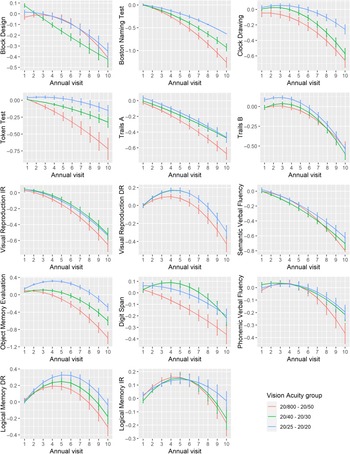
Regarding the effect of baseline VA on change in test scores over time, the average duration of follow-up was 6.77 years, which did not differ by VA groups. The range of annual observations in the longitudinal model was 2 to 5. The results of the longitudinal sub-model of the joint modeling are summarized in Table 3, showing the four interaction terms of interest: Low VA × Time, Average VA × Time, Low VA × Time2, and Average VA × Time2. The High VA group was the reference group. Significantly different group longitudinal trajectories over time were observed for seven neuropsychological tests. Vision-dependent tests included Boston Naming Test (Low VA × Time2, −0.004, SE 0.002); clock drawing (Average VA × Time, 0.111, SE 0.023; Average VA × Time2, -0.011, SE 0.002); and IU Token Test (Average VA × Time, −0.092, SE 0.024; Average VA × Time2, 0.006, SE 0.002). Vision-independent tests included semantic verbal fluency (Low VA × Time2, −0.006, SE 0.002); Fuld Object Memory Evaluation (Low VA × Time, −0.107, SE 0.024); phonemic verbal fluency (Low VA × Time, 0.067, SE 0.021; Low VA × Time2, −0.008, SE 0.002); and Logical Memory immediate recall (Average VA × Time2, −0.005, SE 0.002) (Table 3).
Summary of longitudinal sub-model with unstandardized coefficients (SE) and p-values indicating differences in cognitive test trajectories by baseline visual acuity group (reference group = high VA, 20/25 to 20/20)

Note. Animals = Semantic Verbal Fluency (animals), OME = Fuld Object Memory Evaluation, Block = Block Design (WAIS-III), BNT = Boston Naming Test, Clock = Clock Drawing Test, Digit = Digit Span Forward, Letters = Phonemic Verbal Fluency (letters P & S), LM Immediate = WMS-R Logical Memory immediate recall, LM DR = WMS-R Logical Memory delayed recall, IUTT = Indiana University (IU) Token Test, TMTA = Trail Making Test Part A, TMTB = Trail Making Test Part B, VR IR = WMS-R Visual Reproduction immediate recall, VR DR = WMS-R Visual Reproduction delayed recall.
Bonferroni corrected alpha level = 0.05/8 = 0.00625 for vision-dependent tests, and 0.05/6 = 0.00833 for vision-independent tests.
All models adjusted for baseline neuropsychological test score, age, sex, education, and baseline hypertension, diabetes mellitus, CES-D depression score, and number of prescription medications. Full model results in Supplementary Tables A – N.
As seen in Figure 1, scores did not change in a linear manner over the observation period; for many tests, scores initially improved, most likely showing practice effects, before declining. The lower VA groups (i.e., “Low” or “Average”) generally declined at faster linear rates or with faster acceleration of change over time, relative to the High VA group. Of the 10 significant interaction terms, most (7) had negative coefficients, meaning greater decline or less practice gain, relative to the High VA group. The 3 positive coefficients (clock drawing, linear term, Average VA; Token Test, quadratic term, Average VA; phonemic verbal fluency, linear term, Low VA), even though significant, do not result in less decline or greater practice gain, relative to the High VA group, as shown in Figure 1. (See Supplementary Tables for full model results.)
Estimated longitudinal trajectories of neuropsychological test performance, by baseline visual acuity groups. Models are adjusted for baseline neuropsychological test score, age, sex, education, and baseline hypertension, diabetes mellitus, CES-D depression score, and number of prescription medications.

DISCUSSION
This study investigated associations of VA both with concurrent cognitive performance and with subsequent cognitive decline in a large population-based cohort of older adults, with a follow-up period of up to 9 years. The use of a comprehensive neuropsychological test battery provided a range of both vision-dependent and vision-independent tests. Longitudinal modeling reflected non-linear cognitive trajectories and incorporated joint modeling accounting simultaneously for informative drop-out, which otherwise may bias results.
We found that lower VA was associated with concurrent neuropsychological test performance on both vision-dependent and vision-independent measures, consistent with findings from previous cross-sectional studies (Pham et al., Reference Pham, Kifley, Mitchell and Wang2006; Tay et al., Reference Tay, Wang, Kifley, Lindley, Newall and Mitchell2006; Yamada et al., Reference Yamada, Denkinger, Onder, Henrard, van der Roest, Finne-Soveri and Topinkova2016). The longitudinal analyses indicated greater decline in the low baseline VA group on vision-dependent neuropsychological tests as well as vision-independent tests in episodic memory, language, and executive functions. This is also consistent with previous longitudinal studies (Anstey et al., Reference Anstey, Luszcz and Sanchez2001; Dearborn et al., Reference Dearborn, Elias, Sullivan, Sullivan and Robbins2018; Hong et al., Reference Hong, Mitchell, Burlutsky, Liew and Wang2016; Lin et al., Reference Lin, Gutierrez, Stone, Yaffe, Ensrud, Fink and Mangione2004; Valentijn et al., Reference Valentijn, van Boxtel, van Hooren, Bosma, Beckers, Ponds and Jolles2005; Zheng et al., Reference Zheng, Swenor, Christ, West, Lam and Lee2018). In the Maine-Syracuse Longitudinal Study (Dearborn et al., Reference Dearborn, Elias, Sullivan, Sullivan and Robbins2018), which used a multi-domain neuropsychological test battery, VA predicted 5-year change in verbal episodic memory and verbal working memory, as well as in visuospatial organization. The current study expands upon this literature with a longer 9-year follow up, annual assessments with a comprehensive multi-domain test battery, and accounting for informative attrition in a population-based cohort. While the collective longitudinal evidence of these observational studies, including present findings, does not prove causality, it supports the idea that sensory impairments might be modifiable risk factors for cognitive decline, and possibly play a causal role.
Various general hypotheses have been proposed to account for associations between sensory and cognitive impairment in aging (Roberts & Allen, Reference Roberts and Allen2016). The “common cause” hypothesis posits that another pathological process, such as vascular disease, or even aging itself, influences both sensory and cognitive functions (Baker et al., Reference Baker, Wang, Rogers, Klein, Kuller, Larsen and Wong2009). We addressed this possibility by adjusting our models for age, diabetes, hypertension, and number of prescription medications, and still observed significant effects of baseline VA, indicating that at least these covariates cannot completely account for the observed greater cognitive decline. The “information degradation” hypothesis holds that a chronically incomplete or ambiguous perceptual signal, as in sensory impairment, requires additional information processing resources and thus limits those resources available for cognitive performance (Monge & Madden, Reference Monge and Madden2016). Another mechanism might be that sensory impairments lead to reduced social, leisure or physical activity, which in turn decrease the protective effects these lifestyle factors have against cognitive decline (Yamada et al., Reference Yamada, Denkinger, Onder, Henrard, van der Roest, Finne-Soveri and Topinkova2016). Mood, depressive symptoms, or social isolation may also play a mediating role, as they appear to do with hearing impairment (Maharani et al., Reference Maharani, Pendleton and Leroi2019). In this study, models were adjusted for baseline depressive symptoms. As this longitudinal observational cohort study was not designed to test these specific hypotheses, further prospective work with focused study designs is needed to test them directly (Whiston et al., Reference Whitson, Cronin-Golomb, Cruickshanks, Gilmore, Owsley, Peelle and Lin2018). Few prospective interventional studies have investigated whether treating vision or hearing loss has downstream beneficial effects on cognitive functioning; however, there is indirect support for this. For example, in the English Longitudinal Study of Aging, episodic memory decline was slower after cataract surgery than before surgery, and at similar rates to a non-intervention group, using propensity-weighting in this observational study (Maharani, Dawes, Nazroo, et al., Reference Maharani, Dawes, Nazroo, Tampubolon and Pendleton2018). In the Maastricht Aging Study, change in VA over 6 years was associated with change in cognitive test performance over the same period (Valentijn et al., Reference Valentijn, van Boxtel, van Hooren, Bosma, Beckers, Ponds and Jolles2005). In the Salisbury Eye Evaluation Study, although association across time were bidirectional overall, crossed-lag modeling over 8 years indicated that VA had a stronger association with cognitive abilities 2 years later than did cognitive abilities predicting VA (Zheng et al., Reference Zheng, Swenor, Christ, West, Lam and Lee2018). There is evidence for improvement in other health outcomes, such as mood, after vision or hearing loss interventions (Choi et al., Reference Choi, Betz, Li, Blake, Sung, Contrera and Lin2016; Fraser et al., Reference Fraser, Meuleners, Lee, Ng and Morlet2013). A population-based study in France of adults age 78 and older reported a prevalence estimate of uncorrected (i.e., correctable) refractive error of 38.8% (Nael et al., Reference Naël, Pérès, Dartigues, Letenneur, Amieva and Arleo2019). In the U.S., an estimated 36% of vision impairment in adults age 45 and older is correctable to 20/40 or better (Klein & Klein, Reference Klein and Klein2013). However, of note, the current U.S. Preventive Services Task Force determination is that evidence is insufficient to recommend vision or hearing screening in the primary care setting in adults aged 50 and older (Chou et al., Reference Chou, Dana, Bougatsos, Grusing and Blazina2016; Moyer, Reference Moyer2012).
The population sampled was from under-served Rust Belt small-town communities of relatively low socioeconomic status not typically included in cognitive aging research. These are study strengths, but there are also limitations. While the assessment of cognitive outcomes was detailed with a comprehensive multi-domain neuropsychological test battery, the measure of VA was limited to the basic Snellen chart assessment of distance acuity and does not capture other important facets of vision impairment in older adults (Jin, Reference Jin2016). Study visits most often took place in participant homes, (i.e., their usual environs), and may have resulted in some limits to control of the testing environment. Exclusion criteria included visual impairment severe enough to preclude neuropsychological testing but including them would not have provided additional cognitive data. The cohort was predominantly of European descent, representing the older population of the communities we studied; as such, results should be replicated in other populations with greater ethnic and racial diversity.
In sum, we found that baseline VA was associated with both concurrent cognitive functions and subsequent cognitive decline over 9-year follow-up in a population-based cohort, after accounting for informative attrition. Greater decline in episodic memory and attention/working memory among participants with the lowest baseline VA supports the notion of a predictive, possibly causal, role for sensory impairment in cognitive decline. Sensory impairments should be considered relevant modifiable risk factors for adverse cognitive outcomes in aging and warrant further study regarding screening and interventions.
SUPPLEMENTARY MATERIAL
To view supplementary material for this article, please visit https://doi.org/10.1017/S1355617721001363
ACKNOWLEDGEMENTS
The authors would like to acknowledge and thank all MYHAT study participants and study personnel for their contributions to this work.
FINANCIAL SUPPORT
The work reported here was supported by grant # R01AG023651 from the National Institute on Aging.
CONFLICTS OF INTEREST
There are no conflicts of interest to report.