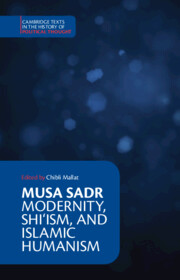


I.1 Musa al-Sadr’s Islamic Humanism
This book introduces Musa Sadr less as a leading political figure in modern Lebanese and Middle Eastern history than as a thinker whose actions were firmly rooted in ethical and religious values. For him, Islam was social philosophy as well as faith.
The book consists of twelve addresses, lectures and interviews given by Sadr since his social and economic concerns in Tehran in the late 1950s through his meteoric rise and leadership in Lebanon, which was cut short by his invitation and kidnapping by the Libyan ruler on August 31, 1978. This is the first such collection in English by Imam Musa, as he is widely referred to in the region. Several collections of articles, speeches and interviews were collected in a series of books published by the Imam Sadr Center for Research and Studies in both English and Persian (and some in other languages).Footnote 1 The present book focuses on his intellectual contributions.
The collection confirms Sadr’s intellectual preeminence in a wider world perspective by setting forth a living vision of a thoughtful political and civil society leader. In sharp contrast to both “religious” and “secular” regimes that have brought disaster upon disaster on the Middle East, it offers a vision of a man immersed in a complex and troubled region, in his own words, at key moments of a remarkable career. The reader will be struck by the relevance and topicality of his ideas.
The occasions gathered present Sadr’s ideas on the centrality of justice and free will in Islam, his views on press freedom, individual and social responsibility, “Islamic economics,” humanism and civil society, sect and sectarianism in Lebanon and the tumultuous history of the Middle East. They express Sadr’s
desire and feeling of wanting to give and to receive, the desire to fulfill obligations and duties toward others, and the enjoyment at having rights and obligations fulfilled by others; this is what we call “civic feeling.” It is innate, inherent and natural in human beings. When Islam comes to this feeling it tries to make it more profound by approaching it philosophically.Footnote 2
The texts vary in their formality and cover a wide spectrum, which ranges from a short philosophical treatise in Sadr’s critical preface to the History of Philosophy by famed French scholar on classical Shiʿism Henry Corbin, to particular challenges and dangers of the hour – which Sadr consistently communicates in an accessible, engaging and sometimes ironic way.
The book also includes a chronology of Sadr’s life and a recently discovered autobiographical text (see Chapter 1), which we chose to footnote heavily to explain the context of Sadr’s actions and words for the larger, non-Middle Eastern readership.
These essays carry Musa al-Sadr’s voice as it was most closely shared by his audience. Behind the apparent improvisation, for he worked sometimes from written notes, sometimes without any, the texts show his intellectual reach with, in addition to the autobiographical Chapter 1, a focus on recurring themes in three main parts: (i) Islamic thought on human values; (ii) social and economic considerations; and (iii) his approach to, and involvement in, the Lebanese crisis until his disappearance in 1978. The texts are divided across three main parts, organized thematically rather than chronologically.
A picture emerges of a political leader shaping, and reacting to, fast-moving events from a clear set of general principles, at the center of which stands the individual, together with her social responsibility, a spiritual connection with the divine, Sadr’s attachment to the Shiʿi religious tradition, as well as a sustained criticism of the way politics operate in Lebanon. The reader will draw his own conclusions on the adequacy of these principles in the turbulent region in which Sadr worked, and on the larger humanistic appeal that underlines his action.
The remainder of this introduction examines various issues and themes intimately linked to Sadr the activist and thinker.
I.2 Context: “The Shiʿi International”
By any standard, Musa al-Sadr is a larger-than-life Lebanese leader.Footnote 3 Nearly five decades after his abduction in Libya, his image towers over an assertive Shiʿi community in Lebanon.Footnote 4 Sadr brought it out from a marginal status reinforced by a sectarian political system, and he did so without allowing it to appear as a threat to the other communities. In Lebanon, Sadr is adulated by the vast majority of Shiʿis and commands respect across the other religious groups. His place in the collective memory stems partly from a charisma compelled by his tall stature and elegant gait, his gentle personality, beauty in the face with luminous eyes, his willingness to listen and a special command of Arabic with a slight Persian accent. The continuous attachment to him comes mostly from a successful projection of his Shiʿi pride and convictions onto a more universal religious and human scene of which he sought to be part between 1957, when he was just short of thirty years of age, and his abduction in 1978. All Lebanese realize how irreplaceable Sadr remains to a fragile society lacking moderation, wisdom and equanimity, and his cross-confessional appeal is associated with sundry anecdotes. A famous one is Sayyed Musa, as he is also called less formally, taking people after prayer to buy ice cream from a Christian merchant in Tyre, a gesture portrayed as a large embrace of all without heed to their religious community.Footnote 5
There is, however, a much larger circle than Lebanon in the context of Sadr’s life and works, and it does not carry the same universal reverence. Musa al-Sadr stands firmly at the center of “the Shiʿi International,” described elsewhere as a network constituted by the historical convergence between traditional Shiʿi law and modern constitutionalism.Footnote 6 This transnational network came to dominate Middle Eastern politics, and the larger international scene, upon the access of religious leaders to power in Iran in 1979 in the wake of the Islamic Revolution. By doing so, it created a significant resentment in various parts of the Arab and Muslim world, including in Lebanon.
Yet Sadr’s prominence antedates the revolution in Iran. He is the scion of a celebrated family of religious leaders across the Middle East, where both men and women have succeeded in shaping their proximate and less proximate environment with the values they believe in.Footnote 7 Visiting Iraq for the first time after the removal of Baʿthist rule, one of us (Mallat) was struck by the immediate embrace of several people of his Lebanese leadership and the inevitable mention in the same breath of their sadness and anger at his disappearance. In Baghdad, “Sadr City” covers almost half of the large metropolis and was renamed, in the wake of the fall of the Baʿth Party, after Muhammad Baqer al-Sadr, the Imam’s younger cousin, and Sadeq al-Sadr, his cousin on his mother’s side.Footnote 8
In Iran, Muhammad Khatami, who was elected president twice with large majorities and established a period of moderation and growth between 1997 and 2005, is married to Sadr’s niece, Zohreh. In Lebanon, Sadr’s close kin is wedded into other prominent Shiʿi families, including the Sharafeddins in particular. In the late 1950s, Abdul Hussein Sharafeddin, respected religious leader of the Shiʿis of Jabal Amil, in south Lebanon, introduced the young Iranian religious scholar Sadr to the country and pushed him into prominence.Footnote 9 Sadr visited Lebanon for the first time in 1955 and made the decision to stay in the country after 1959. Lebanon has since been the terrain where he was most active.Footnote 10 His sister Rabab married a notable from Tyre, Hussein Sharafeddin, and has taken over the large social institutions that she founded with her brother in the 1960s.Footnote 11
I.3 Nonviolence for Lebanon
In the light of the Imam’s status nationally and regionally, his abduction during his visit to Libya in 1978 marks a turning point in Lebanese and regional politics. The sudden, unexpected disappearance from the public scene was, to borrow the words of a famous editorial by the French daily Le Monde a year earlier, an “insult to the future.”Footnote 12 The editorial had been penned in reaction to the assassination in March 1977 of Kamal Jumblat. Within less than two years, Lebanon lost its two most compelling figures to crimes committed by regional strongmen in a double insult to the country’s future. The pattern of assassinations has never stopped since.
Reference to Jumblat as another major figure of modern Lebanese history is purposeful, and one should mention in this context of Lebanese towering figures in the twentieth century a third exceptional leader, Raymond Eddé. From the very first day of Lebanon’s descent into chaos in April 1975, Eddé, a traditional Maronite Christian notable, a prominent parliamentary deputy and minister and a lawyer by profession, remained committed to nonviolence. He also refused systematically to make the slightest compromise in his rejection of force and in his steadfast opposition to foreign governments meddling in Lebanese affairs. Together with Eddé and Jumblat, Sadr constitutes the third shining figure in a narrow pantheon of Lebanese leaders.Footnote 13 Eddé was forced to leave Lebanon after several attempts on his life in 1976 and died in French exile in 2000. Jumblat was assassinated in 1977 in Lebanon. Sadr was “disappeared” in 1978 in Libya. History was unkind to Lebanon and to the world by depriving the country of its most alluring leaders. With their absence, the crisis in which the country has been mired continues several domestic and regional wars later, with no end in sight after fifty years.
Lebanon first descended into violence in 1975, when Lebanese and Palestinians in Lebanon fought Lebanese factions, mostly Christian, over different views of the country and its role in the region. Jumblat was the leader of a Lebanese–Palestinian front responding to Christian militia exactions and ethnic cleansing. As the head of the Lebanese National Movement (LNM), Jumblat led a large armed opposition to the Christian militias and the then president of the country with a view to remove him from power and establish a reformist, left-of-center nonsectarian government.Footnote 14
Sadr took a diametrically opposed stance to the one chosen by Jumblat. Jumblat wanted to reform Lebanon in secular terms, while Sadr never jettisoned the religious component as central to change. As importantly, they differed in the means chosen. While Sadr’s legacy is associated with a famous Arabic aphorism, “al-silah zinat al-rijal” (weapons are men’s adornment), he rapidly took a reserved position toward the use of force inside the country:Footnote 15
Before I translate the needs of the deprived into this political, social, economic change that we demand, it is imperative to add the central foundation for this change: this foundation is our refusal to change by force, not only because it is a pity for this small nation to be subjected to violence and because the Lebanese structure is complicated, but also because it is prohibited to handle fire with one’s bare fingers, so long as there are democratic means available in principle and their use possible and expected.Footnote 16
This is a remarkable paradox in the position of Lebanon’s two national figures at the outset of the Lebanese wars. Jumblat had embraced, for years, the nonviolent path pioneered by Gandhi. Sadr had not, and his writings and political philosophy support armed resistance. The paradox lay at the heart of the tragic beginnings of the long Lebanese history of unrest, with Jumblat taking up arms against the Ancien Régime despite his express advocacy of nonviolence, and Sadr’s refusal to use force to remove the established order despite the association of his large following, prima facie, with armed resistance. It pits philosophically nonviolent Jumblat embracing violence for the sake of the oppressed despite a long-standing belief in nonviolence as political philosophy of change, versus Sadr, the founder of a revolutionary movement with an early military calling, shunning violence on the Lebanese political scene and adamantly refusing to involve his followers in the violent revolution/civil war engulfing the country.
This does not exclude Sadr’s own contradictions. In addition to a long-standing closeness to the Syrian ruler Hafez al-Assad, whose military involvement in Lebanon he supported, the political party founded by Sadr was named Amal, the Arab acronym of which (a-m-l) means hope, yet represents the militia dimension associated with its birth as Afwaj al-Muqawama al-Lubnaniyya (Units [or Regiments] of the Lebanese Resistance).Footnote 17 This resistance included a military dimension, which came to the fore brutally after Sadr’s disappearance in 1978. But Sadr was ambivalent when creating the movement, and his interviews in 1975 and 1976 show his deep unease with any armed group operating outside the Lebanese state’s monopoly of violence.
When Jumblat was assassinated in March 1977, likely under the orders of Syrian president and ally of Sadr, al-Assad, whom Jumblat had just accused of turning Syria into “a large prison,” Sadr’s initially muted reaction gave way, two weeks after the assassination, to a dark premonition that he expressed in an interview condemning the murder:Footnote 18 “There is no doubt that political assassinations, especially in the present circumstances, must be considered a setback to peace.”Footnote 19
This is consistent with a track record that goes as far back as 1966, when Sadr reacted to the assassination of Kamel Mroue, a leading journalist who established two daily newspapers in Lebanon, al-Hayat and The Daily Star. Mroue was gunned down in Beirut on May 16, 1966, by assassins close to then Egyptian president Gamal Abdel Nasser. Sadr denounced the assassination in one of the most expressive statements of his legacy: “Assassination is one of the worst, most futile and cowardly ways to reach any goal, no matter what the goal may be. It is also a dangerous social phenomenon, since trial, judgment and execution are undertaken by one single person.”Footnote 20
In the early months of Lebanon’s violent trials and tribulations, as violence engulfed the country further every day, Sadr started a hunger strike in the ʿAmiliyya mosque in south Beirut in a Gandhi-like gesture:
Violence had defiled the country; I have come to the house of God, and my sustenance is the book of God [the Qur’an] and a few drops of water. I will stay here until death, or until the country is saved. I have bid farewell to my family, to my wife and children, and have come here to ask God to save this country.Footnote 21
Sadr did not waver from this position: two months later, in his Letter to the Deprived, he made clear that “just as we do not accept violence as a means of change, we do not accept violence to prevent it; otherwise, we would fall into a dictatorship. Better have a revolution.”Footnote 22 There is no attested violence under his command between his hunger strike and his disappearance three years later. This does not mean that he is not perceived as having taken side with Syria’s rulers, themselves part of “the Shiʿi International” as Alawis, a minor Shiʿi community in terms of numbers, but a politically dominant group in Syria from the 1970s to their violent removal from power at the end of 2024.Footnote 23
I.4 Violence in a Regional Context
Because of Israel, Musa al-Sadr’s attitude was different on nonviolence in a regional context. In addition to a long-standing enmity since the establishment of Israel over Palestine and the massive influx of Palestinians seeking refuge in Lebanon, on-and-off low-scale hostilities had persisted since Palestinians took up arms in the south of Lebanon in guerrilla warfare after the 1967 war.
The situation developed in a complex pattern, with the Palestinians as the main armed group established in the south. As trouble spread in Lebanon in 1975 and Syria invaded the country in October 1976, Israel established a small perimeter inside the country, dubbed “the good fence,” with villagers within that zone isolated from the rest of the country and allowed to work in Israel. Considering the precedent of the West Bank, Sadr and most Lebanese were alarmed at the transformation of south Lebanon into a potential “North Bank,” with land-grabbing settlements a tangible fear, compounded by the full military onslaught conducted in April 1978 and the occupation of about a fifth of Lebanese territory. Sadr supported armed resistance to Israel while denouncing Palestinians taking up arms within Lebanon.
Whether regarding Israel and other countries, Sadr’s vision was never limited to Lebanon, on account of the “the Shiʿi International” and its regional network, which he personally embodied more than any other Lebanese leader in modern history. In his life, Sadr had three major moments, Iranian, Iraqi and Lebanese. Having studied in Iran at the traditional seminary curriculum at Qom as well as in the modern law school in Tehran, then in Iraq for a brief two-year period of “graduate studies” at Najaf in 1955–57 meant for apprentice scholars in the traditional fashion, Sadr honed his family and religious network in a way few other political figures in the Middle East succeeded in achieving. While the Lebanese moment was the latest and the most intense, it was never exclusive of the other two.
Various accounts are replete with recollections of major Iranian and Iraqi figures about the activities of Sadr in an intimate and intricate community of leaders in the making across the three countries.Footnote 24 In 1977–78, the star of Ruhollah Khumaini rose considerably in the popular revolt he led against a powerful US-backed shah, but the revolution did not succeed until early 1979, after Sadr’s fateful visit to Libya. Like many people within and outside the Middle East, he was supportive of an extraordinary insurrection against the entrenched dictatorship in Tehran. From philosopher Michel Foucault to local Arab and Iranian folk, people across the globe were sympathetic to the rising rebellious tide against one of the most entrenched dictatorships on the planet. Disillusion came later.
Two days before Sadr arrived in Libya, he articulated his support for Khumaini and the rising revolutionary tide in an op-ed in Le Monde. Signing it as “President of the Supreme Shiʿi Council of Lebanon,” he noted that the popular mobilization unfolding in Iran was distant from right and left alike, and he underlined its “open humanism and revolutionary ethics.”Footnote 25 His enthusiasm for the Iran revolution and its clerical leadership is evident.Footnote 26 This last published article before his disappearance shows his admiration for the Iranian Revolution about to sweep the Middle East. It is remarkable, reading it half a century later, how much Sadr is attentive to nonviolence. Sadr mentions twice in the brief op-ed his respect for the “unarmed people” (peuple désarmé) standing against the “Shah’s regime … which disposes at the moment the greatest stockpile of weapons in the Third World.”Footnote 27
This theme of “unarmed people” rising against dictatorship is of importance in the subsequent course of history and the many nonviolent revolutions, also known as “color revolutions,” that have marked the world since the collapse of the Soviet bloc. In this book, the reader will find insights into the philosophy of Sadr mostly on the side of nonviolence as principle. While the subsequent history of Iran is disappointing for its rampant authoritarianism, the humanism that surfaces in Sadr’s various lectures and writings comes down strongly on the side of human rights as his dominant philosophical outlook and in his rejection of violence as a political tool. But in his larger view of the region, his fascination with the budding unarmed revolution of Iran would probably not trump his support for armed resistance to Israel. This also explains his wide respect in Lebanon across the Shiʿi political/religious spectrum, including Amal and Hizbullah, the latter being founded in the wake of the wider occupation of south Lebanon by Israel in 1982.
I.5 Musa al-Sadr’s Humanism
If one were to reduce Musa al-Sadr’s legacy to a single idea, this monad would be humanism.
At the center of his writings rests the human being, al-insan, meaning both the individual per se and the individual within the larger collectivity. So recurrent is the reference to the word insan in the texts chosen that its translation falls short of projecting the intensity of references to all that is human in Sadr’s view. In part, the word in Arabic corresponding to man/human has special connotations in its multiple uses. In English, “man” appears traditionally both in opposition to “woman” and as a synonym of human, as in man/humankind. In Arabic, insan is genderless, for the feminine insana is rarely if at all used in classical or modern texts. In addition, the concept of insan carries an abstract nuance one can render in English as humankind.Footnote 28
Evidence of this nuance can be found in the Qur’anic verse joining the word insan with an adjective in the feminine gender, basira: “bali-l-insanu ʿala nafsihi basiratun” (a human [being] is responsible for her soul).Footnote 29 The verse appears in one major Arab jurisdiction as the basis chosen by courts to root the individual’s responsibility in the Qur’an.Footnote 30 In this literal reading of the verse, the courts derive legal consequences in terms of compensation for damages inflicted or the crime committed by the person who betrays this testimony/evidence/responsibility. It establishes for the jurist the individual’s responsibility for her acts.
The consequence is to neutralize gender with a view to marking a preference in the translation by using alternatively man and woman for insan, save when the male/female difference is emphasized by Sadr, usually to show his deference to women in reading the tradition. As his nephew Sadeq Tabatabaʾi reports, “I recall, since childhood, that [Sadr] paid special attention to the kids in the family, both male and female without discrimination, and to be more precise, paid special attention to the girls.”Footnote 31 This conforms with another, eminently practical report, arising from the Imam’s social work. In Lebanon, “he established ‘the home for girls’ (bayt al-fatat) to elevate the social level of women, including a school to erase illiteracy, a school for manual work and for sewing and a technical high school for nursing.”Footnote 32 While the alternative translation would have appeared slightly contrived a few years ago, there is little doubt that the “feminine condition” (Simone de Beauvoir) figures highly in the Imam’s set of priorities. Sadr’s genderless use of the word insan provides an objective platform for a gender-parity interpretation of the world.
This is also true for the humanist label more generally. The life and works of Sadr hold him as figure of choice for the “humanist” tradition. In Western modern history, the period generally associated with the beginning of humanism is the Renaissance, with Erasmus of Rotterdam as its archetype. In the deep history of the Middle East, there are several contenders to the humanist pantheon, as varied as Jewish philosopher and jurist Moses Maimonides (d. 1204), Syrian poet-philosopher Abu al-ʿAlaʾ al-Maʿarri (d. 1057) or Iranian philosopher Mulla Sadra al-Shirazi (d. 1640); let alone, lest we unduly forget him, a Middle Eastern person of choice, Jesus of Nazareth. Adding Sadr to that long list is easily defendable.Footnote 33
Sadr’s humanism is Islamic.Footnote 34 This is inevitable for a man of religion as a profession and dedication. It is the more noteworthy since the Western tradition of humanism is historically linked to the detachment from religion as its dominant component. European humanism – read Western/world humanism – emerged in significant part as a secular movement against the power of the Church. Humanism rose in Europe against established churches, Roman Catholicism in particular. It sailed through the wars of religion that tore Europe for the better part of the sixteenth and seventeenth centuries as the philosophical harbinger of the separation between religion and state. In the West, secularism and humanism are cognates, even if humanism is also espoused in modern Christian philosophy. This is not the tradition of the East, not a Near or Middle Eastern tradition at least, where the relationship between religion, society and state remains deeply intertwined. In the Arab and Muslim Orient, or in the Middle East generally, the humanism of Sadr never turns its back to religion.
From a narrow Western perspective, that might disqualify Sadr from being a humanist. The way humanist religious leaders generally overcome the secular pull is to turn ecumenical. Sadr is always celebrated for his ecumenism. In different moments of his life, including his participation in the coronation of Pope Paul VI in the Vatican in 1963, interfaith dialogue on a world scale is central to his activity. A Christian reader will find herself at ease with most ideas and theological underpinnings in the present book. This is a mantra that was reinforced in Pope John Paul II’s celebrated “Lebanon as message” joining East and West in 1989. It appears strongly in Sadr’s belief in Lebanon as the model example of ecumenical humanism:
Lebanon, at this particular stage in history, represents an essential model for the world. Firstly, because of the expansion of transport and communication, we feel that the entire world in the late twentieth century and at the beginning of the twenty-first century lives effectively like a single country. The distance between one country and another, in terms of physical travel time, seems no more than the distance between Beirut and Tripoli. In such an interconnected world as ours, which includes different religions and coexistence among the peoples of the world, any efforts to create a universal state should link closely with and be greatly affected by the success of Lebanon’s example …
If the experience of Lebanon should falter or fail, this would harm and undermine the whole of human civilization for the next fifty years, at the very least. Therefore, we say that Lebanon is a civilizational necessity, now more than ever.Footnote 35
In addition to the premonitory quality of this comment, Sadr’s Islamic humanism is informed by several other traits also feeding into his philosophy.
One is egalitarian, with an insistence on the charitable dimension of Islam and the need to go beyond to the structural problems of inequality. In a full book on economic principles in Islam, one can see the convergence of his approach and worldview with the elaborate examination of his cousin Muhammad Baqer al-Sadr in Iqtisaduna (Our economic system) or the Persian oppositional cleric Mahmud Taliqani’s Islam and Ownership.Footnote 36 In Lebanon, Sadr’s name is associated with the struggle of the “mahrumin,” those who have been “deprived” (also translated as “disinherited” or “dispossessed”). Both Sadrs’ views are strongly anchored in a socially aware message to be achieved by the state for the poorer, exploited and deprived sectors of society.Footnote 37
Another anchor is spiritual, with Sadr’s attraction to what he calls “a [special] type of Sufism”:
This type of Sufism differs from the more well-known ascetic type of Sufism, which is based upon ignoring desires deliberately in a quest for purity and perfection of the soul. Rather, desire is a transcendental need for man. What he can impose on himself by fulfilling his desires keeps him from a total dependency on his surroundings.Footnote 38
A third overarching trait is legal. It is present in Sadr’s works as both theory and practice. As theory,
the separation between the principles of economic and social justice and those that obtain from Islamic beliefs is part and parcel of the tragedy in dissociating doctrine from the law. This separation, and the passivity of Muslims, has resulted in a loss of depth and strategy in the foundations of justice, so much so that economic, social and other applications of justice have become simply a social and political demand shorn [from the law].Footnote 39
As practice, Sadr entrusts the responsibility to the religious law scholars, the fuqahaʾ:
The responsibility of religious scholars in this field is great, highly delicate and urgent, as they are the trustees serving the community and its people, especially those deprived among them – these scholars alone can give a true picture of the struggle of the disadvantaged and the oppressed within societies and stand in the way of appeals to extremism and atheism. Religious scholars are especially capable of preventing the distortion and deflection of efforts to restore rights to people deprived of them. The oppressors and usurpers of justice and rights typically accuse movements that are struggling for justice of atheism or sectarianism. The best remedy in such cases is for religious scholars to stand with the deprived and oppressed and adopt their cause.Footnote 40
The responsibility of scholars in the city is obvious for Sadr. Other than this passing reference, however, one does not find in Sadr’s written legacy a more specific official role for religious clerics, in particular his fellow scholars of traditional law. This is because in the period when Sadr was active, from the late 1950s through the mid-1970s, he was defending the social role of religious scholars and encouraging them to participate actively in social and political life, rather than assigning them governmental positions in the state. As the Islamic Revolution in Iran succeeded and endured, the concept known as “the rule of the jurist” (Arabic wilayat al-faqih, Persian velayat-e faqih) consecrated the role of “leader” to a top member in the Shiʿi religious leadership, both in constitutional text and practice, leading to a large controversy that persists to date.Footnote 41 This was not the case in the period during which Sadr was active in Lebanon, when his access to an official governmental seat was hard to conceive. Paradoxically, the sectarian constitutional system of the country does not encourage the religious leaders of the various communities to be in government.
Except for the passage above, the subject of religious leadership does not appear prominently in Sadr’s written texts. His emphasis is more in the equivalent of Vatican II, perhaps even “the liberation theology” one finds in Latin America, with an advocacy for men of religion to be involved on the side of the poor and the deprived, not to lead the country as government officials. This is another important area where Sadr’s views would have been of importance in the development of modern constitutionalism had Muammar Qaddafi not abducted him in 1978.
I.6 Musa al-Sadr’s Trials
In 1996, Muhammad Khatami was emerging with a promise for stability and moderation in a revolution that had endured a long war with Iraq, during which it considerably hardened domestically.Footnote 42 As a self-styled reformist, the new Iranian president steered the country onto a moderate course. A close relative of Musa Sadr, Khatami had authored two books that provide the best entry point to understanding his general religious and political philosophy.Footnote 43 After the long interaction with Sadr’s Iraqi cousin Muhammad Baqer, another intellectual expression of “the Shiʿi International” comes by way of Khatami.
Together with my interest in Muhammad Baqer and Khatami, in addition to the many remarkable people encountered in “the Shiʿi International,” I developed with the Sadr family a lifetime journey of friendship and trust, of which the present book is one result. There were several others. The most meaningful career-wise was when the family of the Imam entrusted my law office in 2000 with bringing a legal case about his abduction in Libya two decades earlier. Together with two close companions on the trip, cleric Muhammad Yaʿqub and journalist Abbas Badreddin, news of his whereabouts abruptly stopped on August 31, 1978.
With the legal fight came unique challenges and some difficult moments. Central to the judicial effort was the Imam’s son, Sadri, who bears his father’s physical traits and endearing charisma, with whom a strenuous legal effort was carried out over five continents, including Australia,Footnote 44 to force out the responsibility of Muammar Qaddafi for the abduction of the Imam and his two colleagues.
The lawsuit on behalf of the Sadr, Badreddin and Yaʿqub families was brought in Lebanon on May 22, 2001, by their immediate relatives as parties civiles. For a lawyer entrusted with such momentous responsibility, the first question is to determine the central conceptual approach to secure progress, both procedurally and substantively. While moved by the same universal values of justice, the legal rationale for the case operated against a very different background to other international law instances that had developed the field of international criminal law beyond its traditional narrow boundaries.
Before the 1990s, only the pursuit of Nazi war criminals had yielded serious judicial results on the international scene. In the world at large, developments in international criminal law had been effectively halted since Nuremberg. They were revived with the demise of the Soviet Union in two main theaters: Iraq with the invasion of Kuwait by Saddam Hussein in August 1990, and Yugoslavia after its 1992 collapse into various smaller states and immense violence within them and on the newly established borders.
The first tangible result was the International Criminal Tribunal for the former Yugoslavia, which was established by United Nations Security Council Resolution 827 (1993). Several other international courts have since been established by the Security Council, including the 2007 Special Tribunal of Lebanon for the assassination of Lebanese former prime minister Rafiq Hariri in February 2005. The search for justice for grave violations of basic human rights culminated in the establishment of the International Criminal Court (ICC) at the Rome conference in 1998, with the ICC starting officially its work in 2002.
All these cases, as well as the trial for the downing of an airliner over the Scottish town of Lockerbie in 1988, are part of a heavy state-directed machinery and the United Nations. In the case of Lockerbie, the US and British governments actively supported the families of the victims by flexing their significant power in the Security Council to produce the special tribunal that sat in Scotland.
For several reasons, it was impossible in 2001 to imagine a special court getting established by the Security Council for the disappearance of Imam Musa al-Sadr, despite the generally unfailing national support in Lebanon. The country was beset with a weak government and an unending succession of civil and regional wars. The disappearance of the Imam had taken place in 1978, over two decades earlier, denting its legal appeal. Unlike Lockerbie, where 270 people were killed, the crime was “kidnapping,” and only three Lebanese citizens had disappeared. It was not possible to argue that a crime against humanity had been committed, which generally requires a far larger number of victims. Even if the statute of limitations and the projection backward of the jurisdiction of the ICC had been possible, the competence of the ICC in such matters was hard to envisage.
This left open the national jurisdictions’ route only. The most important precedent was formed by the Pinochet case in England. The case was brought by the Chilean dictator’s victims before the London High Court. At the same time, other jurisdictions were solicited by relatives of victims, Belgium in particular, where new legislation allowed the successful prosecution of the so-called Butare four, including two nuns who had participated in the Rwanda massacres of 1994. By 2000, preparations for the trial for Sadr started, with his family’s trust resulting from some success in rallying the fissiparous Iraqi opposition around a demand for an international trial of Hussein; and, more significantly, in the case of the victims of Ariel Sharon in the Palestinian camps of Sabra and Shatila, which I had brought in Brussels before the Belgian ordinary criminal courts in June 2000 on behalf of the victims’ families.Footnote 45
The hard facts in the case of the disappearance of Sadr and his two companions on August 31, 1978, are scant. Qaddafi invited Sadr around the time of the annual celebrations of the military coup that brought him to power nine years earlier, on September 1, 1969. The visit of his three official guests took place in the last days of August against a tense background in Lebanon and the region. In Lebanon, Qaddafi had mediated unsuccessfully among the various warring parties in 1976 (which did not include Sadr’s Amal movement) as part of his then messianic belief of taking on the leadership of the Arab world after the death of Egyptian leader Gamal Abdel Nasser. Qaddafi was close to the leftist Palestinian coalition at the time, despite some privileged ties to the Assad family in Syria, whose rule lasted through the Libyan leader’s demise in October 2011.
Alliances and disagreements are notoriously murky in the Middle East. Although Qaddafi negatively perceived the Imam siding with Syria against the Palestinians allied with the Lebanese left whom he supported, this was a while before he invited him, and the privileged relationship of Qaddafi with the Assad regime lasted until his demise in October 2011. When the Imam visited Libya on Qaddafi’s invitation in late August 1978, the revolution in Iran was on the rise, with tension across the Middle East exacerbated by a coup in Afghanistan and a profound split in the Arab world, with Egypt going it alone for a peace treaty with Israel when the successor of Nasser, Anwar al-Sadat, visited Jerusalem in November 1977. Amid all this turbulence, various theories emerged on the reason why Qaddafi abducted his guest the following year. They all remain pure speculation.
The main legal episodes of the trial are discussed elsewhere.Footnote 46 To summarize procedurally complicated developments straddling Libya, Lebanon and Italy, the criminal complaint of the families forced Qaddafi into publicly disavowing the fabricated story that prevailed over fifteen years, namely, that he had nothing to do with the three men’s disappearance, and that the Imam and his two companions left Libya on an Alitalia flight to Rome on the evening of August 31, 1978. By forcing the collapse of the narrative, leading Qaddafi to publicly declare that the Imam had disappeared in Libya, the judicial fight in Lebanon drew the support of worldwide human rights organizations, especially Amnesty International. The case then saw Qaddafi indicted by the Lebanese prosecutor general and the investigative judge in charge concurring.
Qaddafi threatened the lawyers and sought to bribe the Sadr family. All threats and enticements were ignored, and the family’s moral standing stood in sharp contrast to the acceptance of blood money for Lockerbie in the West. The case also defeated efforts to whitewash Qaddafi’s name by way of the Italian judiciary. It created the only public opposition to him in the streets of New York as the United Nations opened its largest forum to him shortly before the revolution that swept him away in 2011. In short, the indictment scared Qaddafi, his family and his associates far more than any action taken previously to make him accountable, including repeated solicitations by Arab leaders for Qaddafi to come clean on Sadr’s disappearance.
The efforts before the highest court (al-majlis al-ʿadli) in Lebanon reached their pinnacle in the summer of 2011, when the families put their arguments to the court as the massive popular revolt against Qaddafi was under way. Before judgment was rendered, Qaddafi died next to the sewers where he was hiding to escape the ire of his victims’ anger, which had been pent up over four decades of continued tyranny in the country.
Ever since watching the poor-quality video of Qaddafi begging for mercy at the hands of the vengeful mob that killed him on October 20, 2011, I have in my mind a story that takes us back over 2,000 years in history. This was the rout of “Matho (or Mathos) the Libyan” and his execution by a mob in 238 bc, in a precedent that was immortalized in Salammbô, the magnificent novel of Gustave Flaubert published in 1862.
Matho was a soldier and mercenary who rose to power during Carthage’s heyday in the third century bc. In the Histories of Polybius (d. 118 bc), Mathos rallied other Libyan mercenaries shortly after the end of the First Punic War in 241 bc to march on Carthage. “This was the origin and beginning of the mercenary, or, as it is also called, the Libyan war.”Footnote 47 After three long years of internal strife, Matho was defeated by Hamilcar Barcas, Hannibal’s father, and brought down by a popular revolt in 238 bc. He died in horrendous conditions. “For the last act in the drama was performed by the young men conducting a triumphal procession through the town, and finally inflicting every kind of torture upon Mathōs.”Footnote 48
Polybius does not give any further details, but in his inimitable style, Flaubert built on the account the fictional story of Matho’s lover Salammbô. The passages fictionalizing that obscure episode of Libyan history deserve to be quoted, for the parallels with the end of Qaddafi are just stunning. The description of Matho’s execution by the mob comes from the fifteenth and last chapter of Salammbô, ending with the wide sense of relief among his victims:
The sun sank behind the waves; his rays fell like long arrows upon the red heart. As the beatings diminished the planet sank into the sea; and at the last palpitation it disappeared.
Then from the gulf to the lagoon, and from the isthmus to the pharos, in all the streets, on all the houses, and on all the temples, there was a single shout; sometimes it paused, to be again renewed; the buildings shook with it; Carthage was convulsed, as it were, in the spasm of Titanic joy and boundless hope.Footnote 49
In Qaddafi’s gory death fiction uncannily matched reality. For the Sadr, Yaʿqub and Badreddin families, the relief in seeing his comeuppance was marred by the faintness of the hope that the men, one of them, or two, or all three, might suddenly emerge from the dictator’s underground jails. In October 2011, when Qaddafi’s regime fell, Sadr would have been eighty-three years old, Yaʿqub sixy-three, Badreddin seventy-three. There was one case in Libya in which a political prisoner who had disappeared eight years before them had been suddenly released.Footnote 50
It was not to be: 2011 was a special moment in history for Middle Eastern hope, but the counter-revolution prevailed there and elsewhere. Since then, the efforts to find the truth of what happened to the Imam and his companions have been frustrated. The fate of Sadr and his companions in Libya is as obscure in 2026 as the day they disappeared. We still do not know their exact whereabouts or fate. Every day is added torture for their families. The judicial indictment of Qaddafi and his Matho-like demise are no substitute for justice and truth. This is no less true for Lebanon and the Middle East, where thousands of victims have yet to see even a modicum of justice, in a world mired by the violence of dictatorships and massive inequality.
In Lebanon, the void occasioned by Sadr’s disappearance is yet to be filled. This book is one opportunity to keep him and his message alive. Sadr’s humanism is needed more than ever.
I.7 Conclusion: A Household Name
In Lebanon and in the Middle East, Musa al-Sadr is a household name. He was for me (Mallat) also, in a more personal sense. I retain a faint memory from when I was perhaps ten years old. It is a strong image of a tall man appearing with my parents in the early 1970s in the bedroom that I shared with my sister in our Beirut home to wish us sweet dreams. Clearly, a distinguished guest was visiting for dinner, but I was not sufficiently aware of Lebanese politics other than to recognize a famous name. I have other memories from my youth of the Imam, but I never saw him in person again. A picture dating from around 1973 or 1974 shows him with my father, probably at a meeting my father had with Sadr while presiding over the Beirut bar, or perhaps to celebrate the historical arrangement reached in a legal dispute known in the country as the Rumul case. The story of this case is worth recounting.
Rumul is “sands” in Arabic, and a long-standing legal dispute over large plots of sandy land in the southern suburb of Beirut involved powerful parties: the Maronite bishopric of Beirut, which had a century-old beneficial interest in waqf (trust) over the land, against the municipalities of Shiyyah (Chiah), Ghobeiry and Haret Hreik, owners of the land as commons. The dispute included, adventitiously, the people who had come to live on large parts of the land, namely, Shiʿi citizens from the south who had migrated to the Beirut suburbs in search of work and better living conditions.
This in Lebanon is a historical case by any measure, including the extraordinary rehabilitation of an obscure clause that my father, as the lawyer for the Maronite Church, had found in the nineteenth-century register of revenues received by the Maronite bishopric of Beirut. The old register, which served as evidence of an effective and continued interest in perpetuity for its Maronite beneficiaries, survived to provide the strongest argument for the fiduciary interest of the Church. The case proceeded slowly, over a period of thirty years, with a dual argument that the Lebanese civil courts accepted, all the way to the court of cassation and the administrative expropriation committees.Footnote 51 The first prong of the argument was the right to inscribe the Beirut Maronite bishopric as beneficiary of the trust in the land register; the second prong of the legal argument was administrative, namely, that perpetual beneficial interests in a religious waqf were at least tantamount to half the value of the property over which the waqf had been established.
The case was eventually decided by the Lebanese courts in favor of the bishopric against the claim of the ownership of the commons by the municipalities, but it had also long been the basis of a compromise that my father agreed upon with the Imam for a new ownership status for the land that benefited its residents. As the de jure leader of the Lebanese Shiʿi community since Sadr established the Supreme Shiʿi Council in 1969 and directed it until his disappearance in 1978, the Imam was naturally concerned about the well-being of hundreds of thousands of Shiʿi citizens who had been displaced from the south by poor economic conditions and by Israeli violence, and relocated to the southern suburb where the sandy land stood.Footnote 52 The al-Zahra hospital, still there today, was built on one of these plots.
In a symbol of Lebanese continuity, the Imam Sadr Foundation in the southern suburb of Beirut may well have been first built on part of the land freed by the Rumul compromise.Footnote 53 Upon every visit to the foundation was some Schadenfreude bringing back that early memory of the Imam leaning in the doorway of our bedroom to wish us well, my sister and me, and the strong friendship and the purposeful professional interaction across the generations.
Since then, another Lebanon altogether has emerged since after half a century of violence, a far less compromising one. One does not know what the continued leadership of Musa al-Sadr would have meant for the country. The fate of Lebanon would have been far more humane, no doubt.
1 For a sample, s.v. “Ṣadr, Mūsā,” Bibliography.
2 From Chapter 6, address in Senegal, 1967.
3 See the Bibliography for extensive coverage of his life and works. Two good introductions are Fouad Ajami, The Vanished Imam: Musa al Sadr and the Shia of Lebanon (Ithaca, NY: Cornell University Press, 1986); and Rabāb al-Ṣadr, al-Falsafa al-iṣlāḥiyya fī ruʾyat al-Imām Mūsā al-Ṣadr wa-aʿmālihi [The reformist philosophy in the vision of Imam Musa al-Sadr and in his writings] (Beirut: Markaz al-Imām Mūsā al-Ṣadr li-l-Abḥāth wa-l-Dirāsāt, 2022).
4 In the absence of evidence provided by the Libyan government to the contrary, the family considers the Imam to be still alive. We respect this strongly held conviction and use the present tense accordingly.
5 For this cross-religion appeal, see his church address at Lent 1975 in Chapter 10. Sayyed is a formal title for Shiʿis who descend from the Prophet Muhammad through his daughter Fatima, the wife of the first Imam in the Shiʿi tradition, Ali b. Abi Talib, also the cousin of the Prophet.
6 See, generally, Chibli Mallat, The Renewal of Islamic Law: Muhammad Baqer as-Sadr, Najaf and the Shiʿi International (Cambridge: Cambridge University Press, 1993).
7 For the family tree, see H. E. Chehabi and Majid Tafreshi, “Musa al-Sadr and Iran,” in Distant Relations: Iran and Lebanon in the Last 500 Years, ed. H. E. Chehabi (Oxford: Centre for Lebanese Studies, 2006), 140; Sabrina Mervin, Un réformisme Chiite: Ulémas et lettrés du Jabal ‘Âmil (actuel Liban-Sud) de la fin de l’Empire ottoman à l’indépendance du Liban (Paris: Karthala, 2000), 437.
8 Muhammad Baqer al-Sadr was executed by the Iraqi regime of Saddam Hussein on April 8, 1980. His cousin Muhammad Sadeq al-Sadr was assassinated with his two sons in Baghdad on February 19, 1999.
9 Abdul Hussein Sharafeddin is the author of al-Murājaʿāt (Sour: al-ʿIrfān, 1936), one of the most important books in the 1930s advocating a rapprochement between Sunnis and Shiʿis. He died in 1957.
10 For details, see his autobiography, Chapter 1.
11 On Hussein Sharafeddin, the grandson of Abdul Hussein and the author of a modern history of Tyre/Sour, see the obituary by Chibli Mallat, “Ghiyāb al-adīb Ḥusayn Sharaf al-Dīn muʾarrikh madīnat Ṣūr” [Passing of man of letters Hussein Sharafeddin, historian of Tyre], al-Nahār (Beirut), March 17, 2022. Sitt (respectful title akin to “Lady”) Rabab published her informed doctoral thesis on Sadr as al-Ṣadr, al-Falsafa al-iṣlāḥiyya.
12 Editorial, “L’Avenir insulté,” Le Monde, March 18, 1977.
13 On Kamal Jumblat, a good biography is Igor Timoviev, Kamāl Junblāṭ: al-Rajul wa-l-usṭūra [Kamal Jumblat: The man and the legend] (Beirut: Dār al-Nahār li-l-Nashr, 2000). See also on his thought and relevance, Chibli Mallat, ʿAn Kamāl Junblāṭ wa-min waḥyihi [On Kamal Jumblat and his inspiration] (Beirut: Badāʾiʿ, 2018). On Eddé, see Nicolas Nassif, Raymond Eddé: Jumhūriyyat al-ḍamīr [Raymond Eddé: The moral republic] (Beirut: Dār al-Nahār li-l-Nashr, 2002).
14 The National Movement (al-Haraka al-Wataniyya) was a coalition of motley groups generally on the left and of secular persuasion that supported the Palestinian cause. It came to prominence after securing several military victories in late 1975 and early 1976 against the right-wing Christian militias that were opposed to armed Palestinian presence in Lebanon and fought them in the country. While the LNM included originally Sadr and his supporters, Sadr and Jumblat (with the PLO leadership) parted ways a few months into 1976 over Syria’s increasing intervention in matters Lebanese under the rule of Hafez al-Assad. On the fraught relations between Sadr and the Palestinians at this crucial period, see Tristan Hillion-Launey, “Musa al-Sadr, les chiites libanais et les Palestiniens du Liban (4). Rivalités, divergences et affrontements,” Cahiers de l’IFPO, March 29, 2021, https://ifpo.hypotheses.org/11058. Syria’s military intervention in the summer of 1976 rolled the LNM back and forced a ceasefire that consecrated Syrian military presence in the country and the domination of Damascus over the Lebanese political scene for three decades. For an overview of the so-called two years’ war (1975–76), see René Chamussy, Chronique d’une guerre: Liban 1975–1977 (Paris: Desclée 1978); Samir Kassir, La Guerre du Liban: De la dissension nationale au conflit régional (Paris: Karthala 1994) (new ed. L’Orient des Livres/Sindbad/Actes-Sud, 2018).
15 On the expression al-silah zinat al-rijal, which is a statement widely ascribed to Sadr and associated with his political activities, he responded to criticism in an interview carried out a few months into the civil war: “In Lebanon, I believe that the complex local conditions and the looming dangers to the country and to the [Palestinian] resistance prevent the possibility of using violence for the sake of change, especially since change has become a wide national demand. There needs to be change in the means of change, i.e., in the electoral law so that change can happen.” Interview for Majallat al-Usbuʿ al-ʿArabi (weekly Arabic-language magazine in Paris) by Samir Shahin and Fatima Sarduk, “al-Thawra wasila la ghaya” [The revolution is a means, not an end], September 20, 1975, www.imamsadr.net/News/news.php?NewsID=6158.
16 Mūsā Ṣadr, Risāla ilā al-maḥrūmīn [Message to the deprived] (Beirut: Markaz al-Imām Ṣadr li-l-Abḥāth wa-l-Dirāsāt, 2000), 11. This is the text of a long statement read at the press conference of Sadr on September 11, 1975, also entitled “ibtihal al-watan” (the supplications of the nation). On mahrumin, see Footnote n. 22 and accompanying text; on the historical context, see Rula Jurdi Abisaab, “Sayyid Musa al-Sadr, the Lebanese State, and the Left,” Journal of Shiʿa Islamic Studies 8, no. 2 (2015): 131–57.
17 Hafez al-Assad emerged from the 1963 and 1966 coups in Syria to become president from 1971 until his death in 2000, when he was quickly succeeded by his son. A good biography is Patrick Seale, Asad of Syria: The Struggle for the Middle East (London: I.B. Tauris, 1988); on the closeness of Sadr and Assad, see 173, 352, 357.
18 Ajami, The Vanished Imam, 176.
19 “La shakk anna al-ightiyal al-siyasi, wa-khassatan fi al-zuruf al-haliyya, yuʿtabar intikasa fi masirat al-salam”; interview with ʿIsam Kheireddin, al-Muḥarrar, April 3, 1977, www.imamsadr.net/News/print.php?NewsID=6192.
20 The speech at the commemoration of Mroue two weeks after his assassination includes several of the humanist traits one finds in Sadr’s writings, “La siyana li-l-hurriyya illa bi-l-hurriyya” [No preservation of freedom except with freedom], May 31, 1966, translated here in Chapter 9.
21 Cited by Ajami, The Vanished Imam, 165 (mentioning late June 1975).
22 Ṣadr, Risāla ilā al-maḥrūmīn, 11. The last clause, “better have a revolution” (khayrun minha thawra), is intriguing and appears to contradict Sadr’s appeal to nonviolence, but it must be seen in the context associated with revolutions, perceived then as naturally violent. On this association, which includes Hannah Arendt in a late text from 1969, see Chibli Mallat, Philosophy of Nonviolence (New York: Oxford University Press, 2015), 6n8.
23 On the development of closer ties between Syrian Alawis and Twelver Shiʿis in the rest of the Middle East, including the Lebanese Shiʿis, see Chibli Mallat, Aspects of Shiʿi Thought from the South of Lebanon (Oxford: Oxford Centre for Lebanese Studies, 1988), Footnote n7, and accompanying text. The return of Syria to Sunni rulers in December 2024 marks a watershed in the region.
24 In addition to the works mentioned in Footnote n. 11, see Hussein Sharafeddin, al-Imām al-Sayyed, Maḥaṭṭāt tārīkhiyya, Īrān – al-Najaf – Lubnān (Imam Sayyed, historical moments, Iran – Najaf – Lebanon] (Beirut: Dār al-Arqam, 1996). We do not have clear testimonies on the relationship between Sadr and Khumaini. For a complex set of local and regional entanglements, s.v. “Khomeini” in Chehabi, Distant Relations, various chapters.
25 Imam Moussa el-Sadr, “L’appel des prophètes,” Le Monde, August 23, 1978.
26 A book published in Iran shows the reverence of various first-rate Iranian personalities; see Mahdī Farrokhiān, ed., Andīshe-ye rabudeh shodeh [The thought that was stolen (with the disappearance of the Imam)] (Tehran: Imam Moussa Sadr Cultural Research Institute, 2006). See also Ḥabībe Jafariān, Sayyed Mūsā Ṣadr: Haft revāyat khuṣūṣī [Sayyed Musa Sadr: seven personal narratives] (Mashhad: Sepīdeh Bavārān; Tehran: Markaz-e Imām Mūsā Ṣadr, 2015).
27 Sadr, “L’appel des prophètes.” In Mallat, Philosophy of Nonviolence, 53–54, the question of nonviolence in the Iranian Revolution of 1978–79 is discussed at some length. The verdict is that, absent its conscious and deliberate commitment to nonviolence, it does not rise to being qualified as a nonviolent revolution. Sadr’s emphasis on the “unarmed people” rising against the shah in the article published in Le Monde does not mean that Sadr was opposed, Gandhi-like, to all violence used in deposing the shah, but this was never tested.
28 In this book, in line with Musa Sadr’s known views on gender, we have generally used “humankind” and the pronoun “she” as well as “he.”
29 Qur’an 75:14. This is our translation, which emphasizes the feminine ending of basiratun. It does not appear in traditional English translations; e.g., see https://corpus.quran.com under 75:14:
Sahih International: Rather, man, against himself, will be a witness.
Pickthall: Oh, but man is a telling witness against himself.
Yusuf Ali: Nay, man will be evidence against himself.
Shakir: Nay! man is evidence against himself.
Muhammad Sarwar: In fact, people are well-aware of their own soul.
Mohsin Khan: Nay! Man will be a witness against himself.
Arberry: Nay, man shall be a clear proof against himself.
30 See Chibli Mallat, The Normalization of Saudi Law (New York: Oxford University Press, 2022); for the use of the verse in Saudi courts, see 60, 83.
31 Sharafeddin, al-Imām al-Sayyed, 42.
32 Ibid., 129.
33 For more on this humanist roster of Middle Eastern figures, see Mallat, Philosophy of Nonviolence, 82–83nn38–39.
34 Our preference for “Islamic humanism” over “Muslim humanism” comes from the relatively more dynamic connotation of the word “Islamic.” “Muslim” evokes state of fact. “Islamic” appears as a determined, dynamic choice. In contrast, there is no such nuance for the word “Christian” in English. One can only say “Christian humanism.”
35 From Chapter 12.
36 Muhammad Baqer al-Sadr was executed by the Iraqi regime in April 1980. His main contribution is Iqtisaduna (Our economic system), published originally in two volumes in Najaf in 1961. Musa al-Sadr authored, just before the publication of this major book, a series of seven articles in Persian that appeared in the first year of the journal Maktab-e Islam, published in Qom ca. 1959. Many concepts and explanations are shared, and no doubt the two Sadrs must have exchanged conclusions of their research into the economic doctrine in Islam at the time. Musa Sadr’s articles were collected in Iqtiṣād dar maktab-e Islām [Economics in the Islamic school] (Tehran: Mashʿal Dāneshjū, 1989), and translated into Arabic as al-Madhhab al-iqtiṣādī fī al-Islām [The economic school in Islam] (Beirut: Markaz al-Imām Ṣadr li-l-Abḥāth wa-l-Dirāsāt, 1998). See also Chapters 6–8. In Iran, Iraq and Lebanon, this egalitarian spirit was shared, until the Iranian Revolution, by prominent clerical figures, including foremost in Iran Mahmud Taliqani (d. 1979), author of Islām va Malekiyyat [Islam and ownership] (Tehran: Enteshār, 1965 [1961]). The position of Musa Sadr on property is more guarded and less redistributionist economically than his contemporaries, including Muhammad Baqer. He was closer to Khumaini in that respect.
37 Ṣadr, Risāla ilā al-maḥrūmīn. For more on his socioeconomic views, see the thorough contribution of Tristan Hillion-Launey, “The Islamic Economy according to Musa al-Ṣadr: The Avant-gardist Thoughts of an Original Shiʿi Reformist Cleric,” in Proceedings of the Sixth Annual Conference on Shiʿi Studies (London: Islamic College, 2021), 33–74.
38 From Section 2.8.
39 From Section 8.1.
40 Ibid.
41 There is a large body of literature on wilayat al-faqih (rule of the jurist) as the central tenet of the Iranian constitution in Art.5 and Arts.107ff. A rich introduction on political philosophy in the contemporary Iranian debate can be found in Constance Arminjon Hachem, Chiisme et État: Les clercs à l’épreuve de la modernité (Paris: CNRS, 2013).
42 This and the next section were primarily written by Mallat, to whom the personal references apply.
43 On Khatami’s worldview, see Chibli Mallat, “Khatami – A Man amidst the Waves,” Daily Star, June 23–28, 1997 (in six parts). The two books by Khatami are Az Doniā-ye Shahr tā Shahr-e Doniā [From the world of the city-state to the city of the world] (Tehran: Nashr-e Nāy, 1994); and Bīm-e Mawj [In the middle of the waves] (Tehran: Sīmā-ye Javān, 1994).
44 Natalie O’Brien, “Cracks in Case of Missing Imam,” Australian, September 4–5, 2004.
45 For all these cases, see Mallat, Philosophy of Nonviolence, 263–68, including a bibliography.
46 Ibid., 271–76. I conducted the trial on behalf of the families with my colleague at the law school, Dean Fayez Hage-Chahine. The threat materialized in a fax sent by Qaddafi’s office to mine in August 2002. The bribes suggested were conveyed through various indirect “intermediaries,” in the spirit of the large settlement that Qaddafi paid to the families of Lockerbie’s victims. For text of the fax, see ibid., 275n95.
47 Polybius, The Histories of Polybius, trans. Evelyn Shirley (London: Macmillan, 1889; Project Gutenberg), 1, §70, www.gutenberg.org/files/44125/44125-h/44125-h.htm.
48 Ibid., 1, §88.
49 Gustave Flaubert, Salammbô, trans. J. S. Chartres (Paris: Michel Lévy Frères, 1862; Project Gutenberg, 2006), chap. xv, www.gutenberg.org/ebooks/1290.
50 “In 2001 nearly 300 prisoners, among them political prisoners, were released. They included Libya’s longest-serving political prisoner, Ahmad Zubayr Ahmad al-Sanussi, accused of involvement in an attempted coup in 1970.” “Factbox: Qaddafi Rule Marked by Abuses, Rights Groups Say,” Reuters, February 22, 2011.
51 Case initiated before the Lebanese civil courts, decision of first instance court of Mount Lebanon December 30, 1958, confirmed on appeal on May 31, 1965, and in cassation on June 11, 1971. Decision of the expropriation first instance committee of Mount Lebanon dated March 30, 1996, affirmed by the expropriation appeal committee. (All files with author.)
52 Because there had been state expropriation on top of the land dispute, the case continued with some momentous consequences: the Maronite bishopric benefited from a large financial compensation for its beneficial interests as recognized by the court and the committees, for much of the land had meanwhile been expropriated. It used the money in part to build the large Hikma/La Sagesse university building on the outskirts of Beirut.
53 This is not certain and requires some archival work. There is no doubt, however, that the present al-Zahra hospital is built on the Rumul land.
