Introduction
For plants, it is important that seed germination occurs in the right place and at the right time, and, for this reason, most species have mechanisms that delay germination, such as seed dormancy (Fenner and Thompson, Reference Fenner and Thompson2005). The definitions of dormancy in seeds have been a source of controversy (Fenner and Thompson, Reference Fenner and Thompson2005; Finch-Savage and Leubner-Metzger, Reference Finch-Savage and Leubner-Metzger2006). A definition of dormancy that has been proposed recently is that dormancy is an innate seed property determined by genetics that defines the environmental conditions in which the seed is able to germinate (Finch-Savage and Leubner-Metzger, Reference Finch-Savage and Leubner-Metzger2006). Five classes of seed dormancy are recognized, and one of them is physical dormancy (Baskin and Baskin, Reference Baskin and Baskin2004), which is caused by a seed (or fruit) coat that prevents absorption of water (Morrison et al., Reference Morrison, McClay, Porter and Rish1998; Baskin and Baskin, Reference Baskin and Baskin2001; Smith et al., Reference Smith, Wang, Msanga and Vozzo2002).
Physical dormancy is known to occur in 17 families of angiosperms, including the Fabaceae (Baskin and Baskin, Reference Baskin and Baskin2000; Funes and Venier, Reference Funes and Venier2006), where it occurs in many species. Water-impermeability of the coat (or in some species the fruit coat) is caused by the presence of one or more layers of elongated, lignified Malpighian cells that are tightly packed together and impregnated with water-repellant chemicals (Morrison et al., Reference Morrison, McClay, Porter and Rish1998; Baskin and Baskin, Reference Baskin and Baskin2001; Smith et al., Reference Smith, Wang, Msanga and Vozzo2002; Baskin, Reference Baskin2003). Under natural conditions, it has been suggested that physical dormancy is not broken by seeds passing through the digestive tracts of an animal or by cracks in the coat caused by animals (Baskin and Baskin, Reference Baskin and Baskin2001; Fenner and Thompson, Reference Fenner and Thompson2005). One characteristic that suggests this hypothesis is correct is the presence of a specialized anatomical region in physically dormant seeds that develops an opening where water can enter the seeds (Baskin and Baskin, Reference Baskin and Baskin2001). Several types of specialized structures (‘water gaps’) have been found in 12 of the 17 families that have physical dormancy; for example, the carpellary micropyle in Anacardiaceae; the bixoide chalazal plug in Bixaceae, Cistaceae, Cochlospermaceae, Dipterocarpaceae and Sarcolaenaceae; the imbibition lid in Cannaceae; the chalazal plug in Malvaceae; the lens and hilar slit in Fabaceae (Baskin et al., Reference Baskin, Baskin and Li2000) and the micropyle-water gap complex in Geraniaceae (Gama-Arachchige et al., Reference Gama-Arachchige, Baskin, Geneve and Baskin2011). However, in some Fabaceae (subfamilies Caesalpinioideae and Mimosoideae) the lens is absent (Gunn, Reference Gunn1984, Reference Gunn1991) and after treating some legume seeds to break physical dormancy, cracks develop in the extrahilar region or in the hilum that permit entrance of water into the seeds (Hu et al., Reference Hu, Wang, Wu, Nan and Baskin2008, Reference Hu, Wang, Wu and Baskin2009).
Several artificial techniques are used to break physical dormancy in seeds, including mechanical, thermal and chemical scarification, enzymes, dry storage, percussion, low temperatures, radiation and high atmospheric pressures (Baskin and Baskin, Reference Baskin and Baskin2001). Studies on seeds with physical dormancy have contributed greatly to our understanding of water gaps, the effects of various factors (e.g. drying, heating, low temperatures and alternating temperatures) in breaking physical dormancy under natural conditions, and the rate and path of water entrance into seeds that have become permeable (Baskin and Baskin, Reference Baskin and Baskin2001). Under natural conditions, it is known that temperature is an important environmental factor for breaking physical dormancy in seeds (Baskin and Baskin, Reference Baskin and Baskin2001). Vázquez-Yanez and Orozco-Segovia (1982) verified that the highly fluctuating temperature that occurs in gaps, but not in forest understorey, breaks physical dormancy in gap forest species.
Schizolobium parahyba (Fabaceae–Caesalpinioideae) is a pioneer woody species from the Atlantic Forest of Brazil that occurs mostly in gaps and along forest borders, with physically dormant seeds and anemochoric seed dispersal (Carvalho, Reference Carvalho2003). The impermeable seed coat of this species can be broken artificially by boiling water or mechanical scarification (Cândido et al., Reference Cândido, Condé, Silva, Maria and Ledo1981; Freire et al., Reference Freire, Coffler, Gonçalves, Santos and Piña-Rodrigues2007; Matheus and Lopes, Reference Matheus and Lopes2007).
The aim of this work was to study the seeds of S. parahyba with the objectives of: (1) locating the water gap in the seeds; (2) describing the anatomical structure of the water gap; and (3) testing the effect of alternating temperatures on breaking the physical dormancy of the seeds.
Materials and methods
Seed collection
Seeds of S. parahyba, which remain enclosed in the similar-shaped papery envelope of endocarp resembling a wing, were collected from the ground soon after wind dispersal, during spring, in a section of Atlantic Forest located in the municipality of Florianopolis, Santa Catarina, Brazil (27°35′36″S, 48°35′60″W). The endocarp was removed, and the seeds were stored in plastic bottles at room temperature until they were used.
Location of the water entrance region
After artificially breaking dormancy of the seeds by placing them in water at 98°C for 1 min (Cândido et al., Reference Cândido, Condé, Silva, Maria and Ledo1981; Matheus and Lopes, Reference Matheus and Lopes2007), the seed coats were made impermeable in four ways: (1) extrahilar region blocked with paraffin; (2) hilar region blocked with paraffin; (3) hilum blocked with Super Bonder® glue (Henkel, Jundiai, Brazil); and (4) lens blocked with Super Bonder® glue. A control group was of non-dormant, non-blocked seeds. Twenty seeds were utilized for each treatment. Seeds were placed in transparent plastic boxes of 11 × 11 × 3.5 cm on two layers of filter paper (Whatman No. 1, Whatman International Ltd, Maidstone, England) with 10 ml of distilled water. The boxes were stored at 20°C with a photoperiod of 12 h/12 h. Incubated seeds were counted at intervals of 2 or 3 d for 19 d, during which time germination was observed.
Analysis of seed coat features
The hilar regions of five intact and five thermally scarified seeds were fixed in 2.5% glutaraldehyde in a 0.1 M sodium phosphate buffer at pH 7.2 and dehydrated in a graded ethanol series. Sections of 40 μm thickness were cut using a sliding microtome. Histochemical tests were made utilizing Sudan IV for suberin, cutin, oils and waxes; acid phloroglucinol and iron chloride for lignin (Costa, Reference Costa1982); and toluidine blue for polychromatic reactions to lignin and cellulose (O'Brien et al., Reference O'Brien, Feder and McCully1965). Images were taken with a digital camera connected to an optical microscope (Leica MPS 30 DMLS). For scanning electron microscopy (SEM) analyses, the dehydrated pieces of five intact and five scarified seeds were immersed in hexamethyldesilasane (HMDS) for 30 min, as a substitute for critical point drying (Bozzola and Russell, Reference Bozzola and Russell1991) and then mounted on aluminium stubs and blocked with a gold layer (40 nm thick). The pieces were viewed using a Jeol JSM 6390 LV scanning electron microscope.
To verify the presence of callose in the seeds, sections of non-fixed samples of the hilar and extrahilar regions of five intact seeds were immersed in 0.05% aniline blue with a 0.1 M potassium phosphate buffer at pH 8.3 (Ruzin, Reference Ruzin1951). As a control, some sections were immersed only in the potassium phosphate buffer. The sections were observed using an Olympus BX41 microscope, with a mercury vapour lamp (HBO 100) and a blue epifluorescence filter (UMWU2), at 330–385 nm excitation and 420 nm emission wavelengths. Images were taken with a Q-imaging digital camera (3.3 mpixel QColor3C) and the software Q-captures Pro 5.1 (Q Images, Surrey, British Columbia, Canada).
Effect of alternating temperatures on germination and dormancy break
Seeds were immersed in 5% sodium hypochlorite for 5 min and then washed three times in distilled water. For some of the seeds, the region with the lens was covered using Super Bond® glue, which made the seeds impermeable. Then the seeds were placed in transparent plastic boxes on a 5 cm autoclaved layer of sand moistened with distilled water. The boxes were stored at 20°C, 30°C and a 12 h/12 h alternating temperature regime of 20/30°C with a photoperiod of 12 h. Four boxes, each with 20 blocked seeds and another four, each with 20 non-blocked seeds, were used for each treatment. Germinated seeds were counted at intervals of 2 or 3 d for 29 d. To verify the effect of the temperature on the breaking of dormancy of the seeds, three boxes with 20 seeds (of known mass) were stored at 20°C, 30°C, and at a 12h/12h alternating temperature of 20/30°C with a daily photoperiod of 12 h. Every day the mass of the seeds was measured until the beginning of germination. The mass of each seed, after and before the incubation period, was used to calculate the amount of absorbed water.
Data analysis
A completely randomized design was used in all experiments. Arcsine-transformed germination data were analysed using one-way ANOVA with the software Statistica (Statsoft, 2001). Tukey's tests were performed to compare treatments.
Results
Location of the water entrance
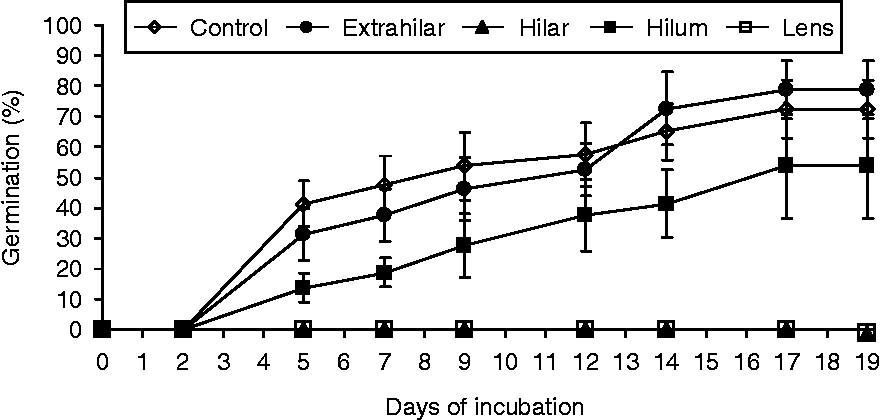
After 19 d of incubation, germination of scarified seeds exposed to boiling water, as well as the germination of scarified seeds with the blocked extrahilar region, was about 80% (Fig. 1). Germination of scarified seeds with the blocked hilar region (i.e. the hilum plus lens) and with the blocked lens was only 1.0%. However, 50% of the scarified seeds with only the hilum blocked germinated (Fig. 1). The germination levels at the last day of incubation were similar for seeds blocked in the lens and in the hilar regions, but significantly different for scarified seeds and scarified seeds blocked in the extrahilar region and hilum (P ≤ 0.05).
Germination curves for seeds of Schizolobium parahyba that were thermally scarified (control) and with extrahilar, hilum and lens regions blocked after scarification. Germination at day 19 of incubation was not significantly different for seeds with blocked lens and hilar regions, but significantly different for scarified seeds and scarified seeds with blocked extrahilar region and hilum (Tukey's test, P ≤ 0.05). Bars indicate standard deviation.

Analysis of seed coat features
In S. parahyba, the hilar region is near the wide end of the seeds and consists of the hilum, micropyle and lens, with the hilum positioned between the micropyle and lens (Fig. 2a, b).
Optical micrographs (OM) and scanning electron micrographs (SEM) of the seed coat of Schizolobium parahyba: (a) front view of the hilar region (SEM); (b) longitudinal section of the hilar region (OM); (c) extrahilar region of seed coat, showing macrosclereids (SEM); (d) front view of macrosclereids (SEM); (e) longitudinal section of peripheral tissues of hilar region showing palisade layer, subjacent sclerenchymatous tissue and shorter macrosclereids in the region of the lens; arrow points to the light line (OM); (f) longitudinal section of lens region showing palisade layer and sclerenchymatous tissue; arrow points to the light line (OM). le, lens; hi, hilum; mc, macrosclereids; mi, micropyle; sc, sclerenchymatous tissue.

The seed coat consists of one layer of thick walled, tightly packed, columnar palisade cells (macrosclereids or Malpighian cells) and sclerenchymatous tissue; osteosclereids (‘hourglass cells’) are not present (Fig. 2c–f). The seed coat is covered by a thin cuticle. In front view, the macrosclereid cells have a hexagonal shape (Fig. 2d). The palisade layer is thinner in the lens region than in the rest of the coat (Fig. 2e). It is possible to see a light line crossing the macrosclereids in the palisade layer (Fig. 2e, f). Below the sclerenchymatous tissue and above the endosperm is the tegmen, formed by a layer of crushed cells with thin walls between two cuticle layers, which reacted positively to Sudan IV (not shown). The macrosclereids and the subjacent sclerenchymatous tissue reacted negatively for lignin when exposed to iron chloride, phloruglucinol and toluidine blue. However, the macrosclereids reacted positively for cellulose when exposed to toluidine blue. The cuticle reacted positively to Sudan IV.
The upper portion of the macrosclereids, mainly the light line, showed aniline blue-induced fluorescence, indicating the presence of callose (Fig. 3a). In non-scarified seeds, the lens is a slight depression at the side of the hilum and opposite the micropyle (Fig. 3b). In thermally scarified seeds, the hilum and micropyle do not show alterations, but in the lens region a crack forms between the macrosclereids, exposing the underlying tissue (Fig. 3c).
Morpho-anatomical aspects of the seeds of Schizolobium parahyba. (a) Longitudinal section of the tegument stained with aniline blue. Arrow indicates the light line with high fluorescence and upper portion of the macrosclereíds. Asterisk indicates the sclerenchymatous tissue which did not show fluorescence. (b) Front view of hilar region of a seed (not thermally scarified). (c) Thermally scarified seed, showing cracks (arrow) between the macrosclereids and subjacent tissue of the lens. le, lens; hi, hilum; mi, micropyle.

Effect of alternating temperatures on dormancy break and germination
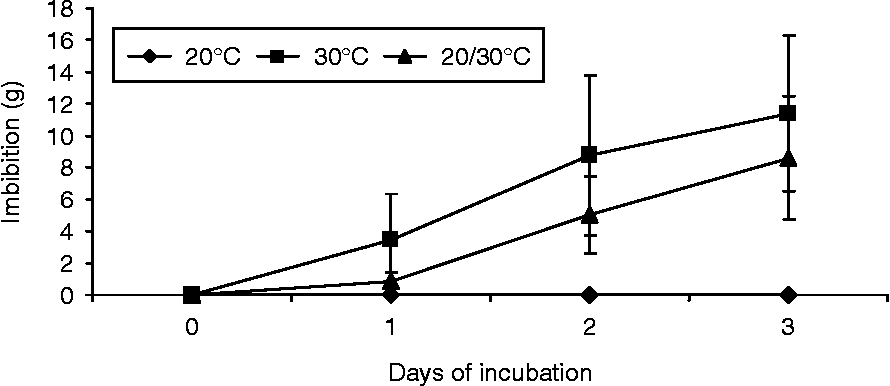
Seeds incubated at alternating temperatures of 20/30°C and 30°C absorbed about 10 g of water during 3 d of incubation, while those at 20°C did not absorb water (Fig. 4). The amount of absorbed water on the third day of incubation was similar for seeds incubated at 20/30°C and 30°C (about 10 g) but significantly different for seeds at 20°C (P ≤ 0.05).
Imbibition curves (water absorbed in grams) for intact seeds of Schizolobium parahyba incubated at 20°C, 30°C and 20/30°C. Imbibition at the third day of incubation was similar for seeds incubated at 30°C and 20/30°C, but significantly different for seeds at 20°C (Tukey's test, P ≤ 0.05). Bars indicate standard deviation.

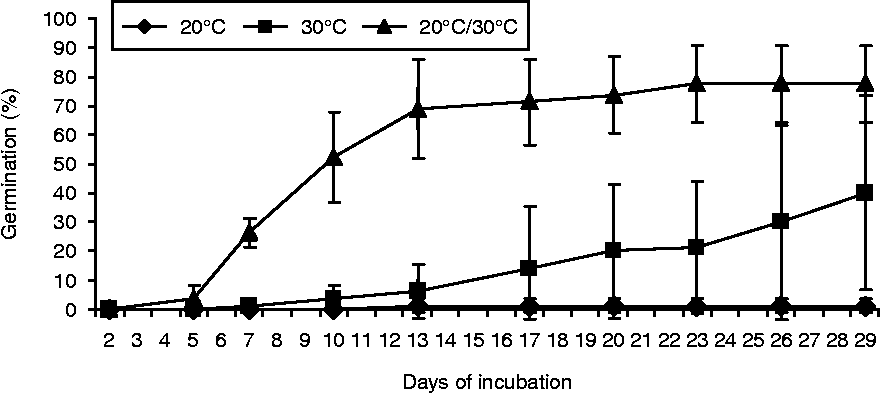
Seeds incubated at alternating temperatures of 20/30°C reached the maximum percentage of germination (about 80%) after 13 d of incubation, while those incubated at a constant temperature of 30°C reached only 7% of germination in the same period. The percentages of germination at 20/30°C and 30°C at the last day of incubation were not significantly different, but both were significantly different from germination at 20°C (P ≤ 0.05) which was less than 2% (Fig. 5). Seeds with blocked lens did not germinate.
Germination curves for intact seeds of Schizolobium parahyba incubated at 20°C, 30°C and 20/30°C. Germination on day 29 of incubation was not significantly different for seeds at 30°C and 20/30°C, but significantly different for seeds at 20°C (Tukey's test, P ≤ 0.05). Bars indicate standard deviation.

Discussion
Location of the water entrance region
In physically dormant seeds, dormancy break involves disrupting an impermeable seed (fruit) coat, thereby creating an opening for water to enter (Baskin and Baskin, Reference Baskin and Baskin2001). However, the initial site where water enters after physical dormancy is broken varies in the Fabaceae (Hu et al., Reference Hu, Wang, Wu, Nan and Baskin2008; Valtueña et al., Reference Valtueña, Ortega-Olivencia and Rodriguez-Riaño2008). The hilum and micropyle have been reported to allow water entrance into seeds after physical dormancy is broken (Hyde, Reference Hyde1954; Zeng et al., Reference Zeng, Cocks, Kailis and Kuo2005; Hu et al., Reference Hu, Wang, Wu, Nan and Baskin2008), as well as cracks in the cuticle of the seed coat (Morrison et al., Reference Morrison, McClay, Porter and Rish1998; Hu et al., Reference Hu, Wang, Wu and Baskin2009). Water entrance in the region of the lens has been reported for legume seeds by several authors (Dell, Reference Dell1980; Hanna, Reference Hanna1984; Van Staden et al., Reference Van Staden, Manning, Kelly, Stirton and Zarucchi1989; Serrato-Valenti et al., Reference Serrato-Valenti, De Vries and Cornara1995; Morrison et al., Reference Morrison, McClay, Porter and Rish1998; Baskin et al., Reference Baskin, Baskin and Li2000; Burrows et al., Reference Burrows, Virgona and Heady2009; Hu et al., Reference Hu, Wang, Wu and Baskin2009).
The seeds of S. parahyba lack a conspicuous lens, as observed by Gunn (Reference Gunn1991) for the subfamily Caesalpinioideae, and it is distinguished on the seed coat as a subtle depression close to the hilum and opposite the micropyle. Our experiments in which the hilar and extrahilar regions of thermally scarified seeds were blocked, and also the SEM images of the lens region after breaking seed dormancy with boiling water, showed that the lens is the only region involved in the absorption of water in seeds of S. parahyba. In the study where dormancy was broken by alternating temperature, the seeds that had blocked lenses did not germinate, indicating that the lens is broken by alternating temperature. However, Hu et al. (Reference Hu, Wang, Wu and Baskin2009) obtained results that indicated that the primary site of water entry, after the breaking of physical dormancy, can vary for Vigna oblongifolia and that it depended on the treatment (boiling water or sulphuric acid). For Sesbania sesban, however, Hu et al. (Reference Hu, Wang, Wu and Baskin2009) found that the treatment method used to break physical dormancy did not affect the location where the water initially entered, which was always through the lens. Unfortunately, there are no data on this subject in the literature about the genus Schizolobium.
Anatomical structure of the seed coat
Our study showed that the seed coat of S. parahiba is composed of a coat and tegmen. The coat originates from the outer integument of the ovule and the tegmen from the inner integument (Corner, Reference Corner1951). It is considered an exotestal seed because the main mechanical layer of the coat lies in the outer epidermis of the outer integument (Corner, Reference Corner1951). As described for other species of Fabaceae (Corner, Reference Corner1951), the coat of S. parahyba consists of a layer of palisade cells with thick walls, that are packed tightly together, a light line and sclerenchymatous tissue. However, the layer of osteosclereid cells (also called ‘hourglass cells’) that usually lies below the palisade layer is not present. Smith et al. (Reference Smith, Wang, Msanga and Vozzo2002) reported that ‘hourglass cells’ are not universally present in Fabaceae.
The light line lies just beneath the cuticle, as in Glycine max (Harris, Reference Harris1983; Ma et al., Reference Ma, Cholewa, Mohamed, Peterson and Jzen2004), but in S. parahyba, this line crosses the palisade layer in the middle third of the macrosclereids, as in other species of Fabaceae (Serrato-Valenti et al., Reference Serrato-Valenti, De Vries and Cornara1995; Leython and Jáuregui, Reference Leython and Jáuregui2008). The origin of the light line has been discussed by many authors, and Kelly et al. (Reference Kelly, Van Staden and Bell1992) suggested that it is an optical phenomenon generated by the juxtaposition of the inner cellulose of the palisade cells and the outer suberized caps. For Pisum sativum, Harris (Reference Harris1983) noted that the light line becomes discernable with a light microscope, at the junction of the cellulosic tips of the macrosclereids and the line of the subcuticular layer, and may represent the suberin caps. Martens et al. (Reference Martens, Jakobsen and Lyshede1995) indicated that the light line in Trifolium repens is caused by an alteration of cellulose microfibrillar orientation in palisade cell walls. Ma et al. (Reference Ma, Cholewa, Mohamed, Peterson and Jzen2004) reported that in G. max the light line is not merely an optical phenomenon caused by chemical modifications, but is a real structure formed where the secondary walls are tightly appressed to one another. Baskin and Baskin (Reference Baskin and Baskin2001) suggested that the light line is due to differences in refraction of light by the top and bottom portions of the macrosclereids, which differ in chemical composition. In S. parahyba it was possible that the light line originates at the junction of the upper portion of the macrosclereids with callose and the inner portions without callose.
The seed coat of Fabaceae contains several substances, including polysaccharides, lignin, proteins, phenolic compounds, pigments, waxes, fats and resinous matter, that protect the embryo or create a barrier to water (Bewley and Black, Reference Bewley and Black1994). In S. parahyba, the cell wall of the macrosclereids is composed of cellulose, as indicated by histochemical tests, but suberin and lignin, which have been found in the seed coats of legumes (Kelly et al., Reference Kelly, Van Staden and Bell1992), were not present. In another species of subfamily Caesalpinioideae, Cassia cathartica, Souza (Reference Souza1981) also found macrosclereids that only had walls made of cellulose. The presence of callose in the upper portion of the macrosclereid cells, and especially in the light line, in S. parahyba has also been observed in other Fabaceae species (Serrato-Valenti et al., Reference Serrato-Valenti, Cornara, Ferrando and Modenesi1993; Ma et al., Reference Ma, Cholewa, Mohamed, Peterson and Jzen2004), and its function is associated with the impermeability of the coat to water (Bhalla and Slattery, 1984; Serrato-Valenti et al., Reference Serrato-Valenti, Cornara, Ferrando and Modenesi1993).
The present study showed that in the lens region the macrosclereids were shorter than in the rest of the tegument. This has been observed in other legume species (Serrato-Valenti et al., Reference Serrato-Valenti, De Vries and Cornara1995; Baskin et al., Reference Baskin, Baskin and Li2000), and it was suggested that this site is physically the weakest part of the seed coat and thus more easily broken by treatments (Serrato-Valenti et al., Reference Serrato-Valenti, De Vries and Cornara1995; Baskin et al., Reference Baskin, Baskin and Li2000; Hu et al., Reference Hu, Wang, Wu and Baskin2009).
Effect of alternating temperatures on dormancy break and germination
Laboratory experiments showed that the physical dormancy of S. parahyba seeds was broken when the seeds were exposed to alternating temperatures of 20/30°C and a constant temperature of 30°C. Germination of the seeds also occurred at these temperature regimes. These data are consistent with previous studies, which suggest that the two factors that influence the breaking of physical dormancy of seeds are a high constant temperature and fluctuating temperature (Bewley and Black, Reference Bewley and Black1994; Argel and Paton, Reference Argel, Paton, Loch and Ferguson1999; Baskin and Baskin, Reference Baskin and Baskin2001). The alternating temperature that breaks the physical dormancy of a seed depends on the amplitude of the fluctuation (Quinlivan, Reference Quinlivan1966). Seeds of Trifolium subterraneum soften in response to temperatures that fluctuate between 30°C and 60°C each day over a period of several weeks or months, which are similar to fluctuations that occur on open soils in Mediterranean and tropical climates (Hagon, Reference Hagon1971; Quinlivan, Reference Quinlivan1971; Taylor, Reference Taylor1981). Germination of species from tropical coastal dunes increased when temperature fluctuations were greater than 20°C and lasted for more than 45 d (Moreno-Casasola et al., Reference Moreno-Casasola, Grime and Martinez1994). In Thermopsis lupinoides (Fabaceae), which grows on dunes in Japan, alternating temperatures of 25°C/35°C promoted breaking of physical dormancy (Kondo and Takahashi, Reference Kondo and Takahashi2004). In water-soaked seeds of Ipomoea lacunosa (Convolvulaceae), dormancy was broken by an alternating temperature of 35/20°C or a constant temperature of 35°C (Jayasuriya et al., Reference Jayasuriya, Baskin, Geneve, Baskin and Chien2008). The regimes of temperatures tested for S. parahyba occur in gaps in the Atlantic rainforest, the natural environment where this species grows. Thus, we suggest that temperature is probably the factor involved in breaking the physical dormancy of the seeds of this species in natural habitats, as reported for Heliocarpus donnell-smithii, a gap tree species from Mexico and Costa Rica (Vázquez-Yanes and Orozco-Segovia, Reference Vazquez-Yanes and Orozco-Segovia1982).
Acknowledgements
This study received financial support from Coordenação de Aperfeiçoamento do Ensino Superior (CAPES), Brazil.