Introduction
Livestock contribute significantly to poverty alleviation of a major section of society, especially in the developing world. Studies by Hoffmann (Reference Hoffmann2010) indicate that livestock are an important component of livelihood of resource challenged societies. CSA (2012) indicate that Ethiopia has about 52.13 million cattle and the livestock production system can be classified into three types of production systems: the lowland pastoral and agro pastoral system; the highland crop livestock production system; and a very small proportion of urban and peri-urban livestock production system. As indicated by ESPSLMMP (2010) the livestock sector contributes about 20 percent of the Gross Domestic Product, supporting the livelihood (directly or indirectly) of about 70 percent of the natiońs population and representing 11 percent of the annual foreign earnings. According to ESPSLMMP (2011), Ethiopia earned about 211.1 million USD from export of 16 877 tonnes of meat and 472 041 head of livestock, and the revenue was enhanced by 69 percent in 2011 over the previous fiscal year. The study also shows that the earnings were mostly due to the sale of live animals (70 percent), while the rest was from the sale of chilled carcasses. Among the different classes of livestock, the sale of cattle on the hoof accounted for 46 percent of the total livestock exported.
Studies by NEPAD–CAADP (2005) indicated that most of the cattle raised for export purpose are bred in the lowlands situated below 1 500 m a.s.l which covers about 60 percent of the total land of the country. These lowlands are situated in the Eastern, Southern and Western parts of the Central highlands. The report also indicates that these regions house 20 percent of the nation's cattle, 25 percent sheep and 75 percent of the goat population. The majority of the residents in these areas directly or indirectly depend on livestock or livestock products to meet their daily needs. Cattle play a multifarious role in the life of the Agrarian Society: their dung is used as manure, they are also used for most of the agriculture-related work, from ploughing to transportation of the agriculture produce to the market, with many other intermediate activities in between (Felleke and Geda, Reference Felleke and Geda2001; Little et al., Reference Little, Smith, Cellarius, Coppock and Barrett2001). As indicated by Solomon (Reference Solomon2001), Borena plateau of Southern Ethiopia is the home of the best-known cattle breed from this country. The Boran cattle are the most sought after breed for consumption within the country and for the export purpose (LMA 2001). The pastoralists usually grade their livestock using informal methods of quality estimation such as feeling the loin area or by visual estimates alone. Weighing scales are rare and they are mostly inaccurate due to lack of maintenance. Therefore under such constraints, the pastoralists are usually unable to receive a fair price of their livestock. Linear measurements provide a scientific basis to describe the biological variations between breeds and also for animals within a breed and thus can serve as a basis for measuring the performance, productivity and carcass characters (Kayastha et al., Reference Kayastha, Zaman, Goswami and Haque2011; Kugonza et al., Reference Kugonza, Nabasirye, Mpairwe, Hanotte and Okeyo2011). Studies by Gatesy and Arctander (Reference Gatesy and Arctander2000) indicated that morphological descriptions are useful tools for distinguishing livestock breeds and strains. These traits are also used to evaluate the breeding goals of livestock (Zechner et al., Reference Zechner, Zohman, Sölkner, Bodo, Habe and Marti2001). Accordingly, Mwacharo et al. (Reference Mwacharo, Okeyo, Kamande and Rege2006) indicated that the relationship between size and breed can also be fairly well estimated using several morphometrical measurements. Many of the morphometrical traits are highly correlated with the body weight (BW) of livestock and hence can serve as an important predictor for assessment of live weight of animals (Goe, Alldredge and Light, Reference Goe, Alldredge and Light2001; Mwacharo et al., Reference Mwacharo, Okeyo, Kamande and Rege2006). Skeletal measurements such as height at withers (HW) and body length (BL) indicate measurements pertaining to size of the livestock, which are better indicators of BW when compared to measurements which are related to muscle development and fat deposition, which are affected by nutrition and management (Kamalzadeh, Koops and van Bruchem, Reference Kamalzadeh, Koops and van Bruchem1998). One of the most commonly used procedures for the estimation of live-weight of cattle is by developing regression equations based on some simple linear measurements as predictors. Studies by Heinrichs, Rogers and Cooper (Reference Heinrichs, Rogers and Cooper1992) and Gilbert, Bailey and Shannon (Reference Gilbert, Bailey and Shannon1993) indicated that body measurements in livestock can serve as predictors of body weight. Msangi et al. (Reference Msangi, Bryant, Kavana, Msanga and Kizima1999), Slippers, Letty and De Villerrs (Reference Slippers, Letty and De Villerrs2000), Fouire et al. (Reference Fouire, Neser, Oliver and Van der Westhizen2002), Willeke and Dürsch (Reference Willeke and Dürsch2002) and Bozkurt (Reference Bozkurt2006) reported that emphasis has shifted from subjective methods like body condition score to objective methods such as the use of linear measurements of different body parts for the estimation of body weight. As indicated by Alderson (Reference Alderson1999), the importance of BW alone is of limited importance in the absence of associated traits of type and conformation. Studies by Gilbert and Gregory (Reference Gilbert and Gregory1952) indicate that ratios of BW/ HW can serve as an indicator of beef type in Hereford cattle. According to Alderson (Reference Alderson1999), indices can serve as useful tools in selection of breeding animals and also for assessment of cattle at maturity. They also serve as an alternative option for the assessment of BW as it incorporates measures, which are correlated with desirable conformation. Calculation of indices can also help potential livestock dealers as the traits considered in the development of the indices are associated with the production traits. As indicated by Salako (Reference Salako2006), the desirable body conformation for traits pertaining to meat production is quite complex and hence cannot be truly assessed taking into account a single linear measurement and is usually assessed using body condition score, which itself is a very subjective measurement and hence prone to errors, besides most of the subjective scores have very low heritability, and hence are rarely accurate in selection of breeding stock. Indices are objective body measurements that are relatively accurate to estimate and are relatively easy to understand. The term “type” indicates the structure of an animal besides its body form and is hence considered as ideal for understanding the purpose for which the animal has been developed. The aim of this study was to investigate morphometrical traits, assessment of live weight using step-down regression equations and calculation of structural indices values of Boran bulls aged 2, 3 and 4 years of age and reared at two locations of Southern Ethiopia.
Materials and methods
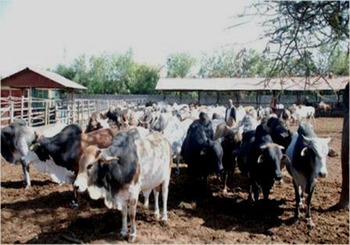
The study was conducted at Maki district of Oromia region. The feedlots are situated at a distance of 133 km south of Addis Ababa. The study was conducted on two feedlots, which varied significantly as far as the climate was concerned. The first feedlot is situated near Lake Ziway (7°59′19″N 38°50′30″E) in an area devoid of any vegetation or tree breaks; especially during the night when the temperature was low and uncomfortable for the bulls. The second feedlot is situated 25 km west of the first feedlot. The climate of the second feed lot was favourable for the livestock as there are sufficient trees to serve as wind break thereby preventing the chilly winds from the lake thus making the cattle comfortable during the night (Figure 1). The study was conducted between January and April months of 2012, which is considered as the dry season in the region. The cattle were grouped in three age groups, i.e. 2, 3 and 4 years, respectively in both the feedlots, where they were separated by their ages, the bulls were purchased by estimating their age and body weight. The age of the animals was assessed using the dentition method as suggested by Hammond, Mason and Robinson (Reference Hammond, Mason and Robinson1971).
Boran bulls reared in the second feed lot.

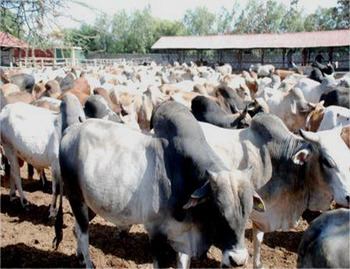
The Boran bulls (Figure 2) were purchased from their breeding in Southern Ethiopia tract 6 months prior to the commencement of the study. In the feedlot, the bulls were sprayed with Cypermethrin at 2 ml/l of water and drenched with Albendazole based on their BW and as per the manufacturer's recommendation. The cattle were provided with concentrate supplements, which comprised rice and wheat bran besides hulls from different pulses (haricot bean (Phaseolus vulgaris), lentil (Lens culinaris) and peas (Pisum sativum) cotton seed cake and common salt the roughage (consisted of teff (Eragrostis tef), wheat (Triticum sp.) and barley (Hordeum vulgare) straw) and water was provided adlib, the proximate analysis of the feed indicated that it contained 19 percent crude protein, 2.5 percent crude fat, 16.5 percent crude fibre on dry matter basis, which was in accordance with the recommendation of Hutcheson (Reference Hutcheson2006) for Boran bulls reared for fattening purpose under Ethiopian condition. The concentrate was provided twice a day and the animals were group fed according to their respective age categories.
Boran bulls of different age groups.

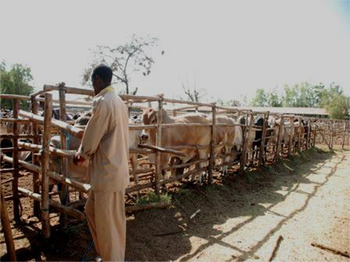
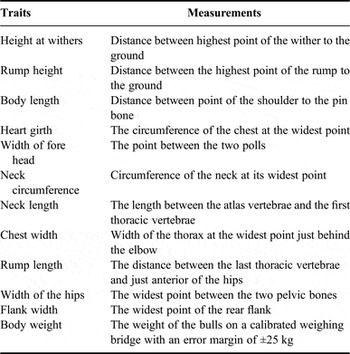
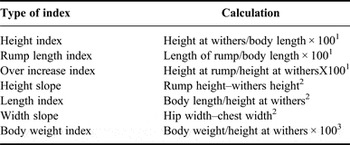
The BW and linear measurements were taken early in the morning (Figure 3) after overnight fasting to ensure minimum gut content in the bulls. The BW of the bulls was assessed using a platform balance, which was calibrated prior to being used. The linear measurements were taken by one of the authors during the course of the study and were carried out according to the methods suggested by Macjowski and Zieba (Reference Macjowski and Zieba1982) and Tolenkhomba et al. (Reference Tolenkhomba, Konsam, Shyamsana Singh, Prava, Damodor Singh, Ayub Ali and Motina2012). The traits included in the study were: HW, height at rump (RH), BL, heart girth (HG), head width (WFH), neck circumference (NC), neck length (NL), chest width (CW), rump length (RL), hip width (WH), flank width (FW) and BW of the bulls. The methodologies for the assessment of the measurements are presented in Table 1. The data were analysed statistically using SPPS V 12 for Windows (SPSS, 2003). The data were analysed using descriptive statistics, the effect of feedlots on morphometrical traits and BW of Boran cattle from various age groups were compared using one-way analysis of variance and were considered significant both at P < 0.01 and also P < 0.05. The prediction of BW taking into account different morphometrical traits was conducted using step down linear regression analysis and the accuracy was assessed using R 2 adj values. The formulae used to calculate the various body indexes are presented in Table 2, height, rump length, over increase was calculated according to the methodology suggested by Szabolcs et al. (Reference Szabolcs, Nagy, Nagy and Kiss2007), whereas the values for height slope, length; width slope were assessed according to the methods suggested by Alderson (Reference Alderson1999). The weight index was assessed according to the method suggested by Röhrer and cited by Szabolcs et al. (Reference Szabolcs, Nagy, Nagy and Kiss2007).
Restraining chute for taking the morphometric measurements.

Measurement techniques for the morphometrical traits.

Calculations for structural indices.

1Alderson (Reference Alderson1999).
2Szabolcs et al. (Reference Szabolcs, Nagy, Nagy and Kiss2007).
3Rohrer (Reference Rohrer1921).
Results and discussions
Morphometrical traits of Boran bulls aged 2 years and reared in the two feedlots
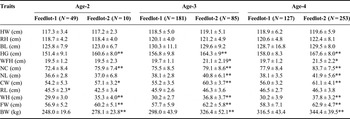
The values pertaining to the various morphometrical traits of Boran bulls aged 2 years and reared in two feed lots and of different age categories are presented in Table 3. The results from the table indicate that the average HW for the bulls aged 2 years did not vary significantly between the cattle reared in the two feedlots. The HW values as assessed in the study are lower than those reported by Alberro and Haile-Mariam (Reference Alberro and Haile-Mariam1982) for Boran cattle, Fasil (Reference Fasil2006) for Fogera cattle, Kugonza et al. (Reference Kugonza, Nabasirye, Mpairwe, Hanotte and Okeyo2011) for Ankole cattle and Mwambene et al. (Reference Mwambene, Katule, Chenyambuga and Mwakilembe2012) for Nkasi cattle. The values are comparable with those reported by Mason and Maule (Reference Mason and Maule1960) for Arado, Takele (Reference Takele2005) for Sheko cattle, Getinet et al. (Reference Getinet, Ayalew and Hegde2009) for Ogaden cattle, Fasil (Reference Fasil2006) for Gojjam Highland Zebu cattle and Nakachew (Reference Nakachew2009) for Abigar cattle. The results pertaining to the RH too did not vary significantly across the two locations. The values for the trait are comparable with the figures reported by Nakachew (Reference Nakachew2009) for Abigar cattle. The results of the study pertaining to BL also did not vary significantly across the two locations. The values for BL are comparable with those reported by Shiferaw (Reference Shiferaw2006) for Kereyu cattle and also Nakachew (Reference Nakachew2009) for Abigar cattle, Zulu (Reference Zulu2008) for Angoni and Tonga cattle and also Cyprian et al. (Reference Cyprian, Gerald Nwachi, Pano and Danbab2012) for Bunaji cattle. HG showed variations across the two locations, with higher values being recorded among the cattle reared in the second feedlot, which may be attributed to favourable climate prevailing in the area. The HG values observed are in accordance with the findings of Alberro and Haile-Mariam (Reference Alberro and Haile-Mariam1982) for Boran cattle, Fasil (Reference Fasil2006) for Fogera cattle and Gojjam Highland Zebu, Getinet, Ayalew and Hegde (Reference Getinet, Ayalew and Hegde2009) for Ogaden, Kugonza et al. (Reference Kugonza, Nabasirye, Mpairwe, Hanotte and Okeyo2011) for Ankole cattle, Mwambene et al. (Reference Mwambene, Katule, Chenyambuga and Mwakilembe2012) for Nkasi cattle. The HG values as assessed were however lower than those reported by Zulu (Reference Zulu2008) for Barotse, Tonga and Baila cattle. The WFH for the cattle reared in the two feedlots did not vary significantly; the values are similar to those reported by Szabolcs et al. (Reference Szabolcs, Nagy, Nagy and Kiss2007) for Charolais and Red Angus cattle. NC values too varied across the two feedlots, with (P < 0.01) higher values among the bulls raised in the second location, the values being similar to those reported by Phanchung and Roden (Reference Roden1996) for Siri cattle from Bhutan. The average NL indicated no significant difference among the bulls reared across the two feedlots. The results as obtained are similar to those reported by Abdelhadi and Babiker (Reference Abdelhadi and Babiker2009) for Baggara cattle but higher values for the trait were reported by Mason and Maule (Reference Mason and Maule1960) for Arado cattle, Nakachew (Reference Nakachew2009) for Abigar cattle and Aamir et al. (Reference Aamir, Babiker, Youssif and Hassan2010) for Kenena cattle. The results pertaining to CW varied (P < 0.05) among the cattle reared in the two feedlots. The results pertaining to the RL were higher (P < 0.05) among the bulls reared in the first feedlot. The RL values as recorded in the study were similar to those observed by Szabolcs et al. (Reference Szabolcs, Nagy, Nagy and Kiss2007) for Aberdeen Angus and Red Angus bulls. The results pertaining to WH, FW and BW too differed significantly (P < 0.01) between the two feedlots with higher values observed in the cattle reared in the second location. The WH values as recorded for the bulls raised in the second location are in accordance with the reports of Gilbert, Bailey and Shannon (Reference Gilbert, Bailey and Shannon1993) for Angus cattle; Suriya, Boonsaen and Innuruk (Reference Suriya, Boonsaen and Innuruk2011) for Kamphaengsaen (grass-fed) cattle. The FL values as recorded in the study are lower than the values reported by Khalafalla et al. (Reference Khalafalla, Atta, Eltahir and Mohammed2011) and Abdelhadi, Babiker and Kijora (Reference Abdelhadi, Babiker and Kijora2011) for Baggara and Zebu cattle from Sudan, the lower values for the trait may be attributed to both genetic and non-genetic factors affecting the trait. The results pertaining to the BW of the bulls reared in the second site are in close accordance with the reports of Nakachew (Reference Nakachew2009) for Abigar cattle Mwambene et al. (Reference Mwambene, Katule, Chenyambuga and Mwakilembe2012) for Sumbawanga rural cattle and also for Baggara cattle of Sudan as observed by Khalafalla et al. (Reference Khalafalla, Atta, Eltahir and Mohammed2011).
Morphometrical measurements of Boran bulls of three age groups and across two feedlots.

*P < 0.05, **P < 0.01.
HW, height at withers; RH, rump height; BL, body length; HG, heart girth; WFH, width of forehead; NC, neck circumference; NL, neck length; CW, chest width; RL, rump length; WH, width of hips; FW, flank width; BW, body weight.
The results pertaining to the morphometrical traits of Boran cattle (reared in the two feedlots) aged 3 years are also presented in Table 2. The study indicated that the HW values did not vary between the two feed lots and are lower than the values reported by Kugonza et al. (Reference Kugonza, Nabasirye, Mpairwe, Hanotte and Okeyo2011) for Ankole cattle, Mwambene et al. (Reference Mwambene, Katule, Chenyambuga and Mwakilembe2012) for Nkasi cattle, Mwambene et al. (Reference Mwambene, Katule, Chenyambuga and Mwakilembe2012) for Sumbawanga cattle Urban cattle, Mwambene et al. (Reference Mwambene, Katule, Chenyambuga and Mwakilembe2012) for Sumbawanga cattle rural, Aamir et al. (Reference Aamir, Babiker, Youssif and Hassan2010) for Kenena cattle and Abdelhadi and Babiker (Reference Abdelhadi and Babiker2009) for Baggara cattle. The values, however, being higher than those reported by Mason and Maule (Reference Mason and Maule1960) for Arado, Takele (Reference Takele2005) for Sheko cattle, Getinet et al. (2005) for Ogaden cattle, Fasil (Reference Fasil2006) for Gojjam Highland Zebu cattle, Nakachew (Reference Nakachew2009) for Abigar cattle and Kayastha et al. (Reference Kayastha, Zaman, Goswami and Haque2011) for Assam cattle. The values as assessed in the study find consonance with the assessment of Alberro and Haile-Mariam (Reference Alberro and Haile-Mariam1982) for Boran cattle and Fasil (Reference Fasil2006) for Fogera cattle. The average values of RH also did not vary significantly across the two locations; the figures are comparable with the values reported by Nakachew (Reference Nakachew2009) for Abigar cattle. However, the values are lower than those reported by Szabolcs et al. (Reference Szabolcs, Nagy, Nagy and Kiss2007) for Hungarian Simmental cattle, Hereford cattle and for Aberdeen Angus cattle. The similar trend was also observed for BL with no differences among the cattle reared in the two locations. The findings are in close agreement with the observations of Milla, Mahagoub and Bushara (Reference Milla, Mahagoub and Bushara2012) for Nilotic cattle, Mwambene et al. (Reference Mwambene, Katule, Chenyambuga and Mwakilembe2012) for Sumbawanga cattle Urban, Zulu (Reference Zulu2008) for Angoni cattle, Zulu (Reference Zulu2008) for Tonga cattle, Cyprian et al. (Reference Cyprian, Gerald Nwachi, Pano and Danbab2012) for Friesian cattle X Bunajii cattle.
However, the HG varied (P < 0.01) among the bulls reared in the two locations with higher values observed among those raised in the second location. The values as assessed for the first feed lot are in agreement with the observations of Kugonza et al. (Reference Kugonza, Nabasirye, Mpairwe, Hanotte and Okeyo2011) for Ankole cattle and Mwambene et al. (Reference Mwambene, Katule, Chenyambuga and Mwakilembe2012) for Nkasi cattle, while the results among the cattle reared the second feed lot find consonance with the observations of Alberro and Haile-Mariam (Reference Alberro and Haile-Mariam1982) for Boran cattle, Shiferaw (Reference Shiferaw2006) for Kereyu cattle, Mason and Maule (Reference Mason and Maule1960) for Arado, Milla, Mahagoub and Bushara (Reference Milla, Mahagoub and Bushara2012) for Nilotic cattle, Takele (Reference Takele2005) for Sheko cattle, Getinet et al. (2005) for Ogaden cattle, Fasil (Reference Fasil2006) for Gojjam Highland Zebu cattle and Fasil (Reference Fasil2006) for Fogera cattle. The findings indicate that the WFH too varied (P < 0.05) among the bulls reared in the two feedlots with higher values observed among the bulls reared in the second location. The findings are in close accordance with the observations of Szabolcs et al. (Reference Szabolcs, Nagy, Nagy and Kiss2007) for Hereford cattle, Aberdeen Angus cattle, Red cattle Angus cattle, Hungarian Simmental cattle, Lincoln Red cattle, Shaver cattle and Charolais cattle. However, the assessment of Gilbert, Bailey and Shannon (Reference Gilbert, Bailey and Shannon1993) for Hereford cattle and Angus cattle, Tolenkhomba et al. (Reference Tolenkhomba, Konsam, Shyamsana Singh, Prava, Damodor Singh, Ayub Ali and Motina2012) for Manipuri cattle, Szabolcs et al. (Reference Szabolcs, Nagy, Nagy and Kiss2007) for Limousin cattle, and Blonde d'Aquitaine cattle are higher than those observed among the bulls reared in first feedlot but lower than those reared in second location. The findings also indicate differences (P < 0.01) for NC among the bulls reared in the two locations with higher values observed among the cattle reared in the second location, the values as assessed in the study are lower than the observations of Phanchung and Roden (Reference Roden1996) for bulls of Siri cattle from Bhutan.
The findings also indicate (P < 0.01) differences for NL between the bulls reared in the two locations. The values being higher among the cattle reared in the second location. The observations (irrespective of the feedlots) are in accordance with the results of Mason and Maule (Reference Mason and Maule1960); Arado cattle, Abdelhadi and Babiker (Reference Abdelhadi and Babiker2009); Baggara cattle, Nakachew (Reference Nakachew2009); Abigar cattle and Aamir et al. (Reference Aamir, Babiker, Youssif and Hassan2010); Kenena cattle. Similarly CW values too varied among the cattle reared in the two locations, with higher values observed among the cattle reared in the second location the values as assessed find similarity with the reports of Getinet et al. (2005) for Ogaden cattle. The RL did not show significant differences among the cattle reared in the two feedlots; the values are similar to the results observed by Szabolcs et al. (Reference Szabolcs, Nagy, Nagy and Kiss2007) for Shaver, Charolais, Limousin and Blonde d'Aquitaine cattle breeds. While the WH too varied (P < 0.01) between the bulls reared in the two locations with higher values observed among the bulls reared in the second location, the findings are in close agreement with the results of Gilbert, Bailey and Shannon (Reference Gilbert, Bailey and Shannon1993) for Hereford and Angus cattle and also Suriya, Boonsaen and Innuruk (Reference Suriya, Boonsaen and Innuruk2011) for Kamphaengsaen (grass-fed) cattle; however, higher values for the trait were reported for dairy cattle breeds, Holstein Friesian and Brown Swiss by Ozkaya and Bozkurt (Reference Ozkaya and Bozkurt2009).
The results pertaining to the average values of FW too find differences among the cattle reared in the two feed lots with higher value being observed among those being reared in the second feedlot. The values of this study being lower than those reported by Khalafalla et al. (Reference Khalafalla, Atta, Eltahir and Mohammed2011) for Sudan Baggara and also by Abdelhadi, Babiker and Kijora (Reference Abdelhadi, Babiker and Kijora2011) for Zebu cattle from Sudan. The results pertaining to the average BW indicate that it varied (P < 0.01) among the bulls reared in the two locations, the values being higher among the bulls raised in the second feedlot. The values as observed among the bulls reared in the first location find similarity with the findings of Shiferaw (Reference Shiferaw2006) for Kereyu, Milla, Mahagoub and Bushara (Reference Milla, Mahagoub and Bushara2012) for Nilotic cattle, Mwambene et al. (Reference Mwambene, Katule, Chenyambuga and Mwakilembe2012) for Sumbawanga cattle reared in the urban areas. While BW of the cattle reared in the second location are similar to those reported by Phanchung and Roden (Reference Roden1996) for bulls of Siri breed from Bhutan.
The results pertaining to morphometrical traits of bulls of Boran breed and aged 4 years and reared in the two feed lots are also presented in Table 3. The results indicate that the HW were similar among the bulls reared in the two locations, the figures are similar to the observations of Alberro and Haile-Mariam (Reference Alberro and Haile-Mariam1982) for Boran cattle, Shiferaw (Reference Shiferaw2006) for Kereyu cattle, Mason and Maule (Reference Mason and Maule1960) for Arado cattle, Getinet, Ayalew and Hegde (Reference Getinet, Ayalew and Hegde2009) for Ogaden cattl and Fasil (Reference Fasil2006) for Fogera cattle. The HW values are however higher than those reported by Fasil (Reference Fasil2006) for Gojjam Highland Zebu, Kayastha et al. (Reference Kayastha, Zaman, Goswami and Haque2011) for Assam cattle and also Suriya, Boonsaen and Innuruk (Reference Suriya, Boonsaen and Innuruk2011) for Kamphaengsaen (grass-fed) cattle. The values for HW as assessed in this study are however lower than the figures reported by Suriya, Boonsaen and Innuruk (Reference Suriya, Boonsaen and Innuruk2011) for Kamphaengsaen (feedlot-fed) cattle, Abdulmojeed et al. (Reference Abdulmojeed, Kingsley Omogiade, Hadiza Salihu, Matthew and Samuel2010) for Sokoto Gudali cattle, Cyprian et al. (Reference Cyprian, Gerald Nwachi, Pano and Danbab2012) for Bunaji and also Angoni, Baila, Barotse and Tonga cattle by Zulu (Reference Zulu2008).
The results of the study also indicated that the values of HR also did not vary among the bulls reared in the two locations, the findings are in consonance with the observations of Abdulmojeed et al. (Reference Abdulmojeed, Kingsley Omogiade, Hadiza Salihu, Matthew and Samuel2010) for Sokoto Gudali cattle, Shiferaw (Reference Shiferaw2006) for Kereyu cattle and Nakachew (Reference Nakachew2009) for Abigar cattle; higher values for the trait were reported by Szabolcs et al. (Reference Szabolcs, Nagy, Nagy and Kiss2007) for Hereford, Aberdeen Angus, Red Angus, Charolais and Limousin breeds. The study shows that BL too was non-significant between locations, the values are in close accordance with the findings of Zulu (Reference Zulu2008) for Baila, Tonga and Angoni cattle, the values are however higher than those reported by Tolenkhomba et al. (Reference Tolenkhomba, Konsam, Shyamsana Singh, Prava, Damodor Singh, Ayub Ali and Motina2012) for Manipuri cattle, Rajendran et al. (Reference Rajendran, Raja, Thiruvenkadan, Mahalinga Nainar and Thangaraju2008) for Umblachery cattle, and are lower than those reported by Abdulmojeed et al. (Reference Abdulmojeed, Kingsley Omogiade, Hadiza Salihu, Matthew and Samuel2010) for Sokoto Gudali and Bunaji cattle. The HG values indicated differences (P < 0.01) between the bulls reared in the two locations. The HG values of the bulls raised in the first feedlot find similarity with the observations of Fasil (Reference Fasil2006) for Fogera cattle, Alberro and Haile-Mariam (Reference Alberro and Haile-Mariam1982) for Boran cattle, Aamir et al. (Reference Aamir, Babiker, Youssif and Hassan2010) for Kenena cattle and Mwambene et al. (Reference Mwambene, Katule, Chenyambuga and Mwakilembe2012) for Sumbawanga Urban cattle, whereas those raised in the second location find similarity with the observations of Mwambene et al. (Reference Mwambene, Katule, Chenyambuga and Mwakilembe2012) for Nkasi cattle, Zulu (Reference Zulu2008) for Angoni, Baila and Tonga cattle. The WFH figures indicate the difference (P < 0.05) between the bulls reared in the two locations the results, for those raised in the first location being similar to those reported by Szabolcs et al. (Reference Szabolcs, Nagy, Nagy and Kiss2007) for Red Angus, Aberdeen Angus and Charolais bulls, whereas those reared in the second feedlot are similar to those reported by Szabolcs et al. (Reference Szabolcs, Nagy, Nagy and Kiss2007) for Shaver, Hungarian Simmental and Hereford cattle.
The NC too varied between the bulls reared in the two feedlots, the values being higher among the bulls raised in the second location similar values were reported by Phanchung and Roden (Reference Roden1996) for bulls of Siri breed. The results of the study pertaining to the NL too indicate that there is variation for the trait among the bulls reared in the two feedlots, with higher values among the bulls reared in the second feedlot, the values as observed among the bulls from the first feedlot are in close accordance with the observation of Abdelhadi and Babiker (Reference Abdelhadi and Babiker2009) for Baggara cattle, whereas those from the second feedlot are similar to those reported by Nakachew (Reference Nakachew2009) and Aamir et al. (Reference Aamir, Babiker, Youssif and Hassan2010) for Abigar and Kenena cattle, respectively. The NL values as assessed by Mason and Maule (Reference Mason and Maule1960), Takele (Reference Takele2005) and Tolenkhomba et al. (Reference Tolenkhomba, Konsam, Shyamsana Singh, Prava, Damodor Singh, Ayub Ali and Motina2012) are lower than those assessed for the bulls reared in the first feedlot, while higher values for the trait have also been reported by Shiferaw (Reference Shiferaw2006) for Kereyu cattle. The CW too showed difference (P < 0.01) among the bulls reared in the two feedlots with higher value observed among the cattle reared in the second feedlot, the results as assessed for the bulls maintained in the first feedlot is in agreement with the results of Getinet et al. (2005) for Ogaden bulls. The differences may be attributed to differences in muscling among the bulls reared in the two feedlots with lower muscling among the bulls reared in the first feedlot. The effect of several non-genetic factors including the temperature prevailing in the region, which may influence the muscling as a part of the ration is utilized in maintenance of the body temperature, the observations are in accordance with the reports of Young Manzi et al. (Reference Manzi, Junga, Ebong and Mosi2012). The results as assessed for RL indicated no significant differences due to two feedlots.
The WH too indicated differences among the two feedlots with higher (P < 0.01) values observed among the bulls reared in the second feedlot. The WH for those reared in the first location are similar to those reported by Gilbert, Bailey and Shannon (Reference Gilbert, Bailey and Shannon1993) for Angus and Hereford bulls, while those reared in the second feedlot are in consonance with the observations of Suriya, Boonsaen and Innuruk (Reference Suriya, Boonsaen and Innuruk2011) for Kamphaengsaen (grass-fed) bulls, while the value was lower than those of Kamphaengsaen bulls reared on feedlot. The study also indicates that the FW of the bulls reared in the two feedlots too varies significantly, with lower values observed among the bulls reared in the second feedlot, the findings are lower than those reported by Khalafalla et al. (Reference Khalafalla, Atta, Eltahir and Mohammed2011), and Abdelhadi, Babiker and Kijora (Reference Abdelhadi, Babiker and Kijora2011).
The BW of the bulls indicate that those reared in the second feedlot had higher (P < 0.01) values for the trait, those reared in the first feedlot was higher than those reported by Shiferaw (Reference Shiferaw2006), Abdelhadi and Babiker (Reference Abdelhadi and Babiker2009), Khalafalla et al. (Reference Khalafalla, Atta, Eltahir and Mohammed2011), Milla, Mahagoub and Bushara (Reference Milla, Mahagoub and Bushara2012) and Nakachew (Reference Nakachew2009). The results of a study by Mwambene et al. (Reference Mwambene, Katule, Chenyambuga and Mwakilembe2012) indicated that the BW of Sumbawanga cattle reared in the rural and urban areas was lower than those observed for the bulls reared in the first feedlot, whereas the BW of Nkasi cattle was higher than even the cattle reared in the second feedlot.
Effect of non-genetic factors influencing the morphometrical traits and Body weight
The term “adaptability” refers to both genetic and physiological traits associated with an animal's response to both external and internal stimuli (Hafez, Reference Hafez and Hafez1968). According to Hafez (Reference Hafez and Hafez1968) the term physiological adaptation refers to the capacity of an individual to adjust to the external environment. All animals are genetically adapted to the environment where they have evolved (Pianka, Reference Pianka2000), genetic adaptation is the set of heritable traits that favour the survival of the population in a particular environment. This is all the more true for those animals, which are raised on natural grazing as they are subjected to several stress factors when compared to those raised in the farm premises.
The present study indicated that the skeletal traits (HW, RL, BL and RH) did not vary significantly between feedlots for a particular age category, which may be because skeletal traits are highly heritable and hence are least affected by non-genetic factors the observations are in accordance with the findings of Mwambene et al. (Reference Mwambene, Katule, Chenyambuga and Mwakilembe2012) and Yunusa, Salako and Oladejo (Reference Yunusa, Salako and Oladejo2013). However, the other non-skeletal traits varied significantly across feedlots for a particular age category. The differences among the bulls due to feedlots are observed in the study may be attributed to the fact that the increase or decrease in live weight is a gross expression of many factors viz. organs, viscera, gut fill and also tissue mass, which are influenced by both genetic and non-genetic factors besides sex of the animal. As reported by Oladimeji et al. (Reference Oladimeji, Osinowo, Alawa and Hambolu1996), the climate of a region affects feed and water intake and also can influence the utilization of components within the feed consumed. It also influences the heat produced by the animal and thereby the net available energy and ultimately the productivity and phenotypic expression of the growing livestock.
The results also indicated that among the cattle aged 2 years the values for HG, NC, CW, BD, WH, FW and BW were significantly higher in cattle raised in the second location, while RL was significantly higher among cattle reared in the first feedlot. The study also indicated that traits such as HG, WFH, NC, NL, CW, BD and BW values were higher among bulls of 3 and 4 years of age raised in feedlot 2, whereas WH and FW for both the categories were higher among the cattle raised in feedlot 1. It was also observed that the reared in the second feedlot were better managed. This may be attributed to adaptability of the cattle to the respective location; the findings pertaining to the effect of adaptability on variation in morpohometrical traits have also been reported by Hafez (Reference Hafez and Hafez1968) and Bonsma (Reference Bonsma1980). The effect of climate prevailing in the first location may have influenced the physiological factors; hence, the apparently cold climate influenced the muscle development thus affecting the BW but did not influence the skeletal development of the bulls, the findings being in consonance with the observations of Otuma (Reference Otuma2004). The findings are in consonance with the observations of several earlier studies in the tropics (Willamson and Pyne, Reference Willamson and Pyne1978; Pagot, Reference Pagot1992; McDonald et al., Reference Mc Donald, Edwards, Greenhalgh and Morgan2002; Brito et al., Reference Brito, Silva, Barbosa and Kastilec2004). The muscle development of the cattle is significantly affected by several non-genetic factors. This may be the reason why there were differences among bulls (within an age group) reared in the two feedlots; the observations are in accordance with the findings of Rothouge (Reference Rothouge2000). The difference in muscle development may also be attributed to the nutritional quality of the feed ingredients and the way they were cultivated, harvested and post-harvest methods of processing and storing, the observations are in accordance with the findings of Hunters and Buck (Reference Hunters, Buck, Jarrige and Beranger1992) and Bosman (Reference Bosman, Scholtz, Berg and Bosman1999).
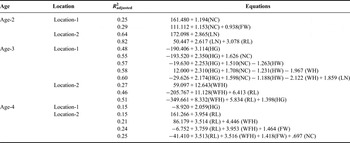
The results of step-down regression equation as presented in Table 4 indicate that NC was considered as the best predictor among the cattle aged 2 years and reared in the first feedlot, whereas the assessment of BW was best assessed using NL values for the bulls reared in second feedlot, this was followed by considering the NL and RL values together. The assessment of BW of the bulls aged 3 years indicates that it was best assessed using HG values which was followed by taking both HG and NC values together, whereas the BW of the bulls reared in the second location were best assessed taking into account the values of WFL and RL together.
Step-down regression equations for assessment of body weight using morphometric measurements of Boran bulls of different age groups and reared in two different feedlots.

The results of the regression studies also indicate that BW for the bulls aged 4 years and reared in the first feedlot was best assessed using their HG values, while those reared in the second feedlot was estimated using RL, WFH and FW values taken together, the importance of RL as an indicator of BW is in accordance with the findings of Alderson (Reference Alderson1999). The importance of NC, NL and WFH for assessment of BW of beef cattle has also been reported by Hammond, Mason and Robinson (Reference Hammond, Mason and Robinson1971). The importance of HG as a reliable tool to assess BW of cattle has also been reported (Branton and Salisbury, Reference Branton and Salisbury1946; Mullick, Reference Mullick1950; El Khidir, Reference El Khidir1980; Khogali, Reference Khogali1999; Bagui and Valdez., Reference Bagui and Valdez2007; Abdelhadi and Babiker Reference Abdelhadi and Babiker2009). According to Afolayan et al., (Reference Afolayan, Adeyinka and Lakpini2006), the morphometrical traits are moderately heritable and have a strong relationship with the growth traits of livestock; however, the relationship vary from breed and also are influenced by several factors such as age, type size, condition and degree of fattening of the animals (Heinrichs, et al., Reference Heinrichs, Rogers and Cooper1992; Yanar et al., Reference Yanar, Tüzemen, Özhan, Aydın and Uğur1995; Ozkaya and Bozkurt, Reference Ozkaya and Bozkurt2009).
Structural indices
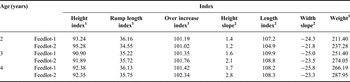
The results pertaining to the structural indices of Boran bulls of different age groups and reared in the two feed lots are presented in Table 5. The results indicate that the height index values for the bulls aged 2 years varied across the two feedlots with higher values being observed among the bulls reared in the second location. While the height index remained more or less similar among the bulls aged 3 and 4 years and reared in both the feed lots. The observations are in accordance with the findings of Shackelford, Koohmaraie and Wheeler (Reference Shackelford, Koohmaraie and Wheeler1995) who also reported that the skeletal maturity score increased till 2 years of age in cattle and thereafter remained more or less constant. The study also indicated that the RL index did not vary between the bulls across both age categories and feedlots. This can be attributed to the character of the breed, the RL index values as obtained in the study are higher than those reported by Szabolcs et al. (Reference Szabolcs, Nagy, Nagy and Kiss2007) for different taurine breeds of beef cattle. The results pertaining to the over increase index too did not vary between the bulls reared in the two feed lots and also across the ages, the study indicated that the frame of the Boran bulls sloped towards the anterior part of the body, the RH being higher than the height at withers, the observations are in accordance with the findings of Szabolcs et al. (Reference Szabolcs, Nagy, Nagy and Kiss2007). The results pertaining to the height slope as assessed in the study too collaborated with the findings of the over increase index. The length index indicates that the Boran bulls are proportionately longer bodied in comparison to their height. The width slope index values as obtained in the study indicate that the Boran bulls are narrower at the hind quarters. The weight index values indicate that the values were lower (across all age groups) among the bulls reared in the first feedlot, which may be attributed to the fact that the place was colder than the second feedlot and a part of the energy from the ration was utilized for body maintenance rather than for BW development. The similar results were also reported by Young (Reference Young1981) who reported that under the similar levels of nutrition the cattle subjected to cold stress have poor productivity than those reared under comfortable environment.
Morphometrical indices of Boran bulls of different age groups and across the two feedlots.

1Szabolcs et al. (Reference Szabolcs, Nagy, Nagy and Kiss2007).
2Alderson (Reference Alderson1999).
3According to Röhrer as cited by Szabolcs et al. (Reference Szabolcs, Nagy, Nagy and Kiss2007).
Conclusion
Hence, it can be concluded from the study that Boran bulls if properly managed can be reared profitably for beef purpose. Linear measurements can be effectively used to assess BW of Boran bulls at all ages. Hence, morphometrical measurements such as NL, NC, RL and WFH of Boran bulls can serve as indicators of selection of sires for higher BW. The results of the indices indicate that the Boran bulls have a higher CW when compared to the hips, which may be a breed character. It can be concluded that Boran bulls can be selected for BW using the regression equations. However, similar studies should be conducted using a large population to further confirm the results.
Acknowledgements
The authors acknowledge the assistance received from Federal A.T.V.E.T co-coordinator, for the financial support. The Dean and staff members of Dilla A.T.V.E.T College, Head and staff members of School of Animal and Range Sciences, Hawassa University.