

To me, public accountability is a moral corollary of central bank independence. In a democratic society, the central bank’s freedom to act implies an obligation to explain itself to the public…. While central banks are not in the public relations business, public education ought to be part of their brief.
—Alan Blinder, Princeton University professor and former vice chairman, Federal Reserve Board. Reference Blinder1
We made clear as a committee that we were going to look at the distributional impact of the budget in unprecedented detail. As a result, George Osborne responded by giving a lot more detail not only in the budget but also when he came before us. And there were some pretty vigorous and detailed exchanges about the distributional impact of the budget in that hearing. I think everybody gained from that experience. It certainly enabled a wider public to find out exactly what was going on in the budget and the Government was forced to explain its actions.
—Andrew Tyrie, member of Parliament and chairman, Treasury Select Committee, commenting on Chancellor George Osborne’s first budget. 2
Public officials in modern democracies are conscious that their decisions and actions should be and are subject to scrutiny in the public domain. In the United Kingdom, that scrutiny is a statutory requirement and is conducted in formal parliamentary committee hearings. In economic policy, two very different sets of actors are routinely scrutinized by select committees: (1) officials of the Bank of England — who are not elected but appointed — are held accountable by committees in Parliament for their decisions in pursuit of their objectives toward monetary policy and financial stability; and (2) elected ministers from the U.K. Treasury are held accountable for their objectives toward fiscal policy by these same parliamentary committees. The two quotes at the beginning of this article — the first relating to monetary policy oversight and the second relating to fiscal policy oversight — highlight what might be considered the key priority for public accountability, namely, the obligation to provide explanations for objectives held and decisions taken. In short, legislative hearings entail parliamentarians probing both central bankers and Treasury ministers; reasoned argument is therefore central to the purpose and focus of the hearings — that is, they are intended as a deliberative forum.
To be clear, “accountability” refers here to the requirement that policymakers are held to account for their decisions; they are obliged to explain and justify their decisions, ex post facto. This use of accountability presupposes a reciprocal dialogue and, crucially, necessitates a judgment on the effectiveness and persuasiveness of the policymaker who is being held to account. Reference Bovens3 Thus, the policymakers face questions and the parliamentary committees render judgments.
Notably, the concern here is with the explanations and justifications aspect of accountability, and as such, the focus is on the deliberative component of accountability rather than the implications or consequences of any judgments (e.g., sanctions, penalties, or other consequences of judgments are not explored in this project). Moreover, the “judgments” of parliamentary committees are not in the form of votes (at least in respect to oversight hearings) but rather are ongoing and cumulative assessments of ministers and experts. In this way, both the deliberations and the judgments are dynamic and inherently interactional.
Although deliberation is at the heart of decision making within public policy, its contribution remains inherently hard to measure and assess within a systematic framework. One approach to studying deliberation empirically is to apply textual analysis to the verbatim transcripts from committee meetings. In studying American monetary policy decision making, this methodology has proved valuable for gaining insights into both the policy meetings of the Federal Open Market Committee and the conduct of oversight by congressional committees. Reference Schonhardt-Bailey4 In a similar fashion for the United Kingdom, transcripts of both the Treasury Select Committee and the House of Lords Economic Affairs Committee hearings on monetary policy, financial stability, and fiscal policy were analyzed over the period from 2010 to 2015 (i.e., the previous Conservative-Liberal Democrat government). Reference Schonhardt-Bailey5 The 2010–15 Parliament is especially important for select committee activity, given the much greater prominence of these committees following the key reforms of 2010. Those reforms, among other things, required the election of committee members and chairs, thereby stripping the power of the party whips to appoint these members, lending the committees greater autonomy in holding the government to account, 6 and even (more rarely) triggering resignations by top officials (most recently, the resignation of a newly appointed Bank of England deputy governor Reference Chan7 ).
The findings from textual analysis are instructive as to the depth and breadth of arguments used by policymakers in their defense of policy actions. In particular, this analysis finds that deliberation in fiscal policy hearings contrasts sharply with deliberation in monetary policy and financial stability hearings; moreover, the deliberation conducted by members of Parliament (MPs) in the House of Commons committee contrasts systematically with that conducted by peers in the Lords committee. The context for these differences in content will be described further later, but the point here is that while textual analysis is effective in empirically measuring the deliberative content, it provides no information as to the delivery of these arguments within a deliberative setting. In short, the written record provides us with the semantic content of deliberation but not the underlying interpersonal dynamic of the committee hearing. Measuring nonverbal behavior promises a means to better gauge both the emotive tone of the arguments and the nature of the intentions of the witnesses appearing before each committee — witnesses whose credibility and intentions with respect to public policy are being judged by parliamentarians. It is this interactional dynamic that this article seeks to assess.
To be sure, the study of nonverbal communication in political contexts is extensive. For example, televised debates of national leaders are frequently used to examine the effects of nonverbal communication on political attitudes and responses. Reference Maurer and Reinemann8,Reference Bucy, Gong and Browning9,Reference Gong and Bucy10 While the effects of visual cues by political leaders are noted in political election campaigns, Reference Knapp and Hall11,Reference Bucy and Grabe12,Reference Bucy and Grabe13,Reference Stewart, Bucy and Mehu14 to date little attention has been paid to the role of nonverbal communication in legislative committee hearings.
Methodologically, the goal here is to bring research from interpersonal communication studies, political psychology, and political ethology (behavior) into the study of committee deliberation and to show that nonverbal communication can play an important role in government accountability. Indeed, there are strong biological and cognitive reasons why information gleaned from nonverbal means should be evaluated on par with that from verbal communication. To name but a few, the human brain is both more specialized and faster in processing visual information than it is in processing written/verbal information, and cognition is easier for the former than for the latter. Reference Grabe and Bucy15 Verbal language is also a relatively recent phenomenon in human history (in written form, “just 5,200 years”) relative to the millions of years of history of visual perception. In short, the evolutionary development of the brain suggests that its adaptive ability to absorb visual information is far more advanced (in evolutionary terms) than for written and spoken communication. 16 Elsewhere, communication scholars have long argued that verbal and nonverbal behavior work together in the process of communication. 17 Empirical investigations into the quality of deliberation in public policy accountability that focus solely on verbal exchanges thus risk missing the role of nonverbal behavior in shaping such fundamental features as the credibility and trustworthiness of witnesses being held to account for their policy decisions. More broadly, these investigations risk studying just a portion of the actual messages that are being conveyed.
Moreover, nonverbal messages may influence — either consciously or not — the attitudes and behaviors of select committee members, particularly in the form of persuasion. As Bucy notes, nonverbal behavior “may prime later judgments about political viability and shape the criteria by which [in this paper, witnesses] are evaluated.” Reference Bucy, Döveling, von Scheve and Konijn18 In legislative committee settings, where verbal deliberation is the focus, nonverbal communication may be pivotal in the acceptance or rejection of arguments proffered by policymakers. This study offers an initial assessment of the role of nonverbal cues in parliamentary committee oversight hearings on economic policy. Viewed from the traditional Lowi policy typology, Reference Lowi19,Reference Lowi20 in which political relationships and conflicts are shaped by people’s expectations of policy outputs, one might expect to find more ideological/partisan conflicts in fiscal policy hearings than in either monetary policy or financial stability hearings, as the former aligns with clear partisan cleavages, whereas the last two policies are less overtly partisan in orientation. Moreover, a pertinent feature of the U.K. parliamentary system is that in fiscal policy hearings, backbench parliamentarians (the legislature) hold frontbench parliamentarians (the executive) to account, which invariably generates more partisan tension than in hearings between parliamentarians and unelected (and ostensibly nonpartisan) experts such as central bankers. Hence, while one might expect the argumentative content of fiscal policy discussions to be more ideological and partisan than for monetary policy or financial stability, neither Lowi nor his followers explored how perceptions and judgments of this content might be influenced by the delivery of this content, and so this aspect of the policy divide is as yet unexplored.
The significance of nonverbal communication in parliamentary hearings
Broadly speaking, persuasion may be the product of (1) the content of the argument (e.g., its logic, its evidence, whether it difficult or easy to understand Reference Cobb and Kuklinski21 ); (2) the way in which it is structured or framed Reference Druckman22,Reference Druckman23 ; or possibly (3) the way in which it is delivered. It is in the delivery of an argument that nonverbal cues become relevant. While persuasion is not measured directly in this article, I do examine the nonverbal context (e.g., combative versus relaxed) in light of the potential for persuasion to occur — that is, it is worth considering the extent to which nonverbal behavior may facilitate the persuasiveness of an argument or a committee witness more generally, as well as how this behavior may affect the deliberative process.
Within the broader literature on deliberation, the emotive aspects of nonverbal communication are typically ignored in favor of the more rational, more deliberative aspects of communication. And yet, as Kahneman famously noted, psychologists have long noted two modes of thinking, one that is instinctual and “operates automatically and quickly, with little or no effort and no sense of voluntary control,” and one that is methodical and deliberative, thereby taking time, mental effort, and concentration. Reference Kahneman24 By focusing on nonverbal communication, we are allowing for the influence of “fast” thinking and behavior on our “slow” decision-making processes — particularly in the form of persuasion. For instance, as a component of nonverbal communication, rapid appearance-based assessments of candidates (linked to competence and dominance) are shown to be a strong predictor of electoral success. Reference Olivola and Todorov25 Indeed, if we interpret nonverbal communication as a form of “fast” thinking and behavior, the visual stimuli inherent in this form of communication may well outweigh the slower, rational, and verbal forms of communication. In reviewing both the evolutionary and biological bases of the visual processing of information, Grabe and Bucy note that “[c]ontrary to the preferences of political theorists for a rationally engaged public that relies on reason and deliberation to make informed decisions, visual experience remains the most dominant mode of learning.” 26
Beyond affecting the persuasiveness of speakers and their arguments, there are other reasons to expect nonverbal communication to be a fruitful avenue of research. One reason is that whereas speech is deliberate and sometimes scripted, nonverbal communication is far less conscious: “People are formally trained in their verbal behavior in the schools. Nonverbal communication is less obvious, as in subtle facial expressions and barely perceptible changes in voice tone, and people are not typically formally trained in their nonverbal communication.” Reference Matsumoto, Frank, Hwang, Matsumoto, Frank and Hwang27 Admittedly, politicians and officials often undergo some media training before giving evidence in parliamentary hearings (as well as for other official engagements), and most are practiced public communicators. Hence, we might expect their nonverbal communication (as well as their verbal communication) to be more controlled. It is nonetheless unlikely that such training entirely negates the tendencies of these individuals to allow their own innate mannerisms and emotions to find expression. Consequently, even subtle facial expressions, gestures, and other signals such as voice may provide important insights into not only the intentions of committee members but also the competence, trustworthiness, and credibility of the witnesses who are being held to account.
Interpreting nonverbal communication
Emotions versus signals
The extent to which nonverbal behavior “signals” the strategic intentions of the sender, however, is disputed, particularly in the literature on facial expressions. On the one hand, such behavior might serve as a visual manifestation of an individual’s emotions — that is, a spillover or leakage of some discernible internal emotion(s). Reference Izard, Russell and Fernández-Dols28 Core emotions are said to be “associated with unique physiological signatures in both the central and autonomic nervous systems,” and they are, moreover, “expressed universally in all humans via facial expressions regardless of race, culture, sex, ethnicity, or national origin.” Reference Matsumoto, Hwang, Matsumoto, Frank and Hwang29 Seven emotions — anger, disgust, fear, joy, sadness, surprise, and contempt — are each said to produce unique and identifiable facial expressions. Reference Ekman30 This causal link between the face and internal emotions, however, has been challenged on a number of fronts, including the categorization of complex emotions into single facial expressions and the tendency to overlook context.
In contrast to the emotions view of faces, a second interpretation is that facial expressions are employed as social devices to manage interpersonal and intragroup encounters. This approach stems in part from animal communication, where animals “signal” a behavioral intent — such as to attack or to appease — as a means to negotiate conflict and cooperation with other animals. Reference Rendall, Owren and Ryan31,Reference Yik and Russell32 This behavioral ecology approach maintains that both intention and context are essential to the interpretation of facial expressions. Reference Fridlund33 For example, an angry face conveys a readiness to attack, while a contempt face is a way to express superiority. 34 And yet, some facial expressions, such as smiling, may in fact convey a combination of emotions — for example, a genuine (“felt”) smile may signify a willingness to befriend or to play, but a feigned (“false”) smile may signify readiness to acquiesce or appease, or a phony smile may mask some underlying negative emotion (such as anger). 35 Contempt can also be conveyed in a “controlled half smile,” by which an individual signals tolerance but not acceptance of some other group member. 36
The social and political significance of facial expressions may thus be categorized as intent to attack or threaten (anger face), reassurance or willingness to socially bond (happiness), appeasement (sadness), or intention to flee/submit (fear), and each has been identified in the facial expressions of televised politicians. Reference McHugo, Lanzetta, Sullivan and Englis37,38,39 The sociopolitical significance of this typology becomes clear when it is subsumed into two broader typologies of social interaction or behavioral types — agonic and hedonic. Reference Masters and Sullivan40 In agonic interactions, the actors are in direct competition for power, and so in an effort to maintain social order, one might submit to or appease the threatening actor. In hedonic encounters, actors are more relaxed (even playful) in pursuit of social bonding and alliance building or to reassure/reinforce social status. Facial expressions (and other nonverbal behavior, such as posture Reference Bull41 ) are thus indicative of dominance hierarchy 42,43 and can serve to signal either cooperative or noncooperative intent. For instance, in a one-shot anonymous prisoner’s dilemma game, contempt expressions have been found to predict defection by the sender, while genuine smiles signify cooperative intention. Reference Reed, Zeglen and Schmidt44 An important caveat to the behavioral ecology approach is that nonverbal messages conveyed by a communicator do not elicit identical emotional responses in all receivers, as the effect of the nonverbal signal is shaped by prior attitudes and the context in which the behavior occurs. 45 Moreover, some people are simply better at “decoding” the signals of nonverbal behavior, as studies of gestures have shown. Reference Beattie46
The emotions and behavioral ecology interpretations are sometimes depicted as if they are in conflict, with disagreement on facial expressions including “their clarity, specificity, extent of their innateness and universality, and whether they relate to emotions, social motives, behavioral intentions, or to all three.” 47 Nonetheless, both rely on the evolutionary literature (e.g., Darwin Reference Darwin48 ) and, in the end, converge on the assessment that facial expressions function to communicate information. 49
Facial expressions, vocal cues, and gestures in parliamentary oversight
Once investigation turns to the empirics of nonverbal communication, the analytical and methodological framework encounters significant hurdles, not least of which is the appropriateness of the data to be examined. One might, for example, begin quite broadly by measuring the static visuals of the setting, such as the committee room, seating arrangement, lighting, temperature, and so on, as some communications scholars have done. 50 For simplicity, here the focus is on three primary forms of dynamic nonverbal communication: facial expressions, vocal cues, and body movement/gestures. These key aspects of communication are shown to be highly effective in gauging behavior by political actors whose appeals to voters are being televised, 51 although the largest attention in the literature has been given to facial expressions.
The political significance of facial expressions is aptly summarized by Stewart and colleagues: “The face has long been appreciated as a focal point of attention by those competing for positions of power and then for maintaining influence once power has been attained. In large part, this is caused by the ability leaders have in communicating their emotional state and behavioural intent nonverbally to followers” (italics added). 52 The previous section focused predominantly on facial expressions for the simple reason that competition for power (and jockeying for political position) is at least a subtext of parliamentary committees that seek to hold government to account. While there is no overt competition concerning policy per se, oversight contains an element of competition over the influence and direction of policy decisions. In the case of unelected central bankers, there is a recognition that independence of the central bank is not absolute — typically governments set the goals, while central banks retain discretion over how to pursue these objectives (i.e., independence to choose the appropriate instrument[s]). 53 Moreover, it is by parliamentary statute that the Bank of England’s Monetary Policy Committee (MPC) and Financial Policy Committee (FPC) exist, and, in theory, Parliament could abolish these independent committees.
Thus, when central bank experts appear before parliamentary committees, they are invariably cognizant of their politically dependent existence. In contrast, the situation is more overtly competitive in fiscal policy hearings. The primary witness in these proceedings is the chancellor of the exchequer, who — like members of the Treasury Committee — is himself a member of Parliament. There is no statutory independence given to either the Treasury or the chancellor. Moreover, as noted earlier, fiscal policy is inherently more partisan in nature than monetary policy, thus exacerbating the competitive nature of these hearings. Broadly speaking, then, we might expect fiscal policy hearings to feature more competitive (agonic) nonverbal facials expressions and monetary policy and financial stability hearings to showcase expressions of a more reassuring (hedonic) nature. Employing a behavioral model of leader-follower interactions, Reference Stewart, Méhu and Salter54 we might expect dominant individuals (leading committee members) to invoke threatening facial expressions (e.g., anger) and the presumed subordinate (the chancellor) to display more submissive or appeasing emotional expressions such as sadness or fear. (Select committees may presume that witnesses from the government — for example, the chancellor — are in a subordinate role when being held to account before the committee; however, as part of the executive, the chancellor may dispute his subordinate role before the committee.)
A noncompetitive setting would predict different facial expressions: dominant individuals (committee members) should seek “to enhance group affiliation by reassuring subordinates [here, witnesses from the Bank of England] through facial displays of happiness, while subordinates… will display submissiveness through appeasement gestures such as sadness.” 55 The presumed motivation in both settings and by both sets of actors is to regulate relations within the group (here, committee members and witnesses) and for each set of actors to maintain its status within the group setting 56 ; nonverbal behavior thus functions to regulate intragroup relations.
Turning to vocal cues, research (and consensus) on the emotional significance or interpretation of vocal expressions is less developed than for facial expressions. Reference Frank, Maroulis, Griffin, Matsumoto, Frank and Hwang57 Indeed, scientific research into the voice is said to be in “its infancy.” Reference Dumitrescu58 Nonetheless, identifiable characteristics of nonverbal vocal cues include pitch, loudness, the quality or “timbre” of the speaker’s voice, rate of speech, amount of time spent speaking, response time (how long it takes person A to respond to person B), time spent pausing between words, and errors in speech. 59 Such characteristics are relevant for parliamentary committee deliberations inasmuch as listeners better remember (and are more persuaded by) information if the pitch and amplitude are varied, and persuasion is further increased when the speaker pauses less frequently, spends less time in his or her responses, and speaks more quickly. 60 An alternative focus of research is on the vocal cues of audiences, including laughter and booing of presidential debate audiences, Reference Stewart, Eubanks and Miller61,Reference Stewart62 or the link between the interruptions by Supreme Court justices during oral argument and their judicial voting behavior. Reference Kimmel, Stewart and Schreckhise63 Others have examined Supreme Court oral argument even more closely, with attention given to such features as speech rate, speech disturbances, the valence of expression and related factors, Reference Schubert, Peterson, Schubert and Wasby64 and vocal cues between a justice and a lawyer. Reference Beňuš, Levitan and Hirschberg65
Beyond facial expressions and voice, gestures and body movement make up a third influential mode of nonverbal communication. Among other functions, gestures help illustrate speech (e.g., pointing and saying “there,” nodding and saying “yes”) or serve as “emblems” in place of words (e.g., thumbs up for “okay,” shoulder shrugging for “I don’t know/care”). Reference Matsumoto, Hwang, Matsumoto, Frank and Hwang66 In contrast to the biological underpinnings for facial expressions and vocal cues, however, emblematic gestures are culturally learned and therefore are less clear-cut to study and interpret. Illustrators may serve a more universal purpose by communicating greater intensity: as Bull notes, “a speaker can pick out particular words or phrases which may be important in his communication, and highlight them with some kind of illustrative body movement.” 67 Illustrators may also serve as a visual means for viewers to track the flow of speech and, with this greater stimulation, better comprehend speech. Reference Rogers68 Alternatively, illustrators might actually convey more about the speaker’s emotions regarding message content or attitudes toward one’s audience. 69 Studies have also found systematic effects on voters’ evaluations from differences in the use of gestures by female and male politicians, Reference Everitt, Best and Gaudet70 although in the present study, women do not feature prominently either as witnesses (the two governors and the chancellor are male) or as committee chairs (again, both are male).
For the purposes of this article, in which the focus is on nonverbal communication in a deliberative (verbal) context, two difficulties in measuring and coding gestures are relevant. First, viewers are not equally adept at capturing the informative content of gestures: “research has…demonstrated that some people seem to miss out on…information in the gesture channel almost completely; others are tuned in to it and quite unconsciously process this important information along with the speech itself.” 71 Second, viewers of gestures are highly selective about which gestures are actually “seen,” in part because our natural focus is on the face, where attention gravitates. 72 In any case, the study of gestures in politics is increasingly capturing the attention of researchers across many disciplines, including political science, history, philosophy, and psycholinguistics. 73
Measuring nonverbal communication in parliamentary committee hearings
As noted, the purpose of the present research is unique in that it seeks to capture the interactional dynamic of the deliberation between a series of questioners (parliamentarians) and a series of witnesses, particularly as collective groups. Unlike many empirical investigations of nonverbal behavior discussed earlier, the subjects of investigation are engaged in a reciprocal form of communication: rather than giving speeches, they are asking and answering questions — they are not directing their words and actions at some passive audience but rather engaging with and reacting to one another. This means that the empirical focus is the exchange between two actors (a committee member and a witness), repeated with new sets of actors (or a new committee member and the same witness), for the duration of each committee hearing.
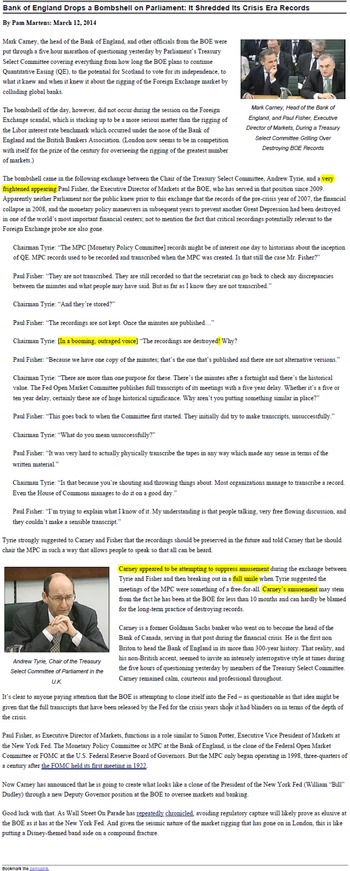
A casual observer might easily dismiss nonverbal behavior in parliamentary hearings, concluding that what really matters is the verbal arguments and discussion. Even anecdotal evidence illustrates that this is not necessarily the case. In March 2014, one hearing raised the specter of a possible major transformation in the conduct of the Bank of England’s MPC meetings, through a substantial increase in the transparency of policymaking discussions. During this hearing, Treasury Select Committee chairman Andrew Tyrie queried Paul Fisher (executive director for markets and member of the MPC) and Mark Carney (governor of the Bank of England) on whether the Bank stored the verbatim transcripts of the MPC meetings once these were summarized and published as minutes. The exchange became fodder for MPs and other Bank observers who have sought greater transparency from the Bank. As seen in the media attention given to this hearing (Figure 1), nonverbal communication plays a distinct role in capturing the underlying conflict between Parliament and the Bank of England (see highlighted text).
An example of nonverbal communication in a Treasury Select Committee hearing on monetary policy.

Examples of media and press attention to nonverbal behavior in select committee hearings are not difficult to find, but as yet no attempt has been made to examine this behavior more systematically.
Coding of nonverbal behavior in parliamentary hearings
A pilot study for coding nonverbal behavior was completed using five full hearings (each with a duration around two hours), from which a simplified coding structure was devised and implemented. Three research assistants (RAs) (one with a doctorate and more than 15 years of research experience and two second-year undergraduates) then independently revised a scheme to systematically code specific nonverbal expressions and behavior of key individuals for 12 hearings (totaling 23 hours of video footage, all of which is publicly available from the U.K. Parliament website athttp://www.parliament.uk/). These hearings are a representative sample of the 37 total hearings on monetary policy, financial stability, and fiscal policy in the Commons Treasury Select Committee (hereafter, the Commons committee) and the Lords Economic Affairs Committee (hereafter, the Lords committee) during the 2010–15 Parliament (see Appendix 1 online), which was the first parliamentary session to implement significant reforms that elevated the committees to greater prominence (e.g., the election of committee chairs) and gave them more autonomy in holding the government to account.
While the total 37 hearings have been analyzed in their entirety using automated textual analysis, 74 the 12 coded hearings were selected in reasonably evenly distributed intervals across the 2010–15 timeframe, while factoring into account (a) the inherent imbalance in the distribution of hearings across types of witnesses (27 total hearings for Bank of England officials on monetary policy and financial stability versus 10 total hearings for the chancellor on fiscal policy) and across chambers (30 total hearings in the Commons committee and seven in the Lords committee), and (b) that the Lords committee held no hearings specifically on financial stability during the 2010–15 Parliament. Thus, for Bank of England witnesses, eight hearings were selected (six for monetary policy and two for financial stability), and for the chancellor, four hearings. Across chambers, 10 were from the Commons and two were from the Lords.
Before beginning coding, the RAs underwent four online training courses on micro expressions and subtle expressions (all obtained from the Paul Ekman Group) and in each of the online tests were required to achieve a success rate of at least 75%. The training focused particularly on identifying the seven basic emotions (joy/happiness, surprise, anger, contempt, sadness, fear, disgust), which are identifiable in facial expressions. The test stimuli were provided in the training packages. The RAs were also given a practical textbook Reference Borg75 on “body language” to review and use as a reference for the gesture coding.
The coding proceeded as follows. For each hearing, each MP or peer’s “turn” in asking questions was treated as a “deliberative exchange.” For the most part, this consisted of a back and forth between one MP or peer and one witness, although it could include one or more witnesses. A single deliberative exchange may consist of 5 to 10 minutes of questions and answers between a committee member and a witness. The term “deliberative exchange” is unique to this project and is used to distinguish it from the “turn-taking” concept, which is commonly understood to consist of an individual speaker taking a turn in a conversation, in a back-and-forth series of turns for an entire conversation. Reference Bull76 For each exchange, three basic dimensions were coded: facial expressions, vocal cues, and gestures/posture. The coding scheme is summarized in Appendix 2 online. Facial expressions such as anger, contempt, and happiness were counted as single instances (counts) and then tallied for each of the participants in the deliberative exchange. Similarly, vocal cues such as variations in volume, speed, and pauses in speaking were tallied by individual and across each deliberative exchange, as were gestures such as leaning forward, nodding or shaking the head. The bulk of the coding that is reported here is based on broad areas of agreement among the three coders. The threshold for agreement rests not on the numeric scores (counts) but rather on the relative weights of the different types of witnesses (elected minister for fiscal policy versus unelected experts for monetary policy and financial stability) and of the two parliamentary committees (Commons versus Lords). As such, the coding is used largely as a qualitative assessment and as a precursor to a larger, multimethod investigation which gauges more fully the impact of nonverbal communication in parliamentary oversight hearings.
Some attention is also given to where the coders disagreed. To be sure, measures for coding should avoid incurring inconsistencies arising from human idiosyncrasies, Reference Hayes and Krippendorff77 and to the extent that the agreed results reported here are based on a simple 100% agreement that one set of witnesses or committee exhibited relatively more nonverbal cues (anger, happiness, etc.) than the other set of witnesses or committee, the bulk of the coding results do not report as findings any inconsistencies among the coders (and so a measure such as Krippendorff’s alpha is not used). Studies do not usually discuss differences among coders (exceptions include Schubert and colleagues, who comment on a coder’s “idiosyncratic tendency to overcode,” 78 and Bucy and Gong, 79 who discuss specific techniques for improving intercoder reliability and precision) and yet — as discussed earlier — receivers of nonverbal messages do not necessarily respond in similar ways, as these signals are conditional on preexisting attitudes and the situational context of the behavior, and some individuals are simply more adept than others at discerning the meaning of the signals. Finally, “stereotypical” university undergraduates have been criticized for being “socially compliant” and “more likely to be mercurial in their attitudes because of lack of self-knowledge.” Reference Stewart, Salter and Mehu80 While this complaint is made in reference to undergraduates as research participants, the authors nonetheless argue that different cultural groups (and by inference, different age groups) vary in their perceptions of nonverbal communication. 81 It is worth, then, allowing here for the possibility that — in spite of having received the same training in coding nonverbal behavior — a meaningful difference may still emerge between younger coders (ages 20–22) and another older coder (in his 40s).
Underlying the coding exercise was a premise that nonverbal behavior helps capture the extent of interest in the topic or the intensity of the discussion. (This is akin to motivational activation. Reference Lang, Newhagen and Reeves82,Reference Lang, Sanders-Jackson, Wang and Rubenking83 ) Witnesses who are more nonverbally expressive in hearings may be making greater effort to persuade the committee members (as studies of the use of gestures have shown 84 ), or certain facial expressions may be expressing latent emotions.
Informed researchers in nonverbal communication may (quite rightly) note that software is beginning to be available for automatically coding facial expressions (e.g., Visage, FaceReader), and plausibly such software could be used in this instance rather than human coders. There are three rebuttals to this argument. First, humans still outperform computers in interpreting the nuances and context of facial expressions, although the capacity of automation is no doubt rapidly evolving. Reference Lewinski85 Second, no software as yet (of which I am aware) automatically codes facial expressions, vocal cues, and gestures as a whole package. Third, software that codes all relevant aspects of nonverbal communication may well be around the corner; nonetheless, this does not negate the importance of obtaining human coding of the various categories, as observed in real-world settings. Human coding may serve to first map the contours of nonverbal expression in parliamentary hearings, and subsequent automation may then rely on such human coding as a baseline. In short, human coders may initially define the contours of nonverbal cues in parliamentary hearings, and software may subsequently refine or even challenge these outright.
A further response, which extends beyond this article, is that the coding of the hearings is the first half of a research design that then supplements this with an experiment. In the experiment, some participants watched selected footage from the 12 parliamentary hearings previously coded in their entirety by the three RAs, while a second group served as a control group, in that they only listened to recordings of these same hearings. Following completion of the nine videos and questions on these videos, participants met in groups to discuss their individual impressions of the witnesses, according to their likeability, competence, and persuasiveness. Following these discussions, participants returned to their stations and were asked whether the group discussion changed their initial impressions of each witness and why or why not. This post-group element sought to gauge the extent to which participants were influenced by others to change their views, given knowledge of the views of fellow participants. This experiment — together with a qualitative analysis of about two dozen elite interviews with members of both select committees and former witnesses from the Bank of England and Treasury — is added to the human coding of facial expressions, vocal cues, and gestures.
Findings: nonverbal communication in parliamentary committees
The context
Again, the focus here is on the delivery rather than the content of the discourse in the parliamentary hearings. Nonetheless, to understand the delivery, some context is required. From an earlier analysis of the full verbatim transcripts of the 37 oversight hearings on monetary policy, financial stability, and fiscal policy during the 2010–15 Parliament, variation in deliberation was found (1) between types of witnesses and types of economic policies, (2) between MPs and peers in their respective committees, and (3) in partisan influence across different policy areas.
First, it was found that oversight varies between (a) members of the Bank of England’s Monetary Policy Committee and Financial Policy Committee on monetary policy and financial stability and (b) Treasury ministers and officials — primarily Chancellor George Osborne — on fiscal policy. The key difference is that hearings with Bank officials tend to exhibit greater reciprocity in deliberation, whereas those on fiscal policy exhibit more of a “talking across” one another phenomenon. In monetary policy, both MPs and peers tend to enter into exchanges with MPC members on each theme discussed. In these hearings, many members on both sides of the table are able and willing to engage in discussion on multiple themes rather than focusing on just one. In fiscal policy, the chancellor tends to speak to one theme, whereas committee members focus on other themes, and, individually, these committee members tend not to focus on more than one theme. Deliberation in financial stability hearings exhibits more of a committee-level reciprocity — that is, FPC members and MPs speak to the same set of themes, but there is more topic specialization among the witnesses than in monetary policy.
Second, deliberative reciprocity is evident for both sets of committee hearings on monetary policy; however, in the Commons committee, members tend to speak to multiple themes, whereas in the Lords committee, peers tend to focus on one theme. A key criterion for judging the quality of economic policy oversight is its degree of reciprocity. As Pedrini and colleagues explain, reciprocity in deliberation entails “both interactivity and respect. It involves an effort to listen to and engage with people with whom we disagree.” Reference Pedrini, Bächtiger and Steenbergen86 Reciprocity therefore requires participants to “engage with one another” so that “they do not only give reasons but listen and take up the reasons of other participants” (italics added). 87
Third, in the Commons, partisanship appears to vary across policy areas. In monetary policy hearings, there is virtually no cleavage between the two main parties, whereas in fiscal policy, MPs of the minority party (Labour) tend to be more extensive in their questioning of the Conservative chancellor. For financial stability, a small amount of partisanship could be discerned in the greater tendency of Labour members to speak to the housing issue. (U.K. housing policy has become more ideologically contentious as escalating house prices in recent decades have made home ownership increasingly unaffordable. Hence, the provision of “social housing” for disadvantaged groups has evolved into discussions of appropriate welfare spending by government. Reference Keohane and Broughton88 )
Results
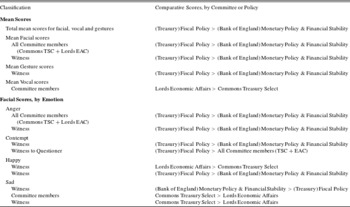
Table 1 provides the summary findings for the nonverbal coding. In Online Appendix 3, Tables A1–A4 provide the details for the coding. Table 1 reports only where all three coders agreed on the relative weights across the witness type or the committee type. (In cases of a tie in the scores across groups, the determination of coder agreement relied on agreement of rankings by the other two coders.) These summaries correspond to Tables A1–A4, in which the findings highlighted in each table (in bold or underline) represent only where the coders agreed, and in italicized brackets, the degree to which one witness or group type was greater than another.
Summary findings.

Table 1 begins with the aggregate means (corresponding to Tables A1 and A2), as grouped by witness type (Bank of England or Her Majesty’s Treasury [HMT]) and by legislative chamber (Lords or Commons). The scores are presented for both the parliamentary committee members and the witness, and they aggregate across all the three types of nonverbal communication analyzed here (facial, vocal, and gesture). At the most aggregate level, fiscal policy hearings — in which the chancellor is the one key witness (with only marginal interjections from Treasury officials) — exhibit more nonverbal behavior than hearings with Bank of England officials. For the facial expressions, the committee members in both chambers (MPs and Lords) and the witnesses have more coded facial expressions in fiscal policy hearings than Bank of England hearings. The same is true for witnesses when it comes to gesture scores as well. Finally, across chambers, peers score higher on vocal scores than do MPs.
What does this mean? For one, in fiscal policy — where ideological/partisan conflicts are more in evidence as redistributive effects are discussed — we find in the aggregate more intense nonverbal behavior than in monetary policy or financial stability. Bridging these findings with the textual analysis of the transcripts, we note that in fiscal policy hearings, not only do committee members and witnesses tend to “talk across” one another, they also become quite animated in doing so — perhaps in frustration with the failure to engage in a more reciprocal dialogue. In both monetary policy and financial stability, where testimony centers more on technical language, the deliberative exchange is far less animated and emotionally engaging between questioner and witness. Simply put, Chancellor Osborne’s testimony is more partisan in orientation, while that of the Bank’s experts is more technical, and, by implication, partisan language conveys more emotive cues than technical language. During fiscal policy hearings, the parliamentarians in both the Commons and Lords tend to reciprocate in kind with their own more frequent use of facial expressions. Moreover, Osborne also tends to use hand movement more frequently than Bank experts, which may suggest that he sought to persuade his fellow parliamentarians to a greater extent than did officials from the central bank. (Notably, while all the coders observed Osborne’s frequent hand movement, one coder scored these movements considerably higher, which supports Beattie’s earlier observation that some people are simply more attuned to “seeing” gestures than others.)
Across chambers, peers in the Lords committee tend to use more vocal cues than MPs in the Commons committee. Notably, Lords tend to be economic experts in their own right (e.g., former chancellors, such as Nigel Lawson, or financiers, such as Michael Forsyth) and the questioning tends to be more discursive — that is, peers tend to spend more time phrasing and elaborating on their questions before allowing witnesses to respond. This finding aligns with anecdotal observations and elite interviews with committee members that greater discursiveness from peers is likely to produce more vocal cues.
Section II of Table 1 (corresponding with Table A3) summarizes the mean scores for selected facial expressions, focusing on anger, disgust, contempt, happiness, and sadness. A key emotion expressed in these facial expressions by both parliamentary committee members and Treasury witnesses (predominantly Chancellor Osborne) is anger. This emotion is, by comparison, exhibited far less frequently in hearings with Bank experts. Importantly, anger is expressed by both the committees and the witnesses in fiscal policy hearings. One further emotion — contempt — is also more prominently expressed by witnesses in fiscal policy hearings than in Bank of England hearings. Moreover, focusing on the fiscal policy hearings, we also observe that the witnesses (again, predominantly the chancellor) exhibit greater contempt than the parliamentarians who are engaged in questioning. In short, fiscal policy hearings unleash higher levels of anger by questioners and witnesses alike than Bank oversight hearings. In addition, witnesses tend to exhibit contempt toward committee members, but this does not appear to be returned by the committee members toward the witnesses.
Turning to reassuring or happy facial expressions, the comparison across chambers suggests that witnesses (both Bank and Treasury) appearing before the Lords committee tend to be more congenial than those appearing before the Commons. Conversely, for expressions of sadness, both committee members and witnesses are more rueful in the Commons committee than in the Lords committee. This does seem to suggest a difference in interactional dynamic between the two committees, with a more reassuring dynamic in the Lords hearings (by witnesses and committee members) and more concern or appeasement (“sadness”) in the Commons hearings. Observers of deliberative norms in both committees note that because partisanship is less acute in the House of Lords committees, these hearings tend to be relatively more relaxed than those in the Commons committees, Reference Norton, Horne and Le Sueur89 which may help explain this finding. Evidence for this is both from my own interviews with MPs, peers, and policy experts, as well as from other published accounts: “The absence of an absolute majority, the presence of a sizeable body of peers with no party affiliations and the appointed nature of the House (members not seeing one another as electoral threats) have resulted in a less adversarial approach and fewer divisions than in the Commons.” 90 Arguably, MPs generally hold career aspirations and are not as established as are peers, and thus we might draw on a behavioral model of nonverbal communication for an interpretation of this finding (e.g., the “challenger” style [aggressive] versus the “power holder” style [more confident, assured] Reference Broom, Koenig and Borries91 ).
From the behavioral model of leader-follower interactions discussed earlier, one is tempted to depict the Commons committee as a competitive setting and the Lords committee as noncompetitive. Some aspects of this model seem to apply — for example, the anger by parliamentarians in the Commons committee and the sadness/appeasement of Bank officials in this same committee. But the goal of maintaining social order through fear/submission does not appear to hold for the chancellor in fiscal policy hearings; rather, he in essence mirrors the anger of the committee members and adds to this contempt. Bank officials also do not respond with fear to the anger of the committee members, although their nonverbal expressions of sadness/appeasement are less overtly combative than the chancellor’s contemptuous expressions. In short, the expectation of the behavioral model for nonverbal behavior is that actors will adapt their behavior in order to regulate social relations. The interesting finding here is that the chancellor does not appear to respond as expected in either a competitive setting (fear) or a noncompetitive setting (appeasement), whereas central bankers respond in both committees along the lines of what would be expected in a noncompetitive setting.
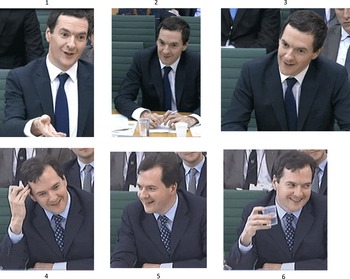
The smiles of Chancellor George Osborne.

There is, however, one final observation that appears out of place — that is, the higher happiness/reassurance displays by Treasury witnesses relative to Bank experts. At first, this does not accord with the parallel findings of more anger and contempt by Treasury witnesses in these hearings. An intuitive interpretation is the tendency of politicians to be somewhat disingenuous in “putting a positive spin” (literally, by smiling) on politically sensitive budgetary news. To explore this further, Figure 2 presents still photos of Chancellor Osborne that were taken from the coded hearings. The contrast is between the top row and the bottom row (but ignoring his notable weight loss Reference Dominiczak92 ). The “smirk” in Osborne’s smile has been noted previously by journalists, Reference Fenton93 and this element can be seen in the smiles on the first row. The second-row smiles are quite different in being more genuine. More specifically, the bottom-row smiles resemble the enjoyment smile (also known as the “Duchenne” smile, named after Duchenne de Boulogne Reference Ekman, Davidson and Friesen94 ), which accords with feelings of happiness or amusement, but may also be signaling cooperation. 95 In the top row, Osborne’s teeth are less in evidence, and the muscles surrounding the eyes are not contracted, as one would expect from an enjoyment smile. 96
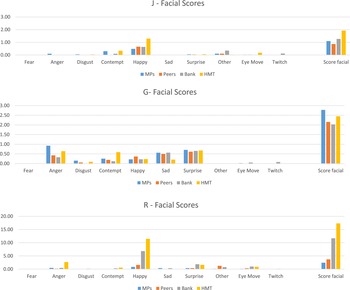
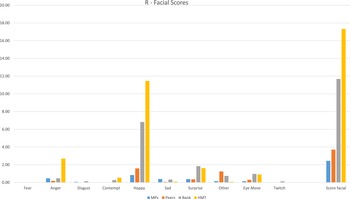
Figures 3 and 4 examine differences in the distributions of facial expression coding. The top and bottom distributions (“J” and “R”) are from the two undergraduate coders, while the distribution by “G” is from the older coder (with over 15 years of experience in empirical political science research). Both the undergraduates code the happy scores of the hearings with the chancellor (HMT) relatively higher than all other facial expressions (and coder R tended to overcode, as seen in the vertical scale; Figure 4 thus provides an enlarged version of these scores). In contrast, coder G produces a wider array of facial expression scores, which indicates more scores for anger, contempt, and surprise and less for happiness. While it is highly unconventional to note what appear to be idiosyncratic differences among coders, both the nature of Osborne’s phony smiles and the contrast between the innate experience of the coders suggest that the degree of contempt and anger by Osborne agreed on by all three coders (from Table 1) may in fact be greater, if perhaps the undergraduate coders had received more extensive training in the specific nature of Osborne’s false or phony smiles. At the very least, Figures 2–4 suggest that much more could be done to more accurately capture the genuine and more controlled expressions of Chancellor Osborne.
Distributions of facial expression scores among coders.

Distributions of facial expression scores — R only.

Discussion and conclusion
The quotations at the beginning of this article presage the findings of nonverbal behavior in the committee hearings. Speaking from his experience as a central banker, Alan Blinder emphasizes that unelected (independent) central bankers are morally accountable to the public and therefore are obliged to explain themselves. In their appearances before the parliamentary select committees in the United Kingdom, central bankers convey this acquiescence to parliamentarians in their nonverbal facial expressions. Conversely, the quote from Commons committee chair Andrew Tyrie characterizes a particular fiscal policy hearing as having “pretty vigorous exchanges” in which “the Government was forced to explain its actions.” The description suggests a heated (threatening) tone in the room and competition for control over policy decisions or outcomes. This, too, fits well with the documentation of anger expressed by parliamentarians and the chancellor over fiscal policy, although it may not have anticipated the clear finding of contempt by the chancellor toward the committee members. In short, the findings in this article accord with the observations of those intimately familiar with select committee hearings.
Moreover, this article builds on a previous analysis of the deliberative content of the hearings that used automated textual analysis software. The analysis of the verbal content of these hearings found that in fiscal policy hearings, committee members would focus on a certain array of thematic concerns, while the witness (namely the chancellor) would seek to address his own topic(s). As a process, questioners and witness would effectively talk past one another. The content of fiscal policy hearings is also far more partisan in orientation than either monetary policy or financial stability. From the present study of nonverbal communication in these hearings, certain findings complement our understanding of the verbal content: angry/threatening expressions by parliamentarians (shared by the witness) together with the contempt of the witness run parallel to the partisan clashes and failure of both questioners and witness to establish a shared discourse around common themes (i.e., there is more talking past one another than talking with one another — in other words, the witness tends to avoid answering the question asked, and instead provides a response which is unrelated or diversionary in nature). This nonverbal behavior of each side may reflect latent emotions of anger and contempt by both backbench and frontbench parliamentarians. Yet bearing in mind that these hearings are not one-shot episodes but occur with regularity throughout the life of the parliamentary session, these expressions may also signal ongoing animosity and a continuous struggle for control over fiscal policy priorities by members of the legislature versus members of the executive. As such, committee members may be signaling their willingness to remain vigilant in questioning (“attacking”) the priorities and processes of the Treasury, while the chancellor is also signaling his resistance to this seeming challenge to his authority and competence. In this context, there appears to be little agreement as to who is situated where in the dominance hierarchy between the committee members and the Treasury. Confrontation between backbench and frontbench parliamentarians (legislature versus executive) persists — which is in accordance with behavioral/ethological principles — although the expectation that each set of actors will seek to maintain social order does not appear to apply.
In the monetary policy hearings with Bank officials, the verbal content contains very little discernible partisanship, and for each theme in the hearings, both committee members and Bank officials engage with each other — that is, Bank of England officials respond more directly to the questions of committee members, thereby creating a shared thematic discourse. The assessment of nonverbal behavior in these hearings accords with this verbal content, in that these witnesses display more appeasement (“sad”) expressions toward both sets of committee members, suggesting that central bankers perceive these hearings as noncompetitive encounters. From the behavioral ecology approach, this behavior appears to signal a willingness to cooperate with (and defer to) Parliament.
The comparison of nonverbal behavior across the two chambers further complements the analysis of the verbal content. From the transcripts, it was found that in the Commons committee, MPs tended to divide their speaking time across several themes whereas in the Lords committee, each peer tended to focus on one theme (typically one that fell into that peer’s area of expertise). The finding of a higher incidence of reassuring facial expressions in the Lords committee is thus a feature of a more relaxed, less confrontational discourse in this committee, where peers are also at liberty to engage witnesses in themes of greatest interest to them.
Finally, this article has neither sought nor obtained a precise quantification of nonverbal behavior in committee hearings; rather, it has explored the relative occurrence of expressive displays and extent to which systematic differences are identifiable between types of witnesses and types of questioners in the real-world setting of parliamentary oversight. Additionally — and unconventionally — this article has made transparent a contrast between more inexperienced, young coders and a more experienced, older coder, with the former less able (or willing) to differentiate the genuine or phony natures of smiles by Chancellor Osborne. Bearing in mind criticisms leveled against the overreliance on undergraduates in empirical research, it is worth noting that phony smiles may be an aspect of nonverbal coding that requires far more extensive training and expertise to accurately code. Ultimately, however, the goal of this study is to gauge the extent to which the interactional dynamic of fiscal policy hearings differs from hearings with central bankers, and the extent to which contrasts are observed in nonverbal behavior between parliamentary committees. To that end, this study has found clear differences. This study has not, however, directly gauged the effect of either verbal or nonverbal behavior on the persuasiveness of the witnesses vis-à-vis committee members; this remains a task for further investigation, using both experimental methods and qualitative interviews with parliamentarians and central bankers.
Acknowledgements
Research funding from the London School of Economics and Political Science Suntory and Toyota International Centre for Economics and Related Disciplines is gratefully acknowledged. The article has benefited greatly from audience feedback at the Text as Data Conference, the European Political Science Association Conference, the Political Studies Association Conference, and London School of Economics and Political Science Government Department seminars. I am particularly grateful to Erik Bucy for his encouragement, advice, and extensive suggestions for improvements to this research, as well as to anonymous referees, who were generous with their time and expertise. The dedication of my research assistants (Gordon Bannerman, Jack Winterton, and Richard Glasspool) was essential to the success of this project. I am also grateful to Mark Thatcher and Christian List for their suggestions.