Nomenclature
- HMGT
-
Helideck Micro GripTester
- IoT
-
Internet of Things
- KNN
-
k-Nearest Neighbours
- ML
-
machine learning
- RFE
-
recursive feature elimination
1.0 Introduction
Helidecks are critical infrastructure designed to accommodate the landing of large and heavy helicopters, particularly in offshore environments [Reference Park, Kishore, Ha and Jang1, Reference Truelock, Czaban, Luo, Wang, Holtmann, Begovic, Yasuda, Ventura, Nicholls-Lee, Oterkus and Sensharma2]. A fundamental requirement for their design is ensuring that the helideck surface possesses a sufficient coefficient of friction to facilitate safe landings and take-offs. If this requirement is mandated by regulatory or operational standards, an appropriate source should be cited. Helidecks serve as key access points for offshore structures, enabling rapid transportation between ships, aircraft (e.g., helicopters, drones) and offshore installations. In most operational scenarios, they provide the fastest and safest means of access; however, safety is contingent upon prevailing environmental and operational conditions. Offshore helicopter operations also extend beyond the high seas, including within bays and territorial waters, where helicopter support remains indispensable [3–5].
A crucial aspect of helideck safety is maintaining a non-slip surface that complies with regulatory standards. Throughout both installation and operational phases, helideck surfaces must be kept free from contaminants such as oil, grease, ice, standing water and other debris (e.g., bird droppings) that may compromise frictional properties. It is essential that helicopter operators implement robust procedures to mitigate these hazards, ensuring that sufficient cleaning measures are in place to maintain surface integrity without impeding operations [4]. Additionally, helideck flooring should be designed to enhance slip resistance, safeguarding the safety of crew and passengers. To meet specified friction coefficient requirements, specialised surface coatings are applied, and effective drainage systems are integrated to prevent water accumulation and enhance operational safety.
Ensuring adequate surface friction is critical in helicopter operations to mitigate the risk of slippage for helicopters, helideck crews and passengers [Reference Oster, Strong and Zorn6, Reference Wilke, Majumdar and Ochieng7]. The selection of appropriate materials and surface textures plays a crucial role in optimising friction, while integrated drainage systems further reduce the risk of water accumulation [Reference Malakis, Kontogiannis and Smoker8–Reference Mendes, Vieira and Mano10]. To maintain optimal friction levels, regular surface inspections must be conducted, and corrective actions such as surface cleaning, reapplication of anti-slip coatings or repair of damaged sections should be undertaken when necessary [Reference Park, Chung, Song, Baek and Chung11, Reference Deng, Wang, Bai and Jiang12]. In occupational settings, slippery surfaces are a major cause of workplace accidents, historically accounting for 20% to 40% of reported serious injuries in developed countries [Reference Goulet13, Reference Chang, Leclercq, Lockhart and Haslam14].
The safety and durability of helideck surfaces are particularly critical in offshore oil and gas operations, where helicopters play a pivotal role in passenger and cargo transportation. Effective management of helideck surfaces is essential across the global offshore industry. Helicopter models such as the Sikorsky S76, Leonardo AW139 and AW189 operate from onshore bases to offshore platforms, all of which require appropriately maintained helideck surfaces to ensure safety and operational efficiency [Reference Yam, Guo, Jiang, Li and Zhang15–Reference Onuchukwu, Onyiliofor and Ekong18]. Furthermore, other widely used offshore helicopter models, such as the Sikorsky S-92, Airbus H175 and Bell 412, also rely on well-maintained helideck conditions to ensure operational safety and efficiency.
Over time, helideck surfaces are susceptible to degradation due to wear, corrosion and exposure to harsh environmental factors. Offshore conditions, particularly the presence of saltwater and crude oil, exacerbate the corrosion process, increasing maintenance requirements. In this context, innovative materials such as graphene-based coatings present promising solutions for enhancing helideck performance. Graphene exhibits superior properties, including high electrical conductivity, thermal stability and hydrophobic characteristics, which contribute to improved surface friction and reduced corrosion. Studies indicate that graphene-based coatings can reduce corrosion by up to 90% while simultaneously enhancing frictional performance. Additionally, the hydrophobic nature and two-dimensional structure of graphene prevent water accumulation, enabling the surface to retain its frictional properties even in wet conditions [Reference Onuchukwu, Onyiliofor and Ekong18–Reference Zeng, Peng, Liu and Lang24].
Research examining helideck surface challenges, friction management and maintenance strategies has highlighted the potential of graphene-based solutions in mitigating surface degradation. Studies have also emphasised the need for preventive measures to counteract wear and corrosion, ensuring sustained safety and operational efficiency. Furthermore, investigations into the effects of environmental factors and helideck mobility on surface friction reinforce the importance of regular maintenance and strategic management approaches [25]. The safe execution of offshore helicopter operations, particularly those conducted during night-time, is heavily influenced by various flight phases and environmental conditions. Risk levels across different flight phases, including landing, vary, and recent flying practice and visual approach techniques play a crucial role in ensuring safe operations, especially in offshore oil and gas missions [Reference Nascimento, Majumdar, Ochieng and Schuster26].
Acknowledging the significance of deck conditions for safe helicopter operations on helidecks, this study aims to assess the necessity of routine surface testing and refurbishment. To achieve this objective, a comprehensive methodology has been established, incorporating experimental testing and statistical analysis to evaluate the impact of surface modifications on helicopter adhesion performance. This study contributes to enhancing continuous monitoring strategies and improving deck conditions on helidecks, ultimately strengthening the safety and efficiency of offshore helicopter operations.
2.0 Materials and methods
2.1 Measurement of the friction coefficient of the helideck surface in accordance with CAP 437 standards
In this study, the surface friction coefficient of the helideck platform was measured using a Helideck Micro GripTester in accordance with CAP 437: Standards for Offshore Helicopter Landing Areas. CAP 437 specifies the minimum required friction coefficients (Table 1) and emphasizes the importance of helideck geometry and layout in ensuring safe helicopter landings. Accordingly, both the surface friction and the geometrical characteristics of the helideck were evaluated to determine compliance with the established safety standards.
Helideck friction requirements

The HMGT is the first purpose-built, continuous friction measurement device specifically designed for helicopter landing areas. It is optimised for operation in harsh offshore environments and is transportable via helicopter, with two portable cases weighing a total of 12kg. The device provides direct surface friction measurements without requiring additional coatings or treatments (Fig. 1).
Helideck Micro GripTester (HMGT) device.

The test was conducted under optimal weather conditions, ensuring no external influences such as rain or excessive wind. To systematically define the measurement zones, the helideck surface was divided into a 1-metre grid pattern, aligned with chevron markings. The H marking was designated as the starting reference point, and the axis lines were drawn accordingly (Fig. 2).
Helideck friction coefficient measurement scheme.

Measurements were performed in two perpendicular directions: Direction A, parallel to the chevron markings, and direction B, perpendicular to the chevron markings. To enhance accuracy, friction coefficients obtained in both directions were subsequently analysed and averaged (direction AB correlation). The final friction values were then used to assess compliance with CAP 437 standards (Fig. 3).
Friction coefficient measurement results.

The results confirmed that the helideck met the minimum coefficient of friction requirement of 0.6, as specified in CAP 437. Consequently, the surface was deemed safe for helicopter landings. The study further validated the effectiveness of the HMGT in assessing friction properties in accordance with industry standards.
2.2 Machine learning models
Machine learning (ML) is a branch of computer science that enables systems to learn from data and perform predictive analysis without explicit human intervention. The ability to construct data-driven models and utilise them in decision-making processes allows ML techniques to be applied across various domains, including classification, clustering, pattern recognition and trend analysis. It has become increasingly significant, particularly in applications related to the Internet of Things (IoT) and predictive analytics for safety-critical environments such as helideck surface assessment.
In the context of helideck safety, ML models can be utilised to analyse large datasets related to surface conditions, environmental factors and operational parameters. By leveraging historical data and real-time measurements, these models facilitate predictive maintenance strategies, ensuring compliance with safety regulations and mitigating risks associated with helicopter landings.
The dataset used in this study comprises measurements collected from multiple helideck surfaces under varying environmental conditions. The data includes parameters such as surface friction coefficients, weather conditions and helicopter landing success rates. The dataset was preprocessed through outlier detection and normalisation to ensure consistency. Key features were selected using recursive feature elimination (RFE) and mutual information scores to retain only the most relevant predictors for model performance.
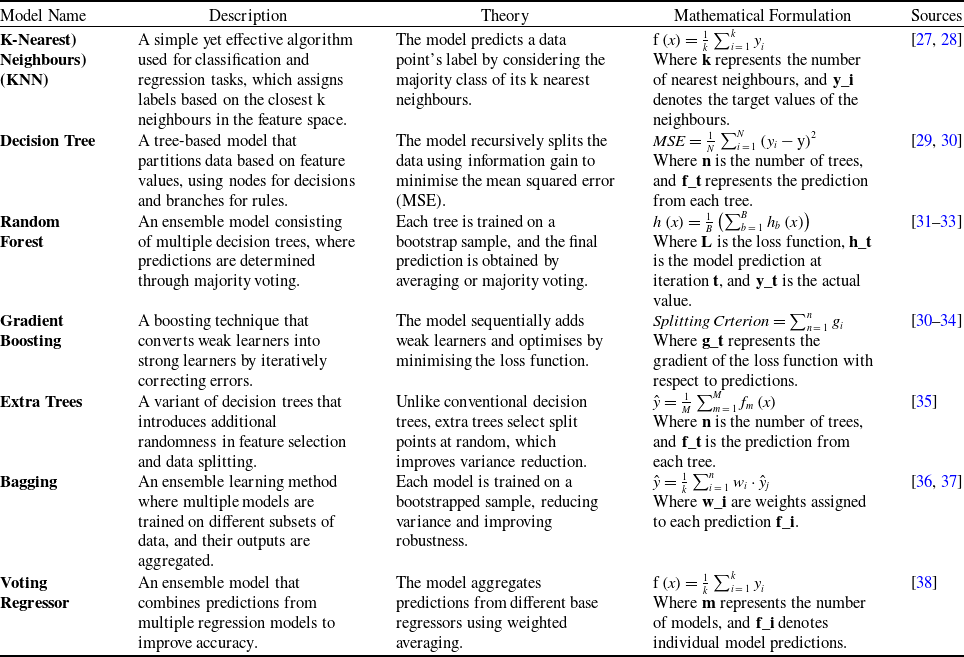
A range of ML models was employed in this study, selected for their effectiveness in regression tasks and their ability to model complex, nonlinear relationships. The k-Nearest Neighbours (KNN) –, decision tree, random forest, gradient boosting, extra trees, bagging and voting regressor – were chosen due to their robustness in feature importance estimation and their capacity to handle high-dimensional data. These models were preferred over others for several key reasons: first, while deep learning models require substantial computational resources, gradient boosting regression (GBR) and random forest regression (RFR) offer high accuracy with relatively lower computational costs. Second, they provide interpretability by ranking feature importance, which enhances the understanding of the parameters most influential to helideck safety. Finally, prior research has demonstrated that ensemble models, such as KNN, decision tree, random forest, gradient boosting, extra trees, bagging and voting regressor – consistently outperform linear models in predictive accuracy, particularly in structured data scenarios. Table 2 presents the machine learning models used in this study, along with their descriptions, theoretical foundations, mathematical formulations and sources.
Machine learning models

The dataset was partitioned into training (80%) and testing (20%) subsets to facilitate the evaluation of model performance. Hyperparameter optimisation was carried out through grid search and cross-validation methods, focusing on key parameters such as learning rate, tree depth and the number of estimators. The models were developed using Python, leveraging relevant libraries, including Scikit-Learn, XGBoost and TensorFlow, to implement the algorithms efficiently. To assess the accuracy and robustness of the models, several evaluation metrics were employed, including mean absolute error (MAE), root mean squared error (RMSE) and R-squared scores. These methodological steps, encompassing dataset preparation, feature selection, hyperparameter tuning, and the use of robust coding frameworks enhance the transparency and reproducibility of the study, thereby ensuring the reliability of the ML-based helideck safety assessment.
3.0 Results
3.1 Analyses on deck conditions and grip performance: independent sample t-test, correlation and scatter comparisons
This section presents the statistical analyses conducted to evaluate the effect of different deck conditions on grip performance. Measurements were taken on both old and new helideck surfaces to assess variations in key parameters. The results indicate that structural differences between the two surfaces significantly influence grip performance. Statistical methods, including the independent sample t-test and correlation analysis, were employed to examine the impact of surface type and environmental factors on helicopter operations.
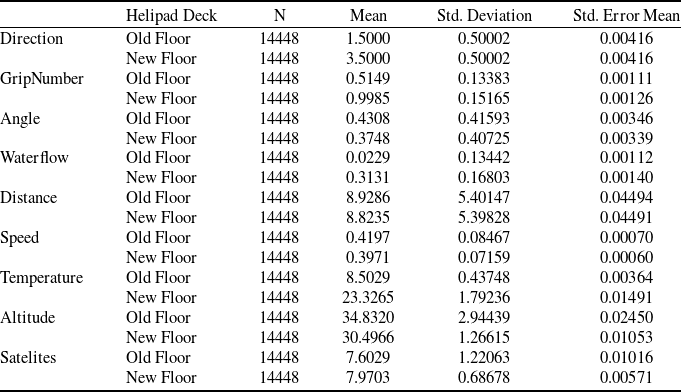
Table 3 presents a comparative summary of the performance metrics for the old and new helideck surfaces. The analysed variables include direction, grip number, angle, water flow, distance, velocity, temperature, altitude and number of satellites. Notable differences were observed between the two surfaces. For instance, the mean grip number increased from 0.5149 on the old surface to 0.9985 on the new surface. Similarly, water flow rose from 0.0229 to 0.3131, whereas altitude decreased from 34.8320 m to 30.4966 m. The temperature difference was particularly striking, with an increase from 8.5029°C on the old surface to 23.3265°C on the new surface.
Comparative statistical summary of performance metrics for old and new helideck surfaces

Table 3 includes the mean, standard deviation and standard error for both surface types. The sample size (N = 14,448) represents the total number of discrete coefficient of attrition measurements collected on the helideck. Additionally, all numerical values are presented with consistent decimal notation throughout the text.
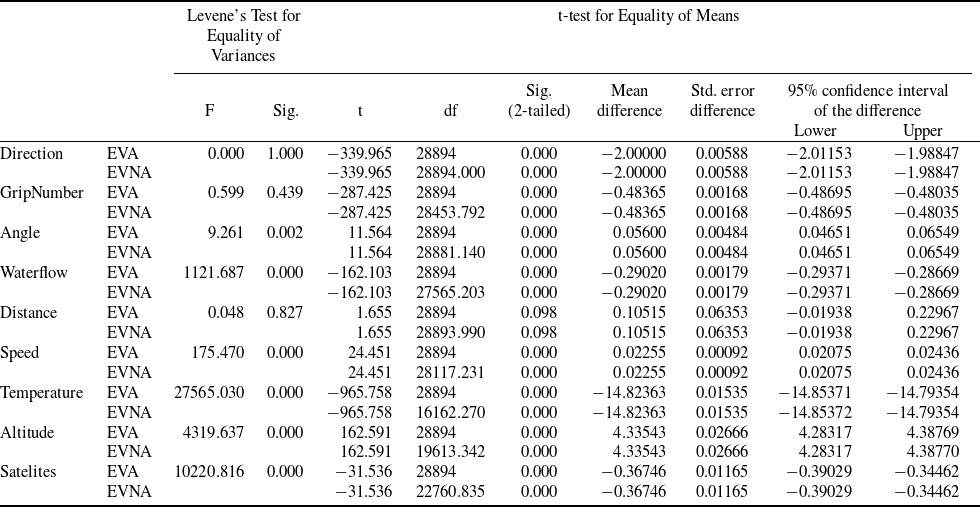
The results of the independent sample t-test are provided in Table 4. Levene’s Test for Equality of Variances revealed that the variances were not equal (p < 0.05) for most variables. Significant differences were identified for direction and grip number (p < 0.001). For instance, the t-test result for direction was t(28,894) = −339.965, p < 0.001, indicating a two-unit difference between the new and old surfaces. Similarly, for temperature, t(28,894) = −965.758, p < 0.001, with a mean temperature difference of −14.8236°C. These findings confirm that surface modifications led to statistically significant changes in critical parameters.
Statistical comparison of variance equality and mean differences between old and new helideck surfaces using Levene’s test and independent samples t-test

EVA: Equal variances assumed, EVNA: Equal variances not assumed
Figure 4 illustrates the distribution of grip number across the two surfaces. The histogram reveals a bimodal distribution, with peaks at approximately 0.50 and 1.00, reflecting the grip performance on the old and new surfaces, respectively. The mean grip number was 0.76, with a standard deviation of 0.281, indicating substantial variation in friction performance due to surface conditions. The normal distribution curve suggests that while the overall distribution approximates normality, the presence of two peaks indicates distinct friction behaviours on each surface. These results highlight the significant impact of helideck surface modifications on friction performance.
Distribution comparison of friction performance (grip number) between old and new helideck surfaces.

The correlation analysis presented in Fig. 5 indicates a strong positive relationship between helideck surface conditions and grip number (r = 0.769), highlighting the importance of deck surface quality in determining friction performance. This suggests that improved surface maintenance correlates with increased friction, potentially enhancing safety during helicopter landing operations. A moderate positive correlation (r = 0.749) was also observed between grip number and ambient temperature. However, it is important to interpret this relationship with caution. While higher temperatures may influence surface texture or material behaviour, thereby potentially affecting friction, the correlation may also reflect coincidental patterns arising from the introduction of a new helideck surface. As noted in Fig. 5, the relative importance of temperature in the model output is relatively low (0.40%), comparable to that of satellite data, which by nature has no direct influence on surface friction. This discrepancy reinforces the principle that correlation does not imply causation. Furthermore, variables such as altitude and the number of satellites should be viewed as contextual or environmental parameters rather than direct contributors to surface friction. Their inclusion in the model may reflect ambient variations present during measurement rather than causal factors impacting the grip number. Regarding the use of ML, while the dataset may appear limited in terms of discrete surface states (e.g., old vs. new helideck), each measurement instance includes a rich set of environmental and operational parameters collected over numerous flights. Machine learning models were applied to capture complex, potentially nonlinear relationships across this broader multidimensional dataset. Thus, even with a limited number of categorical surface conditions, the models can still provide meaningful insights by learning from the patterns embedded in the continuous and contextual data. In summary, while certain variables exhibit statistical correlations with surface friction, their practical significance must be interpreted within the operational context. The observed relationships highlight the need for cautious interpretation and underscore the value of integrating domain expertise, particularly in offshore operations alongside data-driven approaches.
Correlation analysis of helideck surface conditions and friction performance.

Building on these insights, in addition to the independent sample t-test, correlation and scatter analyses presented in this section, ML techniques were employed to model the complex, non-linear relationships between surface conditions, environmental parameters and grip performance. Unlike traditional statistical methods, ML algorithms are capable of identifying latent patterns and high-dimensional interactions that may not be captured through linear correlation alone. This methodological advantage enables the development of predictive models that can simulate helideck safety across a variety of operational scenarios, thereby supporting a data-driven and proactive approach to surface condition management. By training these models on an expanded dataset derived from repeated measurements across diverse flight operations, the findings can be generalised beyond the immediate case study, offering scalable and transferable solutions for broader offshore infrastructure safety assessments. The following section elaborates on the machine learning models employed, their predictive performance and their implications for operational decision-making in offshore environments.
3.2 Machine learning model analysis and performance evaluation
This section provides a comprehensive analysis of the performance of seven different ML models used to predict the parameters influencing deck conditions and friction performance. The evaluation is based on performance metrics obtained from both training and test datasets, assessing each model’s adaptability and generalisation capability. The findings offer valuable insights into predictive accuracy, error rates and overall model reliability, aiding in the identification of the most suitable models for forecasting deck conditions and friction performance.
Figure 6 presents the variable importance rankings derived from the XGBoost model. These rankings were subsequently analysed to assess the effects of input features on the model’s predictive capability concerning helicopter friction performance following deck condition measurements.
Importance ranking of parameters affecting the performance of deck conditions and grip number.

This analysis provides crucial insights into the relative contribution of each input feature to the prediction outcomes. Notably, the helideck deck (old and new deck) variable demonstrated the highest significance, contributing 94.18% to the model output. This finding underscores the critical role of the helideck deck type in predicting helicopter deck holds. Moreover, this information enhances our understanding of the model’s sensitivity to specific input features, serving as a valuable resource for optimising prediction accuracy and improving model reliability.
Figure 7 compares the performance of seven different ML models in predicting the effects of deck conditions on friction performance, based on R2 values for training (R2 Train) and test (R2 Test) datasets. Each model exhibits varying degrees of adaptability and generalisation.
Performance comparison of the effects of different machine learning models on deck conditions and friction performance in training and test data.

The KNN model demonstrates strong predictive performance, achieving a high R2 score of 0.973164 on the training dataset and 0.936742 on the test dataset. Similarly, the random forest model exhibits excellent generalisation capability, with an R2 score of 0.995887 on the training dataset and 0.959374 on the test dataset, indicating its robustness for this predictive task. The decision tree and extra trees models also generalise effectively, achieving R2 scores of 0.999958 (training) and 0.941558 (test) for the decision tree model and 0.999958 (training) and 0.944830 (test) for the extra trees model. However, the significant discrepancy between training and test performance suggests a risk of overfitting. In contrast, the gradient boosting model exhibits lower R2 scores of 0.809487 (training) and 0.788801 (test), indicating suboptimal predictive accuracy and generalisation. This suggests that further parameter tuning and optimisation are required to enhance its performance. The voting regressor model, which has the lowest test performance (R 2 = 0.868372), demonstrates relatively weaker predictive power, likely due to incompatible or suboptimal model components.
These findings indicate that the random forest and bagging models generally outperform other models in predicting deck conditions and friction performance, making them more reliable choices for this dataset. Conversely, models such as gradient boosting and voting regressor require optimisation to improve their predictive efficacy.
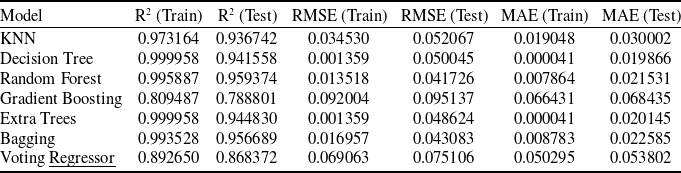
The results in Table 5 further evaluate model performance based on R2, RMSE and MAE. These metrics provide additional insights into model fit, predictive accuracy, and generalisation capability.
Prediction performance of machine learning models for deck conditions and grip number

The KNN model exhibits high R2 scores (0.973164 training, 0.936742 testing), alongside low RMSE (0.034530 training, 0.052067 testing) and MAE (0.019048 training, 0.030002 testing), demonstrating its strong predictive reliability. Similarly, the random forest model maintains low RMSE (0.013518 training, 0.041726 testing) and MAE (0.007864 training, 0.021531 testing), further confirming its robustness. Conversely, the gradient boosting model records relatively lower R2 scores (0.809487 training, 0.788801 testing) and higher error values (RMSE: 0.066431 training, 0.068435 testing), suggesting a need for further refinement through hyperparameter tuning. Notably, the voting regressor model’s performance is the weakest among the models analysed, with an underlined Regressor entry in Table 5 requiring clarification. If this formatting was unintentional, it should be rectified.
In summary, the random forest, KNN and decision tree models emerge as the most reliable predictors for this dataset, consistently achieving high accuracy across multiple evaluation metrics. In contrast, models such as gradient boosting and voting regressor require further optimisation to enhance predictive performance.
4.0 Discussion
This study conducted surface testing to assess the safety of helideck operations, specifically analysing the impact of old and newly refurbished deck conditions on helicopter landing performance. The findings indicate that the degraded condition of the old deck posed potential safety risks, as evidenced by performance losses that could compromise operational safety. However, following refurbishment, the coefficient of friction of the platform increased, ensuring compliance with the required safety standards for helicopter landings. These results underscore the necessity of routine deck assessments and the critical role of resurfacing in maintaining safety standards.
The data analysis highlights that while deck surface modifications do not directly influence helicopter handling performance during landing, they play a significant role in ensuring the helicopter’s stability on the helideck post-landing. Statistically significant differences were identified between the old and new helideck surfaces across multiple operational and environmental parameters, including landing direction, friction (grip number), water drainage behaviour, ambient temperature and altitude. These variations primarily reflect the influence of surface condition on friction performance, a key determinant of landing safety. Although ambient temperature and altitude (as a proxy for pressure) exhibited moderate correlations with friction, their relatively low importance scores in the machine learning model suggest that these parameters serve more as contextual indicators rather than direct causal factors. Notably, the introduction of a new surface coincided with shifts in these variables, likely due to concurrent environmental changes during the measurement period. Therefore, while temperature and altitude appear in the statistical analysis, their roles should be interpreted with caution and within the broader operational context. These findings reinforce the importance of deck surface quality and highlight the value of combining domain expertise with data-driven methods in offshore aviation safety assessments.
The results of the independent sample t-test provide strong statistical evidence supporting the impact of deck alterations on helicopter operations. The significant differences observed between the old and new deck conditions confirm that physical modifications to the surface directly influence operational performance. The high levels of statistical significance reinforce the necessity of deck refurbishment, primarily from a safety perspective, with potential implications for operational efficiency.
In conclusion, this study reaffirms the critical importance of regularly assessing deck conditions and undertaking refurbishment when necessary to ensure the safety of helicopter landings and take-offs. The study highlights that deck properties exert substantial effects on helicopter operations, necessitating standardised testing, precise analytical evaluation and routine maintenance to uphold safety standards. By systematically identifying and addressing deck deficiencies, helideck safety can be optimised, mitigating risks associated with degraded landing surfaces.
5.0 Conclusions
This study evaluated the friction coefficients of the helideck on a drillship used in natural gas exploration activities, with the objective of assessing the effects of deck conditions on helicopter adhesion performance and, ultimately, ensuring safe landings. The statistical tests conducted identified significant differences between the old and newly resurfaced deck conditions, demonstrating that the refurbishment brought the platform into compliance with safety standards and provided optimal conditions for helicopter operations. These findings underscore the necessity of regular testing and surface renewal to maintain safety standards.
The independent sample t-test results showed that there were statistically significant differences between the old and new surfaces in critical parameters such as the number of adhesions, water flow and temperature. Notably, substantial differences were observed in temperature and the number of holds, both of which directly influence the operational safety and performance of helidecks. The findings confirm that deck resurfacing improves friction performance, which is essential for ensuring safe take-off and landing operations.
Furthermore, correlation analysis revealed a strong positive relationship between helideck surface conditions and friction performance, indicating that improved deck conditions directly enhance helicopter deck handling capabilities. This finding reaffirms that optimising surface properties is crucial for the safe landing and take-off of helicopters. A higher number of holds contributes to greater control of helicopters, thereby enhancing operational safety.
In conclusion, this study highlights the significant impact of deck conditions on helicopter operations and reinforces the importance of regular testing and resurfacing to ensure safe landings and take-offs. The widespread implementation of similar testing procedures on comparable platforms would be a valuable step toward enhancing the safety of helicopter operations. Continuous monitoring and, when necessary, improvement of deck conditions can effectively minimise safety risks and contribute to increased operational efficiency.