




No CrossRef data available.
Spanish subject personal pronoun use in New York City Puerto Ricans: Can we rest the case of English contact?
Published online by Cambridge University Press: 01 March 2004
Abstract
The variable use of subject personal pronouns (SPPs) in null subject languages, though extensively researched in several Spanish dialects, is for the first time examined in a contact variety of Puerto Rican residents of New York City (NYC). In a large-scale study conducted by Flores-Ferrán (2002), a number of contradictions arose with regard to how the degree of exposure to NYC may mediate the influence of overt SPP use on speakers. The degree of exposure to NYC was considered as indirect contact with English. This article further analyzes how 41 Puerto Rican residents in NYC use overt SPPs, and it also describes the patterns of each group: the recent arrivals, established residents, and native-born NYC Puerto Ricans. Of the larger study, this article examines the verbs' person and number, switch reference, and exposure to NYC. A striking resemblance in the patterns of overt SPP use was found among NYC residents, as a group, when compared to those reported on the island (Ávila-Jiménez, 1995, 1996; Cameron, 1992). However, when considering years of exposure to the City, the NYC native-born group appeared to have the strongest tendency to use explicit SPPs. In spite of the fact that this distinction was found with the NYC native-born group, there remains little evidence in favor of an English contact hypothesis.This study has benefited from previous research conducted by Richard Cameron and Bárbara Ávila-Jiménez. I thank Richard for his insight, comments, and his continuous support throughout the years. I also express much gratitude to Ricardo Otheguy and Edward Bendix and the three anonymous reviewers whose sharp criticisms contributed to this work. All errors, of course, remain mine.
Information
- Type
- Research Article
- Information
- Copyright
- © 2004 Cambridge University Press
Spanish, as is the case of Portuguese, Turkish, Italian, and other languages, is known to be a pro-drop or null subject language, which means that speakers have the option of expressing a subject personal pronoun (henceforth SPP) or omitting it. A language such as English is not considered to be a null subject language, for in almost all instances SPPs must be expressed.
In general, studies on the variable use of overt SPPs have reported that linguistic factors, such as a switch in reference, the distance to the previous mention of the verb's subject, /-s/ deletion on 2nd person verbs, the verb's person and number, verb semantics, contrast and emphasis, and morphological ambiguity influence speakers' use of the null or overt form. These findings have been documented in several Spanish dialects of the United States, in Puerto Rico, the Dominican Republic, Madrid, Mexico, and in Latin America (Ávila-Jiménez, 1996; Barrenechea & Alonso, 1977; Bayley & Pease-Álvarez, 1997; Bentivoglio, 1980, 1983, 1988; Cameron, 1992, 1993, 1995; Enríquez, 1984; Flores-Ferrán, 2002; Flores & Toro, 2000; Henríquez Ureña, 1939; Hochberg, 1986; Jiménez-Sabater, 1975; López Morales, 1983, 1992; Morales, 1986, 1988, 1997; Pérez Sala, 1973; Silva-Corvalán, 1982, 1994).
There has been great debate as to how contact with English may be influencing speakers of Spanish in Puerto Rico and the United States mainland to produce redundant uses of SPPs. English does not have the same inflectional richness in its verbs as Spanish, and it requires almost all verbs to have an expressed subject. Therefore, although vivimos or nosotros vivimos are referentially equivalent in Spanish, speakers cannot alternatively use ‘We live’ and *‘(0) live’ to convey the same meaning in English.
Having stated that English has an almost obligatory use of SPPs, several nonvariationist researchers have suggested that Spanish speakers on the island of Puerto Rico are paralleling structures similar to those of English when they express overt SPPs in a redundant manner. These studies argue in favor of the permeability of syntactic structures (De Granda, 1978; Gili Gaya, 1959; Navarro, 1974).
But most sociolinguistic quantitative research conducted on the island and in the United States mainland (Ávila-Jiménez, 1996; Flores-Ferrán, 2002; Flores & Toro, 2000; Morales, 1986; Pérez Sala, 1973) has not found a correlation between the use of overt SPPs and exposure to English as hypothesized by the previously mentioned nonvariationist studies. What is consistently reported by variationist studies, however, is that the Spanish variety of Puerto Rico, as other Spanish varieties spoken in the Caribbean, shows higher rates of overt pronominal usage than non-Caribbean varieties (Cameron, 1992, 1993, 1995; Flores-Ferrán, 2002; Flores & Toro, 2000; Lipski, 1994; Morales, 1986, 1997; Pérez Sala, 1973; Silva-Corvalán, 1994).
Research conducted in Puerto Rico has documented English-contact induced change. Morales' (1986) research was able to find evidence of English influence in several syntactic structures. However, that same study was unable to find a correlation between the use of overt SPPs and the levels of exposure to English. Instead, Morales (1986) maintained that a switch reference operates as a pivotal factor in the use of SPPs. Morales (1986) also noted that the previous mention of the verb's subject also conditions the use of overt SPPs. In addition, Morales (1986) found evidence that new information resulted in higher use of overt SPPs, whereas old or repeated information favored null SPPs.
In Puerto Rico, Ávila-Jiménez's (1996) study also did not support the claim that English contact alone could account for higher use of overt SPPs among the young generation of participants in that study.
Pérez Sala (1973), in another variationist study conducted on island residents, arrived at a similar conclusion to that of Morales (1986). That research suggested that speakers express SPPs overtly to add emotional weight to an expression that could have been produced with a null subject. Pérez Sala also suggested that similar patterns of overt SPPs found in island residents also appeared in Spanish varieties of Madrid, Perú, Argentina, Bolivia, Ecuador, and Mexico, areas that were considered at the time to have little contact with English.
In another study conducted in Puerto Rico, Cameron (1992) argued that the realization of the SPP was strongly conditioned by several linguistic factors, among them, the switch reference.
On the mainland of the United States, Hochberg (1986) conducted a study that examined morphological ambiguity and its effect on pronominal expression in Puerto Ricans living in Boston. The results of that study showed that when the /-s/ in 2nd person singular verbs was dropped, functional compensation occurred. That is, speakers used SPPs at a higher rate because with the /-s/ deletion, the verb alone could not distinguish person. However, Cameron (1992) and Morales (1997) found evidence contrary to the hypothesis.
In short, variationist research conducted in Puerto Rico reveals that contact with English does not correlate with heightened use of overt SPPs, and that other linguistic factors play a stronger role in determining the selection of an overt or null form.
With respect to Spanish varieties of the United States mainland, findings of Silva-Corvalán (1994) and Bayley and Pease-Álvarez (1997) also revealed that English contact did not influence speakers of the Mexican Spanish variety in California to use more overt forms.
In sum, exposure to English has not been found to correlate with increased use of SPPs in the Spanish varieties spoken in the United States and in Puerto Rico.
It should be noted that with regard to research conducted on the variable use of SPPs, Flores-Ferrán's (2002) study is the most extensive of its kind that documents SPP expression in the Spanish variety of Puerto Rican residents of New York City. The study is also the most extensive study conducted in a language contact environment regarding this feature. For details of the extensive study, see Flores-Ferrán (2002).
In the research presented here, I discuss findings regarding the factors of the verb's person and number (henceforth, person and number), switch reference, and exposure to NYC (which is indirectly associated with English contact), and how these independent variables influence speakers' use of overt SPPs. I illustrate and discuss how the NYC residents as a whole and as three separate groups (recent arrivals, established residents, native-born NYC residents) use overt SPPs.
First, with regard to person and number, I examine the relative frequency with which speakers use overt SPPs and proceed to compare the findings in NYC to the findings reported in San Juan by Cameron (1992) and Ávila-Jiménez (1995, 1996), who conducted the two most recent sociolinguistic studies in San Juan. For the factor of switch reference, I also examine the relative frequency with which speakers in NYC signal a switch in reference and compare the results to those reported only1
Ávila-Jiménez (1995, 1996) examined switch reference, but constructed the switch reference factor group differently than Cameron's (1992) study. This made comparisons difficult. In addition, Ávila-Jiménez (1995, 1996) did not present varbrul weights for all tables, further limiting comparisons.
It should be noted that, although I discuss the factor of exposure to NYC as it may relate to indirect exposure to English, the problem addressed throughout the article is whether or not the almost categorical use of SPPs in English influences NYC speakers' use of more overt SPPs with regard to the verb's person and number and in switch reference environments when compared to residents of the island. If a positive influence is found, it should be detected in the relative frequencies and probabilities with which speakers express overt SPP when compared to those documented in Puerto Rico by Cameron (1992) and Ávila-Jiménez (1995, 1996). That is, the presence of the effect should be represented by more elevated uses of explicit SPPs in NYC, because I am comparing two different geographical yet parallel contexts. This positive effect would be suggestive of a contact hypothesis. If no effect that departs from previous research appears, then the absence of that effect should be detected in the similar frequencies, probabilities and/or patterns of pronominal expression found in the NYC residents. In this respect, if no apparent effect is found, it would be suggestive of a noncontact hypothesis, and we can thereby rest the case that suggests that exposure to life in the City plays a role in determining the selection of the explicit or null forms in NYC residents.
As will be shown in greater detail in the following sections, I present three arguments here that support a noncontact hypothesis. First, it will be demonstrated that NYC speakers as a whole tend to use overt SPPs in patterns similar to those documented in San Juan. Second, the frequencies and the strengths of the probabilities will also be similar to those reported by Cameron (1992) and Ávila-Jiménez (1995, 1996). And third, even though the native-born NYC residents tend to express more overt SPPs than the established residents or recent arrivals to the City, the NYC native-born Puerto Ricans do not strongly diverge from the patterns found in residents of the island (Ávila-Jiménez, 1995, 1996; Cameron, 1992). This set of conditions will lead to the conclusion that exposure to life in NYC does not correlate to heightened uses of overt SPPs in NYC. Admittedly, although there are some differences with regard to the frequencies with which the NYC native-born Puerto Ricans use this feature, there are far more striking similarities in the frequencies, probabilities, and patterns of pronominal expression within all three groups of residents examined in this study. It may well be that other factors may be playing a role in determining the choice that speakers make with regard to the overt or null SPP. The other suggested factors that may play a role in conditioning the use of the explicit or null form will be discussed in the latter part of this article.
The article first presents the demographics of the study, followed by a discussion on the envelope of variation, in which I explain how the data were analyzed. To illustrate the analysis, I use examples of naturally occurring speech from taped narratives. Second, I present and discuss the findings with regard to person and number and immediately proceed to compare these results with those documented in San Juan (Ávila-Jiménez, 1995, 1996; Cameron, 1992). Third, a discussion on switch reference is presented. I describe how the factor of switch reference was defined in this study, and provide examples of how the verbs were analyzed under this complex factor group. The results for this factor once again are compared to Cameron's (1992) study on pronominal usage and switch reference. And finally, I discuss the use of overt SPPs according to the degree of exposure to NYC. In this section, I discuss how recent arrivals, established residents, and native-NYC born participants express overt SPPs as separate groups and draw comparisons between these groups and the islanders.
DEMOGRAPHICS OF THIS STUDY
Following Labov's (1984) methods of sociolinguistic interviews, I interviewed 20 men and 21 women between the ages of 23 and 81 who were randomly referred to me during a six-month period. All the participants were asked to recount an incident that had an impact on their lives.
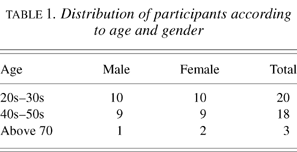
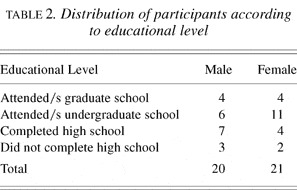
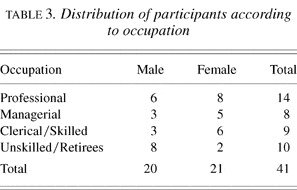
As seen in Table 1, the majority of participants were between 20 and 59 years old. The education level of the participants was slightly different between males and females (Table 2). More females had college experience than did the males. Participants in the professional category were in banking, teaching, TV reporting, nursing professions, and so forth (Table 3). The managerial category was reserved for participants who supervised people. The skilled category included printers, clerks, postal workers, and so forth. The unskilled category was used mainly for delivery workers, supermarket staff, doormen, maintenance workers, or unskilled retirees.
Distribution of participants according to age and gender

Distribution of participants according to educational level

Distribution of participants according to occupation

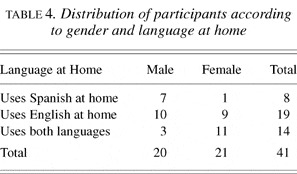
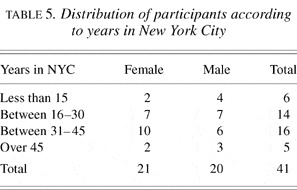
Participants self-reported the information appearing in Table 4. The majority of participants were in daily contact with English at home. Those who claimed to use only Spanish were still in daily contact with English, because they worked in bilingual settings. In Table 5, we find that the majority of participants had lived in the City for 16 to 45 years.
Distribution of participants according to gender and language at home

Distribution of participants according to years in New York City

THE ENVELOPE OF VARIATION
The envelope of variation refers to the set of environments within which the SPPs are said to vary or to constitute a linguistic variable. In this study, the envelope of variation was defined as a tensed verb whose [+human] subject can be either a null or expressed SPP. If the alternation could not occur, the verb was excluded from the analysis.
The examples that follow represent instances in which a speaker had the option of expressing the overt SPP or omitting it in the Spanish variety of Puerto Rico:
(1) Yo (a) quiero que tú (b) sepas que nosotros te (c) ibamos a botar como bolsa.
‘I want you to know that we were going to throw you out like a bag.’ (Participant #27)
In (1), the speaker had the option of using all three verbs (a) quiero, (b) sepas, and (c) ibamos without the overt SPP. In this example, all three verbs were entered in the analysis because they represented a site where the variable use of SPPs existed.
(2) Y de regreso (a) me acordé que (b) tenía un montón de correspondencia en casa de mi amigo José xxx de los bancos, y eso porque (c) tuve que poner la dirección de el. Él me (d) ayudó muchísimo.
‘and upon returning, [I] remembered that [I] had a bunch of mail in the house of a friend, José xxx of the banks, and that was because [I] had to address things to his place. He helped me a lot.’ (Participant #27)
In (2), the same speaker used null forms with verbs (a) acordé, (b) tenía, and (c) tuve, but used an overt 3rd person SPP in verb (d) ayudó. All four verbs were entered in the analysis because the option of expressing a null or overt form existed in each case.
There are certain environments, however, where SPPs must be obligatorily expressed. Therefore, the verbs in the following examples were not included in the analysis:
(3) Él llegó tarde pero ella no dijo nada.
‘He arrived late but she didn't say anything.’ (Participant #8)
In (3), the verb llegó was entered in the analysis because it represented a site where the variation could take place. However, the verb dijo did not enter the analysis because the speaker had to use the overt form obligatorily to preserve the meaning and contrast with the competing 3rd person Él. Without the overt expression of ella, the verb dijo would be interpreted as having él as its subject, as in (3a):
(3a) El1 llegó tarde pero no 01 dijo nada.
Therefore, clauses like (3) with pero + NP2 Verb did not enter the analysis.
Instances in which the use of a null SPP was the only option were also omitted from the analysis:
(4) Muchos amigos míos que son policías …
‘Many friends of mine that are policemen’ …
Here an expressed SPP produces:
(4a) *Muchos amigos míos que ellos son policías …
In Spanish, in general, including the Spanish variety spoken in Puerto Rico, (4a) is not considered grammatical.
As previous studies have indicated (Bayley & Pease-Álvarez, 1997; Cameron, 1992; Silva-Corvalán, 1994; Otheguy & Zentella, 2000), there are specific uses of certain verbs in which pronouns are obligatorily expressed or are obligatorily absent. These particular verbs, in which the alternation could not have existed, were also excluded from the analysis:
Nonpersonal subject as:
(5) Eso duró tres años.
‘That lasted three years’. (Participant #1)
Existential verbs haber as:
(6) Hay que trabajar mucho.
‘One has to work a lot.’ (Participant #8)
Verbs with inanimate subjects such as:
(7) Faltaban dos horas para los bancos cerrar y ellos cierran a las tres.
‘There were two hours before the banks closed and they close at 3.’ (Participant #7)
Verbs with nonpersonal pronouns such as:
(8) Eso no es así.
‘That's not the way it is.’ (Participant #7)
Verbs with uno as their subject such as:
(9) Uno no se imagina …
‘You cannot imagine …’ (Participant #24)
Verbs with impersonal se such as:
(10) En Puerto Rico se vive muy bien.
‘In Puerto Rico [one] lives well.’ (Participant #41)
Verbs that had subjects referring to atmospheric conditions as:
(11) Hace calor en Florida.
‘It is hot in Florida.’ (Participant #3)
Verbs in pseudo-cleft constructions in which the SPP falls to the right of the verb (D'Introno, 1989) as in:
(12) La que me voy soy yo.
‘The one who is leaving is me.’ (Participant #8)
Verbs in constructions of contrast with pero as in:
(13) Ellos optaron por el suicidio pero ellas no pensaron igual.
‘They opted for suicide but they didn't think the same way.’ (Participant #16)
The subject of the verb pensaron must be expressed in this sentence because the referents are not the same. In this instance, the verb pensaron is excluded from the study.
(14) El redujo la velocidad pero siguió tocando bocina …
‘He reduced the speed but kept on honking his horn.’ (Participant #19)
The subject of siguió is the same as that of redujo. Variation can exist with siguió.
Verbs in constructions where the pronoun is expressed with mismo as in:
(15) El mismo me lo dijo.
‘He himself told me.’ (Participant #30)
Subject headed relative clauses:
(16) Muchos amigos míos que son policías.
‘Many of my friend that are police officers.’ (Participant #40)
Set phrases:
(17) Qué sé yo. ‘What do I know?’
¡No chaves! ‘Don't bother me.’
The varbrul program, commonly used for variationist research, was also used in this study to analyze over 15,000 tokens. The dependent variable was identified as the overt or null SPP, and in the binomial application of varbrul, the probabilities were defined relative to the occurrence of the overt SPP. A probabilistic weight of above .50 was considered as favoring the presence of the overt SPP, and a weight lower than .50 was considered as disfavoring the use of the overt form. Generally speaking, .50 is considered as an absence of an effect. However, it is important to note that a value of .50 relative to a value of .42, for example, can also be interpreted as showing a stronger probability, and therefore a higher favoring of overt SPPs. Likewise, a value of .75 relative to .65 can also be interpreted as showing a stronger probability, and therefore a higher favoring of overt SPPs. In general, we can consider that the probabilistic weights also serve to indicate a degree of strength that the independent variable has on the use of the dependent variable, the overt SPP. For varbrul see Paolillo (2002).
Unless otherwise indicated, the significance value of all runs in Flores-Ferrán's large-scale study was (p < .0001). The p value represents the probability that the results obtained were due to chance. The log likelihood for the best run was found to be equal to −8900.612, with a chi-square of 1.390 per cell. Chi-square values have been omitted from the tables that show comparisons between two or more studies.2
Every table showing cross-tabulations between two factor groups of this study, however, have chi-square values explicitly indicated.FINDINGS
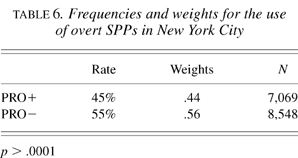
To begin, Table 6 shows the frequencies and weight probabilities of overt SPP (PRO+) expression for the entire group of NYC residents who participated in the study. In general, Table 6 shows that at .44, the Puerto Rican residents of NYC, as a group, do not tend to favor the use of overt SPPs, but rather favor the null form at .56, a tendency found in most Spanish varieties. We can assume then, at this point, that a shift in the tendency favoring the use of overt SPPs would have indicated a departure from most Spanish varieties.
Frequencies and weights for the use of overt SPPs in New York City

Even though there were differences in the agendas of these two studies with regard to the number and types of factors examined,3
Flores-Ferrán's (2002) complete study examined over 15 different linguistic and social factors. Of these, four factors were identically constructed and coded according to Cameron's (1992) study: switch reference, person and number, gender, and degrees of bilingualism.
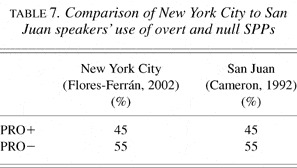
Comparison of New York City to San Juan speakers' use of overt and null SPPs

PERSON AND NUMBER
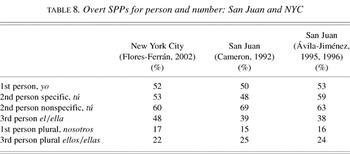
In Table 8, comparisons of the frequencies of overt SPP use among NYC and San Juan residents are made with the purpose of determining the differences between the two geographic areas, if any.
Overt SPPs for person and number: San Juan and NYC

A number of interesting points can be drawn from Table 8. First, the NYC speakers as a whole do not tend to deviate from the current patterns of pronominal expression when compared to speakers residing on the island. The NYC group tends to produce overt SPPs within or below the range of frequencies of these two studies, with the exception of 3rd person SPPs. Second, there are similar patterns found in the order or rank in which the frequencies appear. For instance, Ávila-Jiménez' (1995, 1996) and Flores-Ferrán's (2002) studies showed identical ordering: 2nd person nonspecific tú,4
Nonspecific tú is considered ‘one’, whereas specific tú is considered as ‘you’.
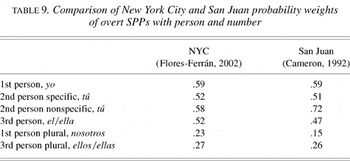
There are two observations that need to be made with respect to the frequencies in Table 8, however. First, there seems to be a slight difference in the frequencies with which speakers use 2nd person nonspecific tú. Cameron's (1992) study shows 69%, whereas Flores-Ferrán (2002) shows 60%. But note that even though we find slight differences, we still see that all three studies show a higher frequency in the use of the nonspecific tú than of specific tú. Furthermore, the frequency found in the NYC residents is not higher than that found in the other two studies. Note that the frequency is not working in the direction of a contact hypothesis. Second, there also seems to be a slight difference with regard to the use of 3rd person el/ella. The NYC group uses higher frequencies than those reported in both San Juan groups. This difference requires further examination.
If we observe the probabilistic weights reported for nonspecific tú and 3rd person el/ella, reported by Cameron (1992) and Flores-Ferrán (2002), more similarities than differences can be uncovered.
The varbrul weights in Table 9 show that for the use of overt 3rd person el/ella the islanders have a probability weight of .47, disfavoring the use of overt 3rd person el/ella, whereas the New Yorkers have one of .52, which represents a stronger probability in favor of the overt expression. Relative to .47, this .52, although not a very big difference in the strengths, suggests a positive effect with regard to the use of overt SPPs in the 3rd person in the NYC group. But, at this point, we cannot distinguish if this difference is correlated to increased exposure to NYC. Therefore, I will revisit the discussion regarding 3rd person SPPs later in this article.
Comparison of New York City and San Juan probability weights of overt SPPs with person and number

In Table 9, however, we are still left with the most marked difference in the probability weights of nonspecific tú. NYC speakers have a .58 probabilty of expressing the nonspecific pronoun overtly, whereas the islanders have a much stronger probability, .72. This difference in the probability weights does not favor a contact hypothesis, but suggests that perhaps this gap exists in part because of the differences in the type of corpora analyzed when examining the use of overt SPPs with 2nd person nonspecific tú.5
Whereas the corpora of my study consisted of oral narratives produced by individual speakers who were interviewed by me alone, Cameron (1992) used oral interviews and narratives with small groups and individual speakers. It may well be that the topic of the conversation generated the use of ‘one’, the nonspecific tú form, or that the three-way conversations may have produced more of the other form. In the narratives produced in this current study, the speakers were only addressing me and had less need to produce the specific tú. Rather, they mostly were using the nonspecific or generic tú form as they narrated their stories or lectured me about their particular opinions.
In sum, although it is understood that varbrul weights and frequencies cannot be compared on a strictly equivalent basis, because these three studies contained different factor groups, the similarities found in the use of overt SPP for person and number are striking. Thus, and in general terms, it seems reasonable to assume that the NYC group, although separated by distance and exposed to an urban environment where English is spoken, seems to have similar patterns of overt SPP usage when compared to their counterparts on the island.
Before turning to switch reference, I would like to revisit the observation made regarding the use of 3rd person SPPs, because the large study further examined the use of overt and null SPPs with regard to 3rd person in more detail. Because 3rd person pronouns el and ella use the same morphological endings in their verbs, I hypothesized that potential interference may influence speakers use of overt 3rd person SPPs in their narratives. Therefore, a factor group named Competition or Potential Interference between previously overtly mentioned 3rd person singular subjects was constructed in Flores-Ferrán (2002). The purpose of this factor was to determine whether contexts with two or more 3rd person singular subjects in previously mentioned verbs tend to produce more appearances of overt SPPs in the verb under study. The rationale behind this factor was that the two or more 3rd person subjects in the same narrative would create an environment of potential referential ambiguity. Contrary to my hypothesis, an initial varbrul run in a step-down analysis asked for this factor group's removal. That is, the results showed that there was no connection between the use of multiple 3rd persons subjects in a narrative and the high or low numbers of overt 3rd person SPPs.
SWITCH REFERENCE
A factor that has been shown to condition the use of overt SPPs in a significant and systematic manner is that of switch reference, found across Spanish dialects (Cameron, 1992, 1995; Ávila-Jiménez, 1996; Bayley & Pease-Álvarez, 1997; Flores-Ferrán, 2002; Morales, 1986; Silva-Corvalán, 1982, 1994) and also other languages (Eid, 1983; Enç, 1986; Lira, 1982).
In search for evidence of contact showing that the NYC residents studied here have altered their use of pronominal expression because of their exposure to the City, I questioned whether or not a switch in reference influenced speakers' use of overt SPPs, and I also questioned if the patterns of pronominal expression were similar to those documented on the island. I hypothesized that if differences were found, they could be attributed to the degree of exposure to NYC.
DEFINING SWITCH REFERENCE AND HOW THE DATA WERE ANALYZED
Cameron's (1992, 1995) study conducted in Puerto Rico constitutes a valuable contribution to any study related to the variable use of SPPs. That study showed that a switch in reference has a robust effect on the use of overt SPPs. Therefore, Cameron's (1992) terminology and formula were used to analyze the data in this present study with the purpose of providing a point of comparison for the NYC data:
… two related reference relations that may hold between two NPs. When these two NPs have different referents, they are ‘switch’ in reference. When these two NP's share the same referent, they are ‘same’ in reference. (1992, p.117)
The relationship of switch and same reference for this present study was defined between two NPs where the second NP is the [+human] subject of a tensed verb that occurs after and nearest to another subject NP of a tensed verb. Following Cameron's (1992) terminology, NP (1) is known as the trigger and NP (2) as the target. The target is the subject NP that is marked as either switch or same with respect to the trigger. For the purposes of comparison, I strictly adhered to Cameron's (1992, 1995) formula:

The NYC narratives for switch reference analysis were coded using the following:
0 = There is no trigger (for beginning of discourse)
1 = The target NP referent is the same as the trigger NP
2 = The target NP referent is not the same as the trigger NP
3 = The target NP referent is a subset of the trigger NP
4 = The trigger NP referent is a subset of the target NP
Examples of how a switch referent was analyzed and coded:

In example (17), when we compare the target NP of verb (b) contesta to the NP of the trigger (a) estaba, we find that there has been a switch in reference from mami to yo, and therefore contesta was coded with factor 2 (switch in reference). However, when we compare the target NP in verb (c) dice, to the NP trigger (b) contesta, we find that both NPs refer to the same subject, ella and mami. Therefore, (c) dice was coded as same in reference (factor 1). When we compare the NP target in (d) estás to its trigger NP found in (c) dice, we find that the NP for (d) estás is the null 2nd person specific tú, whereas the NP for (c) dice, is the null form 3rd person, ella. Therefore, the verb (d) estás was coded with factor 2, as a switch reference.
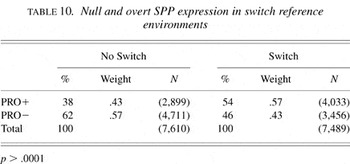
Table 10 shows higher frequency and probability weights for the use of overt SPPs in a switch reference environment. In instances where there is no switch, speakers expressed only 38% of their SPPs overtly. The strength of this frequency is represented by .43 varbrul weight. Said differently, when there is not a switch reference, speakers tend to favor null SPPs. However, when there is a switch reference, there is a stronger probability (.57) that speakers will use an overt SPP. That is, when a switch occurs, speakers favor the use of an overt form. This pattern was also reported by scholars in the United States, the Caribbean, Mexico, Spain, and Latin America, which suggests that a switch reference conditions the use of overt SPPs. In sum, a switch reference in NYC does show a robust effect on pronominal expression.
Null and overt SPP expression in switch reference environments

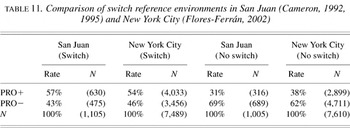
We now turn to a comparison of switch reference findings in NYC and San Juan. In Table 11, we see that the frequencies of overt SPP expression resemble those documented in San Juan. First, and in general, both groups show higher rates of overt SPPs in a switch reference, and lower rates in a nonswitch environment. Second, we find that in a switch, the San Juan speakers expressed 57% of their SPPs overtly, whereas the NYC group expressed 54%, a close proximity. A similarity also exists in the use of overt SPPs in a nonswitch environment. The NYC group expressed overt SPPs in a nonswitch environment in 38% of their verbs, while the San Juan residents did so for 31%. Although the patterns are similar, the NYC group tends to express more overt SPPs in a nonswitch environment (38%) than the islanders (31%). This observation may require further examination.
Comparison of switch reference environments in San Juan (Cameron, 1992, 1995) and New York City (Flores-Ferrán, 2002)

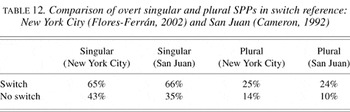
But before further examining the nonswitch environment of the NYC group, a comparison of singular and plural verbs in a switch reference environment is in order. Table 12 also shows striking similarities in the frequencies with which overt SPPs are expressed in a singular and plural context. Notice, however, that in nonswitch instances, the NYC group shows higher frequencies of singular and plural overt SPPs than the islanders. Further discussion is also needed with regard to this observation.
Comparison of overt singular and plural SPPs in switch reference: New York City (Flores-Ferrán, 2002) and San Juan (Cameron, 1992)

Before continuing, I need to address the questions asked earlier: Does a switch in reference exert an influence on the use of overt SPPs in the NYC group? The response is positive; a switch in reference does exert an influence on the use of overt SPPs in NYC. Furthermore, the patterns of pronominal expression are similar to those documented in San Juan (Cameron, 1992). When I address the second question regarding the relative frequencies of overt SPP expression and whether or not the NYC group exceeds the frequencies found in San Juan, I find that the only distinction that can be made is that the NYC group tends to use more overt SPPs in a nonswitch reference environment. At this point, I cannot find evidence of a change with regard to this factor, unless I address how the three separate groups of residents use overt SPPs in this environment.
To further examine this finding, we now look at how the three distinct groups, the recent arrivals, the established residents, and the NYC native-born, use SPPs in a switch reference environment. In this analysis some gaps begin to emerge in the data, in particular, with the NYC native-born group.
EXPOSURE TO NEW YORK CITY AND SPP USE: IS THERE EVIDENCE OF A CHANGE IN PROGRESS?
Recall that I used Cameron's (1992) formula for defining a switch reference for analyzing the corpora. I hypothesized that residents of NYC would show similar patterns of overt pronominal expression to those in San Juan, providing that the NYC group had not been affected by their exposure to NYC, which I can indirectly associate to English contact. In Tables 7, 8, 9, 10, 11, and 12, when comparisons between the NYC group and the islanders were drawn, similar patterns of SPP expression were found, as well as similar frequencies and probability weights with regard to person and number, switch reference, and the use of overt singular and plural SPPs in switch reference. But earlier in the article, it was also mentioned that if heightened use of overt SPPs were detected and those frequencies and/or probabilities exceeded those already documented in San Juan, then this would be considered a sign of divergence, pointing towards a contact hypothesis. I discovered that for nonswitch reference, the realization of the overt SPP in the New Yorkers was seen at a frequency of 38%, whereas the islanders showed only a 31% frequency. The question I need to address now is whether or not this difference detected is sufficient to claim that degree of exposure to NYC can be correlated to the use of overt SPPs.
When constructing the factor group that examined the indirect exposure that a NYC resident might have to English, I had to take into account several subfactors that were self-reported. Still, these factors indirectly address the matter of English contact. The factor of exposure to NYC was coded as: Degree of exposure to NYC, wherein absences away from the City were not subtracted from the total years:
- N = speaker has lived in NYC since birth and had any 5 of the first 8 years of education in the United States (native-born New Yorker)
- E = speaker has lived in NYC more than 16 years (established resident)
- R = speaker has lived in NYC between 0 and 5 years (recent arrival)
Total years in NYC, wherein absences from the City were subtracted from the total years:
- 1 = less than 15 years
- 2 = between 16 and 30 years
- 3 = between 31and 45 years
- 4 = more than 45 years
Age of arrival to NYC was coded with:
- B = born in NYC
- C = child until 12 years
- T = teen from 13 to 19 years
- A = adult more than 20 years
Language at home was coded with the following schema:
- E = English
- S = Spanish
- B = Both
The only factor group to survive the step-up/step-down analysis of the varbrul program was that of exposure to NYC, which did not take into account the time that a participant may have left NYC to go to Puerto Rico on vacation or left NYC for a period of time to live elsewhere. One reason why the distinction was made regarding the factor groups of degree of exposure and total years in NYC was that older participants could not identify the exact years they had spent away from the City. The nonsignificance of age of arrival, language spoken at home, and whether one arrived as a child or at an older age shows that these three categories are immaterial for describing an account of indirect English contact. However, some observations can be made if we examine the only surviving factor in this category.
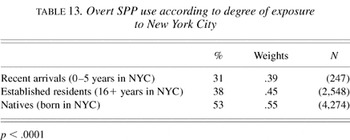
Table 13 shows that only the NYC native-born group (at .55) has a probability of using more overt SPPs with their verbs than the other two groups. That is, the recent arrivals and the established residents do not show a probability weight that favors the dependent variable, the overt SPP (.39, .45). Furthermore, there is an increase in the progression of the frequencies and probability weights as degrees of exposure increase. This finding with regard to native NYC-born Puerto Ricans and their tendency to use more overt SPPs needs further discussion, for it appears to favor a contact hypothesis. But first, I will compare research documented in San Juan, Boston, and New York and then discuss in more detail how these comparisons may relate to the results found with the NYC native-born group reported in Flores-Ferrán (2002).
Overt SPP use according to degree of exposure to New York City

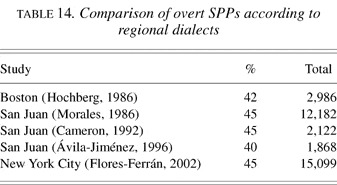
I use Table 14 as a point of reference to enable us to see at a glance if the NYC group's frequencies diverge from other studies. In Table 14, the NYC group as a whole shows a similar frequency of overt SPP expression to those documented in Boston and San Juan. Now I would like to further address why the NYC native-born Puerto Ricans may be exceeding in the frequencies. Recall that in Table 13 the NYC group was shown to use 53% of its SPPs overtly. By cross-tabulating the factor group of degree of exposure to NYC and the factors of switch reference and the use of singular and plural subjects, we find that, on the surface, some data may support the contact hypothesis.
Comparison of overt SPPs according to regional dialects

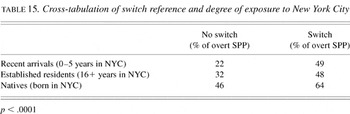
I ran a cross-tabulation of the factors of switch reference and degree of exposure to NYC. In Table 15, one sees that the NYC native-born group does express more overt SPPs in a nonswitch environment than the established residents and the recent arrivals. This frequency also exceeds the frequency reported by Cameron (1992), which was 31%. Therefore, although the established and recent arrivals remain within or close to the boundaries of previously reported research, the native NYC-born Puerto Ricans do not. But a closer look shows that there is an increased progression in the frequencies of pronominal expression for the nonswitch environment, but not in instances of switch. This is the first contradiction that emerges, in that the recent arrivals and the established residents show very similar frequencies (49% and 48%, respectively).
Cross-tabulation of switch reference and degree of exposure to New York City

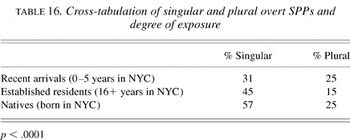
Table 16 once again shows that the NYC native-born group leads in the use of overt singular SPPs at 57%. We also see an increased progression in the frequencies that match the degree of exposure for the use of singular SPPs. However, we do not find that for plurals the same pattern holds. That is, the native-born New Yorkers and the recent arrivals show identical frequencies in the use of overt plural SPPs (25%), a concern that does not point toward a contact hypothesis. It should be noted that previous studies (Barrenechea & Alonso, 1977; Bentivoglio, 1980; Cameron, 1992; Enríquez, 1984; Morales, 1986) have reported that plural subjects show a much lower rate of SPP expression than do singular subjects; therefore, in that sense, the NYC native-born group seems to follow patterns documented in other studies.
Cross-tabulation of singular and plural overt SPPs and degree of exposure

In sum, the explanation that states that the increased progression in the frequencies of overt SPP expression parallels years of exposure can no longer be used to support a contact hypothesis, because this is the second instance in which this inconsistency appears. If English were to be indirectly influencing Puerto Ricans who are NYC native-born, then we should be seeing increased uses of overt SPPs in plurals also because it is expected that the almost categorical use of overt plural SPPs in English may also influence NYC speakers to use more overt plural SPPs in Spanish, regardless of number.
If we go back to Table 15, one can also see that the NYC-born residents tend to express more overt SPPs in almost half of their verbs (46%), even when a switch in reference has not occurred. This observation lends itself to the question of whether the NYC native-born group is arriving at the stage of expressing overt SPPs with and without a switch. This parallel use of the overt form may suggest that perhaps the strategy for signaling a switch may be what is being altered as a consequence of indirect exposure to English, an observation that is outside the scope of this study and would need further investigation.
Because we now know that the NYC native-born group shows a stronger tendency to use overt SPP in both switch and nonswitch references, we should then compare the NYC native-born group with the San Juan speakers. I draw on these comparisons to see if there are any similarities with respect to switch reference, as the participants in this study are exposed to NYC English.
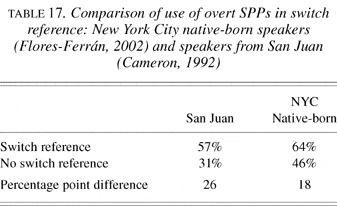
In Table 17, note that both groups have a tendency to express higher rates of SPPs in a switch reference, and both decrease frequencies in a nonswitch environment. However, one can see that the San Juan group makes a clear distinction of expressing overt SPPs in a switch versus a nonswitch, as there is a 26 percentage point gap. The NYC native-born group, on the other hand, has only an 18 percentage point gap difference between switch and nonswitch instances. One may consider this gap of 18% to be a signal indicating that the NYC native-born group does not clearly make the distinction of using overt SPPs in switch as the San Juan group does; however, the 26% to 18% difference is not very robust. It should be noted that, with regard to Madrid Spanish, Cameron's (1992) study also found a 19% difference in the use of overt SPPs between a switch and nonswitch environment. Therefore, the 18% difference on the surface does not necessarily point toward a change in a switch reference strategy.
Comparison of use of overt SPPs in switch reference: New York City native-born speakers (Flores-Ferrán, 2002) and speakers from San Juan (Cameron, 1992)

CONCLUSION
In this article, I explained how a group of NYC Puerto Ricans use overt subject personal pronouns in oral narratives, and I examined how their use of overt SPPs was conditioned by the factors of the verb's person and number, switch reference, and the degree of exposure to NYC. The problem addressed in this research was to determine whether or not the use of overt SPPs was affected by the NYC residents' degree of exposure to NYC. Based on initial results, it was found that NYC Puerto Rican residents express overt SPPs in patterns, frequencies, and probability weights similar to those reported on the island. As a group, the NYC residents did not diverge from patterns found for speakers residing on the island.
Based strictly on the facts presented here, there is more evidence in this study that points toward a noncontact hypothesis than to a contact hypothesis. To substantiate this claim, I will outline the findings:
- With regard to the factor of person and number, Puerto Rican residents of NYC used overt SPPs below or in the range of frequencies of those studies reported in San Juan.
- When further examining the factor of person and number, the ordering or rank of overt SPPs was identical to the frequencies reported by Ávila-Jiménez (1996).
- With regard to the factor of switch reference, the NYC group appeared with frequencies and probability weights of SPP expression that resembled those documented by Cameron (1992). Furthermore, the patterns in the expression of overt SPPs were the same.
- With regard to singular and plural SPP expression in a switch reference environment, the NYC group produced identical frequencies of SPP expression.
- The factor groups of switch reference and person and number in this study initially were not loosely constructed. They were constructed in the same manner as Cameron's (1992) study. Therefore, the comparisons made between the two studies are accurate comparisons made between two distinct geographical regions.
I also suggested that if a positive effect were found in the use of overt SPPs with regard to the factors of person and number and switch reference, then we would be able to detect that effect by seeing elevated frequencies in the use of the feature under study, but none were found.
Two findings that emerged may favor the contact hypothesis:
- The NYC native-born was found to have the highest probability of overt SPP expression.
- The NYC native-born residents also showed higher frequencies of expression in a nonswitch environment.
With regard to the latter point, in Madrid Spanish, Cameron (1992) also found a small gap in the use of overt SPPs in a switch and nonswitch environment. Therefore, this observation is not an indication of any one tendency.
I would like to further address the former point regarding the NYC native-born because this group expressed more overt SPPs than its local counterparts. The NYC native-born group is considered to be a bilingual group, because participants may have been exposed to NYC all their lives. Yet, the direct means to further analyze this group do not exist, because the other accompanying factors—language spoken at home, age of arrival, and years in NYC (which subtracted absences from this City)—were removed from the statistical runs. Therefore, we need to question if the only surviving factor group that did not include time spent outside of NYC can accurately portray a picture of indirect English contact, because within the results, several contradictions emerged.
Two strong contradictions that emerged suggested that the degree of exposure to NYC did not parallel the increased use of overt SPPs:
- The recent arrivals and the established residents had similar frequencies of overt SPP expression in a switch reference. The recent arrivals had the higher of the two frequencies.
- NYC native-born and the recent arrivals expressed plural SPPs with identical frequencies.
If data showing that the degree of exposure consistently produced heightened uses of overt SPPs, then the data would have substantiated a claim pointing toward a contact hypothesis. Also recall that the factor group that produced the NYC native-born category did not take into account the time the participants spent traveling or living outside NYC, and perhaps this observation may explain why this factor group survived the analysis. It was self-reported data and participants may have not provided accurate accounts to this effect. The factor that accurately measured the years in NYC, excluding absences or travel or staying in the island over summer, had to be removed from the runs.
Furthermore, the manner in which the degree of exposure to NYC is defined cannot solely be considered a sign of indirect exposure to English. If that were the case, it would also represent a sign of indirect exposure to other Spanish varieties in NYC. For example, Dominican Spanish is spoken by many NYC residents and that community is in daily contact with Puerto Rican residents of NYC. They coexist in the same island of Manhattan in large numbers where this study took place. Because Dominican Spanish has been documented as having one of the highest rates of pronominal expression in Spanish (Flores & Toro, 2000; Lipski, 1994), it may well be that contact with the Dominican variety mediates the influence of overt SPPs in the NYC native-born Puerto Ricans. But this study did not address the problem of exposure to NYC as it relates to other Spanish varieties.
Chambers (1992) suggested that people who immigrate to different dialect areas will not show similar acquisition patterns of complex features of a new dialect. Although the use of overt SPPs may not represent a complex feature, in that the use of the overt form does not violate grammar rules and it is a variable feature, it is difficult to say at this point whether or not the contradictions found in the NYC native-born with respect to overt SPP usage are a reflection of the varying degrees of acquisition. What was consistent throughout this study was that no evidence of innovative uses of overt SPPs were found in the NYC native-born participants, the established residents, or the recent arrivals.
Another aspect of this research that is absent is the effect of early bilingualism of the NYC native-born group, a concern that was not within the scope of this study. And to that effect, early contact with other Spanish dialects should also be examined.
According to Thomason and Kaufman (1988),
In order to support a claim that feature X arose in a language A under the influence of language B, we need to show that features a,b,c,y,z—at least some of which belong to a subsystem different from the one X belongs to—also arose in A under the influence of B. (p. 61)
We know through previous research that there is evidence of contact in the Spanish of Puerto Ricans in New York (Klein, 1980; Pousada & Poplack, 1982; Torres, 1997; Zentella, 1997). The general picture presented is that English is widely used by New York Puerto Ricans, and the lexicon is generally affected. But few studies have argued in favor of linguistic changes in the Spanish of Puerto Ricans in the City. For example, Pousada and Poplack (1982) did not find a significant difference in the tense-mood-aspect system of NYC Puerto Ricans. Zentella (1997), for example, was also able to document a full array of verb tenses in children. In a preliminary study of contact, Flores and Toro (2000) were unable to find a correlation between the use of overt SPPs and English contact. This study examined several Spanish dialects, including Puerto Ricans in NYC.
From this present study, it appears that there is insufficient evidence that favors the case of whether or not the degree of exposure to NYC can be correlated with increased uses of overt pronominals in the Spanish of Puerto Ricans in NYC.
References
REFERENCES
Ávila-Jiménez, Bárbara.
(1995).
A sociolinguistic analysis of a change in progress: Pronominal
overtness in Puerto Rican Spanish.
Cornell Working Papers in Linguistics
13:25–47.Google Scholar
Ávila-Jiménez, Bárbara.
(1996).
Subject pronoun expression in Puerto Rican Spanish: A
sociolinguistic, morphological, and discourse analysis.
Doctoral dissertation,
Cornell University.
Barrenechea, Ana, &
Alonso, Alicia.
(1977).
Los pronombres personales sujetos en el Español hablado en
Buenos Aires. In
L. Blanch (ed.),
Estudios sobre el español hablado en las cuidades
principales de América.
Mexico City:
Universidad Nacional Autónoma de México.
33–349.
Bayley, Robert, &
Pease-Álvarez, Lucinda.
(1997).
Null pronoun variation in Mexican-descent children's narrative
discourse.
Language Variation and Change
9:349–371.Google Scholar
Bentivoglio, Paola.
(1980).
Why canto and not yo canto? The problem of first-person subject
pronoun in spoken Venezuelan Spanish.
Master's thesis,
University of California, Los Angeles.
Bentivoglio, Paola.
(1983).
Topic continuity and discontinuity in discourse: A study of spoken
Latin-American Spanish. In
T. Givón (ed.),
Topic continuity in discourse: A quantitative cross-language study.
Amsterdam:
Benjamins.
259–312.
Bentivoglio, Paola.
(1988).
La posición del sujeto en el español de Caracas: Un
análisis de los factores lingüísticos. In
R.M. Hammond &
M.C. Resnick (eds.),
Studies in Caribbean dialectology.
Washington, DC:
Georgetown University Press.
13–23.
Cameron, Richard.
(1992).
Pronominal and null subject variation in Spanish: Constraints,
dialects, and functional compensation.
Doctoral dissertation,
University of Pennsylvania.
Cameron, Richard.
(1993).
Ambiguous agreement, functional compensation, and non-specific
tú in the Spanish of San Juan, Puerto Rico, and Madrid,
Spain.
Language Variation and Change
5:305–334.Google Scholar
Cameron, Richard.
(1995).
The scope and limits of switch reference as a constraint on
pronominal subject expression.
Hispanic Linguistics
6/7:1–27.Google Scholar
Cameron, Richard.
(2000).
Language change or changing selves? Direct Quotation strategies in
the Spanish of San Juan, Puerto Rico.
Diachronica XVII
2:249–292.Google Scholar
D'Introno, Francesco.
(1989).
Empty and full pronouns in Spanish.
Hispanic Linguistics
3:27–47.Google Scholar
De Granda, Germán.
(1978).
Estudios lingüísticos hispánicos,
afrohispánicos y criollos.
Madrid:
Gredos.
Eid, Mushira.
(1983).
On the communicative function of subject pronouns in Arabic.
Journal of Linguistics
19:287–303.Google Scholar
Enç, Murvet.
(1986).
Topic switching and pronominal subjects in Turkish. In
D. I. Slobin &
K. Zimmer (eds.),
Studies in Turkish Linguistics.
Amsterdam:
Benjamins.
196–207.
Enríquez, Emilia V.
(1984).
El pronombre personal sujeto en la lengua española hablada
en Madrid.
Madrid:
Consejo Superior de Investigaciones Científicas.
Flores-Ferrán, Nydia.
(2002).
A sociolinguistic perspective on the use of subject personal
pronouns in Spanish narratives of Puerto Ricans in New York City.
Munich:
Lincom-Europa.
Flores, Nydia, &
Toro, Jeannette.
(2000).
The persistence of dialect features under conditions of contact and
leveling.
Southwest Journal of Linguistics
19(2):31–42.Google Scholar
Haiman, John.
(1983).
Introduction. In
J. Haiman &
P. Munro (eds.),
Switch-reference and universal grammar.
Amsterdam:
Benjamins.
51–81.
Henríquez Ureña, Pedro.
(1939).
‘Ello.’ Revista de Filología Hispánica
I:209–229.
Hochberg, Judith.
(1986).
Functional compensation for /s/ deletion in Puerto Rican
Spanish.
Language
62(3):609–621.Google Scholar
Jiménez-Sabater, Max.
(1975).
Estructuras morfosintácticas en el Español
Dominicano: Algunas implicaciones sociolingüísticas.
Ciencia y Sociedad
II(1):5–20.Google Scholar
Klein, Flora.
(1980).
A quantitative study of syntactic and pragmatic indications of
change in the Spanish of bilinguals in the U.S. In
W. Labov (ed.),
Locating language in time and space.
New York:
Academic.
69–82.
Labov, William.
(1984).
Field methods of the project on linguistic change and variation.
In
J. Baugh &
J. Sherzer (eds.),
Language in use.
Englewood Cliffs, NJ:
Prentice Hall.
28–53.
Lipski, John. M.
(1994).
Latin American Spanish.
London:
Longman.
Lira, Solange de Azambuja.
(1982).
Nominal, pronominal and zero subject in Brazilian Portuguese.
Doctoral dissertation,
University of Pennsylvania.
López Morales, Humberto.
(1983).
Estratificación social del español de San Juan de
Puerto Rico.
Mexico, D.F.:
Universidad Nacional Autónoma de México.
López Morales, Humberto.
(1992).
El español del Caribe.
Spain:
MAPFRE.
Morales, Amparo.
(1986).
Gramáticas en contacto: Análisis sintácticos
sobre el Español de Puerto Rico.
Puerto Rico/Madrid:
Editorial Playor.
Morales, Amparo.
(1988).
Infinitivo con sujeto expreso en el español de Puerto Rico. In
R. Hammond &
M. Resnick (eds.),
Studies in Caribbean dialectology.
Washington, DC:
Georgetown University Press.
85–96.
Morales, Amparo.
(1997).
La hipótesis funcional y la aparción de sujeto no
nominal: El español de Puerto Rico.
Hispania
80:153–165.Google Scholar
Morales, Amparo.
(1999).
Anteposición del sujeto en el español del Caribe. In
L. A. Ortíz López (ed.),
El Caribe hispánico: Perspectivas lingüísticas
actuales.
Madrid:
Vervuert.
77–98
Navarro, Tomás.
(1974).
El español en Puerto Rico.
Rio Piedras:
Universidad de Puerto Rico.
Otheguy, Ricardo, &
Zentella, Ana C.
(2000).
Coding manual: Analysis of transcripts for the study of
variable presence of Spanish subject pronouns with finite
verbs.
Unpublished manuscript.
Paolillo, John.
(2002).
Analyzing linguistic variation. Statistical models and methods.
Stanford, CA:
CSLI Publications.
Pérez Sala, Paulino.
(1973).
Interferencia lingüística del inglés en el
español hablado en Puerto Rico.
Hato Rey, Puerto Rico:
Inter American University Press.
Pousada, Alicia, &
Poplack, Shana.
(1982).
No case for convergence: The Puerto Rican Spanish verb system in a
language-contact situation. In
J. Fishman &
G. Keller (eds.),
Bilingual education for Hispanic students in the United States.
New York:
Teachers College Press.
207–237.
Silva-Corvalán, Carmen.
(1982).
Subject expression and placement in Mexican-American Spanish. In
J. Amaste &
E. Olivares (eds.),
Spanish in the United States: Sociolinguistic aspects.
New York:
Cambridge University Press.
93–120.
Silva-Corvalán, Carmen.
(1994).
Language contact and change: Spanish in Los Angeles.
New York:
Oxford University Press.
Thomason, Sarah G., &
Kaufman, Terrence.
(1988).
Language contact, creolization, and genetic linguistics.
Los Angeles:
University of California Press.
Torres, Lourdes.
(1997).
Puerto Rican discourse: A sociolinguistic study of a New York
suburb.
Mahwah, NJ:
Erlbaum.
Zentella, Ana C.
(1997).
Growing up bilingual.
Malden, MA:
Blackwell.
Distribution of participants according to age and gender
Distribution of participants according to educational level
Distribution of participants according to occupation
Distribution of participants according to gender and language at home
Distribution of participants according to years in New York City
Frequencies and weights for the use of overt SPPs in New York City
Comparison of New York City to San Juan speakers' use of overt and null SPPs
Overt SPPs for person and number: San Juan and NYC
Comparison of New York City and San Juan probability weights of overt SPPs with person and number
Null and overt SPP expression in switch reference environments
Comparison of switch reference environments in San Juan (Cameron, 1992, 1995) and New York City (Flores-Ferrán, 2002)
Comparison of overt singular and plural SPPs in switch reference: New York City (Flores-Ferrán, 2002) and San Juan (Cameron, 1992)
Overt SPP use according to degree of exposure to New York City
Comparison of overt SPPs according to regional dialects
Cross-tabulation of switch reference and degree of exposure to New York City
Cross-tabulation of singular and plural overt SPPs and degree of exposure
Comparison of use of overt SPPs in switch reference: New York City native-born speakers (Flores-Ferrán, 2002) and speakers from San Juan (Cameron, 1992)
 You have
Access
- 67
- Cited by