As is often stated, the US Supreme Court lacks control of both the purse and the sword and instead must rely upon its legitimacy and widespread public support to enforce its decisions (Dahl Reference Dahl1957; Murphy and Tanenhaus Reference Murphy1968; Adamany and Grossman Reference Adamany and Grossman1983; Vanberg Reference Vanberg2005; Whittington Reference Whittington2007; Clark Reference Clark2011). An important function of this support is to ensure that the public accepts the Court’s decisions rather than challenging them (Mondak Reference Mondak1990, Reference Mondak1994; Clawson, Kegler, and Waltenburg Reference Clawson, Kegler and Waltenburg2001; Gibson, Caldeira, and Spence Reference Gibson2005). Without voluntary acceptance, the Court’s legitimacy could be threatened. As Clark (Reference Clark2011) shows, there is a relationship between public support for the Court and court-curbing activity by the US Congress. Presumably, members of Congress introduce court-curbing legislation because at least some of their constituents support challenging prior Court decisions. In some circumstances, the lack of acceptance can lead to decisions not being enforced. For example, after Brown v. Board of Education the Court’s decision was not effectively implemented in the South in part because of the lack of acceptance by the mass public in that area of the country (Hall Reference Hall2011).Footnote 1
Scholars have offered various explanations for how the judiciary ensures acceptance of its decisions, which Gibson et al. (Reference Gibson2005) divided into the three categories of instrumentalism, institutional legitimacy, and perceptions of the process that courts use to make decisions. Most extant research has compared these various explanations in an attempt to determine which best explains acceptance judgments (Tyler and Rasinski Reference Tyler1991; Mondak Reference Mondak1994; Gibson et al. Reference Gibson2005). In this literature, acceptance of decisions is conceptually separate from agreement with the policy implications of the decisions. Gibson et al. (Reference Gibson2005, 188) defined acceptance as requiring “citizens to respect (a decision), to cease opposition and get on with politics.”
This study takes a different approach and proposes that which explanation dominates depends on the context and specifically whether a court is perceived as making decisions in a politicized or principled manner. Most scholars agree that perceptions of how the US Supreme Court makes decisions are an important determinant of the public’s support for the institution (Jaros and Roper Reference Jaros1980; Scheb and Lyons Reference Scheb2000; Baird Reference Baird2001; Baird and Gangl Reference Baird2006; Benesh Reference Benesh2006; Gibson and Caldeira Reference Gibson2011), but when dealing specifically with the acceptance of decisions, process perceptions have only occupied an indirect role. Existing studies that include both process perceptions and more general support measures such as institutional loyalty in the same model conclude that process perceptions do not directly affect acceptance (Gibson Reference Gibson1989; Tyler and Rasinski Reference Tyler1991; Gibson and Caldeira Reference Gibson and Caldeira1995; Gibson et al. Reference Gibson2005). Instead, process perceptions affect acceptance indirectly through their effect on institutional loyalty attitudes. This lack of a direct effect obscures a previously untested and important effect process perceptions have on acceptance judgments. They change the determinants of acceptance.
This paper describes a series of three studies showing that if a court is perceived as politicized, the instrumentalism explanation of acceptance dominates, and agreement with the policy outcome of a decision determines acceptance. If a court is perceived as principled, the legitimacy explanation dominates, and institutional loyalty attitudes determine acceptance. While the link between loyalty and acceptance is usually portrayed as almost universally strong (Gibson and Caldeira Reference Gibson and Caldeira1995; Gibson et al. Reference Gibson2005; see Clawson et al. [Reference Clawson, Kegler and Waltenburg2001] and Skitka, Bauman, and Lytle [Reference Skitka, Bauman and Lytle2009] for two exceptions), the strength of the link can vary by both context and individual (see Gibson, Lodge, and Woodson [Reference Gibson2014] for a study showing how exposure to judicial symbols affects the link between loyalty and acceptance). As a result, in some circumstances even a court with widespread public support may still have trouble ensuring the voluntary acceptance of its decisions.
Two Modes of Evaluation
The criteria that people use to evaluate institutions, issues, and political figures vary dramatically between individuals. For example, vast amounts of research examine what causes people to shift between evaluating political candidates based on issues stances or partisanship (Marcus, Neuman, and Mackuen Reference Marcus2000; Hillygus and Shields Reference Hillygus and Shields2008; Lavine, Johnston, and Steenbergen Reference Lavine2012). Evaluative criteria for courts can also vary by individual. Gibson and Caldeira (Reference Gibson2009) examined the different criteria that people use to evaluate US Supreme Court confirmation hearings. In what they called the judiciousness frame, people evaluated judicial nominees based on judicial qualifications. In the ideology/partisanship frame, nominees were evaluated based on agreement with the nominees’ policy attitudes. In broad terms, these can be categorized into two modes of evaluating the judiciary—either a principled mode (judiciousness) or a politicized mode (ideology and partisanship).
This distinction concerning the criteria the public uses to evaluate the judiciary can be applied across multiple contexts. Just as the public can evaluate judicial nominees in the principled or politicized mode, it can evaluate judicial decisions in either the principled or politicized mode. The key proposition driving this paper’s hypotheses is that a person’s perception of how a court makes its decisions determines which mode of evaluation is used. If a court is perceived as making decisions in a politicized manner, the public evaluates the court on political criteria. If a court is perceived as making decisions in a principled manner, the public evaluates the court on principled criteria. Bartels and Johnston (Reference Bartels and Johnston2011) offers evidence that the public’s evaluation of the US Supreme Court’s confirmation hearings mimics their perception of how the Court makes decisions. They show that the more people perceive the Court as political, the more they desire for the appointment process to be based on political criteria like the nominee’s policy preferences.Footnote 2
Scholars have conceptualized the public’s perception of a court’s decision-making process in a few ways. Under the traditional view—sometimes called the myth of legality—the spectrum of process perceptions ranges from purely legalistic decision making at one end to decision making based on political attitudes at the other (Casey Reference Casey1974; Jaros and Roper Reference Jaros1980; Scheb and Lyons Reference Scheb2000; Baird and Gangl Reference Baird2006). Other scholars concentrate on procedural fairness (Tyler Reference Tyler2006), but Gibson (Reference Gibson1991) argues that procedural fairness is less applicable to institutions like the US Supreme Court with which people have little personal interaction. Gibson et al. (Reference Gibson2011) propose an alternative based on a two-factor model. The first measures whether judges exercise discretion or whether they merely apply the law using mechanical jurisprudence. The second measures whether judges use this discretion in a principled manner or in a politicized manner like an “ordinary politician.”
In addition to the debate over how best to measure process perceptions, the literature includes an ongoing debate over how to measure legitimacy perceptions. Gibson and Caldeira created the most common and widespread index, and it has been used in many studies (Gibson Reference Gibson1989, Reference Gibson1991, Reference Gibson2008; Gibson and Caldeira Reference Gibson and Caldeira1995, Reference Clawson and Waltenburg2003, Reference Gibson2009, Reference Gibson2011; Gibson et al. Reference Gibson2005, Reference Gibson2014). It borrows the distinction between diffuse and specific support from Easton (Reference Easton1965), which separates short-term evaluations of an institution’s output (specific support) from more long-standing commitments to an institution (diffuse support). They designed the measure to tap into only diffuse support (Gibson, Caldeira, and Spence Reference Gibson and Caldeira2003) and called it institutional loyalty because the items assess whether people want to make fundamental changes to the way an institution operates. The separation of these two key concepts—loyalty and process perceptions—are key for this study. Loyalty concerns a long-standing commitment to an institution while process perceptions concern how a decision is made. Process perceptions can involve a person’s opinion of a specific decision or their opinion about how an institution generally makes its decisions. The empirical tests provided in this paper concern the latter, but the theory applies to both.
The politicized to principled factor of process perceptions from Gibson and Caldeira (Reference Gibson2011) matches the two modes of evaluating the judiciary, and it is this spectrum of process perceptions that determines whether people use the politicized or principled mode of evaluating the judiciary.
-
• In the politicized mode, decision making is based solely on the policy implications of a decision. For judges, this is policy-based decision making in which judges’ main goal is to advance their own policy preferences. For an ordinary citizen making acceptance judgments, this corresponds to judgments based solely on whether the decision advances his or her own policy preferences.
-
• In the principled mode, decision making is based solely on abstract principles unrelated to the policy implications of a decision. For judges, this could be a variety of principles that includes but is not limited to legalistic principles. For an ordinary citizen making acceptance judgments, this corresponds to judgments based on the principle of whether this is the proper institution to make this decision, as measured by institutional loyalty.
The switch in mode of evaluation results from people evaluating a court on the same type of criteria they perceive the court as using to make its decisions. While institutional loyalty normally strongly affects acceptance, a perception that a court is politicized blunts that effect. The salience of policy preferences in the court’s decision-making process causes them to overcome institutional loyalty as the main determinant of acceptance. Through this process, perceptions of how judges make decisions change the question of acceptance from one of loyalty to an institution to one of policy agreement. This leads to this study’s central hypothesis:
HYPOTHESIS 1 If judges are perceived as making decisions based on policy preferences, the public evaluates the judges’ decisions based on policy preferences. If judges are instead perceived as using abstract principles, the public evaluates judges’ decisions based on institutional loyalty.
An additional dynamic that could affect people’s mode of evaluation is their own normative expectations for how a court should make a decision rather than their perception of the actual process. While this theory is plausible and will be empirically tested in one of the three studies, it is unlikely for the following reasons. Except for perhaps legal experts, those who prefer the court to follow a principled approach will not challenge an otherwise agreeable decision solely because they disagree with the decision-making process. Instead, whenever people encounter an agreeable decision based on its policy implications they treat it like any other attitudinally congruent piece of political information and accept it without much thought (Gibson et al. Reference Gibson2005; Lodge and Taber Reference Lodge and Taber2013). Perhaps the alternative of a person who firmly wants a court to make decisions in a politicized manner would challenge a disagreeable decision made in a principled manner, but an extremely small portion of the population desires a purely political court. While a national survey from 2005 found that 33% of the sample thinks it is very important for US Supreme Court justices to “give my ideology a voice,” in the same survey less than 5% of the sample said it was not important for the justice to be “fair and impartial” (Gibson et al. Reference Gibson2009). Thus, while some people want a court to make decisions in a political manner, these same people think it is also important for a court to be principled. These people desire both a political and a principled court, and it is their perception of the actual decision-making process that will determine which of these desires dominates their evaluations of a court and its decisions.
This theory emphasizes that the judiciary has two methods of inducing acceptance of its decisions beyond those who previously agreed with the decision’s policy content. It can act as a “Republican Schoolmaster” (Franklin and Kosaki Reference Franklin and Kosaki1989) and persuade the public to change their substantive issue positions, or it can convert institutional loyalty directly into acceptance. Mondak (Reference Mondak1994) made a similar point and showed that a court’s public support directly affects acceptance and also indirectly affects acceptance through its effect on policy agreement. The theory presented here suggests a modification to Mondak (Reference Mondak1994). The availability of these two methods depends on whether a court is perceived as principled or politicized.
A court perceived as principled can directly convert institutional loyalty into acceptance and does not need to change the public’s substantive issue position, and with few exceptions (see Skitka et al. [Reference Skitka, Bauman and Lytle2009] for one), the evidence shows that loyalty toward the US Supreme Court (Gibson Reference Gibson1989; Mondak Reference Mondak1990, Reference Mondak1994; Clawson et al. Reference Clawson, Kegler and Waltenburg2001, Reference Clawson and Waltenburg2003; Gibson et al. Reference Gibson2005) and other judicial institutions (Gibson and Caldeira Reference Gibson and Caldeira1995, Reference Gibson2003) causes people to accept decisions in which they disagree with the policy outcome.
A court perceived as politicized must change the public’s substantive issue positions to induce acceptance of an initially unpopular decision. The evidence concerning the ability of judicial decisions to accomplish this is mixed. Experimental evidence shows that a US Supreme Court decision causes more people to agree with its substantive policy implications (Mondak Reference Mondak1994; Hoekstra Reference Hoekstra1995; Clawson et al. Reference Clawson, Kegler and Waltenburg2001; Bartels and Mutz Reference Bartels and Mutz2009; see Baird and Javeline [Reference Baird2007] for an example using Russian courts). However, when examining aggregate public opinion before and after US Supreme Court decisions, Marshall (Reference Marshall1989) found little movement toward the decision. Instead, the nonexperimental evidence suggests that a decision restructures public opinion by moving some people in one direction and others in the opposite (Franklin and Kosaki Reference Franklin and Kosaki1989; Johnson and Martin Reference Johnson and Martin1998; but see Hoekstra and Segal [Reference Hoekstra and Segal1996] for evidence of an aggregate change in a locality especially affected by a decision). This means that a politicized court is not without the ability to induce acceptance of its decisions, but it is without its greatest tool—the ability to convert its widespread loyalty and support among the public directly into acceptance.
Study Design
At least three general methods can be used to assess the determinants of acceptance judgments, and each has strengths and weaknesses. One method is to ask someone’s position on an issue, present a decision that opposes that position, and measure acceptance (Gibson and Caldeira Reference Gibson and Caldeira1995; Gibson et al. Reference Gibson2005). This guarantees that people receive a disagreeable decision, or fulfills the “objection precondition,” but asking their opinion directly before presenting them with a contrary judicial decision presents a problem. It raises the accessibility of their opinion and makes it more likely that issue opinions will drive acceptance judgments. The second option solves this by not asking for a person’s attitude on a specific issue. Instead, it uses a question like ideological orientation as a proxy (Zink, Spriggs, and Scott [Reference Zink2009] used this approach). On most issues, a conservative will have different policy positions than a liberal, and thus if conservatives are more/less likely to accept than liberals that would indicate that policy positions affected acceptance judgments. This option provides a more realistic decision-making environment by allowing the subjects to evaluate court decisions without pronouncing their issue opinion beforehand. However, it requires the assumption that the effect of ideological self-placement on acceptance is caused by policy agreement. The third option is to avoid presenting the subjects with any decision and assessing their general tendency to accept disagreeable court decisions. It passes the “objection precondition” test and does not require asking a person’s issue position directly before presenting them with a judicial decision, but it requires a general tendency to translate into specific instances of behavior.
This paper presents three studies, with each using a different one of these three options. One study uses an experimental manipulation, while the other two use observational data. The samples vary with an undergraduate sample, an adult sample from Mechanical Turk, and a representative sample of Kentucky residents. If the main hypothesis is confirmed across multiple study designs, it cannot be a fluke of one particular design choice.
Study 1
The first study involves a representative sample of Kentucky residents. The survey was conducted in 2006 by James Gibson to examine the effect of judicial elections on public opinion toward the Kentucky State Supreme Court (see Gibson [Reference Gibson2008] for other analysis and an in-depth description of this survey). The study uses an item that assesses the subject’s general tendency to accept a disagreeable decision of the Kentucky Supreme Court. It asks whether people strongly agree, agree, are uncertain, disagree, or strongly disagree with the statement “People should obey the Kentucky Supreme Court even when they disagree with its decisions.” This item presupposes that someone disagrees with the decision. As a result, it cannot be used to test whether evaluations of a court decision are driven by policy preferences when the court is perceived as politicized. It can only examine how the marginal effect of institutional loyalty changes based on process perceptions.
In the survey, the four institutional loyalty items come from the Gibson and Caldeira scale. They form a relatively reliable scale, with a Cronbach’s α of .66. Politicization is measured using one item that asks the subjects’ level of agreement with the statement “The Kentucky Supreme Court gets too mixed up in politics.” The survey had three waves, but all the variables used here come from the first wave. Support for the rule of law, knowledge of the court, and awareness of the court are included as control variables. The survey had 2,048 respondents. Eighty-four subjects had never heard of the Kentucky State Supreme Court and were excluded from the analysis. The exact wording for every item is shown in appendix A.
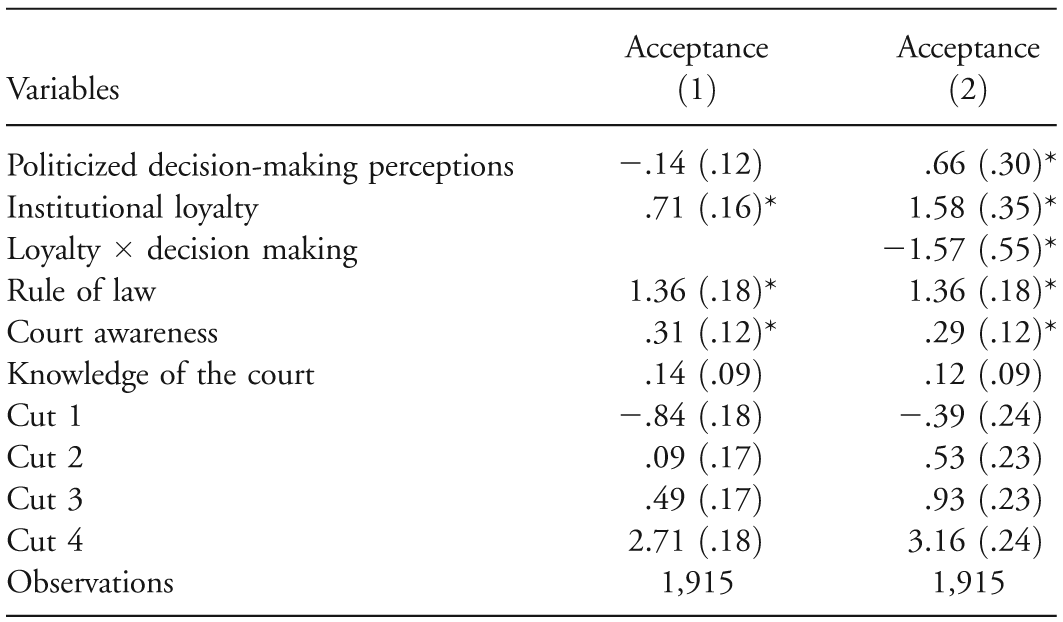
Before including interactions in the model, it is important to examine the average effect of politicization perceptions on acceptance. Column 1 of table 1 displays the model without interactions, and since the dependent variable has only five points an ordered probit model is used. The coefficient on politicization is statistically insignificant, indicating that politicization perceptions have no detectable average effect on acceptance. The institutional loyalty coefficient is positive and statistically significant at p < .05. This coefficient measures the average effect of loyalty on acceptance but does not test the central hypothesis, which is that loyalty should affect acceptance but only when the court is perceived as principled. Testing that hypothesis requires adding an interaction between politicization and institutional loyalty to the model.

Note.—This model is estimated using an ordered probit link. All variables are recoded with 0 as the minimum and 1 as the maximum.
* p < .05.
The model with the interaction included is shown in column 2 of table 1. The coefficient for the interaction of loyalty and politicization perceptions is negative and significant at p < .05. This shows that the more a person perceives the court as being “mixed up in politics” the smaller the marginal effect of loyalty on acceptance. At the 5th percentile of the politicization item (disagree), the coefficient on loyalty is 1.10 and significant at p < .05. At the 95th percentile of the politicization item (strongly agree), the coefficient is almost exactly zero (b = .02, p > .9). Substantively interpreting ordered probit coefficients is difficult without converting them into predicted probabilities. The following marginal effects are the change in the predicted probability of a person agreeing or strongly agreeing with the acceptance item when moving loyalty from its 5th to 95th percentile. At the 5th percentile of the decision-making item (the court perceived as principled), the marginal effect of loyalty is .16. At the 95th percentile (the court perceived as politicized), the marginal effect decreases to .03. The results provide evidence that when a court is seen as principled institutional loyalty has a large and substantial effect on acceptance, but when a court is seen as politicized it has little effect on acceptance. However, the study cannot provide a complete test of the hypothesis because the acceptance item presupposes that someone disagrees with the decision. The next two studies provide a test of both aspects of the hypothesis and also improve upon the first study in a variety of ways, including a better measure of politicization perceptions and asking about specific decisions rather than assessing a person’s general tendency to accept decisions.
Study 2
Study 2 measures the subjects’ initial issue position on whether juveniles convicted of murder should be eligible for a life sentence without the chance of parole and then presents them with a US Supreme Court decision that opposes that position. After measuring the control variables, the subjects are asked their issue position on whether juveniles who are 16 years old and convicted of murder should be eligible for a life sentence without the chance of parole. Two follow-up items with four response options assess attitude strength and the importance of the issue. Next, institutional loyalty and decision-making perceptions are measured. Following these items, the Court announced a decision contrary to the issue position of the subject. It declared the juvenile life sentence to be either constitutional or unconstitutional. After the decision, the subjects answered three acceptance items. These items asked whether the subject would sign a petition to overturn the decision, would support or oppose removing the justices from the Court who voted for this decision, and would accept the decision or desire to see it challenged. The exact wording of the items from study 2 is included in appendix B.
Politicization perceptions are measured using three items that ask whether the subjects agree or disagree with the statements that the justices are “nothing more than self-interested politicians,” “get too mixed up in politics,” and “follow a firm and proper set of guiding principles when making decisions.” They form a scale with a Cronbach’s α of .77. Study 2 also includes a direct measure of the subject’s issue position prior to the Court’s decision. Since everyone was given a disagreeable decision, the measure of policy agreement is their prior opinion strength. If policy agreement is driving acceptance judgments, a person who has a strong opinion on the issue will exhibit a lower level of acceptance than a person who has a weak opinion on the issue. Loyalty is again measured using four items taken from the work of Gibson and Caldeira (Gibson et al. Reference Gibson and Caldeira2003).
The sample for this study was recruited using Mechanical Turk, which is a service run by Amazon.com that allows people to complete short tasks for a small amount of money. The subjects in this study were offered 30 cents to complete a survey that took on average 10 minutes; 112 people completed the study between January 8 and 11, 2013. Of these, four are excluded because they are not US citizens. Two questions were included to make sure that the subjects did not speed through the survey and actually read the instructions. At the end of the instructions for these two items the subjects were told to ignore the previous instructions and answer the question in a specific way. Six people failed one of these checks and are excluded. Berinsky, Huber, and Lenz (Reference Berinsky, Huber and Lenz2012) analyzed the quality of samples from Mechanical Turk and found that while the samples were more representative than student samples they were still more liberal and younger than a representative sample. Importantly, they also replicated previous studies using a Mechanical Turk sample.
Study 2 Results
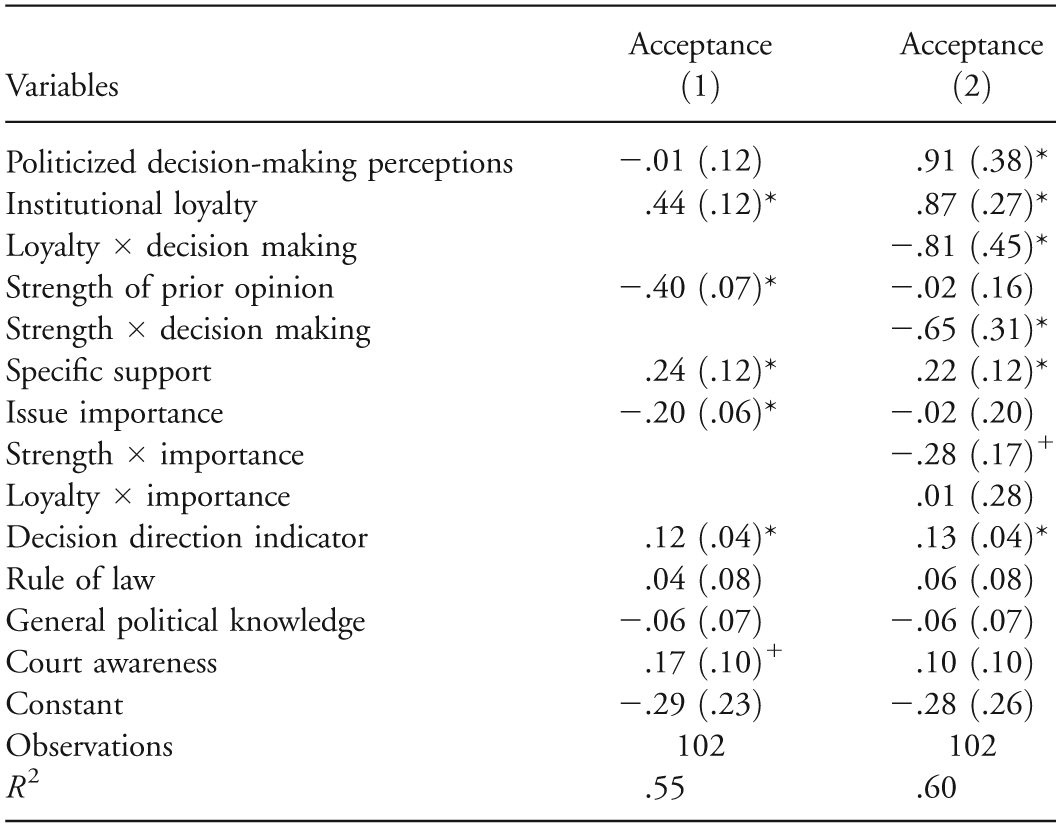
As with study 1, the average effect of politicization perceptions on acceptance is examined first. Column 1 of table 2 contains the model without any interactions. Support for the rule of law, political knowledge, and Court awareness are included as control variables. A measure of specific support is also included as a control variable (Easton Reference Easton1965). It is an additive index of two items that ask how well the Court does its main job in government and whether the Court is too liberal, too conservative, or just about right. The coefficient on politicization perceptions is −.01, which is insubstantial and insignificant. This again shows that politicization perceptions do not change the average level of acceptance.
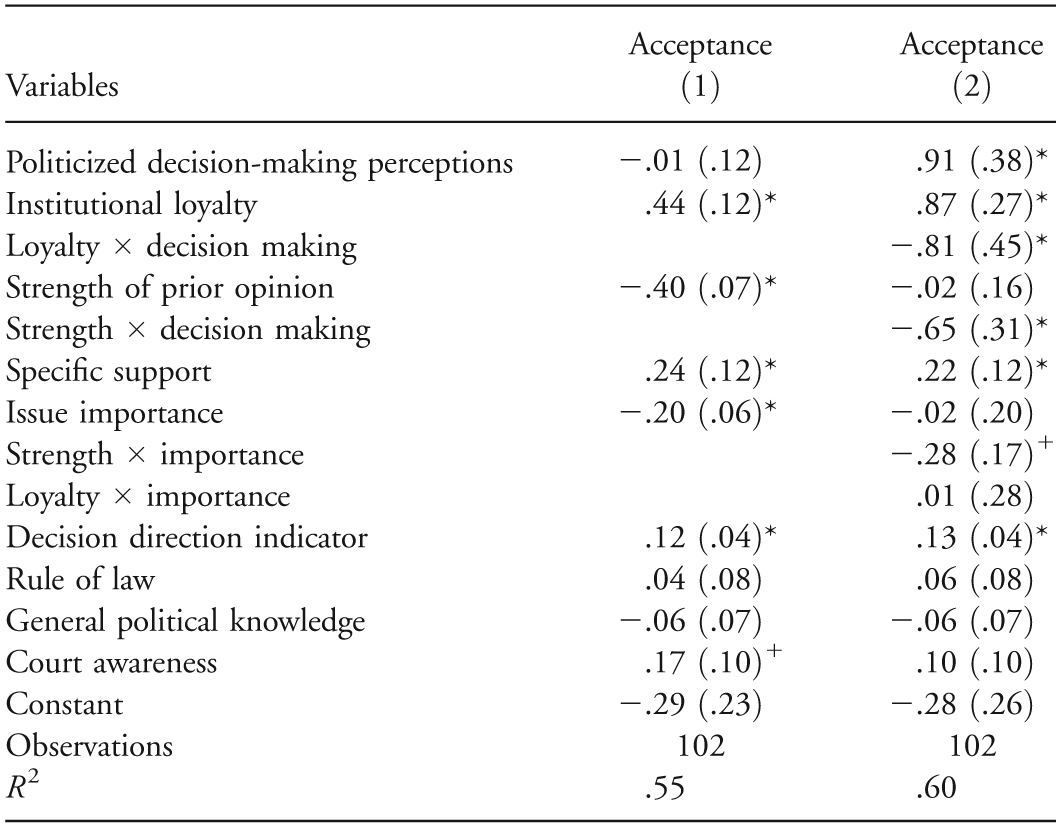
Note.—Models estimated using ordinary least squares. All the variables are recoded with 0 as the minimum and 1 as the maximum.
+ p < .06 (one-tailed).
* p < .5 (one-tailed).
Column 2 of table 2 displays the results with the interactions included. In addition to the interactions of loyalty and opinion strength with politicization perceptions, the model includes interactions of the same two variables with issue importance because it is another influence that may change the determinants of acceptance. The politicization perception interactions support the hypotheses. Both interactions are negative and statistically significant at p < .05 in a one-tailed test. A one-tailed test is appropriate because of the specific directional hypotheses based on study 1. The interaction coefficients indicate that as decision-making perceptions become more politicized the marginal effect of loyalty decreases and the magnitude of the marginal effect of opinion strength increases.
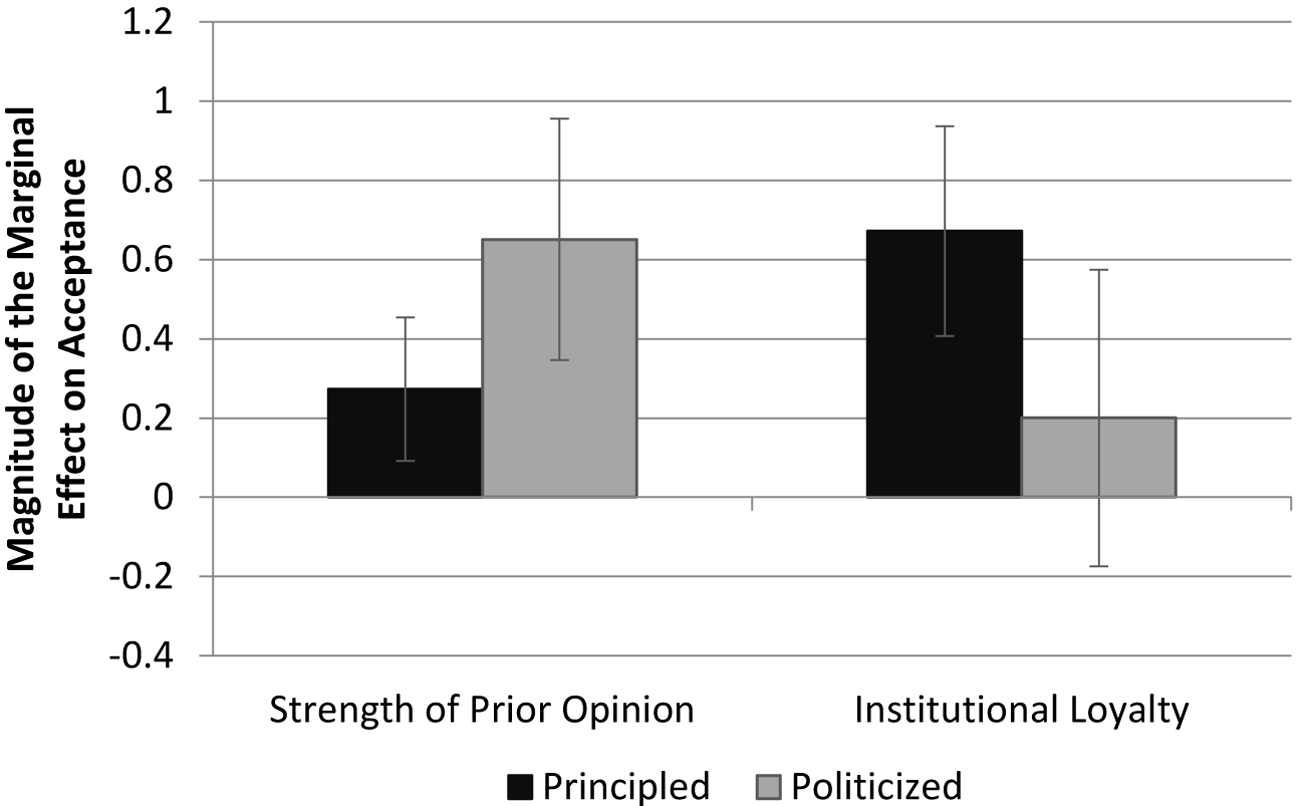
Figure 1 displays the marginal effect of loyalty and opinion strength at the 5th and 95th percentile of decision-making perceptions, with 95% confidence intervals. These marginal effects were calculated with issue importance set at the 50th percentile, which corresponds to a “somewhat important” issue. At the 5th percentile of politicization perceptions (those who perceive the Court as principled) the marginal effect of loyalty is .67 and significant at p < .05. Since acceptance is coded from 0 to 1, a marginal effect of .67 means that when loyalty moves from its minimum to its maximum the predicted level of acceptance moves 67% of its range. The marginal effect for the strength of prior opinion is lower at .27, but it is still significant at p < .05. These two marginal effects are the result of taking loyalty and opinion strength from their minimum to maximum. Because the tails of each variable’s distribution may contain few people, a better way to compare effect sizes is to take them from their 5th to their 95th percentile. For loyalty, the marginal effect of moving from the 5th to the 95th percentile is .46. The marginal effect for opinion strength does not change since the 5th and 95th percentile are the same as the minimum and maximum. Thus, when people perceive the Court as principled both loyalty and opinion strength affect acceptance judgments, but loyalty has a larger effect (.46 compared to .27).
Study 2 results. The black bars represent the marginal effects when politicization perceptions are held at their 5th percentile. The gray bars represent the marginal effects when they are held at their 95th percentile; 95% confidence intervals are included.
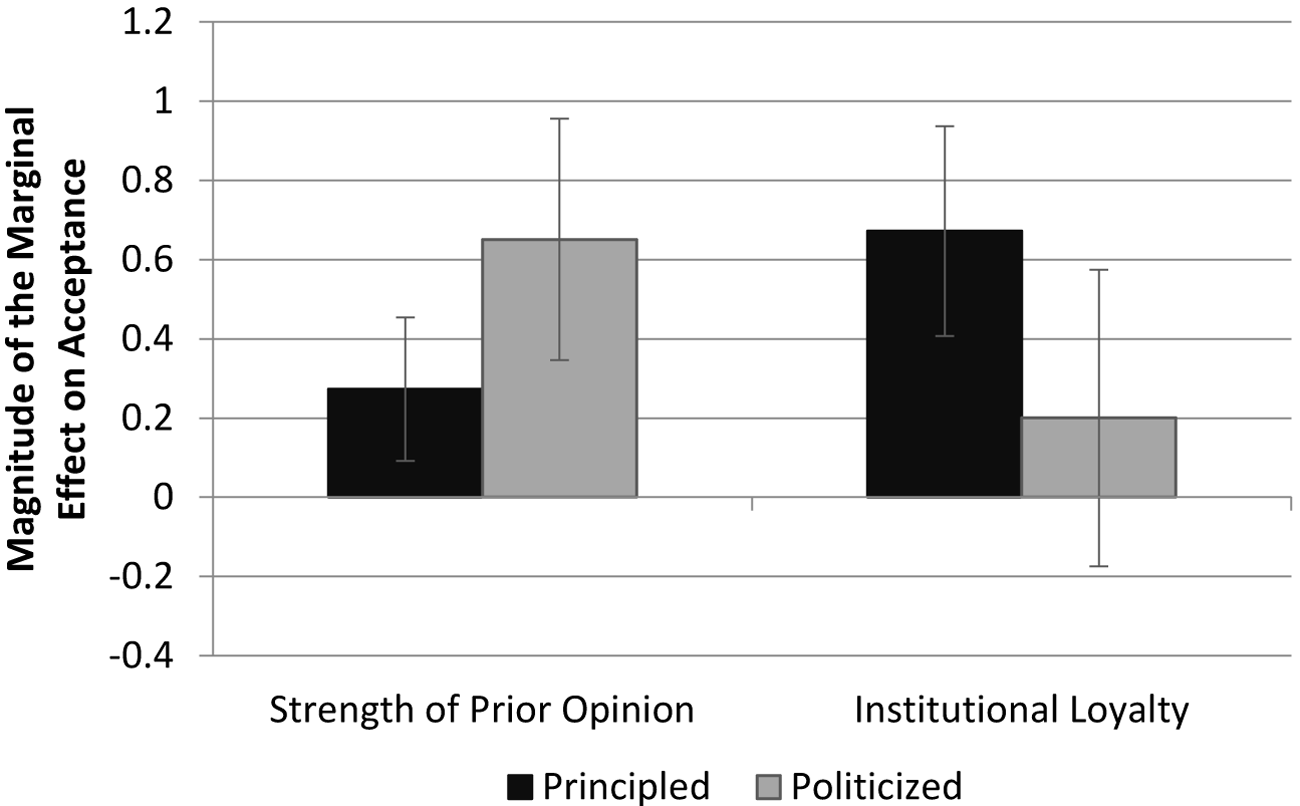
At the 95th percentile of politicization perceptions, the roles reverse. Opinion strength now has a much larger effect than loyalty. The marginal effect of opinion strength (min to max) is .65 and significant at p < .05, while the marginal effect of loyalty (min to max) is only .20 and insignificant (p > .25). Thus, when the Court is perceived as politicized, loyalty has no detectable effect on acceptance judgments. Instead, acceptance judgments are driven by agreement with the policy outcome of a decision.
This model also includes the interactions with issue importance. The interaction between issue importance and opinion strength is negative, indicating that as the importance of an issue increases the magnitude of the marginal effect of prior opinion strength increases. The statistical significance of the interaction is just above traditional levels with p < .06 (one-tailed). The interaction between loyalty and issue importance is insignificant and near zero. Thus, issue importance appears to increase the effect of policy preferences on acceptance but not loyalty.
Study 3
The third study improves upon the second by including an experimental manipulation of politicization perceptions rather than relying on observational data. The use of an experimental manipulation allows stronger claims of causation. In this study, the subjects read three fabricated decisions from the US Supreme Court, their acceptance of each decision is measured, and ideological orientation acts as a proxy for policy attitudes.
The study begins by measuring ideological orientation and the control variables. The wording of every item can be found in appendix C. Second, the subjects are randomly assigned to either the experimental condition designed to make the Court appear politicized or the control condition. In the experimental condition, the subjects read a news article discussing activities of the justices in the run-up to the decision on the highly salient health care case National Federation of Independent Business et al. v. Sebelius that some in the media portrayed as evidence that the justices were politicized. The study ran during the spring semester of 2011 before oral arguments, but after the case had been granted cert. The article includes criticism of the justices from both sides of the political spectrum that was drawn directly from published articles in major media sources. It includes criticism of Clarence Thomas for the involvement of his wife in the Tea Party movement and criticism of Elena Kagan for not recusing herself even though she was part of the Obama administration when the legislation was passed. It frames these activities as signs of the Court’s politicization. In the control condition, the subjects read a news article summarizing the benefits and problems with high-fructose corn syrup. Appendix C contains the text for the politicized condition.
Even though the manipulation involves a specific decision, study 3 tests the effect of politicization perceptions about the Court in general because the acceptance questions concern other cases. The information about the health care case makes the subjects perceive the Court as more politicized. When they encounter the new decisions after being exposed to the manipulation, their perception about the Court in general affects their mode of evaluation.
The manipulation does not include specific information about the process justices use to make their decisions. Instead, it includes information that is designed to influence how people perceive this process. The public is rarely given direct information about the mental process the justices use to make their decision. Instead, the public infers their mental process through other information. Some of this information is the extralegal activity of the justices. The manipulation includes information about extralegal activity, and as the analysis will show the manipulation strongly affected politicization perceptions. The question of what influences the public’s perception of how the justices make decisions is an important one, but it is beyond the scope of this paper. For the purposes of this paper, it is only important that the manipulation had the intended effect of making the subjects perceive the Court as using a politicized decision-making process. The analysis then examines how this experimentally manipulated change in politicization perceptions affects the determinants of acceptance.Footnote 3 Following the manipulation, politicization perceptions and loyalty are measured using scales similar to those used in study 2.
Next, the subjects read about three cases: Florence v. Board of Chosen Freeholders, Fisher v. University of Texas, and United States v. Alvarez. Florence involves a jail’s policy to strip search all incoming inmates. Fisher involves a university’s affirmative action program. Alvarez involves the free speech aspects of a law that criminalizes lying about being awarded a military decoration. All had been appealed to the Court but had yet to be decided when the study was conducted. For each, the subjects read a fabricated news article summarizing a decision attributed to the US Supreme Court. The direction of the decision was randomly determined, with each subject reading either three liberal or three conservative decisions. The articles briefly summarize the decision, give some background information about the case, and end by presenting a legal argument supporting each side.Footnote 4 The order of the articles was randomly determined.
Following each article the subjects were presented with three items assessing their acceptance of the decision. The first asks whether the decision should be accepted and obeyed by the mass public; the second whether it should be implemented as public policy by government officials; the third whether the subjects support or oppose overturning the decision. Following each was a four-level item assessing opinion strength that ranged from extremely to not at all strongly. The strength follow-up is combined with the initial item. These three items form a relatively reliable scale with the Cronbach’s α for the cases ranging from .66 to .75.
The sample for the experiment was composed of undergraduates in political science classes at a public northeastern university. They were offered extra credit for their participation; 245 people completed the experiment; 55 subjects were excluded from the analysis because they were not US citizens. Subjects who did not properly complete the survey were also excluded. This applies to the 12 subjects (5% of the sample) who spent less than 5 seconds reading one of the two articles, which were 689 and 655 words, respectively.
Study 3 Manipulation Check
The first task is to determine whether the experimental manipulation made the Court appear politicized as intended. For the decision-making items, the subjects were presented with a statement and asked their level of agreement/disagreement. Three items tap into perceptions of politicization: “U.S. Supreme Court justices are really just politicians in robes,” “The personal political opinions of Supreme Court justices have too much influence on how they make decisions,” and “The U.S. Supreme Court gets too mixed up politics.” One item assesses whether people perceive the Court as using a general principled decision-making process: “The members of the U.S. Supreme Court usually follow a firm set of principles when making decisions.” The final item assesses whether people perceive justices as using specifically legalistic principles: “Supreme Court justices base their decisions on the law, not their personal political opinions.”
These items are combined into an additive index with higher numbers indicating more politicized and less principled perceptions of the Court’s decision-making process. The correlation between the additive index and the manipulation is substantial (r = .33) and significant (p < .05). Also, the correlation between each of the individual items and the manipulation is significant (p < .05) and ranges from r = .18 to r = .29. This indicates that the manipulation caused the subjects to perceive the Court as more politicized. Additionally, the correlation between an additive index of the four loyalty items and the manipulation is insubstantial and insignificant (r = −.06, p > .4). This shows that the manipulation accurately targeted politicization perceptions without affecting institutional loyalty.
Study 3 Model Design
In study 3, each subject answered three acceptance items for three separate cases. Each case is treated as a separate observation, giving the data a two-level structure in which three cases are embedded within 178 subjects. Correctly modeling this type of multilevel data requires adding a random intercept coefficient that varies by subject and clustering the standard errors by subject (Gelman and Hill Reference Gelman2006). This approach allows the model to control for the perceived importance of the case, which is measured for every case. A random coefficient parameter for the importance variable is also included since case importance varies within each group or subject. In addition, indicator variables are included for the six possible decisions a subject could have received. A separate error variance term is estimated for each decision. This controls for any heteroskedasticity caused by using different decisions.
The dependent variable is an additive index of the three acceptance items. This variable is recoded with 0 as the minimum and 1 as the maximum, as are all variables in this model. The loyalty variable is an additive index of the four loyalty items. Measuring policy agreement is somewhat more difficult in this study because the subject’s attitude on each specific issue is not directly measured. Instead, ideological self-placement acts as a proxy for issue attitudes. This variable when combined with the manipulation in which the decisions were either all conservative or all liberal allows the creation of an ideological agreement index. The five-level ideological agreement index ranges from strong agreement (e.g., strong liberal receiving a liberal decision or strong conservative receiving a conservative decision) to strong disagreement (e.g., a strong liberal receiving a conservative decision or strong conservative receiving a liberal decision). Both institutional loyalty and ideological agreement are interacted with the politicization manipulation. The final noncontrol variable in the model is the importance of the issue to the subject.
Study 3 Results
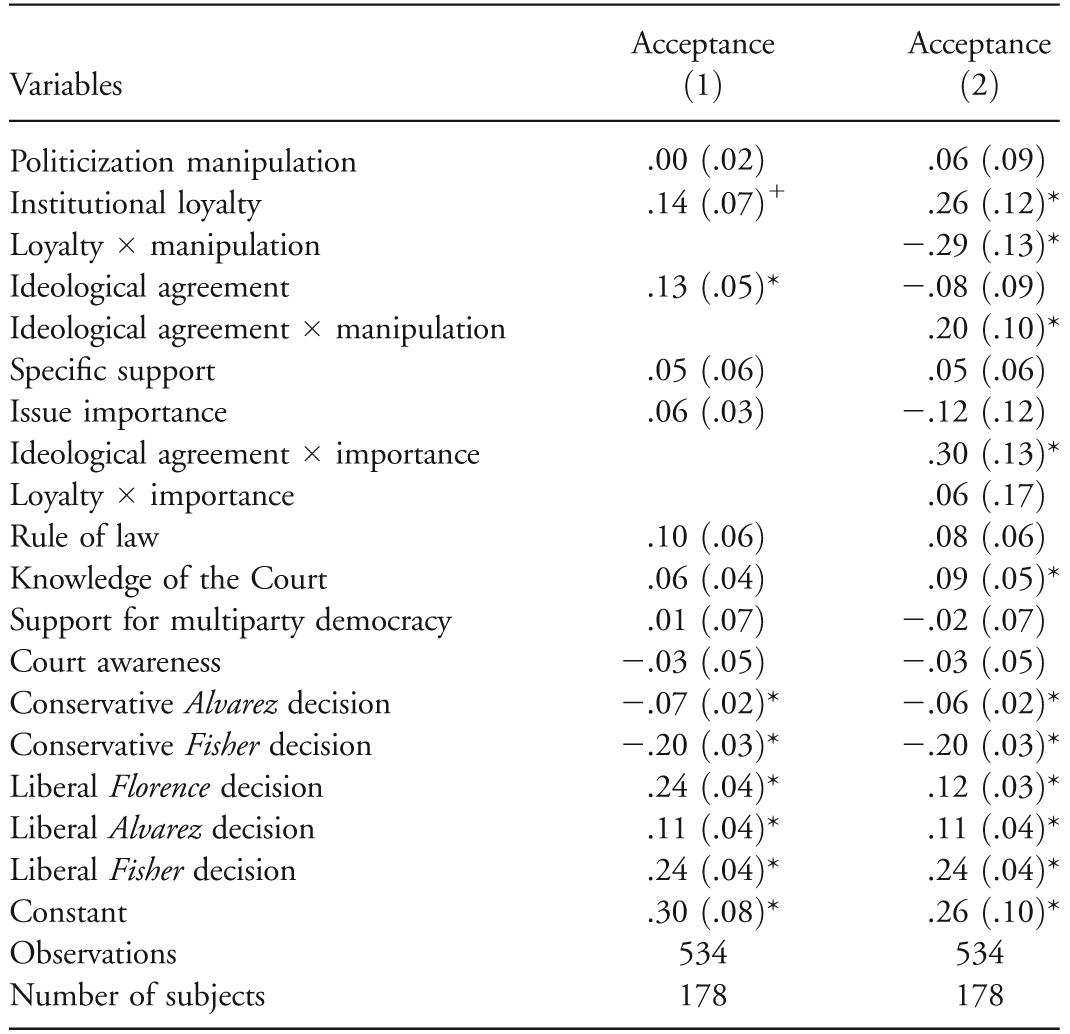
As with the previous studies, the first model in column 1 of table 3 does not include interactions. The coefficient on the politicization manipulation is .00, showing for the third time that politicization perceptions do not change the average level of acceptance.
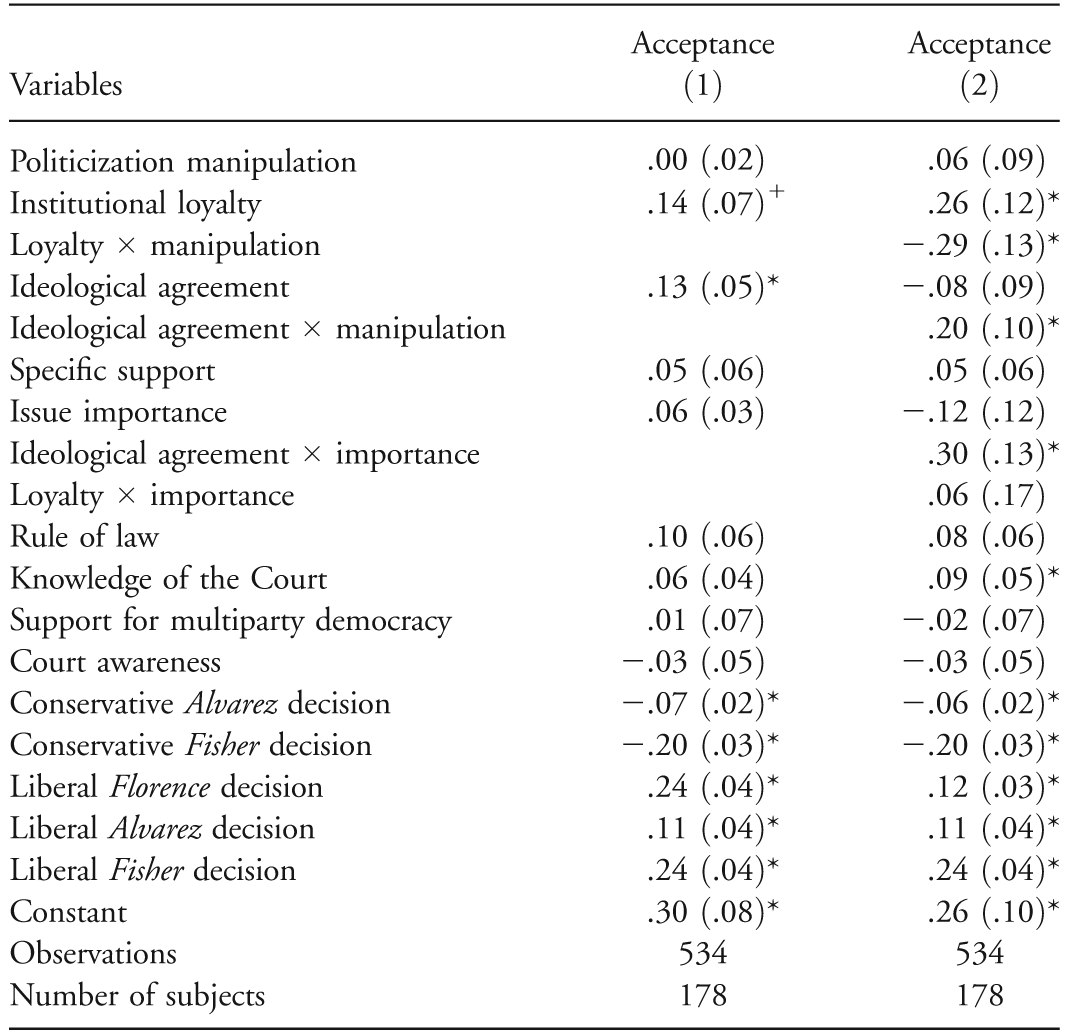
Note.—This model is estimated using a mixed-effects maximum likelihood ordinary least squares model. The data are structured with three acceptance judgments embedded within 178 individual subjects. A random intercept parameter for the subject and a random coefficient parameter for issue importance are included. A separate error variance term is estimated for each of the six judicial decisions. All variables are coded with 0 as the minimum and 1 as the maximum.
+ p < .06.
* p < .05.
Column 2 of table 3 contains the model with interactions included, and the results support the hypothesis. The interaction of the politicization manipulation (1 = politicized, 0 = control) and loyalty is negative and significant at p < .05. The interaction of the manipulation and ideological agreement is positive and significant at p < .05. These interaction coefficients mean that the manipulation decreased the marginal effect of loyalty and increased the marginal effect of ideological agreement on acceptance.
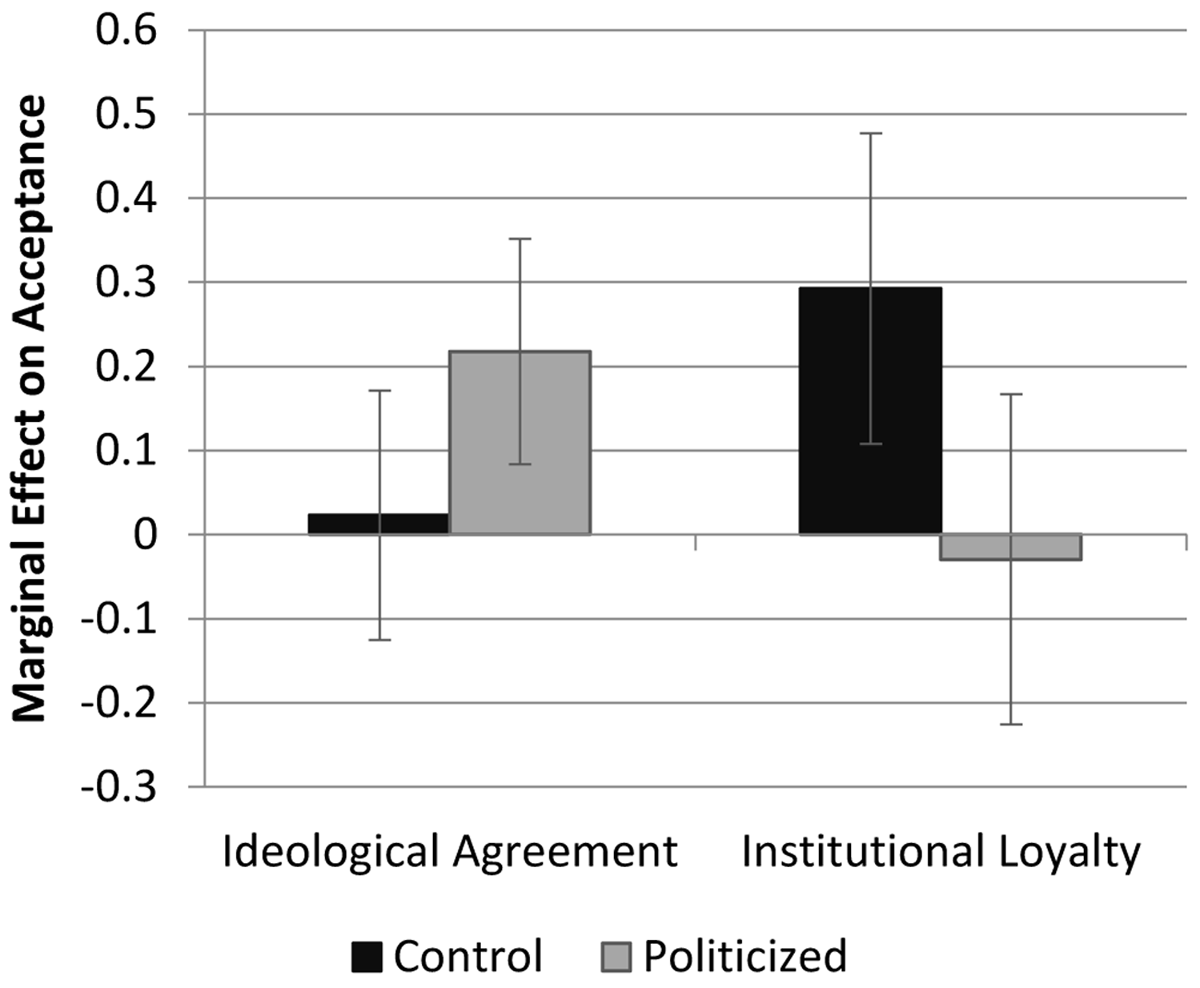
Figure 2 displays the marginal effect of loyalty and ideological agreement on acceptance divided by experimental condition, with 95% confidence intervals. The marginal effects were calculated with issue importance held at the 50th percentile or an issue that is “a little important.” In the control condition, loyalty with a marginal effect of .29 is the only significant predictor of acceptance. The predicted difference between a person at the minimum and maximum of the loyalty index is 29% of the acceptance scale. Ideological agreement is substantively small and insignificant. The opposite pattern occurs in the politicized condition. The marginal effect of loyalty is insignificant and actually slightly negative. The marginal effect of ideological agreement (b = .22) is positive and significant (p < .05).Footnote 5
Study 3 results. The black bars represent the marginal effect in the control condition. The gray bars represent the marginal effect in the politicized condition. Each marginal effect is the change in acceptance when taking the identified variable from its minimum to its maximum; 95% confidence intervals are included.

The last important findings from table 3 concern the interactions of issue importance with loyalty and ideological agreement. The only significant (p < .05) interaction is between issue importance and ideological agreement. This interaction is positive, indicating that as the importance of an issue increases the marginal effect of ideological agreement on acceptance also increases. As with study 2, issue importance increases the effect of policy preferences on acceptance but does not change the effect of loyalty.
These results strongly support the hypothesis. In the control condition, loyalty substantially affects acceptance while ideological agreement does not. In the politicized condition, the roles reverse, and ideological agreement substantially affects acceptance while loyalty does not. The politicization manipulation caused people to switch from using loyalty as the main determinant of acceptance to using ideological agreement.
Normative Expectations
One plausible alternative dynamic affecting the mode of evaluation is a person’s normative expectations for how a court should make its decisions. Study 3 includes three items that can test this. The items ask whether the subjects agree or disagree on a 5-point scale with the following statements: “In the perfect world, the personal political opinions of judges would have little effect on their decisions”; “In the perfect world, legal principles would be the only influence on how judges make decisions”; and “In the perfect world, judges would follow legal principles when making decisions rather than what they personally believe is right.” These three items all load onto a single factor with an eigenvalue above 1 and form a relatively reliable scale with a Cronbach’s α of .66.
Across a variety of models (not shown) that add interactions of these normative expectation items with loyalty and ideological agreement to the model in column 2 of table 3, the interactions never approach statistical significance at even p < .1. The attempted models included ones that interact the three-item normative expectation scale on the full sample and on only the sample in the control condition. In addition, a series of three models interacting each individual normative expectation item with institutional loyalty and ideological agreement found no statistically significant interactions. These results show that normative expectations about the process through which a decision should be made do not seem to change the determinants of acceptance judgments.
Results Summary
These results provide evidence that process perceptions structure how people make acceptance judgments. In all three studies, loyalty was the main determinant of acceptance when a court was perceived as using a principled decision-making process. When a court was seen as using a politicized decision-making process, policy agreement was the main determinant. Additionally, politicization perceptions consistently had no direct effect on acceptance. These results converged across three different samples and study designs. One study used a convenient undergraduate sample while another used a convenient sample of adults. Both of these samples were drawn from populations more liberal and educated than the general population. However, study 1 used a telephone survey to gain a representative sample of Kentucky—a state poorer, less well educated, and more conservative than the national average.
Most work concerning politicization perceptions and institutional loyalty examines the direct relationship between the two, and it has been found to be robust. This may lead some to worry that while the results show that higher politicization perceptions prevent loyalty from affecting acceptance judgments this has little meaning in the real world because everyone with high politicization perceptions has extremely low loyalty. At least in the three studies here this is not the case. The correlations between politicization perceptions and loyalty for each study are statistically significant but, with the exception of study 2, not overly large (study 1: r = −.36; study 2: r = −.48; study 3: r = −.24). While increasing politicization perceptions are associated with decreases in loyalty, some people both perceive courts as politicized and exhibit a high degree of loyalty. Politicization is one of the many determinants of loyalty, but they are conceptually and empirically separate.
Conclusion
Many studies have examined the relationship between process perceptions and institutional loyalty. Most concerned the direct effect of process perceptions on loyalty or which type of process perceptions affect loyalty, but process perceptions have another type of effect. They moderate the effect of loyalty on acceptance, and if a court is perceived as politicized the normally strong link between them is broken.
This finding increases the importance of politicization perceptions for acceptance judgments. Prior studies show that politicization has an indirect effect on acceptance through its effect on loyalty. Under this model of an indirect effect, politicization is of secondary importance to loyalty. This changes under the model proposed in this study where politicization moderates the effect of loyalty on acceptance. With this model it is only through the combination of a perception of principled decision making and a high magnitude of institutional loyalty that a court can induce acceptance of a disagreeable decision. If someone perceives a court as politicized, it does not matter whether the public supports an institution because institutional loyalty does not affect acceptance. Under this new model, decision-making perceptions are not of secondary importance but, instead, occupy a place next to institutional loyalty as an equal partner supporting and ensuring that courts can induce acceptance of their decisions.
With the elevated position of politicization perceptions it becomes essential to understand what influences them. This is a surprisingly understudied topic in the literature, leaving scholars and judges with little guidance (see Baird and Gangl [Reference Baird2006] for a rare study examining this). Some possible determinants of process perceptions such as whether decisions are unanimous or whether judges recuse themselves are controllable by judges, but much if not most of what affects process perceptions will be outside of their control. All judges portray themselves as using principled decision making, but in the face of their efforts some will still perceive them as politicized. Any political elites who oppose a court decision have an incentive to portray the decision as politicized, irrespective of how the court portrays itself. Another possibility is that people will be more likely to perceive any displeasing decision as politicized and any pleasing decision as principled. Because of the lack of knowledge concerning the cause of politicization perceptions and a court’s inability to control them, it is hard to make any recommendations based solely on this study about what actions courts can take to increase acceptance. The one certainty is that these results show that process perceptions are even more important than previously thought and that too little is known about what causes people to perceive a court as politicized or principled.
These results should provide motivation for scholars to examine politicization perceptions but also to study public support for political institutions in a more nuanced manner. The determinants of institutional loyalty are intensely studied because institutional loyalty has been shown to greatly affect political behavior. However, one understudied aspect of institutional loyalty is that it does not always affect behavior to the same extent. For some people and for some types of institutions, loyalty will not affect certain types of important political behavior. As was shown in these three studies, whenever a court is perceived as politicized, its loyalty does not affect acceptance. Future work should begin to examine other conditions under which loyalty exists but does not affect political behavior. Without understanding variation in the manner with which loyalty affects political behavior it is impossible to have a full understanding of institutional loyalty.
The ability of politicization perceptions to break the link between loyalty and acceptance is perhaps more pernicious than the direct effect of politicization on loyalty because it is a hidden effect. It does not destroy loyalty but instead prevents it from affecting some types of political behavior. This hidden effect cannot be detected using a survey with a few loyalty items, and this could cause people to overestimate the Supreme Court’s ability to induce acceptance of disagreeable decisions. If a somewhat politicized Court is able to hang on to a reasonable store of loyalty, many may think the Court’s somewhat lower level of public support has not reached crisis level, but by concentrating solely on the magnitude of the Court’s loyalty, people miss the hidden effect of politicization. Because of the hidden effect, this type of Court with a reasonable level of public support would be unable to induce acceptance of disagreeable decisions. As a result, even small amounts of politicization may cause large problems for the Court, and because the public’s loyalty to the Court remains substantially intact, scholars and the Court may not even realize the fragility of its position.
Many other influences may have this type of hidden effect on institutional loyalty. These hidden influences do not necessarily need to undermine the magnitude of loyalty exhibited toward an institution to cause a crisis in the institution. If they cause an institution’s loyalty to not affect political behavior in the same way as politicization, the institution would be unable to convert this loyalty into acceptance, leaving it in the same position as if it had no loyalty. Since few scholars have examined the question of what breaks the link between loyalty and acceptance, even with its high level of institutional loyalty the Supreme Court as well as other courts may be in such a time of crisis without anyone’s realizing it.
Appendix A Question Wording for Study 1
For the institutional loyalty and rule of law scales the subjects were asked whether they strongly agree, agree, are uncertain, disagree, or strongly disagree with the following statement.
Institutional Loyalty
-
1. The Kentucky Supreme Court may have its ideas about what the constitution means, but more important is what the majority of the people think the constitution means.
-
2. If the Kentucky Supreme Court started making a lot of decisions that most people disagree with, it might be better to do away with the Supreme Court altogether.
-
3. The right of the Kentucky Supreme Court to decide certain types of controversial issues should be reduced.
-
4. The Kentucky Supreme Court ought to be made less independent so that it listens a lot more to what people want.
Rule of Law
-
1. It is not necessary to obey a law you consider unjust.
-
2. Sometimes it might be better to ignore the law and solve problems immediately rather than wait for legal solutions.
-
3. The government should have some ability to bend the law in order to solve pressing social and political problems.
-
4. It is not necessary to obey the laws of a government that I did not vote for.
Court Awareness
As you know, in Kentucky, there are three branches of government: the governor, the state legislature, and the state Supreme Court. In general, are you very aware, somewhat aware, not very aware, or haven’t you heard of the Kentucky Supreme Court?
Very aware; Somewhat aware; Not very aware; Have never heard
Knowledge of the Court
-
1. Some judges in the American states serve for a set number of years; others serve a life term. Do you know if the justices of the Kentucky Supreme Court serve for a set number of years or whether they serve a life term?
Serve set number of years; Serve life term
-
2. When there is a conflict over the meaning of the Kentucky Constitution, do you know who has the last say—is it the Kentucky Supreme Court, the Kentucky legislature, or the governor?
Kentucky Supreme Court; Kentucky legislature; Governor
-
3. Some judges in the American states are elected; others are appointed to the bench. Do you happen to know if the justices of the Kentucky Supreme Court are elected or appointed to the bench?
Elected; Appointed to the bench
Appendix B Question Wording and Other Text for Study 2
For the institutional loyalty and rule of law scales the subjects were asked whether they strongly agree, agree, neither agree nor disagree, disagree, or strongly disagree with the following statement.
Institutional Loyalty
-
1. If the U.S. Supreme Court started making a lot of decisions that most people disagree with it might be better to do away with the Supreme Court altogether.
-
2. The right of the U.S. Supreme Court to decide certain types of controversial issues should be reduced.
-
3. The U.S. Supreme Court should have the right to say what the Constitution means, even when the majority of people disagree with those decisions.
-
4. People should be willing to do everything they can to make sure that any proposal to abolish the U.S. Supreme Court is defeated.
Rule of Law
Same as items 1 and 2 from study 1
Supreme Court Job Approval
How well do you think the U.S. Supreme Court does its main job in government?
Great job; Pretty good job; Not very good job; Poor job
Supreme Court Perceived Ideological Difference
In general would you say the U.S. Supreme Court is too liberal, too conservative or just about right in its decisions?
Much too liberal; Somewhat too liberal; Just about right; Somewhat too conservative; Much too conservative
Court Awareness
-
1. Would you say you are very aware, somewhat aware, not very aware, or haven’t heard of the U.S. Supreme Court?
Very aware; Somewhat aware; Not very aware; Have never heard of it
-
2. How often do you hear or read news about the U.S. Supreme Court?
Very often; Often; Somewhat often; Not very often; Almost never; Never
General Political Knowledge
If both the President and Vice-President of the United States resigned, who is next in the line of succession? In other words, who would become President under these circumstances?
Chief Justice of the Supreme Court; President Pro Tempore of the Senate; Speaker of the House of Representatives; Secretary of State
Do you happen to know how many times a person can be elected President of the United States under current law?
1; 2; 3; 4; 5; 6; 7; 8; There is no limit under current law.
For how many years is a United States Senator elected—that is, how many years are there in one full term of office for a U.S. Senator?
1; 2; 3; 4; 5; 6; 7; 8
Initial Issue Position
The U.S. Supreme Court decided a case recently determining whether or not it is constitutional for a juvenile who is at least 16-years-old and convicted of murder to be eligible for a sentence of life in prison without the chance of parole. In the case, a 16-year-old male killed a person during a home robbery. The juvenile was charged as an adult, convicted of first-degree murder and sentenced to a penalty of life in prison without the chance of parole.
The juvenile appealed the sentence to the U.S. Supreme Court saying that it violated the ban on cruel and unusual punishment in the 8th amendment of the U.S. Constitution. The juvenile relied upon previous Supreme Court decisions saying it is unconstitutional to impose the death penalty on juveniles. Those in favor of the juvenile life sentence argued that the death penalty is a much more extreme penalty than a life sentence, and that some juveniles deserve a life sentence.
What is your opinion on this issue? Which of the two options below better fits your view?
It should be possible for a juvenile convicted of murder who is at least 16-years-old to be sentenced to life in prison without the chance of parole; Any juvenile convicted of murder should have the chance to receive parole and get out of prison later in life.
Initial Issue Position Strength
How strongly do you feel that (it should be possible for a juvenile convicted of murder who is at least 16-years-old to be sentenced to life in prison without the change of parole/any juvenile convicted of murder should have the chance to receive parole and get out of prison later in life)?
Very strongly; Strongly; Somewhat strongly; Not strongly at all
Initial Issue Position Importance
How important would you say the issue of the juvenile life sentence without the chance of parole is to you personally?
Very important; Important; Somewhat important; Not important at all
Text of Court Decision If Subject Pro–Juvenile Life Sentence
The U.S. Supreme Court issued a decision saying the government CAN NOT impose a sentence of life in prison without the chance of parole on 16-year-old juveniles convicted of murder. The justices said this type of penalty constitutes cruel and unusual punishment and thus violates the Constitution.
Text of Court Decision If Subject Anti–Juvenile Life Sentence
The U.S. Supreme Court issued a decision saying the government CAN impose a sentence of life in prison without the chance of parole on 16-year-old juveniles convicted of murder. The justices said this type of penalty does not constitute cruel and unusual punishment and thus does not violate the Constitution.
Acceptance Questions
-
1. Do you accept this decision and consider it the final word on the matter or do you think there ought to be an effort to challenge it and get it changed?
I accept the decision and consider it the final word on the matter; I want to challenge the decision and get it changed.
Follow-up Strength Item: How strongly do you feel the decision should be (accepted/challenged)?
Very strongly; Strongly; Somewhat strongly; Not strongly at all
-
2. Would you support or oppose efforts to remove the justices of the U.S. Supreme Court who voted for the decisions (allowing/prohibiting) the life sentence without the chance of parole for 16-year-olds?
Strongly support removing them; Support removing them; Somewhat support removing them; Neither support nor oppose removing them; Somewhat oppose removing them; Oppose removing them; Strongly oppose removing them
-
3. Would you sign a petition in support of a group that was attempting to overturn this decision?
Definitely; Possibly; Probably not; Definitely not
Postdecision Issue Position
We would like to revisit your position on the issue of the juvenile life sentence. Which of the two options below better fits your current view on this issue?
It should be possible for a juvenile convicted of murder who is at least 16-years-old to be sentenced to life in prison without the chance of parole; Any juvenile convicted of murder should have the chance to receive parole and get out of prison later in life.
Postdecision Issue Position Strength
How strongly do you feel that (it should be possible for a juvenile convicted of murder who is at least 16-years-old to be sentenced to life in prison without the change of parole/any juvenile convicted of murder should have the chance to receive parole and get out of prison later in life)?
Very strongly; Strongly; Somewhat strongly; Not strongly at all
Appendix C Text of Manipulation and Question Wording for Study 3
Text of Unprincipled Condition
Political activists from both sides of the aisle worry that some of the current U.S. Supreme Court justices will be biased when ruling on the constitutionality of the Obama health care plan. The health care plan is working its way through the federal court system, and the U.S. Supreme Court is poised to rule on whether it is constitutional very soon.
Most recently, some court scholars voiced their concern over Justice Clarence Thomas and the involvement of his wife in the tea party movement. His wife is the founder of a group called Liberty Central that was instrumental in organizing the Tea Party protests that swept across the country. She even wrote an article suggesting that the health care legislation was unconstitutional and posted it on the web site of that group.
To make matters worse, Thomas failed to report these activities on the income disclosure forms he is required to file as a member of the Supreme Court. On these forms he is supposed to disclose the income sources for both himself and his spouse. His wife has long worked at conservative think tanks, conservative activist groups, and even as an aide to a Republican member of Congress. He only included his wife’s income from her partisan political activity on these forms after a government watchdog group highlighted his failure to disclose it.
Thomas responded to these criticisms by lashing out at his political enemies during a speech to the Federalist Society, a conservative legal society. He said that he and his wife “believe in the same thing” and he will stand by her. During the speech, he said he is worried about the liberal direction the country has taken, and his job on the court is to fend off threats to the American way of life.
This is not the first time that Thomas has given a speech to a partisan audience. He spoke at a gathering of major conservative donors in 2008 sponsored by the billionaire industrialist Koch brothers who spend millions every year lobbying for conservative political causes. These activities leave many watchers of the court wondering whether Thomas can be impartial with his rulings on the upcoming health care bill.
However, the worries are not limited to the conservative judges on the court. The activities of the liberal judges also cast doubt on their ability to be impartial when dealing with cases. During the confirmation hearings for the newest Supreme Court Justice Elena Kagan, it was revealed that during her time as part of the Obama administration she had helped to plan the administration’s legal defense of the health care bill. Now that she has been put on the court she will be ruling on whether the legal defense she helped to create is correct or not.
Kagan refuses to recuse herself from the vote though. One possible reason for this is that she could be the deciding vote in favor of upholding the health care bill. The court is split between four conservative judges and four liberal judges. The conservative judges are almost certain to vote against the health care bill while the four liberal judges are almost certain to vote for it. If the health care bill has any chance of being upheld as constitutional, Kagan, as one of the four liberals on the court, must vote for it. Otherwise it is almost certain to be defeated.
These two instances of judges becoming involved in partisan politics are just two of the many indications that the U.S. Supreme Court has become just as politicized as Congress or the Presidency. While it is supposed to be the institution most shielded from partisan bickering, the polarized politics of the modern era has made its way even to the Supreme Court. Whether it is Justice Sonia Sotomayor saying that judges don’t interpret the law but instead “judges make law” or Justice Antonin Scalia attacking homosexuals in speeches to anti-gay rights groups while ruling against homosexual rights in his Supreme Court decisions, the one constant is that this Supreme Court is just another arena in the constant political bickering that is corrupting the American political system.
Question Wording
Supreme Court job approval, Supreme Court perceived ideological difference, and Court awareness same as in study 2. Rule of law items same as study 1.
For the following items, a statement was presented on the screen, and the subjects were asked, “Do you agree or disagree with that statement?” Their answer options were strongly agree, agree, neither agree nor disagree, disagree, and strongly disagree.
Institutional Loyalty
Items 1–3 same as in study 2, item 4 replaced with following:
4. The Supreme Court ought to be made less independent.
Support for Multiparty Democracy
-
1. What our country needs is one political party which will rule our country.
-
2. The party that gets the support of the majority ought not to have to share political power with the political minority.
-
3. Our country would be better off if we just outlaw all political parties.
Ideological Self-Placement
Many people think of politics in terms of liberal or conservative. Do you consider yourself to be conservative, moderate or liberal?
Very conservative; Conservative; Moderate; Liberal; Very liberal
Knowledge of the Court
-
1. Some judges in the U.S. are elected; others are appointed to the bench. Do you happen to know if the justices of the U.S. Supreme Court are elected or appointed to the bench?
Appointed to the bench; Elected; I don’t know the answer
-
2. Some judges in the U.S. serve a set number of years; others serve a life term. Do you happen to know whether the justices of the U.S. Supreme Court serve for a set number of years or whether they serve a life term?
A set number of years; Life term; I don’t know the answer
-
3. Can a decision of the Supreme Court be overturned by a constitutional amendment?
Yes; No; I don’t know the answer
-
4. After a case is appealed to the Supreme Court, the Court will not hear the case unless a writ of certiorari is issued by the Court. What is the minimum number of justices that must agree to hear a case before a writ of certiorari is issued?
All the justices; A majority; Four; One; I don’t know the answer
-
5. As you know, the U.S. Supreme Court issues written opinions along with its decision in most major cases it decides. I wonder if you know about how many decisions with opinions the Court issues each year. Would you say it is:
Less than one hundred opinions; Around five hundred opinions; A thousand opinions; I don’t know the answer
-
6. When the U.S. Supreme Court decides a case, would you say that:
The decision can be appealed to another court; Congress can review the decision to see if it should become law; The decision is final and cannot be further reviewed; I don’t know the answer
Acceptance Items
-
1. Do you think that the court’s decision in this case should be accepted and obeyed by the mass public even if some people may disagree with it?
Yes; No
-
2. Even if they may disagree with the decision, should this decision be implemented as public policy by government officials all across the country?
Yes; No
-
3. Would you support or oppose efforts to overturn the court’s decision in this case?
Support; Neither support nor oppose; Oppose
Follow-up question for each acceptance item:
How strongly do you feel about this?
Extremely strongly; Strongly; A little strongly; Not strongly at all
Issue Importance
How important would you say that the issues involved in this case are to you personally?
Extremely important; Important; A little important; Not important at all