Yāska's Nirukta (ca. fifth to third century bce) is one of the most fascinating yet least studied late Vedic texts.Footnote 2 Modern scholarly contributions on the Nirukta have been few and far between, and have focused almost exclusively on its etymologies.Footnote 3 One important dimension of the text that has virtually remained unexplored is Yāska's theology. In this respect, Nirukta Chapter 7 is particularly relevant. It provides a wealth of information regarding how Yāska conceptualises Vedic deities, including sophisticated arguments whereby the deities are classified and defined. This chapter offers unique glimpses into the development of Indian religions and associated hermeneutic practices. We believe that recognition of the importance and fascination of Yāska's theology is long overdue. As a first attempt to fill this gap, we give an annotated translation of Nirukta Chapter 7, preceded by a comprehensive introduction. We hope that our contribution will stimulate interest in Yāska's theology and more generally in the Nirukta.
The only other English translation of Nirukta Chapter 7 of which we are aware is by Lakṣman Sarup.Footnote 4 This pioneering work, which remains the only complete English translation of the Nirukta to date, is still essential. Yet, two main factors make it hard to read: (i) the R̥gvedic citations and Yāska's commentary thereupon are not differentiated in print; and (ii) no information is given regarding Yāska's argumentation. As a result, the reader struggles to pick her way through the complexities of the text. Although they do not constitute a full translation, Rudolph Roth's copious notes accompanying his edition of the Nirukta are very helpful.Footnote 5 In preparing our translation, we also benefited from Jamuna Pathak's masterful Hindi translation and commentary.Footnote 6
The following introduction comprises eight sections: section 1 briefly presents the Nirukta and the Nighaṇṭu; section 2 introduces Nirukta Chapter 7; sections 3 to 7 give a detailed summary of the structure and contents of this chapter; section 8 delineates Yāska's theology.
1. The Nirukta and the Nighaṇṭu
Yāska's Nirukta comprises 14 chapters. The last two chapters are later additions and are known as ‘supplements’ (pariśiṣṭa). The first two chapters provide a general introduction into the discipline of etymology. Notably, they give rules for etymologising, and detail the purposes that etymology is supposed to achieve. The bulk of the Nirukta, Chapter 2.5 to Chapter 12, is a commentary on a list of words, mostly excerpted from the R̥gveda. Called Nighaṇṭu (or, more precisely, nighaṇṭavas in the plural), this word list comprises 1,770 items divided into five chapters, which are arranged in three sections.
The fifth chapter of the Nighaṇṭu, which corresponds to its third section, is known as daivatakāṇḍa ‘the section on divine [names]’. It lists 151 divine names and epithets. These are divided into six subgroups, and are commented in Nirukta Chapters 7 to 12 respectively. The first three subgroups comprise the names of deities that reside on earth (Nighaṇṭu 5.1 [=Nirukta 7.14-7.31]; Nighaṇṭu. 5.2 [=Nirukta 8]; Nighaṇṭu 5.3 [=Nirukta 9]). The fourth and fifth subgroups comprise the names of deities that reside in the middle space region (Nighaṇṭu 5.4 [=Nirukta 10]; Nighaṇṭu 5.5 [=Nirukta 11]). The sixth and last subgroup comprises the names of deities that reside in the sky (Nighaṇṭu 5.6 [=Nirukta 12]).Footnote 7
2. Nirukta Chapter 7
Chapter 7 of the Nirukta, the object of our study, can be divided into four parts: Part I (Nirukta 7.1-13); Part II (Nirukta 7.14-18); Part III (Nirukta 7.19-20); and Part IV (Nirukta 7.21-31). Part I is a general introduction to the latter half of the Nirukta, Chapters 7 to 12, which comments on the daivatakāṇḍa. This part deals with several topics pertaining to the divine names and to the formulas (mantra) in which such names occur, including principles to classify the deities and the associated formulas. Each of Part II, III and IV deals with one of the three divine names that form the first of the six subgroups in which the 151 divine names of the daivatakāṇḍa are divided. Specifically, Part II deals with agni (Nighaṇṭu 5.1.1), Part III with jātavedas (Nighaṇṭu 5.1.2), and Part IV with vaiśvānara (Nighaṇṭu 5.1.3).Footnote 8 Part IV is the most detailed one.
We summarise below the contents of Part I to Part IV. For the sake of clarity, we have divided the text into sections. These are marked by a progressive number preceded by ‘§’. For each Part, we first give a discursive summary; this is followed by a table that represents each Part's content schematically. Though the argumentation in Nirukta 7 follows a logical sequence and is fully self-consistent, this is obscured by Yāska's terse style. To help the reader navigate Yāska's argumentation, we have tried to make his reasonings and their concatenation as explicit and clear as we can.
3. Summary of Part I (Nirukta 7.1-13)
We begin with a bird's-eye view summary of Part I. Yāska deals with four major themes:
(i) He gives a definition of two key topics, [§1] the divine names and [§2] the formulas in which they occur.
(ii) In [§3-5], formulas are the focus of attention. Different ways to classify the formulas are discussed. Yāska records three major kinds of formulas: those in which the divine name, i.e. the name of the addressee deity, is explicitly mentioned [§3]; those in which the divine name is not mentioned [§4]; and those in which the divine names refer to seemingly non-divine entities, such as ‘horse’ (aśva), ‘herb’ (oṣadhi), and ‘mortar-pestle’ (ulūkhalamusale) [§5].
(iii) In [§6-9], the deities are the focus of attention. The following topics are discussed: how many deities there are [§6]; their form [§7]; their shares, i.e. the items with which such deities are connected; their characteristic actions; their association with other deities [§8]; finally, a fourfold classification of deities, depending on what they enjoy (√bhaj), is given [§9].
(iv) In [§10], Yāska explains the rationale that led him to select and transmit the divine names constituting Nighaṇṭu 5.
A more detailed summary of Part I follows. Yāska begins by defining two interrelated key topics: the divine names that are listed in Nighaṇṭu 5 [§1], and the formulas in which such names occur [§2].
[§1] Divine names are the appellations with which the deities are addressed in the formulas. Yāska identifies two kinds of divine names: (a) those with which the addressed deities enjoy primary praise; and (b) those with which they enjoy secondary praise.Footnote 9 (a) refers to the deity that is the primary addressee of a formula; (b) refers to a deity whose name is mentioned incidentally in a formula that is addressed to another primary deity.Footnote 10
With respect to this twofold classification, note three points. First, this classification is not word-bound, but formula-bound. One and the same divine name can be (a) in one formula, but (b) in another formula.Footnote 11
Second, all the names that belong to (b) exclusively are not listed in Nighaṇṭu 5. That is, this list does not include the names with which the deities enjoy secondary praise only, but never enjoy primary praise.Footnote 12
Third, we will see that this classification plays an important role in Part II, III, and IV, when Yāska discusses which of the three fires (terrestrial [=ritual fire]; atmospheric [=lightning]; celestial [=sun]) is the referent of the three divine names, agni, jātavedas, and vaiśvānara.
[§2] A formula (mantra) is a praise by which a seer addresses a deity, wishing to obtain an object. This definition assumes reciprocity as the characteristic feature of the interaction between human beings and deities: The seer praises the deity with a verse and the deity reciprocates by fulfilling the seer's desire.
[§3] Yāska records several parameters whereby formulas are classified. A threefold classification ([§3.1]; [§3.2]; [§3.3]), which is mostly based on formal grammatical features, is followed by additional classificatory parameters that are mostly concerned with the content of the formulas [§3.4].
[§4] Yāska goes on to discuss formulas that do not contain a divine name. He notes three cases. [§4.1] First, if the formula is used in ritual, its deity is the deity of the ritual or the deity associated with the part of the ritual in which the formula is recited.Footnote 13 [§4.2] Second, if the formula is not used in ritual, its deity is a default deity. This is Prajāpati for the ritualists, Narāśaṃsa (=Agni) for the etymologists.Footnote 14 [§4.3] Third (which seems to be an alternative of [§4.2]), several alternative practices are recorded, including choosing the deity according to one’ own wish.
[§5] Yāska turns to discuss another kind of formulas, those in which the divine names refer to entities that are seemingly not divine. Reference is to the names listed in Nighaṇṭu 5.3. Yāska first records an objection [§5.1], and then responds to it [§5.2]: all such names—e.g. ‘horse’ (aśva: Nighaṇṭu 5.3.1), ‘herb’ (oṣadhi: Nighaṇṭu 5.3.1), and ‘mortar-pestle’ (ulūkhalamusale: Nighaṇṭu 5.3.29)—are divine names on their own right, for they share the same ultimate referent with all the other divine names, namely, the one existing deity, the Self (ātman).
[§6] Next, the discussion focuses on the deities. How many deities are there? Yāska records the etymologists’ and the ritualists’ views. [§6.1] The former maintain that there are only three deities, Agni, Vāyu/Indra, and Āditya, which are associated respectively with the earth, the atmosphere, and the sky. [§6.2] The ritualists believe that there are many deities, for there are multiple praises and multiple appellations. Yāska first records the ritualists’ criticism of the etymologists’ view [§6.3], then he sides with the etymologists [§6.4].
[§7] What do deities look like? Specifically, are deities like human beings, i.e. do they have a human-like intellect? Having an intellect seems to be a necessary precondition for the deities to be able to understand—and thus reciprocate—the formulas human beings address to them. Four views are recorded.
[§7.1] maintains that deities are like human beings. In support of this view, the following four arguments are given. (a) That praises are addressed towards the deities (and they are called with names) shows that deities must have a human-like intellect that enables them to understand such praises (and their own names). Next, several R̥gvedic passages are cited in which deities are praised in association with (b) bodily limbs, (c) human-like objects of possession, and (d) human-like actions. Conversely, [§7.2] maintains that deities are not like human beings, for it is evident that deities such as fire and wind do not look anything like human beings. Hereafter the four arguments given in [§7.1] are countered. (a¹) Divine names are recorded in Nighaṇṭu 5.3.4-22, such as ‘dice’ and ‘herb’, which refer to entities that clearly do not have intellect. Next, R̥gvedic passages are cited in which non-human entities, such as the pressing stones and the rivers, are praised in association with (b¹) bodily limbs, (c¹) human-like objects of possession, and (d¹) human-like actions. [§7.3] seems to offer a compromise view: deities are both like and unlike human beings. [§7.4] seems to be Yāska's view, though what this view entails is not fully clear. Yāska seems to say that there are two kinds or aspects of deities, one with and the other without intellect. The latter kind of deities consists in (ritual) action, and are subordinated to the former kind. Yāska explains the relationship between these two kinds of deities with reference to the relation between ritual action (which is without intellect) and the patron of the sacrifice (with intellect).
[§8] Yāska elaborates on the etymologists’ view that there are only three deities [§6.1], Agni [§8.1], Indra [§8.2] (note that Vāyu is not mentioned, unlike in [§6.1]), and Āditya [§8.3]. For each deity, he discusses three parameters: (a) their ‘shares’ (bhakti), i.e. the items that are associated with each deity; (b) their characteristic actions (karman); (c) and their association with other deities in the formulas.
[§9] One other way of classifying deities is given. Deities can be classified according to what they enjoy (√bhaj): (a) hymns (sūkta); (b) oblations (havis); (c) stanzas (r̥c); (d) and incidental mention (nipāta).
[§10] Yāska returns to discuss the divine names, with which he began in [§1]. Criticising other similar lists of divine names, Yāska explains that in Nighaṇṭu 5 he has recorded only those names that are conventionally known to refer to a deity and with which a deity enjoys primary praise.
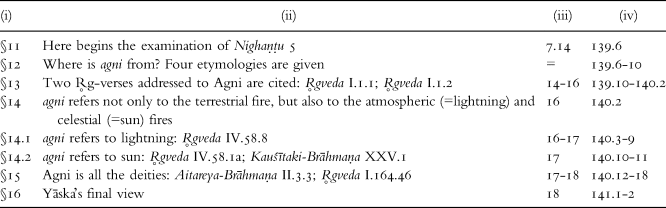
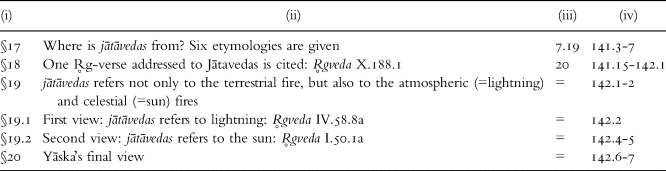
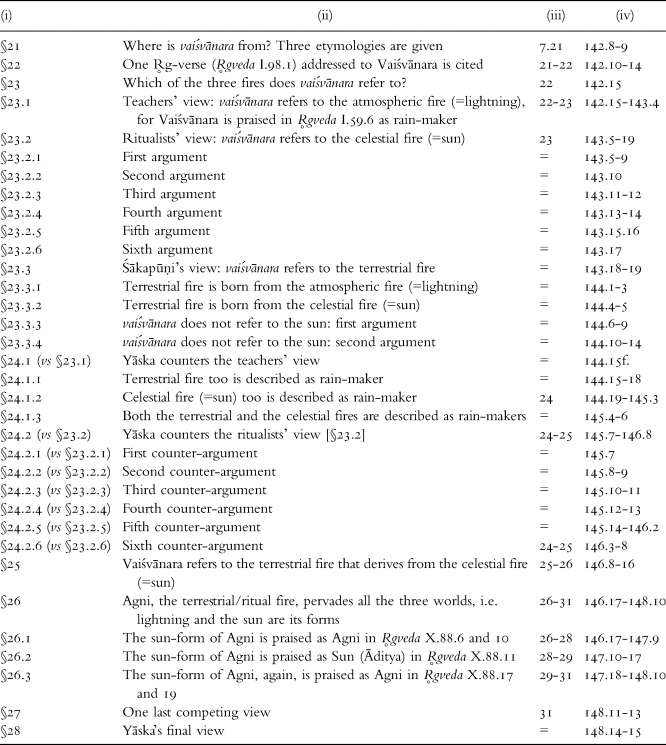
The structure and content of Part I is represented in Table 1. The four columns contain: (i) the number marking the sections in which we divide chapter seven; (ii) a heading that characterises the section's main theme; such headings occur in square brackets in the body of the translation; (iii) reference to the traditional text division of Nirukta 7; (iv) reference to page and line numbers in Sarup's edition.Footnote 15
structure and contents of Part I (Nirukta 7.1-13)

4. Similar Structure of Parts II, III and IV
Part II, III, and IV follow a similar fourfold structure, with Part IV being the most elaborate.
(i) An opening question “where is ‘x’ from?” (‘x’ kasmāt?)—with ‘x’ being the divine names agni [II: §12], jātavedas [III: §17] and vaiśvānara [IV: §21], respectively—is answered with several etymologies.Footnote 16
(ii) One or two R̥gvedic verse(s) containing ‘x’ is(are) cited and then explained. These verses are representative examples. For agni, Yāska cites the first two verses of the first hymn of the R̥gveda (R̥gveda I.1.1; I.1.2) [II: §13]. For jātavedas, he cites the first verse of R̥gveda X.188, which is then said to be the only hymn in the gāyatrī meter that is addressed to Jātavedas [III: §18]. For vaiśvānara, R̥gveda I.98.1 is cited [IV: §22].
(iii) Next, Yāska addresses the issue of what the referent of ‘x’ is [II: §14; III: §19; IV: §23]. Yāska assumes that there are three fires that reside in the three worlds: the terrestrial (=the ritual fire),Footnote 17 the atmospheric (=lightning), and the celestial fires (=sun). The issue, then, is to determine which fire ‘x’ refers to. While in the example verses cited in (ii) ‘x’ refers to the terrestrial fire, Yāska contends that ‘x’ refers also to the other two fires, i.e. lightning and the sun.Footnote 18 Yāska first registers two views according to which ‘x’ refers to lightning [II: §14.1; III: §19.1; IV: §23.1] and to the sun [II: §14.2; III: §19.2; IV: §23.2], respectively.
At this juncture, Part III and Part IV introduce other elements. Part III deals with the view that Agni is all the deities, i.e. all the divine names refer ultimately to Agni, the one existing deity [III: §15; cf. §5.2 above]. In Part IV, an additional third view regarding the referent of ‘x’ is added, i.e. Śākapūṇi's view that vaiśvānara refers to the terrestrial fire [IV: §23.3]. Next, Yāska counters the first two views in detail [IV: §24.1 (vs §23.1); IV: §24.2 (vs §23.2)], and additional issues are discussed [IV: §25; §26; §27].
To fully understand Yāska's reasoning in (iii), it is crucial to gain clarity on two points. First, the issue of the referent of ‘x’ is connected with the twofold classification of divine names discussed at the beginning of Nirukta 7 [I: §1]. Ascertaining whether ‘x’ refers to the ritual fire, the lightning, or the sun amounts to ascertaining which one of these three deities is being addressed by the formula that contains ‘x’. In other words, at stake is ascertaining whether it is the ritual fire, the lightning, or the sun that enjoys primary praise through the divine name ‘x’.
Second, the two views according to which ‘x’ refers to the lightning or to the sun do not represent Yāska's own view, but voice two other parties’ mutually competing views.Footnote 19 They should be understood in relation to Yāska's twofold classification of the divine names. So, while the first view maintains that it is lightning that enjoys primary praise through ‘x’, the second view claims that this deity is in fact the sun.
(iv) At the end of each Part, Yāska states his own final view, using the same formulation: ‘agni [II: §16]/agni jātavedas [III: §20]/ agni vaiśvānara [IV: §28] who enjoys the hymn and to which the oblation is offered is only this (terrestrial fire). These well-known two upper lights (i.e. the atmospheric [=lightning] and the celestial [=sun] fires) enjoy only incidental mention through this name’.Footnote 20
The two competing views given in (iii) maintain that ‘x’ refers to either the lightning or the sun, i.e. it is either Lightning or the Sun that enjoys primary praise through a formula featuring ‘x’. Conversely, Yāska maintains that ‘x’ refers to all the three fires. Yet, an important specification must be made. When ‘x’ refers to the ritual fire, this is the deity ‘who enjoys the hymn and to which the oblation is offered’. We take this to mean that whenever ‘x’ refers to the ritual fire, the latter enjoys primary praise through ‘x’, i.e. ritual fire is the addressee of the formula. On the other hand, whenever ‘x’ refers to either the lightning or to the sun, these two deities enjoy only secondary praise, i.e. their names are incidentally mentioned in a formula addressed to another deity.
5. Summary of Part II (Nirukta 7.14-18)
[§11] After the preliminary discussions in Part I, Yāska says that from now he will be dealing with the deities listed in Nighaṇṭu 5. The first divine name is agni (Nighaṇṭu 5.1.1), a deity whose place is the earth.
[§12] Yāska first gives four etymological explanations of agni; [§13] then he cites two representative R̥gvedic verses (R̥gveda I.1.1; I.1.2) that contain this word and comment on them.
[§14] Yāska states that the word agni does not refer to the terrestrial fire only (as it does in the verses cited in [§13]), but it also refers to the two other fires. Next, Yāska cites two competing views. While [§14.1] maintains that agni refers only to the atmospheric fire (=lightning), [§14.2] maintains that agni refers only to the celestial fire (=sun). In support of the former view, R̥gveda IV.58.8 is cited. In support of the latter view, R̥gveda IV.58.1a and Kauśītaki-Brāhmaṇa XXV.1 are cited.Footnote 21
These two views advance mutually exclusive interpretations concerning the addressee deity of R̥gveda IV.58, and should be understood in relation to the twofold classification of divine names. [§14.1] claims that Lightning enjoys primary praise through agni in R̥gveda IV.58.8; [§14.2] argues that R̥gveda IV.58.1a shows that the addressed deity in R̥gveda IV.58 as a whole is the Sun. Accordingly, it is the Sun that enjoys primary praise through the mention of agni in R̥gveda IV.58.8.
[§15] Agni is all the deities. The view is reminiscent of [§5.2], where Agni is equated with the one existing deity, the Self. This view seems to entail that all the divine names have Agni as their ultimate referent. In support of this view, two citations are given. First, Aitareya-Brāhmaṇa II.3.3: “Agni is all the deities”.Footnote 22 Next, R̥gveda I.164.46 is interpreted as saying that the one deity Agni is called with different names, such as indra, mitra, varuṇa, agni, etc. Agni is identified with the Great Self (mahāntam ātmānam).
[§16] Yāska's final view. While the divine name agni refers to all the three fires, it is only Agni the terrestrial fire which enjoys primary praise through this name and to which oblations are offered. Lightning and Sun only enjoy secondary praise through the name agni. This means that agni refers to either one of these two deities only when it occurs incidentally in a formula that is addressed to another deity.
structure and contents of Part II (Nirukta 7.14-18)

6. Summary of Part III (Nirukta 7.19-20)
[§17] This part deals with the word jātavedas (Nighaṇṭu 5.1.2). Six etymologies of this word are given.
[§18] R̥gveda X.188.1 is cited as an example and commented upon.
[§19] Yāska states that the word jātavedas does not refer to the terrestrial fire only (as it does in the verses cited in [§18]), but it also refers to the two other fires. Next, Yāska cites two competing views. While [§19.1] maintains that jātavedas refers only to the atmospheric fire (=lightning), [§19.2] maintains that jātavedas refers only to the celestial fire (=sun). In support of the former view, R̥gveda IV.58.8a is cited.Footnote 23 In support of the latter view, R̥gveda I.50.1a is cited.
[§20] Yāska's final view. While the divine name jātavedas refers to all the three fires, it is only Agni the terrestrial fire that enjoys primary praise through this name and to which oblations are offered. Lightning and Sun only enjoy secondary praise through the name jātavedas. This means that jātavedas refers to either one of these two deities only when it occurs incidentally in a formula that is addressed to another deity.
structure and contents of Part III (Nirukta 7.19-20)

7. Summary of Part IV (Nirukta 7.21-31)
[§21] Part IV deals with the word vaiśvānara (Nighaṇṭu 5.1.2). Three etymologies are given.
[§22] R̥gveda I.98.1 is cited and explained.
[§23] Yāska asks ‘what is Vaiśvānara?’. That is, when the word vaiśvānara occurs in a formula, which of the three fires is its referent? Yāska records and discusses three competing views: [§23.1] his teachers take vaiśvānara to refer to the atmospheric fire, i.e. lightning; [§23.2] the ritualists maintain that it refers to the celestial fire, i.e. the sun; [§23.3] Śākapūṇi believes that it refers to the terrestrial fire, i.e. the ritual fire. It must be remembered that, like in Parts II and III, the issue concerning the referent of the divine name is associated with the twofold classification of divine names. That is, determining which of the three fires is the referent of vaiśvānara amounts to determining whether it is Ritual Fire, Lightning, or Sun the deity that enjoy primary praise through a formula that contains the name vaiśvānara.
[§23.1] View I: The teachers opine that vaiśvānara refers to lightning, for vaiśvānara is praised in connection with the action of rain-making in R̥gveda I.59.6. The verse is cited and commented on.
[§23.2] View II: The previous ritualists maintain that vaiśvānara refers to the sun. Six arguments are given.
[§23.2.1] The first argument pertains to the ritual of the Soma pressing. This ritual comprises three pressings, in the morning, at noon, and in the evening. Each pressing is associated with one of the three worlds, i.e. the earth, the atmosphere, and the sky. By means of the pressings, the sacrificer or patron of the sacrifice is thought to ascend from earth to the sky. With the third pressing, then, the sacrificer is supposed to be in the sky. Key to the ritualists’ argument is that at this point the Hotar Priest lets the patron of the sacrifice descend from the sky and return to the earth by reciting a hymn addressed to Vaiśvānara. This correspondence between Vaiśvānara and the sky is seen as proof that the word vaiśvānara refers to the celestial fire (=sun).
[§23.2.2] The second argument, too, draws on ritual. That vaiśvānara refers to the sun is supported by the fact that an oblation cooked on twelve potsherds is offered to Vaiśvānara. The number twelve is significant, for it is taken to symbolise the twelve-fold actions performed by the sun, i.e. the actions performed in the twelve months of the year.
[§23.2.3] As the third argument, a brāhmaṇa passage is cited: “Agni Vaiśvānara is clearly that sun over there.” (Maitrāyaṇī-Sam̐hitā II.2.1; II.3.11).Footnote 24
The fourth [§23.2.4], fifth [§23.2.5] and sixth [§23.2.6] arguments are similar. The ritualists’ reasoning comprises two steps: (i) if it can be proved that the nivid formula, the chāndomika hymn, and R̥gveda X.88 are addressed to the Sun, (ii) from this it follows that the word vaiśvānara, which is mentioned in these three formulas, refers to the Sun, i.e. the Sun is the deity that enjoys primary praise through this name. To prove (i), the ritualists cite one passage from the nivid and the chāndomika, respectively, which refer to actions that are characteristically associated with the sun. (Note two things. First, even though no citation from R̥gveda X.88 is given, the ritualists must implicitly refer to one such passage.Footnote 25 Second, even though the word vaiśvānara does not occur in the passages cited by the ritualists from the nivid formula and from the chāndomika hymn, this does not affect their argument: the ritualists’ aim is to prove that the nivid and the chāndomika as a whole are addressed to the Sun.)
[§23.3] View II: Śākapūṇi. He maintains that vaiśvānara refers only to the terrestrial fire. He argues that the word viśvānara refers to the two ‘upper lights’, i.e. the atmospheric (=lightning) and the celestial fire (=sun). The word vaiśvānara is a derivative of viśvānara; it means that which is born from viśvānara. Four arguments are given in support of this view.Footnote 26 The first two arguments are empirical:
[§23.3.1] The terrestrial fire is born from the atmospheric fire, as is observed when lightning generates fire.
[§23.3.2] The terrestrial fire is born from the sun; this can be demonstrated with a small experiment: one can produce fire by interposing a brass plate or a jewel between the sun's rays and dried cow dung.
The other two arguments rely on textual citations: [§23.3.3] That vaiśvānara does not refer to the sun is supported by R̥gveda I.98.1d: “Vaiśvānara is united with the sun”. Clearly, something cannot be united with itself; hence, vaiśvānara cannot possibly refer to the sun. (Note that R̥gveda I.98.1 is cited in [§22]).
[§23.3.4] If vaiśvānara referred to the sun, it would follow that (a) vaiśvānara should be mentioned in hymns that are addressed to the deities that reside in the sky; (b) it should be praised with reference to actions performed by the sun, such as rising, setting, and revolving. However, (a¹) vaiśvānara is mentioned only in hymns that are addressed to Agni, the terrestrial fire; (b¹) it is praised with references to actions that are performed by Agni, such as inviting the deities to the sacrifice, cooking, and burning. Hence, vaiśvānara does not refer to the sun, but to the terrestrial fire.
Next, Yāska counters the teachers’ and the ritualists’ views. [§24.1 (vs §23.1)] The teachers’ argument (vaiśvānara refers to lightning because it is praised in connection with the action of rain-making in R̥gveda I.59.6) is not probative. For also the terrestrial [§24.1.1] (R̥gveda I.164.51) and the celestial [§24.1.2] (R̥gveda I.164.47) fires are praised as rain-makers. [§24.1.3] One brāhmaṇa passage provides further evidence. It describes both the terrestrial and the celestial fires as rain-makers.
[§24.2 (vs §23.2)] Yāska counters all the ritualists’ arguments.
[§24.2.1 (vs. §23.2.1)] The ritualists’ first argument is not probative, for the correspondence between the three Soma pressings and the ascent of the three worlds is based only on a traditional statement (āmnāya [=āmnāta in Nirukta 7.23]). Hence, the correspondence between the hymn addressed to Vaiśvānara and the sky, too, is based merely on a traditional statement. The point seems to be this: Statements stemming from human tradition are fallible; they do not have the same degree of authority as statements found in the śruti.
[§24.2.2 (vs. §23.2.2)] There is no inherent or necessary connection between the number twelve and Vaiśvānara, for also oblations cooked on one or on five potsherds are offered to him. Hence, the argument that Vaiśvānara is the sun because of an oblation cooked on twelve potsherds—the number twelve symbolising the sun's twelve-fold actions—is not probative.
[§24.2.3 (vs. §23.2.3)] That a brāhmaṇa passage identifies Vaiśvānara with the sun is not probative, for other brāhmaṇa passages also identify Vaiśvānara with other items, such as the earth, the year, and the Brahmin.
To counter the ritualists’ fourth [§24.2.4 (vs. §23.2.4)], fifth [§24.2.5 (vs. §23.2.5)], and sixth [§24.2.6 (vs. §23.2.6)] arguments, Yāska employs the same kind of argument used by the ritualists and turns it against them. Like the ritualists, Yāska seeks to determine the referent of vaiśvānara in the nivid formula, the chāndomika hymn, and R̥gveda X.88, by ascertaining what is their addressed deity. To do so, Yāska cites other passages than those cited by the ritualists. These citations are meant to prove that the nivid, chāndomika, and R̥gveda X.88 are addressed to the terrestrial fire, and, therefore, vaiśvānara refers to the terrestrial fire, i.e. it is the Ritual fire that enjoys primary praise through this name. It is not clear why Yāska's citations should provide more robust evidence than the citations given by the ritualists. It is clear however that Yāska takes the word vaiśvānara occurring in the nivid, the chāndomika, and R̥gveda X.88 as referring to the terrestrial fire only (eva). This is consistent with Yāska's final view that when vaiśvānara refers to the deity being the formula's primary addressee that deity is the terrestrial, ritual fire.
In the concluding part of Chapter Seven Yāska's argumentation becomes harder to follow. Our analysis is necessarily more interpretive.
[§25] Yāska cites R̥gveda VI.8.4. This verse describes Agni Vaiśvānara as deriving from the celestial fire, the sun (4cd) (and perhaps also as deriving from the atmospheric fire, the lightning [4ab]). It seems that Yāska cites R̥gveda VI.8.4 to provide further evidence in support of his view that vaiśvānara refers to the terrestrial fire.
[§26] Yāska cites five verses from the haviṣpāntīya hymn, i.e. R̥gveda X.88. In our interpretation, in doing so Yāska emphasises two interrelated points: (i) Agni, the terrestrial/ritual fire, is the fundamental fire; (ii) Agni pervades the three worlds in the forms of lightning and the sun, which are essentially the same as Agni.
R̥gveda X.88 is addressed to Agni as the sun. This means that the terrestrial/ritual fire is being praised in its celestial form. We refer to this form as the sun-form of Agni. In the verses of R̥gveda X.88 cited by Yāska, this sun-form of Agni is praised in two different ways, either as Agni or as the Sun. Specifically, [§26.1] verses 6 and 10 praise the sun-form of Agni as Agni; [§26.2] verse 11 praises it as the Sun; [§26.3] verses 17 and 19 praise it, again, as Agni. Praising the sun-form of Agni as Agni or as the Sun means that the verses in question characterise the sun-form of Agni with features that are relatable to Agni (=the terrestrial/ritual fire) or to the Sun.
[§26.1] Verses 6 and 10 praise the sun-form of Agni as Agni. R̥gveda X.88.6ab says that ‘this very [Agni = terrestrial/ritual fire] is born as the rising sun in the early morning’; R̥gveda X.88.6cd characterises the gods’ esoteric knowledge as the knowledge that one and the same Agni is the terrestrial fire at night as well as the sun in the daytime. R̥gveda X.88.10ab says that the gods begot Agni in the sky (‘in the sky (diví), the divinities (devā́so) begot (ájījanañ) Agni’). R̥gveda X.88.10cd says that this Agni is threefold, i.e. it has three forms: terrestrial/ritual fire on earth; lightning in the mid-space; and the sun in the sky. That the sun-form of Agni is referred to with the name agni (R̥gveda X.88.6a; 10a) seems to be the reason why verse 6 and 10 are said to praise the sun-form of Agni as Agni.
[§26.2] Verse 11 praises the sun-form of Agni as the Sun. R̥gveda X.88.11ab says that ‘the gods (devā́ḥ) set it in the sky (diví) as the Sun (sū́riyam), the son of Aditi (āditeyám)’. This half-verse closely resembles R̥gveda X.88.10ab. Both half-verses say that the gods (devā́so/devā́ḥ) begot or set the sun-form of Agni in the sky (diví). There is one notable difference, however: while the sun-form of Agni is called agni in verse 10, it is called sun (sūrya) in verse 11. This difference seems to be the reason why Yāska states that the sun-form of Agni is praised as Agni in verse 10, but as Sun in verse 11.
[§26.3] Verses 17 and 19, again, praise the sun-form of Agni as Agni. Verse 17 mentions a debate between two divine Hotars, the lower (ávaraḥ) and the higher (páraś) one. The former is the terrestrial/ritual fire on earth. The latter is the sun in the middle of the sky. While the word Hotar commonly refers to the terrestrial/ritual fire, its reference to the sun is significant. The fact that the sun-form of Agni is referred to as Hotar shows that verse 17 praises it as Agni. Verse 19, too, indicates two Hotars, the Brahmin who sets up the ritual fire in the morning to perform the Agnihotra and the ritual fire itself. Like in verse 17, that the sun-form of Agni is referred to as Hotar shows that the former is being praised as Agni.
[§27] Yāska mentions one last competing view. In the formula recited by the Hotar (note the link with [§26.3]), the divine name vaiśvānara does not refer to Agni. For it explicitly qualifies Agni's father. Hence, in this formula vaiśvānara must refer to either the atmospheric or celestial fire, Agni's father. Yet, that vaiśvānara refers also to the other two fire does not seem to contradict Yāska's final view.
[§28] Yāska's final view. While the divine name vaiśvānara refers to all the three fires, it is only Agni the terrestrial fire which enjoys primary praise through this name and to which oblations are offered. Lightning and Sun only enjoy secondary praise through the name vaiśvānara. This means that vaiśvānara refers to either one of these two deities only when it occurs incidentally in a formula that is addressed to another deity.
structure and contents of Part IV (Nirukta 7.21-31)

8. Yāska's theology
In this final section, we describe Yāska's key theological ideas. As is characteristic of his style, Yāska does not state his view explicitly. Although some interpretive work is therefore required, we think that our interpretation does not stray far from Yāska's own ideas.
Yāska's theological thinking concentrates on the number of deities and their relation. He records three different views. (i) The etymologists believe that there are three deities, Agni, Vāyu/Indra, and Āditya. These three deities are associated with one of the three worlds, the earth, the atmosphere, and the sky, respectively [I: §6.1]. (ii) The ritualists opine that there are many deities [I: §6.2]. (iii) A third party (R̥jvarthā 7.17 [690.12] ātmavids, ‘the knowers of the self’) maintains that there is only one deity, the Great Self (mahāntam ātmānam) [I: §5.2]. Yāska rejects the ritualists’ view and sides with both the etymologists and the knowers of the Self. He defends the etymologists’ view against the ritualists’ criticism [I: §6.4] and adopts their three-deity model of Agni, Indra and Āditya [I: §8]. With respect to the view of the knowers of the Self, Yāska uses the argument that all names ultimately refer to the one existing deity, the Self, when he counters the criticism that names referring to non-divine things, such as plants and ritual tools, should not be regarded as divine names [I: §5.2]. He refers to the ‘Great Self’ in his commentary on R̥gveda I.164.46 [I: §15].
Yāska's theological system conflates both the three-deity view and the one-deity view. Both views appear to be simultaneously valid at two different levels of description. Yāska's system can be thought as a Matryoshka doll. On the surface, Yāska accepts the three-deity view. This means that all the divine names listed in Nighaṇṭu 5 are reduced to three main deities. Specifically, the names listed in Nighaṇṭu 5.1-3 ultimately refer to the one terrestrial deity, Agni. The names in Nighaṇṭu 5.4-5 refer to the one atmospheric deity, Indra. And the names in Nighaṇṭu 5.6 refer to the one celestial deity, Āditya. On a deeper level, however, these three basic deities are in turn reduced to one fundamental deity. This one deity is Agni, the terrestrial/ritual fire.
Yāska's theological system coordinates with Yāska's conceptualisation of the three fires and their relation. There are three fires, the ritual fire on earth, the lightning in the atmosphere, and the sun in the sky. Each of these three fires corresponds to the main deity associated with one of the three worlds. That is, the terrestrial/ritual fire corresponds to Agni, the lightning to Indra, and the sun to Āditya.Footnote 27 These three fires can be reduced to one, the terrestrial/ritual fire, which Yāska regards as the fundamental fire, the other two fires being its forms or manifestations in the two upper worlds [IV: §26]. In short, Yāska's view on the three fires provides the conceptual model whereby the plurality of deities can first be reduced to the three main deities and these in turn can be reduced to the one fundamental deity, Agni, the terrestrial/ritual fire, the Great Self.
9. Translation of Nirukta Chapter 7
Part I (Nirukta 7.1-13)
[§1 Definition of the divine names listed in Nighaṇṭu 5]
[Nirukta 7.1] Now, then, [we shall explain] the section [of the Nighaṇṭu] on the names of the deities. So (tad), [teachers] call ‘section on the names of the deities’ the names of the deities that enjoy primary praise. That section is [the subject of] the following close examination into the deities.Footnote 28
[§2 Definition of the deity of the formula]
Desiring [it], seeking to obtain ownership of [that] object, a seer employs [a verse of] praise (stuti) for deity ‘x’—that [praise] becomes a formula (mantra) that has ‘x’ as its [addressed] deity.Footnote 29
[§3 Classification of formulas]
This (formula) occurs as three kinds of R̥gvedic stanzas:Footnote 30 [§3.1] those which address [a deity] indirectly; [§3.2] those which address [a deity] directly; [§3.3] those which are self-addressed (i.e. spoken by the deity itself).
[§3.1 Formulas that address a deity indirectly]
Of these, those which address [a deity] indirectly are associated with [i.e. they present] all the nominal endings and the third persons of the verb:
[Nirukta 7.2]
“Indra (índro) is master of heaven and Indra of earth.” (R̥gveda X.89.10a)Footnote 31
“Just to Indra (índram) have the singers [bellowed] aloft.” (R̥gveda I.7.1a)
“These Tr̥tsus, constantly laboring alongside Indra (índreṇa), . . .” (R̥gveda VII.18.15a)
“To Indra (índrāya) sing a Sāman chant.” (R̥gveda VIII.98.1a)
“Without Indra (índrād) he (Soma) does not purify any domain of his.” (R̥gveda IX.69.6d)
“Now I shall proclaim the heroic deeds of Indra (índrasya).” (R̥gveda I.32.1)
“On Indra (indre) the desires were based.”Footnote 32
[§3.2 Formulas that address a deity directly]
Next, [the formulas] which address [a deity] directly are associated with the second person [of the verb] and the pronoun ‘you’ (tvam):
“You (tuvám), Indra, were [born] from power.” (R̥gveda X.153.2a)
“Smash away (jahi) the scornful for us, O Indra.” (R̥gveda X.152.4a)
Furthermore, those who praise (i.e. the seers) are addressed directly, the objects of praise are addressed indirectly:
“Don't praise (ví śaṃsata) anything else!” (R̥gveda VIII.1.1a)
“Sing forth (prá gāyata), o Kaṇvas.” (R̥gveda I.37.1c)
“Come forth (úpa préta), Kuśikas; make yourselves known (cetáyadhvam).” (R̥gveda III.53.11)Footnote 33
[§3.3 Formulas that are self-addressed by the deity itself]Footnote 34
Further, [the formulas] which are self-addressed are associated with the first-person verb and with the personal pronoun ‘I’ (aham). Examples of this are: Indra Vaikuṇṭha [hymns] (R̥gveda X.48-49), the hymn of lapwing (R̥gveda X.119), and the hymn of Vāc, daughter of Āmbhr̥ṇa (R̥gveda X 125).
[Nirukta 7.3] Formulas which address a deity indirectly and those which address a deity directly are the most numerous. Formulas which are self-addressed are rare.
[§3.4 Additional classificatory principles]
Furthermore, there is praise only, not wish (āśis), like in this hymn:
“Now I shall proclaim the heroic deeds of Indra.” (R̥gveda I.32.1a)
Further, there is wish only, not praise:
“May I see well with my eyes, may I be intensely lustrous by my face, may I hear well with my ears.”Footnote 35
This [kind of formula] is abundant in formulas connected with the Adhvaryu priests (i.e. in yajus formulas) and in [other] ritualistic formulas.
Furthermore, [some formulas are] a curse [on oneself] and a curse on [others]:
“Let me die today if I am a sorcerer.” (R̥gveda VII.104.15a)
“Then he should be separated from ten heroes.” (R̥gveda VII.104.15c)
Furthermore, [some formulas have] the intention of describing a certain state:
“Death did not exist nor deathlessness then.” (R̥gveda X.129.2a)
“Darkness existed, hidden by darkness, in the beginning.” (R̥gveda X.129.3a)
Furthermore, [some formulas are] lamentation of a certain state:Footnote 36
“If the gods’ pet should fly away today, never to return, . . .” (R̥gveda X.95.14a)
“I do not understand what sort of thing I am here.” (R̥gveda I.164.37a)
Furthermore, [some formulas are] criticism and commendation:
“Who eats alone has only evil.” (R̥gveda X.117.6d)
“This dwelling of the benefactor is like a lotus-pound.” (R̥gveda X.107.10c)
In this way in the dice-hymn (R̥gveda X.34) [the formulas are] criticism of gambling and commendation of agriculture. Thus (as described in §3.4) with several different intentions the seers have vision of the mantras.
[§4 Formulas in which the divine name is not specified]
[Nirukta 7.4] Then, [there follows] a close examination of the deities of the formulas whose deities is not specified.
[§4.1: view 1]
[Such formulas have] as deity the deity of the ritual or part of the ritual [in which they are employed].
[§4.2: view 2]
Further, ritualists say that [formulas that are employed] elsewhere than in the ritual have Prajāpati [as their deity].Footnote 37 The etymologists say [that such formulas] have Narāśaṃsa as their deity.Footnote 38
[§4.3: view 3]
Or else, that [deity] would be a deity according to one's desire (i.e. one can choose the deity as one wishes);Footnote 39 or there would be many/various deities. For the practice is various in the world: [one and the same formula has sometimes] a god as its deity, [sometimes it has] the guests, [sometimes it has] the ancestors.Footnote 40
[§5 Should the names listed in Nighaṇṭu 5.3 be regarded as divine names?]
[§5.1 No: they do not refer to deities]
[It has been said that] a formula [has as its deity the deity of] the ritual or [another] deity.Footnote 41 [With respect to this, there is the following objection:] also non-deities are praised as deities like [those referred to by the divine names] beginning with ‘horse’ and ending with ‘herb’ (i.e. the names listed in Nighaṇṭu 5.3.1-22). Furthermore, there are eight dyads [of such non-deities that are praised as deities, referred to in Nighaṇṭu 5.3.29-36].Footnote 42
[§5.2 Yes: also non-deities are part of the one divine Self (ātman)]
One should not consider as adventitious/fortuitous (āgantu), as it were, the meanings/objects (artha) of the deities.Footnote 43 This becomes evident [in what follows].
Because of the great power of the deity (= Self, ātman), one single Self is being praised as multiple. The other gods are limbs of the one Self-trunk. Also, [scholars] say that seers perform praises through the plenitude of the source (=Self) of the beings. And because the source (=Self) has all the names [of the beings].
[Deities] are born from each other; they have each other as their origin; they are born from [ritual] action; they are born from the Self.Footnote 44 [For example] ‘chariot’ [Nighaṇṭu 5.3.6] among these [so-called non-deities referred to in Nighaṇṭu 5.3.1-22; 29-36] is nothing else than the Self; ‘horse’ [Nighaṇṭu 5.3.1] [among these is nothing else than] the Self; ‘weapon’ (āyudha) [= dhanus (Nighaṇṭu 5.3.11) ‘bow’] [among these is nothing else than] the Self; ‘arrows’ [Nighaṇṭu 5.3.13] [among these is nothing else than] the Self. Everything of the god(s) is the Self (i.e. every manifestation of the gods is nothing but the Self).
[§6 How many deities are there?]
[§6.1 Etymologists’ view: there are three deities: Agni, Vāyu/Indra, and Āditya]
[Nirukta 7.5] The etymologists [maintain that] there are only three deities: Agni whose place is the earth; Vāyu or Indra whose place is the mid-space; the Sun whose place is the sky.Footnote 45 On account of their great power, each of the three deities has many names; or on account of their distinct actions [each of the three deities has many names]. Like [the ritual performer], though he is one, [he is called] ‘Hotar’, ‘Adhvaryu’, ‘Brahman’, ‘Udgātar’ [according to the distinct ritual actions he performs].Footnote 46
[§6.2 Ritualists’ view: there are many deities]
[On the other hand, the ritualists maintain that] or else, [the deities] would be disparate. For the praises [of the deities] are disparate [and] so are [their] appellations.Footnote 47
[§6.3 Ritualists’ criticism of etymologists’ view]
As to [the etymologists’ view (§6.1) that] ‘on account of their distinct actions [each of the three deities has many names]’, [the ritualists raise the following criticism:] many [agents], too, would perform their [respective] actions after having divided them [among themselves].Footnote 48
[§6.4 Yāska's view: etymologists’ view (§6.1) is correct]
With respect to this (i.e. the number of deities), the unity in terms of common location and common enjoyment should be considered. Common location: like on earth there are men, animals and gods etc. Common enjoyment, too, is seen: [first example] like the Earth enjoys [an oblation/formula] with Parjanya (rain-cloud), Vāyu (wind), and Āditya (sun). [Second example] and another world's [fire] (the atmospheric and/or celestial fire) [enjoys an oblation/formula] together with Agni (terrestrial fire).Footnote 49 With respect to this, it is like a kingdom of human beings.Footnote 50
[§7 What forms do deities have?]
Now, [we] consider the forms of deities.
[§7.1 Deities are like human beings, i.e. they are provided with intellect]
One [view] is that they should be like human beings. For there are praises [for deities] as if they were provided with intellect; and the same is true of [their] names.
Furthermore, [deities] are praised with their limbs which are like those of human beings:
“High are the arms of you, O Indra, who are stalwart.” (R̥gveda VI.47.8c)
“When you grabbed them (two world-halves) together, bounteous one, it was just a handful for you.” (R̥gveda III.30.5d)
Furthermore, [deities are praised] with the associations of objects of possession, [associations that are] like those of human beings:
“With your two fallow bays, Indra, journey here.” (R̥gveda II.18.4a)
“Your lovely wife, a great delight, is in your house.” (R̥gveda III.53.6b)
Furthermore, [deities are praised] with actions that are like those of human beings:
“Eat and drink of it (Soma) when it is presented, Indra.” (R̥gveda X.116.7d)
“You of listening ear, listen to our call.” (R̥gveda I.10.9a)
[§7.2 Deities are not like human beings, i.e. they are without intellect]
[Nirukta 7.7] The other [view] is that [deities] should not be like human beings. For, surely, what is [actually] seen is not like human beings. For example: fire, wind, the sun, the earth, and the moon.
As to this [reason given above that] ‘[deities should be like human beings] for there are praises [for deities] as if they were provided with intellect’, [we reply that] also beings without intellect are praised in the same way. For example: [those deities referred to by the divine names] beginning with ‘dice’ and ending with ‘herb’ [which are listed in Nighaṇṭu 5.3.4-22].
As to this [reason given above that] ‘[deities should be like human beings for they] are praised with limbs that are like those of human beings’, [we reply that] this occurs also regarding beings without intellect:
“They (pressing stones) roar with their golden mouths.” (R̥gveda X.94.2b)
This is a praise of the pressing stone.
As to this [reason given above that] ‘[deities should be like human beings for they are praised] with the associations of objects of possession, [associations that are] like those of human beings’, [we reply that] this, too, is the very same (i.e. such kind of praises occur also for beings without intellect, e.g.:)
“Sindhu has yoked her own well-naved, horsed chariot”. (R̥gveda X.75.9a)
This is a praise of a river.
As to this [reason given above that] ‘[deities are praised] with actions that are like those of human beings’, [we reply that] this, too, is the very same (i.e. such kind of praises occur also for beings without intellect, e.g.:)
“They (pressing stones) have achieved the eating of the oblation even before Hotar”. (R̥gveda X.94.2d)
This is a praise of the pressing stone.
[§7.3 Deities are both like and unlike human beings]
Or else, [the deities] should be of both kinds [both with and without human-like intellect].
[§7.4 Yāska's view]
Or else, the [deities that are not like human beings, i.e. those without intellect] whose nature is the [ritual] actions would belong precisely to the truly existing (satām) deities that are like human beings [i.e. those that have intellect].Footnote 51 Like sacrifice [which is without intellect and has the nature of ritual actions belongs] to the patron of the sacrifice [who is provided with intellect]. ‘And this is the agreement of the legend [school of interpretation] (ākhyānasamaya)’.Footnote 52
[§8 Agni, Indra, and Āditya: their shares (bhakti), actions (karma), and association with other deities]
It has been said before [in §6.1] that there are three deities only. We will explain their shares and association [with other deities].
[§8.1 Agni]
Now, the following are the shares of Agni: this world, the morning pressing (of soma), spring, the gāyatrī meter, the triple stoma, the rathantara Sāman chant. And the group of gods transmitted [in the Nighaṇṭu 5.1-3 as residing] in the first place (i.e. earth). Agnāyī, Pr̥thivī, Iḷā are the women [of Agni].Footnote 53
Next, the action of Agni is: carrying oblations [to the deities] and bringing the deities to [the ritual arena], and whatever pertains to the domain of sight—that is precisely Agni's action [and not the action of other deities].
Then, the gods that are jointly praised with Agni are Indra, Soma, Varuṇa, Parjanya, and R̥tus. There is a joint oblation offered to Agni and Viṣṇu, but no joint R̥g-verse addressed to them in the tenfold (i.e. the R̥gveda). Furthermore, there is a joint oblation offered to Agni and Pūṣan, but no joint praise is addressed to them.
With respect to this (i.e. that Agni and Pūṣan are not praised jointly), [the scholars] give as example the [following] R̥g-verse in which [the two deities] are praised separately:
[Nirukta 7.9] “Forth let Pūṣan stir you from here, the wise one, whose livestock does not get lost, the herdsman of the world. He will entrust you to these forefathers; Agni [will entrust you] to the wealthy gods.” (R̥gveda X.17.3)
“Let Pūṣan stir you forth from here, the wise one, whose livestock does not get lost, the herdsman of the world”: for this (Pūṣan) is the protector of all beings. “He will entrust you to these forefathers”: the third foot is doubtful (i.e. it is unclear whether its subject is Pūṣan or Agni). One [view is that] Pūṣan that was mentioned above is referred to again here. The other [view is that] Agni that is mentioned below is referred to here. “Agni [will entrust you] to the wealthy gods”: suvidatra means wealth; it is from vid (‘to find’) with one preverb (su) or from dā (‘to give’) with two preverbs (su and vi).Footnote 54
[§8.2 Indra]
[Nirukta 7.10] Then, these are the shares of Indra: middle space, the midday pressing, summer, the triṣṭubh meter, the fifteenfold stoma, the br̥hat Sāman chant. And the group of gods transmitted [in the Nighaṇṭu 5.4-5 as residing] in the middle place (i.e. atmosphere) and the women [of Indra, i.e. those referred to by the female divine names listed in Nighaṇṭu 5.4-5].
Next, the action of Indra is: releasing the waters, slaying Vr̥tra, and any activity of physical strength—that is precisely Indra's action [and not the action of other deities].
Next, the gods jointly praised with Indra: Agni, Soma, Varuṇa, Pūṣan, Br̥haspati, Brahmaṇaspati, Parvata, Kutsa, Viṣṇu, and Vāyu. Furthermore, [among the gods residing in the middle space like Indra,] Mitra is jointly praised with Varuṇa; Soma with Pūṣan and Rudra; Pūṣan with Vāyu;Footnote 55 Parjanya with Vāta.
[§8.3 Āditya]
[Nirukta 7.11] Then, these are the shares of Āditya: the world over there, the third (evening) pressing, the rainy season, the jagatī meter, the seventeen-fold stoma, the vairūpa Sāman chant. And the group of gods transmitted [in the Nighaṇṭu 5.6 as residing] in the highest place (sky) and the women [of Āditya, i.e. those referred to by the female divine names listed in Nighaṇṭu 5.6].
Next, the action of Āditya is: taking the fluid (i.e. to absorb water) and retaining it by means of his rays,Footnote 56 and whatever is enigmatic/mysterious (pravalhita)Footnote 57—that is precisely Āditya's action [and not of other deities]. [Āditya is] praised together with the Moon, Wind, the Year etc.Footnote 58
[§8.4 Remaining shares]
In this very distribution of places (i.e. in earth, mid-space, and sky), one should arrange the remaining shares concerning seasons, meters, stomas and pr̥ṣṭhas. Autumn, the anuṣṭubh meter, the twenty-one-fold stoma, the vairāja Sāman chant are [the shares] that have earth as their foundation. Winter, the paṅkti meter, the twenty-seven-fold stoma, the śākvara Sāman chant are [the shares] that have mid-space as their foundation. Cold season (late winter?), the aticchanda meters, the thirty-three-fold stoma, the raivata Sāman chant are the shares of sky.
[. . .]Footnote 59
[§9 Fourfold classification of deities depending on what they ‘enjoy’ (√bhāj)]
[Nirukta 7.13] Thus, these deities have been dealt with in order. [Some such deities] enjoy hymns (sūkta); [some] enjoy oblations (havis), and the most numerous ones enjoy R̥g-verses. A few enjoy incidental mention [alongside the principal deities].
[§10 Yāska's rationale for the transmission of Nighaṇṭu 5]
Now, then, [an injunction] enjoins [one to offer an] oblation having joined [the principal names of the deities with their] epithets: e.g. ‘to Indra, the slayer of Vr̥tra’; ‘to Indra, the deliverer from crisis’.Footnote 60 Some [scholars] transmit also such epithets [as part of the list of the names of the deities]. However, [such epithets] are more numerous than the transmitted list.Footnote 61 On the other hand, I transmit only those [epithets] that are conventionally known and by which [the deities] enjoy primary praise.
Now, then, seers praise the deities [with epithets that are associated] with the deities’ actions ‘the slayer of Vr̥tra, the splitter of stronghold, etc.’. Some transmit such epithets as well. However, [such epithets] are more numerous than the transmitted list. Also, such [epithets] merely [circumstantially] qualifies the [principal] names [of the deities]. Like ‘Give rice gruel to a Brahmin who is hungry, an ointment to a Brahmin who has taken a bath, a drink to a Brahmin who is thirsty.’Footnote 62
Part II: Agni (Nirukta 7.14-18)
[§11 Here begins the examination of Nighaṇṭu 5]
[Nirukta 7.14] From now on, we will deal with [the deities] in order (i.e. according to how they are listed in Nighaṇṭu 5). We will explain first Agni [Nighaṇṭu 5.1.1] whose place is the earth.
[§12 Where is the word agni from? Four etymologies are given]
[Question:] Where is agni from?Footnote 63
[Etymology 1:] [For, Agni] is led at the front (agraṇī): he is led forth at the front in the rituals.
[Etymology 2:] He leads (nayati) his limbs (aṅga) (flames) [ahead], completely inclining forward.
[Etymology 3:] Sthaulāṣṭhīvi says that [Agni] is a non-moistener (aknopana) (i.e., a drier). It does not moisten [something], that is, it does not make [something] wet.
[Etymology 4:] Śākapūṇi says that [the word agni] is produced from three verbs: i, añj or dah, and nī.Footnote 64 You should know,Footnote 65 Śākapūṇi takes the sound a from the verb i, the sound g from the verb añj or dah, and (the verb) nī is the final.Footnote 66
[§13 Two R̥g-verses addressed to Agni are cited]
The following R̥g-verse is for Agni:
[Nirukta 7.15] “I beg (īḷe) Agni, the one placed to the fore, god and priest of the sacrifice, the Hotar, the best conferrer of treasures.” (R̥gveda I.1.1)
‘I invoke Agni’, that is, I beg Agni. The [verb] īḷ (ili) denotes the action of requesting or worshiping. ‘The one placed to the fore’ (purohita) and ‘sacrifice’ (yajña) have been explained already [in Nirukta 2.12 and 3.19, respectively]. ‘God’ (deva) is from giving (dāna), or from shining (dīpana), or from illuminating (dyotana), or from the fact that he is the one whose place is the sky (dyusthāna)’. What is a ‘god’ (deva) is a ‘deity’ (devatā) [i.e. both words are synonyms].Footnote 67 ‘Hotar’, that is, ‘one who invokes’ (hvātar). Aurṇavābha says that hotar is from [the verb] hu (juhoti) ‘to offer oblations’. ‘Best conferrer of treasures’ (ratnadhātama), that is, ‘best giver of agreeable wealth’ (ramaṇīyānāṃ dhanānāṃ dātr̥tamam).
The following is another R̥g-verse for Agni:
[Nirukta 7.16] “Agni, to be invoked by ancient seers and by the present ones, shall carry the gods here to this place.” (R̥gveda I.1.2)
Agni, who is to be invoked by both ancient seers and us, the newer ones, may he carry the gods here to this place.
[§14 agni refers not only to the terrestrial fire, but also to the atmospheric (=lightning) and celestial (=the sun) fires]
One should not think that [the word] agni [refers to] this [terrestrial fire] only. Also the two upper lights (i.e. the lightning and the sun) are called agni.
[§14.1 First view: agni refers to lightning]
Now then, the middle [fire (=lightning) is called agni]:
[Nirukta 7.17] “They bend themselves, like same-minded young women, lovely, smiling, towards agni (=lightning). The streams of ghee (=water) bow to [reach] the kindling sticks. Jātavedas delights, taking pleasure in them.” (R̥gveda IV.58.8)
They bow toward, like same-minded young women. samana (‘same-minded’) is from samanana ‘thinking the same’ or from sammānana ‘honouring together’—lovely, smiling, towards Agni. [This half verse] is metaphorical. ‘The streams of ghee’, that is, the streams of water, approach the kindling sticks. The [verb] nas denotes the action of reaching or bowing to. ‘Jātavedas delights (haryati), taking pleasure in them’. The [verb] hr̥ denotes the action of longing for or diverting oneself.Footnote 68
[§14.2 Second view: agni refers to sun]
“From the sea (samudra), a honeyed wave has arisen.” (R̥gveda IV.58.1a)
[Some other people] think that [in this verse] the sun is being spoken of. [Therefore, R̥gveda IV.58 is addressed to the sun; hence, the divine name agni (R̥gveda IV.58.8) refers to the sun, not to the lightning].
A brāhmaṇa passage also says:
“From the sea, indeed, this (honeyed wave) rises from the waters.” (Kauśītaki-Brāhmaṇa XXV.1)
[§15 Additional view: Agni is all the deities]
Furthermore [another] brāhmaṇa passage says:
“Agni is all the deities.” (Aitareya-Brāhmaṇa II.3.3)
The following [R̥g-verse] [serves] to further explain this [point, i.e. that Agni is all the deities:]
[Nirukta 7.18] “They call [Agni] ‘Indra’, ‘Mitra’, ‘Varuṇa’, ‘Agni’, and he is also the celestial well-winged Garutmat (bird, i.e. the sun)—though it is one, inspired poets speak of Agni in many ways—they call [him] ‘Yama’, ‘Mātariśvan.’” (R̥gveda I.164.46.)Footnote 69
The wise speak of this very (terrestrial) Agni, the Great Self, in various ways, as Indra, Mitra, Varuṇa, Agni, and the celestial Garutmat. ‘Celestial’ (divya), that is, born in the sky (divija). Garutmat, that is, the one provided with praise (garaṇavān); or heavy-souled (gurvātmā), i.e. great-souled.Footnote 70
[§16 Yāska's final view]
Yet, agni who enjoys the hymn and to which the oblation is offered is only this [terrestrial fire]. These two upper lights (i.e. the atmospheric [=lightning] and the celestial [=sun] fires) enjoy only incidental mention (nipātam) through this name (agni).
Part III: Jātavedas (Nirukta 7.19-20)
[§17 Where is the word jātavedas from? Six etymologies are given]
[Nirukta 7.19] [Question:] Where is jātavedas from?
[Etymology 1:] [Agni] knows (veda) all the creatures (jātāni).
[Etymology 2:] Or all the creatures (jātāni) know (viduḥ) him.
[Etymology 3:] Or he is found (vidyate) in every creature (jāte jāte).
[Etymology 4:] Or he is the one due to which wealth is born (jātavitta).
[Etymology 5:] Or he is the one due to which wisdom is born (jātavidya).
[Etymology 6:] There is a brāhmaṇa passage:
“When born (jātáḥ), he found (ávindata) the cattle. This is why Jātavedas is called jātavedas.” (Maitrāyaṇī-Sam̐hitā I.8.2)
Also [there is this other brāhmaṇa passage]:
“Therefore, during all the seasons, the cattle crawl towards Agni.” (Maitrāyaṇī-Sam̐hitā I.8.2)
[§18 One R̥g-verse addressed to Jātavedas is cited]
There is the following [R̥g-verse] for Jātavedas:Footnote 71
[Nirukta 7.20] [Interpretation 1] “Forth (prá) now ye spur (hinota) Jātavedas, the one that is all-pervading [by means of actions], to sit here on this ritual grass of ours.”
[Interpretation 2] “Forth ye spur Jātavedas like [one spurs forth] a horse, to sit here on this ritual grass of ours.” (R̥gveda X.188.1)
Ye spur forth (prahiṇuta) Jātavedas, the one that is all-pervading (sam-aśnuvāna) by means of actions. Or else, [aśva ‘horse’] is used as a simile: ‘[Ye spur forth] Jātavedas like [one spurs forth] a horse’.Footnote 72 May Jātavedas sit on this ritual grass of ours. This triplet of verses in the gāyatrī meter (i.e. R̥gveda X.188) is the only one that is addressed to Jātavedas in the tenfold (i.e. the R̥gveda). However, any [hymn in the gāyatrī meter that is] addressed to Agni can be used in the place of [hymns] addressed to Jātavedas.Footnote 73
[§19 jātavedas refers not only to the terrestrial fire, but also to the atmospheric (=lightning) and celestial (=sun) fires]
One should not think that [the word] agni [jātavedas] [refers to] this [terrestrial fire] only. Also the two upper lights (i.e. the lightning and the sun) are called jātavedas.
[§19.1 First view: jātavedas refers to lightning]
Now then, the middle [fire, i.e. lightning, is called jātavedas]:
“They bend themselves, like same-minded young women.” (R̥gveda IV.58.8a)
This has been explained before [in §14.1].
[§19.2 Second view: jātavedas refers to sun]
Next, the sun over there [is called jātavedas]:
“Up do [the beacons convey] this Jātavedas.” (R̥gveda I.50.1a)
We will explain this below [Nirukta 12.15].Footnote 74
[§20 Yāska's final view]
Yet, agni jātavedas who enjoys the hymn and to which the oblation is offered is only this [terrestrial fire]. These two upper lights (i.e. the atmospheric [=lightning] and the celestial [=sun] fires) enjoy only incidental mention through this name (jātavedas).
Part IV: Vaiśvānara (Nirukta 7.21-31)
[§21 Where is the word vaiśvānara from? Three etymologies are given]
[Nirukta 7.21] [Question:] Where is vaiśvānara from?
[Etymology 1:] he leads every (viśva) people (nara).
[Etymology 2:] Or every (viśva) people (nara) leads this one.
[Etymology 3:] Or else, [vaiśvānara] is precisely the same (eva) as viśvānara. [viśvānara is analysed as] fixed upon all the beings—vaiśvānara is its [derivative].Footnote 75
[§22 One R̥g-verse addressed to Vaiśvānara is cited]
The following R̥g-verse is for Vaiśvānara:
[Nirukta 7.22] “May we be in the goodwill of Vaiśvānara, for he is indeed the king to be relied on by [all] the creatures. Born from here, he looks over this entire [world]. Vaiśvānara is united with the sun.” (R̥gveda I.98.1)
Born from here, [Vaiśvānara] looks out over this whole [world]. Vaiśvānara is united together with the sun. May we be in the favourable will of Vaiśvānara, who is the king to be relied on by all the creatures.
[§23 Which of the three fires does vaiśvānara refer to?]
Then, what is Vaiśvānara?
[§23.1 Teachers’ view: vaiśvānara refers to the atmospheric fire (=lightning), for Vaiśvānara is praised in R̥gveda I.59.6 as rain-maker]
Teachers say that he is the middle [fire (=lightning)]. For [a seer] praises it (Vaiśvānara) with the action of making rain:
[Nirukta 7.23] “I now proclaim the greatness of the bull (i.e. rain-maker), whom the Pūrus (i.e. those men to be filled with [rain-water]) follow as Vr̥tra(cloud)-smasher. Agni Vaiśvānara, having smashed the Dasyu (cloud), shook the kāṣṭhā (water), cut down Śambara (cloud).” (R̥gveda I.59.6)
I announce the greatness, i.e., the high excellence of the bull (vr̥ṣabha), i.e. the rain-maker (varṣitar), whom the Pūrus, i.e., those men to be filled with (pūrayitavya) [rain water], desiring rain, follow, i.e. attend upon as the Vr̥tra-smasher, i.e. the cloud-smasher. Dasyu is from [the verb] dasyati having the meaning of destroying. [Dasyu is one] in whom water decays (upadasyanti); [one] who destroys (upadāsayati) [ritual] actions.Footnote 76 Agni Vaiśvānara, smashing him, shook down the water, the kāṣṭhā; he split Śambara, i.e. the cloud.Footnote 77
[§23.2 Ritualists’ view: vaiśvānara refers to the celestial fire (=sun)]
[Nirukta 7.23] Now, previous ritualists say that [the name vaiśvānara] refers to that sun over there.
[§23.2.1 First argument]
The ascent of [the three] Soma pressings has been traditionally considered (āmnātaḥ) as the ascent of these [three] worlds (i.e. earth, mid-space, and sky). The descent from [or after] that ascent is desired to be done. A Hotar performs that (descent) as an imitation (i.e. symbolically),Footnote 78 by means of a hymn dedicated to Vaiśvānara recited at the time of a śastra dedicated to Agni and the Maruts. Further, [the Hotar] should not heed the stotriya (tr̥ca, a set of three verses recited at the beginning of the corresponding śastra), for [this stotriya] is addressed to Agni. From there (i.e. the sky) [the sacrificer in his descent] comes to the mid-space deities, to Rudra and the Maruts.Footnote 79 From there (i.e. the mid-space) [the sacrificer comes to] Agni situated here (i.e. on earth). It is precisely at this point that the [Hotar] recites the stotriya [dedicated to Agni and the Maruts].Footnote 80
[§23.2.2 Second argument]
Furthermore, ‘[an oblation cooked on] twelve-potsherds is offered to Vaiśvānara. For this one [Vaiśvānara (=sun) performs] a twelve-fold action (i.e. actions done in the twelve months of the year).
[§23.2.3 Third argument]
Furthermore, there is this brāhmaṇa passage [which also shows that vaiśvānara refers to the sun]:
“Agni Vaiśvānara is clearly that sun over there.” (Maitrāyaṇī-Sam̐hitā II.2.1; II.3.11)
[§23.2.4 Fourth argument]
Furthermore, a nivid [formula] is addressed to Vaiśvānara as the sun (that is, the word vaiśvānara contained in it refers to the Sun, i.e. the latter enjoys primary praise through the name vaiśvānara):
“[Agni Vaiśvānara] who shines in the direction of sky, in the direction of the earth.” (Śāṅkhāyana-Śrautasūtra VIII.22.1).Footnote 81
For this one (the sun) illuminates earth and sky. [Hence, vaiśvānara must refer to the sun]
[§23.2.5 Fifth argument]
Furthermore, a chāndomika hymn is addressed to Vaiśvānara as the sun (that is, the word vaiśvānara contained in it refers to the Sun, i.e. the latter enjoys primary praise through the name vaiśvānara):
“Sought after, [the lofty Agni Vaiśvānara] shone forth in the sky.” (Vājasaneyi-Sam̐hitā XXXIII.92)Footnote 82
For this one [the sun], sought after, shone forth in the sky. [Hence, vaiśvānara must refer to the sun]
[§23.2.6 Sixth argument]
Furthermore, the haviṣpāntīya hymn (R̥gveda X 88) is addressed to Vaiśvānara as the sun (that is, the word vaiśvānara contained in it refers to the Sun, i.e. the latter enjoys primary praise through the name vaiśvānara).
[§23.3 Śākapūṇi's view: vaiśvānara refers to the terrestrial fire]
Śākapūṇi maintains that Vaiśvānara is none other than this [terrestrial] fire. [For] these two upper lights (i.e. lightning and sun) are [called] viśvānara. This [terrestrial fire] [is called] vaiśvānara (i.e. that which derives from viśvānara) because it is born from these two [upper lights].Footnote 83
But how is this [terrestrial fire] born from these two [upper lights]?
[§23.3.1 Terrestrial fire is born from the atmospheric fire (=lightning)]
When the lightning[-fire] strikes a receptacle, as long as it is not being appropriated [by people] it preserves the very characteristics of middle [fire=lightning]—i.e. it has water as its kindling [and] it becomes extinguished in [solid] bodies. As soon as it is being appropriated [by people] [the atmospheric fire=lightning] becomes this [terrestrial fire], it becomes extinguished in water and it flares up in [solid] bodies.Footnote 84
[§23.3.2 Terrestrial fire is born from the celestial fire (=sun)]
Next, [it is explained how the terrestrial fire is born] from the sun.
When the sun is high, having just reached [the pinnacle in his daily course],Footnote 85 one, after having polished a brass plate or a jewel, holds [it] upon a focal point where there is dried cow dung, without letting [the brass plate or the jewel] touch [the focal point]; then fire flares up. That [sun] becomes this very [terrestrial fire].
[§23.3.3 vaiśvānara does not refer to the sun: first argument]
Also, [a seer] says:
“Vaiśvānara is united with the sun.” (R̥gveda I.98.1d)Footnote 86
It is not the case that one is united together with oneself. One is united together only with something else [therefore, Vaiśvānara does not refer to the sun]. Here (on earth) one establishes this [terrestrial fire]. There (in the sky) the rays of that [sun] over there appear. Here (on earth) there are his (terrestrial fire's) flames. Having seen the close connection between the two lusters, [the seer] would have uttered [R̥gveda I.98.1] thus.Footnote 87
[§23.3.4 vaiśvānara does not refer to the sun: second argument]
Now, [if it was the case that vaiśvānara referred to the sun], in the hymns addressed to [deities] situated in the highest place (sky), that is, in hymns addressed to Bhaga, Savitar, Pūṣan, or Viṣṇu, there would have been references to Vaiśvānara. And [the seers] would have praised Vaiśvānara by referring to the sun's actions such as ‘you rise’, ‘you set down’, and ‘you revolve’. Actually, [however,] there are references to Vaiśvānara only in hymns addressed to Agni (terrestrial fire). [Indeed, a seer] praises Vaiśvānara by referring to Agni's activities such as: ‘you carry’, ‘you cook’, and ‘you burn’. [Therefore, vaiśvānara refers to this terrestrial fire, not to the sun.]Footnote 88
[§24.1 Yāska counters the teachers’ view: (§23.1) ‘vaiśvānara refers to the atmospheric fire (=lightning), for Vaiśvānara is praised in R̥gveda I.59.6 as rain-maker’]
[§24.1.1 Terrestrial fire too is described as rain-maker]
As to this [view (§23.1) that vaiśvānara refers to lightning] ‘for [a seer] praises it (Vaiśvānara) with the action of making rain [in R̥gveda I.59.6]’, [we reply that] this is also true of this [terrestrial fire]:
“This same water goes up and down throughout the days. Rain clouds vivify the earth, and fires (agnáyaḥ) vivify heaven.” (R̥gveda I.164.51)
This [verse] has been explained [merely] through reciting it.Footnote 89
[§24.1.2 Celestial fire (=sun) too is described as rain-maker]
[Nirukta 7.24] “[During (?)] the black way (niyā́ṇaṃ), graspers (=sun-rays), well-feathered, clothing themselves in water, fly up toward the sky. When they (graspers=sun-rays) return [to earth] from the abode of order (r̥tásya) [=water], then the earth is moistened widely with ghee (ghr̥téna) [=water].” (R̥gveda I.164.47)Footnote 90
‘Black out-way’ (nirayaṇa), i.e. the night of the sun (= dakṣiṇayāṇa ‘the southern course’). ‘Graspers (hari), well-feathered’, i.e. the grasping (haraṇa) sun-rays [because they grasp the water, i.e. absorb and carry it from the earth to the sun; cf. [§8.3]]. When the rays of the sun return hitherward from there, that is, from the co-abode of the water, i.e. from the sun (the abode of the heavenly water seems to be equated with the sun), then the earth is moistened widely with ghee (ghr̥ta). ‘Ghee’ is a name for water (Nighaṇṭu 1.12.10). [ghr̥ta derives from the verb] ghr̥ denoting the action of moistening.Footnote 91
[§24.1.3 Both the terrestrial and the celestial fires are described as rain-makers]
Furthermore, there is the following brāhmaṇa passage [which describes both (a) the terrestrial/ritual fire and the (b) celestial fire (=sun) fires as rain-makers]:
[(a)] “Agni verily propels rain from here (i.e. the earth). After becoming a coverer of abodes in the sky (i.e. clouds), he produces rain. The Maruts lead the released rain. [(b)] When that sun returns to Agni with his sun-rays, he produces rain”.Footnote 92
[§24.2 Yāska counters the ritualists’ view (§23.2) that vaiśvānara refers to the celestial fire(=sun)]
[§24.2.1 (vs §23.2.1)]
As to the [argument that vaiśvānara refers to the sun because] ‘the descent from (or after) that ascent is desired to be done’, [we reply that] this is [only based on] a traditional (āmnāya) statement.Footnote 93
[§24.2.2 (vs §23.2.2)]
As to the [argument that vaiśvānara refers to the sun because] ‘[an oblation cooked on] twelve-potsherds is offered to Vaiśvānara’, [we reply that] the [number of] potsherds is a non-explanation (anirvacana) [that Vaiśvānara, which is the recipient of the oblation, should be identified with the sun]. For [an oblation cooked on] one-potsherd and five-potsherds are offered to the sun.Footnote 94
[§24.2.3 (vs §23.2.3)]
As to the [argument that a brāhmaṇa shows that vaiśvānara refers to the sun], [we reply that] brāhmaṇa passages express many shares [of Vaiśvānara] (i.e. brāhmaṇa passages identify Vaiśvānara with several other items, e.g.:)
[§24.2.4 (vs §23.2.4)]
As to the [argument that vaiśvānara refers to the sun because] ‘a nivid formula is addressed to Vaiśvānara as the sun, [we reply that] that [same] nivid formula is [addressed] to this [terrestrial fire] only:
“[Agni Vaiśvānara] who shone for the human clans.”
For it is this [terrestrial fire that] shines for the human clans.Footnote 96
[§24.2.5 (vs §23.2.5)]
As to the [argument that vaiśvānara refers to the sun because] ‘the chāndomika hymn is addressed to Vaiśvānara as the sun’, [we reply that] that [same] chāndomika hymn is [addressed] to this [terrestrial fire] only:
“[You (terrestrial fire)], having been offered the oblations by the Jamadagni family, . . .” (Āśvalāyana-Śrautasūtra VIII.9.7)Footnote 97
Jamadagnis, i.e. ‘those whose fire moves forward’ (prajamitāgni) or ‘those whose fire burns up’ (prajvalitāgni). [The terrestrial fire] was offered an oblation by them.
[§24.2.6 (vs §23.2.6)]
As to the [argument that vaiśvānara refers to the sun because] ‘the haviṣpāntīya hymn (R̥gveda X.88) is addressed to Vaiśvānara as the sun’, [we reply that] that [the same] haviṣpāntīya hymn is [addressed] to this [terrestrial fire] only:
‘‘The oblation, drinkable, unaging, has been offered to (ā́hutaṃ) to Agni as delightful, who finds the sun (suvarvídi) and touches the sky. In order to sustain, produce and support this oblation, whom (káṃ) did the gods spread out with food?’’ (R̥gveda X.88.1)
The oblation which is drinkable, unaging, has been poured into (abhihuta) Agni as delightful, the one who finds the sun (sūrya) (svar [Nighaṇṭu 1.4.1] is glossed as svar ādityo bhavati [Nirukta 2.14]) and touches the sky. In order to sustain, produce, and support that oblation—for all these actions, the gods spread out (apaprathanta) this terrestrial Agni with food.Footnote 98
[§25 Terrestrial fire derives from both the atmospheric (=lightning) and celestial (=sun) fire]
Furthermore, [another verse] says:Footnote 99
[Nirukta 7.26] “In the seat of the waters, the powerful ones (i.e. the mid-space group of deities) grasped [the atmospheric fire], [like] the clans reverently approached their praiseworthy king [so did the mid-space deities reverently approach the atmospheric Agni]. The messenger [of the deities], Mātariśvan, carried hither (ā́ . . . abharad) Agni Vaiśvānara from the stimulator/far-flung (parāvátaḥ) Shining one (the sun).” (R̥gveda VI.8.4)
‘In the seat of the waters’, i.e. in the abode, (mahiṣā, i.e.) those that reside (āsīnāḥ) in the great (mahati), i.e. in the mid-space world, or the powerful ones (mahānta)Footnote 100—the mid-space group of gods grasped (agr̥hṇata) [the atmospheric fire]. Like the clans reverently approached their king [so did the mid-space deities reverently approach the atmospheric fire]. ‘Praiseworthy’ (r̥gmiya) means ‘provided with R̥g-verses (r̥gmat)’, or worthy to be praised (arcanīya). Which (i.e. Agni Vaiśvānara) the messenger of the gods brought hither (āharad)Footnote 101 from the Shining one, i.e. the sun. ‘Shining one’ (vivasvat) means ‘the one provided with radiancy’ (vivāsanavat). The [verse] describes Mātariśvan, the bringer (āhartāram) of this Vaiśvānara Agni from the [sun that is the] stimulator ([parāvataḥ=] preritavataḥ), or the far-flung ([parāvataḥ=] parāgatād) one. Mātariśvān is Vāyu: inside his mother (mātari), i.e. the mid-space, he breaths (śvasiti); or inside his mother (mātari) he draws rapid breaths (āśu aniti).
[§26 Agni, the terrestrial/ritual fire pervades all the three worlds, i.e. lightning and the sun are its forms]
[§26.1 The sun-form of Agni is praised as Agni in R̥gveda X.88.6 and 10]
Now, with the following two R̥g-verses (R̥gveda X.88.6,10), [a seer] praises this (enam, the sun-form of Agni) as moving across (abhyāpādaṃ) all the [three] worlds:
[Nirukta 7.27] “During the night, Agni becomes the head of [all] beings (bhuvó); therefrom [this very Agni (=terrestrial/ritual fire)] is born as the rising sun in the early morning. Yet (ū tú),Footnote 102 [people regard] this as the wisdom of those worthy of sacrifice—the work which [Agni] foreknowing [performs] speedily.” (R̥gveda X.88.6)
Head (mūrdhan), i.e. that which is placed (√dhā) on this, i.e. on the solid [body] (mūrta) (mūrdhan < mūrta-√dhā). Agni, which during the night becomes the head of all beings (bhūta), therefrom, this very [Agni=terrestrial/ritual fire] is born as the rising sun in the early morning. But (tu) [people] regard this as the wisdom (prajñā [=māyā]) of those worthy of sacrifice, i.e. of the gods that partake of the sacrifice. [This is] the work (apas), i.e. the action (karman) which (Agni) foreknowing [the way] performs (carati)—that is, he moves across (anucarati [=carati]) the [three] worlds, rushing (tvaramāṇa [=tūrṇi in R̥gveda X.88.6d]).Footnote 103
The following [R̥g-verse] [serves] to further explain this [point, i.e. the sun-form of Agni moves across the three worlds].Footnote 104
[Nirukta 7.28] “For with a song of praise, in the sky, the divinities (devā́so) begot (ájījanañ) Agni, the filler of world-halves through his powers—that one they wrought (akr̥ṇvan) threefold for the sake of the universe (bhuvé). He ripens the plants of all forms.” (R̥gveda X.88.10)
For with a song of praise, in the sky, the gods (devā) generated (ajanyayan) Agni, the filler of the sky and earth through [his] actions—that one they made (akurvan) threefold for the sake of the world (bhavāya). [This means] according to Śākapūṇi: on earth, in the mid-space, and in the sky.
A brāhmaṇa passage says: “The sun over there is the third [form] of this [terrestrial fire] in the sky”. Thus, [the seer who saw R̥gveda X.88] praises [the sun-form of Agni], making [it] into Agni [in R̥gveda X.88.6,10] (tad agnīkr̥tya stauti).
[§26.2 The sun-form of Agni is praised as Sun in R̥gveda X.88.11]
Now [the same seer] praises this [sun-form of Agni], making [it] into the Sun in the following [verse, i.e. R̥gveda X.88.11] (athainam etayādityīkr̥tya stauti).
[Nirukta 7.29] “When the worthy of sacrifice, the gods set it in the sky as the Sun (sū́riyam), the son of Aditi (āditeyám); when the wandering pair appeared, only after that did all living beings see in front of [them].” (R̥gveda X.88.11)Footnote 105
When all the worthy of sacrifice, the gods, set him in the sky as the Sun (āditya), the son of Aditi; when the wandering pair appeared into existence, always wandering together—the Dawn and the Sun (āditya). Where is ‘pair’ (mithunau) from? [i] ‘mi-’ expressing the action of leaning onto; ‘thu’ is a noun-maker, or ‘tha’ [is a noun-maker]; ‘ni-’ (‘to lead’) as last, or ‘van-’ (‘to seek for’ [?]). Leaning/relying together they lead each other, or seek for each other. Also, ‘human pair’ come from the same (analysis as above). [ii] Or else, making a pair (methantau), they they seek for each other.Footnote 106
[§26.3 The sun-form of Agni, again, is praised as Agni in R̥gveda X.88.17 and 19]
Now [the same seer] praises this [sun-form of Agni], making [it again] into Agni in the following [verse, i.e. R̥gveda X.88.17] (athainam etayāgnīkr̥tya stauti):
[Nirukta 7.30] “Where the lower and the higher discuss ‘which of us two leaders of sacrifice knows better?’. The friends attended to the debate [between the lower and the higher], they attained the sacrifice [asking] ‘who of us shall proclaim (ví vocat) this?’.” (R̥gveda X.88.17)
Where the two divine Hotar priests debate, this Agni here (=terrestrial) and the middle one over there (=atmospheric), ‘which of us two knows more about the sacrifice?’. Thus, then (tat ?)Footnote 107 the same-minded (samānākhyāna [=sakhāya]),Footnote 108 i.e. the priests, attended (āśaknuvanti [=ā śekuḥ]) the communal intoxication [a debate (?)] (sahamadana [=sadhamāda] between the two fires) [asking] ‘which of us who have attained the sacrifice will proclaim (vivakṣyati [=vi vocat]) this [i.e. which one of the two fires is superior]?’.Footnote 109
The following (R̥g-verse, i.e. R̥gveda X.88.19) serves to further explain this [point, i.e. the sun-form of Agni is praised as Agni]:
‘‘Just (ná) when the Dawn's visage [appears], the fast-rushing (nights) clothe themselves, O Mātariśvan, [with the rosy light of dawn]. Then, the Brahmin sets up [the agnihotra ritual fire], approaching the sacrifice, sitting down next to the Hotar [=ritual/terrestrial fire].’’ (R̥gveda X.88.19)
When there is the Dawn's decoration [pratyakta (=pratīka)], i.e. her looks. [The particle na] of comparison is used in the sense of ‘just now’. Like [in the utterance] ‘place [it] here just now (iva)’ [where the particle of comparison iva is taken to mean ‘just now/ at once’.]Footnote 110 ‘The well-feathered ones’ (suparṇyaḥ), i.e. the fast [well]-rushing ones (supatanāḥ); [that is,] these nights clothe themselves, o Mātariśvan, with the light of colour (i.e. with the rosy light of dawn). Then, coming to the sacrifice (i.e. having reached the place where the agnihotra ritual fire is to be kindled), the Brahmin, i.e. the Hotar priest, sets up [the ritual fire], sitting down next to the Hotar, i.e. this [terrestrial] fire.
[§27 One last competing view]
On the other hand, the Hotar's muttered recitation [contains the word] vaiśvānara [which does] not [refer] to Agni:
“O God Savitar, they choose this Agni as you, for the sake of oblation, together with [your] father Vaiśvānara.” (Āśvalāyana-Śrautasūtra I.3.23)
[The citation] speaks of this very terrestrial fire as Savitar, the propeller of everything; [it speaks of its] father as the middle [atmospheric fire=lightning] or as the highest (i.e. celestial fire=sun).
[§28 Yāska's final view]
Yet, Agni Vaiśvānara who enjoys the hymn and to which the oblation is offered is only this [terrestrial fire]. These two upper lights (i.e. the atmospheric [=lightning] and the celestial [=sun] fires) enjoy only incidental mention through this name (vaiśvānara).