The Origin of Rehearsal Letters
Beethoven composed three string quartets in the mid-1820s in response to a commission from the Russian Prince Galitzin, but the earliest attempts at performing the third of them, Op. 130, were greatly hampered by the extreme difficulty of the sixth and last movement, a fugue of 741 bars. Beethoven eventually separated this movement from the rest of the work and had it published independently as a Grande Fugue – known today as his Grosse Fuge – after composing a new finale in autumn 1826, a few months before his death. The change was made, however, only after there had been several trial runs through the original version, in addition to a public premiere on 21 March 1826.Footnote 1 After the first trial run, probably on 3 January 1826, first violinist Ignaz Schuppanzigh reported about the second violinist Karl Holz: ‘Holz is now going to sleep – the last movement has knocked him out’.Footnote 2 There were several subsequent comments about the difficulty of the fugue, and the first public performance left many listeners bewildered by it. After a few more trials, however, difficulties were being overcome and some people were beginning to express their appreciation of the fugue. Mathias Artaria, who had agreed to publish the work, arranged for two consecutive runs through the whole quartet at his place around Wednesday 9 August 1826, and Holz reported to Beethoven the next day: ‘Yesterday the quartet was tried out at Artaria’s; Tobias [Haslinger] was also invited; we played it twice; Artaria was completely enchanted, and he found the fugue, when he heard it for the third time, already completely intelligible’.Footnote 3
The performances of the fugue may not have been without mishap, however, since one or other player can easily lose the place, especially in the first main section (bars 31–158), owing to the complexity of the part writing. Whenever this happened in those days, the only alternatives were to continue playing and hope that the players would somehow align themselves again, or resume from the beginning of the section or movement, since the instrumental parts had no bar numbers or other clear points of reference apart from the occasional change of key signature or tempo mark. It was apparently during these two performances that Artaria had the bright idea of adding rehearsal letters, to facilitate rehearsals and trial runs of complex pieces (which suggests that at least one lapse may well have occurred on that occasion).
The concept of rehearsal letters seems to have been entirely new at that time. Although the fifteenth-century use of the signum congruentiae in vocal parts is somewhat similar, no such device was in use in the early nineteenth century, and bar numbers were not used for this purpose till nearly a century later. Rehearsal letters can be found in orchestral scores by Mendelssohn and Spohr from the early 1830s, but none are known from the 1820s in scores by these or other composers.Footnote 4 It is possible, of course, that the device had already been used in some manuscript work or lost printed work, or even one that survives and has hitherto been overlooked, but no evidence has been found that this is the case. Movements in earlier music had generally been much shorter and simpler, and so there was little need for rehearsal letters. It was the extreme difficulty, length and complexity of the Grosse Fuge, and the apparent seamlessness of its longer sections, that necessitated some kind of reference points to be added, and necessity proved, as so often, to be the mother of invention.
Artaria’s new idea was transmitted to Beethoven the day after those two performances, and was the very first thing Holz entered in Beethoven’s conversation book after arrival that day – even before mention of the performances. Holz wrote: ‘He [Artaria] would be pleased if you would indicate particular sections in the fugue with letters, for amateurs at rehearsal. A B C D’.Footnote 5 To anyone unfamiliar with the concept of rehearsal letters, this laconic request would have been puzzling, for the purpose of the proposed letters was far from clearly stated. Hence Beethoven must have asked for an explanation, and Holz replied: ‘If they get out with each other, or if it is going badly, to repeat beginning from the letter’. This was a sufficiently clear explanation, and Beethoven probably then asked how far apart such letters would be placed, for Holz continued: ‘About 4 or 6 lines’.Footnote 6 It is remarkable to find that the origin of something as familiar as rehearsal letters is so well documented in Beethoven’s conversation book.
Beethoven immediately approved the idea, but saw that the addition of rehearsal letters was not a task that needed to be done by the composer, and so he evidently asked Holz to do it. Holz was an obvious choice, for he was a highly intelligent musician, as is evident in many of his entries in the conversation books; he knew the Grosse Fuge well, having played it several times and helped with proof-reading; and he had become a close friend of the composer during the previous months. He reported back a fortnight later (about 24 August), during unrelated conversations: ‘I have written the letters on it – 13 sections.’Footnote 7 Thus we have confirmation that the task was indeed carried out by Holz. Shortly after this, in early September, Beethoven decided to detach the movement from the rest of the quartet and publish it separately. The main reason seems to have been that the newly completed piano-duet version was now to be published as a separate work, and Beethoven apparently wanted the same treatment for the string version.Footnote 8 Thus Artaria’s edition of the Grosse Fuge appeared independently in May 1827, not long after Beethoven’s death; but Holz’s 13 rehearsal letters, shown as A–N (excluding I), are duly present in both score and parts, although Artaria did not include any explanation of their purpose. They are mostly about four to six lines apart in the printed parts, as had apparently been proposed in the conversation books. Once the edition began to circulate, other composers were able to latch on to the idea of rehearsal letters, and their use became widespread during the course of the nineteenth century.
Holz’s Task
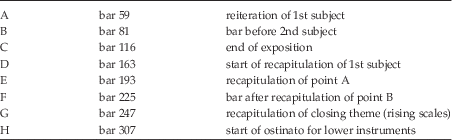
Holz’s task was to identify the best places to add letters, using his knowledge and experience of the work and of playing and rehearsing it. He was apparently given no guidelines, and he simply had to work out a system himself from first principles. He quickly reasoned out that there was no sense in adding rehearsal letters at changes of key signature or time signature, since these could already function as reference points. On the other hand it was not very helpful to add letters randomly, or space them evenly between such changes, since performers might have difficulty in entering in mid-phrase. Bars that were structurally important, reflecting a change of texture or new theme, made better reference points. This principle has been widely adopted in more modern editions, including those of Beethoven’s orchestral music. In his Egmont Overture, for example, rehearsal letters A to H have been added as follows (see Table 1).Footnote 9
Rehearsal letters in Beethoven’s Egmont Overture

As can be seen, there are slight irregularities, for there is no letter in the exposition that corresponds to G in the recapitulation; and letters B and F are one bar out from each other. But the letters clearly relate to the structure of the overture, while avoiding the changes of time signature at bars 25 and 287. A similar procedure is found in Beethoven’s Ninth Symphony.Footnote 10 Here, however, letters E and Q in the second movement, and L in the finale, occur at changes of key signature, where they are unnecessary, although the remaining letters are at places that arguably have some structural or textural significance despite there being no change of key signature or time signature.
The Grosse Fuge, with its long passages that lack obvious boundaries, has a more complex structure than almost any other Beethoven work. Consequently, Holz had the unenviable task of deciding precisely where to place the letters, and with no models or guidance from elsewhere. It was his choices that were to act as models, direct or indirect, for all subsequent applications of rehearsal letters. It cannot be assumed that he always chose the best places, and it must be remembered that his choices were made for practical purposes, rather than to elucidate the structure of the work. Nevertheless, it is useful to compare his choices with this structure, to see how far they coincide with structurally important points. To do this, however, requires a re-examination of this structure, for it has been viewed in several different ways, none of which is wholly adequate for comparing with these rehearsal letters.
The Grosse Fuge can be divided and subdivided into almost any number of sections, but commentators are generally agreed that there is an initial introduction headed ‘Overtura’ by Beethoven (bars 1–30), followed by a ‘Fuga’, in which the first section (bars 30–158) is in common
 $$\left(\rm or \,\raster="rg5" \left)$$
time with a two-flat key signature, and the second (bars 159–232) entirely in
 $$\raster="rg6"$$
with a six-flat key signature. Thereafter opinions differ about further subdivisions, but the music that follows is entirely in
 $$\raster="rg7"$$
except for two short subsections (bars 493–532 and 657–662). In terms of the work’s macrostructure there are therefore at least three main sections (bars 30–158, 159–232, 233–741), of which only the third utilizes more than one different time signature and key signature. The similarity of this macrostructure to that of three of Beethoven’s late piano sonatas, Opp. 101, 109 and 110, each of which consists of two short movements with limited emotional and stylistic range, followed by a much longer, multi-sectional finale with several changes of time signature and mood, was pointed out in an earlier article by this author.Footnote
11
Thus it is convenient to refer to the three main sections of the Grosse Fuge as ‘movements’, in that each ‘moves’ in a very different way; and there are only three different tempo marks, corresponding to the three movements, in the entire work: ‘Allegro’, ‘Meno mosso e moderato’, and ‘Allegro molto e con brio’. Moreover, if the Grosse Fuge is regarded as an independent work, Op. 133, rather than as the finale of another work, it is easier to perceive these three large sections as movements, even though they are all based on different transformations of the same theme. The first two sections have already been considered as ‘movements’ by Sidney Grew; but he divides the remainder of the work into further movements such as the ‘A flat movement (273–532)’.Footnote
12
This contravenes traditional terminology, for it is unknown for two consecutive movements to have the same tempo and metre; hence the whole of the section from bar 233 to the end is best viewed as a single movement with two short interpolations of material from earlier movements. Nobody should be uneasy about this third movement being much longer than the first two, in view of the precedents in the late piano sonatas.
In the introductory ‘Overtura’ four versions of this single fugue theme are heard, as has often been noted.Footnote 13 All but the third are without harmony, and they move through several keys. These four versions are then heard in reverse order as main themes during the three movements – one in the first, one in the second, and two in the third. Let us therefore consider the form of each of the three movements in turn, and how Holz’s rehearsal letters relate to it. None were needed in the ‘Overtura’, since it has two changes of key and time signatures despite being so short, but the first movement of the ‘Fuga’ is very different and clearly needed some.
Rhythmic Modes in the First Movement
At first glance this first movement seems incredibly monolithic – loud throughout, with non-stop energy and momentum and no very obvious subdivisions. Tonally it has no standard shape, mostly staying in or near to B-flat and its closely related keys, and it is based on two main themes that recur repeatedly as might be expected in a double fugue. Rhythmically, however, it is remarkably consistent and straightforward. Rhythmic analysis of Beethoven’s music is far less common than motivic or tonal analysis, but in this movement it works particularly effectively, for the movement is based on just four rhythmic cells each of which is repeated numerous times in succession. Beethoven had used similar repeated rhythmic patterns in some of his earlier works, such as his Seventh Symphony, where each movement contains a frequently recurring rhythmic cell; but he had never done so as systematically or extensively as in the first movement of the Grosse Fuge. Nor had any other composer since the thirteenth century: the incessant repetitions of a small group of rhythmic cells recall the rhythmic style of the Notre Dame School of Perotinus and his contemporaries in the late twelfth and early thirteenth centuries, where repeated rhythmic patterns known as rhythmic modes form the basis for much of their music. In this music, one rhythmic mode would predominate for a time, before giving way to a different one, and sometimes different modes would be present in different voices at the same time. Beethoven’s use of rhythm in this movement of the Grosse Fuge is remarkably similar. He did not derive it directly from the medieval system, which seems to have been scarcely known until its rediscovery later in the nineteenth century, through the work of Charles Coussemaker and other scholars; but it is fruitful to use the medieval system as a means of approaching an understanding of Beethoven’s.
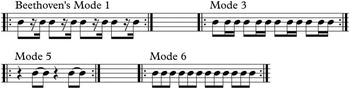
The medieval system of rhythmic modes can be summarized as follows. According to thirteenth-century theorists such as Johannes de Garlandia, there were six main rhythmic modes, all in ternary rhythm.Footnote 14 Mode 4 was largely theoretical, and Mode 2 does not correspond to anything Beethoven used, but Modes 1, 3, 5 and 6 are pertinent. They are shown in Example 1, using modern notation (the original notation consisted of longs and breves). The four main rhythmic cells used during the first movement of the Grosse Fuge, though not identical to these four rhythmic modes, are close approximations to them, and can therefore be regarded as Beethovenian rhythmic modes. For convenience of comparison they have here been allocated the same numbers in Example 2 as the corresponding ones in Example 1.
Medieval rhythmic modes 1, 3, 5 and 6

Beethoven’s version of the patterns in the medieval rhythmic modes

Beethoven’s Mode 1 differs from the medieval equivalent in having a rest between the long and the short note in the pattern, thus creating a binary rather than ternary division of the beat; and it is used with a semiquaver anacrusis, whereas the medieval mode begins on the beat. His Mode 3 moves twice as fast as its medieval predecessor, fitting three notes into a single beat rather than two beats. The last two notes in each group are also equal rather than unequal in length, although there is some evidence that the same sometimes applied to medieval rhythmic mode 3; the two shorter notes were both referred to as ‘breves’ whereas the first note was a ‘long’. The fifth rhythmic mode in the medieval system consisted entirely of long notes. Beethoven’s Mode 5 is somewhat similar, but in the Grosse Fuge these long notes are generally separated by crotchet rests as shown, and are written not as crotchets but as tied quavers, whose performance has incidentally given rise to much controversy.Footnote 15 There are also places where the notes begin on half-beats, or without intervening rests, or where the two quavers are of slightly different pitches. Beethoven’s Mode 6 is the only one completely congruent with its medieval equivalent.
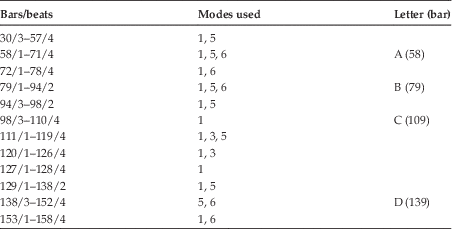
As noted above, Beethoven devised his system independently from the medieval one, which helps to explain its differences. If there is any connection it is through the metres of Classical poetry, which were well-known to both Beethoven and medieval writers. The connections between Classical poetic metres and Beethoven’s Seventh Symphony have in fact been explored in detail by Maynard Solomon.Footnote 16 The rhythmic patterns in the Grosse Fuge, however, are no closer to these poetic metres than to the rhythmic modes, and so one cannot assume that Beethoven systematically derived them from poetry. It is significant that out of the many poetic metres available Beethoven selected for the Grosse Fuge four that are also relevant to the medieval rhythmic modes: the trochee (long – short, though in Beethoven’s version it is really iambic, short – long), dactyl (long – short – short), spondee (long – long) and tribrach (short – short – short). The Notre Dame composers and Beethoven may therefore have sensed independently that these metres were particularly suited to musical development. Thus the rhythmic modes used in the Grosse Fuge are essentially Beethoven’s own creation, despite some superficial similarities to both medieval rhythmic modes and Classical poetic metres. If the first movement of the Grosse Fuge is analysed according to these Beethovenian rhythmic modes, with Holz’s letters added for comparison, a picture emerges as seen in Table 2.
Rhythmic modes in the first movement of the Grosse Fuge

Several notable features about the movement that are not entirely obvious aurally are readily apparent in Table 2. Changes from one group of modes to the next group normally occur at the ends of bars, or occasionally at half-bars, but not at quarter-bars, and the changes follow no set pattern but seem designed to create variety. Mode 1 persists throughout, apart from a short passage at bars 138–152, and there are two short sections where only Mode 1 is present, whereas Mode 5, which embodies the main eight-note theme of the entire work, disappears for several sections (bars 72–78, 98–110, 120–128 and 153–158), totalling 35 bars altogether. Mode 3 is present for only a short spell (111–26) and is never heard alongside Mode 6 – presumably because these two modes would not sound well together. Mode 6 is heard in only two passages, but they are quite extended (58–94 and 138–158). Changes of group are more conspicuous aurally when a new mode enters than when one ceases; thus bars 58, 79, 111, 129, 138 and 153 stand out as forming the start of new subsections, whereas bars 72, 94, 98, 120 and 127 do not.
How far do these subsections correspond to Holz’s rehearsal letters? It would be surprising if there were an exact match, but it is conspicuously close. Letters A and B appear precisely at bars 58 and 79, thus the first two places where a mode enters (or re-enters after dropping out). Letter C appears at bar 109, thus two bars before the third subsection, where two modes enter or re-enter; and letter D appears at bar 139, two beats after a new subsection, and therefore as near as possible if it is to be on a bar-line. Of the other two subsections identified above, Holz omitted any letter at bar 129, which is too close to both 111 and 138, while bar 153 did not need a letter as it is only six bars before the change of key and time signatures.
One other feature probably guided Holz in his placement of the letters. At letter A there is a clear cadence in E-flat, after which the cello is silent for over three bars, making this a particularly convenient place for a rehearsal letter. A similar situation occurs at letter C: there is a D minor cadence, followed by two beats of viola solo, after which the other instruments enter at two-beat intervals (violin 2, violin 1, cello). This texture makes it even more convenient as a rehearsal point than letter A, and a better place than two bars later where Modes 3 and 5 reappear. As for letter D, Holz would surely have placed it two beats earlier if this had been at a bar-line, for again there is a cadence (inverted cadence in B-flat), followed by rests for three instruments, though the viola re-enters after only two beats. Instead he placed it just before the re-entry of the viola, which is equally convenient. Letters A, C and D mark the only places where there is an extended rest for cello (and sometimes for other instruments); thus it was relatively easy for Holz to fix them. Letter B is a less obvious point, for the full texture continues without interruption or cadence; thus it was surely the re-entry of the main fugue theme (in Mode 5) that induced him to place it at bar 79. In sum, then, if four rehearsal letters are to be used in this movement, their best locations in terms of texture and rhythmic structure are those chosen by Holz.Footnote 17
Double Fugue in the Second Movement
The form of the second movement needs to be approached in an entirely different way. According to Joseph Kerman, it ‘cannot be considered a fugue at all; all that happens, after a peculiar fugato exposition, is an 8-bar sequence and a closing entry over a tonic pedal’.Footnote 18 This hardly does justice to the movement, which is in some ways a model double fugue, though in other ways irregular, well illustrating Beethoven’s overall description of the work on the original title page as ‘tantôt libre, tantôt recherchée’ (sometimes free, sometimes strict). If analysed as a fugue its form is quite clear, although it has not been fully described in previous accounts. As in the first movement, rhythmic differentiation between the themes is important: one of the two fugue themes is in crotchets, transformed from the main Grosse Fuge theme; the other is in semiquavers and had also been heard in the ‘Overtura’. The former appears four times in bars 167–190 – successively in tonic, dominant, tonic, dominant – in viola, violin 2, cello and violin 1 respectively; and in each case it is paired with the semiquaver theme, exactly as in a regular double-fugue exposition. Thus, since all the basic fugal procedures are in place and almost anything might happen in a fugue after the exposition, this movement could certainly be considered a proper fugue.
There are some irregularities, however. There is an unorthodox eight-bar introduction (bars 159–166) before the fugue gets under way, and the semiquaver theme appears complete during this introduction. In the fugal exposition itself this semiquaver theme appears successively in violin 2, violin 1 and viola, but then in violin 2 instead of cello as expected. Another unusual feature is that the eight-bar introduction returns in varied form in the dominant at bars 175–182 between the second and third main fugal entries, functioning as a conventional codetta. The texture of both the exposition and what follows is also more homophonic than is usual in a fugue, creating a sense of calm that contrasts particularly well with the preceding movement. Apart from the contrast between crotchets and runs of semiquavers, there is relatively little rhythmic variety between the four voices.
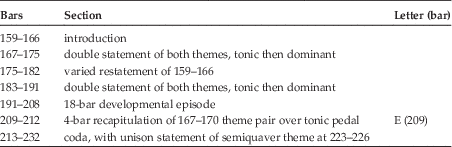
At the end of the exposition there is an 18-bar developmental episode (bars 191–208) which moves through several keys and includes a stretto for cello and violin 1, based on the crotchet theme, as well as numerous fragments of both themes. Bar 209 marks the start of a kind of recapitulation, where the thematic pair is finally heard in violin 1 and cello (which at last has the semiquaver theme that it missed in the exposition) over a tonic pedal. This gives way to a coda (bars 213–232), which includes further thematic fragments and a complete statement of the semiquaver theme in unison or heterophony (bars 223–226) in the only loud passage in the entire movement. Thus the form of the movement can be summarized as in Table 3.
Summary of second-movement form

Holz inserted only one letter in this movement, and chose an ideal location, placing letter E at the start of the recapitulation at bar 209 (see Table 3). He might usefully have placed another letter at the beginning of the central episode, where there is a significant change of texture; but as this is only 18 bars before letter E he probably felt that such a short distance did not warrant another letter. He did, however, show a keen awareness of the structure of the movement by placing E at such a critical juncture.
The Multi-partite Third Movement
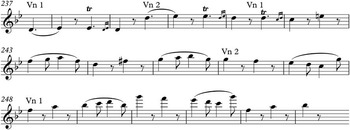
The form of the third movement needs a different approach again, for it divides into several sections marked by changes of key signature or time signature. Conventionally there is a double bar at such points in modern editions, but there are none in the autograph score or original edition at these points. The movement has been described in some detail by various writers, but there is no overall consensus about its structure. An assessment of this structure should ignore the spurious double bars but begin by noting any exact reprises of material, for it is normally important thematic material that is reprised, such as the first section of a da capo aria, a minuet after a trio, the refrain of a rondo, or the first subject of a sonata form. Here the only passage in the entire work where there is an exact reprise is bars 237–268, which reappear at 533–564, and the reprise is so exact that Beethoven did not write it out in the autograph but just indicated come sopra. Although this reprise is mentioned by several commentators, its importance has tended to be overlooked. Since such a reprise after contrasting and developmental material is characteristic of the first subject of a sonata form or the refrain of a rondo, it could be regarded as an allusion to these forms. The section amounts to precisely 32 bars, made up of four four-bar phrases that are followed by an exact repetition of these 16 bars with different scoring. Thus it bears the hallmarks of a typical, even archetypal, finale theme (whether in sonata form or rondo), with its jig-like melody in
 $$\raster="rg8"$$
metre and four-square phrase structure. It has a clear melody throughout, albeit shared between the two violins, and its regularity becomes obvious when this melody is written as a continuous line, as in Example 3. Since this 16-bar theme is heard four times altogether, it functions as one of the main building blocks of the third movement, and its first two appearances can be regarded as a First Subject, preceded by a four-bar introduction (bars 233–236) that does not return. This First Subject is accompanied almost throughout by one of the transformations of the original Grosse Fuge theme or fragments from it.
Theme of third movement

Certain other passages in the movement are occasionally referred to as reprises. Warren Kirkendale, for example, refers to bars 493–510, the first interpolation of material not in
 $$\raster="rg9"$$
, as a ‘reprise’ of bars 159–232; and Lewis Lockwood, apparently following Kirkendale, refers to these bars as a ‘full reprise’ of the Meno mosso theme.Footnote
19
Yet to describe this passage as a reprise is misleading, since there is no full restatement of either the crotchet or the semiquaver theme from that movement, let alone an entire section from it; the passage is merely an imprecise recall of some of the material. In this respect it resembles the recall of the scherzo during the finale of the Fifth Symphony, or the recalls of the first three movements near the start of the finale of the Ninth: never can more than a few notes in succession be matched up exactly between initial statements and recalls. These two symphonies thus provide clear precedents for the function of the two interpolations in different metre during the last movement of the Grosse Fuge. Bars 493–532 act as a reminiscence or recall of the previous movement (with an accompaniment based on material from the first), followed by a retransition to the reprise of the First Theme of the third movement. Thus this passage appears in a similar position to the reminiscence in the finale of the Fifth Symphony, shortly before the return of the main theme. The second interpolation, bars 657–662, is much briefer, and consists of recalls of both of the first two movements – again a close but inexact recollection of their material, and thus not a reprise as such (bars 657–659 are an almost exact restatement of 30–31, but less than two bars long). It occurs during the coda, and in terms of its position a useful comparison is the first movement of the Pathétique Sonata, where part of the slow introduction is recalled shortly before the end of the movement.
The Allegro molto e con brio movement has a very prominent Second Subject, which is in A-flat and consists of a new fugal exposition (starting with the upbeat to bar 273). Again it is a double fugue, but this time one theme is the main Grosse Fuge theme in long notes while the counter-theme is based on the third, fourth and fifth notes of the same theme, played much faster – a highly unusual procedure for a double fugue. Yet the tonal structure of this exposition is conventional (tonic – dominant – tonic – dominant), and the long-note theme, which is by far the stronger of the two, appears successively in cello, viola, violin 2 and violin 1, while the counter-theme is played in turn by violin 2, violin 1, cello and viola. Thus each theme is presented by each instrument in turn, in an entirely regular manner, and the whole consists of four sections of eight bars each (bars 272–304). This fugal exposition is succeeded by an extended development in which fragments of the theme appear but only one complete statement (bars 370–378), which is in G-flat.
The third movement as a whole could therefore be compared to sonata form, since it includes a First Subject, a Second Subject in a different key, some development, an exact reprise of the First Subject, and continuation in or close to the tonic for the rest of the movement. But this is where its similarity to sonata form ends: the Second Subject is in A-flat – perhaps the least likely key for a sonata form in B-flat; there is no reprise of the Second Subject in the tonic; there are also additional themes; and the development is based mainly on the Second Subject, with little or no reference to the First. This development section can be divided into three parts (305–327, 327–350 and 350–413) and begins with fragments of both themes from the Second Subject in nearby keys, followed by a return to A-flat; the second section is a sequential journey most of the way round the circle of fifths (from A-flat to F); and the third introduces running triplet quavers.
The movement then proceeds to a Third Subject (bars 416–432), which is in E-flat major and less noticeable, not having been announced in the initial ‘Overtura’ like the Second Subject of the movement. Indeed it is not mentioned in some analyses of the work,Footnote
20
but it once again takes the form of a regular double-fugue exposition. One of its two themes is a transformed version of the first six notes of the eight-note Grosse Fuge theme, in which the rhythm is greatly distorted and two of the intervals are stretched (the diminished seventh becomes a whole octave).Footnote
21
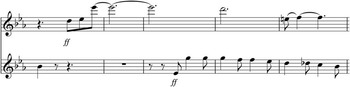
It is heard against a counter-theme based on the main counter-theme of the first movement (see Example 4). Since the music is now in
 $$\raster="rg18"$$
, however, this counter-theme uses the medieval rhythmic mode 1 instead of Beethoven’s modified version of the pattern.
Third movement, bars 414–418 of the whole work (violins 1 and 2), first edition

These two themes unfold in an entirely regular way, with the six-note theme starting at bars 416, 420, 424 and 428, in violin 1, viola, cello, and violin 2 respectively, while the counter-theme appears in violin 2, violin 1, viola, and cello respectively. The second and fourth entries of both themes are modified slightly (the octave leap is reduced to a minor seventh), in imitation of the conventional ‘tonal answer’ in a fugue. As with the previous fugal exposition, development follows in which the two themes are alluded to but without a complete statement of either. After this, fragments of the Second Subject’s leading theme return in A-flat (from bar 453) in a pseudo-stretto, before giving way to the interpolation and retransition mentioned earlier, and eventually to the reprise of the First Subject at bar 533.
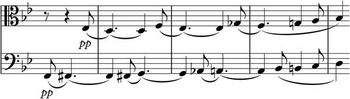
After a short linking passage that follows the reprise of the First Subject at bar 565, what might be described as a Fourth Subject begins at bar 581 (Example 5). In this Fourth Subject a version of the original eight-note theme is repeatedly shared between two instruments, each taking two notes in turn and sustaining the second while the other instrument plays the next two notes, thus creating two melodic lines out of a single one. This recalls the medieval device of hocket, where individual notes of a melodic line are shared between more than one voice. Again the connection with medieval music is apparently fortuitous. At bar 581 the hocket pattern begins with cello and viola, and it is repeated at four-bar intervals (thus bars 585, 589 and 593). These subsequent entries are played by violins 1 and 2 (both with the theme inverted), viola and cello (again inverted), and violins 2 and 1. Thus in some ways the pattern mimics that of a fugal exposition; but the use of inversion and an abnormal tonal structure militate against this being regarded as a true fugal exposition. After a short extension the music leads to a perfect cadence in B-flat (bar 632) that could have marked the end of the work. What follows could therefore be described as coda, which is largely homophonic, especially in the section after the second interpolation at bars 657–662. Precisely where the coda begins, however, is arguable.
Third movement, bars 581–585 of whole work (viola and cello), first edition

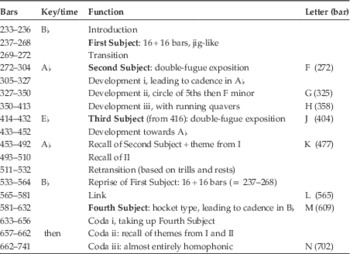
The overall form of the third movement can be interpreted in many different ways, but according to the above outline it could be summarized as in Table 4. The keys indicated are those of the key signatures; there are many brief modulations to other keys. This summary differs from others in various ways, focusing particularly on distinguishing between new thematic material, developmental passages, recalls and reprises, and it aims to show more clearly than previous analyses the four main subjects of the movement, together with their relationship to its tonal and metrical structure. To what extent it reflects Beethoven’s own perception of the shape of the work will have to be determined by a much more detailed scrutiny of his sketches than has hitherto been attempted.Footnote 22
Summary of third-movement form

As Table 4 shows, some of Holz’s rehearsal letters F to N seem less well placed than letters A to E, although he clearly gave them all some thought. Perhaps he was less sure of the structure here, and also wanted to keep close to his principle of spacing them out evenly, every four to six lines (in the first-violin part). Letter F might have been better placed at bar 269, which marks the end of the main 32-bar theme, rather than 272; but it is not actually needed, since there is a change of key signature at bar 273 which could be used as a reference point by performers. Letter G is well placed at bar 325, just before the cadence in A-flat that launches the journey round the circle of fifths: bars 325–326 are immediately repeated with little modification in nine different keys. Bar 358 seems an odd choice for letter H, although the first violin is about to re-enter after a three-bar rest. Bar 350, where the triplets begin and where the viola initiates a series of incomplete entries of the long-note theme from the A-flat fugue, would seem a better location for H. Bar 404 for J is another odd choice, since it is close to the change of key signature at bar 414; but there is no suitable place in the preceding bars – at least not since bar 370, which is close to letter H. From bar 370 there are continuous overlaps between instruments, and ties across every bar-line, until letter J, where there is at last a quaver rest for all instruments simultaneously.
Holz avoided placing letter K at the strategic bar 453 where a cadence is broken off by a pseudo-stretto in a recall of the Second Subject, since there is a change of key signature here. Instead he placed it at bar 477, an excellent alternative since it marks the start of a prolonged dominant pedal on E♭ , culminating in an A♭ chord at the Meno mosso interpolation at bar 493. Since the time signature changes at bars 493 and 533, Holz left an unusually long gap – nine lines in the original printed first-violin part – before letter L, which is placed precisely at the end of the reprise of the First Subject, at bar 565. Letter M is also well placed at bar 609, the start of a subsection based on dotted-minim chords. It is only three lines after L, however, and it might have been wise for Holz to place a letter at bar 633 as well as, or instead of, at 609. Further changes of time thereafter obviate the need for another letter until bar 702, which could be regarded as marking the start of a new subsection of the coda, after another series of dotted-minim chords and a convenient rest for all four instruments. It is a suitable location from a practical point of view, though it has limited structural significance.
Final Overview
Holz’s rehearsal letters show considerable awareness of the structure of the work, while not reflecting it quite as closely as they might have done. His choices were obviously based more on performance criteria than theoretical ones, and in some cases they could have been slightly improved; but on the whole they were well chosen and set an excellent model for subsequent works by other composers. Matching them up against the structure, however, has necessitated a reassessment of this structure, from which several interesting points have emerged.
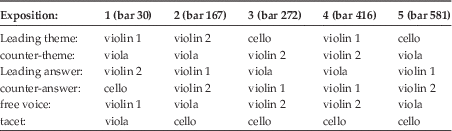
There are four clear fugal expositions, in B-flat, G-flat, A-flat and E-flat, starting at bars 30, 167, 272 and 416 respectively, and each is more or less regular – or recherchée, to use Beethoven’s term.Footnote 23 They alternate tonic and dominant entries in the traditional manner, using all four instruments for the four entries. Each exposition is followed immediately by episodic or developmental counterpoint based on the material of the exposition, as in most standard fugues, although common fugal devices such as inversion, augmentation and retrograde, which Beethoven had used in the fugue in his ‘Hammerklavier’ Sonata, are not exploited during these passages.Footnote 24 The only thing that prevents the four passages being classed as fugues is that each eventually leads into other material rather than terminating with a full-close. None of them, however, is a monothematic fugue of the type found in Bach’s ‘48’ (which Beethoven had known since he was a child), but a double fugue. Each exposition has one leading theme and one counter-theme; together these make a pair from the outset. In each case, one or more notes are heard on the leading instrument entirely unaccompanied; it is then joined by the second instrument to form the thematic pair, unaccompanied by the other two instruments. When the third instrument enters with the leading theme or ‘answer’, the counter-theme (or ‘counter-answer’) is either taken either by the fourth instrument (first and third expositions, bars 34 and 280), in which case one of the first two falls silent while the other has a free part; or alternatively it is taken by the instrument that had the leading theme, while the one that had the counter-theme has free writing and the fourth instrument remains silent (bars 171 and 420). Thus at the second pair of entries in each case there is still only three-part counterpoint, and all four instruments are heard together only after the end of this second pair of entries. The passage beginning at bar 581, though not a conventional fugal exposition, exhibits a similar use of the four instruments. The distribution of instruments at the first two entries of the theme in each of the expositions can therefore be summarized as in Table 5. It is striking that at the second entry of each thematic pair, the instrument that is silent is the cello in every exposition except the first.
Distribution of themes at first two entries in each exposition

It has often been pointed out that the Overtura contains four versions or transformations of the eight-note fugue theme, each of which then functions in turn (in reverse order) as the basis for a section of the Fuga. It might therefore be expected that each would form the basis for one of the four fugal expositions, but in fact only three of them do. The quick
 $$\raster="rg10"$$
transformation of the theme appears only as an introduction and accompaniment to the jig-like theme of bar 237, and never as a fugue theme, though fragments of it form the counter-theme in the third exposition. On the other hand the six-note transformation of the Grosse Fuge theme used in the fourth exposition does not appear in the Overtura and is entirely unforeshadowed.
The obvious precedent for using a fugue for the finale of a string quartet is Haydn’s Op. 20 set, where three quartets have finales explicitly headed ‘Fuga’. Like the Grosse Fuge, none of them is monothematic: No. 2 is based on four themes, No. 5 on two and No. 6 on three. Thus No. 5 in F minor, based on a main theme and a single counter-theme, is the nearest precedent, especially as its main theme has a similar angular shape with prominent use of a diminished-seventh leap. Beethoven was surely well aware of this connection, and it is perhaps significant that this very movement was mentioned by Holz in a conversation book around 15 July 1825: referring to Mozart’s Requiem, he points out that a theme (the Kyrie theme) had been used by Haydn much earlier in a quartet, and he quotes, very inaccurately but in the right key, the theme of the finale of Op. 20, No. 5.Footnote 25 At this date Beethoven was still wrestling with the theme of the Cavatina movement of Op. 130, and as far as can be gleaned from the sketches he had not considered a grand fugue for the finale but only a light fugue or more recently a non-fugal movement.Footnote 26 He had, however, considered a version of the Grosse Fuge theme for a possible finale for Op. 127 in 1824, and had used another version of it at the start of Op. 132 – his first two quartets for Prince Galitzin. Thus a reminder of this Haydn double fugue, only about a month before he began working on the Grosse Fuge, is certainly suggestive. Haydn’s distribution of instruments at the beginning of his movement, incidentally, is identical to Beethoven’s at bar 167: violin 2 leads and viola has the counter-theme, then violin 1 has the main theme, violin 2 the counter-theme, viola the free part, and the cello remains silent.
Another striking connection between Haydn’s movement and the Grosse Fuge is the use of dynamics: the first 109 bars of Haydn’s fugue are marked ‘sempre sotto voce’, but towards the end there is a strident fortissimo section (bars 145–160). Beethoven uses a greatly expanded fortissimo section (bars 30–158) but it has something of the same effect, while his second movement remains pianissimo for over 60 bars, again echoing Haydn’s movement. Several writers have seen Haydnesque elements in the replacement finale for Op. 130 or in Beethoven’s final quartet Op. 135; but they have been more reluctant to look for them in the Grosse Fuge, perhaps because it does not concur well with ‘typical’ Haydn. Hence the intertextual relationship between Beethoven’s movement and Haydn’s has perhaps not previously been noted, beyond the superficial thematic resemblance.
Whatever the Grosse Fuge may owe to Haydn, however, and despite its echoes of Notre Dame rhythmic modes and Baroque fugal practices, it is universally acknowledged to be an exceptional work, with nothing remotely like it by Beethoven or anyone else, and many important aspects of it have had to be left unmentioned in the above account. Conceived as the finale for an already long quartet with five preceding movements, it was performed, engraved, printed, proof-read at least six times,Footnote 27 and given rehearsal letters, before being arranged by Beethoven for piano duet and accepted for publication in this format as an independent work. Only then, and no earlier, did Beethoven decide to detach the string-quartet version from Op. 130, recognizing that, like the piano version, it could and should stand on its own as a three-movement work in which the three movements were not only joined together but were also related by thematic transformation of a single idea.
It was doubtless because the Grosse Fuge was such a large-scale, structurally complex, multi-faceted and initially puzzling movement or work that new means had to be created for audiences and performers to cope with it. One of these means was the creation of the piano-duet version, which gained raised status through having been done by Beethoven himself. Another was the separation of the Grosse Fuge from the rest of Op. 130, so that it might more easily be approached on its own terms and perceived by audiences as a self-standing entity, while being less exhausting for performers without any preceding movements; in this format it might also more readily suit the recent penchant in Vienna for challenging works in Schuppanzigh’s series of quartet concerts,Footnote 28 although this was clearly not the reason for its separate publication. In the long term, however, the most influential means of assisting performers to cope with the work was probably the simple, practical device of the insertion of rehearsal letters, which have subsequently become such a familiar sight.