Introduction
There have been rapid social, economic, and political changes in the Canadian Arctic during the last half of the twentieth century (Irwin Reference Irwin1989; Hamilton Reference Hamilton1994; Damas Reference Damas2002). These changes have transformed Inuit harvesting practices, community social networks, and cultural and spiritual traditions (Wenzel Reference Wenzel1991; Kral Reference Kral2003; Einarsson and others Reference Einarsson, Larsen, Nilsson and Young2004). Furthermore, Inuit are increasingly exposed to risks associated with climate change (Krupnik and Jolly Reference Krupnik and Jolly2002; Huntington and Fox Reference Huntington, Fox and Symon2005). Local observations and instrumental measurements have indicated changes in temperature and precipitation, permafrost, coastal erosion, and ice instability (McBean Reference McBean and Symon2005; Gearheard and others Reference Gearheard, Matumeak, Angutikjuaq, Maslanik, Huntington, Leavitt, Kagak, Tigullaraq and Barry2006; Nickels and others Reference Nickels, Furgal, Buell and Moquin2006; Zhang and others Reference Zhang and Walsh2006; Manson and Solomon Reference Manson and Solomon2007; Stroeve and others Reference Stroeve, Holland, Meier, Scambos and Serreze2007; Laidler and Ikummaq Reference Laidler and Ikummaq2008). These changes are already affecting Arctic communities, and scientists project that they will continue in the future with further implications for the Arctic environment and people (Kattsov and Kallen Reference Kattsov, Kallen and Symon2005; Anisimov and others Reference Anisimov, Vaughan, Callaghan, Furgal, Marchant, Prowse, Vilhjalmsson, Walsh, Parry, Canziani, Palutikof, Linden and Hanson2007).
Research on climate change in the Arctic has provided considerable information about the implications of climate change for physical and biological systems (for example Callaghan Reference Callaghan and Symon2005; Loeng Reference Loeng and Symon2005). There has been less work regarding the implications of climate change for people and their livelihoods, and their capacity to deal with and adapt to changing conditions. It is increasingly recognised that to understand better what climate change means for people and communities requires knowledge of how people experience and respond to changing conditions that are relevant to them, including the role of non-climatic drivers (for example demographic, economic, sociopolitical, motivational, technological, etc.) (Duerden Reference Duerden2004; Ford and Smit Reference Ford and Smit2004; McCarthy and Martello Reference McCarthy, Martello and Symon2005; Ford and others Reference Ford, Smit, Wandel, Allurut, Shappa, Ittusujurat and Qrunnut2008b). This paper uses a vulnerability framework described by Ford and Smit (Reference Ford and Smit2004) and the IPCC (2007) to identify the conditions to which community members in Ulukhaktok, Northwest Territories (NWT) are sensitive. The study highlights climate related changes to which the community is exposed and the associated adaptive capacities. This provides a baseline on which to assess vulnerabilities and generate insights on the adaptability of people in Ulukhaktok to continuing climate change.
The paper first provides a review of climate change and impacts in the Arctic, noting the evolution of analytical approaches, and describes the main features of the vulnerability framework on which the Ulukhaktok case study is based. The community of Ulukhaktok is briefly described, and the empirical methodology employed is outlined. The results are presented first for current vulnerability (that is current exposure-sensitivities and adaptive strategies), and then for future vulnerability (that is future exposure-sensitivities and adaptive capacity).
Climate change, vulnerability and adaptation in the Arctic
There is strong consensus in the international scientific community that the global climate is changing, and these changes are already being experienced in the Arctic (ACIA 2005; Anisimov and others Reference Anisimov, Vaughan, Callaghan, Furgal, Marchant, Prowse, Vilhjalmsson, Walsh, Parry, Canziani, Palutikof, Linden and Hanson2007; Furgal and Prowse Reference Furgal, Prowse, Lemmen, Warren, Lacroix and Bush2008). The main response to concerns over climate change has been to seek reductions in greenhouse gas emissions to ‘mitigate’ changes to the climate system (UNFCCC 2002), and the importance of mitigation has been argued by Inuit representatives (Ford and others Reference Ford, Pearce, Smit, Wandel, Allurut, Shappa, Ittusujurat and Qrunnut2007; Martello Reference Martello2008). However, it is recognised that even under the most aggressive control measures, greenhouse gas emissions commit the Earth to some degree of climate change, with effects requiring communities to undertake adaptations (Klein and others Reference Klein, Schipper and Dessai2005; Hare and Meinshausen Reference Hare and Meinshausen2006; IPCC 2007). Adaptation is particularly important in the Arctic where climate change is already affecting the local environment and northern livelihoods.
Several approaches have been employed to assess the implications of climate change in the Arctic and the prospects for adaptation. Impact studies, based on projected future emission trends, have developed climate change scenarios to model the potential biophysical impacts of future climate change (McCarthy and others Reference McCarthy, Canziani, Leary, Dokken and White2001; ACIA 2005). These studies are conducted at broad scales, and focus on long term changes in average climate conditions (for example annual mean temperature, precipitation, and sea level rise, variables most readily available from climate models) for the purpose of quantifying the net impact of climate change, mostly in ecological terms. The role of the human system is typically downplayed, with vulnerability being viewed in terms of estimated changes in physical and biological variables that may be relevant to human occupancy and livelihoods. Arctic climate impact studies have improved our understanding of the potential severity of the broad affects of climate change on ecosystems, but they do not explicitly address adaptation.
A growing body of studies is providing insights into how climate change is being experienced in the Arctic, by northerners, beyond the variables included in climate change models, and how Arctic people are being affected (for example Berkes and Jolly Reference Berkes and Jolly2002; Wesche and Armitage Reference Wesche, Armitage, Riewe and Oakes2006; Huntington and others Reference Huntington, Hamilton, Nicolson, Brunner, Lynch, Ogilvie and Voinov2007; Ford and others Reference Ford, Smit, Wandel, Allurut, Shappa, Ittusujurat and Qrunnut2008b; Sakakibara Reference Sakakibara2008). Arctic residents have noted changes in sea ice dynamics and weather variability which have affected the health and availability of some species of wildlife important for subsistence and have exacerbated risks associated with hunting and travel (Riedlinger Reference Riedlinger2001; Furgal and Seguin Reference Furgal and Seguin2006; Tremblay and others Reference Tremblay, Furgal, Lafortune, Larrivee, Savard, Barrett, Annanack, Enish, Tookalook, Etidloie, Riewe and Oakes2006; Ford and others Reference Ford, Pearce, Gilligan, Smit and Oakes2008a). Community infrastructure has also been affected by coastal erosion and permafrost degradation (Couture and others 2001; Smith and Levasseur 2002; Instanes Reference Instanes and Symon2005). While this work has greatly enhanced understanding of the human dimensions of climate change, there has been limited research done on the interconnections between climate and non-climatic factors that influence vulnerability.
To initiate adaptation actions, decision makers need to know the nature of vulnerability, in terms of who and what are vulnerable, to what stresses, and in what way, and also what is the capacity of the system to adapt to changing conditions (Smit and others Reference Smit, Burton, Klein and Wandel2000; Turner and others Reference Turner, Kasperson, Matson, McCarthy, Corell, Christensen, Eckley, Kasperson, Luers, Martello, Polsky, Pulsipher and Schiller2003; Schroter and others Reference Schroter, Polsky and Patt2005). In the climate change field, the term ‘vulnerability’ refers to the susceptibility of a system (community) to harm relative to a climate stimulus or stimuli, and relates both to sensitivity to climate exposures and capacity to adapt (Adger Reference Adger2006; McLeman and Smit Reference McLeman and Smit2006; Smit and Wandel Reference Smit and Wandel2006). Beyond the climate change impact research, studies have built on the natural hazards field to focus on the social dimensions of human sensitivity and adaptability, and have considered vulnerability to climate change in the context of the other economic, social, cultural and environmental forces that affect communities (Adger and others Reference Adger, Kelly and Ninh2001; Kasperson and Kasperson Reference Kasperson and Kasperson2001b; Cutter and others Reference Cutter, Boruff and Shirley2003). Some vulnerability studies aim to calculate comparative rankings or indices (for example Downing and Patwardhan Reference Downing, Patwardhan, Lim and Spanger-Siegfried2003; O'Brien and others Reference O'Brien, Sygna and Haugen2004), others seek to identify and describe the nature of vulnerability, its underlying forces and its dynamics (for example Adger and Kelly Reference Adger and Kelly1999; Parkins and MacKendrick Reference Parkins and MacKendrick2007; Tschakert Reference Tschakert2007). Furthermore, it is now widely accepted that adaptation initiatives are most effective when they are integrated, or mainstreamed, into other resource management, disaster preparedness, and/or community planning programmes and institutions (Burton and others Reference Burton, Huq, Lim, Pilifosova and Schipper2002; Huq and others Reference Huq, Rahman, Konate, Sokona and Reid2003; Ford and others Reference Ford, Pearce, Smit, Wandel, Allurut, Shappa, Ittusujurat and Qrunnut2007; Klein and others Reference Klein, Eriksen, Naess, Hammill, Tanner, Robledo and O'Brien2007). This integration requires knowledge of local institutions and policies as well as the forces that influence vulnerability and the factors that facilitate or constrain adaptation. A research perspective that addresses these needs, and has been recognised by the ACIA (2005), IPCC (2007) and Canada's national assessment on climate change report (Lemmen and others Reference Lemmen, Warren, Lacroix and Bush2008) is the ‘vulnerability approach.’
The vulnerability approach seeks to describe the processes and forces that influence and structure vulnerabilities in particular places to help identify why vulnerability exists and to identify opportunities for facilitating adaptation. The vulnerability approach includes two stages of assessment. The first stage assesses current vulnerability by documenting how people are exposed and sensitive to climatic variables, and the adaptive strategies employed to deal with these conditions. The second stage assesses future vulnerability by incorporating future climate change probabilities and future social probabilities to estimate directional changes in exposure-sensitivities and associated adaptive capacities (Ford and Smit Reference Ford and Smit2004).
Exposure-sensitivity refers to the susceptibility of people and communities to variable conditions. It is a joint property of the community characteristics (location, livelihoods, economy, infrastructure, etc.) and the characteristics of climate related stimuli (magnitude, frequency, spatial dispersion, duration, speed of onset, etc.) (Cutter Reference Cutter1996; Adger, Reference Adger2006; Smit and Wandel Reference Smit and Wandel2006).
Adaptive capacity and adaptation are closely related. Adaptive capacity refers to the potential of a community to adapt to climate change (including climate variability and extremes), to moderate potential damages, to take advantage of opportunities, or to cope with the consequences (IPCC 2007). Determinants of adaptive capacity include the availability and distribution of resources, available technology, structure and function of institutions, human capital including education and personal security, social capital including property rights, ability of decision makers to manage information, and the public's perceived attribution of the source of stress (Yohe and Tol Reference Yohe and Tol2002; IPCC 2001, 2007). These attributes will differ among regions, communities, and individuals and will vary over time, translating into different capacities to adapt (Adger and Kelly Reference Adger and Kelly1999; Duerden Reference Duerden2004). Adaptations are the manifestation or the realisation of adaptive capacity (Smit and others Reference Smit, Burton, Klein and Wandel2000; Brooks Reference Brooks2003). For example, Inuit hunters have extensive knowledge of the local environment and routinely respond to and adjust their behaviour to accommodate risks. Environmental knowledge and land skills are a source of adaptive capacity or adaptation potential. This potential is manifested as adaptation when the hunters draws on their knowledge and experience to navigate over unstable sea ice to continue to access hunting areas.
Variations of the vulnerability approach have been applied in several geographic regions and contexts (for example Adger Reference Adger1999; Eriksen and others Reference Eriksen, Brown and Kelly2005; Sutherland and others Reference Sutherland, Smit, Wulf and Nakalevu2005; Belliveau and others Reference Belliveau, Smit and Bradshaw2006; McLeman and Smit Reference McLeman and Smit2006; Pouliotte and others Reference Pouliotte, Islam, Smit and Islam2006; Wall and Marzall Reference Wall and Marzall2006), and in the Arctic (for example Pratley Reference Pratley2005; Duerden and Beasley Reference Duerden, Beasley, Riewe and Oakes2006; Furgal and Seguin Reference Furgal and Seguin2006; Ford and others Reference Ford, Macdonald, Smit and Wandel2006a; Ford and others Reference Ford, Smit and Wandel2006b; Huntington and others Reference Huntington, Hamilton, Nicolson, Brunner, Lynch, Ogilvie and Voinov2007; Tyler and others Reference Tyler, Turi, Sundest, Bull, Sara, Reinert, Oskal, Nellemann, McCarthy, Mathiesen, Martello, Magga, Hovelsrud, Hanssen-Bauer, Eira, Eira and Corell2007; Wolfe and others Reference Wolfe, Armitage, Wesche, Brock, Sokal, Clogg-Wright, Mongeon, Adam, Hall and Edwards2007; Keskitalo Reference Keskitalo2008a, Reference Keskitalo2008b; Ford in press). In many cases, climatic and non-climatic factors have acted synergistically to affect individuals and communities, and studies of vulnerability are increasingly considering the multiple variables that drive exposure sensitivities and adaptations. These studies have also shown that how climate change is experienced will differ among regions, communities, and individuals as a result of different geographies, economies, traditions, access to resources, and institutional structures. Case studies provide an effective means of identifying local effects of climate change and adaptation processes (Jones Reference Jones2001). The vulnerability research reported in this paper was undertaken for the case study of Ulukhaktok. Ulukhaktok is one of many Arctic communities that is experiencing climate change, and is having to adapt. To extend existing information on aggregate changes in physical conditions and local observations of climate change in the Arctic, research was conducted to examine the exposure sensitivities, and adaptations specific to the people of Ulukhaktok.
Case study
Ulukhaktok
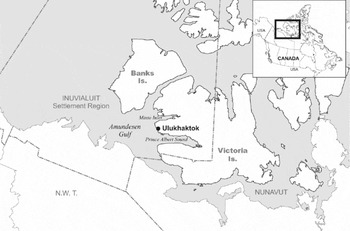
Ulukhaktok is a coastal Inuit community of approximately 430 people (96% Inuit) (NWT Statistics 2006) located on the west coast of Victoria Island (70°45′42′ N, 117°48′20′ W) in the Inuvialuit settlement region (ISR), NWT (Fig. 1). Victoria Island is the second largest island in the Canadian Arctic archipelago. The area around Ulukhaktok is characterised by lowlands, hills and rugged plateaux, and numerous ponds, lakes and rivers. The ISR was created in 1984 with the signing of the Inuvialuit final agreement (IFA), a land settlement agreement between six Inuit communities and the Canadian Government. Federal and territorial government agencies and Inuvialuit organisations jointly manage social, economic, political, and environmental issues in the ISR including education, health care, fish and wildlife management, and resource development (Fast and others Reference Fast, Mathias and Banias2001).
Location of Ulukhaktok and selected hunting areas in the Inuvialuit settlement region, NWT, Canada.

Ulukhaktok evolved as a permanent settlement starting in 1939 with the establishment of a Hudson's Bay Company (HBC) trading post and a Roman Catholic mission near the location of the current settlement. Throughout the 1940s and 1950s, the regional population continued to live in isolated hunting and trapping camps and came to Ulukhaktok several times a year to trade furs and socialise. Inuit in Ulukhaktok are largely descended from the northernmost groups of Copper Inuit: the Kangiryuarmiut of Prince Albert Sound and the Kangiryuatjagmiut of Minto Inlet (Condon and others Reference Condon, Collings and Wenzel1995). In the 1930s and 1940s, several western Inuit (now called Inuvialuit) from the Mackenzie Delta region moved into the Ulukhaktok area for the purposes of trapping or employment at the HBC or the Roman Catholic mission (Condon and others Reference Condon, Collings and Wenzel1995). As a result of the closing of the Reid Island HBC trading post on southern Victoria Island in the early 1960s, several Puvilingmiut families also moved to the Ulukhaktok area (Condon and others Reference Condon, Collings and Wenzel1995). In 1967 the last family to remain on the land moved into the settlement and the settlement has since expanded considerably (Condon and others Reference Condon1987).
The present community is described as a ‘modern Inuit town’ (Stern Reference Stern2001). There is a school from kindergarten to grade twelve, a satellite campus of Aurora College, a health care centre, arena, community hall, hotel and restaurant, artist print shop, two grocery stores, and a convenience store. Like many communities in the Canadian Arctic, bulk supplies are transported to the settlement annually by barge and weekly year round flights from Yellowknife and Inuvik provide much needed medical and health services, and are vital transportation links for mail, perishable foods, passengers, and freight.
Since the mid-1980s the settlement, rather than the land, has increasingly become the focus of daily life for many residents, and wage income is an important component of Ulukhaktok's economy. 25% of Inuit adults in Ulukhaktok between the ages of 18 and 64 years have full time wage employment, another 25% have regular part time jobs, and the remainder are either dependent on another wage earner or derive their income from subsistence earnings, seasonal employment (for example guiding and helping sport hunts, wildlife monitoring, mineral exploration), casual work or social transfer payments (Condon Reference Condon1987; Stern Reference Stern2001).
Despite undergoing sweeping social, political and economic changes, subsistence hunting, fishing and trapping continue to be valued activities among Inuit in Ulukhaktok. 76% of community members participate in hunting and fishing and country foods (locally harvested fish and wildlife) are the primary source of meat for 46% of households (NWT Statistics 2006). Arctic char, iqalukpik (Salvelinus alpinus), ringed seal, natiq (Phoca hispida), bearded seal, ugyuk (Eringnathus barbatus), lake trout, ihuuhuk (Salvelinus namaycush), Peary caribou, tuktu (Rangifier tarandus), Dolphin-Union caribou, tuktu (Rangifer tarandus groenlandicus x pearyi), musk-ox, umingmuk (Ovibos moschatus), King Eider ducks, kingalik (Somateria spectabilis), and snow geese, kanguq (Chen caerulescens) are common species that are hunted for subsistence. Although to a much lesser extent than in the past, Arctic fox, tirigannia (Vulpes lagopus) and Arctic wolf, amaruq (Canis lupus arctos) are trapped for their pelts that are sold at southern auctions. Participation in harvesting varies among community members with some people continuing to hunt full time and others balancing hunting with wage employment. Condon and others (Reference Condon, Collings and Wenzel1995) and Collings and others (Reference Collings, Wenzel and Condon1998) documented several interconnected variables influencing individual participation in subsistence harvesting in Ulukhaktok including age, employment, family histories, motivation, skill and knowledge levels, access to capital equipment, and availability of time. Climate change is but one of several factors affecting involvement in harvesting activities and is considered as such in this analysis of vulnerability.
Methods
Research Approach
This research was undertaken with community members in Ulukhaktok using a vulnerability approach described in detail by Ford and Smit (Reference Ford and Smit2004) and Smit and Wandel (Reference Smit and Wandel2006) and consistent with Kasperson and Kasperson (Reference Kasperson and Kasperson2001a), Turner and others (Reference Turner, Kasperson, Matson, McCarthy, Corell, Christensen, Eckley, Kasperson, Luers, Martello, Polsky, Pulsipher and Schiller2003), Fussel (Reference Fussel2007), and Keskitalo (Reference Keskitalo2008a).
The four steps of the vulnerability approach are:
• Identify the conditions or risks (climate related and other) that are relevant to the people in the community (referred to as exposure sensitivities).
• Identify and assess the strategies employed in the community to cope with and adapt to exposure sensitivities.
Together these components are considered ‘current vulnerability.’ The next two components relate to ‘future vulnerability:’
• Estimate future risks or exposure sensitivities based on likely changes in conditions that have been identified as important to community livelihoods.
• Assess the capacity of the community to adapt to future conditions based on current adaptive capacity and future demographic and socio-economic projections.
Information on each of the four components of the vulnerability approach was obtained primarily from data collected through semi-structured interviews with community members and also from secondary sources of information and participant observation. The documentation of northern people's experiences with climate change using semi-structured interviews builds on the work of many scholars working in the Arctic including, Berkes and Jolly (Reference Berkes and Jolly2002), Krupnik and Jolly (Reference Krupnik and Jolly2002), Fox (Reference Fox2004), George and others (Reference George, Huntington, Brewster, Eicken, Norton and Glenn2004), Ford and others (Reference Ford, Macdonald, Smit and Wandel2006a), Ford and others (Reference Ford, Pearce, Gilligan, Smit and Oakes2006b), and Nickels and others (Reference Nickels, Furgal, Buell and Moquin2006). The procedures for community selection, engagement, and participation followed the guidelines of Aurora research institute (2004), and ITK and NRI (2007). Communication was initiated with the Inuvialuit game council (IGC) and with representatives from each of the six Inuvialuit communities early in research planning. This resulted in an expression of interest from the representatives from Ulukhaktok in having the research conducted in their community, citing changes in the environment and community concerns for affects on wildlife and subsistence hunting. A consultation visit to Ulukhaktok was conducted over a two week period in April 2005, including meetings with the hunters and trappers committee (HTC), community corporation, and hamlet council. Community feedback was integrated into the research design, including the timing of fieldwork, data collection techniques, and language considerations. The support of each organisation was obtained, a NWT research licence was acquired, and three local collaborators, selected in consultation with community representatives, were hired (A. Goose (interpreter), R. Inuktalik and F. Kataoyak (research assistants)). The interpreter played vital roles in the field research, including translator (Inuinnaqtun and English), research assistant, community liaison, cultural guide and teacher. The research assistants facilitated interviews. They identified respondents, scheduled interviews and helped conduct interviews, collected economic and social data in the community, communicated the research objectives to community members, and collaborated with university researchers to present research finding in the community and elsewhere. The lead author worked with the local collaborators and others to interpret the data and develop results. Local collaborators and other community members provided comments on earlier drafts of this manuscript (in person and via the phone and E-mail), and several of these comments have been integrated into the text. Primary data collection was conducted in Ulukhaktok over a four month period between May and September 2005. The methods used to engage community members in the design, development, application, and dissemination of the research are described in detail in Pearce and others (in press).
Data Collection
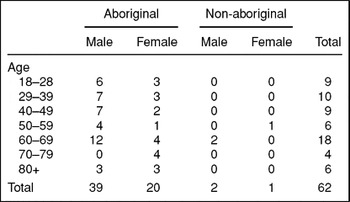
Over a period of five months, 62 semi-structured interviews were conducted with a cross section of community members 18 years old and older to identify those climate related conditions and risks that people have experienced, and are currently experiencing; to gain insights on the strategies being used to cope with and adapt to these conditions; and to identify factors that influence their exposure sensitivity and adaptive capacity to projected future climate change. A purposive sampling strategy was used to recruit respondents from different age and gender cohorts and people who were involved in different sectors of the local economy. A snowball sampling method was then used in which community research partners identified people willing to participate in the research, who then led to others who were willing to be involved (Bernard Reference Bernard2000). A description of the research sample is provided in Table 1. The male bias (41/21) may be due to a combination of factors including, the tendency for families to have a male representative speak on their behalf, the male dominance in the research team (3/4), and a higher proportion of males in the hunter and elder cohorts.
Characteristics of the interview sample in Ulukhaktok.

Interview questions were open ended and the interviews were guided by a semi-structured interview guide. The open ended structure was adopted to minimise interview bias or prompting and to allow respondents to describe their experiences and actions from their perspectives and in terms that made sense to them and reflected their priorities (Ferguson and Messier Reference Ferguson and Messier1997; Fienup-Riordan Reference Fienup-Riordan1999). For example, people were asked to describe conditions they have had to deal with in their lives and livelihoods, rather than asking how climate change affects or might affect them. Semi-structured interviews are a standard method of data collection used in ethnography for gathering information in an open ended format and are widely used in northern research (Huntington Reference Huntington1998; Cruikshank, Reference Cruikshank2001; Riedlinger and Berkes Reference Riedlinger and Berkes2001; Noongwook and others Reference Noongwook2007). Interviews were undertaken with two community research partners, were conducted in Inuinnaqtun or English, and were most often conducted at the respondent's home. The interviews conducted in Inuinnaqtun were translated during the interview. Interviews were voluntary and interviewees had the option of remaining anonymous or having their information attributed to them. Respondents also had the option of having their interview audio recorded. 38 interviews were audio recorded and later transcribed and the other interviews were recorded in writing during the interview. After each interview, transcripts were reviewed and verified by the interview team. The interview quotations provided in the text are from both audio recordings and hand written transcripts. Three additional research trips were made to the community (4.5 months in the community) between 2005 and 2008 to verify interview data, collect additional information on identified themes, confirm that the data was being interpreted the way that respondents intended it to be, and to collect feedback on previous versions of this manuscript.
Interviews were complemented with informal meetings and experiential trips on the land with community members. These experiences helped contextualise information shared by interviewees about the local environment and harvesting activities. Secondary sources of information including government and community reports, economic and harvesting data, climate records, books, and journal articles were analysed and incorporated as appropriate in the assessment of vulnerabilities.
Data analysis
Using the principles of latent content analysis (Dunn Reference Dunn and Hay2000), the interview data were scanned to identify common or recurring themes or processes related to exposure sensitivities and adaptation. Interview data were coded and analysed based on these themes using NVivo (QSR International), qualitative data analysis software. Each coding scheme was cross-referenced to identify instances where multiple themes were discussed together. Given that the themes and processes identified in this exercise involve interpretation of raw data, and given that the original expressions provide particular insights, the presentation of findings includes direct quotes to illustrate how the information was originally supplied and how the broader context was seen by the respondent. Interview data are complemented, when available, with data from secondary sources of information including, instrumental records, community reports, and past research. Secondary sources of information are referenced throughout the text.
Current vulnerability
Exposure sensitivities
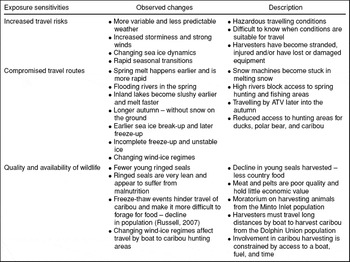
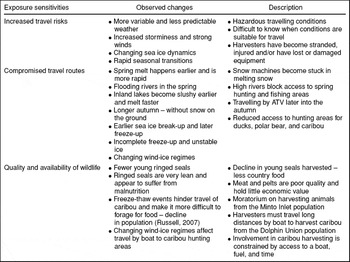
In the context of subsistence hunting, changes in temperature, seasonal patterns, sea ice and wind dynamics, and weather variability have affected the health and availability of some species of wildlife important for subsistence and have exacerbated risks associated with hunting and travel (Table 2). These climatic changes are expected to continue into the foreseeable future, with further impacts on Inuit in the social, cultural, and economic sectors of society (Anisimov and others Reference Anisimov, Vaughan, Callaghan, Furgal, Marchant, Prowse, Vilhjalmsson, Walsh, Parry, Canziani, Palutikof, Linden and Hanson2007).
Current climate related exposure sensitivities in Ulukhaktok.
Increased Travel Risks
Travelling and harvesting on the land, water and sea ice is inherently dangerous and Inuit have long known about and coped with these risks. However, in recent years, changes in the climate have altered and in some cases increased the magnitude and frequency of hazards with which people have to deal. In particular, hunters are increasingly exposed to hazards associated with more variable and less predictable weather. The weather changes quickly with minimal warning, and it is difficult to forecast wind direction and the development of storms. These conditions have also been recorded in other northern locations (Krupnik and Jolly Reference Krupnik and Jolly2002; Simpson and others 2002; L'Heureux and others Reference L'Heureux, Mann, Cook, Gleason and Vose2004).
There is an increased occurrence of strong winds that now last for weeks at a time and are described as ‘constantly going’ (Alikamik Reference Alikamik2005). Less predictable weather, strong winds and severe storms make travel and harvesting difficult, if not impossible, and increasingly hazardous. ‘White-out’, niptiaktuk, conditions reduce visibility and travellers have been separated from their travel partners, lost, stranded, and have encountered hazards such as driving their snow machines over cliffs, a hazard that would be avoided in better visibility. In the past, people travelled by dog team and the dogs were able to navigate through reduced visibility, but today people are travelling faster by snow machine, often with limited supplies, and risk becoming lost and encountering hazards when visibility is poor. In the past, Inuit hunters relied on knowledge of the local environment to forecast and navigate weather events. Under changing climate conditions, however, harvesters explain that they are unable to read signs in the weather like they used to because the weather and seasonal changes no longer follow regular patterns.
. . .it can be very cold one day and the next day it's the opposite, it's too mild. In January some days it's really cold for several days and then so many days just after being so very, very cold the weather gets really mild for several days. It's not a balanced winter anymore. – Anonymous (translated from Inuinnaqtun)
Harvesters reported that they are increasingly faced with changing sea ice conditions in the autumn, winter, and spring. Some areas of sea ice, over which harvesters are accustomed to travel, are no longer stable and in some instances the ice has not formed. Even experienced harvesters have encountered hazards in what are thought to be safe travel areas. Greater variability, less predictable weather, and changing sea ice conditions make it difficult to know when conditions are suitable for travel and there is uncertainty among hunters about the safety of travel. In recent years, several travellers have been stranded, injured, forced to take alternative travel routes, and/or have lost or damaged equipment (for example snow machines breaking through the ice) due to unexpected changes in weather and sea ice conditions.
Compromised travel routes
Changes in the nature and timing of the spring melt, wind patterns, sea ice dynamics, and fluctuations in temperature have affected travel routes to hunting areas. The spring is a popular time for community members to travel on the land to ice fish at lakes and hunt musk-ox, and on the sea ice to hunt seals, ducks, and polar bears. However, in recent years the spring melt has happened earlier and more rapidly and this is making travel by snow machine more difficult and sometimes impossible. An elder and active hunter, recognised in the community for his knowledge of the weather and environment, explained that in the years that he has been travelling on the land the spring melt usually started in May and June and the snow would melt gradually from the top down. In the last five years the melting has started from underneath the surface of the snow, and although snow conditions appear to be good for travelling, they are not because there is so much moisture and water under the snow that snow machines can become easily stuck (Akoakhion Reference Akoakhion2005).
Long ago you could be out on the land for several weeks, not afraid of [the] spring thaw happening. There is no notice now. [The] snow gets soft really fast and warm winds come up. Trails under the snow melt very fast. There is a greater chance of getting stuck and having to drag your machine out. It makes travel harder. George Okheena (translated from Inuinnaqtun)
Rapid periods of melting have also caused rivers to flood, and lakes are becoming ‘slushy’ earlier which has affected travel routes on the land and spring ice fishing.
These observations are consistent with instrumental records in the western Arctic: an increase in the number of days with thaw (defined as a day with snow on the ground when the daily mean temperature is above −2°C (Brown Reference Brown2000) has been recorded over the past fifty years (Smith Reference Smith1998; Groisman and others 2003).
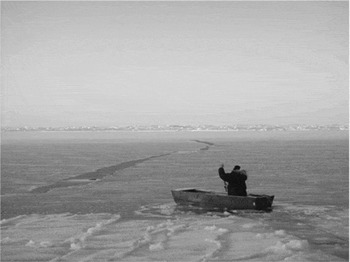
Later and incomplete sea ice freeze-up and earlier, more rapid break-up are also affecting access to hunting areas. Recorded fluctuations in surface air temperatures during fall and winter months over the past two decades in the western Canadian Arctic have delayed and sometimes prevented the sea ice around Ulukhaktok from completely freezing over, resulting in open water and thin ice in areas that harvesters expect to be safe for travel (Rigor and others Reference Rigor, Colony and Martin2000; Environment Canada 2007). Experienced hunters explain that after two or three days with very cold (below −30°C) temperatures in the late fall (November), the sea ice used to freeze over and although it was thin, it could support travel by snow machine. In the past decade, however, the sea ice is taking longer to freeze over and recently there have been years when there has been open water and/or very thin unstable temporary ice cover that is vulnerable to winds and current (Fig. 2).
Inuit hunter, Adam Kolouhok Kudlak, retrieves a ringed seal natiq from the open water lead aolagot near Holman Island Qikiktakyoak using an open water boat oinikhiot on 20 February 2009.

The speed and direction of the wind affects sea ice dynamics. Queen's Bay, where the community is located, faces southwest and a strong northeast wind is necessary to break up the sea ice, usually in the late spring. Northeast winds, however, are no longer exclusive to the spring and they have been experienced in recent years in the autumn and winter, resulting in later freeze-up, premature break-up and open water leads. Open water and unstable sea ice has made it more difficult for harvesters to reach autumn, winter, and spring hunting areas accessible by the sea ice. Harvesters must travel to other locations or take alternative travel routes that are often longer and require more time and fuel than the affected routes, and carry their own risks (for example land crossing) (see Current adaptive strategies).
Winds also affect sea ice break-up in the spring. Westerly winds have become more common in the spring which is a deviation from the usual pattern of east winds. In the spring of 2005, east winds broke up the ice in late May but the wind direction shifted to westerly winds which pushed the broken ice back into the community bays and prevented harvesters from travelling by boat. Harvesters were unable to access caribou harvesting grounds in Prince Albert Sound, Kangiryuaq until late in the fall. While these specific observations may be an aberration for the year, unpredictable wind patterns are increasingly being observed in the community indicating that a trend of changing wind patterns may be occurring.
Quality and availability of wildlife
Harvesters have observed changes in the quality and availability of some wildlife species important for subsistence. These changes are affecting subsistence and income driven activities that depend on quality wildlife products (for example sport hunting, food, furs for crafts and clothing). In the winter and spring of 2005, hunters observed a significant decline in the quality of ringed seals and in the number of young ringed seals caught (ringed seals are harvested in Ulukhaktok for their meat and pelts). The ringed seals harvested were extremely lean, the meat was often not suitable for human consumption, and the pelts held limited economic value. Although the community does not depend on seals for fuel, food, or income as they did in the past, seals are still harvested for dog food and a decline in the health of seals is interpreted as an indicator that the health of the ecosystem is under threat.
This year was very real for the community because there's so many signs of running out of seals. The seals were in need of their own food chain and it wasn't around so therefore they were skinny. Anonymous (translated from Inuinnaqtun)
Seals are very skinny through the spring, they are pitiful. . .we can't eat them because of health concerns. They are only good for dog food. Pat Ekpakohak, (translated from Inuinnaqtun)
The quality of ringed seal meat and pelts improved later in the summers of 2005 and in 2006. However, harvesters report a continued decline in the number of young ringed seals harvested.
An experienced seal hunter in Ulukhaktok who has hunted and worked extensively on seal monitoring projects in the region for over three decades explains that when the sea ice breaks up early, as it has in recent years, it is quickly blown out into the ocean and many young seals and adult animals are removed from the area. As a result, there are fewer seals in locations where they are expected to be abundant (H. Wright, personal communication, 1 December 2008). Others have recorded poor seal health and a potential association with changing sea ice conditions. In 1998, for instance, Smith and Harwood (Reference Smith and Harwood2001) observed poor body conditions and short body lengths in a sample of neonate ringed seal pups in Prince Albert Sound (Ulukhaktok harvesting area). Although not defined, these conditions may have resulted from later birth dates or shortened lactation and consequent slower growth associated with the premature disruption of the land fast ice breeding habitat (Harwood and others Reference Harwood, Smith and Melling2000).
Beginning in the late 1970s, there has been a dramatic decline in the Peary caribou population on the Arctic islands. Caribou is an important and preferred source of meat in the community. Aerial surveys conducted by the government of the Northwest Territories (GNWT), found that the Minto Inlet caribou population (important to Ulukhaktok) declined from 4500 in 1980 to about 100 in 1993 (Nishi and Buckland Reference Nishi and Buckland2000). Recent warming has led to a dramatic increase in the number of days above freezing temperatures during the migration period for the caribou, and thawing and freezing of snow results in ice layers in the snow pack that hinder travel of caribou and make it more difficult for them to forage for food. The formation of ice layers that prevent caribou from accessing food has been identified as a key causal factor of the declines (Russell Reference Russell, Armstrong and Brodzik2007). Peary caribou are now listed as an endangered species in Canada, a species that faces imminent extirpation or extinction. In 1993, harvesters in Ulukhaktok implemented a voluntary five year moratorium on hunting Peary caribou from the Minto Inlet population. That moratorium ended in 1998 and is now reviewed annually, but since 1993 Ulukhaktok harvesters have only hunted caribou from the Dolphin-Union caribou population on the south part of Victoria Island (NWT Wildlife 2007). This requires travelling long distances by boat which limits who is able to participate in the harvest based on access to a boat, fuel, and time.
Current adaptive strategies
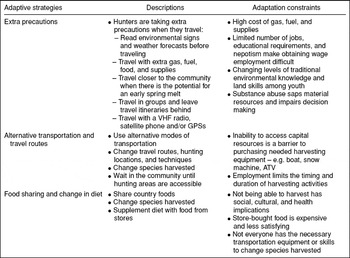
Inuit in Ulukhaktok have a long history of coping with change and are employing several measures to deal with current climate related exposure sensitivities. There are numerous characteristics by which adaptations can be distinguished and which could contribute to the development of a typology of adaptation (for example Burton and others Reference Burton, Kates and White1993; Carter and others Reference Carter, Parry, Harasawa and Nishioka1994; Smithers and Smit Reference Smithers and Smit1997). This analysis of adaptations draws on a modified set of adaptation characteristics described by Smit and Skinner (Reference Smit and Skinner2002) and includes timing and duration, scale and responsibility, and degree of success. Timing differentiates adaptations based on whether they are anticipatory (pro-active), concurrent (during), or responsive (reactive); duration identifies adaptations according to the time frame over which they apply (for example tactical (short-term) vs. strategic (long-term)); scale distinguishes the spatial extent at which adaptation occurs; responsibility differentiates among the various actors that undertake or facilitate adaptations; and degree of success highlights how adaptation success is viewed differently by various agents. Adaptations that are deemed successful by some agents may have undesirable outcomes for others. These characteristics are applied in describing the adaptive strategies employed to deal with climate related exposure sensitivities in Ulukhaktok (Table 3).
Current adaptive strategies and adaptation constraints.

Extra precautions
Community members often respond to climate related hazards by adjusting their behaviour without any pre-planned strategy (reactive). Harvesters react to increased variability and unpredictability in climate conditions, such as the occurrence of a storm or a sudden spring melt, by drawing on their knowledge of the local environment and the resources available to them to cope with the disturbance. For example, harvesters have coped with the onset of sudden storms by drawing on their knowledge of the local geography to find refuge and set up camp, have unexpectedly altered travel routes to avoid hazardous trail conditions, and have switched species harvested when necessary.
Reactive courses of action serve short term needs but have also contributed to the development of longer term proactive adaptations. Drawing on past experiences coping with climatic risks, harvesters are increasingly anticipating the possibility of encountering hazards when travelling on the land and sea ice, and are taking extra precautions to avoid and/or be prepared to cope with emerging risks. These precautions include: taking extra time to read environmental signs and local weather reports before travelling; travelling with extra supplies (for example gas, fuel, food, tent, etc.); travelling closer to the community when there is the potential for an early spring melt; travelling in groups; leaving travel itineraries with people in the community in case they encounter hazardous conditions and require assistance; and travelling with a VHF radio, satellite phone and/or GPS. There are several incidences of harvesters being stranded due to rapidly changing conditions (for example caribou hunters stranded in Prince Albert Sound because of bad weather or moving sea ice), but because they carried extra food, fuel and supplies they were able to cope with the situation and wait for conditions to improve before returning safely to the community. In other cases, having a VHF radio or satellite phone has enabled travellers, who became stuck in melting conditions, to contact people in the community for assistance.
Alternative transportation and travel routes
Harvesters have adapted to compromised travel routes to hunting areas by adjusting their modes of transportation, travel routes, and hunting locations. For example, in the event of an early break-up or late freeze-up (when travel on the sea ice by snow machine is not feasible) harvesters who have access to alternative transportation equipment have adapted and now travel to hunting areas by all terrain vehicles (ATV) or boat. Harvesters usually switch from travelling by ATV to snow machine in approximately mid October; however, in the past few years due to late snowfall, harvesters have been travelling inland by ATV until late November. The down side to this change is that it is more difficult to pull a sled, alliak behind an ATV and it cannot carry as much weight as it could if it were being pulled by a snow machine. In the marine environment motorised boats are becoming increasingly important for adapting to changing sea ice conditions and are being used to access hunting areas in the spring (for example duck hunting) and autumn (for example caribou hunting). The ocean around Ulukhaktok is often rough due to the prevalence of wind and boating can be a dangerous mode of transportation. Furthermore, hunting ducks from a boat is more difficult than by snow machine and requires more fuel.
We hunt ducks in the spring. You need good ice to hunt ducks, go by [snow] machine. If it's an early break-up and the ice is bad we go by boats but it's harder to hunt ducks from the boat. The boat moves around and it's harder to shoot. . . Anonymous.
As a result of later sea ice freeze-up, harvesters are changing their travel routes. For instance, harvesters are travelling inland by snow machine rather than on the sea ice to reach caribou hunting areas in Prince Albert Sound. This route is not as desirable as moving on the sea ice because it is longer and more rugged. Similarly, as a result of more open water during the winter and spring, hunters have been forced to change their travel routes to key polar bear hunting areas. To hunt polar bears around Nelson Head, an important polar bear hunting area, hunters used to travel by snow machine across the sea ice in the Amundsen Gulf from Ulukhaktok to Banks Island. Within the past decade, this travel route has not been possible because the sea ice has not completely frozen over. To reach Nelson Head, harvesters have had to travel longer distances up the coast of Victoria Island, cross the sea ice in the Prince of Wales Strait Ikirahak near Ramsey Island to Banks Island and then travel along the coast of Banks Island to Nelson Head. This route takes longer and requires more fuel, and some hunters have opted to hunt in alternative locations. Several hunters do not have access to the transportation equipment or fuel needed for travelling via alternative routes, and others do not possess the environmental knowledge or land skills important for navigating new routes. This limits who is able to adapt to changing sea ice conditions and continue to participate in subsistence hunting.
Food sharing
Harvesters often share country foods with other people in the community. For example, in July 2005, a hunter was fortunate to harvest a lone Peary caribou. Upon returning to the community, the hunter divided the animal into separate portions and distributed them to 22 households in the community. Similarly, when a community member harvested a beluga whale qilalugaq (Delphinapterus leucas) during the same month, they also distributed the whale meat, maktaq throughout the community. This form of sharing payuktuq (the giving or carrying of food, whether fresh or cooked, to another individual or household) is documented by Collings and others (Reference Collings, Wenzel and Condon1998) to be the most frequent type of food sharing practiced in Ulukhaktok. Food sharing relationships have a long history in Inuit society, and as in the past, food sharing networks continue to help people cope during times when country foods are less abundant. An interviewee describes the importance of food sharing.
. . .that's what community is all about, sharing. Once they share something today, with their family or elders . . . . people bring them some and share, they still do that, they do that like long ago when they catch something they share it. . .bring food to elders and people who can't get out. . .that is what I like about Holman [Ulukhaktok], people share, with their family or the elders. . . Susie Malgokak.
Food sharing provides community members with country foods in spite of factors that may affect their involvement in harvesting including changing climatic conditions. Food sharing is also part of a greater emotional and social bond that is built among individuals and which is important for a healthy community. Some respondents, however, report that food sharing networks are not functioning as they did in the past. Food sharing is now more restricted to within family units. A detailed analysis of food sharing networks in the community is needed to understand better the distribution process in the context of continuing social and environmental changes.
Change in diet
Most community members supplement their diet, to varying degrees, with store bought foods. For many Inuit, however, store bought foods are not an equal trade off for country foods. Store bought foods are considered to be less satisfying, not as desirable, and more expensive. This finding is consistent with research on Inuit dietary beliefs and attitudes (Condon Reference Condon, Collings and Wenzel1995; Wenzel Reference Wenzel1995; Wein and others Reference Wein, Freeman and Makus1996; Collings and others Reference Collings, Wenzel and Condon1998). As described in Collings and others (Reference Collings, Wenzel and Condon1998) and substantiated in community interviews, country foods are preferred because they are healthier, fresher, and therefore better tasting and more satisfying, and less expensive than store foods. A respondent who is faced with purchasing more store bought foods to feed his or her family due to a combination of factors including less time to participate in harvesting activities due to employment, increased costs associated with harvesting (for example equipment and fuel), and changing climate conditions, describes what it is like not to have country (native) foods.
. . .we have a lot of native food and once you don't have a certain type of food, it's like you're always hungry even though you eat, and once you finally have that certain type of food it's like your body is satisfied, your not as hungry all the time, but I could see that happening more and more in the future if the weather keeps changing the way it is, I could see us craving for more and more native food. Anonymous.
The collection and consumption of country foods is also important to cultural identity. The importance lies in the activity of harvesting, spending time with family members, the fulfilment, status, and self-esteem associated with the harvest and also in the sharing of country foods.
When people want to travel and weather patterns change like this, it affects their emotions, their mentality. They live on country food. It is good for their soul and to spend time with family members. Jimmy Memogana (translated from Inuinnaqtun).
Adaptation success in this case is a matter of perspective and, although it is feasible that a community household could survive on store bought foods, it is not a desirable option for many community members, and has broad social, cultural, and health and nutritional implications. This highlights the importance of engaging local peoples in adaptation planning to ensure that policies reflect the values and needs of the community.
Adaptation constraints
There have been rapid societal changes in Arctic regions in the last half of the twentieth century. These have included: settlement of semi-nomadic groups in permanent communities; the development of the wage economy; compulsory schooling; participation in external markets; imposition of wildlife management such as hunting quotas; rapid population growth; and land claim agreements (Wenzel Reference Wenzel1991; Hamilton Reference Hamilton1994; Oakes and Riewe Reference Oakes and Riewe1997; Damas Reference Damas2002). These changes have affected harvesting practices, social networks, and cultural and spiritual traditions, and have been linked to the loss of land skills among youth and to social problems (Kral Reference Kral2003; Einarsson and others Reference Einarsson, Larsen, Nilsson and Young2004; Takano Reference Takano2005). In several instances, social change and climate change have acted synergistically to affect Inuit livelihoods and adaptive capacity. The interconnections between access to capital resources, the development of the wage economy, changing levels of traditional knowledge and land skills among youth, substance abuse and adaptive capacity to deal with climate change are discussed here (Table 3).
Access to capital resources
Harvesters depend on mechanised modes of transportation to access hunting areas. Snow machines have all but replaced dog teams as the primary mode of transportation in the winter and spring, ATVs are the vehicle of choice for travel on the land in the summer and autumn, and motorised boats are used on the ocean. Mechanised transportation allows harvesters to access hunting areas beyond the limited zone imposed by fixed settlements. In some instances, changing trail conditions have made it necessary for harvesters to switch their mode of transportation and travel longer distances to access hunting areas. Transportation technology, however, is expensive to purchase, maintain and operate, and the price of fuel has increased dramatically in recent years (the price of petroleum in Ulukhaktok was $1.77 CDN/litre on 26 November 2008). This limits who is able to participate in harvesting, a problem that is exacerbated by emerging climatic changes.
Community members face significant challenges in obtaining capital resources including a limited number of wage jobs, lack of qualifications, and nepotism in the local workforce. Several adults who moved from a subsistence lifestyle on the land into the permanent settlement have limited formal education and even though they often possess the necessary skills, they are not academically qualified for many wage jobs that require a high school education. In 2004, 49% of adult community members had less than a high school education (NWT Statistics 2006). Furthermore, some high school graduates in Ulukhaktok have been assessed at education levels much lower than their granted grade twelve diploma; as a result, these individuals do not have the credentials to pursue higher education or to obtain skilled employment in the community without additional upgrading. Concerns about the standard of education provided in communities in the Canadian Arctic are well documented (Irwin Reference Irwin1989; Berger and Epp Reference Berger and Epp2005; Johansson and others Reference Johansson, Paci, Stenersen-Hovdenak, Einarsson, Larsen, Nilsson and Young2005).
In some cases, community members choose not to seek employment, a consequence of the NWT housing rental policy that bases rent on an assessment of household income (33% of household income goes towards rent) (NWT Housing 2006). Depending on their income level renters can pay up to $2,617 CDN per month for a four bedroom rental house whereas renters who receive income support only pay $32.00 CDN per month (NWT Housing 2009). Some community members lack the incentive to seek employment because a large percentage of their income will go to paying rent, a cost they can avoid by not working. These factors affect participation in harvesting and constrain adaptations that require capital resources.
A regional scale programme, the Inuvialuit harvesters assistance program (IHAP) responds to this need and provides some Inuit with funding to purchase harvesting equipment. Preference is given to Inuvialuit subsistence harvesters engaged in harvesting activities and showing demonstrated need for programme support to continue or start harvesting and, those harvesting applicants that regularly involve youth in their traditional harvesting activities (IRC and IGC 2001). For the IHAP a subsistence harvester is defined as an Inuvialuit harvester who is either currently or has been within the last three years, active for six or more months of the year in hunting, fishing and trapping activities for subsistence purposes (IRC AND IGC, 2001). Applicants to IHAP are eligible to receive up to $5000 CDN once every three years towards the purchase of new harvesting equipment. IHAP is not directed at adaptation to climate change, but builds household capacity to participate in harvesting. In Ulukhaktok, IHAP has provided successful applicants with the economic means to purchase new transportation equipment, which has enabled them to continue to harvest, and in some cases be better equipped to deal with changing conditions. Four interviewees identified IHAP funding as essential for their households to be able to participate in subsistence. One couple that has three children explain that IHAP funding enabled them to purchase a new snow machine and they are now once again able to travel in the winter and spring to go fishing and duck hunting. However, several respondents commented that the allocation of IHAP in the community is plagued by nepotism and funds were not necessarily being allocated to individuals who met the programme's definition of ‘subsistence harvester’ (defined above). Addressing this concern to ensure that IHAP funds are allocated to subsistence harvesters and then potentially expanding the IHAP programme to assist more harvesters are practical initiatives that would support involvement in harvesting under changing conditions.
Availability of time
Some community members balance harvesting with the wage employment necessary for generating income to purchase harvesting equipment, supplies, and fuel. Employment, however, also constrains the timing and duration of harvesting activities. Unpredictable weather patterns and increasingly compromised travel routes have made it difficult to plan when to travel on the land, and employment obligations further limit when harvesters can travel. Consequently, some employed harvesters, although well equipped for harvesting, are spending less time harvesting and are making shorter, rushed trips to travel when conditions are not considered optimal. Three male respondents who have full time wage employment in the community explain that because of employment obligations they are spending less time harvesting than they did prior to working in the wage sector. When asked whether they used their days off and vacation time to harvest, each respondent replied that while they did use some of their time off for harvesting, they most often spent their days off relaxing in the community. Two of these respondents said that they sometimes choose not to travel on their days off because of uncertainty if they would make it back to the community in time for their next work day. Employment acts as both an aid to adaptation by providing access to a needed source of income, but it can also constrain adaptation by limiting the timing and duration of harvesting activities. An analysis of the relationship between employment and participation in subsistence harvesting is available in Condon and others (Reference Condon, Collings and Wenzel1995).
Traditional knowledge and land skills
Inuit capacity to deal with variable environmental conditions has long been facilitated by traditional environmental knowledge and land skills. The term ‘traditional knowledge’ is defined as a cumulative body of knowledge, practice and values, which have been acquired through experience, observation from the land or from spiritual teachings, and handed down from one generation to another (Huntington Reference Huntington1998; Berkes Reference Berkes1999; Government of the Northwest Territories 2005). Traditional knowledge is dynamic, continually evolving and being updated, and has evolved in this context to manage changing climatic conditions, including unpredictability and extremes. Hunters manage the risks associated with hunting by taking precautions, knowing what equipment to take along and what preparations to make, and being sensitive to critical signs in the environment and knowing how to respond. Knowledge of animal behaviour enables hunters to adapt to changing animal numbers and location.
Traditionally, knowledge and skills were developed and transmitted through on-the-land education or ‘people's practical engagement with the environment. . .’ (Ingold and Kurttila Reference Ingold and Kurttila2000), and from listening to and learning from elders and other experienced individuals. In traditional Inuit education, learning and living were the same thing, and knowledge, judgment and skill could never be separated (Nunavik Education Task Force 1992). However, community members are concerned that the traditional modes of intergenerational knowledge transfer and learning by which Inuit have developed the skills to hunt safely and successfully no longer function effectively. Elders and other experienced community members together with community educators, point to the potential loss of land based skills coupled with lack of workplace relevant skills among the growing population of young Inuit (49% of the population in Ulukhaktok is under the age of 25 (NWT Statistics 2006)). Youth are spending considerably less time involved in traditional subsistence activities beyond organised land camps and occasional hunting trips but comparatively more time engaged in formal education and wage employment. Adult community members are concerned that youth are not learning the land skills necessary for safe and successful harvesting, particularly in light of the changes they are experiencing in the climate and environment.
Young people go out on the land in everyday jackets; they get cold more easily; they go for appearance. They can't go for long periods of time, can't take the cold anymore. [They] get stranded on the land, they can't make snow shelters and searches have to go for them. . .older adults should be taking out young people, teaching them survival on the land. Ida Kuneyuna (translated from Inuinnaqtun).
It is widely accepted in the community that some form of formal education is necessary and beneficial; however, there is strong support for youth to receive a more balanced education between formal school teachings and land based skills. It is not expected that youth should return to the traditional lifestyle that their elders lived, but there is an expressed need for youth to have sufficient knowledge of the land and harvesting activities if the values and benefits integral to a subsistence lifestyle are to be carried forward to future generations.
Substance abuse
Substance abuse was identified as a major stress affecting the community. Although there is no legal distributor of alcohol in Ulukhaktok, community members can order alcohol from Yellowknife or Inuvik as freight. Drugs, primarily marijuana, is also readily accessible in the community. Substance abuse has led to addictions, health problems (for example foetal alcohol syndrome), family violence, child neglect, and the disruption of social networks.
Right now there is so much drug and alcohol problems in the community. . . [It is] probably the biggest problem that we have in the community. . .kids [are] going hungry because their parents spend their money on drugs and alcohol, there are more fights, more stress in families. Anonymous.
At the time of the research the drug and alcohol counsellor, wellness worker and mental health worker positions in the community were vacant, and if needed, community members had to fly to Inuvik for these services. These wellness positions often go through rapid rotations of southern workers and some positions go unfilled for years at a time. Addictions and lack of support services have left some community members more susceptible to stresses associated with substance abuse, and consequently ill prepared to deal with challenges that may arise from climate change, sapping both their material resources and impairing decision making (for example money is spent on drugs and alcohol instead of on needed harvesting equipment, supplies, fuel, or food and in some cases harvesting equipment has been traded for drugs and/or alcohol).
Future vulnerability
Exposure sensitivities and adaptive capacity are dynamic and will change as the community and the climate change over time. Harvesters in Ulukhaktok are currently sensitive to climate related risks that make harvesting more hazardous, compromise travel routes to hunting areas, and affect the health and availability of wildlife species important for subsistence. These conditions are projected to continue in the future with further implications for Inuit livelihoods. It is not possible to predict the future with certainty, but we can gain insight into the nature of future vulnerabilities by using current exposure sensitivities and adaptive strategies as starting points from which to consider the implications of projected changes in climate and society (Ford and others Reference Ford, Macdonald, Smit and Wandel2006).
Climate models generally estimate future changes in climate over specified time periods (for example 10, 50, 100 years). These estimations are useful for understanding potential future changes in temperature and precipitation and their associated affects (for example sea ice extent and thickness, permafrost, etc.). This section includes information from future climate models; however, it does not focus on specific future time periods but rather deals with the progression of current exposure sensitivities and adaptive capacity relative to anticipated changes in climate and society.
Future exposure sensitivities
Depending on the model and forcing scenario used, the average warming in the Arctic is projected to range from about 2°C to about 9°C by the year 2100. The projected warming is largest in the autumn and winter, and is largest over the polar oceans in areas of sea ice loss (Anisimov and others Reference Anisimov, Vaughan, Callaghan, Furgal, Marchant, Prowse, Vilhjalmsson, Walsh, Parry, Canziani, Palutikof, Linden and Hanson2007). A study based on the IPCC model simulations and scenarios, projects mean reductions of annually averaged sea ice area in the Arctic by 2080–2100 of between 22% and 33% depending on the atmospheric greenhouse gas loading scenario used (Zhang and Walsh Reference Zhang, Chen and Riseborough2006). Other studies project an ice free Arctic ocean in September within this century (Stroeve and others Reference Stroeve, Holland, Meier, Scambos and Serreze2007). Climate models generally agree that likely impacts of future warming will also include changes in the timing and duration of the spring melt season (Rigor and others Reference Rigor, Colony and Martin2000), increased precipitation (Kattsov and others Reference Kattsov, Walsh, Chapman, Govorkova, Pavolova and Zhang2007), later freeze-up and earlier break-up of river and lake ice (Walsh Reference Walsh and Symon2005) and an increased frequency of extreme weather and storm events (Kattsov and Kallen Reference Kattsov, Kallen and Symon2005). These projections, although not inclusive of all possible changes that may occur as a result of climate change, present a range of possible future risks for arctic communities. Table 4 outlines some potential implications of future climatic changes in Ulukhaktok based on current community-identified exposure sensitivities.
Future climate change projections and possible future exposure-sensitivities.

Projected reductions in sea ice cover, more unstable sea ice conditions (for example thin ice), and trends toward later freeze-up and earlier break-up would probably continue to exacerbate risks associated with travel on the sea ice, compromise travel routes to hunting areas, and affect the health and availability of some wildlife species. Some species of marine wildlife that are harvested by Ulukhaktok hunters, specifically ringed seals and polar bear, are expected to be negatively affected by projected increases in precipitation and changes in sea ice (Loeng Reference Loeng and Symon2005; Laidre and others Reference Laidre, Stirling, Lowry, Wiig, Heide-Jørgensen and Ferguson2008). A study of the ringed seal population around Ulukhaktok documented that even a very local, small scale, premature disruption of the land fast breeding habitat has significant negative impacts on the growth, condition and survival of unweaned pups (Harwood and others Reference Harwood, Smith and Melling2000). Progressively warmer temperatures in spring will cause seal birth lairs to melt earlier, exposing pups at increasingly earlier ages to predation and freeze thaw cycles similar to those recorded by Stirling and Smith (Reference Stirling and Smith2004). Projected increases in precipitation in the spring are expected to result in more frequent and widespread collapses of subnivean birth lairs, the mortality of ringed seal pups will increase and local populations may be significantly reduced. As ringed seals are the primary prey of polar bears, a significant decline in ringed seal populations, especially in the production of young, is capable of having negative effects on the health of polar bears (Stirling and Parkinson Reference Stirling and Parkinson2006).
Polar bear hunting is an important activity in Ulukhaktok for subsistence and as a source of income. Several hunters in Ulukhaktok derive a large portion of their income from guiding and helping on sport hunts for polar bear. Climate and political changes, however, have implications for polar bears and the sport hunting industry in the Canadian Arctic. The health of the polar bear as a species under future climate change projections is in question. Stirling and Parkinson (Reference Stirling and Parkinson2006) and Stirling and others (Reference Stirling, Lunn and Iacozza1999) documented a significant positive relationship between the time of sea ice break-up and the condition of adult female polar bears (that is the earlier the break-up, the poorer the condition of the bears). Strong positive relationships between the time of sea ice break-up and freeze-up have also been documented by Derocher and others (Reference Derocher, Lunn and Stirling2004), who found that reduced sea ice has led to reduced reproductive rates. Scientists have expanded these findings to the whole circumpolar Arctic and suggest that polar bears are threatened as a species if future sea ice projections of a complete disappearance of sea ice in the Arctic Ocean during the summer, come true (Derocher and others Reference Derocher, Lunn and Stirling2004). Dyck and others (Reference Dyck, Soon, Baydack, Legates, Baliunas, Ball and Hancock2007), however, warn that claims for the fate of polar bears are highly premature. They challenge the skilfulness of climate models to project sea ice changes and argue that alternative factors including, increased human-bear interaction, natural population dynamics, and variability of the Arctic ice, ocean and atmosphere that occur naturally on decadal to multi-decadal time scales must be taken into account in a more realistic study and explanation of the population ecology of polar bears.
Together with climate change, political changes threaten the polar bear sport hunting industry in the Canadian Arctic. Despite assurances from Inuit and wildlife biologists in the NWT and Nunavut that most polar bear populations are healthy and in some regions increasing, the United States government has decided to list polar bears as a threatened species under its endangered species act because of the effects of climate change. The endangered species designation bans all polar bears products from being imported to the US, including the trophy hides that most sport hunters seek, essentially shutting down the American component of the Canadian polar bear sport hunting industry. The implications of this ban on Inuit hunters has yet to be determined.
Future adaptive capacity
Consistent with current adaptive capacity, the future capacity of community members to deal with climate change will probably depend on factors including access to capital resources, community wellness, and the transmission of traditional knowledge and land skills. In several cases, supporting current adaptation needs will enhance adaptive capacity to deal with projected future changes.
Access to income
Adaptations that necessitate economic responses (for example extra fuel, alternative mode of transportation, purchasing food from stores) could be supported by developing income generating opportunities. Efforts have been made and are currently underway in Ulukhaktok to provide community members who are seeking employment with additional skills training and greater educational opportunities. Programmes include education in the community extending to grade 12, and courses at the local Aurora College campus that focus on skills training pertinent to current employment opportunities in the community and region (for example exploration geology, oil and gas industry, driver's licence, small business operation, environmental monitoring). As a result of these efforts, more community members are obtaining their high school education which should make them eligible for more employment opportunities, and community members are obtaining job related skills that allow them to work on projects such as mineral exploration. Despite these advancements in training respondents express the need to offer more programmes that are of interest to community members beyond those provided by current industrial interests (for example mineral exploration and oil and gas development), and that meet the educational competency standards necessary for students to pursue post-secondary education. Some respondents, including local educators and high school graduates, call for educational reform to develop a curriculum that meets both southern educational requirements and also includes traditional knowledge, land skills, Inuinnaqtun language, and cultural values that are important to the community. They argue that if education had a better balance between southern curriculum and traditional knowledge and land skills, more people would value the opportunities education presents and more fully engage in educational pursuits.
Potential future resource development (mining and/or oil and gas development) would certainly influence future vulnerability. Increases in individual incomes, seasonal employment patterns, greater exposure to outside cultures, and divisions in the community between those in favour of development and those opposed are potential factors to consider, the implications of which have been documented elsewhere in the Canadian Arctic (Brubacher and Associates 2002). Currently there is no resource extraction activity near the community, but two companies, Great Northern Mining and Exploration and DeBeers are actively exploring Inuvialuit lands on Victoria Island for precious metals and diamonds and the Mackenzie Valley gas project is currently under review.
Flexibility
There is some uncertainty when discussing future climate change projections but community members recognise that continued flexibility and ingenuity will play central roles in future adaptation.
I could see us having to learn all over again about the ice conditions in the spring time, the ice conditions in the early fall or winter with the climate change and the way it's affecting it. I think we're going to have to be like educated all over again on how to travel or when to travel, good time of the year to travel. Anonymous.
Flexibility may be expressed in an individual's ability to use alternative modes of transportation and alternative travel routes to access hunting areas, and/or change the timing and location of harvesting as well as the species of wildlife harvested. Knowledge of the local environment and land skills influence how harvesters respond and adapt to changing environmental conditions. These skills are honed through consistent interaction with the environment. Programmes that support participation in harvesting activities and the transmission of environmental knowledge and land skills to youth are important for ensuring that younger generations have the opportunity to learn and practice these skills. Additional support for land programmes operated by the school, hamlet and Canadian rangers, and for programmes that connect elders with youth would contribute to the transmission of knowledge and skills and build capacity among younger generations to cope with and adapt to changing environmental conditions.
Flexibility may also be found at the institutional level in terms of comanagement bodies that facilitate communication between the community, the regional Inuvialuit government, the territorial government and the federal government. Membership in comanagement bodies such as the fisheries joint management committee (FJMC), and the wildlife management advisory council (WMAC) provide Ulukhaktok with access to scientific information and additional resources to address issues affecting the system or species of interest. The ability of these institutions to be flexible and include climate change impacts and projections in environmental and other assessments and to be innovative in their response strategies, will contribute to adaptive capacity to deal with future climate change.
Discussion
In the literature on climate change impacts and adaptation in the Arctic, this study aims to represent a significant contribution by showing how people in communities are affected by and are responding to conditions associated with a changing climate. The research investigated human vulnerabilities to climate change in the community of Ulukhaktok. Vulnerability is conceptualised as a function of both the characteristics of climate which the community is exposed and sensitive to, and the capacity of the community to adapt. The knowledge and experiences of local people were primary sources of information, and the involvement of community members in the research provided an opportunity to identify climate conditions and adaptations that were important to community members beyond those selected a priori by researchers. It also allowed for the identification of multiple drivers of cumulative change which may not be climate related but influence how climate change is experienced and how adaptations are facilitated.
In Ulukhaktok, climate change together with changing livelihoods has altered, and in some cases exacerbated the exposure sensitivity of community members to climate driven hazards. In several ways, community members are more sensitive to existing and/or new risks associated with harvesting, travel routes to hunting areas have been compromised, and the health and availability of some wildlife species important for subsistence have been affected. Some community members are demonstrating significant adaptability to changing conditions. This adaptability is facilitated by access to capital resources, traditional knowledge and land skills, resource use flexibility, and strong social networks. The capacity to cope with and adapt to changing conditions, however, is not uniform among community members with some individuals better equipped to adapt than others nor are all adaptation options desirable. Societal factors including the inability to access capital resources, time restrictions imposed by wage employment, changing levels of traditional knowledge and land skills among youth and substance abuse are affecting the capacity of community members to deal with exposure sensitivities. These constraints to adaptation represent strategic policy entry points in which to address the adaptation needs of the community now and to enhance the adaptive capacity of the community in the future. As is the case with the IHAP providing economic support to community members to purchase harvesting equipment, adaptations to climate change are unlikely to be undertaken for climate change alone but are more likely to be a response to problematic conditions that already exist in the community. Supporting efforts that increase financial, health, educational, and cultural capacity in the community will inadvertently enhance the adaptive capacity of the community to deal with current and future climate change risks. Some of the experiences with climate change documented for Ulukhaktok are similar to those recorded elsewhere in the Arctic (for example Berkes and Jolly Reference Berkes and Jolly2002; Ford and others Reference Ford, Smit, Wandel, Allurut, Shappa, Ittusujurat and Qrunnut2008b) and some findings have been compared among communities in different regions (Gearheard and others Reference Gearheard, Matumeak, Angutikjuaq, Maslanik, Huntington, Leavitt, Kagak, Tigullaraq and Barry2006; Ford and others Reference Ford, Pearce, Gilligan, Smit and Oakes2008a). An International Polar Year project, ‘Community adaptation and vulnerability in Arctic regions (CAVIAR),’ is building upon existing vulnerability to climate change research (including the research presented here) to draw comparisons among communities across the circumpolar Arctic, to understand better how arctic communities are affected by climate change, and identify common factors that influence exposure sensitivity and adaptation to help inform adaptation planning.
Acknowledgements
The generosity, friendships, and knowledge shared by the residents of Ulukhaktok are gratefully acknowledged. The contributions of Steve Baryluk (Inuvialuit joint secretariat), Scott Nickels and Eric Loring (Inuit Tapiriit Kanatami), John Keogak (Sachs Harbour), and the staff at Helen Kalvak Elihakvik school, Ulukhaktok cultural resource centre (Emily Kudlak) and Aurora Research Institute, Inuvik are also acknowledged. Thank you to Harold Wright, Colin Okheena, Albert Alias, and Mark Andrachuk for commenting on earlier drafts, Erica Beasley, Peter Collings, Don Johnson, Adam Kudlak, Robbie Inuktalik and Mel Pretty for intellectual input and assistance in the field, Marie Puddister for Fig. 1, and Adam Kudlak for Fig. 2. We would also like to thank all the members of our research sample and two anonymous reviewers who provided constructive suggestions on an earlier version of this paper. This research was supported by ArcticNet, northern scientific training program, Aurora Research Institute fellowship and research assistant programme, Arthur D. Latornell scholarship, University of Guelph scholarships, and the Social Sciences and Humanities Research Council of Canada. The research was undertaken as part of the Global Environmental Change Group at the University of Guelph, and was conducted under Aurora Research Institute scientific research licences13832N and 14025R.