Introduction
Seedling recruitment is critical to fitness, and therefore plants are adapted to ensure that seedlings emerge despite environmental variability. For example, increased seed size increases the probability of seedling emergence under dense shade or deep burial (Leishman et al., Reference Leishman, Wright, Moles and Fenner2000). Prolonged seed-bank persistence improves seedling recruitment in environments characterized by frequent disturbance (Cohen, Reference Cohen1966). Because increased seed size and seed longevity both represent adaptations to heterogeneity in the environment, Venable and Brown (Reference Venable and Brown1988) proposed that strong selection for one coincides with weaker selection for the other, and results in an inverse relationship between seed size and seed longevity in the soil.
Evidence in support of the inverse relationship between seed size and seed longevity is provided by observations of variation among species in some floras (Rees, Reference Rees1996; Thompson et al., Reference Thompson, Jalili, Hodgson, Hamzeh'ee, Asri, Shaw, Shirvany, Yazdani, Khoshnevis, Zarrinkamar, Ghahramani and Safavi2001). Among the herbaceous plants in grasslands of north-western Europe (Thompson et al., Reference Thompson, Band and Hodgson1993) and central Argentina (Funes et al., Reference Funes, Basconcelo, Diaz and Cabido1999), species that produce small, light seeds tend to exhibit greater rates of seed-bank persistence, compared to species that produce large, heavy seeds. Also, an inverse relationship between seed size and seed longevity can occur among taxonomically related species in the same habitat, as indicated by co-occurring Ranunculus species. Ranunculus bulbosus, R. acris and R. repens are characterized by successively greater rates of seed-bank persistence (Sarukhan, Reference Sarukhan1974) and successively smaller seeds (Uva et al., Reference Uva, Neal and DiTomaso1997). Despite reports of intraspecific variation in seed size (Byers et al., Reference Byers, Platenkamp and Shaw1997; Halpern, Reference Halpern2005), seed dormancy (Andersson and Milberg, Reference Andersson and Milberg1998; Schutz and Rave, Reference Schutz and Rave2003) and seedling emergence timing (Biere, Reference Biere1991), the relationship between seed size and seed longevity among individuals of a population has yet to be examined. Such a study is important to exclude potentially confounding effects when conducting studies on multiple species.
Ambrosia trifida is an ideal species for studying the relationship between seed size and seed longevity among individuals of a population. The dispersal unit of A. trifida is a hardened involucre that encloses an achene (a single-seeded fruit). Within a population, involucres range from 3 to 14 mm in length, 2–10 mm in width, and ellipsoid to obovoid with 3–8 apical spines. Seed size, shape and spine number are fairly consistent within a maternal family (progeny from one individual), but highly variable among maternal families (Sako et al., Reference Sako, Regnier, Daoust, Fujimura, Harrison and McDonald2001). Thus, the A. trifida dispersal unit (hereafter referred to as ‘seed’) size is genetically polymorphic. In addition to being well-suited for the study of interindividual variation in seed size, A. trifida is one of the most problematic (Loux and Berry, Reference Loux and Berry1991; Gibson et al., Reference Gibson, Johnson and Hillger2006) and competitive (Webster et al., Reference Webster, Loux, Regnier and Harrison1994; Harrison et al., Reference Harrison, Regnier, Schmoll and Webb2001) summer annual weeds in agricultural fields of the United States Corn Belt. In the eastern US Corn Belt, A. trifida seedlings typically emerge in two successive flushes: one prior to 1 May and one after 1 May (Schutte et al., Reference Schutte, Regnier, Harrison, Schmoll, Spokas and Forcella2008). Seedlings that emerge after 1 May can evade weed control and interfere with crop yield (Harrison et al., Reference Harrison, Regnier, Schmoll and Webb2001). Causal factors of late-season seedling emergence in A. trifida are poorly understood. By comparing the temporal emergence patterns of maternal families, we can determine if the biphasic pattern of emergence is because of genetic polymorphism or intraindividual variation in seedling emergence timing.
The overall goal of this study was to better understand the implications of interindividual variation in seed size on seedling emergence timing within populations of A. trifida. We hypothesized that maternal family seed size inversely relates to soil seed-bank longevity, and therefore small-seeded maternal families were expected to exhibit greater rates of late-season emergence (emergence after 1 May) and seed-bank persistence (persistence after one growing season) compared to large-seeded maternal families. Our specific objectives were: (1) to determine the effects of maternal phenotype on traits related to seed longevity under natural conditions, including seedling emergence timing and seed-bank persistence; (2) to determine the effects of maternal phenotype on seed size; and (3) to evaluate the association between seed size and seed longevity among maternal families.
Materials and methods
One-year field experiments were conducted at the Ohio State University Waterman Agricultural and Natural Resources Laboratory (39°59′N, 83°01′W) in 2004–2005 and in 2005–2006. The seed harvest site was an agricultural field (25 × 30 m) in which A. trifida was first introduced in 1984 with seeds that contaminated local corn and soybean harvests. Thereafter, the field was maintained in corn or soybean production. On 15 May 2004 and 9 May 2005, the field was rotary-tilled and was planted with soybeans, and A. trifida was not controlled. Soybean plants were removed in the last week of June to produce a monoculture of A. trifida.
Seeds were harvested from A. trifida maternal plants at three times. In 2004, all mature seeds were removed on 16 September, 23 September and 1 October. In 2005, all mature seeds were removed on 21 September, 1 October and 11 October. During seed harvest periods, air temperature was recorded at 5-minute intervals by a weather station located 0.1 km from the site. Temperature data were used to calculate daily average air temperatures (T avg):

where T min = minimum daily temperature and T max = maximum daily temperature. Also, precipitation data were collected on site daily, and daylengths were determined from archived astronomical data on the worldwide web (USNO, 2007). Maternal plants were initially selected with the criteria of at least 60 mature seeds per plant and sufficient immature seeds to supply additional collections. In 2004, the experiment included 20 maternal families, and in 2005, 27 maternal families. Following harvest, maternal families were stored in paper bags at room conditions (approximately 20°C, 50% relative humidity).
Within 1 month of harvest, seed size was determined for 30 individual seeds (10 seeds per collection) from each maternal family. Following Sako et al. (Reference Sako, Regnier, Daoust, Fujimura, Harrison and McDonald2001), seed surface area was measured using two-dimensional, side-view images of individual seeds. Digital images were obtained with a personal computer equipped with flat-bed scanner, and were adjusted to enhance the contrast between the seed and the background by converting the colour scheme to black seeds on a white background. Image analysis software (Rasband, Reference Rasband2007) was then used to quantify seed area. For seed mass measurements, individual seeds were weighed to the nearest 0.1 mg and then dissected to reveal the embryo. Only seeds with firm, intact embryos were included in assessments of seed mass.
Seed longevity and emergence timing were determined at the Waterman Agricultural and Natural Resource Laboratory in a Crosby silt loam soil (fine, mixed, active, mesic Aeric Epiaqualf) with no history of A. trifida. The experiment was designed as a randomized complete block with four blocks. Within each block, a row of open-top baskets was incorporated into the soil so that the tops were even with the soil surface. Baskets were constructed from fibreglass mesh (0.8 mm2) and measured 10 cm by 21 cm, 4 cm deep. To stabilize the baskets, opposite basket walls were fixed to parallel, wooden planks that ran the length of the row. Each maternal family was randomly assigned to a basket. Seed samples from maternal families consisted of 12 seeds from each of the three collection times. Before sowing, seeds were individually weighed and visually inspected to discard those lacking embryos or damaged by predispersal predators. On 2 December 2004 and 20 November 2005, seeds were placed in baskets and buried at depth 4 cm, previously shown to be optimal for A. trifida seedling emergence (Harrison et al., Reference Harrison, Regnier, Schmoll and Harrison2007).
Beginning 23 March 2005 and 20 March 2006, seedlings were counted and removed with minimal soil disturbance every 3–5 d. Seedling emergence was defined as complete cotyledon expansion. Throughout the study, the surrounding area was kept free of vegetation by hand-weeding and glyphosate applications at 0.94 kg ai ha− 1. Emergence was declared complete when no seedlings were observed for 28 consecutive days, which occurred on 4 August 2005 and 14 August 2006. At these times, baskets were excavated and brought to the laboratory to recover ungerminated seeds.
Seeds were extracted from the soil with slotted sieves (2 × 13 mm) and dissected to reveal embryos. Seeds with firm, visually undamaged embryos were considered viable. Preliminary experiments indicated that this assessment was consistent with viability determined by tetrazolium staining (Schutte, unpublished data).
Data analysis
Intraindividual variation in seed longevity and seed size was studied separately by year because each year consisted of unique environments and genotypes. Seed size data within years met the requirements for analysis of variance (Neter et al., Reference Neter, Kutner, Nachtsheim and Wasserman1996), and therefore data were not transformed prior to variance component analysis. The proportion of total variation in seed size because of differences among maternal families was determined by dividing the maternal family sum of squares by the total sum of squares. To determine the proportion of total variation resulting from differences within maternal families, the residual sum of squares was divided by the total sum of squares. For each maternal family, the influence of time of maturation on seed weight was determined with repeated measures analysis conducted with the REPEAT subroutine of SYSTAT 11.0.1 (SYSTAT Software, Richmond, California, USA). Repeated measures analysis allows for modelling of the covariance structure associated with measurements that are relatively near each other in time (Littell et al., Reference Littell, Henry and Ammerman1998).
Seed longevity for each maternal family was described by: (1) day of final emergence; (2) the percentage of maximum emergence that occurred after May 1 (late emergence); and (3) the percentage of seeds that remained viable after one emergence season (seed-bank persistence). Tests of normality and constant error variance (Neter et al., Reference Neter, Kutner, Nachtsheim and Wasserman1996) indicated that non-parametric analyses were most appropriate for comparison of final days of emergence among maternal families. Accordingly, maternal phenotype effects on day of final emergence were determined with analysis of variance by ranks (Kruskal–Wallis test; Zar, Reference Zar1999) conducted with the NPAR routine of SYSTAT. Maternal phenotype effects on percentage late emergence and percentage seed-bank persistence were evaluated with univariate logistic regression models formulated with the LOGISTIC subroutine of SYSTAT. The binary dependent variable ‘fate’ was coded as late emergent or persistent = 1, and early emergent or non-persistence = 0. Resulting logistic regression models were assessed with the likelihood-ratio test statistic (Λ), which utilizes the chi-square distribution to test the hypothesis that all coefficients except the constant are zero (Hosmer and Lemeshow, Reference Hosmer and Lemeshow2000).
The association between maternal family seed mass and day of final emergence was assessed with least squares linear regression (REGRESS subroutine of SYSTAT), with maternal family mean seed mass as the independent variable and overall day of final emergence as the dependent variable. The effects of maternal family seed mass on percentage late emergence and percentage seed-bank persistence were determined with univariate logistic regression models formulated with the LOGISTIC subroutine of SYSTAT. The binary dependent variable ‘fate’ was coded as late emergent or persistent = 1, and early emergent or non-persistence = 0. Significance levels for the effects of mass were estimated with the likelihood-ratio test statistic (Λ) and the odds ratio, which described the change in probability in persistence when seed mass increased by 1 mg (Hosmer and Lemeshow, Reference Hosmer and Lemeshow2000).
Results
Maternal phenotype effects on seed longevity
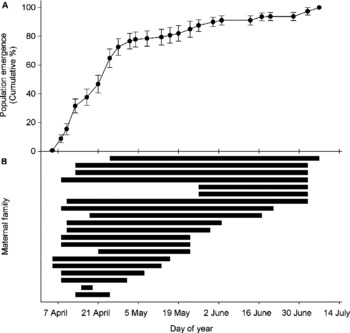
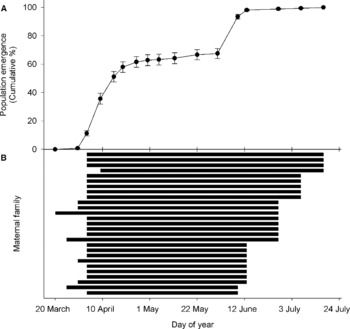
In 2005, seedling emergence at the population level began on 5 April, plateaued to 73% of maximum emergence on 1 May, then resumed at a lower rate and concluded on 7 July (Fig. 1A). Two maternal families exhibited early-season emergence only (100% of emergence prior to 1 May), two maternal families emerged late season only (100% of emergence after 1 May), and the remaining maternal families produced both early- and late-season seedlings (Fig. 1B). Percentage late-season emergence varied among maternal families (logistic regression Λ = 74.6, df = 19, P < 0.001). Also, the day of first emergence and the day of final emergence varied among maternal families [Kruskal–Wallis test statistic (H) = 30.6 for day of first emergence, 29.9 for day of final emergence, df = 19, P < 0.05]. In 2006, seedling emergence at the population-level began on 30 March, reached 62% of maximum by 1 May and concluded on 17 July (Fig. 2A). Maternal families within the 2006 population differed in day of first emergence (H = 57.2, df = 26, P < 0.001), but were similar in the day of final emergence (H = 36.9, df = 26, P = 0.07) (Fig. 2B). Percentage late-season emergence ranged from 11 to 68% among maternal families, and the influence of maternal identity on percentage late-season emergence was statistically significant (logistic regression Λ = 331.1, df = 26, P < 0.001).
(A) Temporal pattern of seedling emergence for an Ambrosia trifida population in 2005. Data are means with SEs of 20 maternal families. (B) Emergence phenology of A. trifida maternal families (each represented by a bar) during 2005. Bar left edge represents day of first emergence, bar right edge represents day of final emergence. Maternal families in (B) correspond with the population in (A).

(A) Temporal pattern of seedling emergence for an Ambrosia trifida population in 2006. Data are means with SEs of 27 maternal families. (B) Emergence phenology of A. trifida maternal families (each represented by a bar) during 2006. Bar left edge represents day of first emergence, bar right edge represents day of final emergence. Maternal families in (B) correspond with the population in (A).

In addition to temporal patterns of seedling emergence, maternal identity affected the percentage of seeds that persisted in the seed bank at the conclusion of one emergence season (2005 logistic regression: Λ = 156.6, df = 19, P < 0.001; 2006 logistic regression: Λ = 422.5, df = 26, P < 0.001). In 2005, seed-bank persistence ranged from 4 to 36% and averaged 19% among maternal families. In 2006, seed-bank persistence ranged from 1 to 51% and averaged 14% among maternal families.
Maternal phenotype effects on seed size
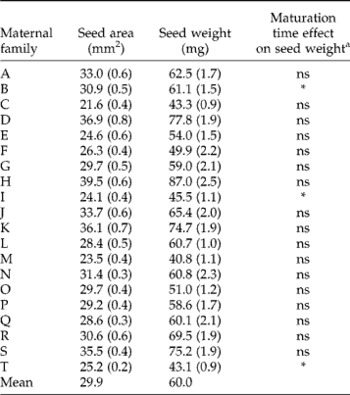
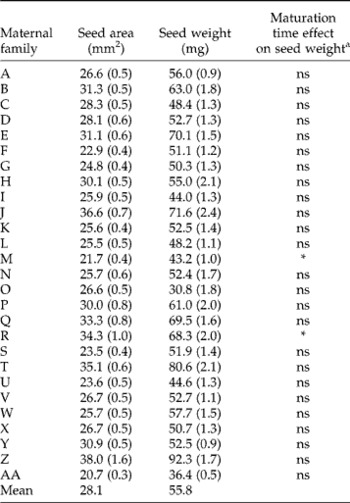
For the seed population collected in 2004 (seedlings emerged in 2005), individual seed mass ranged from 22.2 to 79.9 mg, and individual seed area ranged from 17.2 to 47.0 mm2. Seed area was positively correlated with seed mass (r = 0.94, P < 0.001), which was significantly affected by maternal phenotype (F (19,515) = 61.13, P < 0.001). For the seed population collected in 2005 (seedlings emerged in 2006), individual seed mass ranged from 27.5 to 89.1 mg and individual seed area ranged from 16.5 to 55.9 mm2. Again, seed area was positively correlated with seed mass (r = 0.90, P < 0.001), which was influenced by maternal phenotype (F (26,783) = 67.74, P < 0.001). Variation among maternal families (Tables 1 and 2) constituted a majority of the variation in seed size. For both the 2004 and 2005 seed populations, differences among maternal families accounted for 69% of the variation in seed mass, whereas differences within maternal families constituted only 31% of the variation in seed mass.
Seed area, seed weight and statistical significance of repeated measures analysis for maturation interval effects on seed weight for Ambrosia trifida maternal families collected in 2004 (seedlings emerged in 2005). Data are means with standard errors of 30 seeds, 10 per maturation interval

a All mature seeds were removed from individuals on 16 September, 23 September and 1 October.
* Significant difference, P < 0.05.
Seed area, seed weight and statistical significance of repeated measures analysis for maturation interval effects on seed weight for Ambrosia trifida maternal families collected in 2005 (seedlings emerged in 2006). Data are means with standard errors of 30 seeds, 10 per maturation interval

a All mature seeds were removed from individuals on 21 September, 1 October and 11 October.
* Significant difference, P < 0.05.
In 2004, seeds were collected three times over an interval of 16 d. Seed weights were not affected by collection time in 17 of the 20 maternal families (Table 1). During the 2004 seed collection period, daylength decreased from 12 h 25 min to 11 h 46 min, daily mean air temperatures fluctuated from 25.4°C to 5.6°C and precipitation was intermittent. In 2005, seeds were collected over an interval of 21 d, characterized by decreasing daylengths (12 h 11 min to 11 h 20 min), fluctuating daily mean temperatures (23.7°C to 9.5°C) and intermittent precipitation. Seed weights were not affected by collection time in 25 of the 27 maternal families (Table 2).
Association between seed size and seed longevity
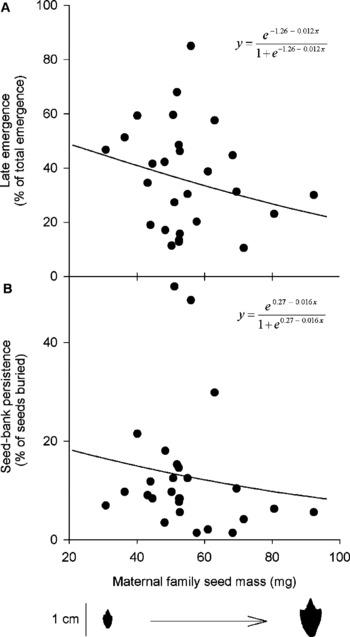
The relationship between maternal family seed mass and maternal family day of final emergence was not significant in 2005 and 2006 (α = 0.05). Also, maternal family seed mass did not influence the probability of late-season emergence in 2005 (logistic regression: Λ = 1.6, df = 1, P = 0.21), but it did affect the probability of late-season emergence in 2006 (logistic regression: Λ = 19.1, df = 1, P < 0.001) (Fig. 3A). On average, a 1 mg increase in seed weight decreased the odds of late-season emergence 0.02 times (odds ratio = 0.98, 95% confidence interval = 0.99–0.97). For seed-bank persistence, the effect of maternal family seed mass was not significant in 2005 (logistic regression: Λ = 1.9, df = 1, P = 0.17), but was significant in 2006 (logistic regression: Λ = 10.2, df = 1, P = 0.001) (Fig. 3B). On average, a 1 mg increase in seed weight decreased the odds of seed-bank persistence 0.02 times (odds ratio = 0.98, 95% confidence interval = 0.99–0.97).
(A) Percentage late-season emergence as a function of mean seed mass for Ambrosia trifida maternal families. Late-season seedlings were those that emerged after 1 May 2006. Logistic regression (solid line) Λ = 19.1, df = 1, P < 0.001. (B) Percentage seed-bank persistence as a function of mean seed mass for A. trifida maternal families. Persistent seeds were viable at the conclusion of the 2006 emergence season (14 August). Logistic regression (solid line) Λ = 10.2, df = 1, P = 0.001. Under the horizontal axis are silhouettes of representative seeds from two maternal families: the lightest (30.8 mg) maternal family on the left, the heaviest (92.3 mg) maternal family on the right.

Discussion
Sako et al. (Reference Sako, Regnier, Daoust, Fujimura, Harrison and McDonald2001) hypothesized that A. trifida seeds were genetically polymorphic because seed size, shape and colour were more consistent within a maternal family than among maternal families. These previous observations of A. trifida seed morphology were based on seed samples collected at one time only, which may not have accurately reflected the general seed population (e.g. Jones et al., Reference Jones, Allen and Sharitz1997). Also, previous observations of A. trifida seed morphology did not include seed mass, which is a more direct estimate of offspring provisioning than morphology, and is thought to represent a compromise between the number of offspring produced and the amount of resources per offspring (Leishman et al., Reference Leishman, Wright, Moles and Fenner2000). In general, reproductive success is maximized by equal investment in all offspring, and therefore seeds are expected to be uniformly sized within maternal families (Smith and Fretwell, Reference Smith and Fretwell1974; McGinley et al., Reference McGinley, Temme and Geber1987). But, because of temporal fluctuations in resource availability (Stamp, Reference Stamp1990; Winn, Reference Winn1991) and plant architectural constraints (Watson and Casper, Reference Watson and Casper1984), seed weight within a maternal family often varies. We found that seed weight was fairly consistent within maternal families, but highly variable among maternal families. Also, we determined that seed mass within maternal families was mostly constant among different maturation intervals for individual seeds, despite environmental fluctuations during the overall seed maturation period. In addition to supporting the hypothesis of Sako et al. (Reference Sako, Regnier, Daoust, Fujimura, Harrison and McDonald2001) regarding genetic polymorphism in A. trifida seeds, these results suggest that A. trifida is resistant to factors that could influence seed size. Such resistance may allow for the realization of the mean population fitness advantage granted by uniformly sized seeds.
In general, maternal plants can influence the germination of offspring through maternally derived embryo-covering structures (Roach and Wulff, Reference Roach and Wulff1987). Accordingly, variation in embryo-covering structures can be indicative of a range of germination behaviours within seed accessions. For example, Sicyos deppei G. seed coat colour varies from brown to black, and germination of black S. deppei seeds is inhibited by far-red light (730 nm), whereas far-red light has no effect on germination of brown seeds (Orozco-Segovia et al., Reference Orozco-Segovia, Brechu-Franco, Zambrano-Polanco, Osuna-Fernandez, Laguna-Hernandez and Sanchez-Coronado2000). Abutilon theophrasti seed coat weight differs among individual seeds within an accession and corresponds with variation in primary seed dormancy (Nurse and DiTommaso, Reference Nurse and DiTommaso2005).
In the present experiment, variation in seed-bank persistence among maternal families may have been because of differences in embryo-covering structures (i.e. involucre, pericarp, seed coat), which are known to influence A. trifida germination (Davis, Reference Davis1930; Schutte et al., Reference Schutte, Regnier and Harrison2006). Also, A. trifida seed germination is affected by an embryo dormancy, the intensity of which varies between A. trifida populations in agricultural and successional habitats (Schutte et al., Reference Schutte, Regnier and Harrison2006). This suggests that embryo dormancy is responsive to selection pressures, and may have contributed to differences in seed longevity among maternal families observed in this experiment.
The low incidence of families exhibiting only late emergence and the high incidence of families with both early and late emergence indicate that the biphasic temporal pattern of emergence in agricultural A. trifida populations of the eastern US Corn Belt is mostly because of variation within individuals, rather than genetic polymorphisms within the population. Also, all maternal families contained seeds that persisted in the soil after one emergence season, yet no maternal families contained persistent seeds only. These observations are consistent with the bet-hedging emergence hypothesis, which predicts that reproductive success in frequently disturbed habitats is maximized by diverse emergence times (Cohen, Reference Cohen1966), and variance in emergence periodicity is expressed by individuals (Seger and Brockmann, Reference Seger and Brockmann1987).
Plants from which seeds were collected were thought to be genetically unique because rates of self-pollination are low for A. trifida (Regnier, unpublished results), and self-pollinated plants produce seeds that are less vigorous than seeds of out-crossed plants (Bassett and Crompton, Reference Bassett and Crompton1982). Along these lines, Patzoldt and Tranel (Reference Patzoldt and Tranel2002) demonstrated a high level of genetic diversity in an A. trifida population, as they found 15 different alleles of the gene encoding acetolactate synthase among 16 individuals. In addition to differential maternal genetics, seed maturation environments probably varied among maternal phenotypes. We utilized seeds produced under natural conditions, and several environmental factors were not controlled. Seed production in a highly controlled environment was not practical because A. trifida pollen is a major aero-allergen in humans (Rybnicek and Jager, Reference Rybnicek and Jager2001), and mature plants can reach heights that exceed 4 m (Bassett and Crompton, Reference Bassett and Crompton1982). Conditions in the maternal environment that may have varied among maternal plants and influenced seedling emergence include: soil moisture (Sharif-Zadeh and Murdoch, Reference Sharif-Zadeh and Murdoch2000), soil fertility (Luzuriaga et al., Reference Luzuriaga, Escudero and Perez-Garcia2006) and light quality (Orozco-Segovia et al., Reference Orozco-Segovia, Brechu-Franco, Zambrano-Polanco, Osuna-Fernandez, Laguna-Hernandez and Sanchez-Coronado2000).
A potential consequence of interindividual variation in seed longevity is differential maternal family mean fitness in a particular environment. In successional environments, where year-to-year variation in establishment success is low, and seeds that germinate early produce more offspring than those that germinate late, fitness is improved by germination synchronized with the growing season onset and low rates of seed-bank persistence. But in agricultural environments, where years of complete reproductive failure are frequent and disturbance eliminates seedlings that emerge early, seed-bank persistence increases the probability of seedling recruitment (Cohen, Reference Cohen1966; Thompson, Reference Thompson and Fenner2000). Thus, a multitude of emergence strategies within a population is essential for adaptation to environments with contrasting emergence requirements, a phenomenon reported to occur in A. trifida populations (Hartnett et al., Reference Hartnett, Hartnett and Bazzaz1987).
We hypothesized that emergence strategies within a population were recognizable by maternal family seed size because of a co-evolutionary syndrome between seed size and seed-bank persistence, first proposed by Venable and Brown (Reference Venable and Brown1988). Our hypothesis was rejected in 2005, but supported in 2006. The discrepancy between years may have been because of environmental variability during burial, as conditions were thought to have been more conducive to late-season seedling emergence in 2006 as compared to 2005. This assumption is based on June precipitation totals. In 2005, total precipitation for June at our study site was 42% below the regional 30-year average of 11.7 cm, whereas in 2006, total precipitation for June (11.0 cm) approximated the 30-year average. Also, as noted above, conditions during seed maturation varied between years, which can influence seed dormancy levels (Andersson and Milberg, Reference Andersson and Milberg1998). Thus, the discrepancy between years suggests that the association between seed size and seed longevity is influenced by the environment, and indicates that maternal family seed size is not a primary determinant of longevity in the soil seed-bank.
Nonetheless, the association between seed size and seed longevity among A. trifida maternal families in 2006 was consistent with previous investigations that indicated increased dormancy in small-seeded genotypes. Adkins et al. (Reference Adkins, Loewen and Symons1986) showed that Avena fatua lines that were bred for decreased seed dormancy produced seeds that were heavier than seeds from A. fatua lines that were bred for increased seed dormancy. Simons and Johnston (Reference Simons and Johnston2000) determined that Lobelia inflata seed size varied among maternal families, and larger seeds required less time for germination than smaller seeds. Bhati and Sen (Reference Bhati and Sen1978) found that Ipomoea pes-tigridis seeds were genetically polymorphic, and the smaller morphs were more dormant than larger morphs. These previous studies, combined with our results, suggest that the inverse relationship between seed size and seed longevity among maternal families is common among species. However, proof of the generality of this assertion requires further study.
In recent years, A. trifida has spread from North America to central and eastern Europe (Rybnicek and Jager, Reference Rybnicek and Jager2001), as well as to temperate regions of eastern Asia (Ishikawa et al., Reference Ishikawa, Nakajima and Kayashima2006). In these newly colonized regions, A. trifida is mostly confined to ruderal and riparian habitats and has not invaded agricultural fields; however, there is concern about such an event because riparian populations facilitated agricultural land invasion in the eastern US Corn Belt (Bassett and Terasmae, Reference Bassett and Terasmae1962), where it causes severe crop yield loss (Webster et al., Reference Webster, Loux, Regnier and Harrison1994; Harrison et al., Reference Harrison, Regnier, Schmoll and Webb2001). Interestingly, in the western US Corn Belt, A. trifida populates crop field margins, but does not occur in crop field interiors (Sprague et al., Reference Sprague, Wax, Hartzler and Harrison2004). Critical to the establishment of A. trifida populations in agricultural fields is evolutionary change in seedling emergence patterns (Hartnett et al., Reference Hartnett, Hartnett and Bazzaz1987; Schutte et al., Reference Schutte, Regnier and Harrison2006). In regions where agricultural fields are lacking, but are exposed to A. trifida, preventive management efforts (which are often resource limited) should be directed at populations with high levels of phenotypic variance in seed-bank longevity, i.e. populations with high levels of phenotypic variance in seed size.
Acknowledgements
This research was funded in part by the United States Department of Agriculture National Research Initiative (USDA-CSREES-NRI) Weedy and Invasive Species Program. Salaries and research support were provided by state and federal funds appropriated to the Ohio Agricultural Research and Development Center, Ohio State University. Journal article no. 08–09.