A TALE OF TWO FRONTISPIECES
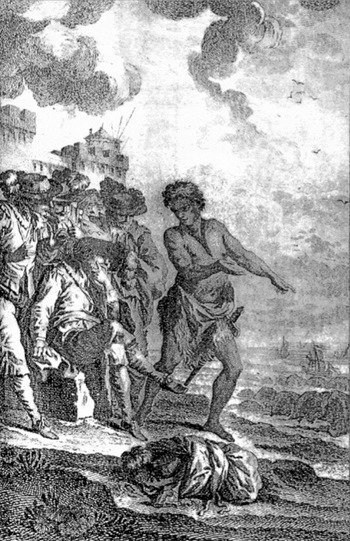
The frontispiece for the first edition of Jean-Jacques Rousseau's Discourse on the Origin and Foundations of Inequality amongst Men presented readers with an illustration that was central to the Discourse's message and to its fundamental critical stance (Fig. 1).Footnote 1 A small drama unfolds before us: as Rousseau's own note relates, a Hottentot who was kidnapped at birth by the Dutch and raised back in Europe has been returned to his homeland. Whatever the designs of imperial power, the Hottentot literally casts off the colonial cloak with Rousseauvian panache: “I forever renounce these trappings. I also renounce the Christian religion for the rest of my life; my resolution is to live and die in the Religion, the ways and the customs of my Ancestors.”Footnote 2 The Hottentot's dramatic gesture is emblematic of the Discourse's own disavowal of the fruits of European civilization: if the Hottentot has heard and understood Rousseau's message, he can still hope to return to the culture of his infancy, which Rousseau portrays as the relative infancy of all humankind. It is a return towards Nature—if not quite to arrive there—and readers of Rousseau's Discourse were prodded to ask themselves whether they, too, could follow in the footsteps of the Hottentot. But toward what Nature might they turn?Footnote 3
Discours sur l’inégalité, original frontispiece (1755).

Confronting this dilemma, Rousseau's critics were more than happy to play the cards they had been dealt. In a polemic appearing soon after the publication of the Discourse on Inequality,Footnote 4 Jean de Castillon, professor at the University of Utrecht, seized upon the declaration of Rousseau's Hottentot and summoned a savage irony in response:
Some, after coming to know the Christian religion, have closed their eyes to the truth, and have renounced the morality that is the most sweet and in accordance with our nature, to return to the religion of their fathers; to a religion which blinds them to the existence of the Supreme Being, and which prescribes them to fear evil forces and sorcerers; to a religion that summons them to the most cruel wounds, and which abandons them dying and helpless.Footnote 5
Such a return to ancestral religion and custom was terrible to contemplate; but for Castillon, it was the imagery of the frontispiece itself—with its dramatic divestment of the Hottentot—that presented the most inviting target:
The nature of a being is all that enters into its constitution. All that follows necessarily is natural . . . It is not in depriving man of all that one might remove from him that one will come to know him . . . it is in contemporary man [l’homme actuel] that we will uncover natural man. The essence of things is invariable; it is a fabric of which the art of the embroiderer may disguise the appearance, but not the substance.Footnote 6
Thus, in firmly grasping the cloak of “l’homme actuel” we likewise seize upon “l’homme naturel,” a being whose development over time—though embroidered by various accidents—unfolds a nature left dormant ab origo.
What might perceptive readers contemplate, then, were they to strip Rousseau in turn of his philosophical embroidery? According to Castillon, nothing so much as a naked Epicureanism:
It is almost a year since he [Rousseau] revived the ravings of the Epicureans on our origin; that he reduced our forefathers to the rank of the stupidest of beasts; that he accuses us of being the worst and most ferocious of all animals: and no one has yet repudiated such calumnies?Footnote 7
Rousseau was certainly not alone in reviving such ravings: the fifth volume of the Encyclopédie appeared within the same year of publication (November 1755), including not only Diderot's lengthy, provocative article s.v. “Epicurisme,”Footnote 8 but likewise the entry for Natural Law (“Droit de la Nature, ou Droit Naturel”), with which Epicurean concerns were often linked.Footnote 9 Even so, Castillon was no Cassandra, alone amongst contemporary critics in decrying Rousseau's Discourse on Inequality as a kind of Epicurean Trojan Horse;Footnote 10 furthermore, Castillon's critical perspective continues to resonate with modern scholarship as well, which has explored suggestively Epicurean features both of Rousseau's writings in general and of the Second Discourse in particular.Footnote 11 However, while such literature has mapped a variety of critical pathways through this scholarly terrain, it has yet to discern a distinctive philosophical source or tradition against which those “calumnies” that so offended Castillon were principally directed—and with such threatening incisiveness by the Discourse on Inequality above all. If Rousseau may no longer be seen as nakedly Epicurean, what matters of pressing philosophical and critical concern might he nonetheless have chosen to engage or to challenge in the Second Discourse through recourse to Epicurean thought?
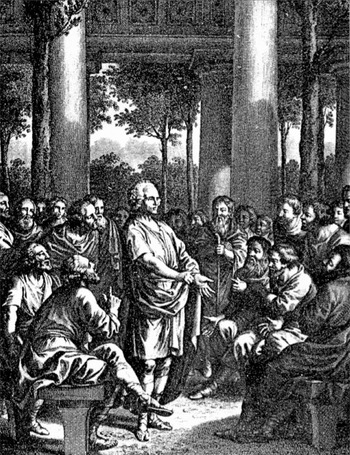
To grasp the nature of Castillon's alarm—in particular at those who would sever the threads interweaving “l’homme naturel” with “l’homme actuel”Footnote 12 —we may turn to another frontispiece prepared for the Discourse on Inequality, drawn yet again from the text itself. In light of its dramatic predecessor, the frontispiece for the Second Discourse that was published with the posthumous edition of Rousseau's collected works in 1782 appears comparatively ill-fitting: viewers gaze upon a bland, neoclassical tableau that reverses the de-cloaking of the Hottentot, as though a film frozen in mid-action for the original frontispiece had now been run backwards a few frames (Fig. 2). Rousseau poses, proudly draped in neoclassical vestments befitting a philosopher, which suit equally well all the other figures with whom he shares the scene. The comforts of both the clothing and the setting seem wholly alien in their Apollonian repose to the Dionysian rending of the civic fabric that will ensue in the Discourse itself: far from quitting the scene in haste, Rousseau stands firm, calmly addressing not only his audience of confrères but all of posterity. And yet, on Rousseau's own account, this tepid tableau—so discordant with the dynamic portrayal of the Hottentot—is precisely how he envisages himself as he presents his argument: “I shall suppose myself in the Lyceum of Athens, repeating the Lessons of my Masters, with the likes of Plato and of Xenocrates as my judges, and Mankind as my Audience.”Footnote 13 What an odd location Rousseau has thereby chosen for the conjectural space of his Discourse. Surely there must be some mistake: Rousseau's original essay had been submitted to members of a modern-day académie, not a lycée. Did the rejection of his work by the Academy at Dijon prompt a change in setting for its adjudication post hoc?
Discours sur l’inégalité, posthumous frontispiece (1782).

But the tableau conjured by Rousseau has been doctored even further: Rousseau does indeed address the members of an academy, for he speaks of judges proper to the Academy of Athens, Plato and his successor Xenocrates, rather than that other disciple of Plato who left the Academy to found the Lyceum, and who would likely preside over the recitation of any lessons learned there—namely Aristotle. What can have happened to this rather well-known figure, who not only provides the epigraph for the Second Discourse but is referred to by name on the very next page, the first of the Discourse proper? In both words and imagery, Rousseau has forcibly drawn our attention to an iconographic setting, at the center of which we discover—in place of the iconic figure we expect to find there—none other than Rousseau himself. How are we to read this apparent usurpation of the Philosopher, and how seriously are we to entertain Rousseau's suggestion that his argument is intended for the precincts of the Lyceum? If the tone of the frontispiece itself is one of seemingly undisturbed confraternity, we might question the complacency with which the listeners are portrayed, were they indeed followers of Aristotle. Having asserted that “it is in contemporary man that we will uncover natural man,” Castillon might well have pictured himself in such an audience, now finding his opportunity to respond to the discourse he has heard: could it be that Rousseau's Epicurean “calumnies” registered their gravest offense in halls of political or social thought still haunted by Aristotle's philosophy of Nature and the natural?
STEALING ARISTOTLE’S FIRE
Rousseau begins his preface to the Discourse on Inequality with a familiar Enlightenment lament: “The most useful and the least advanced of all human knowledge seems to me to be that of man.”Footnote 14 Rousseau raises this concern in the context of a topic proposed by the Academy of Dijon, “What is the origin of inequality among men, and whether it is authorized by the natural Law,”Footnote 15 a topic that for Rousseau marks a particular challenge to historical inquiry: “how will man ever succeed in seeing himself as Nature formed him . . . to disentangle what he owes to his own stock from what circumstances and his progress have added to or changed in his primitive state?”Footnote 16 Briefly considering an empirical approach, Rousseau asks, “what experiments [expériences] would be needed in order to come to know natural man; and by what means can these experiments be performed within society?” but recommends this problem to “the Aristotles and the Plinys of our century,” whose company he evidently does not plan to keep.Footnote 17 Instead, Rousseau will undertake a conjectural investigation that recalls the Epicurean poet, Lucretius,Footnote 18 distinguished by the care he will take to not repeat the error of conjectures proceeding from a false initial datum:
The Philosophers who have examined the foundations of society have all felt the necessity of going back as far as the state of Nature, but none of them has reached it . . . [A]ll of them . . . transferred to the state of Nature ideas they had taken from society; They spoke of Savage Man and depicted Civil Man.Footnote 19
In this context, the epigraph from Aristotle's Politics would appear to be an ironic gibe at authors such as Thomas Hobbes, who is targeted several times in the Second Discourse for precisely the sort of aboriginal error highlighted by Rousseau. Given in Latin on the original title page, the epigraph in a standard, modern translation from the Greek reads, “We must look for the intentions of nature in things which retain their nature, and not in things which are corrupted.”Footnote 20 The passage is drawn from Aristotle's Politics, Book I, 1254a,Footnote 21 suggesting that Rousseau quotes Aristotle approvingly with respect to the ambitions of his own project, and with clear critical intent toward those of others. Perhaps here Rousseau indeed repeats the lesson of a Master for, as Aristotle writes, “he who considers things in their first growth and origin, whether a state or anything else, will obtain the clearest view of them.”Footnote 22 If one of the principal critical targets of the Discourse on Inequality were Hobbes—and, furthermore, in light of Hobbes's repeated attacks on Aristotelian thought and tradition—one could imagine the relish with which Rousseau would critique Hobbes's account of human sociability for its failure to have suitably heeded Aristotle’s. But could Aristotle's epigraph be wielded with even greater ironic force against some other target?
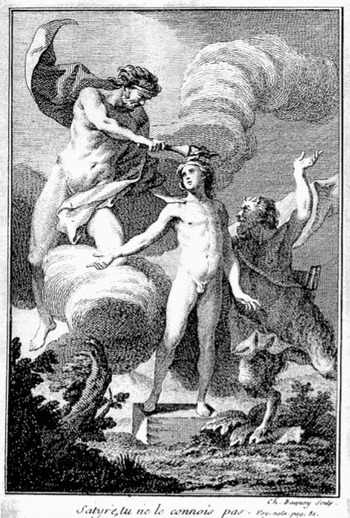
Given Rousseau's penchant for the ironic, a critique of Aristotle or of Aristotelian political, social and moral thought, while using the epigraph as a framework for that very critique, would be entirely in keeping with both the strategy and the style of the Second Discourse, as well as the further development of a line of argument previously essayed in the First Discourse. Introduced by a correspondingly dramatic original frontispiece, the Discourse on the Sciences and Arts in effect presented its readers with a double portrait (Fig. 3): on the one hand, the familiar torch-bearing—and partially cloaked—figure of Prometheus, who appears as if descended from a cyclone, and, counterposed to this figure, a fully naked Prometheus who intervenes in a satyr's eager attempt to reach for the flames.Footnote 23 This second Prometheus has foreknowledge of the dangers of enlightenment, reflecting the etymology of the name (pro mathesis, to know before or in advance). Having identified himself as the latter Promethean figure in his response to a critique,Footnote 24 Rousseau seized the opportunity to further develop one of his claims. Rousseau had begun the First Discourse with a routine denunciation of European learning prior to the emergence of humanism:
Discours sur les sciences et les arts, frontispiece (1750).

Europe had relapsed into the Barbarism of the first ages . . . I know not what scientific jargon more contemptible still than ignorance [itself] had usurped the name of knowledge, and stood as an almost insurmountable obstacle in the path of its return. A revolution was required to return men to common sense . . .Footnote 25
Responding to the critic Lecat, Rousseau had subsequently clarified the precise nature of the Barbarism he had had in mind:
Peoples had lost common sense not because they were ignorant, but because they were so foolish as to believe that with Aristotle's big words . . . they knew something; it took a revolution to teach them that they knew nothing, and another is badly needed to teach us the same truth.Footnote 26
This passage is almost immediately followed by the explication of the frontispiece:Footnote 27 following Rousseau's own train of thought, therefore, the Promethean intercessor of the First Discourse might well stand for that revolutionary thinker who would warn the readily seduced away from the “scientific jargon” and “big words” of an Aristotle. The Second Discourse evidently offered that Promethean figure a second act, in which to pursue the critique of a presumed science or knowledge of man that was found wanting precisely to the extent that it betrayed a fundamentally Aristotelian conception. Indeed, Rousseau may have sought to draw out critical consciousness of an Aristotelian perspective so deeply embedded that it eluded self-detection, framing the very questions of social and moral inquiry—such as the very essay topic proposed by the Academy of Dijon—that ought themselves to be the object of critical evaluation. Perhaps, suitably enlightened, the “academicians” of Dijon might then be able to remove themselves from the audience of the Lyceum, where they had surprisingly found themselves, and return instead to the precincts from which they had presumed to draw their identity. What philosophical resources might conceivably dislodge them from their current place of uncritical repose?
TWO DISCOURSES OF NATURE
It might be suggested that, from Rousseau's perspective, Hobbes's attack on Aristotelian thought was suitably intentioned but injudiciously executed, and that Rousseau not only criticized Hobbes where he was due, but shared no less in his targets. If Aristotle were held to be a central culprit for the impoverished status of the sciences of the human in general and the political in particular, it would certainly be a charge familiar to many other sciences as they had developed over the previous two centuries. Furthermore, Rousseau could be understood to have engaged in one of the foundational projects of the so-called “modern school of natural law,” namely borrowing James Tully's formulation, “to cleanse natural law of its grounding in the Aristotelian and Thomistic concept of nature as a purposeful realm ordered by intrinsic teleological dispositions.”Footnote 28 This characterization clearly resonates with those authors of the Huguenot diaspora from whose hands Rousseau received his exposure to Pufendorf and Grotius, namely Jean Barbeyrac (1674–1744) and Jean-Jacques Burlamaqui (1694–1748), to whom the Second Discourse explicitly refers. Timothy Hochstrasser notes that “the lively debates over the interpretation of Pufendorf's revisions to natural law theory”—that is, amongst Huguenot intellectuals of the Refuge—became a virtual “method for unravelling and reconstituting the convoluted and tortuous relationship between German Protestantism and Aristotelianism.”Footnote 29 Rousseau, the citizen of Geneva, might therefore be recognized as one of those who became engaged in the critical unraveling of that relationship, a project to which Epicurean thought could bring incisive critical resources.
The very topic proposed by the Academy of Dijon—in particular, whether inequality is authorized by natural law—suggests a lingering Aristotelian perspective, notwithstanding the complex genealogy of a term like “natural law.” The concept of a constitutive relationship between a natural order in some sense and a civic or moral order is woven into the very fabric of Aristotle's Politics, but Aristotle's account relies upon a particular discourse of nature that Rousseau appears determined to overturn with respect to several key components. The possibility that a distinctly critical orientation towards Aristotle informs the Discourse on Inequality has not gone unrecognized in scholarly literature: Roger Masters succinctly observed that “nothing marks the difference between Rousseau's thought and the classics so clearly as the radical shift in the meaning of ‘nature,’” a meaning that Masters explicitly identifies with Aristotle's teleology.Footnote 30 Masters's claim merits careful scrutiny: the distorted perceptions of necessity and of pleasure engendered by civil life; the emergence of increasingly complex social arrangements per accidens; the incommensurability between early and more developed forms of society; the mendacious character of those who initiate the establishment of civil order; the moral depravity and psychological distortions that threaten members of civil society; the problematic relationship between the development of language and human sociability or political capacity; the duplicitous and fundamentally forced emergence of slavery; and the perverse translation of slight differences in natural human potential into vast, wholly incommensurable differences in social and political power—all these mark determined polemical engagement with an Aristotelian correlation between natural and civil order. On this reading, what has been held to be “natural”—as manifest in contemporary civil society or its citizens—is but the mask of artifice and the mark of social and moral decay.
But did Aristotle alone define the conceptual parameters of Nature left by classical authors to posterity? In Primitivism and Related Ideas in Antiquity (1935), Arthur O. Lovejoy and George Boas argued that “Lucretius may on the whole be said to stand nearer to Rousseau's position than any other classical writer,”Footnote 31 a view that has been shared both by commentators contemporary to Rousseau and by those of more recent vintage.Footnote 32 Could one classical conception of Nature have been brought to bear on another, whether in whole or in part? In terms of chronology, the perspective of Lovejoy and Boas (and those who share their Lucretian reading of Rousseau) meshes rather poorly with that of Masters: in a Preface written over the winter of 1752–3 for the publication of his early play Narcissus Footnote 33 —that is, in close proximity to both the First and Second Discourses—Rousseau summarily dismisses Lucretius, whose Epicurean philosophical system he castigates (amongst several others) as “absurd” and promoting a “contempt for the duties of man and citizen.”Footnote 34 Such comments are generic, consistent with a lengthy tradition of Christian concerns over the moral and political degeneracy ostensibly promoted by On the Nature of Things. However, more distinctive and complex concerns emerge when we consider other aspects of Rousseau's oeuvre and interests, whether in relation to Epicureanism in general or to Lucretius in particular.
Although formerly claiming that Rousseau relied on a specifically Aristotelian conception of biological telos (as in Rousseau's account of the sterility of plant monstrosities),Footnote 35 Alexandra Cook does not pursue this theme again in her recent monograph on Rousseau's botany, in which she observes a general disposition toward contemplation of the works of a Creator God that is far more consistent with the directive teleology of the demiurgos familiar to Christian Neoplatonism than with Aristotle's prime mover.Footnote 36 On the other hand, the idea of a prime mover frames much of the critique of a materialist conception of the properties of matter in the “Profession de Foi du Vicaire Savoyard” (“Profession of Faith of the Savoyard Vicar”) in Emile (1762);Footnote 37 and it was out of similar convictions—supported by the deep intellectual and affective challenges he confronted in his attempts to grasp the operations of chanceFootnote 38 —that, in his Letter to Voltaire of 18 August 1756, Rousseau had professed his unshaken faith in a divine Providence. The letter was principally a response to Voltaire's Poem about the Lisbon Disaster, composed in the context of the Lisbon earthquake of 1755, which had presented a notorious challenge to the theodicy of Leibniz and its associated defenders like Alexander Pope. In his own defense of Providence, Rousseau does not entertain the possibility of retributive justice meted out by divine powers through seemingly natural catastrophes, such as Lucretius had been at pains to discredit. Nonetheless, adopting the categories of contemporary debate, Rousseau undertook the translation of a “physical evil” into a “moral evil”: on this account, the tragic consequences of the earthquake were chiefly due to people living in crowded cities (Rousseau counts the stories of Lisbon apartment buildings as though he were a building inspector assessing lesser Towers of Babel), where the likelihood of terrible injury or death was exponentially increased, and compounded by citizens lingering over their earthly treasures once the catastrophe had begun—an assessment that readily lends itself to providential interpretation, thus standing apart from a Lucretian perspective. Furthermore, in the Second Discourse itself, the aegis of Providence appears to extend well into the domain of nascent society, where perfectibilité has not yet shaken the foundations of relatively peaceful coexistence amongst human beings, nor of a human psychology at rest within the boundaries of its own perceived needs and ambitions.Footnote 39
And yet, readers can neither escape nor ignore Rousseau's keen appetite for the seemingly random—or the critical significance he bestows upon it—in the Discourse on Inequality. In a crucial passage in the first part of the Discourse, Rousseau outlines the main challenge to be confronted by his genealogy of sociability and inequality:
perfectibility, the social virtues and the other faculties which natural man had received in potentiality could never develop by themselves . . . [and] needed the fortuitous concatenation of several foreign causes which might never have arisen and without which he would eternally have remained in his primitive condition; it remains for me to consider . . . the various contingencies that can have perfected human reason while deteriorating the species, made a being wicked by making it sociable, and from so remote a beginning finally bring man and the world to the point where we now find them.Footnote 40
Rousseau's emphasis on the foreign, the contingent, and the fortuitous, and the central role these play in the moral denaturing of humanity, does not appear at all in keeping with his deference to the teleological or the providential in Emile and in the letter to Voltaire, even though the latter was written in such close proximity to the completion of the Second Discourse. Indeed, in his 1756 critique of the Discourse, Castel highlighted Rousseau's “system or hypothesis of a purely physical nature governed by chance, following Epicurus,” such that Rousseau recognized no goals or ends in nature.Footnote 41 If the diverse philosophical traditions appropriated and deployed by Rousseau resist comprehensive reconciliation, the strands of argument with which he wove his conjectural history can nevertheless help us to discern the critical mean between Aristotle and Lucretius from which Rousseau addressed the Academy at Dijon.
Compared to Rousseau, Lucretius had envisioned decidedly less bucolic prospects for humanity in a natural or near-natural condition: “True, each one was then more likely to be caught by wild beasts, torn by their teeth, and to fill woods and forests and mountains with groaning as he saw his own living flesh buried in a living tomb.”Footnote 42 These fleet sarcophagi had real fangs and active digestive tracts, and the only epitaph to mark the passing of their human prey was the cry of nature that passed their lips as they disappeared into the maw of oblivion. Nevertheless, this portrayal frames the transition to nascent society; and, as Lovejoy and Boas observed, “it is implied, though not expressly said, by Lucretius that this condition [that is, nascent society], if it could have endured, would have been the happiest for man,”Footnote 43 a sentiment notably shared by Rousseau in the Second Discourse.Footnote 44 Furthermore, highly significant portions of Rousseau's Discourse on Inequality adopt the catastrophism and lack of providential direction that characterize Lucretius’ account of the natural world,Footnote 45 a similarity that distinctly opposes the teleological framework of Aristotle’s.Footnote 46 Thus, if Rousseau were to seek a philosophy of nature that stood in fundamental opposition to the Aristotelian model—furthermore, one that was articulated with powerful affect and imagery, ideally suited to the rhetorical ambitions of his Discourse—he need have looked no further than the De rerum natura.Footnote 47 Lucretius was a favored reference of Helvétius, Holbach, La Mettrie and Diderot—a veritable rogues’ gallery of radical Enlightenment—and, as we have already seen with Castillon and Castel, some of Rousseau's contemporaries openly branded him an Epicurean fellow traveler. What particular features of the Discourse on Inequality would have provoked such a reading, and how might a critique of Aristotle have cast them in especially bold relief?
THE POLITICS OF NEED
In the Politics, Aristotle initially seeks rudimentary signs of a political life that will only fully realize its potential in the polis. Aristotle's account portrays sociability growing according to a capacity to meet needs, with development in communal life progressively addressing more of such needs until an end is reached in social organization that is largely self-sustaining: “when several villages are united in a single complete community, large enough to be nearly or quite self-sufficing, the state [polis] comes into existence, originating in the bare needs of life, and continuing in existence for the sake of a good life.”Footnote 48
One of Rousseau's primary concerns is the role played by the very perception of need, and one of the primary advantages that may be attributed to Rousseau's state of nature is not just the natural plenitude of the earth—to which he avidly attests, as supported by various farming experimentsFootnote 49 —but the scarcity of unmet needs as perceived by natural man, along with a corresponding psychology of ready satisfaction:
one can only desire or fear things in terms of the ideas one can have of them, or by the simple impulsion of Nature; and Savage man, deprived of every sort of enlightenment, experiences only the Passions of this latter kind; his Desires do not exceed his Physical needs . . .Footnote 50
Opposed to such “natural” needs and the psychological horizons they circumscribe stands the insatiability of perceived needs in a human psychology dominated by amour propre such as characterizes civil society, an insatiability that luxury industries exacerbate: these wholly artificial needs are among the most potent forces that drive the development of ever more complex social and economic organizations, and that serve to increasingly destabilize them.Footnote 51 On Rousseau's account, therefore, complex social organizations could be said to address certain needs, but such needs are fundamentally different in kind from those that characterize human beings in a natural state; therefore, contra Aristotle, the more complex form of social organization cannot be thus derived from the more rudimentary.
Rousseau's careful distinction between types of need—as well as the consequences of such a distinction for emergent human psychology and forms of sociability—finds a strong philosophical basis in Epicurean tradition. Epicureanism was distinguished by its close analysis of the forms of pleasure, and promotion of a simple lifestyle that answered principally to natural needs (notwithstanding its conventional misrepresentation by Christian commentators from Lactantius onward as a hotbed of libertine hedonism). Such a lifestyle derived lasting or “katastemic” pleasure from the fulfillment of genuine bodily and mental necessity, the height of which was marked by the achievement of “ataraxia,” or freedom from disturbance.Footnote 52 This stood opposed to the artificial stimulation typified by the enjoyment of luxuries or of romantic love, resulting in a transient and merely “kinetic” pleasure such as Lucretius critiqued in Book IV, 1058–1191—a critique echoed in the first part of the Second Discourse, where Rousseau attacks such immoderate passions as wholly artificial, the product of civil society.Footnote 53
Furthermore, the forms of illness that characterize life in civil society reflect the vast psychological distance that separates the perception of need in natural man and in civil man, a distance that Lucretius highlights by contrasting a contemporary lifestyle with that of ancient times, where “it was lack of food that drove fainting bodies to death; now contrariwise it is the abundance that overwhelms them. In those days men often unwittingly poured poison for themselves, now they make away with themselves more skilfully.”Footnote 54 Rousseau's reflections on the genealogy of the appetites and illness inspired one of the more fervid passages early in the Discourse, a virtuoso cadenza upon a Lucretian theme:
the ease with which our appetites and our sensuality are aroused and satisfied, the excessively exotic dishes of the rich, which fill them with inflammatory humors and wrack them with indigestions, the bad food of the Poor, which most of the time they do not even have, and the want of which leads them greedily to overtax their stomachs when they get the chance . . . such are the fatal proofs that most of our ills are of our own making, and that we would have avoided almost all of them if we had retained the simple, uniform and solitary way of life prescribed to us by Nature.Footnote 55
Rousseau then continues on to say how we may now wittingly poison and injure ourselves upon the expert advice of doctors and surgeons, to complete the Lucretian motif.Footnote 56
TELOS AND CHANCE IN POLITICAL DEVELOPMENT
The incongruity between perceptions of need, and the corresponding incongruity between types of social organization, echoes an even deeper antipathy toward Aristotelian thought from the perspective of the Discourse on Inequality. Aristotle claims that “it is evident that the [city] state is a creation of nature, and that man is by nature a political animal . . . Further, the state is by nature prior to the family and to the individual, since the whole is of necessity prior to the part.”Footnote 57 This is not a historical claim per se, but that is precisely the conceptual orientation and the tactic used by Rousseau to refute any assumption that a teleological framework governs the development of social complexity or political organization beyond nascent society. The stimuli that prod human beings from a state of nature toward nascent society are already fitful at best, characterized by random environmental events and only occasional recourse to fleeting associations of convenience, rather than to consistent need. As Rousseau observes,
it is at least clear, from how little care Nature has taken to bring Men together through mutual needs and to facilitate their use of speech, how little it prepared their Sociability, and how little of its own it has contributed to all that men have done to establish its bonds.Footnote 58
Furthermore—and contrary to both Aristotle and Locke, whom he directly critiques on this point—Rousseau does not even find a basis for rudimentary sociability in the family. The transition from a latter stage of nascent society to civil society bears some similarity to Hobbes's account of the more precipitous leap from a natural to a civil condition, but Rousseau repeatedly stresses the accidental nature of the events that bring about the emergence of civil society. Regarding nascent society, Rousseau observes that humanity “must have left it only by some fatal accident [par quelque funeste hazard]”;Footnote 59 thus the eventual birth of civil society is fundamentally the product of accident.
For Aristotle, “it is plain . . . that nature is a cause, a cause that operates for a purpose”;Footnote 60 therefore, our “nature” is revealed by reaching the conclusion of a teleological process—and certainly not by returning to its beginning, in whatever sense—so long as no accidents have deflected or deterred us from attaining that goal and realizing our potential. Aristotle thus portrays a fundamental continuity in the development of our personal and political aptitude through sociability: “if the earlier forms of society are natural, so is the [city] state, for it is the end of them, and the nature of a thing is its end. For what each thing is when fully developed, we call its nature.”Footnote 61 With the culminating institution of civil society, we have become who we were meant to be by nature, for it is in the polis, with its institution of civil laws guided by principles of justice, that we attain our fullest development as human beings, “for man, when [thus] perfected, is the best of animals, but, when separated from law and justice, he is the worst of all.”Footnote 62
On Aristotle's account, therefore, as political animals we both reveal and realize our nature when we form political associations; the only way we would have failed to have become political would have been by accident. For Rousseau's Second Discourse, on the contrary, political association is the very product of the accidental in human history, and wholly artificial with respect to human nature (although that artifice may be suitably disciplined and directed). Thus, if Rousseau has entered the Lyceum of Athens, it has been to turn the lessons of its Master on their head: the institution of civil government establishes forms of inequality that are not found in nature, and amongst persons who are not fundamentally unequal by nature. This inequality is established purely by convention, not by the observance of any “natural law,” and, ironically, such convention will in fact assure the inequality of members of that society.
The original context for the Aristotelian epigraph of the title page to the Second Discourse provides Rousseau with further opportunity to critique a supposedly “natural inequality,” for Aristotle is in the process of justifying the claim that there are both naturally superior and naturally servile natures amongst human beings—a claim that Rousseau was no less provoked to dispute in the Social Contract (1762) than in the Discourse on Inequality, as we will see. A fuller quotation from the Politics reads,
We must look for the intentions of nature in things which retain their nature, and not in things which are corrupted. And therefore we must study the man who is in the most perfect state both of body and soul, for in him we shall see the true relation of the two; although in bad or corrupted natures the body will often appear to rule over the soul.Footnote 63
For the political animal that is the human being, soul and body will be in the best possible condition in the optimum setting for such a being, namely in a fully developed city state; this is clearly advantageous for those whose souls are ruled by a rational nature and who may engage in the high science of statesmanship. Rousseau will agree that our rational capacity finds its fullest expression in civil society, but this expression in itself is far from one of civic virtue or of a healthy state of the soul:
It is reason that engenders amour propre, and reflection that reinforces it; reason that turns man back upon himself; reason that separates him from everything that troubles and afflicts him. It is Philosophy that isolates him; by means of Philosophy he secretly says, at the sight of a suffering man, perish if you wish, I am safe.Footnote 64
Rousseau's characterization of the literally dis-affected philosopher distinctly recalls one of the more notorious passages in the Nature of Things—in fact, one of the most popular Lucretian topoi to be revisited in the poetry of Ronsard and many other French writersFootnote 65 —in which the ataraxia achieved by the Epicurean is compared to the shore-bound spectator's perspective on the travails suffered by those caught in a tempest at sea:
Pleasant it is, when on the great sea the winds trouble the waters, to gaze from shore upon another's great tribulation: not because any man's troubles are a delectable joy, but because to perceive what ills you are free from yourself is pleasant.Footnote 66
Through its instrumental role in the ascendance of amour propre, our reason thereby promotes those psychological forces that gradually overpower our aboriginal amour de soi—the form of self-love that is not intrinsically inimical to the interests of others—and that suffocates our natural compassion, the sole faculty in which Rousseau can find at least some basis for a natural sociability. The only teleological account that could be made of such an outcome is one that mistook a nadir for a final cause.
The plainly negative association of “philosophy” with the image of the Lucretian spectator is not unmixed, however: the original passage in the Nature of Things immediately continues with what could be taken for a quintessentially Rousseauvian observation on the travails of modern civil life:
But nothing is more delightful than to possess lofty sanctuaries serene, well fortified by the teachings of the wise whence you may look down upon others and behold them all astray, wandering abroad and seeking the path of life:—the strife of wits, the fight for precedence, all labouring night and day with surpassing toil to mount upon the pinnacle of riches and to lay hold on power.Footnote 67
Near the end of the Discourse on Inequality, Rousseau similarly encourages his readers to imagine a Carib observing the pursuits of a European minister, as though a penultimate objective of the Second Discourse were to promote a critical ataraxia amongst its readers as they contemplate the spectacle of modernity:
Savage man and civilized man differ so much in their inmost heart and inclinations that what constitutes the supreme happiness of the one would reduce the other to despair. The first breathes nothing but repose and freedom . . . and even the Stoic's ataraxia[ Footnote 68 ] does not approximate his profound indifference to everything else. By contrast, the Citizen, forever active, sweats, scurries, constantly agonizes in search of ever more strenuous occupations: he works to the death, even rushes toward it in order to be in a position to live, or renounces life in order to acquire immortality . . . But in order to see the purpose of so many cares, these words, power and reputation, would have to have some meaning in his mind.Footnote 69
This passage vividly recalls the conclusion to Montaigne's Essai on the cannibals, in which the supposedly savage observers brought to Rouen are bewildered, not just by the bizarre spectacle of a boy king (Charles IX) served by grown men, but above all by the inexplicable state of inequality through which one part of European society cannibalizes the other with seeming impunity—an inequality characterized by human predatory behavior.Footnote 70 If Rousseau's immediate reference is to Stoic apatheia, labeled “ataraxia” following Sextus Empiricus’ umbrella term,Footnote 71 the discursive framework for the passage—the ceaseless striving, the concern with rank, reputation and power—is a palpably Lucretian rebuttal of the Aristotelian ideal.
THE RUSE OF THE POLITICAL BENEFACTOR
Although Aristotle describes political life as the natural telos of the human being, the actualization of this telos nonetheless requires human action or intervention. A concern with Aristotle's account of the emergence of political life, and of the city state as its end, gains particular prominence when Rousseau finally moves to address the second half of the Academy's question, whether inequality is authorized by natural law. Rather than directly addressing this issue in terms of natural law tradition itself, Rousseau famously sidesteps such discussion by proclaiming its irrelevance: the founding moment of civil society is nothing but the ruse of the Rich Man, who dupes those he considers a looming threat to his property claims unless he can otherwise convince them that it serves their interests to protect his.Footnote 72 The founding of civil society, therefore, requires the initiation and leadership of an individual who must act decisively to coerce those who are otherwise disinclined toward—or are simply not capable of envisaging or of developing—such a level of social organization. Rousseau's imaginative dramatization of this event, carefully crafting the rhetoric of a figure who decisively seizes hold of such founding political initiative, draws sharp attention to the moral character of that individual: the Rich Man is presented to readers as wholly self-interested, while determined nonetheless to present himself as performing a just service to all who will listen to his plea.
We might be reminded here of that perfectly unjust man who successfully disguises himself as just and who promotes himself as a ruler, the ancestor of Gyges in Plato's Republic, in contrast to whom Socrates is challenged to demonstrate the merits of the genuinely just life.Footnote 73 What we would least likely be reminded of is that person whom Aristotle identifies as necessary to the founding of political life, and to whom we owe a profound debt in recognition of our corresponding capacity to pursue and live the good life: “A social instinct is implanted in all men by nature, and yet he who first founded the state was the greatest of benefactors.”Footnote 74 Aristotle's account of such an individual is entirely consistent with his account of natural development: the fulfillment of a natural potential may well require the intervention or direction of a craft or craftsman, but the result is not thereby artificial or the product of accident. Our political nature, from the time of our birth into a family, is consistently being nurtured by such intervention, directing us to actualize it in terms of the prospects for social organization that we encounter. On Aristotle's account, therefore, the originating statesman genuinely serves and brings to fruition the natural potential and best interests of all those who will enter into political life, not just the ruling class. On Rousseau's account, on the other hand, that figure is the very charlatan who performs the trick of the Rich Man, plunging all into a social organization that can only denature its members: far from being magnanimous or benevolent, a leader qua leader, the founder of civil society is characterized instead as the perfected swindler, someone who takes advantage of those whose reason is able to discern the advantages of civil society, but who lack sufficient experience and the Promethean foresight with which to gauge its dangers.
If the ruse of the Rich Man marks him as the very antithesis of the political benefactor envisaged by Aristotle, the resounding reception that greets his canny staging of political theater nevertheless represents the close integration of visionary direction and successful performance—an opportunistic telos commanded by a skillful political artificer, capitalizing on social upheaval that is the gift of fortune. When closely observing the emergence of contemporary politics in the Histoire du Gouvernement de Genève—an unpublished manuscript composed alongside the Lettres Ecrites de la Montagne (1764)—Rousseau emphasizes yet again the anti-teleological, and pointedly ironic, nature of political developments. Brusquely disenchanting a Calvinist mythology dear to the heart of would-be Genevan reformers—the ruse of a Reform Man—Rousseau argued that the civil liberty enjoyed by Genevans was never greater than that established by Catholic episcopal rule over the city in the fifteenth century;Footnote 75 and, even then, such initiative was undertaken purely as a bulwark against interference by the Dukes of Savoy—an entirely self-serving enterprise of which Calvin was the unforeseen beneficiary, and the serendipitous product of which was gravely threatened by the political ambitions of the latter-day Calvinist pastorate. Rousseau's genealogy of the Republic of Geneva thus brought the Epicurean forces governing the nascent social and political developments of the Discourse on Inequality into the political machinery of the modern era, where even the great Calvin—ostensibly the most virtuous and well-intentioned of political benefactors—was left the child of Chance.
The practical political implications of the Discourse on Inequality extended well beyond the birth of civil order, for the Rich Man is not just looking after his own personal interests but necessarily those of an ascendant class that is equally invested in such interests: the class of property holders who will need to secure their station in civil society. Taken to its fullest development, the pursuit of such propertied interests follows a trajectory toward the formation of a particular kind of aristocracy such as became the target of social and moral opprobrium in the Geneva of Rousseau's day. In the Social Contract, a work that appeared seven years after the Second Discourse, Rousseau was careful to distinguish between different types of aristocracy: “There are, then, three kinds of Aristocracy: natural, elective, hereditary. The first is suited only to simple peoples; the third is the worst of all governments. The second is the best; it is Aristocracy properly so called.”Footnote 76 The “best” of the aristocratic types of government suggests that, from Rousseau's perspective, there is indeed a form of good government consistent with comparatively sharp distinctions in political engagement amongst citizens. However, with respect to “the worst of all governments,” Rousseau invokes a discourse of inequality that he turns specifically against Aristotle:
Besides, while this form [of government] involves a certain inequality of fortune, it does so primarily so that . . . the administration of the public business be entrusted to those who can best devote all of their time to it, and not, as Aristotle contends, so that the rich always be preferred. On the contrary, it is important that an opposite choice should occasionally teach the people that men's merit offers more important reasons for preference than do riches.Footnote 77
Aristotle fails his audience precisely in confusing the properly aristocratic—the rule of those recognized as most capable—with the merely oligarchic, a distinction that was a matter of frequent and often heated contention in the Genevan politics of mid-century. The critique of Aristotle—already associated with the First Discourse, and prominently continued well into the Social Contract—therefore appears to have been a matter of pressing contemporary concern for Rousseau. Rousseau was able to draw upon specifically Lucretian resources as he developed this critique further, such as in his attempts to undermine the ostensibly natural foundations of civil society insofar as it relied on the natural emergence of language.
THE PARADOXES OF NATURAL LANGUAGE
Language plays a crucial role in the trick performed by the Rich Man, exemplified by the dramatic speech with which Rousseau provides him: it is the very means by which the Rich Man can appeal to the concerns and interests of those with whom he would seek to associate, but who lack sufficient foreknowledge of the consequences that attend such association. Furthermore, the influence of language over the maintenance and growth of inequality that follows in the Rich Man's wake remains pervasive in the crafting of laws by his inheritors. One might go so far as to characterize the capacity for language as the tragic flaw through which the happy man of nascent society succumbs to the horrors of civil society: to the extent that language makes political organization possible, it becomes the trapdoor through which all participants fall into a social arrangement that will both seal and subsequently exacerbate gross inequities founded upon no natural basis whatsoever.
Given Aristotle's portrayal of language as a characteristic faculty of human nature, therefore, Rousseau ostentatiously struggles to give a plausible naturalistic account of the emergence of human language, pointedly undermining one of the principal pillars that supports Aristotle's account of the emergence of political life. When Aristotle classifies human beings as political animals, the category is not without its cohorts; what distinguishes specifically human political animals from bees and other animals of evident complex social organization is their capacity for rational speech.Footnote 78 For that which Aristotle holds to be constitutive of the natural and distinctively political animal, Rousseau can determine no naturalistic origin, his account famously dissipating into paradoxes:
The first difficulty that arises is to imagine how languages could have become necessary; for, Men having no relations with one another [in the state of nature] and no need of any, one cannot conceive the necessity or the possibility of this invention if it was not indispensable . . . [But] let us for a moment cross the immense distance that must have separated the pure state of Nature from the need for Languages; and, by assuming them to be necessary, let us inquire how they might have begun to be established. New difficulty [arises], even worse than the preceding one; for if Men needed speech in order to learn how to think, they needed even more to know how to think in order to find the art of speech . . .Footnote 79
Rousseau has been struggling to conjecture a plausible scenario in which speech might be seen to have received appropriate stimulus and sustained reinforcement so that it might take hold amongst naturally political beings. The central role of chance in early forms of human interaction has precluded gaining any such purchase through family relations, with Rousseau's droll comment reinforcing the limited extent of any conversational opportunities likely to arise: “Everyone bedded down at random [au hazard] and often for one night only; males and females united fortuitously, according to chance encounters [selon la rencontre], opportunity, and desire, without speech being an especially necessary interpreter of what they had to tell one another.”Footnote 80 The aleatoric framework for Rousseau's line of argument here develops one of the central paradoxes established in the Nature of Things, Book V, where Lucretius entertains a kind of Adamic origin story for the birth of language:
Therefore to suppose that someone then distributed names amongst things, and that from him men learnt their first words, is folly. For why should he have been able to mark all things with titles and to utter the various sounds of the tongue, and at the same time others not be thought able to have done it? Besides, if others had not also used these terms in their intercourse, whence was that foreknowledge of usefulness implanted in him, and whence did he first gain such power, as to know what he wanted to do and to see it in his mind's eye? Compel them again he could not, one against many, nor could he master and conquer them, that they should wish to learn the names of things.Footnote 81
As Rousseau summarizes it, “speech seems to have been very necessary in order to establish the use of speech.”Footnote 82
Thus, where some contemporaries found his delight in paradox puerile, Rousseau's determination to render the natural origins of language deeply problematic marks a strategic undermining of Aristotle's account of the most distinctive of political animals and the political life they pursue. This critical objective would also suggest a reason for avoiding the kind of naturalistic account that is the starting point of the posthumously published Essay on the Origin of Languages, composed in close proximity to the Second Discourse:Footnote 83 to have provided such an account within the Second Discourse would have been to give the game away to Aristotle, yielding an essential point upon which Aristotle's claim for the political nature of the human being stood.
Furthermore, Rousseau posits a uniquely human faculty, the capacity to “perfect” ourselves in association with our free will, that depends upon our capacity for language:
general ideas can enter the Mind only with the help of words, and the understanding grasps them only by means of propositions. That is one of the reasons why animals could not form propositions. That is one of the reasons why animals could not form such ideas, nor ever acquire the perfectibility that depends on them.Footnote 84
Although it demarcates a peculiarly human source of developmental power—an innate faculty that is suggestively Aristotelian in this respect—perfectibilité is nonetheless the source of a peculiarly human vulnerability:
this distinctive and almost unlimited faculty, is the source of all of man's miseries . . . the faculty which . . . draws him out of that original condition in which he would spend tranquil and innocent days . . . causing his enlightenment and his errors, his vices and his virtues to bloom . . .Footnote 85
A “perfection” of our capacities as human beings—yet another “gift” of language—leads precisely to our degradation; and, contra Aristotle, it is the interruption or forestalling of such “perfection” that is most dearly to be hoped for.
NATURAL SLAVES AND NATURAL MASTERS
Though reliant on a faculty for language, our political nature in itself was not held by Aristotle to be uniform in expression. This distinction in political aptitudes or capacities marks a particularly acute point of contention between the Discourse on Inequality and Aristotelian tradition, while presaging key concerns of Rousseau's mature political writings. One of Aristotle's more notorious and influential claims in the Politics asserts the existence of the natural slave—and, no less significantly, the natural master.Footnote 86 On this account, political association between human beings is founded upon fundamental inequalities of human nature, a framework which the Epicurean position challenged. Lucretius gave an account of the early formation of pacts of mutual assurance that was noted among modern natural law and social contract theorists for its emphasis on the parity of such arrangements:
neighbors began to join friendship amongst themselves in their eagerness to do no hurt and suffer no violence . . . Nevertheless concord could not altogether be produced, but a good part, indeed the most, kept the covenant unblemished, or else the race of mankind would have been even then wholly destroyed.Footnote 87
This parity of both interests and concerned parties might not be preserved through subsequent political development, but Lucretius nonetheless offered a conception of the political that was not founded upon a corresponding conception of the fundamental inequality of human nature. An essential equality amongst political actors and subjects became virtually synonymous with the problem of the political for contract theorists like Hobbes and Rousseau, likewise informing their critical engagement with Aristotle's Politics.Footnote 88
Aristotle's account of the natural master–slave relationship is attacked early and with forceful irony in the Social Contract:
Aristotle before all of them had also said that men are not naturally equal, but that some were born for slavery and others for domination. Aristotle was right, but he mistook the effect for the cause. Any man born in slavery is born for slavery, nothing could be more certain . . . [I]f there are slaves by nature, it is because there were [first] slaves contrary to nature. Force made the first slaves, their cowardice perpetuated them.Footnote 89
Rousseau's ironic treatment of the concept of “slaves by nature” emphasizes the pernicious character of modern society: if, for Aristotle, polities encompass persons of different potentials who should not be fitted to roles they cannot hope to fulfill, then, for Rousseau, civil society takes small differences in natural potential and translates them into vast and wholly artificial differences in actual power. Such emergent and fundamentally accidental inequalities are perverse and pernicious because they come to be seen as “natural” in an essential sense:
just as violence had to be done to Nature in order to establish slavery, Nature had to be altered in order to perpetuate this right; And the Jurists who have gravely pronounced that the child of a Slave would be born a Slave have in other words decided that a man would not be born a man.Footnote 90
Thus the confusion of cause and effect that Rousseau diagnoses in the Social Contract, epitomized by the monstrosity of so-called “natural slaves”—those whose chains are an affront to all standards of legitimacy—marks the outcome of a clinical assessment assiduously prepared by the Discourse on Inequality.
Rousseau's locution pointedly appropriates vocabulary familiar to the Aristotelian discourse of change, whether with respect to the local motion of bodies or the development of natures: in producing the slave, Nature itself has been subjected to violent, rather than natural, change—a formulation subverting the premise of the topic framed by the Academy of Dijon on its own terms. Furthermore, the vividness with which Rousseau dramatizes the response to the appeal of the Rich Man—a voluntary, positively eager entry into slavery—points toward the fundamental psychological transformation that attends modernity, where all members of society become denatured to the extent that they themselves become enslaved to the pursuit of esteem and office, a pursuit through which they would likewise seek to enslave their fellow citizens: “Citizens . . . consent to bear chains so that they might impose chains [on others] in turn. It is very difficult to reduce to obedience someone who does not seek to command, and the cleverest Politician would never succeed in subjugating men whose only wish was to be Free.”Footnote 91 We might therefore picture Rousseau joining ranks with early modern intellectuals who questioned the legitimacy of power relations through a critique of Aristotle's natural-slave–natural-master relationship, an inheritor of the philosophical polemic exemplified by the Valladolid controversy that embroiled Bartolomé de Las Casas (c.1484–1566) with Juan Ginés de Sepúlveda (1489–1573) over the nature of indigenous peoples and civilizations subjected by the Spanish Crown. If Rousseau's Natural Man may be said to have served any final cause, it was perhaps to tear the cloak of philosophical respectability off a moldering Aristotelian corpus that had too long served to justify the theory of the naturally servile human being.
And yet, as we have already witnessed, the political implications of Rousseau's conjectural history clearly extended into the more immediate—and specifically Genevan—political realm with which he became increasingly engaged following publication of the Discourse on Inequality, through works such as the Lettres Ecrites de la Montagne and the Histoire du Gouvernement de Genève. Correspondingly, the critique of natural slaves and masters that Rousseau develops in the Second Discourse can help us to understand some of the practical recommendations he was to offer as a would-be political consultant to the reform movement in Geneva, however poorly certain recommendations were received.Footnote 92 The “slave” and the “master” in this sense can be recognized as terms of convenience—sometimes figurative, sometimes literal—employed as part of the eighteenth-century political discourse of “liberty,” both natural and civil, and in regard to concerns over its proper foundation and maintenance. Furthermore, we should recall how Rousseau's critique of the passions engendered by civil society served to undermine any essential categorical distinction between these terms: namely that none can be “natural masters” because all are subject to the passions, having no distinctive mastery over themselves in this politically relevant capacity.
While many of Rousseau's contemporaries had presumed his support of democratic reforms in Genevan politics, such as would vest greater legislative and executive powers in the General Council, those reformers who came to be known as the représentants were greatly disturbed by Rousseau's disavowal of a “pure” or “untempered” democracy, painfully evident to them in his publication of the Lettres Ecrites de la Montagne.Footnote 93 Far from wishing to undermine the role of the smaller executive councils that the représentants saw as usurping the sovereignty of the larger representative body, Rousseau was concerned that any such initiative threatened to destroy a crucial distinction between sovereignty and government that he considered essential to effective direction of the state, and as maintained by the executive powers of the councils of 200 and of 25.Footnote 94 In the sixth of the Lettres, Rousseau emphasized this distinction in terms sure to confound the sensibilities of the représentants: “the best of all governments is the aristocratic; the worst of sovereignties is the aristocratic.”Footnote 95 Both sides of the political divide were advised that, while there was a need for an empowered leadership resembling an elective rather than an oligarchic aristocracy (recalling the distinctions of the Social Contract), that aristocracy was not constituted by an essential, distinctive human nature. Rousseau therefore observed in the eighth letter that a “free people,” such as was constituted by the citizens of a republic, “has leaders but not masters [des chefs et non pas des maîtres]”:Footnote 96 all members of the body politic owed obedience to the laws of the state rather than to any superior human nature.Footnote 97 Rousseau called for the droit négatif or veto power of the executive councils—a prerogative detested by the représentants—to be retained, but likewise to be enacted reciprocally by the General Council: to institute, as Richard Whatmore describes it, a “double-edged droit negatif,” since “neither the people, the pastors, nor the magistrates could sufficiently control the passions and be trusted sufficiently to exercise authority without checks upon their actions.”Footnote 98 The legitimate inequalities of political engagement entailed by the appropriate division of governing powers, and as suitably constrained by appropriate checks and balances, therefore, carefully observed a fundamental equality of human nature.
Such pragmatic political considerations, reflecting the inclinations and actual behavior of citizens—rather than occult virtues of leadership or of obedience held to be characteristic of distinctive social orders—mark a productive outgrowth from the often bleak association of the personal and the political in the Discourse on Inequality. Rousseau's genealogy of a healthy form of self-love, providing a natural foundation for the pursuit of legitimate self-interest—a cornerstone of modern natural law theory, often derided as “Epicurean” by its critics in France and elsewhereFootnote 99 —makes possible a civil society in which the passions and the interests of citizens, including amour propre (leveraged toward the pursuit of suitable forms of public esteem), could be realistically and productively engaged.
AN END TO NATURE
In the Discourse on Inequality, the Book of Nature is portrayed as distorted beyond legibility when read through the lens of Aristotelian thought, not that a sharper image will bring much comfort to those readers whom Rousseau addresses. The tragedy of the Discourse on Inequality encompasses many features, and resonates further in this capacity with the Nature of Things. Peripeteia befalls the political vision of Hobbes, whose commonwealths secured by sovereign authority have themselves become the very breeding ground for a new state of nature, metastasized to an all-consuming and cosmopolitan scale:
The Bodies Politic thus remaining in the state of Nature among themselves soon experienced the inconveniences that had forced individuals to leave it, and this state became even more fatal among these great Bodies than it had previously been among the individuals who made them up. From it arose the National Wars, Battles, murders, reprisals that make Nature tremble and that shock reason . . . [M]ore murders were committed in a single day's fighting, and more horrors at the capture of a single town, than had been committed in the state of Nature for centuries together over the entire face of the earth.Footnote 100
The “National Wars” reflect the outsized growth in both military and commercial power of states like France and Britain, in the shadow of whose contest the progressive but highly vulnerable small states like Geneva struggled to survive. Rousseau's calculated irony—juxtaposing the death toll of the great nation states within “a single day's fighting” with that of the state of nature—recalls that of Lucretius, for whom “one day” in the course of our prehistory “did not send to destruction many thousands of men in the battle-field.”Footnote 101
For Rousseau and Lucretius, therefore, it is not the state of nature, correctly understood, that proves inimical to the welfare of humankind: that distinction belongs to civil society, born of a fatal temptation proffered by a serpent-tongued demagogue. In thrall to the pursuit of power, this political visionary unleashed the rapacious, roving sarcophagi of Lucretius in human form:
The rich . . . had scarcely become acquainted with the pleasure of dominating than they disdained all other pleasures, and using their old Slaves to subject new ones, they thought only of subjugating and enslaving their neighbors; like those ravenous wolves which once they have tasted human flesh scorn all other food, and from then on want to devour only men.Footnote 102
Rousseau's homo homini lupus unveils the bestial nature that lurks, scarcely concealed, beneath the civil trappings of Montaigne's European cannibals—a fitting adaptation from the essayist who was no less the enthusiast of Horace than of Lucretius. Thus, with the advent of a new State of Nature that stands utterly bereft of the good or the just, a realm of unbounded human predation realizing all possible forms of enslavement, Aristotle's Natural Man has at last found a place to call home. Meanwhile, his old clothing cast aside, Rousseau's Hottentot nonetheless remains sufficiently enlightened to have retained his sword.