Introduction
In one of his latest writings, David Barker said ‘The more limited a baby’s resources are, the more economical in resource allocation, or thrifty, it may have to be. But, this seems to predispose it to disease in later life, especially if it encounters stressors along the way. This predisposition could reflect reduced functional capacity or altered metabolic settings and hormonal responses. The fundamental biological reasons why thrift initiates disease are not known. A thrifty strategy is likely to affect more than one organ or system whose critical periods occur around the same time’.Reference Barker and Lampl 1 We have spent the last few years exploring the idea that the thrifty strategy spreads out beyond the functioning of organs and systems and can, in fact, be recognized in behavioral characteristics. Avid for energy, thrifty phenotype individuals not only exercise lessReference Vickers, Breier, McCarthy and Gluckman 2 – Reference Kajantie, Strang-Karlsson and Hovi 4 and eat more food in general,Reference El-Haddad, Desai, Gayle and Ross 5 , Reference Ross and Desai 6 but have specific food preferences towards highly caloric, highly palatable foods.Reference Portella and Silveira 7 , Reference Portella, Kajantie and Hovi 8
Increased energy consumption, especially due to high intake of palatable (sugar/fat) energy-dense food, is one of the main contributors to the escalating rates in overweight and obesity globally.Reference Low, Lacy and Keast 9 , Reference Lampure, Deglaire and Schlich 10 Although appetite and the homeostatic control of energy intake/expenditure is a major determinant of caloric intake, ingestive responses are significantly mediated by hedonic mechanisms (i.e. pleasure associated with the intake of a palatable food), food preferences and social behavior. The two systems interact with each other. The close proximity between the hypothalamic arcuate nucleus and the median eminence allows this structure to detect changes in peripheral signals, such as glucose and lipids. This information is processed within the hypothalamus,Reference Legradi and Lechan 11 – Reference Zamir, Skofitsch and Jacobowitz 15 but signals are also sent to regions such as the ventral tegmentar area (VTA),Reference Rodaros, Caruana, Amir and Stewart 16 , Reference Sakanaka, Magari, Shibasaki and Inoue 17 nucleus accumbens (NAc)Reference Kampe, Tschop, Hollis and Oldfield 18 and prefrontal cortex (PFC).Reference Fadel and Deutch 19 In return, the NAc, VTA and PFC project back to the hypothalamusReference Beckstead, Domesick and Nauta 20 – Reference Kita and Oomura 22 to regulate neurochemical signaling.
In this review, we synthesize current clinical and experimental evidence demonstrating that the fetal exposure to a paucity of nutritional resources affects the offspring’s food preferences in different ages and that programming of these preferences may contribute to the development of metabolic disturbances later in life. We used PubMed (inception to April 2015) database for the search and combined two sets of keywords. Group 1 of keywords: ‘low birth weight’, ‘intrauterine growth restriction’, ‘small for gestational age’ and ‘intrauterine growth retardation’. Group 2 of keywords: ‘feeding preferences’, ‘food preferences’, ‘food intake’, ‘eating behavior’, ‘feeding behavior’, ‘overweight’ and ‘obesity’. After the search, titles and abstracts were reviewed. Full text articles of relevant abstracts were retrieved and studied in detail. Next, all references of the articles selected were carefully reviewed to find any other possible study to be included. A last search using the name of authors of the articles that meet the inclusion criteria was performed to amplify the findings. No limit for data was established. We selected articles written in English, Portuguese or Spanish. We limited this review to articles involving alteration in food preferences toward specific types of foods or regarding peculiar feeding behaviors, not to appetite or hyperphagia. While both ‘programming of appetite’ and ‘programming of food preferences’ may be occurring in low birth weight individuals, they refer to very different phenomena. The programming of appetite has to deal with hyperphagia in general (increased caloric intake, mainly related to hypothalamic function). Programming of food preferences refers to food choices (energy dense, unhealthy food, palatable food, etc.) and its neural basis rely on mesocorticolimbic structures.
Clinical evidence
The first studies to show evidences for the fetal programming of food preferences were performed in adults. Barbieri et al. demonstrated a higher intake of carbohydrate in young women born with severe intrauterine growth restriction (IUGR). There was also a preference for carbohydrate over protein in the severely growth restricted group. The waist/hip ratio was also larger in IUGR in this sample.Reference Barbieri, Portella and Silveira 23
Studies regarding famine exposure have also shown an increased body mass index in adult life. Stein et al. conducted a study comparing adults whose mothers were exposed to the Dutch famine with their siblings (pregnancies not exposed to the famine) and controls whose mothers were not exposed to the famine. There was a positive association of famine exposure with higher energy intake, higher fat density on their diets, lower physical activity and higher predicted energy expenditure.Reference Stein, Rundle, Wada, Goldbohm and Lumey 24 In addition, Lussana et al. Reference Lussana, Painter and Ocke 25 revealed that those exposed to the famine in early gestation were twice as likely to consume a high-fat diet at 58 years of age.
Perala et al. aimed at verifying if ponderal index (PI) at birth (weight [kg]/length [m3]), birth weight and length, were associated with food and macronutrient intake in adult life. It was demonstrated that a small size at birth (considering birth weight and/or PI) was associated with a lower consumption of fruits, berries, rye and rye products in adults of 56–70 years old. There was also a positive correlation of small size at birth and increased consumption of fats, as well as a lower intake of carbohydrates, sucrose, fructose and fiber. There was a stronger correlation between PI at birth than between birth weight and macronutrient intake in adulthood. Birth length did not associate significantly with food intake.Reference Perälä, Männistö and Kaartinen 26
Kaseva et al. analyzed a sample of young adults aged 19–27 years born with very low birth weight (VLBW) (⩽1500 g) to evaluate if there were differences in food and nutrient intake that could explain an increased risk for noncommunicable diseases such as osteoporosis, impaired glucose regulation and cardiovascular diseases. VLBW showed markedly reduced consumption of vegetables, fruits, berries, milk products and low-fat dairy products when compared with controls. There was also a higher intake of polyunsaturated fatty acids and essential fatty acids. Vitamin D, calcium, zinc, iodide and magnesium intakes were lower among the VLBW. These dietary differences could partially explain the increased risk of chronic adult diseases. Within the VLBW group there were 35.8% born small for gestational age (SGA), and there were no significant differences in macro and micronutrient intake between VLBW-AGA (adequate for gestational age) and VLBW-SGA.Reference Kaseva, Wehkalampi and Hemiö 27
Although the relationship between low birth weight/IUGR and food preferences in adulthood is seen in several studies as cited above, the direction of causality of it is unclear. One could argue that IUGR leads to metabolic changes, which secondarily influence eating behavior over time. To deal with this question, many studies were performed in children, before the likely metabolic disturbances take place. Silveira et al. investigated impulsive eating at three years of age, both in AGA and SGA children, demonstrating that girls with normal birth weight had a significantly higher ability than boys to delay response to an eating impulse. That relationship was not significant in the SGA sample. This suggests that IUGR girls do not have the same ability to delay their response to impulsive eating as compared to non-IUGR girls. Furthermore, the mean response delay score during the snack delay test at 36 months was inversely related to the amount of fat consumed and to body mass index (BMI) values at the age of 48 months in girls. Because this study was conducted at an early age, it suggests that the obesogenic changes in eating behavior associated with IUGR are unlikely to be secondary to metabolic effects.Reference Silveira, Agranonik and Faras 28
Migraine et al. evaluated two French cohorts regarding eating behavior at 2 years of age. Data were collected from preterm (<33 weeks gestational age) and term children at 24 months of age (corrected for the preterm, and civil age for the term). Initially they found that preterm children had a lower drive-to-eat and a tendency for lower-food-repertoire. These children also had specific food preferences, with a higher intake of milk products and potatoes, but less consumption of fruit, cereals and prepared dishes. However, once the data were adjusted for maternal age, BMI, educational level, breastfeeding, sex, birth weight and z score, the association of gestational age with an impaired eating behavior was no longer significant. The study identified that a birth weight z score less than −1 was associated with eating difficulties, regardless of gestational age. Therefore, IUGR appears to be a major risk factor for eating difficulties, even in term infants.Reference Migraine, Nicklaus and Patricia 29
Similarly to Migraine et al., Oliveira et al. conducted a study involving three European cohorts to evaluate the impact of birth weight in eating behaviors of young children. In this study, children were classified in three groups (SGA, adequate for gestational age and large for gestational age) and the problematic eating behaviors were assessed at 4–6, 12–15, 24 and 48–54 months. It was demonstrated that SGA were more likely to have feeding difficulties and poor eating, particularly at 4–6 months. One possible bias is that parents of lower birth weight children may have differential parental food rules in order to stimulate growth and, therefore, can increase their perception of eating difficulties.Reference Oliveira, de Lauzon-Guillain and Jones 30
Crume et al. also demonstrated a significantly higher percent energy intake of fat in IUGR children at 10 years of age compared to the unexposed. The IUGR children had higher waist circumference, higher subcutaneous adipose tissue, higher fasting insulin, lower glucose levels and lower adiponectin levels. These findings were independent of other perinatal exposures, current lifestyle and socioeconomic factors.Reference Crume, Scherzinger and Stamm 31
The programming of the sensitivity to the hedonic signaling (i.e. pleasure) associated with the ingestion of palatable food is one of the mechanisms that could explain different individual’s food choices. Ayres et al. evaluated the hedonic response after sucrose solution was given orally to 25 to 29-week gestational age babies in the first day of life and there was a negative correlation between the degree of fetal growth restriction and the hedonic response. In other words, the intensity of IUGR was highly and inversely related to the frequency of positive affective reactions to the sweet taste. IUGR may lead to a decreased sensitivity to the enjoyment of the sweet taste, which may be associated with an increased consumption in order to achieve a higher degree of pleasure.Reference Ayres, Agranonik and Portella 32
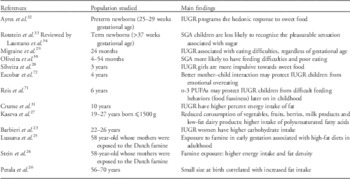
Recently, a similar study was conducted by Rotstein et al.,Reference Rotstein, Stolar and Uliel 33 evaluating the innate patterns of smell and taste recognition in SGA newborns, compared to AGA controls. In this study, the population was composed by term babies (>37 week gestational age) and the parameter used to define IUGR was birth weight <10th percentile for gestational age. Sucrose was rated with significantly higher ‘like’ reaction in both AGA and SGA, and water was rated as ‘dislike’ for AGA and ‘neutral’ for SGA. The authors concluded that there were no differences in the facial reaction to stimuli during immediate postnatal life in SGA. However, reviewing Rotstein data, it becomes clear that the response ratio of sucrose to water is ~1 in the SGA group, while almost doubles in AGA; this suggests that SGA children are less likely to recognize the pleasurable sensation associated with sugar,Reference Laureano, Molle, Portella and Silveira 34 confirming our previous findings.Reference Ayres, Agranonik and Portella 32 Table 1 delineates the studies described here.
Future challenges
From the above-mentioned data, it is clear that specific feeding behaviors and food preferences in this population plays an important role in the increased risk of obesity and noncommunicable diseases. Adequate prenatal care with careful surveillance of mother’s health and prevention of risk factors for IUGR (i.e. smoking, obesity, hypertension, diabetes) is key in order to avoid long-term consequences of fetal programming.Reference Mucellini, Manfro and Silveira 35 After birth, pediatric follow-up of infants with identifiable vulnerabilities is also a window for intervention prior to the development of metabolic consequences. Health workers should take into account the perinatal history to focus counseling on the positive impacts of breastfeeding and healthy foods, especially in this at-risk population.
Future research is needed to identify possible mechanisms involved and potential targets of interventions. Since IUGR is a dynamical process, the ideal study design would include repeated ultrasound fetal measurements to adequately define a failure to achieve full potential growth and exclude other causes of low birth weight (i.e. constitutional). Furthermore, little is known about the role of catch-up growth in the programming of feeding preferences. Larger birth cohorts, with appropriate IUGR definition and prospective long-term follow-up may further clarify the relation and causality of these findings.
Experimental evidence
Behavioral changes
It is well established in the literature that fetal growth-restricted rat pups nursed by control dams demonstrate significantly increased food intake with rapid catch-up growth. In adult life, these animals have increased body weight and percent body fat, as well as increased plasma leptin levels, insulin resistance and hypertriglyceridemia.Reference Desai, Gayle, Babu and Ross 36 , Reference Desai, Gayle, Han and Ross 37 Studies with large animals found similar results. For instance, George et al. Reference George, Zhang and Tuersunjiang 38 investigated female offspring of lambs exposed to maternal nutrient restriction (50% of the recommendation) and observed that IUGR lambs had greater and more rapid food intake. This was accompanied by greater body weight gain and caloric efficiency. They also assessed insulin and glucose dynamics and found lower insulin sensitivity and higher insulin secretion in IUGR animals. In addition, Dellschaft et al. Reference Dellschaft, Alexandre-Gouabau and Gardner 39 observed leptin resistance and raised cortisol in IUGR sheep. Ovilo et al. Reference Ovilo, Gonzalez-Bulnes and Benitez 40 investigated IUGR in a swine model and observed greater body weight gain and fat mass in adult females. They also found increased cortisol levels in the female restricted newborns, which may reflect metabolic stress caused by nutrient insufficiency. These behavioral and metabolic results support the thrifty phenotype hypothesis - more efficient acquisition and storage of food energyReference Hales and Barker 41 , Reference Hales and Barker 42 that possibly predisposes the offspring to developing metabolic diseases. However, to date few studies focused on the programming of food preferences in IUGR animals, which may contribute to overeating.
The first studies regarding fetal programming of food intake/preference emerged in the early 2000. Vickers et al. Reference Vickers, Breier, Cutfield, Hofman and Gluckman 43 , Reference Vickers, Breier, McCarthy and Gluckman 44 used an animal model of maternal undernutrition throughout pregnancy (30% of ad libitum diet) to investigate eating and sedentary behavior and observed that increased food intake coincided with reduced physical activity and higher body fat, results that correspond to the ‘couch-potato’ phenotype. Afterwards, Bellinger et al. Reference Bellinger, Lilley and Langley-Evans 45 offered three types of diet (high-fat, high-protein and high carbohydrate) to adult rats exposed to protein restriction prenatally and found that the prenatal undernourished rats preferred the high-fat diet, which promotes an elevation of energy intake in females, but not in males. The preference for fatty foods was observed when the rats were 12 weeks old (young adults), while new testing at 30 weeks of life revealed no differences. In another study they tested the difference between animals derived from three gestation periods of protein restriction: day 0–7 (LPEarly), day 8–14 (LPMid) or day 15–22 (LPLate). Using this protocol, it was found that prenatal protein restriction programmed feeding behavior in females, but not males, offspring. Interestingly, among females, all low-protein exposed groups consumed less fat than the control group.Reference Bellinger and Langley-Evans 46 Using almost the same maternal protein restriction protocol (LPEarly, LPMid, LPLate and LPAll – low protein throughout gestation) food intake was measured at 18 months of age with standard rat chow offer. The results show a greater food intake in LPMid males. Among females hypophagia was noted in groups LPAll and LPLate.Reference Bellinger, Sculley and Langley-Evans 47 These results suggest that programming of feeding behavior is likely to be gender-specific, age-specific and dependent upon the timing of nutrient insult in fetal life.
Recent animal studies from our research group continued to verify the food preference and feeding behavior in an animal model of IUGR based on food restriction of 50% during pregnancy (starting on day 10 of gestation).Reference Desai, Gayle, Babu and Ross 36 , Reference Cunha Fda, Dalle Molle and Portella 48 Alves et al. Reference Alves, Dalle Molle, Desai, Ross and Silveira 49 observed that IUGR adult males, compared to controls, eat more sweet food when acutely exposed to it. In spite of no food intake differences in females, it was found that IUGR females needed fewer trials to reach criterion in the Attentional Set-Shifting Task (ASST), using a sweet food as reward. Also DalleMolle et al. (Reference Molle, Laureano and Alves2015)Reference Molle, Laureano and Alves 50 observed that IUGR adult rats have an increased preference for palatable food (a pellet rich in fat and added sugar) when compared to control rats. However, the increased preference was accompanied by diminished conditioned place preference for this type of food. Interestingly, two studies assessed animals’ motivational behavior in adulthood by giving them a stimulus of food reward and observed that the rats submitted to the perinatal low protein protocol (IUGR) were more motivated by food reward,Reference da Silva, Borba and de Almeida Lira 51 , Reference de Melo Martimiano, da Silva and Coimbra 52 and in one of these studies they found that IUGR animals had delays during learning of the task.Reference da Silva, Borba and de Almeida Lira 51 All these results suggest that IUGR animals are more driven towards food reward and are able to deal with the difficulty to find the food, even though they have learning and/or association difficulties. This type of behavioral programming seems to be an adaptation to deal with scarcity.
Vucetic et al. Reference Vucetic, Totoki and Schoch 53 also demonstrated that maternal malnutrition (through reduced protein diet) causes behavioral alterations in the offspring. IUGR animals had an exaggerated response to cocaine, hyperactivity when receiving a high fat diet after weaning and a decreased sucrose preference, suggesting an increased addiction risk as a result of suboptimal prenatal environment. According to this article discussion, there are two factors that can contribute to the development of addiction: the activation of the reward system by drugs of abuse, and the underactivation of reward circuitry in response to natural rewards (i.e. sucrose). Both factors were observed in this animal model. Social interaction was also tested, either by interpreting interactions between unfamiliar dyads (in male mice) or in a three chamber test (in female mice). In both conditions, IUGR animals spent significantly less time interacting with the co specific, indicating deficits in sociability.Reference Grissom and Reyes 54
Exploring the mechanisms
The early programming of eating behavior is a very complex process since we know that food intake can be influenced by homeostatic, hedonic, and executive components. Also, there are many peripheral signals that can act in different brain regions modulating specific neurotransmitters systems.Reference Portella and Silveira 7 Studies have been developed focusing on the feeding and satiety pathways in an attempt to clarify the possible mechanisms involved in the programming of food preferences.
As mentioned above, fetal growth-restricted animals have a higher risk to develop obesity and the first studies to investigate the possible mechanisms responsible for this phenotype focused on the homeostatic control system. Nutritional restriction in early life (prenatal or perinatal) is associated with reduced satiety responses to leptin and impaired arcuate nucleus signaling responses to leptin,Reference Desai, Gayle, Han and Ross 37 , Reference Shin, Dai, Thamotharan, Gibson and Devaskar 55 – Reference Delahaye, Breton and Risold 57 as well as with increased responses to appetite stimulatory factors, such as ghrelin.Reference Yousheng, Nguyen, Desai and Ross 58 There is also association with increased expression of appetite (neuropeptide Y) versus satiety (pro-opiomelanocortin) neuropeptidesReference Remmers, Verhagen, Adan and Delemarre-van de Waal 59 – Reference Fukami, Sun, Li, Desai and Ross 62 and programmed dysfunction of neuroprogenitor cell proliferation/differentiation.Reference Desai, Li and Ross 63 , Reference Desai, Li and Ross 64 According to Plagemann et al.,Reference Plagemann, Harder and Rake 61 cell counts were increased in SGA rats in the paraventricular, arcuate, and ventromedial nuclei, three hypothalamic regions involved in food intake regulation. Disruptions in leptin and insulin levels, which are produced not only maternally but in the placenta as well, could contribute to the dysregulation of the cell cycle in the hypothalamus.Reference Desai, Li and Ross 63 In addition, another study that investigated protein deficiency during gestation and lactation observed an upregulation of hypothalamic intracellular signaling in the adult offspring of the low-protein group, particularly in the insulin and leptin intracellular transduction cascade (phophoinositide 3-kinase pathway).Reference Orozco-Solis, Matos and Guzman-Quevedo 65 Therefore, maternal undernutrition (by caloric restriction or low protein diet) can alter nutrient sensors, neuroendocrine levels and signaling, neurogenesis and/or neuropeptide levels of the offspring. These pathways can interact and impact appetite (for review seeReference Ross and Desai 66 ).
In our studies we aimed at finding possible mechanisms related to the altered feeding behavior investigating especially to the mesocorticolimbic system. IUGR females submitted to the ASST exhibited increased tyrosine-hydroxylase (TH) content in the orbito-frontal cortex in response to sweet food intake. There is also a differential response of TH content in the NAcc after sweet food intake in both IUGR males and females.Reference Alves, Dalle Molle, Desai, Ross and Silveira 49 In addition, we described diminished levels of dopamine-2 (D2) receptors in the NAcc of IUGR rats when compared to controls, which explains the conditioned place preference deficits in these animals.Reference Smith, Fetsko, Xu and Wang 67 In the same study, tissue was collected at baseline conditions (after 4 h fasting) or after 1 h of sweet food intake. At baseline, TH and phospoho-tyrosine hydroxylase (pTH) levels in the NAcc were higher in IUGR males compared to control males. However, in females, TH and pTH levels were increased after exposure to sweet food in IUGR compared with controls.Reference Molle, Laureano and Alves 50 Together, our findings suggest that IUGR rats exhibit a preference for palatable foods and a different central response to palatable food cues, probably due to alterations in dopamine release in selected structures of the mesocorticolimbic dopaminergic pathway. Differently, a recent study that explored the gene expression of dopamine receptors (D1 and D2) in the ventral striatum of animals exposed to perinatal malnutrition observed an increase in gene expression of D1 receptors and no differences regarding D2 receptors. However, they used a different animal model based on perinatal protein restriction.Reference de Melo Martimiano, da Silva and Coimbra 52 In this same study there was also a decrease in palatable diet consumption in both the control and malnourished groups after the application of D1 and D2 agonists; however, the anorexic effect of the D1 agonist was understated in malnourished animals.
Exploring the same system in an animal model of IUGR based on maternal protein restriction, Vucetic et al. Reference Vucetic, Totoki and Schoch 53 observed that their behavioral results were also accompanied by changes in dopamine expression. IUGR offspring had increased expression of dopamine-related genes [TH and dopamine reuptake transporter (DAT)] in brain regions related to reward processing (VTA, NAcc and PFC) and homeostatic control (hypothalamus), and increased content of TH and dopamine in the VTA and PFC, respectively. Thus, the basic mesocorticolimbic circuitry represented by VTA to NAcc and PFC connectivity is dysregulated in IUGR. According to these results, it seems that there is a net hyperdopaminergic tone, with TH overactivity and compensatory increases in DAT. Together with the mesocorticolimbic system alterations they also verified the opioid system and were able to find changes in IUGR rats that fit with the decreased sucrose preference observed in the behavioral tasks. A decreased expression of opioid genes was observed: preproenkephalin in the PFC and mu-opioid receptor in the NAcc.Reference Grissom and Reyes 54 Similarly, Kademian et al.Reference Kademian, Perez and Keller 68 found that rats undernourished at perinatal age (day 14 of gestation until 50 days of age) had decreased mu-opioid receptor density (Bmax) in the midbrain in adult life.
Therefore, the compilation of these results demonstrates that an imbalance between the hedonic versus homeostatic control systems may be associated with overeating in IUGR animals (especially palatable/rewarding foods), resulting in poor regulation of body weight in the long term.
Another possible mechanism involved in eating behavior changes in IUGR individuals is the functioning of the hypothalamic–pituitary–adrenal (HPA) axis. Studies suggest that early exposure to undernutrition programs HPA axis throughout lifespan. As cited above, IUGR is associated with higher levels of corticosterone in different ages, leading to chronic hyperactivity of this neuroendocrine axis.Reference Dellschaft, Alexandre-Gouabau and Gardner 39 , Reference Ovilo, Gonzalez-Bulnes and Benitez 40 , Reference Vieau, Sebaai and Leonhardt 69 There is also evidence showing that maternal food restriction leads to reduced glucocorticoid and mineralocorticoid receptor expressions in the hippocampus of IUGR newborns.Reference Lesage, Blondeau, Grino, Breant and Dupouy 70 The chronic hyperactivity of the HPA axis may contribute to the programming of chronic diseases, as well as altered response to acute stress, which can influence feeding behavior and food choices.
Considering what was already experimentally demonstrated, a better characterization of the fetal programming of food preferences involves the assessment of in vivo functional changes during the exposure to palatable foods, as well as a deep investigation of other systems related to food preference such as the opioid system. It is also important to further explore the neurobiological aspects involved in food intake and preferences, that is how tissue’s specifics changes in the sensitivity to metabolic signals (insulin, leptin and ghrelin) can modulate neurotransmitters’ release and neuron’s activity in areas related to reward, pleasure and decision making.
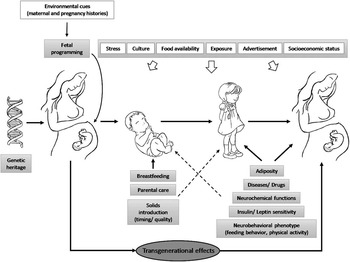
Another important question that needs to be addressed refers to the potential interventions that could modify this programmed food preference in IUGR offspring. This idea was explored in a recent study involving the consumption of n-3 polyunsaturated fatty acids (n-3 PUFAs) during infancy, in which authors show that n-3 PUFAs intake during infancy decreases a non-adaptive feeding behavior, namely food fussiness, in IUGR children. They suggest that n-3 PUFAs putatively acts by modulating inhibitory control and reward sensitivity through alterations in the dopamine system.Reference Reis, Bernardi and Steiner 71 Therefore, they suggest that n-3 PUFAs may protect IUGR children from difficult feeding behaviors later on in childhood, but other studies need to be performed to elucidate the mechanisms involved and plan interventions. Similarly, the quality of maternal care seems to moderate the association between IUGR and emotional overeating in girls.Reference Escobar, O’Donnell and Colalillo 72 There is preliminary evidence suggesting that interventions improving this relationship may also benefit IUGR children.Reference Braga, Farias, Reis, Agranonik and Silveira 73 Figure 1 delineates the factors affecting food choices over the life course.
Factors influencing food preferences over the life course. Genetic heritage affects flavor sensitivity. Events and exposures happening in utero program food preferences and influence the third generation through the oocytes already present in fetal life (transgenerational effects). During infancy, breastfeeding practice and duration, the quality and timing of the solids introduction, as well as the quality of parental care will influence the infant’s feeding behavior, learning and preferences being established, having some influence (though smaller, dotted line) also during childhood. Adiposity, hormonal sensitivity and neurochemical functioning, exposure to diseases or drugs and temperament/behavior will affect food choices in children, having had also some effect in toddlers (dotted line). Stress, culture, food availability, exposures/learning, socioeconomic status and environmental cues such as media and advertisements from food industry will impact food choices over the life course. The notion that all these factors interact is essential for comprehending the diversity of phenotypes observed in the different studies, although many describe specific behaviors in IUGR individuals, which will vary according to the age tested and the tools used.

Conclusions
From the reviewed clinical and experimental evidence, the fetal programming of food preferences is a consistent finding, replicated in different continents, despite the heterogeneity of the studied populations in terms of age, sex, economic development and IUGR cause. Therefore, through a persistent imbalance in food choices in everyday life, over the life course, this phenomena is likely to be a key player in the increased risk for obesity and its metabolic consequences demonstrated in these individuals.Reference Portella and Silveira 74 Awareness about fetal programming effects in the clinical practice, as well as the better understanding of putative mechanisms and mediators, can have an important impact for preventive medicine in this vulnerable population.
List of the different studies comparing small to normal birth weight children in their food preferences and feeding behavior, at different ages

IUGR, intrauterine growth restriction; SGA, small for gestational age.
Acknowledgement
None.
Financial Support
Research Support Foundation of Rio Grande do Sul (FAPERGS), Coordination for the Improvement of Higher Education Personnel (Capes) and National Counsel of Technological and Scientific Development (CNPq).
Conflicts of Interest
None.