The governance of medical performance is changing. Professional self-regulation has traditionally been dominant. This means that the state has allowed doctors considerable autonomy over their work and that in exchange doctors have been expected to provide quality care and de-politicize the rationing of health care. However, heightened cost concerns and the emergence of more assertive patients among others have challenged this implicit contract between doctors and the state. Instead, new governing instruments are emerging, which emphasize the importance of public accountability. The present article critically assesses the extent and nature of change in the governance of medical performance using recent health reforms in Germany as a case study.
The literature assessing the impact of New Public Management reforms on medical practice highlights the complexity of new governance arrangements, especially the co-existence of professional self-regulation and new forms of governance. For example, Allsop and Mulcahy (Reference Allsop and Mulcahy1996) in their analysis of new public management reforms in Britain emphasize that internal, professional, and external state-based forms of regulation tend to occur in combination. Similarly, Dent (Reference Dent2004) in his comparative analysis of hospital reforms in Europe presents a continuum of different degrees of professional and managerial control to characterize the ambivalent nature of change in individual countries. The interplay between different forms of governance is even more explicit in Harrison et al.'s (Reference Harrison, Moran and Wood2002) study of the changing approaches to medical practice. The authors characterize the new approach to medical practice as a hybrid of ‘scientific-bureaucratic medicine’. The analyses above have in common that they tend to focus on professional self-regulation as interacting with another form of governance. Allsop and Mulcahy for example contrast internal with external regulation, while Dent distinguishes between professional and managerial controls. This makes for a more or less dualistic perspective and limits the possibility for exploring more fully the nature of complexity of governance change.
Building on existing analyses, this article relates changes in the governance of medical performance to broader changes in how states relate to societies and govern public services. This allows putting the complexity of governance centre stage. More specifically, exploring the co-existence of different forms of governance provides a basis for a more precise assessment of the extent and nature of governance change. To this end, the analysis presented in this article uses recent contributions to the literature on governance, which challenge the view of a linear move away from hierarchy and towards other, network-based forms of governance. Instead, Newman (Reference Newman2001) suggests that change tends to be incomplete and that the relationship between old and new forms of governing remains ambivalent. Newman therefore tries to capture the non-linear nature of change by defining governance as the interplay between different forms of governing (similarly Jørgensen and Vrangbæk, Reference Jørgensen and Vrangbæk2004).
Against this background, this article analyses more closely the complexity of governance change through examining the co-existence of different forms of governance. The aim is to assess both the relative extent and the substantive nature of governance change. Using recent reforms of the governance of medical performance in Germany as a case study, the analysis suggests that the complexity of governance change takes three forms: first, the balance among (hybrid) forms of governance is shifting; second, the nature of individual (hybrid) forms of governance is changing; and, third, both types of change are reflected in tensions not only between but also within (hybrid) forms of governance. As such, the article also contributes to the recent literature on governance by highlighting the centrality of tensions in contemporary governance, which can also occur within both hybrid forms of governance and ‘pure’ forms of governance.
The analysis
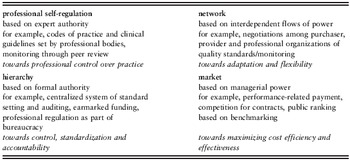
In terms of analysing the co-existence of different forms of governance Newman (Reference Newman2001) and Jørgensen and Vrangbæk (Reference Jørgensen and Vrangbæk2004) suggest distinguishing between four ideal forms of governance: hierarchy, the rational goal/market model, the open systems/network model, and the self-governance/clan model (based on professional self-regulation). Table 1 illustrates what the individual forms of governance mean in relation to the governance of medical performance and points to the tensions between them.
Different forms of the governance of medical performance

Governance-based professional self-regulation pulls into the direction of professional control over practice. Typical forms of governance are codes of practice and clinical standards set by professional bodies and monitoring through peer review. The authority of (medical) experts is the basis of power. This stands in stark contrast with market-based forms of medical governance, which rest on managerial power. Here, the focus of governance is on maximizing cost efficiency and effectiveness. Examples of this type of governance include performance-related payments of providers (such as Diagnosis-Related Groups), competition for service contracts in public quasi markets, and the public ranking of provider organization based on benchmarking. As Newman (Reference Newman2001) suggests, in reality market and hierarchy-based forms of governing are often closely connected. Examples of this form of governance include a centralized system of standard setting and auditing, the use of earmarked funding and embedding professional regulation in the regular public administration of health care. This is markedly different in relation to network-based forms of governance, which are rooted in flows of power among interdependent actors. Examples include joint negotiations of quality standards and monitoring among purchaser, provider, and professional organizations. This type of governance pulls into the direction of adaptation and flexibility, in the context of ongoing negotiations that include processes of feedback and learning.
Based on this the authors introduce different types of governance change. Jørgensen and Vrangbæk (Reference Jørgensen and Vrangbæk2004) define governance change as the changing nature both of individual forms of governance and of the relationships between different forms of governance. This builds on an understanding of individual forms of governance as dynamic and non-exclusive. More specifically, the authors identify: changes within individual forms of governance, changes in the balance between different forms of governance, and the emergence of hybrid forms of governance. In contrast, Newman treats individual forms of governance as static and exclusive. Individual forms of governance consist of a distinct set of definitions of problems and assumptions about the nature of change. When combined, as is typical of contemporary policies, this leads to tensions that cannot be resolved easily. Governance is thus characterized by multiple and conflicting forms of governance that pull into different directions. As such, Newman (Reference Newman2001) goes beyond the description of hybrids as more or less unproblematic combinations of different forms of governing and instead focuses on the interactions and especially tensions between different forms of governance. Governance change therefore emerges as a process concerned with balancing competing pressures and addressing a variety of dilemmas.
The following analysis uses the distinction between ideal typical forms of governance as a framework for mapping out change in the governance of medical performance and uses this as a basis to critically assess the extent and nature of governance change. More specifically, the analysis initially looked for four types of governance change: change in the balance between different forms of governance, change within individual forms of governance, change as reflected in the emergence of hybrids, and change as reflected in tensions between different forms of governance. In the course of the analysis, it emerged that the third type of change was less relevant in the present case. Hybrids are a salient feature of governing arrangements in Germany and recent reforms have changed existing hybrids but not added new ones.
The present article analyses the extent and nature of governance change using recent reforms of the governance of medical performance in Germany as a case study. Freidson (Reference Freidson1970) suggests that controlling clinical work is at the centre of medical governance, as doctors as professionals are about applying knowledge. Further, compared to education and research, performance is an area of governance which has the most direct effect on the public (as cases of medical negligence demonstrate). This politicizes the governance of medical performance and therefore makes performance an ideal focus for studying governance change. The governance of medical performance consists of all those mechanisms that together influence the performance of medical work in terms of either diagnosis or treatment broadly understood. Such mechanisms can take the form of standard setting or monitoring and include knowledge-based mechanisms such as research and clinical guidelines as well economic-based mechanisms such as funding based on diagnosis-related groups. In terms of analysing the extent and nature of governance change, the case of Germany is particularly interesting. The salient mix of different forms of governance typical of the corporatist health care state provides a good basis for analysing the co-existence of different forms of governance in relation to both the extent and nature of governance change. Further, in addition to professional self-regulation, doctors are also involved in other, network- and hierarchy-based forms of governance (Kuhlmann, Reference Kuhlmann2006). This potentially makes change difficult, and, as such, Germany offers an ideal test case for critically assessing the relative extent of governance change. Also since the late 1990s, there has been a plethora of health reforms that have addressed the micro level of medical practice. The analysis presented below looks more closely at aspects of individual reforms, relying mainly on primary sources in the form of articles from policy and health practitioner journals in addition to secondary sources. The following analysis begins by examining the traditional (hybrid) forms of governing medical performance and against this background maps out governance change following recent reforms.
Traditional (hybrid) forms of governing medical performance
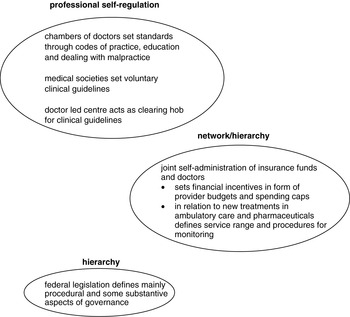
In Germany, professional self-regulation has traditionally dominated the governance of medical performance, but has come to increasingly co-exist with a hybrid of network- and hierarchy-based governance in form of the joint self-administration of insurance funds and doctors (for an overview see Wigge, Reference Wigge2000).
As in other countries, statutory organizations of professional self-regulation are responsible for setting professional and ethical standards. In Germany, state-level Chambers of Doctors (Ärztekammern) set standards directly through general codes of good practice and more indirectly through their responsibility for secondary training and continuing education, as well as through dealing with cases of malpractice. This is complemented by voluntary medical guidelines developed by specialist societies as well as by more direct approaches in form of professionally led quality management. In 1997, for example, the Federal Chamber of Doctors (Bundesärztekammer) and the Federal Association of Insurance Fund Doctors (Kassenärztliche Bundesvereinigung) issued ‘guidelines’ for clinical practice. In 1999, this culminated in the creation (together with the insurance funds) of a clearing hob for clinical guidelines as part of the Medical Centre for Quality (Ärztliches Zentrum für Qualität in der Medizin), a non-statutory organization for medical quality created by several organizations of doctors in the early 1990s (Clade, Reference Clade1999; Wigge, Reference Wigge2000).
In addition to professional self-regulation, there is another statutory regime of governance. The joint self-administration of insurance funds and doctors is at the heart of the corporatist health care state and represents a hybrid of hierarchy and network-based forms of governance (for an overview see Busse and Riesberg, Reference Busse and Riesberg2004; Deppe, Reference Deppe2000; Kuhlmann, Reference Sauerland2006; Rosenbrock and Gerlinger, Reference Rosenbrock and Gerlinger2004). This part of the governance regime in effect consists of two parts: legislation regulating statutory health insurance as ‘pure’ hierarchy-based forms of governance and the collective agreements by joint self-administration and more specifically the Federal Committee of Doctors and Insurance Funds (Bundesausschuss der Ärzte und Krankenkassen). The committee includes the statutory Federal Association of Insurance Fund Doctors and the federal associations of the different insurance funds. The committee's main responsibility is the specification and implementation of federal framework legislation, and over the years the committee has grown into a ‘small legislator’ in health policy. Taken together this means two things. First, hierarchy-based forms of governance are limited and consist of mainly procedural and some substantive legislation regulating the statutory health insurance. As such and second, the negotiations of insurance funds and doctors are statutory in nature and this explains their hybrid nature, combining elements of network- and hierarchy-based forms of governance.
In terms of substance, the governance of medical performance is mostly indirect and takes the form of financial incentives. Since the early 1990s, the funding of ambulatory care, pharmaceuticals, and hospitals has been based on different forms of provider budgets or spending caps (for an overview see Busse and Riesberg, Reference Busse and Riesberg2004: 164). Financial incentives are especially powerful when combined with definitions of the range of services covered, as in relation to ambulatory care and pharmaceuticals, because this allows for the de facto exclusion of services. Target volumes for pharmaceuticals also operate at the level of the individual practice and as such extend possibilities of monitoring medical performance. The same applies to ambulatory care, where assessment is random or based on indicators of excess service provision, although the Organizations of Insurance Fund Doctors (Kassenärztliche Vereinigungen) remain responsible for this type of monitoring (for further details see Rosenbrock and Gerlinger, Reference Rosenbrock and Gerlinger2004: 130). Taken together this provides a potential springboard for change and for formalizing and fine tuning the governance of medical performance. Figure 1 maps out the traditional (hybrid) forms governing medical performance.
Traditional (hybrid) forms of governing medical performance

Reforming the governance of medical performance
Health reforms since the late 1990s have changed the governance of medical performance (for an overview see Igl, Reference Igl2002; Hess, Reference Hess2005; Sauerland, Reference Sauerland2001): first, in terms of the balance between different (hybrid) forms of governance the joint self-administration has extended its scope and now even includes some aspects of governing that used to be part of professional self-regulation; second, in terms of the nature of individual (hybrid) forms of governance the joint-self administration and hierarchy have become more formalized and fine tuned; and, third, these changes have exacerbated the tensions both between different and within individual (hybrid) forms of governance.
Changes in the balance between (hybrid) forms of governance
In terms of the balance between different (hybrid) forms of governance, there are two types of changes: the joint self-administration has extended its scope, first in its own right, and second by including some aspects of governing which used to be part of professional self-regulation. At the same time and as examined in more detail in the discussion below of changes in individual (hybrid) forms of governance, the relevant federal legislation now has more substantive elements and this extends the scope of hierarchy to some extent.
First, indirect standard setting through defining the scope of the health insurance and what services are included has provided a springboard for extending the scope of the joint self-administration. The development of the Joint Committee of Insurance Funds and Providers (Gemeinsamer Bundesausschuss) has been key here. More specifically, the scope of the assessment process for the inclusion of services has been extended to include not only existing treatments (and thereby also the exclusion of services) but also hospital treatment. The Joint Committee is now also responsible for quality assurance, setting standards and defining procedures for monitoring.
The scope of the assessment process for the inclusion of services has been extended to include the services provided by hospitals. This points to the emergence of a joint governing strategy across the ambulatory care and hospital care sectors that is closely reflected in changes to the Joint Committee of Insurance Funds and Providers. In the 1990s, the Joint Committee developed into the flagship of a new governing strategy (Urban, Reference Urban2001). In 1997, a sub-committee for the evaluation of medical treatments and procedures was created; in 2000, a sub-committee on hospital care followed; and, in 2004, all sub-committees merged into a new Joint Committee (for an overview see Busse and Riesberg, Reference Busse2004: 46). The legal and corresponding institutional integration of governing arrangements has advanced further with the introduction of funding through diagnosis-related groups.
Procedures of quality assurance are the other new area of the joint self-administration (Schmacke, Reference Schmacke2001). The extended responsibilities of the Joint Committee include defining (evidence-based) guidelines for medical treatment and closely related to this compulsory quality assurance (for an overview see Sauerland, Reference Sauerland2001). Following this, office-based doctors as well as hospitals are required to set up measures of internal quality management and are also subject to external quality assessment. For example, as part of their external quality assurance hospitals have to document quality indicators, which form the basis for comparisons across hospitals. Significantly, incomplete documentation triggers negative sanctions in the form of more frequent, in this case yearly, assessments of the correct use of DRGs. In terms of the governance of medical performance, this makes for a more formalized approach to governing.
Second, in terms of extending the scope of the joint self-administration by including some aspects of governing, which used to be part of the professional self-regulation, the evaluation of medical guidelines is an indicative example. As mentioned above, the Medical Centre for Quality as a non-statutory organization run jointly by several medical organizations initially occupied this niche. The Modernization Act in 2004 made the evaluation of medical guidelines a statutory responsibility and transferred this responsibility to the Joint Committee; the clearing hub of the Medical Centre for Quality ceased to exist in the same year. The literature refers to such developments as ‘Korporatisierung’ (Döhler, Reference Döhler1995; Döhler and Manow, Reference Döhler and Manow1997), whereby the joint self-administration extends its scope while at the same time becoming both more standardized and centralized. However, here it also has to be taken into consideration that the governance of medical performance is still new territory for insurance funds and where doctors, also as part of the joint self-administration, continue to exert considerable influence. For example, many of the staff of the newly created Institute for Quality and Efficiency (Institut für Qualität und Wirtschaftlichkeit) have a medical background and the approach of the Institute to evaluation mirrors the focus and methods of medical research. Kuhlmann (Reference Kuhlmann2006) suggests that this reflects the fact that global models of quality management are not adequately linked to existing governing structures both within and outside the medical profession.
Changes within individual (hybrid) forms of governing
In terms of changes of the nature of individual (hybrid) forms of governance, the joint-self administration and hierarchy have become more fine tuned and formalized. First, the joint self-administration uses a wider range of criteria both for evaluating medical treatments and for defining clinical guidelines and mechanisms for setting standards. Second, hierarchy has become more differentiated in procedural as well as substantive terms.
First, the basis for evaluating medical treatments and procedure was extended to include ‘benefit’ and ‘efficiency’ in addition to ‘medical necessity’, making for a broader as well as more formal assessment process (Busse, Reference Busse1999: 78). In addition, the assessment process is now closely tied to the notion of ‘evidence-based medicine’ and, as discussed above, this has coincided with the introduction of procedures of quality assurance. A newly created Institute for Quality and Efficiency is meant to support the work of the Joint Committee through, among other things, presenting evidence on the quality and efficiency of medical services and evaluating selected evidence-based guidelines (see Sozialgesetzbuch V, Reference Sozialgesetzbuch2005: §139).
This process of mainstreaming relates the governance of medical performance to a broader ‘quality turn’. This adds new ways of setting standards for treatment and diagnosis within the statutory health insurance, not least as the ‘quality turn’ has been part and parcel of wider organizational reforms (Schmacke, Reference Schmacke2002). For example, in 2000 the Joint Committee was extended to include a sub-committee on co-ordination, charged with, among others, defining treatment guidelines for inter-sectoral care. In conjunction with the opening up of the collective contract and the development of new forms of contracting, clinical guidelines also gain further ‘operational meaning’ for the governance of medical performance, as the Disease Management Programmes demonstrate (Müller de Cornejo, Reference Müller de Cornejo and Essers2005). The Programmes, which focus on specific sets of chronic illnesses, include process-related standards and also open up the possibility of more extensive monitoring (Kuhlmann, Reference Kuhlmann2004). The corresponding requirements for quality assurance vary between individual programmes and include: standardized documentation, feedback reports to doctors, and patient information (Busse and Riesberg, Reference Busse2004: 66). Nevertheless, clinical guidelines continue to remain largely advisory (as opposed to compulsory) and, as such, first and foremost provide a basis for the individual decisions by doctors, as opposed to defining a corridor for individual decisions (Hart, Reference Hart2000). This reflects a broad consensus among key actors in the health policy arena, ranging from insurance funds (cf. Schönbach, Reference Schönbach2001) and the Institute for Quality and Efficiency (cf. Gesundheit und Gesellschaft, Reference Gesundeit und2002) to the government (Bundesministerium für Gesundheit und Soziale Sicherung, Reference Bundesministerium für2004).
Second, the nature of hierarchy has become more fine tuned in procedural but also substantive terms (cf. Rosenbrock and Gerlinger, Reference Rosenbrock and Gerlinger2004; Urban, Reference Urban2001; Wendt et al., Reference Wendt, Rothgang and Helmert2005). The most obvious indication of this change is the fact that the federal government now often sets deadlines by which the joint self-administration has to come to an agreement (and threatening intervention in the case of non-agreement). In relation to the introduction of diagnosis-related groups as part of the Reform Act in 2000, the government defined a tight time table, which the self-administration was unable to meet in full. In addition, the government outlined a substantive framework for negotiation by the joint self-administration, which was also subject to final approval by the Ministry of Health (Busse, Reference Busse2004). The threat of government intervention is a strong ‘symbolic policy’, whereas its specific impact on governance arrangements is less clear. In the case of Disease Management Programmes, for example, the deadline set by the government had the opposite effect and made for a strong alliance between providers and insurance funds. This was precisely to avert hierarchy-based governance in form of government intervention.
Tensions between and within (hybrid) forms of governance
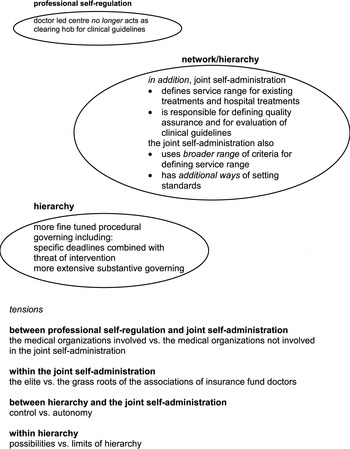
The two sets of changes, in the balance between different (hybrid) forms of governance and within individual (hybrid) forms of governance, are complex. At the same time, these changes exacerbate the salient tensions between as well as within (hybrid) forms of governance. Figure 2 below offers an overview.
Reforming (hybrid) forms of governing medical performance

First, there are tensions within the hierarchy and more specifically between the possibilities and limits of hierarchy-based forms of governance. These forms of governance have traditionally been weak and have focused on the procedural aspects of setting the framework of the joint self-administration. Yet, over recent years, this framework setting has become more specific in relation to procedural but also substantive issues. The government now combines delegation with a considerable degree of ‘context steering’. The government is also quite active as an ‘architect of political order’ (Döhler, Reference Döhler1995), creating institutional spaces for intervention. As discussed above, examples from recent reforms include the reform of the Joint Committee and the creation of the Institute for Quality and Efficiency. At the same time, this fine tuning has exposed the limits of hierarchy-based governance, as the capacity of the federal government continues to be limited in institutional terms. The government therefore does not necessarily have the capacity to assert its role in relation to seeing reforms through and the running of the newly created institutions. For example, although Disease Management Programmes signal a willingness on the part of the government to use more extensively hierarchy-based forms of governance, traditional forms of governance in the form of the joint self-administration remain strong and this also secures the continuously strong influence of doctors (Kuhlmann, Reference Kuhlmann2006).
Second, there are tensions between hierarchy-based forms of governance and the joint self-administration. The joint self-administration has not only maintained its position at the centre of health governance, but, as discussed above, has even widened its scope, especially as reflected in the considerably extended role of the Joint Committee. Thereby, the joint self-administration has moved into areas that were formally the exclusive responsibility of professional self-regulation and has thereby also become more closely integrated into the agenda of the government. The substance of the governance of medical performance has become more controversial and the joint self-administration depends even more strongly on legislation as a source for legitimacy. At the same time, it is precisely the changed nature of hierarchy-based forms of governance, in the form of more fine tuned procedural and substantive steering, that limits the room for manoeuvre of the joint self-administration.
Further and third, there also exist tensions within the joint self-administration. The provider organizations involved in the Joint Committee gain influence, but their position vis-à-vis their membership becomes more problematic. This particularly applies to the Federal Organization of Insurance Fund Doctors with its compulsory membership. The more intense distributional struggles as a result of cost containment have heightened the divisions among doctors. With its statutory status the Federal Organization is caught up between having to make more compromises vis-à-vis insurance funds so as to not lose ground, while at the same time having to implement those decisions vis-à-vis their membership (for a more detailed analysis see Gerlinger and Stegmüller, Reference Gerlinger, Stegmüller and Norbert1999; more generally Brechtel, Reference Brechtel2001; Urban, Reference Urban2001). In relation to the last aspect it is also significant that the opening of the collective contract has challenged the monopoly of the Associations of Insurance Fund Doctors over ambulatory care and has allowed for grass root initiatives from individual (groups of) doctors to gain influence (Döhler, Reference Döhler, Winand Gellner and Schön2002).
Finally and fourth, the less secure position of the Federal Organization of Insurance Fund Doctors has repercussions for its relationship with the medical organizations not involved in the joint self-administration and leads to tensions between the two. The scientific and interest organizations for their part potentially lose influence as the importance of purely voluntary forms of professional self-regulation diminishes. The situation is similar in relation to the Federal Chamber of Doctors, as the governance of medical performance by the joint self-administration has become more extensive in scope and thereby co-exists more firmly with the governance by (statutory) professional self-regulation. The provider organizations have been proactive in terms of involving individuals in internal and external quality management, including the new agencies responsible for quality assurance. Nevertheless, tensions between the two types of medical organizations remain, and, for example, came to the fore as part of the negotiations of the first Disease Management Programmes. The Federal Chamber of Doctors in particular was strongly opposed to the Programmes, because of the stronger formalization of clinical guidelines. In contrast, the Federal Association treated the Programmes as an opportunity to secure the continued influence of the joint self-administration. The tensions culminated in the withdrawal of the Federal Chamber from the negotiations.
Discussion
The governance of medical performance is changing and, with the policy emphasis on strengthening public accountability, new forms of governance are emerging. The literature which assesses the impact of these reforms highlights the complexity of new governing arrangements whereby professional self-regulation co-exists with other forms of governance. This is an important insight, but the focus of the analysis remains firmly on professional self-regulation as interacting with other forms of governance. Such a more or less dualistic perspective limits the possibilities for exploring the complexity of governance arrangements and thereby for more fully understanding governance change. Against this background, the present article puts the complexity of governance centre stage by relating changes in the governance of medical performance to broader changes in how states relate to societies and govern public services. The article uses recent contributions to the literature on governance to analyse more closely the co-existence of different forms of governance. More specifically, the review of the literature introduces hierarchy, network, the market, and professional self-regulation as four (ideal typical) forms of governance and on that basis identifies different types of governance change. Using recent health reforms in Germany as a case study the analysis presented here maps out the co-existence of different forms of governance with the aim to assess more precisely the extent and nature of change in medical governance. As such, the analysis also puts some of the key propositions of the recent literature on governance to the test.
The governance of medical performance in Germany has traditionally been characterized by the co-existence of three (hybrid) forms of governance: professional self-regulation in the form of both statutory and voluntary profession-led regulation of medical practice; joint self-administration as a hybrid of hierarchy and network-based governance, which consists of statutory negotiations between insurance funds and providers about different substantive aspects of health insurance; and hierarchy in form of federal legislation setting the procedural and, to a lesser extent, the substantive framework of health insurance. As discussed above, the co-existence of these (hybrid) forms of governance is closely related to the nature of the corporatist health care state, where the state tends to extensively delegate governing tasks to statutory, non-state bodies. This makes for a high degree of institutional embeddedness and not surprisingly recent health reforms do not change the basic composition of the governance of medical performance. Instead, as Figure 2 above illustrates, the governance of medical performance is undergoing complex change, notably in three ways: first, the balance among (hybrid) forms of governance is shifting; and, second, the nature of individual (hybrid) forms of governance is changing. Third, both types of change are reflected in tensions not only between but also within (hybrid) forms of governance.
First, the balance among (hybrid) forms of governance is shifting in favour of the joint self-administration and, to a lesser extent, hierarchy. The scope of the joint self-administration in relation to the governance of medical performance is extending considerably and now also includes defining the service range for existing and hospital treatments as well as defining quality assurance and being responsible for the evaluation of clinical guidelines. At the same time, the relevant federal legislation now has more substantive elements and this extends the scope of the hierarchy to some extent. The scope of professional self-regulation formally remains largely intact and only the evaluation of clinical guidelines has moved to the joint self-administration. Yet the greater scope of joint self-administration, in conjunction with the somewhat extended scope of hierarchy, clearly challenge the voluntary elements of professional self-regulation and also provide a counterweight vis-à-vis the statutory elements of professional self-regulation.
Second, the changes within (hybrid) forms of governance occur mainly in relation to joint self-administration and hierarchy, where the mechanisms of governance are becoming more fine tuned. When defining the service range of different sectors of health care provision, the joint self-administration now uses a broader range of criteria, which in addition to criteria of medical quality also include criteria related to economic efficiency and medical evidence. Further, the coupling of standard setting to the ‘quality turn’ has opened up new possibilities beyond defining the range of services covered by health insurance. In relation to hierarchy, the fine tuning of mechanisms of governance has occurred especially in relation to the procedural aspects of the federal legislation and increasingly includes specific deadlines for the negotiations of the joint self-administration together with threats of government intervention.
The discussion above suggests that change in the governance of medical performance occurs first and foremost gradually, while the basic components of governance remain intact. This includes professional self-regulation and as such the analysis presented in this article supports existing studies of the impact of New Public Management reforms on the governance of medical practice. Similarly, the literature on governance stresses the non-linear nature of governance change, whereby old and new (hybrid) forms of governance exist side-by-side. However, in contrast to capturing governance change using dualistic notions of governance, the present analysis opens up for the complexity of governance. Governance forms (and associated governance change) do not always neatly fall into dualistic categories such as internal and external regulation as the joint self-administration with its strong involvement of the medical profession illustrates. Similarly, a single point on a continuum (such as between professional and managerial controls) or a single ideal type (such as scientific bureaucratic medicine) do not always accurately capture the nature of governance change. In the case of Germany, for example, governance change occurs in relation to three separate (hybrid) types of governance and the relations among them.
Finally, the two forms of governance change discussed above exacerbate salient tensions. Importantly, tensions exist not only between different (hybrid) forms of governance, but importantly also within (hybrid) forms of governance. This in particular has interesting implications for recent contributions to the literature on governance. Jørgensen and Vrangbæk (Reference Jørgensen and Vrangbæk2004) include hybrid forms of governance in their discussion of governance change. This builds on the idea that, while forms of governance are different, they do not necessarily exclude each other. At first sight, the notion of hybrids stands in clear contrast with Newman's focus on tensions between different forms of governance as based on distinct (and as such exclusive) logics of governing. However, the analysis presented in this article suggests a more complex picture, notably in two ways. First, tensions can also occur within hybrid forms of governance. The joint self-administration is a genuine hybrid form of governance combining elements of network (in form of negotiations between insurance funds and providers) with elements of hierarchy (whereby the negotiations occur in a statutory framework and function as ‘small legislation’). At the same time, the amalgamation of two forms of governance into a hybrid is far from conflict free, as the tensions within the joint self-administration and especially between the elite and the grass roots of the associations of the insurance fund doctors demonstrate. Second, tensions occur even within (pure) forms of governance. In the case of Germany, for example, this includes tensions within hierarchy and more specifically between the possibilities and limits of the federal legislation in terms of its governing capacity. As such, the analysis presented in this article highlights the centrality of tensions in contemporary governance and calls for a more thorough understanding of such tensions.