Introduction
The National Policy on Education (1977, 1998) makes provision for music at the various levels of schooling in Nigeria. How far this government position is in consonance with current realities justifies the need for periodic research. It is against this backdrop that this research was carried out on music education in Kwara State, a geo-political entity within the Federal Republic of Nigeria, between 2002 and 2004, with further updates of data in 2008 and 2009. Specifically my research set out to ascertain how far the goals of music education have been achieved in secondary and tertiary institutions in the state and to identify specific problems and gaps between educational plans and realities. This is with a view to draw inferences, make deductions and address some contentious issues that are woven around an effective music education delivery system in Nigeria.
This paper employs both empirical and deductive methods of research. Primary data were gathered through oral consultations, structured questionnaires as well as participant-observation in classroom situations. Primary data were also gathered from classroom teachers, principals, students and music teachers in selected secondary schools as well as the state ministries of education and information, colleges of education and universities in the state. The simple random sampling method was used to select students at the secondary school level as well as school principals. Two sets of questionnaires were then administered: one for school principals and the other for secondary school students. Responses to questionnaires were analysed using the simple percentage score method while other data collected were analysed using descriptive tools such as tables and histograms. Percentages of responses were then calculated from the total responses for each item in the questionnaire using this formula:

Where X is the frequency of response and Y the total number of respondents. Therefore:

Secondary data were gathered from published and unpublished materials on the subject matter.
Background of the study area
This study is based on Kwara state, a geo-political entity within the Federal Republic of Nigeria. On 1 October 1960, Nigeria attained political independence from Britain. For administrative purposes, the country was divided first into three regions, namely Northern, Eastern and Western regions, and in 1963 a fourth region, the Midwestern region was added. These regions were later divided into states. Kwara state was created from the former Northern Region in 1967 by Federal Government decree No. 14, which created 12 states out of the existing four regions (Emielu, Reference EMIELU1991, p. 5). Kwara state is strategically located as the northernmost part of southern Nigeria and the southernmost part of northern Nigeria. It has boundaries with the states of Ekiti, Kogi, Niger, Osun and Oyo. It also has an international boundary with the Republic of Benin in Baruten Local Government Area of the state. Kwara occupies a landmass of 32 500 square kilometres, with a population figure of 1 548 412 people (provincial census, 1991).
The population is fairly heterogeneous, combining elements of northern and southern cultures. The people of the state comprise Yoruba, Igbomina, Ibolo, Ekiti, Fulani, Nupe, Baruba and Bokobaru ethnic groups. However Yoruba appears to be the dominant ethnic group whose language seems to be the lingua franca of the state.
Communities in Kwara state practice three main religions: African traditional religion, Islam and Christianity. Before the advent of Islam and Christianity, African societies had their various cultures where they articulated and objectified their religious and philosophical beliefs in their arts, music, folklore and worship of spirits and divinities. Kwara state is not an exception to this rule. According to Jawondo (Reference JAWONDO2002, p. 163), adherents of African traditional religion largely populated Ilorin and its environ in pre-Islamic times. However by 1830 some Islamic scholars had come from the north to Yorubaland through Ilorin, the Kwara State capital (Fafunwa, Reference FAFUNWA1995) and by 1831 Ilorin had become an Emirate under its first Emir Abdulsalami (Emielu, Reference EMIELU1991). Christianity was introduced to Kwara state through various missionary groups among who were the Church Missionary Society (C.M.S.), Methodist and Sudan Interior Mission (S.I.M.). In Kwara state today there are numerous Christian missions and churches especially in the Yoruba-speaking areas of the south.
Musical events are quite common in Kwara state. These take place at the community and urban levels in a variety of social, political, occupational and religious settings. The state has several performing musicians, bands, recording studios and performance venues. Several indigenes of the state have also distinguished themselves in creative and performing arts at the national and international levels, notable among whom is the international musician and ‘masked man’ Lagbaja who hails from Ijagbo, a short distance from the state capital Ilorin.
According to 1997 statistics, Kwara state had 66 government secondary schools with a total enrolment of 41 895 students, 154 voluntary agency schools with 16 224 students, six technical colleges with 2005 students, one school for the handicapped with 118 students, two federal government colleges with 1817 students, 12 private secondary schools with 2417 students, one government Arabic college with 689 students, one government Christian college with 53 students, one college of Arabic with 712 students, three colleges of education, one state polytechnic, one federal polytechnic, one school of nursing and one federal university (Ministry of Information, 1997). Today, there are over 1136 local government educational authority (LGEA) primary schools, 282 nursery and primary schools owned by private and religious organisations and 270 post-primary institutions and three universities; one university is owned by the federal government while the other two are owned by private individuals and the state government.
Music education in schools
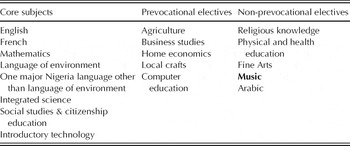
In the new National Policy on Education (1998), secondary school education is given in two stages: the junior secondary school (JSS) and the senior secondary school (SSS). At both levels, the curriculum accommodates music as a subject. However, the curriculum subjects are grouped into core subjects (compulsory), prevocational electives and non-prevocational electives. Table 1 contains the subject groups for the junior secondary school.
Junior secondary school (JSS) subject groups

Each student is expected to offer a minimum of 10 and maximum of 13 subjects, inclusive of all the core subjects and at least one subject each from prevocational and non-prevocational groups.
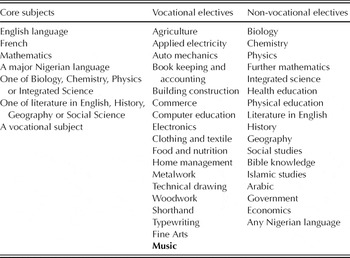
At the senior secondary school level the subjects are grouped as shown in Table 2.

Each student is expected to offer seven core subjects, a minimum of one and a maximum of two subjects from vocational and non-vocational electives. However one of the electives may be dropped in the last year of the senior secondary school.
In JSS 1, the student is introduced to the study of music through singing of Nigerian folk songs, rudiments of music, music appreciation and listening to the music of various composers in music history. Creative music making and learning to play simple percussion instruments to accompany songs and dances and playing simple melodies on instruments like the piano, xylophone and recorder are also included. In JSS 2 and JSS 3, musical training continues along these lines but at a higher level to include sight reading and sight singing, listening to familiar pieces by Bach, Handel, Mozart, Haydn as well as Nigerian composers like Fela Sowande, T.K.E. Phillips, Akin Euba, Ayo Bankole, Meki Nzewi, Laz Ekwueme, Adam Fiberesima, W.W.C. Echezona, Sam Akpabot, Sam Ojukwu and others. The junior school curriculum stipulates that every child must learn to play a musical instrument within 3 years and should take Royal Schools of Music theory examinations. The senior secondary school syllabus also includes the study of history, theory, creative and practical music.
At the tertiary level we have the colleges of education, the polytechnics and the universities. There are three colleges of education which offer the National Certificate of Education (N.C.E.) programme in various subjects in Kwara state. These are College of Education Ilorin, College of Education Oro and College of Education (Technical) Lafiagi. Up until 2008, only the College of Education Ilorin had music in its academic programmes. The college was established in 1974 and music was introduced in 1982/83 session. However as at the time of writing this paper in 2009, music has been introduced also to College of Education Oro, while College of Education (Technical) Lafiagi still has no department of music.
The National Commission for Colleges of Education (NCCE) which is the official regulatory body for colleges of education in Nigeria stipulates the objectives of the NCE music programme as to:
i. offer courses in African and Western European music;
ii. produce music teachers for primary and junior secondary school levels;
iii. produce teachers for the private sector, churches, mosques, armed forces, media houses, advertising companies and so on;
iv. produce teachers who are capable of benefiting from further education in music;
v. promote cultural continuity. (NCCE, 2002, p. 46)
The NCCE programme is usually three or four years, depending on the mode of entry. The entry qualifications are a credit or ordinary pass in English and any two arts subjects. Credit pass in music is not compulsory for admission though the NCCE regulation specifies that two of the credit passes must be relevant to the proposed course of study. Candidates are however expected to have a basic knowledge of music at the JSS level and also to undergo a departmental audition before admission. Music is offered as a single major in combination with a second subject approved by the college. Students are free to teach either of the subjects during teaching practice and on graduation. Each student is supposed to enrol for and pass the following (NCCE, 2002, p. 50):
Education courses - 36 credit units
General courses - 14 credit units
Teaching practice - 6 credit units
Music courses - 44 credit units
Second teaching subject - 37 credit units
Total credits for graduation - 137 credit units
Music courses include theory of music, history, music education, applied music, music technology, choral studies, African music and dance studies.
Out of the three universities and the state-owned polytechnic in Kwara State, music is taught only in the department of the performing arts at the University of Ilorin. Established in 1975, the University of Ilorin was one of the seven tertiary institutions set up by the federal military government of Nigeria as part of the educational focus of the Third National Development Plan. The department of performing arts was established in 1982 and the first head of department was Professor Atta Annan Mensah, a Ghanaian musicologist.
At the department of the performing arts, music is taught as part of a tripartite course which comprises music, dance and drama as areas of emphasis. A Credit pass in music at the secondary school level is not compulsory for admission, though it is an added advantage. The department also admits NCE and National Diploma graduates in music as well as certificate holders of the Royal Schools of Music (ABRSM) and the Musical Society of Nigeria (MUSON). The nomenclature for the degree is however Bachelor of Arts (B.A.) in the performing arts. Music courses are compulsory for 100 (first year) and 200 (second year) level students. These include fundamentals of music, theory of music, history of music (African and European), African music and choral studies. Students must specialise in any of the three areas of the performing arts at 300 (third year) and 400 (fourth year) levels. Courses for music specialists at the 300 and 400 levels include harmony and counterpoint, orchestration, form and analysis, music ensemble, musicology, Afro-American music, history of music and applied music.
Assessment of music programmes in secondary schools
Having listed the plans and objectives of music programmes in secondary and tertiary institutions in the state, my research went further to assess how far these goals and objectives have been achieved against the broader framework of formal music education in Nigeria. My assessment of music in secondary schools is based on students’ enrolment and performance, teachers’ expertise, availability of musical instruments and instructional aids and other related areas as stipulated in the curriculum by the regulatory bodies such as the West African Examination Council (WAEC) and the Nigerian Educational Research Council (NERC).
Students’ enrolment and performance
My study revealed that out of a total of about 280 secondary schools in Kwara state in 2004, only 18 schools offered music as a curricula subject and they did so only at the junior secondary school (JSS) level (Emielu, Reference EMIELU2004). This figure represented a mere 6.4% of the total number of secondary schools in Kwara state. Out of this number, private and voluntary agency schools accounted for 67%, the state government 22% and the federal government 11%. It was also observed that most students who enrolled for music did so at the JSS 1 and JSS 2 levels only. Music was frequently dropped by students in the final year of the junior secondary school. Kwara State JSS 3 final examination enrolment for 2001 and 2002 showed that only 31 students from the Anglican Grammar School Ilorin registered for music out of a total of 20 472 candidates that enrolled for the examination in the state. In 2002, only the Anglican Grammar School and Queen Elizabeth School Ilorin registered students for the final JSS examination in music. Fifty-four students out of this number came from the Anglican Grammar School Ilorin, while three students came from Queen Elizabeth School, Ilorin (Ministry of Education, Ilorin).
Attempts were made to investigate the reasons for this poor enrolment figure through personal interactions with teachers. Most teachers complained of a high student/teacher ratio as well as lack of encouragement on the part of the schools’ administration. In most of these schools, only one music teacher teaches JSS 1 to JSS 3 classes which in government schools, may run into hundreds of students. It becomes very difficult to adequately prepare the students for theory and practical courses for the JSS 3 examination. While in recent times the situation has hardly improved in government secondary schools, there are commendable efforts by some new international and private schools in the state to introduce music as a subject. As at March 2009 when I visited, Romeichs International School and Eucharistic College had already started running their music programmes, while Sapati International School and Mollys School Ilorin were in the process of recruiting music teachers and introducing music as a curricula subject.
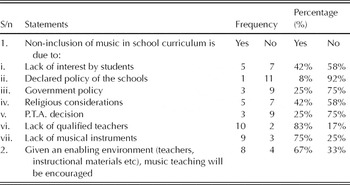
This research has also shown that no secondary school offers music as a curricula subject at the senior secondary school (SSS) level. Twelve principals of such schools were sampled randomly and administered questionnaires for possible reasons for the non-inclusion of music in their school curriculum. Their responses are shown in Table 3.
School principals’ responses to non-inclusion of music as a curricular subject

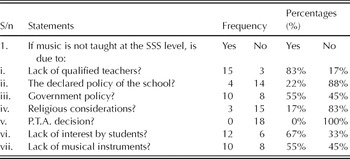
In other schools that offer music at the JSS level but not at the SSS level, 18 principals of such schools were randomly selected and questionnaires administered to them. Their responses are shown in Table 4.
School principals’ responses to non-inclusion of music in SSS classes

It was also discovered from this study that secondary schools that offer music are concentrated in Kwara Central and Kwara South Senatorial Districts occupied mainly by the Yoruba-speaking people. No school located in Kwara North occupied mainly by the Nupe, Fulani and Baruba ethnic groups offer music. These areas are parts of the Islamic Emirates of Patigi, Lafiagi, Shonga and Nupe. It is not exactly clear why music is not taught in schools in these Muslim-dominated areas. However, Adegbite's (1989) submission that Orthodox Muslims perceive music as associated with paganism, immorality, drunkenness, sexuality, gambling and directly linked with the devil hence its exclusion from Islamic liturgy and Islamic schools seems a probable explanation.
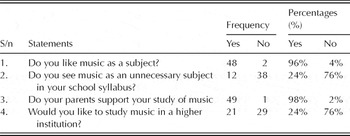
In terms of students’ interest in music as a subject as it affects students’ enrolment for the JSS 3 examinations, 50 students were randomly sampled and given questionnaires. Their responses shown on Table 5 suggest that students love music as a subject, though not necessarily as a career preference. Again, at the junior secondary school, students are allowed to drop two elective subjects in JSS 3 and music is dropped most frequently.
Students’ interest in music as a subject in secondary schools

From the responses above, it is clear that most students love music as an art and as a subject yet, there is no direct relationship between indication of interest and enrolment for music as a curricula subject. What one can approximate from this picture is that other factors other than sheer interest are responsible for low enrolment figures.
Teachers’ expertise
I observed from my study that students’ enrolment for music is seriously hampered by lack of adequate and qualified teachers at the various levels. I observed also that the high job mobility of music teachers affect students’ enrolment for music as a subject. Consequently, music is offered when there is a teacher (usually one teacher to a school). But if the teacher resigns or is transferred, a vacuum is created and the subject is abandoned till another music teacher is recruited. The time lag may be several sessions or terms. Consequently, students’ interest may not be sustained. In government schools, it is a common practice to transfer music teachers to schools where music is not taught as a curricula subject. In such cases, the teacher is made to teach other subjects instead of music. High job mobility of teachers was also the reason given by Mr During, principal of Alade Comprehensive High School Ajase-Ipo for the non-inclusion of music as a curricula subject in his school. In his words, ‘music teachers are hard to come by, hard to keep and hard to replace’.
Several ‘push’ and ‘pull’ factors are involved in discussing the high mobility of music teachers in the state. In government-owned schools especially, low wages, high teacher-to-student ratio, complete absence or inadequate teaching materials, musical instruments and instructional aids constitute significant ‘push’ factors for serious-minded music teachers. On the other hand, the fast-growing number of ‘international schools’, with fewer students, fairly well-equipped music studios, higher wages, institutional support and encouragement, well-defined educational goals and objectives both within and outside Kwara State, constitute ‘pull’ factors for career-minded music teachers. As at 2002/2003 session when I first carried out my initial field work, there were just about 20 music teachers in all the secondary schools in the state. Out of this number five were employed on a part-time basis. In terms of qualifications four teachers out of the total above had Bachelor of Education (B.ED.) degree, three holders of Bachelor of Arts (B.A.) degree in music, one Higher National Diploma (HND) in music technology, 11 NCE holders and one Grade V (ABRSM) certificate holder (Emielu, Reference EMIELU2004, p. 164).While a few more teachers have been recruited since then, some others have also left the state for greener pastures and it is highly probable that those newly recruited may not stay too long based on the reasons given above.
Since the National Policy on Education restricts NCE graduates to teaching in primary and junior secondary schools, this may be one reason why schools that have NCE music teachers may not commence teaching music at the senior secondary school level. Lack of qualified teachers was also one of the major reasons given by most school principals for the non-inclusion of music in the SSS classes in their schools as responses of school principals have shown in Table 4.
Availability of musical instruments and instructional aids
It was discovered in my research that out of 18 secondary schools offering music in the state as at 2004, only eight had some musical instruments, while 10 had none at all. However, some of the new international and private schools like Romeichs and Eucharistic Colleges have fairly well-equipped music studios as I saw during my field trip in March 2009. In all the schools I visited in 2002/2003, there were no facilities for listening, neither were there audio-visual aids such as recorded tapes, CDs, video tapes and training charts for teaching music as recommended in the school curriculum. Without these instructional aids, students will not be able to relate theory to practice. This runs counter to the benchmark of the Nigerian Educational Research Council (NERC) (1980, pp. 10–11) which stipulates that ‘the provision and effective use of instructional materials, equipment and laboratories for the various courses constitute the most important characteristic of secondary education’.
Assessment of music programmes at the College of Education Ilorin
Students’ enrolment/performance
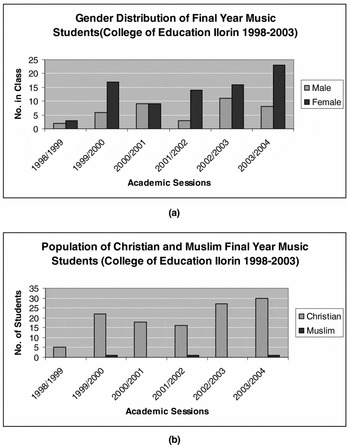
From as few as five students in 1982, the total population of music students (Pre-NCE to NCE 3) in 2002/2003 session was 108. In my discussion with the head of department, he expressed satisfaction with students’ enrolment both in terms of number, gender and religion. He is of the opinion that since music is a single major subject in the department, it might have affected students’ enrolment, especially as they can combine music with a second subject and are free to teach either of them on graduation. However, given the fact the college is a state government institution and the seemingly predominant Muslim population of Kwara state, I went further to examine the twin issues of gender and religion as they affect students’ enrolment. The data elicited are shown in Fig. 1.
Gender distribution and Christian/Muslim population of music students at College of Education Ilorin

From the statistics given above, it is obvious that more females enrol for music as a course than males. No reason was adduced for this gender inclination in my research though it is highly probable that their Christian background and participation in church choirs and singing groups may be a factor of influence for females. From my experience in recording various church choirs in the state since the late 1980s, I can attest to the fact that there are more female than male choristers in Kwara State. Again, that the number of Christian students far outnumber Muslims suggests that music as a subject, may be associated with Christianity. It may also mean that music taught in schools does not reflect the socio-religious realities of the host environment.
However, since the College of Education, Ilorin seems to be the only ‘supplier’ of music teachers to primary and junior secondary schools in the state, low enrolment figures will also mean short supply of teachers. This may be a major reason why most junior secondary schools do not offer music as a curricula subject, especially since recruitment of teachers is usually on state basis except for federal schools.
Teachers’ expertise and availability of instructional materials
In terms of musical instruments, staff and other facilities, the NCCE stipulates that each department of music must have among other things, 10 or more upright pianos in classrooms, practice cubicles, ensemble room and staff offices; about half a dozen or more of practice cubicles each equipped with a piano or electronic keyboard. Added to these are the provision of a wide range of Western orchestral and African traditional musical instruments and a minimum of five to six lecturers for single major and eight lecturers for double major (NCCE, 2002, pp. 47–49). However, it was observed in this research that facilities on the ground as at 2004 were a far cry from the benchmark above and understandably so. For example, a good upright classroom piano in Nigeria costs as much as about five hundred thousand naira (N500 000), while orchestral and other dance band instruments are equally expensive. The music department had only three academic staff on the ground as opposed to the five to six staff required for single major programme by the NCCE. Given the low level of funding and government special focus on science and technology education, it is understandable why most departments of music in government schools may not meet this benchmark.
However, a significant attempt was made by the college authority to provide various facilities including a new office complex, performance hall, some musical instruments and practice cubicles in 2008. Yet, this emerging scenario is currently being threatened by a new move to change the college to a university with music not provided for in the new arrangement. If implemented, this move will further cut short the supply of music teachers to primary and junior secondary schools in the state.
Assessment of music programmes at the University of Ilorin
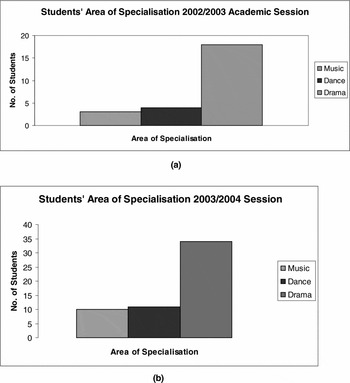
The university is the highest level in the vertical structure of the educational chain in Nigeria as in most parts of the world. The university student population is therefore, fed from graduates of the lower levels both in number and cognition. As expected, poor student enrolment for music at the lower levels among other things, translates into poor enrolment figures at the university level. A breakdown of students’ area of specialisation in the department of the performing arts, University of Ilorin in 2002/2003 and 2003/2004 session attests to this (Fig. 2).
Performing arts students' areas of specialisation, University of Ilorin

Additionally, only one student specialised in music in the 2006/2007 session, while in 2007/2008 and 2008/2009 sessions, only two students each specialised in music. One reason adduced for this low figure according to the head of the music unit, is the poor musical background of students enrolling for the programme. My observation in classroom situations over the past eight years as well as responses from most students interviewed confirmed this assertion. Consequently, most students find it difficult to cope with technically demanding music courses at the 300 (third year) and 400 (fourth year) levels. The study further revealed that the technical nature of music and dance scares most students from specialising in these areas hence most students opt for drama which, though involving some technicalities, comes more naturally to them. This explains in part why in each academic session, students majoring in drama always outnumber those for dance and music as shown in the statistics above. However, the music unit of the department has a reasonable collection of Western musical instruments, few traditional instruments, about 150 music books and but only two full-time staff as at 2008.
Some issues in music education in Nigeria
Most of my findings in this research are symptomatic of the nature and realities of music education in Nigeria. Coupled with research findings and published articles by scholars on music education in Nigeria, notably Sowande (Reference SOWANDE1967), Adegbite (Reference ADEGBITE1989, Reference ADEGBITE and Obidike2001), Faseun (Reference FASEUN and Obidike2001), Adesokan (Reference ADESOKAN1997), Obidike (Reference OBIDIKE2001a, Reference OBIDIKE and Obidike2001b), Nzewi (Reference NZEWI1988) and Idolor (Reference IDOLOR1993, Reference IDOLOR and Obidike2001), I will now proceed to discuss some critical issues as they affect the delivery of an effective music education system in Nigeria.
The school curricula and bi-musicality
By virtue of Nigeria's colonial history, having been colonised by Britain from 1861 when Lagos became a British colony, to 1 October 1960 when Nigeria became an independent nation, the issue of bi-culturalism with its attendant paradox of alienation and enculturation continually confronted both local and educated Africans. As Mudimbe (Reference MUDIMBE1988) has rightly noted, colonialism and European contact brought in its wake a dichotomy of systems: the traditional versus the ‘modern’; oral versus the printed; ‘educated’ versus ‘uneducated’ which in his view, has broken down the culturally unified schema of African traditions. Reclaiming the African consciousness or better still, forging this dual identity into a composite whole has been a major issue in African arts, politics, economy and education. This phenomenon has produced a crisis of perspectives or what may be described as ‘perspective tangle’. It is within this nexus of dual cultural identities that the issue of bi-musicality can be truly located and discussed in the light of our colonial history in Nigeria.
Coined by Mantle Hood, an ethnomusicologist at the University of California, bi-musicality as a concept stresses musical literacy in both one's own culture and Western music. Consequently, various Nigerian scholars have stressed the need for bi-musicality in our music education programmes, sometimes suggesting frameworks within which the system can work. For example, Fela Sowande outlined a model which combines field research into Nigerian folklore, traditional music, poetry and dance with publications of music books derived from such researches, as well as a synthesis of formal and informal processes in the training of musicians (Sowande, Reference SOWANDE1967). Nzewi (Reference NZEWI1988, p. 21) states categorically that ‘our traditional music heritage offers immense possibilities for original approaches to the study of theory, compositional forms, musical structures and developmental techniques’ while Obidike (Reference OBIDIKE2001a, p. 32) laments that ‘the modern school system has not been able to provide an alternative way of imparting traditional musical knowledge’. To her, the alternative way lies in comprehensive research and documentation of traditional music (p. 32) and a re-education that will make traditional musical idioms a significant part of the vocabulary of the compositional and performance techniques of the music student (Obidike, Reference OBIDIKE and Obidike2001b, pp. 155–156).
The need for bi-musical curricula at the various levels of education in post-colonial Africa was re-echoed at various regional and national conferences and symposia. Notable among them are the conference of Music Association of Nigeria held in 1965 at Nigeria's first indigenous university, the University of Nigeria, Nsukka, International Conference on Music Education, Lusaka, Zambia in 1971, symposium on African and Afro-American Music held at the Institute of African Studies, University of Ghana in 1972 and the 1st National Conference of Nigerian Association of Music Educators hosted by the department of music, College of Education Akwa, Nigeria in 1987 among several others. Arising from these conferences, bi-musicality was given an official government stamp in Nigeria when it was incorporated into the curricula for music at both the secondary and tertiary levels of education in the country as reflected in the documents of the regulatory bodies like the West African Examination Council, National Council for Colleges of Education (NCCE) and the National Universities Commission (NUC). However, I want to lend my voice to some of Obidike's pertinent questions: ‘what has been achieved so far in African music education? Considering the new impetus given to it in the 1960s and 1970s, what are the results of the recommendations made at several conferences and symposia? If there were changes, they would be manifested in the works of music graduates in Africa’ (Obidike, Reference OBIDIKE and Obidike2001b, p. 152).
As this research and some by other scholars have shown, bi-musicality exists more in principle than in practice in Nigeria. Various reasons can be adduced for this. First, although significant documentations and recordings of indigenous Nigerian music were carried out especially in the days of the Nigerian Broadcasting Corporation (NBC) which had such trained musicians as Fela Sowande and Steve Rhodes as directors of music at some points in time, such researches were not translated into educational texts and resource materials for teaching purposes. In Ghana for example, musicologists like Dr Ephraim Amu, Professor Kwabena Nketia, Kongo Zabana, John Collin and others have not only done extensive research on traditional Ghanaian music and musical instruments, they have also gone ahead to make these research findings and documentations an integral aspect of teaching and learning materials. This is in line with government policy of ‘African music renaissance’ since the days of the late president Dr Kwame Nkrumah. As I observed during a research trip to Accra in 2008 and during the 2010 conference of the Pan African Society for Musical Arts Education (PASMAE) in Winneba, Ghana, there is a very close working relationship and musical collaboration between traditional musicians of various ethnic groups and music educators and musicologists within the academy in Ghana. This synergy of perspectives seems to provide an endless well of stylistic possibilities and cross-fertilisation of ideas on bi-musicality in music education in Ghana. The Nigerian situation is a far cry from the above.
Most research into traditional music and musical instruments in Nigeria has been necessitated in pursuit of academic degrees or as publications needed for promotion and career advancement in academic institutions. Even with Nigerian art composers who combine Western and traditional musical resources, publication of compositions as printed music scores for educational purposes have either not been given priority or Nigerian scholars and publishers have not taken advantage of modern technology in music printing and dissemination. Of course, Nigerian academics have continually agitated for better funding of the university system which includes better funding of research activities and publications. With poor funding and lack of interest in research for development by the government and its agencies as it is now, the attainment of the goals of an effective and sustainable bi-musical music education programme can only be best imagined.
Again, there is the problem of perspective tangle. Most of the music educators in Nigeria were either trained in Western universities and music conservatoires abroad or trained locally based on Western perspectives of music and musicology. To most observers and critics in Nigeria, the idea of bi-musicality is lopsided, reflecting more of European concepts, theories, forms and aesthetic benchmarks while forcing African music to adapt its structure, analysis and aesthetic appreciation. It is my contention that if African music is to be on an equal footing with Western music in the musical equation of bi-musicality, then African music must be taught from a purely African perspective, developing in the process its theories and concepts, notational methods as well as standardized tuning procedures and aesthetic philosophies.
The vertical relationship between levels of education
There is a structural defect in the vertical relationship between the music programmes at the various levels in the educational chain as this research has shown. Gaps will exist in the student's capacity building process and in the cognitive levels of learning behaviour if certain levels of learning are omitted between JSS and SSS levels; between SSS and NCE levels; between SSS and university levels and between NCE and university levels. It is important therefore, that learning behaviour should begin at the very basic level of knowledge or recall in the cognitive domain and go all the way through the various levels of comprehension, application, analysis, synthesis and evaluation. This is why it is important to have an unbroken chain in the vertical structure of music education at the various levels of schooling where the student progresses from the very basic level of knowledge at the JSS level to the levels of analysis, synthesis and evaluation at the higher levels of education.
Formal versus informal music education
The bias of government educational policies in favour of core science and science-based disciplines is a significant issue that will continue to affect the listing of music as a core subject in the junior and senior secondary schools. It has also affected the establishment of new departments of music and adequate funding of existing ones in tertiary institutions. At present, only about 30 tertiary institutions out of over 60 colleges of education, 44 polytechnics, 27 federal universities, 31 state universities and over 30 private universities in Nigeria that offer music as course (Idolor, Reference IDOLOR and Obidike2001, pp. 138–140). This is usually in the faculty of arts, with the exception of The Polytechnic, Ibadan which offers courses in music technology. No Nigerian university has a faculty of music or offers the Bachelor of Music (B.Mus.) programme. Yet Nigerians have great love for music and the informal sector has continued to produce more skilled and creative musicians than the school system.
In today's Nigeria for example, the Church remains a good training ground for both gospel and popular musicians who are attracted more to practical musicianship than to the academic and institutional rigours of formality, obsolete and culturally irrelevant musical concepts and forms. The preference for informal music education which I have observed in my 25 years of working with musicians in western and central Nigeria is a significant issue which should be addressed in repositioning music education for the global cultural challenges ahead. That popular music is still not in the mainstream of the school music curricula today despite its popularity in terms of practice and patronage, portrays the inadequacy of the formal processes of music education in meeting societal musical needs in Nigeria. As I stressed in the Ghanaian example earlier, there should be a synergy of perspectives between the formal and the informal processes of music education. As Hawes (Reference HAWES1979, p. 161) rightly observed, ‘it has become increasingly obvious that current school systems and their curricula can never suffice to give people the knowledge, skills and attitudes needed in a world of change’.
Christian roots of music education
While we must acknowledge the Christian roots of music education in Nigeria through the arrival of various Christian missions with their penchant for hymn singing, there is the need to change this perception in contemporary times. Music is a human behaviour in particular cultural and geographical contexts, not necessarily as a product of religion. The perception of music as a Christian subject especially in northern Nigeria as this research has revealed, explains largely why in the geographical distribution of music departments both in Kwara state and in Nigeria generally, over 90% of them are concentrated in the southern parts. These areas had early contacts with Christianity and missionary education which began in the late 19th and early 20th centuries. However, for music in schools to be attractive to a cross-section of Nigerians irrespective of religious bias, it should shed a significant part of its colonial/church legacy and focus more on meeting the musical needs of the host environment. In other words, an African music education delivery system must strive to reflect our diverse socio-religious configuration and economic needs. One way to do this is to introduce popular music into the music curriculum, most importantly because of its social/non-religious nature, its contemporary relevance and commercial viability.
Summary and conclusion
This paper examined my research findings on music education in Kwara state of west-central Nigeria where I have lived and worked as a musician and researcher in and out of the school system in the past 25 years. Some research findings and submissions by other scholars on music education in Nigeria have also been examined. My research findings are in significant ways symptomatic of the general picture of formal music education in Nigeria. Using these findings as a spring board, I did raise a number of contentious issues to which I have also provided new perspectives in tackling them. My findings are that while the goal of music education in Nigeria is quite commendable, its effective delivery is hampered by a lack of proper implementation and the perspective tangle of the concept of bi-musicality, inadequate research-based teaching and learning, poor students’ enrolment, government bias in favour of science and science-based disciplines and poor social perception of music as a subject. The paper concludes that whilst a good deal of rhetoric has been expended at national and international conferences and symposia, not much has been achieved in terms of evolving a truly Nigerian music education framework. The concept of bi-musicality is still lopsided because Nigerian music is still being studied from Western perspectives. The resultant effect is that until significant musical theories and conceptual approaches emerge from extensive fieldwork into Nigeria's diverse musical cultures, it will be difficult to develop an authentic and functional music education framework in Nigeria. Again, until Nigerian music education sheds its colonial/church dualism in concepts and precepts, music in schools will continue to be perceived as a Christian subject which may be unattractive to adherents of alternative religions.
Recommendations
Better funding for the educational sector generally, and music departments specifically, is fundamental. The Federal Government's recent approval of 47 billion Naira as a special intervention fund for some tertiary institutions in Nigeria can be seen as a step in the right direction (see The Punch, Wednesday 22 April 2009, p. 8). What remains is the prudent management of these funds by heads of educational institutions so as to achieve government objectives. External funding/technical assistance by such international bodies as the United Nation Educational Scientific and Cultural Organization (UNESCO), The Associated Board of the Royal Schools of Music (ABRSM), the British Council and the International Association for the Study of Popular Music (IASPM) among several others will greatly enhance the development of music education and capacity building in Nigeria. The British Council in Nigeria has demonstrated in recent times its interest in the development of music in Nigeria with the introduction of the International Young Music Entrepreneur Award where a Nigerian, Cobhams Asuquo won the 2009 edition (see The Guardian on Sunday, 19 April 2009, p. 44). More efforts are needed in this direction especially as regards the actual training of these musicians in educational institutions. There is also an urgent need to establish private music conservatoires across the country. These will cater for specific areas of specialisation and also increase the supply of learned musicians to schools and other establishments.
The need for a paradigm shift in government 60/40 policy on science and humanities-based courses is important also. The arts pre-date science and the humanities is the mother of science. Government educational policies should reflect the natural endowment and comparative advantage of its peoples rather than pursuing an imported agenda which in the true sense of development leaves much to be desired.