Introduction
Psychotic experiences (PEs) are reported by a significant minority of adolescents, with an estimated prevalence of 7.5% of adolescents in non-clinical populations (Kelleher et al., Reference Kelleher, Connor, Clarke, Devlin, Harley and Cannon2012a). PEs are associated with elevated risk of suicidal behaviours (Kelleher et al., Reference Kelleher, Lynch, Harley, Molloy, Roddy, Fitzpatrick and Cannon2012b; Yates et al., Reference Yates, Lang, Cederlof, Boland, Taylor, Cannon and Kelleher2019), risk of development of schizophrenia and other psychiatric disorders in adulthood (Fisher et al., Reference Fisher, Caspi, Poulton, Meier, Houts, Harrington and Moffitt2013; Healy et al., Reference Healy, Brannigan, Dooley, Coughlan, Clarke, Kelleher and Cannon2019; Trotta et al., Reference Trotta, Arseneault, Caspi, Moffitt, Danese, Pariante and Fisher2019) and of persistently poorer functioning through to early adulthood (Healy et al., Reference Healy, Campbell, Coughlan, Clarke, Kelleher and Cannon2018). Previous research based on a large community sample of Irish adolescents identified associations between PEs and a range of factors including depression, low self-esteem, low optimism, school misconduct and avoidant coping (Dolphin, Dooley, & Fitzgerald, Reference Dolphin, Dooley and Fitzgerald2015). Associations have been reported between PEs and mental disorders including attention deficit hyperactivity disorder (Hennig, Jaya, & Lincoln, Reference Hennig, Jaya and Lincoln2017), anxiety and depression (Armando et al., Reference Armando, Nelson, Yung, Ross, Birchwood, Girardi and Fiori Nastro2010) and substance misuse (Mackie, Castellanos-Ryan, & Conrod, Reference Mackie, Castellanos-Ryan and Conrod2011). Adverse life events, including childhood trauma and victimisation, have also been found to be associated with PEs (Crush, Arseneault, Jaffee, Danese, & Fisher, Reference Crush, Arseneault, Jaffee, Danese and Fisher2017; Kelleher et al., Reference Kelleher, Keeley, Corcoran, Ramsay, Wasserman, Carli and Cannon2013). Varese et al., in a meta-analysis of 36 studies, found that childhood adversity was overall associated with an almost 3-fold increased odds of psychotic symptoms or illness, including associations between psychotic symptoms and sexual abuse, physical abuse, emotional abuse and bullying. In the case of most studies examined, risk increased with each additional adversity (Varese et al., Reference Varese, Smeets, Drukker, Lieverse, Lataster, Viechtbauer and Bentall2012). A dose–response effect of accumulated adversity was also reported by Trauelsen and colleagues who suggest a large shared effect of adversities on risk of psychosis (Trauelsen et al., Reference Trauelsen, Bendall, Jansen, Nielsen, Pedersen, Trier and Simonsen2015).
The impact of childhood adversity appears to be dependent on the presence of other genetic or environmental factors (Morgan & Gayer-Anderson, Reference Morgan and Gayer-Anderson2016). A review by Williams and colleagues examined psychological mediators of associations between adversity and psychotic symptoms, concluding that there is evidence that associations between childhood adversity and psychosis are mediated by post-traumatic sequelae, affective dysfunction and dysregulation and maladaptive cognitive factors including self-esteem and beliefs about the self and others (Williams, Bucci, Berry, & Varese, Reference Williams, Bucci, Berry and Varese2018).
A small number of community surveys have investigated the correlates of PEs including a wide range of potential predictors but research examining protective factors such as personal resources including coping style has been lacking (Dolphin et al., Reference Dolphin, Dooley and Fitzgerald2015). Youth at ultra-high risk of psychosis report fewer close friends, less diverse social networks, less perceived social support, poorer relationships with family and friends and more loneliness than their peers (Robustelli, Newberry, Whisman, & Mittal, Reference Robustelli, Newberry, Whisman and Mittal2017). Greater social support was found to be protective against adolescent PEs in a longitudinal UK study (Crush et al., Reference Crush, Arseneault, Moffitt, Danese, Caspi, Jaffee and Fisher2018). A recent study examining the mediating effect of parent–child relationships on associations between adversity and psychopathology found that parent–child conflict explained almost half the relationship between adversity and persisting externalising problems in adolescence and a fifth of the relationship with persisting internalising problems (Dhondt, Healy, Clarke, & Cannon, Reference Dhondt, Healy, Clarke and Cannon2019). As few modifiable protective factors have been identified to date, further investigation of the possible mediating role of family relationships and coping style among non-clinical samples of young people is warranted.
Our objectives were to examine the correlates of PEs in a general population sample of Irish adolescents, including factors from three domains: mental health measures; adverse life events and lifestyle factors and protective factors including parental support and coping style. A second aim was to examine whether associations between adversity and PEs were mediated by parental support and/or coping style.
Method
Cross-sectional data were drawn from the Irish centre of the Saving and Empowering Young Lives in Europe (SEYLE) study (Wasserman et al., Reference Wasserman, Carli, Wasserman, Apter, Balazs, Bobes and Hoven2010). The SEYLE trial is registered at the German Clinical Trials Registry, number DRKS 00000214. Participants were recruited from 168 schools in 10 European countries (Austria, Estonia, France, Germany, Hungary, Ireland, Italy, Romania, Slovenia and Spain) and the trial evaluated school-based interventions; mental health awareness, professional screening and gatekeeper training, for prevention of suicidal behaviour. Schools in the study regions were included if they were public, a minimum of 40 students aged 15 were enrolled and no more than 60% of students were of the same sex. All students in participating classes were included. The study was approved ethically by the European Commission. Ethical approval was also obtained in each participating country, including from the Clinical Research Ethics Committee of the Cork Teaching Hospitals in Ireland. An independent ethical advisor supervised the implementation of the ongoing project to ensure maximum protection of vulnerable individuals. In Ireland, 24 schools in Counties Cork and Kerry were approached based on random selection and 17 schools took part in the study. Of the 1602 students invited to participate, 1112 took part (a response rate of 69%). At 12 month follow up, 973 participated (87.5% of the original sample). Full details of trial methodology, consent procedures, response rates and representativeness of the sample have been reported elsewhere (Carli et al., Reference Carli, Wasserman, Wasserman, Sarchiapone, Apter, Balazs and Hoven2013). Questions on PEs were included in the study protocol for the Irish SEYLE centre only; therefore, the current analyses were based on the Irish site only. Full information on the study was provided to students and their parents and participation was by assent, with both parents and students given the option to decline to participate.
Data collection
Students were administered a self-report questionnaire in their classroom, which included well-established instruments and several items developed for the SEYLE study (Wasserman et al., Reference Wasserman, Carli, Wasserman, Apter, Balazs, Bobes and Hoven2010). Local teams were uniformly trained in the study procedure. Adherence to study procedures and quality control was monitored through site visits and questionnaires. Data were entered at each site following double data entry procedures.
Measures
Psychotic experiences
PEs were assessed in the Irish SEYLE centre only, using the 7-item Adolescent Psychotic Symptom Screener (APSS) (Kelleher, Harley, Murtagh, & Cannon, Reference Kelleher, Harley, Murtagh and Cannon2011). This instrument is comprised of the following items, with possible responses ‘No, never’, ‘Maybe’ and ‘Yes, definitely’ during past 12 months:
• Have other people ever read your mind?
• Have you had messages sent to you through TV or radio?
• Have you ever felt that you were under the control of some special power?
• Have you ever heard voices or sounds that no one else can hear?
• Have you ever seen things that other people could not see?
• Have you ever felt that you have extra-special powers?
• Have you ever thought that people are following you or spying on you?
The APSS has previously been found to have good sensitivity and specificity for identifying PEs in non-clinical populations (Kelleher et al., Reference Kelleher, Harley, Murtagh and Cannon2011). In line with the APSS validation study findings, for the current study, those scoring 2 or above were categorised as ‘at risk’ of PEs (Kelleher et al., Reference Kelleher, Harley, Murtagh and Cannon2011).
Parental support
Parental support was assessed using the following items from the Global School-Based Pupil Health Survey (WHO, 2009), with possible responses of ‘Rarely/Sometimes’ and ‘Often/Always’: ‘Parents check if my homework is done’; ‘Parents know how I spend my free time’; ‘Parents take time to talk about life’; ‘Parents help me to make decisions’; ‘Parents come to see me in a performance/play/sport’ and ‘Parents pay attention to my opinion’.
Coping style
To assess coping style participants were asked whether they frequently used each of the following five strategies when faced with a problem, with responses ‘Rarely/Sometimes’ and ‘Often/Always’: Learn as much as possible; Get into fights; Do athletics or aerobic sports; Draw, paint, write or compose; Talk with a parent, teacher or professional.
Mental health measures
The Strengths and Difficulties Questionnaire (SDQ) was used to assess emotional and behavioural difficulties. The SDQ is a brief measure of psychopathology which can be self-completed by children aged 11–16 (Goodman, Meltzer, & Bailey, Reference Goodman, Meltzer and Bailey1998). It has been validated in community samples in both developed and developing countries, and has been found to have good internal consistency, content, structural and concurrent validity in a range of ethnic groups (Paalman, Terwee, Jansma, & Jansen, Reference Paalman, Terwee, Jansma and Jansen2013) and good internal reliability in the Irish SEYLE sample (Carli et al., Reference Carli, Wasserman, Wasserman, Sarchiapone, Apter, Balazs and Hoven2013). The SDQ consists of 25 statements about the participant's behaviour in the past 6 months, consisting of 5 subscales with 5 items each: emotional, conduct, hyperactivity/inattention, peer problems and pro-social behaviour (Goodman, Reference Goodman2001). A Total Difficulties score is calculated by summing the four symptom sub-scales, with those scoring at the 90th centile or above considered at high probability of psychopathology (Ronning, Handegaard, Sourander, & Morch, Reference Ronning, Handegaard, Sourander and Morch2004). In this case those scoring above 15 on the SDQ total scale were categorised as having a probable disorder.
Depressive symptoms: Severity of depressive symptoms was measured using the Beck Depression Inventory II (BDI-II) (Beck, Steer, Ball, & Ranieri, Reference Beck, Steer, Ball and Ranieri1996). Items of this instrument assess specific symptoms of depression experienced over the preceding 2 weeks. Each question was scored from 0 to 3, indicating the severity of the symptom, with total scores ranging from 0 to 60. Cronbach's alpha in our sample was 0.872, indicating good internal reliability (Carli et al., Reference Carli, Wasserman, Wasserman, Sarchiapone, Apter, Balazs and Hoven2013). The reliability and validity of the BDI-II have been confirmed in clinical and community samples of adolescents (Byrne, Stewart, & Lee, Reference Byrne, Stewart and Lee2004; Osman, Kopper, Barrios, Gutierrez, & Bagge, Reference Osman, Kopper, Barrios, Gutierrez and Bagge2004). The BDI-II includes an item measuring loss of libido which was excluded from the SEYLE questionnaire as it is considered inappropriate for adolescents in some cultural settings (Byrne et al., Reference Byrne, Stewart and Lee2004). Participants scoring 14 or higher on the BDI were categorised as having mild, moderate or severe depressive symptoms (Schulte-van Maaren et al., Reference Schulte-van Maaren, Carlier, Zitman, van Hemert, de Waal, van der Does and Giltay2013).
Anxiety symptoms: Symptoms of anxiety were assessed using the Zung Self-Rating Anxiety Scale (SAS) (Zung, Reference Zung1971), a 20-item self-report questionnaire. Responses to each item range from 1 to 4 with scores ranging from 20 to 80. Higher scores indicate increased levels of anxiety. Cronbach's alpha in our sample was 0.821, indicating good internal reliability (Carli et al., Reference Carli, Wasserman, Wasserman, Sarchiapone, Apter, Balazs and Hoven2013). The SAS has been shown to have good reliability and validity in samples of undergraduate students (Olatunji et al., Reference Olatunji, Deacon, Abramowitz and Tolin2006). Participants scoring 45 or higher on the SAS were categorised as having mild, moderate or severe anxiety symptoms (McDowell, Reference McDowell2006).
Adverse life events
Individual items designed for the SEYLE study assessed a wide range of adverse events including bereavement, victimisation and problems with family and peers. Seven life events experienced in the past 3 months were examined, with possible responses Yes and No: trouble with bullies; theft of personal belongings; lower grades than expected; change of school; serious argument with a friend; minor violation of the law; alcohol or drug use by a family member. Three further life events were assessed for the past 12 months: having been physically attacked, having trouble with parents and death in the family. The number of adverse events reported by participants from this list of 10 was also computed.
Lifestyle factors
A range of lifestyle factors in the past 12 months with responses Yes and No was assessed using the following questionnaire items: ‘Have you used cannabis, hashish or marijuana?’; ‘Have you smoked cigarettes?’; ‘Have you drunk so much alcohol that you have been really drunk?’; ‘Do you play sport on a regular basis?’ ‘On how many days out of the past 14 days have you accumulated at least 60 min of physical activity?’. Responses of 4 + days to this question (two or more days’ activity per week) were categorised as physically active with those reporting less than 2 days per week categorised as inactive. The questionnaire also included the item ‘Do you eat breakfast before school?’ with responses ‘Often’ and ‘Always’ categorised as positive and ‘Rarely’ and ‘Never’ categorised as negative.
Pathological internet use (PIU) was assessed using the Young's Diagnostic Questionnaire (YDQ) (Young, Reference Young1998). The 8-item questionnaire has been found to be a reliable instrument for ascertaining pathological internet use among adolescents (Siomos et al., Reference Siomos, Dafouli, Braimiotis, Mouzas and Angelopoulos2008). The YDQ assesses patterns of internet usage that result in psychological or social distress. The 8-item score reflects eight of the nine criteria for internet gaming disorder in DSM-5; however, the YDQ allows for the assessment of all online activities. Based on the YDQ total score, internet users were categorised into two groups: adaptive internet users (scoring 0–2); maladaptive/pathological internet users (scoring 3 + ).
Statistical analysis
We calculated numbers and percentages of participants reporting each of the risk and protective factors examined. We computed crude odds ratios for membership of the group at risk of PEs for each variable.
Multivariate logistic regression models were constructed separately for each risk domain; lifestyle, adverse events and mental health factors and for the postulated protective factors (parental support and coping style) for which significant univariate associations with risk of PEs were found. The method used was backward with the usage of likelihood ratios. Models were adjusted for age, gender and trial arm.
A final multivariate model was constructed including variables which showed independent associations with risk of PEs in each risk domain examined. The probability for stepwise removal was set at 0.01. A low threshold for removal was set due to the large sample size giving adequate power and the fact that a wide range of variables were included with many statistically significant crude associations. All categorical variables entered in the model were dichotomous.
Based on literature indicating causal associations between adversity and psychopathology, potential mediating effects of parental support and coping factors on associations between adverse events and PEs were examined. Potential social support and coping mediators with significant associations with PEs in multivariate logistic regression were chosen. Mediation analysis was undertaken in line with Baron and Kenny's recommendations (Baron & Kenny, Reference Baron and Kenny1986). Logistic regression was used to investigate whether the number of adverse events reported predicted PEs (Table 1). Logistic regression was used to investigate whether adverse events predicted mediators: in all cases the predicted mediators were associated with reported adverse events. Logistic regression was used to investigate the association between mediators and PEs (Table 2). The Karlson, Holm and Breen method (Kohler et al., Reference Kohler, Karlson and Holm2011), which allows comparison of estimated coefficients of two nested non-linear probability models, was used in Stata 12 to decompose the effects of the mediators in this logistic regression model.
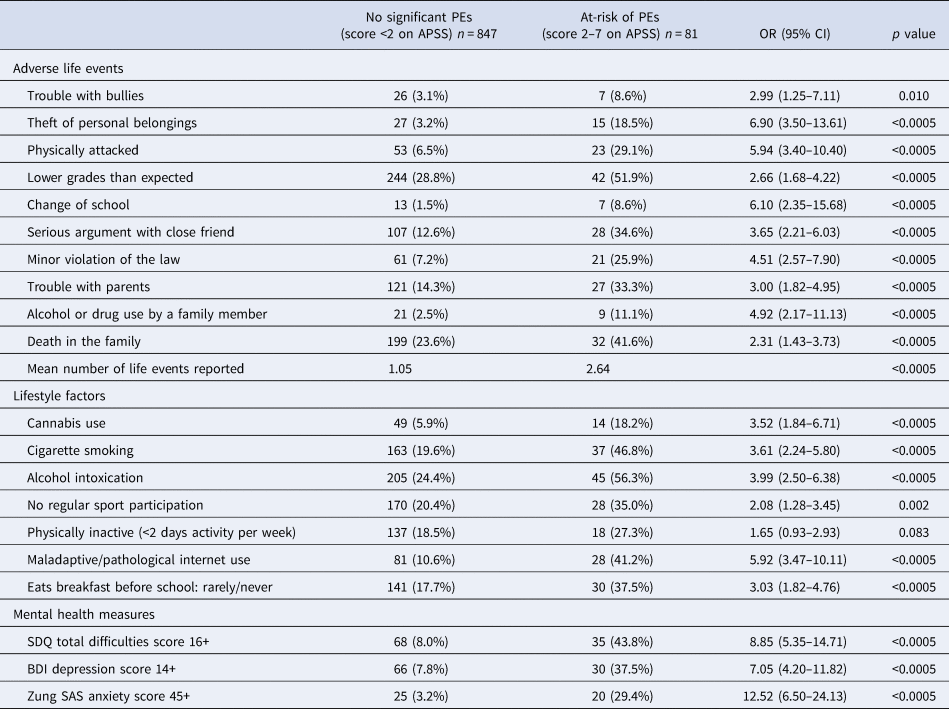
Associations between PEs and risk factors from adverse event, lifestyle and mental health domains

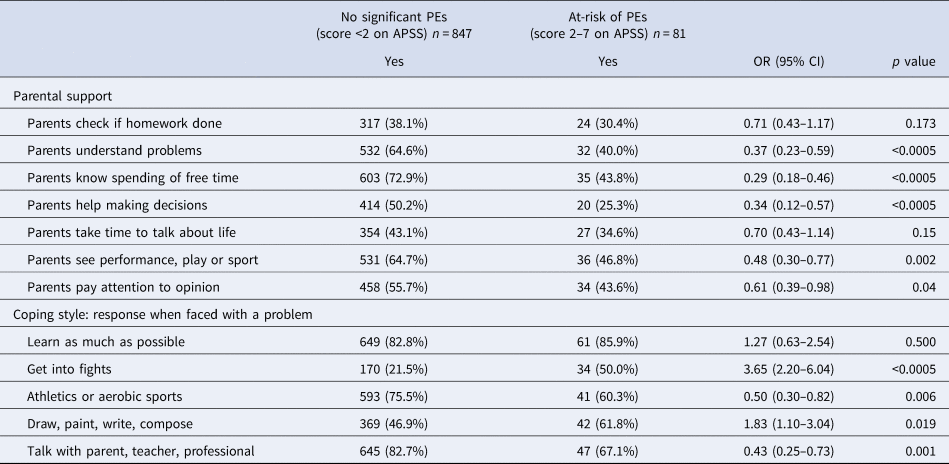
Associations between PEs and parental support and coping style

Missing data ranged from 2% and 12% on included variables. Cases with missing data on the relevant variables were excluded from the analysis.
Results
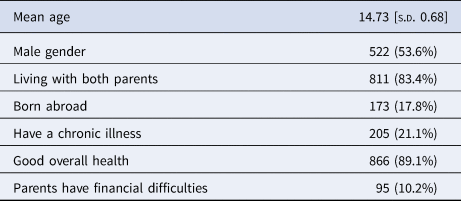
The study questionnaire was completed by 973 adolescents of whom 522 (53.6%) were male and 437 (45.0%) were female. Gender was not recorded for 14 individuals (1.4%). The mean age was 14.73 years (Table 3).
Characteristics of the study sample (n = 973)

Of the total sample, 114 participants (10.25%) answered ‘Yes, definitely’ to at least one of the items of the APSS (online Supplementary Table). Those scoring 2 or above were categorised at risk of PEs, with 81 (8.7%) of the sample considered at-risk.
Parental support and coping style
In univariate analysis, factors relating to parental support and supervision were associated with lower incidence of PEs (Table 2). These included parents knowing how adolescents spent their free time (OR 0.29, CI 0.18–0.46), parents helping with decision-making (OR 0.34, CI 0.12–0.57) and parents understanding problems (OR 0.37., CI 0.23–0.59).
Coping style was also associated with risk of PEs, with those reporting that they get into fights when faced with problems having elevated incidence of PEs (OR 3.65, CI 2.20–6.04) (Table 2).
Adverse life events
Of the adverse events examined, the highest odds ratios for PEs were among those reporting having been the victim of theft (OR 6.90, CI 3.50–13.61), having changed school (OR 6.10, 2.35–15.68) or having been physically attacked (OR 5.94, CI 3.40–10.40) (Table 1).
Lifestyle factors
Several lifestyle factors were also associated with PEs, including maladaptive or pathological internet use (OR 5.92, CI 3.47–10.11), alcohol intoxication (OR 3.99, CI 2.50–6.38), cigarette smoking (OR 3.61, CI 2.24–5.80) and having used cannabis (OR 3.52, CI 1.84–6.71) (Table 1). Frequent physical activity did not have a significant association with PEs.
Mental health measures
There were significant differences between the groups with and without PEs in terms of all three mental health measures (Table 1).
A comparison of Total SDQ scores found that those in the PE group were over 8 times more likely to have high levels of difficulties (OR 8.85, CI 0.35–14.71). They also had a 7-fold increase in the odds of experiencing symptoms of depression based on their BDI II scores (OR 7.05, CI 4.20–11.82) and an over 12-fold increase in the odds of experiencing anxiety as assessed by the Zung SAS (OR 12.52, CI 6.50–24.13).
Multivariate analysis
A multivariate logistic regression model was constructed including the SDQ score, BDI score and Zung SAS score, each of which had significant crude associations with risk of PEs. All three factors remained significant in multivariate analyses.
A further model was constructed including the 10 adverse events which all had significant crude associations with risk of PEs, as well as a variable for the number of these events reported. The number of adverse events but not any specific event examined remained significant in the model.
Finally, a model was constructed including the significant lifestyle correlates of risk of PEs. The following factors had significant associations in the multivariate analysis: alcohol intoxication and maladaptive/pathological internet use. In the multivariate model for the coping style and parental support factors, two of the parental factors were significant (parents know how free time is spent and parents help with decision making) while four of the five coping variables were significant (Coping through: Talk to someone; draw, write or paint; get into fights; engage in athletics/sport).
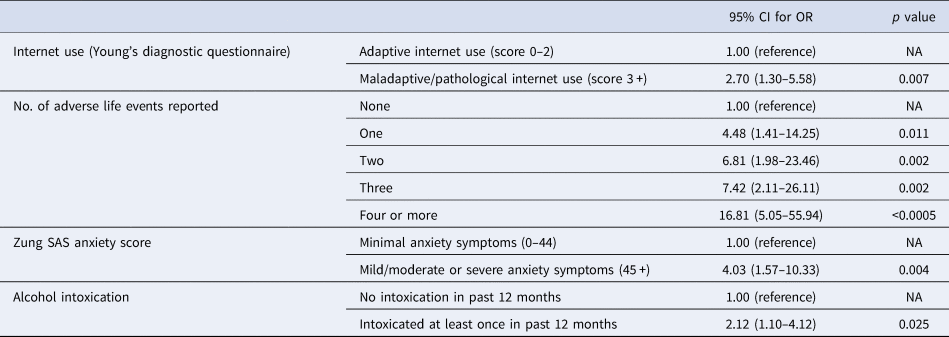
The variables with significant associations within each risk domain were entered into a final model. Two lifestyle factors were associated with PEs in the final model, maladaptive/pathological internet use (OR 2.70, CI 1.30–5.58; p = 0.007) and alcohol intoxication (OR 2.12, CI 1.10–4.12) (Table 4). The number of adverse life events also remained a significant predictor of risk of PEs, with greater number of events reported associated with increased odds of PEs. Those reporting one adverse event had an over 4-fold increased odds of PEs compared with a reference group reporting none (OR 4.48, CI 1.41–14.25; p = 0.011).
Mutivariate logistic regression model for risk of PEs (n = 749; model adjusted for age, gender and trial arm)

Of the mental health factors examined, only the Zung anxiety score was associated with PEs in the final model (OR 4.03, CI 1.57–10.33; p = 0.004).
Mediation analysis
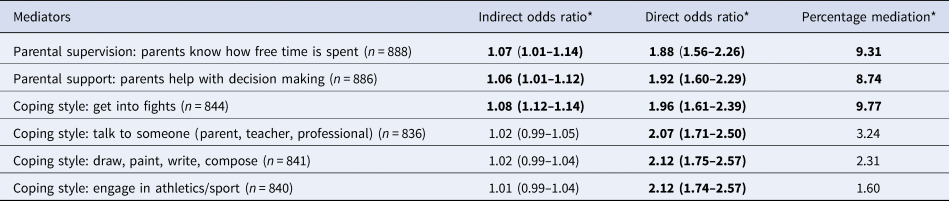
Multivariate path-decomposition was used to examine mediation effects of potential protective factors on associations between the number of adverse events reported and PEs, adjusted for gender and trial arm (Table 5). Mediators from parental support and coping style domains were selected following multivariate logistic regression analyses including all variables from these domains. Parental support (parents help with decision-making) significantly mediated the relationship between adversity and PEs (indirect OR 1.06, CI 1.01–1.12; 8.74% mediation) as did parental supervision (parents know how free time is spent (indirect OR 1.07, CI 1.01–1.14; 9.31% mediation)). Of the coping style variables, only one had a significant mediating effect; responding to problems by getting into fights (indirect OR 1.08, CI 1.12–1.14; 9.77% mediation). The direct pathway remained significant for the remaining coping style variables, while the indirect pathway did not: talking to a parent, teacher or professional (direct OR 2.07, CI 1.71–2.50); drawing, painting, writing or composing (direct OR 2.12, CI 1.75–2.57) and engaging in athletics/sport (direct OR 2.12, CI 1.74–2.57).
Pathway decomposition for mediators in relationship between adverse events and PEs (adjusted for gender and trial arm)

* Statistics in bold are significant at the p < 0.05 level.
Discussion
In this study we examined a range of potential risk and protective factors for PEs among a large community sample of adolescents. Fewer than one in 10 participants met criteria for risk of PEs. A wide range of factors from adverse life event, lifestyle and mental health domains had crude associations with PEs, while parental support was associated with a lower incidence of PEs. In multivariate analysis, independent associations between PEs and the number of adverse events experienced as well as maladaptive or pathological internet use, alcohol intoxication and anxiety symptoms were observed. Maladaptive coping through getting into fights, parental support and parental supervision had small mediating effects on the relationship between adverse events and PEs.
We found significant associations between PEs and higher levels of depressive symptoms, anxiety and higher scores on the SDQ, which is in keeping with previous research on comorbidity between PEs and other psychopathology (Armando et al., Reference Armando, Nelson, Yung, Ross, Birchwood, Girardi and Fiori Nastro2010). A previous longitudinal study found that many risk factors are shared between depression and psychosis, including childhood adversity (Niarchou et al., Reference Niarchou, Zammit and Lewis2015). It may be the case that adversity and negative life events are associated with a range of negative mental health and other outcomes with both non-specific and specific effects, with the activation of stress responses leading to general effects on processes involved in a range of outcomes (Morgan & Gayer-Anderson, Reference Morgan and Gayer-Anderson2016). Our findings of a dose–response relationship between the accumulation of adverse events and increasing risk of PEs is in keeping with large scale international research (McGrath et al., Reference McGrath, Saha, Lim, Aguilar-Gaxiola, Alonso, Andrade and Kessler2017).
We also found strong associations between some lifestyle factors and PEs, including maladaptive or pathological internet use. These findings build on previous research arising from the SEYLE study which identified significant associations between pathological internet use and suicidal behaviours, depression, anxiety, conduct problems and hyperactivity/inattention (Kaess et al., Reference Kaess, Durkee, Brunner, Carli, Parzer, Wasserman and Wasserman2014). The findings of the strong associations between maladaptive/pathological internet use and PEs in multivariate analysis adds to growing research which has identified a close link between pathological internet use and PEs (Mittal et al., Reference Mittal, Dean and Pelletier2013; Pelletier-Baldelli et al., Reference Pelletier-Baldelli, Ives and Mittal2015). It may be that the characteristics of individuals experiencing PEs render this group particularly susceptible to problematic internet use, in particular interpersonal deficits, social withdrawal or impulsivity (Mittal et al., Reference Mittal, Dean and Pelletier2013).
Despite the clear potential benefits of identifying protective factors which can mitigate the effects of vulnerability to psychosis, few protective factors have been identified to date. Large scale longitudinal studies have reported that involvement in sport (Keskinen et al., Reference Keskinen, Marttila, Koivumaa-Honkanen, Moilanen, Keinanen-Kiukaanniemi, Timonen and Jaaskelainen2016) and relatively high levels of physical activity (Crush et al., Reference Crush, Arseneault, Moffitt, Danese, Caspi, Jaffee and Fisher2018) in childhood were protective against psychotic symptoms in general population samples. We examined physical activity and found that, although there were significant univariate associations between sport participation and PEs, these did not remain after adjustment for other factors.
A novel aspect of this study is the focus on the potential mediating roles of both parental support and parental supervision. Previous research has found that trauma in childhood was associated with both psychotic symptomatology and poor parenting style in childhood (Catalan et al., Reference Catalan, Angosto, Diaz, Valverde, de Artaza, Sesma and Gonzalez-Torres2017), and has identified poorer family communication and social support in families of young people with a first psychotic episode (Otero et al., Reference Otero, Moreno-Iniguez, Paya, Castro-Fornieles, Gonzalez-Pinto, Baeza and Arango-Lopez2011) or at high risk of psychosis (Pruessner et al., Reference Pruessner, Iyer, Faridi, Joober and Malla2011; Shi et al., Reference Shi, Wang, Yao, Chen, Su, Zhao and Zhan2016). Our focus on adolescents with early indicators of potential risk of psychosis points to opportunities for early intervention, and in particular may provide support for family-based interventions (Falloon, Reference Falloon2003). Our finding that parental support and supervision both have a small but significant mediating effect on the relationship between adversity and PEs provides some support for the suggestion that parent–child relationships are a translating mechanism between adversity and adolescent psychopathology (Dhondt et al., Reference Dhondt, Healy, Clarke and Cannon2019). As greater levels of social support predict willingness to seek help for mental ill-health (Sheffield et al., Reference Sheffield, Fiorenza and Sofronoff2004), interventions that promote family support can also have a positive impact on mental health through developing recognition of the need for the individual to seek help and the importance of parental intervention and support during times of significant distress. Recent research examining early risk and protective factors among young people with a history of PEs reported that those who experience multiple early adversities, childhood trauma and insecure attachment relationships were at highest risk for reoccurring PEs and poor young adult outcomes (Coughlan et al., Reference Coughlan, Healy, Ni Sheaghdha, Murray, Humphries, Clarke and Cannon2019).
A further potential mediating factor of associations between adversity and PEs which we examined was coping style. A mediating effect of maladaptive coping through getting into fights was found. Previous studies have concluded that coping style, in particular emotion-oriented coping, may mediate the relationship between sub-clinical PEs and psychosocial functioning among non-clinical adolescent samples (Chisholm et al., Reference Chisholm, Wigman, Hallett, Woodall, Mahfouda, Reniers and Lin2018; Lin et al., Reference Lin, Wigman, Nelson, Vollebergh, van Os, Baksheev and Yung2011). Associations between high levels of avoidant coping and PEs or risk of psychosis have also been reported (Dolphin et al., Reference Dolphin, Dooley and Fitzgerald2015; Jalbrzikowski et al., Reference Jalbrzikowski, Sugar, Zinberg, Bachman, Cannon and Bearden2014), while it has also been reported that relationships between both traumatic events and perceived stress were mediated by maladaptive coping (Ered et al., Reference Ered, Gibson, Maxwell, Cooper and Ellman2017). Further research is needed to examine the potential mechanisms through which coping style may impact risk of PEs. As interventions promoting positive coping in adolescents are available, this finding highlights the importance of incorporating such resilience-promoting programmes into mental health interventions for adolescents.
Strengths and limitations
The cross-sectional design of this study meant that the causal impact of risk and protective factors on subsequent development of PEs was not examined. It is only possible to speculate on the mechanisms by which mediating factors affect the outcome examined. In addition, the limited number of survey items assessing resilience factors limits our understanding of potential protective effects. While we have examined a broad range of adversity-related factors, the list of adverse events examined was not exhaustive. Aspects of parent–child relationships which were examined as mediators may also be included in the adverse events examined. As this study relied on self-reported data, there may have been biases which led to over or under-reporting of mental ill-health and its correlates.
The strengths of this study include the validated measure of PEs, the large, nationally-representative sample and the inclusion of a wide range of potential risk and protective factors. In particular, the inclusion of scales assessing parental support and coping style allows for a novel examination of the potential mediating role of these factors, while also addressing the relationship between PEs and many established risk factors.
Having examined a wide range of risk factors for PEs among adolescents, we have identified important associations with adversity, pathological internet use, alcohol intoxication and anxiety symptoms. We have also identified the potential benefits of parental support as a buffer against the development of PEs among young people at risk, through the experience of trauma or stress, which is promising in the context of the dearth of evidence for protective factors. These findings can inform the development of optimal interventions for adolescents at risk of psychosis and their families.
Supplementary material
The supplementary material for this article can be found at https://doi.org/10.1017/S0033291719004136
Acknowledgements
The Project Leader and Coordinator of the SEYLE project is Professor Danuta Wasserman, Karolinska Institute (KI), Head of the National Centre for Suicide Research and Prevention of Mental Ill-Health and Suicide (NASP), at KI, Sweden. Other members of the Executive Committee are Senior Lecturer Vladimir Carli, Karolinska Institute, Sweden; Professor Christina W. Hoven, New York State Psychiatric Institute and Columbia University, USA; Anthropologist Camilla Wasserman, New York State Psychiatric Institute, USA and Columbia University, NYC, USA and Professor Marco Sarchiapone, University of Molise, Italy. Site leaders for each SEYLE centre are: Danuta Wasserman (Karolinska Institute, Sweden, Coordinating Centre), Christian Haring (University for Medical Information Technology, Austria), Airi Varnik (Estonian Swedish Mental Health & Suicidology Institute, Estonia), Jean-Pierre Kahn (University of Lorraine, France), Romuald Brunner (University of Heidelberg, Germany), Judit Balazs (Vadaskert Child and Adolescent Psychiatric Hospital, Hungary), Paul Corcoran (National Suicide Research Foundation, Ireland), Alan Apter (Tel-Aviv University, Israel), Marco Sarchiapone (University of Molise, Italy), Doina Cosman (Iuliu Hatieganu University of Medicine and Pharmacy, Romania), Vita Postuvan (University of Primorska, Slovenia) and Julio Bobes (University of Oviedo, Spain).
Conflict of interest
None.
Financial support
The SEYLE project is supported through Coordination Theme 1 (Health) of the European Union, Seventh Framework Program (FP7), Grant agreement nr HEALTH-F2-2009-223091. EMcM was supported by the Health Research Board Ireland (ICE/2012/11; ARPP-A-2018-009). MC and CH were supported by a European Research Council Consolidator Award to MC (iHEAR; Grant number 724809).
Ethical standards
The authors assert that all procedures contributing to this work comply with the ethical standards of the relevant national and institutional committees on human experimentation and with the Helsinki Declaration of 1975, as revised in 2008.