


For those of you who have never attended a banquet at the BHC, the genre of our presidential address is a strange one. For reasons lost in the mists of time, presidents are expected to artfully weave their own personal history with an intellectual argument relating to the theme of the conference. This is no minor undertaking, though my immediate predecessors—Daniel Wadhwani and Sharon Murphy—made it look easy.Footnote 1
Let me begin by stating that those who know me well have probably wondered why I, of all people, made “The Business of Labor” the theme of this year’s conference. They should wonder. I am not a labor historian. I am not a labor activist. In fact, I am currently working in the academic equivalent of middle management, serving as an associate dean. And yet, I have convened a conference dedicated to revisiting the labor question in our field of business history. I owe you an explanation.Footnote 2
It’s very tempting to stand here and tell you that the reason that I am pushing this theme is simply a matter of me making a cutting-edge academic intervention—that I’m bringing together business history and labor history because I believe that there is a strong historiographical argument for doing so.
I do think that’s the case, but framing my decision as an intellectual choice would be misleading, even disingenuous: it would absolve me of my own disengagement from labor history. This is why what you will hear from me tonight is less a manifesto than a meditation on why historians—and I’m one of them—study some things at the expense of others, and how doing so can have real-world consequences.
In my own case, it has blinded me from seeing a storm that began building many years ago here in the United States. That storm now rages at full force, lashing American institutions. Watching this unfold, it’s tempting to identify a single individual—the current occupant of the White House—as the reason.
Doing so misses an important point; voters put this person into office—a majority, in fact. And not just white voters, as is often assumed. In fact, the recent election turned on the decisive shift of a specific cohort of voters: those making less than $50,000 a year. Members of this income bracket, a proxy measure for working-class membership, went for the Republican Party for the first time in living memory. Note, too, that a majority of voters making $100K or more went for the Democrats for the first time, too.Footnote 3
All of this represents a seismic change, one that began in the wake of the Great Recession, gathering force in the 2010s. We are now at the point where the grievances of the working class are difficult, if not impossible, to ignore. Moreover, this is not restricted to the United States. All around the world, working-class voters—again, typically without a college education—are gravitating toward authoritarian leaders. There’s a robust academic literature on this phenomenon that goes back to 1959, when Seymour Martin Lipset published his classic study, “Democracy and Working-Class Authoritarianism,” which examined how economic hardship translates into political choices. Many scholars have elaborated and refined his thesis—for example, identifying a post-1989 shift away from left-leaning authoritarian movements and toward right-leaning ones rooted in a revolt against the economic and culture “globalist” elites associated with the era of neoliberalism.Footnote 4
We historians often take our cue from current events—this is why, for example, the long-neglected field of financial history enjoyed a rebirth after the 2007 financial crisis. Given what is happening now, I will not be surprised if our larger profession rediscovers the working class. If that happens, our own field of business history has an important role to play.
In proposing this, please know I am following the lead of a handful of brave souls who have moved back and forth between business history and labor history for many years. And here I want to give a shout-out to Roger Horowitz, Phil Scranton, Walter Licht, and more recently, Jennifer Klein and Elizabeth Tandy Shermer.Footnote 5 Still, it’s striking that the unifying vision of labor historian Steven Ross and business historian Edwin Perkins has yet to come to pass. Forty years ago, they presented a paper at this conference entitled “Integrating Business History and Labor History,” laying out a plea to join the two fields. It was largely greeted with resounding silence. Only four other academic publications ever cited it. My presidential address will make five.Footnote 6
Nonetheless, I have found it rather helpful in wrestling with this question of the proper relationship between the two fields. What struck me most was the authors’ observation that the division between the two fields was a product of “different ideological outlooks or intellectual concerns. Business historians tend to identify with capitalism and the play of the free market, with special emphasis on the role of entrepreneurship, whereas labor historians have generally expressed reservations about the impact of unrestrained competition upon less powerful individuals.”Footnote 7
When I read these words, I recognized myself as the person who identified more with capitalism, the play of the free market, and even entrepreneurship—not in a positive way, mind you, but through a glass, darkly, focusing on fraud, speculative excess, and chicanery. Still, in re-reading this passage, I began to contemplate an awkward question: why had I not thrown my scholarly lot with labor, too? It was in attempting to grapple with that question that the theme of this year’s conference took shape.
Tonight, I hope to answer this question with you in the room, training our attention on the long-neglected “labor question”—the fate and role of labor in a democratic, capitalist economy. In doing so, I cannot tell the tale in a straight line, as we historians generally prefer, with a clear beginning, middle, and end. Instead, we will move back and forth over the past century. Tonight, we will become “unstuck in time,” much like the protagonist of Kurt Vonnegut’s Slaughterhouse-Five. Footnote 8
* * *
My path to business history began in the 1990s. Though I wasn’t a history major as an undergraduate, I resolved to pursue a doctoral degree in the subject. There was only one problem: I didn’t really have any coursework in the field. To demonstrate I was serious, I would need to take some classes.
I was living in Washington, DC at the time and went down to George Washington University. The first grad course that had an opening was entitled “Business History.” It was taught by former BHC president William Becker, who passed away a little over a year ago. Becker had been Chandler’s student, and the first book he assigned us to read was his doctoral advisor’s masterwork, The Visible Hand. I wish Becker could be here tonight, given that this course and this book put me on the path to studying business history, and to standing here today.
After sampling business history at George Washington, I applied to doctoral programs and chose to attend NYU, not because of the particular strengths of the department, but because I wanted to live in New York City. This choice posed a problem: my meager graduate fellowship made finding a roommate a necessity. My quest led me to Brooklyn, where an advertisement in the Park Slope Food Co-op caught my eye. I answered it and set up a time to meet a woman who was sub-leasing out part of a floor of a rowhouse on St. Mark’s Avenue for the princely sum of $462.50 a month.
My prospective roommate’s name was Laurie Bell, and she was much older than me. She was a self-described ‘healer’ who possessed a truly astonishing collection of tinctures, herbal remedies, and other alternative cures. She worked with AIDS patients and intravenous drug addicts in a particularly run-down area of Brooklyn. She was very different from me and, honestly, a bit too quirky for my taste. Still, I needed to find a place to live, fast, and so I signed a lease, moving into the back room of the second floor. Little did I know that my choice of roommates would inaugurate my education in labor history.
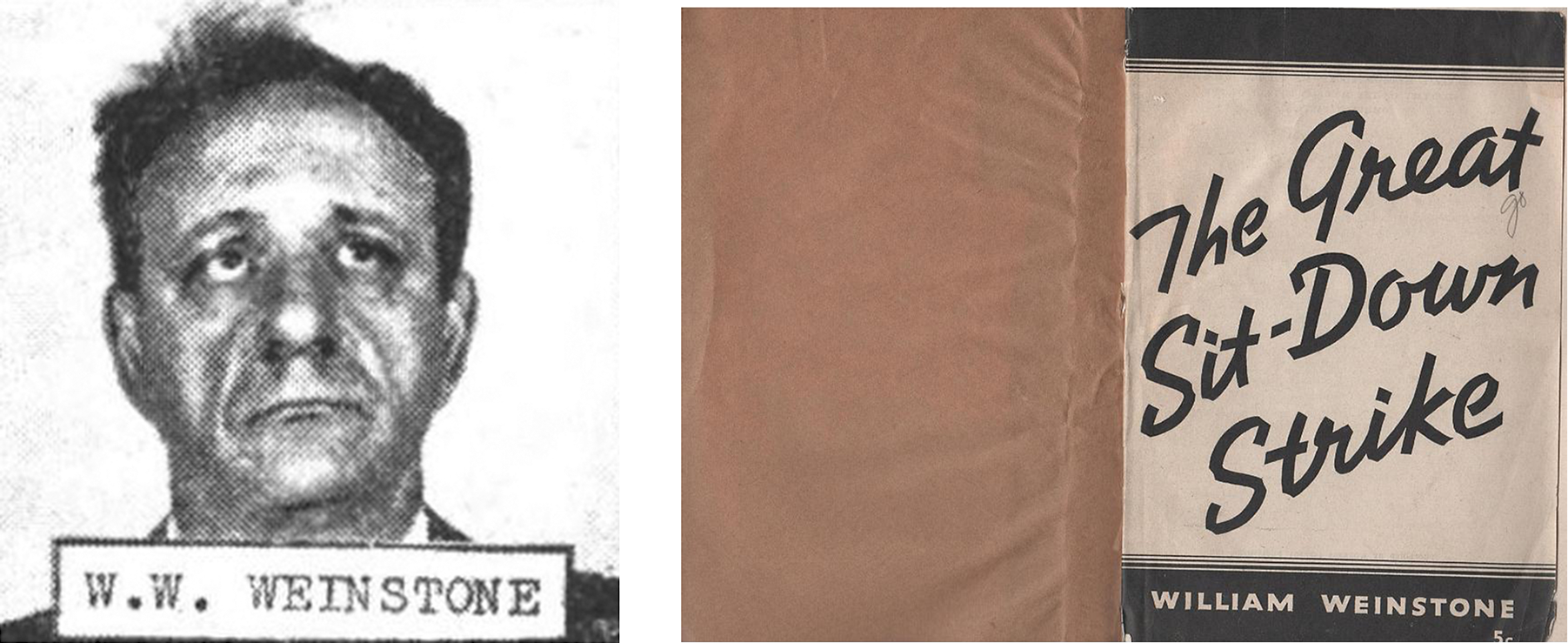
I soon discovered that Laurie had a most unusual backstory: she was the daughter of one of the most prominent labor radicals of the twentieth century: William Weinstone, who played a signal role in both the Communist Party as well as the larger labor movement of the interwar era (Figure 1). It was Weinstone, head of the Communist Party in Michigan, who helped orchestrate the sit-down strikes that convulsed the auto industry in 1936, a key turning point in the history of labor in the United States.Footnote 9
In those first couple years of graduate school, Laurie would share stories of her family’s fate during the McCarthy Era, when Weinstone spent time in prison, having been prosecuted under the Smith Act. Laurie told me about being shadowed by FBI agents as her mother walked her to kindergarten—and other tales of a not-so-normal childhood. Whatever I thought of her father’s dedication to the labor movement, there was no denying that his devotion had completely upended their lives.
Left: William Weinstone FBI mug shot. Right: Weinstone’s role in the strikes of the 1930s prompted a historical account not entirely out of keeping with public sentiment. By 1953, though, Weinstone was convicted under the Smith Act, along with twelve other Communist intellectuals, for advocating the violent overthrow of the United States government.

I found these stories unsettling. I also found them at odds with what I was encountering in graduate school. NYU had formidable strengths in labor history, and I was force-fed a steady diet of social and cultural history which inevitably emphasized the “agency” of ordinary workers, glorifying the struggle for better wages and working conditions in the fight against nefarious business owners.
These works left me cold. They seemed completely at odds with the reality of the postwar era, beginning with the repression of the labor movement in the McCarthy era that Laurie’s father endured, much less what came afterward: the long, painful decline of the labor movement, courtesy of decades of deindustrialization, offshoring, declining union membership, and a Democratic Party that retreated from its historic connection to labor.
There were no courses in business history in my program. Perhaps because I was incorrigibly contrarian in nature—and still under the spell of The Visible Hand—I became increasingly drawn to labor’s antagonists. I did so because I sensed that if you want to know more about capitalism, you should know more about capitalists, along with the financiers, managers, and engineers who belonged to business. This led me, perhaps inevitably, to the Hagley Museum and Library, where Roger Horowitz took pity on me when I showed up with an extraordinarily ill-conceived dissertation project that I quickly abandoned. Soon I found my topic and wrote the thesis, closing the circle on my graduate education; I received a Newcomen Postdoctoral Fellowship at Harvard Business School, where Alfred Chandler had held court for many years. I belonged to business.
Nonetheless, something was happening that made me begin reconsidering my relationship to the labor question. I had reconnected with my father’s long-lost twin.
* * *
Before you meet my family, I want you to contemplate the following thought experiment. Imagine that our society is plunged into chaos and all knowledge of the late nineteenth-century United States is lost apart from one tattered copy of The Visible Hand. Future monks transcribing it could be forgiven for thinking that the overriding challenge facing managers of large, complex corporations of the late nineteenth century was the question of how to build a bureaucracy staffed by rational managers who coordinated “the flow of goods and services”—Chandler’s words, not mine. That managers might actually have to manage employees was of limited importance.Footnote 10
This might have come as a surprise to the managers of these corporate combines. Again and again, they confronted staggering labor unrest. Their employees nursed incandescent rage against management, one that repeatedly broke into open violence, culminating in strikes that left thousands of rail cars and locomotives destroyed, buildings burned down, and the entire industrial edifice shaken to its core. Chandler explained this away by claiming that labor didn’t have a voice in management decisions until the violent strikes of the 1930s—the very same sit-down strikes that William Weinstone had helped orchestrate. Before that time, though, labor was irrelevant. Nothing to see here: move along.
In any other book, this omission might have been inconsequential, but Chandler’s book—and his larger corpus of works—have had an outsized impact on business history. Few fields owe their origins so completely and unequivocally to one individual as we do, and there are many people in this room who can, like me, trace their own interest in the subject to this one historian and his works. This is not restricted to scholars here in the United States. Chandler’s works effectively framed much of the study of business history worldwide, even as the field has evolved a great deal.
That’s fostered a remarkable outpouring of scholarship. But it’s also played a signal role in putting the labor question beyond the bounds of business history.Footnote 11
I am not the first person to point this out. A few years after the publication of The Visible Hand, a testy exchange between Chandler and the sociologist Charles Perrow raised the question I am raising now: where is labor and what happens when you leave it out? Perrow wrote in disbelief that “Chandler’s book is remarkable in that he can intentionally treat the history of industrialization in the United States without dealing with the labor force …” As Perrow observed, this omission cast doubt on his central argument. What of the possibility, he inquired, that one of the drivers of vertical integration was the desire to secure a more docile, pliable workforce? Certainly, the managers had every imaginable reason to want that, given that their workers proved quite willing to go to extraordinary lengths to disrupt and destroy the careful coordination mechanisms beloved by Chandler’s managers.Footnote 12
Why had Chandler been so eager to steer clear of labor? Perhaps it had something to do with his class position. Alfred Dupont Chandler was the great-grandson of Henry Varnum Poor, who brought order to the chaos of railroad finances via the Standard and Poor’s Corporation. He began his academic career around the same time as the passage of the Taft-Hartley Act; he was deeply influenced by the aversion to conflict so typical of the “Consensus School of Historiography.”
All good explanations, really. But why had I been so leery of labor? What’s my excuse?
* * *
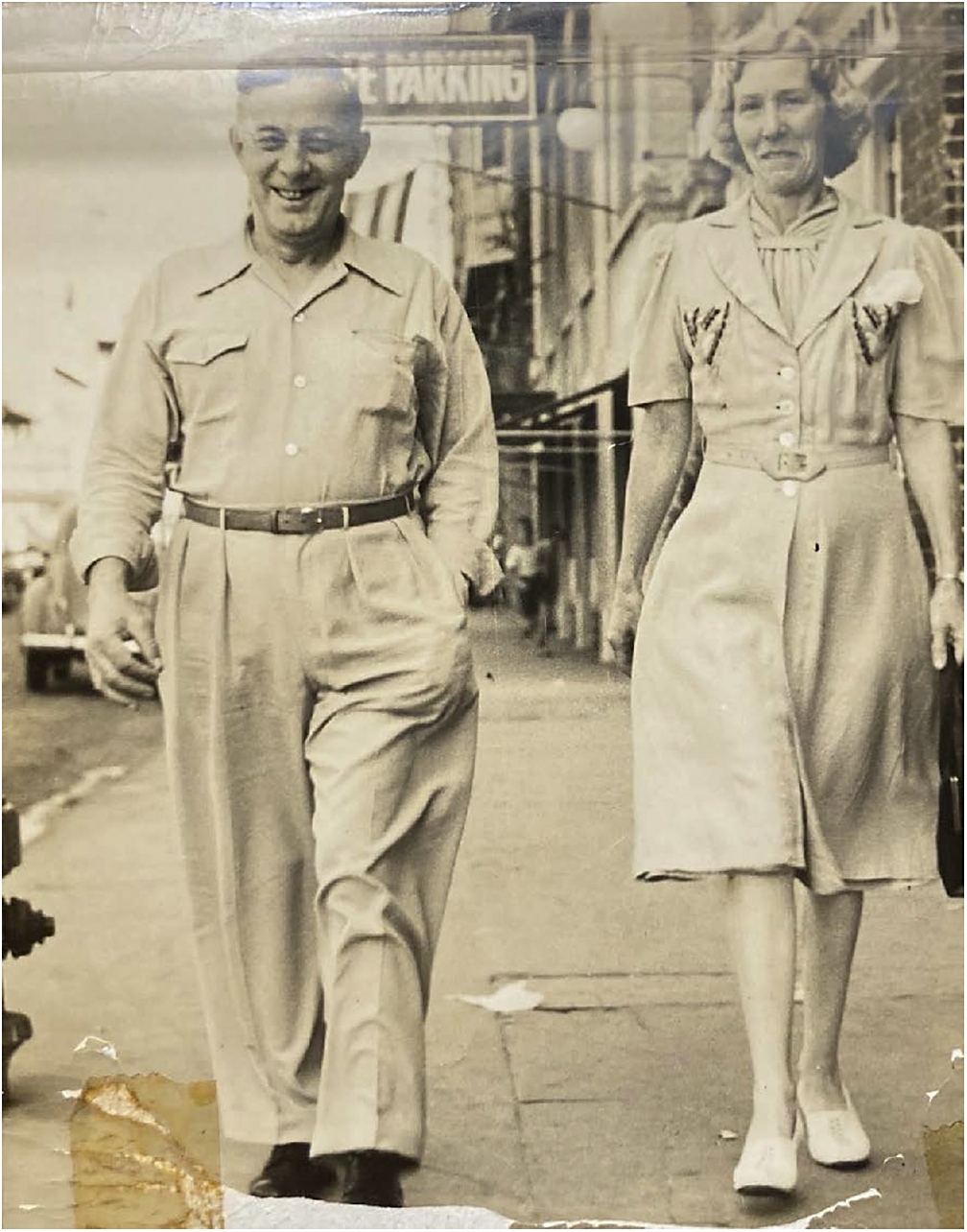
At first glance, I should have a personal stake in the subject. My father was born into a working-class family, one I know a great deal about. My grandfather, William Mihm, worked as a shipfitter at the Cramp Shipyard in Philadelphia, one of the few places where Taylorism was implemented at scale (Figure 2). My grandparents would have five children, all boys. My father was the third. He was unquestionably brilliant. His burning intelligence, though, did not spare him labor—and plenty of it. At age four—yes, four years old—he was put to work, getting up each morning well before dawn to pull a wagon filled with newspapers while his older brothers delivered them. When the local authorities got wind that my grandmother was taking child labor to a whole new level, they put a stop to it.
William and Margaret Mihm in an undated photograph, likely strolling the streets of Philadelphia in the 1940s, not far from Cramp’s Shipyard.
Source: Collection of the author.

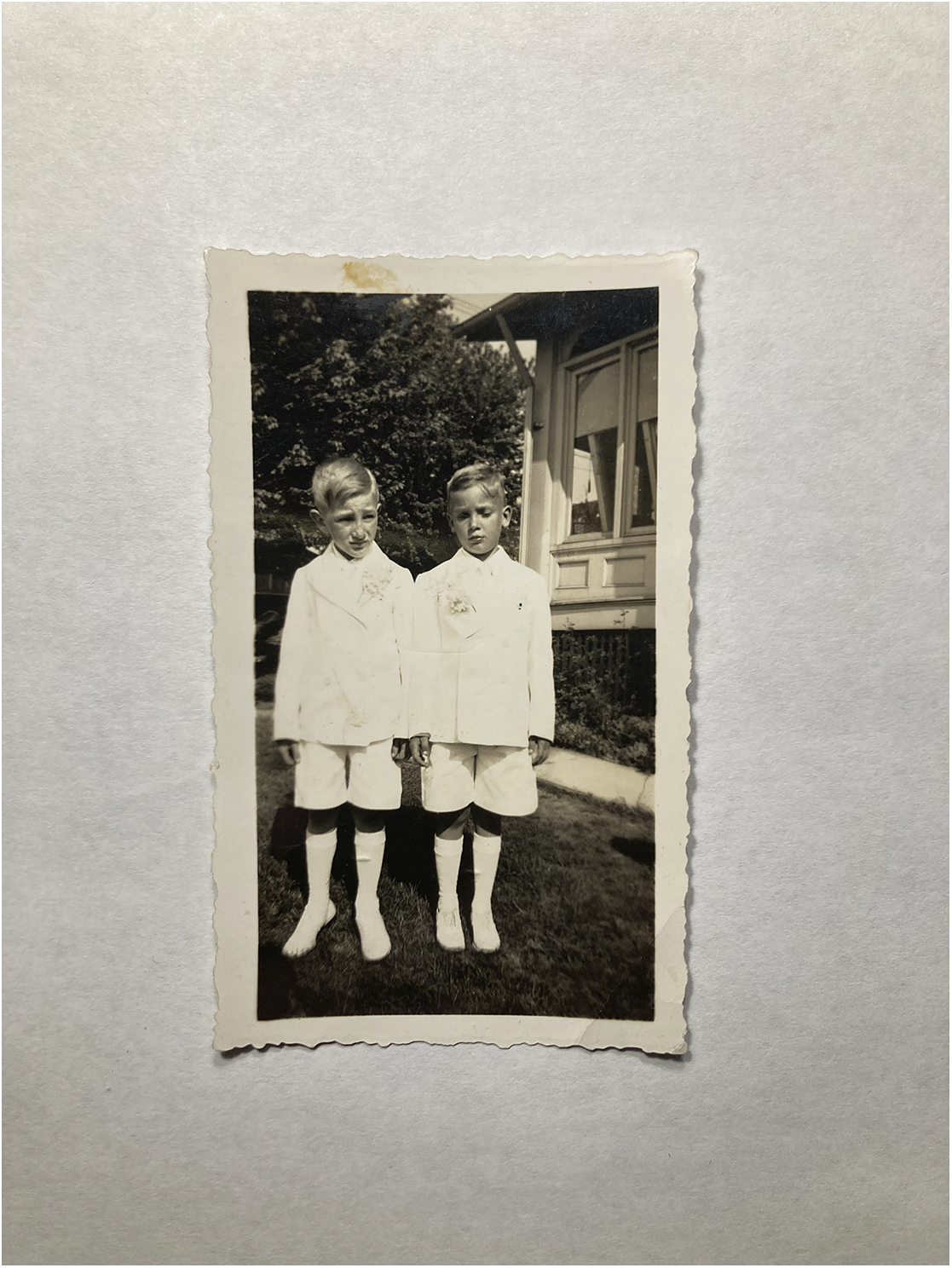
It was around this time that my father’s twin materialized. Not a “real twin,” but a boy born only a few months later than my father whom the family took in as a foster child. The initial motivation was crassly instrumental: the state of New Jersey provided a small amount of cash to foster families, and most valuable of all, several changes of clothing. Because the two boys were the same age and stature, these could be shared, removing the need to buy clothing for my father (Figure 3). Francis, as the new brother was named, had been born into a large Polish family living in the slums of Camden, New Jersey. He had been given up for adoption, spent several years in foster care before taking his place as my father’s unofficial twin. They shared a bedroom; they attended the same school and the same classes. But here the similarity ended. Where my father excelled in school, Francis struggled with what was likely dyslexia. He could not learn how to read.
Richard Mihm and Francis Mihm, wearing matching outfits sometime in the late 1930s.
Source: Collection of the author.

The school held Francis back a grade. My grandmother insisted that my father stay back a grade, too, so that Francis had company. This would happen one more time, with my father repeating a grade so the two could remain together. After the second time, though, Francis fell behind and my father jumped ahead. And here their paths began to diverge, with Francis dropping out of school by eighth grade while my father continued his ascent.
In 1950, my father took the statewide entrance examination to Rutgers University. He aced the exam, earning himself a four-year scholarship—one of only a handful of kids in South Jersey to do so. He recalls his parents putting him on the bus to New Brunswick and his father slipping him a $20 bill—the extent of the family’s contribution to his education. As soon as he got on that bus, he began shedding his working-class identity, moving from menial, dangerous labor to the life of the mind. He almost didn’t make it. The summer after his first year in college, he joined his father, now semi-retired after a near-fatal accident at Cramp’s, working in the bathhouses on the beaches of Cape May, New Jersey. My father would join him. One of his jobs was running laundered towels through a centrifuge before hanging them up to dry.
The centrifuges were big, monstrous spinners. One afternoon, my father, impatient to finish, reached into one to pluck out a towel before it had come to a stop. The machine took his arm and shattered it, breaking the bones in fourteen different places, leaving behind a bloodied limb, now barely recognizable. My father was taken to the tiny local hospital, which wasn’t known for cutting-edge medical treatment. His arm, mangled and torn beyond recognition, would need to be amputated.
Yet that’s not what happened. The attending surgeon that day just happened to have recently returned from the front lines of the Korean War, where he had gotten ample experience in patching men back together. According to family lore, when this battle-weary surgeon saw my father, he apparently shrugged and declared, a bit cockily: “I can fix that.” And after seventeen hours toiling in the operating room, he succeeded, reassembling my father’s dominant arm. Yes, his limb that was slightly shorter (and would set off metal detectors for the rest of his life). But my father kept his arm—and the momentum that had fueled his social mobility up to that point.
These and other stories of my father’s early life—and tales of Francis—made me conclude that membership in the working class was a cross to be carried, not a badge of pride. It was something to avoid, escape, and transcend. That feeling likely informed my studious indifference to the labor question, and accounts for the fact that I venerated my father’s meritocratic, meteoric rise. I took vicarious pride in the fact that he had escaped his origins and become a cultured, college-educated man who loved classical music (Jean Sibelius was his favorite composer) and avidly read works by Conrad, Melville, and other literary greats. Or that he would successfully court a brilliant young woman—a microbiologist—who had grown up in a comfortable middle-class family where college education was the norm. He would go on to pick up advanced degrees in geology and physics, becoming an award-winning high-school teacher, and eventually a school administrator. And he and my mother would have a family, with my sister arriving, followed by me in 1968.
I will do the math for you: I am fifty-six years old. Middle age may confer few benefits, but I am now old enough to have a dawning awareness of the ways that the decades-long span of my own modest life maps onto the kind of sweeping, historical changes measured in decades, not days. I can now see, for example, that I was born in the twilight of the American Century, as the nation’s manufacturing base began moving offshore and many in the working class began their drift into the underclass. Yet I can also see that I was born at the dawn of an entirely new economy rooted in digital computers, increasingly powerful integrated circuits, the internet, and yes, artificial intelligence.
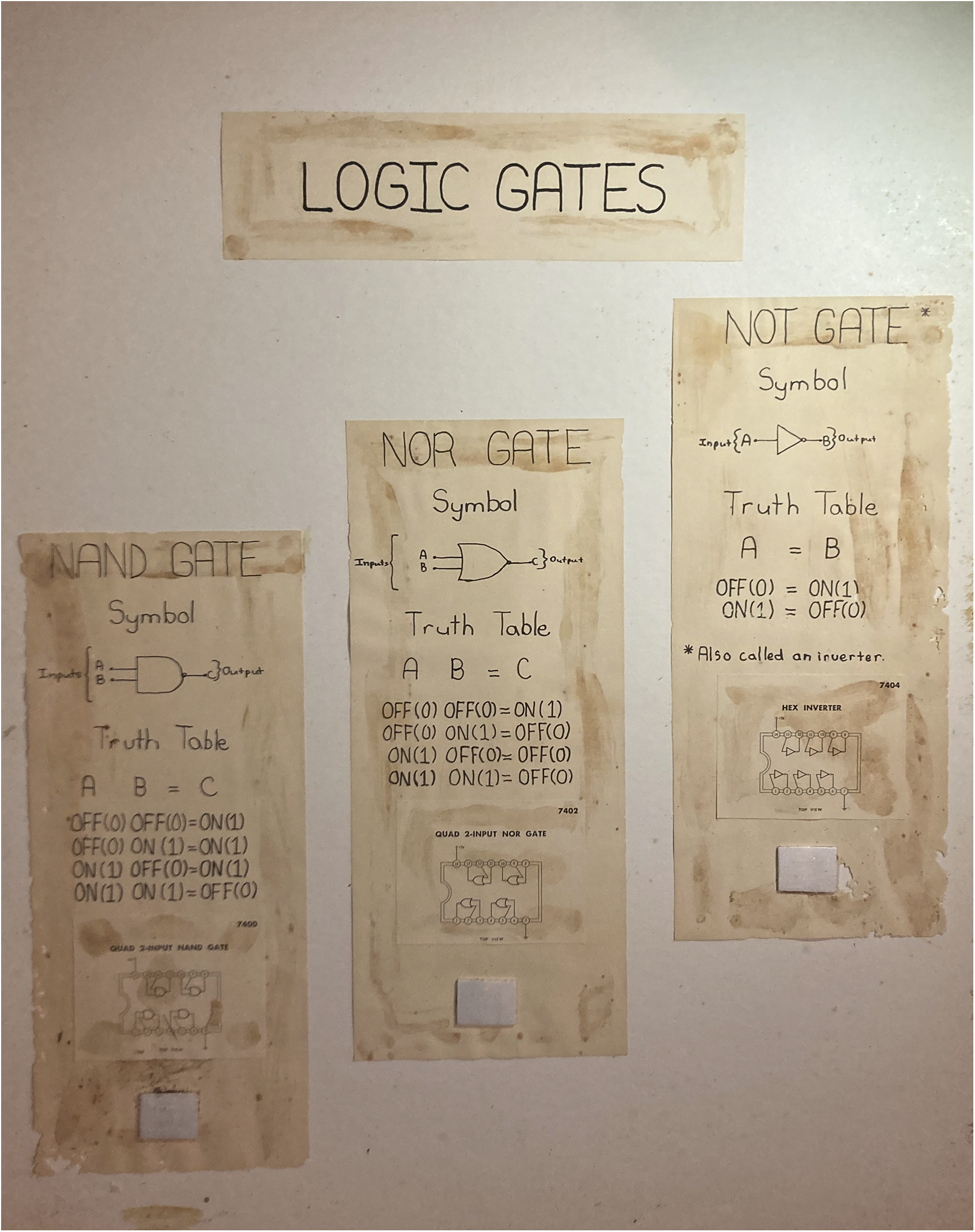
My father saw it coming before most. In the 1960s, he began bringing computers into the classroom, using DEC terminals to tap into mainframes at nearby Trinity College. I have distinct memories of working on a DEC Terminal hooked up to one of these mainframes via our rotary telephone. My father began teaching himself COBOL, FORTRAN, and other languages. This may account for why I learned about binary number systems and Boolean logic before I learned about the facts of life. Long before I thought about becoming a historian, I was a computer geek. And it was here that I gained a dawning awareness that these most basic building blocks of computer hardware—so-called logic gates—would become the foundation of an emerging digital architecture that would transform the world (Figure 4).
The author’s knowledge of Boolean logic would inform the creation of a crude calculator fashioned from the logic gates that remain the building blocks of the information age, and more recently, artificial intelligence.
Source: Collection of the author.

Figure 4. Long description
A horizontal banner at the top reads LOGIC GATES. Below it are three vertical panels.
Left Panel: N A N D GATE
- Symbol: Two inputs A and B entering a D-shaped gate with a small circle at the output.
- Truth Table: A B = C. O F F (0) O F F (0) = O N (1). O F F (0) O N (1) = O N (1). O N (1) O F F (0) = O N (1). O N (1) O N (1) = O F F (0).
- Diagram: QUAD 2-INPUT N A N D GATE 7400 showing a 14-pin I C layout.
Middle Panel: N O R GATE
- Symbol: Two inputs A and B entering a curved, pointed gate with a small circle at the output.
- Truth Table: A B = C. O F F (0) O F F (0) = O N (1). O F F (0) O N (1) = O F F (0). O N (1) O F F (0) = O F F (0). O N (1) O N (1) = O F F (0).
- Diagram: QUAD 2-INPUT N O R GATE 7402 showing a 14-pin I C layout.
Right Panel: N O T GATE
- Symbol: One input A entering a triangle with a small circle at the output B.
- Truth Table: A = B. O F F (0) = O N (1). O N (1) = O F F (0).
- Note: Also called an inverter.
- Diagram: HEX INVERTER 7404 showing a 14-pin I C layout.
My father’s faith in the information age was such that when his parents passed away in the early 1970s, he invested his share of the estate—a very modest $224.53—in a single company: Intel, manufacturer of computer chips. He soon left the classroom and became a computer programmer, joining the information economy. And that initial investment in Intel? He never supplemented it with additional purchases, yet it would grow, along with the larger digital economy, at a remarkable rate. Forty years later, as he succumbed to dementia, I liquidated it in order to pay for his care, netting $157,284.06. My father had reaped the dividends of the new economy.
His adopted brother, by contrast, remained wedded to the older, industrial economy. After dropping out of middle school, he did some unskilled jobs before apprenticing as a machinist, a trade he could master without formal literacy. Francis eventually went to work at a company founded by the oldest brother—Laurel Valley Manufacturing. He soon became estranged from his brothers, and by extension, the rest of the family. He quit and moved away. And that might have been the end of the matter, as the paths of Fran and my father diverged entirely.
* * *
Still, I had fond memories of my uncle. And as I grew older, I increasingly identified with Franny. The reason? I began having trouble in school. For reasons that remain unclear, I proved incapable of writing, even as reading came naturally. I was taken to experts, who pronounced me as suffering from “learning disabilities,” and I was told I would need to repeat second grade. My parents were informed that I would need special assistance for the rest of my life, yoked to an amanuensis who would serve as my scribe.
Needless to say, this did not happen, but the experience of being put in “SPED”—Special Education—classes and repeating a grade gave me a firsthand taste of what Francis had experienced. And yes, I did learn how to write; I did make it to third grade. The experience, though, made me wonder about Francis. How had he coped and adapted? And what had become of him?
These questions remained unanswered until grad school. I was traveling back and forth between Washington, DC and New York, passing very close to where I knew he lived. I tracked down his number and called him up, telling him I would like to stop and visit. Would he be around? He was a bit taken aback: he hadn’t spoken to anyone in the family for over twenty years. Nonetheless, we agreed to meet.
So began a friendship, with me visiting him a few times a year and calling him once a month. He was kind and enjoyed getting to know my children. He had been very fortunate, landing a machinist job at Garvey Industries, a manufacturer of conveyor belts. The company had never shifted production offshore, and he had managed to save enough money to buy a tiny house in Clementon, New Jersey. He grew tomatoes, inspiring me to do the same.
As the years passed, I became increasingly curious about his work as a machinist, in part because one of his hobbies in retirement had been to visit flea markets, buying up American-made drills and bits left behind when factories closed. My scholarly obsession with screw threads, taps, and dies began with those conversations. So, too, did my new, clandestine interest in labor history. In fact, it was around this time that I became increasingly bothered by the fact that the stories of business and labor continued to be told, Severance-style, by entirely different groups of historians, each of which seemed to be oblivious of the other, or worse, hostile, as if they were continuing the age-old struggle between capital and labor in the halls of academe.
In theory, the “new” history of capitalism should have fixed these flaws: it aspired, to use Louis Hyman’s eloquent phrasing, to tell “history from below, all the way to the top.” I fear, though, that the field has not always delivered on its original promise. For the most part, the history of capitalism has been dominated by discrete areas of inquiry: the economics of slavery, most visibly, but also the history of finance and neoliberalism. It has suffered, though, from a certain murkiness and lack of clarity.Footnote 13
It also suffered from a relative disengagement from the labor question. This is perhaps understandable: workers in the United States had seen their power decline over the last fifty years. Most of the scholars marching under the banner of the history of capitalism, myself included, have spent their lives watching labor’s already fragile power erode to the point of insignificance. And yet, just as the new history of capitalism flourished, something was happening outside the academy that is worthy of notice. A remarkable percentage of Americans now approve of unions—upward of 70 percent. That’s not the same as actually having unions, obviously, but these trend lines are remarkable.Footnote 14
I suspect that this is something of a leading indicator of a sea change underway. What’s striking, too—no pun intended—is the growing anxiety about the security and stability of employment for the “knowledge workers” who have prospered over the past fifty-plus years. In the past two years, the explosive growth of artificial intelligence has raised the specter, if not the reality, that higher-order human cognition could be outsourced to a machine no more or less unceremoniously than weavers saw their craft transformed 200 years ago.
I sometimes wonder what my father would think of these developments. Nvidia bills its new Blackwell chip as “the engine of the new industrial revolution.” The logic gates in my middle-school project required five or six transistors. The Blackwell chip, by contrast, has 80 billion transistors, and will soon be supplanted by an even more powerful chip, a process that will be repeated in the years to come. While much of the coverage of AI is clouded by hype, these developments will almost certainly transform the nature of work, and by extension, business. In turn, I imagine these looming changes will draw historians’ attention back to the labor question. Business historians will have an important role to play in this undertaking, revisiting earlier phases of automation and deskilling—not in order to tell heroic stories of resistance, but to examine the role of business in driving these changes.
The possibilities multiply from here. Business historians who take workers as a serious subject of inquiry can break the wall that has divided our field from labor history. Business historians can and will bring a new perspective on a range of subjects, many of them in evidence at this conference: strikes and strikebreaking, pensions, employee benefits, human resource departments, workplace surveillance, guestworkers and undocumented workers, disability, forced labor, gender-driven pay disparities, remote work, labor law, emotional labor, discriminatory hiring, offshoring, and much more. All of this means acknowledging that there is more to the history of business than the bloodless, order-making decisions of rational managers, that chaos and conflict—often quite violent—is central to the story.
The purpose of this conference has been to highlight and encourage this kind of work—not only as standalone, discrete inquiries, but as something larger and more coherent: a serious, sustained engagement by business history with the labor question, broadly defined. Time will tell whether we have succeeded. For those still skeptical of the enterprise, I want to leave you with a final vignette that will underscore the origins of this year’s conference.
Shortly before he died, my Uncle Franny, who had never expressed the slightest interest in politics, told me over the phone that he had become a Trump supporter. And it was at that moment that the rightward drift of the working class, which had up until then remained a vague and distant abstraction, suddenly became a very concrete, tangible reality. It was at that moment, too, that I genuinely began to question my failure to consider the plight of labor. I have spent the last half century capitalizing on my father’s own gains, enjoying the privileges of an elite education and the connections that it affords. It is easy and understandable to ascribe this to one’s own merit. Yet my own trajectory rests on something very solid: my own father’s exit from the working class, which was made possible by the simple fact that his father could earn enough as a shipfitter to provide for a family of five.
That world is gone, and no amount of pointless prattle about disruptive innovation can banish that stubborn reality. The decline of economic opportunity for large swaths of workers in this country and others has brought us to this point. As a consequence, the labor question, largely missing from our national discourse for decades, has made a dramatic return.
How, then, as business historians, will you answer it?

 Open access

