1. Introduction
Academic interest in democratisation and the long run stability of democratic regimes is widespread, but its findings are probably also some of the most contested in social science. Large-scale changes in domestic political institutions, like the post-communist transitions of Eastern Europe during the 1990s, or the more recent Arab Spring uprisings of 2011, add new insights and rekindle interest with a certain regularity, where many of the underlying debates nonetheless present a high degree of continuity. Contemporary autocratic resurgence and the potential decline of established democracies is once again attracting considerable new research effort to the field, enlightening the debate with fresh perspectives (e.g. Acemoglu and Robinson, Reference Acemoglu and Robinson2019).
Ever since the 1950s, a prominent strand of literature holds that stable democracy is predominantly a consequence of economic development (Lipset, Reference Lipset1959). Here, ongoing debates mainly concern development as a determinant of transitions towards democracy or of democratic stability (Paldam and Gundlach, Reference Paldam and Gundlach2018; Przeworski, Reference Przeworski1991; Treisman, Reference Treisman2020). Parallel to this, a more recent strand of studies finds the determinants of democracy (and economic development) in historical differences, rather than under economic conditions. A large part of this research line has effectively focused on whether colonial institutions significantly affect post-independence institutions, finding overwhelming evidence that colonial history matters a great deal for the development of formal institutions and economic prosperity after transition to independence (Acemoglu et al., Reference Acemoglu, Johnson and Robinson2001; Guardado, Reference Guardado2018; La Porta et al., Reference La Porta, Lopez-de-Silanes and Shleifer2008; Lee and Paine, Reference Lee and Paine2019; Maseland, Reference Maseland2018; Olsson, Reference Olsson2009; Seidler, Reference Seidler2014, Reference Seidler2018). However, there is really no consensus in this literature on the exact mechanisms that make history so prevalent in the current institutional arrangements of independent states. Following Boettke et al. (Reference Boettke, Coyne and Leeson2008), there is a big consensus that history matters for present day institutions, but not on how it matters.
In this paper, we return to the question of whether modern democracy in developing countries has colonial roots, and under what circumstances the institutional transplant of democracy to former colonies is successful. In particular, our question is twofold: first, we examine whether the differences in political institutions that can be observed in the late colonial period have had any consequences for subsequent political development in independent states, and if they characterise its political institutions of the 21st century? Previous research has especially highlighted the role of European settlers (Acemoglu et al., Reference Acemoglu, Johnson and Robinson2001; Paine, Reference Paine2019) and the existence of higher education (Lipset, Reference Lipset1959) in this context. Here, colonial political institutions act as mediators of the relation between colonial characteristics and post-colonial outcomes. Second, we explore whether certain features, such as the size of the European population, institutions of higher education and total population, affect the probability of having representative political institutions prior to independence in the late colonial period, and whether the influence of those same factors persist in the sense of affecting the choice of political institutions today. In this second view, colonial and postcolonial political institutions are seen as jointly determined by the same underlying set of variables (e.g. Hariri, Reference Hariri2012).
Contrary to most research in the field, we focus on factors in the late colonial period instead of settlement patterns in early colonial expansion. In fact, only very few studies employ comparable cross-colonial data to empirically observe outcomes for present-day institutions (i.e. Bjørnskov and Rode, Reference Bjørnskov and Rode2020; Lee and Paine, Reference Lee and Paine2019). We do so, because major changes occurred in most colonies in the interwar period and the years immediately following World War II (WWII), exhibiting also a large degree of cross-colonial variation. Many European colonial powers started preparing their colonies for independence during this period, but the exact path differed heavily across colonial powers and also across individual colonies. By employing more recent and detailed data, we are able to exploit this large cross-colonial diversity for empirical analysis to distinguish different transmission mechanisms of transplanting democratic institutions to former colonies (cf. Berkowitz et al., Reference Berkowitz, Pistor and Richard2003; Couyoumdjian and Larroulet, Reference Couyoumdjian and Larroulet2018; Seidler, Reference Seidler2014, Reference Seidler2018).
Employing novel sources of information for a large number of non-sovereign countries, our findings suggest that neither the size of the European population nor educational institutions appear to be important for subsequent democratisation after the last big decolonisation wave. Conversely, the existence of representative political bodies during the late colonial period clearly predicts the existence and stability of democracy in recent decades. In many ways, our findings suggest that successful transplants of democracy seem to crucially depend on the fact that recipients had time available to experiment around, adjusting them to the informal local settings that determine success or failure (Boettke et al., Reference Boettke, Coyne and Leeson2008; Seidler, Reference Seidler2018).
The remainder of the paper is organised as follows: section 2 reviews the large variation of approaches adopted by European powers in the late colonial period towards democratisation and independence, connecting these with some important scholarly findings on the potential mechanisms of institutional transplants in Section 3. Section 4 introduces the novel data, section 5 comments on the results of our research strategy, while Section 6 discusses the findings in light of the relevant literature.
2. Colonial approaches to representative institutions
Although the simple, popular view of colonies is that they are areas ruled directly by some distant European power – often against the wishes of the inhabitants – the actual historical picture is much more varied and complex. Before 1960, colonies around the world had very different political institutions ranging from fully democratic governments with extended home rule to colonies with no representation that were directly ruled from Europe. The approaches both varied over time and between different colonial powers.
As Acemoglu et al. (Reference Acemoglu, Johnson and Robinson2001) have emphasised, Europeans who moved to the colonies may have had a preference for implementing representative political institutions. The parliament of Bermuda for example first met in 1620 and Barbados established its assembly in 1639, thereby preceding the establishment of most European parliaments. Both islands implemented property restrictions on voting known from England and would not abandon them before 1963 and 1950, respectively. Similar representative institutions had already been introduced in Virginia and would spread rapidly to all of the 13 British colonies in New England (Acemoglu and Robinson, Reference Acemoglu and Robinson2019; Congleton, Reference Congleton2011). Jamaica also introduced an elected assembly in 1677 while the Bahamas introduced elections and a small parliament on Royal order in 1729 (Encyclopedia Britannica, 2020).
This system spread in various guises to other British colonies. The tiny colony of the Cayman Islands held its first elections to a legislative assembly on the lines of Jamaican institutions in 1831 (Elections Office, 2020). In Africa, the Cape Colony held its first elections in 1854, in which voting was limited by property restrictions implemented regardless of ethnicity (Newton et al., Reference Newton, Benians and Walker1963). However, a more typical development in British colonies founded in the 19th century is exemplified by Rhodesia. In 1899, the colonial authorities introduced a Southern Rhodesia Legislative Council consisting of five members nominated by the British South Africa Company and four members elected by male British citizens subject to either a property or income restriction. Yet, the authorities ceded to popular pressure and the number of elected members of the council was gradually extended. As Rhodesia was granted self-government in 1923, the council turned into a Legislative Assembly that was elected by a franchise including women who were subject to the same property restrictions as male voters (Newton et al., Reference Newton, Benians and Walker1963).
A similar development over time was typical for most British colonies. The Legislative Council of the Gambia for example included a member elected in the colony area from 1944, besides the Governor, three ex officio members, three officials and six appointed members. By 1954, the Council included four elected members and the colonial authorities replaced it in 1960 with a House of Representatives that 2 years later consisted of five officials, three nominated members and 32 members elected in fully democratic elections (Bjørnskov and Rode, Reference Bjørnskov and Rode2020). Although the timing of these changes varied considerably from colony to colony and mainly appeared as a set of processes that was not coordinated by the colonial authorities in Westminster, they meant that almost all British colonies had representative political institutions in the late colonial period following WWII, albeit these differed in detail quite substantially.
The development in French colonies was markedly different and shaped by the particular approach to colonies in Paris. Although each British and Dutch colony was a separate administrative and political entity, the French approach was that all colonies were parts of France itself (Whittlesey, Reference Whittlesey1937), essentially making the relation of the political centre towards the territories into the defining element of domestic political development within all French colonies themselves.
Elections were introduced in all French colonies with the implementation of a new constitution for the Fourth Republic, which required all parts of France to elect members to parliament. For instance, this new constitution implied that Côte d'Ivoire in October 1945 elected two members of parliament, using two separate electoral colleges. One college was for citizens – essentially white French people – and another for non-citizens, meaning mostly Black Ivorians. The second college elected Félix Houphouët-Boigny who would go on to serve as a cabinet minister in the French government and later was elected the first president of an independent Côte d'Ivoire. Houphouët-Boigny achieved this election by exiling his main rival and would continue as president for the next 33 years (Encyclopedia Britannica, 2020). As such, he was a supreme example of the way the French – perhaps unwittingly – created a political elite with strong ties to France and its political establishment that Le Vine (Reference Le Vine1968, 372) calls ‘company boys’.
Elsewhere in the French colonies, the authorities introduced so-called Conseils Generale elected by ethnically stratified electoral colleges. In Dahomey and French Middle Congo – present-day Benin and the Republic of Congo – voters in a first French and predominantly White college elected 12 members to the Conseil while voters in a second, indigenous and Black college elected 18 members. The same type of institution was implemented in other French colonies, although with varying Conseil size. In Cameroon, voters elected 16 and 24 members in the two colleges while the Ivorian Conseil consisted of 18 and 32 members elected by the first and second college, respectively.
Certain French colonies with large shares of French citizens – often called Pied Noirs – were nevertheless given different institutions. By 1950, the Assemblee Algerien consisted of 60 Europeans and 60 Algerians elected on separate rolls while Tunisia's Grand Council consisted of 106 delegates, half of which were on a European roll and the other half on a Tunisian roll although Europeans only constituted about 10% of the population. Some of these delegates were appointed and the Muslim Tunisian delegates continued to be indirectly elected. Only the Jewish delegate was elected directly through a secret ballot while the French ballot was not secret and Tunisian voters were required to hold a high school degree.
However, the French institutional situation changed with the adoption in June 1956 of la Loi Cadre that introduced self-government in all colonies by direct mandate from Paris via territorial governments elected by a full franchise. The underlying idea was the creation of a relatively homogenous path to domestic democratic governance for all French colonies. These governments effectively paved the way for independence, which also provided the French authorities with strong incentives to manage their elections. Apart from the Ivorian example above, in which the opposition candidate was simply removed, a number of other examples of electoral ‘management’ were widely reported in the media at the time. The 1959 elections in Dahomey provided a pertinent example of the degree of electoral manipulation in many French colonies. Although the opposition Union Démocratique Dahoméenne obtained 44% of the vote, it only gained 11 of the 70 seats in parliament owing to the geographical distribution of the votes while the incumbent Parti Républicain Dahoméen gained 37 seats with 39% of the vote (Houngnikpo and Decalo, Reference Houngnikpo and Decalo2013: 286). Examples of outright fraud include the 1957 elections to the Ubangi-Shari Territorial Assembly in what is now Chad and the Central African Republic in which literally all seats went to the Mouvement pour l’Évolution Sociale de l'Afrique Noire. In the 1959 elections in what would become the Central African Republic, the party again won all seats and the country would remain a single-party regime until Jean-Bedel Bokassa's coup in December 1965. Similarly, Maurice Yaméogo had been part of the colonial administration for more than a decade before he joined a coalition government in 1957. After the death of the president of the council in 1958, Yaméogo took power and managed to impose a single-party dictatorship in Upper Volta (i.e. present day Burkina Faso) that was not opposed by the colonial authorities.
Other colonial powers pursued different policies towards their colonies in the late colonial period. Although Belgian colonies continued to be ruled directly and Portuguese colonies typically had appointed legislative councils, the Dutch approach was similar to British policy. All Dutch colonies moved to fully democratic political institutions after WWII. Although suffrage for example had been restricted to men paying taxes in Suriname, women could stand for office and a full franchise was introduced with the 1948 elections. Elections to the Estates of Suriname were as democratic as in the Netherlands and led to frequent changes of power even before Suriname was granted self-government in 1954 and final independence in 1975. The exception to the Dutch policy was Indonesia, in which 38 of the 60 members of the Volksraad were elected and the rest were appointed. Membership was further stratified across ethnic lines in a system similar to present day Lebanese political institutions.
In summary, colonial institutions and policies may not only have affected post-colonial constitutional norms but more general political norms defining how practical politics evolve. Colonial approaches differed substantially with French authorities taking a more active role in the creation of political institutions than their British or Dutch equivalents. The long period of elections to the Grand Council of French West Africa resulted in the establishment of party structures and ideologies in line with those in France. These parties represented a small French colonial elite, despite the fact that elections were fully democratic from 1947 onwards (Gonidec, Reference Gonidec, Becker, Mbaye and Thioub1997). The Grand Council for example included important independence figures such as the later dictator of Guinea, Ahmed Sékou Touré, who had also been a deputy to the French parliament, the later Ivorian dictator Felix Houphouët-Boigny, and Senegal's first minister of justice, Gabriel d'Arboussier, who happened to be the son of a French baron and colonial governor. The establishment of clear elite parties and institutions was thus aligned with the overall French approach of employing only French or French-educated civil servants (Whittlesey, Reference Whittlesey1937).
Conversely, it appears that British and Dutch development was far less controlled and planned. In the Caribbean, formalised political parties only arose in the 20th century, and a rich colony such as Bermuda had no formal parties before the 1963 elections. Elsewhere, the first leaders of several British colonies were far from representative of the colonial elite and often strongly unpopular with the colonial authorities. Both Kenya's first leader and long-time dictator Jomo Kenyatta and Botswana's much more democratically minded Seretse Khama had clashed with their respective colonial administrations but came to power in fully democratic elections (Bjørnskov and Rode, Reference Bjørnskov and Rode2020). These examples thus illustrate the potential long-term influence of colonial political institutions on subsequent political norms and accepted behaviour, if independent institutions continue colonial traditions of elite capture, management of elections or full respect for democratic outcomes.
3. Why would colonial institutions have such persistent consequences? A tentative interpretation of the relevant literature
Moving into the late colonial period after WWII, there were thus large differences between the different colonial powers, as well as across different colonies within the same empire. Not only did most colonies have representative political institutions – and some of the British colonies had had such quasi-democratic institutions for two centuries or more – but some of them were bona fide democratic. By 1959, immediately before the decolonisation wave of Africa, 64 of the 85 colonies covered by the Bjørnskov and Rode (Reference Bjørnskov and Rode2020) database in that year had representative political institutions. Only the Central African Republic had turned to a single-party regime at that time while 26 of the colonies were fully democratic.
The question whether the differences in political institutions in the late colonial period continue to shape institutions in the 21st century is essentially one of institutional persistence and path dependence – how important are historical institutions to the modern status? – which is the question asked by a notable strand of development research in recent years. Most empirical contributions investigate the impact of colonial structures on comparative economic development (e.g. Acemoglu et al., Reference Acemoglu, Johnson and Robinson2001; La Porta et al., Reference La Porta, Lopez-de-Silanes and Shleifer2008), while a subset has more specifically analysed the importance of colonialism for the democratic development of former colonial dominions (e.g. Guardado, Reference Guardado2018; Lee and Paine, Reference Lee and Paine2019; Olsson, Reference Olsson2009). Both find overwhelming evidence that colonial history matters a great deal for the development of formal institutions and economic prosperity after transition to independence, but this literature is often rather ambiguous with respect to how exactly path dependence and institutional persistence matters (Boettke et al., Reference Boettke, Coyne and Leeson2008; Maseland, Reference Maseland2021).
A growing body of related literature has since focused extensively on the factors that determine successful (or unsuccessful) processes of institutional transfers during the colonial era, attempting to uncover how exactly history matters for post-colonial institutional outcomes. This body of literature highlights a common set of factors that determine successful institutional transplants, such as the importance of individual leaders (Couyoumdjian, Reference Couyoumdjian2012; Couyoumdjian and Larroulet, Reference Couyoumdjian and Larroulet2018), historical institutional precedents (Berkowitz et al., Reference Berkowitz, Pistor and Richard2003; Boettke et al., Reference Boettke, Coyne and Leeson2008; Pavlik and Young, Reference Pavlik and Young2020, Reference Pavlik and Young2021), the compatibility of formal and informal institutions (Berkowitz et al., Reference Berkowitz, Pistor and Richard2003; Boettke et al., Reference Boettke, Coyne and Leeson2008; Gutmann and Voigt, Reference Gutmann and Voigt2020; Seidler, Reference Seidler2014, Reference Seidler2018), as well as the factor time, where recipients can experiment around and adjust the imported institutions to local practices (Seidler, Reference Seidler2018). Obviously, these factors are not mutually exclusive and successful institutional transplants to former colonies often present a combination of several elements. Finally, questions of the persistence of colonialism for current institutions have only been raised very recently, with some authors emphasising its declining impact and the growing importance of pre-colonial institutions (Maseland, Reference Maseland2018).
Despite these important advances, as a whole, this literature remains quite ambiguous on the exact transmission mechanisms that make successful institutional transfers ‘stick’ (cf. Boettke et al., Reference Boettke, Coyne and Leeson2008), at least in a strictly empirical sense. In some way, the present state of the applied literature offers two possible interpretations: first, a number of notable contributions examine whether the differences in political institutions that can be observed in the late colonial period have consequences for subsequent political development in independent states, and if they characterise its political institutions of the 21st century? In one of the most influential contributions to this literature, Acemoglu et al. (Reference Acemoglu, Johnson and Robinson2001) argue that the introduction of representative political institutions in European colonies was much more likely when Europeans chose to settle permanently: where the disease environment was favourable, European immigration brought the beginnings of representative democratic institutions. Their claim has since been re-evaluated in the relevant literature (e.g. Ketterer and Rodríguez-Pose, Reference Ketterer and Rodríguez-Pose2018), albeit with some criticisms voiced regarding the accuracy of their data and strategy, and the extent to which the claim is specific to a certain class of colonies (e.g. Albouy, Reference Albouy2012; Fails and Kriekhaus, Reference Fails and Krieckhaus2010). Olsson (Reference Olsson2004) for example notes that the two different waves of colonisation had different ideological backgrounds and therefore different consequences for the institutions transplanted in the colonies.
Since Lipset's (Reference Lipset1959) seminal study of democratisation, a different tradition has also focused on the role of education. Lipset believed that some level of literacy and education is necessary for democracy to be a viable political institution, as voters would otherwise either not be informed about political discussions or unable to understand their consequences. Again, colonies in the late colonial period varied markedly in citizens' access to education. Although a number of colonies only offered primary education, the colonial powers in general invested in education in the 20th century although the quality of the educational infrastructure varied substantially. Parker (Reference Parker1959) for example notes the well-known quality of educational institutions in Rhodesia in the post-war period, which were attended by 85% of Black African children. Conversely, only 3.3% of children finished school in French West Africa around 1950 (Diop, Reference Diop, Becker, Mbaye and Thioub1997). Nevertheless, some colonies both offered high school degrees and higher education.Footnote 1 The University of Dakar for example grew out of a series of French institutions in 1957 and the University of the West Indies was founded in Jamaica 9 years earlier. Elsewhere, reputable universities in Europe established franchises such as Codrington College in Barbados, which for decades prior to independence provided university education courtesy of Durham University in the United Kingdom (Statesman's Yearbook, 1950–1954). Following the tradition from Lipset (Reference Lipset1959), colonial educational decisions might therefore affect democratic development after independence.
Despite these very different approaches to the roots of colonial and post-colonial democracy, all of these studies have a common underlying thread: they potentially see colonial political institutions as mediators of the relation between colonial characteristics and post-colonial outcomes. The basic idea is that the institutional characteristics of the colony largely determine post-colonial outcomes. Factors like demography, education and culture are only important in the sense that they determine the characteristics of the individual colony, which will in turn determine the characteristics of the post-colonial independent state. So in this first scenario, transplanted institutions are effective, but certain characteristics determine whether good-quality transplanted institutions are likely. Interestingly, due to a lack of adequate data, the mediation argument is never explicitly tested, but rather implicitly assumed.
Second, another strand of this literature essentially assumes that certain features, such as the size of the European population, institutions of higher education and total population, affect the probability of having representative political institutions prior to independence in the late colonial period, and that the influence of those same factors persist in the sense of affecting the choice of political institutions today. For example, Hariri (Reference Hariri2012: 471) argues that countries with established statehood prior to colonisation were less likely to experience institutional transplants, as they had ‘enough state infrastructure that the colonial powers would rule to a considerable degree through existing institutions’. Some of these institutional transplants may have enabled the development of democracy while others have had the opposite effect. In addition, it remains possible that some of the transplants of constitutional norms and institutions were not necessarily formal and immediately measurable. Instead, a likely way that historical factors as well as different colonial approaches may have affected subsequent development can be through the establishment of constitutional norms or culture – i.e. the unwritten rules that effectively constrain political actors (cf. Ferejohn, Reference Ferejohn1986; Seidler, Reference Seidler2014; Voigt, Reference Voigt2020).
In this second strain of the literature, colonial and postcolonial political institutions are jointly determined by the same underlying set of variables (education, demography and culture). The institutional characteristics of colonies obviously matter for post-colonial outcomes, but factors like demography, education and culture also determine the characteristics of the post-colonial independent state to a substantial degree, and in a parallel manner. In this second scenario, transplanted institutions do not play an overly important role, rather it would be the underlying characteristics of the country that determine its current level of democracy.
Summarising, the empirical literature to date does not distinguish between these two scenarios of how institutional transplants might affect post-colonial outcomes. Although making the associated arguments, these studies typically do not measure late colonial political institutions, because they often lack data about the potentially mediating factors. To some degree, the different scenarios highlighted above also reflect an older debate between Acemoglu et al. (Reference Acemoglu, Johnson and Robinson2001, Reference Acemoglu, Gallego and Robinson2014) and Glaeser et al. (Reference Glaeser, La Porta, Lopez-de-Silanes and Shleifer2004) on the structural determinants of long-run growth, where Maseland (Reference Maseland2021) recently highlights that it is still largely unclear how ‘deep determinants’ influence present economic outcomes. What we introduce in the following, is a measure of late colonial political institutions and their potential determinants, that further allows us to test whether the influence of colonial social characteristics is direct or indirect, i.e. jointly determining or mediating.
4. Data and sources
The empirical application relies on several data sources: first, we employ the recently developed database in Bjørnskov and Rode (Reference Bjørnskov and Rode2020) who provide an update and expansion of the information on regime types and political institutions in the Democracy-Dictatorship data by Cheibub et al. (Reference Cheibub, Gandhi and Vreeland2010) dating back to 1950. Among other innovations, Bjørnskov and Rode (Reference Bjørnskov and Rode2020) provide new institutional data for periods under colonial rule covering more than 90 entities at present, thereby offering substantially wider coverage of non-sovereign countries than comparable alternatives, such as the Varieties of Democracy project (Coppedge et al., Reference Coppedge, Lindberg, Skaaning and Teorell2016).
As part of the post-1990 wave has been the rise of illiberal democracy, where some states have introduced multi-party elections but implemented in a way that de facto implies little electoral risk for the incumbent (Zakaria, Reference Zakaria1997), it might sometimes be difficult to distinguish between these two concepts. For that reason, Bjørnskov and Rode (Reference Bjørnskov and Rode2020) provide a variable that captures whether colonies have no regular elections, hold elections in one-party states, elections with opposition parties but without an actual chance of government change or have full electoral democracy. For the present analysis, this allows us to separate colonies into three groups: those with a functioning democracy, territories in which the colonial power still ‘directed’ the elections and colonies without any representative institutions. Of 94 former colonies in the dataset, 58 are currently categorised as democracies, 34 as electoral autocracies and only two do not have multi-party institutions: Equatorial Guinea is essentially a single-party military dictatorship and Somalia, as the quintessential failed state, is unable to even hold nation-wide elections. From the same source, we add a dummy capturing if a colony was self-governing.
Second, we combine these data with hand-collected information from early 1950s editions of The Statesman's Yearbook. This reference book has been published annually since 1864 and provides general information on the countries of the world, among it, reliable data on educational institutions and population structure at the time. To the best of our knowledge, the only other recent use of this source in political science or economics is by Bjørnskov and Rode (Reference Bjørnskov and Rode2020). In particular, we hand-collect data on the relative size of the European (or White) population at the end of the 1940s, the total population, the total land area covered by the colony and whether colonies presented institutions of secondary or tertiary education at the time (Statesman's Yearbook, 1950–1954).
Third, in further robustness tests we employ additional control variables from other sources, such as the famous settler mortality rates by Acemoglu et al. (Reference Acemoglu, Johnson and Robinson2001), which we introduce to control for historical population patterns. Similarly, we employ a variable from Pavlik and Young (Reference Pavlik and Young2020, Reference Pavlik and Young2021) that captures medieval and early modern assembly experiences to capture variation in historical political institutions. We also code a dummy variable capturing whether a colony had representative institutions prior to 1900.Footnote 2 All variables are summarised in the Appendix, which also includes a list of all colonies included, with their modern names.
With a cross-sectional dataset of up to 65 former colonies that are all observed before and after their transition to independence, we attempt to empirically establish the determinants of countries' political institutions at the moment of independence, and for the present day, in the following section. Apart from applications by Bjørnskov and Rode (Reference Bjørnskov and Rode2020) and Lee and Paine (Reference Lee and Paine2019), we are also unaware of any further study that directly associates pre-independence political institutions of colonies with the democratic outcomes of the post-independence period. Of those, the current study is the only one that tests whether the influence of colonial social characteristics is jointly determining, or mediating.
5. Results
Before going into a more formalised econometric investigation of our cross-sectional dataset, we present a descriptive analysis of transitions between colonial autocracy or democracy and present-day/modern autocracy or democracy in Tables 1 and 2. Table 1 categorises colonial institutions just before formal independence, while Table 2 does so at the last election before formal independence. In the case no elections were held, observations in Table 2 are 5 years prior to independence.
Colonial institutions and modern institutions, immediately prior to independence

Note: Numbers in parenthesis refer to colonies that were self-governing immediately prior to independence.
Colonial institutions and modern institutions, one election prior to independence

Note: Numbers in parenthesis refer to colonies that were self-governing already an election prior to independence.
Both tables clearly suggest that political institutions are highly persistent. Only one in five former colonies have not retained the basic type of institutions that were in place in the late colonial period: of 36 that were autocratic in the year prior to independence 29 are still autocratic, and of 39 that were democratic in the last year of being a colony and 30 have been democratic during the last 10 years. With respect to the institutional persistence of democracy, the high share of territories with a self-governing status is also notable in both tables. In fact, there are only three democracies in non-self-governing colonies, namely one election in the Assemblee Territoriale of French Middle Congo (the present Republic of Congo) in May 1957, the May 1962 elections in the Gambia (which gained home rule the year after) and elections in the UN trust territory of the Pacific Islands from 1966.Footnote 3
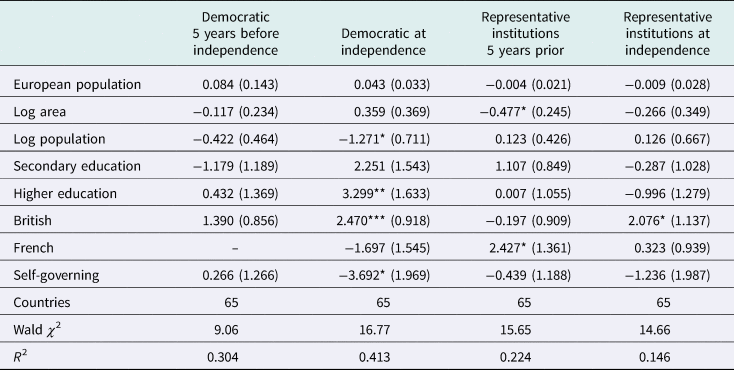
Table 3 presents a simple linear estimation with a Logit estimator (due to the categorical nature of our dependent variable), where we explore a set of potential structural predictors of the existence of colonial democracy or representative institutions in a cross-sectional dataset of 65 former colonies (with full data). Both of these variables are observed 4–5 years before formal independence of the colony and immediately before the transition to independence. Most control variables refer to the data collected from the 1950–1954 editions of the Statesman's Yearbook, as described in the preceding section, where we only do a simple log conversion of the total population and the total area covered by the colony. Following the literature, we further introduce a dummy for colonies of the British and Dutch Commonwealths, and another one for French colonies.
Predicting colonial democracy

Note: *** (**) [*] denote significance at p < 0.01 (p < 0.05) [p < 0.10]. All regressions include a constant term; numbers in parentheses are robust standard errors.
The findings in Table 3 give us only few insights into the structural predictors of colonial democracy or representation. For the dependent variable ‘democratic at independence’ we find some indications that having an institution of tertiary education and being a British colony are both significantly and positively associated. In turn, a comparatively larger population and being self-governing are negatively and significantly associated with this same dependent variable. However, these variables are insignificant in the other four estimations, which is why we cannot really consider them to be robust predictors of colonial democracy. For the case of explaining representative institutions at independence, we also find a significant and positive effect of having been a being a British colony, which is very much in line with large parts of the relevant literature (cf. Bergh and Fink, Reference Bergh and Fink2018; Fails and Krieckhaus, Reference Fails and Krieckhaus2010; La Porta et al., Reference La Porta, Lopez-de-Silanes and Shleifer2008). The result that having been a British colony is a predictor of democracy at independence, but not at all 5 years prior is intriguing: it suggests a uniquely British last-minute push for installing democratic institutions in order to prepare colonies for independence, where the United Kingdom seems to have taken a somewhat unique policy towards decolonisation. Notably, the share of the European population is always insignificant in Table 3. This sheds doubt on the hypothesis that colonial powers were more likely to grant their settlement colonies democratic (or representative) institutions during colonial rule. Neither does it seem to be a factor for having been able to create democratic institutions at the moment of formal independence.
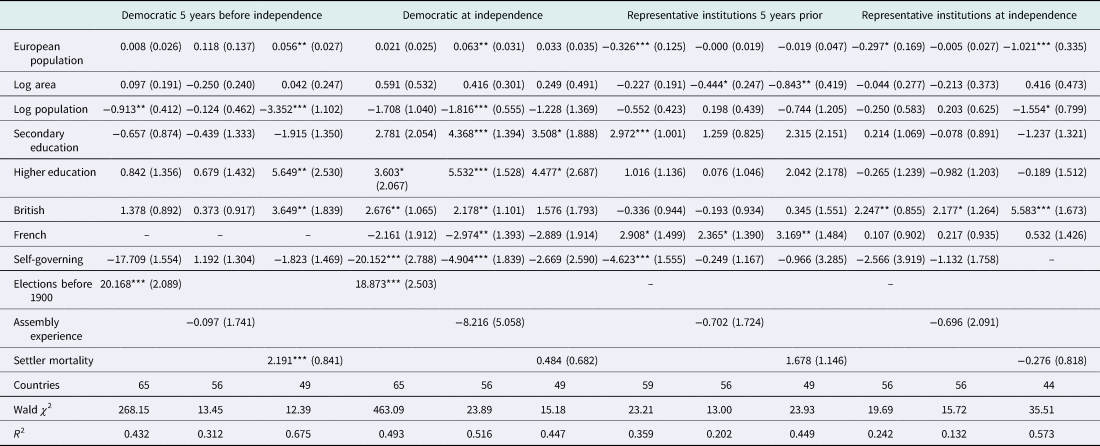
Table A3 of the Appendix repeats this analysis introducing a set of additional controls, namely a variable whether the corresponding colony held elections before the year 1900, a variable on historical assembly experiences by Pavlik and Young (Reference Pavlik and Young2020, Reference Pavlik and Young2021), and the settler mortality rates by Acemoglu et al. (Reference Acemoglu, Johnson and Robinson2001). The latter two reduce our sample quite significantly, which is why the corresponding analyses should probably be regarded with some degree of reservation. Of these three variables, only the election variable is statistically highly significant for predicting the existence a colonial democracy. This is nevertheless clearly driven by the relatively few colonies with particularly early representative bodies, like the examples of Bermuda and the Cayman Islands mentioned above. Generally, our main conclusion from Table 3 that there are no robust structural predictors of colonial democracy (or representation), is clearly confirmed in Table A3.
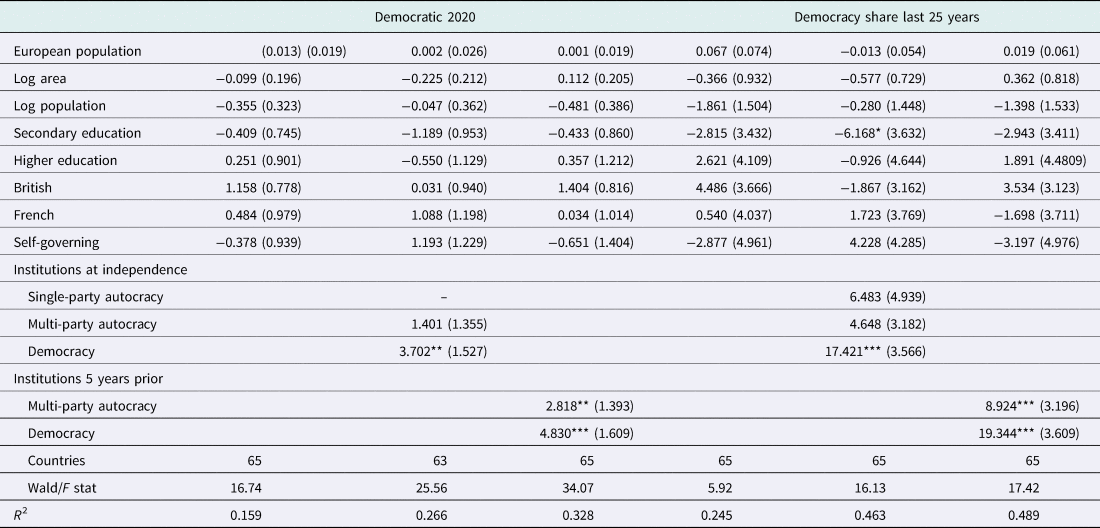
In the following, Table 4 presents linear Logit and ordinary least squares results (when the dependent variable is not categorical) where we explore potential predictors of current democracy in the same cross-sectional dataset of 65 former colonies. The dependent variable is whether the country is classified as democratic in 2020, or the share of time it has been democratic for the last 25 years. We employ the same basic control variables as in Table 3, further introducing a series of dummy variables from the Bjørnskov and Rode (Reference Bjørnskov and Rode2020) dataset to capture political institutions of colonies at independence or 5 years prior.
Predicting modern democracy

Note: *** (**) [*] denote significance at p < 0.01 (p < 0.05) [p < 0.10]. All regressions include a constant term; numbers in parentheses are robust standard errors.
The findings from Table 4 again show that none of the structural colonial variables that we collected from the Statesman's Yearbook can be considered robust predictors of current democracy. In fact, this time none of them turn out significant in any of the four regressions, even when modern democracy is only regressed on colonial characteristics, without including colonial institutions. In turn, the existence of a colonial democracy, either at the moment of independence, or 5 years before, is a statistically highly significant predictor of former colonies being an institutional democracy in Table 4. This is also true for both our dependent variables, the classification as democratic in 2020, and the share of time the respective country has been democratic for the last 25 years. Notably, at 5 years before a transition to independence, even having been a multiparty autocracy as a colony is positive and statistically highly significant for both dependent variables after decades of independence.
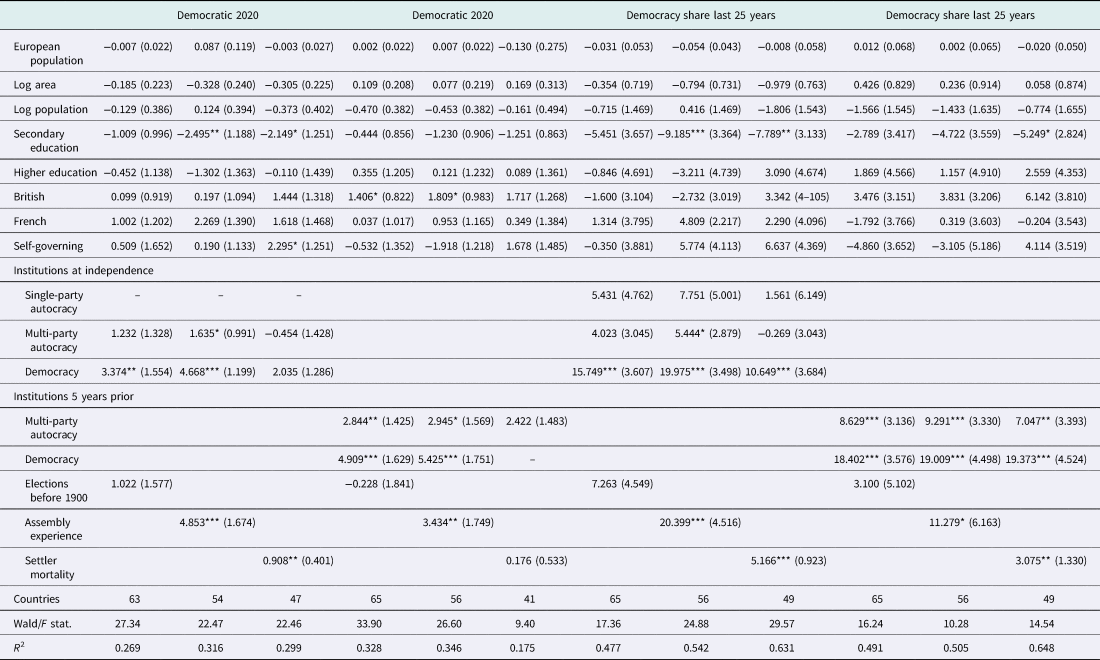
Table A4 of the Appendix again confirms the robustness of these findings, introducing our controls on the presence of elections before the year 1900, historical assembly experiences and settler mortality rates. Although settler mortality is significant and unexpectedly positive in some specifications, only early assembly experience can really be considered to be an additional robust predictor of post-colonial democracy. To some degree, it is notable that this variable only seems to be relevant for predicting the democracy of independent states, rather than also the existence of a colonial democracy in Table A3. However, it should be noted that this finding is again driven by relatively few colonies with historical assembly experiences, not least Belize and Cape Verde, indicating along the lines of Maseland (Reference Maseland2018) that also pre-colonial experiences may matter for the long-run institutional outcomes of post-colonial states.
In summary, the element of ‘stickiness’ that is present in formalised democratic experiences seems to be strong and highly persistent over time: once formal democratic institutions had been formally transferred by the colonial power, or set up under its explicit toleration by the local population, these acted as a powerful conditioning factor for the future political development of former colonies. Even if rather rudimentary, and only installed a relatively short time before independence, representative colonial institutions have had a profound impact until today, suggesting that it is not necessarily colonial history that matters, but rather the process of decolonisation. In light of the relevant literature, domestic experience with imported democratic institutions then seems to make all the difference, putting education, geography that conditions settlement patterns and European immigration partially out of the equation, at least when considering the last wave of decolonisation during the latter half of the 20th century.
6. Discussion and conclusions
Employing the Statesman's Yearbook, a previously unused source of empirical information, allows us to directly explore some critical claims in the institutional democracy literature for a large number of non-sovereign countries in the immediate aftermath of WWII. In particular, we examine whether colonial political institutions act as mediators of the relation between colonial characteristics and post-colonial outcomes, or if colonial and postcolonial political institutions can be seen as jointly determined by the same underlying set of variables.
Notably, we find that late colonial political institutions matter, but neither they nor post-colonial outcomes are driven by the characteristics in question. In other words, neither the joint influence nor the mediator argument really appears to hold in their own right. Contrary to large parts of the literature, we find no indications that colonial characteristics matter for the installation of post-independence representative democratic institutions. Along those lines, we also find no evidence that the size of the European population in the late colonial period matters for whether the country subsequently became democratic or, indeed, whether the colonial institutions were representative or fully democratic at the time.
This non-finding forces us to ask what might explain this obvious contrast with large parts of the literature? One potential reason why we find no differences for settler colonies and those of a more extractive nature, to use the terminology by Acemoglu et al. (Reference Acemoglu, Johnson and Robinson2001), could perhaps be that many countries in their study were effectively independent at the time under consideration in our research, most specifically countries in Latin America and certain settler colonies of Great Britain (Australia, Canada and New Zealand). As suggested by Fails and Krieckhaus (Reference Fails and Krieckhaus2010), the settler hypothesis may only apply to a specific subset of British colonies. Generally speaking then, we essentially observe a much shorter time frame than many of these earlier studies, and are effectively only able to make claims on the last wave of decolonisation in the second half of the 20th century, not on colonialism per se.
For the subset of former colonies that became independent after 1950, our findings show that the effect of having domestic experience with formalised democratic institutions is highly persistent over time. It seems that once even rather rudimentary formal democratic institutions had been transferred, these acted as a powerful conditioning factor for future political development of newly independent countries. Following earlier contributions in this area, it thus seems to be important that recipient colonies of democratic governance structures had some time available to experiment around and adjust the imported institutions to local practices (Seidler, Reference Seidler2018), even though our results suggest that this ‘practice period’ did not necessarily have to be overly long.
A separate question, nevertheless, is if the political institutions inherited from colonial times proved to be stable. Occasionally, coups lead to democratisation although it remains the exception more than the rule (Derpanopoulos et al., Reference Derpanopoulos, Frantz, Geddes and Wright2016). If colonial history systematically affects the likelihood to experience coups, this could pose a potential problem for an analysis such as the one presented above. However, Bjørnskov and Rode (Reference Bjørnskov and Rode2020) find no evidence that colonial political institutions affected the subsequent coup risk and although some countries have been particularly prone to experiencing coups, we still observe institutional persistence in the very long run. In summary, late colonial political institutions matter directly for current outcomes in our framework, and not because they proxy some kind of obvious, underlying condition that drives outcomes.
The hopeful message contained in our findings is that the promise of responsive and democratic government is not necessarily one that has to be achieved over hundreds of years via systematic changes in informal institutions in order to be able to work properly. Within one generation, profound changes to formal institutions can potentially condition future decisions on political development and turn political democracy into a viable and stable choice. Ideally, one would like to know the extra benefit of each year of democratic experience before independence. Does it matter if independence came right after WWII (1950s) or much later when the political influence of France and the United Kingdom had all but vanished? Unfortunately, we are unable to answer this important question with our data. Another crucial question that arises from our findings is: what essentially explains the differences in late colonial political institutions, if not the embeddedness in stable underlying characteristics? With our present findings, it is totally unclear what these characteristics might be, or how they essentially interact with much more short-term oriented institutional transfers.
Acknowledgements
We thank the late David Savage, participants of the 2019 Australasian Public Choice Conference (Brisbane), a 2020 online research seminar for Economic Research Southern Africa and three anonymous reviewers for comments on earlier versions, as well as Jerg Gutmann for data assistance. Bjørnskov also gratefully acknowledges financial support from the Jan Wallander and Tom Hedelius Foundation.
Appendix
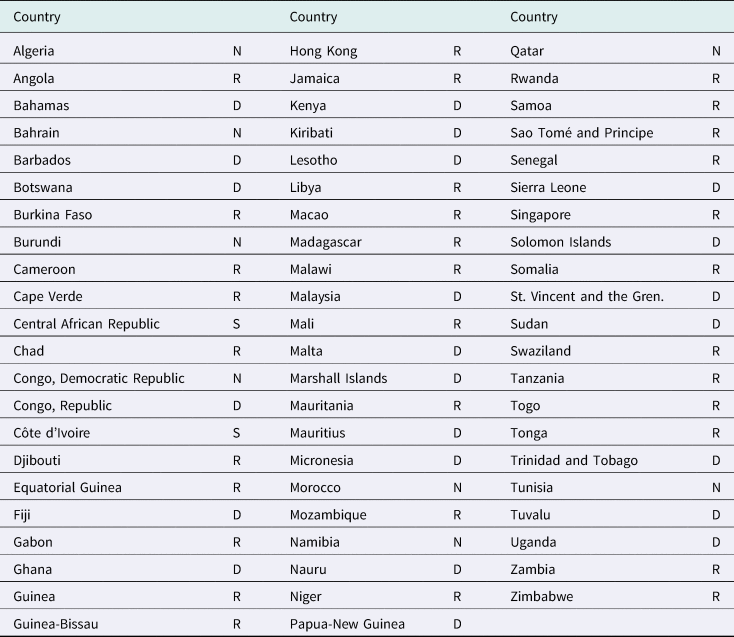
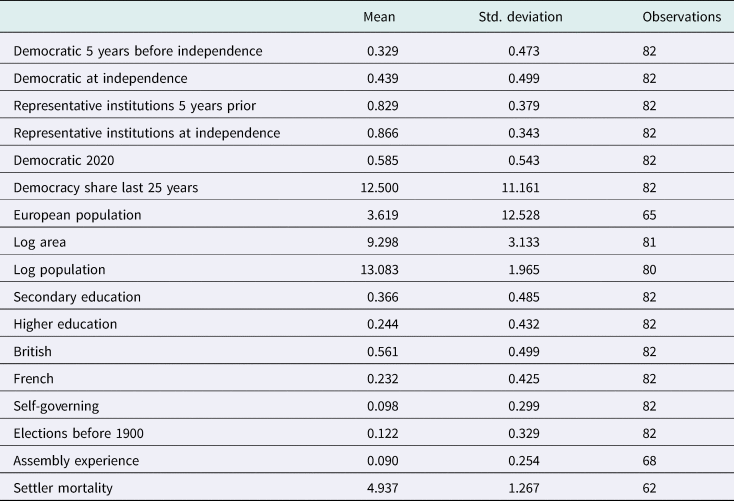
In this appendix, we provide a full list of countries used in our sample in Table A1, descriptive statistics in Table A2 and document the additional robustness tests associated with the main results reported in Tables A3 and A4.
Countries in the sample

Descriptive statistics

We repeat all estimates in Tables A3 and A4 including one of three additional variables: whether a colony held its first elections to a representative institution before the year 1900, which we code ourselves, a variable on historical assembly experiences by Pavlik and Young (Reference Pavlik and Young2020, Reference Pavlik and Young2021), and mortality rates among early settlers by Acemoglu et al. (Reference Acemoglu, Johnson and Robinson2001). We add a few observations to the historical assembly experiences in cases where we know there was no established, larger settlement prior to colonisation. Similarly, we add nine observations to the settler mortality data when an observation is available for a neighbouring country with the same geography and similar disease environment. In both cases, this is primarily done for small island colonies in the Caribbean for which there usually is no information. Even with these additions, the maximum sample size for the historical assembly variable is 56, and 49 when applying settler mortality data.
As the results show, all of our main results remain qualitatively unchanged. In Table A3, the only characteristic to be robustly associated with colonial democracy is whether the colony had representative institutions prior to 1900. The reason why the variable drops out of the specification in columns 6 and 9 is that it becomes perfectly collinear with the dependent variable. This is therefore the only robust predictor of democracy in the late colonial period. In addition, historical assembly experience appears to be related to modern democracy, although we must warn that the overall association is driven by a handful of former colonies – Belize, Cape Verde, Jamaica, Mauritius and Namibia – which according to Pavlik and Young (Reference Pavlik and Young2020) have a tradition of assembly politics. As such, the only robust observation we can draw from these additional tests is that some period of representative institutions, and thus some degree of experience with representation, appears to be a mediating factor.
Predicting colonial democracy

Predicting modern democracy