INTRODUCTION
Cetacean strandings can result from a variety of causes, which are often poorly understood (Geraci et al., Reference Geraci, Harwood, Lounsbury, Twiss and Reeves1999; Bradshaw et al., Reference Bradshaw, Evans and Hindell2006). Nonetheless, the historical and ongoing record of animal strandings represents a valuable method for gathering information on species occurrence and potential threats, particularly in areas where research effort is limited and knowledge is scant.
The fin whale Balaenoptera physalus is the only mysticete regularly occurring in the Mediterranean. The species is abundant in the western basin, but numbers decrease towards the east (Notarbartolo di Sciara et al., Reference Notarbartolo di Sciara, Zanardelli, Panigada, Jahoda and Airoldi2003; Panigada et al., Reference Panigada, Lauriano, Burt, Pierantonio and Donovan2011). Fin whales in this region are genetically distinct, with limited gene flow from the contiguous North Atlantic (Bérubé et al., Reference Bérubé, Aguilar, Dendanto, Larsen, Notarbartolo di Sciara, Sears, Sigurjonsson, Urbàn and Palsbøll1998; Palsbøll et al., Reference Palsbøll, Bérubé, Aguilar, Notarbartolo di Sciara and Nielsen2004). The Mediterranean population has been classified as ‘Vulnerable' in the IUCN Red List of Threatened Species (Panigada & Notarbartolo di Sciara, Reference Panigada and Notarbartolo di Sciara2012). Collision with ships is described as an important threat and the main cause of direct mortality in the region (Panigada et al., Reference Panigada, Pesante, Zanardelli, Capoulade, Gannier and Weinrich2006).
In the Adriatic Sea, sporadic sightings and mortality events of fin whales have occurred since historical times (Notarbartolo di Sciara et al., Reference Notarbartolo di Sciara, Zanardelli, Panigada, Jahoda and Airoldi2003; Lipej et al., Reference Lipej, Dulčić and Kryštufek2004; Pađen & Maurić, Reference Pađen and Maurić2008; Caputo & Giovannotti, Reference Caputo and Giovannotti2009). The National Italian Strandings Database (http://mammiferimarini.unipv.it/) contains no Adriatic records prior to 1986, and only five strandings are reported between 1986 and 2012. Here, we contribute an updated list of fin whale mortality events in the Adriatic Sea, together with an account on the killing of a fin whale in 1960.
MATERIALS AND METHODS
Study area
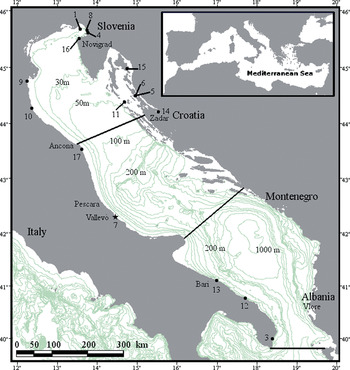
The Adriatic Sea is a semi-enclosed basin connected to the rest of the Mediterranean through the Strait of Otranto in the south, which represents its narrowest portion (Figure 1). It extends latitudinally, from 39°44′N to 45°45′N, with a maximum length of about 830 km and a surface of about 150,000 km2. While the northern basin is characterized by very shallow depths (35 m on the average), it reaches a maximum depth of 1222 m in its central-southern basin (Zavatarelli & Pinardi, Reference Zavatarelli and Pinardi2003). Two seasonal coastal currents exist, one flowing southward along the whole western coast and the other northward along the eastern coast. Gyres located in the southern, central and northern sub-basins characterize the general cyclonic circulation of the basin (Russo & Artegiani, Reference Russo and Artegiani1996; Artegiani et al., Reference Artegiani, Bregant, Paschini, Pinardi, Raicich and Russo1997a, Reference Artegiani, Bregant, Paschini, Pinardi, Raicich and Russob; Poulain, Reference Poulain2001; Zavatarelli & Pinardi, Reference Zavatarelli and Pinardi2003).
Map of the Adriatic Sea showing bathymetric contours and stranding locations as reported in Table 1. Star, unreported killing described in this paper. The location of the stranding which occurred in 1771 is unknown.

Literature review
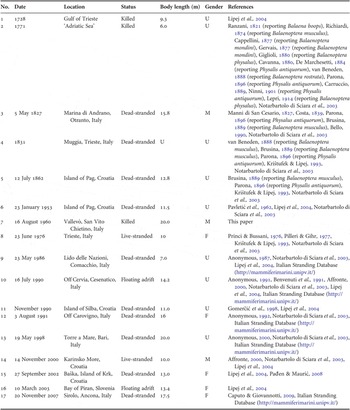
This work is based on a careful review of historical and recent sources including scientific articles, newspapers, illustrations, maps, non-published scientific reports, and other grey literature from the 18th Century onwards. Earlier lists of cetacean occurrence in the Adriatic, including both sightings and strandings (e.g. Brusina, Reference Brusina1889; Parona, Reference Parona1896), were compared with recent reviews of fin whale occurrence (Notarbartolo di Sciara et al., Reference Notarbartolo di Sciara, Zanardelli, Panigada, Jahoda and Airoldi2003; Lipej et al., Reference Lipej, Dulčić and Kryštufek2004), and updated with records from additional information sources and the new report presented here. Stranding circumstances including date, location, number, size and sex of the animals involved, whether they stranded dead or alive and any other pertinent information were based on the primary and earlier sources. Information across sources was compared, relevant inconsistencies being reported in Table 1. In the few instances where the original sources were inaccessible, the stranding events were validated only if previously reported in peer-reviewed publications. In particular, the original sources for the fin whale killing in 1728 remain unavailable and a published review was used as the primary source (Lipej et al., Reference Lipej, Dulčić and Kryštufek2004).
Updated list of fin whale mortality events in the Adriatic Sea with bathymetric lines. All fin whale records relate to single individuals and numbers correspond to event locations in Figure 1. U, unreported; M, male; F, female.

Unreported mortality event
We interviewed six individuals who were either directly involved in the killing of the fin whale or present at the stranding site. Interviews took place at or near the village of Vallevò near Chieti, Italy (42°17′N 14°28′E). Additionally, we reviewed photographs and footage made available by the persons interviewed and we searched for any information in the local and national press, as well as in the scientific literature. Photographs and videos allowed validating the species identification and precise location of the stranding, further confirmed through a visual inspection of the location where the whale was reported to have died.
RESULTS
Review of mortality events
A review of the historical and recent literature yielded a total of 17 fin whale mortality events that occurred along the Adriatic coast between 1728 and 2012. A list of these events and a map with their locations are presented in Table 1 and Figure 1. Multi-animal strandings (similar to those documented for species such as the sperm whale Physeter macrocephalus: Bearzi et al., Reference Bearzi, Pierantonio, Affronte, Holcer, Maio and Notarbartolo di Sciara2011) were never reported for fin whales in the Adriatic. The first two events—in 1728 and 1771—relate to live and possibly debilitated animals that were deliberately killed (but see our disclaimer relative to the case of 1728). The case of Vallevò presented here is therefore the only known instance of a fin whale killing in the Adriatic in recent times.
The killing of Vallevò
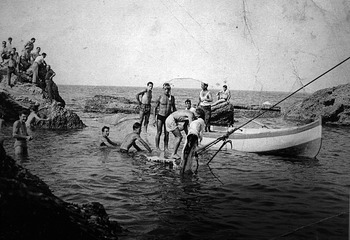
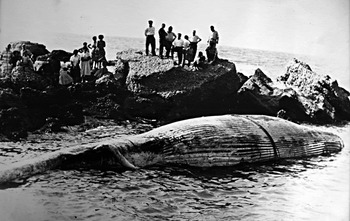
On 16 August 1960, a 20 m long male fin whale (Figure 3) was wounded by two poachers (who prefer to remain anonymous) engaging in illegal dynamite fishing near Punta Tufano, in the locality of Vallevò, near San Vito Chietino (Chieti), Italy (Figure 1). These individuals reported to have spotted from shore a ‘dark mass' slowly moving under the surface towards the breakwater rocks, allegedly misidentifying it for a large school of fish. They rapidly approached the spot with a small rowing boat and threw a TNT stick of about 300 g (illegal dynamite fishing was popular at the time). A few seconds after the explosion the fin whale surfaced, wriggling violently for a few minutes as water turned red. While still alive, the wounded animal was later dragged into a rocky enclosure (42°17′15.93″N 14°28′51.31″E) by means of a steel cable wrapped around its fluke (Figure 2). The whale reportedly died about three hours after being dragged ashore. The carcass remained in the cove for several days before the local authorities decided to remove it. However, the fate of the carcass remains unknown. Photographs of the event and a total of 3 minutes 16 seconds of footage portray men in bathing suits standing near or above the carcass, as well as villagers posing for group photographs with the dead whale—a setup that was popular at that time (Bearzi et al., Reference Bearzi, Pierantonio, Bonizzoni, Notarbartolo di Sciara and Demma2010). Some interviewed people referred to the event as the ‘fishing highlight of the century', while others vividly recalled the waters extensively coloured by the whale's blood.
The dead fin whale while being dragged ashore by means of an iron cable wrapped around his fluke.

The male fin whale in the cove near Vallevò.

DISCUSSION
Long-term stranding datasets based on validated information can help us to understand the past and present occurrence of cetaceans. The information provided here represents a useful tool to investigate spatial and temporal correlates of fin whale strandings in the Adriatic Sea. Because the fin whale is considered a vagrant in the Adriatic (Notarbartolo di Sciara et al., Reference Notarbartolo di Sciara, Zanardelli, Panigada, Jahoda and Airoldi2003) it can be expected that only a few animals strand in this area. While the limited number of fin whale sightings and strandings (Notarbartolo di Sciara et al., Reference Notarbartolo di Sciara, Zanardelli, Panigada, Jahoda and Airoldi2003; Lipej et al., Reference Lipej, Dulčić and Kryštufek2004) is likely related to absence of favourable habitat in the northern and central Adriatic (Bearzi et al., Reference Bearzi, Holcer and Notarbartolo di Sciara2004, Reference Bearzi, Pierantonio, Affronte, Holcer, Maio and Notarbartolo di Sciara2011), the southern basin—with depths up to 1200 m—could potentially be more suitable for this species. However, there are only a few published observations of fin whales in the southern Adriatic (e.g. Politi et al., Reference Politi, Bearzi, Notarbartolo di Sciara, Cussino and Gnone1992, Reference Politi, Airoldi and Notarbartolo di Sciara1994; Nascetti & Notarbartolo di Sciara, Reference Nascetti and Notarbartolo di Sciara1996; Notarbartolo di Sciara et al., Reference Notarbartolo di Sciara, Zanardelli, Panigada, Jahoda and Airoldi2003). The relatively low occurrence of fin whales in the southern Adriatic and more generally in the eastern Mediterranean basin, as compared to the western basin, is poorly understood.
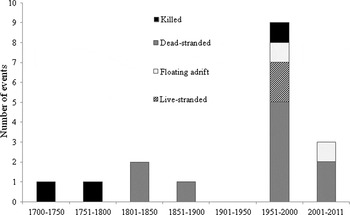
Most Adriatic strandings occurred in the shallow north-western and western portions of the basin, with no records along the south-eastern sector of the region (Figure 1). Such stranding pattern may be due to causes including: (1) drifting carcasses being transported unevenly by the general surface circulation as well as local and seasonal currents patterns (Russo & Artegiani, Reference Russo and Artegiani1996; Artegiani et al., Reference Artegiani, Bregant, Paschini, Pinardi, Raicich and Russo1997a, Reference Artegiani, Bregant, Paschini, Pinardi, Raicich and Russob; Zavatarelli & Pinardi, Reference Zavatarelli and Pinardi2003); (2) stretches of coast that are or used to be relatively less populated or more difficult to access, resulting in fewer reports; and (3) geographical differences in awareness and monitoring effort, affecting the likelihood of reporting. On a temporal scale, a peak of strandings in the second half of the 20th Century is apparent (Figure 4), likely due either to increased reporting or research effort.
Mortality events involving fin whales in the Adriatic Sea (N = 17) subdivided in 50-year blocks between 1700 and 2012.

Fin whale age-classes can be extrapolated from body lengths (Lockyer et al., Reference Lockyer, Gambell and Brown1977; Aguilar & Lockyer, Reference Aguilar and Lockyer1987; Aguilar et al., Reference Aguilar, Olmos and Lockyer1988). Based on this information, only 2 (12.5%) of the fin whales stranded in the Adriatic would be adults. This information is consistent with the mortality pattern of mammals, being generally higher among young and immature animals (Caughley, Reference Caughley1966; Emelen, Reference Emelen1970). Prevalence of young fin whales in the Adriatic record is also consistent with the recent findings of Arrigoni et al. (Reference Arrigoni, Manfredi, Panigada, Bramanti and Santangelo2011), who described a higher mortality for young and immature fin whales throughout the Mediterranean Basin.
It should be noted that mortality events involving large cetaceans such as the sperm whale have not been uncommon in the Adriatic, where a total of 36 sperm whale mortality events were recorded since historical times (Bearzi et al., Reference Bearzi, Pierantonio, Affronte, Holcer, Maio and Notarbartolo di Sciara2011)—compared with only 17 such events involving fin whales. Unlike sperm whales (58.3% live-stranded: Bearzi et al., Reference Bearzi, Pierantonio, Affronte, Holcer, Maio and Notarbartolo di Sciara2011), fin whale mortality events in this area mostly involved dead animals (N = 12; 70.6%), with only 2 whales live-stranded (11.8%) and 3 killed (17.6%). Although commercial whaling never existed in Italy (Notarbartolo di Sciara & Bearzi, Reference Notarbartolo di Sciara, Bearzi and Notarbartolo di Sciara2002), until the 1960s large cetaceans were often considered as resources and used to extract oil or other consumer goods (Bearzi et al., Reference Bearzi, Pierantonio, Bonizzoni, Notarbartolo di Sciara and Demma2010, Reference Bearzi, Pierantonio, Affronte, Holcer, Maio and Notarbartolo di Sciara2011). Additionally, in historical times, even accredited naturalists regarded large cetaceans as anomalies in the Mediterranean, and their strandings attracted considerable scientific interest (Bearzi et al., Reference Bearzi, Pierantonio, Bonizzoni, Notarbartolo di Sciara and Demma2010). While no details are available regarding the killing of a fin whale in 1728, the meat of the small individual caught in 1771 was partly sold at the fish market of Bologna, Italy (Parona, Reference Parona1896). The skull of the latter whale was then exposed at the Museum of Natural History of Bologna until 1826, and then moved to the Museum of Comparative Anatomy in the same town (Parona, Reference Parona1896). Similarly, the skull of the fin whale beached near Trieste in 1831 was sent to the Oceanographic Museum of Monaco (Brusina, Reference Brusina1889; Parona, Reference Parona1896). The skeleton of the fin whale found floating adrift in the Bay of Piran in 2003 is exposed at the Museum of Natural History of Ljubljana, Slovenia.
In the case of Vallevò, local authorities tried to sell the carcass to a soap factory, without reaching an agreement. According to two respondents the whale was dragged a few miles offshore and ‘sunk with stones', whereas others reported that the decomposing whale would not sink and after having floated for days it was buried on land in an unknown location. One respondent reported that skeletal parts were sold to an unspecified museum in the UK long after the death of the whale. However, inquiries sent to the main UK museums (Natural History Museum of London, National Museum of Scotland, Oxford University Museum of Natural History and the University Museum of Zoology, Cambridge) as well as searches in online databases were unproductive.
The fin whale killed near Vallevò may have approached shore because of his poor physical conditions. The fin whale is considered a flight species (Jefferson et al., Reference Jefferson, Stacey and Baird1991; Ford & Reeves, Reference Ford and Reeves2008), i.e. a species that tends to swim away from predators, with no active defence or reaction to threats. The hypothesis of debilitation may further explain why the whale could be dragged ashore while the animal was still alive. Conversely, several reports exist of wounded sperm whales—a fight species that actively fights back in response to threats—reacting forcefully to dragging attempts (Bearzi et al., Reference Bearzi, Pierantonio, Bonizzoni, Notarbartolo di Sciara and Demma2010). The event of Vallevò has remained unreported in the scientific literature for about 50 years, despite a few recent articles in local newspapers that recalled the story and published photographs (Il Tempo, 2 January 2004; Abruzzo Quotidiano, 14 August 2010; Il Centro, 28 August 2010). Back in 1960, the national news media misreported that a ‘greedy' whale had become stranded while ‘chasing' the fishing boat of the two poachers, being attracted by nets full of fish and unaware of the shallow sea floors, where the whale ‘naturally' died (Il Messaggero, 17 August 1960; Il Tempo, 17 and 18 August 1960). The national news media also reported the whale being ‘unable to regain the open sea', and ‘expressing his fury by angrily erupting air from the mouth and the two characteristic water fountains' (our translations from Italian). Photographs and videos, together with information obtained through interviews, are suggestive of a general attitude towards the animal, which can be described as ‘non-compassionate' (Bearzi et al., Reference Bearzi, Pierantonio, Bonizzoni, Notarbartolo di Sciara and Demma2010). The event triggered the curiosity of the local community. Hundreds of people flocked to the stranding site and trains transiting on the railway parallel to the coast stopped and allowed the passengers to get out and watch the dead animal. Shortly after the whale was dragged into the cove at Vallevò, local fishermen set up a shack to sell grilled fish to the crowds. Today, the stranding location is known by the locals as Punta Balena (Cape Whale).
ACKNOWLEDGEMENTS
We are grateful to Tommaso D'Oltremare, Giacinta Sciascio, Stefano Tucci, Rinaldo Verì and the cultural association ‘Lo Scoglio del Gabbiano' for kindly providing information, personal communications, photographs and video material about the stranding. Robert Asher, Daisy Cunynghame, Rob Deaville, Sonja Eisfeld, Malgosia Nowak-Kem, Polly Parry and Richard Sabin contributed useful information on fin whale specimens in UK museums. Tilen Genov, Ana Hace, Lovrenc Lipej and Giuseppe Notarbartolo di Sciara provided useful information about previous fin whale strandings. Marina Costa, Sonja Eisfeld, Tilen Genov, Giuseppe Notarbartolo di Sciara, Simone Panigada and two anonymous referees contributed valuable suggestions and comments to early drafts of this manuscript.