Introduction
The chemistry and morphology of native gold are of great importance to better understand the genesis and evolution of gold in gold deposits, especially in relation to other associated metals. Gold occurs in a wide variety of economic deposits that have formed in a range of tectonic settings and over a wide range of crustal depths and temperatures. The morphology and chemistry of alluvial or placer gold grains have been used widely in mineral exploration to help determine their likely primary source (e.g. Fisher, Reference Fisher1945; Knight et al., Reference Knight, Mortensen and Morison1999; Townley et al., Reference Townley, Herail, Maksaev, Palacios, de Parseval, Sepulveda, Orellana, Rivas and Ulloa2003; Hough et al., Reference Hough, Butt and Fischer-Buhner2009). In addition, gold can be transported in a wide range of fluids/melts and be precipitated from these via a range of mechanisms (Chapman et al., Reference Chapman, Leake, Bond, Stedra and Fairgrieve2009; Frimmel, Reference Frimmel, Kelley and Golden2014).
Native gold almost always occurs as an alloy with silver as gold and silver have the same atomic radius and thus can form a continuous alloy series (Hough et al., Reference Hough, Butt and Fischer-Buhner2009). Gold can also alloy with a number of other metals including copper, mercury lead, tin, antimony, bismuth and platinum-group elements (Desborough, Reference Desborough1970; Boyle, Reference Boyle1979; Morrison et al., Reference Morrison, Rose and Jaireth1991; Townley et al., Reference Townley, Herail, Maksaev, Palacios, de Parseval, Sepulveda, Orellana, Rivas and Ulloa2003; Hough et al., Reference Hough, Butt and Fischer-Buhner2009; Liu et al., Reference Liu, Beaudoin, Makvandi, Jackson and Huang2021), though these occur mostly in minor concentrations and comprise <1 wt.% (Morrison et al., Reference Morrison, Rose and Jaireth1991). Although electrum has been defined as a gold–silver alloy in which the silver content exceeds 20% (Harris, Reference Harris1990) it is not an official mineral species according to the International Mineralogical Association (Pasero, Reference Pasero2022). Instead, if the Ag–Au alloy contains >50 wt.% Ag it would be called silver and conversely, if it contains >50 wt.% Au it would be called gold. However, Harris (Reference Harris1990) also pointed-out that the term ‘electrum’ is normally applied to epithermal and what we now refer to as orogenic deposits where the Au–Ag alloy exhibits a wide range of silver concentrations.
Gold can also occur in a wide variety of mineral species including various alloys where it is combined with antimony, copper, mercury, bismuth, platinum-group elements and, rarely, tin. It also occurs in tellurides, tellurates, sulfides and selenides (Harris, Reference Harris1990; Missen et al., Reference Missen, Etschmann, Mills, Sanyal, Ram, Shuster, Rea, Raudsepp, Fang, Lausberg, Melchiorre, Dodsworth, Liu, Wilson and Brugger2021). Of relevance to this present study is the mineral aurostibite (AuSb2), a member of the pyrite group where gold is alloyed with antimony and was first described by Graham and Kaiman (Reference Graham and Kaiman1952) from the Giant mine at Yellowknife, Northwest Territories and the Chesterville mine of Ontario, Canada, both being quartz-vein hosted orogenic gold deposits (Shelton et al., Reference Shelton, McMenamy, van Hees and Falck2004; Ispolatov et al., Reference Ispolatov, Lafrance, Dube, Creaser and Hamilton2008). Since then, it has been described from many deposits including, but not restricted to, the quartz-vein hosted orogenic Mobale gold mine, Kivu, Democratic Republic of Congo (Jedwab et al. Reference Jedwab and Mendes1992; Milesi et al., Reference Milesi, Toteu, Deschamps, Feybasse, Lerouge, Cocherie, Penaye, Tchameni, Moloto-A-Kenguemba, Kampunzu, Nicol, Duguey, Leistel, Saint-Martin, Ralay, Heinry, Bouchot, Doumnang Mbaigane, Kanda Kula, Chene, Monthel, Boutin and Cailteux2006), metamorphosed Sulitjelma VMS deposit of northern Norway (Cook, 1992, Reference Cook1996), quartz-vein hosted orogenic Kharma Sb deposit of Bolivia (Dill et al., Reference Dill, Weiser, Bernhardt and Riera Kilibarda1995), quartz-vein hosted orogenic West Gore Sb-Au deposit of Nova Scotia, Canada (Kontak et al., Reference Kontak, Horne and Smith1996), hydrothermal quartz-vein hosted Hillgrove gold-antimony deposit of northeastern NSW, Australia (Ashley et al., Reference Ashley, Creagh and Ryan2000), intrusion-related Au–Sb A deposit of New Brunswick, Canada (Cabri et al., Reference Cabri, Hoy, Rudashevsky and Rudashevsky2007; Deschenes et al., Reference Deschenes, Xia, Fulton, Cabri and Price2009; Ravenelle et al., Reference Ravanelle, Lutes and Hynes2008; Watters et al., Reference Watters, Castonguay, Lutes and McLeod2008), intrusion-related Darasun deposit of Eastern Transbaikal, Russia (Bryzgalov et al., Reference Bryzgalov, Krivitskaya and Spiridonov2007; Spiridonov et al., Reference Spiridonov, Krivitskaya, Bryzgalov, Kulikova and Gorodetskaya2010), quartz-vein hosted orogenic Passagem de Mariana gold mine, Brazil (Oberthur and Weiser, Reference Oberthur and Weiser2008), carbonaceous clastic sediment-hosted Suzdal gold deposit of eastern Kazakhstan (Kovalev et al., Reference Kovalev, Kalinin, Naumov, Pirajno and Borisenko2009), metamorphosed mafic-ultramafic hosted orogenic Lapa deposit, Abitibi Belt, Canada (Simard et al., Reference Simard, Gaboury, Daigneault and Mercier-Langevin2013; Jebrak et al., Reference Jebrak, Lebrun, Andre-Mayer and Simard2016), intrusion-related Mokrsko-West gold deposit of the Bohemian Massif, Czech Republic (Zacharias et al., Reference Zacharias, Moravek, Gadas and Pertoldova2014), metavolcanic hosted Pirunkoukku gold occurrence of northern Finland (Novoselov et al., Reference Novoselov, Belogub, Kotlyarov and Mikhailov2015), the Krasna Hora deposit of the Czech Republic (Zacharias and Nemec, Reference Zacharias and Nemec2017), and most recently, the intrusion-related Oleninskoe Au–Ag deposit of the Kola Peninsula, Russia (Kalinin et al., Reference Kalinin, Savchenko and Selivanova2019).
In this paper, we describe the mineral associations, textures and chemistry of gold, electrum and aurostibite from a number of associations and ore lenses within the Devonian Hera metaturbidite-hosted polymetallic Au–Zn–Pb–Ag deposit of the southern Cobar Basin, central NSW, Australia. Hera presented an excellent opportunity to study the textures and chemistry of gold as most of the gold is free-milling (i.e. not locked-up as minute inclusions in phases such as pyrite) and relatively coarse-grained. We also provide potential explanations for the occurrence of aurostibite and the almost complete spectrum of gold–electrum compositions from almost pure Au (~96 wt.%) to electrum with ~27 wt.% Au.
Location and geological setting
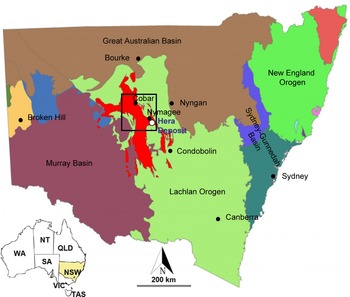
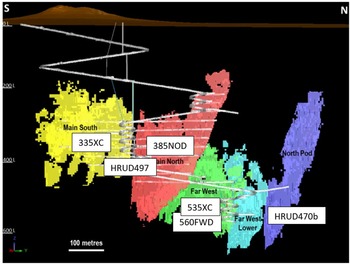
The Hera mine is located within the southern Cobar Basin, some 5 km south of the town of Nymagee in central New South Wales, Australia (Fig. 1). It is a polymetallic deposit containing economic concentrations of gold, lead, zinc and silver with mineralisation starting 240 metres below the surface. Hera had a total undepleted resource of 3.6 Mt @ 3.8% Zn, 2.6% Pb, 25 g/t Ag and 3.3 g/t Au. The deposit consists of multiple lodes which are structurally offset by a series of faults. These appear to dip west and strike in a NNW direction for over 800 metres in length with economic mineralisation currently identified to 640 metres below the surface (Fig. 2) (McKinnon and Fitzherbert, Reference McKinnon and Fitzherbert2017).
Map showing the location of the Hera mine (indicated by white circle) and limits of the Cobar Basin (marked in red) within central NSW, Australia (adapted from David, Reference David2006).

Cross-section showing the distribution of the various lodes within the Hera mine and location of samples studied (Aurelia Metals Ltd, 2018).

The Cobar Basin is located within the Central subprovince of the Lachlan Orogen and comprises several shelves (Winduck Shelf, Walters Range Shelf and Kopyje Shelf) and troughs (Cobar Trough, Mount Hope Trough and Rast Trough) (Glen, Reference Glen1991; David, 2008). Active sedimentation occurred within multiple depositional environments from deep-water troughs to shallow-water shelves. It has been suggested that tectonic activity was initiated on the eastern boundary of the basin and migrated to the west during the early Pragian (410.8–407.6 Ma) or late Lochkovian (419.2–410.8 Ma) (Glen et al., Reference Glen, Drummond, Goleby, Palmer and Walce-Dyste1994).
The basin contains many regional structures due to the many deformational cycles during and after its deposition (Glen, Reference Glen1990). Glen (Reference Glen1990) separated the Cobar Basin into a series of structural zones where differing geometry and strain were used to differentiate between them. Zone 1 is located on the eastern margin of the basin and underwent the highest strain; Zone 2 is in the central and south-western part of the basin and underwent a lower strain; and Zone 3 is in the north-western part and underwent the least strain. The Hera deposit is located within Zone 1 as are most of the deposits in the region (Glen, Reference Glen1991).
The inversion of the basin in the mid-Devonian (395–400 Ma) (Glen et al., Reference Glen, Dallmeyer and Black1992) caused the reactivation of existing faults and other structures leading to the mobilisation of fluids causing mineralisation across the region. Glen (Reference Glen1990) suggested that the compression occurred in a northeast/southwest direction and that most of the strain was focussed into Zone 1. Extensive metamorphism of varying grades occurred within the Cobar Basin with burial metamorphism being observed across the region. Greenschist-facies metamorphism is also observed which is related to the basin inversion event. However, there are also greenschist- to low-amphibole-facies assemblages which possibly formed from localised magmatism in conjunction with burial gradients until the basin inversion event (Fitzherbert et al., Reference Fitzherbert, Mawson, Mathieson, Simpson, Simpson and Nelson2017).
The creation of the basin led to the deposition of the various basin related sediments forming the Cobar Supergroup. The sediments deposited within the supergroup vary in their depositional environment with deep-water troughs containing siliciclastics (Cobar Basin) and volcanic–volcaniclastics–siliciclastics (Mt Hope Trough and Rast Tough) and flanking (Kopyje Shelf, Winduck Shelf) and intrabasinal shelfs (Wiltagoona, Walters Range Shelf) (David Reference David2018). The Cobar Trough not only hosts the Hera deposit, but many of the region's mineral deposits (i.e. Peak mine, CSA mine and Great Cobar mine).
The Hera deposit is hosted within the finer-grained sedimentary rocks of the Mouramba Group and overlying Lower Amphitheatre Group (David, Reference David2005). It lies 1 km west of the Rookery Fault, which is steep westward dipping, bounds the eastern margin of the Cobar Basin (David, Reference David2005) and is associated with many of the deposits in the region. The deposit shows a strong structural control being hosted within a fault splay with a NNW-trending cleavage (David, Reference David2005). It is made-up of several steeply west dipping, narrow ore bodies which are split into multiple lenses by two sets of parallel faults, one steeply south dipping set and one steeply east dipping set (McKinnon and Fitzherbert, Reference McKinnon and Fitzherbert2017). Waltenburg et al. (Reference Waltenberg, Blevin, Hughes, Bull, Fitzherbert, Cronin and Bultitude2019) obtained consistent U–Pb ages of 383 Ma on euhedral titanite crystals from quartz veins from the 435 and 460 levels of the Hera mine and this age is within error of a preliminary Ar–Ar age of 382 Ma for muscovite intergrown with sulfides from the Far West ore zone (Downes and Phillips, Reference Downes and Phillips2018).
Fitzherbert et al. (Reference Fitzherbert, McKinnon, Blevin, Waltenburg, Downes, Wall, Matchan and Huang2020) described the Hera deposit as a complex distal skarn with two distinct skarn types, a prograde skarn and a retrograde skarn. The prograde skarn comprises two subtypes: (1) silicilastic-hosted veins and breccia-fill hosted within metasiltstones comprising quartz–calcsilicate veins with an assemblage of quartz–garnet (with grossular-rich cores and spessartine-rich rims) –zoisite–titanite–tremolite ± scheelite; (2) sandstone/carbonate replacement skarn hosted primarily within sandstones comprising pods/clasts of grossular–quartz–diopside–actinolite–zoisite–anorthite ± carbonate. The retrograde skarn is ubiquitous throughout many of the sulfide orebodies with a moderate-temperature retrograde assemblage of actinolite–tremolite–biotite ± spessartine followed by a later low-temperature skarn assemblage of chlorite–muscovite. In addition, Fitzherbert et al. (Reference Fitzherbert, Mawson, Mathieson, Simpson, Simpson and Nelson2017) suggested that the prograde event occurred at temperatures of ~400–500°C and that the retrograde event occurred at temperatures of 200–250°C.
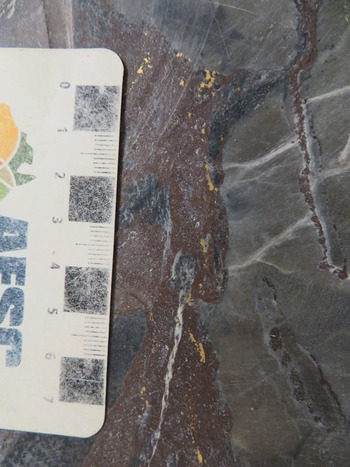
At Hera, the main ore lenses are Far West, Far West Lower (also called Far West Deeps), Hays North, Hays South, Main North, Main South and North Pod (Fig. 2). Most of the ore comprises sub-massive to massive sulfides, but sulfide veins are also relatively abundant as are breccia ores comprising angular to subrounded host-rock clasts in a sphalerite–galena matrix (Graham et al., Reference Graham, McKinnon, Schellen, Lay, Liepa, Burrows, Privat, Quan, French and Dietz2021). The latter are known as ‘durchbewegung’ (Vokes, Reference Vokes1969), provide clear evidence of remobilised sulfides, and were described from the CSA mine in the north of the Cobar Basin by Gilligan and Marshall (Reference Gilligan and Marshall1987). Most of the ore at Hera comprises an early generation of pyrrhotite with minor chalcopyrite with the main ore stage characterised by sphalerite and galena with minor chalcopyrite and pyrrhotite, and rare pyrite and gold (Burrows, Reference Burrows2017; Graham et al., Reference Graham, McKinnon, Schellen, Lay, Liepa, Burrows, Privat, Quan, French and Dietz2021). Visible gold is relatively common within the main sulfide ores, occurring as small (0.5–2mm) grains, most commonly enclosed in sphalerite associated with galena (Fig. 3). However, the Far West and North Pod lenses differ in additionally containing a number of Ag-rich, Sb-rich and As-rich phases including relatively abundant gudmundite (FeSbS), Ag-rich tetrahedrite, freibergite-series minerals, tetrahedrite and arsenopyrite, along with sporadic occurrences of native silver, dyscrasite (Ag3Sb), native antimony, acanthite, breithauptite (NiSb) and nisbite (NiSb2) (Lay, Reference Lay2019; Graham et al., Reference Graham, McKinnon, Schellen, Lay, Liepa, Burrows, Privat, Quan, French and Dietz2021). Using the recent nomenclature and classification for the tetrahedrite group in Biagioni et al. (Reference Biagioni, George, Cook, Makovicky, Moelo, Pasero, Sejkora, Stanley, Welch and Bosi2020), the North Pod contains both argentotetrahedrite-(Fe) and tetrahedrite-(Fe) whereas tetrahedrite from the other lenses at Hera (Main South, Main North, Far West, Far West Deeps) can all be classified as tetrahedrite-(Fe). Fitzherbert et al. (Reference Fitzherbert, McKinnon, Blevin, Waltenburg, Downes, Wall, Matchan and Huang2020) briefly described some of the visible gold occurrences from Hera but provided no analyses. They suggested that gold was associated with the retrograde skarn – commonly, but not exclusively, with sulfides (with a distinctive low-Fe sphalerite as infill between breccia clasts) with gold away from the sulfide lenses being often remobilised within the main foliation.
Hand-specimen image of cut slice of ore from the Hera deposit showing abundant visible gold in sphalerite–galena (scale bar is in mm).

Cobar-style deposits were defined initially by Lawrie and Hinman (Reference Lawrie and Hinman1998) who formed a genetic model for these deposits. Cobar-style deposits are some of the richest deposits within the Cobar Basin. They have several characteristics such as narrow steeply-dipping ore lenses which are broken-up en echelon by faults (David, Reference David2018). These lenses are massive sulfides typically containing gold and various base metals (i.e. copper, lead and zinc). Past studies initially classified Hera as a Cobar-style deposit (David, Reference David2005) due to its similarities to other such deposits. However, recent studies have found characteristics within the Hera deposit that conflict with some of these criteria (Burrows, Reference Burrows2017; Lay et al., Reference Lay, Graham, Burrows, McKinnon and Privat2018; Lay, Reference Lay2019; Schellen Reference Schellen2019, Reference Schellen2020; Graham et al., Reference Graham, McKinnon, Schellen, Lay, Liepa, Burrows, Privat, Quan, French and Dietz2021). Hera contains the same initial mineralisation stages as other Cobar-style deposits with an initial stage during basin inversion and a second stage of mineral replacement. However, a third stage of skarn mineralisation was also found to occur across most of the ore bodies, characterised by widespread tremolite, commonly intergrown with sulfides (Burrows, Reference Burrows2017), suggesting an additional event occurring after the initial two mineralisation events. Unusual elemental associations are also noted with gold being abnormally high (Lay et al., Reference Lay, Graham, Burrows, McKinnon and Privat2018) as well as elevated levels of antimony and silver within the North Pod (Lay, Reference Lay2019). There is also clearly more than one epigenetic gold mineralisation event and abundant (though non-economic) scheelite mineralisation (Graham et al., Reference Graham, McKinnon, Schellen, Lay, Liepa, Burrows, Privat, Quan, French and Dietz2021).
Sampling and analytical methods
This paper results from five years of study at UNSW Sydney, largely the honours projects of Burrows (Reference Burrows2017), Liepa (Reference Liepa2019) and Schellen (Reference Schellen2020), along with part of the PhD project of Lay (Reference Lay2019), and ongoing studies since by the senior author. The most comprehensive sample collection was made during several trips in 2016–2019, from numerous underground exposures in situ, the run of mine (ROM) pad on the surface, and from both underground (HRUD) and surface (HM) diamond drillholes.
All samples were first investigated under reflected light microscopy using a Leica DM2500P polarising microscope at the School of Biological, Earth and Environmental Sciences, UNSW Sydney. These were then analysed for their gold chemistry using the JEOL JXA-8500F Hyperprobe electron probe micro-analyser (EPMA) within the Electron Microscopy Unit (EMU), UNSW. A series of synthetic metals (bismuth for Bi and Cd for cadmium) and natural mineral standards (cobaltite for Co and As; millerite for Ni; galena for Pb and S; chalcopyrite for Cu, Fe and S; sphalerite for Zn; pentlandite for Ni and Fe; and stibnite for Sb) were used as calibration standards. For the gold and silver analyses, two synthetic alloy standards with differing Au:Ag were used, one a commercial supplied refined 24 carat fine gold (i.e. certified 99.9% purity) and the other an alloy of composition Au64Ag36 made in the Materials Sciences laboratories at UNSW from the 24 carat gold described above mixed with pure certified silver. A probe current of 10 μA, an accelerating voltage of 25 kV with a focused beam and a 10 s count time were used. Wavelength-dispersive spectroscopy (WDS) elemental mapping of some of the samples was also acquired using the same JEOL instrument with the following operating conditions of 20 kV accelerating voltage, 30 nA beam current and dwell time of 10 ms per pixel. During the early part of this study, unfortunately only Au and Ag were analysed for and hence the results for these analyses are expressed as Au:Ag ratios. As most of the aurostibite grains were in the small size range of 5–10 μm, there was probably interference in the analyses from surrounding sphalerite and pyrrhotite. Because of this, the analyses presented in the main body of this paper cover the key elements present, Au, Sb, Bi and As, and have been normalised. The original analyses with a full element list are presented in Supplementary Table S1.
Results
Assay results and correlations
Assay results for 52,760 ore samples from the Hera deposit are presented in Table 1. Unfortunately, there are no results for Sb as this was not routinely assayed for as it mostly occurs in trace amounts at Hera. These show that the overall composition of the sulfide ore for Hera comprises 4.6% Fe, 3.1% Zn, 3.1% S, 2.2% Pb, 0.1% Cu, 221 ppm As, 19 g/t Ag and 3.5 g/t Au. However, the results for both Ag and As are strongly skewed by the North Pod, which for the Hera deposit is unusually enriched in these with an average of 32 g/t Ag (rest of deposit mostly ~10 g/t) and 590 ppm As (compared to 19 ppm for the Main North and 50 for the Far West Deeps lenses). Variation also occurs in gold, reaching a maximum in the Hays South (7.5 g/t) and a minimum in North Pod (2.8 g/t). Correlation coefficients were also determined for all elements in the assay data. Overall, these show that Au correlates very poorly with all elements assayed (Table 2), especially for Ag (0.05). Table 3 is a breakdown of the correlation coefficients for each of the main ore lenses. Once again, these show very poor correlations between Au and the other elements assayed for, with Au having highest correlations with S% for Far West and Far West Deeps (0.18), Ag for both Main North (0.12) and Main South (0.25) lenses, and Cu for the North Pod (0.17). These alone would tentatively suggest that Au at Hera occurs in a number of associations and/or generations.
Average metal contents for Pb, Zn, Cu, Au, Ag, Fe, S and As from the various lodes of the Hera deposit.

*n = number of samples analysed.
Correlation coefficients (n = 52,760) for Pb, Zn, Au, Ag, Cu, S, Fe and As from the Hera deposit (significant correlations marked in bold).

Correlation coefficients for Pb, Zn, Cu, Au, Ag, Fe, S and As from the Far West and Far West Deeps (n = 17,690), Main North (n = 8579), Main South (n = 7823) and North Pod (n = 17,613) lodes of the Hera deposit (significant correlations marked in bold).

Gold–electrum textures, mineral associations and chemistry
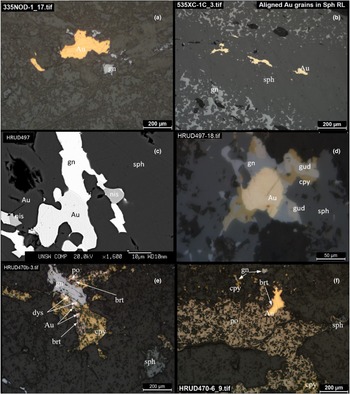
As shown from the assay data, gold is widespread throughout the Hera deposit. Over the last 5 years of study, a number of distinctive associations have been found to occur. At 385NOD (Main lode), gold occurs in thin discontinuous quartz veinlets associated with minor fine-grained disseminated galena and sphalerite (Fig. 4a). The gold occurs as (1) subhedral equant-shaped grains some 10–50 μm across; (2) platy grains with irregular cuspate-lobate boundaries some 10–250 μm, in places rimmed by either galena or tetrahedrite. Results of EPMA (8 analyses, Table 4) showed that this is the most Au-rich gold from Hera with 94.28–96.36 wt.% Au, 3.68–3.97 wt.% Ag and 0.46–0.90 wt.% Bi and both As and Sb below the detection limit. As clearly seen from the analyses, there is little variation in gold chemistry from this lense, especially in the Au:Ag ratio (24.27–25.75; Table 4).
Photomicrographs of various gold occurrences and their associations within the ore lenses of the Hera deposit in reflected light and back-scattered electron images: (a) native Au within fracture associated with galena within host siltstone from Main Lode; (b) aligned platy electrum grains within cross-cutting sphalerite vein from Far West Deeps ore lens; (c) nisbite associated with electrum and galena within sphalerite from the Central South; (d) electrum rimmed by galena, gudmundite and chalcopyrite within sphalerite from Central South; (e) dyscrasite rimming galena associated with chalcopyrite and electrum rimmed by breithauptite from North Pod; and (f) breithauptite enclosed in electrum rimmed by pyrrhotite from North Pod. Key: Au – gold; brt – breithauptite; cpy – chalcopyrite; dys – dyscrasite; gn – galena; gud – gudmundite; nis – nisbite; po – pyrrhotite; and sph – sphalerite.

EPMA (wt.%.) of gold-electrum from the Hera mine, – = below detection limit.

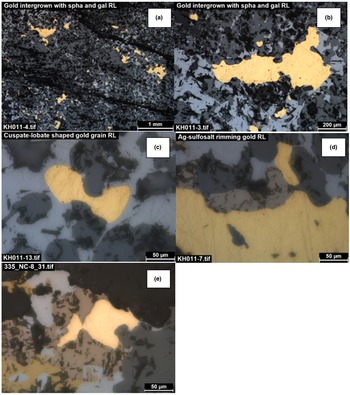
From the Far West lense at 560FWD, a rich and complex association of gold with galena, sphalerite, chalcopyrite, pyrrhotite, gudmundite, tetrahedrite and aurostibite was found (Fig. 5a). In this association, the gold occurs as both subhedral equant-shaped grains some 10–50 μm (Fig. 5b) and as cuspate–lobate shaped grains associated with galena and sphalerite ranging widely in size from <10 μm to 1 mm (Fig. 5c). The gold grains are commonly rimmed by both aurostibite (see below) and tetrahedrite (Fig. 5d). The gold grains from this lense are relatively Au rich (11 analyses, Table 4), comprising 86.44–87.76 wt.% Au, 10.87–12.27 wt.% Ag and 0.44–0.55 wt.% Bi with both As and Sb being below detection limit. As with the gold grains from 385NOD, there is little variation in the gold chemistry from this lense with the Au:Ag ratio varying little from 7.15–8.03 (Table 4).
Photomicrographs in reflected light of various gold occurrences and their associations within selected ore lenses of the Hera deposit: (a) gold intergrown with sphalerite, galena and tremolite from 560 Far West; (b) gold intergrown with sphalerite, galena and tremolite from 560 Far West; (c) cuspate–lobate gold grain with sphalerite and galena from 560 Far West; (d) gold rimmed by tetrahedrite from 560 Far West; and (e) cuspate–lobate gold with pyrrhotite, sphalerite, galena and chalcopyrite from Main South.

Samples from the North Pod (HRUD470b) are very Ag rich and hence are here called electrum. These grains occur in a complex Sb-rich polymetallic association with dyscrasite, breithauptite, galena, sphalerite, pyrrhotite and chalcopyrite (Figs 4e and f). Gold occurs as both subhedral equant-shaped grains ranging in size from <1 to 25 μm and as larger cuspate-lobate grains some 50–200 μm and commonly rimmed by pyrrhotite. There is a large variation in the chemistry of electrum with 26.77–37.55 wt.% Au, 62.34–71.70 wt.% Ag, below detection limit (bdl)–0.06 wt.% As, bdl–0.31 wt.% Bi and 1.05–2.58 wt.% Sb (12 analyses, Table 4). Unlike the grains from the other lenses described above, these grains are very Sb rich and have low Au:Ag ratios of 0.37–0.60.
As with the North Pod, samples from the Central South lense (HRUD497) are also Ag rich and hence electrum. These grains also occur in a complex association with galena, sphalerite, gudmundite, chalcopyrite and nisbite (Figs. 4c and d). The gold grains occur as (1) small (10–20 μm) subhedral equant-shaped grains in sphalerite; (2) more elongate to platy grains (10–50 μm) in sphalerite; and (3) as complex intergrowths with galena and nisbite cross-cutting massive sphalerite (Fig. 4c). However, unlike electrum from the North Pod, there is little variation in the chemistry of the electrum with 41.33–42.20 wt.% Au, 57.02–57.49 wt.% Ag, bdl–0.04 wt.% As, 0.23–0.37 wt.% Bi and 1.66–1.80 wt.% Sb (4 analyses, Table 4). As with the North Pod sample, these grains are also Sb rich and have very consistent Au:Ag ratios of 0.72–0.74 (Table 4).
Early on in this project, grains from 335XC (Main South lode) and 535XC (Far West Deeps lode) were only analysed for their gold and silver and hence will only be used for comparative purposes here. The grains from 335XC were found to be Au-rich electrum with a consistent Au:Ag of 46:54 (Table 5). These occur as cuspate–lobate grains (50–75 μm) associated with a relatively simple base-metal sulfide assemblage of pyrrhotite, galena, sphalerite and chalcopyrite (Fig. 5e). In contrast, grains from 535XC were also found to be gold with Au:Ag varying only slightly from 80:20 to 73:27 (Table 5). These occur in a number of associations including: (1) discrete equant, subhedral-shaped gold grains (10–30 μm) within sphalerite and galena; (2) aligned elongate cuspate–lobate gold grains (<10 to 200 μm) in a sphalerite vein cross-cutting an earlier sphalerite–galena vein (Fig. 4b); and (3) as cuspate–lobate shaped gold grains (<1 to 100 μm) enclosed in massive sphalerite.
Au–Ag ratios for gold-electrum samples from the 335XC and 535XC lodes.

Aurostibite
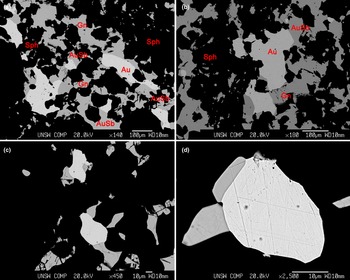
Aurostibite (AuSb2) was only found in 560FWD, though in relative abundance associated intimately with gold, sphalerite and galena. It occurs as both cuspate–lobate shaped aggregates (Figs 6a and b) and as small (10–20 um) subhedral equant-shaped grains, always rimming the associated grains of gold (Figs 6c and d). The aurostibite grains have a relatively constant composition of 42.82–43.68 wt.% Au, 55.78–56.63 wt.% Sb, 0.21–0.28 wt.% As and 0.20–0.34 wt.% Bi (12 analyses, Tables 6 and S1). As discussed above, the associated gold grains are Au rich and contain minor Bi but with both As and Sb being below detection limit.
Normalised EPMA data (wt.%.) of aurostibite from 560FWD, Hera mine (complete EPMA results in Supplementary Table S1).

Back-scatter electron images of the aurostibite–gold association from 560 FWD: (a) network textured gold (white, Au) rimmed by aurostibite (AuSb) and galena (brighter grey, Gn) in sphalerite (dark, Sph); (b) network textured gold (white, Au) rimmed by aurostibite (AuSb) and galena (brighter grey, Gn) in sphalerite (dark, Sph); (c) gold (bright white) rimmed by aurostibite (palest grey); and (d) equant-shaped gold grain rimmed by subhedral aurostibite grains.

Discussion
Origin of aurostibite
In their study of the Krasna Hora Sb–Au deposit, Czech Republic, Zacharias and Nemec (Reference Zacharias and Nemec2017) found that aurostibite was always later than gold and that the aurostibite contained minor amounts of bismuth (0.11–0.15 wt.%) and tellurium (0.11–0.16 wt.%), with one grain also containing minor silver (bdl–0.5 wt.%) but no arsenic. In a study of the Darasun deposit of Eastern Transbaikalia, Russia, Spiridonov et al. (Reference Spiridonov, Krivitskaya, Bryzgalov, Kulikova and Gorodetskaya2010) found that aurostibite replacing gold contained substantial bismuth (2.49–4.60 wt.%) and arsenic (1.16–1.4 wt.%) but no silver, while aurostibite pseudomorphing maldonite contained even more bismuth (8.98–9.83 wt.%) but was devoid of both arsenic and silver. Furthermore, Oberthur and Weiser (Reference Oberthur and Weiser2008) found that aurostibite from the Passagem de Maria mine, Brazil, was highly enriched in bismuth (11.19–11.57 wt.%) along with minor arsenic (0.43–0.54 wt.%) and was also devoid of silver. The results from this study differ only slightly from these (Tables 6 and S1) with trace amounts of both arsenic (0.21–0.27 wt.%) and bismuth (0.19–0.33 wt.%) in Hera aurostibite in addition to consistent low amounts of nickel (bdl–0.21 wt.%). The low bismuth for Hera is not surprising as the Hera orebody contains very little bismuth and no bismuth minerals have been found.
As with the Krasna Hora deposit and many others where gold is associated with aurostibite (e.g. the Darasun deposit of Eastern Transbaikal, Russia, Bryzgalov et al., Reference Bryzgalov, Krivitskaya and Spiridonov2007; Sulitjelma deposit of northern Norway, Cook et al., Reference Cook, Halls and Boyle1993; Kharma deposit of Bolivia, Dill et al., Reference Dill, Weiser, Bernhardt and Riera Kilibarda1995; and the Suzdal deposit Eastern Kazakhstan, Kovalev et al., Reference Kovalev, Kalinin, Naumov, Pirajno and Borisenko2009) aurostibite is always later than gold, occurring as rims around the gold grains (Fig. 6). Collectively, these studies suggest that not only is aurostibite always later than the associated gold, but that its composition can vary widely in terms of its bismuth and arsenic and that it is generally completely devoid of silver. For the Krasna Hora deposit, Zacharias and Nemec (Reference Zacharias and Nemec2017) found that the gold grains rimmed by aurostibite were Au rich (90.33–98.2 wt.%), with low to moderate silver (1.99–10.36 wt.%), low antimony (bdl–0.92 wt.%), low bismuth (bdl–0.34 wt.%) and were devoid of arsenic. The gold associated with aurostibite from Hera completely lacked any antimony, contained minor amounts of bismuth and had a relatively constant silver content (10.87–12.27 wt.%; Table 4).
The upper temperature stability limit for aurostibite has been suggested to be 353°C (Gather et al., Reference Gathers, Shanes and Brier1976 cited in Wang et al., Reference Wang, Leinenbach and Roth2009), though an earlier paper by Barton (Reference Barton1971) suggested that it was below 125°C. However, gudmundite is associated with aurostibite at Hera and Williams-Jones and Norman (Reference Williams-Jones and Normand1997) have suggested that gudmundite is only stable below 300°C. This later temperature would fit with the chlorite–talc–biotite–actinolite–tremolite–chamosite retrograde skarn assemblage that the aurostibite from Hera is associated with. For the Krasna Hora deposit, Zacharias and Nemec (Reference Zacharias and Nemec2017) suggested that aurostibite formed by interaction of pre-existing gold with Sb-rich hydrothermal fluids. The textural and chemical evidence from Hera suggests a similar model and that during the formation of aurostibite from gold, the released silver from the host gold reacted with Sb-rich hydrothermal fluids leading to the late-stage formation of tetrahedrite-(Fe), argentotetrahedrite-(Fe), native silver, acanthite and dyscrasite (Graham et al., Reference Graham, McKinnon, Schellen, Lay, Liepa, Burrows, Privat, Quan, French and Dietz2021), all of which are post-gold in formation.
Evidence for multiple generations of gold mineralisation
Remobilisation involves the physical and/or chemical translocation and disassociation of sulfides and/or wallrock from their original sites of formation (Marshall and Gilligan, Reference Marshall and Gilligan1987). The textural evidence for remobilisation includes recrystallisation of sulfides, mixed breccia sulfide-silicate ores, boudinage, foliations, elongation lineations and folding of sulfide layers (Gilligan and Marshall, Reference Gilligan and Marshall1987). Almost all of these are present within the Hera deposit, and are especially evident within the Sb-rich Far West and North Pod ore bodies (Burrows, Reference Burrows2017; Lay et al., Reference Lay2019; Schellen, Reference Schellen2019).
The almost complete lack of correlation between gold and other metals assayed for (Table 2), along with the gold from differing sulfide lenses correlating weakly with different elements (i.e. the best, though still weak, correlations being with sulfur for Far West and Far West Deeps, Ag with Main North and Main South and with Cu for North Pod; Table 3) alone suggests that there were multiple gold mineralising events/geochemical overprints at Hera. These correlation coefficients for the assay data also show that much of the gold at Hera is unrelated to the Pb–Zn–Ag mineralisation with these three metals all having a relatively high correlation coefficient with each other (0.82 for Pb–Zn and 0.51 for Pb–Ag and 0.46 for Zn–Ag; Tables 2 and 3).
At Hera, gold varies widely in composition, though mostly between the differing sulfide lenses, generally with little variation within ore bodies. The most Au-rich grains average 95 wt.% Au (Table 4), are restricted to the Main ore body and occur within the host metasiltstone associated with minor galena, pyrrhotite and chalcopyrite and chlorite–muscovite–quartz alteration (Fig. 4a, Table 7). Based on the textural relationships, associations and chemistry of this occurrence, this is the most likely representative of the initial gold mineralisation at Hera. Gold from the 535XC (Far West Deeps) is also Au rich, though with more widely varying contents, from 73–80 wt.% Au (Table 5). It occurs as aligned grains in a sphalerite vein which cross-cuts an earlier sphalerite–galena vein (Fig. 4b) or as grains within sphalerite. Here, the gold and sulfides are associated with a retrograde skarn alteration assemblage of quartz–tremolite–chlorite–zoisite (Table 7). Gold from a shallower level of the Main South lode (335XC) is far more Ag rich, averaging 46 wt.% Au and thus is electrum (Table 5). Here, the gold occurs within galena, pyrrhotite and sphalerite (Fig. 5e) and is associated with minor chalcopyrite, tetrahedrite-(Fe), rare pyrite and an alteration assemblage of quartz–muscovite–K-feldspar–chlorite (Table 7).
Relationships between gold–silver ratios and mineral associations.

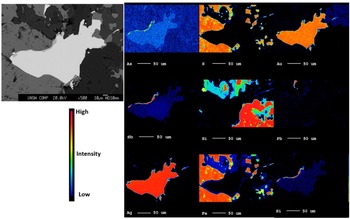
The other gold occurrences studied at Hera are all Sb rich and associated with retrograde skarn assemblages. Gold rimmed by aurostibite from the Far West varies little in composition and averages 87 wt.% Au (Table 4). It is associated with galena and sphalerite, along with minor gudmundite and tetrahedrite-(Fe) and rare pyrrhotite and chalcopyrite (Figs 5 a–d). The associated alteration comprises a retrograde skarn assemblage of chlorite–talc–biotite–tremolite–actinolite–chamosite (Table 7). Gold from the Central South lode (HRUD497) is rich in Ag (42 wt.% Au; Table 4) and hence electrum. It occurs in micro-veinlets of cuspate–lobate gold, galena and nisbite which cross-cut massive sphalerite (Fig. 4c) and in some occurrences is rimmed by galena, gudmundite and chalcopyrite (Fig. 4d). In places, it is also associated with minor pyrrhotite, tetrahedrite-(Fe), native antimony and rare pyrite. This occurrence has a partly retrograde skarn alteration assemblage of quartz–chlorite–tremolite–K-feldspar–muscovite–biotite–zoisite (Table 7). The most Ag-rich gold samples from Hera are from the North Pod with 26.77–37.55 wt.% Au (Table 4) and hence electrum. Electrum from here is associated with breithauptite, dyscrasite, chalcopyrite, galena and pyrrhotite, along with minor sphalerite, gudmundite, tetrahedrite-(Fe) and argentotetrahedrite-(Fe) (Figs 4e and f). It occurs with a retrograde skarn assemblage of chlorite–zoisite–tremolite–quartz (Table 7). Based on their textural relationships, ore mineral assemblages and associated retrograde skarn alteration assemblages, these Sb-rich gold occurrences probably represent a final stage of gold mineralisation at Hera. In all these occurrences, the gold grains are rimmed by later Sb-rich phases and this is clearly shown in the WDS element map in Fig. 7 where an electrum grain is rimmed by breithauptite with a very sharp contact between the two phases and all Au and Ag restricted to the electrum grain. For the Suzdal sediment-hosted gold deposit of Eastern Kazakhstan, Kovalev et al. (Reference Kovalev, Kalinin, Naumov, Pirajno and Borisenko2009) found that aurostibite along with other Sb-phases and rare Ni–Co–As–Sb phases in close association with gold were indicative of remobilisation. The same can be applied to Hera as exemplified by the occurrence of aurostibite, breithauptite and nisbite as rims around gold grains.
WDS element map of electrum partially rimmed by breithauptite within pyrrhotite (HRUD470) from the North Pod.

A histogram showing the wt.% Au versus number of analyses (Fig. 8) clearly shows five main peaks of gold compositions: 28–37 (HRUD470b from North Pod), 42–46 (HRUD497 from Central South and 335XC from Main South), 75–86 (560FWD from Far West and 535XC from Far West Deeps), 87 (560FWD from Far West Deeps) and 95–96 (385NOD from Main lode). The peak at 87 wt.% Au is skewed by the number of analyses from this sample though is consistent with the other analyses from this lode at ~86 wt.% Au. The spatial distribution of these (see Fig. 2) would suggest that gold from the centre of the deposit is distinctly more Au rich compared to gold from the margins of the deposit, though more analyses would be required to support this.
Histogram showing wt.% Au of the gold and/or electrum grains versus number of analyses.

A number of authors have suggested that primary gold with higher Ag contents correlates with lower temperatures of formation (Morrison et al., Reference Morrison, Rose and Jaireth1991; Gammons and Williams-Jones, Reference Gammons and Williams-Jones1995). More recently, Bonev et al. (Reference Bonev, Kerestedjian, Atanassova and Andrew2002) suggested this for gold from the Chelopech epithermal Au–Cu deposit of Bulgaria. This is certainly reflected at Hera (Table 7) with the first stage of gold mineralisation in the host-rock having the highest Au:Ag (96:4) and presumably occurring at the highest temperature, along with gold associated with Sb phases with the lowest Au:Ag (42:58 down to 27:73) reflecting lower temperatures of formation. If this holds true, then a progression from the highest temperature to lowest temperature ore lenses for Hera would be Main (96:4), Far West (~89:11), Far West Deeps 535XC (80:20 to 73:27), Main South 335XC (46:54), Central South (42:58) and finally North Pod (38:62 to 27:73). For at least the Main South lense, this would also suggest that higher silver content reflects decreasing temperature with elevation. Although EPMA results for gold with antimony are only rarely reported in the literature as such a chemistry is likely to be of rare occurrence (Hough et al., Reference Hough, Butt and Fischer-Buhner2009), Ciobanu et al. (Reference Ciobanu, Birch, Cook, Pring and Grundler2010) found that gold associated with maldonite from Maldon, Victoria, Australia contained small amounts of antimony (up to 0.04 wt.%). In addition, the recent paper of Chapman et al. (Reference Chapman, Banks, Styles, Walshaw, Piazolo, Morgan, Grimshaw, Spence-Jones, Matthews and Borovinskaya2021), though failing to mention antimony in gold via EPMA, found substantial antimony in gold using laser ablation inductively coupled plasma mass spectrometry in the orogenic gold deposits they investigated. Thus, the relatively high Sb (1.05–2.71 wt.%) content within electrum from the North Pod and Central South lenses may not be restricted solely to gold–antimony occurrences and is possibly indicative (though experimental work would be required to prove this) of a lower temperature of formation during the terminal stages of retrogressive metamorphism.
For the Krasna Hora deposit, based on fluid inclusion and experimental data, Zacharias and Nemec (Reference Zacharias and Nemec2017) and Nemec and Zacharias (Reference Nemec and Zacharias2018) suggested that gold formed at temperatures of ~130–170°C. Important and relevant to this study, they also found four generations of gold, with Au-1 (1.99–10.36 wt.% Ag) being the most abundant and associated with calcite; Au-2 (15.70–48.16 wt.% Ag) forming narrow zones or rims around Au-1; Au-3 (~0 wt.% Ag and only found in one sample) as thin replacements of both Au-1 and Au-2 and Au-4 (< 5 at.% Ag) as a spongy and probable supergene phase. Many hydrothermal gold deposits have multiple generations of gold formation (e.g. Lapa mine, Canada, Simard et al., Reference Simard, Gaboury, Daigneault and Mercier-Langevin2013; Kharma deposit of Bolivia, Dill et al., Reference Dill, Weiser, Bernhardt and Riera Kilibarda1995; Mokrsko-West deposit of the Bohemian Massif, Czech Republic, Zacharias et al., Reference Zacharias, Moravek, Gadas and Pertoldova2014) and the Hera deposit is no exception to this. For deposits subjected to metamorphism (e.g. see Marshall and Gilligan, Reference Marshall and Gilligan1987; Cook, Reference Cook1996 amongst others) after any early stage of mineralisation, such as for the Hera deposit, the differing generations of gold and other metals can be ascribed to remobilisation events during subsequent metamorphism. For Hera, most of this remobilisation probably occurred during widespread retrogressive metamorphism as shown by the alteration assemblages associated with each of the ore lenses, at temperatures below 300°C.
Although a number of quartz vein generations are relatively widespread throughout the Hera deposit, only the late-stage coarse-grained quartz carries any mineralisation, in the form of relatively coarse-grained (>10 mm) pyrrhotite, chalcopyrite, cubanite, galena and sphalerite. None of the generations of quartz veins from Hera have been found to contain any gold. In terms of the hydrothermal fluid source, although granites are relatively widespread in the region, these are significantly older than the Hera deposit (~382 Ma) having been dated to 428–422 Ma (Chisolm et al., Reference Chisolm, Blevin, Downes and Simpson2014; Waltenberg et al., Reference Waltenberg, Blevin, Hughes, Bull, Fitzherbert, Cronin and Bultitude2019). However, Graham et al. (Reference Graham, McKinnon, Schellen, Lay, Liepa, Burrows, Privat, Quan, French and Dietz2021) described granite pegmatite dykes, comprising intergrowths of microcline–anorthite–albite–quartz, which cross-cut both the host-rock sequence and sulfide lenses on levels 285SB, 285SC, 310SA and 615FWA. These may be related to an underlying magmatic body responsible for both the source of the skarn-forming fluids and some of the metals at Hera, especially Sb, As and Bi.
Conclusions
Gold correlates poorly with other metals across the Hera deposit and also between the various ore lenses. The deposit contains a number of distinctive gold associations, each with a distinctive gold chemistry. These span a wide range from early host-rock associated gold comprising 96 wt.% Au, through intermediate gold compositions (86–73 wt.% Au) associated with base-metal sulfides to Ag-rich electrum (42–27 wt.% Au) associated with a number of Sb phases and retrogressive skarn alteration. Aurostibite with a homogenous composition was found to rim gold with the gold itself containing no antimony but 11–12 wt.% Ag. This aurostibite formed via interaction of Sb-rich hydrothermal fluids (associated with retrogressive skarn formation) with pre-existing gold. The wide range in gold compositions and associations is attributed to widespread physical and chemical remobilisation associated with multiple periods of deformation, principally in the form of shear zones and faults. Sb-rich gold may be indicative of a low temperature of formation during the terminal phases of metamorphism and may be more common in orogenic gold deposits than previously thought.
Acknowledgements
We thank the management of Aurelia Metals Ltd for not only providing financial support for the honours studies of Burrows (Reference Burrows2017), Liepa (Reference Liepa2019) and Schellen (Reference Schellen2020) along with PhD project of Lay (Reference Lay2019), but also for ready access to the deposit (including underground workings, ROM pad and diamond drillcores), access to all company assay data and accommodation and meals onsite. We would also thank all of the geologists, field assistants and other Hera mine staff for their help. The authors acknowledge the facilities and the scientific and technical assistance of Microscopy Australia at the Electron Microscope Unit (EMU) within the Mark Wainwright Analytical Centre (MWAC) at UNSW Sydney.
The authors would additionally like to thank Stuart Mills and Jiri Zacharias whose comments/suggestions greatly improved the revised manuscript. This contribution is dedicated to our friend, colleague and mentor, Prof Pete Williams who has a long lasting interest in the deposits of the Cobar Basin.
Supplementary material
To view supplementary material for this article, please visit https://doi.org/10.1180/mgm.2022.46