Introduction
Atrypides dating from the latest Hirnantian and early Rhuddanian are not well known for several reasons. First, the initial drop in sea level and subsequent rapid rise that coincides with the end Ordovician glaciation led to major erosion of exposed areas and large gaps in the record worldwide (Hallam and Wignall, Reference Hallam and Wignall1997). Secondly, atrypides were known to prefer generally shallower reef or carbonate settings (Bassett et al., Reference Bassett, Popov and Sokiran1999). The rapid transgression often led to deposition of dark, fossil-poor shales in deeper waters. And thirdly, spire-bearing brachiopods require sectioning of whole specimens, which is very labor-intensive and often impossible when the fauna is preserved as molds.
During Hirnantian time, the central Oslo Region had a complicated topography with incised valleys separated by plateaus (Bockelie et al., Reference Bockelie, Baarli and Johnson2017). The fjords were filled with sediments of the Kalvøya Formation, which includes the falling limb of the Hirnantian Isotope Carbon Excursion HICE (Calner et al., Reference Calner, Bockelie, Rasmussen, Calner, Lehnert and Joachimski2021). In the western part of the central Oslo region, the fauna at the base of the overlying Solvik Formation lived at varying depths and shows an unmistakable Ordovician affinity, especially above valley fill, as described by Baarli and Harper (Reference Baarli and Harper1986) and Baarli (Reference Baarli2014). The Solvik Formation was, thus, deposited from late Hirnantian into the latter parts of Aeronian time and features a rich brachiopod fauna. It means that the survival and recovery of brachiopods in a clastic setting at varying depths is well represented.
This contribution, together with Baarli (Reference Baarli2021a, Reference Baarlib), treats the atrypide fauna of the Solvik Formation. Baarli (Reference Baarli2021a, Reference Baarlib) described the ribbed atrypides taxonomically. The smooth atrypides are treated herein. Previously, the only smooth atrypide described from the formation was Thulatrypa gregaria Huang et al., Reference Huang, Baarli, Zhan and Rong2016. The order Athyridida Boucot, Johnson, and Stanton, Reference Boucot, Johnson and Staton1964 includes other smooth spire bearers. Athyridides rarely appear in the Solvik Formation. Hindella kiaeri Sheehan, Reference Sheehan1977 is an athyridide described earlier. This study aims to describe the smooth spire bearers taxonomically and, thus, shed some light on the evolutionary history and post-glacial recovery of these brachiopods.
Geological setting
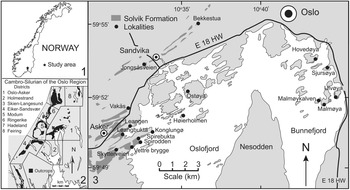
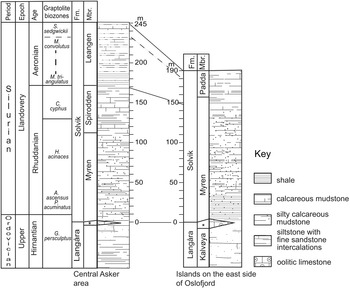
Lower Paleozoic deposits of the Oslo region are exposed in a narrow Permian graben that extends from Ringsaker in the north to Skien in the south (Fig. 1.2). The rocks are allochthonous, folded, partly tectonized, and fossiliferous. The central Oslo region consists of the eastern Oslo and the western Sandvika and Asker areas. The distribution of outcrops of the Solvik Formation used in this contribution is shown on the map (Fig. 1.3). The Solvik Formation consists of mainly shales in the eastern areas and mudstones in the western areas, with thin to very thin silty limestone to limy siltstone intercalations. In the Oslo area, the formation is ~190 m thick and divided into the lower Myren Member and the overlying Padda Member (Fig. 2). The Myren Member consists of shale with very thin to thin silt intercalations, whereas the 30 m thick Padda Member is more lime-rich, with thin silt and limestone intercalations. In the Asker area, the Solvik Formation is 245 m thick (Fig. 2) and divided into the lower Myren Member, represented by mudstone with very thin to thin limy siltstone intercalations, and the succeeding Spirodden Member, which exhibits thin limestone and limy siltstone beds in mudstone with common corals and stromatoporoids. The Leangen Member features mudstones or shales with thin to medium-thick fine sand intercalations deposited during storm events (Fig. 2).
(1) Map of Norway marking the study area (star). (2) Map showing the Paleozoic outcrops in the Oslo region with different districts identified. (3) Map of the central Oslo region showing marked localities where collections were made. Outcrops of the Solvik Formation marked in gray.

Lithostratigraphic columns from the central Asker area correlated with the column from islands on the east side of the Oslofjord. Both are composite sections. Asterisk (*) denotes the Pilodden Member.

The shale-rich Solvik Formation often overlies thick sandstones and limestones that are Upper Ordovician in position. These Ordovician deposits are resistant to erosion and folded. As a consequence, many of the islands in the Oslo Fjord are formed by Ordovician rocks with only the basal layers of the softer Solvik Formation remaining on land and the rest eroded between islands (Fig. 1.3). The rest of the formation is exposed farther east at Malmøya and Ormøya, and at coastal and inland outcrops in the western parts.
Near the end of Hirnantian time, glaciations led to a eustatic sea-level drop and development of incised valleys in the central Oslo region (Bockelie et al., Reference Bockelie, Baarli and Johnson2017). The ensuing transgression resulting from glacial melting elsewhere in Gondwana turned local valleys into fjords. The valley fill of the Kalvøya Formation includes the falling limb of the HICE (Calner et al., Reference Calner, Bockelie, Rasmussen, Calner, Lehnert and Joachimski2021). In the east, at Hovedøya, δ13C of 3‰ is measured in the basal Solvik Formation; at Konglungen to the west, the values are between 1–2‰. Calner et al. (Reference Calner, Bockelie, Rasmussen, Calner, Lehnert and Joachimski2021), as well as Kaljo et al. (Reference Kaljo, Martma, Neuman, Rønning, Hints and Ainsaar2004), constructed δ13C curves showing that the gap between the Solvik Formation and the underlying strata varies throughout the central region. As transgression continued, higher lands were submerged, the proximal clastic source was drowned, and the fine-grained Solvik Formation was deposited across the central Oslo region. It often lies conformably above the valley fill, or in some cases, infills small channels not eroded by the initial transgression (Johnson and Baarli, Reference Johnson and Baarli2018). In the areas between the valleys, there is a break between the older Ordovician strata below and the Solvik Formation above.
The brachiopod fauna at the base of the formation is mainly of Ordovician affinity (Baarli and Harper, Reference Baarli and Harper1986; Baarli, Reference Baarli2014). Brachiopods of clear Ordovician affinity include the genera Chrustenopora Havlíček, Reference Havlíček1968, and Jerzersia Havlíček and Mergl, Reference Havlíček and Mergl1982, among others. Brevilamnulella kierulfi (Kiær, Reference Kiær1902) and Bockeliena flexuosa (Marr and Nicholson, Reference Marr and Nicholson1888) are taxa typical of upper Hirnantian strata (Rong et al., Reference Rong, Harper, Huang, Rongyu, Xiaole and Di2020). Other faunal elements indicative of late Hirnantian to the transitional Ordovician/Silurian boundary include graptolites (Howe, Reference Howe1982; Štorch and Schoenlaub, Reference Štorch and Schoenlaub2012) and conodonts (Aldridge et al., Reference Aldridge, Jeppsson and Dorning1993). Thus, the age of the base of the Solvik Formation varies around the Ordovician/Silurian (O/S) boundary, so these beds are herewith identified as the O/S boundary sections. The Ordovician components gradually disappear through the basal 40 m (Baarli, Reference Baarli2014), replaced by Silurian brachiopods. The basal brachiopod fauna is highly diverse, whereas the initial Silurian fauna found from 30–100 m above the base of the formation is stunted, with low diversity.
Figure 2 shows stratigraphic relationships among the different members of the Solvik Formation correlated between the eastern sections and the western sections. The Myren Member spans uppermost Hirnantian- to middle Rhuddanian-aged strata in the western areas, whereas the Myren Member extends into strata of early Aeronian age in the Oslo area. The Spirodden Member of Sandvika and Asker is of late Rhuddanian age. The Padda Member in the Oslo area and the Leangen Member of the Asker area both contain strata of Aeronian age, and the upper parts conform to the Stimulograptus sedgwickii graptolite zone of late Aeronian age.
Material and methods
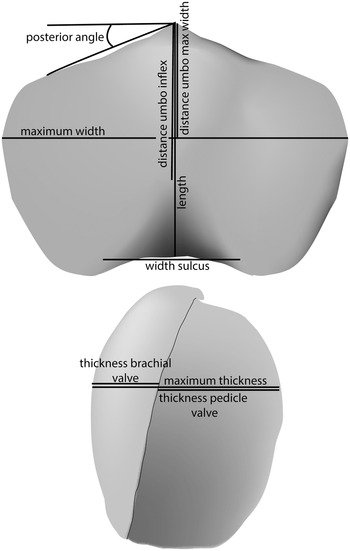
All whole specimens were measured as shown (Fig. 3), with as many measurements as possible. Univariate summary statistics and principal component analysis (PCA) were generated using the program PAST 4 (Hammer et al., Reference Hammer, Harper and Ryan2001). One whole shell of each taxon was sectioned, if there were more than two well-preserved specimens. Detailed information on the method used for sectioning is given in Baarli (Reference Baarli2021a) and summarized herein. Most of the specimens were encased in resin and cut by a precision saw every 0.05 mm for small and 0.1 mm for large specimens. The sectioning was stopped shortly after the maximum number of whorls of the spiralia was revealed or stopped farther towards the posterior when no spiralia were present. Peels were taken for each cut and photographed using a petrographic microscope. Due to lab closure during the pandemic in 2020, two specimens were ground down by hand using 400-micron grit and the cuts were photographed with a DSLR camera. Peels were taken of all cuts and tracings of the photographs are shown for each taxon. Using these drawings, a simple three-dimensional rendering was drawn for all taxa.
Pedicle and side view of Meifodia showing measurements taken on the valves.

The localities mentioned are marked in Figure 1.3. Detailed descriptions of the localities are given in Baarli (Reference Baarli2021a, Reference Baarlib). Two new localities are mentioned in this contribution: (1) old collections from coastal outcrops of the Solvik Formation from the southeastern side of Hovedøya, and (2) roadcut at Bekkestua (59°54'48.56"N, 10°34'.49.98"E).
Repositories and institutional abbreviations
The material under study was mainly from older collections kept at the Paleontological collections (PMO) of the Natural History Museum of Norway. Limited additional material was collected by the author and deposited in the paleontological collections. Two specimens were borrowed from Nanjing Institute of Geology and Palaeontology, Chinese Academy of Sciences (NIGP).
Systematic paleontology
Suborder Lissatrypidina Copper, Reference Copper1996
Superfamily Lissatrypoidea Twenhofel, Reference Twenhofel1914
Family Lissatrypidae Twenhofel, Reference Twenhofel1914
Remarks
Lissatrypide taxa occur abundantly in the Solvik Formation. All are smooth, but the shape and anterior margin vary widely. The internal configuration displays the clearest differences. The type species Lissatrypa atheroidea Twenhofel, Reference Twenhofel1914, which is absent in the Solvik Formation, has a unique, solid hinge pad with a cardinal pit covered by the cardinal process, and jugal processes that initially are directed ventrally and end in ring-like structures. Meifodia Williams, Reference Williams1951, has a short cardinal pit, and fairly thin, well-separated, and horizontal hinge plates. The crura are directed anteriorly initially. The genus Thulatrypa Huang et al., Reference Huang, Baarli, Zhan and Rong2016, has unsupported cardinal plates with elevated crural supports.
Genus Eisaella new genus
Type species
Eisaella uniplicata new species from the basal part of the Myren Member in the O/S boundary layers in the Oslo-Asker districts, Norway
Diagnosis
Medium-sized, smooth, biconvex, and thick-shelled valves with clear sulcus and fold. The umbo is small, adpressed, lacking a foramen and delthidial plates. Internally it lacks a pedicle collar, teeth are short, solid, and relatively slender, a low hinge pad rests on the valve floor, crura initially ventrally directed, and jugal plates create a ring-like feature. It has fewer than 10 whorls of the spiralia.
Occurrence
Found in the Oslo-Asker districts in Norway in uppermost Hirnantian to lower Aeronian strata.
Etymology
Named after Eisa, the goddess of old age in Norse mythology.
Remarks
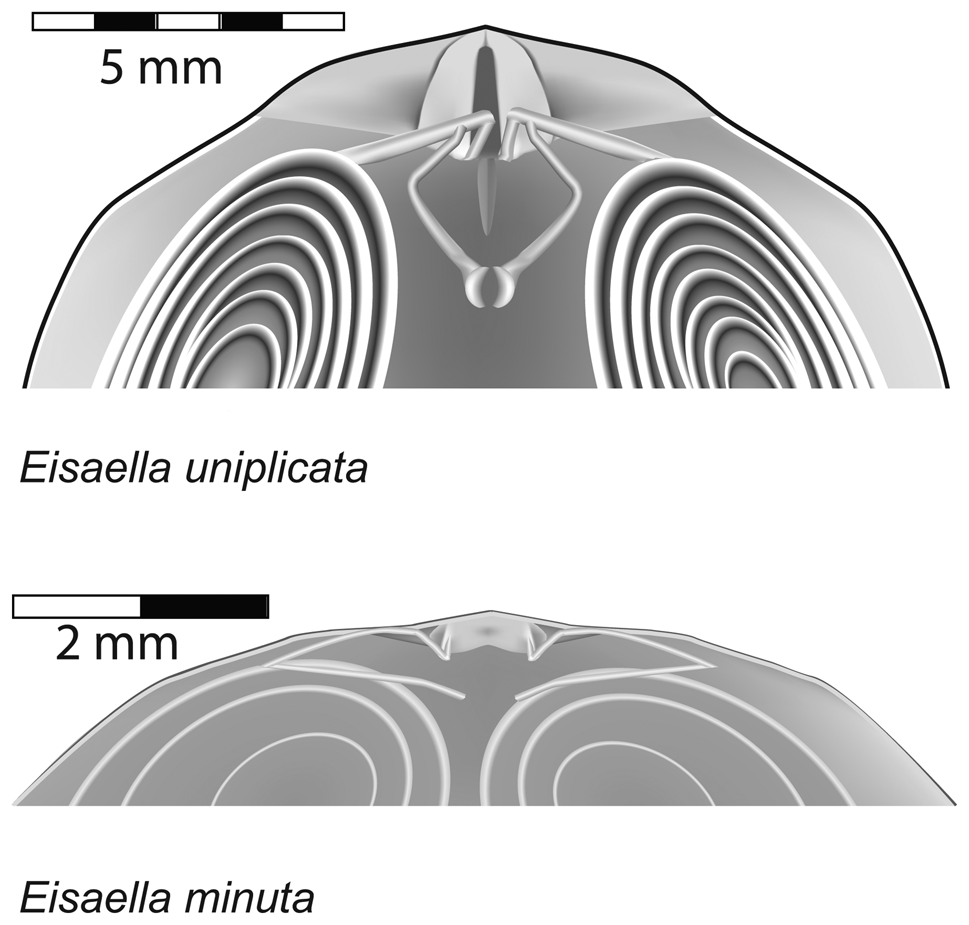
Externally, Eisaella n. gen. is difficult to distinguish from juvenile specimens of Meifodia, with which it occurs. Compared with mature specimens, it is less transverse in outline and the sulcus originates farther anteriorly. However, external features are unstable and often adapt to specific environmental conditions. Internally, it differs strongly by having an elevated hinge pad and crura that initially are directed straight ventrally. Meifodia has hinge plates that are widely separated and fastened to the lateral shell wall and the crura are directed more laterally. Furthermore, Meifodia has jugal processes that are projected anteriorly with simple plates (Fig. 7), whereas Eisaella n. gen. has jugal plates that form a ring-like configuration (Fig. 6). Lissatrypa differs in lacking fold and sulcus and having a pedicle collar, apical or transapical foramen, and cardinal process. The two genera share hinge pads, fibrous crura initially directed ventrally before curving laterally, and jugal processes ending in plates with a ring-like structure. The configuration of the jugal processes was deemed the most stable character for taxonomic designation among lissatrypides by Nikiforova and Andreeva (Reference Nikiforova and Andreeva1961).
Copper (Reference Copper2004) speculated that Meifodia is the ancestor to Lissatrypa, with the oldest two species, L. atheroidea Twenhofel, Reference Twenhofel1914, from the Jupiter Formation, Anticosti Island and L. magna Rong and Yang, Reference Rong and Yang1981, from the Lojoping Formation in Hubei Province appearing in upper Aeronian strata. The new genus Eisaella is a more likely direct ancestor. The interior has most of the traits of a typical Lissatrypa, including the peculiar ring-like jugal plates.
Eisaella uniplicata new species
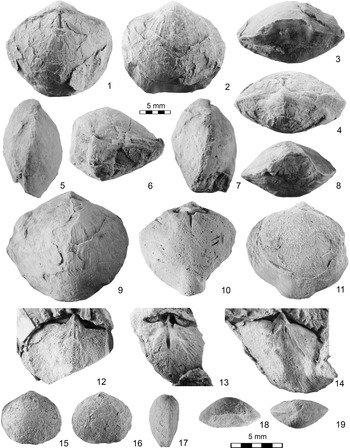
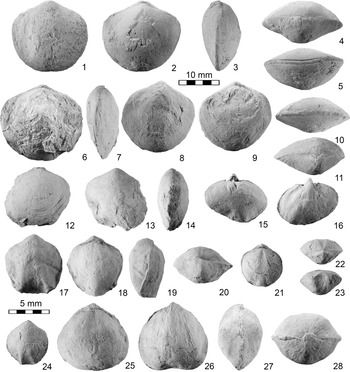
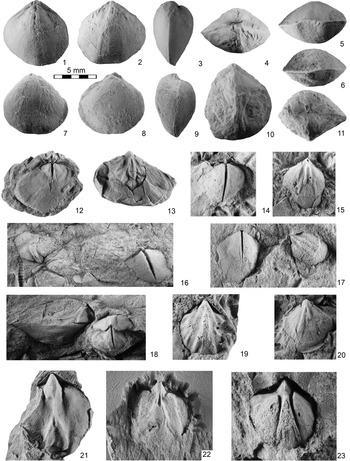
Figures 4.1–4.14, 5, 6
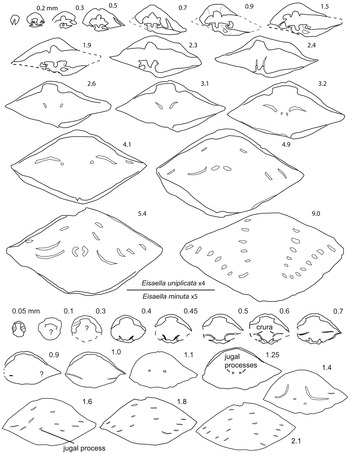
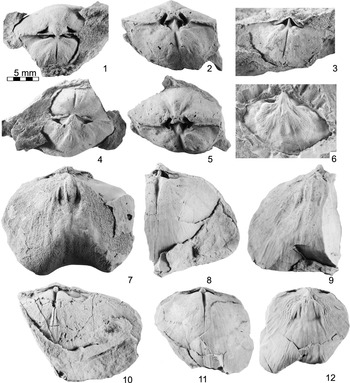
(1–14) Eisaella uniplicata n. gen. n. sp. (1–5) Holotype, PMO 52.174, brachial, pedicle, anterior, posterior, and side view of valve; lower 12 m of Myren Member, Konglungø, Asker; (6, 7) PMO 20.885, posterior and side view of valve; lower part of Myren Member, Hovedøya, Oslo; (8) PMO 52.309d, anterior view, lowest part of Myren Member, Høyerholmen, Asker; (9) PMO 52.175 (sectioned), view of brachial valve, lower 12 m of Myren Member, Konglungø, Asker; (10) PMO 158.126, view of acid-treated brachial valve, ~55 m above base of Myren Member, Spirodden, Aske; (11) PMO 234.621, view of brachial valve, 20 m above the base of Myren Member, outcrop along E 18, Vakås, Asker; (12) PMO 158.158, mold of pedicle valve; (13) PMO 234.622, mold of brachial valve; (14) PMO 158.151, mold of pedicle valve; (12–14) from 21 m above base of Myren Member, along E18 Vakås, Asker. Eisaella minuta n. comb. (15–19) PMO 88.148, pedicle, brachial, side, anterior, and posterior view of valve, top of Myren Member, Malmøya, Oslo. Notice different scale for (15–19).

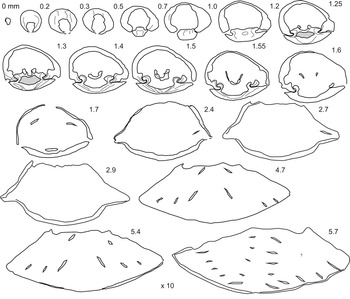
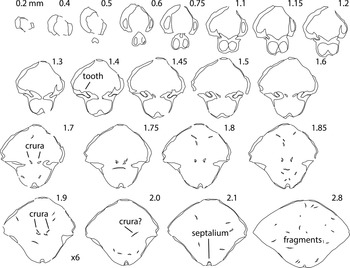
Eisaella uniplicata n. gen. n. sp. Serial section of specimen PMO 52.175 lower 12 m of Myren Member, Konglungø, Asker. Eisaella minuta n. comb. Serial section of specimen PMO 51.968c, from Leangen Member, Leangen, Asker.


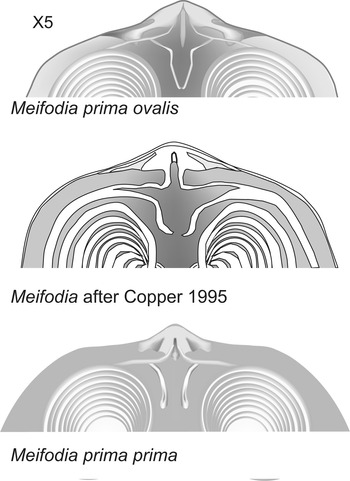
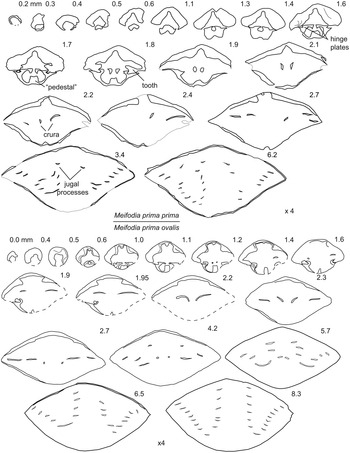
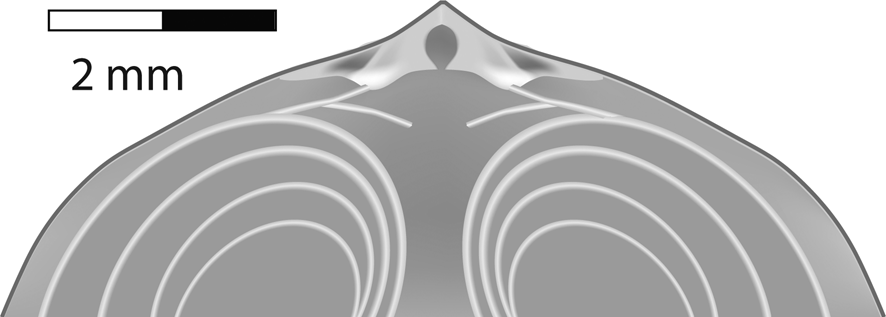
Comparison of reconstructed internal structures for Meifodia prima. Reconstruction of M. prima prima is based on PMO 52.309h from basal Myren Member, lowermost part of the profile at Spirodden, Asker. The middle figure is of M. cf. M. subundata, PMO 41.220b, from upper part of Myren Member, the south coast of Malmøya in Norway (modified from Copper, Reference Copper1995, fig. 8, p. 853). Meifodia prima ovalis is based on PMO 41.227 from Padda Member at Malmøykalven, Oslo.

Holotype
PMO 52.174 (Fig. 4.1–4.5), close to the O/S boundary at Konglungø, Asker.
Diagnosis
Medium-sized and evenly rounded shells with a well-defined pedicle sulcus and fold originating in the anterior part of the valves. Small and strongly incurved beak without a foramen. Strongly impressed, elongated, and triangular muscle field in pedicle valve. Short massive teeth and a low hinge pad with a long cardinal pit. Crura and jugal processes as for the genus, eight whorls of the spiralia.
Occurrence
Konglungø, Spirodden, Vakås along E18 and Høyerholmen, all Asker and Hovedøya, Oslo. From basal Myren Member up to 55 m above the base. Uppermost Hirnantian to lower Rhuddanian.
Description
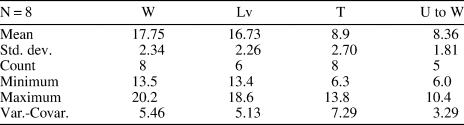
Smooth, medium-sized, and dorsibiconvex valve with a small, strongly incurved beak. No foramen or delthidial plates. A broad and angular sulcus in the pedicle valve originates in the anterior part of the valve. Evenly rounded lateral sides with maximum width posterior, near the midline. Relatively high apical angle at 22° on average (Table 1).
Univariate summary statistics based on measurements of Eisaella uniplicata n. gen. n. sp. N = number of specimens measured, W = width, Lv = saggital pedicle length, U to I = umbo to start of fold, U to W = distance from umbo to the maximum width of the valve measured along the mid-length, T = maximum thickness, T ped = thickness of pedicle valve, T brach. = thickness of brachial valve, Angle = posterior angle of commissure, W F = maximum width of fold, D F = maximum depth of fold, St. dev. = standard deviation from the mean, and var.-covar. = variance-covariance matrix. Mean, maximum, and minimum are in mm.

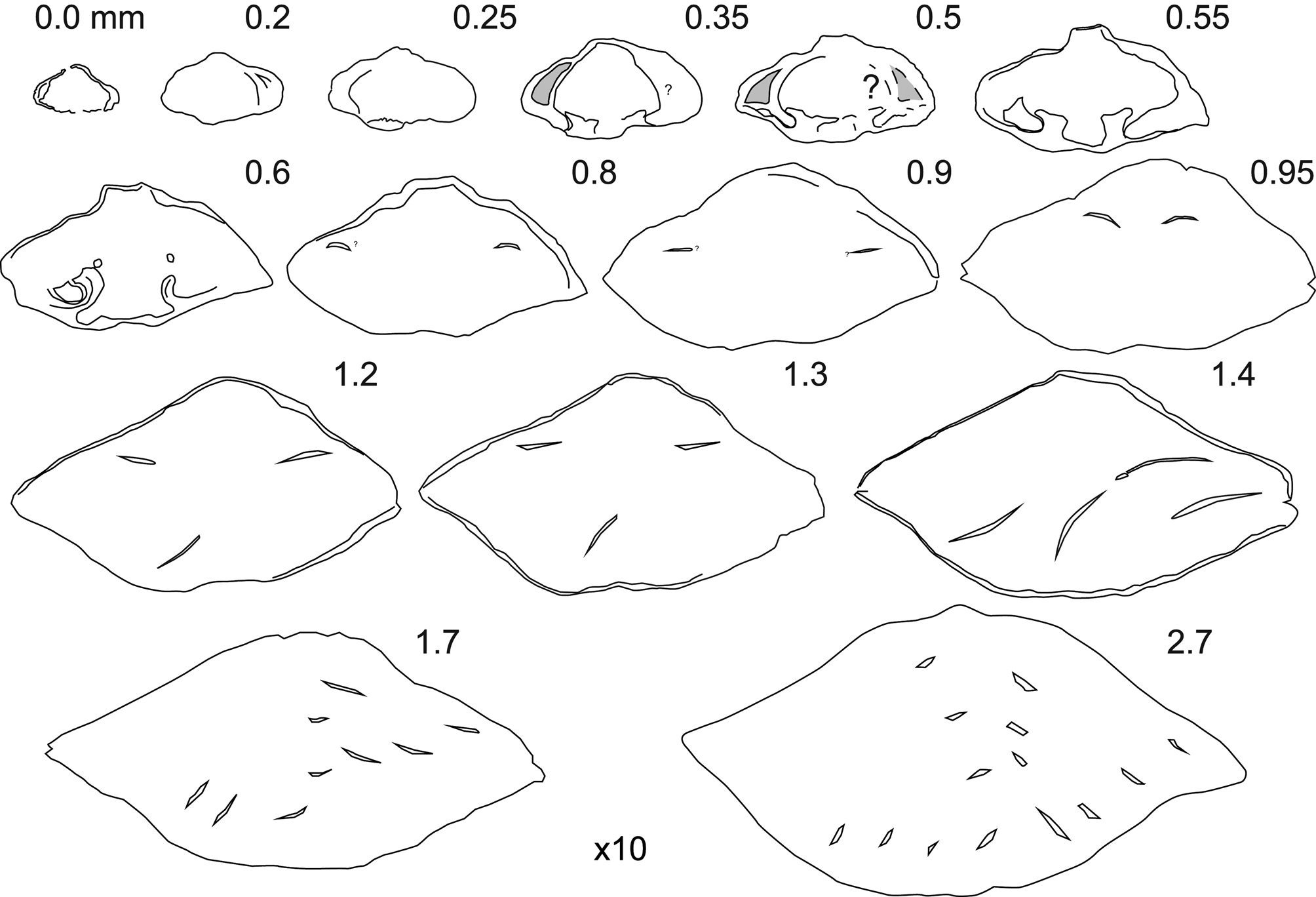
Very thick interior posterior shell wall. Pedicle collar seems to be missing, but the preservation is poor. Short, strong, massive, teeth extended forwards with short lobes curving under projecting socket plates (Fig. 5). Strongly impressed pedicle muscle scars delineated by strong ridges deviating slightly and making a narrow, triangular muscle platform. Small, elongated, and strongly impressed adductor scars. Brachial muscle scars are also impressed and flaring out. Thick, horizontal, and strong hinge plates elevated on a cardinal pad with bulbous socket plates. Long cardinal pit without cardinal process. Median ridge in the posterior one-third to one-half of the valves. Crura extend up ventrally and curve laterally before they join the spiralia. Long jugal processes end in ring-like plates (Fig. 6). Eight whorls in the spiralia.
Etymology
Latin for single plication.
Materials
PMO 20.874, 20.878, 20.882, 20.885, 52.057b, 52.173, 52.174, 52.175 (peel), 52.309d, 52.310, 158.126, 158.151 (mold), 158.152 (mold), 158.153, 158.158 (mold), 209.202, 234.621, 234.622 (mold), from Hovedøya and Malmøykalven, Oslo, Høyerholmen, Konglungø, Spirodden and Vakås, Asker, the basal layers to 55 m above the base of the Myren Member. The specimen from Malmøykalven is from an unspecified horizon in the Solvik Formation.
Remarks
Species same remarks as genus.
Eisaella minuta (Rybnikova, Reference Rybnikova1967) new combination
Figures 4.15–4.19, 5, 6
- ?Reference Venyukov1899
Glassia obovata; Venyukov (non J. de C. Sowerby), pl. 1, fig. 21.
- Reference Rybnikova1967
Glassia minuta Rybnikova; p. 203, fig. 33, pl. 23, fig. 3.
- non Reference Rybnikova1967
Lissatrypa minuta Kulkov.
- non Reference Doyle, Harper and Parkes1990
Lissatrypa minuta Doyle et al.
- non Reference Copper2004
Lissatrypa cf. minuta Copper.
Holotype
LDM G 30/224 (Latvian National Museum of Natural History) Choldre borehole at 333.9 m, Latvia, Aeronian. Stored at the Museum of the Institute of Geology, Riga, Latvia.
Occurrence
Upper Myren Member, Malmøya, Oslo, Leangen Member, Leangen, Asker, uppermost Rhuddanian through Aeronian.
Description
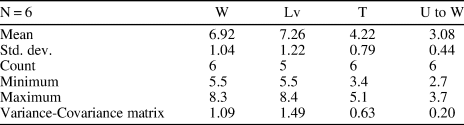
Small, smooth valves, wider than long (length to width 85%, Table 2), with rounded margins and maximum width in the anterior part of the valve (maximum width to length, 65%). Posterior part is somewhat triangular (apical angle 135–140°), giving the shell a drop-like outline. Ventribiconvex to biconvex shell with a slight sulcus in the pedicle valve that varies, but starts in the anterior part. Small, strongly incurved beak overhanging the hinge line. Evenly rounded transverse cross-section and longitudinal profile rounded posterior that flattens out somewhat anteriorly.
Measurements of Eisaella minuta n. comb. See Table 1 for explanation of abbreviations. PMO = Specimen numbers from the Paleontological collection of the Natural History Museum in Oslo, Norway.

Thick interior shell wall with a pedicle callist. Strongly impressed muscle scars in pedicle valve. Posterior part not captured in the sectioned specimen, but an eventual pedicle collar is unlikely since no foramen is visible. Teeth seem not to engage in the dental sockets. Low, thick, and very short brachial hinge pad with a broad v-shaped cardinal pit. Large, fibrous crural bases are gently arched ventrolaterally until they nearly touch the shell walls. Jugal processes originate close to the shell walls and are directed medially before they turn anteriorly a short distance. Secondary crystals prevent a clear view of the nature of the plates, but they are not as closely placed as seen in E. uniplicata n. gen. n. sp. Four whorls in the spiralia (Figs. 5, 6).
Materials
PMO 51.968c (sectioned) and 88.148, both whole shells from the Leangen Member, Leangen, Asker, and uppermost Myren Member, Aeronian, respectively.
Remarks
Rybnikova (Reference Rybnikova1967) described this brachiopod from Rhuddanian and Aeronian strata as belonging to Glassia Davidson, Reference Davidson1881. She noted the species differed from later Glassia in the convexity of the shell and the sulcus in the pedicle valve. Copper (Reference Copper2004) referred Rybnikova's species to Lissatrypa. He described and sectioned L. cf. L. minuta from Telychian strata of the Hugley Shale near Wenlock Edge, Great Britain, and noted that the material probably was conspecific. However, the British material is lacking the sulcus in the pedicle valve. Furthermore, Rybnikova's drawings show a low pedestal as opposed to the high one in the British material. The British material seems to be true Lissatrypa, whereas the coeval Latvian and Norwegian material belong to Eisaella n. gen. The fibrous crura that initially are directed ventrally and then gracefully curve laterally are typical both of Lissatrypa and Eisaella n. gen. The Norwegian material is very scant, but similar to Lissatrypa minuta (Rybnikova, Reference Rybnikova1967). Lissatrypa minuta Kulkov, Reference Kulkov1967 from Wenlock strata in Gorno-Altai was excluded from the species by Copper (Reference Copper2004). It is close to Eisaella minuta n. comb. in outline and in having a sulcus in the pedicle valve. The figures are schematic, but a hinge pad is missing and the crura are different than the present material. It is excluded from Eisaella n. gen.
Baarli (Reference Baarli1987) collected and acid treated 10 kg samples from the Solvik Formation and counted the macro fossils for community analysis. Most of the 36 samples from Malmøya was donated by Dr. D. Worsley. ?Cyclospira Hall in Hall and Clarke, Reference Hall and Clarke1893, occurred commonly in the Eoplectodonta-Isorthis assemblage and is likely Eisaella minuta n. comb.
Genus Meifodia Williams, Reference Williams1951
Type species
Hemithyris subundata McCoy, Reference M'Coy1851, SM A28851 from “Lower Llandovery,” Rhuddanian or early Aeronian, Mathrafal, near Meifod, Powys, Wales.
Remarks
Williams (Reference Williams1951) described two species of Meifodia and divided each into two subspecies. He proposed that the lineage underwent gradual evolution. Temple (Reference Temple1987) made a quantitative study of British specimens and found some of the same changes. However, this idea has not been thoroughly tested. Looking at the internal characteristics, Williams (Reference Williams1951) noted six traits that change gradually stratigraphically: (1) fusion of hinge plate acting as supports to the median ridge, (2) progressive strengthening of a transverse ridge bearing the pedicle muscle scars, (3) increasing definition of the pedicle chamber, (4) increasing massive development of the hinge plates and appearance of a septalium-like feature in later forms, (5) decreasing distinctness of brachial muscle scars, and (6) progressively more massive development of teeth. Meifodia occurs abundantly both as molds and whole specimens in the Norwegian sections near the base of the Solvik Formation in the western parts of the Oslo-Asker District and through the upper half of the Myren Member and the Padda Member in the eastern part of the district. The present study agrees with points 2, 3, and 5, related to changes in muscle scars and the definition of the pedicle chamber and point 6 as the teeth broaden. In spite of great variation in the Norwegian material, there is a general increase in the size of the cardinalia relative to the valve, which is in agreement with point 4 of Williams (Reference Williams1951) (Figs. 7, 8). This would accommodate the increase in width of the teeth. Point 1 of Williams (Reference Williams1951) is not so clear cut. The older of the two sectioned specimens has a slight lengthening of the inner socket plates anteriorly, which would correspond to the supporting plates mentioned by Williams (Reference Williams1951). Molds of older specimens show that some of these plates stay parallel (Fig. 8.1, 8.5), others converge towards the median ridge (Fig. 8.2, 8.3), but they do not meet in any of the six molds present, thus Williams's (Reference Williams1951) definition of plates not merging is correct. The illustrations by Temple (Reference Temple1987, pl. 14, figs. 1, 2, 7) show the same variation. The sectioned specimen from the upper range does not show a “septalium-like” feature, but it is present in three of the four molds (Fig. 8.10, 8.11), so the latter part of Williams’ (Reference Williams1951) point 4 is partially right. Cocks (Reference Cocks2019, pl. 37, fig. 2) also figured specimens from British material with this feature.
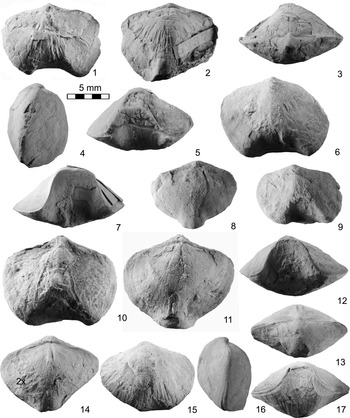
(1–7) Meifodia prima prima. (1, 4) PMO 234.007, mold of conjoined valves, posterior views with pedicle valve on top and bottom position, respectively, 20 m above base; (2, 5) PMO 234.609, mold of conjoined valve, posterior views with pedicle valve on top and bottom position, respectively, 8–10 m above the base; (3) PMO 234.006, mold of brachial valve, 20 m above the base; (6) PMO 158.145, mold of pedicle valve 21 m above base; all molds from base of Myren Member, Solvik Formation, outcrop along Motorway E18 parallel to Nye Vakås Vei, Asker; (7) PMO 41.220g, pedicle view, part of the collection investigated by Copper (Reference Copper1995) from the southern coast of Malmøya, Myren Member. (8–12) Meifodia prima ovalis, uppermost Myren Member, Ulvøya bad, Ulvøya, Oslo; all from Solvik Formation; (8, 9) PMO 234.614, molds of conjoined valve, (8) brachial view, (9) pedicle view; (10) PMO 234.612, brachial view of mold; (11, 12) PMO 234.613, brachial (11) and pedicle (12) views of mold. (8–12).

The hinge pad with the cardinal pit changes into a high median septum or pedestal between the hinge plates (Figs. 7–9) before it fuses with a lower and thinner ridge, as seen in thin sections from the lower and higher ranges in Norway. Williams’ (Reference Williams1951) descriptions do not include this feature and it is not evident in figures from Temple (Reference Temple1987) or Cocks (Reference Cocks2019) from Britain. Instead, M. prima ovalis shows a short transverse bar in front of the cardinalia—something not seen in Norwegian material. Both must have acted as supports for the cardinalia and they may be local variations of such support. Molds from both low and high stratigraphic levels in Norway show that the pedestal within the cardinalia is a variable feature from very high to non-present. There may be a trend since it is present, although not very high, in two specimens out of six in the lower range and high in five out of six in the upper range.
Meifodia prima prima. Serial section of specimen PMO 52.309h from basal Myren Member, lowermost part of the profile at Spirodden, Asker. Meifodia prima ovalis. Serial section of specimen PMO 41.227 from Padda Member at Malmøykalven, Oslo.

Copper (Reference Copper1995) made thin-sections of specimen PMO 41.220b from Malmøya in Norway (Fig. 7). This comes from a collection of 10 valves collected by the Norwegian paleontologist Kiær from the southern side of Malmøya. They are marked as level 6b, which corresponds to the upper half of the Myren Member (upper Rhuddanian to lower Aeronian). The southern side exhibits an anticline with the Padda Member of Aeronian age on the two sides and the upper half of the Myren Member with the lowest strata of middle Rhuddanian age in the middle. Most material comes from the point on the southern beach with these lowest strata. Hence, it is most likely that these are upper Rhuddanian in position.
Williams (Reference Williams1951) did not describe the jugal processes. There is a marked difference between the stratigraphically older specimens with fairly thick jugal processes directed straight anteriorly and younger specimens with slender processes that nearly touch (Fig. 7). The thin section of Copper (Reference Copper1995, fig. 8) shows jugal processes in an intermediate position, so this might be an additional trend. Otherwise, the thin section differs markedly from sections made by the present author (Figs. 7, 9) in that there are no signs of a “pedestal.” The height and presence of the “pedestal” increase upwards stratigraphically, so low or none is a primitive feature. Furthermore, there are no supporting plates lateral to the hinge plates, but the thin-sections that potentially could reveal this point are not published. Acid treatment of one of the other specimens in Copper's collection (Fig. 8.7) shows pedicle scars that conform to those of Meifodia subundata forma typica of Williams (Reference Williams1951). The valve was partially filled by secondary calcite, making it hard to observe the features of the cardinalia, but a fairly wide cardinal pit and a “pedestal” are present, together with converging support plates. Copper (Reference Copper1995) assigned his specimen to Meifodia cf. M. subundata based on the differences found in the thin section. This study suggests that the thin section made by Copper (Reference Copper1995) is an outlier among specimens with transitional features that fall between the two end members. The collection is here included in Meifodia prima prima.
Williams (Reference Williams1951) did not distinguish stratigraphically older and younger material by external characteristics. Differences are difficult to discern visually (Fig. 10). To test actual differences, specimens from the basal layers of the Solvik Formation in Asker (upper Hirnantian–lower Rhuddanian) were measured and compared to material from upper Myren and Padda members at Malmøya (Aeronian). The Meifodia specimens from the collection with the one specimen sectioned by Copper (Reference Copper1995) and others from the same level, upper Rhuddanian, were also measured. The specimens are from the collections of the Paleontological Museum in Oslo, including additional specimens of Aeronian age collected by the author. The museum material is quite abundant, but many lack accurate stratigraphic information so those without information were omitted from this study. The result was 32 specimens from the basal Myren Member (uppermost Hirnantian–lower Rhuddanian strata) and 20 specimens from the uppermost Myren and Padda members (Aeronian strata), together with the specimens from Copper's (Reference Copper1995) study (upper Rhuddanian). Ten different features were measured (see Fig. 3, Tables 3, 4). Principal component analysis (PCA) was conducted to visualize differences between the populations and to supplement basic statistical summaries for the three populations. To mitigate for variations in body size, components 2 and 3 were utilized.
(1–9) Meifodia prima prima. (1–5) PMO 52.379, pedicle, brachial, posterior, side, and anterior views, lower part of Myren Member, Spirebukta, Asker; (6, 7) PMO 52.133, pedicle and anterior views, basal Myren Member, Konglungø, Asker; (8, 9) PMO 52.055a, brachial and pedicle views, basal Myren Member, Høyerholmen, Asker. (10–17) Meifodia prima ovalis. (10–12) PMO 21.009, pedicle, brachial, and anterior views uppermost Myren Member, Malmøya, Oslo; (13–17) PMO 41.240a, posterior, brachial, pedicle, side, and anterior views, Padda Member, Malmøya, Oslo. All Solvik Formation.

Univariate summary statistics based on measurements of Meifodia prima prima. See Table 1 for explanation of abbreviations.

Univariate summary statistics based on measurements of Meifodia prima ovalis. See Table 1 for explanation of abbreviations.

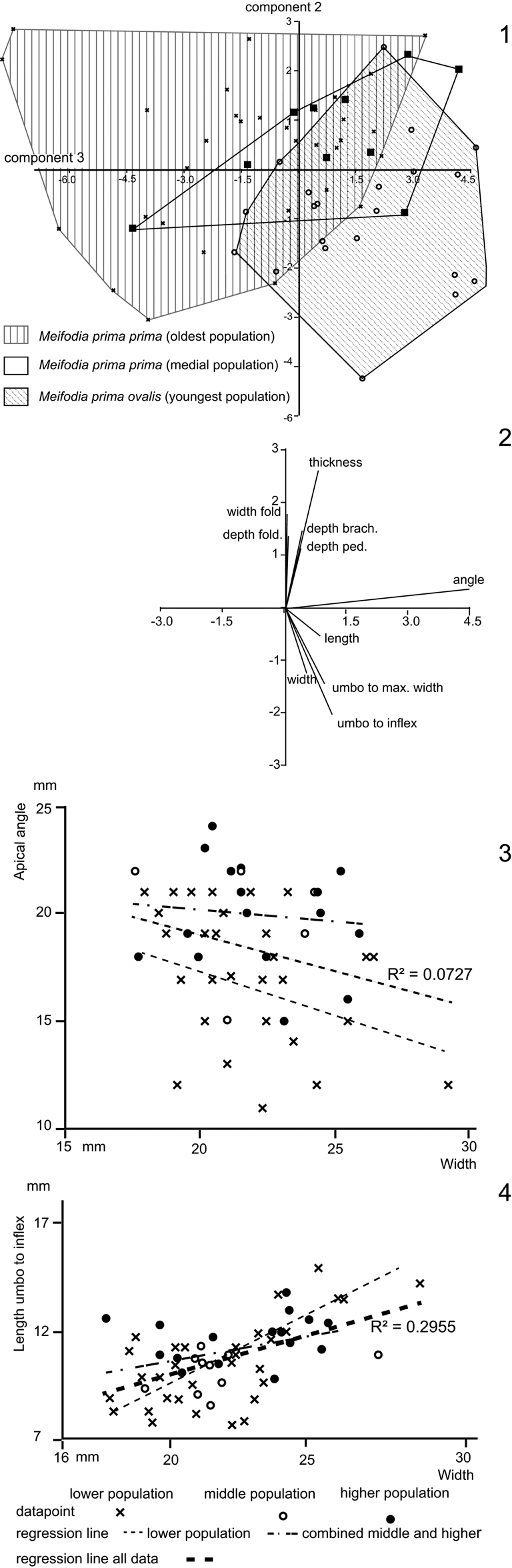
The result mimics what was clear from internal molds and thin sections—wide variation within individual populations (Fig. 11.1). The lower and upper populations plot in different areas, but these areas overlap. The most important feature separating them is the angle of the posterior margin (Fig. 11.2). This concurs with larger beaks that jut out farther and larger cardinalia in the stratigraphically younger population. Two other features found to be of importance are the distance from the posterior end to maximum width and the distance from the posterior end to the start of the fold. This means the shells from higher levels tend to be rounder in outline and the fold tends to start farther posteriorly. The small collection used by Copper (Reference Copper1995) plots very much in the middle of these two areas (Fig. 11.1).
(1) Principle component analysis (PCA) of ten measurements compiled from three populations of Meifodia prima using components 2 and 3 and showing convex hull. Specimens taken from the lower half of Myren Member (uppermost Hirnantian and basal Rhuddanian) are shown as “x,” specimens used by Copper (Reference Copper1995) and other shells from the same horizon in the lower upper half of the Myren Member (upper Rhuddanian) are shown as black squares, and specimens from the upper Myren Member and the Padda Member (Aeronian) are shown as open circles. (2) Eigenvalues from the measurements used in Figure 12.1. (3). Bivariate plot of the apical angle towards maximum width with linear trend and R2 value line for all the data points and linear trends for the stratigraphically lower population and the population occurring towards the top of the Solvik Formation. (4). The same bivariate plots and trends for length from umbo to inflex of sulcus towards maximum width.

Bivariate plots (Fig. 11.3, 11.4) correlating the size of the valves represented by maximum width and other measurements confirm the large variability in morphology. The distance from umbo to the inflex of the sulcus increases with size, as expected, although the increase is smaller in the later populations (Fig. 11.4). The exception is the angle of the posterior margin (Fig. 11.3). The angle is nearly independent of size of the shells (R2 = 0.0727, Fig. 11.4), but the lower populations occurring in strata around the O/S boundary plot lower (i.e., the angle is consistently lower) than the combined middle and upper populations from Malmøya from the upper 60 m of the 190 m thick Solvik Formation.
As pointed out by Williams (Reference Williams1951) and Temple (Reference Temple1987) and shown in this study, there is a gradual change in the prevalence of certain internal features between the stratigraphically oldest and youngest specimens. This study adds converging jugal processes and changes in external shape that occur with time with a beak that becomes more prominent, shells that tend to be rounder and have a sulcus that starts farther anterior with time. The PCA supports a pattern of gradual phyletic evolution where no final separation of the two phena has occurred. Individuals from the older and younger population may be distinctly different from each other, but they fall along a continuum with extreme specimens, which makes them difficult to separate.
Temple (Reference Temple1987) stated that the type material is poorly constrained in age and locality and consists of just three specimens. He regarded M. subundata as a nomen dubium. Instead, he recognized M. prima prima and M. prima ovalis; two of the subspecies determined by Williams (Reference Williams1951). Cocks (Reference Cocks2019) elevated M. ovalis to species level. A species is an arbitrary segment of an evolving lineage in time (Vaux et al., Reference Vaux, Trewick and Morgan-Richards2016). That is a fitting definition and an elevation to species for M. ovalis may be defended in that light. However, there are still large overlaps in features and the evolving traits could probably still be reversed. To keep them as subspecies, as recommended by Temple (Reference Temple1987), is more prudent. The Solvik Formation where Meifodia occurs throughout was deposited over ca. 5.6 Ma and most species have a shorter duration than that (Patzkowsky and Holland, Reference Patzkowsky and Holland1997). Exceptions are species with a large geographic distribution (e.g., Meifodia prima), which tend to have greater longevity than endemic species (Heim and Peters, Reference Heim and Peters2011) since traits can be reintroduced from elsewhere. In conclusion, this is an example of gradual phyletic evolution or a biased random walk where a wide range of variation in traits is expected as seen in the coeval genus Stricklandia (Williams, Reference Williams1951; Baarli, Reference Baarli1986). Practically, a handful of specimens has to be used for definition of subspecies.
Meifodia prima prima Williams, Reference Williams1951
Figures 7, 8.1–8.7, 9, 10.1–10.9
- Reference M'Coy1851
Hemithyris subundata M'Coy, p. 394.
- Reference Sedgwick and M'Coy1852
Hemithyris subundata M'Coy; M'Coy in Sedgwick and M'Coy, p. 207, pl. 1H, fig. 9a–c.
- Reference Davidson1867
Meristella? subundata (M'Coy); Davidson, p. 129, pl. 13, fig. 4–4c.
- Reference Williams1951
Meifodia subundata prima (M'Coy); Williams, p. 107, fig. 11, pl. 6, figs. 1–3.
- Reference Williams1951
Meifodia subundata (M'Coy) forma typica; Williams, p. 108, fig. 12, pl. 6, figs. 4–7.
- Reference Temple1970
Meifodia subundata (M'Coy); Temple, p. 61, pl. 17, figs. 1–12.
- Reference Boucot, Johnson and Shagam1972
Meifodia subundata prima, Williams; Boucot et al., p. 643, pl. 27, figs. 1–16.
- Reference Thomsen, Baarli and Worsley1982
Meifodia subundata (Mc Coy); Thomsen and Baarli, pl. 3, figs. 7, 8, 13.
- Reference Temple1987
Meifodia prima prima Williams; Temple, p. 115, pl. 14, figs. 1–7.
- Reference Copper1995
Meifodia cf. M. subundata (M'Coy); Copper, p. 852, text figs. 8, 9, fig. 5.31–5.35.
- Reference Copper, Williams, Brunton and Carlson2002
Meifodia subundata (M'Coy); Copper, p. 1463, figs. 993, 1a, b.
- Reference Copper2004
Meifodia cf. prima Williams; Copper, p. 107, fig. 74.
- Reference Cocks2019
Meifodia subundata (M'Coy); Cocks, p. 142, pl. 37, figs. 1–7.
Holotype
SM (Sedgwick Museum) A30114, a brachial valve from strata of Rhuddanian age at Esgair-fwyog, northeast of Llandovery, Dyfed, Wales.
Occurrence
Høyerholmen, Ostøya, Bærum, Konglungø, Spirebukta, Spirodden, and Vakås in Asker, near the base of the Solvik Formation. Sjursøya and Malmøya in Oslo. All from strata of uppermost Hirnantian to middle Rhuddanian age.
Description
Medium-sized, strongly dorsibiconvex, smooth shells, broader than long (average, length 77% of width; Table 3). Wide variation in width to length, but generally, the proportions increase with size. Broad hingeline with small, adpressed beak and small (most often hidden or apical) foramen. Low posterior angle becomes lower with increasing width. Maximum width well in front of the midline (Table 3). A characteristically strong and often angular sulcus in the pedicle valve varies and is proportionally deeper in small valves. Sulcus initiates at about mid-length and may inflex abruptly. Corresponding fold in the brachial valves starts in the posterior third and is sometimes outlined by a small groove on each side.
Very thick posterior shell wall (Fig. 9). Narrow, deep muscle platform has strongly impressed adductor scars and a faintly impressed transverse ridge (Fig. 8.4, 8.6). Less well-impressed diductor scars splay out at ~45° angle. Short and medium thick teeth. Well-impressed and large muscle scars in the brachial valve. A very short cardinal pit and relatively small, short, and horizontally directed hinge plates. A characteristic median pedestal (median septum) separates them, descends to the floor at the front of the hinge plates, and goes on as a low ridge to about one-third of the shell length (Figs. 7, 9). Short, brachial continuations of the inner socket plates, or septal support, may be parallel or less commonly angled towards the median septa. Thin crura splay out ventrolaterally. Far-separated jugal processes stay high ventrally and splay out into thin plates. Eight to nine whorls in the spiralia (Fig. 9).
Materials
PMO 41.220a, d–l, 41.639, 41.722, 52.055a–c, 52.056, 52.057a, 52.133, 52.137, 52.138, 52.151, 52.309a–c, e–g (h sectioned), 52.360a, b, 52.378, 52.379, 87.592, 87.593, 91.321, 91.322, 91.324, 91.326, 103.531 (brachial mold), 143.274, 158.145, 234.006, 234.007, 234.009, 234.011 (last four molds). All whole specimens except where noted.
Remarks
The pedicle muscle marks, as seen in Figure 8.6, conform to those described by Williams (Reference Williams1951, SM A 30118), although they are more strongly imprinted than those seen in most other valves. Williams described the subspecies prima as biconvex. The degree of convexity in the Norwegian material varies, but the brachial valve is consistently the deeper valve.
Meifodia prima ovalis Williams, Reference Williams1951
Figures 7, 8.8–8.12, 9, 10.10–10.17
- Reference Williams1951
Meifodia ovalis (M'Coy); Williams, p. 109, fig. 11, pl. 6, figs. 8–10.
- Reference Temple1987
Meifodia prima ovalis Williams; Temple, p. 116 (part), pl. 14, figs. 8–15.
- Reference Copper2004
Meifodia ovalis Williams; Copper, p. 107.
- Reference Cocks2008
Meifodia ovalis Williams; Cocks, p. 97, pl. 12, figs. 1–9.
- Reference Cocks2019
Meifodia ovalis Williams; Cocks, p. 141, pl. 37, figs. 1–7.
Holotype
SM A301214, one-quarter mile southwest of Llwyn-yr-iâr, north-east of Llandovery, lower Aeronian.
Occurrence
Malmøya, Malmøykalven, and Ulvøya bad, all in Oslo in uppermost Myren and the lower parts of Padda members, basal to middle Aeronian.
Description
Smooth, transverse (average length 76% of the width), dorsibiconvex valves with a somewhat rounded outline (maximum width close to mid-length). Broad hingeline; adpressed and fairly prominent beak creating an average posterior angle of 20° (Table 4). Strong, deep sulcus with rounded flanks originates at about mid-length and occupies half of the valve width. Corresponding fold in the brachial valve originates in the anterior third. Fold may have small plica. All these characters vary, as seen in Figure 10.
Thick shell posteriorly. Muscle scars sit on a platform with small, deeply impressed adductor scars, flanked by large, broad, and flabellate diductor scars. Strongly impressed muscle scars with high, narrow ridge in the pedicle chamber, divided by a median indentation (Fig. 8.12). Fairly thick, short, and massive teeth (Fig. 9). Medium-well impressed and oval muscle scars in the brachial valve. Very short, broad cardinal pit. Bottom of the pit stays elevated as a pedestal or median ridge and increases in height towards the front of the cardinalia, continuing in a short and low median ridge (Figs. 7, 9). Fairly delicate, strongly splayed out, and horizontal hinge plates. Fine crura directed laterally with thin, long jugal processes ending in horizontal plates that nearly touch in the middle of the valve. Eight whorls are visible.
Materials
PMO 21.000, 21.002, 21.003, 21.006, 21.009, 21.010, 41.226 (sectioned), 41.227, 41.230a, b, 41.240a, b, 234.037–39, 234.042, 234.604–7, 234.612–17, 234.632, 234.633 (last eight are molds).
Remarks
The internal characters, as seen in molds, correspond to what was described for the species in Williams (Reference Williams1951). As found by him, the brachial muscle scar is faintly impressed. The brachial valve relative to the pedicle valve is shallower than what is found in older populations on average (Table 4).
Genus Thulatrypa Huang et al., Reference Huang, Baarli, Zhan and Rong2016
Type species
Thulatrypa gregaria Huang et al., Reference Huang, Baarli, Zhan and Rong2016, PMO 158.116, uppermost Leangen Member of the Solvik Formation, Bleikerveien.
Remarks
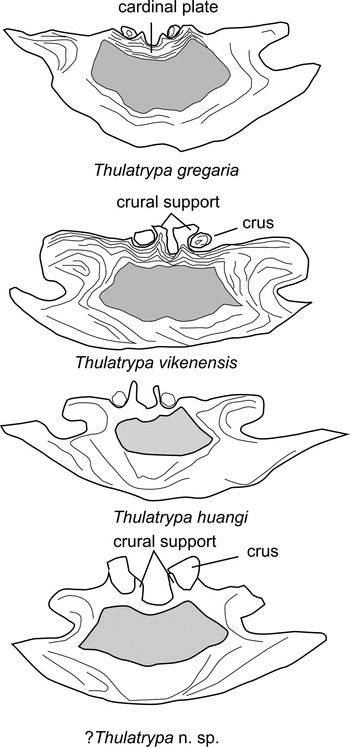
The type species of Thulatrypa is very abundant in the Aeronian strata of the Oslo-Asker districts. Specimens with unsupported cardinal plates jutting into the valve displaying peculiar crural supports (see Fig. 12), similar to the type species Thulatrypa gregaria, are common throughout the Solvik Formation. However, the shape, size of the shells, and the number of spiralia vary widely.
Thulatrypa gregaria Huang et al., Reference Huang, Baarli, Zhan and Rong2016
Figures 12, 13.1–13.4, 14, 15
- Reference Thomsen, Baarli and Worsley1982
Meifodia sp.; Thomsen and Baarli, p. 77, figs. 11, 12, 17, 21.
- Reference Huang, Baarli, Zhan and Rong2016
Thulatrypa gregaria Huang et al., p. 89, figs. 6, 7, 8B, 10A, 10B, 10E, 10F, 11, 12.
Holotype
PMO 158.116, uppermost Leangen Member of the Solvik Formation, Bleikerveien, Asker.
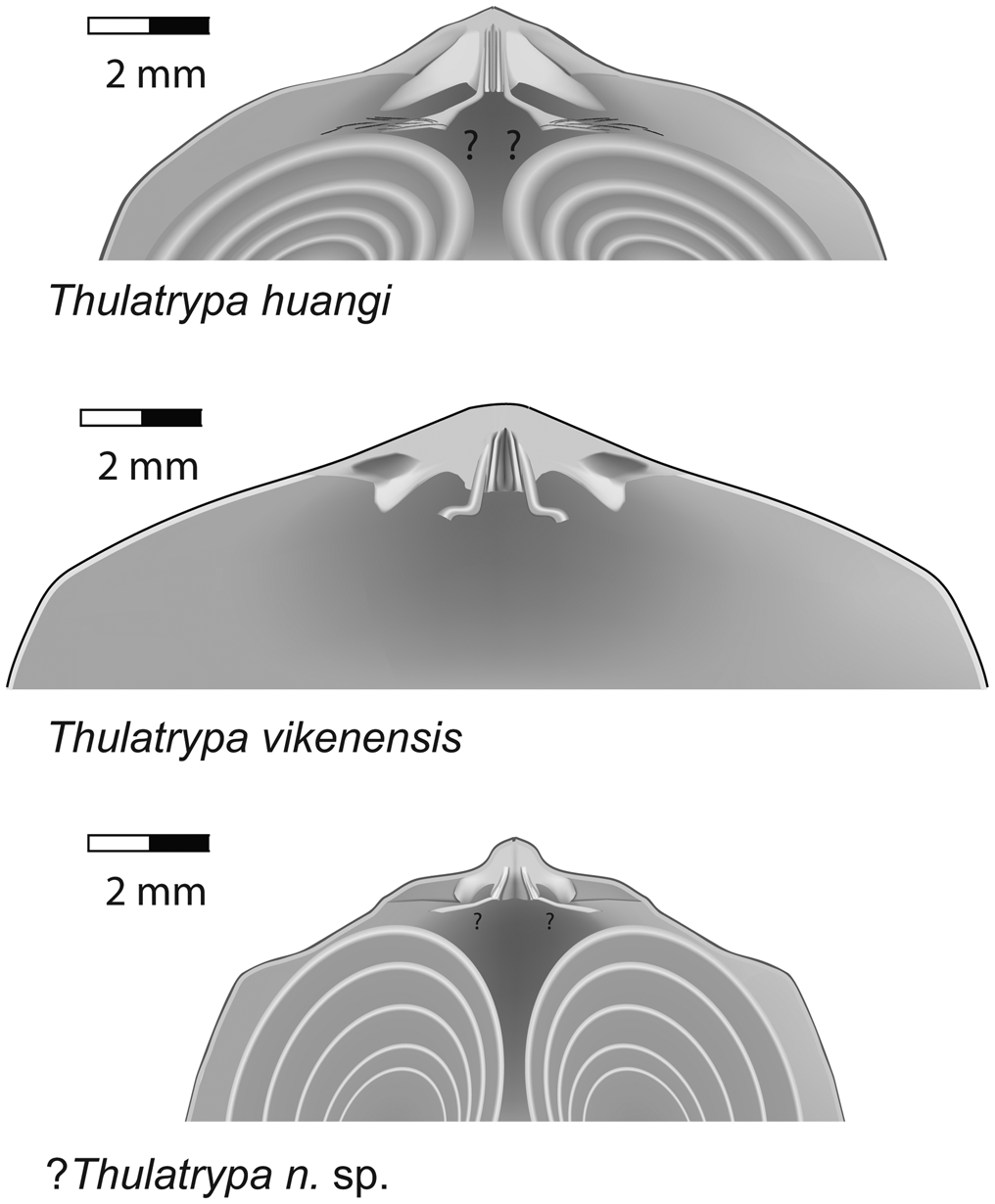
Cross sections of the posterior parts of the brachial valves from the type species Thulatrypa gregaria, T. vikenensis n. sp., T. huangi n. sp., and ?T. new species showing the cardinal plate with crural supports and crus. Note how the fibers in the cardinal plate curve up into the crural supports. The cross-sections are not drawn to scale.

(1–4) Thulatrypa gregaria. (1, 2) PMO 21.084, pedicle and side views, from Padda Member, Malmøya, Oslo; (3, 4) PMO 52.727h, side and pedicle views, uppermost Spirodden Member, Vettre Brygge. (5–22) Thulatrypa huangi n. sp. (5–9) PMO 158.291g, holotype, brachial, pedicle, side, anterior, and posterior views; (10–13) PMO 158.107r1, brachial, pedicle, side and posterior views; (5–13) 52–57 m above base of Leangen Member, Skytterveien; (14–18), NIGP 174600, posterior, brachial, pedicle, side and anterior view; (19) NIGP 174601, anterior view; (14–19) upper part of Leangen Member, Skytterveien; (20) PMO 105.872, mold of pedicle valve, 10 m above base of Leangen Member, Skytterveien; (21) PMO 234.625, mold of brachial valve, 41 m above base of Leangen Member, Leangbukta; (22) PMO 158.119, mold of pedicle valve, 16 m above base of Leangen Member, Skytterveien; (23–28) ?Thulatrypa n. sp. (23–26) PMO 234.635, posterior, brachial, ventral, and side views, 4 m above base of Leangen Member, Skytterveien; (27, 28) PMO 158.222, brachial and pedicle views, 20 m above base of Leangen Member, Leangbukta; (3–28) all Asker.

Occurrence
Malmøya and Malmøykalven in Oslo, Skytterveien, Leangen, Vettrebukta, and Vettre Brygge in Asker, Løkkeåsen in Sandvika, uppermost Rhuddanian through Aeronian.
Materials
PMO 21.084, 21.093, 41.340a, 51.968y1, 52.727a–l, 53.258a–i, 154.124 (mold), 52.979s, 157.986 (mold), 158.224 (mold), 158.610, 209.201, 233.940, 234.634, 234.636, 234.642, 234.643 (last three molds). All whole specimens except where noted.
Remarks
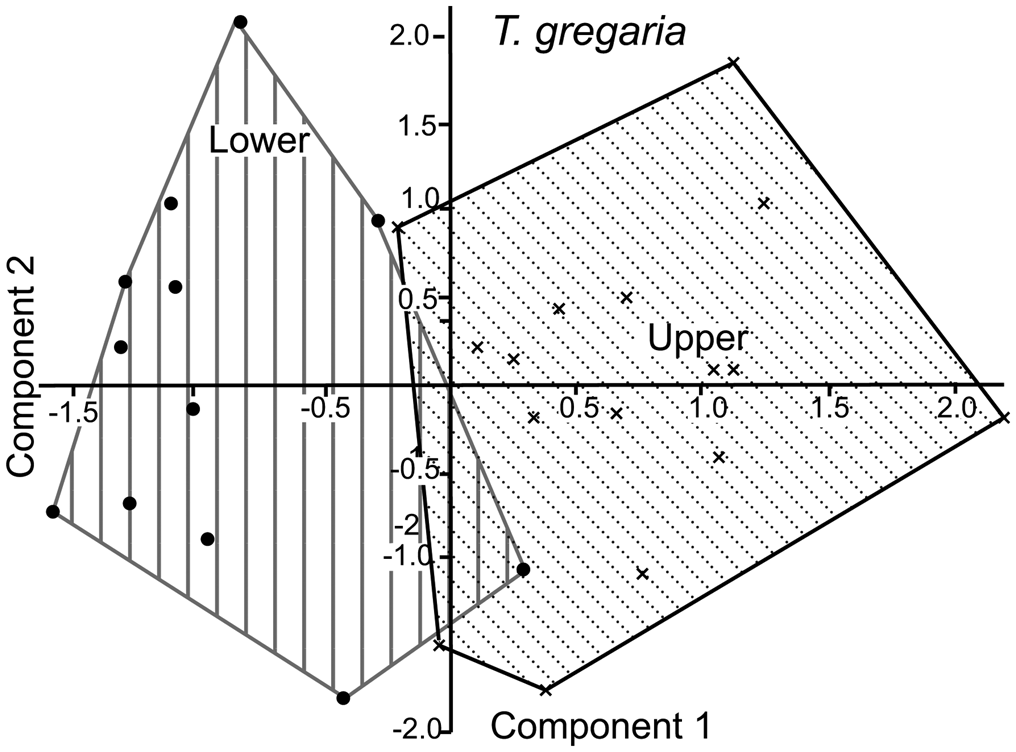
Thulatrypa gregaria is one of the most common brachiopods in the Aeronian, especially in the Asker area. It was well described by Huang et al. (Reference Huang, Baarli, Zhan and Rong2016); however, its exact stratigraphic range was not established in that article. Specimens in a collection from uppermost Rhuddanian strata at Vettrebukta (Fig. 13.3, 13.4) are generally smaller and more biconvex compared to the large, strongly dorsibiconvex specimens found farther up in the section (Fig. 13.1, 13.2). There is an increase in convexity of the valve with increasing size in T. gregaria (Huang et al., Reference Huang, Baarli, Zhan and Rong2016, fig. 12B). Internal features seen in thin sections of the early specimens concur with T. gregaria (Fig. 14). PCA plots using the same ten external measurements used for Meifodia (Fig. 3) show that the two populations (using convex hulls) plot in different areas, but intersect slightly (Fig. 15). The main differences between the populations are in width, umbonal angle, and the distance from umbo to inflex of the sulcus, with differences in brachial depth as a secondary component. Much of this is due to ontogenetic change., but a larger intersection in PCA was expected because the populations overlap in size. The early specimens are likely phenotypes of the later T. gregaria. Thus, the range of that species is extended down into the uppermost Rhuddanian.
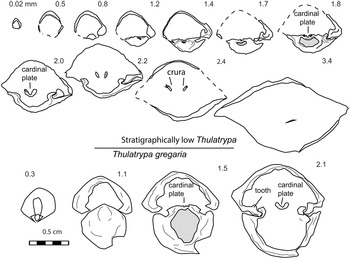
Thulatrypa gregaria. Serial section of specimen PMO 52.727 from the top of Spirodden Member at Vettre Brygge, Asker (stratigraphically low Thulatrypa) compared with selected cross-sections of the holotype specimen, PMO 158.116 (redrawn from Huang et al., Reference Huang, Baarli, Zhan and Rong2016, fig. 6).

PCA of 10 measurements on individual specimens (see fig. 3) of Thulatrypa gregaria from uppermost Rhuddanian (denoted by black, filled circles in area of plot designated “Lower”) and middle Aeronian (crosses in area of plot designated “Upper”).

Thulatrypa huangi new species
Figures 12, 13.5–13.22, 16, 17
Holotype
PMO158.291 g from 52–57 m above the base of Leangen Member, Solvik Formation, (mid-Aeronian), Skytterveien, Asker. A whole shell (Fig. 13.5–13.9).
Diagnosis
Smooth, biconvex, and medium size, with maximum thickness in the posterior part of the valve. Small, adpressed beak with apical foramen and clear growth lines anteriorly. Pedicle valve with wide, gentle sulcus and lightly incised triangular muscle scars. Unsupported cardinal plate with medium-strong crural support and thin crural bases with fibrous crura. Four to six whorls in the cardinalia.
Occurrence
Malmøya, Oslo. Vettre, Leangbukta, and Skytterveien, Asker. Occurring throughout Aeronian.
Description
Medium-sized, smooth, and evenly biconvex with rounded margins and a wide, gentle sulcus in the pedicle valve. Slightly wider than long valves (length 87% of width on average; Table 5) and maximum thickness in the posterior part of the valve giving it an almond-shaped, sidewise cross-section. Clear growth lines over most of the valves, especially anteriorly. Very small and strongly incurved beak with small foramen. Delthidial plates not visible.
Univariate summary statistics based on measurements of Thulatrypa huangi n. sp. See Table 1 for explanation of abbreviations.

Pedicle valve with lightly incised, triangular muscle field, small adductor scars and long, narrow diductor scars. Strong, solid, broad, and short teeth (Fig. 16). Very thick pedicle shell wall posteriorly, probably with a pedicle callist. No clear cardinal process or cardinal pit. Cardinal plate with moderately thick socket plates, concave hinge plates, and fairly thin crural-base supports. Supports start far posterior and continue onto the unsupported cardinal plate. Ventrolaterally directed, delicate, and fibrous crura (Fig. 17). Jugal processes not observed, although a hook-like structure seen in the cross-section at 2.9 mm (Fig. 16) may represent part of one. Four wide whorls in the medio-anteriorly directed spiralia.
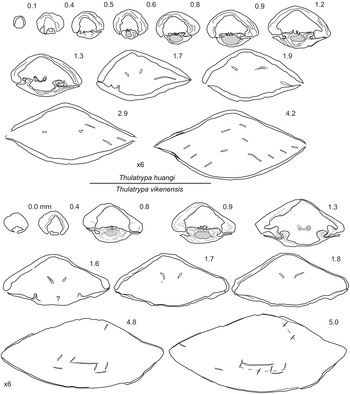
Thulatrypa huangi n. sp. Serial section of specimen PMO 158.107s1 from the top of Leangen Member at Skytterveien, Asker. Thulatrypa vikenensis n. sp. Serial section of specimen PMO 209.199 from 20 m above the base of the Myren Member, outcrop along E18 motorway, Vakås, Asker.

Reconstruction of internal structures based on specimen PMO 158.107s1 for Thulatrypa huangi n. sp. (see above), for Thulatrypa vikenensis n. sp. based on specimen PMO 209.199 (see above), and ?Thulatrypa n. sp. based on specimen PMO 153.873 (see below).

Etymology
Named in honor of Dr. Bing Huang from Nanjing Institute of Geology and Palaeontology who loaned me specimens from his collection.
Materials
PMO 41.941a, 52.979a, t, 87.546, 105.872 (pedicle mold), 105.887 (pedicle mold), 158.107r1, s1 (sectioned), 158.119 (pedicle mold), 158.291c, e-g, 158.291g (holotype), 234.623, 234.624, NIGP 174600 and NIGP 174601, all whole shells unless stated otherwise.
Remarks
This species of Thulatrypa is close to T. vikenensis n. sp. that occurs from the base of the Solvik Formation and overlaps slightly in age near the base of Aeronian. It differs in that T. huangi n. sp. has an almond-shaped cross-section where maximum thickness is in the posterior part as compared with a flatter valve that tapers steeply near the anterior margin. Thulatrypa vikenensis n. sp. has an anacline area and foramen that is mesothyroid, while the beak is strongly incurved with apical foramen in T. huangi n. sp. It differs from T. gregaria in size, being biconvex, having a fairly narrow triangular muscle scar in the pedicle valve, and an apical foramen.
Thulatrypa vikenensis new species
Figures 12, 16, 17, 18.1–18.16
- Reference Baarli and Harper1986
Idiospira sp.; Baarli and Harper, pl. 3, figs. d, e.
Holotype
PMO 234.041 from 8–10 m above the base of the Myren Member, Solvik Formation, Vakås, along E18, Asker. A conjoined shell.
Diagnosis
Medium-sized, rounded, equally biconvex to slightly ventribiconvex and relatively flat Thulatrypa. Length close to width and the cross-sections, both longitudinally and transversely, in the two valves are evenly convex. Anterior margin rectimarginate with well-developed growth lines anteriorly. Beak very small and orthocline to anacline with mesothyridid foramen. Thick, prismatic shell. Narrow pedicle collar, no cardinal process present on a cardinal plate supported by bulbous socket plates.
Occurrence
Vakås along E18, Spirodden, Skytterveien, all Asker and Malmøya, Oslo, lowermost Rhuddanian to lower Aeronian.
Description
Medium-sized, smooth, low biconvex, with wide hingeline (Fig. 18). Maximum width is around mid-length and the margin is evenly rounded. Average length to width is 93% and thickness to width 54% (Table 6). Anterior margin is rectimarginate to slightly uniplicate. Beak very small, orthocline to anacline, with mesothyridid foramen and tiny triangular delthidial plates. Thick, prismatic shell. Growth lines spaced two to three mm apart anteriorly. The muscle field in the pedicle valve is wide, triangular, and fairly well impressed. Adductor scars are not visible on the specimen. A pedicle callist with a narrow pedicle collar is seen in the one available mold (Fig. 18.15). Brachial muscle scars are weakly impressed on the side of a short median ridge. The teeth are fairly large, simple, and directed anteromedially. There is no cardinal process, but a cardinal plate with well-developed crural support (Figs. 16, 17) is present. The crural bases are fairly large and rounded. The socket plates are large and the cardinal plate juts unsupported out into the valve. The crura continue into the pedicle part of the valve. Jugum is not known and parts of the spiralia are lying sidewise in the brachial valve. There are 3–4 whorls present and the distance between them indicates that there was maximum space for 6–7 whorls.
(1–16) Thulatrypa vikenensis n. sp. (1–5) PMO 234.041, holotype, pedicle, brachial, side, posterior, and anterior views, 8–10 m above base of Myren Member, Vakås, along E18; (6, 7) PMO 158.873 brachial and side views, 19 m. above the base of the Leangen Member, Skytterveien; (8–10) PMO 209.199 (sectioned) pedicle, brachial, and anterior views, 20 m above the base of the Myren Member; (11–14) PMO 234.619, posterior, brachial, pedicle, and side views, 8–10 m above the base of the Myren Member; (15, 16) PMO 234.610 mold, brachial and pedicle views, 8–10 m above the base of the Myren Member; (8–16) along motorway E18 Vakås, Asker. (17–24) ?Becscia pentagona n. sp. (17–20) PMO 87.387a, holotype, pedicle, brachial, side, and posterior views, lower part of Myren Member at the west side of Ostøya, Bærum; (21–24) PMO 88.163, brachial, posterior, anterior, and pedicle views, lower part of Myren member, Spirodden, Asker. (25–28) ?Glassia sp., PMO 87.601, brachial, pedicle, side, and posterior views, middle to top of the Myren Member, Malmøya, Oslo.

Univariate summary statistics based on measurements of Thulatrypa vikenensis n. sp. See Table 1 for explanation of abbreviations.

Etymology
From the major county (Viken) it which it occurs.
Materials
PMO 21.039, 52.717 t, v, 158.146, 158.873, 209.199 (sectioned), 234.042, 234.610 (internal mold of conjoined valves), 234.619. Eight whole shells.
Remarks
The present material occurs from the base of Rhuddanian into Aeronian. Externally it conforms to the shape of Lissatrypa that first appeared in Aeronian strata, although the beak is not much incurved. It also has the mesothyridid foramen and pedicle collar of Lissatrypa, while the cardinal plate with crural supports aligns it with Thulatrypa. Eisaella n. gen. from basal Rhuddanian is close to Meifodia in shape and a likely ancestor of Lissatrypa. Since Meifodia, Eisaella n. gen., and Thulatrypa appear together in O/S boundary layers, this must have been a time of intense evolution of the lissatrypides on the Baltic continent. The divergence of these genera was yet not finished and a possible common ancestor may be found in older Hirnantian strata. Another unstable species is ?L. hunanensis (Rong et al., Reference Rong, Xu and Yang1974), from lower Aeronian in China, which was moved from Thulatrypa to Lissatrypa (Huang et al., Reference Huang, Harper, Zhou, Zhan, Wang, Tang, Ma, Wang, Chen, Zhang and Luan2019), but shares characteristics with both genera.
Thulatrypa orientalis occurs in beds of middle Rhuddanian age of South China, and Huang et al. (Reference Huang, Baarli, Zhan and Rong2016) postulated that Thulatrypa migrated from South China to Baltica where T. gregaria occurs from upper Rhuddanian strata. Thulatrypa vikenensis n. sp. occurs in layers of uppermost Hirnantian age into early Rhuddanian, so this postulation might be revised. The species may have followed the southern gyre from Baltica to China. However, all other atrypide genera described from the Solvik Formation seem to originate in the east and follow the currents westward (Baarli, Reference Baarli2021a, Reference Baarlib), raising the possibility that the genus remains to be found in older strata in China.
?Thulatrypa new species
Figures 12, 13.23–13.28, 17, 19
?Thulatrypa n. sp. Serial section of specimen PMO 153.873, from near the top of the Leangen Member, Skytterveien, Asker.

Occurrence
The species occurs at Leangbukta and Skytterveien, Asker throughout Aeronian strata.
Description
Very small, slightly biconvex with a strongly projecting beak, anacline interarea with long, narrow delthidial plates. Cardinal angle between 30–35° (Table 7), with anterior part of the valve evenly rounded and rectimarginate margin. Pedicle callist and medium-strong, short teeth curving below the cardinal plate. Bulbous socket plate and concave hinge plates. The cardinal plate curves gently ventrally. Small crural supports border thick crural bases that continue onto a cardinal plate jutting unsupported into the valve. Crural bases extend vertically into the pedicle valve initially before they curve laterally. There are five whorls in the spiralia.
Measurements of ?Thulatrypa n. sp. See Table 1 for explanation of abbreviations. PMO = Specimen numbers from the Paleontological collection of the Natural History Museum in Oslo, Norway.

Materials
PMO 113.698 (brachial mold), 153.873 (sectioned), 158.222, and 158.610, all whole valves.
Remarks
Only three poorly preserved specimens are known of this species. For that reason, it has not been formally defined. The material does not fit comfortably within Thulatrypa. It is a very small species with an outline and shape far different than any other Thulatrypa. It is provisionally aligned with Thulatrypa because it exhibits the typical cardinal plate that juts into the valve with the peculiar crural base supports (Figs. 12, 17). However, the crura initially project ventrally as in Lissatrypa, not laterally as in other species of Thulatrypa. This might be assigned to a new genus if sufficient material becomes available.
Subfamily Septatrypinae Kozlowski, Reference Kozlowski1929
Genus Becscia Copper, Reference Copper1995
Type species
Becscia scissura Copper, Reference Copper1995 from the lower parts of the Becscie Formation, uppermost Hirnantian into Rhuddanian, west side of Fox Point, Anticosti, Canada.
Remarks
Genera occurring in strata of transitional Hirnantian and Rhuddanian age are Becscia Copper, Reference Copper1995, and Idiospira Cooper, Reference Cooper1956, belonging to the subfamilies Septatrypinae Kozlowski, Reference Kozlowski1929, and Idiospirinae Copper, Reference Copper, Williams, Brunton and Carlson2002, respectively. What genus and family the material below represents depends on the nature of the jugal processes, which are obscure in the material described below.
?Becscia pentagona new species
Figures 18.17–18.24, 20, 21
- Reference Thomsen, Baarli and Worsley1982
Cyclospira sp.; Thomsen and Baarli, pl. 3, fig. 15.
Holotype
PMO 87.387a (Fig. 18.17–18.20), from the basal Myren Member at the west side of Ostøya, Asker.
Diagnosis
Very small, ventribiconvex, smooth shells with maximum width in the posterior half. Adpressed and pronounced beak. Outline pentagonal with the two more or less-pronounced folds starting far posterior. Sulcus between the folds deepens abruptly near the anterior margin. Cardinal pit present between slightly divided hinge plates.
Occurrence
Ostøya, Høyerholmen, Asker; all from basal Solvik Formation.
Description
Small, smooth shell with two characteristic pedicle folds starting far posterior ending in a sulcus (Fig. 18.24). Fold in the brachial valve starts at mid-length. Deeply ventribiconvex shells, longer than wide (length 104% of width; Table 8) with a slightly pentagonal outline. Pronounced beak (apical angle 115°), strongly curved, and adpressed.
Univariate summary statistics based on measurements of ?Becscia pentagona n. sp. See Table 1 for explanation of abbreviations.

Pedicle valve with thin shell wall. Large dental cavities and teeth that curve below the socket plates (Fig. 20). Low and relatively robust hinge plates supported by socket plates. Initially, horizontal and nearly touching, but farther anterior diverge and curve up into the pedicle valve. Valve filled with secondary crystals making the thin structures of the crura and jugal processes impossible to discern. Clearly seen dorso-medially directed spiralia with four whorls.
?Becscia pentagona n. sp. Serial section of specimen PMO 87.387b, basal Myren Member, Ostøya, Asker.

?Becscia pentagona n. sp. Reconstruction of internal structures based on specimen PMO 87.387b (see above).

Etymology
From Latin pentagonum, five-angled or pentagonal.
Materials
PMO 52.054, 87.387a (holotype), b (sectioned), 88.163, 158.127a–d; all but c and d are whole shells.
Remarks
Externally, the material is close to Becscia with the typical lateral and diverging corrugations, although an apical foramen was not confirmed. Internally, it differs in that the inner socket ridges are close, but not fused into a cardinal plate as is found in Becscia. Idiospira does not have the typical corrugations, but may have a sulcus anteriorly with a crenulation that gives a w-shaped brachial fold, a feature not seen in this material. It is also biconvex to dorsibiconvex, not ventribiconvex. Internally, Idiospira has separate hinge plates like the Norwegian material. The present material is assigned to Becscia and the subfamily Septatrypinae based on the close external configuration, but a more confident taxonomic assignment depends on discovery of material with visible jugal processes.
Copper and Jin (Reference Copper and Jin2014) ascribed the tiny, ribbed Atrypina gamachiana Twenhofel, Reference Twenhofel1928, to Becscia, while Modzalevskaya (Reference Modzalevskaya, Nekhorosheva and Sobolevskaya2018) described B. scissura Copper, Reference Copper1995, with strong secondary folds from Rhuddanian aged strata in Taimyr. No ribs or secondary folds are seen in the present material.
Superfamily Glassoidea Schuchert and LeVene, Reference Schuchert and Levene1929
Family Glassiidae Schuchert and LeVene, Reference Schuchert and Levene1929
Genus Glassia Davidson, Reference Davidson1881
?Glassia sp.
Figure 18.25–18.28
Type species
Glassia obovate Sowerby, Reference Sowerby1839, from Lower Ludlow Beds, Mathon Lodge, Malvern Hills, Herefordshire, Great Britain.
Remarks
Only one well-preserved specimen of this taxon (PMO 87.601) is present. It has the typical outline of Glassia. However, Glassia typically occurs in younger strata from upper Llandovery and into Devonian, so the assignation to genus is questionable. Species of Glassia are mentioned as occurring fairly commonly at Malmøya in samples collected by Dr. D. Worsley and described by Baarli (Reference Baarli1987) in Aeronian strata.
Order Athyridida Boucot, Johnson and Staton, Reference Boucot, Johnson and Staton1964
Superfamily Meristelloidea Waagen, Reference Waagen1883
Family Hindellidae Schuchert, Reference Schuchert1894
Hindellidae indet. Figure 22.21–22.23
Remarks
Representatives from this order are not common in the Solvik Formation. Sheehan (Reference Sheehan1977) collected Hindella kiaeri Sheehan, Reference Sheehan1977, from a layer 3–4 m above the base of the Solvik Formation at one locality at Bekkestua, in Bærum. The species also occurs in older beds of the Langåra Formation. Just a couple of pedicle valves that probably represent H. kiaeri have been found at localities investigated in this contribution. They occur at 3 m and 8 m above the base of the Solvik Formation at Konglungø and Vakås, respectively, in Asker (Fig. 22.21, 22.22). A pedicle valve belonging to Cryptothyrella Cooper, Reference Cooper1942, occurs in Aeonian strata from the top of the Leangen Member at Jongsåsveien in Sandvika (Fig. 22.23). Otherwise, there is only one common athyridide, Shelvothyris Cocks, Reference Cocks2019, which will be discussed below.
(1–20) Shelvothyris bivittata n. sp. (1–5) PMO 88.723 (sectioned), brachial, pedicle, side, posterior, and anterior views, uppermost Myren Member, Malmøya; (6–9) PMO 11.811, anterior, pedicle, brachial, and side views (note that the beak is partially eroded), Solvik Formation, Sandvika. (10, 11) PMO 153.944, brachial and posterior views, middle of Leangen Member. (12, 13) PMO 153.998, brachial and pedicle mold of whole, flattened valve, lower part of Leangen Member; (14) PMO 153.871, mold of brachial valve and (15) PMO 158.900, mold of pedicle valve; (14, 15) top of Leangen Member; (16) PMO 234.015, molds of pedicle and brachial (holotype) valve, 11 m above base of Leangen Member; (17) PMO 234.626, molds of brachial and pedicle valve, upper part of Leangen Member; (18) PMO 234.627, longitudinal cross-section of whole valve and mold of posterior part, lower part of Leangen Member; (19) PMO 158.900, top of Leangen Member; (20) PMO 153.997a, lower part of Leangen Member; (10–20) all from Skytterveien, Asker. (21, 22) Hindella kiaeri (21) PMO 234.010, pedicle valve from 8 m. above the base of the Myren Member, Vakås, along E18, Asker; (22) PMO 158.223, mold of pedicle valve, three meters above base of Myren Member, Konglungø, Asker. (23) Cryptothyrella sp., PMO 234.620, top of Leangen Member, Jongsåsveien, Sandvika.

Subfamily Hindellinae Schuchert, Reference Schuchert1894
Genus Shelvothyris Cocks, Reference Cocks2019
Type species
Terebratula furcata Sowerby, Reference Sowerby1839. Lectotype reselected by Cocks (Reference Cocks2019), GSM Geol. Soc. Coll. 6909a, from original material collected by Sowerby from Bog Quartzite, Shropshire, Great Britain.
Remarks
Copper and Jin (Reference Copper and Jin2017) listed the type species of this genus, Terebratula furcata Sowerby, Reference Sowerby1839, as Cryptothyrella. Cocks (Reference Cocks2019) questioned this because they defined Cryptothyrella as a medium to large genus with a narrow medial groove in the pedicle apex. Moreover, the dental plates in this material fail to diverge strongly medio-ventrally, as is typical in Cryptothyrella, but is more like those typical of Hindella. However, the dental plates in Hindella are long, whereas Shelvothyris has short ones. The genus is, therefore, considered valid.
Shelvothyris bivittata new species
Figures 22.1–22.20, 23
- Reference Thomsen, Baarli and Worsley1982
Cryptothyrella sp.; Thomsen and Baarli, pl. 3, fig. 9.
- Reference Baarli1987
Cryptothyrella sp.; Baarli, p. 86, fig. 6I.
Holotype
PMO 234.015, brachial valve from 11 m above the base of the Leangen Member (lower Aeronian), Skytterveien, Asker.
Diagnosis
Shelvothyris with a very long brachial septum covering 50–85% of the length of the valve. Strap-like, moderately impressed muscle scars in pedicle valve diverge just slightly anteriorly. Relatively slender teeth.
Occurrence
Skytterveien, Asker, Sandvika, Malmøya, Oslo. Occurring through Aeronian strata.
Description
Small, biconvex to dorsibiconvex smooth shell with drop-shaped outline, evenly rounded with maximum width in anterior part (umbo maximum width to length 58%; Table 9). Rectimarginate to slightly plicate anterior margin is (Fig. 22.5, 22.6). Strong and incurved pedicle beak with small, triangular, pedicle delthidial plates flanking relatively large apical foramen. Brachial valve with a weaker incurved beak.
Measurements of Shelvothyris bivittata n. sp. See Table 1 for explanation of abbreviations. PMO = Specimen numbers from the Paleontological collection of the Natural History Museum in Oslo, Norway.

Pedicle shell valve thickened posteriorly with shorth, dental lamellae that curve slightly anteriorly (Fig. 23). Relatively slender teeth, extending anteriorly as they curve below the hinge plates. Well-impressed, y-shaped muscle scar with a thin medium groove is somewhat variable in outline. Most diverge modestly at ~20°, but they may splay up to 50°. Two trunks of vascular channels continue anteriorly on each side of the muscle scars. Relatively thin hinge plates posteriorly supported by a median septalium. Farther anteriorly, where the septalium support is absent, they thicken before the crura splay off in a medial position. Septalium comprising 50–85% of the length of the valve, becomes shallower anteriorly. Weakly impressed muscle scars in the brachial valve. The spiralia are not preserved whole.
Shelvothyris bivittata n. sp. Serial sections of specimen PMO 88.723, uppermost Myren Member, Malmøya.

Etymology
Latin for the double ribbon-like muscle scars in the pedicle valve.
Materials
PMO 11.811, whole shell, PMO 88.723, whole shell (sectioned), PMO 153.871, mold of brachial valve, PMO 153.944, whole shell, PMO 153.996a, b, molds of whole valves, 153.997a, b, c, d, molds of three pedicle, one brachial, and a whole shell. PMO 153.998 mold of whole shell, PMO 158.900, molds of 14 pedicle and seven brachial valves, PMO 234.015, mold of brachial (holotype) and three pedicle valves, PMO 234.626, mold of one brachial and one pedicle valve, PMO 234.627, molds of two whole shells, two brachial valves, and one pedicle valve.
Remarks
Cocks (Reference Cocks2019) described two species from England and Wales, Shelvothyris furcata and Shelvothyris sp. The present material differs from both primarily in the very long and initially deep median septa. The latter species is not well described, although it differs both from S. furcata and S. bivittata n. sp. in having very short dental plates. The type species has short, stumpy teeth and well-impressed muscle scars. The teeth in S. bivittata n. sp. are relatively slender and curl below the hinge plates for a considerable distance anteriorly, and the muscle scars are not so deep. The apical foramen seems larger than in the type material. Shelvothyris furcata was not sectioned by Cocks (Reference Cocks2019). He could, therefore, not assign the species with certainty to a family, but chose the subfamily Whitfieldellinae Alvarez, Rong, and Boucot, Reference Alvarez, Rong and Boucot1998. Whitfieldella Hall and Clarke, Reference Hall and Clarke1893, is a later genus with a complex jugum. Copper and Jin (Reference Copper and Jin2017) simplified the taxonomy and included genera with a simple jugum in the subfamily Hindellinae, which is followed here. Shelvothyris is very common in the high-energy, middle part of the Solvik Formation, but whole specimens are rare. The whole shell that was sectioned for this study had spiralia that were fragmentary. However, the configuration of the cardinalia and the placement of crura (Fig. 23) seem to fall close to Hindella and Koigia Modzalevskaya, Reference Modzalevskaya1985. The earliest complex jugum is known from late Aeronian. Confident assignment of the genus is still not certain, but it likely belongs to Hindellinae.
Family Atrypinidae
Figure 24
Remarks
To complete the treatment of the atrypides in the Solvik Formation, three very rare species of the family are added herein. Two shells of Atrypina (Atrypina) Copper, Reference Copper, Williams, Brunton and Carlson2002, of the subfamily Atrypinae McEwan, Reference McEwan1939, occur in the Leangen Member at Leangen and Skytterveien (Fig. 24.1–24.5). The subfamily Clintonellinae Poulsen, Reference Poulsen1943, is represented by two genera, ?Anabaria Lopushinskaya, Reference Lopushinskaya1965, with two valves at the base and 43 m above the base of the Leangen Member at Vettrebukta and Skytterveien, respectively (Fig. 24.6–24.10). Clintonella aprinis Verneuil, Reference Verneuil1845, appears as molds in one single shale horizon, 32.5 m above the base of the Leangen Member, Leangbukta (Fig. 24.11–24.13), together with other rare brachiopods and graptolite fragments.
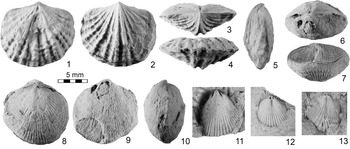
Atrypina (Atrypina). (1–5) PMO 51.968t, brachial, pedicle, posterior, anterior, and side views, from Leangen Member, Leangen, Asker. ?Anabaria sp. (6–10) PMO 157.985, posterior (note dental lamellae), anterior, brachial, pedicle, and side views of valve, 0–5 m above the base of the Leangen Member, Vettrebukta. (11–13) Clintonella aprinis from 32 m above the base of the Leangen Member, Leangbukta. (11) PMO 105.238, mold of pedicle valve; (12) PMO 157.989, mold of brachial valve; (13) PMO 157.990 mold of brachial valve.

Results and discussion
Herein are described one new genus (Eisaella) and 11 species, of which six are new: Eisaella uniplicate, Thulatrypa huangi, Thulatrypa vikenensis, ?Thulatrypa n. sp., ?Becscia pentagona, and Shelvothyris bivittata. Also, two athyridides and three rare ribbed atrypides species are documented. Herein, the holotype of the species identified as Glassia minuta by Rybnikova (Reference Rybnikova1967) is reassigned as Eisaella minuta n. comb. Other occurrences from younger strata that are attributed to Lissatrypa minuta are correctly attributed to Lissatrypa, but ought to be transferred to a different species. Of the 10 smooth atrypides, all but one belong to the family Lissatrypidae. Baarli (Reference Baarli2021a, Reference Baarlib) treated 22 ribbed atrypides in the suborder Atrypidina from the Solvik Formation making the total number of atrypides 35. Herein, three taxa are added from the suborder Athyridida, of which just one, Shelvothyris bivittata n. sp., is prevalent and described.
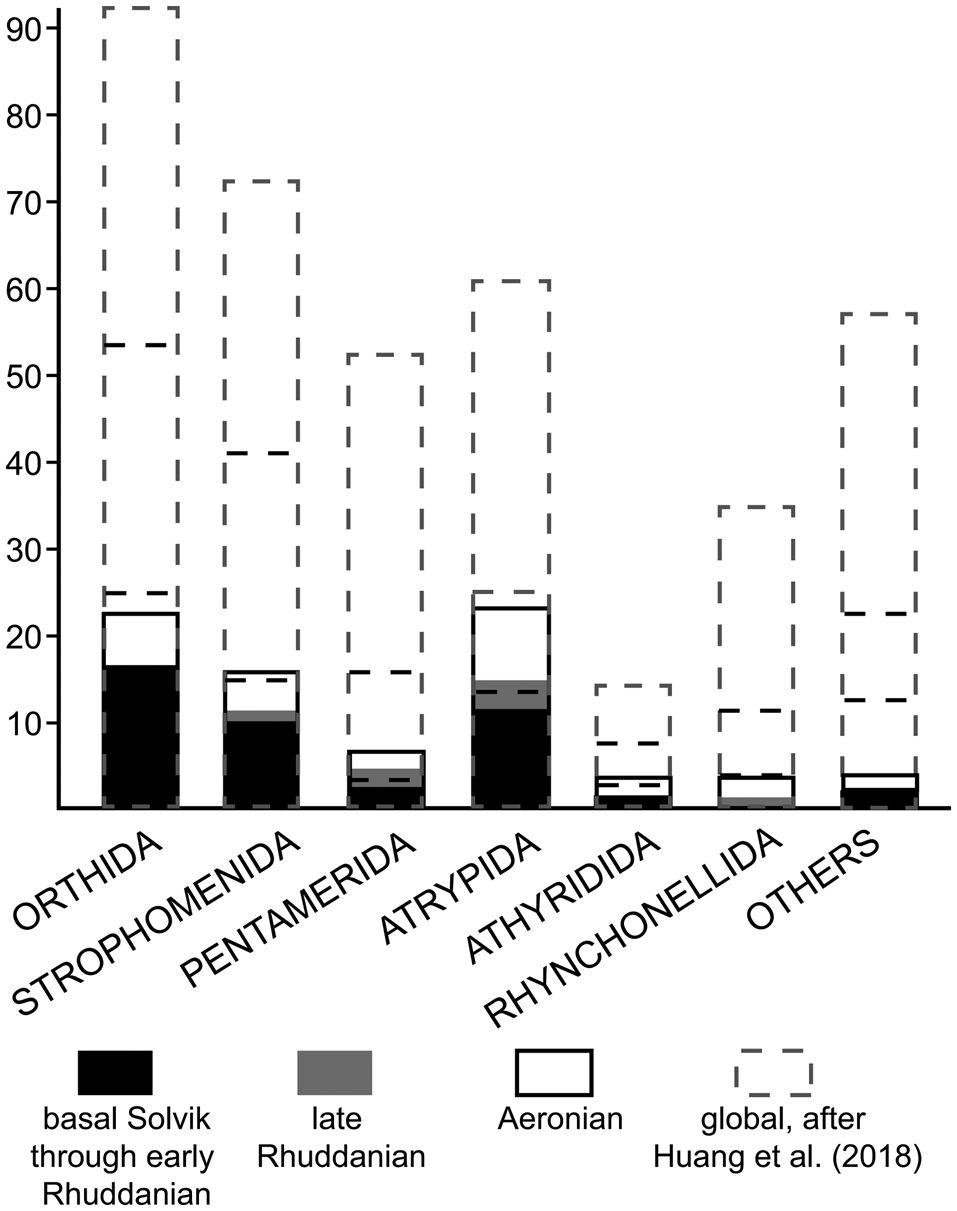
Atrypides is the largest group of genera in the Solvik Formation, accounting for 30% of the total brachiopod fauna, outnumbering the Orthida with 24 to 23 genera (Fig. 25). The 24 atrypide genera described from the Solvik Formation equal more than one-third of all taxa known worldwide where orthids and strophomenids outnumber atrypides from Rhuddanian through Aeronian stratigraphic positions (total numbers; 93 to 73 to 61, respectively (Huang et al., Reference Huang, Jin and Rong2018). The difference is especially striking during the early Rhuddanian, although the world numbers do not include the new genera from the base of the Solvik Formation (Fig. 25). Nine genera are present in the O/S boundary layers and two more are added farther up in lower Rhuddanian, compared with the worldwide distribution of 13 genera for the same time interval. Only three new genera appear in the upper Rhuddanian compared with 13 worldwide (23%; Fig. 26). Atrypides originating in the Aeronian total 35 genera globally while 10 genera (29%) appear in the Aeronian strata belonging to the Solvik Formation.
Generic diversity of major taxonomic groups of brachiopods occurring in early and late Rhuddanian and Aeronian strata of the Solvik Formation. Columns shown with stippled lines represent worldwide diversity from Huang et al. (Reference Huang, Jin and Rong2018).

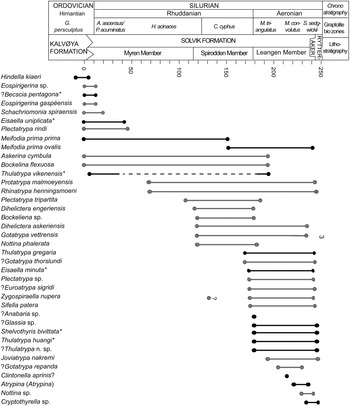
Stratigraphic ranges for the atrypides and athyridides from the Solvik Formation plotted against the stratigraphy of the Asker area. Ranges shown in gray are taken from Baarli (Reference Baarli2021a, Reference Baarlib); ranges in black are those described in the present paper. New species, genera or new name combinations are marked with an asterisk (*). A few taxa occur only in the Oslo area and the ranges for those are correlated with the Asker lithostratigraphy. Note that the Myren Member is diachronous and includes Aeronian strata in the Oslo area (see Fig. 2).

Stratigraphic distribution
Figure 26 shows the ranges for all the atrypides and athyridides documented from the Solvik Formation with the ranges of taxa described in this contribution in black. Eleven species occur at the base of the formation, of which four are smooth spire bearers. Two new species have their first appearance in the middle part of the Rhuddanian, whereas five new species occur from the base of the Coronograptus cyphus graptolite zone within shallower and more lime-rich strata. The major increase of taxa is seen around the transition from Rhuddanian to Aeronian strata where 12 taxa appear, of which seven are described in this paper. One additional smooth spire bearer occurs at the top of Aeronian strata. Five taxa extend their range into the base of Aeronian and 22 additional taxa extend into the top of the Solvik Formation. The greater majority of these are found in the siliciclastic and storm-dominated Leangen Member in Sandvika and Asker.
Benthic assemblages
Baarli (Reference Baarli1987) described the benthic assemblages (BA) in the Solvik Formation. The smooth atrypides ?Becscia pentagona n. sp. and T. vikenensis n. sp. from the basal beds of the Solvik Formation occur in mudstones of the deepest environment (BA 5) together with Dicoelosia Wright, Reference Wright1968, Skenidiodes Schuchert and Cooper, Reference Schuchert and Cooper1931, Anisopleurella Cooper, Reference Cooper1956, Jezercia Havlíček and Mergl, Reference Havlíček and Mergl1982, and Chrustenopora Havlíček, Reference Havlíček1968. Hindella kiaeri, Meifodia prima prima, and Eisaella uniplicata n. gen. n. sp. occur in slightly shallower environments (BA 4) in the basal layers and Meifodia prima ovalis is very common in BA 4 of upper Myren and Padda members on Malmøya. The smooth spire bearers are rare in the lime-rich Spirodden Member (upper Rhuddanian). Smooth spire bearers are very abundant in the clastic and storm-dominated Leangen Member in Asker, which shows a shallowing-upwards trend from BA 5 through BA 4 into BA 3 and back to BA 4. Thulatrypa vikenensis n. sp. reappears in the basal BA 5 assemblage of the Leangen Member. Thulatrypa gregaria, Thulatrypa huangi n. sp., and Shelvothyris bivittata n. sp. are found throughout the Leangen Member and were adapted to clastic environments of different depth, but the latter is most common in BA 3. Eisaella minuta n. comb. is found in BA 4 near the top of the Leangen Member and probably occurs throughout the Padda Member (BA 4).
The post-glacial transgression in the Oslo region was very rapid as evinced by the Solvik Formation filling open channels at Torbjørnsøya and Vakås (Johnson and Baarli, Reference Johnson and Baarli2018). The earlier source areas in the hinterland must have been flooded quickly while little transgressive erosion occurred, leaving an uneven sea bottom blanketed by mud with benthic assemblages BA 3 to BA 5 and a varied brachiopod fauna at the base of the formation. As the transgression proceeded, the sea bottom became more level and variation in benthic assemblages decreased. This can be seen in upper Rhuddanian strata, where the diversity of brachiopods decreases sharply (Fig. 25) and BA 4 environments prevail. Throughout Aeronian time, eustatic sea-level change stimulated variation in benthic assemblages stratigraphically with a higher number of niches and atrypide taxa.
Evolutionary relationships
According to Copper and Gourvennec (Reference Copper, Gourvennec, Copper and Jin2018, fig. 2), the earliest Lissatrypidae are known from the base of the Rhuddanian. However, three genera, Meifodia, Eisaella n. gen., and Thulatrypa, are widespread in the O/S boundary layers in Norway and at least two of them occur in uppermost Hirnantian strata.
Copper (Reference Copper2004) proposed that Meifodia is a likely ancestor to Lissatrypa. The new genus Eisaella exhibits several of the peculiar features found in the younger genus Lissatrypa (e.g., ventrally directed crura and ring-like jugal plates) and is a more likely direct ancestor of this genus. Meifodia and Eisaella n. gen. occur simultaneously in upper Hirnantian strata from Norway. The differences between the genera Eisaella n. gen., Meifodia, and Thulatrypa are not as clear as seen farther up in Rhuddanian strata with a likely common ancestor to all three genera occurring in the immediately underlying Hirnantian strata. Thus, rapid evolution occurred after the initial appearance of the family Lissatrypidae at the very end of Hirnantian into earliest Llandovery time in the Oslo region. This agrees with Rong et al. (Reference Rong, Harper, Huang, Rongyu, Xiaole and Di2020), who found that the evolution of the typical Silurian faunas was initiated in late Hirnantian and early Rhuddanian times. However, the early expansion and diversity of atrypides in the Oslo region deviates from the suggestion of Rong et al. (Reference Rong, Harper, Huang, Rongyu, Xiaole and Di2020), who found that atrypides expanded first in late Rhuddanian time.
Meifodia prima prima and Meifodia prima ovalis show a gradual change both in exterior and interior characters. The variations within each stratigraphic level are very large, so there are no grounds for making them separate species.
The O/S boundary fauna
As the climate warmed after the end-Ordovician glaciation during the late Hirnantian, the Edgewood-Cathay Fauna took over after the earlier Hirnantia fauna and persisted into early Rhuddanian time (Rong et al., Reference Rong, Harper, Huang, Rongyu, Xiaole and Di2020). The Edgewood-Cathay Fauna consists of the previously recognized Edgewood Fauna from carbonate facies of the Laurentian mid-continent, and the Cathay Fauna from clastic facies of South China as the most well-known examples. At Brønnøya and Ostøya, two small collections with large orthids and strophomenids are similar to a Cathay Fauna association of BA 2–3 type in a clastic environment at Wenchang, Chun'an in Western Zhejiang (Zhang et al., Reference Zhang, Chen, Yu, Goldman and Liu2007; Rong et al., Reference Rong, Harper, Huang, Rongyu, Xiaole and Di2020). Spire-bearers are not prevalent in these two collections or in the Wenchang collection. Eospirigerina and Hindella are rare in central Oslo, but are common elsewhere as part of the Edgewood-Cathay Fauna. As of yet, elements of the Edgewood-Cathay Fauna are little known from deeper environments. The atrypides from the basal Solvik Formation occur most abundantly in BA 4 and expand the knowledge of the deeper Edgewood-Cathay Fauna.
A relict Hirnantian Fauna was found in lower Rhuddanian strata of the English Lake District (Harper and Williams, Reference Harper and Williams2002), an area that at that time was in proximity to the Oslo region. Baarli and Harper (Reference Baarli and Harper1986) and Baarli (Reference Baarli2014) also found that typical Ordovician brachiopods persisted well into Rhuddanian strata in the Asker area. Moreover, the prevalence of atrypides in the lowest Solvik Formation of the central Oslo region points to early rapid evolution of atrypides there. In contrast, the Rhuddanian Cathaysiorthis fauna from Qinling in southeast China occurs in a range of depth gradients similar to those in the central Oslo area, but harbors only two atrypides, Protatrypa and Lissatrypa, which make up just 3.5% in the fauna (Huang et al., Reference Huang, Harper, Zhou, Zhan, Wang, Tang, Ma, Wang, Chen, Zhang and Luan2019). This might indicate that the Oslo region and nearby terranes in the Iapetus Ocean were a refuge, and later a nexus for the evolution of atrypides at the end of Hirnantian into Rhuddanian times.
Conclusions
The Solvik Formation was deposited during late Hirnantian into late Aeronian times. Eleven taxa of smooth atrypides and athyridides are described from the formation. Among these, there is one new genus, Eisaella, and five new species: Eisaella uniplicate, Thulatrypa huangi, Thulatrypa vikenensis, ?Becscia pentagona, and Shelvothyris bivittata. Two additional athyridides and three rare atrypides are documented. The species Glassia minuta Rybnikova is transferred to the new genus Eisaella. Nine of the described taxa belong to the family Lissatrypidae. Atrypides make up 30% (24 genera) of the total brachiopod genera in the central Oslo region, one-third of the coeval, global atrypide fauna, and a number that surpasses what is registered any other place globally during that time interval.
Members of the family Lissatrypidae show close affinity to each other near the O/S boundary, indicating a common ancestor in Hirnantian strata, which is older than previously assumed. The new genus Eisaella is a likely ancestor of Lissatrypa. Meifodia displays gradual evolution during Rhuddanian to Aeronian, but highly variable morphologies at any stratigraphic level, preclude elevation of the subspecies into separate species.
Due to an uneven topography during the end-Ordovician glacial draw-down in sea level and succeeding rapid transgression, various benthic assemblages (BA) with a rich atrypide component from fairly shallow to deeper waters were present during late Hirnantian into earliest Rhuddanian times. As the sea bottom leveled in later Rhuddanian time, just one benthic assemblage is present over the area in transition to a less-diverse brachiopod fauna. During the Aeronian, there were strong eustatic changes in a clastic storm-dominated environment contributing to more highly diverse atrypide fauna preserved in those strata.
Part of the fauna occurring at the base of the formation is similar to that found in the shallow clastic Cathay part of the Edgewood-Cathay Fauna, but few atrypides are present. Deeper-water environments are not well documented globally, but are common in Norway, where most atrypides occur abundantly in BA 4 and BA 5 settings. Atrypides surviving the mass extinction may have taken shelter in these deeper settings that created an area of refuge and further a nexus for atrypide evolution during the Ordovician/Silurian transition.
Acknowledgments
I thank my partner M.E. Johnson, Williams College, for help with the English and steady encouragement. The comments of C.D. Sprout and an anonymous reviewer greatly improved the final version. My doctoral adviser D. Worsley, PRW Geoconsultants, graciously granted me access to his unpublished community data and gave access to some important fossil collections. A. Bockelie generously let me use her late husband's private collections. The Geoscience Department at Williams College made available lab space and equipment. I also thank J.Y. Rong and B. Huang, both at Nanjing Institute of Geology and Palaeontology, and L.R.M. Cocks, Department of Earth Sciences, The Natural History Museum, London, for discussion of specific questions.