I. Legal background
The Xylella II caseFootnote 1 concerns the failure of the Italian authorities to properly tackle the spread of the plant pathogen Xylella fastidiosa (hereinafter Xylella) in Apulia, an Italian region in the south of Italy.
The ruling regards the breach of some of the obligations stemming, in particular, from Commission Decision 2015/789,Footnote 2 implementing Council Directive 2000/29/EC on protective measures against the introduction into the EU territory of organisms harmful to plants or plant products and against their spread within the Union (hereinafter Plant Health Directive).Footnote 3
Article 16(1) of this Directive requires the Member States “to immediately notify the Commission and the other Member States of the presence in its territory of any of the harmful organisms listed in Annex I, Part A, Section I […]”. The Member States concerned “shall take all necessary measures to eradicate, or if that is impossible, inhibit the spread of the harmful organisms concerned. It shall inform the Commission and the other Member States of the measures taken”.
Under Article 16(3), where there is a notification from a Member State, the Commission shall examine the situation as soon as possible within the Standing Committee on Plant Health and adopt the necessary measures. These include “those whereby it may be decided whether measures taken by the Member States should be rescinded or amended, under the procedure laid down in Article 19[…]”. Moreover, the Commission is required to follow the development of the situation and, eventually, to “amend or repeal, as that development requires, the said measures”.
In May 2015, two years after the presence of Xylella was detected for the first time in Apulia, the Commission adopted – among othersFootnote 4 – Implementing Decision 2015/789 (hereinafter the Decision). This contains a list of “specified plants” and establishes a demarcated area (including a buffer zone and an infected zone). Plus, within the demarcated area, the Decision lays down stringent eradication measures, the introduction of containment measures, the establishment of a surveillance zone, and the creation of a system of traceability and official checks on the movement of specified plants.
With regard to the demarcated area, Article 4(2) of the Decision provided that the buffer zone “shall be of a width of at least 10km, surrounding the infected zone”.Footnote 5 The latter, originally covered “at least” the province of Lecce.Footnote 6 Nevertheless, given the propagation of the pathogen in the territory of the region, the Decision was modified by Implementing Decisions 2015/2417Footnote 7 and 2016/764,Footnote 8 extending the infected zone beyond the sole province of Lecce, in order to also include parts of the provinces of Brindisi and Taranto.Footnote 9 Nevertheless, since Xylella had been established in certain parts of Apulia for more than two years, its eradication was no longer possible.Footnote 10 The Commission therefore amended the Decision and provided, exceptionally, in the areas showing stable infection levels, for containment measures instead of eradication measures.Footnote 11
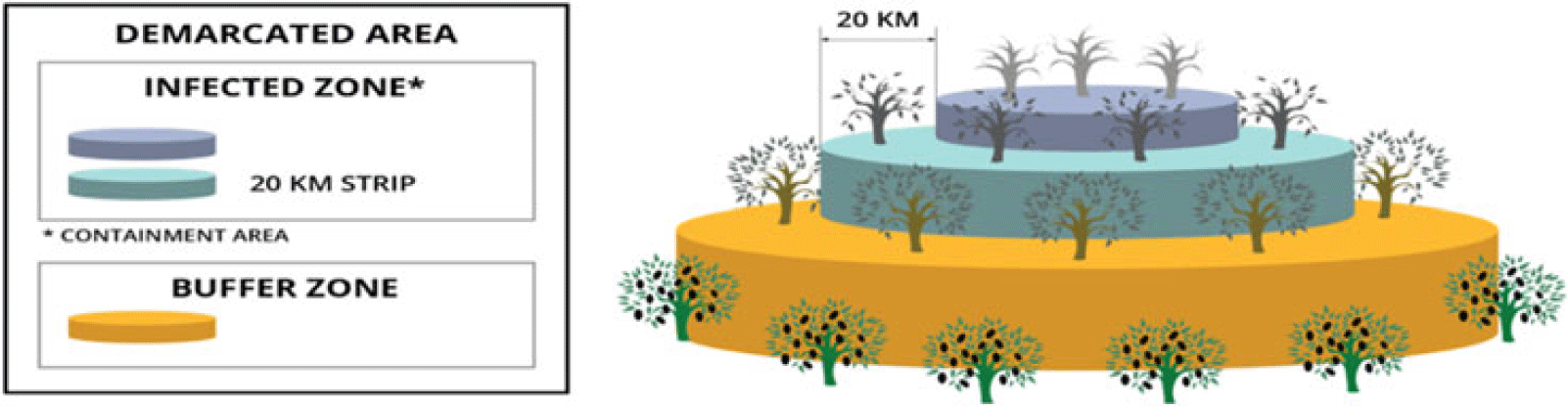
With regard to these containment measures – before being further amendedFootnote 12 – Article 7(2) of the Decision obliged the Member States concerned to “immediately remove” – at least – all plants which were found to be infected by the specified organism if they were situated, inter alia, “within a distance of 20km from the border of the infected zone with the rest of the Union territory”.Footnote 13 The containment area thus included the infected zone and the area of 20km from the border of the infected zone. Moreover, in the infected zone and within the 20km strip, Article 7(7) of the amended Decision required the Member States concerned to “monitor the presence of the specified organism by annual surveys at appropriate times” (see Figure 1).
Demarcated area.

With regard to the eradication measures, Article 6(2) of the Decision still requires the Member States concerned to apply “eradications measures” in the demarcated area. In particular, such measures consist of the immediate removal of: (i) all infected plants; (ii) all plants showing symptoms indicating possible infection by the bacterium or suspected to be infected by that bacterium; (iii) all host plants (regardless of their health), “within a radius of 100 meters around the plants which have been tested and found infected” by Xylella.
II. Facts
The pathogen Xylella is among the most dangerous plant bacteria worldwide, causing a variety of diseases with a huge economic impact on agriculture. The peculiarity of Xylella is that it lives in a plant’s xylem tissue, and is usually carried by spittlebugs, cicadas and sharpshooters, which feed on the xylem. By invading xylem vessels, Xylella blocks the transportation of water and soluble mineral nutrients, causing plants to wilt, dry up and die.
In 2013, the presence of Xylella was detected – for the first time in Europe – in Apulia, the largest producer of olive oil in Italy.Footnote 15 In this region, the pathogen rapidly infected thousands of olive trees. A few months after the detection of Xylella, the infection became a phytosanitary emergency, requiring the EU to adopt emergency measures to eradicate the pathogen and stop the spread of the pest.Footnote 16
In 2015, the Court of Justice of the EU (CJEU) was called upon by the Regional Administrative Court of Lazio (Italy) to assess, inter alia, the validity of the Decision vis-à-vis the principles of prevention, precaution and proportionality as well as the Plant Health Directive. Indeed, a number of local farmers and environmental associations challenged the national measuresFootnote 17 implementing the EU Decision before the competent domestic jurisdiction, which then referred to the Court for a preliminary ruling.Footnote 18
In this regard, in Xylella I Footnote 19 the CJEU carried out its review and concluded that the Decision did not breach either the general principles governing EU environmental policy or the obligations stemming from the Plant Health Directive. The Court thus declared that the contested eradication measures were valid under EU law.Footnote 20
In July 2017, the European Commission delivered a reasoned opinion, giving Italy two months to comply with its requests. In particular, in this opinion the Commission maintained that the Italian authorities had failed to meet, inter alia, three obligations stemming from the Plant Health Directive as well as from the Decision. First, the Commission held that Italy did not carry out the immediate removal of all infected plants within the containment area under Article 7(2) of the Decision. Second, the Commission argued that Italy did not sample and test all plants within a distance of 100m of the infected ones and did not monitor the presence of the plant pathogen at appropriate times within the containment area, as required by Article 7(7) of the Decision.Footnote 21
Third, the European executive pointed out a general non-compliance vis-à-vis the obligation, laid down under Article 16 of the Plant Health Directive, to adopt all the necessary measures to avoid the further spreading of Xylella within the EU territory. In this regard, the Commission stressed that Italy, by permitting the diffusion of the pathogen beyond 40km (compared to the situation in 2015), had also breached the principle of loyal cooperation enshrined under Article 4(3) TEU.Footnote 22
The Italian authorities responded by acknowledging how serious the situation was. However, they highlighted the “evident improvement” of the removal measures thanks to the more efficient administrative procedures adopted at regional level in Apulia.Footnote 23 In spite of these answers, in May 2018, the Commission considered Italy as being still non-compliant with the EU Treaties, the Plant Health Directive and the Decision. As a consequence, in July of the same year, the Commission brought Italy before the CJEU under Article 258 TFEU.Footnote 24
III. The judgment
To simplify the reading, the ruling will be analysed by summarising the main arguments of the parties and the reasoning of the Court for each ground of judicial review.Footnote 25
1. On the “immediate” removal of the infected plants in the 20km strip
The Commission claimed that the national authorities, at the date of expiration provided in the reasoned opinion (ie 14 September 2017), had removed only 78% of the infected plants within the 20km strip. Such plants were identified through the monitoring activities carried out in 2016, but 191 trees had not yet been eradicated.
Furthermore, the Decision required the Member State concerned to “immediately” remove the infected plants, so as to minimise the risk of spread of the pathogen. According to the Commission, the word “immediately” could not justify eradications undertaken one year after the infection had been detected.Footnote 26 Evidence showed that infected plants could be removed in less than a week and that, obviously, the longer the wait, the higher the risk of contamination.Footnote 27 Spittlebugs (the insect vectors of the bacterium) may travel up to 100m in 12 days and thus contaminate a vast number of trees in their journey.
In its defence, Italy argued that the implementation of the containment measures was slowed down by a number of administrative difficulties. The first regarded the proper identification of some of the landowners concerned by the measures. Indeed, some of them were dead or did not reside in the region, making the notification process particularly arduous.Footnote 28 The second difficulty regarded the judicial proceedings initiated by a number of local farmers, which prevented the authorities from “immediately” intervening.Footnote 29 The Italian authorities thus held that the word “immediately” had to be interpreted in light of the factual circumstances of the case.Footnote 30
Interestingly, Italy also referred to an ongoing “national campaign of counter-information” on Xylella, which contributed to slowing the implementation of containment measures. Such a campaign seems to strongly underestimate the risks relating to the pathogen, by claiming that infected plants should not be removed but simply “treated”.Footnote 31
Moreover, the State argued that the obligations stemming from Article 7(2) of the Decision would not require the concerned Member State to achieve a specific objective, but rather to “behave correctly” and do what is necessary to avoid the spread of Xylella.Footnote 32 In other words, the Italian authorities maintained that by adopting a complex set of norms and means to achieve the objective, the State had not failed to respect the obligations provided by Article 7(2) of the Decision.
In its reasoning, the Court noticed that Italy did not contest the evidence put forward by the Commission. In particular, the State did not contest either the percentage of trees to be removed (22%),Footnote 33 or the delay in implementing the containment measures in the 20km strip.Footnote 34
With regard to the meaning of “immediately”, the EU judiciary argued that the wording of Article 7(2) leaves no room for interpretation: in common parlance, the term “immediately” is not compatible with a delay of “some” weeks or months.Footnote 35 In this regard, the Court confirmed the scientific evidence advanced by the Commission, namely the EFSA opinions on Xylella published in 2015Footnote 36 and 2016.Footnote 37 Indeed, in their assessments the scientists of the European authority pointed out that only a rapid removal of the infected plants could stop the advancement of the pathogen.Footnote 38 Furthermore, the Court underlined that even the report of the audit – executed by the Commission in spring 2018 in order to assess the situation in Apulia with regard to the infection – demonstrated serious delays in implementing the required measures.Footnote 39
The CJEU also underlined that the obligations laid down in Article 7(2) must be interpreted as requiring the achievement of a specific result, namely the removal of (at least) all infected plants within the 20km strip. This – according to the Court – is in line with the objective of the Decision, which is preventing the spread of the bacterium.Footnote 40
With regard to the administrative difficulties advanced by the Italian authorities to justify the delays, the Court referred to its own consolidated case law, according to which “a Member State may not plead situations in its internal legal order in order to justify a failure to comply with obligations and time limits arising under EU law”.Footnote 41
Given the state of emergency, Italy – concluded the Court on this point – could have also adopted emergency measures in order to overcome the legal and administrative obstacles it had to face.
2. On the annual surveys
With its second plea the Commission alleged the breach of the obligation under Article 7(7) of the Decision, requiring the concerned Member State to monitor the presence of Xylella by means of annual surveys at “appropriate times” within the 20km strip. In this respect, the Commission maintained that Italy – with regard to the year 2016 – started its surveys in August 2016 and completed them in May 2017, while with regard to the year 2017 the State started its monitoring activities in July 2017 and completed them in April 2018.Footnote 42
According to the European executive, such surveys were carried out at the wrong time of the year, at times that were inadequate to detect symptoms of the infection. The Commission held that the monitoring activities must be carried out at “appropriate times”, namely in the summer,Footnote 43 and completed by the end of the year, in time for delivering the annual report on the presence of the bacterium (required by 31 December).Footnote 44
In defence, the Italian authorities argued that – according to the Commission guidelines on surveys to monitor the presence of Xylella – the symptoms of the disease on the plant may be detected in any season. In this way, experts may identify infections just started in the summer which become clearly visible only after a few months (precisely in the winter).Footnote 45
On this point, the Court’s reasoning focused on the word “appropriate”, which had to be interpreted in light of the objectives of the Decision and the scientific evidence provided by the Commission. Indeed, in the judges’ view, the timeframes chosen by the national authorities to carry out the monitoring activities were not coherent with the objective pursued by the Decision, which was to avoid the spread of the pathogen. This was because Italy completed its surveys in spring, which corresponds to the migration season of the insect vectors of Xylella and, therefore, also to the season with a higher risk of spread of the pathogen.Footnote 46 In view of this, by completing the monitoring activities when the insects’ migration season had already started, the Italian authorities found themselves faced with the impossibility of proceeding with the removal of the infected plants “before” the beginning of the “diffusion period”.Footnote 47 As a consequence, the “appropriate time” to complete the surveys, as required by Article 7(7), would be “before” the beginning of the spring and not “during” that season.Footnote 48
3. On the general non-compliance vis-à-vis the obligation laid down under Article 16 of the Plant Health Directive and the principle of loyal cooperation enshrined under Article 4(3) TEU
Finally, the Commission claimed that the Italian State had failed to adopt all the necessary measures to prevent the further advancement of the pathogen within the EU territory. By so doing, the State breached both Article 16 of the Plant Health Directive as well as the general principle of loyal cooperation.
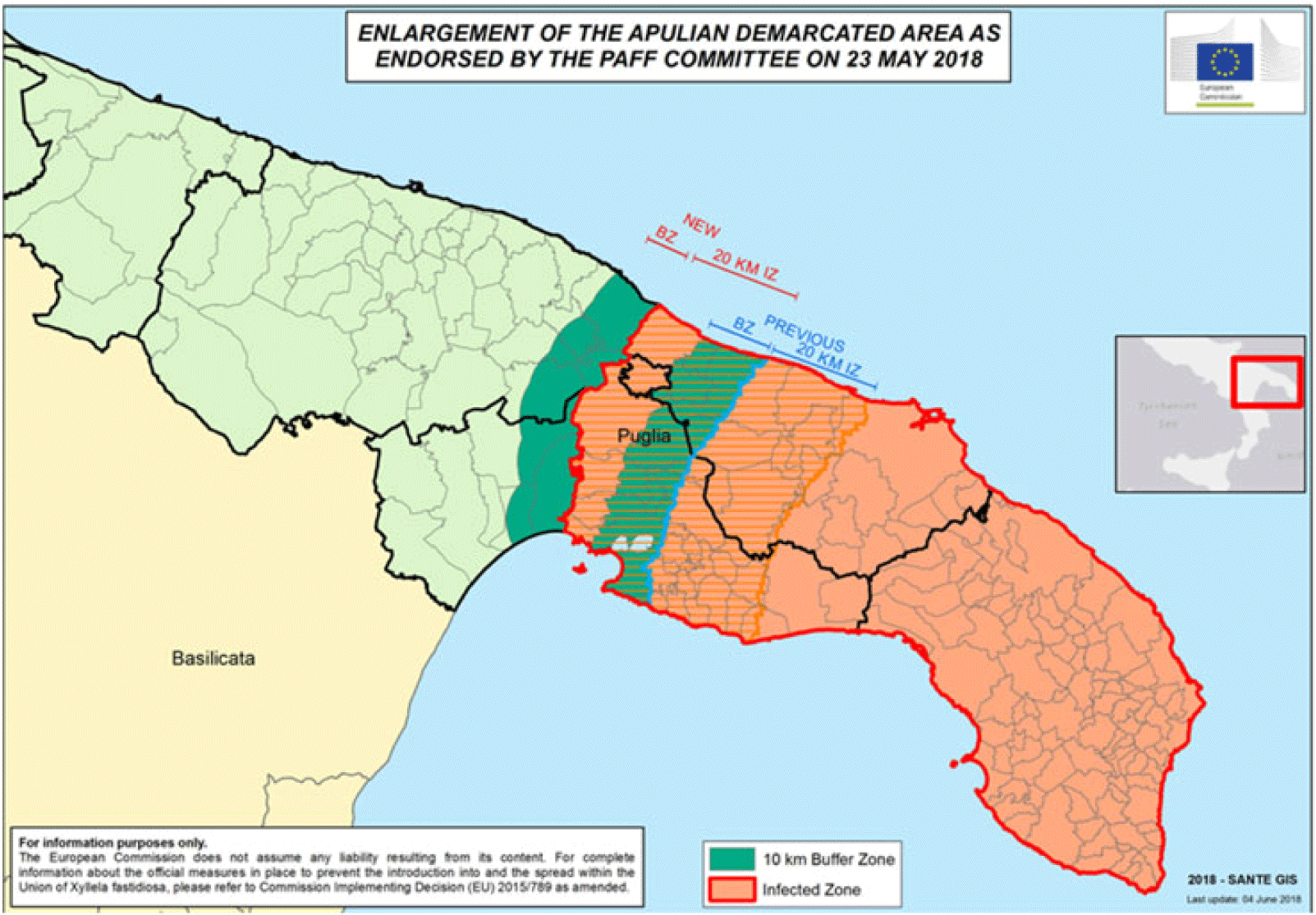
However, in supporting such claims, the European executive did not provide specific evidence. It limited itself to highlighting that, since the local authorities had twice moved the demarcated area northwards, this already demonstrated the further spreading of Xylella into the neighbouring provinces of Brindisi and Taranto.Footnote 49 In this regard, Figure 2 shows the former and current delimitations within the demarcated area.
Enlargement of the demarcated area.

On this point, the Italian authorities claimed that the simple expansion of the demarcated area does not represent, per se, evidence of the State’s failure to meet its obligations under EU law. Indeed, the diffusion of the plan pathogen is a “natural phenomenon”, which may not be automatically impeded by human action but only “managed” and “slowed down”. In other words, the Plant Health Directive – argued Italy – requires the Member State concerned to adopt all the “necessary measures” to inhibit the spread of harmful organisms, but the adoption of such measures does not automatically imply that the organism will not spread.Footnote 50 The causal link between the further spreading of the infection and the State’s negligence must be fully demonstrated and may not be the object of presumptions, since the advancement of the pathogen might also depend on external factors which have nothing to do with the State’s action (or inaction).Footnote 51
The CJEU agreed to a large extent with the Italian reasoning. In particular, the EU judges recalled that the burden of proof in infringement procedures under Article 258 TFEU lies on the Commission. This has to provide the Court with the evidence necessary for it to determine the existence of the alleged failure and it may not rely on any presumption for that purpose.Footnote 52
As a consequence, the Court held that, by simply emphasising a situation of general non-compliance of the State with the obligations stemming from EU law, the Commission may not dispose of its burden of proof: the evidence on which the Court should base its decision must still be put forward by the executive.Footnote 53 By doing otherwise, the CJEU would base its reasoning on presumptions rather than on established causation. In view of this, the EU judiciary did not find any element showing that Italy had breached Article 16 of the Plant Health Directive and the principle of loyal cooperation enshrined under Article 4(3) TEU.
In the end, the Court found that Italy had failed to meet the obligations stemming from Article 7(2) and (7), but that there was no evidence with regard to the other pleas submitted by the Commission.
IV. Comment
The CJEU ruling in the Xylella II case is interesting for a number of reasons. First, for the role played by scientific evidence in the judicial review. In this regard, the national implementing measures were subject to intense scrutiny by the EU judiciary, which used the EFSA opinions and audit reports submitted by the Commission as benchmarks to assess whether or not the State had failed to meet its obligations under the Decision.
Second, although the Commission enjoys broad discretionFootnote 54 as to whether to initiate and cease judicial proceedings under Article 258 TFEU, only the CJEU can be defined as the ultimate “EU law assurer”Footnote 55 with regard to the compliance of Member States’ legislation with EU law.
However, Xylella II demonstrates that the Commission’s discretion under Article 258 TFEU has some limits, even when an infringement proceeding reaches the judicial stage. In particular, the claim that a given Member State has failed to respect an obligation established under EU law must be proved by the EU executive. Indeed, the burden of proof is borne by the executive, and it is called upon to provide the EU judiciary with all the evidence necessary for it to determine whether the situation of non-compliance with EU law is truly due to the negligence of the State.
Third, the CJEU’s ruling under Article 258 TFEU simply ascertains a situation of poor or non-existent implementation at national level. This means that the Court’s decision must then be enforced by the State concerned, which is required to take “the necessary measures to comply with the judgment”.Footnote 56 With regard to the Xylella infection in Apulia, if Italy does not comply with the ruling under analysis, the Commission will trigger the procedure provided under Article 260(2) TFEU, introduced with the Lisbon Treaty.Footnote 57
Under this provision, the Commission may “bring the case before the Court after giving the State the opportunity to submit its observations. It shall specify the amount of the lump sum or penalty payment to be paid by the Member State concerned which it considers appropriate in the circumstances”. It must be stressed that in calculating the lump sum and daily penalty payments, the Commission shall take into account, inter alia, the seriousness of the infringement, and its duration.Footnote 58 In this regard, legal scholarship, as well as the case law of the CJEU, confirm that, in assessing the “seriousness” of the infringement, the Court seems to look at the “importance” of the infringed obligation. On this point, “breaches in the fields of human health, the environment or state aid, are considered quite serious” by the Court.Footnote 59 Other scholars underline that the EU executive traditionally proposes relatively “stiffer penalties where Member State’ infringements of environmental provisions have resulted in significant levels of damage to the environment”.Footnote 60
The Italian Republic has already experienced the EU institutions’ severity with regard to daily penalties in another environmental case, namely infringement procedure no 2007/2195, for which the Member State is still paying €120,000 for each day the waste emergency in the Campania region goes unresolved.Footnote 61
The concluding remark that I would like to put forward concerns the argument presented by the Italian authorities, referring to an ongoing national campaign of counter-information which contributed to slowing the implementation of the containment measures. In this regard, research in the field of sociology and political science highlighted the presence of social movements claiming a different approach to solving the Apulian phytosanitary emergency.Footnote 62 Indeed, top-down approaches have been accepted with scepticism by some parts of the local civil society, which seemed to care deeply about the importance of democratic processes in knowledge societies.Footnote 63 Such inquiries show how complex and multi-faceted the “Xylella saga” is, and how much potential for further research it presents.