I. INTRODUCTION
Since the discovery of carbon nanotubes (CNTs),Reference Iijima1, Reference Iijima and Ichihashi2 considerable progress has been made toward understanding their unique physical, electrical, and spectral properties.Reference Liao, Talla, Yambem, Birx, Chen, Coldren, Carroll, Ci, Ajayan, Zhang and Curran3, Reference Curran, Talla, Dias, Zhang, Carroll and Birx4 Owing to these unique properties, CNTs are considered promising materials for various applications.Reference Curran, Talla, Dias, Zhang, Carroll and Birx4 Introducing defects or impurities (dopants) into CNTs may manipulate the electronic properties of the CNTs and make them an ideal material for building electronic devices, such as solar cells and field effect transistors.Reference Curran, Talla, Dias, Zhang, Carroll and Birx4
Carbon nitride (CNx) nanotubes have received special attention because they retain their metallic properties regardless of their diameter and chirality, as predicted and observed through scanning tunneling microscopy.Reference Fragneaud, Masenelli-Varlot, González-Montiel, Terrones and Cavaillé5–Reference Ayala, Freire, Gu, Smith, Solŕzano, Macedo, Sande, Terrones, Rodriguez-Manzo and Terrones7 For instance, the current–voltage curve of CNx showed higher conductance than that of multiwalled CNTs (MWCNTs).Reference Fragneaud, Masenelli-Varlot, Gonzalez-Montiel, Terrones and Cavaillé6, Reference Ayala, Freire, Gu, Smith, Solŕzano, Macedo, Sande, Terrones, Rodriguez-Manzo and Terrones7 In addition, both the morphology and chemical composition of CNx nanotubes strongly depend on the syntheses method.Reference Curran, Talla, Dias, Zhang, Carroll and Birx4 Although nanotubes cannot be easily doped with nitrogen, many approaches have been used to introduce nitrogen atoms into CNTs, including pyrolysis of nitrogen-rich organic chemicals, magnetron sputtering, and arc discharge in a nitrogen atmosphere.Reference Redlich, Loeffler, Ajayan, Bill, Aldinger and Rühle8, Reference Ghosh, Kumar, Maruyama and Ando9
Different techniques were used to characterize the chemical bonding and electronic structures of CNx nanotubes; these techniques include atomic force microscopy and Raman spectroscopy.Reference Ghosh, Kumar, Maruyama and Ando9
In this study, we investigated both direct current (DC) and alternating current (AC) electrical transport properties of nonpurified and chemically purified nitrogen-doped MWCNTs (N-MWCNTs) with poly(bisphenol A carbonate) composites at different nanotube weight fractions.
II. EXPERIMENTAL
N-MWCNTs (100 mg) (Wake Forest University, CVD) were refluxed in HNO3/H2O (1:3, v:v, 20 mL) for 8–10 h. The suspension was diluted with deionized (DI) water until its pH = 5. The filtered N-MWCNTs were then stirred in HCl/H2O (1:3, v:v, 12 mL) for an additional hour and diluted with DI water. The suspension was then filtered and washed thoroughly with DI water and acetone. The residual sample was then dried overnight at 85 °C in a vacuum oven. Both acid-treated and pristine N-MWCNTs (2–5 mg) were weighed out and mixed with polycarbonate (25–2000 mg) (Sigma-Aldrich Co., St. Louis, MO) in CH2Cl2 solution. The suspension was stirred for two days in air at room temperature because it is known that a long mixing process leads to better dispersion, thereby enhancing the composite conductivity values. Finally, the AC and DC electrical transport properties of acid-treated and pristine N-MWCNTs with polycarbonate composites were examined using a two-point probe setup with vacuum-deposited gold electrodes.
III. RESULTS AND DISCUSSIONS
A. Materials characterization
1. DC electrical properties
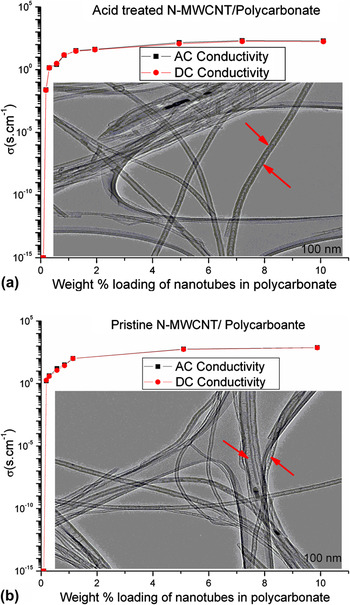
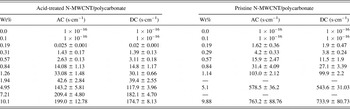
The percolation threshold (p c) can be determined by assessing both DC conductivity and frequency-independent AC conductivity of nanotubes with various weight fractions, p [Figs. 1(a) and 1(b), Table I]. From Figs. 1(a) and 1(b), both the DC and AC conductivities are in good agreement. As explained by Katsuno and Nitta,Reference Katsuno and Nitta10 the weight fraction of conducting particles remains low as the DC conductivity is similar to that of an insulating material. However, as the weight fraction of the conducting particles exceeds the percolation threshold, the conductivity value increases by ∼8–10 orders of magnitude.Reference Katsuno and Nitta10, Reference Kurt, Sanjines, Karimi and Lévy11 The electrical transport properties of acid-treated N-MWCNTs and pristine N-MWCNTs with polycarbonate composites were examined using a two-point probe setup. The DC conductivity significantly increased by several orders of magnitude because of the formation of infinite conductive paths created by nanotubes [Figs. 1(a) and 1(b), Table I]. The percolation threshold is extrapolated after fitting the curve in Figs. 1(a) and 1(b) using the scaling law, based on the percolation theory, given in Eq. (1):

Alternating current (AC) and direct current (DC) conductivity of (a) acid-treated nitrogen-doped multiwalled carbon nanotubes (N-MWCNT) and polycarbonate composites with MWCNT loadings varying between (0.0 to 10 wt %) and (b) pristine N-MWCNT and polycarbonate composites with MWCNT loadings varying between (0.0 to 10 wt %). The red line is fitting curve based on Eq. (1). The inset shows transmission electron microscopy images for the composite.

Summary of the direct current (DC) and alternating current (AC) conductivity (σDC and σo) of acid-treated nitrogen-doped multiwalled carbon nanotubes (N-MWCNTs) and pristine N-MWCNTs with polycarbonate at different nanotubes weight fractions.

where σDC is the DC conductivity of the composite; p, the weight fraction of the nanotubes; and t, the critical exponent. The curve fitting of Eq. (1) has a percolation threshold of p c = 0.19 ± 0.02 with σDC = 1.62 ± 0.36 s·cm−1 and p c = 0.19 ± 0.02 with σDC = 0.025 ± 0.001 s·cm−1 for pristine and acid-treated N-MWCNTs, respectively. Previous investigations on singlewalled CNTs (SWCNTs) with polyacrylonitrile indicated that at 40wt% of SWCNT, the conductivity is around 1500 s·cm−1.Reference Guo, Sreekumar, Liu, Minus and Kumar12 Similarly, the conductivity of SWCNTs (containing iron) with polyaniline doped with 2-acrylamido-2-methyl-1-propane sulfonic acid at 0.35 wt% of SWCNT is around 500 s·cm−1.Reference Mottaghitalab, Spinks and Wallace13 Further, the conductivity of MWCNT with polymethylmetacrylate (0.4 wt% of MWCNTs) is 10 × 10−3 s·cm−1.Reference Kim, Choi, Joo, Cho and Yoon14 Although the final saturated conductivity of pristine N-MWCNTs is close to 734 s·cm−1 at 10 wt%, a sharp decrease in the conductivity value, which was expected, was observed as a result of acid treatment (Table I).Reference Gojny, Wichmann, Fiedler, Kinloch, Bauhofer, Windle and Schulte15, Reference Kovacs, Velagala, Schulte and Bauhofer16
2. AC electrical properties
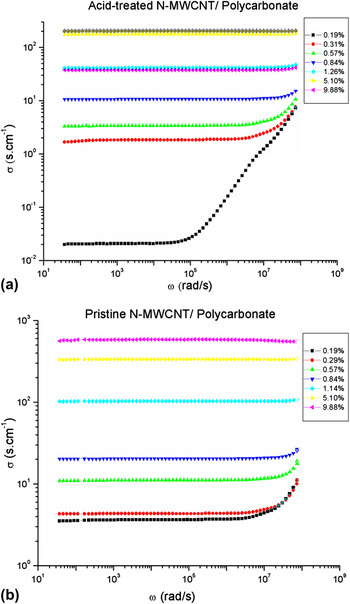
The AC electrical properties of acid-treated and pristine N-MWCNTs with poly(bisphenol A carbonate) composites were tested in the frequency range 5–107 Hz using a HP 4192 LF impedance analyzer. The plots of the total conductivity versus angular frequency for all composites are shown in Figs. 2(a) and 2(b). All curves were characterized by frequency-independent conductivity (σο) up to the critical frequency (ωo), followed by a region of increasing conductivity as a function of frequency. The frequency-independent AC conductivity of the composites is best described by the scaling law [Eq. (1)] [Figs. 2(a) and 2(b), Table I], where σDC (σο) is the frequency-independent conductivity of the composite.Reference Kilbride, Coleman, Fraysse, Fournet, Cadek, Drury, Hutzler, Roth and Blau17–Reference Mamunya, Muzychenko, Pissis, Lebedev and Shut21 The final saturated AC conductivity is close to 199 and 763 s·cm−1 for acid-treated and pristine N-MWCNTs, respectively.
AC conductivity of (a) acid-treated N-MWCNT and polycarbonate composites with MWCNT loadings varying between (0.0 to 10 wt %) and (b) pristine N-MWCNT and polycarbonate composites with MWCNT loadings varying between (0.0 to 10 wt %).

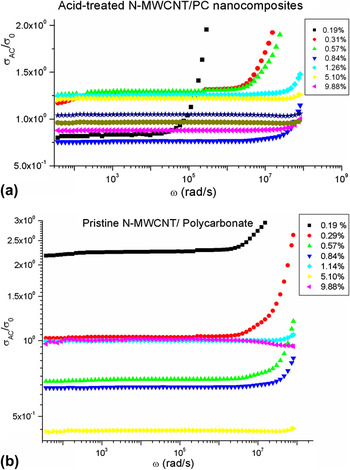
Finally, the total conductivity data was fitted to the universal scaling law. The master curves of the AC conductivity of N-MWCNTs with polycarbonate composites for nanotubes with various weight fractions are shown in Figs. 3(a) and 3(b).Reference Kilbride, Coleman, Fraysse, Fournet, Cadek, Drury, Hutzler, Roth and Blau17, Reference Barrau, Demont, Peigney, Laurent and Lacabanne18, Reference Dutta, Biswas and De22 However, the deviation in the master curve suggests a transport mechanism that is more complicated and merits further investigations.
The master curve for (a) acid-treated N-MWCNT and polycarbonate composites and (b) pristine N-MWCNT and polycarbonate composites. The deviation in the master curve suggested more complicated transport mechanism.

B. Discussion
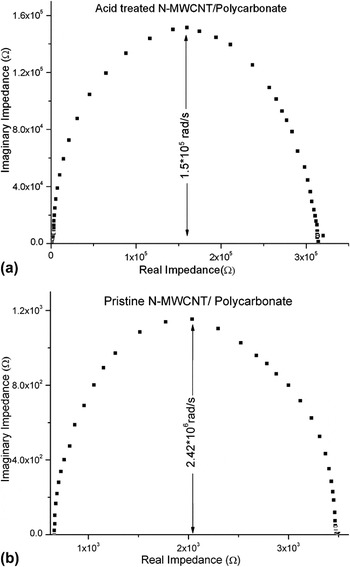
The high conductivity values obtained in our study (as compared to those obtained in all previous investigations) may be caused by blending nanotubes in the polymer matrix and changing interfacial interactions between the composite components. Under certain conditions, the polycarbonate composites behave as a highly viscous Newtonian fluid, in which the polycarbonate has a larger shear stress value; therefore, the nanotube particles are dispersed more homogenously in the host material, allowing the state of agglomeration of the filler phase to control the percolation threshold.Reference Mamunya, Muzychenko, Pissis, Lebedev and Shut21 In our case, the percolation threshold can be attributed to wetting the nanotubes by the polymer, whereas the stronger this interaction is, the better the polymer wets the nanotubes and therefore, the percolation threshold increases. The semicircle plot, Cole–Cole plot (imaginary impedance against real impedance), is a good indication of the homogeneity of our composites [Figs. 4(a) and 4(b)].Reference Lipson, Coleman, Drury, O’Brien, Blau, Cadby, Lane and Bradley23, Reference Mclachlan, Chiteme, Park, Wise, Lowther, Lillehel, Siochi and Harrison24 Nevertheless, not all the samples show this behavior, for example, no arc show up at low nanotubes loadings (p < 0.31 wt%), still for the samples (p = p c) the peak frequency is 1.5 × 10⁵ rad/s and 2.42 × 10⁵ rad/s for acid-treated and pristine N-MWCNTs respectively. Furthermore, doping CNTs with nitrogen (N) is an effective way to enhance the electrical conductivity of the CNTs, as N-doping introduces free electrons and holes into host carbon π-conjugation systems.Reference Barrau, Demont, Peigney, Laurent and Lacabanne18 On the other hand, on increasing the weight fraction beyond the percolation threshold, the conductivity increases as a result of the formation of conducting paths, as shown in Figs. 1(a) and 1(b). After the conducting paths are formed, electron transport is controlled either through the hopping mechanism along CNT interconnects or by tunneling through the host material. The control of the electron transport has a strong impact on the electrical conductivity and other properties of the composites.Reference Liao, Talla, Yambem, Birx, Chen, Coldren, Carroll, Ci, Ajayan, Zhang and Curran3, Reference Curran, Talla, Dias, Zhang, Carroll and Birx4, Reference Hornbostel, Poetschke, Kotz and Roth25, Reference Das, Mahaling, Stöckelhuber and Heinrich26 Generally, there are two processes involved in charge transport in both highly doped conjugated polymers and nanotubes. The first process is the hopping motion of charges between conducting regimes, as observed in highly doped trans-polyacetylene. The second process is the ballistic conductivity in CNTs.Reference Li, Lu, Li, Bai and Gu27, Reference White and Todorov28 In this study, we developed a tight network of nanotubes using the prolonged, less aggressive sonication (or sonic tip) technique. Using this technique, large aggregates of nanotubes formed and are tightly bound together by the polycarbonate, as observed in the transmission electron microscopy images [inset of Figs. 1(a) and 1(b)].
Plot of the imaginary impedance against the real impedance (Cole–Cole plot) for the (a) acid-treated N-MWCNT/polycarbonate and (b) pristine N-MWCNT/polycarbonate.

Consequently, in the tight binding arrangement, the nanotubes carry charges in a manner similar to pseudoballistic transportReference Li, Lu, Li, Bai and Gu27, Reference White and Todorov28 This is not the same as pure ballistic transport along a single perfect metallic SWCNT, where defect-free 2G o conductance is achieved and the conductance is significantly lowered (by a large value of X where G = XG o).Reference Li, Lu, Li, Bai and Gu27–Reference Curran, Zhang, Wondmagegn, Ellis, Cech, Roth and Carroll29 At first, the transport occurs along individual nanotubes and is then directly transferred across from one nanotube to the next as they are in close proximity.Reference Kim, Choi, Joo, Cho and Yoon14, Reference Curran, Zhang, Wondmagegn, Ellis, Cech, Roth and Carroll29, Reference Choi, Ihm, Yoon and Louie30 Although it is easier to disperse nanotubes, we observed that the conductivities are significantly reduced because of acid treatment on the nanotube surface. Because each carboxylated site formed acts as a quantum well that needs to be passed, we reduce the conductance by XG o each time a site is passed. In a carboxyl group, depending on the extent of the occurring defect, a ballistic-inhibiting defect is formed. Then, the electron either moves around the defect, provided there remains a π-conjugated network on the surface; hops across the defect, a distance of at least 0.6 nm; or hops to the next level of the π-conjugated orbital, i.e., the next layer of nanotubes in the N-MWCNT system, for a distance of 0.334 nm. The first two motions alter the ballistic nature of the transport to either a pure hopping transport or a pseudoballistic transport.Reference Curran, Talla, Dias, Zhang, Carroll and Birx4, Reference Li, Lu, Li, Bai and Gu27 The third directional motion change reduces the G value by some factor but, theoretically, this does not change the mean free path of the electron. It must be noted that even a change in the lattice structure, for example, the presence of Haeckelite,Reference Curran, Talla, Zhang and Carroll31, Reference Talla, Zhang, Kandadai, Avadhanula and Curran32 alters the ballistic nature as it is a phonon-induced change in the carrier motion. Although the conductance of SWCNTs is considered to be greater than that of MWCNTs, the presence of defects in SWCNTs results in the hopping-induced motion of the charge carrier.Reference Sundaray, Subramanian, Natarajan and Krishnamurthy33 However, in MWCNT, this motion is far different. From transmission electron microscopy images, one can see that all MWCNTs posses an intricate network of small inner nanotubes, see inset of the Figs. 1(a) and 1(b). This is somehow different to standard MWCNTs that have ordered inner and outer nanotubes and may explain some of the differences seen in these samples as compared to those obtained in all previous investigations.Reference Curran, Zhang, Wondmagegn, Ellis, Cech, Roth and Carroll29 Therefore, there is an additional effect that the charge hopping across individual nanotube walls is in the form of nonballistic propagation. All of these behaviors suggest that the nature of conduction of MWCNTs is considerably more complicated than that of SWCNTs and merits further investigation.
IV. CONCLUSION
We have used DC and AC electrical transport properties to investigate a series of polymer/nanotube composite thin films. Different weight fractions of acid-treated and pristine N-MWCNTs were dispersed in the polycarbonate. The DC conductivity follows the percolation scaling law with percolation threshold (p c = 0.2%). We found that the complexity of the electronic properties of CNTs is dependent on dimensionality to such an extent that when the physical length scale of a nanotube is greater than the electron mean free path, the transport is ballistic. However, when there are a significant number of defects or functionalized species the charge carriers’ progress is altered, resulting in a hopping transport regime. We also observed an unusual phenomenon where nanotube bundles are initially close to each other, maintaining a pseudoballistic state to minimize the resistance. These bundles are directly responsible for high conductivity. Once the ballistic threshold is crossed, we observe the more typical hopping transport regime, as predicted by the percolation theory.
ACKNOWLEDGMENTS
The Authors gratefully acknowledges Dayton #110527 and the NSF-ADVANCE (# NSF0123690) for financial support.