1. Introduction
Scientific research on the fossil vertebrates of the Balearic Islands started with Bate (1909), who published the description of the first endemic fossil mammal from the Pleistocene of Mallorca and Menorca, Myotragus balearicus Bate, Reference Bate1909. Later, she described Hypnomys morpheus Bate, Reference Bate1918 and Nesiotites hidalgo Bate, Reference Bate1944 from fossils found on both islands (Bate, Reference Bate1918, Reference Bate1944). All these taxa exhibit traits linked to their long insular evolution. Until the end of the 1990s, several late Pliocene and Pleistocene species were described belonging to the same phyletic lineages as these three mammals. These lineages, together with those of the endemic midwife toad Alytes muletensis (Sanchiz & Adrover, Reference Sanchiz and Adrover1979) and the endemic lizard Podarcis lilfordi (Günther, Reference Günther1874), form the so-called Myotragus fauna (Bover et al. Reference Bover, Quintana and Alcover2008) that presumably colonized Mallorca during the Messinian Salinity Crisis (MSC). It was widely accepted that the Myotragus fauna evolved gradually and without undergoing any change in its composition, which allowed the establishment of local biozones.
The discovery in 2005 of the Caló den Rafelino site (CdR, Mallorca) improved the knowledge on the composition of the Myotragus fauna during Pliocene time (Bover et al. Reference Bover, Quintana, Agustí, Bailon and Alcover2007). At this locality, five different mammals were described, representing a new genus, four new species and one taxon identified only at generic level: Nesiotites rafelinensis Rofes, Bover, Cuenca-Bescós & Alcover, Reference Rofes, Bover, Cuenca-Bescós and Alcover2012 (with a controversial status: see Furió & Pons-Monjo, Reference Furió and Pons-Monjo2013 and Rofes et al. Reference Rofes, Bover, Cuenca-Bescós and Alcover2013), Tragomys macpheei Agustí, Bover & Alcover, Reference Agustí, Bover and Alcover2012; Hypnomys sp., Hypolagus balearicus Quintana, Bover, Alcover, Agustí & Bailon, Reference Quintana, Bover, Alcover, Agustí and Bailon2010 and Myotragus palomboi Bover, Quintana & Alcover, Reference Bover, Quintana and Alcover2010. The archaic traits of M. palomboi and the derived features of the cricetid Tragomys macpheei in comparison with their assumed continental relatives suggested an early Pliocene age for the CdR fauna (Bover et al. Reference Bover, Quintana and Alcover2010; Agustí et al. Reference Agustí, Bover and Alcover2012).
More recently, a new early Pliocene site in Mallorca, Na Burguesa-1 (NB-1), was discovered in 2012 (Bover et al. Reference Bover, Rofes, Bailon, Agustí, Cuenca-Bescós, Torres and Alcover2014). Six species of mammals were obtained at this site, five of them belonging to the already known Soricidae, Cricetidae, Gliridae, Leporidae and Bovidae lineages (Bover et al. Reference Bover, Rofes, Bailon, Agustí, Cuenca-Bescós, Torres and Alcover2014). The final one is the first fossil record of the family Muridae in Mallorca. Analysis of the Anura and Cricetidae specimens (Torres-Roig et al. Reference Torres-Roig, Agustí, Bover and Alcover2017a,b) indicated that NB-1 can be considered older than CdR. It was assigned a Zanclean age, on the basis of the close relationship between Apocricetus darderi and its ancestor A. alberti.
In view of this age, the presence of Muridae, a family not yet known from the fossil record of the Balearics, is intriguing. In this paper, we describe a new species of Paraethomys based on the murid fossils from NB-1, and we discuss its biogeographic and stratigraphic significance based on its phylogenetic relationships with its mainland relatives.
2. Location, material and methods
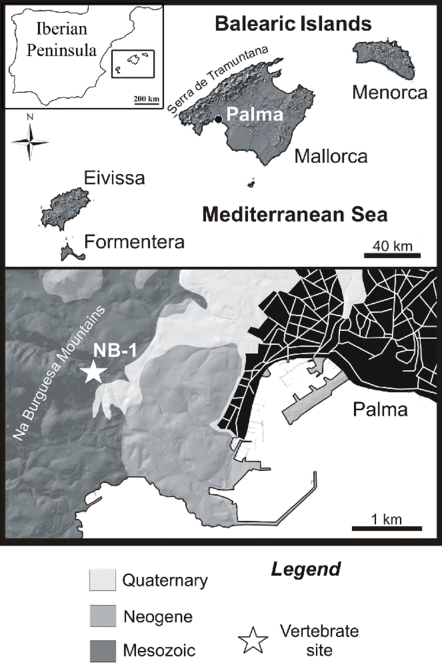
The material here studied was recovered from the karstic deposit of NB-1, located at the southwest end of the Serra de Tramuntana, near to Palma, Mallorca, Balearic Islands (Fig. 1). This deposit and the methodology of the extraction of bones from the hard matrix have been described in Torres-Roig et al. (Reference Torres-Roig, Agustí, Bover and Alcover2017a,b). The material was individually catalogued and is curated at the Institut Mediterrani d’Estudis Avançats, Esporles, Mallorca (collection acronym: IMEDEA). It has been compared directly with the largest P. aff. abaigari population so far recorded (Baza-1 from the Guadix-Baza Basin) and with several P. meini populations (Sifón de Librilla section in the Fortuna Basin, Murcia; Puerto de la Cadena, Murcia; and the Botardo section in the Guadix-Baza Basin).
Scanning electron microscope (Hitachi S-3400N) photographs of teeth were taken at the Scientific and Technical Services of the Universitat de les Illes Balears (UIB). The measurements of teeth were obtained using an Edge AM7915MZT Dino-Lite digital microscope, following the method of Martín Suárez & Freudenthal (Reference Martín Suárez and Freudenthal1993), and the values are expressed in millimetres. The nomenclature used in the description of the molars follows van de Weerd (Reference van de Weerd1976) and Miller (Reference Miller1912). Lower molars are referred to as m1–3 and upper molars as M1–3. Only the best-preserved specimens are included in the descriptive morphological analysis, whereas all the obtained specimens, including those partially eroded or with a high degree of occlusal wear, have been measured.
Geological and geographic location of the early Pliocene palaeontological deposit of Na Burguesa-1.

3. Systematic palaeontology
Order RODENTIA Bowdich, Reference Bowdich1821
Family Muridae Illiger, Reference Illiger1811
Subfamily Murinae Illiger, Reference Illiger1811
Genus Paraethomys Petter, Reference Petter1968
The adscription of the NB-1 murid remains to the genus Paraethomys is based on the presence of an enamel islet between the anteroconid and the second pair of tubercles in m1, the absence of the anterolabial cuspid in m3, the absence of t7 in the upper molars, the reduction of the t9 in M2, the presence of posterior spurs on the anterior tubercles and an enamel islet formed by the union of the tubercles in M3. This combination of characters allows it to be differentiated from other Miocene–Pliocene murine genera, such as Apodemus, Parapodemus, Rhagapodemus, Castillomys, Micromys, Occitanomys or Stephanomys.
Type species. Paraethomys filfilae Petter, Reference Petter1968 from the upper Pleistocene of Algeria.
Paraethomys balearicus sp. nov.
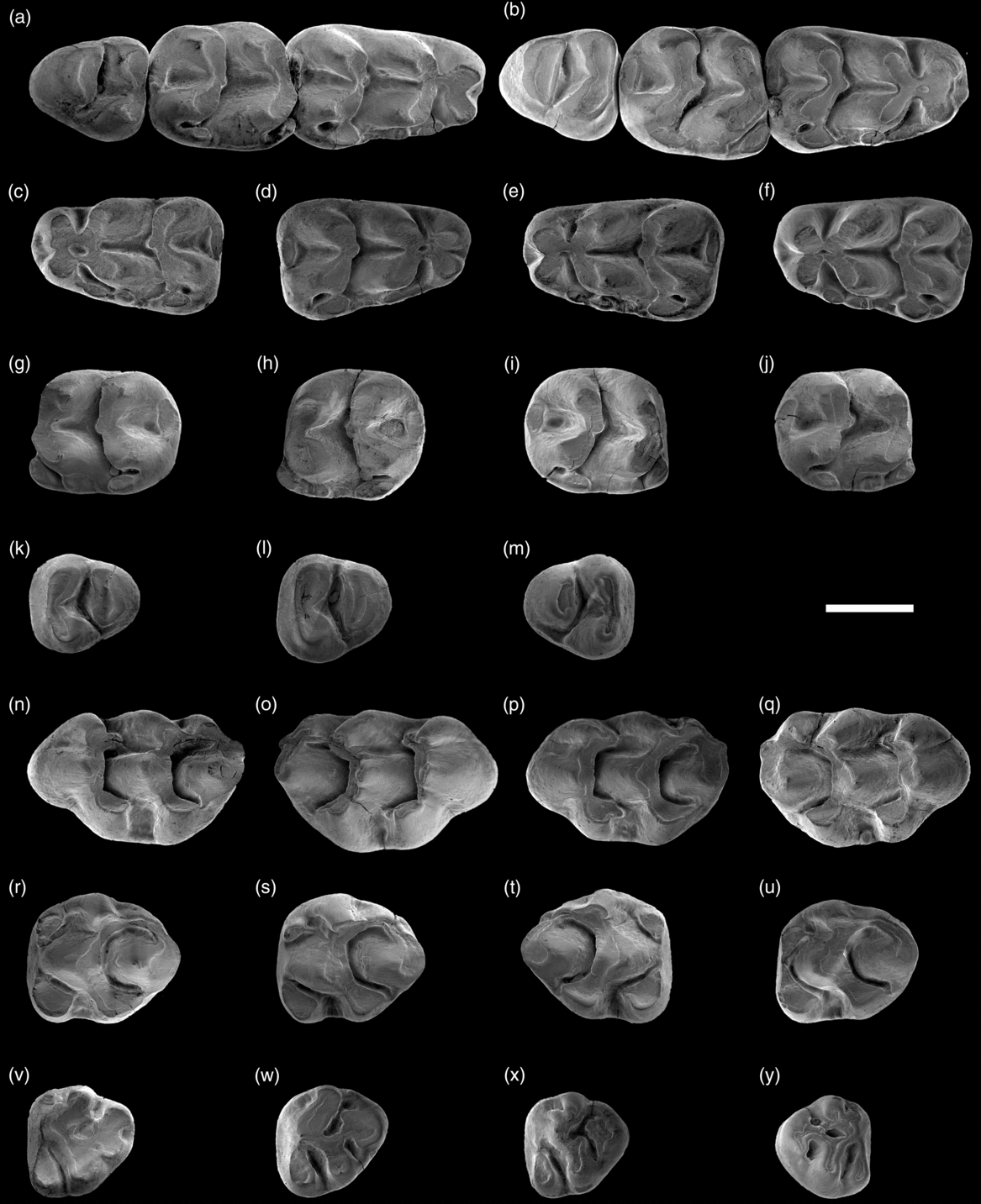
Figure 2
Paraethomys balearicus sp. nov. from Na Burguesa-1, Mallorca: (a) right lower tooth row, mandible IMEDEA 94869 (holotype); (b) right lower tooth row, mandible IMEDEA 94870; (c) left m1, IMEDEA 104337; (d) right m1, IMEDEA 104357; (e) left m1, 104366; (f) left m1, IMEDEA 106276; (g) left m2, IMEDEA 103954; (h) left m2, IMEDEA 104343; (i) right m2, IMEDEA 106278; (j) right m2, IMEDEA 106279; (k) left m3, IMEDEA 103957; (l) left m3, IMEDEA 104367; (m) left m3, IMEDEA 105153; (n) left M1, 104339; (o) right M1, IMEDEA 104360; (p) left M1, IMEDEA 105148; (q) right M1, IMEDEA 106280; (r) left M2, IMEDEA 104352; (s) left M2, IMEDEA 104353; (t) right M2, IMEDEA 105152; (u) left M2, IMEDEA 105156; (v) left M3, IMEDEA 94879; (w) left M3, IMEDEA 104335; (x) left M3, IMEDEA 104340; (y) right M3, IMEDEA 104361.

Derivation of name. The specific name refers to the Balearic Islands.
Holotype. IMEDEA 94869, right mandible with m1, m2 and m3 (Fig. 2a).
Paratypes. Four mandibles with m1–3 (IMEDEA 94870, 104312, 104313, 105048); one mandible with m1–2 (IMEDEA 104314); one mandible with m2–3 (IMEDEA 106284); 10 isolated m1 (IMEDEA 104337, 104345, 104350, 104355, 104357, 104366, 105150, 106275, 106276, 106281); 13 isolated m2 (IMEDEA 103954, 103955, 104343, 104349, 104356, 104359, 104363, 105154, 105157, 105159, 105160, 106278, 106279); six isolated m3 (IMEDEA 103956, 103957, 103958, 104367, 105153, 105158). Four maxillas with M1–M2 (IMEDEA 94871, 104320, 105046, 105047); one maxilla with M3 (IMEDEA 104321); 17 isolated M1 (IMEDEA 94874, 94875, 94876, 104338, 104339, 104341, 104342, 104344, 104346, 104351, 104358, 104360, 105148, 105149, 105155, 106277, 106280); 13 isolated M2 (IMEDEA 94877, 94880, 94882, 104347, 104348, 104352, 104353, 104362, 104364, 105152, 105156, 105161, 105163); 12 isolated M3 (IMEDEA 94878, 94879, 94881, 103959, 104335, 104336, 104340, 104354, 104361, 104365, 105151, 105162). Bold numbers refer to specimens presented in Figure 2.
Locality and horizon. Na Burguesa-1 (Palma, Mallorca); lower Pliocene (MN14).
Diagnosis. Medium-sized and relatively hypsodont Paraethomys species. Lower molars characterized by the presence of a well-developed labial cingulum. m1 and m2 with large and high accessory labial cuspids, resembling the Apodemus pattern. In addition, the m1 and some m2 present a funnel between the hypoconid and the c1 as a result of the great height of the labial cingulum and the accessory labial cuspids. The m1 presents an anterior cingulum, unusual in the genus, and in some cases a tiny tma lingually located. The M1 and M2 may present a posterior spur on t1 and t3 directed towards the t4–t5 and t5–t6 intersections, respectively. The connections between t1 and t2, as well as between t2 and t3, are well developed in the M1, and t4 contacts basally with t8. Rarely, this molar has a small extra cusp between t1 and t4. The M2 has a posterior spur on t3 directed towards the t5–t6 intersection or t6, and some specimens have a t9 that tends to be individualized and a small t12. Additionally, some specimens have an unusual anterior crest formed by the connection between t1 and t3.
Differential diagnosis. Paraethomys balearicus sp. nov. is on average larger and more hypsodont than Paraethomys meini Michaux, Reference Michaux1969 and the connections among cusps in the upper molars are better developed. By contrast, the teeth of P. balearicus sp. nov. are smaller than in Paraethomys abaigari Adrover, Mein & Moissenet, Reference Adrover, Mein and Moissenet1988, and are markedly smaller than in Paraethomys jaegeri Montenat & de Bruijn, Reference Montenat and de Bruijn1976. Additionally, P. balearicus sp. nov. is distinguished from the latter two by its lesser degree of stephanodonty, a narrow connection between t6 and t9 in the M1, the presence in the M2 of a t3 with a posterior spur directed towards the t5–t6 intersection, generally isolated in the other species, an individualized t9 and an occasional t12. The molars of P. balearicus sp. nov. are slightly larger than those of Paraethomys belmezensis Castillo Ruiz, Reference Castillo Ruiz1992. However, P. belmezensis displays a well-developed tma connected to the lingual lobe of the anteroconid; a small t3 attached to t2, and t6 separated from t9 in the M1; and an M2 without t3 or t9 and an isolated t8. Paraethomys lissasfensis Geraads, Reference Geraads1998 is slightly smaller than P. balearicus sp. nov., the t9 is absent in the M2, and it has a deep valley between the t2 and t3 in the M1.
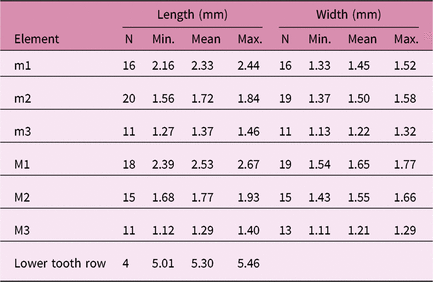
Measurements. See Table 1.
Measurements of the teeth and the lower tooth row of P. balearicus sp. nov. from NB-1

4. Description
m1: Generally the tma is absent, but 3 out of 16 specimens have a small tma located labially (Fig. 2b, c). In addition, 12 out of 16 specimens present an anterior cingulum (Fig. 2a–c, e. f). The anteroconid is slightly asymmetrical in 12 out of 16 specimens, the labial side being narrower than the lingual one, and it is symmetrical in the rest of the specimens (4 out of 16). There is a small and round enamel islet between the anteroconid complex and the protoconid–metaconid pair in 7 out of 16 specimens (Fig. 2b–d, f). Usually, the connection of the labial lobule of the anteroconid is narrower than the lingual lobule, and it is absent in 3 out of 16 m1s (Fig. 2a, e). The labial cingulum is well developed. There are two or three large and high accessory labial cuspids, occasionally merged, located on the mesio-labial side of the protoconid. The c1 is high, large and subtriangular. It is attached anteriorly to the hypoconid. Additionally, in 13 out of 16 specimens the c1 has a posterior spur connected to the posterolabial side of the hypoconid, forming a funnel between both cuspids. Only one specimen has a small extra tubercle on the posterior side of the c1 (Fig. 2f). The hypoconid–entoconid pair is isolated from the anterior cuspids. There is a reduced longitudinal spur in 15 out of 16 specimens. The terminal heel can be compressed or elongated and is posterolingually located. There are two roots.
m2: The anterolabial cuspid is oval or oval-compressed and isolated from the protoconid. The labial cingulum is well to moderately developed, reaching the protoconid in some individuals. There is a small accessory labial cuspid in contact with the protoconid in 9 out of 16 specimens (Fig. 2b, g, h. j). The c1 is oval and similar in size to the anterolabial cuspid. Generally, the c1 posteriorly contacts the base of the hypoconid, and 4 out of 17 specimens have a funnel between the c1 and the hypoconid as a result of a spur connection on the posterolabial side of the hypoconid (Fig. 2g, i). The hypoconid–entoconid pair is isolated from the anterior pair. There is a small longitudinal spur in 15 out of 18 specimens. The terminal heel is oval-compressed or semilunar. There are two roots.
m3: The pattern is very simple and globose (Fig. 2k–m). The protoconid–metaconid complex is slightly asymmetrical, the protoconid being narrower than the metaconid in 8 out of 12 specimens. The labial cingulum is well developed and interrupted at the protoconid. The labial accessory cuspids are absent. There is neither an anterolabial cuspid nor a c1. As in m2, the hypoconid–entoconid complex is isolated from the anterior pair. There are two roots.
M1: The t1 is much larger than the t3 and it is displaced backwards with respect to the latter. Both the t1 and the t3 have a posterior spur directed towards the t4–t5 and t5–t6 intersections, respectively (Fig. 2n–q). They can contact them basally (Fig. 2o, q). The posterior spur of the t3 is better developed than that of the t1. Only in 2 out of 16 specimens is the posterior spur on t1 absent. The t1–t2 contact is narrower than that of the t2–t3 contact. There is neither a t1bis nor t2bis. The t4 contacts the t8 very basally through a low spur. There is a round and low extra cusp between the t1 and t4 (Fig. 2q) in 4 out of 19 individuals. A narrow t6–t9 connection is present in 8 out of 11 M1 specimens (Fig. 2n, o, q). A small t12 is present in 13 out of 16 specimens. There are three roots. Occasionally, there is a fourth reduced root on the labial central side.
M2: The t1 is much larger than the t3. In 11 out of 13 specimens, the t1 possesses a posterior basal spur directed towards the t4–t5 intersection (Fig. 2r, s), and 11 out of 15 specimens have an anterior spur directed towards the anterolingual side of the t5. In 9 out of 14 specimens, the t3 has a small posterior spur directed towards the t5–t6 intersection or the t6 (Fig. 2s, u), and 10 out of 16 have an anterior spur directed towards the anterolabial side of the t5. There is an anterior crest formed by the connection between the anterior spurs of the t1 and the t3 in 3 out of 15 individuals (Fig. 2t–u). This crest is separated from the anterior side of the t5 by a valley (Fig. 2u). An individualized t9 is present in 8 out of 17 specimens, a character that is more evident as wear advances (Fig. 2t). In 4 out of 12 specimens there is a small t12 (Fig. 2s, t). There are three roots.
M3: Hypsodont molar with highly variable morphology (Fig. 2v–y). Usually, the t1 is oval and it has a spur directed towards the t5, contacting it basally in 11 out of 12 specimens. A tiny t3 is present in 4 out of 10 specimens (Fig. 2v, x, y). The t4, t5, t6 and t8 are united, forming a central closed depression in 7 out of 11 M3s (Fig. 2v, y). The valley between the t4 and t8 can be developed into a funnel owing to the presence of enamel in the lingual space between the t4 and t8 in 9 out of 12 specimens (Fig. 2v, y). Similarly, there is a third funnel between the t8 and t6 in 10 out of 11 specimens in which they are joined by the presence of lingual enamel (Fig. 2v, y). Just 1 out of 10 specimens displays a bilobular t8 with a small posterior cingulum (Fig. 2v). There are three roots.
5. Discussion
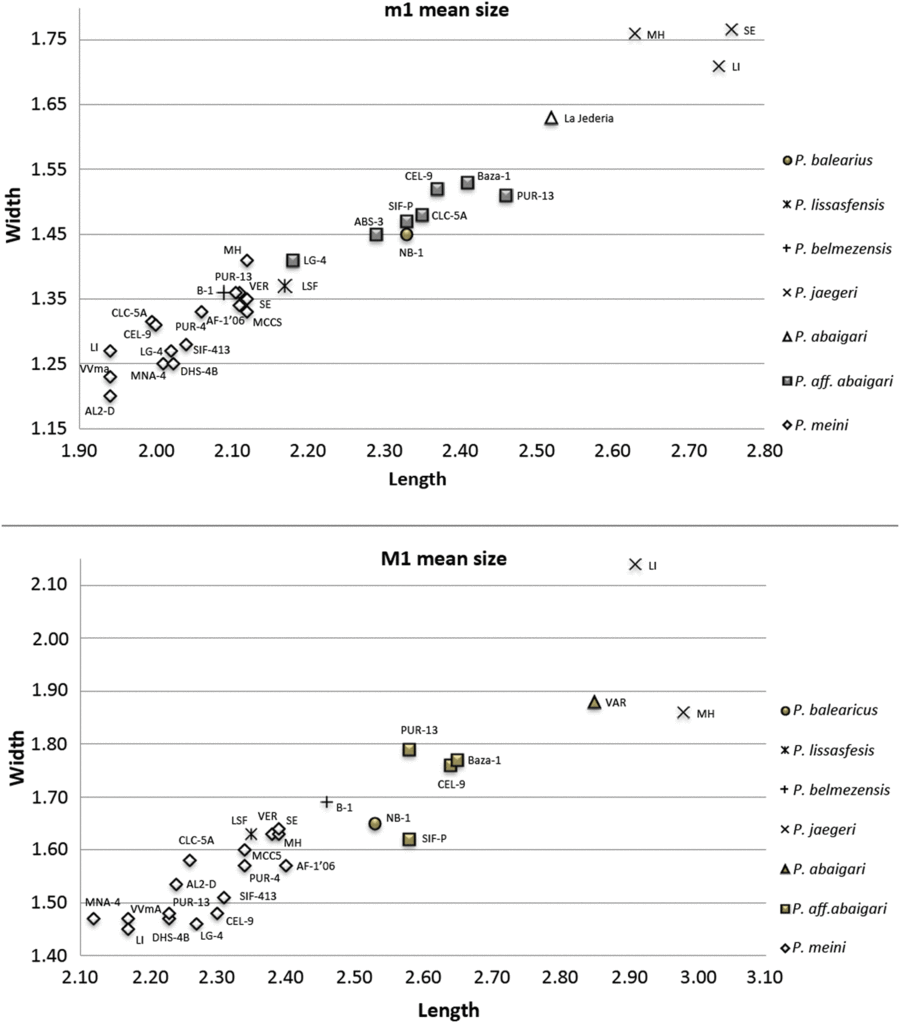
In general terms, the European Paraethomys lineages increased in size over time. García-Alix et al. (Reference García-Alix, Minwer-Barakat, Martín-Suárez and Freudenthal2008) recorded this size increase from the earliest (late Turolian) to the latest (early Ruscinian) populations of P. meini in the Granada Basin, Spain. Similarly, Piñero & Agustí (Reference Piñero and Agustí2017) recognized an increase in size from the first populations of P. meini to P. aff. abaigari in the Fortuna Basin, Spain. Pliocene palaeontological sites (MN14 and MN15) in some basins on the Iberian Peninsula have yielded two coeval Paraethomys forms: one of small size, corresponding to P. meini, and another of larger size, belonging to the lineage composed by P. aff. abaigari – P. abaigari – P. aff. jaegeri – P. jaegeri (Mein et al. Reference Mein, Moissenet and Adrover1990). Among these basins are the Granada (García-Alix et al. Reference García-Alix, Minwer-Barakat, Martín-Suárez and Freudenthal2008), Fortuna (Piñero & Agustí, Reference Piñero and Agustí2017), Guadix-Baza (Piñero et al. Reference Piñero, Agustí, Oms, Blain, Laplana, Ros-Montoya and Martínez-Navarro2017, Reference Piñero, Agustí and Oms2018), Cabriel (Mansino et al. 2015b), Alcoi (Mansino et al. Reference Mansino, Fierro, Ruiz-Sánchez and Montoya2013, Reference Mansino, Fierro, Montoya and Ruiz-Sánchez2015a, Reference Mansino, Ruiz-Sánchez, Fierro and Montoya2016) and Teruel (Adrover et al. Reference Adrover, Mein and Moissenet1993). Piñero & Agustí (Reference Piñero and Agustí2017) proposed that the phyletic lineage P. aff. abaigari – P. abaigari – P. jaegeri was derived from a primitive P. meini, marked by both a progressive size and stephanodonty increase through early Pliocene time, which evolved in parallel with a conservative P. meini lineage. A. García-Alix (unpub. Ph.D. thesis, Univ. Granada, 2006) observed that the size of P. meini from the Granada Basin decreased when a new lineage containing a larger species (P. aff. abaigari or P. abaigari) appeared. This trend seems to change in the last populations of P. meini from the Granada Basin (early Pliocene, late MN14), in which its size increases again. Mansino et al. (Reference Piñero, Agustí, Oms, Blain, Laplana, Ros-Montoya and Martínez-Navarro2017b) proposed that P. meini tends to increase in size in localities that lack species of the lineage P. aff. abaigari – P. jaegeri, while, after the gradual appearance of P. aff. abaigari in early Pliocene time (MN14), P. meini became smaller in sympatric conditions. Paraethomys belmezensis from the Belmez-1 locality (southern Iberian Peninsula; Castillo Ruiz, Reference Castillo Ruiz1992), a species probably also derived from P. meini, is slightly larger than the latter and clearly smaller than P. abaigari. The African P. lissasfensis from the upper Miocene, apparently related to the Iberian Paraethomys (Geraads Reference Geraads1998), has a molar size slightly larger than the specimens of P. meini from Venta del Moro (Mansino et al. Reference Mansino, Crespo, Montoya and Ruiz-Sánchez2017a). This locality contains one of the smallest sized populations of P. meini. Paraethomys balearicus sp. nov. presents a significantly larger size than P. meini across practically all its evolutionary lineage, with the exception of the late Turolian and the late Ruscinian P. meini populations, with which there is some size overlap (fig. 5 in Mansino et al. Reference Mansino, Crespo, Montoya and Ruiz-Sánchez2017a). The size of the m1 of P. balearicus sp. nov. is larger than P. belmezensis, whereas the M1 size overlaps considerably. Paraethomys balearicus sp. nov. is only slightly larger than P. lissasfensis, although there is some overlap in the range of tooth lengths. By contrast, the tooth sizes of P.balearicus sp. nov. overlap widely with those of P. aff. abaigari (Adrover et al. Reference Adrover, Mein and Moissenet1993; García-Alix et al. Reference García-Alix, Minwer-Barakat, Martín-Suárez and Freudenthal2008; Piñero et al. Reference Piñero, Agustí, Oms, Blain, Laplana, Ros-Montoya and Martínez-Navarro2017; Mansino et al. 2015b, Reference Mansino, Ruiz-Sánchez, Fierro and Montoya2016), but they differ morphologically from P. aff. abaigari by the presence of an anterior cingulum on the m1, a funnel between the hypoconid and c1 in m1, and a more reduced longitudinal spur and a narrow connection between t6–t9 in M1. The P. balearicus sp. nov. molars are smaller than those of P. abaigari (Adrover et al. Reference Adrover, Mein and Moissenet1988), and they are considerably smaller than the teeth of P. jaegeri (Fig. 3; Montenat & de Bruijn, Reference Montenat and de Bruijn1976; Castillo & Agustí, Reference Castillo and Agustí1996).
Scatter diagram showing m1 and M1 mean size of several late Miocene and Pliocene populations of P. meini, P. aff. abaigari, P. abaigari, P. jaegeri, P. belmezensis, P. lissasfensis and P. balearicus sp. nov. Abbreviations: VVmA – Venta del Moro A (late Miocene, Mansino et al. Reference Mansino, Crespo, Montoya and Ruiz-Sánchez2017a); MNA-4 – Mina-4 (late Miocene, A. García-Alix, unpub. Ph.D. thesis, Univ. Granada, 2006); DHS-4B – La Dehesa-4B (late Miocene, A. García-Alix, unpub. Ph.D. thesis, Univ. Granada, 2006); VER – Verduno Level 1 (late Miocene, Colombero et al. Reference Colombero, Bonelli, Kotsakis, Pavia, Pavia and Carnevale2013); MCC5 – Moncucco Torinese (late Miocene, Colombero et al. Reference Colombero, Pavia and Carnevale2014); PUR-4 – Purcal-4 (early Pliocene, A. García-Alix, unpub. Ph.D. thesis, Univ. Granada, 2006); SIF-413 – Sifón de Librilla-413 (early Pliocene, Piñero & Agustí, Reference Piñero and Agustí2017); NB-1 – Na Burguesa-1 (this work); LSF – Lissasfa (early Pliocene, Geraads, Reference Geraads1998); AF-1’06 – Alcoi Forn (early Pliocene, Mansino et al. Reference Mansino, Ruiz-Sánchez, Fierro and Montoya2016); ABS-3 – Alcoi Barranc Sud (early Pliocene, Mansino et al. Reference Mansino, Fierro, Montoya and Ruiz-Sánchez2015a); CLC-5A – Calicasas-5A (early Pliocene, A. García-Alix, unpub. Ph.D. thesis, Univ. Granada, 2006); PUR-13 – Purcal-13 (early Pliocene, A. García-Alix, unpub. Ph.D. thesis, Univ. Granada, 2006); LG-4 – La Gloria-4 (early Pliocene, Adrover et al. Reference Adrover, Mein and Moissenet1993); CEL-9 – Celadas-9 (early Pliocene, Adrover et al. Reference Adrover, Mein and Moissenet1993); SIF-P – Sifón de Librilla-P (early Pliocene, Piñero & Agustí, Reference Piñero and Agustí2017); Baza-1 (early Pliocene, Piñero et al. Reference Piñero, Agustí, Oms, Blain, Laplana, Ros-Montoya and Martínez-Navarro2017); AL2-D – Alcoi 2D (early Pliocene; Mansino et al. Reference Mansino, Fierro, Ruiz-Sánchez and Montoya2013); VAR – Villalba Alta Río (middle Pliocene, Adrover et al. Reference Adrover, Mein and Moissenet1988); LJ – La Juliana (middle Pliocene, Montenat & de Bruijn, Reference Montenat and de Bruijn1976); B-1 – Belmez-1 (middle Pliocene, Castillo Ruiz, Reference Castillo Ruiz1992); MH – Mont-Hélène (middle Pliocene, Aguilar et al. Reference Aguilar, Calvet and Michaux1986); SE – Sète (middle Pliocene, Adrover, Reference Adrover1986).

Paraethomys balearicus sp. nov. shows some morphological traits that are close to the earliest populations of P. meini:
(1) Paraethomys balearicus sp. nov. presents a posterior spur both on t1 and on t3 in M1, markedly more developed on t3. In P. meini the posterior spur is also more developed on the t3, although it is variable across time. In the late Turolian P. meini specimens from Venta del Moro and SIF-61, it is not markedly developed (Mansino et al. Reference Mansino, Crespo, Montoya and Ruiz-Sánchez2017a; Piñero & Agustí, Reference Piñero and Agustí2017). On the other hand, this spur is more developed in the latest Turolian specimens from the Granada Basin, whereas the earliest Ruscinian P. meini presents a more reduced t3 (García-Alix et al. Reference García-Alix, Minwer-Barakat, Martín-Suárez and Freudenthal2008). Finally, in the Pliocene populations of the Teruel and Alcoi basins, there are specimens that have lost the spur completely (Adrover et al. Reference Adrover, Mein and Moissenet1988; Mansino et al. Reference Mansino, Fierro, Ruiz-Sánchez and Montoya2013, Reference Mansino, Ruiz-Sánchez, Fierro and Montoya2016).
(2) Generally, the connection between t4 and t8 in the M1 is low in P. balearicus sp. nov., as in P. meini, whereas in P. aff. abaigari/P. abaigari this crest is quite high.
(3) The connection between t6 and t9 in the M1 is narrow in P. balearicus sp. nov., as in the oldest populations of P. meini, whereas in P. aff. abaigari/P. abaigari it is wide.
(4) Paraethomys balearicus sp. nov. frequently presents an individualized t9 and occasionally a reduced t12 in the M2. In the earliest sites in the Granada basin, P. meini may present a reduced t12 in the M2, usually when the t9 is slightly inflated (A. García-Alix, unpub. Ph.D. thesis, Univ. Granada, 2006; R. Minwer-Barakat, unpub. Ph.D. thesis, Univ. Granada, 2005).
5.a. Palaeogeography
Paraethomys was first recorded on the Iberian Peninsula as P. meini at Sifón de Librilla (Fortuna Basin, southeastern Spain; level SIF-61) and at Venta del Moro (Cabriel Basin, eastern Spain), both roughly dated to c. 6.2 Ma (Garcés et al. Reference Garcés, Krijgsman and Agustí1998; Agustí et al. Reference Agustí, Garcés and Krijgsman2006; Gibert et al. Reference Gibert, Scott, Montoya, Ruiz-Sánchez, Morales, Luque, Abella and Lería2013; Piñero & Agustí, Reference Piñero and Agustí2017; Mansino et al. Reference Mansino, Fierro, Tosal, Montoya and Ruiz-Sánchez2017b).
Paraethomys reached the Iberian Peninsula slightly prior to the MSC, and it has been considered as one of the representative taxa of the African–Iberian faunal exchange (Garcés et al. Reference Garcés, Krijgsman and Agustí1998; van Dam et al. Reference van Dam, Alcalá, Alonso Zarza, Calvo, Garcés and Krijgsman2001; Agustí et al. Reference Agustí, Garcés and Krijgsman2006). Paraethomys meini (= P. miocaenicus Jaeger, Michaux & Thaler, Reference Jaeger, Michaux and Thaler1975) was initially described from the site of Khendek-el-Ouaich (Morocco; Jaeger et al. Reference Jaeger, Michaux and Thaler1975). From there, it arrived on the Iberian Peninsula at the same time as the camelid Paracamelus, present at Venta del Moro and Librilla (Garcés et al. Reference Garcés, Krijgsman and Agustí1998; Agustí et al. Reference Agustí, Garcés and Krijgsman2006). Thus, the arrival of these genera probably took place c. 0.25 Ma before the onset of the MSC, through a faunal exchange across an ephemeral land bridge in a restricted Rifian corridor (Agustí et al. Reference Agustí, Garcés and Krijgsman2006; Gibert et al. Reference Gibert, Scott, Montoya, Ruiz-Sánchez, Morales, Luque, Abella and Lería2013; García-Alix et al. Reference García-Alix, Minwer-Barakat, Martín-Suárez, Freudenthal, Aguirre and Kaya2016) or by crossing a narrow sea channel. An alternative scenario, although currently questioned (e.g. R. Minwer-Barakat, unpub. Ph.D. thesis, Univ. Granada, 2005), assumed that a similar population of P. meini (= P. anomalous de Bruijn, Dawson & Mein, Reference de Bruijn, Dawson and Mein1970; described from the uppermost Miocene or lower Pliocene of Maritsa, Rhodes) colonized the two shores of the Mediterranean from the east at the same time (e.g. Jaeger et al. Reference Jaeger, Michaux and Thaler1975).
The MSC represents one of the most important events in the Neogene period of the Mediterranean area. The closing of the connection with the Atlantic Ocean involved the isolation and partial desiccation of the Mediterranean Sea (Hsü et al. Reference Hsü, Ryan and Cita1973, Reference Hsü, Montadert, Bernoulli, Bianca, Erickson, Garrison, Kidd, Mèliéres, Müller and Wright1977). This event had major climatic and biogeographic consequences, allowing the last mammalian exchange between Europe and Africa over the western Mediterranean corridor (Jaeger et al. Reference Jaeger, Michaux and Thaler1975, Agustí et al. Reference Agustí, Garcés and Krijgsman2006; van der Made et al. Reference van der Made, Morales and Montoya2006). New species of African affinities, such as Myocricetodon jaegeri Benammi, Reference Benammi2001 and Debruijnimys almenarensis (Agustí Reference Agustí, Lindsay, Fahlbusch and Mein1990), reached the Iberian Peninsula (Minwer-Barakat et al. Reference Minwer-Barakat, García-Alix, Martín-Suárez and Freudenthal2009), and simultaneously mammals of European origin spread into Africa (e.g. the pika Prolagus Pomel, Reference Pomel1853 and the murid Occitanomys Michaux, Reference Michaux1969).
It is widely accepted that the arrival of the Plio-Pleistocene fauna on the Balearic Islands is related to the MSC, crossing via a land bridge that connected the Balearics with the mainland (van der Made et al. Reference van der Made, Morales and Montoya2006; Bover et al. Reference Bover, Quintana and Alcover2008). The arrival of the NB-1 fauna to Mallorca (including at least 6 mammals, 12 reptiles, and 4 amphibians) is unequivocally related to their dispersal during Messinian time (late Miocene) via a terrestrial route. The narrow window of time in which the group appears supports a terrestrial connection, and cannot be explained by the random drift of animals over time one-by-one from the mainland to far-away islands on flotsam (Mas et al. Reference Mas, Maillard, Alcover, Fornós, Bover and Torres-Roig2018). The whole fauna recorded at NB-1 together with the evidence of a very fast and short episode of refilling of the western Mediterranean Basin (Garcia-Castellanos et al. Reference Garcia-Castellanos, Estrada, Jimenez-Munt, Gorini, Fernàndez, Verges and De Vicente2009) after the opening of Gibraltar (that quickly provided a high degree of isolation to Mallorca), and the total absence of new terrestrial vertebrate immigrants arriving onto the island over the last 5 Ma, strongly supports a terrestrial pathway for the fauna’s appearance.
Although affinities between some of the endemic mammals from the Balearic Islands and mainland European-related species have been suggested (e.g. Reumer, Reference Reumer1980; Bover et al. Reference Bover, Quintana and Alcover2010), direct evidence for the origin of this fauna was elusive until the discovery of the NB-1 site. The Pliocene fauna from CdR (Bover et al. Reference Bover, Rofes, Bailon, Agustí, Cuenca-Bescós, Torres and Alcover2014) improved knowledge on the fauna that arrived on the islands, increasing the number of taxa, but the high degree of endemicity displayed by the components of this fauna already obscures any kind of unquestionable relationship with their continental ancestors. NB-1 is the key site linking the Plio-Pleistocene Mallorcan fauna with its mainland source stocks. This site yielded a relatively diverse fauna containing some species that show clear relationships with their continental ancestors from the upper Turolian. This is the case for Apocricetus darderi, a giant species with a dental morphology very close to Apocricetus alberti (Torres-Roig et al. Reference Torres-Roig, Bailon, Bover and Alcover2017b). Apocricetus darderi is the first endemic Mallorcan mammal that was confidently related to a direct mainland ancestor, providing the first solid palaeontological evidence of a Messinian origin for the Plio-Pleistocene fauna of Mallorca. The description of P. balearicus sp. nov. points again – in an even more solid way – to the Messinian origin of the palaeontological assemblage recorded in NB-1, and of its derived Plio-Pleistocene Mallorcan fauna. The most plausible hypothesis is that at the peak of the Mediterranean desiccation (5.60–5.54 Ma; Roveri et al. Reference Roveri, Gennari, Lugli, Manzi, Minelli, Reghizzi, Riva, Rossi and Schreiber2016), some rodent taxa of African origin reached the Balearic Islands from eastern Iberia: Paraethomys arrived on Mallorca and Debruijnimys reached Eivissa (Agustí, Reference Agustí1989). In the same colonization event, other taxa of Iberian origin also reached the Balearics (e.g. Apocricetus). Paraethomys balearicus sp. nov. together with A. darderi and the anuran Alytes aff. muletensis allow us to suggest that the Baetic System was the main source region for the MSC colonization of the Balearic Islands, based on the distribution of fossils of their ancestors.
5.b. Island evolution
Several murines evolved under insular conditions in the western Mediterranean region. Endemic species have been described from the upper Miocene of Tuscany (Bacinello; Engesser, Reference Engesser1989), Fiume Santo (Sardinia; Casanovas-Vilar et al. Reference Casanovas-Vilar, Van Dam, Trebini and Rook2011) and the Gargano promontory (Freudenthal, Reference Freudenthal1976; Abbazzi et al. Reference Abbazzi, Masini and Torre1993; Savorelli et al. Reference Savorelli, Colombero and Masini2016). Other species have been described from the Plio-Pleistocene of Corsica, Sardinia (Hensel, Reference Hensel1856; Major, Reference Major1905; Brandy, Reference Brandy1978) and Sicily (Thaler, Reference Thaler1972). In Bacinello, a lineage starting with Huerzelerimys vireti from level V0 gave rise to the larger Huerzelerimys oreopitheci (level V1) and the endemic genus Anthracomys (A. majori from level V2 and A. lorenzi from level V3; Engesser, Reference Engesser1989). The main evolutionary trends observed in this lineage are size and hypsodonty increases. In Gargano, a number of lineages have been recognized within the endemic genus Mikrotia, in which the major evolutionary trends are the proliferation of lobes in the m1 and M3, in a similar way to arvicolids, and size and hypsodonty increases (Freudenthal, Reference Freudenthal1976; Abbazzi et al. Reference Abbazzi, Masini and Torre1993; Maul et al. Reference Maul, Massini, Parfitt, Rekovets and Savorelli2014). Although a relationship with the late Miocene continental genus Stephanomys has been suggested (Freudenthal, Reference Freudenthal1985), the origin of Mikrotia should most probably be considered to be the late Miocene genus Parapodemus (Agustí, Reference Agustí1986). A second endemic genus, Apatodemus, is present in the fissure infillings from Gargano (Savorelli et al. Reference Savorelli, Colombero and Masini2016). Two taxa have been accepted for this lineage: A. degiulii (type species) and an unnamed and larger Apatodemus sp. A moderate increase in size is observed as an evolutionary pattern in this endemic lineage, although always within the range of the continental species of Apodemus, such as Apodemus gudrunae (from which they most probably derive).
In Corsica and Sardinia, a lineage has been recorded starting with the species Rhagapodemus azzarolii (present at the site of Mandriola, Sardinia; Angelone & Kotsakis, Reference Angelone and Kotsakis2001), which derives from the continental species Rhagapodemus ballesioi. Rhagapodemus azzarolii gave rise to an endemic Sardinian genus Rhagamys (R. minor Brandy, Reference Brandy1978, from Capo Figari, Sardinia, and R. orthodon, from Corsica and Sardinia). A trend towards size and hypsodonty increase is also observed in this lineage. Other endemic murids are the large-sized Apodemus mannu from the Pliocene site of Mandriola (Sardinia; Pecorini et al. Reference Pecorini, Rage and Thaler1974), and another large representative of Apodemus, A. maximus, at Monte Pellegrino (Sicily; Thaler, Reference Thaler1972). The presence at this latter site of an African ctenodactylid (Pellegrinia panormensis) strongly suggests a Messinian origin for the fauna from Monte Pellegrino (Moyà-Solà et al. Reference Moyà-Solà, Pons-Moyà, Alcover and Agustí1984).
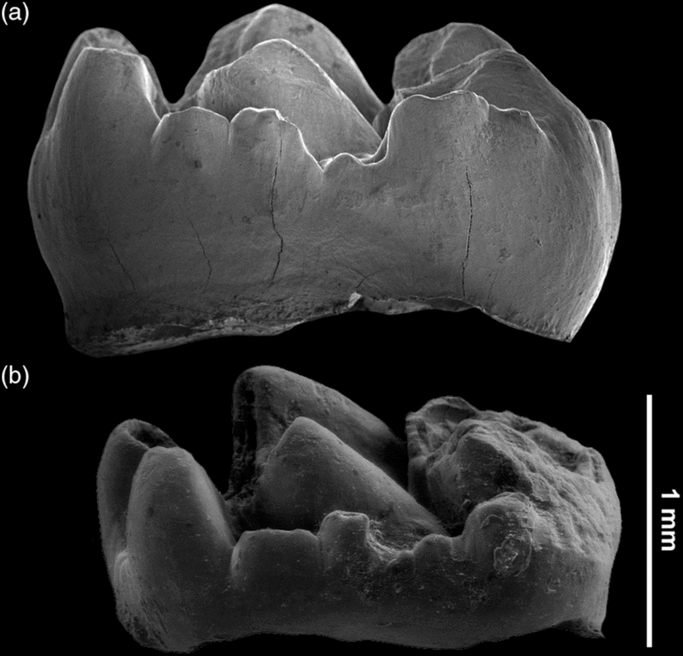
Therefore, according to the available data, most cases of insular endemism in murids in the western and central Mediterranean derive from an Apodemus-related stock (Parapodemus, Rhagapodemus, Apodemus), with an exception in the Tusco-Sardinian province (where some endemic island species were originated from Huerzelerimys). In contrast, P. balearicus sp. nov. represents the first case of insular evolution described for Paraethomys. The derived features recorded in P. balearicus sp. nov. with respect to its presumed continental precursor (P. meini) are in full agreement with those observed in other insular murids (Anthracomys, Rhagamys, Apodemus): an increase in size and hypsodonty (Fig. 4), a general trend for insular Muridae (e.g. Locatelli et al. Reference Locatelli, Awe Due, van den Bergh and van den Hoek Ostende2012). However, P. balearicus sp. nov. does not reach the gigantic size attained by the late representatives of Mikrotia, as was also the case for Anthracomys and Rhagamys. The early insular evolutionary stage of P. balearicus sp. nov. contrasts with that of Apocricetus darderi, also present at NB-1. Probably, the ecological insular conditions of Mallorca, with its limited area and resources, prevented the presence of a second large rodent species on the island.
Comparison of the hypsodonty between the m1s of (a) P. balearicus sp. nov., MEDEA 106276, and (b) P. meini, BO-D-2-14; Botardo-1D, Guadix-Baza basin, in labial view.

5.c. Extinction
Paraethomys has not been recorded in the other Pliocene sites of Mallorca so far. Although this lack of records could suggest that the species probably vanished soon after its arrival on Mallorca, the scarce and partially eroded remains of micromammals retrieved from deposits such as CdR precludes establishing any accurate chronology for the extinction of Paraethomys. Nevertheless, other species recorded in the early Pliocene sites of NB-1 and CdR (e.g. Maioricalacerta, Hypolagus, Apocricetus/Tragomys) are not recorded in deposits with a more recent chronology, suggesting an extinction event slightly before or during Piazencian time.
6. Conclusions
A new species of Paraethomys from the lower Pliocene of Mallorca is described as P. balearicus sp. nov. based on the following dental traits: lower molars with well-developed labial cingulum; m1 and m2 with large and high accessory labial cuspids and a funnel between the hypoconid and the c1; m1 with an anterior cingulum, unusual in the genus; M1 and M2 with a posterior spur on the t1 and the t3; M1 with well-developed connections between t1–t2 and t2–3, and with a t4 that reaches the t8; M2 with an individualized t9 and a small t12; and an M3 with three funnels. The greatest development of the posterior spur on t3 in the M1, the connection between t4 and t8 in the M1, and the presence of an individualized t9 and a reduced t12 in the M2 allows us to relate P. balearicus sp. nov. to the late Turolian populations of the Iberian P. meini. Its arrival to the island occurred during the MSC, and after the refilling of the Mediterranean Sea it started to evolve under insular conditions, increasing slightly in size and degree of tooth hypsodonty, originating P. balearicus. This species represents the first Neogene mammal recorded in the Gymnesic Islands that could have had an African origin, although it likely arrived in Mallorca through the Baetic System. The accurate timing and causes of its extinction are unknown.
Author ORCIDs
Enric Torres-Roig 0000-0003-0221-2448
Acknowledgements
This paper is a contribution to the Research Projects CGL2012-38089, CGL2016-79795-R and CGL2016-80000-P founded by the Agencia Estatal de Investigación (Ministerio de Economía, Industria y Competitividad)/Fondo Europeo de Desarrollo Regional (FEDER) and SCR-901 founded by the Generalitat de Catalunya. One author (ETR) benefited from a predoctoral fellowship (BES-2013-062867) from the Spanish Ministerio de Economía, Industria y Competitividad. The SEM images were obtained at the Serveis Científico-Tècnics of the Universitat de les Illes Balears (Ferran Hierro). The deposit of NB-1 was discovered by Dr Damià Vicens, Mr Antelm Ginard and Mr Damià Crespí, and the material was obtained under the authorization of the land owners (Zaforteza family) and of the General Directorate of Heritage of the Consell de Mallorca. We thank Dr. Lars van der Hoek Ostende and an anonymous reviewer for their constructive comments that greatly improved the manuscript.