Introduction
The purpose of this review was to provide an overview of the literature which examines the role of music interventions in alleviating symptoms of anxiety and depression in older adults living with mild dementia. Specifically, this paper explores the efficacy of music interventions in this vulnerable population, identifies limitations in the studies, and makes recommendations for future research.
Dementia
As the world's population continues to age, an increasing number of adults are being diagnosed with dementia (World Health Organization, 2013). The current number of individuals with dementia is predicted to double every 20 years, reaching 65.7 million in 2030 and 115 million in 2050 (Prince et al., Reference Prince, Jackson and Guerchet2013). The annual worldwide cost of caring for older adults with dementia will reach a staggering $1,174 billion by 2030 (Prince et al., Reference Prince, Jackson and Guerchet2013). Therefore, finding low cost, innovative approaches to care for these older adults is essential to optimize functioning and help to maintain their independence as long as possible.
Dementia was designated a top global health priority in 2011, indicating the importance of proper diagnosis, treatment, and care for older adults with dementia as well as their caregivers (World Health Organization, 2013). The Diagnostic and Statistical Manual of Mental Disorders, fifth edition (DSM-5), defines dementia in terms of Neurocognitive disorders (NCDs) either major or minor and their etiological subtypes (American Psychiatric Association, 2013). Major NCD is defined as an evidence of significant cognitive decline from baseline in one or more cognitive domain that interferes with independence in everyday activities and not in the context of delirium or better explained by another mental disorder (American Psychiatric Association, 2013). Dementia can be categorized by whether or not there is a behavioral disturbance and the level of dementia severity either: mild, moderate, or severe stages based on the level of dependence in instrumental and basic activities of daily living (American Psychiatric Association, 2013). Mood disturbances, such as anxiety and depression, are most common in the early stage of mild dementia (American Psychiatric Association, 2013) as older adults face the realities of a new diagnosis, uncertain prognosis, and loss of life, as they knew it. Anxiety and depression further contribute to decreased overall functioning and cognitive decline (Hynninen et al., Reference Hynninen, Breitve, Rongve, Aarsland and Nordhus2012).
Anxiety in older adults with mild dementia
Symptoms of anxiety negatively impact the quality of life of older adults with mild dementia. Anxiety often goes undiagnosed in this population and as dementia progresses, people with dementia lose their ability to communicate their feelings and symptoms of anxiety. Some studies have estimated the prevalence of anxiety in persons with dementia living in the assisted living environment to be between 11% and 18% (Neville and Teri, Reference Neville and Teri2011). Another study reported the prevalence of anxiety in community dwelling older adults with dementia to be as high as 70%, with 54% of the same sample reported symptoms of both anxiety and depression (Teri et al., Reference Teri1999). Such a wide range of prevalence of anxiety may be attributed to the varying ways that anxiety was diagnosed in older adults, as well as the lack of reliable scales to measure the severity of symptoms of anxiety in dementia (McCabe et al., Reference McCabe, Davison, Mellor, George, Moore and Ski2006). For example, the prevalence of anxiety in nursing home residents varied from 5% to 29% in different studies which may have been the result of different measurement tools employed (Smalbrugge et al., Reference Smalbrugge, Pot, Jongenelis, Beekman and Eefsting2005; Wolitzky-Taylor et al., Reference Wolitzky-Taylor, Castriotta, Lenze, Stanley and Craske2010).
Anxiety is an important symptom of dementia and has been associated with limitations in basic activities of daily living (Teri et al., Reference Teri1999; Hynninen et al., Reference Hynninen, Breitve, Rongve, Aarsland and Nordhus2012), problem behaviors (i.e. wandering, verbal threats), and increased risk of future nursing home placement (Seignourel et al., Reference Seignourel, Kunik, Snow, Wilson and Stanley2008). Increasing frequency of problem behaviors and loss of independence are often associated with caregiver stress, strained personal relationships, and worsened quality of life both for the older adults with dementia as well as caregivers (Seignourel et al., Reference Seignourel, Kunik, Snow, Wilson and Stanley2008). Symptoms of anxiety in older adults with mild dementia are correlated with decreased everyday functioning and often accompany worsening symptoms of depression (Hynninen et al., Reference Hynninen, Breitve, Rongve, Aarsland and Nordhus2012).
Depression in older adults with dementia
Depression is an equally distressing psychological symptom in mild dementia. It is estimated that 50% of older adults diagnosed with dementia will develop minor depressive symptoms and that 15% to 20% will develop major depressive disorder, thus increasing their risk for hospitalization, nursing home placement, further cognitive decline, and death (Onega, Reference Onega2006; Fritze et al., Reference Fritze, Ehrt, Hortobagyi, Ballard and Aarsland2011). Depression rates in older adults who reside in nursing homes without cognitive impairment are significantly higher compared to those among older adults in the community and vary from 24% to 82% (Drageset et al., Reference Drageset, Eide and Ranhoff2011). Significant health disparities exist for cognitively impaired older adults, as they are less likely to be diagnosed and treated for depression than older adults with normal cognitive functioning (Levin et al., Reference Levin, Wei, Akincigil, Lucas, Bilder and Crystal2007). A variety of treatments exist for both anxiety and depression in older adults with mild dementia. The majority of these treatments, however, are not fully effective in reducing symptoms of anxiety and depression (Vink et al., Reference Vink, Birks, Bruinsma and Scholten2004). These interventions are broadly categorized as pharmacological and non-pharmacological.
Treatment for anxiety and depression
Pharmacological interventions aim to manage or alleviate behavioral and psychological disturbances in older adults with dementia. Antidepressant use in older adults with dementia requires careful monitoring. A recent trial investigating the cost effectiveness of two different antidepressants compared to placebo in persons with depression and dementia failed to demonstrate a benefit to antidepressant therapy (Banerjee et al., Reference Banerjee2013). This study also demonstrated a higher rate of serious adverse events in the sertraline and mirtazapine groups compared to placebo. Mortality rates did not differ between the three groups (Banerjee et al., Reference Banerjee2013). Pharmacological treatment for anxiety is limited in its effectiveness to manage anxiety symptoms in older adults with dementia because of the increased vulnerability to adverse drug reactions (Press and Alexander, Reference Press, Alexander and DeKosky2013).
Non-pharmacological, or complementary and alternative medicine (CAM), on the other hand, may be safe and effective in a vulnerable population such as older adults with mild dementia. CAM is defined as non-mainstream medicine approaches used with (complementary) or instead of (alternative) conventional medicine (National Center for Complementary and Integrative Health, 2013). The cultural arts are a type of CAM. Cultural arts can be defined as the “practice of creating perceptible forms expressive of human feeling” (Langer, Reference Langer1966) and include music, visual arts, reminiscence, cognitive exercises, and theatre, among others (de Medeiros and Basting, Reference de Medeiros and Basting2013). Trials using the arts have addressed behavioral, cognitive, and psychosocial disturbances in persons with dementia and have explored their efficacy in improving patient outcomes (de Medeiros and Basting, Reference de Medeiros and Basting2013). The efficacy of music in reducing a number of behavioral and psychological symptoms of dementia has been partially supported in several studies, where music has served as a communication tool for older adults with moderate to severe dementia that have lost the verbal ability to communicate (Vink et al., Reference Vink, Birks, Bruinsma and Scholten2004). Analysis of the efficacy of music interventions in reducing the severity of symptoms of anxiety and depression earlier in the disease trajectory is now needed.
Music has the potential to be a novel and important therapeutic intervention for older adults with mild dementia given its ability to arouse and trigger an emotional response within the individual (Spiro, Reference Spiro2010). In addition, the language of music is universal and consists of several aspects, such as pitch, melody, rhythm, and timbre. Because of its universality and complexity, music is especially promising in alleviating psychological symptoms of mild dementia, such as anxiety and depression (Ueda et al., Reference Ueda, Suzukamo, Sato and Izumi2013).
Music intervention versus music therapy
The use of music to reduce symptoms in older adults with dementia can be broadly characterized as falling into two categories; that of music therapy and music interventions. Music therapy is defined as, “The clinical and evidence-based use of music interventions to accomplish individualized goals within a therapeutic relationship by a credentialed professional who has completed an approved music therapy program” (American Music Therapy Association, 2013). Music interventions, on the other hand, include recorded or live music, do not necessitate a presence of a trained music therapist and have broad aims, such as promoting a feeling of well-being, improving mood, and achieving relaxation (Spiro, Reference Spiro2010). Music intervention and music therapy are generally categorized as either active (interactive), passive (receptive), or integrative (music is not the main goal in the therapy) (Spiro, Reference Spiro2010). The recent literature has shown the importance of active music interventions (vs. passive music interventions) in management of behavioral and psychological disturbances in dementia (Raglio et al., Reference Raglio2012). The definitions of music therapy and music interventions, however, are not strictly adhered to in the literature. Although it may be helpful to investigate the difference between the two concepts, this area of inquiry is beyond the scope of this systematic review. For the purpose of this paper “music therapy” and “music intervention” will be referred to as “music intervention”.
Methods
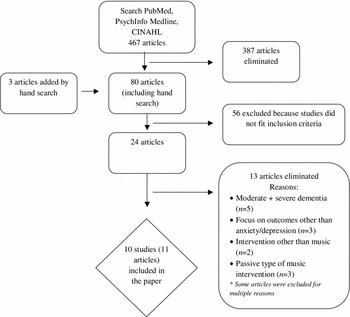
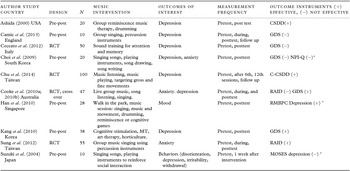
The studies for this systematic review were selected using search terms “music,” “music intervention,” “music therapy,” “singing,” “dementia,” in combination with “anxiety” and/or “depression” from four electronic databases: Medline, PubMed, PsychINFO and Cumulative Index to Nursing and Allied Health Literature (CINAHL). The following search criteria were applied: (1) humans, aged (65+ years), 80 years and over, (2) clinical trials, (3) peer reviewed, (4) English language. The search was not limited to specific publication years; publications dating to 1946 through September 2013 were reviewed. Using these search parameters, 467 articles were retrieved, and 80 were selected for further review, including three that were identified by hand search. Identified articles were imported into a reference manager and duplicates were removed. Articles were selected for review if they were focused on: (1) older adults with mild dementia (study samples with mild dementia and mixed severity levels of dementia were allowed), (2) an active music intervention that engaged the participants, and (3) symptoms of anxiety and/or depression as primary outcomes. Exclusion criteria included studies: (1) conducted in a population other than older adults with dementia, (2) those that used a passive music intervention (such as listening to music), (3) focused on an outcome other than reducing symptoms of anxiety and/or depression, (4) that included only participants with severe dementia. Studies that recruited participants with either mild or moderate dementia, or had participants with all three severity levels of dementia (mild, moderate, severe) were included in this review. Symptoms of anxiety and depression are most common in the early stages of dementia (American Psychiatric Association, 2013), therefore studies that only recruited participants with severe levels of dementia were excluded. Fifty-six studies that included participants with severe dementia were subsequently eliminated. Following a full-text review, 13 articles were excluded due to one of the following reasons: focus on moderate and/or severe dementia (n = 5), focus on outcomes other than anxiety/depression (n = 3), intervention other than music (n = 2), and/or a passive type of music intervention (n = 3), leaving ten original research studies that met the criteria for inclusion (Figure 1). The reviewers worked independently to determine eligibility. The search for original research studies was done by one researcher (DP) and confirmed by two other researchers (PC and MG) working independently of each other. Criteria for inclusion/exclusion was also examined independently by all three researchers. When discrepancies were identified all investigators met in-person to discuss and reconcile differences until consensus was reached. A meta-analysis was not feasible due to the differences in the population studied and instruments used; prohibiting any meaningful clinical or scientific interpretation of the results. A brief description of these studies with the outcome of interest is presented in Table 1.
Database search results.

Brief intervention description of selected studies

Abbreviations: CSDD = Cornell Scale of Depression in Dementia, C-CSDD = Chinese Cornell Scale of Depression in Dementia, NPI = Neuropsychiatry Scale, NPI-Q = Neuropsychiatry Scale Questionnaire, GDS = Geriatric Depression Scale, CMAI = Cohen-Mansfield Agitation Inventory, MOSES = Multidimensional Observation Scale for Elderly Subjects, RAID = Rating for Anxiety in Dementia, RMBPC = Revised Memory and Behavioral Problems Checklist, * = in sub analysis.
Results
The efficacy of music intervention in reducing anxiety
Overall, the research demonstrated mixed effects of a music intervention on anxiety and depression in persons with mild dementia due to low methodological rigor and lack of scientifically rigorous studies. The effect of music intervention in lessening anxiety symptoms in older adults was not consistent across the studies, which included two randomized controlled trials (RCTs) (Cooke et al., Reference Cooke, Moyle, Shum, Harrison and Murfield2010a; Cooke et al., Reference Cooke, Moyle, Shum, Harrison and Murfield2010b; Sung et al., Reference Sung, Lee, Li and Watson2012) and one pre-post study design (Choi et al., Reference Choi, Lee, Cheong and Lee2009). The studies were conducted in eight countries and included participants from England, USA, Italy, Korea, Taiwan, Australia, Singapore, and Japan (Table 1).
Cooke et al. (Reference Cooke, Moyle, Shum, Harrison and Murfield2010a) studied the effect of singing (vs. no intervention) on anxiety in long term care (LTC) older adults (N = 47) as measured by the Rating of Anxiety In Dementia (RAID) instrument. Participants engaged in a 40-minute group session, which included song singing and listening. This RCT failed to demonstrate any significant decrease in anxiety. Similarly, Choi et al. (2009) investigated the effect of singing and instrument playing (vs. usual care) on anxiety in LTC older adults (N = 20) using the Neuropsychiatric Inventory (NPI). There was no evidence to suggest that music intervention in this pre-post study lowered anxiety symptoms in LTC older adults with mild dementia.
In contrast, Sung et al. (Reference Sung, Lee, Li and Watson2012) studied drumming (vs. no intervention) on anxiety in LTC older adults (N = 55) as measured by the RAID. In this RCT, anxiety symptoms in the experimental group were reduced significantly following drumming to the beat of familiar Taiwanese and Chinese songs with moderate tempo. Although the participants in the drumming group experienced significantly lower anxiety scores compared to those in the control group (p = 0.004), this can be attributed to the inherent differences in cognition between the groups at baseline and not the intervention.
The efficacy of music intervention in reducing depression
Similarly, the studies investigating the effect of a music intervention to improve depressive symptoms in older adults with mild dementia lacked methodological rigor and reported mixed efficacy results. Of the ten reviewed studies, nine studies measured depression (three of which were randomized and six that were not). Five studies reported a decrease in depression scores (Ashida, Reference Ashida2000; Cooke et al., Reference Cooke, Moyle, Shum, Harrison and Murfield2010b; Han et al., Reference Han2010; Kang et al., Reference Kang, Bae, Kim, Lee, Chae and Ju2010; Chu et al., Reference Chu2014), three found no difference in depression scores (Suzuki et al., Reference Suzuki2004; Choi et al., Reference Choi, Lee, Cheong and Lee2009; Ceccato et al., Reference Ceccato2012) and one study reported an actual increase in depressive symptoms (Camic et al., Reference Camic, Williams, Myferi and Meeten2013). Two out of three RCTs supported the use of music intervention to alleviate the symptoms of depression.
For example, Ashida (Reference Ashida2000) in a pre-post study design explored the effect of reminiscence music therapy on 20 older adults in LTC and found an overall decrease in depression as measured by the Cornell Scale for Depression in Dementia survey (CSDD; p < 0.05). Reminiscence music therapy consisted of a music therapist singing familiar songs to the participants on a variety of topics (e.g. home, nature, outdoors, hobbies, travel, and love songs). Opening and closing activity consisted of drumming with a chance for participants to express any concerns or feelings to the therapist. Similarly, Chu et al. (Reference Chu2014) investigated the effect of music playing and listening (vs. no treatment) on depression in older adults living in LTC with dementia (N = 100) using the CSDD. In this study, participants engaged in a music therapy protocol which included gross and fine motor movements, listening, and instrument playing. This RCT demonstrated a significant decrease in depression attributed to the music intervention (p < 0.001). In a different RCT, depression scores as measured by the GDS-S improved only in those older adults with dementia who scored five or greater at baseline (Cooke et al., Reference Cooke, Moyle, Shum, Harrison and Murfield2010b). In this RCT, the researchers compared LTC older adults with dementia (N = 47) who participated in music playing and singing with older adults engaged in a reading group.
Likewise, in their pre-post study design, Kang et al. (Reference Kang, Bae, Kim, Lee, Chae and Ju2010) found improved depression scores following music intervention (vs. usual care) in community-dwelling older adults with mild dementia (N = 38) using the GDS (p < 0.001). This study, however, investigated the effect of a multi-component intervention, which included cognitive stimulation, art therapy, music therapy, and horticulture. Similarly, Han et al. (Reference Han2010) explored the effect of a similar multi-component music intervention (vs. usual care) in community dwelling older adults with dementia (N = 45) in a pre-post study design. This study found improved depression scores following the intervention as well (p = 0.019) as measured by the Revised Memory and Behavioral Problems Checklist (RMBPC).
Conversely, Ceccato et al. (Reference Ceccato2012) explored the effect of music listening and playing (vs. usual care) in older adults with mild dementia in LTC (N = 51) using the GDS. This RCT failed to find any significant decrease in the depression scores. Likewise, two pre-post study design studies found no decrease in depressive symptoms following a music intervention (Suzuki et al., Reference Suzuki2004; Choi et al., Reference Choi, Lee, Cheong and Lee2009). Specifically, Choi et al. (Reference Choi, Lee, Cheong and Lee2009) studied the effect of singing, instrument playing and song writing (vs. usual care) in LTC older adults (N = 20) as measured by the GDS and the NPI. Similarly, Suzuki et al. (Reference Suzuki2004) investigated the effect of singing, playing percussion instruments and listening to music (vs. therapeutic activities that did not involve music) in LTC older adults with dementia (N = 23) using the Multidimensional Observation Scale for Elderly Subjects (MOSES).
Unexpectedly, Camic et al. (Reference Camic, Williams, Myferi and Meeten2013) found increased depression in a small group of community-dwelling older adults with mild dementia (N = 10) using the GDS. This group of older adults participated in a sing-along session with their caregivers and were evaluated prior to, and following, the singing intervention.
Discussion
In summary, the majority of the reviewed music intervention studies, which included both randomized and non-randomized studies, did not provide sufficient support for music interventions as an effective intervention to reduce anxiety and depression symptoms in older adults with mild dementia due to low methodological rigor of the studies. These studies inconsistently defined music interventions, used as a wide variety of tools to measure their outcomes, and consisted primarily of small convenience samples.
The mixed efficacy of music interventions in improving depression and anxiety in older adults with mild dementia is not alone in this regard. For example, Yu et al. (Reference Yu, Nelson, Savik, Wyman, Dysken and Bronas2013) examined the effect of aerobic exercise on depression, executive function, global cognition and quality of life in older adults with dementia. Following a six-month aerobic exercise program, there were no significant improvements in any measures, except for depression. Similarly, Cheng et al. (Reference Cheng, Chow, Edwin and Chan2012) investigated the efficacy of leisure activities, such as mahjong and tai chi (vs. handcrafts) in reducing symptoms of depression in older adults with mild dementia. The study found only moderate improvement in symptoms of depression in the mahjong group.
The lack of significant findings for music interventions in older adults with mild dementia may be attributed to the low methodological rigor of the reviewed studies. This lack of methodological rigor in the reviewed studies may be due to the absence of a theoretical model guiding the research investigating the effect of a music intervention in older adults with mild dementia suffering from anxiety and depression. Moreover, the lack of significant findings may be attributed to a sample recruitment flaw. In the majority of the reviewed studies eligibility criteria did not include positive symptoms of anxiety and depression. Absence of these symptoms at the beginning of the study make it difficult for the researchers to find any improvement in those symptoms over time encountering the “floor effect”. Furthermore, interpretation of the results across the studies is complicated by a variety of outcome measures for anxiety and depression in older adults with mild dementia. Two out of three studies screened for anxiety using the RAID, while the remaining study relied on the NPI. Likewise, the researchers used five different scales to measure depression in older adults with mild dementia.
There are several important limitations to our current understanding of the efficacy of music interventions in addressing symptoms of anxiety and depression in older adults with mild dementia driven by low methodological rigor of the studies. First, there are few RCTs (n = 4). In addition, blinding of the researcher and statistical team, a condition that improves the rigor of RCTs, was employed in only one of these studies (Cooke et al., Reference Cooke, Moyle, Shum, Harrison and Murfield2010a), thus introducing possible bias. Additionally, the research conducted in a real-life setting lends itself to the influence of uncontrollable outside factors, such as staff, research staff and resident turnover, weather and illnesses. A possibility exists that the conclusions of this review might have been different had the inclusion criteria been broader and included healthy older adults and qualitative data.
The majority (n = 6) of the reviewed studies were quasi-experimental with either one or two group repeated measure designs. In addition, most studies used multi-component music interventions (i.e. singing, drumming, dance), which does not directly measure the impact of one specific aspect of music intervention on the observed effect in psychological outcome(s). Isolating a component of music intervention, however, may not be feasible in some instances. Music may influence older adults living with mild dementia in several ways. Music may serve as a distraction from daily activities and promote social interaction in a group setting. Some of music's components such as singing in a group versus singing solo, however, may be manipulated in a randomized trial. Another major weakness of the reviewed studies involves sampling. The majority of music intervention research focused on nursing home residents, who were mostly female. This is likely due to the fact that women comprise more than two-thirds (67.2%) of the entire nursing home population (Center for Medicare and Medicaid Services, 2012). In addition, 50% of the reviewed studies did not provide detailed demographic characteristics about the sample, therefore making it difficult to generalize the findings, reducing external validity. Furthermore race was reported in only one study (Sung et al., Reference Sung, Lee, Li and Watson2012).
An important omission in the reviewed studies was the failure of the researchers to include hearing impairment as one of the confounding variables. Only four of these studies (Kang et al., Reference Kang, Bae, Kim, Lee, Chae and Ju2010; Ceccato et al., Reference Ceccato2012; Chu et al., Reference Chu2014; Sung et al., Reference Sung, Lee, Li and Watson2012) excluded older adults with hearing impairment, although the prevalence of hearing impairment in nursing home older adults compared to community dwelling older adults may be as high as 98% (Adams-Wendling et al., Reference Adams-Wendling, Pimple, Adams and Titler2008). Clearly, hearing impairment will affect whether the older adult is able to fully participate in a music intervention. Researchers should identify older adults with hearing impairment and work with their provider to improve or enhance their hearing before administering any type of music intervention in order to maximize positive outcomes. Careful hearing screenings of potential participants will ensure that participants are able to hear and benefit from a music intervention.
With the aim of improving methodological rigor of future music intervention studies, several recommendations emerged based on this literature review. First, a carefully selected theoretical framework should guide research in this area of inquiry. Doing so strengthens the methodological rigor and advances the science. Second, researchers should recruit participations who demonstrate one or more psychological symptoms, therefore increasing the probability of significant findings and eliminating the possibility of a floor effect. Third, instruments to measure outcomes of interest should be standardized and appropriate for use in this older adult population with mild dementia. One of the most common scales to measure depression in the reviewed studies was the GDS, considered to be an appropriate scale to measure depression symptoms in older adults with mild dementia. On the other hand, scales to measure anxiety in this population varied widely, and no consensus exists as to which screening tool is most appropriate for detecting anxiety symptoms in older adults with mild dementia. Lastly, subject demographics should be fully assessed and documented, including age, ethnicity, and education. Future research studies in the use of music intervention to alleviate symptoms of anxiety and depression in older adults with mild dementia would benefit from larger sample sizes, more diverse participants, and detailed description of the music intervention. Given the international scope of the reviewed studies, music interventions should be tailored to the participants’ preferences and cultural backgrounds. Tailoring music to the participants is a way of achieving patient-centered care and the highest quality of care. Music that engages the participants is most likely to contribute to a positive outcome. When demonstrated to be effective, music offers clinicians in low-resource countries an easy-to-implement and inexpensive treatment for a growing population of older adults with mild dementia.
Conclusion
This review examined the effect of music interventions on anxiety and depression in older adults with mild dementia. Poor methodological rigor, variation of approaches measurement tools, and study settings prevent the authors from reaching a consensus on the efficacy of a music intervention in alleviating symptoms of anxiety and depression in older adults with mild dementia. These findings speak to the need for researchers to standardize the design and measurement variables used moving forward so that data can be pooled in future reviews. However, these findings do not contradict many positive clinical experiences with music therapy. With improved designs guided by a deeper understanding of how music engages the aging brain, music may emerge as an important adjunct therapy to improving the lives of older adults with mild dementia. As we are expected to have a growing population of older adults, with increasing rates of dementia, there is an urgent need to identify innovative ways to address this critically important public health issue using non-pharmacologic approaches.
Conflict of interest
None.
Description of authors’ roles
DP contributed to the literature search, planned the overall structure of the review, took the lead in writing the manuscript and producing the accompanying tables and figures. PC and MG contributed to the literature search, the overall planning of the manuscript, edited and contributed to the final version of the manuscript. All authors were involved in the interpretation of data and preparation of the manuscript.
Acknowledgments
Darina V. Petrovsky is a 2014–2016 National Hartford Centers of Gerontological Nursing Excellence Patricia G. Archbold Scholar and a 2014–2016 Jonas Nurse Leader Scholar.
We would like to acknowledge Dr. Kathryn Bowles for her thoughtful comments on the manuscript.