Introduction
Michelle Bachelet's second administration (2014–18) differed from previous left-of-centre governments in post-transition Chile. The incorporation of the Partido Comunista (Communist Party, PC) into the governing coalition and the pursuit of an ambitious reform agenda generated significant internal struggles. While some political figures called for more gradual reform, others argued for rapid, broad transformations as demanded by social movements.Footnote 1
Not by chance, this tension within Bachelet's coalition surfaced over the extent to which the electoral manifesto for the 2013 presidential race should be (strictly) respected once a coalition is in government. After all, the manifesto can be seen as a sort of political mandate, whereby politicians create expectations about the actions they will take if they win office.Footnote 2 At the two extremes of the dispute were the PC and the Partido Demócrata Cristiano (Christian Democratic Party, PDC). On the one hand, the president of the PC argued that ‘[t]his is a [government] programme led by Bachelet and which all parties have committed to accomplish … We cannot sell out the programme; that would be absurd. That would mean a breakup, it would mean that the president negates the popular and political will she declared before the country.’Footnote 3 On the other hand, Senator Ignacio Walker from the PDC declared that ‘[t]he government programme is a navigation chart, not a straitjacket. There are some who think like that, and I think they do not understand the logic of politics … The programme is not the Bible, nor the Koran, nor the Torah.’Footnote 4
As this short illustration reveals, the programmes that political forces develop and follow as their pledges to the voting public, i.e. their manifestos, are key to understanding electoral competition and the formation of government alliances. Through manifestos, parties not only explain their policy proposals to the electorate, but also show voters which issues they consider most relevant. In this article, we study the evolution of electoral competition by analysing electoral manifestos using novel and recently released data on post-transition Chile.
Outside Latin America there is a vast amount of research examining electoral manifestos to analyse tendencies toward ideological convergence or divergence as well as the issues that become the focus of party competition. Most of this research has been conducted using data from the Manifesto Research on Political Representation (MARPOR) project, which provides quantitative measures of party positions. MARPOR has recently expanded geographic coverage to Latin America, and Chile is one of the first new countries included in the database. Chile was long characterised by a very stable political system and a high level of programmatic representation, making it one of the most suitable cases for studying party competition in Latin America.Footnote 5 However, Chile's political system has been undergoing significant changes and shows many signs of deterioration, most notably at the level of party identification, programmatic structuring and voter participation.Footnote 6 We contend that the study of party manifestos contributes to better understanding one important dimension of the evolution of the Chilean political system, namely the reduction of programmatic differences between the two main political coalitions at the moment of competing for votes. Unlike other studies based on opinion polls and parliamentary surveys,Footnote 7 the analysis of Chilean party manifestos shows a counter-intuitive result: convergence in terms of electoral competition has not occurred on the right but on the left end of the political spectrum.Footnote 8
Our main contribution in this article is to explain this puzzling empirical finding, linking it with theories of party adaptation in the context of electoral losses and the cartel party thesis, which points to growing collusion and decreasing policy differences between mainstream political parties.Footnote 9 By doing this, we also contribute to existing scholarship on the increasing difficulties that mainstream political parties in contemporary Chile have in maintaining their linkages with society, as well as explain the difference between how parties compete and how parties govern while in office.Footnote 10 Finally, we provide a guide to understanding and analysing the application of the MARPOR data to Latin American countries.
This article is structured in six parts. Part one provides the theoretical framework, based on salience, party adaptation and the cartel party thesis, from which we derive three hypotheses that we later test empirically. Part two presents an introduction to the MARPOR data and its application to Chile, where the manifestos are developed by political coalitions instead of political parties. Part three provides a detailed discussion of the evolution of the electoral programmes of the two dominant political coalitions in Chile since 1989, showing their growing ideological convergence in electoral competition. Part four examines the policy dimensions driving this convergence, while part five discusses the extent to which the Chilean political system is characterised by cartelisation and the gradual emergence of issue competition. Finally, in part six we discuss how the results of our analysis speak to existing literature on the evolution of the Chilean party system and provide an interpretation of how manifestos should be understood in the context of Latin American party systems.
Theoretical Framework
Scholars working with the MARPOR data rely on salience theory. This was developed to criticise the spatial theory of electoral competition, which argues that political parties are prone to converge toward the policy positions of the median voter.Footnote 11 Salience theory instead argues that the policy space is not fixed: it changes over time with the capacity of parties to process voter demands and their ability to make specific issues relevant through electoral propaganda.Footnote 12 This is particularly true given the existence of valence issues, which are goals shared by all voters, such as low inflation or high employment rates.Footnote 13 Hence, instead of competing on all issues in the political space, parties normally prefer to give more salience to those on which they have more credibility. As Ian Budge et al. indicate, ‘ … parties compete by accentuating issues on which they have an undoubted advantage, rather than by putting forward contrasting policies on the same issues’.Footnote 14
Therefore, it should not surprise us if parties advance similar programmatic positions on valence issues, but end up presenting dissimilar ones on those issues that parties try to own. In fact, ‘issue ownership’, a key concept of salience theory, implies that parties are prone to develop an ideological portfolio that emphasises those issues that they aim to dominate. This explains how the growing programmatic convergence between mainstream parties in Western Europe has facilitated the rise of different types of ‘niche parties’, which opt to politicise sets of issues previously outside of party competition (ecology, immigration, regionalism, etc.) and present themselves as the only ones capable of handling them.Footnote 15
Nevertheless, political parties are not free to adopt any topic since this would hurt their image and reputation. Parties have a history and profile that limit their space for giving more or less salience to different issues. Hence, parties normally highlight topics that they can credibly manage, while they keep silent on issues that are ‘owned’ by others. Seen in this light, Anthony Downs’ spatial theory of the median voter is not incompatible with salience theory: while the former refers to how favourable or unfavourable parties feel about different topics (direction), the latter alludes to how strong these favourable or unfavourable feelings are (intensity).Footnote 16 In other words, ‘ … party competition is not a matter of either confrontation over different issue positions or selective emphasis of some issues over others; one type of competition does not preclude the other … A party's strategy is defined by both issue position and issue saliency.’Footnote 17 This means that parties compete by emphasising those issues on which they have credibility and reputational advantage over their competitors and at the same time take position on those topics that are relevant to the voting public in order to maximise their voter share.
Theories of party adaptation help explain why existing political forces decide to modify their positions and give more or less salience to specific issues. These emphasise that past election results are crucial in the development of manifestos.Footnote 18 The reason for this is that political parties are aware of their opponents’ strategies and after electoral defeats they reconsider the issues put forward in past manifestos.Footnote 19 As Kenneth Janda et al. indicate, if ‘… a party campaigns on an election manifesto that is followed by an election defeat, [one can] expect the party to consider drastically altering its manifesto for the next election campaign’.Footnote 20 By contrast, when parties gain votes or maintain significant levels of support, they have little incentive to change their manifestos in future elections.
Yet, electoral defeats do not automatically transform into programmatic shifts. Because party leaders interpret electoral results in different ways and need to please different factions within their parties, it usually takes time before they decide to make changes.Footnote 21 In fact, party adaptation should be seen as a process that follows a two-step pattern.Footnote 22 An electoral defeat is normally followed by growing divergence from the winning party, since this strategy helps to energise the losing party's base. However, if the incumbent party is capable of winning one or two more elections in a row, a more fundamental learning process will occur as the losing party will tend to shift its policy position toward the incumbent party. This two-step pattern can be identified in the moderation of the Democratic Party in the United States and the Labour Party in the United Kingdom following their serial defeats in the 1980s.Footnote 23
Another noteworthy aspect of the dynamics of political competition is the gradual transformation of mainstream political parties since the end of the Cold War, marked by the growing acceptance of laissez-faire economics and the increasing influence of international markets. This has undermined the perceived relevance of the right–left divide and fostered a process of depoliticisation by transferring control and competences to technocratic institutions at the national and international levels.Footnote 24 An important corollary of this gradual transformation is the emergence of the cartel party.Footnote 25 In contrast to the mass party, which is distinguished by the representation of well organised social groups with significant influence over the formulation of the party's political programme and candidate selection, the cartel party is characterised by its reliance on state funds that allow the party to professionalise and separate from its social basis and advance broad policy proposals that are defined by experts rather than party members.
The emergence of the cartel party implies a major transformation in the dynamics of party competition. In effect, ‘[w]ith the development of the cartel party, the goals of politics become self-referential, professional and technocratic, and what substantive interparty competition remains becomes focused on the efficient and effective management of the polity’.Footnote 26 Thus, the cartel party thesis postulates that mainstream parties tend to protect themselves from electoral risks by obtaining subsidies from the state and by reducing the policy space through an increase in the sphere of action of independent institutions at the national and global level.Footnote 27
The emergence of the cartel party also involves a change of the whole party system because mainstream parties have increasing liberty to adapt their policy profile to maximise votes, thereby facilitating their programmatic convergence.Footnote 28 In this context, to win elections parties need to give minimal signs of difference, making issue competition increasingly relevant for party competition. Instead of giving (too) much emphasis to positional competition on socio-economic topics, parties prefer to compete against each other by raising new issues that they can try to own.Footnote 29 In consonance with theories of party adaptation, the increasing relevance of issue competition should come from losing parties seeking programmatic adaptations to remain competitive.
Following this theoretical discussion, we may state three hypotheses to drive our empirical analysis of the evolution of electoral competition between Chile's two main political coalitions since 1989. First, political systems where one political force tends to dominate electorally over a long stretch of time will show increasing convergence in terms of electoral competition. Second, the political force with more electoral victories will maintain its electoral strategy over time, while the political force with more consecutive electoral defeats will tend to converge toward the winning coalition's electoral programme to increase its voting prospects. Third, the political force with more electoral defeats will, at the same time, attempt to politicise new issues as a way to differentiate itself from the winning coalition.
The MARPOR Project and its Application to Chile
The MARPOR project represents a collaborative effort to provide a quantitative measure of party programmatic positions in as many democracies as possible. To this end, the project collects and codes election manifestos using a salience-based approach.Footnote 30 Manifesto coding involves two important steps: first, the text of each manifesto is broken up into coding units – called quasi-sentences – that include one and only one policy statement; second, these units are assigned to one of the 56 main codes or subsequent subcategory codes. The data is then aggregated for empirical use by providing the relative frequencies for each code – that is, what share of the manifesto each code represents. Thus, the data shows how much salience parties attribute to each of the policy areas. These policy areas cover the main lines of political competition in established Western democracies, such as welfare state restriction or expansion and statements concerning law and order, equality or the environment.Footnote 31
In addition to the raw data on a party's position in each of the 56 policy areas, the data also includes an aggregated right–left ideological score for each manifesto based on a subset of antipodal statements. This right–left variable (RILE) comprises 13 rightist issues and 13 leftist issues that form the core of traditional right–left ideology – for example, economic redistribution vs. free market policies.Footnote 32 These 26 categories are then compiled in an index that ranges from −100 (leftist) to +100 (rightist). While there are certainly critics of the index, the project-provided RILE remains one of the most well-known and often-used right–left ideological calculations.Footnote 33 In line with Riccardo Pelizzo's work, we consider the RILE index a useful tool for analysing how political actors try to signal to the electorate the direction in which they are moving. In other words, the RILE index reveals if, and how much, political forces adapt programmatically in order to remain competitive.Footnote 34
The MARPOR project initially covered a relatively small number of Western European democracies, but the data collection has expanded to over 50 countries and 1,000 parties spanning all of Europe and the Organisation for Economic Cooperation and Development (OECD). The latest expansion of the project was to Latin America, where data from 1990 onward is being collected and coded. While the collection, coding and release of the data is ongoing, Chile was one of the first countries to be fully coded and have its data made publicly available.Footnote 35
Turning to the Chilean data explicitly, one key point is worth mentioning: in post-transition Chile, electoral manifestos are developed by coalitions and not by political parties.Footnote 36 Moreover, the MARPOR project codes the coalitions’ manifestos for the first round of the presidential elections and not for the run-offs. Before elections are held, Chilean presidential candidates assemble broad-based alliances, which secure the possibility of passing legislation once a coalition is in government, making the Chilean political system an example of ‘coalitional presidentialism’.Footnote 37 The manifesto therefore constitutes an explicit agreement between parties with diverging interests that enter together in an electoral contest for both parliament and the executive.Footnote 38 In this sense, electoral manifestos in Chile provide not only a signalling mechanism for potential voters, but also the glue that brings together different parties into an electoral and (if successful) government coalition. Commenting on the relevance of manifestos for Chilean parties, Leticia Ruiz Rodríguez notes: ‘it seems true that in the Chilean case, [electoral] programmes, and more broadly the programmatic positions of party members, allow distinguishing between parties and serve in part to predict their behaviour’.Footnote 39
Coalitions formed in this way have proven to be very stable over time. This is partly related to the predominance of a democratic/authoritarian cleavage forged during the Pinochet dictatorship, generating an enduring split between supporters and opponents of Augusto Pinochet's regime and legacy. Not by chance, since the transition to democracy in 1989, the centre-left coalition Concertación de Partidos por la Democracia (Coalition of Parties for Democracy) and the centre-right coalition Alianza (Alliance) have been able to control almost every seat in congress and every elected president has belonged to one of these two coalitions.Footnote 40 Therefore, given the predominance of these two political coalitions and the very fact that they – and not individual parties – develop the manifestos, we limit the focus of this article to the evolution of these coalitions. Because of recent signs of fatigue within the two coalitions, it seems all the more important to analyse how their manifestos have been changing, or not, since the recovery of democracy in 1989. We come back to this in the concluding remarks.
The Evolution of Political Competition in Post-Transition Chile
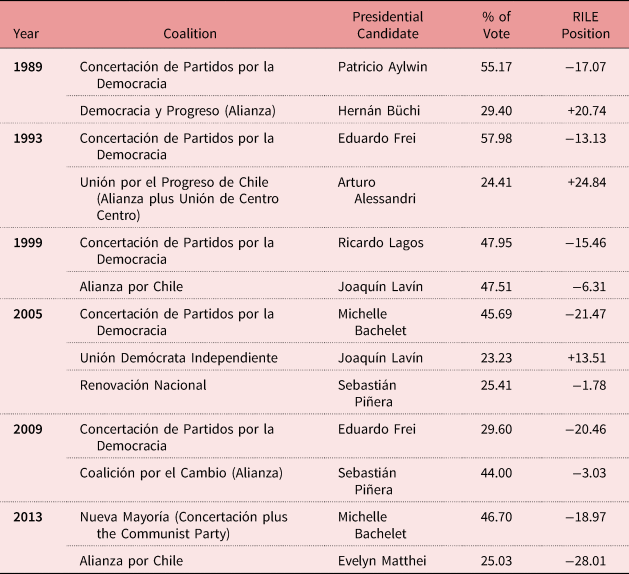
By looking at the data provided by MARPOR, we step directly into the verification of the three hypotheses presented in our theoretical framework. Table 1 presents an overview of the coalitions included in the analysis and their electoral results in presidential elections. It shows that the centre-left Concertación coalition collected a record of four consecutive victories in presidential elections between 1989 and 2009, meaning that the coalition was in office for about 20 years. Moreover, in the first two elections (1989 and 1993) the centre-right coalition Alianza suffered electoral defeat so profound that it was unable to force a ballotage. Instead of expanding its base of support, the centre-right coalition obtained fewer votes in 1993 than in 1989. This is related not only to the coalition's struggle to agree on a candidate but also to its continued strongly conservative profile.Footnote 41
Overview of Coalitions Included in the Analysis

Source: Authors’ elaboration from MARPOR database, which is available at https://manifesto-project.wzb.eu/, last access 5 June 2019.
The key turning point was the 1999 presidential election between Ricardo Lagos and Joaquín Lavín, in which for the first time the Right obtained enough votes to force a run-off. Although Lavín belonged to the more conservative Unión Demócrata Independiente (Independent Democratic Union, UDI), he was one of the key figures in the gradual moderation of the Right and the development of a new electoral strategy marked by distancing from the traditional right-wing agenda.Footnote 42 As Taylor Boas points out, this election marks ‘[the] Chilean right's first wholehearted embrace of the Concertación's model of campaigning’.Footnote 43 The Right's presidential candidates have since converged upon a strategy initially employed by the Left and become much more competitive in the electoral arena.Footnote 44
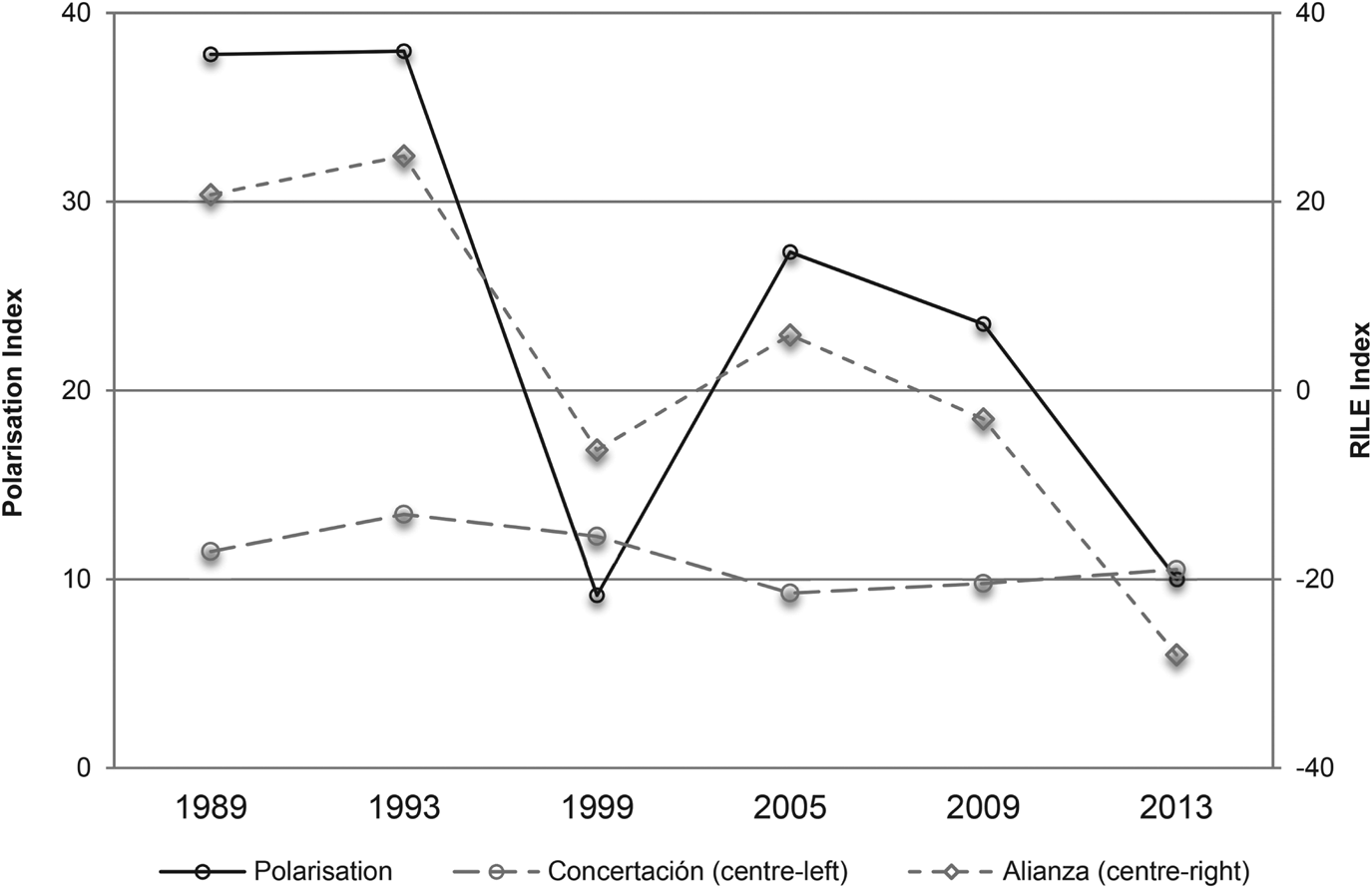
One of the most discussed issues in the analysis of the Chilean party system since 1989 has been programmatic convergence.Footnote 45 This is perhaps understandable, given the elite agreement forged during the 1990s due to the Right's need to compete with the centre-left Concertación coalition when authoritarian reversal was no longer an option, and the Left's need to cooperate with the Right because of the institutional constraints inherited from the Pinochet dictatorship.Footnote 46 The manifesto data confirms that coalitions have also tended to converge at the level of electoral competition. Figure 1 shows the right–left position (RILE index) for the centre-left Concertación and the centre-right Alianza.Footnote 47 We also calculated a polarisation index as the programmatic distance between the two coalitions by simply subtracting both values.
Right–Left (RILE) Position of Main Coalitions and Polarisation Index

Two features stand out in Figure 1. First, the polarisation index confirms the reduction in the level of polarisation between the two main political coalitions over time, with historical lows in 1999 and 2013. Second, the declining polarisation reflects a process of gradual convergence in competition strategies, as evidenced by the narrowing gap in the RILE index for both coalitions. In line with Martin Bækgaard and Carsten Jensen's argument, this convergence trajectory has not been linear, but rather has followed a two-step pattern: first distancing, then approaching.Footnote 48 The level of convergence is such that in the 2013 election both coalitions were programmatically equivalent.
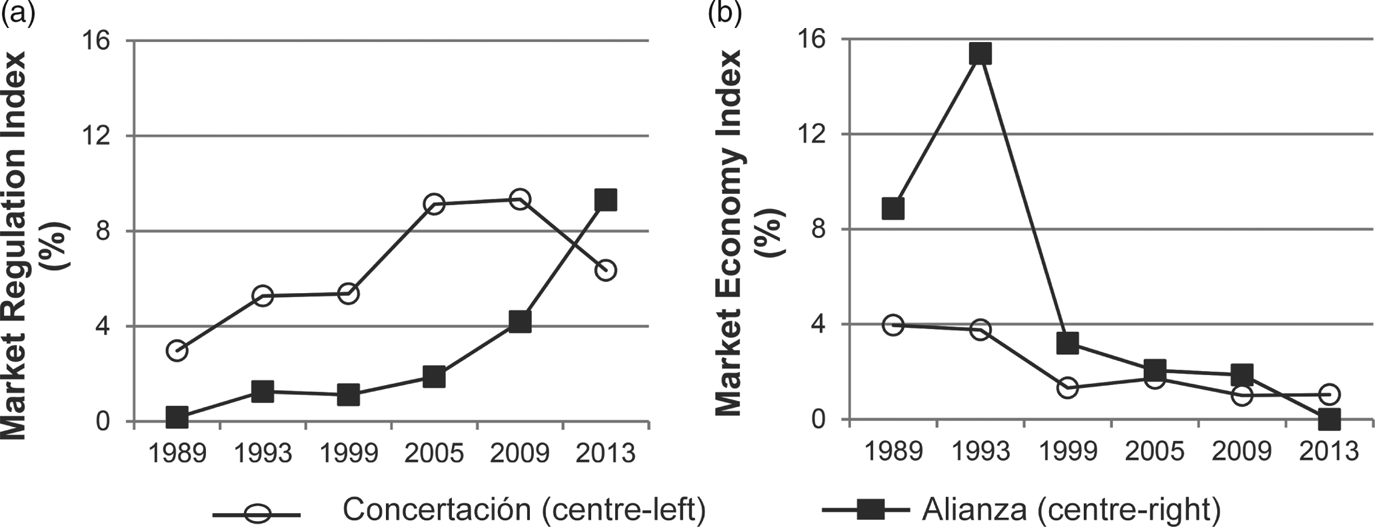
Figure 1 also provides evidence that reveals the direction of convergence, thus supporting our second hypothesis. Much extant scholarship on programmatic evolution in Chile assumes the locus of programmatic convergence to be toward the right side of party competition.Footnote 49 The MARPOR data contradicts this, highlighting that the main cause of convergence has been the evolution of the rightist coalition toward the left. Most notably, in 2013 the RILE indicator shows that the centre-right Alianza lies further to the left than the centre-left Concertación. While perhaps counter-intuitive at first sight, in the vein of the ‘signalling’ interpretation of electoral manifestos,Footnote 50 we argue that the indicator reflects the special nature of political competition in 2013. On the one hand, the Nueva Mayoría (New Majority) – a coalition comprised of Concertación plus the PC – programme was fairly balanced between different policy areas, but placed more emphasis than the Centre-Right on maintaining the market economy and less on market regulation (see Figure 2). Most plausibly, the coalition did this strategically to ensure that an otherwise reformist programme did not scare off the business community. On the other hand, Alianza's 2013 ‘shift to the left’ can be explained by the high concentration of mentions in the manifesto for expanding education (15.6 per cent against 6.9 per cent of the Nueva Mayoría manifesto). In fact, removing the education issue from the RILE indicator leaves both coalitions with the exact same score in 2013. We interpret this as Alianza's reaction to the growing significance of education issues for the population. Put in other words, the Centre-Right decided to give more salience to this issue whose perceived importance had grown for the voting public, particularly after the 2011 student protests and the right-wing Piñera administration's (2010–13) inability to control the education agenda throughout its mandate, a problem that contributed significantly to the erosion of Sebastián Piñera's approval ratings.
Salience of ‘Market Regulation’ and ‘Market Economy’ in Coalitions’ Political Programmes

The data points to two interconnected processes supporting our expectations: inertia in the competition strategies of the Centre-Left and the gradual yet relentless moderation of the Centre-Right. We take each in turn. The consistency of the Concertación coalition's electoral competition strategy over time is quite remarkable. Following the theory of party adaptation, the most obvious explanation for this is the coalition's electoral success: given that Concertación won four consecutive presidential elections (1989, 1993, 1999 and 2005) with manifestos advocating very similar policy proposals, it has had little incentive to innovate.Footnote 51 In effect, by disaggregating the dimensions of political competition, we show that this coalition has evolved little. Moreover, there is vast agreement among scholars that the parties that belong to Concertación experienced a learning process during the 1980s, which produced not only programmatic moderation but also growing convergence between them.Footnote 52
What is more interesting is that this stability provides a new perspective on the evolution of the Left in Chile. Concretely, it shifts the focus of attention from the question of whether there was a turn to the left, as in other Latin American countries, to that of explaining why and how a fairly left-wing political programme transforms into much more moderate policy-making processes once a coalition is in government. In fact, the Latin American left-turn literature argues that Chile represents a case of a ‘moderate’ Left.Footnote 53 The main characteristics of this moderate Left lie in its embrace of the market economy and a deep respect for the institutions of liberal democracy. Different from this, our analysis based on the MARPOR data confirms that, at the level of electoral competition, Concertación's position has remained surprisingly ‘leftist’ and stable over the last two decades, even when compared with other traditional left-wing parties in the Western world that have spearheaded a true turn toward more moderate positions. For example, considering the 1990–2014 period, Concertación's average RILE score (−17.9) is much more ‘leftist’ than the average RILE scores of the US Democratic Party (+1.5), the UK Labour Party (−7.2) and even the German Social Democrats (−13.0), while its standard deviation is about four times lower than that of these parties.Footnote 54 This highlights the distance between the policies announced during campaigning and their implementation once the president comes to power. In other words, one could argue that Concertación has advanced a left-wing programme as an electoral strategy, but in government ends up adopting a moderate policy-making strategy.Footnote 55 This question warrants further research and we return to it briefly in our concluding remarks.
A second trend in the convergence trajectory is the moderation of the Right. As Figure 1 illustrates, while the Chilean right-wing coalition began with a typically rightist electoral platform in the 1990s, it moved on to a rather centrist one in the 2000s and then veered sharply to the left in 2013. By way of comparison, in the 1990s Alianza's average RILE score (+22.8) is similar to that of the US Republican Party (+27.3), whereas in the 2000s Alianza's score (−1.2) is closer to that of José María Aznar's Partido Popular (Popular Party, PP) in Spain (+3.3). As a result, taking into consideration the whole 1990–2014 period, Alianza's standard deviation is more than three times higher than that of the US Republican Party and the Spanish PP.Footnote 56 Several authors point to the existence of ‘two rights’ in Chile and their strategy of forming electoral and governing coalitions as an explanation for this moderation.Footnote 57 The two rights are the UDI on the extreme right, formed by former collaborators and defenders of Pinochet's regime legacy and business interests, and the centre-right Renovación Nacional (National Renewal, RN), formed from the vestiges of the old Partido Nacional (National Party, PN) and a new generation of liberal leaders who intend to represent a wider right-wing constituency.Footnote 58
Nevertheless, the mere existence of the two rights does not explain the gradual convergence toward centrist and even leftist positions. In line with the party adaptation theory reviewed earlier, we believe this is due to a learning process through which the Right adjusts its strategy of political competition over time due to substantial and continued electoral losses. Poor electoral results with a traditional right-wing programmatic platform in the 1990s opened up a process of electoral re-definition. While the first move – as the theory goes – was toward the right in an attempt to re-capture the rightist vote, the subsequent moves were intended to chase a more successful left-wing coalition, thereby gradually moderating the Right's initially conservative programme. This move toward the centre paid off with better electoral results at the end of the 1990s, encouraging the coalition to adopt a more moderate platform in the 2000s and leading to an almost outright abandonment of its traditional platform in the 2010s.Footnote 59 Not by chance, Andrés Allamand, one of the main advocates of moderation as key for the Right's electoral success, has recently argued that the Chilean ‘Centre-Right needs to adopt a new approach: to assume for certain that inequality as a problem exists, that it does not resolve itself and that from now on it will be a political priority for the Centre-Right’.Footnote 60
The Dimensions of Electoral Convergence in Post-Transition Chile
The MARPOR database has the benefit of allowing a disaggregation of the dimensions of electoral competition along several issues. The database itself offers four indices that show the salience attributed to common political conflicts: economic planning, the defence of a market economy, welfare state expansion and international peace. Moreover, it allows researchers to construct their own indices and use the percentage of mentions contained in each question as a measure of the salience of that issue in the relevant political programme.Footnote 61
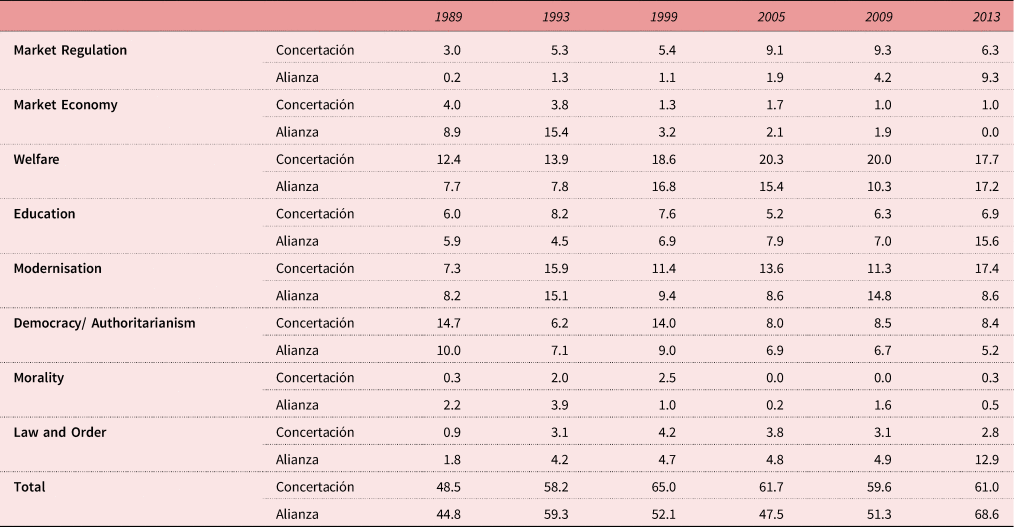
To uncover the dimensions of electoral convergence in Chile and its evolution across time, we use three indices included in the MARPOR database: ‘market regulation’,Footnote 62 ‘defence of the free market’ and ‘welfare and social policy’, which includes ‘education’. These summarise the main axes of programmatic competition in Western democracies and allow for comparisons over time and across countries. We leave out the ‘international peace’ index, given the low salience it has in the Chilean coalitions’ programmes. We also create two additional measures: a ‘modernisation’ index and a ‘democratic/authoritarian’ index. While the first intends to capture a dimension of electoral competition that is relevant outside developed democracies, the second intends to reflect the significance of this cleavage in electoral competition in Chile. Furthermore, to show the increase in issue competition in Chile, we analyse the salience of ‘morality’ and ‘law and order’ issues, which have increased in relevance to the population in recent years. This gives us eight issues that account for most of the coalitions’ attention in their electoral programmes. As Table 2 shows, they cover between roughly 45 per cent and 70 per cent of the issues underpinning electoral competition in each election since 1989.
Salience of Studied Indexes and Issues (% Mentions in Manifesto)

Source: Authors’ elaboration from MARPOR database, which is available at https://manifesto-project.wzb.eu/, last access 5 June 2019.
Market Regulation and Defence of the Free Market
Figure 2a shows the position of Concertación and Alianza on the issue of market regulation, i.e. topics related to increased consumer protection, economic competition and prevention of monopolies and other situations disrupting the functioning of markets.Footnote 63 The figure shows that market regulation has increased in prominence in both coalitions over time and the salience of the issue clearly increased from the 1990s to the 2000s. In the case of the left-wing Concertación, market regulation jumps from less than 6 per cent of mentions in the 1990s to almost 10 per cent in the 2000s, before falling again to 6 per cent in 2013. In the case of the right-wing Alianza, the importance of market regulation jumps dramatically from negligible in 1989 to almost 10 per cent in 2013. This implies that increased support for market regulation constitutes one of the issues that explain the moderation of the Chilean Right, especially in the last two elections. Just to illustrate this position, while the 2009 right-wing manifesto argued that ‘we will continue to promote the organisation of consumers, so that they can defend their rights, and perfect the legislation so that they can access the Courts of Justice’,Footnote 64 the 2013 right-wing manifesto maintained that ‘it is essential to recognise that an adequate functioning of the market requires periodic reviews of the regulations and the existing institutions’.Footnote 65
Figure 2a shows that the 2005 election (the first Bachelet government programme) is an inflection point in terms of the salience of market regulation. The reduced presence of the issue in the second Bachelet government programme (2013 election) might be explained less as a reaction than as a change in the tone of the discourse of her campaign. As opposed to 2005, the discourse of the 2013 campaign included not just more market regulation but greater state intervention. The following statements from the respective years’ coded manifestos support this interpretation. In 2005, the Bachelet campaign posed the issue of market regulation in the following terms: ‘Globalisation creates more advantages and opportunities for bigger enterprises vis-à-vis small and medium enterprises. The hidden face of this process may be market concentration, which threatens fair competition and damages the interests of citizens and consumers. A modern economy combats and punishes anticompetitive practices.’Footnote 66 In 2013, both the rationale for the intervention of the state as well as its role had changed: ‘The realisation of the main proposals contained in this programme requires more state and a better state. Chile needs a modern state that can lead development, that ensures fair competition and that can safeguard access, quality and satisfaction in the public services that it delivers to its citizens.’Footnote 67 This shows that while in 2005 the centre-left coalition believed that the main role of the state was to ensure adequate regulation and oversee the correct functioning of markets, in 2013 the coalition stressed the need for a more active state, highlighting the need for the state to lead the development model. With respect to the Right, the evolution of the salience of market regulation in the coalition's programme – especially during the 2013 election – may be interpreted as a right-wing coalition reacting to a successful left-wing coalition attempting to ‘own’ the discourse of taming unfettered market competition and protecting consumers from abuses, particularly following a series of notorious collusion scandals at the end of the decade.
Figure 2b shows the market economy index for both coalitions. This index includes positive mentions of the free market, free market capitalism as an economic model and related policies like privatisation, fiscal austerity, etc.Footnote 68 The figure shows a significant decrease in mentions of the market economy for both coalitions, especially Alianza. This data is particularly relevant for examining the change in the Right's electoral strategy, from a traditional right-wing platform during the 1990s and up to 15 per cent of the electoral programme devoted to defending the market economy in 1993, to little more than 3 per cent in 1999 and declining thereafter. Interestingly, Figure 2b mirrors Figure 2a and this is perhaps the best illustration of the change in Alianza's electoral strategy in order to match its more successful centre-left competitor.
Welfare and Social Policy
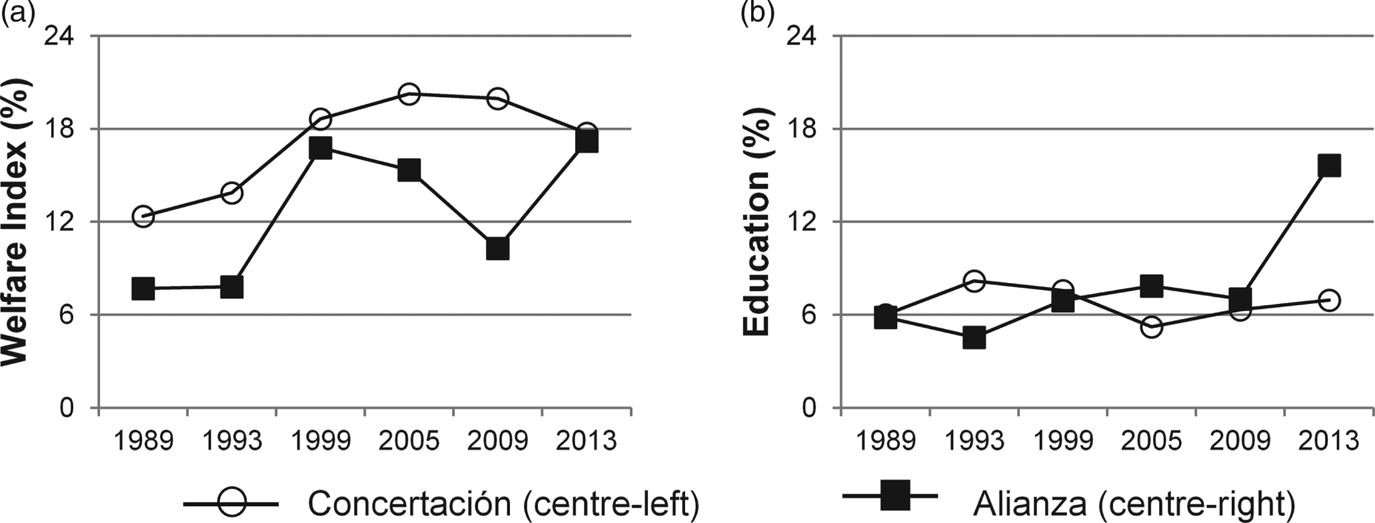
Figure 3 shows the position of the two coalitions on welfare issues.Footnote 69 This data reveals that welfare has constituted a significant and growing part of the Concertación electoral programmes since 1989. Conversely, the important part that welfare issues play for the Right's electoral profile today is noteworthy. Since the 1999 election, welfare issues have become a substantial topic in the Alianza programmes, in recent elections reaching the same level of significance as for its centre-left counterpart. Concretely, mentions of welfare increased by 10 per cent from 1989 to 2013 (7.7 per cent to 17.2 per cent). Moreover, if we consider the expansion of education as an additional dimension of social policy and welfare (Figure 3b),Footnote 70 an issue where salience increased from 5 per cent to 15 per cent for Alianza between 1989 and 2013, mentions of welfare and education alone account for one-third of the coalition's manifesto. We can state, therefore, that welfare and social policy – including education – are the main issues of convergence in electoral competition in Chile.
Salience of Welfare and Education Issues in Coalitions’ Programmes

This finding reinforces previous research on the evolution of the Right in Chile and other Latin American countries. For example, Manuel Alcántara Sáez shows that in the early 2000s Chilean social policy (including housing, healthcare and social assistance) was the only item where nearly a majority of right-wing deputies justified high state intervention. In fact, support for state intervention among right-wing deputies on these issues was equivalent to that of the PDC, a major coalition partner in the centre-left Concertación.Footnote 71 Other research on the evolution of party–voter linkages in Chile has underscored the emergence of a more progressive social policy profile in the UDI, intended to attract the vote of poor constituencies.Footnote 72 This is coincident with research showing that Latin American right-wing parties governing after the ‘turn to the left’ have tended not to dismantle progressive social policies and, in some cases, have even expanded them.Footnote 73
Modernisation
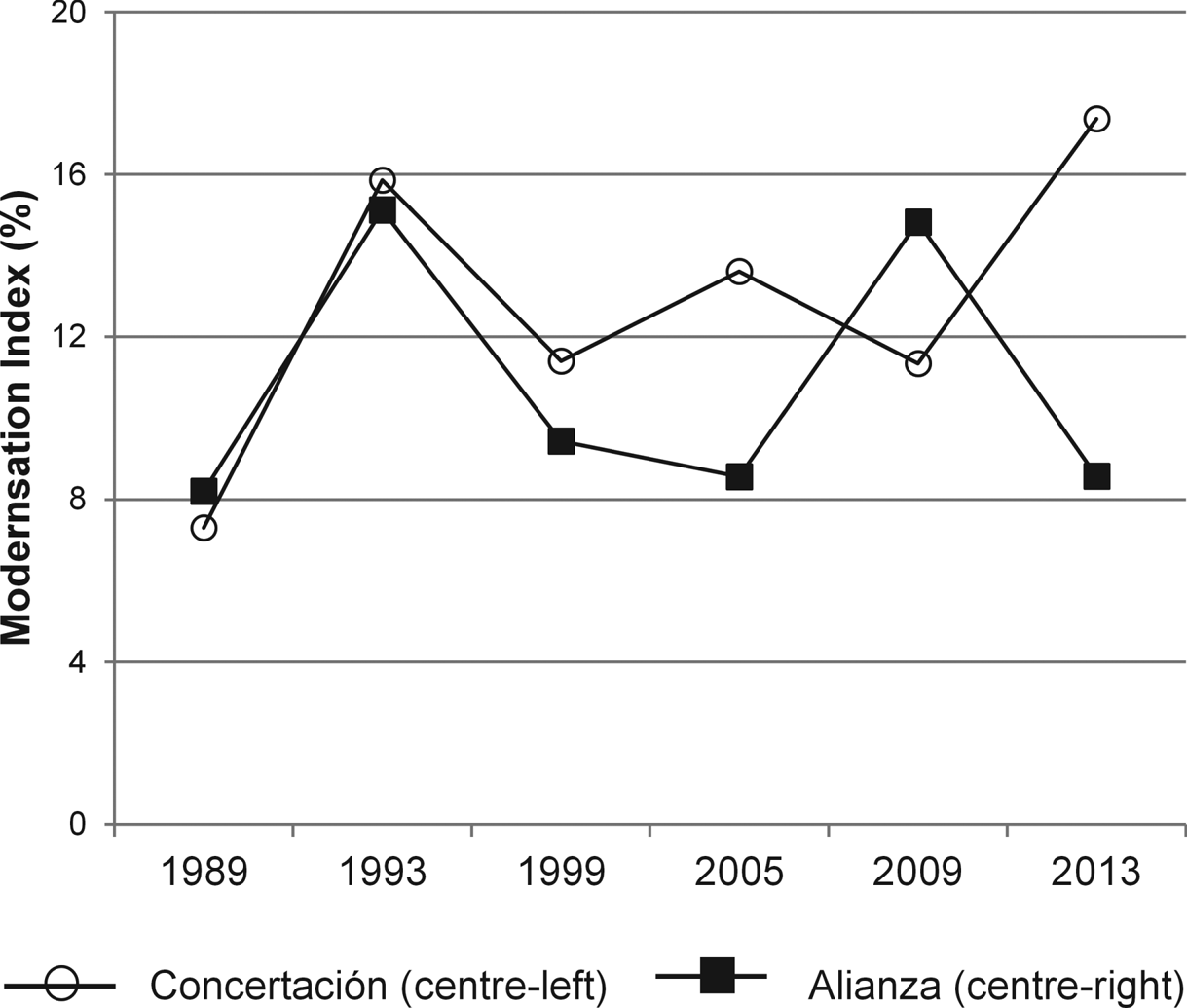
We constructed a modernisation index (see Figure 4) by adding statements that deal with governmental and administrative efficiency,Footnote 74 as well as positive mentions of technology and infrastructure.Footnote 75 The data shows a high salience of modernisation issues for both coalitions, comprising between 8 per cent and roughly 18 per cent of their manifestos throughout the analysed period. The right-wing Alianza shows two peaks, in 1993 with Arturo Alessandri and again in 2009 with Piñera, when it reached close to 15 per cent. The latter is consistent with the technocratic tone of Piñera's 2009 campaign. For the left-wing Concertación, on the other hand, there is a gradual increase in the index, with peaks in the 1993 election with Eduardo Frei and again in the last election of 2013 with Bachelet. The salience of this issue in Bachelet's 2013 programme might be related to the need to show administrative competence, given the coalition's history in government since 1989 and its expansion toward the left with the incorporation of the PC.
Salience of Modernisation Issues in Coalitions’ Programmes

All in all, the data reveals that while highly salient in the electoral programmes, the theme of modernisation probably constitutes a valence issue. Given that Chile is a country that, despite its economic progress, still faces serious problems in areas such as infrastructure, productivity and innovation, it is not surprising that the two dominant coalitions agree on the necessity of fostering economic modernisation. In addition, the high salience of modernisation for both coalitions suggests that there might be competition over ownership. As Bonnie Meguid points out, when certain issues are desired by the whole population, mainstream parties need to not only take this issue into account but also try to own the issue in question to win credibility over rivals.Footnote 76
The Democratic/Authoritarian Cleavage
A significant amount of literature on the evolution of Chilean politics is devoted to discussions of the influence and change of cleavages after democratisation. One crucial controversy is whether the main cleavages that structured Chilean politics prior to the authoritarian breakdown of 1973, i.e. the class and religious cleavages, are still relevant for party competition or whether a new democratic/authoritarian cleavage forged during the dictatorship, dividing supporters from opponents of Pinochet and his legacy, is more salient.Footnote 77 Contemporary contributions to this debate argue that whatever their importance in the immediate post-authoritarian years, this may no longer be the case. For instance, Matías Bargsted and Nicolás Somma find that the significance of both cleavages has been gradually declining.Footnote 78 Similarly, Juan Pablo Luna and Rodrigo Mardones argue that the election in 2010 of Piñera, the first right-wing president after democratisation, marked the decline of the democratic/authoritarian cleavage and therefore opened a new era for party competition in the country.Footnote 79
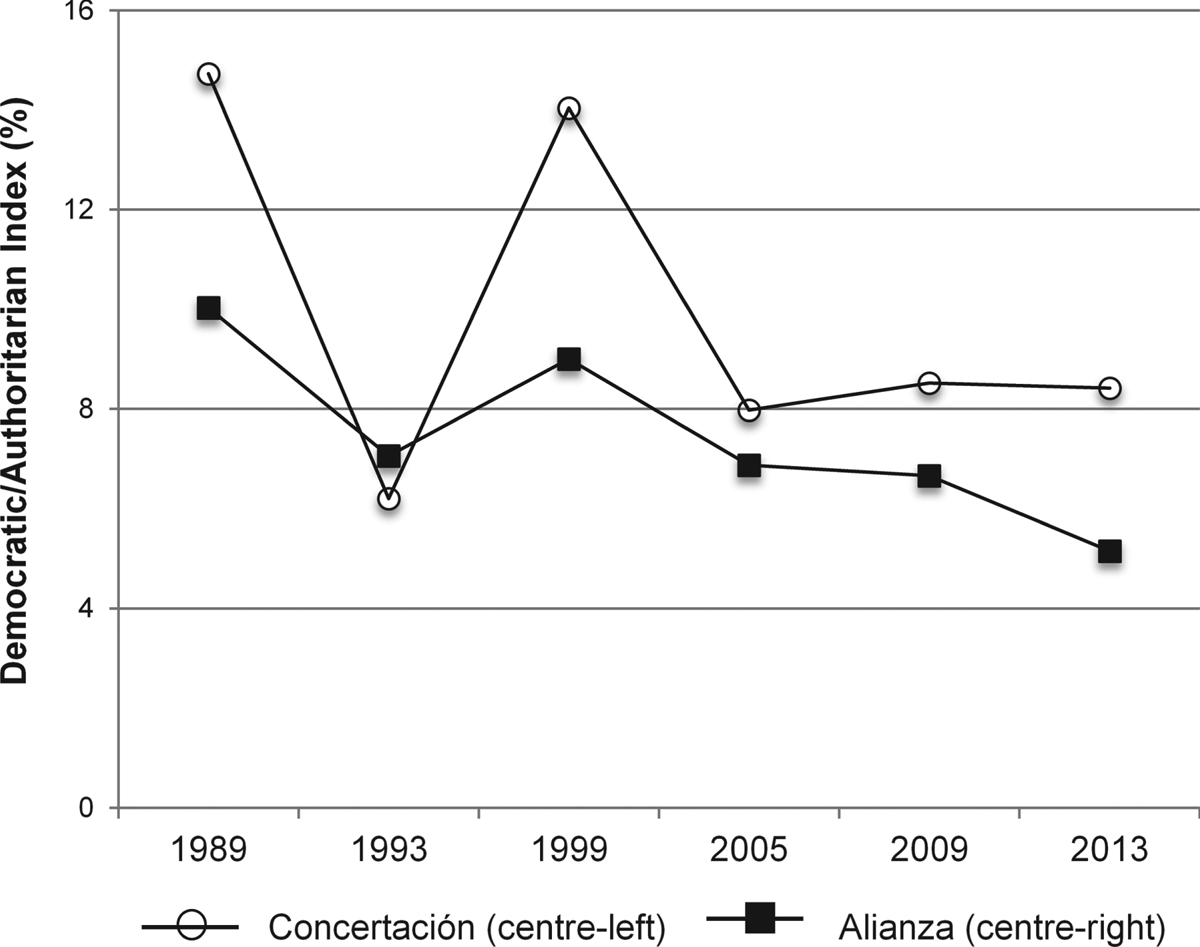
Taking advantage of the MARPOR database, we have constructed a democratic/authoritarian index that captures the salience of this cleavage in political competition since 1989.Footnote 80Figure 5 shows the democratic/authoritarian index and its evolution. The data confirms that the relevance of this political cleavage has decreased significantly: its salience fell to little more than half of what it was in 1989 (from 14.7 per cent to 8.4 per cent for the centre-left Concertación and from 10 per cent to 5.2 per cent for the right-wing Alianza). Nevertheless, this also shows that the democratic/authoritarian cleavage remains an important issue in electoral competition between the two coalitions. In fact, in the 2013 elections, mentions of issues related to this cleavage occupied more than 8 per cent of Nueva Mayoría's programme and more than 5 per cent of Alianza's.
Salience of Democratic/Authoritarian Cleavage

Cartelisation and Issue Competition in Post-Transition Chile
As we have demonstrated, electoral competition in Chile has made the two main political coalitions converge over time in the typical areas where the Right and the Left tended to diverge in the past, notably in terms of welfare and market regulation. Moreover, while the democratic/authoritarian cleavage still weighs in the coalition's electoral strategies, it has declined significantly in importance. Therefore, seen in the light of the MARPOR data, it is not far-fetched to suggest that the Chilean party system is characterised by the electoral dominance of two political forces, which increasingly campaign by developing similar policy proposals in their manifestos. This portrayal of contemporary Chile is quite close to the cartel party thesis advanced by Richard Katz and Peter Mair, who draw attention to the replacement of the traditional mass party by a new type of political party which not only adopts patterns of interparty collusion rather than competition, but also privileges professional expertise and technocratic depoliticisation over political activism and strong roots in society.Footnote 81
Although the cartel party thesis was originally developed to understand political transformations occurring in Western Europe, it can be adapted to analyse the reality of other countries.Footnote 82 Katz and Mair relate the rise of the cartel party and the reduction of party competition directly to the increasing dependence of parties on public funding, a thesis that does not apply to post-transition Chile because party financing has been marked until recently by private donations rather than public money. However, recent corruption scandals have shown that the centre-left and centre-right coalitions obtained funds for campaigning from the business sector in exchange for political influence to achieve a similar result: ensuring that either of the coalitions will govern in a fashion favourable to the interests of the existing economic elites.Footnote 83 As Luna indicates, ‘the upshot of these scandals has been to reinforce the perception that political and business elites are colluding to perpetrate “abusos” [exploitation] for the sake of “lucro” [profit]’.Footnote 84
Therefore, one could argue that the more political coalitions obtained funds from the same source (the business community in the case of Chile), the more they came to resemble one another and adopt similar policy approaches during campaigns. Seen in this light, the increasing convergence between the Centre-Left and Centre-Right in post-transition Chile revealed by the MARPOR data gives some validity to the cartel party thesis. Furthermore, cartelisation helps explain why Concertación's centre-left administrations have made little effort to undertake structural reforms to address the country's economic disparities. Despite the presence of many signs of discontent with the existing levels of inequality, the increasing politicisation of inequality by social movements,Footnote 85 and a fairly leftist and stable political manifesto, the coalition systematically refrained from undertaking more radical reforms while in government. One problem, among others, is that a more leftist government would have threatened the interests of powerful elites, who would have not only stopped financing the Centre-Left's political campaigns but also hardened, limiting a more progressive government agenda.Footnote 86 To a certain extent, this is what happened to Bachelet in her second, more progressive administration (2014–18): the more she pushed for far-reaching reforms, in line with her reformist impetus but undesirable for the business community, the more the latter attacked her agenda.Footnote 87
Another way of looking at the cartelisation thesis is by examining the extent to which issue competition is taking root in Chilean party competition. After all, Katz and Mair maintain that once mainstream parties are ‘largely indistinguishable from one another in terms of their main policy proposals’, they will try to politicise other issues with the aim of signalling at least some sort of difference to the electorate.Footnote 88 Moreover, by examining whether issue competition is taking place in contemporary Chile, we can shed light on our third hypothesis, namely that it is the rightist Alianza, the coalition with more electoral defeats, which has mooted new issues for electoral competition. We examine this argument in two issues where the Right might have a competitive advantage: morality and law and order issues.
Morality Issues
A number of authors highlight the growing importance of post-materialist issues related to lifestyles, culture and the environment in electoral competition in the Western world.Footnote 89 They indicate that as countries increase their level of economic development and welfare, electoral competition will be progressively more concerned with post-materialist issues and less based on traditional cleavages.Footnote 90 In Chile, research has demonstrated the increasing salience to some segments of the population of issues such as divorce, abortion and same-sex marriage.Footnote 91 At the same time, however, Chile is often portrayed as a conservative society in comparison with other Latin American countries, one where the Catholic Church still exerts significant moral as well as political influence.Footnote 92
We have proxied post-materialist issues using the ‘traditional morality positive’ and ‘traditional morality negative’ variables contained in the MARPOR database.Footnote 93 These refer to opposite takes on prohibition, censorship, suppression of alternative behaviour (including divorce, abortion, etc.), maintenance and stability of traditional family values and support for religious institutions and their influence on public affairs.
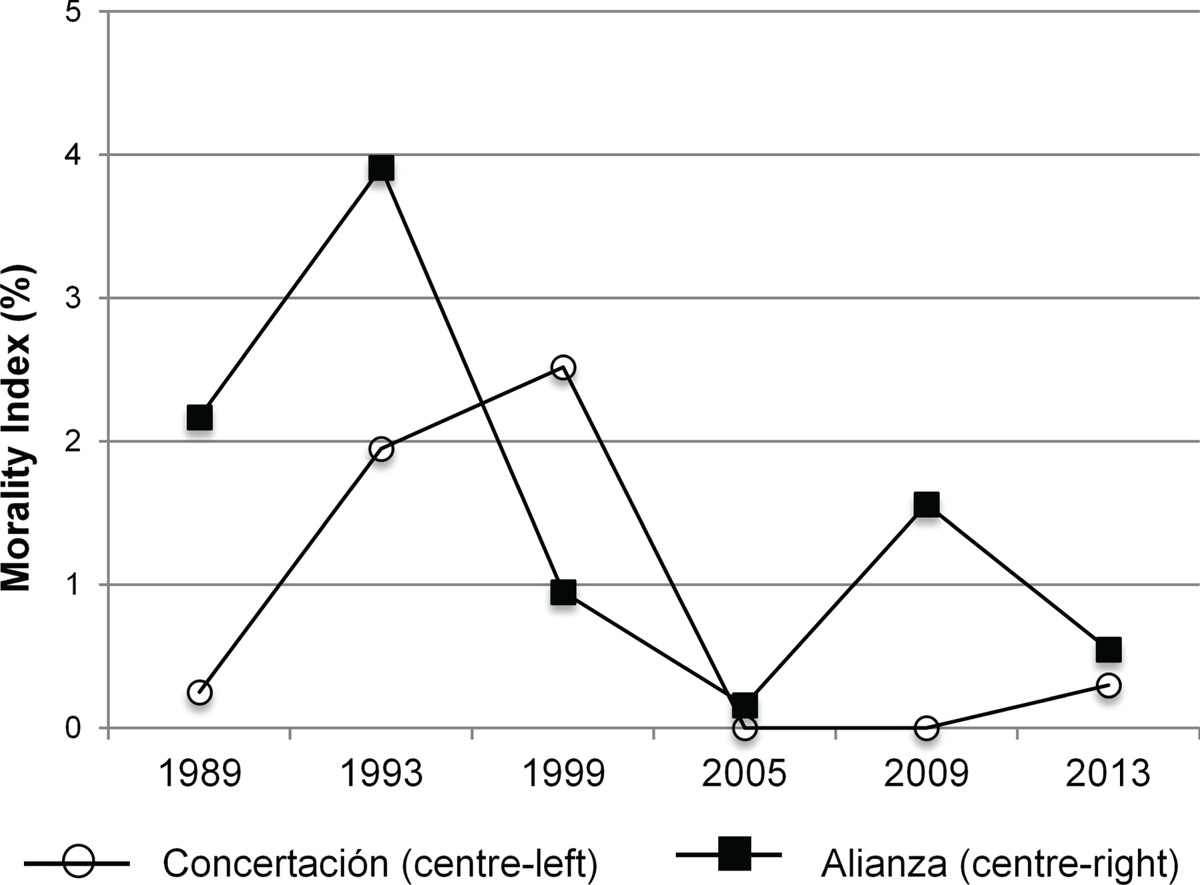
Figure 6 shows the evolution of the salience of morality issues in the electoral strategies of Chile's two main coalitions. The data reveals that morality issues have remained residual in the manifestos of Chile's two main political coalitions, with an average salience of about 1.2 per cent in all elections between 1989 and 2013, and a peak of close to 4 per cent in the 1993 election. Although the data does show that, as expected, the Centre-Right has relied more on morality issues for electoral competition than the Centre-Left, it also demonstrates the declining salience of morality in party competition. In fact, in the 2013 presidential election, morality issues represented less than 1 per cent of the electoral programme of both coalitions. This means that Chile's two main electoral coalitions have not tried to politicise moral issues, although post-material values seem to be becoming increasingly relevant to certain segments of the population. The reason for this probably lies in the fact that the parties of the coalitions have different positions on moral issues, and in consequence, with the aim of avoiding internal conflicts, the parties that belong to each of these coalitions prefer to be silent on this topic in their presidential platforms.Footnote 94
Salience of Morality Issues in Coalitions’ Programmes

Law and Order Issues
In the context of the turn to the left in Latin America, it has been argued that an increasing politicisation of crime and public security concerns is one of the strategies by which right-wing political parties try to buttress their electoral strength.Footnote 95 Although Chile is one of the countries in the region with the lowest indicators of crime and violence, the population has consistently ranked crime among their major concerns in public opinion polls. This, and the fact that the police force continues to be one of the most trusted institutions in the country, incentivises campaigning on law and order issues.Footnote 96
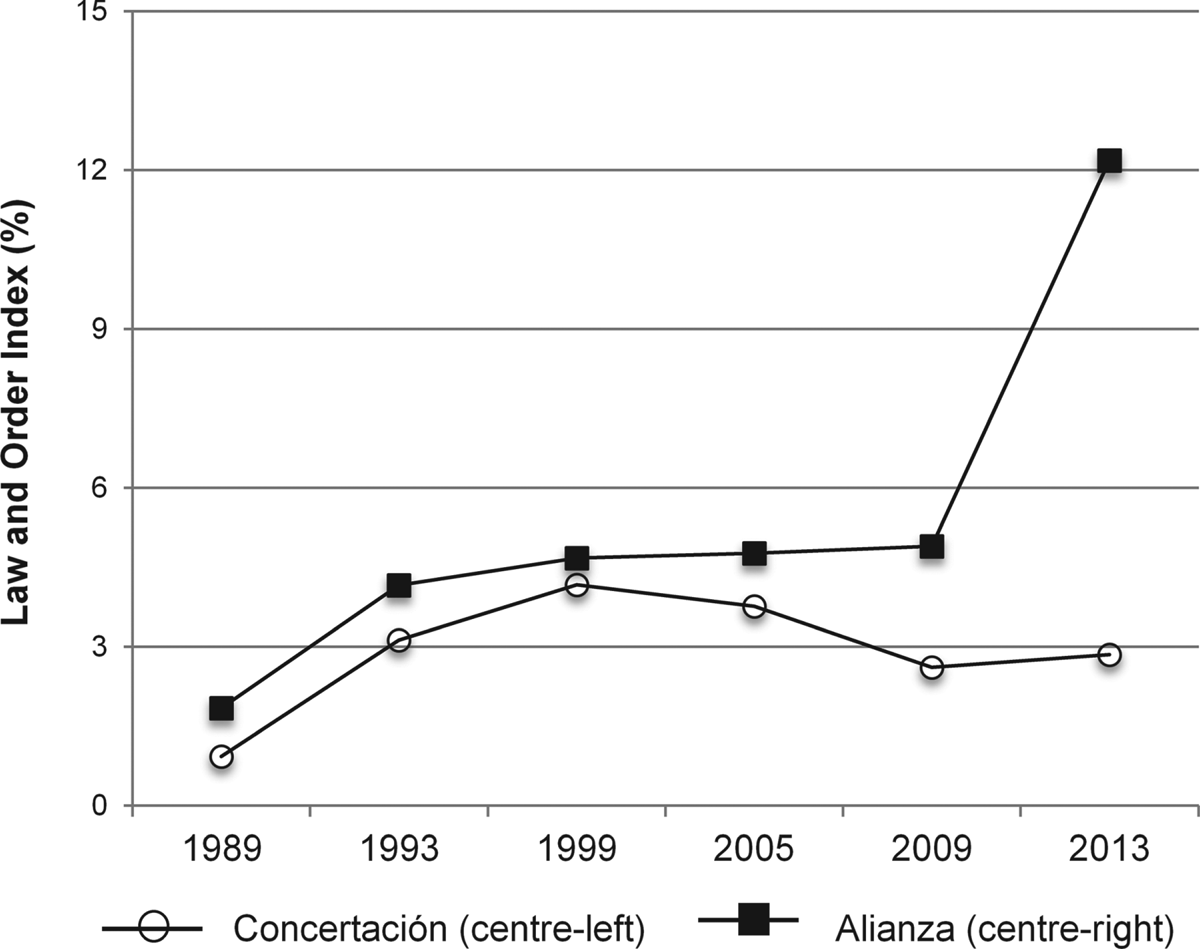
Our data in Figure 7 shows an increase in the salience of law and order issues, positive and negative,Footnote 97 with a rise of up to 4 per cent in the mid-1990s, decreasing slightly for the leftist coalition in the 2000s, but jumping to 12 per cent for Alianza in the 2013 election. Unlike every other dimension of party competition studied here, in the case of law and order it has been the rightist coalition that has consistently and increasingly devoted a larger part of its electoral manifesto to this issue. This indicates that while converging toward the more successful Concertación on almost all issues relevant for electoral competition in Chile, the one issue on which Alianza is consistently seeking an electoral advantage is law and order. This suggests that issue competition might be gradually on the rise in contemporary Chile, particularly because of the Right's interest in presenting itself as the defender of an ‘iron-fist’ approach toward crime. Take, for instance, the following sentence of Alianza's 2013 manifesto: ‘We see how, day after day, people with long police records walk free and commit crimes. […T]hese people cannot be free. This is why in our government, no delinquent or drug trafficker who is a repeat offender will have the right to early conditional release, but will have to serve his complete sentence in prison.’Footnote 98
Salience of Law and Order Issues in Coalitions’ Programmes

Concluding Remarks
In this article we use, for the first time, data generated by the MARPOR project to assess how the electoral platforms of the two main Chilean political coalitions varied from the end of Pinochet's dictatorship in 1989 to the 2013 presidential election. We demonstrate that ideological convergence has been growing, to the point that in the 2013 presidential election the differences between the centre-left and centre-right coalitions were minor. However, contrary to most scholarly accounts pointing to the moderation of the Chilean Left, the MARPOR data shows that it has been the centre-right coalition engaging in a pronounced process of ideological moderation and not the Left, which has maintained a fairly stable left-wing platform even by international standards. Therefore, our first contribution lies in explaining this unexpected result: the severe electoral losses that the Right experienced during the 1990s paved the way for a steady moderation of the policy proposals defended by right-wing presidential candidates in their electoral manifestos. The result of this transformation is growing programmatic convergence between the two political coalitions, although one important difference exists: the growing emphasis on law and order by the Centre-Right.
A second contribution derived from this analysis is to reinforce the utility of analysing electoral manifestos for the study of political competition and its relevance for examining the state of Chilean democracy. One could argue that the moderation of the centre-right coalition is linked to its ability and/or need to take into account demands for more market regulation and welfare expansion. This is certainly true and provides grounds to think that political coalitions in post-transition Chile have been trying to adapt to remain competitive. From this perspective, the party system responds to the demands of the electorate and can therefore adequately represent citizens, as in the median voter theory. However, this contrasts with a vast amount of literature on Chilean politics that draws attention to the unresponsiveness of mainstream political parties and their detachment from society.Footnote 99 This scholarship highlights that the two dominant political coalitions have become ossified and thus have increasing difficulties channelling demands emanating from below, seen in the increased preponderance of social movements and protests in recent years.Footnote 100 Seen in light of our analysis, we can argue that programmatic convergence is becoming a real challenge for Chilean democracy as voters have growing problems identifying the extent to which mainstream political forces meaningfully articulate different policy platforms during campaigns.
Although academics and policy-makers alike saw political polarisation as the main threat to the consolidation of democracy in the early 1990s, this does not seem to be the case today, when convergence, not polarisation, jeopardises Chilean democracy.Footnote 101 Following the cartel party thesis, we may state that, once a political cartel is established, two main threats can affect the democratic system: defection and challenge from new entrants.Footnote 102 While the former results from decreasing sympathy for and identification with mainstream political parties, the latter refers to the formation of new political forces that attack the established ones because of their unwillingness and failure to represent the electorate. As various scholars have shown, these two threats are becoming manifest in contemporary Chile: not only has the level of identification with established political parties plummeted, but new political actors have been gaining ground.Footnote 103
Finally, this article's third contribution is the opening up of a promising avenue of research for the role of manifestos in Latin America – a region that the MARPOR project is currently coding – allowing scholars to use this dataset in the near future. We discuss these contributions in more detail. As we indicated in our analysis of electoral manifestos in Chile, it is important to make a distinction between what parties and leaders say when competing with a certain programme to win office, and the programmatic ideas that they follow once in power. As Boas indicates, ‘[c]ampaigns often touch upon policy, but the process of policy-making in Latin America is very different from the way candidates choose their strategies’.Footnote 104 This seems to be particularly true for the case of Chile, where the centre-left coalition has advanced relatively leftist programmes according to the empirical material discussed in this article, but most presidents of this coalition have undertaken very moderate reforms. By the same token, one could maintain that the centre-right coalition has learned that neoliberal orthodoxy is a non-option in the electoral arena and it needs to find ways to demonstrate sensitivity to social concerns, independent of what it does once in government. In short, what political actors say on the campaign trail may be quite different from what they actually do when policies get created.
Because party manifestos should be seen as the signals that leaders and parties send to the electorate in order to win elections, it is worth analysing in detail the extent to which the actual policy responses of governments deviate from the programmatic propositions made during campaigning. As the dispute over the 2013 Chilean presidential election manifesto at the beginning of this article shows, Chilean party coalitions make use of election manifestos not only for signalling policy proposals to potential voters, but also for agreeing on a common government programme in the context of multiparty coalitions and setting legislative priorities for the administration. In other words, one relevant research question for future investigations is the distance between the actual policies advanced by presidents and those they advocated in their electoral manifestos. In fact, this could help to explain why political parties in Chile and other parts of Latin America are increasingly under stress. After all, if they develop a certain agenda during campaign season but do something different once in government, one should not be surprised when the electorate turns away from established parties.
Acknowledgements
We are grateful for comments and advice from participants in multiple events, including the 2017 and 2018 Conference of the Latin American Studies Association (LASA). Several colleagues were instrumental in conducting this research and provided valuable feedback, including Sonia Alonso, Rossana Castiglioni, Jana Morgan, Onawa Promise Lacewell and Peter Siavelis. Moreover, we would also like to thank the three anonymous reviewers at JLAS for their useful comments on earlier drafts of this manuscript. Both authors acknowledge support from the Centre for Social Conflict and Cohesion Studies (COES, CONICYT/FONDAP/15130009).