I. Introduction
There is now a considerable amount of recent literature about judicial behavior in Kelsenian (German-style) constitutional courts (Epstein Reference Epstein2016; Garoupa Reference Garoupa2017, and references therein). On the one hand, the empirical literature confirms that there is a logic of judicial behavior that is partially ideological, through which judges convert their political attitudes into law when scrutinizing the constitutionality of legislation. On the other hand, those courts also foster a logic of political polarization, through which judges defer to the changing preferences of their partisan appointers as they move from opposition to government roles and vice versa. These two determinants, ideological preferences and party loyalty, play different roles, and their importance is likely to vary in different contexts (Epstein and Posner Reference Epstein2016).
Economic policies under austerity, budgetary limitations, or economic setbacks have been a reality in several North American states, Argentina, Brazil, and all over Europe since the beginning of the sovereign debt crisis (Morlino and Quaranta Reference Morlino2016). In all these countries and regions, when faced with generally unpopular fiscal retrenchment policies, many individuals have looked for constitutional protection, forcing courts to intervene in order to balance the different issues at stake.
When looking at the role of courts that have dealt with budgetary and financial policies in such contexts, many significant questions emerge. How have judges in those courts dealt with austerity measures in a context of intensified political conflict and, often, social upheaval? Have contexts of heightened political demand for judicial scrutiny of austerity policies significantly affected the prevalence of the different logics (ideological preferences and party loyalty) of judicial behavior? Or have such logics, which are incentivized by extant stable institutional rules and arrangements, remained themselves mostly unaffected?
In this article, we look at the case of the Portuguese Constitutional Court (PCC). As in other countries facing complex external bailouts, the PCC has struggled with the inevitable tension between international obligations and constitutional protections. What makes the PCC particularly interesting is the amount of unusual media and scholarly attention it has received so far in this regard, having been described by many observers as assuming a particularly important role in policy making during the financial crisis (Koukiadaki Reference Koukiadaki2014). In order to make austerity a useful context to examine the behavior of Portuguese judges and test the relative importance of ideological preferences and party loyalty in the court, we must take into account previous periods. Particularly, we must recognize that austerity policies adopted during the financial crisis were neither the very first time that the Portuguese government engaged in policies aiming at fiscal retrenchment and budgetary discipline nor the first time constitutional judges had to rule on them. In fact, at least since the beginning of the 21st century, Portuguese fiscal policy has been characterized by successive cycles of loosening and retrenchment, with the latter taking place not only in 2009–14 but also in earlier periods.Footnote 1 Therefore, because of recent Portuguese economic history, we can compare rulings over austerity measures to rulings over other measures in 2009–14 as well as to rulings over similar-to-austerity measures in 2002–9. Did constitutional judges deal with such kinds of policies in those earlier periods as they did later? Has their behavior under the financial crisis and the external bailout differed significantly from their behavior then? In dealing with budgetary, financial, and economic questions, do we find more or less reinforcement of party loyalty at the expense of ideological preferences? Are there judicial personal attributes influencing the balance between party loyalty and ideological preferences?
In the next section, we summarize the literature on judicial behavior in constitutional courts in general and in the PCC in particular. Section III addresses current assessments and expectations about judicial behavior in face of austerity policies. Empirical evidence is developed in Section IV. Section V concludes.
II. Judicial Behavior in the Portuguese Constitutional Court
After years of neglect on the part of judicial politics scholars, the voting behavior of judges in Kelsenian constitutional courts (also known as the German model by which constitutional review is exercised by a top specialized court, in opposition to the American decentralized and nonspecialized model) has begun to be seriously studied. One of the central findings of such research so far is that judges, when deciding on the constitutionality of laws, behave in ways that allow for some degree of predictability on the basis of political determinants. Depending of course on different institutional settings and contexts, two main patterns seem to emerge. First, those courts, to varying degrees, show the signs of what might be called ideological preferences: judges appointed by parties on different sides of the left-right ideological divide in domestic politics tend systematically to reach different conclusions about the constitutionality of legislation. Second, regardless of the ideological placement of the parties that appointed them, judges appointed by parties in government or in the opposition of the day tend not to behave similarly either: while the former tend to conclude for the constitutionality of legislation, the latter tend more often to reach the opposite conclusion. Thus, Kelsenian courts also show the signs of what we could call political polarization, partisan alignment, or party loyalty.
There are good reasons for these patterns to emerge, both linked to well-established theoretical accounts about what drives judicial behavior (the attitudinal and the strategic models). The first reason is linked to the policy preferences of politicians and judges and the way the judicial appointment mechanism contributes to their alignment. Politicians, when they have the ability to appoint judges—as they invariably do to different extents in Kelsenian courts—are likely to select those whose views about the law, political attitudes, and general ideological worldviews are congruent with theirs. Thus, to the extent that judges resort to them in order to interpret and apply constitutional law and statutes, as the attitudinal model suggests they do (Epstein and Knight Reference Epstein1998; Segal and Spaeth Reference Segal2002; Hansford and Spriggs Reference Hansford2006; Spiller and Gely Reference Spiller2007; Epstein Reference Epstein2016), internal divisions within the court are understandably likely to emerge, mirroring ideological alignments in reference to the issues under scrutiny. The second reason is linked to the institutional constraints to which judges are subjected in Kelsenian courts. Unlike what occurs in the US Supreme Court, judges in constitutional courts are not appointed for life. Because constitutional judges hold time-limited mandates (renewable or not), they might want to maintain good relations with their appointer. One possible explanation is that they want to secure future appointments to other offices (Garoupa Reference Garoupa2017). This, in turn, may lead them to behave in a way that, above and beyond their ideological preferences, keeps them responsive to the changing priorities of their partisan appointers as they move from government to opposition roles and vice versa. A degree of personal loyalty to the appointer or the political party is expected (Epstein and Posner Reference Epstein2016).
Portugal is a good example of a case in which both considerations, ideological preferences and party loyalty, seem to be at play. In order to understand why, we need to take a brief look at the basic institutional features of the court (following Amaral-Garcia, Garoupa, and Grembi Reference Amaral-Garcia2009). Created in 1982, the PCC is composed of judges appointed by the parliament in a supermajority voting system. Ten of the 13 judges are elected directly by the parliament, which requires a two-thirds majority. The remaining three are chosen by the first 10 elected judges. Six of them are necessarily members of the career judiciary. The elected judges are extracted from a single list of names negotiated by the parliamentary leadership of the main parties, with the partisan proponents of each name being clearly identifiable. This political bargain extends to two of the three chosen judges, with the end result being that the PCC usually reflects parliamentary preferences in a balanced way (six judges appointed by right-wing parties, six by left-wing parties, one “neutral”). Judges are appointed for nonrenewable terms of 9 years. The court exercises four types of constitutional review: preventive review (abstract ex ante promulgation), successive review (abstract ex post promulgation), concrete review, and review of unconstitutionality by omission. Preventive review commonly takes place at the request of the president before enacting legislation. Successive review, which is conducted independently of any concrete situation, can be requested by many other public officeholders at a later stage.
The consequences of this arrangement, which combines the ability of parties to play a decisive role in the appointment of judges with limited terms, have already been examined in the literature. First, in Portugal, knowing how a specific party voted in parliament on a particular law can serve as a reasonably good predictor of how a judge appointed by that party is likely to decide in the court, particularly in what concerns preventive review (Amaral-Garcia et al. Reference Amaral-Garcia2009; Hanretty Reference Hanretty2012). Second, judges appointed by left-wing parties are more likely to vote against the constitutionality of statutes and laws they scrutinize than right-wing justices, even controlling for whether those parties are part of the incumbent governmental majority. Given the original leftist ideological leaning of the Portuguese Constitution, linked to the circumstances of its enactment and preserved in many respects in spite of several amendments (Santos Reference Santos2011), it is not surprising that “leftist” judges (“leftist” in terms of the parties that appointed them) appear more often as guardians of the constitutional conformity of legislative policy. Finally, controlling for the ideological leaning of the parties that appointed them, being appointed by a party in government increases the probability of that judge voting for constitutionality. In sum, ideological considerations and adjustment to partisan priorities seem to operate simultaneously in explaining judicial behavior, leading to both ideological preferences and party loyalty as behavioral determinants within the PCC.
III. Austerity and Judicial Behavior
In recent years, constitutional courts in Europe have been called to play a central role in domains that do not normally come to mind when considering their role in the political system (Kilpatrick Reference Kilpatrick2015b). To be sure, economic analysis has shown that independent courts and constitutional review may also play a role when it comes to protecting economic liberties and fostering economic growth, apart from guaranteeing political freedom.Footnote 2 However, the financial crisis and the following austerity policies provide a context in which such a role has become much more important. In fact, “courts have become increasingly involved in adjudicating budgetary, financial, and economic questions” (Fabbrini Reference Fabbrini2014, 76), particularly in the countries under European Monetary Union rules and, in some of them, under financial bailouts and the consequent restrictions. Some have argued that courts in these cases should generally behave as gatekeepers of the law, interpreting and applying the constitution while being deferential to political majorities, given the greater expertise and democratic legitimacy of the latter (Fabbrini Reference Fabbrini2014). Courts and judges should take into account the negative consequences of blocking necessary reforms (Sajó Reference Sajó1996) or, at least, exercise self-restraint vis-à-vis the legislator in matters of principle (Ribeiro Reference Ribeiro2013). They should also recognize the proper role of European Union (EU) law as a source of national austerity measures (Pereira Coutinho Reference Pereira Coutinho2016). Others, instead, have argued that it is precisely in the context of Eurozone rules and financial bailouts that an active role of courts in scrutinizing fiscal matters is justified, given the dangers involved in invoking constitutionally undefined situations of so-called economic emergency (Dimopoulos Reference Dimopoulos2013; Koukiadaki Reference Koukiadaki2014; Kilpatrick Reference Kilpatrick2015b). These authors also observe that these austerity policies were passed in situations in which “a wide range of national democratic choices become suspended” (Kilpatrick Reference Kilpatrick2015a, 19; Cisotta and Gallo Reference Cisotta2013; Hinarejos Reference Hinarejos2015).
Alongside Greece, Ireland, and Cyprus, Portugal is one of the Eurozone countries where the EU (more specifically, European Commission [EC] and European Central Bank [ECB]) and the International Monetary Fund (IMF) have intervened in the so-called crisis of the Eurozone.Footnote 3 Between 2009 and 2011, Portugal implemented strict fiscal and budgetary measures required by the Stability and Growth Pact under pressure of the financial markets. Later, as a result of the bailout agreement between the creditors and the Portuguese government itself, for 2011–14, additional austerity measures aimed at balancing the budget and reforms on the labor market, social protection, and the welfare state more generally were adopted. From the initial moment, the constitutionality of all these measures was controversial and challenged by relevant political players with access to the court as litigants, namely, the president and members of parliament (MPs). This, in turn, led to a series of rulings that have attracted significant political criticism and scholarly commentary, turning the Portuguese case into a central example of constitutional review of austerity measures (Pereira Coutinho Reference Pereira Coutinho2013; Reis Novais Reference Reis Novais2014; Ribeiro and Pereira Coutinho Reference Ribeiro2014).
It seems to us that Portugal is a particularly interesting case to bring under examination. Since the onset of the financial crisis in 2009, and especially since the 2011 financial bailout, the PCC played a central role in financial and economic domains of policy making that brought the institution to the public spotlight with a previously unseen intensity. It generated an enormous level of acrimony in public debate. In late 2009, under a center-left minority government (socialists), the approved Stability and Growth Program for 2010–13 included a number of measures of budgetary consolidation, for example, public sector pay cuts and tax increases as well as measures increasing labor market flexibility. In April 2011, a Memorandum of Understanding was signed between the Portuguese government (with explicit endorsement by all three major parties, socialists on the left and PSD-CDS [Social Democratic Party/Democratic and Social Center] on the right) and the three international institutions—IMF, ECB, and EC. Later, already under a PSD-CDS center-right majority government (since June 2011), in the context of the signed memorandum, a broader austerity package that aimed at cutting public expenditure and extending flexibility in labor relations in the public sector was adopted. These measures have been designated as “austerity legislation,” that is, legislation directly adopted as a means to cope with the reduction of the budget deficit (Canotilho, Violante, and Lanceiro Reference Canotilho2015). In this period, doubts about the constitutionality of some of these measures were raised, resulting in referrals to the PCC either by the president or by groups of opposition MPs.
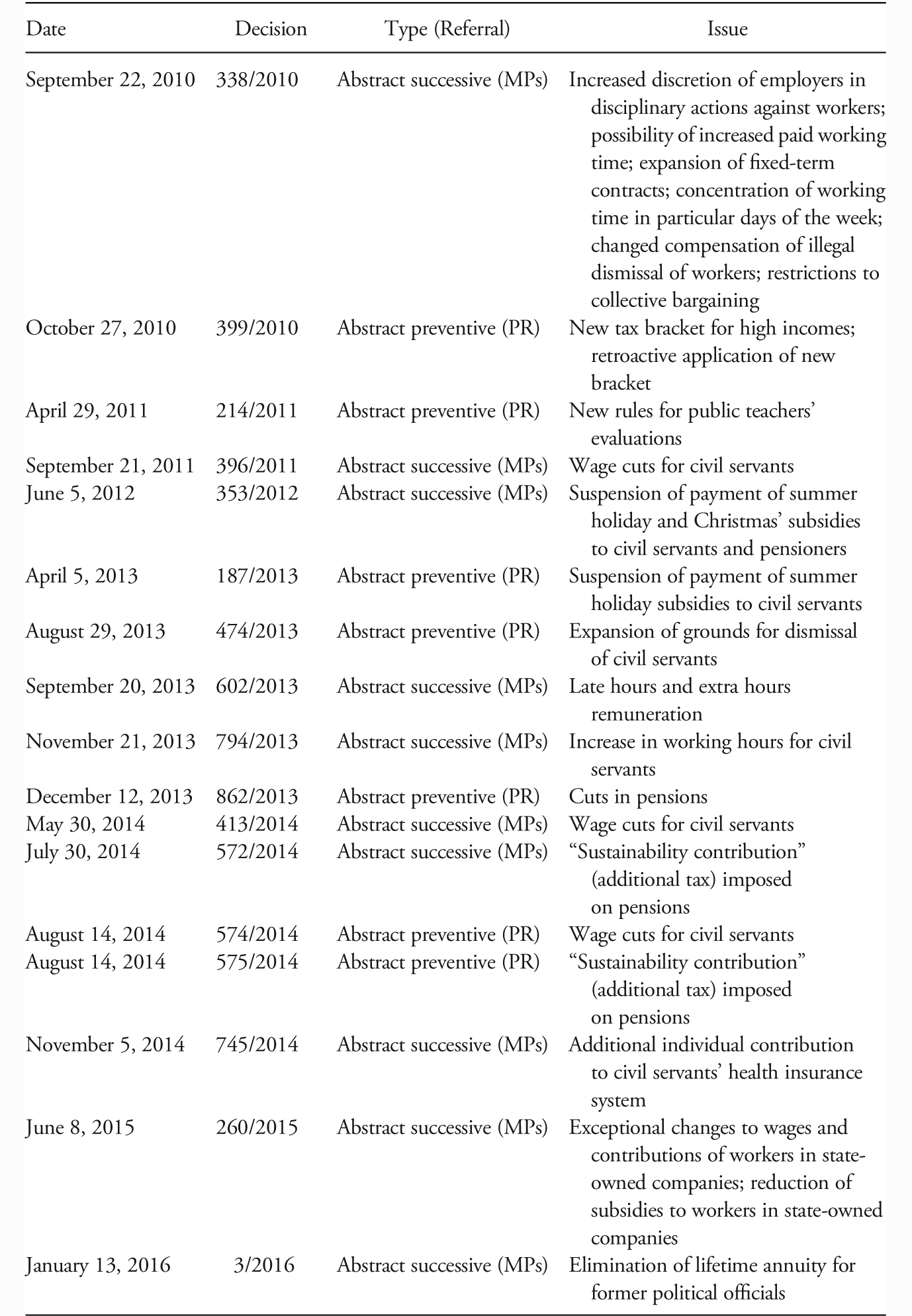
Table 1 summarizes the issues involved and the decisions that, either through preventive or successive review at the request of political actors, were made by the PCC on those laws. They include measures such as increasing labor market flexibility, in both the public and the private sectors; pay cuts and increased working hours for civil servants and workers in state-owned companies; cuts on pensions, convergence of pension systems (across public and private sectors), and the establishment of a special sustainability contribution paid by pensioners; and tax increases, particularly a surtax on personal income, tax bracket reductions, additional “solidarity taxes,” reduction of itemized deductions, and new contributions imposed on sickness and unemployment benefits (Canotilho et al. Reference Canotilho2015). Overall, we register 17 decisions of this kind in abstract review (preventive or successive), emanating from referrals from the president or opposition MPs. As a decision by the PCC may deal with different constitutional issues, each of them subjected to a separate vote, these decisions actually encompass 54 different rulings, which resulted in a total of 661 individual votes by constitutional judges.
Portuguese Constitutional Court Decisions on Austerity Legislation

Note.—PR = president; MPs = opposition members of parliament.
It turns out that, in several of these rulings, a majority of judges decided in favor of the appeals, invoking the defense of fundamental rights and constitutional principles and thus deciding against the constitutionality of several austerity measures (Afonso, Caiado, and St. Aubyn Reference Afonso2015). This forced the executive to find alternative measures, which in many cases resulted in additional tax increases and arguably jeopardized the compliance to the financial agreement (Khalip and Gonçalves Reference Khalip2013; Wise Reference Wise2014). A very contentious public debate followed, in both Portuguese and international forums, including EU institutions (Observador 2015). Several politicians and pundits accused the judges of ruling in favor of the maintenance of their status quo as state employees (Fernandes Reference Fernandes2014a), therefore deciding “on the basis of their private interests” (Saraiva Reference Saraiva2015). Others accused them of having turned the court into a “political body” (Fernandes Reference Fernandes2014b; Saraiva Reference Saraiva2015). Prime Minister Passos Coelho (2011–15) questioned the quality of the judges and called for more democratic scrutiny of the court (TSF 2014a), while pro-government MPs accused the judges of reversing precedents, exceeding their mandates, and jeopardizing the separation of powers, even suggesting sanctions against judicial party misalignment (TSF 2014b). A group of MPs called for the dissolution of the Constitutional Court as an independent institution and for the consequent transfer of its powers to the Supreme Court (Jornal I 2014). Criticism reached international forums: an Eurogroup member stated that the PCC had become the most “activist in comparison with any other Constitutional Court he knew” (do Rosário Reference do Rosário2013), the ECB’s president blamed the court’s decision for Portugal’s negative performance in the financial markets (Jornal de Negócios 2013), and an internal political report of the EC questioned the impartiality of the Constitutional Court, warning against the heavy consequences that judicial activism could have on the country (as it was about to leave the assistance program by June 2014; Pessoa Reference Pessoa2013).
However, not all observers stressed the notion that the court had ruptured with its previous role in the Portuguese political system. There was an important academic debate (Reis Novais Reference Reis Novais2014; Ribeiro and Pereira Coutinho Reference Ribeiro2014). Several constitutional lawyers pointed out how these decisions were consistent with existing jurisprudence and suggested that the judges had managed to remain immune to national and foreign political pressures.Footnote 4 Others noted that the court had behaved with “moderation” and ended up serving as a bulwark against a political rhetoric of “inevitability” and “financial emergency” that reflected a fundamental loss of sovereignty and the undoing of the “fair and redistributive social pact” (Pereira Reference Pereira2013). One of the very few media articles systematically examining the court’s decisions in this period pointed out that, unlike the critics had suggested, the PCC had been generally permissive in relation to this austerity legislation, allowing a majority of laws to be enacted or to remain in force (Miranda and Pereira Reference Miranda2013).
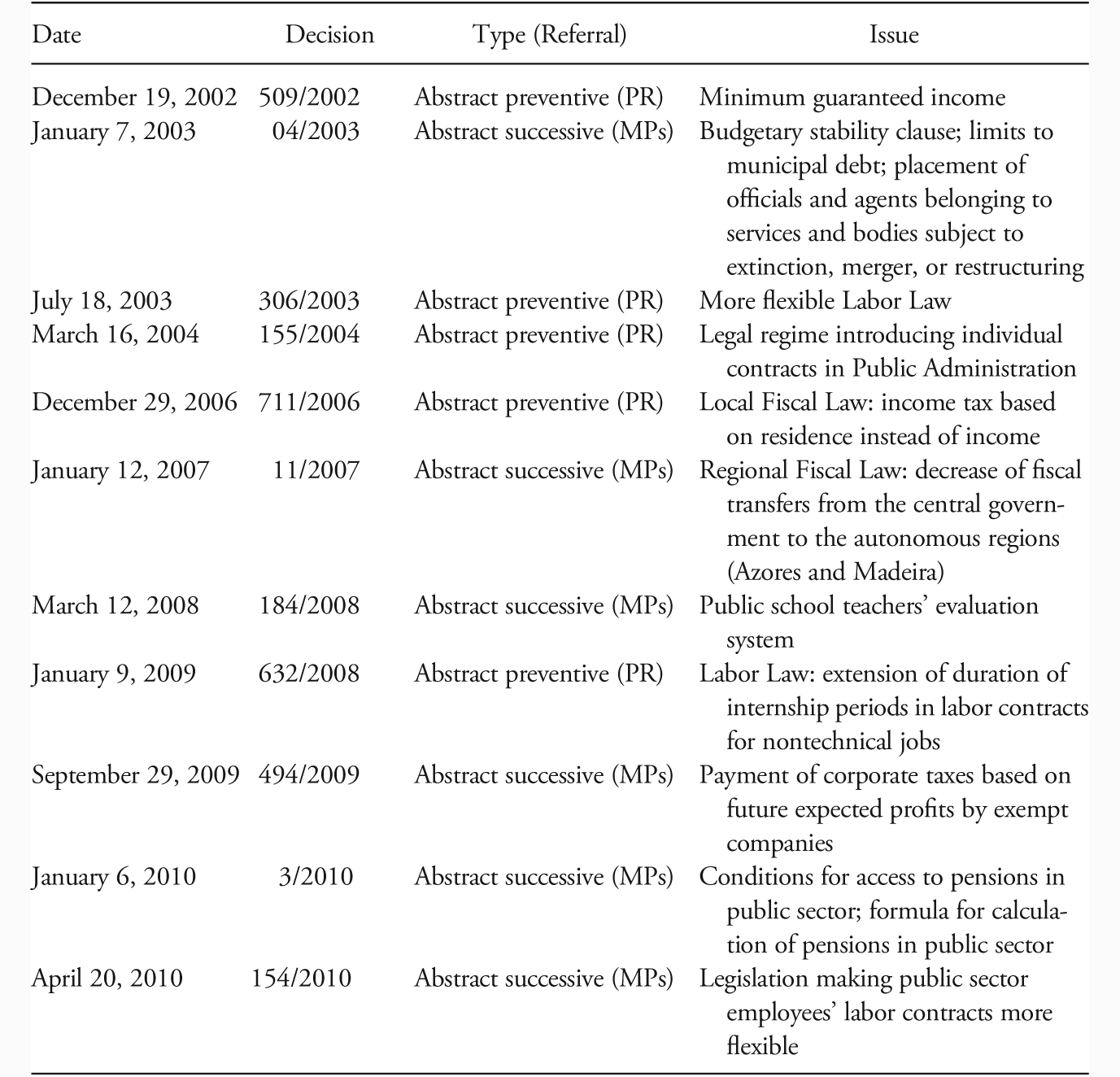
This raises a number of important questions about judicial behavior in the PCC in particular and in constitutional courts more generally. Did judges change behavioral patterns? How was the balance between ideological preferences and party loyalty affected? A segment of that remaining caseload is particularly interesting as a point of comparison, as some of the cases addressed by the PCC before the period of what we have been calling “austerity legislation” actually involved similar topics. They included more flexible labor laws, new legislation revising civil servant contracts and evaluations, cuts in social benefits, and constraints on local and regional governments’ debt. Table 2 lists the 11 relevant rulings of that kind that pertain to legislation passed before the financial crisis, dealing with 47 different issues, in a total of 568 individual votes.Footnote 5 We will call them, from now on, restrictive policies, to distinguish them from the austerity legislation passed after 2009. Did judges ruling on such issues behave in a systematically different way before and during the financial crisis?
Portuguese Constitutional Court Decisions on Restrictive Legislation (Passed before 2009)

Note.—PR = president; MPs = opposition members of parliament.
Our main research question concerns the two logics of judicial behavior we described early on and the extent to which they prevailed in the court in different periods and about different issues. One hypothesis is that decisions on topics such as tax increases and cuts in public spending in a variety of areas should be characterized by a logic of ideological preferences. After all, data on the salience of different issues in partisan politics, as measured in expert surveys about party positions or party manifestos, clearly show that tax, spending, and public services (in expert surveys—Bakker et al. Reference Bakker2015) and welfare/public services (in manifestos—Camões, Mendes, and McDonald Reference Camões2002) have consistently been the most salient issue in Portugal. Furthermore, the evidence points to a broadening polarization between the parties on the left (Partido Socialista/Socialist Party [PS], Coligação Democrática Unitária/Communist and Green Coalition [CDU], Bloco de Esquerda/Left Bloc [BE]) and on the right (PSD-CDS) precisely around these issues around the time of the financial bailout, with right-wing parties publicly advocating more than ever before pro-business and welfare retrenchment measures, and left-wing parties (including the socialists/PS who had been in government up to 2011) the opposite stance (Magalhães Reference Magalhães2014). Thus, when judges are called to decide on matters that raise the ideological divisions that are most salient and controversial for the parties that appointed them, it is conceivable that they themselves reflect that salience and variation in their voting behavior.
But such cases could also bring about an increased party loyalty. Budget consolidation measures typically raise other conflicts apart from those resulting from ideological differences about issues like the size of the public sector, public services provision, and overall countercyclical economic policies. In this respect, government versus opposition conflicts may become particularly relevant. Regardless of the public stance they may take in different moments, and of the predictable association between their left-right position and their preferred budgetary and economic policies, both the socialists (from 2005 to 2007 and again in 2010) and the conservative coalition in government (from 2002 to 2004 and from 2011 to 2013) did engage in fiscal retrenchment policies. As Maatsch (Reference Maatsch2014, 100) notes, while government parties “carry the burden of international responsibility,” oppositions “enjoy an advantaged position, since they are not obliged to implement the policies they are suggesting” and “can attract new voters who are dissatisfied with the current policy line.” Thus, when judges are called to decide on legislation implementing austerity measures in a system that, as we have seen before, contains incentives for judicial responsiveness to partisan priorities, it is possible that the court ends up reflecting a political logic of government/opposition in judicial behavior.
The economic context in 2002–16 as well as the coexistence of different types of legislation—restrictive, austerity, and other—provides for a stimulating empirical exercise. Do they affect the relative significance of ideological preferences over party loyalty? Can we say that austerity affected judicial behavior in ways remarkably different from other legislation?
A final question concerns the extent to which Portuguese judges, or at least some judges, display a behavior that is consistent with “their private interests,” as some critics have pointed out. Do we have evidence that judges who are career magistrates, and thus subject to similar conditions to those of civil servants, tend to scrutinize austerity measures in a way that is systematically different (i.e., more hostile) from other judges? On the one hand, it is indeed conceivable that measures directly and negatively affecting pay and pension benefits of civil servants might be received negatively by judges who, after all, are civil servants themselves. Furthermore, being a career magistrate might be associated with a generic attitudinal predisposition about the size of the public sector, social benefits, and public service provision that would foster hostility to austerity policies. On the other hand, we should recall that the distinction between magistrates and other judges within the court might be less informative than it seems at first sight in this respect: most of the other judges are, with few exceptions, academics teaching in public universities and thus civil servants themselves.Footnote 6 It could therefore be argued that, if such general background is to make a difference, it would be in the direction of creating a broad hostility toward policies aiming at reduction of state size and state intervention in economic matters in general, irrespective of whether judges belong to the career judiciary.
IV. Empirical Analysis
We constructed a data set including all rulings by the PCC between 2002 and 2016 in abstract review (preventive or successive) at the request of the president or opposition MPs. This comprises a total of 60 decisions (46 of them non-unanimous, i.e., containing at least one separate opinion). They took place under four different legislative terms, under both right-wing (PSD-CDS) and left-wing (PS) cabinets. A court decision may deal with different constitutional issues, each of them subjected to a vote (in fact, we analyze 165 rulings). Our unit of analysis is each individual vote on each constitutional issue. This results in a total of 1,998 individual votes in this period.
Our main dependent variable is whether the justice voted for the constitutionality of the law (vote for constitutionality) on the issue under scrutiny, coded 1 if she did and 0 if not.Footnote 7 Of the 1,997 votes recorded, we count 1,177 in favor of constitutionality (59%) versus 820 (41%) against it.Footnote 8 Thus, overall, between 2002 and 2016, the predominant propensity of judges was to rule in favor of the constitutional conformity of legislation submitted to them.
We can also examine whether the judge’s vote on the issue, for or against the constitutionality, mimics the vote in parliament of the party that appointed her on that issue. This is the variable vote according to party, which takes the value of 1 if the judge voted along with the party and 0 if not. Accordingly, the judge voted on the issue according to her party in 1,103 (56%) votes and voted differently in 793 (40%) votes.Footnote 9 Given that there is always one judge who is “neutral” in the court, not appointed or indicated by any party, her votes are included in a different category. A few votes are difficult to consider as according to or as against the party parliamentary disposition. These neutral or difficult votes comprise 101 observations (4% of the total). Just from these results it is easy to see that, regardless of the mechanisms leading to judicial conformity with party behavior (ideology or loyalty), those mechanisms are not deterministic: there are many cases in which judges vote for the constitutionality of legislation that was not supported by the party that appointed them and vice versa. Thus, other variables need to be taken into consideration to predict judicial behavior.
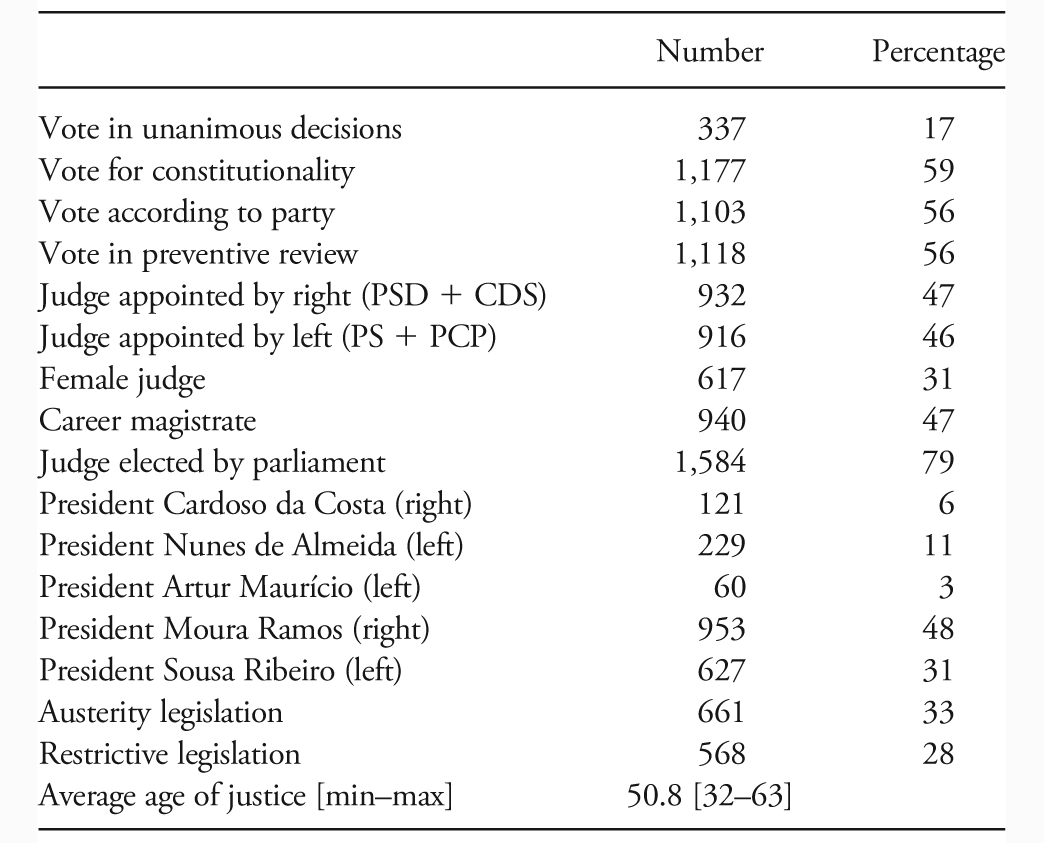
Other aspects of the caseload, cases, judges, and the court in this period are described in table 3, including the type of review (56% of votes are in preventive review, 44% in successive), whether the individual votes were part of unanimous decisions (17%), as well as features of the judges (gender, age) and the court’s president at the time of the ruling.Footnote 10 Finally, we coded cases (and the votes on them) taking into account whether the issues raised were part of the austerity packages passed in the aftermath of the financial crisis: austerity includes the 661 votes recorded on the decisions listed in table 1, legislation passed in the context of the financial crisis. An identical methodology was used for the 568 votes on the laws in table 2 (restrictive), which include the laws applying budgetary restrictive policies (mainly social security, labor laws, and funding of regional and local governments) passed before 2009.
Descriptive Statistics of Main Variables

Note.—PSD = Social Democratic Party; CDS = Democratic and Social Center; PS = Socialist Party; PCP = Portuguese Communist Party.
Two additional aspects deserve notice. First, while, for the overall caseload under examination, 56% of the votes were “according to party,” that percentage is very similar for the austerity rulings (58%) and the restrictive ones (60%). Second, while about 59% of the individual votes on the entire caseload were for the constitutionality of the laws examined, that percentage is very similar for the austerity legislation (58%) and even higher for the restrictive legislation (70%). So, at face value, we have no evidence that any fundamental change occurred when examining this type of legislation either in terms of the predictability of judicial behavior along partisan lines or in terms of an increased propensity to declare legislation to be against the constitution. However, we need to examine this more carefully, not only in terms of different segments of the court’s abstract review docket but also by taking into account several variables and processes that we know affect judicial behavior in the first place.
A. Voting for Constitutionality
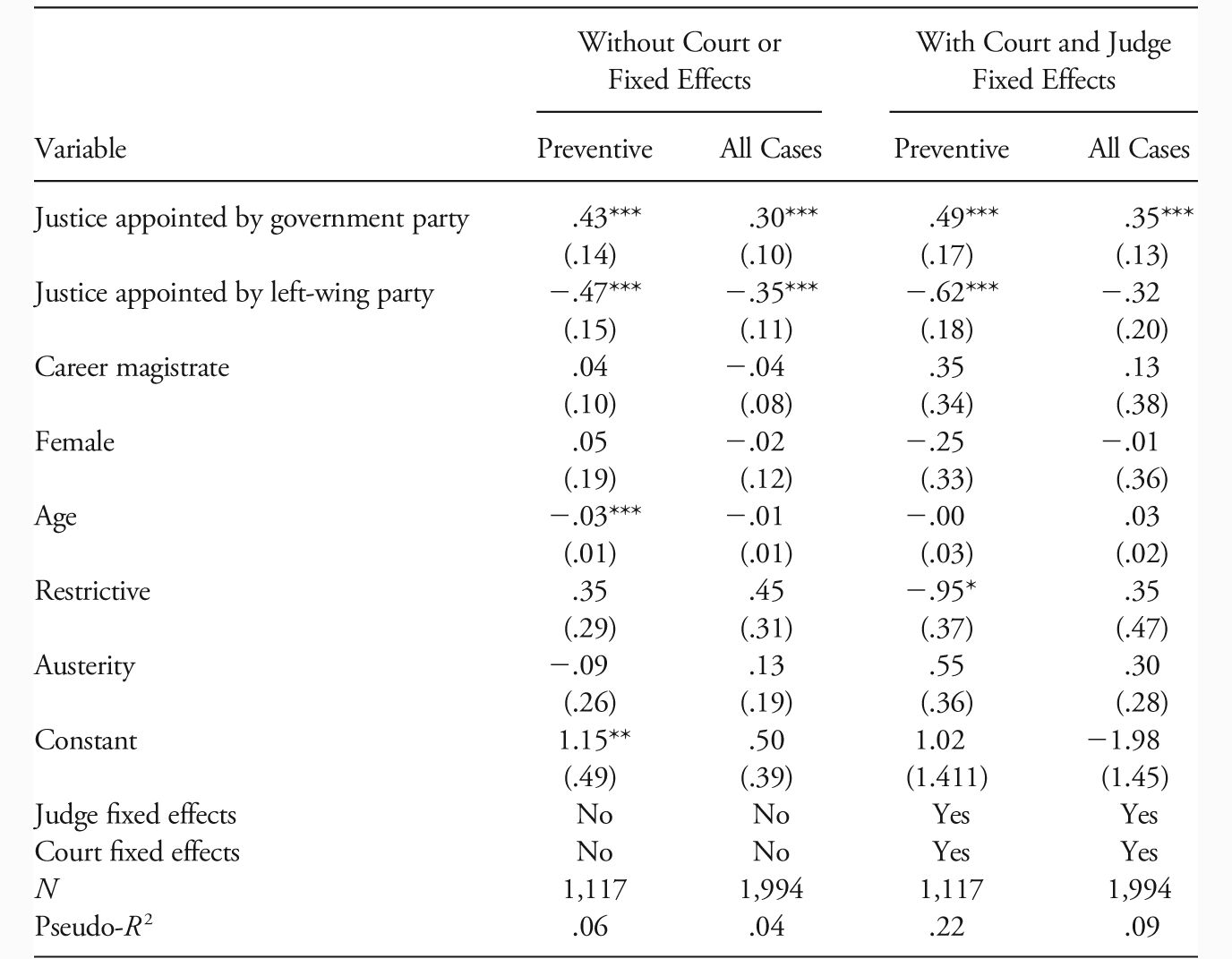
Table 4 shows the first results from the regression analysis. The model for preventive review is a replication of the analysis conducted in previous studies (Amaral-Garcia et al. Reference Amaral-Garcia2009), this time for the 2002–16 period and adding dummies for both the austerity and the restrictive cases. We show the results without and with court and judge fixed effects and for both preventive review decisions and all decisions (preventive and successive). Dummies for whether the judge is a career magistrate or was appointed by a party in government, as well as for whether that party was left-wing, are included, as well as the remaining controls for age and gender.Footnote 11
Probit Analysis of Voting for Constitutionality (Dependent Variable, No Interaction Terms)

Note.—Cluster-corrected standard errors (by decision) in parentheses.
* p < .10.
** p < .05.
*** p < .01.
These results for the entire 2002–16 period point, again, to findings very similar to those obtained in existing research about the PCC and its judges (Amaral-Garcia et al. Reference Amaral-Garcia2009; Hanretty Reference Hanretty2012). The most robust result is that a judge’s having been appointed by a party in government is estimated to increase her probability of voting for constitutionality. This occurs regardless of whether we look just at preventive review cases or at the entire abstract review docket and also regardless of whether court and judge fixed effects are employed. Second, again as in previous studies, being appointed by a left-wing party decreases the probability of voting for the constitutionality of laws, above and beyond the effect of that party being in government. In the last column of table 4, the coefficient has the “correct” (negative) sign but is not significant. However, this is due to the introduction of court and particularly judge fixed effects.Footnote 12
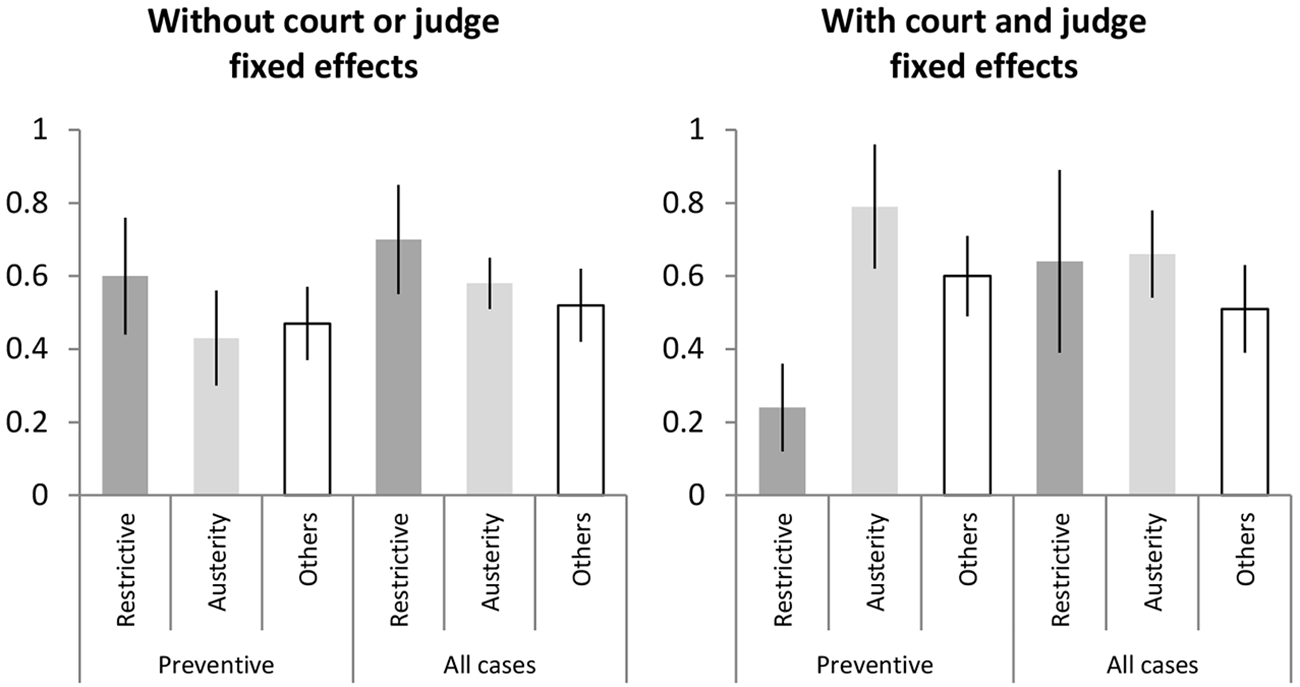
Finally, figure 1 shows the predicted probabilities of a judge voting for the constitutionality of legislation, based on the models with and without court and judge fixed effects, in rulings dealing with three different types of legislation: restrictive, austerity, and the remaining cases (others). Regardless of the particular cut we take of the abstract review docket of the court—only preventive review cases or all abstract review cases—and regardless of whether court and judge fixed effects are employed, we obtain no evidence that judges were significantly less likely to vote for the constitutionality of austerity legislation approved after 2009. At most, the only significant difference that emerges is that, for preventive review and employing fixed effects, restrictive legislation passed and examined before 2009 was actually less likely to be ruled constitutional by judges. But, in general, the safest statement that can be made about this is that, in spite of the intensity of criticism directed against the court, there is no evidence in our data to support a significant change in judicial behavior.
Predicted probability of a judge voting for the constitutionality of legislation for three types of referred legislation, in preventive review and all cases, with 90% confidence intervals.

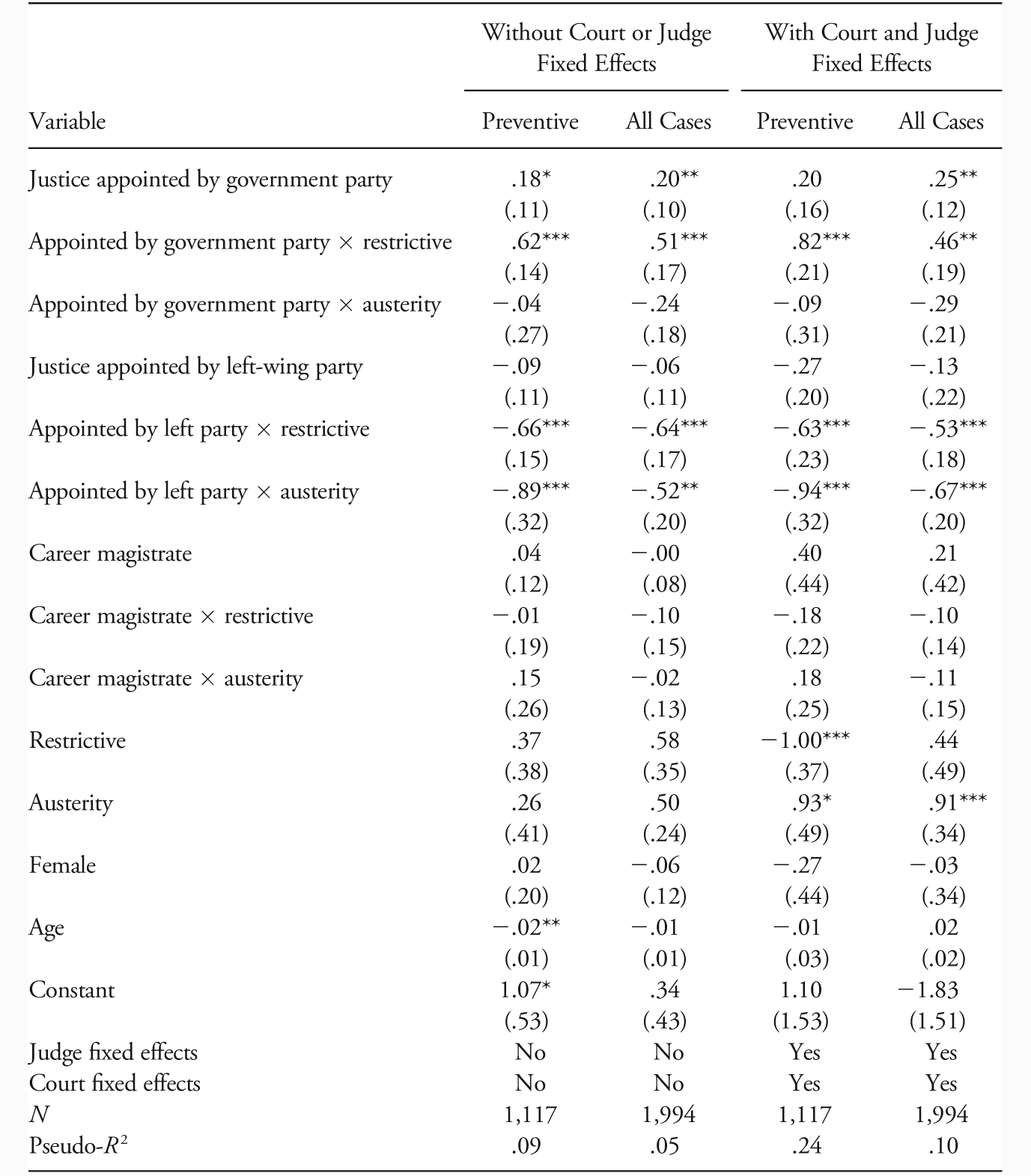
However, this does not necessarily mean judicial decision making was driven by the same factors vis-à-vis different types of laws. Additional analysis is displayed in table 5 addressing this question. Specifically, we interact the crucial independent variables with our austerity and restrictive dummies.
Probit Analysis of Voting for Constitutionality (Dependent Variable, Including Interaction Terms)

Note.—Cluster-corrected standard errors (by decision) in parentheses.
* p < .10.
** p < .05.
*** p < .01.
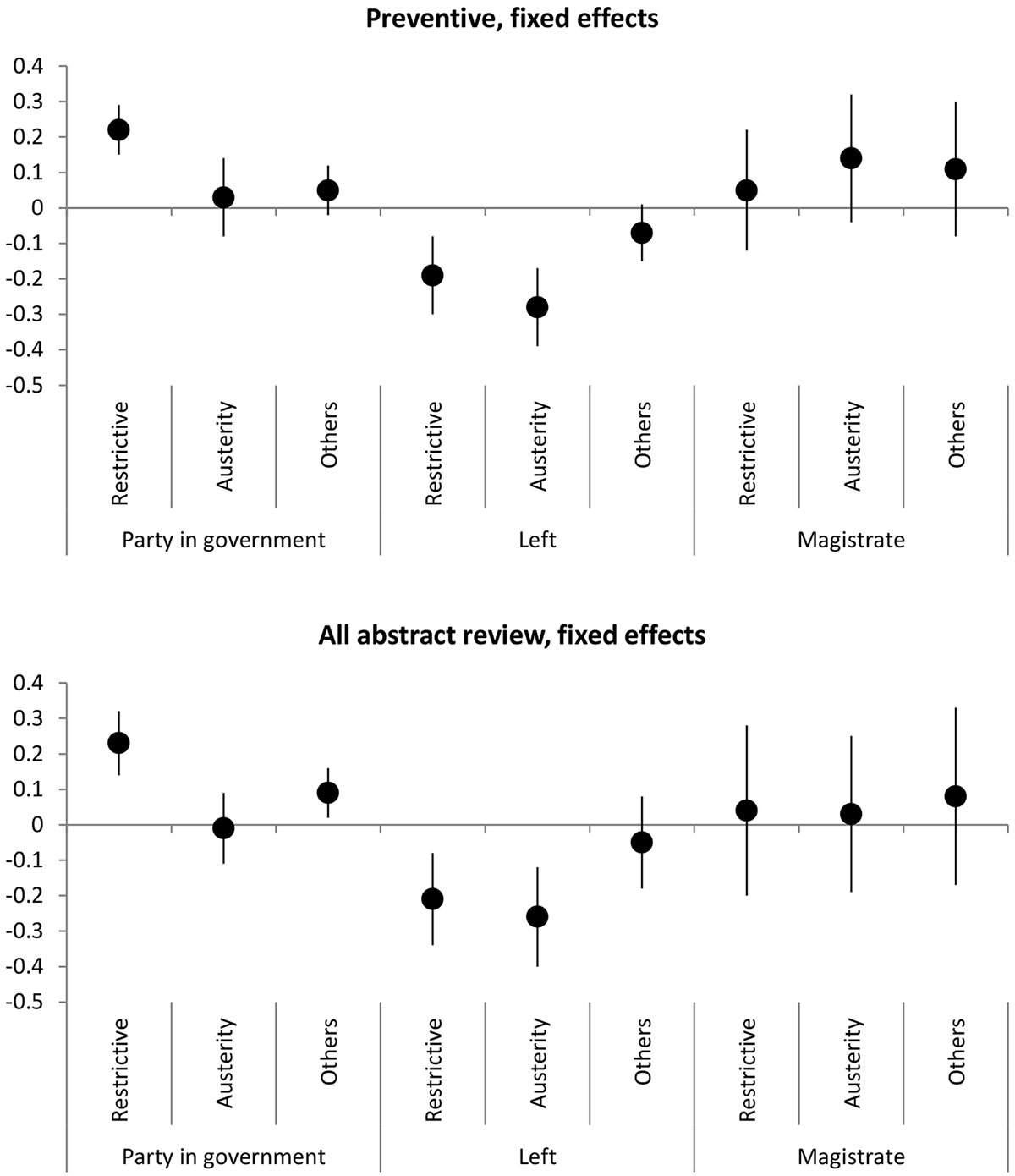
Given the multiple interaction effects, results are not easily interpretable.Footnote 13 Therefore, in figure 2, we plot the marginal effects for the different independent variables of interest, expressed in changes in probability of a vote for constitutionality caused by an increase of one unit in each variable, while the remaining variables are fixed at the mean values, and under the three conditions: restrictive, austerity, and other cases. The upper plot shows the results just for preventive review cases, while the lower plot for all abstract review cases. We display just the marginal effects derived from the fixed effects models since the results are, for these variables, fundamentally similar to the models without them.
Marginal effects of selected variables for three types of referred legislation, in preventive review and all cases, with 90% confidence intervals, court and judge fixed effects.

One of the hypotheses we advanced early on is confirmed: when ruling on the budgetary, financial, and economic issues raised by both the restrictive and the austerity cases, ideological polarization within the court (i.e., between judges appointed by left-wing parties and the others) became particularly prominent in comparison with what occurs in other types of cases. In those cases, being appointed by a left-wing party, independently of whether that party is in government, is estimated to decrease the probability of voting for the constitutionality of such legislation in a range of about 20–30 percentage points. For the remaining cases, such an effect is not significantly different from zero. In other words, when rulings are made in those issues that more saliently structure the left-right partisan conflicts in Portugal, left-right polarization in judicial behavior ensues. The other notable point, however, is that this is true for both the austerity legislation passed after 2009 (table 1) and the restrictive legislation passed between 2002 and 2009 (table 2).
We already knew, from table 4, that political polarization due to party loyalty—between judges appointed by parties in the government and those appointed by parties in the opposition—has also been present in the court in the 2002–16 period. However, what the results in figure 2 show is this was a feature of judicial decision making in cases related to the restrictive legislation passed before the financial crisis. In contrast, if there is something peculiar about the post-2009 austerity legislation, it is the way this sort of polarization seems to have been much less relevant in such rulings. Looking at specific decisions, it is not difficult to document an important number of cases that seem to be driving this result. Out of the 17 austerity decisions from table 1, seven are unanimous or quasi-unanimous—which inevitably means that several (center-right) judges voted against the constitutionality of legislation under a center-right majority—and therefore account for a statistical reduction in political polarization. These cases include, for example, pension cuts (in 2013 and in 2014) and dismissal of civil servants (also in 2013).Footnote 14
Finally, career magistrates in the court, in comparison with the remaining judges, were no more or less likely to vote for the constitutionality of any of the subsets of cases. This was already apparent from the results in table 4 and is now confirmed when we decompose the analysis for the three types of issues under scrutiny. This suggests that the distinction between career judges and other judges in terms of their professional background is indeed not meaningful in this respect. But combined with the previous finding that, in general, judges were not more likely to deem either restrictive or austerity legislation unconstitutional, this suggests that the alleged hostility of PCC judges to financially restrictive legislation finds no support in the data.
B. Focusing on Different Periods
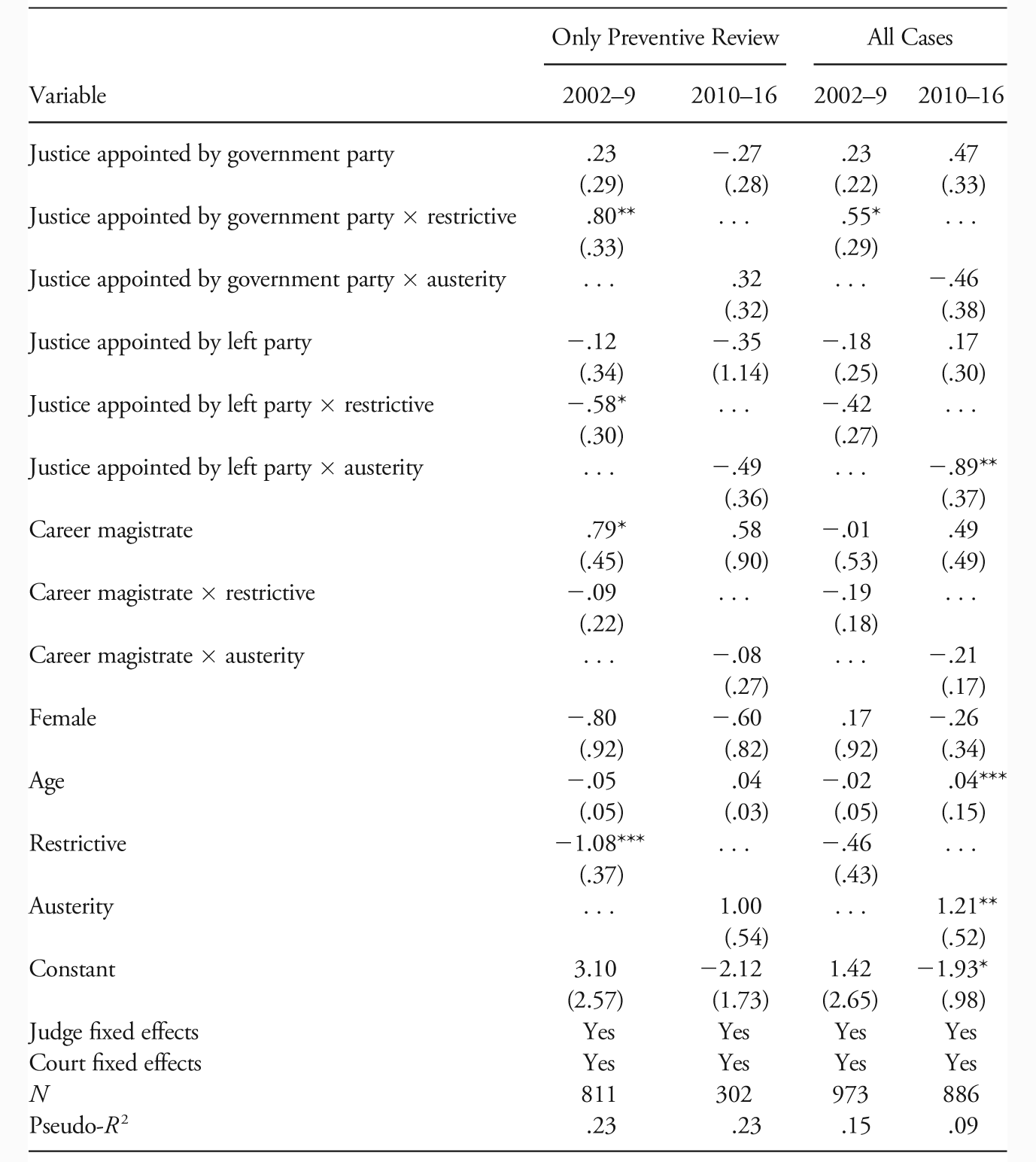
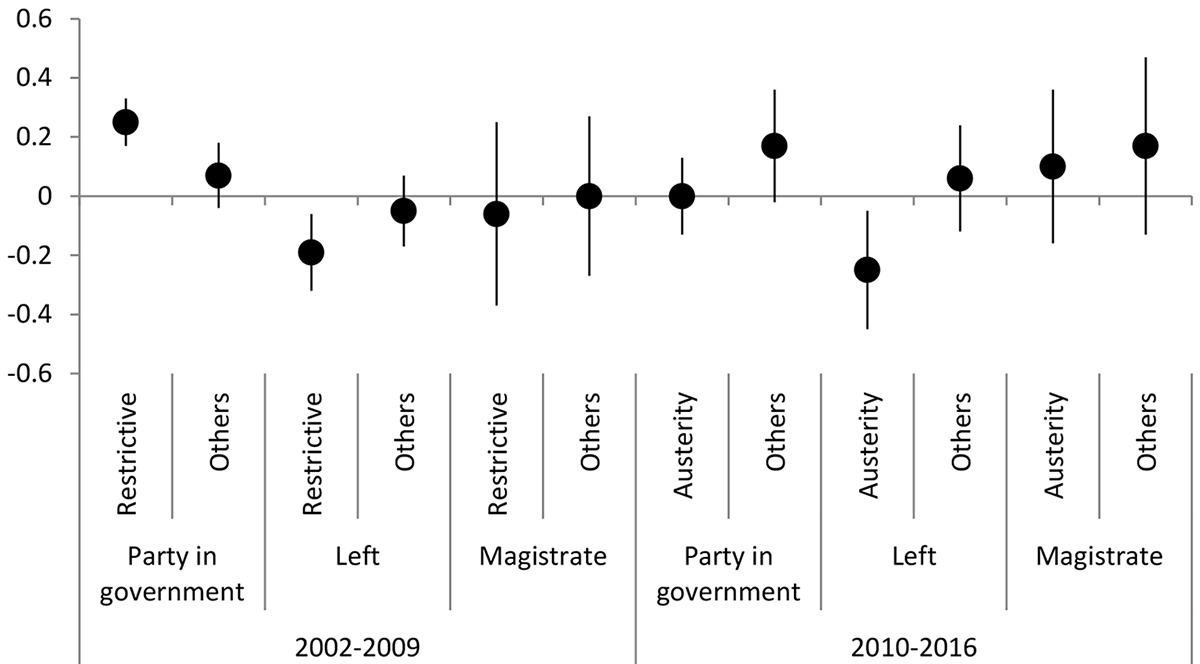
A useful robustness test of our empirical results is to compare austerity legislation against different legislation reviewed in the same period. Controlling for other variables, this would enable us to understand the extent to which, in the same period, the same judges behaved differently when reviewing the constitutionality of such legislation. Thus, we run the same fixed models as in table 5 but separately for the 2002–9 and the 2010–16 periods. Results are reported in table 6 and figure 3. In the latter, we show the results for both preventive and successive review cases only, as they are fundamentally similar.
Probit Analysis of Voting for Constitutionality (Dependent Variable): Judge and Court Fixed Effects

Note.—Cluster-corrected standard errors (by decision) in parentheses.
* p < .10.
** p < .05.
*** p < .01.
Marginal effects of selected variables for three types of referred legislation, in preventive and successive review cases, with 90% confidence intervals, court and judge fixed effects.

The two periods show important similarities: having been appointed by a left-wing party significantly decreases the probability of ruling legislation constitutional, but only for restrictive (pre-2009) or austerity legislation. In other words, for the entire 2002–16 period, before or after the financial crisis, rulings on budgetary and economic matters are characterized by ideological preferences within the court. Moreover, having been appointed by a party in government rather than in the opposition increases the probability of voting for constitutionality because of party loyalty. But that is something that occurs only in the 2002–9 period and for the restrictive legislation. In the 2010–16 period, such political polarization seems to have disappeared. Finally, as before, either before or after the crisis, being a career magistrate does not significantly change the probability of ruling any sort of legislation constitutional.
V. Conclusion
The role played by the PCC during the Portuguese financial crisis and vis-à-vis budgetary and economic austerity policies has been the object of considerable discussion in national and international forums. The perceived excessive “activism” of its judges, their proclivity to block measures that affected their own interests, their “politicization,” and their continuous break with precedent were severely criticized by many observers. Portugal is, consequently, an important case study to frame and test the extent to which austerity shapes judicial behavior. The evidence we collected and analyzed here does suggest some specificities about how the Portuguese judges dealt with the review of the constitutionality of these policies. However, they are not necessarily the ones critics have suggested.
We find “politicization” understood as a manifestation of diverse ideological preferences. It is neither new nor at all unexpected on the basis of the institutional rules that govern judicial appointments in such courts. On the one hand, judges appointed by left-wing parties were more likely to conclude that financially restrictive measures were unconstitutional. However, such a pattern of ideological polarization within the court was as likely to emerge in rulings about the austerity measures passed during Portugal’s financial crisis and bailout as it was for similar policies passed before that period. This is consistent with past findings about judicial behavior in the Portuguese and other Kelsenian courts and reflects the quite obvious fact that parties, in their role of judicial appointers, do not select appointees at random but rather according to their policy preferences. The novelty in our findings in relation to previous research (Amaral-Garcia et al. Reference Amaral-Garcia2009; Hanretty Reference Hanretty2012) is the fact that such ideological polarization in the court seems fundamentally driven by what happens in rulings dealing with budgetary and economic matters. But not even that is particularly surprising: it reflects the fact that the ideological conflicts raised by such matters are the most salient in Portuguese partisan politics.
On the other hand, judges also seem to be, in their voting behavior, at least in some cases and for some periods, responsive to the fact that the party that appointed them is the incumbent. These are situations of strong party loyalty. However, that is not new either (Amaral-Garcia et al. Reference Amaral-Garcia2009; Hanretty Reference Hanretty2012). If there is anything new that results from the analysis conducted in this article it is the fact that this pattern of political—rather than ideological—polarization seems to have been less prevalent during the financial crisis than before. We can only speculate about what may have driven this unanticipated result. In periods of intense media focus and enhanced public awareness of judicial decisions, strategic considerations on the part of judges regarding their future career prospects and how current party leadership affects them may be counteracted by other strategic considerations, namely, the role of public mood and opinion. Austerity measures were largely unpopular (well beyond the partisan opposition) and seen by many as an imposition by external (foreign) agencies. Judges concerned with the court’s institutional role and integrity (Epstein and Knight Reference Epstein1998), or even with the preferences of party factions other than those leading the parties at that moment in time, may have embodied their countermajoritarian role in a more significant way. It is also possible that a few judges appointed by the center-right parties were ideologically closer to judges appointed by the left, when it comes to austerity measures, to the point of reversing the logic of voting with “their” government.
Although our results are based on the specific case of the PCC, we suggest that research strategies and conclusions may be generalizable to other countries with similar constitutional review institutions. Any diagnostics about the behavior of courts during a politically and economically exceptional period such as the financial crisis probably benefit from comparison and benchmarking. As we saw, once such comparison is made, the behavior of Portuguese judges during this period looks much less exceptional than everyday political commentary would lead us to think. The institutional arrangements behind judicial appointment and tenure in many of these courts, including the Portuguese courts, have remained mostly resilient. The political and judicial practices they incentivize have generally followed suit, regardless of changing incumbents and economic contexts.