Networks have long been a familiar feature of international politics. Networks include benign actors such as transnational advocacy networks (TANs) as well as terrorists and criminals organized in “dark” networks. Networks in international relations have typically been treated as a mode of organization, one that displays neither the hierarchical character of states and conventional international organizations nor the ephemeral bargaining relationships of markets. The lens of network analysis offers a broader and contrasting view: networks are sets of relations that form structures, which in turn may constrain and enable agents.Footnote 1 Network analysis provides a set of theories and tools to generate puzzles and test propositions about these structures. It provides answers to key questions in international relations: when are terrorist groups created, strengthened, and dissolved, and how are they organized? How do military alliances and other international affiliations alter states' conflict propensities? Does membership in preferential trade agreements and other international organizations reduce or increase international inequality? What is the best method for halting weapons proliferation?
Network analysis complements existing structural approaches to international relations that focus on actor attributes and static equilibria. Instead, it emphasizes how material and social relationships create structures among actors through dynamic processes. It also provides methods for measuring these structures, allows for the operationalization of processes such as socialization and diffusion, and opens new avenues for reconsidering core concepts in international relations, such as power. Partial or faulty incorporation of network analysis, however, risks trivial conclusions, unproven assertions, and measures without meaning.
We assess the current and potential contributions of network analysis for international relations. In the first section, we provide an overview of the network perspective, comparing it to existing approaches in international relations. We then give a brief overview of the concepts and methods of network analysis and discuss the new dimensions that it can add to the concept of power in international relations. In the final two sections, we review current applications of network analysis to international relations research, assess the promise and risks of the approach, and propose a network analysis research agenda for the field.
Networks as an Analytic Concept in International Politics
Networks have typically been regarded in international relations as a mode of organization that facilitates collective action and cooperation, exercises influence, or serves as a means of international governance. Perhaps the most familiar example is the transnational activist network, described by Keck and Sikkink.Footnote 2 Terrorist networks have received particular attention since the attacks of September 11, 2001; governance networks also have a clear intellectual lineage in international relations, one that begins with transgovernmental cooperation, as described by Keohane and Nye.Footnote 3 The discipline of international relations has not, until recently, treated networks as structures that can constrain and enable individual agents and influence international outcomes. Research has focused on networks' effects on their environments (for example, the effects of transnational activist networks on international agreements) rather than the effects of network structures on actors and outcomes within those networks (for example, the effects of the network of intergovernmental organizations on conflict).Footnote 4 Networks have been contrasted with other modes of organization, such as state hierarchies or markets, but variation among networked organizations and the effects of that variation have received much less attention. Networks are significant actors in international politics and represent a specific mode of international interaction and governance. As such, they remain important objects of research. Too often, however, a definition of networks as any nonhierarchical mode of organization in international relations has obscured a broader, structural perspective on their place in world politics.
Rather than serving solely as a tool for examining a particular form of organization, network analysis also permits fine-grained conceptualization and measurement of structures. The neorealist concept of structure, based on the distribution of material capabilities across units, has typically dominated international relations.Footnote 5 A network approach, by contrast, defines structures as emergent properties of persistent patterns of relations among agents that can define, enable, and constrain those agents. As in other structural approaches to international relations, our interest in network structures derives from their effects. Those effects, however, must be demonstrated empirically, not assumed. Network analysis aims to identify patterns of relationships, such as hubs, cliques, or brokers, and to link those relations with outcomes of interest. Structural relations are as important as, if not more important than, attributes of individual units for determining such outcomes. As a result, the beliefs and actions of individual agents (and observations of individual behavior) are not independent. In contrast to more static conceptions of structure, such as the neorealist variant, network relations are inherently dynamic.Footnote 6 Network analysis allows structural investigation at multiple levels of analysis, including groups of units of any size as well as the monadic, dyadic, and systemic levels familiar to international relations scholars.
In the late 1960s and early 1970s, early pioneers of network analysis in international relations examined emergent structures in the international system that resulted from network ties based on trade, membership in intergovernmental organizations (IGOs), and diplomatic exchange.Footnote 7 These early studies generally stopped short of using network analysis to test theories or predict network effects on international politics. A second wave of research based in sociology began in the late 1970s and used network analysis to investigate structural determinants of international inequality, drawing on dependency and world-systems theory.Footnote 8 This line of research has not found an audience in international relations, since its theoretical grounding is no longer part of mainstream political science.
Only a third wave of network applications, starting in the late 1990s, has begun to integrate the tools of network analysis and the core problems of international relations. To better understand this integration, the concepts and methods of network analysis, largely developed outside international relations, require introduction.
Concepts, Principles, and Methods of Network Analysis
Network analysis concerns relationships defined by links among nodes (or agents). Nodes can be individuals or corporate actors, such as organizations and states. Network analysis addresses the associations among nodes rather than the attributes of particular nodes. It is grounded in three principles: nodes and their behaviors are mutually dependent, not autonomous; ties between nodes can be channels for transmission of both material (for example, weapons, money, or disease) and nonmaterial products (for example, information, beliefs, and norms); and persistent patterns of association among nodes create structures that can define, enable, or restrict the behavior of nodes.Footnote 9 In network analysis, networks are defined as any set or sets of ties between any set or sets of nodes; unlike the study of network forms of organization, no assumptions are made about the homogeneity or other characteristics of the nodes or ties. Consequently, network analysis can be used to analyze any kind of ties, including market and hierarchical relations. Beyond these basic principles, network analysis enables calculation and mapping of structural properties of nodes, groups, or the entire network; predictions regarding the creation, growth, and dissolution of these networks; and investigation of the effects of networks on actors' behavior.Footnote 10
Measuring Network Properties
The strength of a tie is conceptualized as a combination of the magnitude and frequency of interactions between two nodes. Ties may be binary, such as whether two states recognize each other, or of variable strength, for example, the number of phone calls between two individuals in a terrorist cell. Ties may also be symmetrical or asymmetrical (stronger in one direction than the other direction, as often occurs in international trade). Network ties need not imply positive or cooperative relations; they can also be negative, such as the enmity between two states in an enduring rivalry. Finally, ties can be derived from a number of sources: direct networks linking people or trading partners; affiliation networks of alliances, organizations, and agreements; or implicit networks among nodes linked by common identity, geography, or other characteristics.
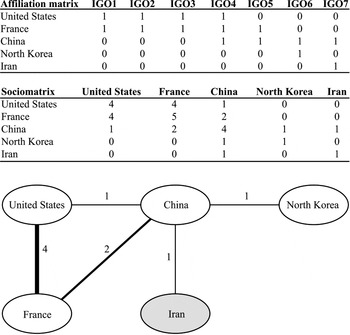
In Figure 1, we demonstrate the derivation of network ties among five states that are members of an affiliation network of seven hypothetical IGOs, one common way of measuring ties in the international system.Footnote 11 We begin with an affiliation matrix (where 1 indicates a state's membership in a particular IGO), then multiply the matrix by its transpose to convert it to a sociomatrix, a common way of representing network data. In this case, the value 4 in row United States and column France means that there is a tie of strength 4 from the United States to France; it indicates that the United States and France share membership in four IGOs. The entire sociomatrix gives the distribution of ties across the network and is graphed in Figure 1.
Deriving a sample international network

The distribution of ties in a network suggests two important structural characteristics: centrality (importance) of nodes in the network and division of the network into subgroups.
Variants of centrality in a network include degree, closeness, and betweenness.Footnote 12 Degree centrality of a node is the sum of the value of the ties between that node and every other node in the network. This measure tells us how much access a particular node has to the other nodes. Closeness centrality is calculated using the length of the path between a node and every other node. This measure could estimate the time required for information or resources to propagate to a given node in a network. Betweenness centrality corresponds to the number of shortest paths in the network that pass through a particular node, and therefore it measures the dependence of a network on a particular node for maintaining connectedness.
These measures do not take into account the importance of other nodes (in the case of degree centrality) or the significance of all paths (in the case of closeness and betweenness centrality). Other measures include these values. For example, eigenvector centrality incorporates not only the number of a node's links and the strength of those ties, but also the centrality of those other nodes.Footnote 13 In a similar fashion, information centrality differentially weights paths to account for not only distance from a given node to the other nodes but also strength of connection, taking into account the probability of transmission along all possible paths.Footnote 14 Flow betweenness centrality accounts for the strength of all paths between nodes instead of just the shortest ones, giving a measure of the proportion of total resource flow in the network controlled by a single actor.Footnote 15 The extent of centralization in a network—how much other nodes rely on a single node—can be calculated using any of these centrality concepts.
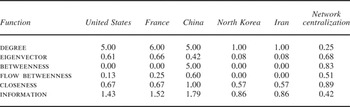
Table 1 applies the six measures of centrality described above to the network in Figure 1 and calculates the centralization of the entire network. While degree centrality simply sums incoming ties, giving France the greatest centrality in this example, with the United States and China tied for second, eigenvector centrality weighs not only the tie values but also the centrality of the attached nodes.Footnote 16 In this measure, the strong ties of the United States to a particularly important actor (France) give it greater eigenvector centrality than China. Both betweenness measures and closeness centrality rank China high. information centrality, which takes into account the likelihood of information actually passing along particular ties (proportional to their strength), also ranks both the United States and France with relatively high centrality due to their strong mutual tie. Finally, the network in this example is highly centralized in terms of betweenness and closeness centrality, mainly due to the position of China (since all paths from one part of the network to the other must pass through it). It is not very centralized with respect to measures that take into account tie strength such as degree and information centrality.
Centrality scores for Figure 1

Notes: All calculations performed using the SNA package (Butts Reference Butts2007), a part of the free statnet package (Handcock et al. Reference Handcock, Hunter, Butts, Goodreau and Morris2008b) in R (R Development Core Team 2007).
Network ties also partition a network into subgroups, a primary concern of network analysis. Two nodes belong to the same group if their direct ties to each other are dense enough (cohesive subgroups) or their ties to all other nodes are similar (structurally similar clusters). As with centrality, multiple conceptions of cohesion and structural similarity exist; here we focus on one type of cohesion (clique) and one type of similarity (structural equivalence).Footnote 17 A clique is a group in which every member has a tie of strength above a certain minimum with every other member. For example, in Figure 1, the United States, France, and China are in a 1-clique, since they all have ties of strength 1 or more to each other, while the United States and France are in a 4-clique. A structurally equivalent cluster is a group where every member has ties of similar strength to every other node in the network. In Figure 1, Iran and North Korea are structurally equivalent, as they have exactly the same strength ties to the same node(s). After dividing a network into structurally similar groups, the network can be presented as a blockmodel to investigate the relationships between groups of nodes and to reveal macrostructures.Footnote 18 These basic network structures can be mapped and measured using a variety of network analysis programs.Footnote 19
Network Creation and Growth
Network analysis describes relational and individual mechanisms through which new network ties are likely to be created. Relational mechanisms suggest how relative location within existing networks influences the likelihood of tie formation; individual mechanisms suggest particular attributes of nodes that make ties more or less likely to occur. We illustrate these different mechanisms in Figure 2, where we add a node (Pakistan) to Figure 1 and denote potential ties due to different mechanisms as dotted lines.
Sample international network with an additional node (Pakistan), demonstrating potential mechanisms for new ties
Note: Dotted lines indicate new ties.

Two of the most prominent relational mechanisms in network analysis are structural balance and structural equivalence. Theories of structural balance (or transitivity) hypothesize that only certain patterns of positive (affect) and negative (enmity) ties can exist among three nodes.Footnote 20 Essentially, the friend of my friend is my friend, and the enemy of my enemy is my friend. From this, we might expect a tie to form between Iran and France in Figure 2, given that each has (positive) ties to China. Structural equivalence may predict that nodes in similar structural positions vis-à-vis other nodes will act in similar ways. They may be likely to form ties as long as they are not in competition for resources. Figure 2 shows that North Korea and Iran may be likely to form a tie due to their structurally equivalent positions vis-à-vis China. These mechanisms are not exclusive; North Korea and Iran may also be more likely to form ties due to structural balance as well.
Individual mechanisms in the formation of network ties include homophily, a tendency for nodes to form ties based on common attributes, or heterophily, in which nodes form ties to share strengths and minimize weaknesses.Footnote 21 For example, in Figure 2, Iran and Pakistan, which share the similar attributes of geography and postcolonial status, may form a tie. Alternatively, Pakistan and North Korea, which have the complementary attributes of possessing centrifuge enrichment technology and ballistic missile technology, respectively, may form a tie.
Finally, pre-existing network connections can also affect the creation of new ties. Under conditions of preferential attachment, highly central nodes will forge more additional ties than less-connected nodes. In Figure 2, Pakistan may seek to attach itself to China because China is the most central node in the network (by information, betweenness, and closeness measures).Footnote 22 States that already have extensive ties through some networks (trade, IGOs, democracy) may be more likely to be linked in other networks. Ties that are one-sided may be reciprocated over time as well. These network mechanisms can be measured simultaneously using exponential random graph models.Footnote 23 They also figure in agent-based models.Footnote 24
Network Effects
General theoretical propositions seek to explain the ways that individual nodes, clusters of nodes, and entire networks will affect processes and outcomes of interest. Because they are highly dependent on specific contexts and assumptions, their translations to the anarchic conditions of international relations are best regarded as hypotheses to be tested rather than propositions that apply automatically to international relations. For example, sociological findings suggest that highly central nodes in networks possess high social capital. Social capital represents the resources derived from network membership.Footnote 25 Two competing perspectives on social capital assign different structural positions greater or lesser weight. The first school holds that nodes positioned between network clusters in structural holes (high betweenness centrality) have high social capital;Footnote 26 the second holds that nodes that are well-connected in general (high degree or eigenvector centrality) have more resources to draw upon through their network connections.Footnote 27 Nodes that have high closeness or information centrality will also receive information more quickly than marginal nodes. Hypotheses regarding social capital are useful, because information and capital asymmetries affect political processes and outcomes at the international level. For example, rationalist theories of conflict rely heavily on beliefs about the distribution of material capital and thus uncertainty about the outcome of war.Footnote 28 Such reasoning could be extended to the distribution of social capital in international relations.
Studies of individual behavior in social networks also point to potential hypotheses. Group socialization of nodes through interactions in a given subgroup can prompt changes in characteristics of individual nodes. Nodes in a cohesive subgroup favor those in-group and treat those outside with enmity.Footnote 29 Nodes in structurally similar clusters face similar constraints and opportunities and therefore are more likely to act in similar ways. Similar behavior does not imply cooperation, however. Structurally equivalent nodes may also compete, depending on the roles associated with their positions. For example, two states in the same postcolonial preferential trading arrangement may compete for trade privileges and aid from the former colonial power.
Conflict and cooperation are strongly influenced by network dynamics. Social network studies of degree centrality and conflict find that more central nodes tend to be more aggressive.Footnote 30 Such hypotheses, based on network position and relying on few assumptions about individual nodes, can also be tested in the context of international relations. Constructivist scholars hypothesize that socialization processes are an important determinant of state behavior in international politics.Footnote 31 Network analysis offers a method for measuring the sources of socialization and the diffusion of norms based on the strength of ties between states, collective state identities such as security communities, and the importance of individual states.
A final theoretical transfer from network analysis concerns network efficiency and robustness. Network structure can determine efficiency in the distribution of information or material resources as well as ability to withstand threats of disruption. Most networks face a tradeoff between efficiency and robustness: redundant links make a network more robust, but they may also make it operate less efficiently. If betweenness measures indicate that a network is highly centralized (most paths go through a few nodes, such as the network in Figure 1), then investment in the important hubs may make the network more efficient, but removal of those few nodes (such as China in Figure 1) can disrupt the network. In a centralized configuration, temporary connection of nodes through “shortcuts” maintains robustness against intentional disruption and increases task efficiency. This type of simultaneous centralization and decentralization is seen in some terrorist networks and in highly reliable organizations (HROs).Footnote 32 These tradeoffs between robustness and efficiency are important for many illicit and licit networks of interest to international relations scholars.
Networks and Power in International Relations
The innovations of network analysis challenge conventional views of power in international relations. For example, a structural analysis of networks equates the power of a particular node to its position in the network, defined by its persistent relationships with other nodes. Power is no longer derived solely or even primarily from individual attributes, such as material capabilities. At the same time, new investigations of power in international relations from a network perspective could refine and enrich network analysis.
Social Power as Access
Network power, defined by Knoke as “prominence in networks where valued information and scarce resources are transferred from one actor to another,” is usually related to one of several competing definitions of centrality.Footnote 33 For instance, a network node with high degree centrality (strong links with many other nodes) may possess social power, easily accessing resources and information from other nodes because of its central position. This proposition identifies France as the most socially powerful state in Figure 1. Social power may not only allow a node—whether a state, an organization, or an individual—to access benefits from other network members, it may also let that node shape the flow of information among nodes and alter common understandings of relative capabilities, common interests, or norms.
Some international relations scholars have adopted this notion of degree centrality as social power. Hafner-Burton and Montgomery propose that actors with higher degree centrality in the international system can “withhold social benefits such as membership and recognition or enact social sanctions such as marginalization as a method of coercion” and would “expect additional support in a conflict.”Footnote 34 In a revision of world polity theory, Beckfield argues that “states and societies with privileged positions in the world polity are able, to a significant degree, to set agendas, frame debates, and promulgate policies that benefit them.”Footnote 35 His definition of “structural inequality” relies on the degree centralization of the IGO network.Footnote 36 These propositions, which treat degree centrality as power, could be revised by moving to eigenvector or related notions of centrality that incorporate the centrality of every node. For example, a state that has many links (such as organizational memberships or trade flows) with regional neighbors that are not well-connected themselves may be less likely to possess social power than a state that is part of a network with many other high-centrality members.Footnote 37
Network analysis provides an intuitive association of social power with access, but it also adds an important qualification: access may impose constraints on autonomy as well as offer opportunities for influence. The direction of influence within the network is seldom one-sided, even if it is asymmetric. States that are part of an alliance network may find themselves in conflicts they would rather avoid; trade ties can be used for economic sanctions; normative bonds are deployed to force compliance through naming and shaming; and telephone and email records can be used to destroy a terrorist network. Network structures and ties also create behavioral expectations: states in certain positions can be expected to play certain roles. Perhaps no contemporary state better exemplifies the dual effects of network ties than Germany, which is deeply embedded in European, Atlantic, and global networks. Germany's role in the European economy is a preponderant one, and that economic status is reflected in the institutions of the European Union (EU). At the same time, German policy, particularly its security policy, is constrained by these same networks of influence. Germany's foreign policy orientation cannot be easily predicted by its overall capabilities, whether military or economic. Its combination of reciprocal constraint within dense, overlapping networks is one that the German elite has maintained since 1945.Footnote 38
The Leverage of Network Brokers
Simple access captures only one dimension of network power. Power may also increase when a node possesses exclusive ties to otherwise marginalized or weakly connected nodes or groups of nodes, such as China in Figure 1. States or other international actors in this type of position can gain influence as brokers; social capital can be turned into social power by a node that bridges structural holes in the network.Footnote 39 A node that acts as a bridge or broker can gain influence through its centrality (defined as betweenness), because it may provide the only link to the larger network. In Figure 1 (as in the real world), it is difficult to form ties between Iran or North Korea and the United States. In this respect, brokerage power or prospective leverage is the mirror image of access: in the former, power flows from connection with those that are less central; in the latter, influence is a product of connecting to other highly central nodes.Footnote 40 Brokerage power is especially common in networks that exhibit “small-world” characteristics: that is, dense local connectivity combined with short global paths.Footnote 41
The structure of imperial systems offers a prominent example of the power awarded to a network broker. Most accounts of empire emphasize bilateral relations between the imperial metropole and its peripheral possessions as the core of empire's definition. Network theory suggests an equally important characteristic: power claimed by the metropole because of the weakness of network ties among nodes on the periphery.Footnote 42 The metropole creates bargaining power vis-à-vis its colonial possessions, not only through its intrinsic military or economic capabilities, but also by its ability to construct and maintain exclusive or near-exclusive links to societies on the periphery.
Exit Options and Network Power
A final form of network power is based not on a node's centrality in the network, but on its ability to exit or de-link. This form of power highlights similarities between networks and markets. If bargaining power is the power of nodes that serve as brokers and social power inheres to highly connected nodes, the power of exit is often wielded by less embedded nodes at the margins of networks. Strategic efforts within the network to exploit bargaining power may result in threats of exit by those who are its targets. The existence of outside options, therefore, becomes critical in assessing network power of this kind. Iran and North Korea's positions in Figure 1 mirror their real-world situations: while both are on the margin and therefore may have exit options, North Korea's options for exit are limited because of its tremendous reliance on China, while Iran is less dependent. Decision rules for linking to networks also determine the credibility of exit threats: if nodes link preferentially to more connected nodes in a network, the threat of exit is less likely. If the social power of a node declines, however, exit threats become more credible.
Nodes that possess bargaining power will attempt to reduce the risk of exit, either through enhancing their appeal to network partners or by using coercion. Returning to the conventional imperial, hub-and-spoke network, for example, exit was constrained by coercion and by the absence of political “space” that was not colonized (exit from one empire risked capture by another). Although clandestine criminal and terrorist networks may also exert coercion to prevent exit, their behavior often suggests both competition for members among networks and high reputational costs associated with obstructing exit.
Network Power, Agency, and Fungibility
Two issues regarding network power are particularly important to international relations: whether actors can increase their power by enhancing and exploiting their network positions, and the fungibility of power—whether network power can be used to supplement or offset other forms of power.
Network analysis emphasizes structural explanations for international outcomes, rather than concentrating on the strategies of individual agents. As agents (nodes) comprehend the power that inheres in network structure, however, they may over time attempt to influence that structure. Pursuit of network power favors agent strategies that differ from those in conventional international politics. If the proposition that social power is based on network centrality is correct, then strategies of membership in international institutions may reflect more than simple calculations of interest in a particular organization or its benefits. The access that international institutions and agreements grant to larger networks may be as important as the content of the agreement itself. For example, the trade benefits of a bilateral agreement with the EU may be outweighed for a nonmember by access provided to the wider networks represented by the EU. Unilateralism, which sacrifices the social power of networks, becomes less attractive as networks become denser. If networks provide information that fosters learning, and if that learning can be biased in ways favorable to other agents in the network, international networks may also become targets of influence by governments and other actors. Thus the learning and socialization processes emphasized by constructivists may be manipulated and co-opted by powerful network actors.
The fungibility of network power and other forms of power in international relations is also worthy of investigation.Footnote 43 Social power based on network position may not closely track other measures of power, such as military capability or economic weight. In the network of preferential trade agreements (PTAs), the United States is a middling power; European states rank higher in the hierarchy of social power. Poorer and militarily less powerful states might offset their material disadvantages through the accumulation of social power.Footnote 44 An alternative view, however, notes that countries engaged in PTAs reinforce their position by becoming ever more attractive nodes in the network. Low-income countries (originally less connected through PTAs) are threatened with exclusion from the benefits of economic integration provided by these trade agreements.Footnote 45 These contrasting views of network effects illustrate one part of the rich research agenda generated by network analysis. Network power may offset other forms of power in international politics, but network power may also be self-reinforcing and ultimately deepen other inequalities in the international system. The perspective of network analysis suggests that countries skilled at building and exploiting their position in multiple networks (particularly midlevel, open, and connected powers) may gain in influence vis-à-vis poorer countries with less central network positions.
The New Wave of Network Analysis in International Relations
Network analysis has a long history in the behavioral sciences, although its incorporation into international relations has been slow and uneven. Theory formation regarding international networks has often been ad hoc, and the toolkit of network analysis has not received wide acceptance. Moreover, studies that have used the tools of network analysis have not always produced significant insights; a few have emphasized method over substance, and most have mapped but not explained some aspect of international politics, assuming rather than demonstrating the causal mechanisms through which networks actually constrain and enable their members. As attention to networks has grown in the field of international relations, however, a new wave of research has moved from description of networks in international politics toward more rigorous analysis of network structure and investigation of network formation and effects. The value of network analysis has already been demonstrated in more precise description of international networks, investigation of network effects on key international outcomes, tests of existing network theory in the context of international relations, and development of new sources of data.
More Precise Description of Network Structure: Implications for Policy
More rigorous description of network structure has proven valuable in both scholarly and policy domains. Research on the dark networks behind arms trading and terrorism, for example, has illuminated network structures that point to political counterstrategies. Highly centralized around individual hubs, nuclear proliferation networks have difficulty transferring tacit knowledge. Ballistic missile networks, on the other hand, have multiple hubs due to an easier division of labor: knowledge about guidance systems, propulsion, and re-entry vehicles relies on less tacit knowledge and systems integration than does an understanding of nuclear warheads.Footnote 46 Networks involved in small-arms trading are much larger; the Illicit Arms Transfers dataset contains seventy-four states (thirty-seven of them African). A simple graph of the small arms trading network appears dense and difficult to attack, but network analysis shows that it follows a power-law distribution and contains only a few important brokers. Removal of these nodes may significantly disrupt the illicit arms trade.Footnote 47 Analyses of network structure suggest that concentration on hubs and brokers in such networks would be most productive in slowing arms proliferation.
Applying network analysis to terrorist networks also yields new policy prescriptions for dissolving those networks and demonstrates that early blanket assumptions about their form (cellular, nonhierarchical) and functioning (centralized decision making, decentralized execution) were too simple. Much of the early work on terrorist networks focused on mapping individual terrorist cells such as those who attacked the United States in 2001,Footnote 48 Bali in 2002,Footnote 49 and Madrid in 2004Footnote 50; national networksFootnote 51; or international networks or coalitions of networks such as the Salafist jihad.Footnote 52 Network analysis illuminates the operation of these networks and undermines commonly held beliefs.Footnote 53 Using network theory, Stohl and Stohl argue that current policy assumptions about terrorist networks may be incorrect.Footnote 54 Both Kahler and Kenney demonstrate the efficiency-robustness tradeoff described earlier: when centralization and hierarchy are adopted in terrorist networks, efficiency increases together with the risk of successful counterterrorist action.Footnote 55 Combining network analysis with strategic interaction, Enders and Su find that typical counterterrorist policies can increase the probability of a successful terrorist attack if rational terrorists strategically respond to those policies (such as infiltration) by reducing density of ties and planning less complex attacks.Footnote 56 Pedahuzur and Perliger find that local activists make decisions in Palestinian suicide networks, contradicting the prevailing view that suicide attacks result from strategic organizational decision making.Footnote 57
Analysts of transnational activist networks and nongovernmental organizations (NGOs) have only begun to apply network analysis to power relationships, issue adoption, and effectiveness in these organizations. Carpenter argues that issues crossing network boundaries are less likely to be adopted by the human rights community. Lake and Wong contend that the hierarchical structure of Amnesty International and its narrow focus have shaped norm adoption and the international human rights agenda.Footnote 58 Brewington, Davis, and Murdie demonstrate that the international human rights NGO network is hierarchical. Within that network, more central NGOs undertake more advocacy.Footnote 59 Moore, Eng, and Daniel relate network centrality among sixty-five NGOs to their effectiveness in flood operations in Mozambique.Footnote 60 Apart from this handful of studies, however, network analysis has not yet made significant contributions to the study of TANs and NGOs. Difficulty in developing suitable data is one constraint on the application of network analysis to this important sector of international politics.
From Structure to Outcomes: Network Effects in International Relations
Network analysis of international institutions has provided hypotheses regarding network effects, as well as initial tests of those posited effects. Alternative, network-based measures of membership in international institutions has produced new insights into key concepts, such as international inequality. For instance, Hafner-Burton and Montgomery find that, although material inequality (measured by gross domestic product and military capabilities) has increased among states since 1950, these material asymmetries may be offset by decreasing inequality in the distribution of social capital, measured by degree centrality of states in PTA networks.Footnote 61 Beckfield also finds steadily decreasing inequality of IGO ties over time among states. Despite increasing equality by some measures, regional fragmentation and exclusion still exist. Inequality in international NGO ties is as high as the level of world income inequality because rich, core, Western states and societies have grown more dominant in the NGO field.Footnote 62 Kim and Barnett find growing regionalization of communications IGOs, with most of the centrality in the network concentrated in Western industrialized nations, while Manger suggests that trade agreements have a strong tendency to produce relatively closed regional subgroups, and that low-income countries are excluded from these networks.Footnote 63
Some studies move beyond descriptive mapping of network ties produced by IGOs to argue that the structure of these IGO networks, by shaping the distribution of power and information, may affect the frequency of international conflict in ways that state-centric analyses ignore. These investigations incorporate both the tools of network analysis and theories regarding information transmission or the effects of centrality and group identity on aggression and conflict. Most assume rather than demonstrate the causal mechanisms that link social networks to behavior. Hafner-Burton and Montgomery use network analysis to link interstate military conflict and the relative power positions created by networks of IGO membership.Footnote 64 They argue that network position alters the distribution of power, making certain strategies more practical or rational. Militarized disputes (MIDs) increase as the number of states in each structurally equivalent cluster grows; in-group favoritism and large disparities in centrality reduce MIDs. Dorussen and Ward claim that membership in IGOs creates network ties between states that allow them either individually or collectively to intervene more effectively in MIDs.Footnote 65 They also suggest that the network as a whole provides communication channels that may substitute for direct diplomatic ties. In these cases and others, network analysis has led to re-evaluation of claims that the Kantian tripod—shared IGOs, trade, and democracy—decreases conflict.Footnote 66
Testing Network Theory in International Relations
Network concepts and theories do not always translate well to the domain of international relations, forcing modification of their use in other fields. Maoz and colleagues employ network methods to measure direct and indirect links between states in order to test whether structural balance holds in international relations. They find evidence that common enemies produce alliances and indirect enemies often fight, as structural balance theory predicts. Violations of structural balance produce higher levels of conflict.Footnote 67 Corbetta also finds that states are more likely to join disputes with states that share a higher degree of homophily (of polity and civilization) and structural equivalence (of alliance, trade, and IGO portfolios).Footnote 68
Networks can also affect other networks, an outcome that requires special methods of analysis. In the domain of international political economy, for instance, Ingram, Robinson, and Busch show that trade between two countries increases substantially when their IGO ties increase, even if those ties result from international social and cultural organizations. Connections through more institutionalized organizations have greater network effects, verifying that ties through one network can effect ties in another network.Footnote 69 Lewer and Van den Burg demonstrate that states sharing membership in the same religious network trade more with each other. Their finding is problematic, however, since network ties between religiously similar states are assumed, rather than demonstrated.Footnote 70 Ward and Hoff argue that conflict does not affect the trade network. Residual importer and exporter effects are significant, however, contrary to the standard assumptions of the gravity model of trade.Footnote 71
Because existing network concepts may not fit the domain of international relations, scholars have created new network measures and theories specifically adapted to the field. For example, Maoz examines the effects of two new measures, network polarization and interdependence, on conflict.Footnote 72 He finds that alliance polarization and strategic interdependence increase the amount of systemic conflict, while trade polarization and economic interdependence have a dampening effect on conflict in the international system. The need for new system-wide measures at this stage of development is unclear. Theories that attempt to explain the level of conflict in the entire system with a single variable are inherently problematic; existing measures that can be applied to networks (such as centralization) may perform the same task.
Data for Network Analysis
The third wave of network analysis in international relations is driven in part by the desire to exploit available data; however, these data also impose constraints on analysis. For example, mutual membership in international institutions is one of the most widely used network variables, with data extending from 1816 through 2000.Footnote 73 Membership reflects affiliations rather than direct network ties, however. Although mutual membership in international institutions may lead to more opportunities for mutual interaction, socialization, and information transfer, it does not necessarily lead to positive ties, as is often assumed in international relations.Footnote 74 IGOs are not created equal in their ability to sustain a transgovernmental network. Group of Eight (G8) meetings of heads of state, for instance, are more likely to produce social ties, information transfer, and socialization effects that can shape important events in international relations than are meetings of midlevel bureaucrats in the African Groundnut Council.Footnote 75 Moreover, government representatives involved in IGOs may not have significant influence in their domestic political and bureaucratic networks. Membership data are also problematic, since international institutions rarely die or lose members.Footnote 76 In contrast to the dynamic emphasis of network analysis, IGO membership may offer a static view of world politics. Just as these institutions are viewed as congealed power, international network analysts must regard them, to some extent, as congealed ties.Footnote 77
For network analysts, directly measured ties are the most valuable and least problematic data. Recent efforts have expanded the number of international datasets with directly measured ties. However, only two such datasets cover enough years and countries to be reliable in charting changes and growth over time between states: those for diplomatic recognition and trade. Diplomatic recognition data is perhaps the most valuable, as it is available for a long period of time (1817 through 2005), is directed rather than symmetrical (A's recognition of B may be different than B's recognition of A), and even measures the strength of recognition (at the levels of chargé d'affaires, minister, and ambassador).Footnote 78 Data on diplomatic ties has been seldom used in network analysis, however, even though some researchers have used it as a unit characteristic.Footnote 79
Trade provides a second body of data that is often used for network analysis. Although trade data are only available from 1948 to the present, they are directed and valued (as opposed to binary). The data are recorded for every year (a significant strength) but are incomplete. Substantial efforts have been made to fill in the missing data, but researchers often make assumptions about the available data and draw incorrect conclusions.Footnote 80 When the tools of network analysis can be applied to international relations data, network datasets are too often treated as if they are complete, accurate, and easily comparable to other network data. The results can be troubling. Superficial comparisons between a “world trade web” and other networks have displayed little or no grounding in either network theory or international political economy.Footnote 81 Work of this kind does not promote integration of network analysis with the theoretical and empirical concerns of international relations.
Network Analysis: Useful Import or Another Fad?
Despite the promise of these recent applications of network analysis to international relations, the brief and unhappy history of other imports provides a cautionary note. Although network analysis has demonstrated its application across a wide variety of disciplines, its use in other fields has been carefully tempered by merging its methods with existing bodies of theory in each discipline. Even then, network analysis has not been uniformly successful; its history is littered with examples of failed imports. In the 1960s, anthropologists turned to network analysis for help in analyzing kinship networks and other core problems of their field. After that first effort at incorporation, Boissevain (a practitioner) warned that network analysis had not realized its full potential because of “an overelaboration of technique and data and an accumulation of trivial results.”Footnote 82 His warning was prescient: the use of network methods in anthropology declined over the succeeding decades and has only recently been revived. Despite its apparent utility in addressing core questions of anthropology, network analysis failed to become a central part of the discipline.Footnote 83 The same was true of the first two waves of network analysis in international relations, due in part to the same problem: too many measurements of structure accompanied by too few tests of either network or international relations theory.
Lost in Translation: Shortcomings in Existing Applications of Network Analysis to International Relations
A consensus on the importance of networks exists in international relations. Effective incorporation of network analysis into the field will require great care, however. Currently, international relations research too often deploys network concepts and theories that are inappropriate or grounded in unproven assumptions. Selective extension of existing theory and findings to international relations may also be misleading. In translating network analysis to international relations, scholars have made theoretical leaps, equating homophily with positive ties and structural equivalence with affinity; yet either or both may lead to competition instead of cooperation. Some of the new literature often assumes that networks result from shared characteristics, such as common democracy, ethnic groups, or religion.Footnote 84 While homophily is an important mechanism in creating ties, the mere existence of common characteristics does not always spur ties. For people, as for most types of actors, sharing one particular trait or characteristic, such as height, race, or gender, does not automatically prompt a network tie or positive interaction. Instead, arguments about homophily and ties must be carefully grounded in theories of interaction. Similarly, structural equivalence has been used as a measure of common identity.Footnote 85 Yet structural equivalence does not predict that nodes in similar positions act in positive ways toward each other. Network similarity can lead to cooperation, but it can also lead to competition for resources.
In other instances, scholars have bent network analysis to conform to existing methodologies in international relations. Networks have been reduced to static properties of individual nodes; a relational view that emphasizes dynamic analysis has been lost. Network analysis challenges many standard statistical assumptions commonly used in international relations. In particular, it threatens the assumption of independence required for standard dyadic statistical treatments in the international relations conflict literature (that is, network theory argues that observation of interaction between A and B is dependent on observations between A and C, B and C, and other network nodes). Fortunately, the tools of network analysis allow for estimation of unobserved (latent) network dependence—taking into account the likelihood of interaction given underlying network structures. These methods are similar to those used to correct for spatial correlation, although they correct for network dependencies, rather than measuring them as quantities of interest.Footnote 86 These tools have already been used to challenge traditional wisdom on the determinants of trade as well as parts of the Kantian tripod.Footnote 87
The underlying causes of network ties beyond monadic attributes and dyadic relationships can also be modeled using stochastic agent-based models. These models simultaneously measure the effects of agent characteristics, dyadic covariates, and particular network mechanisms on network formation over time.Footnote 88 These models have been used to demonstrate that transitivity is a crucial factor in the formation of PTAs: recent agreements are more likely between two countries (by an order of magnitude) when both have signed an agreement with a third country.Footnote 89 Still, common assumptions about the completeness of observations are highly problematic for network analysis: most international network datasets provide aggregate information about states or institutions; most international relations theories rely on micro-theories of causality that these datasets cannot illuminate. Accurate and complete data on some subjects that are highly suitable for network analysis, such as criminal networks, are difficult to obtain.
Although many of the concepts embedded in network analysis appear to fit well with existing structural approaches to international relations, that fit has yet to be empirically demonstrated. Network analysis will be most useful in international relations when it is carefully married to existing theoretical and conceptual approaches and then helps to expand their scope.
With this aim in mind, we offer a three-part agenda for applying network analysis to international relations: Import the toolkit to deepen research on international networks; test existing network theories in the domain of international relations; and test international relations theory using the tools of network analysis.
Importing the Toolkit: Networks as Organizations
Perhaps the simplest strategy for using network analysis is to use its toolkit for a more rigorous description of networks that are already of interest to international relations researchers. Although international relations has produced a rich literature on networks as forms of governance, the structural features of network analysis have rarely been applied to these networks. Applying network analysis can solve three shortcomings in this literature. First, it is difficult to arrive at a satisfying definition of a network organization or mode of governance. Podolny and Page have defined a network organization (as opposed to a network structure) as “any collection of actors (N ≥ 2) that pursue repeated, enduring exchange relations with one another and, at the same time, lack a legitimate organizational authority to arbitrate and resolve disputes that may arise during the exchange.” They suggest that, in contrast to market relationships, those in a network are enduring; in contrast to recognized dispute settlement authority that exits in hierarchies, no such authority resides with any single member of a network.Footnote 90 Although their definition provides empirical indicators for identifying network organizations, many organizations are hybrids, combining constituents that are networked with those that resemble hierarchies or markets. Other efforts to distinguish networks from hierarchies emphasize such characteristics as flatness, decentralization, and reciprocity, but do not provide robust methods of determining them.Footnote 91 Rather than assuming such characteristics, network analysis allows for measurement of the number of levels of hierarchy, the extent of centralization of a network, and the amount of reciprocity.
A second weakness of research on networks as organizations is the lopsided belief that networks enjoy advantages over their institutional rivals, particularly hierarchical state bureaucracies or formal IGOs. Networks have been promoted for “their general virtues of speed, flexibility, inclusiveness, ability to cut across different jurisdictions, and sustained focus on a specific set of problems.”Footnote 92 Terrorist networks, for example, have been portrayed as presenting a novel challenge to national security agencies.Footnote 93 Networked governance has been touted as a solution for a multilateralism that is too often slow-moving and inefficient. The disadvantages of networks, or, more usefully, the circumstances under which networks demonstrate less capability than other institutional forms when measured by actor influence or governance outcome, are less frequently examined.Footnote 94 If networks were uniformly superior to the organizational alternatives, presumably we would have witnessed a widespread demise of states and an erosion of bureaucratic organization. Network analysis allows for more precise assessments of the efficiency and robustness of these different organizational forms.
Finally, comparisons of networked organizations with other types of institutions have too often overlooked variation among these organizations. Although network analysis has been applied successfully to some networks of interest (especially dark networks), it has seldom been used to investigate either transnational activist networks or transgovernmental networks. Simply tracking the membership of such networks, at the individual and governmental level, would be an important first step toward understanding their structure and the potential effects of structure on cooperative outcomes. These networks—central actors in international relations for some time—are promising arenas in which to move from precise measurement and description of networks to investigation of behavior and performance.
Importing Both Theory and Toolkit: Structure and Outcome in International Relations
Some researchers have taken the next logical step: importing hypotheses drawn from network analysis that can be tested on networks in international relations. However, such imports require much more caution than the simple use of network analysis tools. First, extrapolating from individuals to international actors is not straightforward. The content of network links is stipulated much more easily in sociological studies of networks made up of individuals. For example, measurement of friendship or peer group networks relies explicitly on self-designation or other replicable information.Footnote 95 Also, the content of links in international networks is too often left implicit.
Too many attempts that relate international relations networks (typically of governments) to outcomes rely on findings from networks of individuals, failing to demonstrate that the same mechanisms operate at a different level of analysis. For example, Ingram, Robinson, and BuschFootnote 96 argue that membership in social and cultural IGOs has a significant effect on trade patterns. The authors move too quickly from the level of IGOs to that of citizens, however, without specifying mechanisms of influence or demonstrating how IGO networks could influence the behavior of citizens.Footnote 97
Even in studies of networked individuals, microfoundations for personal and collective influence are often indeterminate. In a recent, striking demonstration of the influence of social networks on smoking cessation, the plausible “psychosocial mechanisms” that produced the measured effects “could not be distinguished on the basis of [their] data.”Footnote 98 Of course, having several plausible routes for network influence is superior to having none. Recent research on networks in international relations has devoted even less attention to the microfoundations of network influence, even though the content of network links affects the influence that networks have on their members and, through those members, on international outcomes such as conflict or inequality. For example, scholars grappling with the influence of network structures on conflict have not agreed on the particular aspects of international networks that have the greatest effects.Footnote 99 Such studies often share the methodological shortcomings enumerated above. Dorussen and Ward, for example, claim that information conduits in networks affect propensity for conflict; Hafner-Burton and Montgomery argue for the distribution of social power.Footnote 100 Neither offers any clear evidence for their favored causal path.
The processes that connect network structure to network effects (and international outcomes) require exploration of the similarities and differences between networks of individuals, on the one hand, and networks of governments or NGOs on the other. States in anarchy may not respond to network constraints in the same way as individuals operating under hierarchy (such as workers in an electric company).Footnote 101 While network theory propositions can be usefully imported, mechanisms must be carefully translated and justified when changing levels of analysis, units, or systemic conditions.
Testing International Relations Theories with Network Analysis
Although a transfer of the microprocesses of social network analysis to international relations is often problematic, international macroprocesses and structures will benefit from investigation using the tools of network analysis. Such an application, however, will require adaptation of both international relations and network analysis. Maoz has argued that network analysis provides a means for reviving the near-dormant systemic level of analysis in international relations.Footnote 102 As we have described, assessments of power in international relations could be transformed by network analysis, which proposes new bases for international influence independent of the capabilities of individual states. To successfully import network theories, however, network research in international relations must assess the effects of network position on the behavior of actors. It must also distinguish between network resources that could be translated into power, such as social capital, and actual power relationships. International diffusion is another significant international macroprocess that would benefit from network analysis.Footnote 103 The paths of diffusion often appear puzzling: countries appear to adopt common practices or policies because of affinities that seem to have no relationship to those policies (shared religious belief, for example). Network analysis provides a means for sorting the diverse mechanisms that are involved in diffusion.Footnote 104 Finally, network analysis could contribute to research on the behavior of democracies in international politics. Just as democracies display distinct conflict and alliance behavior, democratic institutions are likely to influence both engagement with international networks and the effects of those networks on domestic politics.
Conclusion
The effort to apply social network analysis to international relations also raises an important theoretical issue within the field: does international relations represent a society and, if it does, how is that society constituted? The English School, world polity theorists, and others who have endorsed a sociological turn in international relations have argued that “society” is more than a metaphor for the international system.Footnote 105 Recent studies on socialization by international institutions have accepted parallels between other social mechanisms and those at work between nation-states and their governments.Footnote 106 Network analysis could both provide an empirical basis from which to test such claims and a means for investigating the ways in which international society differs from a society of individuals. In each of these cases, network analysis sheds new light and offers new understanding of familiar features of international relations. At the same time, network analysis must be adapted to fit the specific needs and problems of the field.
As with past imports into international relations, network analysis carries both great promise and substantial risk. Precise measurement of network structure in organizations such as TANs or dark networks can produce testable propositions about their behavior and survival. The hypotheses and findings of network analysis in other disciplines deserve careful attention for possible application to international relations. At the same time, casual transfer of findings from social networks of individuals must be scrutinized thoroughly. The level of analysis problem in international relations does not disappear in a networked world: are networks of individuals, governments, or other units the subject of investigation? Finally, if these obstacles can be overcome, network analysis provides a means for re-examining core concepts, such as power, diffusion, and socialization. At its grandest, network analysis may give some empirical purchase on the notion of an international society. All of this promise is predicated, of course, on the construction of datasets that are daunting in their novelty and scale. Observers may disagree on the balance of risks and rewards from the import of this new set of tools and theories into the field. We will not be able to assess that balance fully, however, without a deeper engagement with network analysis on the part of those in international relations.