INTRODUCTION
Acanthamoeba species are normally free-living protozoa, their transmission and spread does not depend on a host and they are found almost ubiquitously in the environment (reviewed by Marciano-Cabral and Cabral, Reference Marciano-Cabral and Cabral2003). Several species are pathogenic, causing granulomatous amoebic encephalitis (GAE) and cutaneous acanthamoebiasis in immunocompromised or immunosuppressed hosts, and amoebic keratitis (AK) in immunocompetent individuals (reviewed by Marciano-Cabral and Cabral, Reference Marciano-Cabral and Cabral2003; Schuster and Visvesvara, Reference Schuster and Visvesvara2004). As the importance of this pathogen is recognized there has been an increase in the number of studies, particularly those investigating new antimicrobials, that may improve treatment (Schuster and Visvesvara, Reference Schuster and Visvesvara1998; Mattana et al. Reference Mattana, Biancu, Alberti, Accardo, Delogu, Fiori and Cappuccinelli2004; McBride et al. Reference McBride, Mullen, Carter and Roberts2007; Henriquez et al. Reference Henriquez, Ingram, Muench, Rice and Roberts2008).
The ability to preserve protozoa in a non-actively dividing state has a number of advantages. Firstly, it reduces the material and labour costs of continued culture and passage, secondly it reduces the chance of selection for culture-adapted organisms observed during continued tissue culture and it also allows the possibility to maintain more than one isolate in a single location. Furthermore, it may facilitate transport of isolates without regard to time. The cryopreservation of Acanthamoeba and other free-living amoebae has been previously described (Seo et al. Reference Seo, Yong and Im1992; John et al. Reference John, Eddy and John1994; John and John, Reference John and John1996; Alejandre-Aguilar et al. Reference Alejandre-Aguilar, Calvo-Mendez, Nogueda-Torres and de la Jara-Alcocer1998; Gonzalez-Robles et al. Reference Gonzalez-Robles, Flores-Langarica, Omana-Molina and Shibayama2001). The slow cooling (overall 0·7°C/min) of free-living amoeba trophozoites, Acanthamoeba culbertsoni, A. polyphaga, Naegleria fowleri and N. gruberi, with 7·5% dimethylsulfoxide (DMSO) or 7·5% glycerol produced 2–39% viable trophozoites after 60 days in liquid nitrogen (Seo et al. Reference Seo, Yong and Im1992). John et al. (Reference John, Eddy and John1994) reported that recovery of A. castellanii trophozoites decreases with longer storage times at −70°C with 12% DMSO, 20% heat-inactivated bovine calf serum and 4% glucose with the greatest reduction during the first year of storage (John and John, Reference John and John1996). Alejandre-Aguilar et al. (Reference Alejandre-Aguilar, Calvo-Mendez, Nogueda-Torres and de la Jara-Alcocer1998) found that the viability of A. castellanii trophozoites increased when stored with 10% DMSO in liquid nitrogen if an equilibrium temperature of 4°C was used.
As we found that our ability to recover viable trophozoites from cryopreservation reduced with time we sought an alternative method. Acanthamoeba exist as active trophozoites or dormant cysts. Encystment occurs when the organism is exposed to adverse environmental conditions such as absence of nutrients, biocides, fluctuations in temperature and pH (reviewed by Schuster, Reference Schuster2002). Encystment can be induced in the laboratory by the addition of MgCl2 to the medium (reviewed by Schuster, Reference Schuster2002). We hypothesized that encystment of Acanthamoeba may increase their viability during cryopreservation or eliminate the need for it completely.
Herein, a number of different storage conditions for A. castellanii trophozoites and cysts are compared. The effectiveness of each condition was determined via microscopical observations of the time required to reach confluence.
MATERIALS AND METHODS
Maintenance of A. castellanii trophozoites
Acanthamoeba castellanii (Neff strain) was kindly donated by Keith Vickerman (Glasgow, UK). Trophozoites were routinely grown in RM containing 2% mycological peptone (Sigma, Poole, UK) and 0·9% maltose (Sigma, Poole, UK), supplemented with 125 μg penicillin/streptomycin and 2·5 μg/ml amphotericin B (Sigma, Poole, UK) as previously described (McBride et al. Reference McBride, Ingram, Henriquez and Roberts2005). They were incubated until confluent at room temperature in 75-cm2 tissue-culture flasks, followed by either subculture or harvest by mechanical detachment.
Preparation of cysts
The RM was removed from confluent 75-cm3 tissue-culture flasks and replaced by 10 ml of encystment medium (EM) (20 mm Tris-HCl, pH8·8, 100 mm KCl, 8 mm MgSO4, 0·4 mm CaCl2, 1 mm NaHCO3 – all reagents from Sigma) (Neff et al. Reference Neff, Ray, Benton and Wilborn1964) and monitored until cysts had formed (2–3 days). The cysts were then collected by centrifugation at 1200 g for 5 min resuspended in (EM) and counted using a haemocytometer. Cysts were adjusted to 3×10⁵/ml, added to microcentrifuge tubes (ThermoElectron, UK) and centrifuged at 20 000 g for 5 min. The EM was then removed and the cysts were resuspended in 1 ml of the appropriate medium for storage: (1) EM or RM with (a) 10% DMSO, (b) 5% DMSO, (c) 2·5% DMSO, (d) 80% glycerol, (e) 40% glycerol and (f) 20% glycerol or (2) EM alone. EM and RM suspensions with glycerol or DMSO were then transferred to a cryopreservation tube and stored at −70°C and EM alone was placed at 4°C for 1, 3, 6 and 12 months.
Preparation of trophozoites
Trophozoites were collected from newly confluent cultures by mechanical disruption followed by centrifugation at 1200 g for 5 min and resuspended in RM. Then 3×10⁵ trophozoites in 1 ml of suspension were added to microcentrifuge tubes and centrifuged at 1200 g for 5 min. The RM was then removed and the trophozoites were resuspended in RM, counted using a haemocytometer and adjusted to 3×10⁵ /ml in the appropriate medium for storage: RM with (a) 10% DMSO, (b) 5% DMSO, (c) 2·5% DMSO, (d) 80% glycerol, (e) 40% glycerol and (f) 20% glycerol. The trophozoite suspensions were then transferred to a cryopreservation tube (Nunc, Denmark) and stored at −70°C for 1, 3, 6 and 12 months.
Recovery of Acanthamoeba
After the appropriate length of time in storage (1, 3, 6 and 12 months) each cryovial was thawed slowly at room temperature and then transferred to a microcentrifuge tube. Cells were collected by a 5-min centrifugation at 13 000 rpm and 4°C, resuspended in 5 ml of RM the transferred to 25 cm2 flasks. All samples were monitored every 24 h until the flasks containing either trophozoites or cysts, which revert back to trophozoites in RM, reached 100% confluency.
RESULTS
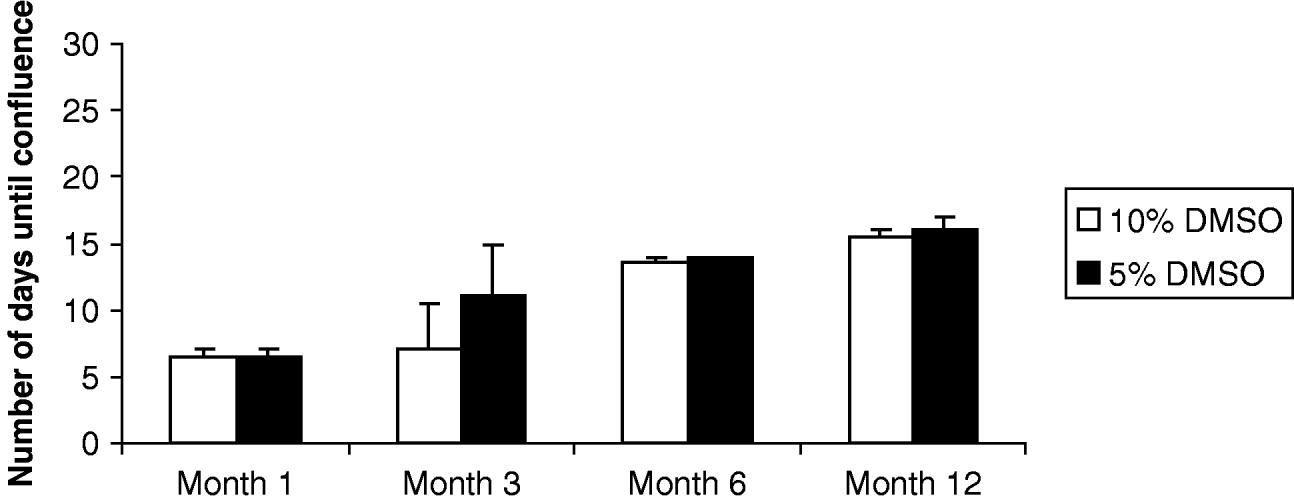
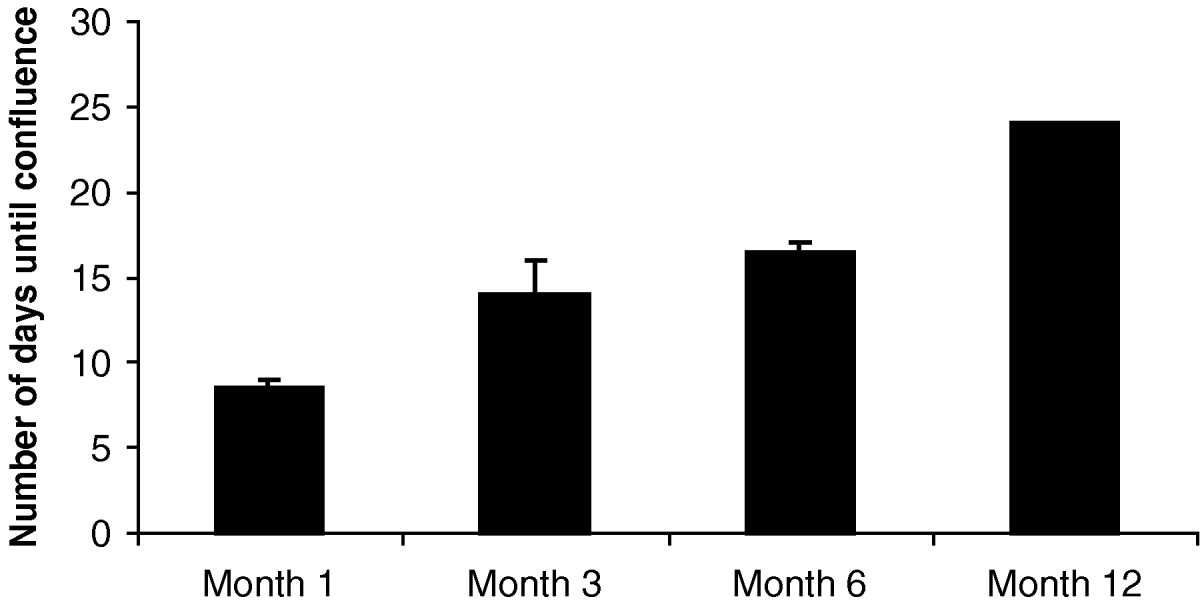
A. castellanii trophozoites and cysts were stored under various conditions to determine their optimal long-term storage method. At 1, 3, 6 and 12 months after being placed in storage, A. castellanii were placed in RM until 100% confluency was reached (Figs 1–4). This demonstrated their viability. Both Acanthamoeba trophozoites and cysts remained viable in all storage media, with the exception of those stored in media containing 20% and 10% glycerol (results not shown). The length of time to reach 100% confluency increased for A. castellanii trophozoites stored in RM with 10% or 5% DMSO at −70°C from 6·5 to 16 days as the length of time to storage increased (Fig. 1). The time to 100% confluency also increased for A. castellanii cysts stored in EM at 4°C from 8·5 to 24 days as the time in storage increased from 1 to 12 months (Fig. 2).
The average time (days) until confluence for Acanthamoeba castellanii trophozoites stored in RM with 10% or 5% DMSO at −70°C. The length of time to reach confluence increased the longer time spent in storage for all samples from 6·5 to 16 days. The data represent the mean of 2 replicate experiments.

The average time (days) until confluence for Acanthamoeba castellanii cysts stored in EM at 4°C. The length of time to reach confluence increased the longer time spent in storage from 8·5 to 24 days. The data represent the mean of 2 replicate experiments.

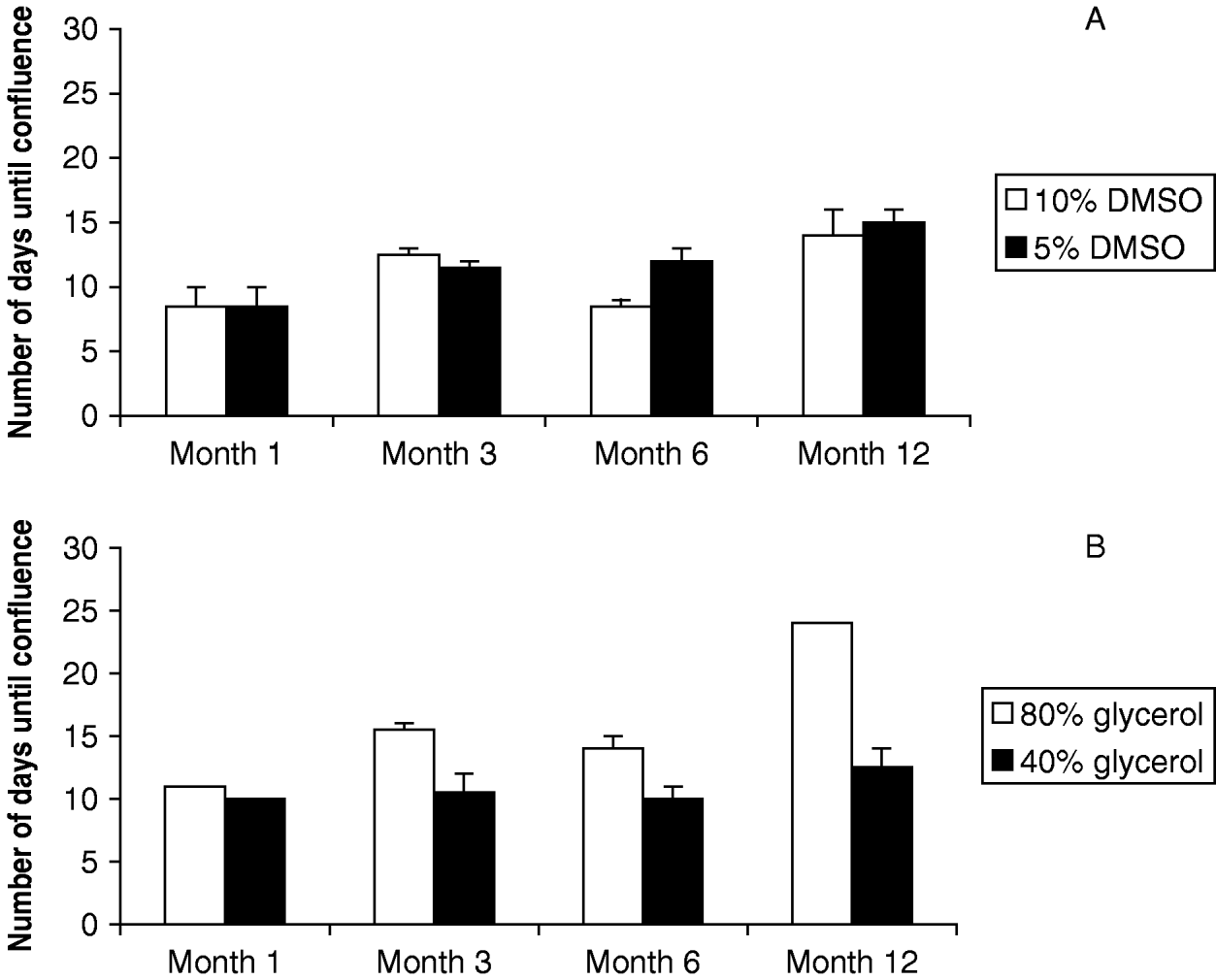
The average time (days) until confluence for Acanthamoeba castellanii cysts stored at −70°C in RM with (A) 10% or 5% DMSO and (B) 80% or 40% glycerol. (A) The length of time to reach confluence increased for cysts stored with RM and 5% DMSO the longer time spent in storage from 8·5 to 15 days whereas cysts stored with 10% DMSO varied from 8·5 to 14 days over the 12-month period. (B) The length of time until confluence remained constant for cysts stored in 40% glycerol and RM (10–12·5 days) whereas cysts stored with 80% glycerol increased after from 11 to 24 days. The data represent the mean of 2 replicate experiments.

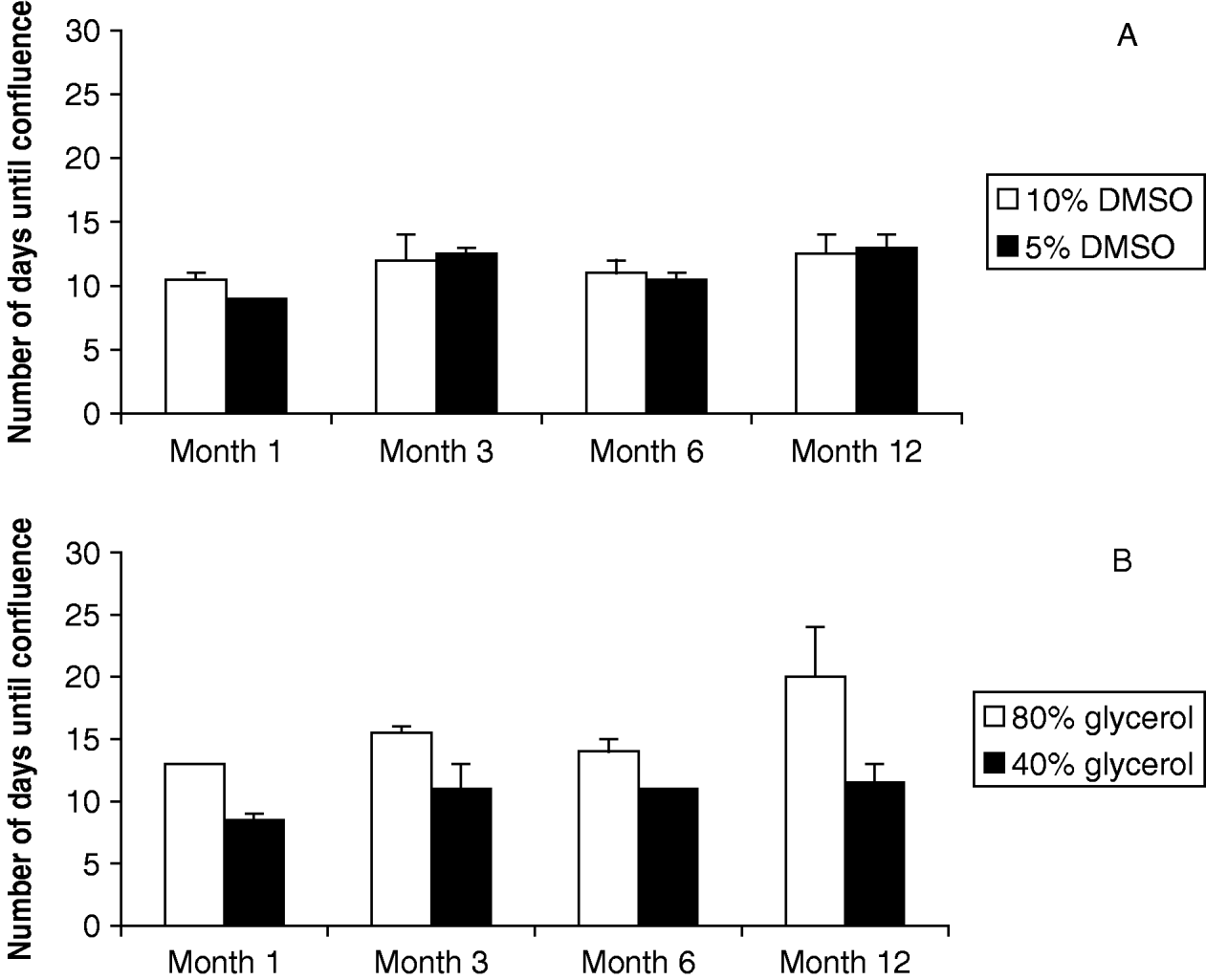
The average time (days) until confluence for Acanthamoeba castellanii cysts stored at −70°C in EM with (A) 10% or 5% DMSO and (B) 80% or 40% glycerol. (A) The length of time for cysts in 5% or 10% DMSO varied from 9 to 13 days over the 12-month period. (B) Cysts stored in EM with 80% glycerol took a lot longer to reach confluence (13–24 days) than cysts stored in 40% glycerol (10–12·5 days). The data represent the mean of 2 replicate experiments.

The length of time to 100% confluency increased for A. castellanii cysts stored in RM and 5% DMSO with length of time spent in storage (from 8·5 to 15 days). However, at a DMSO concentration of 10% the length of time to confluence varied throughout the entire study, with an increase from 1 month to 3 months (8·5 to 12·5 days), then decreasing after 6 months (8·5 days) and finally increasing after 12 months (14 days) (Fig. 3). For cysts stored in 40% glycerol and RM the length of time to confluence remained constant (10–12·5 days), whereas for cysts stored in 80% glycerol the time required to reach trophozoite confluence increased (from 11 to 24) over the 12-month study period (Fig. 3).
The average time until confluence for A. castellanii cysts stored at −70°C in EM and in 5% or 10% DMSO varied from 9 to 13 days over the 12-month period (Fig. 4). However, for A. castellanii cysts stored in EM with 80% glycerol the time to confluence increased over the study period from 13 to 24 days and cysts stored in 40% glycerol remained constant at 10–12·5 days (Fig. 4).
DISCUSSION
Cryopreservation of Acanthamoeba species has been previously described in a number of studies (Seo et al. Reference Seo, Yong and Im1992; John et al. Reference John, Eddy and John1994; John and John, Reference John and John1996; Alejandre-Aguilar et al. Reference Alejandre-Aguilar, Calvo-Mendez, Nogueda-Torres and de la Jara-Alcocer1998; Gonzalez-Robles et al. Reference Gonzalez-Robles, Flores-Langarica, Omana-Molina and Shibayama2001). A solution containing 10% DMSO had previously been shown to produce the highest number of viable A. castellanii trophozoites after storage in liquid nitrogen for up to 210 days (Alejandre-Aguilar et al. Reference Alejandre-Aguilar, Calvo-Mendez, Nogueda-Torres and de la Jara-Alcocer1998). Other studies have also demonstrated that the viability of A. castellanii trophozoites decreases during the first year of storage in the presence of 12% DMSO at −70°C (John et al. Reference John, Eddy and John1994). The studies undertaken herein, to investigate alternative means of storage, were instigated by similar anecdotal observations in our laboratory.
Acanthamoeba transform into cystic stages under adverse conditions and are resistant to biocides, chlorination and antibiotics. Cysts have been shown to give rise to viable trophozoites after 24 years in storage at 4°C (Mazur et al. Reference Mazur, Hadaś and Iwanicka1995; Marciano-Cabral and Cabral, Reference Marciano-Cabral and Cabral2003), but their viability has not previously been assessed relative to cryopreserved trophozoites. The results of the present study confirm that viability as determined by time to confluence is reduced in stabilates stored with DMSO or glycerol as cryopreservant following only 1 month of storage at −70°C. However, cysts in EM stored at 4°C remain viable for in excess of 1 year although time to reach confluence is increased with time in storage, up to 12 months. Specifically, time to reach confluence increased from 8·5 to 24 days over this time-period. Viability could be markedly improved by storage at −70°C in the presence of either DMSO or glycerol as cryopreservant. Notably, those stored in 40% glycerol remained relatively constant throughout the whole time-period, reaching confluence at 8·5 days after the first month of storage and between 10 and 12·5 days for time-periods up to and including 1 year. Similar results were obtained using 5% and 10% DMSO as cryopreservant. The presence of Mg2+ used to induce encystment was not necessary in the cryo-medium, but did not have an adverse affect on amoeba viability.
Overall these studies demonstrate that A. castellanii are best stored as cyst stages rather than as trophozoites. In this state they can be easily and inexpensively preserved for at least 12 months without the need for cryopreservation. However, preservation can be improved when stored −70°C with cryo-preservant and this refinement is recommended for long-term storage where facilities exist.