Introduction
Against the backdrop of a pregnant global decline in male fertility, supported by a growing number of reports showing declining sperm qualitative and quantitative parameters, the environment and dietary behaviours are increasingly being singled out for blame (Mann et al. Reference Mann, Shiff and Patel2020). While it is clear that a well-balanced lipid intake is an important factor in the efficiency of spermatogenesis as well as post-testicular sperm maturation (Ferramosca and Zara Reference Ferramosca and Zara2022), little information is available on the effect of protein intake and amino acid (AA) supplementation (Hallak Reference Hallak2020; Ketheeswaran et al. Reference Ketheeswaran, Haahr, Povlsen, Laursen, Alsbjerg, Elbaek, Esteves and Humaidan2019; Tottenborg et al. Reference Tottenborg, Glazer, Haervig, Hoyer, Toft, Hougaard, Flachs, Deen, Bonde and Ramlau-Hansen2020). Excessive or/and unbalanced intake of dairy products, red meat and processed foods have been shown to negatively impact male reproductive health (Maldonado-Carceles et al. Reference Maldonado-Carceles, Minguez-Alarcon, Mendiola, Vioque, Jorgensen, Arense-Gonzalo, Torres-Cantero and Chavarro2019; Nouri-Majd et al. Reference Nouri-Majd, Salari-Moghaddam, Aminianfar, Larijani and Esmaillzadeh2022) at various sites. One common feature of these protein sources is their richness in branched-chain amino acids (BCAAs) which are therefore suspected to be the detrimental causative agents affecting male reproductive efficiency. For example, bodybuilders are increasingly resorting to BCAA supplementation to build-up their muscle mass (Ketheeswaran et al. Reference Ketheeswaran, Haahr, Povlsen, Laursen, Alsbjerg, Elbaek, Esteves and Humaidan2019; Tom and Nair Reference Tom and Nair2006). Given that the vast majority of these consumers are young men of childbearing age, it is important to study the impact of such a choice on their ability to father.
BCAAs (leucine: Leu, isoleucine: Ile and valine: Val), are essential AAs, meaning they must come from our diet. Daily nutritional requirements for humans have been determined for each of them, and set at 40 mg/kg, 25 mg/kg and 19 mg/kg for Leu, Val and Ile, respectively (Polis and Samson Reference Polis and Samson2020). In addition to their main role in protein synthesis (S Zhang et al. Reference Zhang, Zeng, Ren, Mao and Qiao2017), BCAAs are thought to be involved in other metabolic processes (Arany and Neinast Reference Arany and Neinast2018; Holecek Reference Holecek2018). For example, some reports suggest that BCAAs may be involved in insulin resistance and diabetes (Kolahian et al. Reference Kolahian, Sadri, Larijani, Hamidian and Davasaz2015). As another example, Leu has been shown to specifically activate the mTOR (mammalian target of rapamycin) signalling pathway, a central controller of cell growth in response to growth factors and nutrients (Polis and Samson Reference Polis and Samson2020; S Zhang et al. Reference Zhang, Zeng, Ren, Mao and Qiao2017). Else, in humans, valine-enriched diets have been associated with a higher risk of hypertension (Mirmiran et al. Reference Mirmiran, Teymoori, Asghari and Azizi2019). Intriguingly, lower plasma valine levels were correlated with accelerated cognitive decline, while on the contrary, increased valine concentration in the diet had a protective effect against Alzheimer’s disease (Polis and Samson Reference Polis and Samson2020).
Amino acids are present in large quantities in seminal plasma and come mainly from the accessory sex glands, in particular the prostate. The importance of the AA profile of seminal plasma has been highlighted (Amirjannati et al. Reference Amirjannati, Henkel, Hosseini, Choopanian, Moghadasfar, Arjmand, Asgharpour Sarouey, Haji Parvaneh and Gilany2023; Esmaeili et al. Reference Esmaeili, Alizadeh, Zendehdel, Habibi, Pezeshki, Dizavi, Vesali, Gilani, Nahid and Shahverdi2025; Juyena and Stelletta Reference Juyena and Stelletta2012) and recent findings have shown that AA imbalances in the seminal plasma of patients with severe oligoasthenospermia (Boguenet et al. Reference Boguenet, Bocca, Bouet, Serri, Chupin, Tessier, Blanchet, El Hachem, Chao de la Barca, Reynier and May-Panloup2020) or teratozoospermia (Mehrparvar et al. Reference Mehrparvar, Chashmniam, Nobakht, Amini, Javidi, Minai-Tehrani, Arjmand and Gilany2020) were associated with sperm structural and functional changes and in the pathogenesis of male fertility disorders. More recently, we have emphasized that the presence of valine in blood and seminal plasma is correlated with abnormal sperm morphology in patients without metabolic syndrome (Esmaeili et al. Reference Esmaeili, Alizadeh, Zendehdel, Habibi, Pezeshki, Dizavi, Vesali, Gilani, Nahid and Shahverdi2025). However, little is known about the effect of dietary BCAAs on sperm. In male diabetic rats, Leu supplementation has been shown to improve sperm morphology and spermatogenesis (Kolahian et al. Reference Kolahian, Sadri, Larijani, Hamidian and Davasaz2015). A study in obese mice showed BCAAs supplementation significantly increased testosterone levels, testicular weight and germ cell numbers compared to control (Arakawa et al. Reference Arakawa, Masaki, Nishimura, Seike and Yoshimatsu2011). It seems that BCAA, particularly Leu has beneficial effects on sperm in obese or diabetic males. In zebrafish, leucine was found to increase sperm motility. In mice, BCAA supplementation via gavage at low doses (20 mg/ml) and exercise improved sperm quality and testosterone levels, while at higher doses (60 mg/ml) it had negative effects (Bahadorani et al. Reference Bahadorani, Tavalaee, Abedpoor, Ghaedi, Nazem and Nasr-Esfahani2019; J Zhang et al. Reference Zhang, Zhang, Liu, Su, Dawar, Dan, He, Gui and Mei2017). However, to our knowledge whether dietary supplementation of each member of BCAAs family are associated with sperm parameters has not been addressed. In the work presented here, to better understand the impact of BCAAs on mammalian male reproductive function, we supplemented mice either with Leu or Ileu or Val or a mixture of these three BCAAs. We then assessed conventional sperm parameters as well as testicular apoptotic status.
Material and methods
Animals and study design
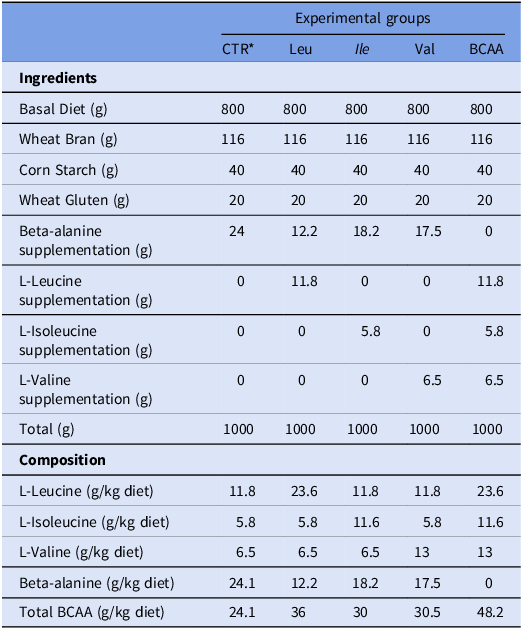
Experimental procedures were approved by the ethics committee of the Royan Institute, Tehran, Iran (IR.ACECR.ROYAN.REC.1399.076). Fifty male NMRI mice (7 weeks old; 27.2 ± 1.55 g) were included in this study. All animals were housed in a controlled environment (12-h light/dark cycle; 21 ± 2°C) for three adaptation days. Animals were randomly divided into five groups (n = 10/group) and fed for 5 weeks on the following diets: basal control diet (CTR); diet supplemented with 1.18% leucine (Leu); diet supplemented with 0.58% Ile (Ile); diet supplemented with 0.65% Val (Val) and, diet supplemented with all 3 BCAAs (Leu 1.18%, Ileu 0.58% and Val 0.65% (BCAA) [Table 1]. Supplementation levels were chosen with reference to the study by Falavigna et al (Reference Falavigna, Alves de Araujo, Rogero, Pires, Pedrosa, Martins, Alves de Castro and Tirapegui2012). Diet formulation for the use of beta-alanine was considered to conform to the Nutrient Requirements of Laboratory Animals, Fourth Revised Edition, 1995 (NRC, 1995). Pelleted feed and water were given ad libitum. All AAs were purchased from Supplements Co (Bulk Supplements.com, Henderson, NV, USA). The basal diet, representing 80% of the experimental diet, was obtained from Roshd Daneh Co (Karaj, Iran). For the experimental diets, each AA was added with a constant level of wheat bran, starch and gluten (Table 1). All animals were fed pellets. Feed and water consumption (via graduated bottles) were recorded daily and values were cumulated weekly. At week 5, animals were euthanized by injection of 10% ketamine-xylazine (100 mg/kg body weight) and tissue samples (n = 5/group) were taken from the left testis and stored in liquid nitrogen (-196°C). In addition, blood samples taken from the heart were centrifuged to separate plasma (n = 4/group) at 3,000 g for 12 min at 4°C and samples were stored at −20°C before use.
Composition and BCAA levels in experimental diets

*CTR: basic diet; Leu: basic diet + Leucine supplementation; Ile: basic diet + Isoleucine supplementation; Val: basic diet + Valine supplementation and BCAA: basic diet + BCAA supplementation.
Plasma amino acids (AA) analysis
AA profiles were determined in the Massoud Clinical Reference Laboratory (Tehran, Iran) using a HPLC with o-phthalaldehyde and fluorescence detection as developed by Frank and Powers (Frank and Powers Reference Frank and Powers2007). Briefly, plasma samples (20 μL) were prepared by adding an equal volume (20 μL) of an internal standard and HPLC-grade water for a final volume of 200 μL. Plasma proteins were precipitated by adding 200 μL of 0.5 mol/ L perchloric acid. Samples were then vortexed and centrifuged at 15,000×g for 5 min at room temperature. Supernatants (150µl) were collected and filtered (Spin-X 0.2-μm) by centrifugation at 15,000×g for 1 min. Filtered samples (100µl) were collected and subjected to HPLC analysis. Samples were split between two vials to minimize the time between derivatization and injection into the HPLC system.
Evaluation of semen parameters
For sperm preparation, the dissected epididymis was transferred to 1 ml of pre-warmed T6 culture medium (100 ml distilled water; 473 mg NaCl; 11 mg KCl; 5 mg NaH2 PO4; 10 mg MgCl2,6 H2O; 26 mg CaCl2,6 H2O; 210 mg NaHCO3; 200 µl Na-Lactate 100 %; 3 mg Na-pyruvate; 100 mg Glucose; 6 mg Penicillin; 5 mg Streptomycin; 1 mg Phenol red; 0.06 mg EDTA) containing 10% bovine serum albumin (BSA) and incubated at 37°C, 5% CO2 for 30 min. Sperm count and motility were analysed by computer-assisted sperm analysis (CASA) using a hot plate equipped with the Sperm Class Analyzer® software (SCA, full research version 5.1; Microptic Co., Barcelona, Spain). For sperm concentration, 6 µl of sperm sample was placed on the slide. Then, using a Nikon 10 × 0.25 field negative phase contrast Ph1 BM microscope, at least 400 spermatozoa were counted in each series. To determine sperm viability, sperm samples were mixed with eosin Y (1:1; Merck Chemical Co., Darmstadt, Germany). Sperm showing purple staining under the microscope were considered dead, and sperm showing no staining were counted as alive (200 cells, 100X).
qRT-PCR assay
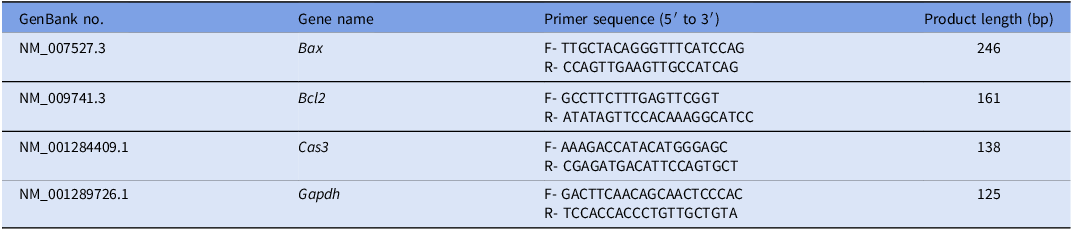
Real-time qPCR was used to study the expression of apoptotic genes (Bax, Bcl2 and Cas3). Briefly, the testis was homogenized in TRIzol for RNA isolation and purification (Qiagen, Dusseldorf, Germany). The DNase I, RNase-free kit (Thermo Fisher Scientific, Carlsbad, CA,USA) was used for DNA digestion. RNA concentration was measured by a NanoDrop ND-2000 spectrophotometer (Thermo Fischer Scientific, MA USA). After assessing RNA integrity, complementary DNA was synthesized using the Takara cDNA synthesis kit (Takara Bio, CA 94043, USA). Expression levels of the three target genes were analysed by the 2-∆∆ct method. GAPDH was chosen as the housekeeping gene for quantitative PCR normalization. The sequence of primers used in the present study is shown in Table 2.
Characteristics of primers used for real-time qPCR, Bax; BCL2 antagonist/killer; Bcl2, BCL2 apoptosis regulator; Cas3, caspase 3

Statistical analysis
All statistical analyses were performed using SPSS 20 software (SPSS Inc., Chicago, IL). Data were first assessed for normal distribution using the Kolmogorov-Smirnov test. Comparison between groups was performed by one-way ANOVA with Post hoc Tukey test. P values below 0.05 were considered significant. Data are least squares means ± standard deviation.
Results
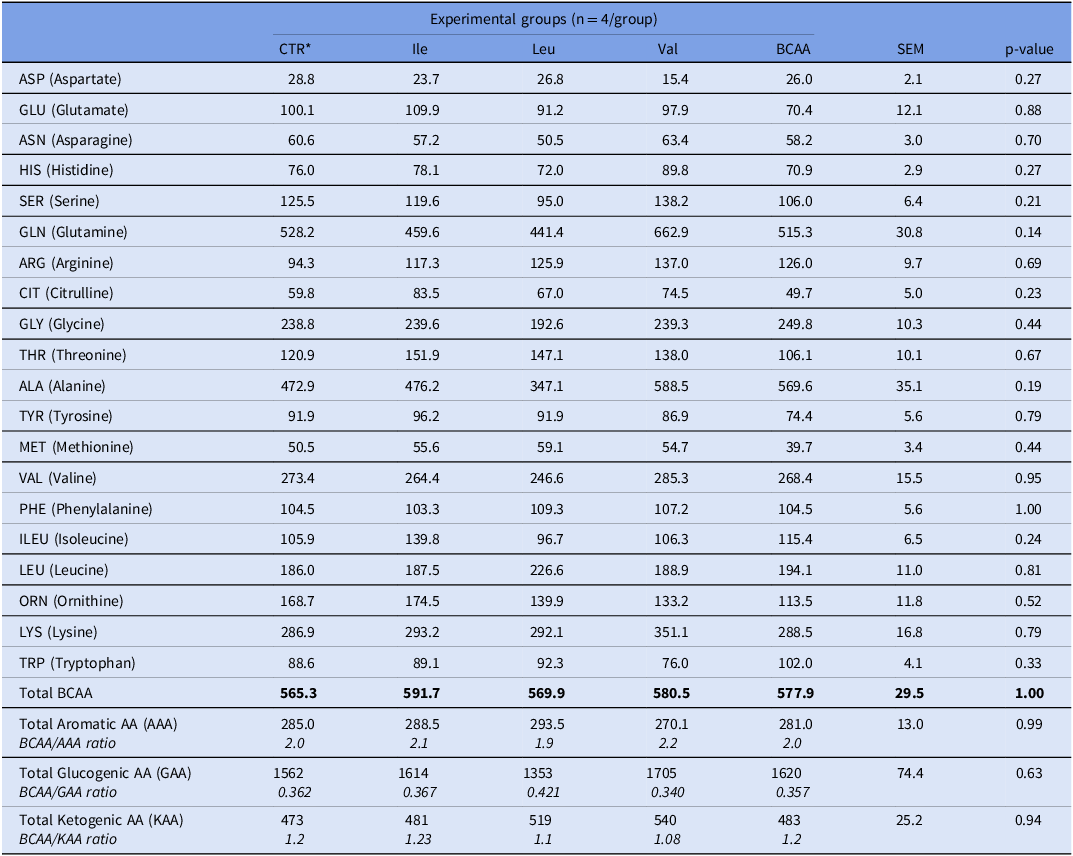
Plasma AA measurements were first carried out to evaluate the impact of the supplementations. Each individual supplementation (Leu, Ile or Val) for 35-days resulted in a significant increase in the plasma representation of the concerned AA when compared with the control regimen (Table 3) attesting of the enrichments provoked by the regimens. Ileu supplementation did not introduce any change in the representation of other classes of amino acids (AAA = aromatic amino acids, GAA=glucogenic amino acids and KAA= ketogenic amino acids) as the ratios presented in Table 3 were similar. In contrast, both Leu and Val supplementation provoked significant changes in the different ratios. It is of interest to note that Leu supplementation provoked a drop in Val and Ile representation (Table 3), a phenomenon that will be discussed later. Finally, Leu supplementation also provoked changes in the different ratios monitored essentially at the expense of the glucogenic and aromatic amino acids (Table 3). Intriguingly, when the supplementation was carried out with the 3 BCAAs altogether, this was not followed by a plasmatic enrichment in any of the individual BCAAs (Table 3) a point that will be also discussed later.
Plasma amino acid profiles (µM/L)

*CTR: basic diet; Leu: basic diet + Leucine supplementation; Ile: basic diet + Isoleucine supplementation; Val: basic diet + Valine supplementation and BCAA: basic diet + BCAA supplementation.
Total BCAA: VAL + ILE + LEU; Aromatic AA: TRP + TYR + PHE; Glucogenic AA: ALA + VAL + ILE + GLY + SER + THR + ASP + PHE+ TYR: Ketogenic AA: LYS + LEU.
Among the different supplementations, Ile- and BCAA-supplemented animals had the highest food consumption, while Val- and Leu-supplemented animals had the lowest (Figure 1A). During the 35 days of supplementation, water consumption was highest in the BCAA group and lowest in the CTR group (Figure 1B). There was no significant difference in final body weight between experimental groups (Table 4).
Total feed intake (A) and total water drinking (B) in 35 days (n = 10/each group). Control: basic diet; Leucine: basic diet + Leucine supplementation; Isoleucine: basic diet + Isoleucine supplementation; Valine: basic diet + Valine supplementation and BCAA: basic diet + BCAA supplementation.

Initial and final body weights (Mean ± sd)

*CTR: basic diet; Leu: basic diet + Leucine supplementation; Ile: basic diet + Isoleucine supplementation; Val: basic diet + Valine supplementation and BCAA: basic diet + BCAA supplementation.
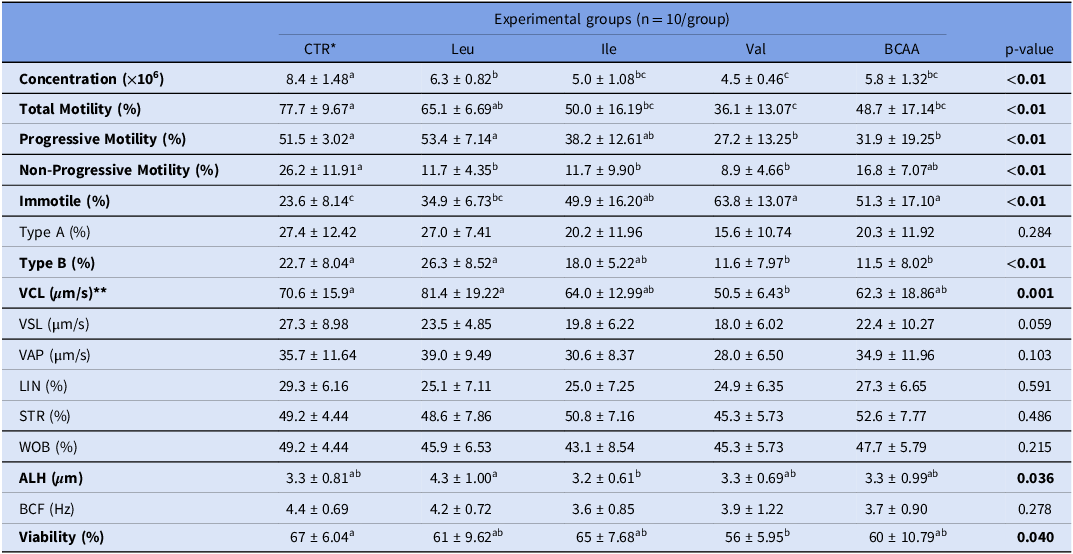
With regard to classical sperm parameters, sperm concentration, total motility and progressive forward motility were significantly reduced in all supplemented groups compared with the control group (Table 5). The Val-supplemented group was the one in which all 3 parameters (total motility, progressive forward motility and sperm concentration) were most affected (Table 5). Logically, the percentage of non-progressive motile sperm decreased in all supplemented groups, while the percentage of immobile sperm increased significantly in all supplemented groups (Table 5). Again, the Val-supplemented group was the most affected (Table 5). Although the percentages of grade A motile sperm (very strong activity with forward progression) were not significantly affected in the supplemented groups compared with the controls, there was a clear tendency for it to be lower in the Val-supplemented group (Table 5). This effect was most pronounced for the percentages of grade B motile sperm (decent sperm activity with forward progression), which were significantly reduced in both the Val and BCAA-supplemented groups (Table 5). Examining the detailed velocity parameters provided by the CASA analysis (VCL, VSL, VAP, LIN, STR, WOB, ALH and BCF), we observed that the Val-supplemented group had a dramatically lower VCL than the other groups (Table 5). None of the other CASA velocity parameters were significantly altered between groups, with the exception of ALH, which was found to be increased only in Leu-supplemented animals compared with those supplemented with Ile (Table 5). Ultimately, sperm viability was only significantly reduced in the Val-supplemented group compared with CTR animals (Table 5).
Sperm characteristics in experimental groups (Mean ± sd)

* *CTR: basic diet; Leu: basic diet + Leucine supplementation; Ile: basic diet + Isoleucine supplementation; Val: basic diet + Valine supplementation and BCAA: basic diet + BCAA supplementation.
** VCL = curvilinear velocity; VSL = straight line velocity; VAP = average path velocity; STR = VSL/VAP (straightness); ALH = amplitude of lateral head, and BCF = beat cross frequency. Type A – These are fast-moving spermatozoa that swim rapidly in a straightforward direction. Type B – These are slow-moving spermatozoa that move forward in a disorderly fashion, or even a little more slowly.
a,b,cValues with different superscripts within lines significantly differ. Parameters in bold shows significant differences.
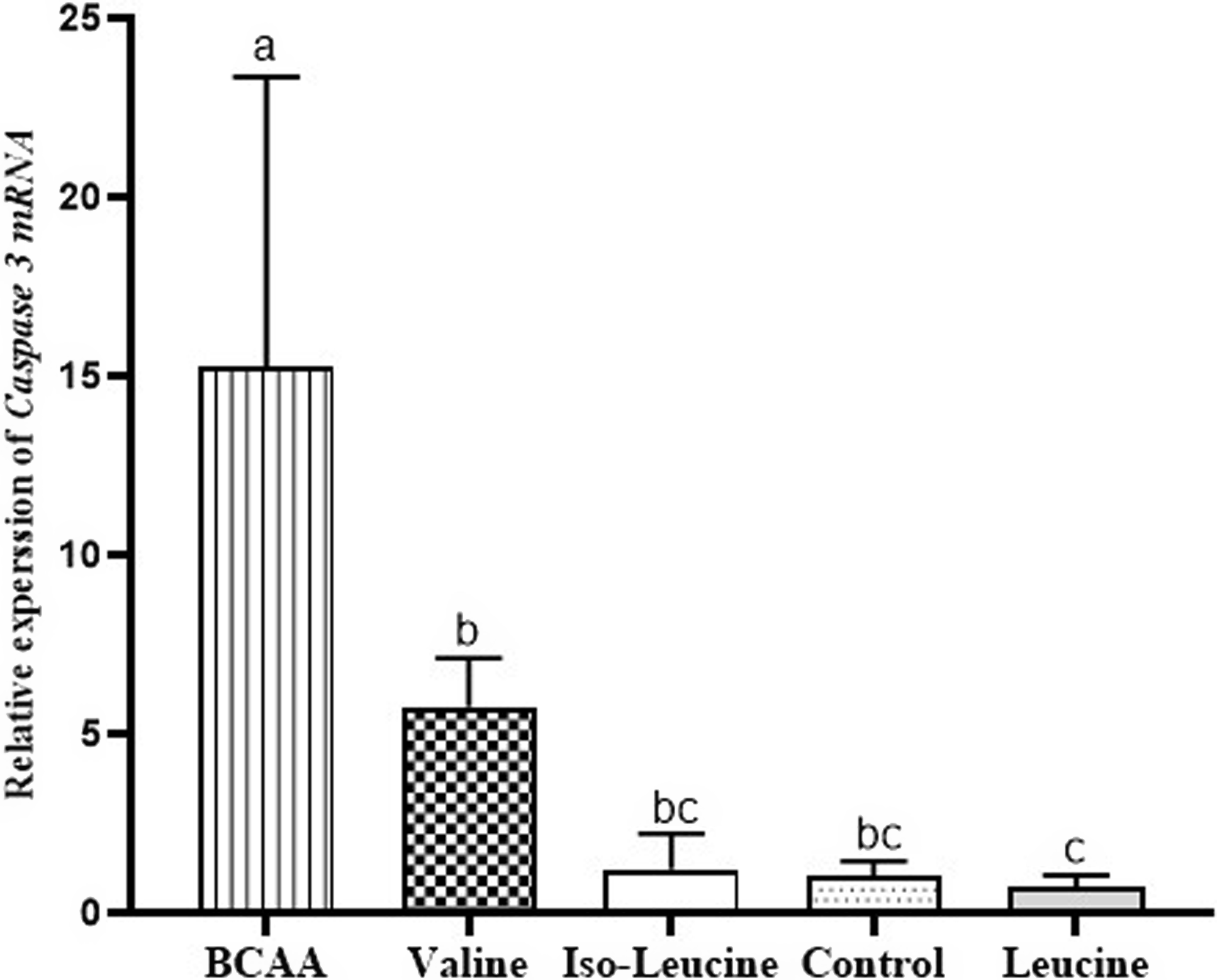
As sperm concentration was significantly decreased following BCAA supplementation, we investigated whether this could be linked to the level of testicular apoptosis. Levels of pro-apoptotic Bax mRNA in the testes of BCAA-supplemented mice were significantly reduced in BCAA-, Leu- and Ile-supplemented animals compared with control animals, whereas surprisingly, in Val-supplemented animals, Bax expression was not altered (Fig. 2A). In contrast, for the Bcl2 apoptosis inhibitory marker, only Val supplementation led to a significant increase in its mRNA steady-state level when compared to the controls and other supplemented animals (Figure 2B). Looking then at the Bax/Bcl2 ratio, a conventional indicator of survival or death after an apoptotic stimulus, we found that Val, Ile and BCAA supplementations were associated with an increased Bax/Bcl2 ratio, that was significant only for Ile- and BCAA-supplemented animals when compared to controls (Fig 2C). As a downstream executor of apoptosis we also monitored the expression of caspase-3 (CASP3) in the different animal groups (Fig. 3). BCAA and Val supplementation were associated with a significant increase in testicular CASP3 mRNA accumulation compared with control animals and animals supplemented with Leu or Ile (Fig. 3).
(A. B. C). Expression of testis apoptotic markers Bax, Bcl2, following BCAA supplementation. A: BAX mRNA expression levels in the testes of mice fed experimental diets. B: BCL-2 mRNA expression levels in the testis of mice fed experimental diets. C: BAX/BCL2 ratio. Control: basic diet; Leucine: basic diet + Leucine supplementation; Isoleucine: basic diet + Isoleucine supplementation; Valine: basic diet + Valine supplementation and BCAA: basic diet + BCAA supplementation. Data are presented as mean ± SD. a,b Bars with distinct superscripts are significantly different (p < 0.05).

CASP-3 mRNA levels in mice testis fed experimental diets (mean ± SD). Control: basic diet; Leucine: basic diet + Leucine supplementation; Isoleucine: basic diet + Isoleucine supplementation; Valine: basic diet + Valine supplementation and BCAA: basic diet + BCAA supplementation. a,b Bars with distinct superscripts are significantly different (p < 0.05).

Discussion
The BCAA supplementations reported in the present work clearly had an impact on the reproductive function of male mice, as evidenced by significant changes in sperm concentration, motility and viability as well as in testis apoptosis status. With regard to sperm parameters, Val supplementation had the greatest effect, followed by supplementation with the 3 BCAA mix (Val, Leu, Ile). Val supplementation caused a marked decrease in sperm concentration, total motility and progressive motility, as well as a sharp increase in the percentage of immobile spermatozoa. In addition, Val and BCAA supplementation were associated with a significant increase in the steady-state level of testicular caspase3 mRNA, suggesting testicular apoptosis. This powerful effect of Val supplementation on spermatogenesis efficiency and conventional sperm parameters can be tentatively explained.
It has been reported that Val catabolism generates intermediates such as methylmalonic acid (MMA), which in turn is associated with mitochondria-mediated generation of reactive oxygen species (ROS) (Caioli et al. Reference Caioli, Candelotti, Pedersen, Saba, Antonini, Incerpi and Zona2016; Liu et al. Reference Liu, Wang, Zhang, Cai, Liu, Fang and Yu2022; Stepien et al. Reference Stepien, Heaton, Rankin, Murphy, Bentley, Sexton and Hargreaves2017; Wang et al. Reference Wang, Liu, Liu, Tian, Zhang, Cai, Fang and Yu2020). Moreover, Val catabolism product accumulation, including propionyl CoA and succinyl CoA, that may lead to chronic hyperinsulinemia and consequently cell dysfunction and insulin resistance, contributes to incomplete lipid oxidation (Newgard Reference Newgard2012). Thus, Valine-induced ROS generation could explain the reduced spermatogenetic efficiency via testicular apoptosis. Reactive oxygen species (ROS) play an essential role in defining the functional competence of spermatozoa. While moderate amounts of ROS promote sperm optimal maturation and capacitation, excessive ROS generation and/or compromised antioxidant defences in the reproductive system can induce a state of oxidative stress (OS) that impairs sperm fertilizing capacity and the structural integrity of sperm cells (Drevet & Aitken, 2020; Aitken & Drevet, Reference Aitken and Drevet2020). In the context of future work, additional tests could be carried out to reinforce this hypothesis by examining classic markers of oxidative stress such as the level of malondialdehyde and the level of 4-hydroxynonenal (4-HNE) in the protein extracts of testicular, epididymal or spermatic cells of animals supplemented with BCAA. Monitoring mitochondrial function by measuring JC-1 could also provide indications of the state of spermatozoa mitochondria.
Ile is also a precursor of MMA, but at a lower level than Val. This may therefore explain why, in BCAA-supplemented animals, Val plus Ile have a synergistic effect, whereas alone (Ile-supplemented animals), the effect recorded on testicular function and spermatozoa is weaker. It could also explain the effects on sperm motility observed in both Valine-supplemented animals and those supplemented with all three BCAAs, via mitochondrial malfunction and ROS-mediated damage (Amaral et al. Reference Amaral, Lourenço, Marques and Ramalho-Santos2013). The weakest effects recorded here, on both testicular apoptosis status and sperm parameters, were observed in Leu-supplemented animals. This makes sense, as it has been reported that excessive Leu intake can decrease plasma levels of the other branched-chain essential AAs, Ile and Val (Holecek Reference Holecek2018), which is exactly what we observed (see Table 3). It should be noted, however, that with regard to Leu supplementation, our observations are not in agreement with a previous report (Kolahian et al. Reference Kolahian, Sadri, Larijani, Hamidian and Davasaz2015) indicating that Leu supplementation provided in drinking water increased the percentage of sperm with normal morphology, improved spermatogenesis and testicular histological parameters in diabetic rats. The configuration of these two experiments (diabetic and non-diabetic animals) being very different, it is difficult to explain the reasons for this discrepancy.
It therefore appears that BCAAs, and valine in particular, have a powerful effect on male reproductive function. Extrapolation of these results to men will require further study. However, it is interesting to note that studies have already reported significant differences in the seminal plasma AA profiles of fertile and infertile oligozoospermic men (Silvestroni et al. Reference Silvestroni, Morisi, Malandrino and Frajese1979). We also found in our infertility clinic that the AA profiles of blood and seminal plasma of men with and without metabolic syndrome were significantly different, with particular changes in valine concentration (Esmaeili et al. Reference Esmaeili, Alizadeh, Zendehdel, Habibi, Pezeshki, Dizavi, Vesali, Gilani, Nahid and Shahverdi2025). On the contrary, no differences in blood BCAA levels were observed elsewhere when comparing azoospermic and oligozoospermic men (Sugiyama et al. Reference Sugiyama, Terada and Miyake2021). Whether seminal plasma and blood plasma behave differently with regard to AA content will need to be investigated. This is one of the limitations of our study, in which only the AA profiles of blood plasma were examined. A complementary study should follow in parallel the AA content of blood plasma and seminal plasma after BCAA supplementation. A second limitation of our work is that only one dose of each BCAA was used in the supplementations. This was an arbitrary choice, as our main objective in this pioneering study was to test the effect of BCAAs (including the 3 members of the Leu, Ileu and Val family) on mammalian sperm physiology. The doses chosen were based on previous internal work, work already published elsewhere and the transposition to mice of the human doses found in commercially available food supplements. For practical reasons, including the costs associated with the animals, the costs of animal caretakers and facilities and compliance with the 3Rs (Replace/Reduce/Refine) rules in animal experimentation, as applied by our local ethics committee, we used a single-dose approach. Now that we have recorded certain effects with certain BCAAs, a rigorous approach would be to test increasing doses to see what happens. In this regard, Rashidi et al (Reference Rashidi, Alizadeh, Sharifi and Najafi2023) pointed out recently that the use of a wider range of Val doses (≥ 9.5 g Val/kg diet) during d0 to d42 of age can lead to histological damage in testis of quail chicks which open the road for more investigation on Val levels and testis function. More recently, our team pointed out the negative effects of high valine levels in diet on testis and semen parameters in mature quail (Dinari et al. Reference Dinari, Najafi, Sharifi, Ghaleno, Alizadeh, Pashaee and Rashidi2025).
The unrestricted use of muscle building supplements (MBS) to improve performance is a growing public health concern, particularly among athletes. In addition to improving athletes’ performance, the growing use of MBS among the general population stems from the social pressure exerted on adolescents and young men of reproductive age to conform to an idealized muscular body (Girardi et al. Reference Girardi, Zheng and Zhu2022). One study reported that 87.5% of high-level athletes take dietary supplements (Girardi et al. Reference Girardi, Zheng and Zhu2022). Recently, Bajool et al. pointed out that protein and dietary supplements containing AA were the most common dietary supplements worldwide (Bajool et al. Reference Bajool, Hemmatinafar, Daryanoosh, Jahaniboushehri, Jahan and Imanian2024). Although there has been a lot of media hype suggesting that BCAA consumption stimulates muscle protein synthesis (MPS) and produces an anabolic response in men, these claims are poorly substantiated (Boccanegra et al. Reference Boccanegra, Verhaart, Cappellari, Vroom and De Luca2020; Holecek Reference Holecek2022; Wolfe Reference Wolfe2017). Conversely, negative effects of BCAA on the health of athletes, in particular BCAA-rich supplements, have been factually reported (Girardi et al. Reference Girardi, Zheng and Zhu2022; Manuel and Heckman Reference Manuel and Heckman2011). Overall, our present findings suggest that further studies are warranted to examine the roles of BCAA supplements particularly in young male bodybuilders suffering from subfertility/infertility.
In conclusion, this report illustrates quite clearly that certain BCAA supplements, particularly Val, can have adverse effects on male fertility. Although it is preliminary and has not yet been transposed to men, it suggests that a principle of caution should be considered when BCAA supplementation is used.
Acknowledgements
The research was made possible thanks to the involvement of our colleagues at the Royan Institute and who contributed to this work. We would also like to thank the staff of the Massoud Clinical Reference Laboratory (Tehran, Iran), for their contributions. AliReza Alizadeh Moghadam Masouleh was awarded a Georg Forster Research Fellowship for experienced researchers by the Alexander von Humboldt Foundation (Bonn, Germany). He was a visiting scientist at the gyn-medicum, Center for Reproductive Medicine, Göttingen, Germany and Institute of Pharmacology and Toxicology, University Medical Center Göttingen, Göttingen, Germany at the time the manuscript was written.
Funding
This project was a master’s thesis supported by the Royan Institute, Tehran, Iran, and the University of Science and Culture, Tehran, Iran (project code 98000161).
Competing interests
The authors declare no conflicts of interest.
Ethical standards
Experimental procedures were approved by the ethics committee of the Royan Institute, Tehran, Iran (IR.ACECR.ROYAN.REC.1399.076).