Introduction
This article is intended to provide a summary and commentary on the extent of community services for mentally disordered offenders in England and Wales. Our focus on England and Wales is because the different countries of the United Kingdom have devolved legislative and administrative powers so that this article would—by necessity if a United Kingdom paper—be 3 times as long so as to include Scottish and Northern Irish law, practice, and policy; Wales is considered alongside England as the 2 countries are sufficiently similar. We have interpreted “community services” broadly and have included descriptions of court liaison and diversion services and multiagency risk management services. In other words, we have described, in some form, all of the services that are in place to manage mentally disordered offenders after they have been released from prison, discharged from hospital, or diverted from either form of custody to the community.
As in all jurisdictions, the issue of mentally disordered offenders is on the agenda of “justice” and “health,” both in political terms and for professionals providing services. Where we refer to forensic community mental health teams, we are describing health services; almost exclusively NHS services. Court and probation services are part of the justice system. The more recent direction of travel has been toward jointly funded services—broadly speaking by the NHS and the National Offender Management Service (NOMS)—and the sharing of responsibility. This is particularly the case with children and young people and with adults with personality disorder.
Multidisciplinary community mental health teams are the backbone of general community psychiatry in England and Wales. Community psychiatry had its origins as early as the 1920s, but the large institutions dominated until much later in the century. More specialized community mental health teams 1 have fallen in and out of fashion over the last 20 years, sometimes driven by research evidence.Reference Killaspy, Bebbington and Blizard 2 Assertive outreach teams have all but disappeared while early intervention in psychosis and crisis teams has shown more longevity. Specialist community forensic mental health teams are relatively young and underevaluated but are at the center of the services we have described below.
History of Forensic Psychiatric Services
Arguably, the first forensic psychiatric inpatient facility anywhere in the world, was formed by the criminal wings at the Bethlem Hospital in London in 1815. These wings were developed in response to, among others, the case of James HadfieldReference Allderidge 3 who had, in a deluded state fired a gun at George III. He missed but was found to be insane. At the time (1800), the legal provisions for his safe confinement were considered to be inadequate and the government swiftly passed the Criminal Lunatics Act. 4 “Criminal lunatics” needed a place to go and specific inpatient services for mentally disordered offenders grew from the 19th century with the development of what later became known as the “special hospitals.” The first was Broadmoor Hospital, which opened in 1863, and the 3 hospitals which were developed exist today as “high secure” services. For most of the 20th century, they constituted the full extent of clinical, forensic mental health services.
The Committee of Mentally Abnormal Offenders (the Butler Committee) 5 was set up jointly by 2 branches of government to consider (i) law as it applied to people with mental disorder and (ii) services for offenders with mental disorder. They reported in 1975 and recommended (albeit they were not the first to do so) that each region set up secure psychiatric units. This recommendation coincided with the closure of the Victorian asylums. There was perceived contradiction in these policies: on the one hand, there was a policy of deinstitutionalizationReference Killaspy 6 but simultaneously Butler recommended a new kind of institution, the regional secure unit. Initial development was hesitant but “medium secure units” were built, with development accelerating throughout the late 1980s and 1990s. Subsequently, low secure units were developed with each stage of forensic mental health provision arising out of a recognition that people needed somewhere to go next. The Butler Report also recommended forensic community services be developed although this has been the last of the recommendations to be adopted.
Forensic psychiatry, as a medical specialty in the United Kingdom, has grown over the last 40 years, in tandem with the secure hospital development. What began as a handful of self-identified forensic psychiatrists, is now a faculty within the Royal College of Psychiatrists with a specific training scheme and recognition as a distinct specialty by the General Medical Council, the regulatory body for doctors. Forensic psychiatry grew along traditional medical, ethical lines, by focusing on beneficence and nonmaleficence. With the accelerating growth of the secure hospital system, there was a strong emphasis on removing mentally disordered people from the prison system to places, which would provide therapeutic benefit and to a lesser extent reduction of risk.
Through the 1980s and 1990s, there was more emphasis on the risk reduction role of psychiatryReference Coid and Maden 7 driven, partly by media publicity of cases where mentally disordered people had committed serious offences. Christopher Clunis killed a stranger, Jonathan Zito in an underground station. The subsequent media coverage was accompanied by consistent statements from Mr Zito’s widow highlighting the absence of adequate care for Christopher Clunis. The influence of these cases and their coverage may have led to policies increasing restrictive care.Reference Hallam and Hallam 8
The global financial crash in 2008 and subsequent policy of austerity in funding public services has contributed to the deceleration of the expansion of secure hospital services, but the profession continues to grow. The last workforce census indicated that there were approximately 350 forensic psychiatrist posts in England and Wales. 9
Community forensic psychiatry services developed significantly at the start of the 21st century, largely in response to the increase—over the preceding 2 decades—of these new inpatient forensic services; perhaps an obvious and necessary next step. Forensic community services represent the evolving compromise between concern about over-zealous control of those with mental disorder (in the deinstitutionalization movement)Reference Thornicroft 10 against the opposing concern about those discharged from secure hospitals receiving inadequate supervision of their risk to others from community psychiatric teams without forensic expertise.
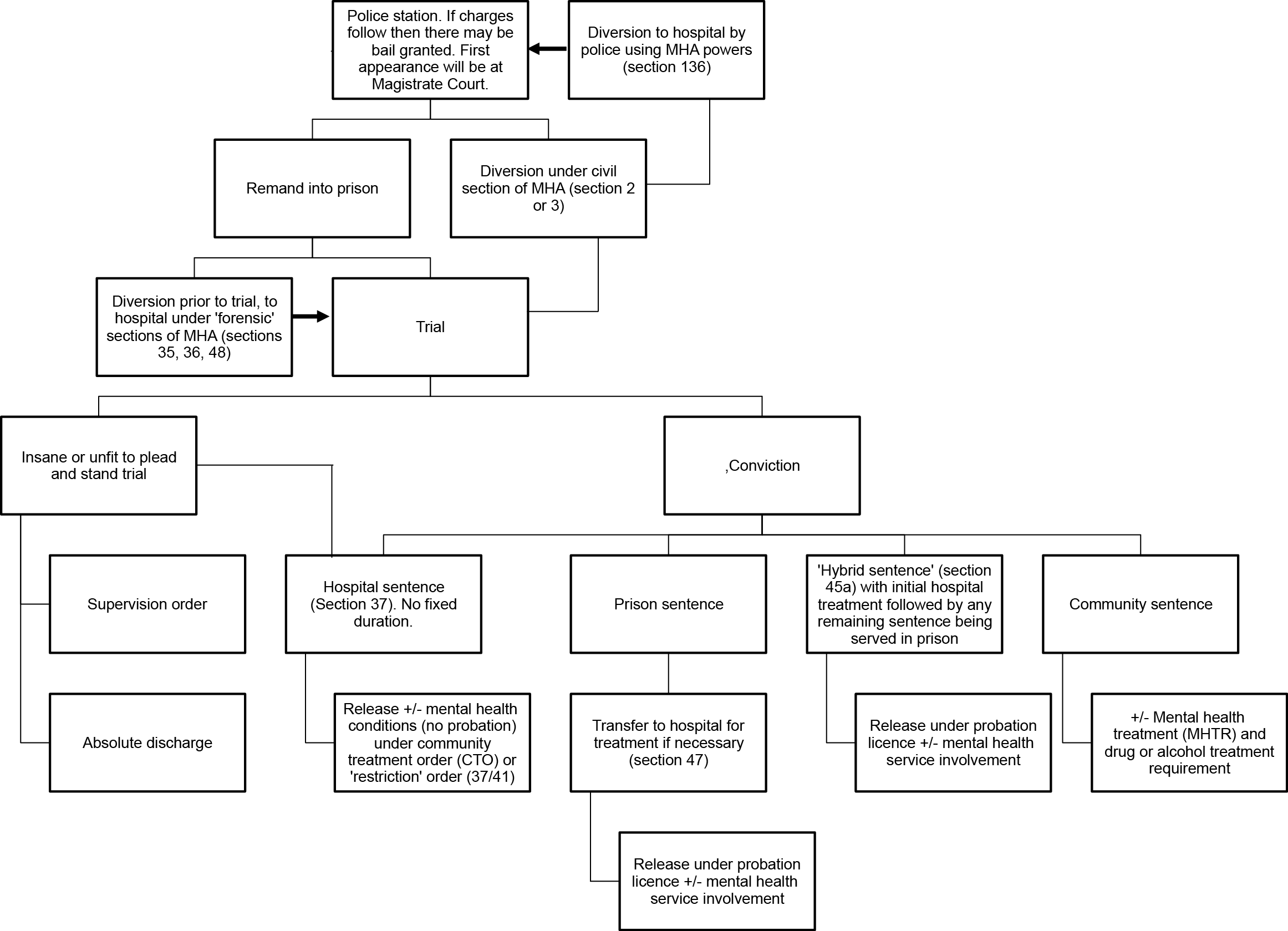
In 1993, a review of forensic services made scant reference to community forensic services.Reference Eastman 11 By 1996, there was a call for a “forensic psychiatry team in each district to own responsibility for mentally disordered offenders.”Reference Grounds 12 Today, there are both community forensic mental health teams and partnership arrangements with justice agencies. These new services provide an exit route for people detained in the secure hospital system as well as—more inconsistently—people released from prison. The initial pathway for patients discharged from forensic hospitals when they were first developed, was to general psychiatric services, which brought some difficulties about “ownership” of people with mental disorders who were considered to have high risks of offending ( Figure 1). The tension between forensic and general services persists with no real resolution to the question, “What makes someone a forensic patient?” Essentially, there is now a parallel forensic psychiatric system, which exists alongside general psychiatric services albeit under the same umbrella organizations: National Health Service (NHS) Trusts (there are 60 mental health trusts in England). The entire forensic psychiatry system is expensive, costing over 1 billion pounds a year.Reference Walker, Amos, Knowles, Batson and Craissati 13 The vast majority of this is associated with the cost of the secure hospital system.Reference Rutherford and Duggan 14 Over 15% of spending on all mental health services is spent on forensic psychiatric services.
Pathways for mentally disordered offenders in England and Wales suspected of criminal offences.

The last decade of forensic mental health service development began with the “Bradley Report,”Reference Bradley 15 which has driven many of the most recent changes in forensic mental health provision and continues to do so. This report was commissioned by the government to examine the extent to which offenders with mental health problems or learning disabilities could be diverted from prison to other services. This ambitious remit led to extensive recommendations, published in 2009 including, in relation to the scope of this article:
-
All police custody suites should have access to liaison and diversion services.
-
Further research on mental health treatment requirements (MHTRs; community orders).
-
Improved continuity of care for prisoners released from custody.
-
Development of Criminal Justice Mental Health Teams (in part to facilitate diversion). These teams were to bridge the gap between the justice and mental health systems in the community.
Forensic psychiatry today
The secure hospital system is constructed around 3 tiers of security: high, medium, and low. There are between 7000 and 8000 people in secure mental health services although there is some difficulty in collecting wholly reliable statistics because of the rather vague nature of what constitutes a low secure service.
-
High secure hospital beds are all provided by the NHS in 3 hospitals: Broadmoor, Rampton, and Ashworth.
-
Medium secure hospital beds are split between the NHS and private sector with approximately 65% in the NHS. The private sector beds are all funded by the NHS. Half of secure hospital beds are medium secure beds.
-
Low secure hospital beds are more diverse with some representing the upper end of security for general psychiatric services and others the lower end of forensic services.
Community forensic services cost very little by comparison to the hospital system and there is little in the way of nationally collected data on their cost.
The increase in the prison population in England and Wales has been mirrored by an increase in the number of people detained in secure hospitals. From 2000 to 2010, the numbers of people sentenced to hospital under sections 37 and 41 (see below) rose from fewer than 1000 to over 1500. Since 2010, as with the prison population, there has been a more gradual but continuing increase in overall numbers of detained forensic patients.
There has, however, been increasing emphasis on reducing the length of stay in secure hospitals and there are some observational (unpublished) data to suggest that where intensive community forensic teams exist there can be a substantial reduction in length of stay. This is providing the impetus for the development of new services.
Core Community Forensic Psychiatry Services
Structure of community forensic services
Community forensic mental health teams in England and Wales are heterogeneous in their design. They are funded according to borough catchment areas.Reference Whittle and Scally 16 A patient’s borough is determined by the geographical location of the General Practitioner they are registered with 28 NHS Trusts provide community forensic psychiatry care (47 provide secure hospital care). The caseload size of community forensic teams varies substantially, with a median size of 89. The teams are multidisciplinary in nature with individual “care coordinators” having caseloads of 12 to 20 patients and psychiatrists 30 to 100. Professional composition varies but includes psychiatry, psychology, nursing, social work, and occupational therapy.
Two different models for delivering specialist forensic care have been recognized and described; parallel and integrated. A parallel forensic service carries out separate assessments and case management to general (nonforensic) community mental health services. They have separate referral meetings, distinct caseloads, and funding. Alternatively, an integrated model involves professionals with forensic expertise working within general community mental health services.Reference Mohan, Slade and Fahy 17 , Reference Gunn 18 One disadvantage of the integrated model is a lack of clarity about who is ultimately responsible for the patient. However, the advantages may include the aim to spread relevant forensic skills through general psychiatric services and allow forensic patients better access to community psychiatric resources with less of a stigmatized, separate position in mental health management.Reference Whittle and Scally 19 The latter may be particularly important given the markedly different distributions of ethnicity between the general and forensic mental health teams in which black and other minority group patients are more likely to be found.Reference Humber, Hayes and Wright 20
The distinction between parallel and integrated models is a comparison, which has been made as a retrospective description. However, in practice, community forensic mental health services have developed in an ad hoc manner, without well-defined theoretical models or a robust evidence base. The advantages and disadvantages of the parallel and integrated models remain discussed and debated but with little consensus reached.Reference Buchanan 21
By 2004, approximately half of mental health trusts in England and Wales had some form of community forensic mental health team. Eighty percentage of these reported that they used a parallel model, although in reality the approaches were mixed much of the time. In a completely parallel system, patients discharged from forensic services would never return to general psychiatric services but always be managed in the community by forensic services.Reference Khosla, Davidson and Gordon 22 This is very rarely the case in practice and to see the models as mutually exclusive is probably erroneous.
In 2019, many forensic community teams will include elements of both parallel and integrated models of working in their service, providing case management and treatment for their own forensic community patients as well as consultancy work for general community services, in the form of one-off assessments and advice and guidance. The Royal College of Psychiatrists Standards for community forensic mental health services suggest the following core functions (abbreviated).Reference Kenney-Herbert , Taylor and Puri 23
Core functions of community forensic mental health services
-
Case management of a defined caseload, particularly those leaving secure care. Case management may be long term.
-
Treatment is provided within a recognized framework.
-
The team provides liaison, advice, specialist interventions, educational, and skills development.
-
Active involvement in care pathway management into and out of secure settings and prison.
-
Liaison with Multiagency Public Protection Arrangements (MAPPA).
-
Links with criminal justice liaison and court diversion services.
Patient entry to community forensic services
There is no consensus on the entry criteria a mental health patient should meet to enter the care of a forensic mental health team as opposed to a general mental health team. Individual services will usually develop operationalized criteria that will include consideration of: risk, legal status, location prior to discharge (prison, secure hospital), specialist treatment needs (sex offending, stalking), gravity of offending.
For every 15 patients with a history of violence in a forensic mental health service, there is 1 patient with a history of violence in general services. Those in forensic mental health services are more likely to be male and managed on long-acting injectable medication. This may be due to those under forensic mental health services being more likely to be subject to legal conditions (eg, section 37/41 of the Mental Health Act [MHA] 1983—see below). Historic comorbid substance misuse is more prevalent in the forensic than the general community teams, although current alcohol and substance misuse is similar.
Constraints may exist in funding arrangements that run contrary to what may make most sense clinically. For example, some community forensic services are commissioned to care for mentally disordered offenders in the community only after they have been discharged from a forensic hospital or referred from a community mental health team unable to contain the patient’s risk of harm to others. Their funding may not commission them to accept referrals directly from prison. In this case, a person not previously known to psychiatric services who is diagnosed with a mental disorder in prison (who then receives treatment only in the prison) will not be eligible to directly enter a community forensic service caseload directly on leaving prison. Funding eccentricities such as this may contravene government strategies for personality disorder designed to demonstrate a “commitment to a consistent and coherent process of offenders moving along a range of different criminal justice and health interventions; starting in the community, moving through the sentence, and back to the community at the end of sentence.” 24
It has been argued that those with mental disorder who have a history of criminality and violence that is not connected to their mental disorder should not be managed by community forensic services, given that there is no proven intervention they can offer for criminality per se, with their acceptance onto the service case load incorrectly implying that mental health services can reasonably prevent further criminal acts not related to mental disorder.Reference Dowsett 25
Whether a patient is accepted onto a forensic service’s caseload or not is usually decided by the lead clinician of the team concerned, with multidisciplinary consultation. There are circumstances, however, in which they may not have complete control over this in practice. For example, if a patient in a medium secure hospital is judged by their inpatient team to be ready for discharge, an opinion from a community forensic service will be sought. The community forensic service may recommend further treatment to be completed before the patient is moved from the hospital into their care. However, if in the meantime the patient successfully argues to a Mental Health Tribunal that inpatient treatment is no longer the least restrictive means to manage their risks (to themselves or the public), then the tribunal can give a legally binding instruction to the hospital to release the patient without the consent of the community forensic service. In most cases, the community forensic service would then be required to take over their care.
When a general community mental health team feels unable to manage one of their patient’s risks to others, they may refer a patient to a community forensic team to take over the patient’s care. If the forensic team does not agree that the patient meets the threshold for entry into their service, they will still generally be expected to write a report on the patient containing advice on the patient’s risk management. Some patients may be referred with only a request for advice. Some services will manage requests for advice with meetings between general and forensic community services.
Patient exit from community forensic services
An issue exists around what happens to patients who have remained stable in a community forensic service for many years who could be managed within general community mental health services if it was not for their past serious violence that will forever remain a static, historical risk factor for future violence. General community psychiatric services may sometimes be reluctant to take on these patients, either because of pressure in other areas or because of the historical risks. Debates about where the transfer point should be between the forensic and general community services and how the interface should be negotiated can lead to unhelpful tension between services. The DUNDRUM needs assessment assist clinicians in determining the appropriate hospital security level, Reference Kennedy, O’Neill and Flynn 26 but there is no such widely used instrument or set of guidelines for assisting in debates about when a patient should be moved from forensic to general community management.
Community forensic mental health services in courts and police stations
The Bradley Report’s most significant contribution has arguably been the development of liaison and diversion services. NHS England has commissioned liaison and diversion services over 83% of England. In the community, this involves the placement of mental health professionals in police stations and courts to assess alleged offenders for mental health problems and refer them for appropriate treatment and support where necessary. The main aim is to divert people away from the criminal justice system if their needs and the needs of the community would be better served by providing proper medical treatment rather than criminalizing and imprisoning.
“Diversion schemes” refer to arrangements between magistrates’ courts and mental health professionals whereby the professionals will attend regularly to assess those suspected of suffering from mental illness with the aim of diverting those with mental illness (where appropriate) out of the criminal justice system and into the healthcare system as early as possible.Reference Blumenthal and Wessely 27
Court liaison services have received some criticism for being too orientated to male rather than female defendants.Reference Hean, Heaslip and Warr 28 Even in the presence of liaison and diversion services, people who are acutely mentally ill will still be missed and find themselves in prison.Reference Slade, Samele and Valmaggia 29
Police services
In England and Wales, there are 3 main mental health interventions within the police system; liaison and diversion, street triage, and specialist staff embedded in police contact control rooms.Reference Kane, Evans and Shokraneh 30
Police station liaison services, like court liaison services involve a mental health professional assessing those who report a mental health problem or who are flagged up to them by other concerned persons for assessment and diversion into the mental health system as soon as possible where appropriate. Street triage capacities of police services will depend on the training level of each individual police officer and local arrangements.
Section 136 of the Mental Health Act 1983 allows police officers to remove members of the public suspected of mental health problems to a “place of safety” for assessment, without their consent, in circumstances where it is “in the interests of that person or for the protection of other persons in immediate need of care or control.”
The specialist mental health professionals embedded in police control rooms are placed to triage telephone calls made to the police at their earliest stage. This service is not available in all police services. A recent systematic review of these different services did not find evidence of any of the 3 models being superior and recommended future research into models that integrate strategies together.
The need for mental health service provision in police stations was highlighted in a study of 1092 referrals to a mental health service in London police stations, which found high levels of mental illness, substance misuse, self-harm, and intellectual disability.Reference Forrester, Samele and Slade 31
Specialist Community Teams and Interagency Working
People with schizophrenia or other psychotic disorders who have committed serious violent offences are the core patient group for community forensic mental health services described above. Approximately 80% have a primary or secondary diagnosis of a schizophreniform disorder. There are, as expected, common comorbidities among this patient group: personality disorder and drug or alcohol use disorders. The emphasis on schizophreniform disorders as the main focus of community teams has been associated with other groups being excluded from health services; the expectation being that they would remain the responsibility of justice services. Specialist services, which have developed in a patchier way include those for children and young people and adults with a primary diagnosis of personality disorder or intellectual disability.
Probation services
High-risk offenders released into the community from prison or sentenced to community orders are managed by the National Probation Service (NPS).Reference Bourne, Rajpur and Field 32
The NPS is part of the NOMS. In addition to the NPS, lower risk offenders are managed under Community Rehabilitation Companies (CRC). CRCs are controversial 33 private-sector organizations providing services previously delivered by public-sector Probation Trusts. The NPS and CRC makes up the entirety of the probation services in England and Wales. A recent announcement confirms that all probation will be taken back into public sector control in the near future.
The NPS is divided into regions with the same boundaries as the police (but different to NHS Trusts). As well as supervising released prisoners, probation services supervise and support offenders sentenced to community orders. On September 30, 2018, 258 157 offenders were on probation. 34 One of the few studies specifically examining people with mental health problems subject to probation found approximately 40% of people supervised by probation have a mental disorder diagnosis.Reference Brooker, Sirdifield and Blizard 35 Of those people with mental disorders, fewer than half were in receipt of mental health care. The data on mental disorder in probation samples are not of the same quality as comparative samples in prisons but it is probably reasonable to accept that this is a population with high levels of mental health morbidity. Practical barriers relating to the configuration of mental health services within the NHS persist. The organization of probation and mental health services is not along the same boundaries so it is common for offenders to find themselves placed in a particular region by probation and then unable to easily access local mental health services.
Children and young people
There has been a significant reduction in the use of criminal justice sanctions for young people from arrest to conviction and custodial sentencing. Over the last 10 years, the number of children and young people receiving a caution or sentence has fallen by 82%. 36 The rates of mental disorder among young offenders in the community are significantly higher than in the general population.Reference Chitsabesan, Kroll and Bailey 37 A total of 26 700 children and young people were cautioned or sentenced in 2017. Seven percentage were sentenced to immediate custody.
Reform of the youth justice system was driven by legislation passed in 1998. The legislation led to the formation of Youth Offending Teams (YOTs), 38 which despite being a criminal justice initiative, included mental health professionals. Forensic child and adolescent mental health services (FCAMHS) have also been developed and there is a national initiative to develop regional services for children and young people with forensic mental health needs. The services, which have developed tend to focus on the management of high-risk young people and so are not restricted to care for people who have already had contact with the justice system. They offer a range of services resembling those in adult teams. Comprehensive specialist teams are likely to include psychiatrists, clinical and forensic psychologists, nurses, social workers, occupational therapists, and other disciplines. As with adults, community forensic psychiatric provision for children and young people has lagged behind secure hospital provision. Services vary from comprehensive specialist teams to generic child and adolescent mental health services providing consultation to criminal justice services. There is also patchy provision of multisystemic therapy.Reference Butler, Baruch and Hickey 39 Services remain fragmented and often poorly integrated. The national implementation for FCAMHS is intended to go toward addressing the current problems.Reference Hindley, Lengua and White 40
Personality disorder
Although personality disorder is highly prevalent among offenders, there were, until recently, relatively few community health services for offenders with a primary diagnosis of personality disorder. Previous attempts at involving health services in partnership with justice services to manage people with personality disorder—The Dangerous and Severe Personality Disorder program—was deemed unsuccessful overall.Reference Völlm and Konappa 41 The Offender Personality Disorder (OPD) PathwayReference Joseph and Benefield 42 was initiated in 2011 as a partnership between departments of health and justice. It includes prison, hospital, and community services. There is clear partnership working between—in OPD community services—probation and health professionals. The overall aims include public protection and psychological health of offenders as well as producing a competent and trained workforce and efficient use of resources. Many of the services provided as part of this pathway are prison-based but community services are included. The target population is higher risk offenders with severe personality pathology but without a strong emphasis on categorical diagnosis. Psychological formulation and joint casework is a core aim of the service as a basis for managing complex behavior and the main community provision of the community OPD service supports over 20 000 offenders; led by probation professionals.
In South London, The Forensic Intensive Psychological Treatment Service was developed in 2004 as a partnership between health and justice services to treat and manage high-risk offenders with personality disorder. It continues to function as a beacon of partnership working under the OPD umbrella managing a group of people historically excluded from health services. As well as providing community support, it includes specialist community hostels.
Not all specialist community personality disorder services fall under the OPD pathway. In the West of England, Pathfinder is a multidisciplinary service working with individuals with personality disorder with a history of offending. They accept referrals from general mental health services, prisons, probation, and other mental health providers. Their model is closer to the integrated model described above; they provide consultation and advice to teams managing higher risk people with personality disorder.
Intellectual disability
People with intellectual disability have been the focus of scrutiny after some high-profile incidents of abuse in hospitals and care homes. Arguably, the institutionalization of people with intellectual disability continued after other people were released from these institutions and there are now extensive attempts to rectify this situation.Reference Bubb 43 These measures include consideration of people who may have had contact with the criminal justice system. However, community services for high-risk people with intellectual disability are relatively few. Where services exist, the model is similar to that which has already been described with multidisciplinary teams providing treatment and supervision as well as consultation and liaison.Reference Lindsay, Steele and Smith 44 Most people under the care of these teams have comorbid mental disorders and their intellectual disability is usually mild.
Other specialist services
The National Stalking Clinic is based in North London. It is an NHS service-providing assessment, treatment, and advice on the management of stalkers. They also provide assessment and treatment of stalking victims. They accept referrals from health and justice agencies.
The Fixated Threat Assessment Centre is a joint police/NHS service. It was established in 2006. Their role is to assess risks posed to public figures by people who are suspected to have mental disorders. People are drawn to their attention because they have sent threatening or harassing communications or made approaches to high profile people. Their role will usually consist of assessing and then diverting people to appropriate mental health services. They receive approximately 1000 referrals a year, with approximately half requiring any further action. In their own analysis of 100 consecutive cases, 57% of people were admitted to hospital and 26% were taken on by community services. Most of their cases were people with psychotic disorders.Reference James, Kerrigan and Forfar 45
Recently, the Stalking Threat Assessment Centre has been commissioned for a 2-year pilot with the aim of reducing reoffending and improving public safety. The initiative is a partnership between criminal justice and health staff.
Interagency Risk Management
Legislation introduced from the mid-1990s sequentially got “tougher on crime” and in particular on people who had committed sexual offences with, longer sentences, longer probation periods and a decrease in the rights of offenders to confidentiality and privacy. MAPPA came into effect in 2001 and represented an attempt to minimize the harm caused by high-risk violent and sexual offenders in the community.Reference Yakeley, Taylor and Cameron 46 The legislation placed a duty on police, probation, and prison services (as the “responsible authority”) in each region, to set up risk management arrangements, involving relevant agencies, with a focus on information sharing. The aim of MAPPA is not primarily to manage mentally disordered offenders but equally people with mental disorder are not excluded from their remit. Their initial introduction was followed by subsequent legislation, imposing a “duty to cooperate” on health and social care organizations. A duty that continues to cause uncertainty for psychiatrists and other health professionals.
Offenders eligible for MAPPA consideration are divided into 3 categories according to their offending: (i) sexual offences (the largest group); (ii) murder or other serious violent offences; and (iii) other people determined to be at risk of causing serious harm (possibly people with convictions for more minor offences but deemed to be higher risk). People are managed with reference to 3 levels: level 1 only involves one agency and is deemed ordinary risk management (this is likely to include people managed by health services); level 2 involves more than one agency but not at the most senior level; and level 3 concerns the small number of very high risk offenders who require senior involvement. Level 2 and level 3 offenders are discussed at multiagency public protection panels where their risk management is coordinated. These are hosted and chaired by the police or probation but with health professionals attending and participating by giving advice, contributing and sharing information on cases where health services are involved, and contributing to decision making about risk management strategies. There are approximately 4500 level 2 and level 3 offenders currently managed in the community. There are no data as to the proportion of those who are involved with mental health services.
The “duty to cooperate” is somewhat vaguely defined but causes most controversy in relation to sharing information. Duties associated with confidentiality for psychiatrists are not automatically overridden and so there is balancing of competing duties before deciding on what information to share. The Royal College of Psychiatrists provides guidance for psychiatrists.Reference Taylor and Yakeley 47 For a psychiatrist, the usual involvement will be in relation to a convicted offender managed under mental health services where they are then requested to share information with other agencies. Disagreements about what information is shared do occur and these often arise out of the clash between professional or ethical duties and in particular, the way that these differ from criminal justice professionals, whose expectations may be exaggerated. Ultimately, employers will have arrangements to resolve these issues so that the individual professional is not necessarily bound to breach their professional duties.
Attempts to study outcomes for MAPPA-eligible offenders have found some support that these arrangements reduce rates of reoffending.Reference Bryant, Peck and Lovbakke 48
Legislation and its Application to Mentally Disordered Offenders in the Community
In broad terms, mentally disordered offenders may be subject to restrictions and conditions arising out of either mental health or criminal justice legislation. There are some circumstances where both can apply. Mental health law procedures all arise from one act of parliament, The Mental Health Act 1983 (amended in 2007). The Criminal Justice Act 2003 is the source of law as it applies to offenders who have been granted parole but there are other examples of specific legislation contributing to risk management strategies, particularly for sexual offenders. The Mental Capacity Act 2005 enshrines the principle that treatment and care should be voluntary unless the person is unable to make decisions for themselves and it is in their best interest to treat them without consent.
While patients may be subject to restrictions in the community, they cannot be forced to receive treatment although it may be argued that treatment is nevertheless coerced because recall to hospital or prison is a possibility if conditions are breached.
Mental Health Act 1983, as amended in 2007
The MHA is law, which is predominantly concerned with the detention of people for assessment and treatment of mental disorder in England and Wales. However, there are several relevant provisions, which apply to people after they have been discharged from detention in hospital.
Hospital order with restrictions (section 37/41)
The “restricted hospital order” (“section thirty-seven, forty-one” in common parlance) is the most prevalent form of detention for people in secure psychiatric hospitals. People convicted of an offence for which they may be sentenced to prison for 1 year or more may be “disposed of” by way of a hospital order (section 37). This is an indefinite order, which will always result in admission to a psychiatric hospital. If it is considered necessary for the protection of the public from serious harm, a restriction order (section 41) may also be imposed. The overall effect of the restriction order is to give the Secretary of State for Justice powers over granting leave, transfer, and discharge of patients. In practice, these orders require the existence of a department in the Ministry of Justice specifically devoted to “restricted patients”: The Mental Health Casework Section. This department has responsibility for considering requests for leave, and so forth, from their responsible psychiatrists.
Arguably, the most significant aspect of this order is that almost all patients, when discharged from hospital, are discharged “conditionally” so that although they are no longer liable to be deprived of their liberty or detained they do have conditions imposed on their discharge. In addition to these conditions, they are liable to be recalled to hospital. In practice, it is only after several years of cooperation with mental health treatment, an absence of reoffending and convincing evidence of likely ongoing cooperation that “absolute discharge” will be granted. After being absolutely discharged, any ongoing treatment is fully voluntary, restrictions are removed and the power of recall falls away. Although these conditions often mandate treatment with medication, they do not provide authority to treat people compulsorily in their own home; there is no power to restrain people and administer medication.
The use of section 37/41 has steadily increased so that there were 4811 detained patients in 2017 and 2611 conditionally discharged patients. Seventy-five patients were “converted” from being conditionally discharged to being absolutely discharged. 49 Of those 2611 people, 1514 had been convicted of violent offences, 379 criminal damage and arson, and 235 sexual offences. Two hundred and twenty people were recalled to hospital in 2017.
Conditions commonly associated with section 37/41 conditional discharge
-
Residence at a specific place.
-
Cooperation with prescribed medication.
-
Abstinence from drugs and/or alcohol.
-
Mandatory drug testing.
-
Cooperation with care plans.
-
Exclusion from specified areas (usually at the request of victims).
-
Prohibition on contact with victims or their families.
Community treatment orders (section 17a MHA 1983)
The MHA was amended in 2007 in an atmosphere of fear about the risks posed by mentally disordered people. The amendments on the whole reflected this and moved away from autonomy toward greater paternalism. A new power was inserted into the MHA—albeit already in existence in other countries around the world—which allowed for conditions to be imposed on people after their discharge from detention in hospital: the community treatment order (section 17a). In many ways, it provided similar powers to those already associated with conditional discharge under section 37/41. Section 17a is not, however, ordered by a judge, it is recommended by the treating psychiatrist for patients who usually have not committed any offence; it is a “civil” order. There is no oversight from the Ministry of Justice although there is a similar power of recall at the discretion of the responsible clinician. Despite the initial hope that Community Treatment Orders (CTO) would address the issue of “revolving door patients,” no clear benefit of CTOs has been shown in decreasing re-admission rates or any outcome measure studied to date.Reference Maughan, Molodynski and Rugkåsa 50 However, CTO use has been maintained.Reference Gupta, Akyuz and Baldwin 51
Other MHA provisions
Guardianship (section 7) is a rarely used order, which has 3 powers requiring: (i) residence at a specific place; (ii) attendance for treatment, education, training, or work; and (iii) the patient to allow access to their home. Very few guardianship orders are made even though they could theoretically be used as an alternative disposal for offenders who have committed minor offences.
Section 117 of the MHA applies to any patient who has been detained in hospital for treatment and comes into effect after they are released from detention. It places a duty on health and social care organizations to provide aftercare. It does not place any burden on the patient to cooperate with treatment offered.
Criminal justice orders
Community orders
Sentences served in the community are referred to as community orders. These are not orders, which are specific to mentally disordered offenders. Community orders as a sentence, have undergone various revisions, the most recent in 2003 legislation. 52 They are available where imprisonment is a possibility (but not mandated) and the offence is sufficiently serious to warrant it. There are 13 requirements, which may be imposed including unpaid work, offender programs, and curfews. The orders have the scope to offer punishment, reparation, and rehabilitation components and the judge is able to create their own “menu” of requirements.
There is the option of imposing a MHTR (with the offender’s consent) and drug or alcohol treatment requirements. Community orders with MHTRs are rarely used although there have been recent attempts to increase their use and pilots continue. The court effectively have this option open when compulsory hospitalization (under powers in the MHA) is not necessary but treatment in the community is judged to be necessary. MHTRs do not depend on a psychiatrist recommendation and will usually be recommended by the probation officer or court diversion professional after liaison with mental health services. There must be willingness on the part of the offender to comply with the mental health treatment. There can be a requirement for treatment in a hospital, care home, or in another place. The court will not impose specific requirements in terms of treatment. The orders can be made for up to 3 years and are overseen by a responsible officer from the probation service. If the offender withdraws their consent then the court have powers to impose sanctions including fines and custodial sentences. The total number of MHTRs made annually is in the hundreds, representing less than 1% of the total number of community orders; 90 618 community orders were made in 2018 for all offences. Barriers to the making of MHTRs includeReference Khanom, Samele and Rutherford 53 :
-
Lack of clarity about who the order is suitable for.
-
Poor understanding and awareness of the order among all professionals involved in the process of making the orders.
-
Difficulties in obtaining agreement from mental health services.
License
People who receive a sentence of 1 year or longer serve half of their sentence in the community “on license.” Their license will be supervised by the probation services but will include conditions. Their conditions may include mental health treatment but these conditions do not have the effect of compelling health services to offer treatment to the offender. If the offender breaches any of their conditions then they may be recalled to prison and serve more of their sentence in custody.
Other measures to manage risky offenders
There are several other legal measures to manage high-risk offenders in the community, often related to sex offenders. The Sex Offenders Act 1997 introduced requirements for sex offenders to notify the police of their address and any travel.
Sexual harm prevention orders (SHPOs) are imposed by a court on individuals who have been convicted of or found to have committed an act within specific sections of sexual offences legislation—essentially serious offences. They are not necessarily made at the time of conviction but can be made later; the police have the option of applying for them. The name is self-explanatory but will likely include conditions tailored to the individual. For example, restrictions on travel, association with specific people, internet use, or employment. They are unlikely to include any mental health requirements. Breaches can result in imprisonment. A total of 5931 SHPOs were imposed in 2016/17.
Outcomes for Mentally Disordered Offenders in the Community
The effectiveness of different models of community care for mentally disordered offenders is underevaluated. The evidence that does exist does not support the development of specialist community forensic services.
A systematic review of outcomes for patients discharged from secure hospitals included 18 studies from England and Wales.Reference Fazel, Fimińska and Cocks 54 They examined mortality, readmission, and repeat offending as outcomes. They found increased mortality rates when compared with released prisoners but similar rates to patients with schizophrenia suggesting mental illness (with its associations with mortality) was the main contributor to the increased mortality. English and Welsh studies did not find such high mortality rates when compared with the rest of the world. Readmission rates were substantially varied between studies. Repeat offending was also markedly varied between studies. Comparisons with released prisoners suggested lower reoffending rates overall.
Specialist forensic community services were formed on the assumption that staff who are specifically trained in the management of mentally disordered offenders would achieve better outcomes both clinically for patients and in terms of public protection. However, the evidence for this assumption remains limited. Many homicides by patients discharged from psychiatric hospitals take place after noncompliance with medication (particularly oral medication). For patients who have only been violent in the context of noncompliance with treatment for a major mental disorder, some may argue that any team that secures medication compliance will be adequate to contain risk to the public, regardless of any expertise in forensic matters.
Coid et alReference Coid, Hickey and Yang 55 compared outcomes in a sample of 1061 patients discharged from medium secure units, depending on whether they were case managed by a forensic community service or general community mental health services during their first 7 years in the community. They found that forensic services did not supervise more high-risk patients in the community than the general mental health teams. They also found that following discharge from medium secure services there were no differences in outcomes—criminal convictions, hospital readmissions, and deaths—when comparing general and forensic services. Weaknesses of the study included that input and advice from forensic services to those initially discharged to a general psychiatry team could not be taken into account in the study design.
Humber et al looked at a variety of measures including the HCR-20 (Historical, Clinical, Risk) assessments in a sample of 639 mental health patients comparing those managed by a general service with a forensic service. Predictably, they found significantly higher mean HCR-20 scores in the forensic than general patients for the historical scale. They found no significant difference on the clinical and risk management scale scores. It is not reasonable to extrapolate that this implies that forensic services successfully contain dynamic risk factors to the extent that forensic patients become more comparable to general psychiatric patients. The same result could be used to argue that forensic patients do not require a specialist service.
Controversy and Conclusions
Forensic mental health services are well developed in England and Wales. Their development in the late 20th century resulted from substantial investment and the secure hospital system continues to demand the lion’s share of the budget. The natural evolution of services has meant that community services have developed last, with a more recent emphasis on integration of different agencies to manage the health and risks of mentally disordered offenders in the community. It is probably uncontroversial to state that the emphasis has shifted toward risk management so that clinicians are facing more complex ethical decisions in relation to the welfare of their patients.
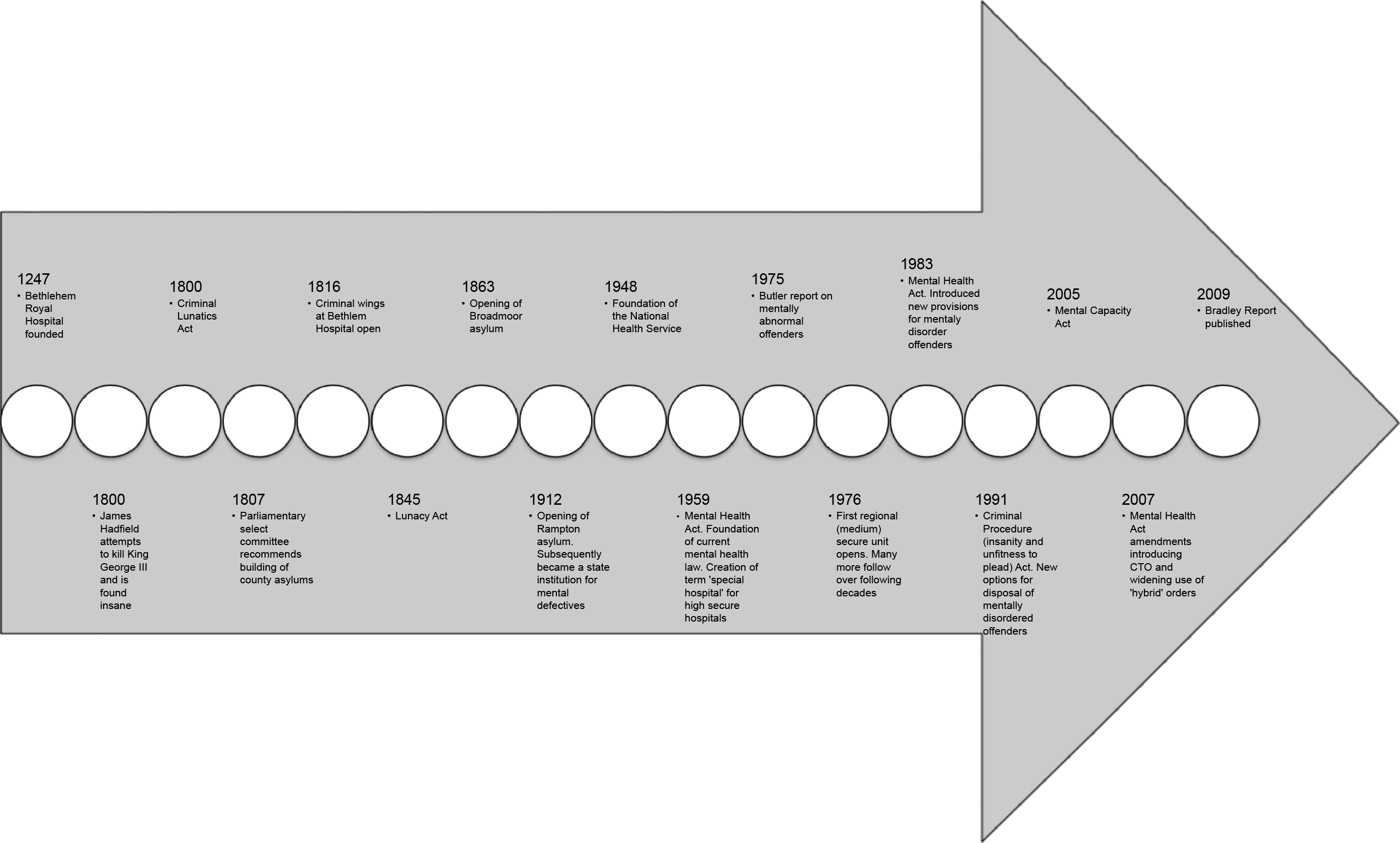
Overall, forensic psychiatry services in England and Wales are high-cost and treat few people. The development of forensic psychiatry—specifically the secure hospitals—was criticized in an editorial in the Lancet in 2011Reference Wilson, James and Forrester 56 largely because of this ratio ( Figure 2). The authors emphasized the cost of secure services and also their perception of the need to concentrate resources in other areas including community teams with multiagency involvement and integration of justice and health. The authors also touched on what they saw as an unhealthy separation of general and forensic mental health services, which has been a persistent problem in the development of community forensic services.
Timeline of forensic psychiatry in England and Wales.

Turner and Salter concentrated on the distinction between general and forensic servicesReference Turner and Salter 57 and emphasized the absence of evidence for the benefits of community forensic psychiatric services (and, in their opinion, the absence of special skills of forensic psychiatrists) and also highlighted the “unhappy result of [forensic psychiatry’s] evolution into a separate specialist domain.” They suggested that forensic community psychiatry should fall foul of the absence of evidence of benefit. Correspondence by the same authors a few years earlier set out their position on community forensic services. Albeit, this may be an unreasonable reduction of the nuance of their argument they essentially posed the question, What’s the point?Reference Turner and Salter 58
There is an ongoing debate within clinical services about the meaning of the term “forensic patient.” It is not a legal term or a clinically agreed term. The decision about which team looks after which patients is therefore at risk of being arbitrary and variable across the country. There may be local agreements about the transfer of patients from forensic to general care, but these rarely prevent debates.
The near future is likely to be characterized by a demand to provide more services for less money and community and diversion forensic services offer an opportunity, if successful to reduce the need for secure hospital services. The secure hospitals are expensive so community services that even modestly reduce the need for secure hospitals are likely to be welcomed. NHS England has responded to evaluation of the impact of community forensic service provision on length of stay in secure hospitals by seemingly making community forensic psychiatry development a priority. While community forensic psychiatry has been something of an afterthought in the development of treatment services for mentally disordered offenders in England and Wales, it is now moving toward the front of the minds of clinicians, commissioners, and managers. 59
Disclosure
The authors have nothing to disclose.