Introduction
Current dimensional models of psychopathology (e.g. Kotov et al., Reference Kotov, Krueger, Watson, Achenbach, Althoff, Bagby, Brown, Carpenter, Caspi, Clark, Eaton, Forbes, Forbush, Goldberg, Hasin, Hyman, Ivanova, Lynam, Markon, Miller, Moffitt, Morey, Mullins-Sweatt, Ormel, Patrick, Regier, Rescorla, Ruggero, Samuel, Sellbom, Simms, Skodol, Slade, South, Tackett, Waldman, Waszczuk, Widiger, Wright and Zimmerman2017) suggest that phenomena associated with clinical syndromes and disorders are continuous in nature and extend also into the realm of health as dimensions of personality. This suggestion, however, is not new (e.g. Eysenck, Reference Eysenck1952), and regarding psychotic disorders, relevant traits are most commonly subsumed under the (wide) rubric of schizotypy or psychosis-proneness (Rado, Reference Rado1953; Meehl, Reference Meehl1962; Claridge, Reference Claridge and Claridge1997; Grant et al., Reference Grant, Green and Mason2018). Evidence of associations between variations in different brain circuits shared between clinical entities like schizophrenia (Bakhshi and Chance, Reference Bakhshi and Chance2015) and states of ultra-high risk as well as schizotypal traits in healthy individuals (Ettinger et al., Reference Ettinger, Mohr, Gooding, Cohen, Rapp, Haenschel and Park2015; Nenadic et al., Reference Nenadic, Dietzek, Schönfeld, Lorenz, Gussew, Reichenbach, Sauer, Gaser and Smesny2015a) support this notion.
Like all traits, schizotypy is seen as a relatively stable personality framework that, like schizophrenia, consists of three major sub-facets, namely positive, negative and disorganised facets (Vollema and van den Bosch, Reference Vollema and van den Bosch1995; Oezgen and Grant, Reference Oezgen and Grant2018). The positive facet resembles positive symptoms of psychosis (e.g. as magical ideation and unusual experiences), is linked to psychotic-like experiences (PLEs) (Kline et al., Reference Kline, Wilson, Ereshefsky, Nugent, Pitts, Reeves and Schiffman2012) and has been suggested as an endophenotype of psychosis-in-schizophrenia (Howes and Kapur, Reference Howes and Kapur2009; Barrantes-Vidal et al., Reference Barrantes-Vidal, Grant and Kwapil2015; Grant, Reference Grant2015).
Negative and disorganised schizotypy, however, have been suggested as more related to schizophrenia-liability than mere proneness to psychotic and PLEs, as these facets – unlike positive schizotypy (Tarbox and Pogue-Geile, Reference Tarbox and Pogue-Geile2011; Tarbox et al., Reference Tarbox, Almasy, Gur, Nimgaonkar and Pogue-Geile2012) – are also elevated in patients with psychotic disorders and their healthy relatives (Brosey and Woodward, Reference Brosey and Woodward2015). Schizotypy, albeit sharing variance with schizophrenia-liability, is a relatively stable trait (Venables and Raine, Reference Venables and Raine2015; Janssens et al., Reference Janssens, Boyette, Heering, Bartels-Velthuis, Lataster, Kahn, de Haan, van Os, Wiersma, Bruggeman, Cahn, Meijer and Myin-Germeys2016), with low conversion rates into the clinical domain (Kwapil et al., Reference Kwapil, Gross, Silvia and Barrantes-Vidal2013). This is, however, expected (Meehl, Reference Meehl1990; Grant et al., Reference Grant, Green and Mason2018) and, thus, does not disqualify schizotypy as an important construct for understanding schizophrenia-spectrum pathology (Debbané and Mohr, Reference Debbané and Mohr2015; Kwapil and Barrantes-Vidal, Reference Kwapil and Barrantes-Vidal2015). Additionally, familial association studies underline the necessity of distinguishing between positive and negative/disorganised facets of schizotypy (Tarbox and Pogue-Geile, Reference Tarbox and Pogue-Geile2011; Tarbox et al., Reference Tarbox, Almasy, Gur, Nimgaonkar and Pogue-Geile2012). This is in line with findings by Schultze-Lutter and co-workers, showing that conversion form clinical high risk (CHR) to frank psychosis is best predicted by negative/disorganised schizotypy (Flückiger et al., Reference Flückiger, Ruhrmann, Debbané, Michel, Hubl, Schimmelmann, Klosterkötter and Schultze-Lutter2016, Reference Flückiger, Michel, Grant, Ruhrmann, Vogeley, Hubl, Schimmelmann, Klosterkötter, Schmidt and Schultze-Lutter2019).
Nonetheless, psychometrically-assessed estimates of schizotypy (like schizotypal traits, measured through scales based on DSM-criteria for Schizotypal Personality Disorder) have, repeatedly, been associated with variations in brain structures also implicated in schizophrenia. One finding replicated in several studies is that of structural and functional variation within the precuneus: Evidence for an association of schizotypy and schizotypal traits with increased grey matter volume (GMV) in the precuneus has been reported in several structural imaging studies (Modinos et al., Reference Modinos, Mechelli, Ormel, Groenewold, Aleman and McGuire2010, Reference Modinos, Egerton, McLaughlin, McMullen, Kumari, Lythgoe, Barker, Aleman and Williams2018; Nenadic et al., Reference Nenadic, Lorenz, Langbein, Dietzek, Smesny, Schönfeld, Fañanás, Sauer and Gaser2015b), although not in all (Ettinger et al., Reference Ettinger, Williams, Meisenzahl, Möller, Kumari and Koutsouleris2012; Kühn et al., Reference Kühn, Schubert and Gallinat2012). Furthermore, PLEs have been shown to be associated with increased precuneus activation (van Lutterveld et al., Reference van Lutterveld, Diederen, Otte and Sommer2014).
Additionally, there is growing evidence for fronto-striatal circuits to be involved in the generation of PLEs. Recent studies have suggested positive schizotypal traits to be associated with variations in frontal volume, but the direction is unclear, with increases (Kühn et al., Reference Kühn, Schubert and Gallinat2012; Nenadic et al., Reference Nenadic, Lorenz, Langbein, Dietzek, Smesny, Schönfeld, Fañanás, Sauer and Gaser2015b; Modinos et al., Reference Modinos, Egerton, McLaughlin, McMullen, Kumari, Lythgoe, Barker, Aleman and Williams2018) as well as decreases (Ettinger et al., Reference Ettinger, Williams, Meisenzahl, Möller, Kumari and Koutsouleris2012; DeRosse et al., Reference DeRosse, Nitzburg, Ikuta, Peters, Malhotra and Szeszko2015) being reported. As most studies have focused on variations in volumetric parameters, apart from one study finding increased right prefrontal lobe gyrification in participants scoring above v. below a clinical cut-off (Stanfield et al., Reference Stanfield, Moorhead, Harris, Owens, Lawrie and Johnstone2008), there is no study using a dimensional approach to schizotypy and folding analysis. Those, however, are of particular interest as cortical folding, happening early during brain development (Chi et al., Reference Chi, Dooling and Gilles1977), might indicate disruption in neurodevelopmental processes (Nenadic et al., Reference Nenadic, Yotter, Sauer and Gaser2014), and has also been reported to be altered in psychosis and high risk (Spalthoff et al., Reference Spalthoff, Gaser and Nenadić2018; Zuliani et al., Reference Zuliani, Delvecchio, Bonivento, Cattarinussi, Perlini, Bellani, Marinelli, Rossetti, Lasalvia, McIntosh, Lawrie, Balestrieri, Ruggeri and Brambilla2018).
Striatal regions have also been reported to correlate with the level of subclinical psychotic-like traits or symptoms: Psychotic experiences in healthy subjects are associated with smaller putamen volumes (Mittal et al., Reference Mittal, Orr, Turner, Pelletier, Dean, Lunsford-Avery and Gupta2013), and psychoticism has been shown to be correlated with greater activation in putamen and pallidum (Ettinger et al., Reference Ettinger, Corr, Mofidi, Williams and Kumari2013), while positive schizotypy has been linked to reduced BOLD signal during antisaccades (Aichert et al., Reference Aichert, Williams, Möller, Kumari and Ettinger2012). Interpersonal schizotypal traits have been associated with decreased task-related activation in the striatum and amygdala (Yan et al., Reference Yan, Wang, Su, Xu, Yin, Fan, Deng, Wang, Lui, Cheung and Chan2016).
In addition, highlighting the role of the fronto-striatal network, positive and negative schizotypy have recently been associated with variations in cortico-striatal resting state functional connectivity (Rössler et al., Reference Rössler, Unterassner, Wyss, Haker, Brugger, Rössler and Wotruba2018; Wang et al., Reference Wang, Ettinger, Meindl and Chan2018; Waltmann et al., Reference Waltmann, O'Daly, Egerton, McMullen, Kumari, Barker, Williams and Modinos2019). SPQ Disorganised has, furthermore, been associated with a higher availability of striatal dopamine (Chen et al., Reference Chen, Lee, Yeh, Chiu, Chen, Yang, Lu and Chen2012).
Together, these findings – to some extent – mirror those in psychotic disorder. Specifically, schizophrenia patients, and (to a lesser degree) their unaffected siblings, show increased volume of striatal regions putamen and pallidum (Mamah et al., Reference Mamah, Harms, Wang, Barch, Thompson, Kim, Miller and Csernansky2008; Okada et al., Reference Okada, Fukunaga, Yamashita, Koshiyama, Yamamori, Ohi, Yasuda, Fujimoto, Watanabe, Yahata, Nemoto, Hibar, van Erp, Fujino, Isobe, Isomura, Natsubori, Narita, Hashimoto, Miyata, Koike, Takahashi, Yamasue, Matsuo, Onitsuka, Iidaka, Kawasaki, Yoshimura, Watanabe, Suzuki, Turner, Takeda, Thompson, Ozaki, Kasai and Hashimoto2016; van Erp et al., Reference van Erp, Hibar, Rasmussen, Glahn, Pearlson, Andreassen, Agartz, Westlye, Haukvik, Dale, Melle, Hartberg, Gruber, Kraemer, Zilles, Donohoe, Kelly, McDonald, Morris, Cannon, Corvin, Machielsen, Koenders, de Haan, Veltman, Satterthwaite, Wolf, Gur, Gur, Potkin, Mathalon, Mueller, Preda, Macciardi, Ehrlich, Walton, Hass, Calhoun, Bockholt, Sponheim, Shoemaker, van Haren, Hulshoff Pol, Pol, Ophoff, Kahn, Roiz-Santiañez, Crespo-Facorro, Wang, Alpert, Jönsson, Dimitrova, Bois, Whalley, McIntosh, Lawrie, Hashimoto, Thompson and Turner2016) and greater putamen volume variability compared to healthy controls (Brugger and Howes, Reference Brugger and Howes2017). Pallidum volume has been positively associated with symptom severity in schizophrenia patients (Spinks et al., Reference Spinks, Nopoulos, Ward, Fuller, Magnotta and Andreasen2005) and there is evidence for altered extra-striatal functional connectivity in schizophrenia patients during a psychotic episode (Peters et al., Reference Peters, Riedl, Manoliu, Scherr, Schwerthöffer, Zimmer, Förstl, Bäuml, Sorg and Koch2017).
It has been suggested that these overlaps in phenotype and concurring neuroanatomy might be, at least partially, explained by overlapping genetic architecture (Walter et al., Reference Walter, Fernandez, Snelling and Barkus2016). The current literature, however, also implies that genetic risk is not linearly represented through overall schizotypal traits, as studies show only marginal associations with polygenic risk scores in healthy individuals, and an influence of environmental factors like stress contexts (Hatzimanolis et al., Reference Hatzimanolis, Avramopoulos, Arking, Moes, Bhatnagar, Lencz, Malhotra, Giakoumaki, Roussos, Smyrnis, Bitsios and Stefanis2018).
Those findings fit well into a model by Siever and Davis, proposing that common genetic variants increase schizophrenia risk through elevated vulnerability for environmental insults, leading to brain structural changes within temporal or striatal regions (Siever and Davis, Reference Siever and Davis2004). In contrast to schizophrenia patients, however, in schizotypal individuals, independent genetic variants and/or beneficial environmental contexts, leading to preserved or increased frontal volume or cognitive protectors like general intelligence, buffer the effect of susceptibility variants and thus lead to a subclinical level of PLEs (Siever and Davis, Reference Siever and Davis2004). The issue of a moderating effect of intelligence has also been suggested by Brod (Reference Brod and Claridge1997) – regarding highly creative individuals – and substantiated by findings that intelligence moderates the tendency of highly positive schizotypal individuals to see meaning in random noise (Grant et al., Reference Grant, Balser, Munk, Linder and Hennig2014a).
Indeed, dysfunctions in prefrontal networks are often reported in psychotic disorders (Dandash et al., Reference Dandash, Pantelis and Fornito2017). Dysregulation of the striatum, a centre for the integration of high-level cognitive, motor and limbic processes (Simpson et al., Reference Simpson, Kellendonk and Kandel2010), seems to be contributing to the manifestation of psychotic symptoms in schizophrenia (Howes and Kapur, Reference Howes and Kapur2009) and possibly also (positive) schizotypy (Ettinger et al., Reference Ettinger, Corr, Mofidi, Williams and Kumari2013; Mohr and Ettinger, Reference Mohr and Ettinger2014).
To further examine the relationship of morphometric variations in fronto-striatal networks with dimensional schizotypal traits, we analysed voxel- and surface-based brain structural parameters in association with psychometrically-assessed schizotypy in healthy individuals. We hypothesised associations of frontal and striatal volume variations with both positive and negative schizotypal traits. Based on a fronto-thalamo-striatal model of the psychosis continuum, brain structural effects in both medial and lateral prefrontal cortex are observed in both positive and negative dimensions of schizophrenia, and in the thalamus for the negative dimension (Koutsouleris et al., Reference Koutsouleris, Gaser, Jäger, Bottlender, Frodl, Holzinger, Schmitt, Zetzsche, Burgermeister, Scheuerecker, Born, Reiser, Möller and Meisenzahl2008; Nenadic et al., Reference Nenadic, Sauer and Gaser2010, Reference Nenadic, Yotter, Sauer and Gaser2015c). Assuming the possibility of general cognitive capacity buffering psychosis risk (Brod, Reference Brod and Claridge1997; Siever and Davis, Reference Siever and Davis2004), we also tested for a moderating effect of intelligence on the relationship of brain morphometry and schizotypal traits. This is, to our knowledge, the first study investigating intelligence as a moderator in the association of brain structural variation and estimates of schizotypy.
Material and methods
Sample
We analysed data of N = 115 healthy participants [54 female, aged 18–50 years, mean age = 27.57 years (s.d. = 8.02)], recruited through advertisements in and around Munich, Germany. All experimental procedures were approved by the research ethics committee of the Faculty of Medicine at the University of Munich, in accordance with the current division of the Declaration of Helsinki. Participants were included after thorough clinical screening and only if they did not meet any of the exclusion criteria: any DSM-IV Axis I disorders, first-grade relatives with psychotic disorders, former or current neurological disorders, current physical conditions, current medication except for contraceptives, uncorrected visual impairments. Further inclusion criteria were age between 18 and 55 and German as a first language. All subjects volunteered to take part in the study, gave written informed consent and received a financial compensation for their participation.
Psychometric assessment of schizotypal traits and IQ
All participants completed the German version (Klein et al., Reference Klein, Andresen and Jahn1997) of the Schizotypal Personality Questionnaire (SPQ, Raine, Reference Raine1991), assessing schizotypal traits on the three dimensions Cognitive-Perceptual (measuring positive schizotypy), Disorganised (related to eccentricity and – somewhat – disorganised schizotypy) and Interpersonal (tapping into negative schizotypy) as delineated by previous factor analyses (Axelrod et al., Reference Axelrod, Grilo, Sanislow and McGlashan2001; Compton et al., Reference Compton, Goulding, Bakeman and McClure-Tone2009). For the questionnaire as a whole and its subscores, adequate internal consistency and criterion validity have been demonstrated (Klein et al., Reference Klein, Andresen, Jahn, Andresen and Maß2001; Fonseca-Pedrero et al., Reference Fonseca-Pedrero, Ortuño-Sierra, Lucas-Molina, Debbané, Chan, Cicero, Zhang, Brenner, Barkus, Linscott, Kwapil, Barrantes-Vidal, Cohen, Raine, Compton, Tone, Suhr, Bobes, Fumero, Giakoumaki, Tsaousis, Preti, Chmielewski, Laloyaux, Mechri, Lahmar, Wuthrich, Larøi, Badcock, Jablensky, Barron, Swami, Tran and Voracek2018). In our sample, the SPQ subscales showed acceptable to good reliability (Cronbach's α for the total score α = 0.882, for the subscales Disorganised α = 0.832, Negative α = 0.848, Positive α = 0.757).
For an estimation of intelligence, we applied the Multiple Choice Word Test-B (MWT-B, Lehrl, Reference Lehrl1995). The MWT-B consists of 37 items in ascending difficulty, each requiring identification of one truly existing word opposed to three distractors. It has been shown to be an economic, easy to administer and robust estimate of global crystallised intelligence, highly correlated with both verbal and general intelligence measured with extensive tests like the HAWIE, the German version of the Wechsler Adult Intelligence Scale (Satzger et al., Reference Satzger, Fessmann and Engel2002). In our sample, the MWT-B showed an internal consistency of Cronbach's α = 0.664.
Image acquisition and preprocessing
We acquired high-resolution, T1-weighted structural images on a 3T MAGNETOM Verio scanner (Siemens, Erlangen, Germany) using a 12-channel head matrix Rx-coil. We used a three-dimensional MPRAGE sequence with a repetition time of TR = 2400 ms, echo time TE = 3.06 ms, flip angle = 9 degrees with 160 slices, slice thickness = 1.0 mm, voxel size = 1.0 × 1.0 × 1.0 mm, field of view FOV = 256 mm.
Images were preprocessed with the CAT12 toolbox (Computation Anatomy Toolbox for SPM, v12.3, build r1318, http://www.neuro.uni-jena.de/cat), based on SPM12 v7219 (Statistical Parametric Mapping, version 12) running under MATLAB R2017a (The MathWorks, Natick, MA, USA). Images were spatially registered using tissue probability maps implemented in SPM12, segmented and spatially normalised using the optimised shooting algorithm (Ashburner and Friston, Reference Ashburner and Friston2011), with an inhomogeneity correction of 0.5. All images passed visual quality inspection for movement artefacts and image quality, as well as the quality assurance protocols implemented in CAT12 (grade B or higher). During preprocessing, total intracranial volume (TIV) was calculated.
Additionally, we extracted gyrification parameters to analyse surfaced-based morphometry with the CAT12 toolbox, using a recently developed algorithm to calculate cortical surface parameters (Dahnke et al., Reference Dahnke, Yotter and Gaser2013), based on absolute mean curvature (Luders et al., Reference Luders, Thompson, Narr, Toga, Jancke and Gaser2006). Gyrification images were smoothed with a Gaussian kernel of 20 mm (FWHM).
Statistical analyses
Statistical analyses were conducted using general linear regression models (GLM) in SPM and CAT12. Given the discussed specificity of the different schizotypy dimensions (Tarbox and Pogue-Geile, Reference Tarbox and Pogue-Geile2011; Grant, Reference Grant2015), we conducted separate GLMs for each of the subscores. We further tested a GLM using SPQ total score as a regressor. In a supplementary analysis, we entered all three subscores into the GLM (and set + 1/−1 in the contrast) to assess the overall effect of schizotypal traits (see online Supplementary SF1).
For both VBM and gyrification analyses, we used age and sex as covariates (setting them to zero to remove related variance), and for VBM we additionally defined TIV as a covariate to remove global brain size differences. For all analyses, we considered significance at p < 0.05 FWE peak level-corrected threshold. For gyrification analyses, that did not survive FWE peak level correction, we conducted additional exploratory analyses at p < 0.001 uncorrected.
To test for a modulating effect of IQ on the association of SPQ-levels and structural variation, we set up a moderation model using the PROCESS macro v3.3 (Hayes, Reference Hayes2013) running on IBM Statistical Package for Social Sciences (SPSS, version 24, IBM, Armonk, NY, USA). It is unclear, whether particular aspects of intelligence or cognitive functions might serve as better factors or predictors in such models. Given the limited availability of cognitive data from this data set, we therefore focused on IQ to be included as a moderator in the model. For schizotypal traits, the respective dimension scores were entered, while for structural data we considered a wider cluster comprising peak and surrounding voxels at an uncorrected p < 0.001 threshold, taking into consideration voxels might not reach corrected significance in direct association statistics (due to the assumed moderation effects), but might add to moderation. Here, we used extracted eigenvariate values as an approximation of mean volume inside the clusters, a weighted mean more robust to heterogeneous voxel values. Correcting for the two models tested, significance was assumed at p < 0.025.
Results
Descriptive statistics and intercorrelations
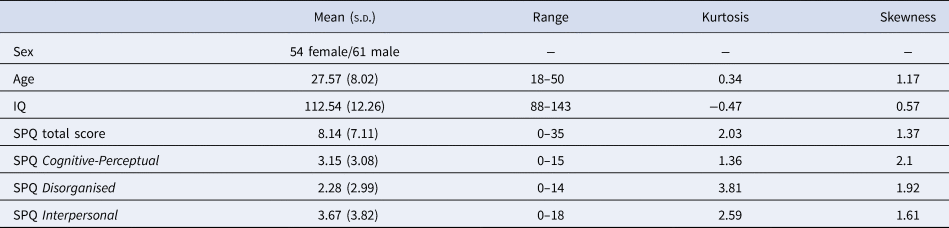
Demographic details and descriptive statistics for SPQ sum score and subscores are shown in Table 1. IQ was significantly negatively correlated with SPQ Cognitive-Perceptual (r = −0.196, p = 0.036), indicating that higher IQ is associated with lower schizotypy scores. There were no significant correlations of IQ with the Disorganised (r = −0.030, p = 0.746) or Interpersonal (r = −0.104, p = 0.268) dimensions.
Demographic characteristics of the sample

Voxel-based morphometry
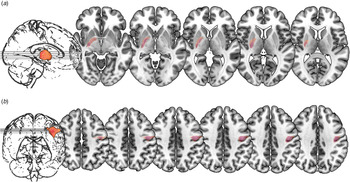
Regression analyses showed significant correlations of the positive and disorganised dimensions of the SPQ with GMV (Fig. 1a, b). Cognitive-Perceptual was positively correlated with GMV in a cluster containing the right pallidum and putamen (k = 6 voxels, x/y/z = 22/−12/−2, T = 4.75, p = 0.040 FWE peak level-corrected). Disorganised was positively correlated with GMV in a cluster including the left precentral gyrus (k = 67 voxels, x/y/z = −40/−12/42, T = 4.90, p = 0.013 FWE peak level-corrected). There were no significant negative correlations of the two subscales with GMV and not any significant associations of GMV and the SPQ total score, the Interpersonal SPQ dimension, or the GLM including all three subscores after FWE-peak-level-correction (see online Supplementary Fig. SF1).
Clusters of positive correlation between grey matter volume and the SPQ Cognitive-Perceptual dimension in the striatum (a, upper panel) and the Disorganised dimension in the pre- and postcentral gyri (b, lower panel); for illustration purposes and highlighting the putamen/pallidum cluster selected for moderation analysis, these images are thresholded at p < 0.001 (uncorrected). Note that parts of both clusters also survive p < 0.05 FWE peak level-correction (illustration prepared with MRIcroGL; www.nitrc.org/projects/mricrogl and depicted in radiological orientation).

Surface-based analysis of gyrification
We did not find any significant associations at p < 0.05 FWE peak level-correction for gyrification with either total SPQ score or subscores. In a subsequent, exploratory analysis (p < 0.001, uncorrected, see online Supplementary Fig. SF2), however, we found a positive correlation of the SPQ total score with gyrification in the left precuneus (k = 10 voxels, x/y/z = −19/−65/25, T = 3.31, p < 0.001 uncorrected), as well as a negative correlation with the gyrification in the right postcentral gyrus (k = 57 voxels, x/y/z = 28/−34/69, T = 3.70, p < 0.001 uncorrected). Additionally, we found a negative association of the Disorganised score with gyrification in the right inferior frontal gyrus (k = 22 voxels, x/y/z = −43/29/−1, T = 3.47, p < 0.001 uncorrected).
Moderation analysis
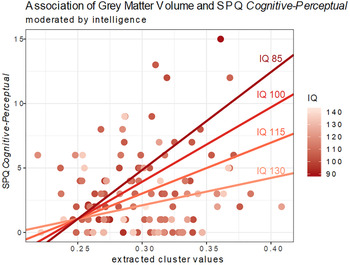
We tested whether intelligence, as a measure for general cognitive capacity, has a moderating effect on the association of striatal structure and schizotypy. Based on the results of the voxel-based-morphometry analyses, we tested this assumption for the association of the cluster around the detected peak voxel in a cluster containing the putamen and pallidum and Cognitive-Perceptual, with age, sex and TIV as covariates (model 1). This model was significant overall [F (6,108) = 6.93, p < 0.001, R 2 = 0.28] and furthermore revealed a significant moderation effect of MWT-B IQ estimation on the association of striatal volume and Cognitive-Perceptual [regression coefficient b = −5.41, F (1,108) = 5.38, p = 0.022]: With increasing MWT-B values, the association between striatal structure and schizotypy decreased (Fig. 2). In a separate model, we tested the equivalent assumption of the association of the Disorganised dimension and the significant paracentral cluster being moderated by IQ. This model, however, was not significant [F (6,108) = 1.13, p = 0.350, R 2 = 0.06].
Scatterplot, depicting the association of extracted grey matter values within the significant striatal cluster and the level on the SPQ Cognitive-Perceptual dimension, dependent on IQ. The colour of the dots represents IQ value. To illustrate the moderating effect of IQ, regression lines have been fitted for IQ values of 85, 100, 115 and 130, represented by the colour of the lines in accordance with the figure legend. Illustration prepared with the ggplot2 package (Wickham, Reference Wickham2016) in RStudio v1.1.456 (RStudio Team, 2016).

Discussion
We found an association of the positive dimension of the SPQ with greater right striatal volume in healthy controls, which was moderated by IQ as a measure of general cognitive capacity. Additionally, we found an association of the Disorganised factor with increased volume of the left precentral gyrus.
In several previous studies, primarily variations in precuneus structure and function have, repeatedly, been associated with schizotypal traits and subclinical PLEs (Modinos et al., Reference Modinos, Mechelli, Ormel, Groenewold, Aleman and McGuire2010, Reference Modinos, Egerton, McLaughlin, McMullen, Kumari, Lythgoe, Barker, Aleman and Williams2018; van Lutterveld et al., Reference van Lutterveld, Diederen, Otte and Sommer2014; Falkenberg et al., Reference Falkenberg, Chaddock, Murray, McDonald, Modinos, Bramon, Walshe, Broome, McGuire and Allen2015; Nenadic et al., Reference Nenadic, Lorenz, Langbein, Dietzek, Smesny, Schönfeld, Fañanás, Sauer and Gaser2015b). It is, therefore, unexpected that we did not find any association with any of the SPQ dimensions in this region in our data.
We did, however, find further evidence of fronto-striatal circuits to be involved in the aetiology of PLEs in healthy individuals. Our finding echoes previous studies suggesting that variations in striatal structure and function are associated with psychotic experiences in healthy subjects (Chen et al., Reference Chen, Lee, Yeh, Chiu, Chen, Yang, Lu and Chen2012; Ettinger et al., Reference Ettinger, Corr, Mofidi, Williams and Kumari2013; Mittal et al., Reference Mittal, Orr, Turner, Pelletier, Dean, Lunsford-Avery and Gupta2013), partially paralleling findings in frank psychosis: In a mega-analysis by the ENIGMA schizophrenia consortium, patients with schizophrenia showed greater pallidum volumes than healthy controls, and putamen and pallidum volumes were correlated with illness duration (van Erp et al., Reference van Erp, Hibar, Rasmussen, Glahn, Pearlson, Andreassen, Agartz, Westlye, Haukvik, Dale, Melle, Hartberg, Gruber, Kraemer, Zilles, Donohoe, Kelly, McDonald, Morris, Cannon, Corvin, Machielsen, Koenders, de Haan, Veltman, Satterthwaite, Wolf, Gur, Gur, Potkin, Mathalon, Mueller, Preda, Macciardi, Ehrlich, Walton, Hass, Calhoun, Bockholt, Sponheim, Shoemaker, van Haren, Hulshoff Pol, Pol, Ophoff, Kahn, Roiz-Santiañez, Crespo-Facorro, Wang, Alpert, Jönsson, Dimitrova, Bois, Whalley, McIntosh, Lawrie, Hashimoto, Thompson and Turner2016). Further support comes from several studies showing that similar to schizophrenia patients, their healthy relatives also show increased GMV within the putamen (Knöchel et al., Reference Knöchel, Stäblein, Prvulovic, Ghinea, Wenzler, Pantel, Alves, Linden, Harrison, Carvalho, Reif and Oertel-Knöchel2016). In healthy controls, the genetic risk for schizophrenia and bipolar disorder has been associated with volumetric abnormalities within those regions (Caseras et al., Reference Caseras, Tansey, Foley and Linden2015). It has, thus, been suggested that striatal size might be an important endophenotype for psychosis (Chemerinski et al., Reference Chemerinski, Byne, Kolaitis, Glanton, Canfield, Newmark, Haznedar, Novakovic, Chu, Siever and Hazlett2013). Putamen size and function might even play a role in risk stratification, predicting clinical course: Subjects at CHR for psychosis showed increased striatal cerebral blood flow (Hubl et al., Reference Hubl, Schultze-Lutter, Hauf, Dierks, Federspiel, Kaess, Michel, Schimmelmann and Kindler2018) and in CHR subjects, smaller putamen volume was associated with the reduction of positive symptoms over a course of six months (Hong et al., Reference Hong, Lee, Kwak, Kim and Kwon2015).
Dopaminergic neurotransmission is central to striatal functioning, and findings from several (although not all; Ettinger et al., Reference Ettinger, Williams, Meisenzahl, Möller, Kumari and Koutsouleris2012) experimental and pharmacological studies implicate an association of altered dopamine neurotransmission with schizotypy and psychosis-proneness (Ettinger et al., Reference Ettinger, Corr, Mofidi, Williams and Kumari2013, Reference Ettinger, Meyhöfer, Steffens, Wagner and Koutsouleris2014; Mohr and Ettinger, Reference Mohr and Ettinger2014). Schizotypy has, additionally, been associated with expression levels of dopaminergic genes (Grant et al., Reference Grant, Gabriel, Kuepper, Wielpuetz and Hennig2014b) and dopamine receptor gene polymorphisms (Ettinger et al., Reference Ettinger, Joober, DE Guzman and O'Driscoll2006; Grant et al., Reference Grant, Kuepper, Mueller, Wielpuetz, Mason and Hennig2013; Gurvich et al., Reference Gurvich, Bozaoglu, Neill, Van Rheenen, Tan, Louise and Rossell2016), including additive effects thereof (Grant et al., Reference Grant, Judith Leila Munk, Kuepper, Wielpuetz and Hennig2015). Taken together, those findings suggest that the dopamine hypothesis of schizophrenia (Howes et al., Reference Howes, McCutcheon, Owen and Murray2017) also extends into the healthy domain (Grant et al., Reference Grant, Judith Leila Munk, Kuepper, Wielpuetz and Hennig2015).
Additionally, we detected an association of greater GMV with higher levels of disorganised schizotypy in the left precentral gyrus. Previous findings linking this region to schizotypy are limited. There is some evidence for reduced paracentral volume in individuals with schizotypal personality disorder (Koo et al., Reference Koo, Dickey, Park, Kubicki, Ji, Bouix, Pohl, Levitt, Nakamura, Shenton and McCarley2006). Another study in subjects with high risk for psychosis and first episode patients also found reduced precentral volume compared to healthy controls (Chang et al., Reference Chang, Womer, Bai, Zhou, Wei, Jiang, Geng, Zhou, Tang and Wang2016).
Those regions have primarily been associated with motor functions, and while there is clear evidence for motor dysfunctions in schizophrenia and other psychotic disorders (Peralta and Cuesta, Reference Peralta and Cuesta2001; Cuesta et al., Reference Cuesta, García de Jalón, Campos, Moreno-Izco, Lorente-Omeñaca, Sánchez-Torres and Peralta2018; Hirjak et al., Reference Hirjak, Kubera, Thomann and Wolf2018), there is limited evidence in schizotypy (Roché et al., Reference Roché, Fowler and Lenzenweger2015). As motor functions were not assessed in this study, we can neither assume nor exclude such an association in our data. It should be noted, however, that the reported cluster lies within the lateral frontal eye field and that schizotypy has repeatedly been associated with impairments in oculomotor function (Aichert et al., Reference Aichert, Williams, Möller, Kumari and Ettinger2012; Meyhöfer et al., Reference Meyhöfer, Steffens, Kasparbauer, Grant, Weber and Ettinger2015).
An additional perspective comes from functional imaging studies, suggesting connections of striatal regions with areas in the pre- and postcentral gyri. Several functional connectivity studies – in healthy subjects as well as schizophrenia patients – have indeed shown important projections from striatal regions to motor areas in the pre- and postcentral cortex, and caudate and putamen seeds were reported to predict resting state activity in pre- and postcentral regions (Postuma and Dagher, Reference Postuma and Dagher2006; Di Martino et al., Reference Di Martino, Scheres, Margulies, Kelly, Uddin, Shehzad, Biswal, Walters, Castellanos and Milham2008; White et al., Reference White, Wigton, Joyce, Collier, Fornito and Shergill2016). Given the focus of grey matter structure in our study, however, we can only speculate on similar associations in our sample.
Further evidence for the notion that brain networks, rather than single structures are involved in the generation of psychotic experiences comes from recent studies analysing resting state connectivity in schizotypy. Several studies report reduced functional connectivity of striatal and cortical regions in association with (primarily positive) schizotypy, indicating an association of this dimension with striatal hypoconnectivity or cortico-striatal decoupling (Wang et al., Reference Wang, Ettinger, Meindl and Chan2018; Waltmann et al., Reference Waltmann, O'Daly, Egerton, McMullen, Kumari, Barker, Williams and Modinos2019). Such dysconnectivity might be facilitated by altered striatal dopamine levels, as has been suggested based on results in animal studies (Grace et al., Reference Grace, Floresco, Goto and Lodge2007; Waltmann et al., Reference Waltmann, O'Daly, Egerton, McMullen, Kumari, Barker, Williams and Modinos2019). There is, in fact, evidence for striato-cortical decoupling associated with positive schizotypy being induced by altered dopaminergic neurotransmission (Rössler et al., Reference Rössler, Unterassner, Wyss, Haker, Brugger, Rössler and Wotruba2018).
Our results also indicate, however, that protective factors may act as a buffer to decrease the risk for psychotic experiences induced by striatal alterations, in line with arguments by Brod (Reference Brod and Claridge1997) or Siever and Davis (Reference Siever and Davis2004). The model assumes that genetic risk variants render the vulnerability for the impact of environmental factors, but can be attenuated by other genetic variants leading to preserved frontal volume or capacity, possibly expressed in an elevated cognitive capacity like general intelligence (Siever and Davis, Reference Siever and Davis2004). Indeed, even though we did not find any association of schizotypy dimensions with GMV in frontal regions, our moderation model showed that IQ (as a measure for cognitive capacity known to be associated with frontal lobe structure, Colom et al., Reference Colom, Burgaleta, Román, Karama, Álvarez-Linera, Abad, Martínez, Quiroga and Haier2013) influences the association of pallidal volume and positive schizotypy: With higher IQ, that association decreased to the point of non-significance. This fits well in line with evidence of cognitive performance or IQ having substantial predictive value for the outcome of individuals at risk for psychosis and with schizophrenia (Leeson et al., Reference Leeson, Barnes, Hutton, Ron and Joyce2009; Woodberry et al., Reference Woodberry, Seidman, Giuliano, Verdi, Cook and McFarlane2010; Ziermans et al., Reference Ziermans, de Wit, Schothorst, Sprong, van Engeland, Kahn and Durston2014; Metzler et al., Reference Metzler, Dvorsky, Wyss, Nordt, Walitza, Heekeren, Rössler and Theodoridou2016). However, we would like to stress that, both in our results and in previous work; it might be that general intelligence rather acts as a proxy for other, possibly psycho-social, resilience factors.
We did not find an association of SPQ scores with gyrification patterns at corrected threshold levels, but the exploratory, uncorrected analysis revealed associations in regions thought to be relevant for psychosis as well as schizotypy (Honea et al., Reference Honea, Crow, Passingham and Mackay2005; Ettinger et al., Reference Ettinger, Mohr, Gooding, Cohen, Rapp, Haenschel and Park2015; Nenadic et al., Reference Nenadic, Dietzek, Schönfeld, Lorenz, Gussew, Reichenbach, Sauer, Gaser and Smesny2015a). It might be speculated that while those effects indeed are of interest, our analysis did not provide the necessary power for them to reach statistical significance. This should spark further studies in larger samples. So far, our findings do not provide robust evidence for gyrification to show a dimensional relationship with schizotypy.
Limitations to the generalisation of our findings arise from the relatively restricted sample size and the fact that our participants showed rather low to moderate SPQ levels, compared to a recent validation sample (Barron et al., Reference Barron, Voracek, Tran, Ong, Morgan, Towell and Swami2018). This, however, only leads to a reduction in statistical power, but does not invalidate our findings (Eysenck, Reference Eysenck1952).
Additionally, since the SPQ is derived from clinical criteria of schizotypal personality disorder (Raine, Reference Raine1991), it differs in both conceptualisation and phenotypal characterisation from other self-rating measures, which needs to be taken into account (for further details, see Gross et al., Reference Gross, Mellin, Silvia, Barrantes-Vidal and Kwapil2014; Grant et al., Reference Grant, Green and Mason2018). While the Cognitive-Perceptual dimension of the SPQ seems to map well on positive schizotypy, the Interpersonal factor taps into negative schizotypy less specifically and includes aspects of Neuroticism, which could account for the lack of associations with this dimension in our analysis in contrast to previous work.
Furthermore, we have to consider that the MWT-B is only an approximating measure of particularly crystallised intelligence, necessitating further studies to replicate the moderation model with the use of an extensive intelligence battery. As due to the study design, several risk factors for psychotic diseases, but also for schizotypy were excluded to rule out confounding influences, our results might only represent part of the subclinical spectrum.
Taken together, our findings suggest that the involvement of fronto-striatal circuits in psychosis aetiology extends into the healthy domain of schizotypy and PLEs, thus, supporting a continuous model of the psychosis spectrum.
Supplementary material
The supplementary material for this article can be found at https://doi.org/10.1017/S0033291719002459
Financial support
This work was partially supported through a FlexiFunds grant (I.N. and P.G., FCMH grant number 2017_2_1_5); and the German Research Foundation (DFG) (I.N., grant number FOR2107 NE 2254/1-2) (U.E. grant number ET 31/2-1).
Conflict of interest
None.
Ethical standards
The authors assert that all procedures contributing to this work comply with the ethical standards of the relevant national and institutional committees on human experimentation and with the Helsinki Declaration of 1975, as revised in 2008.