Introduction
Approximately 300,000 out-of-hospital cardiac arrests (OHCA) occur annually in the US, with a mortality rate of 92%.Reference Roger, Go and Lloyd-Jones1 Bystander cardiopulmonary resuscitation (CPR) roughly doubles the overall survival in OHCA.Reference McNally, Robb and Mehta2 Use of an automated external defibrillator (AED) doubles neurologically intact survival among victims of OHCA with shockable rhythms.Reference Berdowski, Blom and Bardai3 Bystanders witness 37% of all OHCAs; of these witnessed events, only 44% of victims receive bystander CPR, and only 4% are treated with an AED before the arrival of EMS personnel.Reference McNally, Robb and Mehta2
Video self-instruction (VSI) can be an effective, resource-saving method of educating laypersons in CPR.Reference Roppolo, Pepe and Campbell4 In a simulated setting, laypersons who viewed a 1-minute training video on compression-only CPR were significantly more likely to attempt any resuscitation compared with those who did not view the training video.Reference Bobrow, Vadeboncoeur and Spaite5
Police officers are often first responders for EMS systems.Reference Alonso-Serra, Delbridge, Auble, Mosesso and Davis6 Limited knowledge and negative attitudes toward CPR and AEDs among police officers have posed significant barriers to implementing successful CPR-AED training programs.Reference Groh, Lowe, Overgaard, Neal, Fishburn and Zipes7 In a 2012 study, most state police agencies reported training their officers in CPR (98%) and AEDs (78%) but knowledge and attitudes of individual officers are unclear.Reference Hirsch, Wallace, Leary, Tucker, Becker and Abella8 Police officers can be trained in a simulated setting to use AEDs effectively and with high motivation with a 3-hour, in-person, cost- and time-intensive training course.Reference Kooij, van Alem, Koster and deVos9 No large study has been done to examine knowledge improvement or attitude change about CPR and AEDs among police using VSI. The goal of the present study was to evaluate the effect of VSI on knowledge and attitudes about CPR and AEDs among officers of a large, urban police department.
Methods
Study Design, Setting and Population
Institutional review board exemption was obtained (Ref: STU00050473, 11/5/11) for this prospective educational study. It was conducted online using SurveyMonkey (Surveymonkey.com LLC, Palo Alto, California, USA) via the continuing education, e-learning platform for the Chicago Police Department (CPD). With 12,244 officers, CPD is the second largest police force in the US.10
Study Protocol
Coincident with the initiation of this study in March 2011, all officers were required to view the CPR-AED instructional video as part of their continuing education curriculum. The CPD's educational officials preferred separate survey instruments for pretest and post-test to minimize loss of data from anticipated interruptions and other technical problems with computer data entry during a 30-minute period. The survey instrument did not provide automatically generated unique identifier numbers for each pretest that could be linked later to the post-test. Therefore, each participant created her/his own identifier code (based on birthdate and initials) that was used to link pretest and post-test data during analysis. Use of participant badge numbers would not provide optimal identity protection. Internet protocol addresses could not be used because most testing was performed on public/shared computers.
Participants were included in the analysis if they fulfilled all of the following criteria: (1) consented to the study; (2) enrolled in the study between March 1 and April 1, 2011; (3) completed data entry; and (4) used the same identifier code in both pretest and post-test.
Deidentified data were collected and stored in SurveyMonkey. The survey instrument (Appendix, online only) consisted of a 3-part online survey with a total of 36 questions. Part 1 queried demographic variables (five questions). Part 2 assessed prior experience with CPR and AEDs (four questions). Part 3 (pretest) evaluated knowledge of (12 questions) and attitudes toward (15 questions) mouth-to-mouth ventilation (MTM), CC, and AEDs in hypothetical scenarios involving victims of presumed OHCA. Part 3 was repeated (post-test) after participants were exposed to the intervention (see below). The knowledge portion of part 3 consisted of multiple-choice questions with between five and eight answer choices. Question topics included optimal rate and depth of CC, survival statistics for OHCA with and without CPR, mechanism of AEDs, and optimal actions in OHCA scenarios. The attitudes portion of part 3 assessed preferences using a 5-point Likert scale. Questions on the survey were developed by consensus among the emergency medicine investigators and police educational experts.
Two slightly different versions of part 3 were created. The tests differed in the order of answer choices to minimize answer sharing among participants. Participants were randomized into two groups. Group 1 received version A as the pretest and version B as the post-test, while group 2 received version B as the pretest and version A as the post-test. After taking their respective pretests, the groups were exposed to the intervention and then completed the post-tests. The total anticipated completion time for the entire training module was 30 minutes.
The intervention consisted of a 10-minute CPR-AED training video available for free on the Internet.11 The video discussed the use of CPR and AEDs and promoted the use of compression-only CPR for individuals not formally certified in CPR by the American Heart Association or the American Red Cross. The video was created by the Chicago Cardiac Arrest Resuscitation Education Service, a nonprofit organization of which two authors of the present study are the directors (AA, GC).
Outcome Measures
The primary outcomes for knowledge were post-intervention changes in proportion of participants who identified the correct: (1) rate of CC; (2) depth of CC; and (3) best action in an OHCA scenario.
The primary outcomes for attitudes were post-intervention changes in proportion of participants who reported being “very likely” to: (1) do chest compressions on a stranger, and (2) use an AED on a stranger.
Data Analysis
Differences in proportions were reported with 95% confidence intervals. Means were compared using the paired t-test. Numeric data were reported with means and confidence intervals, and ordinal data with proportions. Data were analyzed using Stata (version 11.0, StataCorp, College Station, Texas, USA).
Results
Characteristics of Study Subjects
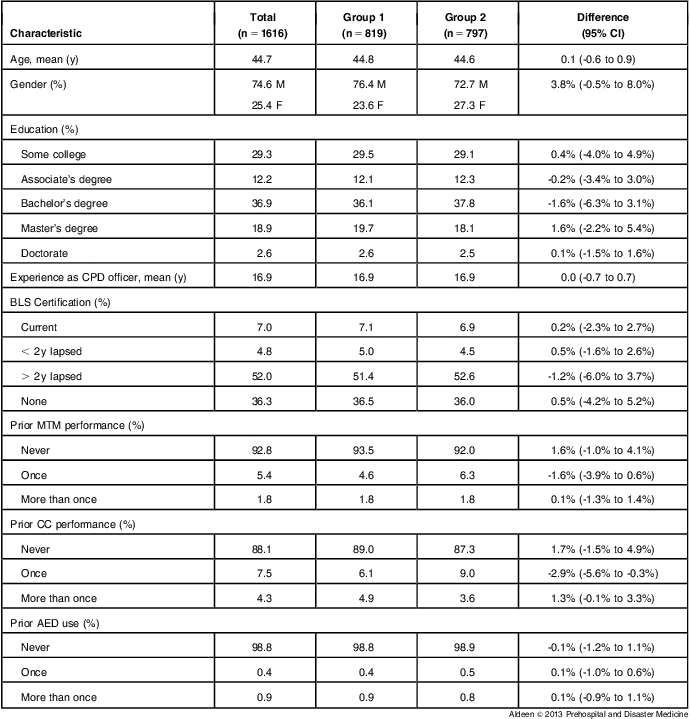
Over a 1-month period, 2615 pretest and 2542 post-test survey entries were collected. A total of 1616 participants (63.6%; 95% CI, 61.7%-65.4%) responded with correctly matched participant identification numbers. Randomization produced 819 participants in group 1, and 797 in group 2. Groups 1 and 2 did not differ significantly in any background variable (Table 1). Mean age was 44.7 years (95% CI, 44.3-45.1); mean CPD experience was 16.9 years (95% CI, 16.5-17.2), and the sample was 74.6% male (95% CI, 72.4%-76.6%). Most participants (88.2%, 95% CI, 86.6-89.7) lacked recent (within two years) BLS certification. The vast majority of participants had never performed MTM (92.8%, 95% CI, 91.4%-93.9%) or CC (88.2%, 95% CI, 86.5%-89.7%) or used an AED (98.8%, 95% CI, 98.2%-99.3%).
Baseline Characteristics of Participants

Abbreviations: AED, automated external defibrillator; BLS, basic life support; CC, chest compressions; CPD, Chicago Police Department; MTM, mouth-to-mouth ventilation
Main Results
Attitudes Results
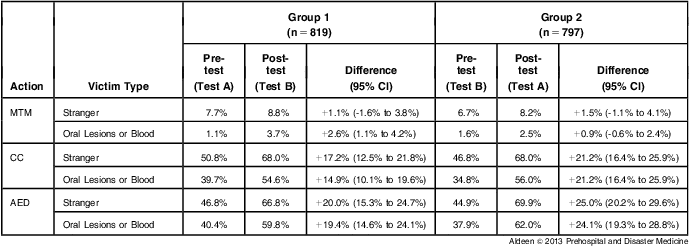
As illustrated in Table 2 and Figure 1, before the intervention, 50.8% of group 1 and 46.8% of group 2 reported being “very likely” to perform CCs on a stranger. After the intervention, these variables increased to 68.0% for each group, an absolute difference of +17.2% (95% CI, 12.5%-21.8%) and +21.2% (95% CI, 16.4%-25.9%), respectively. Similar increases were seen in those who reported being “very likely” to use an AED on a stranger (group 1: +20.0%; 95% CI, 15.3%-24.7%; group 2: +25.0%; 95% CI, 20.2%-29.6%).
Participants Indicating the Highest (“very likely”) Response Toward CPR and AEDs for Various Victim Subtypes Before and After Intervention
Abbreviations: AED, automated external defibrillator; CC, chest compressions; MTM, mouth-to-mouth ventilation
Primary Outcomes for Groups 1 and 2 Abbreviations: AED, automated external defibrillator; CC, chest compressions
Knowledge Results
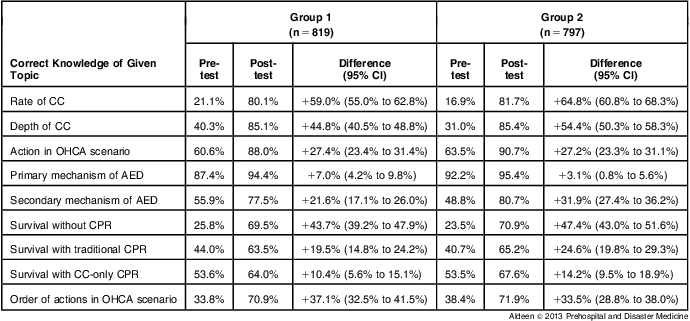
As shown in Table 3 and Figure 1, before the intervention, 21.1% (95% CI, 18.5%-24.1%) of group 1 and 16.9% (95% CI, 14.5%-19.7%) of group 2 knew the proper rate of CC. After the training video, knowledge improved to 80.1% and 81.7%, respectively, an absolute difference of +59.0% (95% CI, 55.0%-62.8%) and +64.8% (95% CI, 60.8%-68.3%). Similar improvements were seen in knowledge of CC depth after watching the video: +44.8% for group 1 (95% CI, 40.5%-48.8%) and +54.4% for group 2 (95% CI, 50.3%-58.3%). Most participants (60.6%; 95% CI, 57.2%-63.9% in group 1; 63.5%; 95% CI, 60.1%-66.8% in group 2) correctly identified the best action in a sample scenario even before the intervention, but significant improvement was noted afterwards (+27.4; 95% CI, 23.4%-31.4% in group 1; +27.2%; 95% CI, 23.3%-31.1% in group 2).
Knowledge of Participants About CPR and AEDs Before and After Intervention
Abbreviations: AED, automated external defibrillator; CC, chest compressions; CPR, cardiopulmonary resuscitation; OHCA, out-of-hospital cardiac arrest
Discussion
The present study represents, to the authors’ knowledge, the first prospective, educational trial among police officers to demonstrate improved attitudes toward and knowledge of basic life support principles after a brief video intervention. About 20% more participants reported being very likely to perform chest compressions and use automated external defibrillators after the training video. More robust post-intervention changes were seen in the knowledge outcomes, with a quadrupling of participants indicating the correct rate and depth of chest compressions.
The primary outcomes reflected the authors’ opinions about the minimum basic knowledge a civil servant in the potential position of first responder should possess. The intervention was effective at improving these knowledge endpoints, was highly cost-effective (free of charge), viewable at any time, easily repeatable, only 10 minutes in duration, and received mostly positive feedback. Furthermore, the target population represents the nation's second largest police force. Although limited by the 63.6% completion rate, the VSI-based intervention seemed to be very effective on a large scale, and smaller law enforcement agencies and other public and private institutions might be able to employ similar training with even greater ease.
Similar to the present findings in improved attitudes, Kooij et al reported a 21% increase in motivation to use an AED among Dutch police officers after a 3-hour training course.Reference Kooij, van Alem, Koster and deVos9 In the survey by Hirsch et al, state police leadership reported CPR and AED training rates of 98% and 78%, respectively.Reference Hirsch, Wallace, Leary, Tucker, Becker and Abella8 However, they did not report when or how often this training took place or whether training was effective. With massive improvements in knowledge about CPR and AEDs after a simple VSI intervention, the present study reflects what individual police officers actually think of and know about these principles. The attitude outcome measure was limited strictly to the proportion of participants indicating the highest (“very likely”) response on the 5-point Likert scale. This is why the likelihood to perform CC on strangers was only about 50% pre-intervention. If combined with the “likely” responses, the overall likelihood increases to over 70% pre-intervention and over 83% post-intervention.
Baseline knowledge about the primary mechanism of AEDs was very high, over 85% in both groups, and increased only slightly after the training video. The intervention was also designed to teach that AEDs essentially have only one function, to defibrillate. This message was very effective, with about one-fourth more participants recognizing that AEDs have a single major mechanism after viewing the training video. The intervention provided not only practical information on how to use an AED, but also stressed the simplicity of its mechanism to help encourage its use.
Advocating compression-only CPR in the video presumably resulted in more participants reporting that they would be very likely to perform CC in all victim types. Of particular note was the scenario of the victim with oral lesions, where likelihood of performing CC increased by up to 21%. Rates of likelihood of MTM did not increase significantly in this (or any) victim subtype. Therefore, the intervention achieved the goal of compression-only CPR promotion in cases where rescuers would not want to perform MTM and might use that as a reason not to perform CPR altogether. Few other cost-effective interventions hold as much potential to improve survival as those that would increase bystander CPR and AED use. Recent efforts by the American Heart Association to educate the public on hands-only CPR through television commercials indicate the importance of improving the likelihood that bystanders are prepared to act. A complementary strategy of partnering with first responders such as law enforcement represents a more targeted intervention, transforming bystander CPR and AED use from isolated heroic acts into the start of a new culture of public safety.
Limitations
The study design lacked a control group unaffected by pretest priming. The pretest was administered to all participants in order to get the most complete view of baseline knowledge and attitudes. Answer sharing was minimized by making the pretest and post-test slightly different for each group. Both groups performed similarly before and after the intervention in the primary outcomes regardless of the pretest type.
The 63.6% completion rate was a result of several issues. Many participants had difficulty entering the exact same identifier code on the pretest and the post-test, resulting in many entries with unmatched identifier codes. Lapses in Internet service caused problems with completion of the tests, resulting in multiple entries with the same identifier code upon resumption. It is theoretically possible that participants with lower knowledge scores purposefully did not complete the surveys. However, CPD required its officers to view the video, complete the surveys, and certify to CPD educators that they had done so to obtain continuing education credit. Specific performance on the survey was neither required nor identifiable, so there was no reason to suspect intentional survey incompletions. Technical difficulties also resulted in at least 13 participants being unable to view the training video (five in group 1 and eight in group 2). All 13 were maintained in their original randomization group using an intention-to-teach approach.
Because the study enrolled participants for only one month, it may have been subject to selection bias. It is possible that the early participants represented a group enthusiastic about the specific subject matter or about continuing education in general. It is also possible, however, that those already familiar with cardiac arrest resuscitation might not want to complete a related training module and might focus on another continuing education topic.
Participants were not observed either watching the video or taking the tests. It is theoretically possible that they could have obtained the answers to the test from other sources.
The tests were not externally validated. Several content experts and CPD educators reviewed items to optimize simplicity, clarity, and relevance. Much like other educational studies, it is unclear if performance on these tests correlates with likelihood of performance of high-quality, life-saving procedures during an actual OHCA event. Further study should be undertaken to evaluate rates of actual bystander CPR and AED use among this cohort of first responders.
Knowledge decay is always a problem with educational interventions. For logistical reasons, participants were not consented for repeat testing in delayed fashion. However, CPD elected to continue periodic retraining with a 3-minute refresher video that highlighted the key aspects of the primary intervention video. The refresher video is played frequently throughout roll call at all police stations and will likely help to keep knowledge of the primary outcomes high. Further study to determine durability of these video-based interventions should be pursued.
Conclusion
Video self-instruction can significantly improve attitudes toward and knowledge of basic life support principles among urban police officers. Further research should be pursued to analyze rates of actual bystander CPR and AED use among these important first responders to OHCA.
Acknowledgments
The authors thank the Officers of the Chicago Police Department for their participation in this study.