




No CrossRef data available.
Article contents
Neurological, neuropsychological, and functional outcome following treatment for unruptured intracranial aneurysms
Published online by Cambridge University Press: 26 August 2005
Abstract
The objective of this study was to carry out a detailed investigation of the neurological, neuropsychological, and return-to-work status of treatment for unruptured intracranial aneurysms (UIAs). A prospective design was used to evaluate the outcome of UIA treatment in a group of 26 UIA patients. Over a 24-month period UIA patients were assessed prior to treatment, during hospitalization, at three months and at six months following treatment. Their performance was compared to a group of 20 matched controls. Neurological morbidity as a result of the UIA treatment was 5%, as assessed by the Glasgow Outcome Scale (GOS) or Rankin at 3 months. The Telephone Interview for Cognitive Status (TICS) proved to be unreliable as a measure of cognitive change. Reliability of change analysis was more sensitive than group analysis, and revealed a pattern of cognitive deficits in 10% of patients as a result of the UIA treatment. In addition, 25% of patients reported a change in work role as a result of the UIA treatment. While 10% of patients sustained mild to moderate neurological and cognitive impairments 3 to 6 months following UIA treatment, their deficits were not as wide-ranging nor as severe as those sustained by patients who survive a subarachnoid hemorrhage (SAH). (JINS, 2005, 11, 522–534.)
Information
- Type
- Research Article
- Information
- Journal of the International Neuropsychological Society , Volume 11 , Issue 5 , September 2005 , pp. 522 - 534
- Copyright
- © 2005 The International Neuropsychological Society
INTRODUCTION
Most recent studies estimate the prevalence of intracranial aneurysms in the general population to range between 1–2% (Juvela et al., 1993, 2000; Rinkel et al., 1998; Winn et al., 2002), but most of these will never rupture. Unruptured intracranial aneurysms (UIAs) are being increasingly identified either at the time of a subarachnoid hemorrhage (SAH) from a separate aneurysm, or as an incidental finding when the individual undergoes an MRI or angiogram for another reason. Once a UIA is identified, a decision must be made whether to leave the UIA untreated in the hope that it never ruptures, or to treat it to prevent it from possible rupture at some point in the future. Although there have been recent improvements in the number of patients experiencing good outcome following spontaneous rupture causing SAH (Cesarini et al., 1999; Hop et al., 1997; Le Roux et al., 1998), mortality remains at 40 to 50%, and approximately 50% of the survivors are left with significant long-term cognitive deficits.
Reviews of published studies suggest that outcomes from UIA treatment are reasonably good (between 5% and 25% morbidity and between 0% and 7% mortality) (King et al., 1994; Raaymakers et al., 1998; Towgood et al., 2004). While the Stroke Council of the American Heart Association provides guidelines for the management of UIAs (Bederson et al., 2000) many of the complex issues associated with the decision to treat remain controversial. In addition, the influential International Study of Unruptured Intracranial Aneurysms (ISUIA; 2003, 1998) raised concerns that the morbidity following treatment of UIAs may be higher than had previously been reported. The findings of this study have been used to suggest that mortality and morbidity rates following treatment for UIAs are higher than the rates of mortality and morbidity associated with spontaneous rupture. This conclusion has been questioned (Ausman, 1999). However, the ISUIA study does raise the possibility that overall, the risks associated with treatment of UIAs outweigh the benefits, particularly for aneurysms smaller than 7 mm in diameter in individuals who have not experienced a previous SAH (ISUIA, 1998, 2003), and hence the debate continues. Thus, any additional information about outcome following UIA treatment that can be gathered from well-designed prospective studies is valuable.
Often the patients for whom treatment decisions are most difficult are healthy adults with many years of active working and social life ahead of them, and for this group in particular it is important to take into account the long-term cognitive outcome and return-to-work status following treatment of UIAs prior to making a decision about treatment. Most of the existing studies have assessed outcome from UIA treatment in terms of mortality and gross neurological morbidity. In comparison, very few studies exist that include measures of outcome such as cognitive status.
There are, however, a few exceptions in which researchers have included measures of cognitive outcome, and these have been reviewed recently by the authors in a separate paper (Towgood et al., 2004). Importantly, one of the studies to include measures of cognitive status was the influential ISUIA study (1998, 2003). This study utilized the TICS (Brandt et al., 1988) and the Mini-Mental State Examination (MMSE) (Folstein et al., 1975) to assess cognitive outcome and the Rankin Scale (Rankin, 1957) to assess neurological outcome. Data from the comprehensive follow-up ISUIA study (2003) found that when based on the Rankin Scale alone, 30 days after surgery morbidity was 2.9% and one year after surgery it was 1.3%. When based on cognitive status alone, 30 days after surgery morbidity was 4.6% and one year after surgery it was 5.7%. Overall morbidity and mortality at 30 days after surgery was 13.2% and one year after surgery it was 12.2% (ISUIA, 2003). These findings raise two interesting points. First, basing measures of outcome on either neurological status or cognitive status alone can be misleading and, second, morbidity changes with time. Studies that report morbidity figures based on only short follow-up periods may therefore over-estimate morbidity outcomes. While the ISUIA study should be applauded for including measures of cognitive status, questions about the use of a brief telephone assessment of cognitive outcome (TICS) must be raised, as this measure has been developed to assess decline in a dementing population much older than the UIA population.
The broad aim of our study was to carry out a detailed investigation of the outcome for treatment of UIAs using measures of neurological, neuropsychological, and return-to-work status. It was also an aim of the study to investigate the possibility of predicting the long-term outcome of treatment for UIAs from acute cognitive outcome variables and to investigate the validity of the TICS for measuring cognitive change in a population of patients treated for UIAs.
METHODS
Patient Population
The Auckland Hospital Neurosurgery Unit (including four neurosurgeons and two neuroradiologists who treat UIAs by clipping and coiling, respectively) manages patients from the upper half of the North Island of New Zealand, thus servicing an approximate population of 2.3 million. In addition, some patients from other areas in New Zealand, or from the Pacific Islands, are treated at Auckland Hospital, particularly for the coiling cases. To participate in the study patients must have been assessed by a doctor (usually a neurologist or neurosurgeon) at Auckland Hospital, and be aged 15 years or older, be able to give fully informed consent and understand English to an extent adequate to complete assessments. Patients must have had at least one UIA, which may or may not be symptomatic, and they may have had a previous aneurysm that had ruptured and been treated at an earlier point in time. Neurologically stable, healthy, age, gender, and ethnicity matched control participants were also recruited. These control participants were first sought from the friends and relatives of the treated UIA groups, and when this was not possible they were recruited from the wider community. Control participants were required to be aged 15 years or older, able to give fully informed consent and able to understand English to an extent adequate to undergo neuropsychological assessment. Treated UIA patients or control participants with a concurrent history of brain injury or brain disease (other than previous SAH), current alcoholism, or relevant psychiatric history were not eligible for the study.
In the 24-month period from the beginning of June 2000 until the end of May 2002, 70 patients with UIAs were identified using extensive case finding methods. Of this group, two patients died prior to treatment, one from a SAH, and one of unknown causes. During the time frame of the study, 30 patients had at least one UIA successfully treated. Of these 30 patients, demographic, clinical, risk factor, and morbidity data were collected for 26 patients enrolled in the study. Of the four patients excluded, one patient was not identified until after her treatment, one patient was lost to contact, and two patients did not consent to participate. Of these 26 patients, 20 were available for both pre- and post-treatment assessment, one patient was only available for pre-treatment assessment, and a further five cases were only available for post-treatment assessment. In the case of the single patient available only for pre-testing, this patient died in an unrelated accident before follow-up testing could be completed. With regard to the five cases who were missed for pre-treatment assessment, in four of these cases patients were not identified until after they had been treated, and therefore pre-treatment testing was not possible. The one patient who was identified prior to treatment, but not assessed at this point, presented acutely to the hospital with a symptomatic UIA (complete right ophthalmoplegia and ptosis), and it was not considered appropriate to assess her prior to treatment. From the control group, one participant was not assessed at follow-up, as their matched experimental patient was no longer enrolled in the study (patient had died, as discussed earlier). Demographic and assessment data have not been reported for this participant.
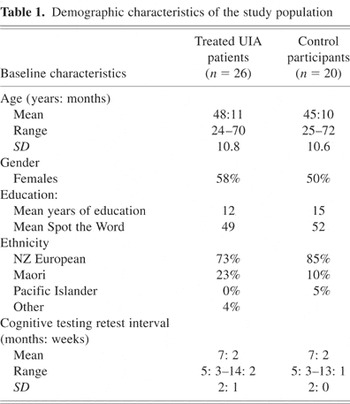
Demographic variables for the UIA patients and control participants are presented in Table 1. Of the treated UIA patients, 58% were female, the mean age was 48 years 11 months and 73% were New Zealand European. In the control group, 50% were female, the mean age was 45 years and 10 months and 85% were New Zealand European. The treated UIA group and the control group were well matched, with independent sample t tests (two tailed) yielding no significant difference for age, baseline Spot-the-Word score (giving an estimate of premorbid IQ), or retest interval, and chi-square tests yielded no significant differences for gender or ethnicity. There was however a significant difference for years of education [t(38) = −3.745, p = .001].
Demographic characteristics of the study population

Procedures
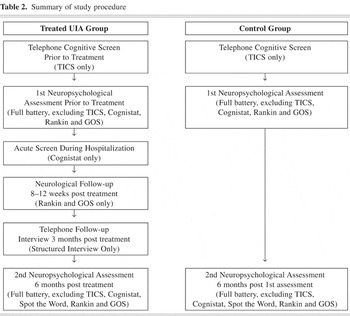
Table 2 presents a summary of the study procedure for the treated UIA patients and control participants. At the commencement of the study, all UIA patients were contacted by telephone to gain their verbal consent to participate and to schedule a time for the initial neuropsychological assessment appointment. Prior to this initial testing session, patients were telephoned to confirm their appointment and to administer the TICS. This telephone interview took approximately ten minutes. At the time of the neuropsychological assessment appointment, UIA patients' written consent was obtained and patients were administered a battery of tests (see Table 2 and the Methods section for further details). This administration took between two to three hours. During the initial assessment, UIA patients were also asked to complete a 22-item structured interview, which included demographic, medical history, and symptom presentation questions.
Summary of study procedure

During hospitalization, UIA patients were administered the Neurobehavioural Cognitive Status Examination (Cognistat; Mueller et al., 2001). This testing took place once patients' neurological status, as measured by the Glasgow Coma Scale (GCS; Teasdale & Jennett, 1974), had stabilized to a minimum of 14 points, and prior to their discharge from hospital (mean time from treatment to testing = 3 days, range 1–8 days). Administration took approximately 15 minutes.
Eight to twelve weeks after treatment, patients were scheduled to return to Auckland Hospital, or an outpatient clinic, for a neurosurgical follow-up appointment. During this visit, the patient was interviewed and neurologically examined by the attending neurosurgeon or neurosurgical registrar, who rated the patient on the Rankin and Glasgow Outcome Scale (GOS, Jennett & Bond, 1975). The six points on the Rankin Scale were: (1) no symptoms, (2) no significant disability, (3) slight disability, (4) moderate disability, (5) moderately severe disability, and (6) severe disability. GOS score was rated in terms of: (1) good recovery, (2) moderate disability, (3) severe disability, (4) persistent vegetative state, and (5) death.
Approximately three months following their treatment, patients were telephoned and interviewed with a follow-up to the structured history-gathering interview, initially administered prior to treatment. Administration of this interview took approximately 15 minutes. Approximately six months following their treatment, another full neuropsychological assessment was conducted, for comparison with the pretreatment assessment. In addition, neurological and medical data were collected from reviews of patients' medical files, operation reports, and outpatient appointment letters. Data collected included: (a) site, size, and number of UIAs prior to treatment, (b) treatment type (surgical or endovascular), (c) nature of any medical and/or surgical complications during and/or following treatment, (d) site and number of remaining UIAs following treatment, (e) date and grade of previous SAH (where applicable) and site and size of previously ruptured aneurysm, (f) details of any neurological deficit following previous SAH, and (g) length of hospital stay for UIA treatment. Information on the nature and neurological outcome of any previous SAH was used to assist the three neurosurgeons and their neurosurgical registrars who completed the ratings in making qualitative assessments as to whether observed neurological deficits following UIA treatment were the result of the current treatment or from a previous SAH. These assessments were then reviewed by the head of neurosurgery (E. Mee) and the first author to ensure 100% agreement on these ratings.
Control participants were also assessed with the TICS by telephone prior to the first administration of the neuropsychological battery and following this were assessed with the battery of neuropsychological tests, and on two occasions, approximately seven months apart. The time interval for follow-up testing was matched to the interval between full battery assessments for the treated UIA patients.
Measures
Measures included in the neuropsychological battery included the Boston Naming Test (BNT; Kaplan et al., 1983), Vocabulary, Similarities, Block Design, Digit Span, and Digit Symbol Coding from the Wechsler Adult Intelligence Scale–Third Edition (WAIS-III; Wechsler, 1997a), Logical Memory I & II, Word Lists I & II, Face Recognition I & II and Letter Number Sequencing from the Wechsler Memory Scale–Third Edition (WMS-III; Wechsler, 1997b), the Rey Complex Figure Test (Spreen & Strauss, 1998), the Ogden Scene Test (Ogden, 1985), the California Computerised Assessment Package (CalCAP; Miller, 2001), the Trail Making Test (TMT; Reitan, 1958) and the Controlled Oral Word Association Test (COWAT; Ruff et al., 1996). The Spot the Word subtest from the Speed and Capacity of Language Processing Test (SCOLP; Baddeley et al., 1992) was also included as a measure of premorbid cognitive functioning.
The Cognistat (Mueller et al., 2001) was included as a measure of acute cognitive status and only administered once during hospitalization. The Cognistat consists of subtests that measure arousal, orientation, attention, comprehension, repetition, naming, visual construction, memory, calculation, abstract reasoning, and judgment. Pre- and post-treatment patients and control participants were also administered the TICS (Brandt et al., 1988) and a structured interview designed primarily to investigate difficulties frequently revealed after treatment for SAH.
Statistical Analysis
All data were analyzed at a group and individual level. Group analysis first involved comparing the baseline performance of the treated UIA patients and the control participants on each measure from the full battery using paired t tests. Pre- versus follow-up testing performances were compared for the control participants and treated UIA patients to identify the effects of UIA treatment using a repeated-measures analysis of variance model. As recommended by Frison and Pocock (1992), covariates were to be included to control for the noted significant difference between years of education in the control and experimental groups. However, this analysis was only to be performed in the case where the initial nonadjusted repeated-measures analysis was significant (Adams et al., 1985).
The data were then analyzed at the individual level using a reliability of change index (RCI) method. The RCI method chosen for the purposes of the current analysis was based on that described by Jacobsen and Truax (1991) and adapted by Chelune et al. (1993). The general methodology of RCI is based on the hypothesis that the level of functioning of the experimental population subsequent to treatment should place the patient closer to the mean of a normal population than it does to the mean of a dysfunctional patient population (Jacobsen & Truax, 1991). In calculating a RCI, the primary measure of interest is the Sdiff (Iverson, 2001), which describes the spread of distribution scores that is expected when no actual change occurs (Jacobsen & Truax, 1991). The calculation of Sdiff, as modified by Iverson (2001), is based on the control population, and can be computed from the following formula:

where standard error of measurement

.
A confidence band can then be formed around the Sdiff by multiplying it by a value from the z-distribution (Iverson, 2001). In the case of the current study, Sdiff was multiplied by 1.965, which formed a confidence interval outside of which a change score is unlikely to occur by chance (2.5% in each direction). This confidence interval was then adjusted for practice effects by adding a correction factor to the confidence intervals, with this factor calculated from the mean practice effect for each measure observed by the control group (Chelune, 2002; Sawrie et al., 1996). The confidence interval can thus be defined as the interval between P + 1.965 * Sdiff and P − 1.965 * Sdiff, where P is the practice effect.
These RCI intervals were next used to classify experimental patients into three groups: patients who fell outside and below the interval (the negative change group), patients who fell within the interval (the no change group), and patients who fell above the interval (the positive change group).
It should be noted that although there are other methods of conducting RCI analysis, the method outlined here was chosen over more complex standardized regression methods, as the theoretical advantages of these more complex models have not been found to lead to better performances (Heaton et al., 2001). In addition, the RCI method chosen was selected for its face validity, simplicity, and ease of replication.
RESULTS
Clinical Characteristics and Neurological Outcome for UIA Patients
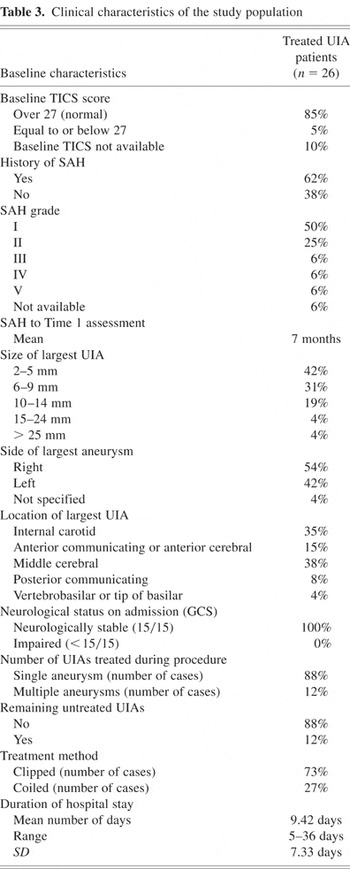
The clinical characteristics for the UIA treated patients are presented in Table 3. A previous SAH had not been experienced by 62% (16 cases) of the treated UIA group, 73% (19 cases) had a UIA that was less than 10 mm in size, 54% (14 cases) of aneurysms were right-sided, and 38% (10 cases) were middle cerebral artery (MCA) aneurysms.
Clinical characteristics of the study population

The characteristics relating to the treatment of the UIAs are also presented in Table 3. On admission to hospital for treatment of their UIAs, 100% of patients were neurologically stable (15/15) according to their GCS score, 88% (23 cases) had a single aneurysm treated, and 12% (3 cases) had multiple aneurysms clipped. Three cases had remaining UIAs left untreated. Of the 26 cases, 73% (19 cases) were clipped and 27% (7 cases) were coiled. The average length of hospital stay was 9.42 days.
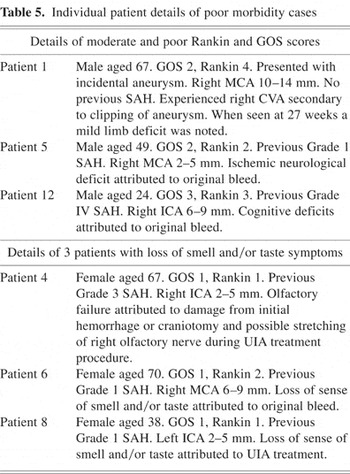
Table 4 presents data from the neurological assessment carried out by the neurosurgeon, on average, 11 weeks and 4 days post-treatment (range 6 to 27 weeks). Neurological outcome data for 6 patients were not available due to either nonattendance at the follow-up appointment or failure of Auckland Hospital to schedule a follow-up appointment. It should be noted that the 6 patients for which neurological outcome data is not reported are not the same as the 6 patients for which pre- versus post-neuropsychological data is not reported. According to the Rankin Scale, 90% (18 cases) of the 20 patients assessed experienced a good outcome (Rankin Score of 0, 1, or 2) and 10% (2 cases) experienced a moderate to severe neurological disability (Rankin Score of 3, 4, or 5). According to the GOS, 90% (18 cases) experienced a good outcome (GOS of 1), 15% (3 cases) experienced a mild to moderate outcome (GOS of 2, 3, or 4), and no patients died (GOS of 5). Details of the three cases with an impairment are presented in Table 5. In two of these cases (Patients 5 and 12) the deficits were attributed to a previous SAH, and in one case (Patient 1), to the treatment of the UIA. This patient suffered a right cerebral vascular accident (CVA) secondary to the clipping of his right MCA aneurysm. On assessment by the neurosurgeon 27 weeks following his treatment, he had only a mild limb deficit. It should also be noted that three additional patients (15%) reported symptoms of loss of sense of smell and/or taste following the UIA procedure. Details of these three cases are also presented in Table 5. In two of these cases, the symptoms were attributed to the UIA treatment. These symptoms are not, however, included as a “poor” outcome in the reported morbidity figures to ensure that our results are comparable with previous studies that do not include these symptoms in their outcome statistics. However, as these sensory losses are often debilitating, we recommend that these symptoms be reflected in morbidity figures in future studies.
Neurological outcome data for treated patients

Individual patient details of poor morbidity cases

Neuropsychological Outcome
Acute cognitive status
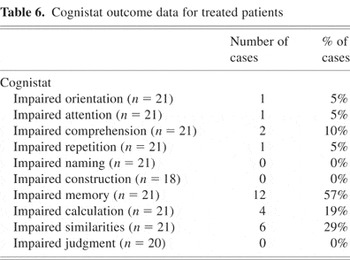
Table 6 presents data from the Cognistat battery. Patients were classified as “impaired” according to the normative study data presented in the test manual (Mueller et al., 2001). According to these assessments, on average 3 days post-treatment, 57% (12 cases) had “impaired” memory performances, while 29% (6 cases) were impaired on a test of similarity judgment (verbal abstraction) and 19% (4 cases) were “impaired” on an assessment of arithmetic calculations.
Cognistat outcome data for treated patients

Group data analysis
Treated UIA patients were reassessed on the full battery of neuropsychological measures, on average, 7 months 2 weeks following their initial pre-treatment assessment (range of 6 months to 14 months 2 weeks). Follow-up assessments for the control participants were completed, on average, 7 months 2 weeks (range of 5 months 1 week to 13 months 1 week) following their initial assessment.
As mentioned in the methods section, five patients were not available for testing prior to treatment and one patient was not available for testing following treatment. Analysis presented in the following section is therefore based on the 20 UIA patients (14 were clipped and 6 were coiled) and the 20 control participants tested on the full battery of neuropsychological tests on two occasions. It should be noted that in the case of the five patients tested only at follow-up, only two of these patients were able to complete the full battery of tests. In addition, the one patient who was only available for testing prior to treatment was also unable to complete the full battery of tests. This may well suggest that this subset of patients represent a group of individuals who had poorer outcome than the 20 patients who were available at both neuropsychological testing intervals, and on whom the bulk of the analysis is based. As such, this may contribute to a bias in the data towards reporting better outcome at follow-up.
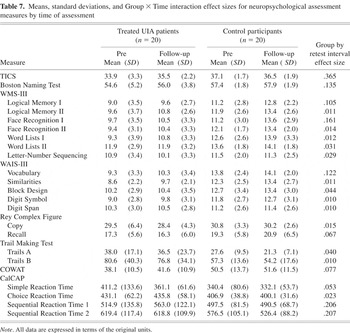
To evaluate the effect of treatment on neuropsychological functioning, a two-factor (group, retest interval) repeated-measures analysis of variance was performed. Table 7 displays means, standard deviations, and “group by retest-interval” interaction effect size statistics for all neuropsychological variables. With the exception of the Trail Making Test and the CalCAP, for all variables, a higher score rep resents better cognitive functioning. In the case of the Trail Making Test and the CalCAP, a higher score represents slower reaction times and hence poorer cognitive function. As can be seen from Table 7, at follow-up both groups tended to improve slightly on most measures. Repeated-measures analysis results revealed the following significant “group main effect”: TICS [F(1,34) = 8.496, p = .006] and the following significant “retest interval” main effects; Boston Naming [F(1,38) = 10.569, p = .002], Logical Memory I [F(1,38) = 10.096, p = .003], Logical Memory II [F(1,37) = 15.056, p = .000], Word Lists I [F(1,38) = 20.101, p = .000], Face Recognition I [F(1,38) = 10.992, p = .002], Face Recognition II [F(1,38) = 8.447, p = .006],Vocabulary [F(1,38) = 10.833, p = .002], Similarities [F(1,38) = 18.484, p = .000], Digit Symbol [F(1,38) = 10.223, p = .003]. There were no significant “group by retest interval” interactions effects at the p = .01 level. One variable, the TICS, did however reveal a significant “group by retest interval” interaction effect at the p = .05 level [F(1,34) = 13.365, p = .025].
Means, standard deviations, and Group × Time interaction effect sizes for neuropsychological assessment measures by time of assessment

Limited (and possibly unreliable) statistical analyses (independent sample t tests) revealed no differences between the clipped and coiled patients on demographic variables, or on the acute neurological outcome measures. Descriptive statistics revealed no significant differences on the full neuropsychological battery.
Reliability of change analysis
From the control group data, RCI were calculated as detailed in the methods section. The number of measures included in this RCI analysis was limited to reduce the number of comparisons made. Bivariate correlations between each of the measures at time one for the control participants were calculated, and in the case where two tests were significantly correlated (at the p = .01 significance level) the test with the lowest test-retest reliability was excluded. This method ensured that each of the remaining 16 tests included in the analysis contributed uniquely to the cognitive profile of the patients.
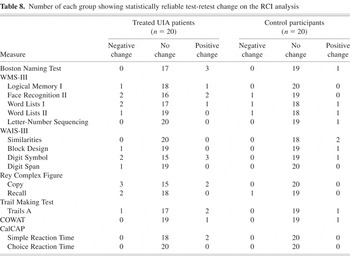
The RCI intervals were then used to classify UIA patients and control participants into three groups; patients who fell outside and below the interval (the negative change group), patients who fell within the interval (the no change group), and patients who fell above the interval (the positive change group). Table 8 lists the numbers of participants in each group showing statistically reliable test-retest change on each of the measures in the RCI analysis. If a significant decline in performance across the two assessments for three or more tests is taken as a reasonable measure of clear clinical impairment, two (10%) of the treated UIA patients, and none of the controls, showed this level of negative change.
Number of each group showing statistically reliable test-retest change on the RCI analysis

Return-to-Work Status
Another useful measure of psychosocial outcome, particularly with regard to the WHO (1980, 2001) category of “Handicap,” is return-to-work status. Five of the treated patients (25%) reported a change of work status that they considered to be a direct result of their treatment, with one UIA patient no longer working, one UIA patient returning to the same work role but with reduced duties, and three patients changing their work role as a result of the treatment. In the case of the three patients who changed their work role, in all cases their previous role had involved heavy physical work that the patients did not want to continue with. Four of the five patients had experienced a previous SAH and had returned to work following their SAH and prior to their UIA treatment.
Validity of the TICS
To assess the validity of the TICS in predicting outcome, both in terms of acute neurological outcome and long-term neuropsychological outcome, bivariate correlations between the TICS score when first administered, TICS follow-up score and the Rankin Scale Score, GOS Score, and neuropsychological outcome measures were computed. No significant relationships were detected. In addition, initial versus follow-up testing correlations were also calculated for the TICS for control participants and UIA patients. This correlation was significant at the p = .05 level for the UIA patients (Pearson r = .547, p = .023), but not for the control group (Pearson r = .371, p = .118).
DISCUSSION
Neurological Outcome
Of the 70 cases of identified UIAs, 26 of these went forward for treatment during the course of the study. Almost two-thirds of these cases had experienced a previous SAH. This figure is much higher than the 34.3% figure quoted in the meta-analysis conducted by Raaymakers et al. (1998) and may reflect the means by which UIA cases are identified in New Zealand. Our study contained a greater number of anterior circulation aneurysms than reported in the Raaymakers et al. (1998) meta-analysis, but a similar number to that reported by the ISUIA (1998, 2003) and King et al. (1994) studies. The size of the treated aneurysms in our study tend to be smaller than that reported by other studies, with 73% of the aneurysms being less than 10 mm in size compared to 53.7% of those from the ISUIA study (1998) and 54.4% of those from the Raaymakers et al. (1998) meta-analysis. The King et al. (1994) meta-analysis did however report a similar size distribution, with their review of five studies where size data were available, suggesting that 72% of treated aneurysms were less than 10 mm in size.
Overall, the UIA treatment mortality rate was nil, while the three-month morbidity rate was 5% (1 case) with the symptoms of loss of sense of smell or taste excluded and 20% (4 cases) if these symptoms are included. The single patient with UIA treatment-related neurological symptoms (excluding the loss of sense of smell or taste) experienced a CVA secondary to neurosurgical treatment. Morbidity figures for the study compare well to other studies that have used similar measures of outcome (ISUIA, 1998, 2003; Nanda & Vannemreddy, 2002; Raaymakers, 2000).
As referred to in the methods section, an attempt was made to “partial” out the effect of neurological deficits from previous SAH when assessing the neurological outcome of current UIA treatment by asking neurosurgeons or neurosurgical registrars to indicate the cause of the current neurological deficit. While this is not a definitive method, as it relies on subjective ratings, it does represent an improvement on many of the existing UIA treatment outcome studies, which frequently do not include pretreatment measures of morbidity. This makes it difficult to separate out the effects of the current treatment from the effects of previous neurological events. Given the high number of UIA patients who have sustained a prior SAH, assessing neurological status before UIA treatment is particularly important. While the ISUIA authors (1998) also indicate in their methodology that only those events related to treatment of the UIA were reflected in their study morbidity figures, they do not make clear how they achieved this. Other recommendations for improving the quality of data collected in UIA treatment outcome studies are made in a recent article by the current authors (Towgood et al., 2004).
Acute Cognitive Outcome
One of the objectives of this study was to investigate the possibility of predicting the long-term outcome of treatment for UIAs. For this purpose, measurement of acute cognitive outcome was conducted with the aid of the Cognistat battery. Analysis of this data revealed that there was moderate impairment in the immediate period following aneurysm surgery, with 57% of cases demonstrating impaired memory, 29% demonstrating impaired verbal abstraction, and 19% demonstrating impaired basic calculation skills. In addition, the finding of a poor result on the memory subtest from the acute cognitive outcome screening was significantly associated with six-month follow-up performance on memory measures from the standardized neuropsychological battery. Such a finding suggests that acute cognitive testing can provide useful data with regard to long-term neuropsychological follow-up. Unfortunately, it was not possible to explore this association further because of the small study numbers and limited variability in the profile of performances from the acute neuropsychological battery. However, a study investigating the use of the Cognistat with traumatic brain injury patients reported a similar result, finding that several of the Cognistat subtests were significantly associated with standard neuropsychological measures in a population of traumatic brain injury patients (Nabors et al., 1997).
Neuropsychological Outcome
Group analysis of the neuropsychological data revealed that performance on a brief telephone screening measure of cognitive status (TICS) was significantly affected by time. However, contrary to expectations, only the control group demonstrated a decline in performance at follow-up testing. This result suggests that performance on the TICS was not affected by treatment of a UIA, and as such does not support the findings from the ISUIA (1998) study. That the control patients declined on this measure over time raises some interesting questions.
The ISUIA (1998) study used the TICS as the primary measure of cognitive status. From the original ISUIA study (1998) it was reported that 11.5% of the treated UIA patients had impaired cognitive status at 30 days following treatment and 9.0% had impaired cognitive status at one-year follow-up. Revised figures have not been reported for the TICS in the more comprehensive report of the ISUIA study in 2003. Any conclusions drawn from the ISUIA data (1998, 2003) assume the TICS to be a valid measure of cognitive status in the UIA population. Unfortunately, the TICS has only been well validated for use with populations of elderly patients (Barber & Stott, 2004; Desmond et al., 1994; Plassman et al., 1994). In addition, as the ISUIA (1998) did not report the inclusion of measures of preoperative cognitive status (Hillis et al., 2000), nor did they include a comparison group with which to evaluate rates of change (Alexander & Spetzler, 1999), it is difficult to attribute the observed decline in performance on the TICS to UIA treatment.
In addition, our study results suggest that the TICS has only limited stability over time in this group of nonimpaired control participants. This however is in contrast to findings of good test-retest reliability by other researchers (Plassman et al., 1994) and may be influenced by the small number of patients enrolled in our study. Furthermore, and perhaps most importantly, the TICS was found not to correlate with performance on a larger battery of neuropsychological tests. Again, these results may be influenced by the small sample size. However, while the sample size of the current study is small, the methodological advantages of the study enhance the validity of the results and raise questions about the conclusions of the ISUIA (1998) with regard to findings of impaired cognitive status in their group of UIA treated patients. Results of our study suggest that the TICS may not be a valid measure for detecting cognitive change and decline in a population of treated UIA patients. As noted earlier, further validation studies of the TICS with younger neurologically impaired and healthy control patients are needed to confirm the usefulness of this measure if it is to be used in further studies as the primary measure of cognitive impairment following UIA treatment or SAH.
Regarding other measures of cognitive status included in the neuropsychological assessment battery, group analysis comparing the treated UIA patients to the control participants over time failed to detect any other significant effects of treatment beyond the expected effect of practice. Findings of no significant neuropsychological deficits as a result of treatment are in keeping with the results of the study by Fukunaga et al. (1999), who reported that three months after treatment all of the 30 patients tested had returned to their preoperative functioning level. However, these findings are in contrast to the ISUIA (1998) study that found that treatment for UIAs resulted in cognitive decline in 9.0% of the treated UIA patients at one-year following treatment. In addition, they are also contrary to the findings of Hillis et al. (2000), who concluded that treatment of a UIA resulted in decline in cognitive functioning on measures of verbal fluency, immediate verbal recall, delayed verbal recall, and executive functioning. However, results from the ISUIA (1998) study can be challenged on several grounds, as referred to previously (Alexander & Spetzler, 1999; Ausman, 1999; Hillis et al., 2000). In addition, as Hillis et al. (2000) limited their follow-up interval to three months, it is possible that the deficits they found may have resolved over a longer time period.
Before concluding from our group results that treatment of a UIA did not cause any deterioration in neuropsychological functioning, several other factors need to be considered. First, was there sufficient power to detect significant findings? Because of the small sample size and limited effect size statistics, the power of the study to detect significant group by time interactions was limited. Because of this restriction in power, a more appropriate conclusion would be that the group analysis failed to detect any significant changes in cognitive function as a result of treatment, and not that there were no changes.
Second, several of the measures in the study were found to be distinctly nonnormal. While analysis of variance models are generally considered to be robust to violations of normality, where sample sizes are small, such as in our study, these models are less robust. As such, the nonnormal nature of many of the cognitive variables may have further limited the ability to detect a significant effect. Combined with the limited power of the group analysis, violations of assumptions of normality further add to the argument for concluding more conservatively that the group analysis of neuropsychological data failed to detect any significant effects of treatment.
Third, while group analysis can provide important information about the presence and magnitude of group differences, it says little about important changes at the individual level. To determine whether an individual has been significantly affected by a treatment, it is necessary to establish whether there are any changes at the individual level that are reliable and beyond what would be expected, given normal change over time and practice (Chelune et al., 1993). To do this, reliability of change indices (RCI) were calculated. As noted by Slade et al. (2001), RCI have greater sensitivity to cognitive change than other methods, and as such, are the method of choice for detecting individual change post-operatively. In the study this analysis revealed that treatment resulted in significant cognitive impairment above and beyond what would be expected by chance or as a result of practice. According to this analysis, 5% of the total UIA-treated patients' change scores fell below the RCI interval.
Significant negative change above and beyond what would be expected by chance (Table 8) was observed on tests of Delayed Face Recognition (10%), Immediate Recall of Word List (10%), Digit Symbol Coding (10%), copy of the Rey Complex Figure (15%), and delayed recall of the Rey Complex Figure (10%). It is important to note that in all cases these significant deficits were actual declines in performance and not simply failures to show practice effects. Some interesting positive change was also noted, with the UIA group showing significant improvement on the Boston Naming Test (15%), Delayed Face Recognition (10%), Digit Symbol Coding (15%), copy of the Rey Complex Figure (10%), Trails A (10%), and Simple Reaction Time (10%). In the majority of cases, this positive change was observed in patients who had previously experienced a SAH and therefore can be hypothesized to reflect processes of ongoing recovery of functioning. Using as a guide that a decline in performance on at least three test measures would signal clear clinical impairment, two of the 20 UIA patients (10%) were neuropsychologically impaired as a consequence of their UIA treatment 6 months later.
Return to Work
Five patients (25%) reported that they had changed their work role as a direct result of their UIA treatment. This may suggest that the treatment of the UIA had a significant impact on functional outcome in a quarter of treated cases. However, four of these patients had experienced a previous SAH, making interpretation of this result difficult. Although all of the four patients who had changed their work role following UIA treatment had returned to their normal work role after their previous SAH, it is possible that the cumulative physical and cognitive effects and psychological sequelae of the previous SAH and treatment, plus the treatment for the UIA, influenced their decision to reduce their work stress. In addition, in three cases where patients had changed their work role from a role that involved heavy lifting to a role with lighter duties, it is possible that this change was viewed as a positive lifestyle change by the patient.
It should however be noted that one of the patients who indicated he was no longer working as a result of the UIA treatment was also one of the two patients who experienced a significant profile of cognitive deficits following treatment, according to the RCI analysis. The other patient who experienced a significant profile of cognitive deficits was of retirement age and therefore had not been working prior to treatment. Additional investigation of the causes for changes in work status is clearly needed before further conclusions can be reached. However, as Ogden et al. (1994) noted, while many “extraneous” factors may account for observed reductions in work status, it is most likely that an interaction of several factors, including the previous SAH and the current treatment, result in the observed reduction.
Study Limitations
As noted by Chelune (2002), the selection of a control group, or reference group, defines a set of assumptions and constrains the conclusions that can be drawn from any study. One of the major assumptions of control group selection is that the control group and experimental group are matched on all variables except the treatment, and therefore any differences between the two groups can be attributed to the effect of the treatment. While other options were considered, for the purposes of this study, a group of matched healthy controls was ultimately selected. While it is acknowledged that the use of a healthy control group may be criticized, it is also worth noting that when they are drawn from friends or relatives of the experimental group, they can provide an optimal method of controlling for practice effects (Slade et al., 2001). However, one major limitation of the control group in this study needs to be acknowledged. While every attempt was made to select well matched patients, as a group, the control group was significantly better educated than the experimental group, although they did not differ significantly on one baseline measure of verbal intelligence (Spot the Word score).
Finally, three cautions need to be made with respect to these conclusions. First, as noted earlier, small sample sizes, limited effect size statistics, and associated loss of power may have limited the ability of the study to detect significant deficits. Second, the small sample size also limited the ability of the study to compare outcome in clipped and coiled cases, and with this acknowledged that these two different procedures may produce different outcomes. Third, the design of the study does not permit the definitive attribution of deficits to unique aspects of aneurysm treatment, with the possibility of deficits in some patients being a result of other more general aspects of treatment, such as the effects of anesthesia.
CONCLUSIONS
No deaths followed UIA treatment. At 10 weeks post treatment, 5% (1 case) was assessed as having neurological morbidity on the GOS or Rankin as a result of the UIA treatment. This patient suffered a CVA as a result of his aneurysm clipping, but at six months only a mild limb deficit was noted and he was given GOS and Rankin scores of “1.” Therefore, six-month neurological morbidity in our study is nil. Reliability of change analysis of the neuropsychological data did reveal a pattern of cognitive deficits in 10% (2 cases). Cognitive decline was noted in the patient with the CVA, who had not had a previous SAH, and in one patient who had experienced a previous SAH but who had been assessed as neurologically unimpaired on the GOS and Rankin at 10 weeks. This patient had three UIAs clipped in one procedure, which may have exposed him to greater risk of cerebral damage from the surgery or the anaesthetic. Ten percent of cases also experienced significant improvement following treatment, with this effect partly due to ongoing recovery of function following a previous SAH, and also being partly due to relieving symptoms of mass affect associated with UIAs. Finally, 25% (5 cases) of patients reported they had changed their work role as a result of their UIA treatment.
ACKNOWLEDGMENTS
We are grateful to Boston Scientific who provided valuable financial assistance for this research project, and the New Zealand Foundation for Research, Science, and Technology who supported the first author with a Bright Futures Top Achiever Doctoral Scholarship. We would also like to thank the patients and participants who willingly gave many hours of their time to the study. Finally, thank you to the staff from Neuroservices at Auckland Hospital and to Professor Michael Corballis for his statistical advice.
References
REFERENCES
Adams, K.M.,
Brown, G.G., &
Grant, I.
(1985).
Analysis of covariance as a remedy for demographic mismatch of
research subject groups: Some sobering simulations.
Journal of Clinical and Experimental Neuropsychology,
7,
445–462.CrossRefGoogle Scholar
Alexander, M.J. &
Spetzler, R.F.
(1999).
Treatment of unruptured cerebral aneurysms.
Surgical Neurology,
51,
255–362.Google Scholar
Ausman, J.I.
(1999).
The New England Journal of Medicine report on unruptured
intracranial aneurysms: A critique.
Surgical Neurology,
51,
227–229.Google Scholar
Baddeley, A.,
Emslie, H., &
Smith, I.N.
(1992).
The Speed and Capacity of Language-Processing Test.
Bury St Edmunds:
Thames Valley Test Company.
Barber, M. &
Stott, S.J.
(2004).
Validity of the Telephone Interview for Cognitive Status (TICS) in
post-stroke subjects.
International Journal of Geriatric Psychiatry,
19,
75–79.CrossRefGoogle Scholar
Bederson, J.B.,
Awad, I.A.,
Wiebers, D.O.,
Piepgras, D.,
Haley, E.C. Jr.,
Brott, T.,
Hademenos, G.,
Chyatte, D.,
Rosenwasser, R.,
Caroselli, C., &
Members.
(2000).
Recommendations for the management of patients with unruptured
intracranial aneurysms: A statement for healthcare professionals from the
Stroke Council of the American Heart Association.
Stroke,
31,
2742–2750.CrossRefGoogle Scholar
Brandt, J.,
Spencer, M., &
Folstein, M.
(1988).
The Telephone Interview for Cognitive Status.
Neuropsychiatry, Neuropsychology, and Behavioural Neurology,
1,
111–117.Google Scholar
Cesarini, K.G.,
Hårdmark, H.-G., &
Persson, L.
(1999).
Improved survival after aneurysmal subarachnoid hemorrhage: A review
of case management during a 12-year period.
Journal of Neurosurgery,
90,
664–672.CrossRefGoogle Scholar
Chelune, G.J.
(2002).
Making neuropsychological outcome research consumer friendly: A
commentary on Keith et al. (2002).
Neuropsychology,
16,
422–425.CrossRefGoogle Scholar
Chelune, G.J.,
Naugle, R.I.,
Lüders, H.O.,
Sedlack, J., &
Awad, I.A.
(1993).
Individual change after epilepsy surgery: Practice effects and
base-rate information.
Neuropsychology,
7,
41–52.CrossRefGoogle Scholar
Desmond, D.W.,
Tatemici, T.K., &
Hanzawa, L.
(1994).
The Telephone Interview for Cognitive Status (TICS): Reliability and
validity in a stroke sample.
International Journal of Geriatric Psychiatry,
9,
803–807.CrossRefGoogle Scholar
Folstein, M.F.,
Folstein, S.E., &
McHugh, P.R.
(1975).
Mini-Mental State—A practical method for grading the cognitive
state of patients for the clinician.
Journal of Psychiatric Research,
12,
189–198.CrossRefGoogle Scholar
Frison, L. &
Pocock, S.J.
(1992).
Repeated measures in clinical trials: Analysis using mean summary
statistics and its implications for design.
Statistics in Medicine,
11,
1685–1704.CrossRefGoogle Scholar
Fukunaga, A.,
Uchida, K.,
Hashimoto, J., &
Kawase, T.
(1999).
Neuropsychological evaluation and cerebral blood flow study of 30
patients with unruptured cerebral aneurysms before and after
surgery.
Surgical Neurology,
51,
132–139.CrossRefGoogle Scholar
Heaton, R.K.,
Temkin, N.,
Dikmen, S.,
Avitable, N.,
Taylor, M.J.,
Marcotte, T.D., &
Grant, I.
(2001).
Detecting change: A comparison of three neuropsychological methods
using normal and clinical samples.
Archives of Clinical Neuropsychology,
16,
75–91.CrossRefGoogle Scholar
Hillis, A.E.,
Anderson, N.,
Sampath, P., &
Rigamonti, D.
(2000).
Cognitive impairments after surgical repair of ruptured and
unruptured aneurysms.
Journal of Neurology, Neurosurgery and Psychiatry,
69,
608–615.CrossRefGoogle Scholar
Hop, J.W.,
Rinkel, G.J.E.,
Algra, A., &
van Gijn, J.
(1997).
Case-fatality rates and functional outcome after subarachnoid
haemorrhage.
Stroke,
28,
660–664.CrossRefGoogle Scholar
ISUIA.
(1998).
Unruptured intracranial aneurysms—risk of rupture and risks of
surgical intervention.
The New England Journal of Medicine,
339,
1725–1733.Google Scholar
ISUIA.
(2003).
Unruptured intracranial aneurysms: Natural history, clinical
outcome, and risks of surgical and endovascular treatment.
Lancet,
362,
103–110.Google Scholar
Iverson, G.L.
(2001).
Interpreting change on the WAIS-III/WMS-III in clinical
samples.
Archives of Clinical Neuropsychology,
16,
183–191.CrossRefGoogle Scholar
Jacobsen, N.S. &
Truax, P.
(1991).
Clinical significance: A statistical approach to defining meaningful
change in psychotherapy research.
Journal of Consulting and Clinical Psychology,
59,
12–19.CrossRefGoogle Scholar
Juvela, S.,
Porras, M., &
Heiskanen, O.
(1993).
Natural history of unruptured intracranial aneurysms: A long-term
follow-up study.
Journal of Neurosurgery,
79,
174–182.CrossRefGoogle Scholar
Juvela, S.,
Porras, M., &
Poussa, K.
(2000).
Natural history of unruptured intracranial aneurysms: Probability of
and risk factors for aneurysm rupture.
Journal of Neurosurgery,
93,
379–387.CrossRefGoogle Scholar
Kaplan, E.,
Goodglass, H., &
Weintraub, S.
(1983).
The Boston Naming Test.
Philadelphia:
Lea & Febiger.
King, J.T. Jr.,
Berlin, J.A., &
Flamm, E.S.
(1994).
Morbidity and mortality from elective surgery for asymptomatic,
unruptured, intracranial aneurysms: A meta-analysis.
Journal of Neurosurgery,
81,
837–842.CrossRefGoogle Scholar
Le Roux, P.D.,
Elliott, J.P.,
Eskridge, J.M.,
Cohen, W., &
Winn, H.R.
(1998).
Risks and benefits of diagnostic angiography after aneurysm surgery:
A retrospective analysis of 597 studies.
Neurosurgery,
42,
1248–1255.CrossRefGoogle Scholar
Miller, E.N.
(2001).
California Computerized Assessment Package Manual
(2nd ed.).
Los Angeles, CA:
Eric N. Miller, Ph.D. & Norland Software.
Mueller, J.,
Kiernan, R., &
Langston, J.W.
(2001).
Manual for COGNISTAT (The Neurobehavioural Cognitive Status
Examination).
Fairfax, CA:
The Northern California Neurobehavioural Group, Inc.
Nabors, N.A.,
Millis, S.R., &
Rosenthal, M.
(1997).
Use of the Neurobehavioural Cognitive Status Examination (Cognistat)
in traumatic brain injury.
Journal of Head Trauma Rehabilitation,
12,
79–84.CrossRefGoogle Scholar
Nanda, A. &
Vannemreddy, P.S.S.V.
(2002).
Surgical management of unruptured aneurysms: Prognostic
indicators.
Surgical Neurology,
58,
13–20.CrossRefGoogle Scholar
Ogden, J.A.
(1985).
Anterior-posterior interhemispheric differences in the loci of
lesions producing visual hemineglect.
Brain and Cognition,
4,
59–75.CrossRefGoogle Scholar
Ogden, J.A.,
Mee, E.W., &
Henning, M.
(1994).
A prospective study of psychosocial adaption following subarachnoid
haemorrhage.
Neuropsychological Rehabilitation,
4,
1.CrossRefGoogle Scholar
Plassman, B.L.,
Newman, T.T.,
Welsh, K.A.,
Helms, M., &
Breitner, J.C.S.
(1994).
Properties of the Telephone Interview for Cognitive Status.
Neuropsychiatry, Neuropsychology, and Behavioural Neurology,
7,
234–241.Google Scholar
Raaymakers, T.W.
(2000).
Functional outcome and quality of life after angiography and
operation for unruptured intracranial aneurysms.
Journal of Neurology, Neurosurgery & Psychiatry,
68,
571–576.CrossRefGoogle Scholar
Raaymakers, T.W.,
Rinkel, G.J.,
Limburg, M., &
Algra, A.
(1998).
Mortality and morbidity of surgery for unruptured intracranial
aneurysms: A meta-analysis.
Stroke,
29,
1531–1538.CrossRefGoogle Scholar
Rankin, J.
(1957).
Cerebral vascular accidents in patients over the age of 60. II:
Prognosis.
Scottish Medical Journal,
2,
200–215.Google Scholar
Reitan, R.M.
(1958).
Validity of the Trail Making Test as an indicator of organic brain
damage.
Perceptual and Motor Skills,
8,
271–276.CrossRefGoogle Scholar
Rinkel, G.J.E.,
Djobuti, M.,
Algra, A., &
van Gijn, J.
(1998).
Prevalence and risk of rupture of intracranial aneurysms: A
systematic review.
Stroke,
29,
251–256.CrossRefGoogle Scholar
Ruff, R.M.,
Light, R.H.,
Barker, S.B., &
Levin, H.S.
(1996).
Benton Controlled Oral Word Association: Reliability and updated
norms.
Archives of Clinical Neuropsychology,
11,
329–338.CrossRefGoogle Scholar
Sawrie, S.M.,
Chelune, G.J.,
Naugle, R.I., &
Lüders, H.O.
(1996).
Empirical methods for assessing meaningful neuropsychological change
following epilepsy surgery.
Journal of the International Neuropsychological Society,
2,
556–564.CrossRefGoogle Scholar
Slade, P.,
Sanchez, P.,
Townes, B., &
Aldea, G.
(2001).
The use of neurocognitive tests in evaluating the outcome of cardiac
surgery: Some methodological considerations.
Journal of Cardiothoracic and Vascular Anesthesia,
15,
4–8.CrossRefGoogle Scholar
Spreen, O. &
Strauss, E.
(1998).
A compendium of neuropsychological tests: Administration, norms and
commentary.
(2nd ed.).
New York:
Oxford University Press.
Teasdale, G. &
Jennett, B.
(1974).
Assessment of coma and impaired consciousness: A practical
scale.
Lancet,
2,
81–84.CrossRefGoogle Scholar
Towgood, K.J.,
Ogden, J.A., &
Mee, E.W.
(2004).
Neurological, neuropsychological, psychosocial and functional
outcome of unruptured intracranial aneurysm treatment: A review and
commentary.
Journal of the International Neuropsychological Society,
10,
114–134.Google Scholar
Wechsler, D.
(1997a).
Wechsler Adult Intelligence Scale
(3rd ed.).
San Antonio, TX:
The Psychological Corporation.
Wechsler, D.
(1997b).
Wechsler Memory Scale
(3rd ed.).
San Antonio, TX:
The Psychological Corporation.
WHO.
(1980).
International Classification of Impairments, Disabilities and
Handicaps.
Geneva:
World Health Organisation.
WHO.
(2001).
International Classification of Functioning, Disability and Health
(Final draft, full version).
Geneva:
World Health Organisation.
Winn, H.R.,
Jane_Sr., J.A.,
Taylor, J.,
Kaiser, D., &
Britz, G.W.
(2002).
Prevalence of asymptomatic incidental aneurysms: Review of 4568
arteriograms.
Journal of Neurosurgery,
96,
43–49.CrossRefGoogle Scholar
Demographic characteristics of the study population
Summary of study procedure
Clinical characteristics of the study population

Neurological outcome data for treated patients
Individual patient details of poor morbidity cases
Cognistat outcome data for treated patients
Means, standard deviations, and Group × Time interaction effect sizes for neuropsychological assessment measures by time of assessment
Number of each group showing statistically reliable test-retest change on the RCI analysis
 You have
Access
- 19
- Cited by