There are an estimated 2 million adults with CHD in the United States.Reference Weale and Kelleher1 Due to medical and surgical advancements, most children born with CHD are now expected to live well into adulthood, with survival rates over 90%.Reference Gleason, Deng and Khan2,Reference Sluman, Apers and Sluiter3 However, adults with CHD require lifelong subspecialty care and are at risk of requiring further surgery or developing heart failure related to their evolving heart disease. From a psychosocial standpoint, adults with CHD may lead more sedentary or cautious lifestyles compared to those without CHD and may experience hesitancy or barriers associated with pursuing education or career goals due to potential risk of becoming unwell. Prior studies indicate that adults with CHD have reduced work participation rates compared to adults without CHD: in one study, employment rates were 59% for adults with CHD with complex disease and 76% for adults with CHD with mild or moderate disease, compared to 83% in the general population.Reference Kamphuis, Vogels, Ottenkamp, van der Wall, Verloove-Vanhorick and Vliegen4 In other studies, employment rates for adults with CHD ranged from 49% to 76%,Reference Pickup, Gaffey, Clift, Bowater, Thorne and Hudsmith5–Reference Agarwal, Thombley and Broberg7 while in a post-transplant cohort, adults with CHD had very low rates of work participation, with socio-economic rather than clinical factors being the principal barriers to employment.Reference Tumin, Chou, Hayes, Tobias, Galantowicz and McConnell8 Adults with CHD may also experience barriers to work participation related to age, sex, comorbidities, social support, and knowledge of the disease.Reference Gleason, Deng and Khan2,Reference Sluman, Apers and Sluiter3,Reference Tumin, Chou, Hayes, Tobias, Galantowicz and McConnell8–Reference Helm, Sticker and Keuchen11 Conversely, use of private health insurance, peers’ awareness and understanding of CHD and its impact in the workplace, and employer accommodations for physical restrictions can facilitate increased employment for adults with CHD.Reference Tumin, Chou, Hayes, Tobias, Galantowicz and McConnell8,Reference Pfitzer, Helm and Rosenthal10–Reference Karsenty, Maury and Blot-Souletie14
Currently, our knowledge of employment among adults with CHD includes data from clinical registries, single-centre retrospective reviews, and cross-sectional surveys.Reference Sluman, Apers and Sluiter3–Reference Crossland, Jackson, Lyall, Burn and Sullivan6,Reference Geyer, Norozi, Buchhorn and Wessel15 However, these studies have been limited by small sample sizes (in single-centre reviews and cross-sectional surveys), a bias towards including only patients followed by a cardiology service, and lack of generalisability to United States employment and health care systems (among studies conducted using European population-based registries). While population-based surveys have been conducted in the United States to identify children with CHD,Reference Razzaghi, Oster and Reefhuis16 equivalent nationally representative data on adults with CHD are lacking. To address these limitations, we used data from a novel CHD registry in North Carolina which collects employment status at all encounters (including routine and acute care in general and subspecialty services) in a large academic medical centre. This design allows us to account for both clinical and socio-economic barriers to employment and include adults with CHD who might have been lost to cardiology follow-up but continue to use other health services within the same hospital system. The primary aim of this study was to quantify employment rate among adults with CHD. Our secondary aim was to describe the factors and barriers associated with work participation.
Materials and methods
The study was approved by the Institutional Review Board at East Carolina University with a waiver of individual consent. We retrospectively identified adults aged 18–64 years who were treated at either East Carolina University or Vidant Medical Center (a tertiary care regional referral hospital serving as the teaching hospital for East Carolina University) and were included in the multicentre North Carolina Congenital Heart Defects Surveillance Network, led by Duke University and supported by funding from the Centers for Disease Control and Prevention (1 NU50DD004933-01-00). This population-based registry links data sources including the North Carolina Birth Defects Monitoring Program, the Society of Thoracic Surgeons database, hospital medical records, vital status records, and educational outcomes data. The registry included patients with International Classification of Diseases-9 codes 745.XX, 746.XX, 747.XX, or V13.65. Patients with International Classification of Diseases-9 codes 747.5X, 747.6X, 747.8X, and 747.9X were excluded. East Carolina University and Vidant Medical Center encounters in 2009–2013 meeting these inclusion criteria were submitted to the registry. The present analysis was limited to patients aged 18–64 years who were seen at East Carolina University or Vidant Medical Center and had valid data on employment status. Multivariable analysis excluded cases with missing or unclassifiable data on study covariates.
The North Carolina Congenital Heart Defects Surveillance Network registry data included multiple encounters per patient, with data available on the year of each encounter. We constructed a patient-year data set for further analysis (one observation per patient per year). Our primary outcome was work participation in our adults with CHD population, which is collected by registration staff at East Carolina University and Vidant Medical Center facilities each time a patient aged 18 years or older checks in for a visit. Employment data were stored in the electronic medical record and reported to the North Carolina Congenital Heart Defects Surveillance Network registry under the categories “employed,” “unemployed,” “unable to work/disabled,” “student,” “retired,” and “homemaker/parent.” We analyzed employment data according to each year a patient was present in the registry and coded this as employed (patient was employed at one or more encounters in a given year) or not employed (patient was not employed at any encounters in a given year, with one of the other categories registered in at least one encounter).
Covariates in our analysis included age, sex, race, marital status (married at any of the encounters registered in each year), complexity of CHD, and the total number of encounters recorded during a given year, as a measure of health care utilisation.Reference Opotowsky and Siddiqi17,Reference Warnes, Liberthson and Danielson18 CHD types were categorised as simple, complex, or other, based on a classification of International Classification of Diseases codes used in a prior study.Reference Opotowsky and Siddiqi17 Additionally, we controlled for the presence of heart failure, epilepsy or seizures, and other CHD-associated comorbidities (diabetes mellitus, renal, haematologic, and hepatic dysfunction) in any of the years included in our analysis. Heart failure was identified using International Classification of Diseases-9 code 428.X as well as other codes commonly used in analyses of administrative data,Reference Saczynski, Andrade and Harrold19 while epilepsy was identified using International Classification of Diseases codes 345.X and 780.3X.Reference Sherzai, Losey, Vega and Sherzai20 Other comorbidities were coded by manual review of all non-CHD International Classification of Diseases codes associated with each patient’s encounters that were submitted to the registry. Health insurance (any private insurance in a given year, versus public insurance/self-pay only) was included in bivariate analysis, but not in the multivariable model, because being currently employed could be the reason for having private health insurance.
We summarised patient characteristics using counts with percentages or medians with interquartile ranges, for the latest year of data each patient contributed to the registry. Descriptive statistics were stratified by the most recent known employment status and compared using Chi-square tests, Fisher’s exact tests, or rank-sum tests, as appropriate. We then used logistic regression to examine patients’ employment status during each year in which they contributed data to the registry. We did not include a patient-level random effect as most patients contributed only 1–2 years of data to the registry. Data analysis was performed using Stata/IC 15.1 (College Station, Texas: StataCorp, LP). Two-tailed p < 0.05 was considered statistically significant.
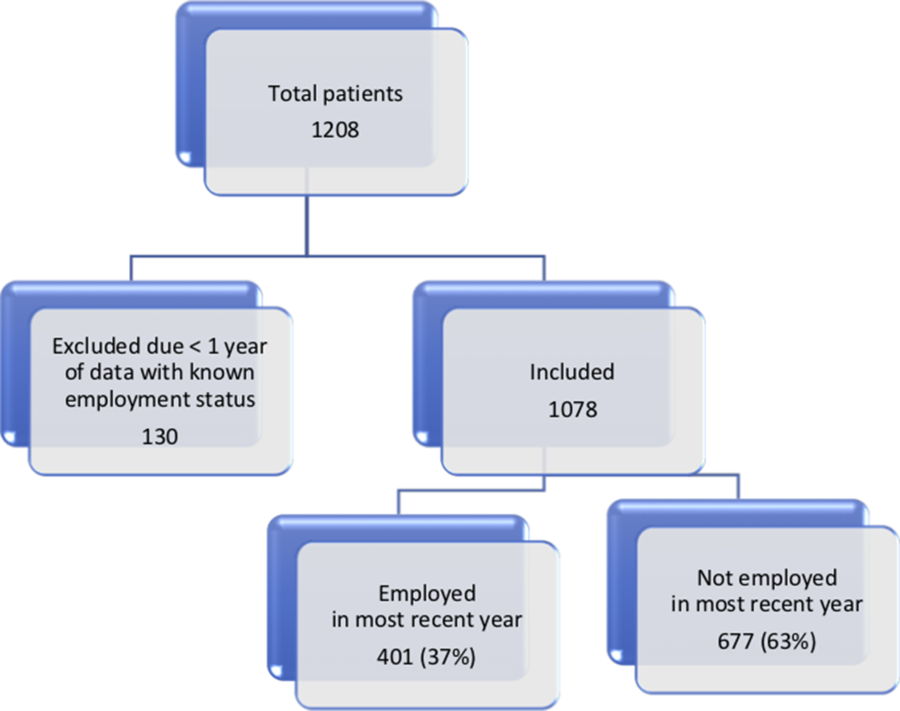
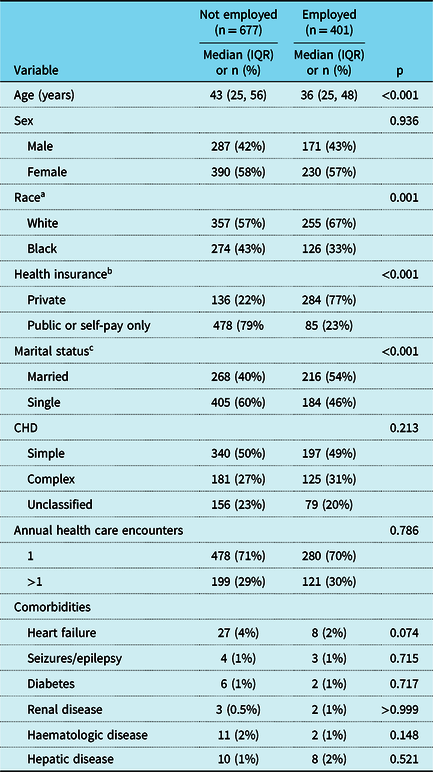
ResultsThe North Carolina Congenital Heart Defects Surveillance Network included 1,208 adults with CHD seen at East Carolina University or Vidant Medical Center between 2009 and 2013, of whom 1,078 had at least 1 year of data with known employment status. Overall, these patients, contributed 1,673 years of data, of which 1,562 had complete covariate data for multivariable analysis. Fifty per cent of patients had a simple lesion, 28% were diagnosed with complex CHD, and 22% had a CHD diagnosis that could not be classified as simple or complex. Forty-five per cent of patients contributed 1 year with employment data to the registry, 21% has employment data for 2 years, and 33% had employment data for 3 or more years. Overall, 401 patients (37%) were employed in their most recent year in the registry (Figure 1). Patient characteristics for their most recent year in the registry are summarised in Table 1 by employment status. On bivariate analysis, patients who were employed tended to be younger and were more likely to be White, privately insured and married, compared to patients who were not employed.
Flowchart of patient inclusion and exclusion.

Patient characteristics by employment status in their most recent year of data (n = 1,078 patients)

IQR = interquartile range.
a Data missing in 66 cases.
b Data missing in 95 cases.
c Data missing in 5 cases.
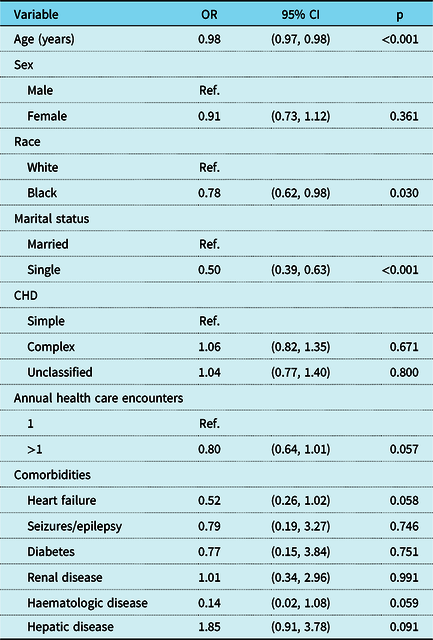
On multivariable analysis of the person-year file (Table 2), the odds of being employed decreased by 2% for each additional year of age (odds ratio = 0.98; 95% confidence interval: 0.97, 0.98; p < 0.001) and were 22% lower for Black as compared to White patients (odds ratio = 0.78; 95% confidence interval: 0.62, 0.98; p = 0.030). Single patients were significantly less likely to be employed than married patients (odds ratio = 0.50; 95% confidence interval: 0.39, 0.63; p < 0.001). Patients who had >1 health care encounter in a given year were also less likely to be employed, but this association did not reach statistical significance (odds ratio = 0.80; 95% confidence interval: 0.64, 1.01; p = 0.057). Likewise, presence of a heart failure diagnosis was associated with lower odds of employment, but this difference was not statistically significant (odds ratio = 0.52; 95% confidence interval: 0.26, 1.02; p = 0.058). None of the comorbidities included in our analysis reached a statistically significant association with the likelihood of employment, although their prevalence in the sample was generally low (Table 1).
Multivariable logistic regression model of employment in a given year (N = 1,562 patient-years)

CI = confidence interval; OR = odds ratio.
Discussion
CHD is known to limit employment participation, even for relatively simple defects, and even after definitive surgical treatment.Reference Agarwal, Thombley and Broberg7,Reference Nyboe, Fonager, Larsen, Andreasen, Lundbye-Christensen and Hjortdal21 However, prior studies in the United States have frequently been limited by tracking employment only among adults with CHD under cardiology follow-up.Reference Sluman, Apers and Sluiter3 With loss to cardiology follow-up becoming increasingly common as adults with CHD age, alternative strategies are needed to produce population-based estimates of employment among adults with CHD, as well as factors affecting employment. Our study used a CHD registry including all encounters with a CHD diagnosis at an academic medical centre where employment status was routinely captured in the electronic medical record. We found that only 37% of adults with CHD aged 18–64 years were employed, with older patients, Black as compared to White patients, and single as compared to married patients being less likely to be employed. Further work is needed to consider how enhancing cardiology follow-up for adults with CHD can integrate support for returning to work (among older patients) or beginning a career (for younger patients).
Prior studies have reported that approximately half or more of adults with CHD are employed. However, studies including United States data have been limited by varying biases in sample selection, for example, sampling from patients under active cardiology follow-up,Reference Sluman, Apers and Sluiter3 sampling from patients enrolled in commercial insurance plans,Reference Agarwal, Thombley and Broberg7 or sampling patients in a registry of heart transplant recipients.Reference Tumin, Chou, Hayes, Tobias, Galantowicz and McConnell8
Definitive population-based ascertainment of employment status among adults with CHD was achieved in Scandinavian studies using existing population registries,Reference Nyboe, Fonager, Larsen, Andreasen, Lundbye-Christensen and Hjortdal21 but may not fully reflect factors affecting employment in the United States, such as the Black–White racial disparity identified in our study. Considering other predictors of employment, we found that work participation was very strongly correlated with private insurance coverage, suggesting that a prior estimate of 49% employment among United States adults with CHD covered by private insurance plans may have overestimated work participation in the all-payor adults with CHD population.Reference Agarwal, Thombley and Broberg7 Furthermore, we found that married adults with CHD were twice as likely to work as patients who were single. This result may represent selection into marriage on the basis of greater independence or social functioning, or discrimination on the marriage market against adults with CHD whose health condition limits their ability to work.Reference Tumin22
The American College of Cardiology and the American Heart Association recommend discussing transition to adult congenital cardiology providers at the age of 12 years.Reference Warnes, Williams and Bashore23 Beginning the transition process at this time prepares adolescents for lifelong cardiology care. In addition to talking about follow-up care and compliance with appointments, it is imperative that providers discuss future life plans, including the importance of lifelong health insurance and career counselling to ideally enhance employment participation. Beyond adolescence, providers need to encourage patients to participate in the workforce if they are able, and each patient encounter is an opportunity to approach this topic. In our study, however, a higher number of encounters at our centre had a negative but not statistically significant association lower likelihood of employment after multivariable adjustment. This may be related to increased work limitations among adults with CHD, whose additional visits may represent hospitalisations or other acute care encounters. We were unable to analyse the visit type as it was not entered into the registry at the time of primary data collection. Similarly to a prior study of heart transplant recipients in the United States,Reference Tumin, Chou, Hayes, Tobias, Galantowicz and McConnell8 we found that determinants of employment among adults with CHD were primarily socio-economic (age, race, and marital status) rather than clinical (primary diagnosis, heart failure, and comorbidities), although analysis of more granular clinical data may have revealed specific factors related to disease severity or comorbid conditions that could limit patients’ ability to work.
The North Carolina Congenital Heart Defects Surveillance Network registry from which our data were drawn captured all encounters with a CHD International Classification of Diseases code at participating centres, allowing us to generalise our findings beyond the population of adults with CHD under cardiology follow-up. Yet, one limitation of these data is that CHD International Classification of Diseases codes may be inconsistently recorded across encounters, particularly encounters not related to the heart condition,Reference Robbins, Onukwube, Goudie and Collins24,Reference Steiner, Kirkpatrick and Heckbert25 potentially leading us to miss some eligible patients or encounters. Furthermore, while our analysis relied on routine capture of employment data during patient registration at our centre, these data lacked detail on full-time versus part-time work, industry, occupation, or other employment characteristics that may have revealed underemployment in addition to unemployment among adults with CHD. We were unable to link our data to independent sources of information on marital transitions, health insurance plan enrolment, or other life changes that may be reciprocally related with work participation such as level of educational attainment. Since most patients contributed only 1 or 2 years of data to the registry, we also could not analyse longitudinal variation in employment patterns. Nevertheless, routine collection of employment data at medical centres can aid with longitudinal follow-up of employment outcomes among patients with chronic diseases. With patient quality of life becoming increasingly important in management of CHD,Reference Moons, Kovacs, Luyckx and Thomet26 data on patient-reported work participation can help inform optimal management of adults with CHD and evaluate the success of centres with connecting adults with CHD to both health care and social resources that facilitate employment.
Supporting employment for adults with CHD patients is an important component of transition to adulthood in this patient population. Worldwide, employment of adults with CHD patients is low, and this may be exacerbated by features of the United States health care system, such as tying Medicare insurance for adults <65 years of age to work disability status. However, population-based data on employment of adults with CHD in the United States are limited in comparison to large registries available in other countries. We used a registry based on all clinical encounters at our health system to estimate employment rates among adults with CHD patients who may or may not have been under cardiology follow-up. We found that only 37% of adults with CHD patients aged 18–64 years were employed, with older patients, Black patients, and single patients being less likely to be employed. Future multicentre, longitudinal studies may provide further details regarding specific barriers or facilitators to workforce participation among adults with CHD patients and elucidate specific features of adults with CHD patients’ employment, including full-time versus part-time work, industry, and occupation. Most importantly, further work is needed to identify how enhancing cardiology follow-up for adults with CHD can integrate support for gaining and keeping employment.
Acknowledgements
We thank A.D. II for assistance with obtaining the data for this analysis and Chelsea Viscardi for assistance with drafting the manuscript. We thank Dr. R.H. who contributed to this data and the care of these patients.
Financial Support
We would like to thank the support of the Centers for Disease Control and Prevention (1 NU50DD004933-01-00).
Conflicts of Interest
None.